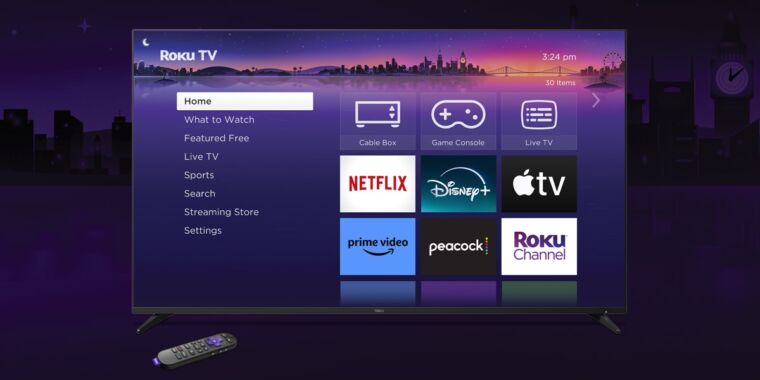
Everyone with a Roku TV or streaming device will eventually be forced to enable two-factor authentication after the company disclosed two separate incidents in which roughly 600,000 customers had their accounts accessed through credential stuffing.
Credential stuffing is an attack in which usernames and passwords exposed in one leak are tried out against other accounts, typically using automated scripts. When people reuse usernames and passwords across services or make small, easily intuited changes between them, actors can gain access to accounts with even more identifying information and access.
In the case of the Roku attacks, that meant access to stored payment methods, which could then be used to buy streaming subscriptions and Roku hardware. Roku wrote on its blog, and in a mandated data breach report, that purchases occurred in “less than 400 cases” and that full credit card numbers and other “sensitive information” was not revealed.
The first incident, “earlier this year,” involved roughly 15,000 user accounts, Roku stated. By monitoring these accounts, Roku identified a second incident, one that touched 576,000 accounts. These were collectively “a small fraction of Roku’s more than 80M active accounts,” the post states, but the streaming giant will work to prevent future such stuffing attacks.
The affected accounts will have their passwords reset and will be notified, along with having charges reversed. Every Roku account, when next requiring a login, will now need to verify their account through a link sent to their email address. Alternatively, one can use the device ID of any linked Roku device, according to Roku’s support page. (Forcing this upgrade yourself is probably a good idea for past or present Roku owners.)
Security blog BleepingComputer reported around the time of the incident that breached Roku accounts were sold for as little as 50 cents each and likely obtained using commonly available stuffing tools that bypass brute-force protections through proxies and other means. BleepingComputer reported that “a source” tied Roku’s recent updates to its Dispute Resolution Terms, which all but locked Roku devices until a customer agreed, to the fraudulent activity. Roku told BleepingComputer that the two were not related.
Enlarge / Morfydd Clark is Galadriel in The Lord of the Rings: The Rings of Power.
Amazon Studios
Subscribers lodged thousands of complaints related to inaccuracies in Amazon’s Prime Video catalog, including incorrect content and missing episodes, according to a Business Insider report this week. While Prime Video users aren’t the only streaming users dealing with these problems, Insider’s examination of leaked “internal documents” brings more perspective into the impact of mislabeling and similar errors on streaming platforms.
Insider didn’t publish the documents but said they show that “60 percent of all content-related customer-experience complaints for Prime Video last year were about catalogue errors,” such as movies or shows labeled with wrong or missing titles.
Specific examples reportedly named in the document include Season 1, Episode 2 of The Rings of Power being available before Season 1, Episode 1; character names being mistranslated; Continuum displaying the wrong age rating; and the Spanish-audio version of Die Hard With a Vengeance missing a chunk of audio.
The documents reportedly pointed to problems with content localization, noting the “poor linguistic quality of assets” related to a “lack of in-house expertise” of some languages. Prime Video pages with these problems suffered from 20 percent more engagement drop-offs, BI said, citing one of the documents.
Following Insider’s report, however, Quartz reported that an unnamed source it described as “familiar with the matter” said the documents were out of date, despite Insider claiming that the leaked reports included data from 2023. Quartz’s source also claimed that customer engagement was not affected,
Ars Technica reached out to Amazon for comment but didn’t hear back in time for publication. The company told Insider that “catalogue quality is an ongoing priority” and that Amazon takes “it seriously and work[s] relentlessly alongside our global partners and dedicated internal teams to continuously improve the overall customer experience.”
Other streaming services have errors, too
Insider’s report focuses on leaked documents regarding Prime Video, but rival streaming services make blunders, too. It’s unclear how widespread the problem is on Prime Video or across the industry. There are examples of people reporting Prime Video inaccuracies online, like on Amazon’s forum or on Reddit. But with some platforms not offering online forums and it being impossible to know how frequently users actually report spotted problems, we can’t do any apples-to-apples comparisons. We also don’t know if these problems are more prevalent for subscribers living outside of the US.
Beyond Prime Video, users have underscored similar inaccuracies within the past year on rival services, like Disney+, Hulu, and Netflix. A former White Collar executive producer pointed out that the show’s episodes were mislabeled and out of order on Netflix earlier this month. Inaccurate content catalogs appear more widespread if you go back two years or more. Some video streamers (like (Disney and Netflix) have pages explaining how to report such problems.
Streaming services have only gotten more expensive and competitive, making such mistakes feel out of place for the flagship video platform of a conglomerate in 2024.
And despite content errors affecting more than just Prime Video, Insider’s report provides a unique look at the problem and efforts to fix it.
Enlarge / O.B., aka Ouroboros, in Marvel’s Loki show, which streams on Disney+.
Despite promises of new and improved TV and movie viewing experiences, streaming services remain focused on growing revenue and app usage. As a result of that focus, streaming companies are mimicking the industry they sought to replace—cable.
On Monday, The Information reported that Disney plans to add “a series” of channels to the Disney+ app. Those channels would still be streamed and require a Disney+ subscription to access. But they would work very much like traditional TV channels, featuring set programming that runs 24/7 with commercials. Disney hasn’t commented on the report.
Disney is exploring adding channels to Disney+ with “programming in specific genres, including either Star Wars or Marvel-branded shows,” The Information said, citing anonymous “people involved in the planning.” It’s unknown when the Disney+ channels are expected to launch.
The report comes as streaming services continue trying to find ways to capitalize off cable companies’ customer base. NBCUniversal’s Peacock streaming service already offers subscribers over 50 always-on live channels. Hulu and Paramount+ offer live TV with cable channels. Streaming platforms are also eager to license content normally delegated to traditional TV channels, including old shows like Suits, the 2023 streaming record-setter, and live sporting events like WWE Raw.
Channel surfing 2.0
If you’ve followed the streaming industry lately, you won’t be surprised to hear that ad dollars are reportedly behind the push for live channels. Disney+, like many streaming services, aims to be profitable by the end of Disney’s 2024 fiscal year and extract as much revenue from each subscriber as possible (including by using tactics like password crackdowns) to fuel profits.
The news follows similar moves by Disney, including adding Hulu to the Disney+ app, as well as plans to add ESPN to Disney+, too, according to The Information. Disney is also attempting to launch a joint sports-streaming app with Fox and Warner Bros. Discovery (WBD). It’s not hard to imagine Disney one day (assuming the app ever debuts) making the sports app’s content accessible through Disney+.
“The idea is to make Disney+ a service that has something for everyone, anytime,” The Information reported.
That sounds an awful lot like cable, which spent years growing customers’ monthly bills by adding more channels and bundles aimed at specific interests, like children’s entertainment, sports, and lifestyle. The ability to hop from on-demand Disney kids’ movies to on-demand sitcoms on Hulu to live programming centered on (the seemingly endless piles of) Marvel and Star Wars content feels a lot like channel surfing. It wasn’t too long ago when channel surfing was viewed as a time-suck.
Netflix has also reportedly considered ways to unite other streaming platforms with Netflix in order to extend the amount of time spent on Netflix. In late 2022, Netflix “explored creating a store within its app for users to subscribe to and watch other streaming services, all without leaving the Netflix app,” The Information said, citing an unnamed person “who was involved in those exploratory discussions.” Netflix reportedly decided not to move ahead with the plans for now but still could. It hasn’t commented on The Information’s report.
As we saw with Netflix’s password crackdown and streaming’s shift to ads, streaming companies tend to copy each other’s strategies for revenue growth. And live channels could be something more streaming companies get involved in, as WBD and Amazon, as examples, already have (albeit separate from their flagship, on-demand streaming apps, which differs from what Disney+’s live channel reportedly will reportedly be like).
Disney, notably, is no stranger to the business of online live channels, having 21 similar offerings within the ABC.com app, including a channel for ABC News and another for General Hospital.
Subscription-based streaming services may even have an easier time competing for ad dollars than free, ad-supported TV (FAST) streaming channels, such as those on Tubi and Pluto TV. Susan Schiekofer, chief digital investment officer for GroupM, the top US ad-buying company, told The Information that advertisers might feel more comfortable allotting dollars to ad-supported channels that are tied to users who have already spent money on a subscription.
Streaming services initially were a way to get only the content you wanted on demand and commercial-free. But the report about Disney+ and Netflix are just two examples of growing interest in reinvigorating the strategies of linear TV. Instead of jumping from network to network within cable, there’s interest in getting people to jump from one streaming service to another within one platform—with plenty of commercials along the way.
Canadian telecom Bell Canada has been pushing its cloud-based DVR service to its Fibe TV subscribers for years. While it has given customers advantages, like the ability to view their recordings from more devices, such as phones, compared to using local DVR storage, users don’t have as much control over the recordings as they thought they had.
On May 1, Fibe TV will automatically delete recordings stored on its Cloud PVR (personal video recorder) offering once the recordings hit 61 days of age, as confirmed by Canadian online newspaper Daily Hive. Currently, customers maintain access to recordings stored via Cloud PVR for 365 days.
Fibe TV apparently started alerting customers of the upcoming change this month.
A Bell Canada spokesperson, Jacqueline Michelis, minimized the idea of disruption to customers, telling Daily Hive: “The viewing of nearly all recordings takes place within 60 days, so there is minimal impact to customers.” Michelis didn’t provide more details on how Bell Canada arrived at this conclusion.
An X user (formerly Twitter) user going by SimonDingleyTV shared what he said was a notice he received from Fibe TV about the policy change. He claimed that a company representative told him that the reason for the change was to “save space.”
Bell updated its website to acknowledge the time limit and noted that Cloud PVR also has a limit of up to 320 hours of recordings. If users surpass that limit, the oldest recordings will start getting deleted.
“Absolutely ridiculous”
Customers have turned to Bell Canada’s online support forum to share their discontent with the changes, with some saying that they don’t align with the services they expected to receive when signing up for Fibe TV. Thankfully, Bell Canada won’t be able to delete recordings stored on DVR hardware inside customers’ homes.
Other complaints are coming from users whose recordings are being deleted even when they haven’t come close to maxing out their cloud storage or if their recordings aren’t available on demand.
A user going by camisotro on Bell Canada’s online support forum called the announcement “absolutely ridiculous” and condemned what they perceived to be years of telecoms pushing back against users’ ability to record content:
… Bell eliminated the option for any device that actually records TV locally, forcing customers onto an inferior TV box with ‘Cloud PVR.’ Now they are nerfing it to a nearly useless 60 days of recording. This is not the service I signed up for on contract, and yet I am still continuing to pay increasing prices.
Like rivals, Bell pushed customers toward cloud-based DVR, with its website stating, “Fibe TV has evolved to a cloud-based storage system for all your recordings.”
However, some users may not have realized the trade-offs.
“Wish I knew this before I traded PVRs to change to cloud storage! No one told us that !!!,” a forum user known as Crazy aunt said.
Another user, Thornquills, called the news a “deal-breaker” because they’re “paying $10.00/month for cloud storage,” and “2 months is too restrictive, in my opinion.”
Meanwhile, Bell Canada rival Rogers Ignite confirmed to The Canadian Press that it will continue allowing its customers to keep DVR recordings stored in the cloud for one year, as its cloud PVR offering exists to “help manage storage capacity.”
Fibe TV’s policy change comes about two months after Bell Canada announced that it was laying off 4,800 workers and selling 45 of its 103 radio stations.
Spotify Premium subscriptions include up to 15 hours of audiobook listening. But starting in April, the company will charge an extra $1 to $2 per month for the feature, Bloomberg reported today, citing anonymous “people familiar with the matter.” The reported price hike would be the second that Spotify customers have faced in nine months.
Currently, Spotify charges nothing for its free plan with ads, $5.99/month for students, $10.99/month for its Premium plan, $14.99/month for its Duo Premium plan for two users, and $16.99/month for its Family Premium plan with up to six users.
Bloomberg reported that individual plan prices will go up by approximately $1 per month and multi-member plans will increase by $2 per month.
The changes will reportedly start in Australia, Pakistan, the United Kingdom, and two other markets by the end of this month. Subscribers in the US will reportedly see prices rise “later this year.”
Spotify will usher the changes by offering a ‘new’ basic tier that lets users access everything on Spotify except audiobooks for $10.99/month, per Bloomberg. That would mean that people who only use Spotify for listening to music and/or podcasts would avoid paying a higher monthly rate. Basic plan members will still be able to buy audiobooks through Spotify, Bloomberg said.
Bloomberg didn’t specify whether Spotify would default current subscribers to this plan so that their monthly costs wouldn’t change or if users would have to take steps to sign up for what would be marketed as a new plan. It also didn’t mention if the basic plan would have additional drawbacks.
The upcoming price increase would be Spotify’s second since it introduced Premium pricing in 2011. In July, Spotify bumped the starting Premium price from $9.99/month to $10.99/month. Spotify’s announcement followed price hikes from rivals like Amazon Music and Tidal.
Spotify tries to be profitable
Spotify may deem these changes necessary to buoy audiobook revenue. The company is heavily invested in the sector and spent $123 million to acquire Findaway in July 2022. Spotify said it was the second biggest audiobook brand after Audible, citing Bookstat data published in The New York Times. But as it stands, Spotify only generates revenue from audiobooks if users go beyond the 15 hours per month limit included in their Premium plan, per Bloomberg.
Spotify, which launched in 2008, hasn’t had a profitable year (although it has reported profitable quarters at times). Audiobooks represent an opportunity for the company to diversify revenue streams beyond its traditional routes, which include paying hefty royalty fees. Spotify says it paid $9 billion in music-related royalties last year, or about 69.7 percent of its 2023 revenue ($13.2 billion). Bloomberg said Spotify’s music industry partners “have been pushing Spotify and its competitors to raise prices” amid concerns about royalty prices.
Spotify has also invested over $1 billion in a podcast business that is currently unprofitable (although Bloomberg noted that Spotify expects this to change in 2024). In December, Spotify announced it was laying off 17 percent of employees.
Audiobooks could help Spotify’s wallets. But charging extra for a service it’s been pushing since October risks losing some of the listeners it’s earned. At the same time, if Spotify ensures that long-time users who simply want Spotify for its original bread-and-butter aren’t impacted, it could help minimize disruption.
As with any price hike, though, Spotify’s changing pricing structure will force users to reassess whether they want to keep paying for Spotify or consider alternatives. Those who’ve been waiting for Spotify to offer high-fidelity audio since 2021, for example, may decide the app doesn’t fit their needs.
A Spotify spokesperson declined to comment on Bloomberg’s report to Ars Technica.
Enlarge/ A promotional image for Sorry for Your Loss, which was a Facebook Watch original scripted series.
Last April, Meta revealed that it would no longer support original shows, like Jada Pinkett Smith’s Red Table Talk talk show, on Facebook Watch. Meta’s streaming business that was once viewed as competition for the likes of YouTube and Netflix is effectively dead now; Facebook doesn’t produce original series, and Facebook Watch is no longer available as a video-streaming app.
The streaming business’ demise has seemed related to cost cuts at Meta that have also included layoffs. However, recently unsealed court documents in an antitrust suit against Meta [PDF] claim that Meta has squashed its streaming dreams in order to appease one of its biggest ad customers: Netflix.
Facebook allegedly gave Netflix creepy privileges
As spotted via Gizmodo, a letter was filed on April 14 in relation to a class-action antitrust suit that was filed by Meta customers, accusing Meta of anti-competitive practices that harm social media competition and consumers. The letter, made public Saturday, asks a court to have Reed Hastings, Netflix’s founder and former CEO, respond to a subpoena for documents that plaintiffs claim are relevant to the case. The original complaint filed in December 2020 [PDF] doesn’t mention Netflix beyond stating that Facebook “secretly signed Whitelist and Data sharing agreements” with Netflix, along with “dozens” of other third-party app developers. The case is still ongoing.
The letter alleges that Netflix’s relationship with Facebook was remarkably strong due to the former’s ad spend with the latter and that Hastings directed “negotiations to end competition in streaming video” from Facebook.
One of the first questions that may come to mind is why a company like Facebook would allow Netflix to influence such a major business decision. The litigation claims the companies formed a lucrative business relationship that included Facebook allegedly giving Netflix access to Facebook users’ private messages:
By 2013, Netflix had begun entering into a series of “Facebook Extended API” agreements, including a so-called “Inbox API” agreement that allowed Netflix programmatic access to Facebook’s users’ private message inboxes, in exchange for which Netflix would “provide to FB a written report every two weeks that shows daily counts of recommendation sends and recipient clicks by interface, initiation surface, and/or implementation variant (e.g., Facebook vs. non-Facebook recommendation recipients). … In August 2013, Facebook provided Netflix with access to its so-called “Titan API,” a private API that allowed a whitelisted partner to access, among other things, Facebook users’ “messaging app and non-app friends.”
Meta said it rolled out end-to-end encryption “for all personal chats and calls on Messenger and Facebook” in December. And in 2018, Facebook told Vox that it doesn’t use private messages for ad targeting. But a few months later, The New York Times, citing “hundreds of pages of Facebook documents,” reported that Facebook “gave Netflix and Spotify the ability to read Facebook users’ private messages.”
Meta didn’t respond to Ars Technica’s request for comment. The company told Gizmodo that it has standard agreements with Netflix currently but didn’t answer the publication’s specific questions.
Roku customers are threatening to stop using, or to even dispose of, their low-priced TVs and streaming gadgets after the company appears to be locking devices for people who don’t conform to the recently updated terms of service (ToS).
This month, users on Roku’s support forums reported suddenly seeing a message when turning on their Roku TV or streaming device reading: “We’ve made an important update: We’ve updated our Dispute Resolution Terms. Select ‘Agree’ to agree to these updated Terms and to continue enjoying our products and services. Press to view these updated Terms.” A large button reading “Agree” follows. The pop-up doesn’t offer a way to disagree, and users are unable to use their device unless they hit agree.
Customers have left pages of complaints on Roku’s forum. One user going by “rickstanford” said they were “FURIOUS!!!!” and expressed interest in sending their reported six Roku devices back to the company since “apparently I don’t own them despite spending hundreds of dollars on them.”
Another user going by Formercustomer, who, I suspect, is aptly named, wrote:
So, you buy a product, and you use it. And they want to change the terms limiting your rights, and they basically brick the device … if you don’t accept their new terms. … I hope they get their comeuppance here, as this is disgraceful.
Roku has further aggravated customers who have found that disagreeing to its updated terms is harder than necessary. Roku is willing to accept agreement to its terms with a single button press, but to opt out, users must jump through hoops that include finding that old book of stamps.
To opt out of Roku’s ToS update, which primarily changes the “Dispute Resolution Terms,” users must send a letter to Roku’s general counsel in California mentioning: “the name of each person opting out and contact information for each such person, the specific product models, software, or services used that are at issue, the email address that you used to set up your Roku account (if you have one), and, if applicable, a copy of your purchase receipt.” Roku required all this to opt out of its terms previously, as well.
But the new update means that while users read this information and have their letter delivered, they’re unable to use products they already paid for and used, in some cases for years, under different “dispute resolution terms.”
“I can’t watch my TV because I don’t agree to the Dispute Resolution Terms. Please help,” a user going by Campbell220 wrote on Roku’s support forum.
Based on the ToS’s wording, users could technically choose to agree to the ToS on their device and then write a letter saying they’d like to opt out. But opting into an agreement only to use a device under terms you don’t agree with is counterintuitive.
Even more pressing, Roku’s ToS states that users only have “within 30 days of you first becoming subject to” Roku’s updated terms, which was February 20, to opt out. Otherwise, you’re opted in automatically.
Archived records of Roku’s ToS website seem to show the new ToS being online since at least August. But it was only this month that users reported that their TVs were useless unless they accepted the terms via an on-screen message. Roku declined to answer Ars Technica’s questions about the changes, including why it didn’t alert users about them earlier. But a spokesperson shared a statement saying:
Like many companies, Roku updates its terms of service from time to time. When we do, we take steps to make sure customers are informed of the change.
What Roku changed
Customers are criticizing Roku for aggressively pushing them to accept ToS changes. The updates focus on Roku’s terms for dispute resolution, which prevent users from suing Roku. The terms have long forced a described arbitration process for dispute resolution. The new ToS is more detailed, including specifics for “mass arbitrations.” The biggest change is the introduction of a section called “Required Informal Dispute Resolution.” It states that except for a small number of described exceptions (which include claims around intellectual property), users must make “a good-faith effort” to negotiate with Roku, or vice versa, for at least 45 days before entering arbitration.
Roku is also taking heat for using forced arbitration at all, which some argue can have one-sided benefits. In a similar move in December, for example, 23andMe said users had 30 days to opt out of its new dispute resolution terms, which included mass arbitration rules (the genetics firm let customers opt out via email, though). The changes came after 23andMe user data was stolen in a cyberattack. Forced arbitration clauses are frequently used by large companies to avoid being sued by fed-up customers.
Roku’s forced arbitration rules aren’t new but are still making customers question their streaming hardware, especially considering that there are rivals, like Amazon, Apple, and Google, that don’t force arbitration on users.
Based on comments in Roku’s forums, some users were unaware they were already subject to arbitration rules and only learned this as a result of Roku’s abrupt pop-up.
But with the functionality of already-owned devices blocked until users give in, Roku’s methods are questionable, and Roku may lose customers over it. Per an anonymous user on Roku’s forum:
Enlarge/ Max viewers will soon need their own account to watch Ellie in The Last of Us.
Warner Bros. Discovery (WBD) has confirmed that it will be cracking down on password sharing for its Max streaming service starting this year. The news follows streaming rivals, including Netflix and, soon, Disney-owned Disney+ and Hulu, in banning the sharing of account login information with people outside of the account holder’s household.
As spotted by TheWrap, while speaking at Morgan Stanley’s Technology, Media, and Telecom 2024 conference in San Francisco on Monday, JB Perrette, CEO and president of global streaming and games at WBD, said that WBD sees a password-sharing crackdown as a “growth opportunity.”
“Obviously Netflix has implemented [its password crackdown] extremely successfully. We’re gonna be doing that starting later this year and into ’25,” Perrette said.
Netflix famously launched the password crackdown trend in March 2022 and brought the rule changes to US subscribers in May 2023. Netflix had excused password sharing for years, but in 2022, it lost subscribers—about 200,000—for the first time since 2011. At the time, Netflix had 221.64 million subscribers; its most recent subscriber count was 260 million.
However, Max is unlikely to see the same subscriber surge as Netflix did. After all, Netflix’s ban on password sharing started after 17 years of gaining millions of subscribers. The Max streaming service has only been around for four years, a number that includes HBO Max, as Perrette pointed out, noting that banning account sharing is still a ”meaningful” financial prospect.
Perrette didn’t get into details about how Max’s password crackdown would work and how it might apply to the Discovery+ streaming service that WBD also owns.
New types of ads on Max
WBD is aiming to grow its streaming business with more subscribers and less churn as it expands to other markets and tries to boost content selection following a light year impacted by strikes.
On Monday, Perrette also discussed interest in changing the types of ads its streaming service shows. On the network side, HBO is known as a channel with very few commercials and a primary focus on its own content. Now that WBD is focusing on driving the streaming side of HBO through the Max app, it would prefer that the content be more synonymous with ads. Streaming services report making more money per user on average when they use a streaming subscription with ads rather than paying more for no commercials.
Per Perrette:
On the ad format size, we’ve made lots of improvements from where we were, but we still have a lot of ad format enhancements that will give us more things that we can go to marketers with, [like] shoppable ads [and] other elements of the ad format side of the house that we can improve …
Again, Max isn’t starting a trend here. Amazon Prime Video, for example, is already looking at transactional ads. Disney+ announced beta testing for shoppable ads to advertisers in January. Hulu has worked with transactional ads for years. Peacock sells them, too. Apple TV+ still doesn’t have an ad tier for its streaming service, but recent hires have people suspecting that that may change.
Perrette also touched on scaling WBD’s streaming business by bundling with third-party services, as Max does with Verizon. Perrette said WBD is in discussions with other partners for potential bundles.
WBD’s strategies come as it tries to grow the profitability of its streaming businesses. In its earnings report shared on February 23, WBD said that its direct-to-consumer (DTC) business, which includes the Max and Discovery+ streaming services and HBO network, made a profit of $103 million in 2023. In 2022, WBD’s DTC business lost $2.1 billion. The company most recently reported having 97.7 million DTC subscribers, compared to the 95.8 million that it finished Q2 2023 with.
Outside of Max, WBD is planning to launch a joint sports-streaming app with Fox and Disney; some, including rival streamers, however, have challenged the proposed joint venture as monopolistic. This week, also at Morgan Stanley’s event, Fox CEO Lachlan Murdoch said he expects the future sports-streaming service to have 5 million subscribers five years after launch, Bloomberg reported.
But as streaming services like Max contemplate ways to make more money in the near term, subscribers are facing a pivotal point. Streaming is increasingly mirroring traditional cable companies in terms of being ad-driven, promoting long-term subscriptions, enacting price hikes, bundling, and threatening possible consolidation. While such moves might make sense from a business perspective, in many cases the result is unhappy subscribers.
Warner Bros. Discovery (WBD) and Paramount Global are no longer considering a merger that would have put the Max and Paramount+ streaming services under one corporate umbrella. Per a CNBC report today citing anonymous “people familiar with the matter,” WBD and Paramount had been mulling a merger for “several months.”
In December, reports started swirling about WBD and Paramount discussing a potential merger. Axios even reported that WBD CEO David Zaslav and Paramount CEO Bob Bakish met in person for “several hours” and that Zaslav also met with Shari Redstone, the owner of National Amusements Inc. (NAI), Paramount’s parent company. Now, CNBC reports that discussions between the media giants “cooled off this month.” Paramount and WBD haven’t commented.
When news of the potential merger dropped, it was unclear what sort of regulatory hurdles the media conglomerates might have faced if they tried becoming one. Combined, the companies would have had the second-biggest streaming business by subscriber count, trailing Netflix.
Debt was also a huge concern. Paramount is $14.6 billion in debt, per its earnings report shared today. WBD was $40 billion in debt at the time of merger talks but said it was eyeing a profitable streaming business. WBD is still in debt currently but reported this month that its streaming business became profitable, making $103 million for the year. Max’s most recent subscriber count is 97.7 million compared to 67.5 million for Paramount+.
Merging with Paramount would have meant WBD added another company with struggling legacy media assets to its portfolio. It also would have meant buying a streaming service that has yet to turn a profit as of this writing. Paramount’s streaming business lost $1.66 billion in 2023, it reported today.
Merger still possible
Although things with WBD reportedly didn’t work out, Paramount is still seriously considering a merger. CNBC reported that the company formed a committee and hired a financial adviser focused on analyzing potential bids for all or parts of the company.
Suitors recently tied to Paramount include Byron Allen and, reportedly, Skydance Media. The David Ellison-owned company is “still performing due diligence on a potential transaction,” CNBC said today, citing two of its anonymous sources. In January, Bloomberg reported that Skydance made an all-cash offer for NAI.
Paramount could also try to bundle its services with another company’s, which could attract subscribers to Paramount+ and help Paramount save money. It has already considered bundling Paramount+ with Comcast’s Peacock through a partnership or joint venture, The Wall Street Journal (WSJ) reported earlier this month. But Comcast doesn’t want to buy Paramount, per one of CNBC’s anonymous sources from today’s report.
Some streaming rivals to Paramount+ are already bundled together (such as Disney’s Disney+ and Hulu) and exploring joint ventures. As streaming services race to achieve the sort of profitability that Netflix has, big strategic moves, such as mergers, partnerships, and price hikes, are expected soon. Meanwhile, subscribers remain worried about potential fallout, which could result in monopolistic practices that limit consumer options.
This article was updated to include information from Paramount’s latest earnings report.
Enlarge/ A scene from One Piece, one of the animes that Funimation has distributed.
Sony is making an effort to appease customers who will lose their entire Funimation digital libraries when the anime streaming service merges into Crunchyroll. Currently, though, the company’s plan for giving disappointed customers “an appropriate value” for their erased digital copies isn’t very accessible or clear.
Earlier this month, Sony-owned Funimation announced that customers’ digital libraries would be unavailable starting on April 2. At that time, Funimation accounts will become Crunchyroll accounts. Sony acquired Crunchyroll in 2021, so some sort of merging of the services was expected. However, less expected was customers’ lost access to online copies of beloved anime that they acquired through digital codes provided in purchased Funimation DVDs or Blu-rays. Funimation for years claimed that customers would be able to stream these copies “forever, but there are some restrictions.”
Rahul Purini, Crunchyroll’s president, explained the decision while speaking to The Verge’s latest Decoderpodcast, noting that the feature was incorporated into the Funimation platform.
“As we look at usage of that and the number of people who were redeeming those and using them, it was just not a feature that was available in Crunchyroll and isn’t in our road map,” Purini said.
The executive claimed that Funimation is “working really hard directly” with each affected customer to “ensure that they have an appropriate value for what they got in the digital copy initially.” When asked what “appropriate value” means, Purini responded:
It could be that they get access to a digital copy on any of the existing other services where they might be able to access it. It could be a discount access to our subscription service so they can get access to the same shows through our subscription service. So we are trying to make it right based on each user’s preference.
Clarifying further, Purini confirmed that this means that Sony is willing to provide affected customers with a new digital copy via a streaming service other than Crunchyroll. The executive said that the company is handling subscribers’ requests as they reach out to customer service.
Notably, this approach to compensating customers for removing access to something that they feel like they purchased (digital copies are considered a free addition to the physical copies, but some people might not have bought the discs if they didn’t come with a free digital copy) puts the responsibility on customers to reach out. Ahead of Purini’s interview, Sony didn’t publicly announce that it would offer customers compensation. And since Funimation’s terms of use include caveats that content may be removed at any time, customers might have thought that they have no path for recourse.
But even if you did happen to demand some sort of refund from Funimation, you might not have been offered any relief. The Verge’s Ash Parrish, who has a free-tier Funimation account, reported today on her experience trying to receive the “appropriate value” for her digital copies of Steins;Gate and The Vision of Escaflowne. Parrish noted that Steins;Gate isn’t available to stream off Crunchyroll with a free subscription, meaning she’d have no way to watch it digitally come April 2. Parrish said Funimation support responded with two “boilerplate” emails that apologized but offered no solution or compensation. She followed up about getting compensated for a premium subscription so that she’d be able to stream what she used to digitally own through Crunchyroll but hadn’t received a response by publication time.
Following up with Funimation’s PR department didn’t provide any clarity. Brian Eley, Funimation’s VP of communications, reportedly told Parrish via email: “Funimation users who have questions about digital copies can contact Funimation here. A Funimation account associated with a digital copy redemption is required for verification.” Ars Technica reached out to Crunchyroll for comment but didn’t hear back in time for publication.
The downfalls of digital “ownership”
Sony’s plan to delete access to customers’ digital properties shows the risks of relying on streaming services. The industry is infamous for abruptly losing licenses to programming, changing prices and accessibility to titles, mergers, as is the case here, and collaborations that change what customers are entitled to.
When asked about this broader industry challenge on Decoder, Purini acknowledged customer inconvenience but noted the importance for Crunchyroll to “keep our resources and teams focused on what would help us bring the best experience for the broader audience.”
It’s unclear how many users were using their Funimation digital copies. However, some may consider their digital copies backups that they won’t use unless they’re no longer able to play their physical copy, giving Funimation customers peace of mind.
Although Funimation claimed that digital copies would be viewable “forever,” their terms of use note that Funimation can remove content “for any reason.” However, it’s not uncommon for customers to avoid reading lengthy, wordy terms of service agreements. Terms of service are easy to understand for an industry participant like Purini, he said, but “that might not be the case with a broader general audience.”
That said, with streaming becoming a more substantial part of people’s media libraries, users must understand what they’re spending money on. Access to beloved shows and movies over the Internet isn’t guaranteed, and inconsistent compensation plans are often the result.
Fubo is suing Fox Corporation, The Walt Disney Company, and Warner Bros. Discovery (WBD) over their plans to launch a unified sports streaming app. Fubo, a live sports streaming service that has business relationships with the three companies, claims the firms have engaged in anticompetitive practices for years, leading to higher prices for consumers.
In an attempt to understand how much potential the allegations have to derail the app’s launch, Ars Technica read the 73-page sealed complaint and sought opinions from some antitrust experts. While some of Fubo’s allegations could be hard to prove, Fubo isn’t the only one concerned about the joint app’s potential to make it hard for streaming services to compete fairly.
Fubo wants to kill ESPN, Fox, and WBD’s joint sports app
Earlier this month, Disney, which owns ESPN, WBD (whose sports channels include TBS and TNT), and Fox, which owns Fox broadcast stations and Fox Sports channels like FS1, announced plans to launch an equally owned live sports streaming app this fall. Pricing hasn’t been confirmed but is expected to be in the $30-to-$50-per-month range. Fubo, for comparison, starts at $80 per month for English-language channels.
Via a lawsuit filed on Tuesday in US District Court for the Southern District of New York, Fubo is seeking an injunction against the app and joint venture (JV), a jury trial, and damages for an unspecified figure. There have been reports that Fubo was suing the three companies for $1 billion, but a Fubo spokesperson confirmed to Ars that this figure is incorrect.
“Insurmountable barriers”
Fubo, which was founded in 2015, is arguing that the three companies’ proposed app will result in higher prices for live sports streaming customers.
The New York City-headquartered company claims the collaboration would preclude other distributors of live sports content, like Fubo, from competing fairly. The lawsuit also claims that distributors like Fubo would see higher prices and worse agreements associated with licensing sports content due to the JV, which could even stop licensing critical sports content to companies like Fubo. Fubo’s lawsuit says that “once they have combined forces, Defendants’ incentive to exclude Fubo and other rivals will only increase.”
Disney, Fox, and WBD haven’t disclosed specifics about how their JV will impact how they license the rights to sports events to companies outside of their JV; however, they have claimed that they will license their respective entities to the JV on a non-exclusive basis.
That statement doesn’t specify, though, if the companies will try to bundle content together forcibly,
“If the three firms get together and say, ‘We’re no longer going to provide to you these streams for resale separately. You must buy a bundle as a condition of getting any of them,’ that would … be an anti-competitive bundle that can be challenged under antitrust law,” Hal Singer, an economics professor at The University of Utah and managing director at Econ One, told Ars.
Lee Hepner, counsel at the American Economic Liberties Project, shared similar concerns about the JV with Ars:
Joint ventures raise the same concerns as mergers when the effect is to shut out competitors and gain power to raise prices and reduce quality. Sports streaming is an extremely lucrative market, and a joint venture between these three powerhouses will foreclose the ability of rivals like Fubo to compete on fair terms.
Fubo’s lawsuit cites research from Citi, finding that, combined, ESPN (26.8 percent), Fox (17.3 percent), and WBD (9.9 percent) own 54 percent of the US sports rights market.
In a statement, Fubo co-founder and CEO David Gandler said the three companies “are erecting insurmountable barriers that will effectively block any new competitors” and will leave sports streamers without options.
The US Department of Justice is reportedly eyeing the JV for an antitrust review and plans to look at the finalized terms, according to a February 15 Bloomberg report citing two anonymous “people familiar with the process.”
Brussels is to impose its first-ever fine on tech giant Apple for allegedly breaking EU law over access to its music streaming services, according to five people with direct knowledge of the long-running investigation.
The fine, which is in the region of €500 million and is expected to be announced early next month, is the culmination of a European Commission antitrust probe into whether Apple has used its own platform to favor its services over those of competitors.
The probe is investigating whether Apple blocked apps from informing iPhone users of cheaper alternatives to access music subscriptions outside the App Store. It was launched after music-streaming app Spotify made a formal complaint to regulators in 2019.
The Commission will say Apple’s actions are illegal and go against the bloc’s rules that enforce competition in the single market, the people familiar with the case told the Financial Times. It will ban Apple’s practice of blocking music services from letting users outside its App Store switch to cheaper alternatives.
Brussels will accuse Apple of abusing its powerful position and imposing anti-competitive trading practices on rivals, the people said, adding that the EU would say the tech giant’s terms were “unfair trading conditions.”
It is one of the most significant financial penalties levied by the EU on Big Tech companies. A series of fines against Google levied over several years and amounting to about 8 billion euros are being contested in court.
Apple has never previously been fined for antitrust infringements by Brussels, but the company was hit in 2020 with a 1.1 billion-euro fine in France for alleged anti-competitive behavior. The penalty was revised down to 372 million euros after an appeal.
The EU’s action against Apple will reignite the war between Brussels and Big Tech at a time when companies are being forced to show how they are complying with landmark new rules aimed at opening competition and allowing small tech rivals to thrive.
Companies that are defined as gatekeepers, including Apple, Amazon, and Google, need to fully comply with these rules under the Digital Markets Act by early next month.
The act requires these tech giants to comply with more stringent rules and will force them to allow rivals to share information about their services.
There are concerns that the rules are not enabling competition as fast as some had hoped, although Brussels has insisted that changes require time.
Brussels formally charged Apple in the anti-competitive probe in 2021. The commission narrowed the scope of the investigation last year and abandoned a charge of pushing developers to use its own in-app payment system.
Apple last month announced changes to its iOS mobile software, App Store, and Safari browser in efforts to appease Brussels after long resisting such steps. But Spotify said at the time that Apple’s compliance was a “complete and total farce.”
Apple responded by saying that “the changes we’re sharing for apps in the European Union give developers choice—with new options to distribute iOS apps and process payments.”
In a separate antitrust case, Brussels is consulting with Apple’s rivals over the tech giant’s concessions to appease worries that it is blocking financial groups from its Apple Pay mobile system.
The timing of the Commission’s announcement has not yet been fixed, but it will not change the direction of the antitrust investigation, the people with knowledge of the situation said.
Apple, which can appeal to the EU courts, declined to comment on the forthcoming ruling but pointed to a statement a year ago when it said it was “pleased” the Commission had narrowed the charges and said it would address concerns while promoting competition.
It added: “The App Store has helped Spotify become the top music streaming service across Europe and we hope the European Commission will end its pursuit of a complaint that has no merit.”
The Commission—the executive body of the EU—declined to comment.