Developed by the European Union and European Space Agency, with Italian participation, this constellation of 290 satellites is planned to come online by 2030 at a development cost of $10.5 billion. During the lengthy negotiations, Italy even managed to secure one of the three primary ground stations in the Abruzzo region of the country.
The response from some Italian and European officials to the potential agreement between Italy and SpaceX has been ferocious.
Antonio Misiani, former deputy finance minister for Italy and senator for the opposition Democratic Party, told Politico that a completed agreement would represent an “unacceptable sell-out of national sovereignty.”
An Atlantic Council senior fellow and former policy advisor to the Italian government, Beniamino Irdi, told the Financial Times, “It sends a political signal to the EU,” Irdi said. “Iris² is a symbol of Europe’s strategic autonomy, and a key EU member shifting to a different solution can be interpreted as a sign of divestment from that.”
There are multiple layers of frustration here beyond Iris². One concerns Musk, who, since the election of Trump, has turned his attention toward advancing far-right political causes in Europe, particularly in Germany and the United Kingdom. Meloni, a conservative leader of Italy, considers Musk a friend and ally. Andrea Stroppa, one of Musk’s advisers in Italy, explained in September that “Elon recognizes Giorgia Meloni’s leadership. And he sees in her the same thing he sees in Donald Trump, someone who can defend Western values in danger.”
Battling with Breton
Musk has also had a long-running feud with French businessman Thierry Breton, who was Commissioner for the Internal Market of the European Union for five years until last September. Breton spearheaded the Iris² initiative to provide secure communications from low-Earth orbit. He also championed the Digital Services Act, which aims to curb misinformation published online in Europe. The European Commission has been energetically investigating Musk’s social media site X under the law.
Starlink says it will offer texting service this year as well as voice and data services in 2025. Starlink does not yet have FCC approval to exceed certain emissions limits, which the company has said will be detrimental for real-time voice and video communications.
For the operations approved yesterday, Starlink is required to coordinate with other spectrum users and cease transmissions when any harmful interference is detected. “We hope to activate employee beta service in the US soon,” wrote Ben Longmier, SpaceX’s senior director of satellite engineering.
Longmier made a pitch to cellular carriers. “Any telco that signs up with Starlink Direct to Cell can completely eliminate cellular dead zones for their entire country for text and data services. This includes coastal waterways and the ocean areas in between land for island nations,” he wrote.
Starlink launched its first satellites with cellular capabilities in January 2024. “Of the more than 2,600 Gen2 Starlink satellites in low Earth orbit, around 320 are equipped with a direct-to-smartphone payload, enough to enable the texting services SpaceX has said it could launch this year,” SpaceNews wrote yesterday.
Yesterday’s FCC order also lets Starlink operate up to 7,500 second-generation satellites in altitudes between 340 km and 360 km, in addition to the previously approved altitudes between 525 km and 535 km. SpaceX is seeking approval for another 22,488 satellites but the FCC continued to defer action on that request. The FCC order said:
Authorization to permit SpaceX to operate up to 7,500 Gen2 satellites in lower altitude shells will enable SpaceX to begin providing lower-latency satellite service to support growing demand in rural and remote areas that lack terrestrial wireless service options. This partial grant also strikes the right balance between allowing SpaceX’s operations at lower altitudes to provide low-latency satellite service and permitting the Commission to continue to monitor SpaceX’s constellation and evaluate issues previously raised on the record.
Coordination with NASA
SpaceX is required to coordinate “with NASA to ensure protection of the International Space Station (ISS), ISS visiting vehicles, and launch windows for NASA science missions,” the FCC said. “SpaceX may only deploy and operate at altitudes below 400 km the total number of satellites for which it has completed physical coordination with NASA under the parties’ Space Act Agreement.”
The Starlink waitlist is back in certain parts of the US, including several large cities on the West Coast and in Texas. The Starlink availability map says the service is sold out in and around Seattle; Spokane, Washington; Portland, Oregon; San Diego; Sacramento, California; and Austin, Texas. Neighboring cities and towns are included in the sold-out zones.
There are additional sold-out areas in small parts of Colorado, Montana, and North Carolina. As PCMag noted yesterday, the change comes about a year after Starlink added capacity and removed its waitlist throughout the US.
Elsewhere in North America, there are some sold-out areas in Canada and Mexico. Across the Atlantic, Starlink is sold out in London and neighboring cities. Starlink is not yet available in most of Africa, and some of the areas where it is available are sold out.
Starlink is generally seen as most useful in rural areas with less access to wired broadband, but it seems to be attracting interest in more heavily populated areas, too. While detailed region-by-region subscriber numbers aren’t available publicly, SpaceX President Gwynne Shotwell said last week that Starlink has nearly 5 million users worldwide.
But many UAP cases have verifiable explanations as airplanes, drones, or satellites, and lawmakers argue AARO might be able to solve more of the cases with more funding.
Airspace is busier than ever with air travel and consumer drones. More satellites are zooming around the planet as government agencies and companies like SpaceX deploy their constellations for Internet connectivity and surveillance. There’s more stuff up there to see.
“AARO increasingly receives cases that it is able to resolve to the Starlink satellite constellation,” the office said in this year’s annual report.
“For example, a commercial pilot reported white flashing lights in the night sky,” AARO said. “The pilot did not report an altitude or speed, and no data or imagery was recorded. AARO assessed that this sighting of flashing lights correlated with a Starlink satellite launch from Cape Canaveral, Florida, the same evening about one hour prior to the sighting.”
Jon Kosloski, director of AARO, said officials compared the parameters of these sightings with Starlink launches. When SpaceX releases Starlink satellites in orbit, the spacecraft are initially clustered together and reflect more sunlight down to Earth. This makes the satellites easier to see during twilight hours before they raise their orbits and become dimmer.
“We found some of those correlations in time, the direction that they were looking, and the location,” Kosloski said. “And we were able to assess that they were all in those cases looking at Starlink flares.”
SpaceX has more than 6,600 Starlink satellites in low-Earth orbit, more than half of all active spacecraft. Thousands more satellites for Amazon’s Kuiper broadband constellation and Chinese Internet network are slated to launch in the next few years.
“AARO is investigating if other unresolved cases may be attributed to the expansion of the Starlink and other mega-constellations in low-Earth orbit,” the report said.
The Starlink network is still relatively new. SpaceX launched the first Starlinks five years ago. Kosloski said he expects the number of erroneous UAP reports caused by satellites to go down as pilots and others understand what the Starlinks look like.
“It looks interesting and potentially anomalous. But we can model that, and we can show pilots what that anomaly looks like, so that that doesn’t get reported to us necessarily,” Kosloski said.
“A satellite is always coming over an area within a given reasonable amount of time.”
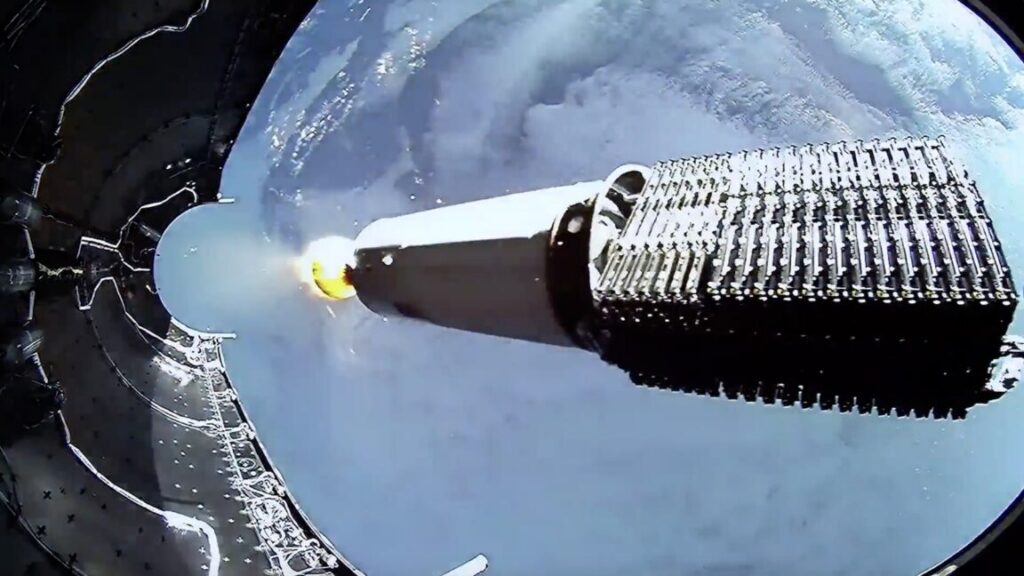
This frame from a SpaceX video shows a stack of Starlink Internet satellites attached to the upper stage of a Falcon 9 rocket, moments after jettison of the launcher’s payload fairing. Credit: SpaceX
The director of the National Reconnaissance Office has a message for US adversaries around the world.
“You can’t hide, because we’re constantly looking,” said Chris Scolese, a longtime NASA engineer who took the helm of the US government’s spy satellite agency in 2019.
The NRO is taking advantage of SpaceX’s Starlink satellite assembly line to build a network of at least 100 satellites, and perhaps many more, to monitor adversaries around the world. So far, more than 80 of these SpaceX-made spacecraft, each a little less than a ton in mass, have launched on four Falcon 9 rockets. There are more to come.
A large number of these mass-produced satellites, or what the NRO calls a “proliferated architecture,” will provide regularly updated imagery of foreign military installations and other sites of interest to US intelligence agencies. Scolese said the new swarm of satellites will “get us reasonably high-resolution imagery of the Earth, at a high rate of speed.”
This is a significant change in approach for the NRO, which has historically operated a smaller number of more expensive satellites, some as big as a school bus.
“We expect to quadruple the number of satellites we have to have on-orbit in the next decade,” said Col. Eric Zarybnisky, director of the NRO’s office of space launch, during an October 29 presentation at the Wernher von Braun Space Exploration Symposium in Huntsville, Alabama.
The NRO is not the only national security agency eyeing a constellation of satellites in low-Earth orbit. The Pentagon’s Space Development Agency plans to kick off a rapid-fire launch cadence next year to begin placing hundreds of small satellites in orbit to detect and track missiles threatening US or allied forces. The Space Force is also interested in buying its own set of SpaceX satellites for broadband connectivity.
The Pentagon started moving in this direction about a decade ago, when leaders raised concerns that the legacy fleets of military and spy satellites were at risk of attack. Now, Elon Musk’s SpaceX and a handful of other companies, many of them startups, specialize in manufacturing and launching small satellites at relatively low cost.
“Why didn’t we do this earlier? Well, launch costs were high, right?” said Troy Meink, the NRO’s principal deputy director, in an October 17 discussion hosted by the Mitchell Institute for Aerospace Studies. “The cost of entry was pretty high, which has come way down. Then, digital electronics has allowed us to build capability in a much smaller package, and a combination of those two is really what’s enabled it.”
A constant vigil
NRO officials still expect to require some large satellites with sharp-eyed optics—think of a Hubble Space Telescope pointed at Earth—to resolve the finest details of things like missile installations, naval fleets, or insurgent encampments. The drawback of this approach is that, at best, a few big optical or radar imaging satellites only fly over places of interest several times per day.
With the proliferated architecture, the NRO will capture views of most places on Earth a lot more often. Two of the most important metrics with a remote-sensing satellite system are imaging resolution and revisit time, or how often a satellite is over a specific location on Earth.
“We need to have persistence or fast revisit,” Scolese said on October 3 in a discussion at the Center for Strategic and International Studies, a nonprofit Washington think tank. “You can proliferate your architecture, put more satellites up there, so that a satellite is always coming over an area within a given reasonable amount of time that’s needed by the users. That’s what we’re doing with the proliferated architecture.
“That’s enabled by a really rich commercial industry that’s building hundreds or thousands of satellites,” Scolese said. “That allowed us to take those satellites, adapt them to our use at low cost, and apply whatever sensor is needed to go off and acquire the information that’s needed at whatever revisit time is required.”
The NRO’s logo for its proliferated satellite constellation, with the slogan “Strength in Numbers.”
Credit: National Reconnaissance Office
The NRO’s logo for its proliferated satellite constellation, with the slogan “Strength in Numbers.” Credit: National Reconnaissance Office
The NRO has identified other benefits, too. It’s a lot more difficult for a country like Russia or China to take out an entire constellation of satellites than to destroy or disable a single spy platform in orbit. Military officials have often referred to these expensive one-off satellites as “big juicy targets” for potential adversaries.
“It gives us a degree of resilience that we didn’t have before,” Scolese said.
The proliferated constellation also allows the NRO to be more nimble in responding to threats or new technologies. If a new type of sensor becomes available, or an adversary does something new that intelligence analysts want to look at, the NRO and its contractor can quickly swap out payloads on satellites going through the production line.
“That’s a huge change for an organization like the NRO,” Zarybnisky said. “It’s a catalyst. Another catalyst for innovation in the NRO is these smaller, lower price-point systems. Rapid turn time means you can introduce that next technology into the next generation and not wait for many years or even decades to introduce new technologies.”
Three-letter agencies
The NRO provides imaging, signals, and electronic intelligence data from its satellites to the National Security Agency, the National Geospatial-Intelligence Agency, and the Department of Defense. Scolese said the NRO wants to get actionable information into the hands of users across the federal government as quickly as possible, but the volume of data coming down from hundreds of satellites presents a challenge.
“Once you go to a proliferated architecture and you’re going from a few satellites to tens of satellites to now hundreds of satellites, you have to change a lot of things, and we’re in the process of doing that,” Scolese said.
With so many satellites, it “means that it’s no longer possible for an individual sitting at a control center to say, ‘I know what this satellite is doing,'” Scolese said. “So we have to have the machines to go off and help us there. We need artificial intelligence, machine learning, automated processes to help us do that.”
“We will deliver data in seconds, not minutes, and not hours,” Zarybnisky said.
The existence of this constellation was made public in March, when Reuters reported the NRO was working with SpaceX to develop and deploy a network of satellites in low-Earth orbit. SpaceX’s Starshield business unit is building the satellites under a $1.8 billion contract signed in 2021, according to Reuters. This is remarkably inexpensive by the standards of the NRO, which has spent more money just constructing a satellite processing facility at Cape Canaveral, Florida (thanks to Eric Berger’s reporting in Reentry for this juicy tidbit).
Chris Scolese appears before the Senate Armed Services Committee in 2019 during a confirmation hearing to become director of the National Reconnaissance Office.
Chris Scolese appears before the Senate Armed Services Committee in 2019 during a confirmation hearing to become director of the National Reconnaissance Office. Credit: Tom Williams/CQ Roll Call
Reuters reported Northrop Grumman is supplying sensors to mount on at least some of the SpaceX-built satellites, but their design and capabilities remain classified. The NRO, which usually keeps its work secret, officially acknowledged the program in April, a month before the first batch of satellites launched from Vandenberg Space Force Base, California.
SpaceX revealed the existence of the Starshield division in 2022, the year after signing the NRO contract, as a vehicle for applying the company’s experience manufacturing Starlink Internet satellites to support US national security missions. SpaceX has built and launched more than 7,200 Starlink satellites since 2019, with more than 6,000 currently operational, 10 times larger than any other existing satellite constellation.
The current generation of Starlink satellites launch in batches of 20 to 23 spacecraft on SpaceX’s Falcon 9 rocket. They’re flat-packed one on top of the other inside the Falcon 9’s payload shroud, then released all at once in orbit. The NRO’s new satellites likely use the same basic design, launching in groups of roughly 21 satellites on each mission.
According to Scolese, the NRO owns these SpaceX-built satellites, rather than SpaceX owning them and supplying data to the government through a service contract arrangement. By the end of the year, the NRO’s director anticipates having at least 100 of these satellites in orbit, with additional launches expected through 2028.
“We are going from the demo phase to the operational phase, where we’re really going to be able to start testing all of this stuff out in a more operational way,” Scolese said.
The NRO is buttressing its network of government-owned satellites with data buys from commercial remote-sensing companies, such as Maxar, Planet, and BlackSky. One advantage of commercial imagery is the NRO can share it widely with allies and the public because it isn’t subject to top-secret classification restrictions.
Scolese said it’s important to maintain a diversity of sources and observation methods to overcome efforts from other nations to hide what they’re doing. This means using more satellites, as the NRO is doing with SpaceX and other commercial partners. It also means using electro-optical, radar, thermal infrared, and electronic detection sensors to fully characterize what intelligence analysts are seeing.
The NRO is also studying more exotic methods like quantum remote sensing, using the principles of quantum physics at the atomic level.
“There’s camouflage,” Scolese said. “There are lots of techniques that can be used, which means we have to go off and look at very different phenomenologies, and we’ve developed and are developing capabilities that will allow us to defeat those types of activities. Quantum sensing is one of them. You can’t really hide from fundamental physics.”
Stephen Clark is a space reporter at Ars Technica, covering private space companies and the world’s space agencies. Stephen writes about the nexus of technology, science, policy, and business on and off the planet.
Starlink offered to 99.5% of zone, but locals say Roam product was disabled.
Starlink satellite dish. Credit: Starlink
Starlink’s home Internet service has come to the National Radio Quiet Zone after a multi-year engineering project that had the goal of minimizing interference with radio telescopes. Starlink operator SpaceX began “a one-year assessment period to offer residential satellite Internet service to 99.5% of residents within the NRQZ starting October 25,” the National Radio Astronomy Observatory and Green Bank Observatory announced last week.
“The vast majority of people within the areas of Virginia and West Virginia collectively known as the National Radio Quiet Zone (NRQZ) can now receive high speed satellite Internet service,” the announcement said. “The newly available service is the result of a nearly three-year collaborative engineering effort between the US National Science Foundation (NSF), SpaceX, and the NSF National Radio Astronomy Observatory (NSF NRAO), which operates the NSF Green Bank Observatory (NSF GBO) in West Virginia within the NRQZ.”
There’s a controversy over the 0.5 percent of residents who aren’t included and are said to be newly blocked from using the Starlink Roam service. Starlink markets Roam as a service for people to use while traveling, not as a fixed home Internet service.
The Pendleton County Office of Emergency Management last week issued a press release saying that “customers with the RV/Roam packages had been using Starlink for approximately two years throughout 100% of the NRQZ. Now, the 0.5% have lost coverage after having it for two years. This means that a large section of southeastern Pendleton County and an even larger section of northern Pocahontas will NOT be able to utilize Starlink.”
PCMag wrote that “Starlink is now live in 42 of the 46 cell areas around the Green Bank Observatory’s telescopes.” Pendleton County Emergency Services Coordinator Rick Gillespie told Ars today that Roam coverage was cut off in the remaining four cell areas.
“After the agreement, we all lost effective use within the four cells,” Gillespie told Ars in an email. Gillespie’s press release said that, “in many cases, Starlink was the only Internet provider option residents and emergency responders had. This is unacceptable.”
“The dark ages of communications systems”
Gillespie was quoted as saying in a WBOY article that the restrictions are “keeping a portion of Pendleton and Pocahontas counties in the dark ages of communications systems.”
We contacted SpaceX and the National Radio Astronomy Observatory about any limits imposed on Roam today and will update this article if we get any response.
Residents of the 13,000-square-mile National Radio Quiet Zone have limited Internet access due to restrictions on radio transmissions first put in place in 1958. In addition to scientific research at Green Bank in Pocahontas County, the National Radio Quiet Zone includes a National Security Agency facility at Sugar Grove Station in Pendleton County.
SpaceX and the NRAO collaborated on testing over the past few years and presumably concluded that the service could only be provided without interference in 99.5 percent of the zone. Chris De Pree, the NRAO deputy spectrum manager, said in the organization’s announcement that “working closely with SpaceX over the past three years has enabled NRAO and SpaceX to better understand each other’s systems and how to actively coexist in this part of the spectrum.”
In that time, “scientists and engineers performed multiple tests and analyses to determine the best way to maximize satellite internet service without hindering the missions within the NRQZ,” the announcement said. During the one-year assessment period for Starlink’s home Internet service, “scientists and engineers will monitor for interference issues and work to resolve them without interrupting Internet service.”
Starlink steers beams away from telescopes
Starlink said in August that it worked with the NRAO “to enable Starlink satellites to avoid transmissions into the line-of-sight of radio telescopes, leveraging our advanced phased array antenna technology to dynamically steer beams away from telescopes.”
Starlink published a summary noting that “direct transmissions from satellites towards the eye of radio telescopes may pose a significant risk of interference to astronomical research.” The technique for steering beams away from telescopes is “made possible by a real-time data sharing framework between radio astronomy observatories and Starlink that provides the Starlink network with a telescope’s planned observation schedule, including the telescope’s pointing direction (aka ‘boresight’) and its observed frequency band. With this information, the Starlink network can ensure that satellites passing near the boresight of a telescope dynamically redirect their beams away from the telescope.”
The redirection happens “in milliseconds” and “protects the telescope’s observations while ensuring Starlink service remains uninterrupted for customers near the telescope.” Starlink is also using the technology with NRAO’s Very Large Array in New Mexico.
Counties want quiet-zone rules scrapped
The quiet-zone rules should be scrapped, a number of local officials say. The Pendleton County press release said that 10 West Virginia counties and one Virginia county “have formally expressed their need for change regarding the National Radio Quiet Zone (NRQZ) through Resolutions and Letters of Support.” These counties have a combined 262,296 residents, the press release said.
“We do not seek the closure of these federal entities but rather their commitment to identifying and funding viable solutions that would enable our communication systems to operate effectively, similar to those in the majority of America,” Gillespie said in the press release.
Gillespie told Ars that local communities are hampered by “archaic 1950’s regulations. We are being left behind when it comes to the modern advancements in public safety and personal communications.” He said that “absent some relief in a timely fashion, we will explore taking our plight to the FCC seeking waivers.”
The Pendleton County Commission resolution approved in September called for dissolution of the quiet zone or “total waivers of any NRQZ restrictions imposed on Public Safety Radio Frequency Bands currently in use, as well as all the commercial cellular/wireless Bands, and commercial satellite Internet providers, such as Starlink.”
The county resolution said the quiet zone is effectively “an ever-growing unfunded federal mandate on our county emergency services/911 operation wherein it causes us to spend large amounts of funding building a larger number of tower sites than would be needed absent the NRQZ restrictions.” The restrictions have greatly diminished access to the AT&T FirstNet public safety network and other networks used by first responders and residents, the resolution said.
The Pocahontas County Commission issued a resolution in September calling for total waivers of restrictions imposed on public safety spectrum, or federal funding to offset costs associated with developing public safety communications systems under “the unique burden of NRQZ regulations.”
Limited fiber and cellular access
Starlink service wouldn’t be as necessary for home Internet access if the area had universal access to fiber broadband. Recent government grants could help, as one funded project is designed to subsidize Spruce Knob Seneca Rocks Telephone’s installation of fiber lines in Pocahontas and Pendleton counties.
Ideally, residents would have access to both fiber home Internet and strong cellular networks. But the NRAO still warns that cellular signals could threaten its scientific research.
“Optical fiber as a broadband solution is far better than service from space or via wireless or cellular links, which are less reliable and have the potential to undo much of the coordination work that has happened in the National Radio Quiet Zone over many decades,” Sheldon Wasik, Zone Regulatory Services Coordinator for the National Radio Astronomy Observatory, said in March 2024.
Jon is a Senior IT Reporter for Ars Technica. He covers the telecom industry, Federal Communications Commission rulemakings, broadband consumer affairs, court cases, and government regulation of the tech industry.
Enlarge/ Soon you’ll be able to stream games and video for free on United flights.
United
United Airlines announced this morning that it is giving its in-flight Internet access an upgrade. It has signed a deal with Starlink to deliver SpaceX’s satellite-based service to all its aircraft, a process that will start in 2025. And the good news for passengers is that the in-flight Wi-Fi will be free of charge.
The flying experience as it relates to consumer technology has come a very long way in the two-and-a-bit decades that Ars has been publishing. At the turn of the century, even having a power socket in your seat was a long shot. Laptop batteries didn’t last that long, either—usually less than the runtime of whatever DVD I hoped to distract myself with, if memory serves.
Bring a spare battery and that might double, but it helped to have a book or magazine to read.
By 2011, the picture had changed. Wi-Fi was no longer some esoteric thing known only to nerds who built their own computers, and smartphones and tablets were on their way to ubiquity. After an aborted attempt in 2004, 2008 made in-flight Internet access a reality in North America, although the air-to-ground cellular-based system was slow, unreliable, and expensive.
Air-to-ground Internet access was maybe slightly cheaper by 2018, but it was still frustrating and slow, particularly if you were, oh, I dunno, a journalist trying to upload images to a CMS on your way back from an event. But by then, there was a better alternative—satellites. Airliners started sporting new antenna-concealing blisters, and soon, we were all streaming and posting and working our way across the skies.
Enter SpaceX
That bandwidth was courtesy of Viasat, according to all the receipts in my expense reports, but in 2022, SpaceX announced that it was adding aviation to Starlink’s portfolio. Initially, Starlink only targeted smaller regional and private jet aircraft, but now its equipment is also certified for commercial passenger planes from Airbus and Boeing and is already in use with carriers including Qatar Airways and Air New Zealand.
United says it will start testing Starlink equipment early in 2025, with the first use on passenger flights later that year. The service will be available gate-to-gate (as opposed to only working above 10,000 feet, a restriction some other systems operate under), and it certainly sounds like a superior experience to current in-flight Internet, as it will explicitly allow streaming of both video and games, and multiple connected devices at once. Better yet, United says the service will be free for passengers.
Depending on the route you fly, you may need to have some patience, though. United says it will take several years to install Starlink systems on its more than 1,000 aircraft.
Enlarge/ The USS Manchester. Just the spot for a Starlink dish.
Department of Defense
It’s no secret that government IT can be a huge bummer. The records retention! The security! So government workers occasionally take IT into their own hands with creative but, err, unauthorized solutions.
For instance, a former US Ambassador to Kenya in 2015 got in trouble after working out of an embassy compound bathroom—the only place where he could use his personal computer (!) to access an unsecured network (!!) that let him log in to Gmail (!!!), where he did much of his official business—rules and security policies be damned.
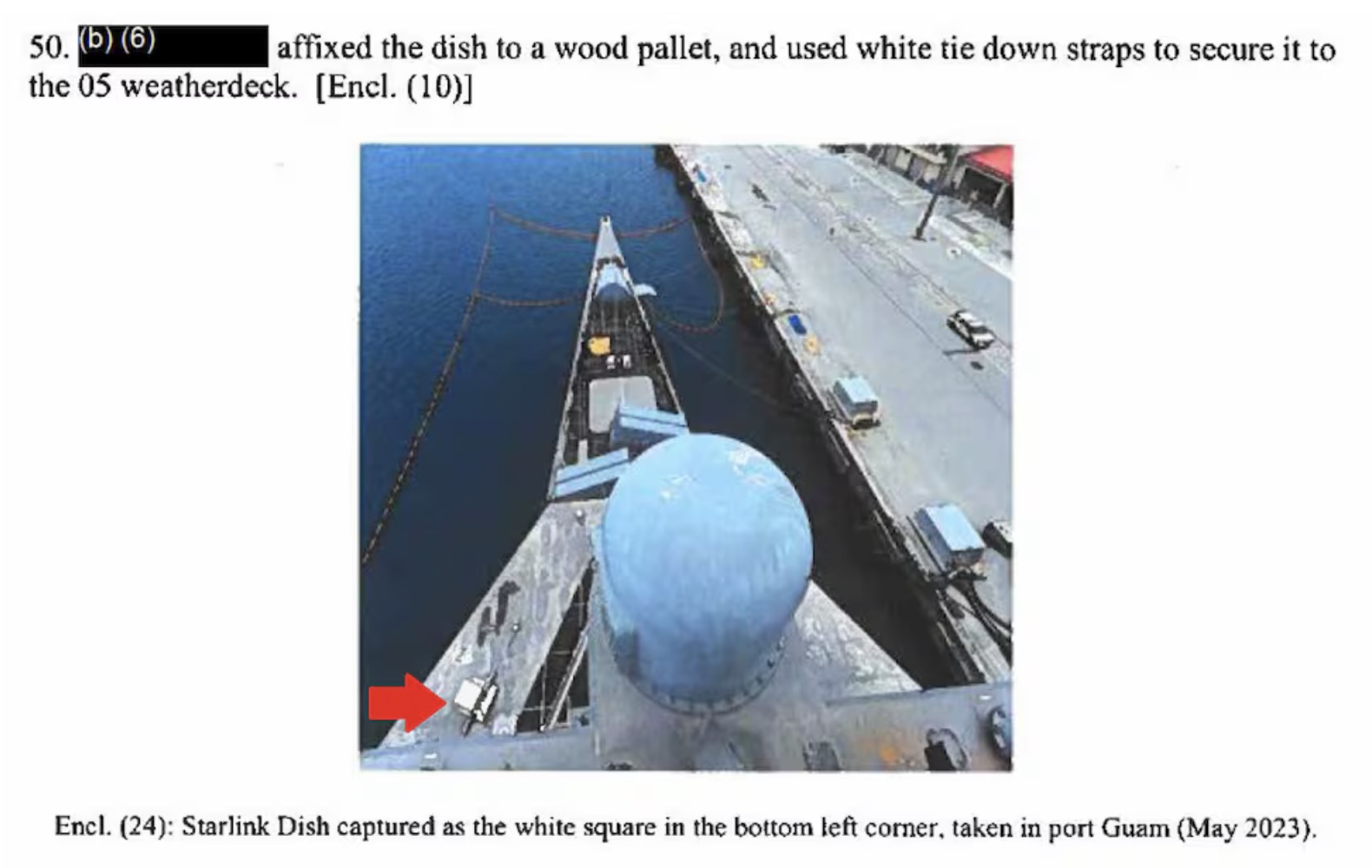
Still, the ambassador had nothing on senior enlisted crew members of the littoral combat ship USS Manchester, who didn’t like the Navy’s restriction of onboard Internet access. In 2023, they decided that the best way to deal with the problem was to secretly bolt a Starlink terminal to the “O-5 level weatherdeck” of a US warship.
They called the resulting Wi-Fi network “STINKY”—and when officers on the ship heard rumors and began asking questions, the leader of the scheme brazenly lied about it. Then, when exposed, she went so far as to make up fake Starlink usage reports suggesting that the system had only been accessed while in port, where cybersecurity and espionage concerns were lower.
Rather unsurprisingly, the story ends badly, with a full-on Navy investigation and court-martial. Still, for half a year, life aboard the Manchester must have been one hell of a ride.
Enlarge/ A photo included in the official Navy investigation report, showing the location of the hidden Starlink terminal on the USS Manchester.
DOD (through Navy Times)
One stinky solution
The Navy Times has all the new and gory details, and you should read their account, because they went to the trouble of using the Freedom of Information Act (FOIA) to uncover the background of this strange story. But the basics are simple enough: People are used to Internet access. They want it, even (perhaps especially!) when at sea on sensitive naval missions to Asia, where concern over Chinese surveillance and hacking runs hot.
So, in early 2023, while in the US preparing for a deployment, Command Senior Chief Grisel Marrero—the enlisted shipboard leader—led a scheme to buy a Starlink for $2,800 and to install it inconspicuously on the ship’s deck. The system was only for use by chiefs—not by officers or by most enlisted personnel—and a Navy investigation later revealed that at least 15 chiefs were in on the plan.
The Navy Times describes how Starlink was installed:
The Starlink dish was installed on the Manchester’s O-5 level weatherdeck during a “blanket” aloft period, which requires a sailor to hang high above or over the side of the ship.
During a “blanket” aloft, duties are not documented in the deck logs or the officer of the deck logs, according to the investigation.
It’s unclear who harnessed up and actually installed the system for Marrero due to redactions in the publicly released copy of the probe, but records show Marrero powered up the system the night before the ship got underway to the West Pacific waters of U.S. 7th Fleet.
This was all extremely risky, and the chiefs don’t appear to have taken amazing security precautions once everything was installed. For one thing, they called the network “STINKY.” For another, they were soon adding more gear around the ship, which was bound to raise further questions. The chiefs found that the Wi-Fi signal coming off the Starlink satellite transceiver couldn’t cover the entire ship, so during a stop in Pearl Harbor, they bought “signal repeaters and cable” to extend coverage.
Sailors on the ship then began finding the STINKY network and asking questions about it. Some of these questions came to Marrero directly, but she denied knowing anything about the network… and then privately changed its Wi-Fi name to “another moniker that looked like a wireless printer—even though no such general-use wireless printers were present on the ship, the investigation found.”
Marrero even went so far as to remove questions about the network from the commanding officer’s “suggestion box” aboard ship to avoid detection.
Finding the stench
Ship officers heard the scuttlebutt about STINKY, of course, and they began asking questions and doing inspections, but they never found the concealed device. On August 18, though, a civilian worker from the Naval Information Warfare Center was installing an authorized SpaceX “Starshield” device and came across the unauthorized SpaceX device hidden on the weatherdeck.
Marrero’s attempt to create fake data showing that the system had only been used in port then failed spectacularly due to the “poorly doctored” statements she submitted. At that point, the game was up, and Navy investigators looked into the whole situation.
All of the chiefs who used, paid for, or even knew about the system without disclosing it were given “administrative nonjudicial punishment at commodore’s mast,” said Navy Times.
So there you go, kids: two object lessons in poor decision-making. Whether working from an embassy bathroom or the deck of a littoral combat ship, if you’re a government employee, think twice before giving in to the sweet temptation of unsecured, unauthorized wireless Internet access.
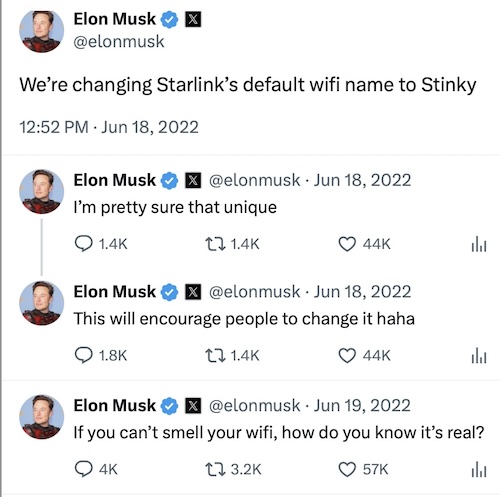
Update, Sept. 5, 3: 30pm: A reader has claimed that the default Starlink SSID is actually… “STINKY.” This seemed almost impossible to believe, but Elon Musk in fact tweeted about it in 2022, Redditors have reported it in the wild, and back in 2022 (thanks, Wayback Machine), the official Starlink FAQ said that the device’s “network name will appear as ‘STARLINK’ or ‘STINKY’ in device WiFi settings.” (A check of the current Starlink FAQ, however, shows that the default network name now is merely “STARLINK.”)
In other words, not only was this asinine conspiracy a terrible OPSEC idea, but the ringleaders didn’t even change the default Wi-Fi name until they started getting questions about it. Yikes.
2022 Twitter thread announcing that “STINKY” would be the default SSID for Starlink.
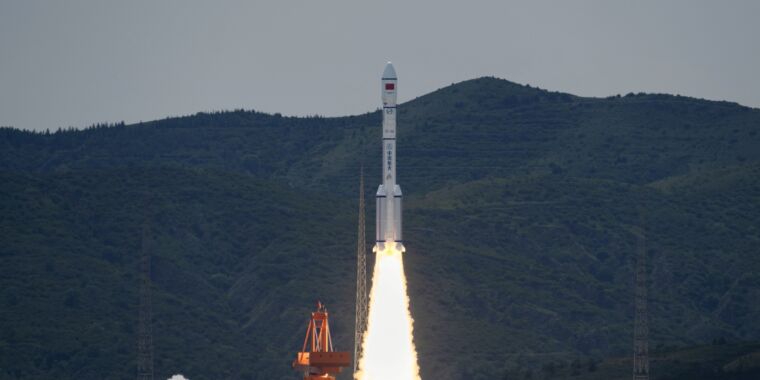
Enlarge/ A Long March 6A rocket launches the first 18 Internet satellites for China’s Qianfan, or Thousand Sails, broadband network.
Chinese officials have long signaled their interest in deploying a satellite network, or maybe several, to beam broadband Internet signals across China and other nations within its sphere of influence.
Two serious efforts are underway in China to develop a rival to SpaceX’s Starlink network, which the Chinese government has banned in its territory. The first batch of 18 satellites for one of those Chinese networks launched into low-Earth orbit Tuesday.
A Long March 6A rocket delivered the 18 spacecraft into a polar orbit following liftoff at 2: 42 am EDT (06: 42 UTC) from the Taiyuan launch base in northern China’s Shanxi province. The Long March 6A is one of China’s newest rockets—and the country’s first to employ strap-on solid rocket boosters—with the ability to deploy a payload of up to 4.5 metric tons (9,900 pounds) into a 700-kilometer (435-mile) Sun-synchronous orbit.
The rocket placed its payload of 18 Qianfan satellites into the proper orbit, and the launch mission was a complete success, according to the China Aerospace Science and Technology Corporation, the largest state-owned contractor for the Chinese space program.
Qianfan translates to “Thousand Sails,” and the 18 satellites launched Tuesday are the first of potentially thousands of spacecraft planned by Shanghai Spacecom Satellite Technology (SSST), a company backed by Shanghai’s municipal government. The network developed by SSST is also called the “Spacesail Constellation.”
Shanghai officials only began releasing details of this constellation last year. A filing with the International Telecommunication Union suggests the developers of Shanghai-based megaconstellation initially plan to deploy 1,296 satellites at an altitude of about 1,160 kilometers (721 miles).
Xinhua, China’s state-run news agency, said the constellation “will provide global users with low-latency, high-speed and ultra-reliable satellite broadband Internet services.”
Opening the floodgates?
SSST’s network was previously known as G60 Starlink, referencing a major cross-country highway in China and the project’s intent to imitate SpaceX’s broadband service.
Thousand Sails may eventually consist of more than 14,000 satellites, but like other Internet megaconstellations, the size of the fleet will likely grow at a rate commensurate with demand. It will take many years for SSST to deploy a 14,000-satellite constellation, if it ever does. SpaceX has rolled out several generations of Starlink satellites to offer new services and more capacity to meet customer uptake.
Chinese officials have released few details about the Qianfan satellites. But the project’s backers have said the spacecraft has a “standardized and modular” flat-panel design. “It meets the needs of stacking multiple satellites with one rocket,” said Shanghai Gesi Aerospace Technology, a joint venture set up by SSST and the Chinese Academy of Sciences to oversee manufacturing of Qianfan satellites.
This sounds a lot like the design of SpaceX’s Starlink satellites, which are flat-packed for launch on Falcon 9 rockets. SpaceX pioneered this way of launching and deploying large numbers of satellites. The approach used for Starlink, and apparently for Qianfan, streamlines the integration of multiple satellites with their launcher on the ground. It also simplifies their separation from the rocket once in orbit.
The new Qianfan satellite factory in Shanghai can produce up to 300 spacecraft per year, project officials said in December. Officials previously said the first 108 satellites for the Thousand Sails constellation would launch this year.
SSST announced in February it had raised more than $900 million from Chinese state-backed investment funds, Shanghai’s municipal government, and sources of venture capital. SSST’s origin is linked to a Chinese joint venture with a Germany-based company called KLEO Connect, which intended to develop a smaller constellation of low-Earth orbit satellites for data relay services.
China launched four technology demonstration satellites, purportedly related to the KLEO Connect venture, to test telecom hardware and electric propulsion systems in orbit. The joint venture fell apart with a flurry of lawsuits, and the German government last year blocked a complete takeover of KLEO Connect by its Chinese investors.
Now, SSST is going it alone with the Thousand Sails network. It has rapidly scaled up satellite manufacturing capacity in Shanghai. But outside of Starlink, companies with ideas for megaconstellations have run into serious headwinds.
OneWeb filed for bankruptcy in 2020 before eventually launching its entire first-generation network of 633 Internet satellites. Amazon has pushed back the full-scale deployment of its Project Kuiper megaconstellation, and the launch of the first operational Kuiper Internet satellites may be delayed again to 2025. The future of the European Union’s IRIS² satellite Internet network is in doubt after disagreements among European governments on funding the project.
The Thousand Sails constellation is less well-known than another planned Chinese satellite Internet network known as Guowang, or “national network,” which is supported by China’s central government. Guowang is owned by a state-backed company called SatNet, and its architecture will consist of 13,000 satellites. However, China has not yet launched any spacecraft for the Guowang project.
It’s unclear if the Thousand Sails network and the Guowang constellation will be direct competitors. They could be geared to different segments of the broadband market. In either case, China’s restrictive Internet policies with terrestrial networks will likely spill over into the satellite segment.
Chinese officials recognize the military utility of satellite Internet services like Starlink, which has supported Ukrainian military forces fighting Russian troops since 2022. A homegrown Starlink-like service would, no doubt, prove useful for China’s military.
Alongside potential domestic civilian users, China could use its satellite Internet networks as a diplomatic tool to build on existing partnerships between the Chinese government and developing countries. This could “lead to a leapfrogging moment, where African countries opt for the Chinese Internet constellation over Western providers due to the fact that much of their infrastructure is already Chinese-built,” the Royal United Services Institute, a UK think tank, wrote in a report last year.
While there are open questions about how China will use its satellite megaconstellations, their deployment will require a significant increase in the country’s launch capacity, driving the development of new commercial rockets, including reusable boosters, to lower costs and increase their flight rate.
Enlarge/ Numerous pieces of ice fell off the second stage of the Falcon 9 rocket during its climb into orbit from Vandenberg Space Force Base, California.
SpaceX
A SpaceX Falcon 9 rocket suffered an upper stage engine failure and deployed a batch of Starlink Internet satellites into a perilously low orbit after launch from California Thursday night, the first blemish on the workhorse launcher’s record in more than 300 missions since 2016.
Elon Musk, SpaceX’s founder and CEO, posted on X that the rocket’s upper stage engine failed when it attempted to reignite nearly an hour after the Falcon 9 lifted off from Vandenberg Space Force Base, California, at 7: 35 pm PDT (02: 35 UTC).
Frosty evidence
After departing Vandenberg to begin SpaceX’s Starlink 9-3 mission, the rocket’s reusable first stage booster propelled the Starlink satellites into the upper atmosphere, then returned to Earth for an on-target landing on a recovery ship parked in the Pacific Ocean. A single Merlin Vacuum engine on the rocket’s second stage fired for about six minutes to reach a preliminary orbit.
A few minutes after liftoff of SpaceX’s Starlink 9-3 mission, veteran observers of SpaceX launches noticed an unusual build-up of ice around the top of the Merlin Vacuum engine, which consumes a propellant mixture of super-chilled kerosene and cryogenic liquid oxygen. The liquid oxygen is stored at a temperature of several hundred degrees below zero.
Numerous chunks of ice fell away from the rocket as the upper stage engine powered into orbit, but the Merlin Vacuum, or M-Vac, engine appeared to complete its first burn as planned. A leak in the oxidizer system or a problem with insulation could lead to ice accumulation, although the exact cause, and its possible link to the engine malfunction later in flight, will be the focus of SpaceX’s investigation into the failure.
A second burn with the upper stage engine was supposed to raise the perigee, or low point, of the rocket’s orbit well above the atmosphere before releasing 20 Starlink satellites to continue climbing to their operational altitude with their own propulsion.
“Upper stage restart to raise perigee resulted in an engine RUD for reasons currently unknown,” Musk wrote in an update two hours after the launch. RUD (rapid unscheduled disassembly) is a term of art in rocketry that usually signifies a catastrophic or explosive failure.
“Team is reviewing data tonight to understand root cause,” Musk continued. “Starlink satellites were deployed, but the perigee may be too low for them to raise orbit. Will know more in a few hours.”
Telemetry from the Falcon 9 rocket indicated it released the Starlink satellites into an orbit with a perigee just 86 miles (138 kilometers) above Earth, roughly 100 miles (150 kilometers) lower than expected, according to Jonathan McDowell, an astrophysicist and trusted tracker of spaceflight activity. Detailed orbital data from the US Space Force was not immediately available.
Ripple effects
While ground controllers scramble to salvage the 20 Starlink satellites, SpaceX engineers began probing what went wrong with the second stage’s M-Vac engine. For SpaceX and its customers, the investigation into the rocket malfunction is likely the more pressing matter.
SpaceX could absorb the loss of 20 Starlink satellites relatively easily. The company’s satellite assembly line can produce 20 Starlink spacecraft in a few days. But the Falcon 9 rocket’s dependability and high flight rate have made it a workhorse for NASA, the US military, and the wider space industry. An investigation will probably delay several upcoming SpaceX flights.
The first in-flight failure for SpaceX’s Falcon rocket family since June 2015, a streak of 344 consecutive successful launches until tonight.
Depending on the cause of the problem and what SpaceX must do to fix it, it’s possible the company can recover from the upper stage failure and resume launching Starlink satellites soon. Most of SpaceX’s launches aren’t for external customers, but deploy satellites for the company’s own Starlink network. This gives SpaceX a unique flexibility to quickly return to flight with the Falcon 9 without needing to satisfy customer concerns.
The Federal Aviation Administration, which licenses all commercial space launches in the United States, will require SpaceX to conduct a mishap investigation before resuming Falcon 9 flights.
“The FAA will be involved in every step of the investigation process and must approve SpaceX’s final report, including any corrective actions,” an FAA spokesperson said. “A return to flight is based on the FAA determining that any system, process, or procedure related to the mishap does not affect public safety.”
Two crew missions are supposed to launch on SpaceX’s human-rated Falcon 9 rocket in the next six weeks, but those launch dates are now in doubt.
The all-private Polaris Dawn mission, commanded by billionaire Jared Isaacman, is scheduled to launch on a Falcon 9 rocket on July 31 from NASA’s Kennedy Space Center in Florida. Isaacman and three commercial astronaut crewmates will spend five days in orbit on a mission that will include the first commercial spacewalk outside their Crew Dragon capsule, using new pressure suits designed and built by SpaceX.
NASA’s next crew mission with SpaceX is slated to launch from Florida aboard a Falcon 9 rocket around August 19. This team of four astronauts will replace a crew of four who have been on the International Space Station since March.
Some customers, especially NASA’s commercial crew program, will likely want to see the results of an in-depth inquiry and require SpaceX to string together a series of successful Falcon 9 flights with Starlink satellites before clearing their own missions for launch. SpaceX has already launched 70 flights with its Falcon family of rockets since January 1, an average cadence of one launch every 2.7 days, more than the combined number of orbital launches by all other nations this year.
With this rapid-fire launch cadence, SpaceX could quickly demonstrate the fitness of any fixes engineers recommend to resolve the problem that caused Thursday night’s failure. But investigations into rocket failures often take weeks or months. It was too soon, early on Friday, to know the true impact of the upper stage malfunction on SpaceX’s launch schedule.
You can now buy a Starlink satellite dish for $299 (plus shipping and tax) in 28 US states due to a discount for areas where SpaceX’s broadband network has excess capacity.
Starlink had raised its upfront hardware cost from $499 to $599 in March 2022 but cut the standard price back down to $499 this week. In the 28 states where the network has what SpaceX deems excess capacity, a $200 discount is being applied to bring the price down to $299. It’s unclear how long the deal will last, though we can assume the number of states eligible for $299 pricing will fall if a lot of people sign up.
“In the United States, new orders in certain regions are eligible for a one-time savings in areas where Starlink has abundant network availability,” a support page posted yesterday said. “$200 will be removed from your Starlink kit price when ordering on Starlink.com and if activated after purchasing from a retailer, a $200 credit will be applied. The savings are only available for Residential Standard service in these designated regional savings areas.”
The 28 states in the “regional savings areas” are Arizona, California, Colorado, Connecticut, Delaware, Florida, Hawaii, Idaho, Iowa, Kansas, Maine, Maryland, Massachusetts, Nebraska, Nevada, New Hampshire, New Jersey, New Mexico, New York, North Dakota, Oklahoma, Oregon, Pennsylvania, Rhode Island, South Dakota, Utah, Vermont, and Wyoming.
There’s one more significant price difference that applies based on location. Since early 2023, Starlink has charged $120 a month for service in areas with limited capacity and $90 a month in areas with excess capacity. So if you’re in an excess-capacity area, you can buy a $299 dish and get $90 monthly service.
Whether you pay $499 or $299 upfront, you’ll get a Wi-Fi router and the new version of Starlink’s standard residential user terminal. There is a drawback compared to the older version of the Starlink dish, which is now called “Starlink Actuated” and doesn’t seem to be available for residential orders on Starlink.com anymore.
The current standard satellite dish doesn’t have the old version’s ability to re-position itself. The new version must be positioned manually, but the Starlink app can help you find the best position.
“The ‘actuated’ part of Standard Actuated refers to the electric motors inside the antenna housing,” says an in-depth comparison of the models written by Starlink user Noah Clarke. “The motors, which are connected to the mast, can rotate and tilt the Standard Actuated dish, enabling it to self-align to the Starlink satellites. In contrast, the Standard dish has done away with the built-in mast and motors. The Standard dish must be manually rotated during the initial installation, with the help of the Starlink app.”
Starlink offers mounting hardware as optional accessories during the checkout process. There’s a pivot mount for $74, a wall mount for $67, a pipe adapter for $38, and a 45-meter cable for $115. The optional cable is three times longer than the one that comes with the standard terminal.
Enlarge/ A stack of 60 Starlink satellites launched in 2019.
SpaceX began launching operational Starlink satellites five years ago this month. Since then, the company has been rapidly developing its constellation of broadband satellites in low-Earth orbit. SpaceX has now launched about 6,000 satellites with its Falcon 9 rocket and has delivered on its promise to provide fast Internet around the world. Today, the company is the largest satellite operator in the world by a factor of 10.
But is this massive enterprise to deliver Internet from space profitable?
According to a new report by Quilty Space, the answer is yes. Quilty built a model to assess Starlink’s profitability. First, the researchers assessed revenue. The firm estimates this will grow to $6.6 billion in 2024, up from essentially zero just four years ago. In addition to rapidly growing its subscriber base of about 3 million, SpaceX has also managed to control costs. Based upon its model, therefore, Quilty estimates that Starlink’s free cash flow from the business will be about $600 million this year.
So, what does it mean for this industry that Starlink has gone from zero to profitability in five years? What’s next for the network? Are there credible competitors to Starlink in OneWeb, Amazon’s Project Kuiper, or other planned megaconstellations? Can low-Earth orbit accommodate all of these satellites?
Please join me for a discussion of Starlink and these questions with Caleb Henry, the director of research for Quilty. Henry is a true expert in the area of satellite-based Internet, and we’ll get into the weeds of this topic. We’ll also be taking your questions.
This will be the first Ars Live event we’ve done in a few years. During these discussions, reporters and editors at Ars Technica speak with industry leaders about the most important technology and science news of the day. So please join us at 2 pm ET (18: 00 UTC) on June 11 on our YouTube livestream.