spacex

italy’s-plan-to-buy-starlink-data-deals-a-serious-blow-to-european-space-network

Italy’s plan to buy Starlink data deals a serious blow to European space network

Developed by the European Union and European Space Agency, with Italian participation, this constellation of 290 satellites is planned to come online by 2030 at a development cost of $10.5 billion. During the lengthy negotiations, Italy even managed to secure one of the three primary ground stations in the Abruzzo region of the country.

The response from some Italian and European officials to the potential agreement between Italy and SpaceX has been ferocious.

Antonio Misiani, former deputy finance minister for Italy and senator for the opposition Democratic Party, told Politico that a completed agreement would represent an “unacceptable sell-out of national sovereignty.”

An Atlantic Council senior fellow and former policy advisor to the Italian government, Beniamino Irdi, told the Financial Times, “It sends a political signal to the EU,” Irdi said. “Iris² is a symbol of Europe’s strategic autonomy, and a key EU member shifting to a different solution can be interpreted as a sign of divestment from that.”

There are multiple layers of frustration here beyond Iris². One concerns Musk, who, since the election of Trump, has turned his attention toward advancing far-right political causes in Europe, particularly in Germany and the United Kingdom. Meloni, a conservative leader of Italy, considers Musk a friend and ally. Andrea Stroppa, one of Musk’s advisers in Italy, explained in September that “Elon recognizes Giorgia Meloni’s leadership. And he sees in her the same thing he sees in Donald Trump, someone who can defend Western values ​​in danger.”

Battling with Breton

Musk has also had a long-running feud with French businessman Thierry Breton, who was Commissioner for the Internal Market of the European Union for five years until last September. Breton spearheaded the Iris² initiative to provide secure communications from low-Earth orbit. He also championed the Digital Services Act, which aims to curb misinformation published online in Europe. The European Commission has been energetically investigating Musk’s social media site X under the law.

Italy’s plan to buy Starlink data deals a serious blow to European space network Read More »
elon-musk:-“we’re-going-straight-to-mars-the-moon-is-a-distraction.”

Elon Musk: “We’re going straight to Mars. The Moon is a distraction.”

To a large extent, NASA resisted this change during the remainder of the Trump administration, keeping its core group of major contractors, such as Boeing and Lockheed Martin, in place. It had help from key US Senators, including Richard Shelby, the now-retired Republican from Alabama. But this time, the push for change is likely to be more concerted, especially with key elements of NASA’s architecture, including the Space Launch System rocket, being bypassed by privately developed rockets such as SpaceX’s Starship vehicle and Blue Origin’s New Glenn rocket.

Not one, but both

In all likelihood, NASA will adopt a new “Artemis” plan that involves initiatives to both the Moon and Mars. When Musk said “we’re going straight to Mars,” he may have meant that this will be the thrust of SpaceX, with support from NASA. That does not preclude a separate initiative, possibly led by Blue Origin with help from NASA, to develop lunar return plans.

Isaacman, who is keeping a fairly low profile ahead of his nomination, has not weighed in on Musk’s comments. However, when his nomination was announced one month ago, he did make a germane comment on X.

“I was born after the Moon landings; my children were born after the final space shuttle launch,” he wrote. “With the support of President Trump, I can promise you this: We will never again lose our ability to journey to the stars and never settle for second place. We will inspire children, yours and mine, to look up and dream of what is possible. Americans will walk on the Moon and Mars and in doing so, we will make life better here on Earth.”

In short, NASA is likely to adopt a two-lane strategy of reaching for both the Moon and Mars. Whether the space agency is successful with either one will be a major question asked of the new administration.

Elon Musk: “We’re going straight to Mars. The Moon is a distraction.” Read More »

trump-nominates-jared-isaacman-to-become-the-next-nasa-administrator

Trump nominates Jared Isaacman to become the next NASA administrator

President-elect Donald Trump announced Wednesday he has selected Jared Isaacman, a billionaire businessman and space enthusiast who twice flew to orbit with SpaceX, to become the next NASA administrator.

“I am delighted to nominate Jared Isaacman, an accomplished business leader, philanthropist, pilot, and astronaut, as Administrator of the National Aeronautics and Space Administration (NASA),” Trump posted on his social media platform, Truth Social. “Jared will drive NASA’s mission of discovery and inspiration, paving the way for groundbreaking achievements in space science, technology, and exploration.”

In a post on X, Isaacman said he was “honored” to receive Trump’s nomination.

“Having been fortunate to see our amazing planet from space, I am passionate about America leading the most incredible adventure in human history,” Isaacman wrote. “On my last mission to space, my crew and I traveled farther from Earth than anyone in over half a century. I can confidently say this second space age has only just begun.”

Top officials who served at NASA under President Trump and President Obama endorsed Isaacman as the next NASA boss.

“Jared Isaacman will be an outstanding NASA Administrator and leader of the NASA family,” said Jim Bridenstine, who led NASA as administrator during Trump’s first term in the White House. “Jared’s vision for pushing boundaries, paired with his proven track record of success in private industry, positions him as an ideal candidate to lead NASA into a bold new era of exploration and discovery. I urge the Senate to swiftly confirm him.”

Lori Garver, NASA’s deputy administrator during the Obama administration, wrote on X that Isaacman’s nomination was “terrific news,” adding that “he has the opportunity to build on NASA’s amazing accomplishments to pave our way to an even brighter future.”

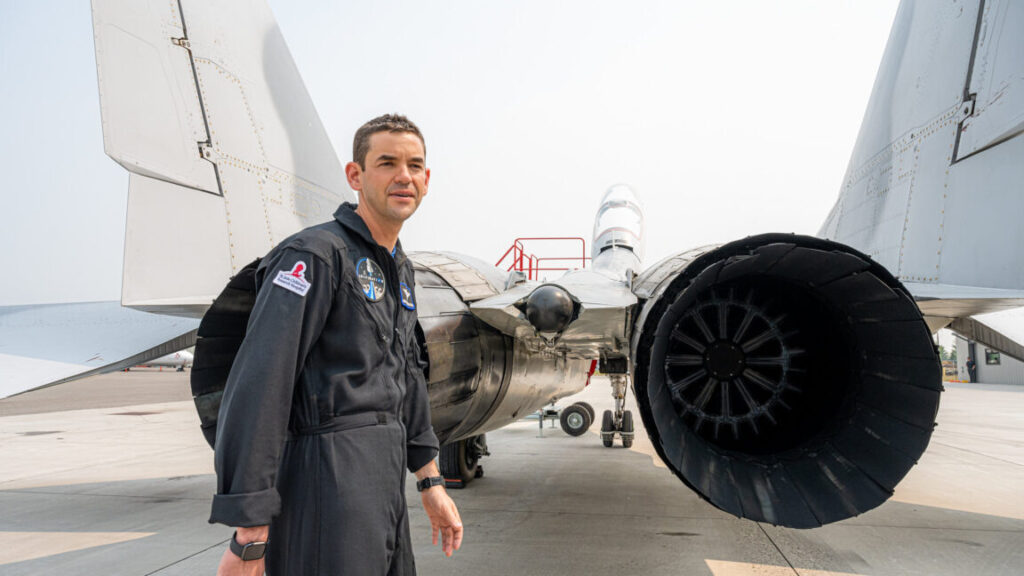
Isaacman, 41, is the founder and CEO of Shift4, a mobile payment processing platform, and co-founded Draken International, which owns a fleet of retired fighter jets to pose as adversaries for military air combat training. If the Senate confirms his nomination, Isaacman would become the 15th NASA administrator, and the fourth who has flown in space.

Trump nominates Jared Isaacman to become the next NASA administrator Read More »

rocket-report:-a-good-week-for-blue-origin;-italy-wants-its-own-launch-capability

Rocket Report: A good week for Blue Origin; Italy wants its own launch capability


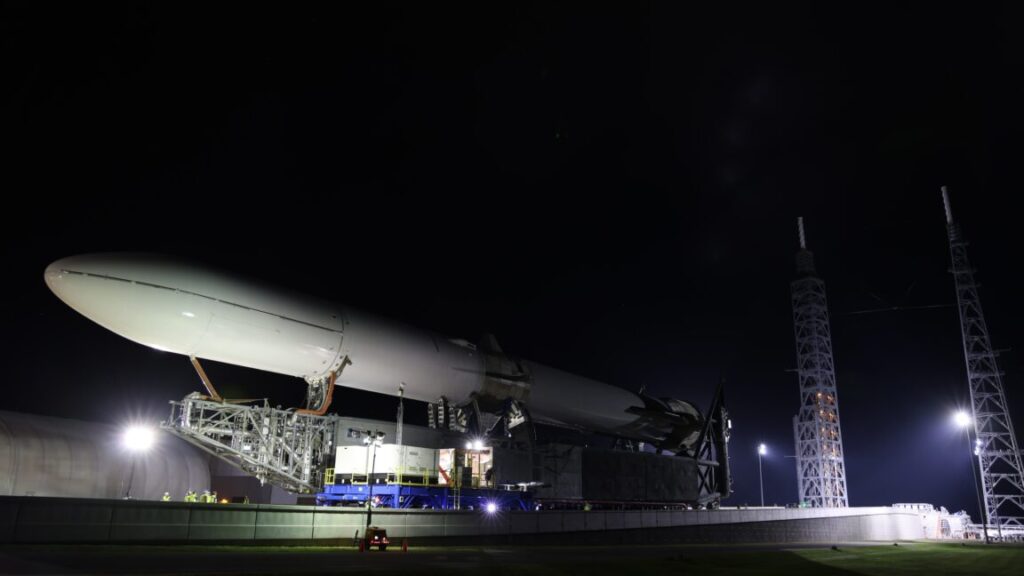
Blue Origin is getting ready to test-fire its first fully integrated New Glenn rocket in Florida.

Blue Origin’s first fully integrated New Glenn rocket rolls out to its launch pad at Cape Canaveral Space Force Station, Florida. Credit: Blue Origin

Welcome to Edition 7.21 of the Rocket Report! We’re publishing the Rocket Report a little early this week due to the Thanksgiving holiday in the United States. We don’t expect any Thanksgiving rocket launches this year, but still, there’s a lot to cover from the last six days. It seems like we’ve seen the last flight of the year by SpaceX’s Starship rocket. A NASA filing with the Federal Aviation Administration requests approval to fly an aircraft near the reentry corridor over the Indian Ocean for the next Starship test flight. The application suggests the target launch date is January 11, 2025.

As always, we welcome reader submissions. If you don’t want to miss an issue, please subscribe using the box below (the form will not appear on AMP-enabled versions of the site). Each report will include information on small-, medium-, and heavy-lift rockets as well as a quick look ahead at the next three launches on the calendar.

Another grim first in Ukraine. For the first time in warfare, Russia launched an Intermediate Range Ballistic Missile against a target in Ukraine, Ars reports. This attack on November 21 followed an announcement from Russian President Vladimir Putin earlier the same week that the country would change its policy for employing nuclear weapons in conflict. The IRBM, named Oreshnik, is the longest-range weapon ever used in combat in Europe, and could be refitted to carry nuclear warheads on future strikes.

Putin’s rationale … Putin says his ballistic missile attack on Ukraine is a warning to the West after the US and UK governments approved Ukraine’s use of Western-supplied ATACMS and Storm Shadow tactical ballistic missiles against targets on Russian territory. The Russian leader said his forces could attack facilities in Western countries that supply weapons for Ukraine to use on Russian territory, continuing a troubling escalatory ladder in the bloody war in Eastern Europe. Interestingly, this attack has another rocket connection. The target was apparently a factory in Dnipro that, not long ago, produced booster stages for Northrop Grumman’s Antares rocket.

Blue Origin hops again. Blue Origin launched its ninth suborbital human spaceflight over West Texas on November 22, CollectSpace reports. Six passengers rode the company’s suborbital New Shepard booster to the edge of space, reaching an altitude of 347,661 feet (65.8 miles or 106 kilometers), flying 3 miles (4.8 km) above the Kármán line that serves as the internationally-accepted border between Earth’s atmosphere and outer space. The pressurized capsule carrying the six passengers separated from the booster, giving them a taste of microgravity before parachuting back to Earth.

Dreams fulfilled … These suborbital flights are getting to be more routine, and may seem insignificant compared to Blue Origin’s grander ambitions of flying a heavy-lift rocket and building a human-rated Moon lander. However, we’ll likely have to wait many years before truly routine access to orbital flights becomes available for anyone other than professional astronauts or multimillionaires. This means tickets to ride on suborbital spaceships from Blue Origin or Virgin Galactic are currently the only ways to get to space, however briefly, for something on the order of $1 million or less. That puts the cost of one of these seats within reach for hundreds of thousands of people, and within the budgets of research institutions and non-profits to fund a flight for a scientist, student, or a member of the general public. The passengers on the November 22 flight included Emily Calandrelli, known online as “The Space Gal,” an engineer, Netflix host, and STEM education advocate who became the 100th woman to fly to space. (submitted by Ken the Bin)

The easiest way to keep up with Eric Berger’s and Stephen Clark’s reporting on all things space is to sign up for our newsletter. We’ll collect their stories and deliver them straight to your inbox.

Sign Me Up!

Rocket Lab flies twice in one day. Two Electron rockets took flight Sunday, one from New Zealand’s Mahia Peninsula and the other from Wallops Island, Virginia, making Rocket Lab the first commercial space company to launch from two different hemispheres in a 24-hour period, Payload reports. One of the missions was the third of five launches for the French Internet of Things company Kinéis, which is building a satellite constellation. The other launch was an Electron modified to act as a suborbital technology demonstrator for hypersonic research. Rocket Lab did not disclose the customer, but speculation is focused on the defense contractor Leidos, which signed a four-launch deal with Rocket Lab last year.

Building cadence … SpaceX first launched two Falcon 9 rockets in 24 hours in 2021. This year, the company launched three Falcon 9s in a single day from pads at Cape Canaveral Space Force Station, Florida, and Vandenberg Space Force Base, California. Rocket Lab has now launched 14 Electron rockets this year, more than any other Western company other than SpaceX. “Two successful launches less than 24 hours apart from pads in different hemispheres. That’s unprecedented capability in the small launch market and one we’re immensely proud to deliver at Rocket Lab,” said Peter Beck, the company’s founder and CEO. (submitted by Ken the Bin)

Italy to reopen offshore launch site. An Italian-run space center located in Kenya will once again host rocket launches from an offshore launch platform, European Spaceflight reports. The Italian minister for enterprises, Adolfo Urso, recently announced that the country decided to move ahead with plans to again launch rockets from the Luigi Broglio Space Center near Malindi, Kenya. “The idea is to give a new, more ambitious mission to this base and use it for the launch of low-orbit microsatellites,” Urso said.

Decades of dormancy … Between 1967 and 1988, the Italian government and NASA partnered to launch nine US-made Scout rockets from the Broglio Space Center to place small satellites into orbit. The rockets lifted off from the San Marco platform, a converted oil platform in equatorial waters off the Kenyan coast. Italian officials have not said what rocket might be used once the San Marco platform is reactivated, but Italy is the leading contributor on the Vega C rocket, a solid-fueled launcher somewhat larger than the Scout. Italy will manage the reactivation of the space center, which has remained in service as a satellite tracking station, under the country’s Mattei Plan, an initiative aimed at fostering stronger economic partnerships with African nations. (submitted by Ken the Bin)

SpaceX flies same rocket twice in two weeks. Less than 14 days after its previous flight, a Falcon 9 booster took off again from Florida’s Space Coast early Monday to haul 23 more Starlink internet satellites into orbit, Spaceflight Now reports. The booster, numbered B1080 in SpaceX’s fleet of reusable rockets, made its 13th trip to space before landing on SpaceX’s floating drone ship in the Atlantic Ocean. The launch marked a turnaround of 13 days, 12 hours, and 44 minutes from this booster’s previous launch November 11, also with a batch of Starlink satellites. The previous record turnaround time between flights of the same Falcon 9 booster was 21 days.

400 and still going … SpaceX’s launch prior to this one was on Saturday night, when a Falcon 9 carried a set of Starlinks aloft from Vandenberg Space Force Base, California. The flight Saturday night was the 400th launch of a Falcon 9 rocket since 2010, and SpaceX’s 100th launch from the West Coast. (submitted by Ken the Bin)

Chinese firm launches upgraded rocket. Chinese launch startup LandSpace put two satellites into orbit late Tuesday with the first launch of an improved version of the Zhuque-2 rocket, Space News reports. The enhanced rocket, named the Zhuque-2E, replaces vernier steering thrusters with a thrust vector control system on the second stage engine, saving roughly 880 pounds (400 kilograms) in mass. The Zhuque-2E rocket is capable of placing a payload of up to 8,800 pounds (4,000 kilograms) into a polar Sun-synchronous orbit, according to LandSpace.

LandSpace in the lead … Founded in 2015, LandSpace is a leader among China’s crop of quasi-commercial launch startups. The company hasn’t launched as often as some of its competitors, but it became the first launch operator in the world to successfully reach orbit with a methane/liquid oxygen (methalox) rocket last year. Now, LandSpace has improved on its design to create the Zhuque-2E rocket, which also has a large niobium allow nozzle extension on the second stage engine for reduced weight. LandSpace also claims the Zhuque-2E is China’s first rocket to use fully supercooled propellant loading, similar to the way SpaceX loads densified propellants into its rockets to achieve higher performance. (submitted by Ken the Bin)

NASA taps Falcon Heavy for another big launch. A little more than a month after SpaceX launched NASA’s flagship Europa Clipper mission on a Falcon Heavy rocket, the space agency announced its next big interplanetary probe will also launch on a Falcon Heavy, Ars reports. What’s more, the Dragonfly mission the Falcon Heavy will launch in 2028 is powered by a plutonium power source. This will be the first time SpaceX launches a rocket with nuclear materials onboard, requiring an additional layer of safety certification by NASA. The agency’s most recent nuclear-powered spacecraft have all launched on United Launch Alliance Atlas V rockets, which are nearing retirement.

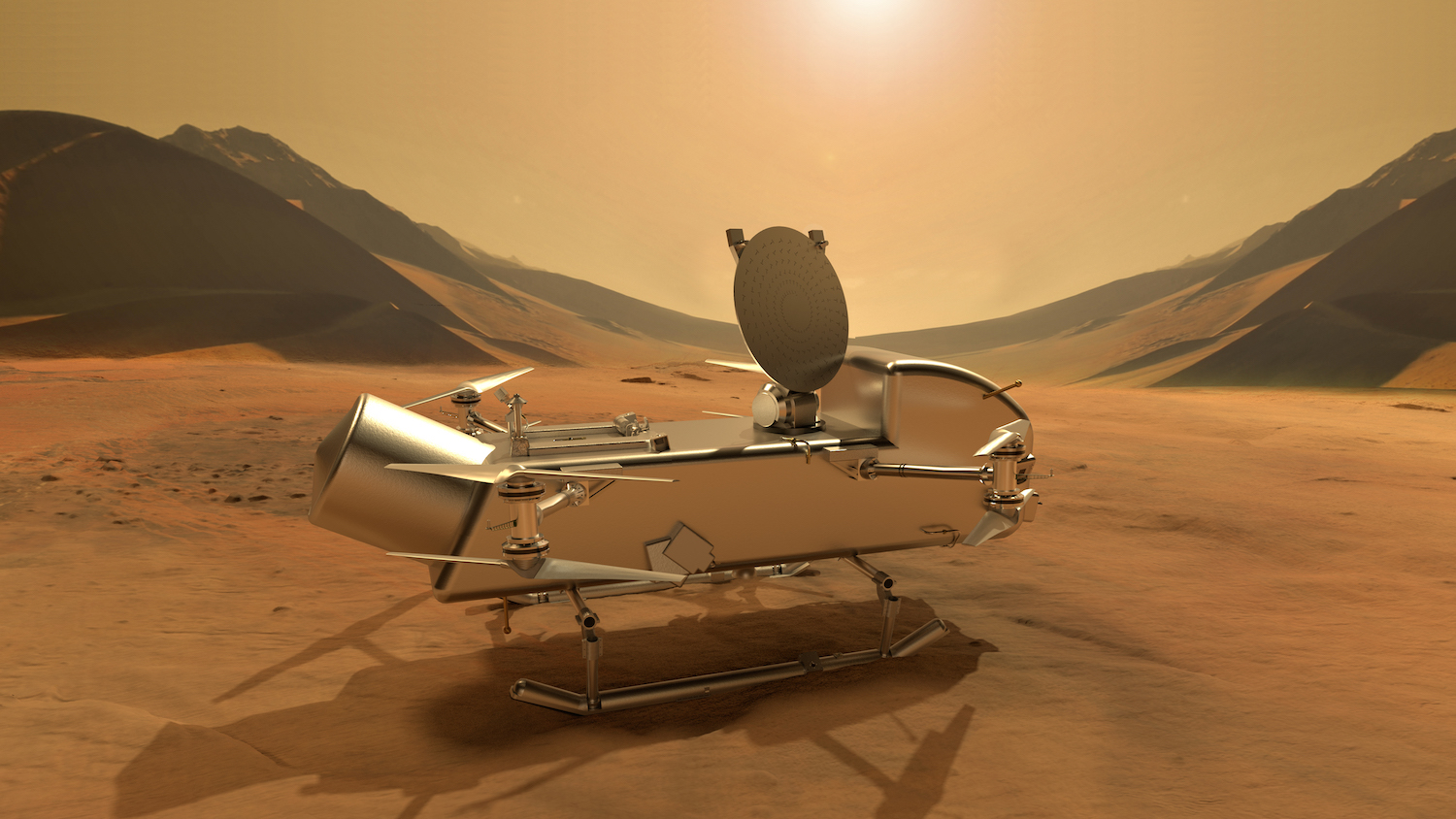
The details … Dragonfly is one of the most exciting robotic missions NASA has ever developed. The mission is to send an automated rotorcraft to explore Saturn’s largest moon, Titan, where Dragonfly will soar through a soupy atmosphere in search of organic molecules, the building blocks of life. It’s a hefty vehicle, about the size of a compact car, and much larger than NASA’s Ingenuity Mars helicopter. The launch period opens July 5, 2028, to allow Dragonfly to reach Titan in 2034. NASA is paying SpaceX $256.6 million to launch the mission on a Falcon Heavy. (submitted by Ken the Bin)

New Glenn is back on the pad. Blue Origin has raised its fully stacked New Glenn rocket on the launch pad at Cape Canaveral Space Force Station ahead of pre-launch testing, Florida Today reports. The last time this new 322-foot-tall (98-meter) rocket was visible to the public eye was in March. Since then, Blue Origin has been preparing the rocket for its inaugural launch, which could yet happen before the end of the year. Blue Origin has not announced a target launch date.

But first, more tests … Blue Origin erected the New Glenn rocket vertical on the launch pad earlier this year for ground tests, but this is the first time a flight-ready (or close to it) New Glenn has been spotted on the pad. This time, the first stage booster has its full complement of seven methane-fueled BE-4 engines. Before the first flight, Blue Origin plans to test-fire the seven BE-4 engines on the pad and conduct one or more propellant loading tests to exercise the launch team, the rocket, and ground systems before launch day.

Second Ariane 6 incoming. ArianeGroup has confirmed that the first and second stages for the second Ariane 6 flight have begun the transatlantic voyage from Europe to French Guiana aboard the sail-assisted transport ship Canopée, European Spaceflight reports. The second Ariane 6 launch, previously targeted before the end of this year, has now been delayed to no earlier than February 2025, according to Arianespace, the rocket’s commercial operator. This follows a mostly successful debut launch in July.

An important passenger … While the first Ariane 6 launch carried a cluster of small experimental satellites, the second Ariane 6 rocket will carry a critical spy satellite into orbit for the French armed forces. Shipping the core elements of the second Ariane 6 to the launch site in Kourou, French Guiana, is a significant step in the launch campaign. Once in Kourou, the stages will be connected together and rolled out to the launch pad, where technicians will install two strap-on solid rocket boosters and the payload fairing containing France’s CSO-3 military satellite.

Next three launches

Nov. 29: Soyuz-2.1a | Kondor-FKA 2 | Vostochny Cosmodrome, Russia | 21: 50 UTC

Nov. 30: Falcon 9 | Starlink 6-65 | Cape Canaveral Space Force Station, Florida | 05: 00 UTC

Nov. 30: Falcon 9 | NROL-126 | Vandenberg Space Force Base, California | 08: 08 UTC

Photo of Stephen Clark

Stephen Clark is a space reporter at Ars Technica, covering private space companies and the world’s space agencies. Stephen writes about the nexus of technology, science, policy, and business on and off the planet.

Rocket Report: A good week for Blue Origin; Italy wants its own launch capability Read More »

nasa-awards-spacex-a-contract-for-one-of-the-few-things-it-hasn’t-done-yet

NASA awards SpaceX a contract for one of the few things it hasn’t done yet

Notably, the Dragonfly launch was one of the first times United Launch Alliance has been eligible to bid its new Vulcan rocket for a NASA launch contract. NASA officials gave the green light for the Vulcan rocket to compete head-to-head with SpaceX’s Falcon 9 and Falcon Heavy after ULA’s new launcher had a successful debut launch earlier this year. With this competition, SpaceX came out on top.

A half-life of 88 years

NASA’s policy for new space missions is to use solar power whenever possible. For example, Europa Clipper was originally supposed to use a nuclear power generator, but engineers devised a way for the spacecraft to use expansive solar panels to capture enough sunlight to produce electricity, even at Jupiter’s vast distance from the Sun.

But there are some missions where this isn’t feasible. One of these is Dragonfly, which will soar through the soupy nitrogen-methane atmosphere of Titan. Saturn’s largest moon is shrouded in cloud cover, and Titan is nearly 10 times farther from the Sun than Earth, so its surface is comparatively dim.

The Dragonfly mission, seen here in an artist’s concept, is slated to launch no earlier than 2027 on a mission to explore Saturn’s moon Titan. Credit: NASA/JHUAPL/Steve Gribben

Dragonfly will launch with about 10.6 pounds (4.8 kilograms) of plutonium-238 to fuel its power generator. Plutonium-238 has a half-life of 88 years. With no moving parts, RTGs have proven quite reliable, powering spacecraft for many decades. NASA’s twin Voyager probes are approaching 50 years since launch.

The Dragonfly rotorcraft will launch cocooned inside a transit module and entry capsule, then descend under parachute through Titan’s atmosphere, which is four times denser than Earth’s. Finally, Dragonfly will detach from its descent module and activate its eight rotors to reach a safe landing.

Once on Titan, Dragonfly is designed to hop from place to place on numerous flights, exploring environments rich in organic molecules, the building blocks of life. This is one of NASA’s most exciting, and daring, robotic missions of all time.

After launching from NASA’s Kennedy Space Center in Florida in July 2028, it will take Dragonfly about six years to reach Titan. When NASA selected the Dragonfly mission to begin development in 2019, the agency hoped to launch the mission in 2026. NASA later directed Dragonfly managers to target a launch in 2027, and then 2028, requiring the mission to change from a medium-lift to a heavy-lift rocket.

Dragonfly has also faced rising costs NASA blames on the COVID-19 pandemic and supply chain issues and an in-depth redesign since the mission’s selection in 2019. Collectively, these issues caused Dragonfly’s total budget to grow to $3.35 billion, more than double its initial projected cost.

NASA awards SpaceX a contract for one of the few things it hasn’t done yet Read More »

spacex-just-got-exactly-what-it-wanted-from-the-faa-for-texas-starship-launches

SpaceX just got exactly what it wanted from the FAA for Texas Starship launches

And there will be significant impacts. For example, the number of large trucks that deliver water, liquid oxygen, methane, and other commodities will increase substantially. According to the FAA document, the vehicle presence will grow from an estimated 6,000 trucks a year to 23,771 trucks annually. This number could be reduced by running a water line along State Highway 4 to supply the launch site’s water deluge system.

SpaceX has made progress in some areas, the document notes. For example, in terms of road closures for testing and launch activities, SpaceX has reduced the duration of closures along State Highway 4 to Boca Chica Beach by 85 percent between the first and third flight of Starship. This has partly been accomplished by moving launch preparation activities to the “Massey’s Test Site,” located about four miles from the launch site. SpaceX is now expected to need less than 20 hours of access restrictions per launch campaign, including landings.

SpaceX clearly got what it wanted

If finalized, this environmental assessment will give SpaceX the regulatory greenlight to match its aspirations for launches in at least 2025, if not beyond. During recent public meetings, SpaceX’s general manager of Starbase, Kathy Lueders, has said the company aims to launch Starship 25 times next year from Texas. The new regulations would permit this.

Additionally, SpaceX founder Elon Musk has said the company intends to move to a larger and more powerful version of the Starship and Super Heavy rocket about a year from now. This version, dubbed Starship 3, would double the thrust of the upper stage and increase the thrust of the booster stage from about 74 meganewtons to about 100 meganewtons. If that number seems a little abstract, another way to think about it is that Starship would have a thrust at liftoff three times as powerful as NASA’s Saturn V rocket that launched humans to the Moon decades ago. The draft environmental assessment permits this as well.

SpaceX just got exactly what it wanted from the FAA for Texas Starship launches Read More »

the-key-moment-came-38-minutes-after-starship-roared-off-the-launch-pad

The key moment came 38 minutes after Starship roared off the launch pad


SpaceX wasn’t able to catch the Super Heavy booster, but Starship is on the cusp of orbital flight.

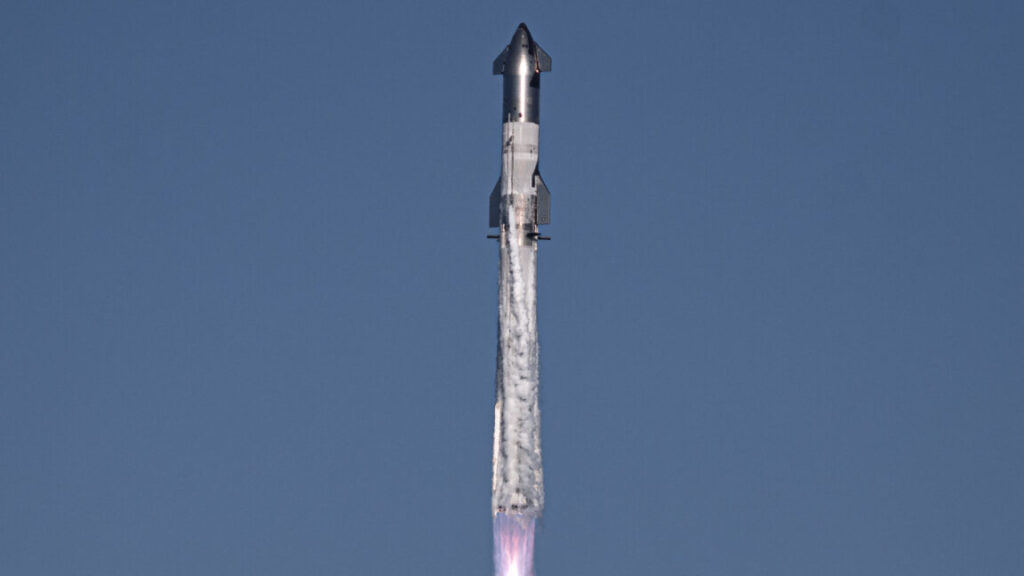
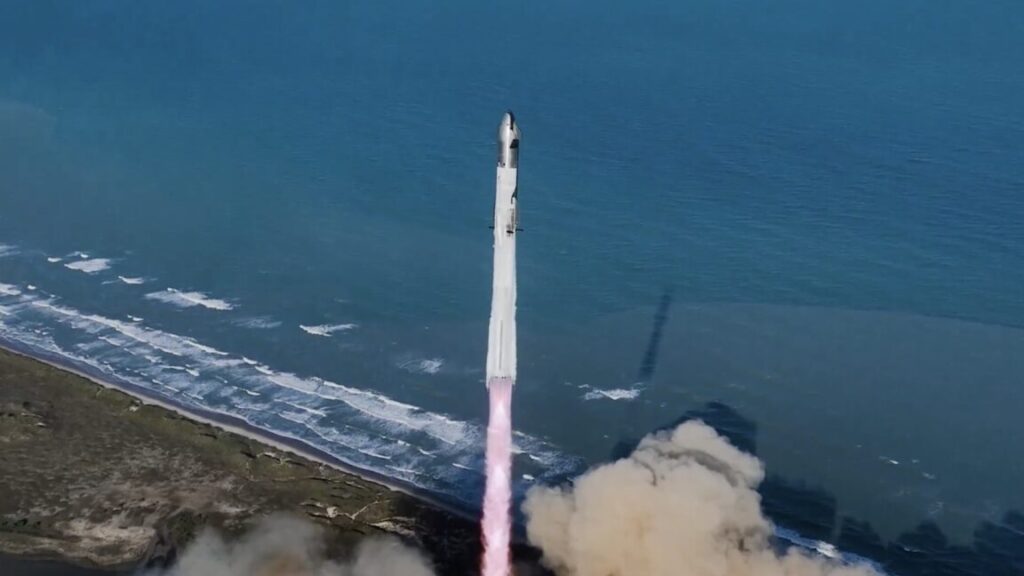
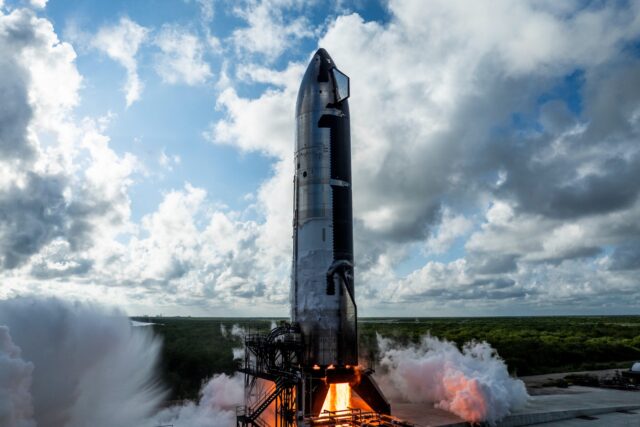
The sixth flight of Starship lifts off from SpaceX’s Starbase launch site at Boca Chica Beach, Texas. Credit: SpaceX.

SpaceX launched its sixth Starship rocket Tuesday, proving for the first time that the stainless steel ship can maneuver in space and paving the way for an even larger, upgraded vehicle slated to debut on the next test flight.

The only hiccup was an abortive attempt to catch the rocket’s Super Heavy booster back at the launch site in South Texas, something SpaceX achieved on the previous flight on October 13. The Starship upper stage flew halfway around the world, reaching an altitude of 118 miles (190 kilometers) before plunging through the atmosphere for a pinpoint slow-speed splashdown in the Indian Ocean.

The sixth flight of the world’s largest launcher—standing 398 feet (121.3 meters) tall—began with a lumbering liftoff from SpaceX’s Starbase facility near the US-Mexico border at 4 pm CST (22: 00 UTC) Tuesday. The rocket headed east over the Gulf of Mexico, propelled by 33 Raptor engines clustered on the bottom of its Super Heavy first stage.

A few miles away, President-elect Donald Trump joined SpaceX founder Elon Musk to witness the launch. The SpaceX boss became one of Trump’s closest allies in this year’s presidential election, giving the world’s richest man extraordinary influence in US space policy. Sen. Ted Cruz (R-Texas) was there, too, among other lawmakers. Gen. Chance Saltzman, the top commander in the US Space Force, stood nearby, chatting with Trump and other VIPs.

Elon Musk, SpaceX’s CEO, President-elect Donald Trump, and Gen. Chance Saltzman of the US Space Force watch the sixth launch of Starship Tuesday. Credit: Brandon Bell/Getty Images

From their viewing platform, they watched Starship climb into a clear autumn sky. At full power, the 33 Raptors chugged more than 40,000 pounds of super-cold liquid methane and liquid oxygen per second. The engines generated 16.7 million pounds of thrust, 60 percent more than the Soviet N1, the second-largest rocket in history.

Eight minutes later, the rocket’s upper stage, itself also known as Starship, was in space, completing the program’s fourth straight near-flawless launch. The first two test flights faltered before reaching their planned trajectory.

A brief but crucial demo

As exciting as it was, we’ve seen all that before. One of the most important new things engineers wanted to test on this flight occurred about 38 minutes after liftoff.

That’s when Starship reignited one of its six Raptor engines for a brief burn to make a slight adjustment to its flight path. The burn lasted only a few seconds, and the impulse was small—just a 48 mph (77 km/hour) change in velocity, or delta-V—but it demonstrated that the ship can safely deorbit itself on future missions.

With this achievement, Starship will likely soon be cleared to travel into orbit around Earth and deploy Starlink Internet satellites or conduct in-space refueling experiments, two of the near-term objectives on SpaceX’s Starship development roadmap.

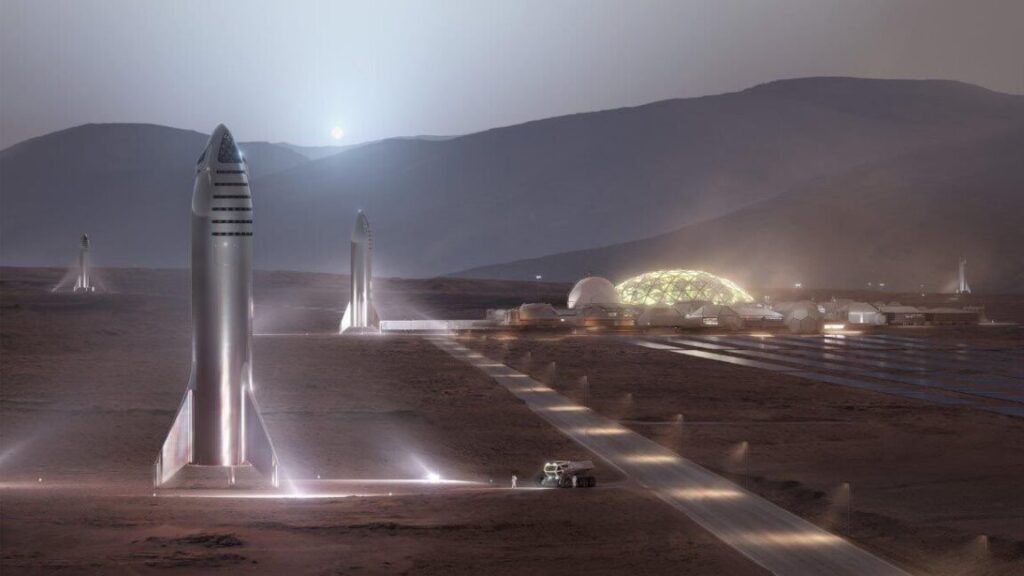
Launching Starlinks aboard Starship will allow SpaceX to expand the capacity and reach of its commercial consumer broadband network, which, in turn, provides revenue for Musk to reinvest into Starship. Orbital refueling enables Starship voyages beyond low-Earth orbit, fulfilling SpaceX’s multibillion-dollar contract with NASA to provide a human-rated Moon lander for the agency’s Artemis program. Likewise, transferring cryogenic propellants in orbit is a prerequisite for sending Starships to Mars, making real Musk’s dream of creating a settlement on the red planet.

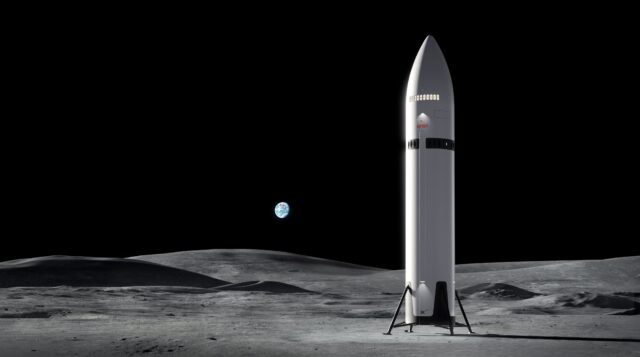
Artist’s illustration of Starship on the surface of the Moon. Credit: SpaceX

Until now, SpaceX has intentionally launched Starships to speeds just shy of the blistering velocities needed to maintain orbit. Engineers wanted to test the Raptor’s ability to reignite in space on the third Starship test flight in March, but the ship lost control of its orientation, and SpaceX canceled the engine firing.

Before going for a full orbital flight, officials needed to confirm that Starship could steer itself back into the atmosphere for reentry, ensuring it wouldn’t present any risk to the public with an unguided descent over a populated area. After Tuesday, SpaceX can check this off its to-do list.

“Congrats to SpaceX on Starship’s sixth test flight,” NASA Administrator Bill Nelson posted on X. “Exciting to see the Raptor engine restart in space—major progress towards orbital flight. Starship’s success is Artemis’ success. Together, we will return humanity to the Moon & set our sights on Mars.”

While it lacks the pizzazz of a fiery launch or landing, the engine relight unlocks a new phase of Starship development. SpaceX has now proven that the rocket is capable of reaching space with a fair measure of reliability. Next, engineers will fine-tune how to reliably recover the booster and the ship and learn how to use them.

Acid test

SpaceX appears well on its way to doing this. While SpaceX didn’t catch the Super Heavy booster with the launch tower’s mechanical arms Tuesday, engineers have shown they can do it. The challenge of catching Starship itself back at the launch pad is more daunting. The ship starts its reentry thousands of miles from Starbase, traveling approximately 17,000 mph (27,000 km/hour), and must thread the gap between the tower’s catch arms within a matter of inches.

The good news is that SpaceX has now twice proven it can bring Starship back to a precision splashdown in the Indian Ocean. In October, the ship settled into the sea in darkness. SpaceX moved the launch time for Tuesday’s flight to the late afternoon, setting up for splashdown shortly after sunrise northwest of Australia.

The shift in time paid off with some stunning new visuals. Cameras mounted on the outside of Starship beamed dazzling live views back to SpaceX through the Starlink network, showing a now-familiar glow of plasma encasing the spacecraft as it plowed deeper into the atmosphere. But this time, daylight revealed the ship’s flaps moving to control its belly-first descent toward the ocean. After passing through a deck of low clouds, Starship reignited its Raptor engines and tilted from horizontal to vertical, making contact with the water tail-first within view of a floating buoy and a nearby aircraft in position to observe the moment.

Here’s a replay of the spacecraft’s splashdown around 65 minutes after launch.

Splashdown confirmed! Congratulations to the entire SpaceX team on an exciting sixth flight test of Starship! pic.twitter.com/bf98Va9qmL

— SpaceX (@SpaceX) November 19, 2024

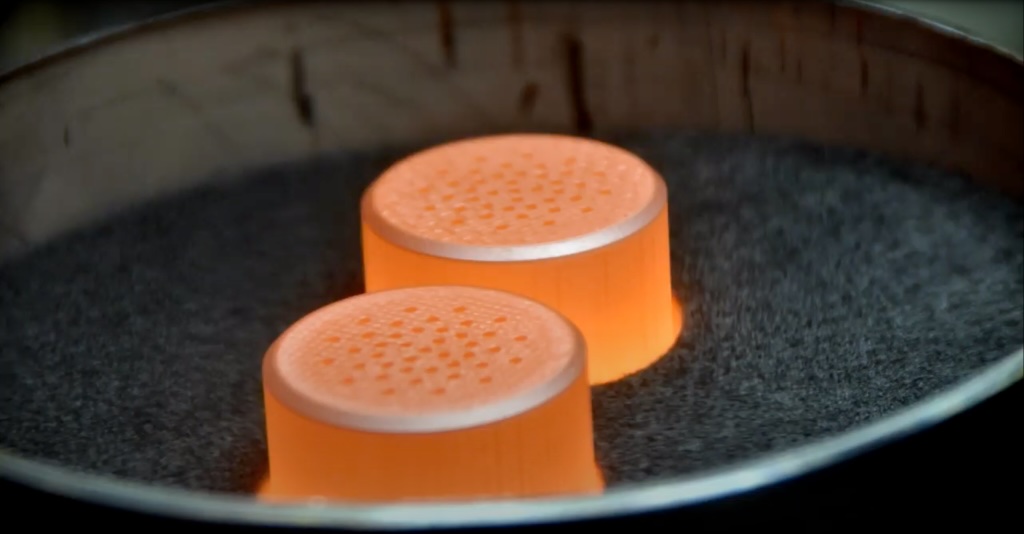
The ship made it through reentry despite flying with a substandard heat shield. Starship’s thermal protection system is made up of thousands of ceramic tiles to protect the ship from temperatures as high as 2,600° Fahrenheit (1,430° Celsius).

Kate Tice, a SpaceX engineer hosting the company’s live broadcast of the mission, said teams at Starbase removed 2,100 heat shield tiles from Starship ahead of Tuesday’s launch. Their removal exposed wider swaths of the ship’s stainless steel skin to super-heated plasma, and SpaceX teams were eager to see how well the spacecraft held up during reentry. In the language of flight testing, this approach is called exploring the corners of the envelope, where engineers evaluate how a new airplane or rocket performs in extreme conditions.

“Don’t be surprised if we see some wackadoodle stuff happen here,” Tice said. There was nothing of the sort. One of the ship’s flaps appeared to suffer some heating damage, but it remained intact and functional, and the harm looked to be less substantial than damage seen on previous flights.

Many of the removed tiles came from the sides of Starship where SpaceX plans to place catch fittings on future vehicles. These are the hardware protuberances that will catch on the top side of the launch tower’s mechanical arms, similar to fittings used on the Super Heavy booster.

“The next flight, we want to better understand where we can install catch hardware, not necessarily to actually do the catch but to see how that hardware holds up in those spots,” Tice said. “Today’s flight will help inform ‘does the stainless steel hold up like we think it may, based on experiments that we conducted on Flight 5?'”

Musk wrote on his social media platform X that SpaceX could try to bring Starship back to Starbase for a catch on the eighth test flight, which is likely to occur in the first half of 2025.

“We will do one more ocean landing of the ship,” Musk said. “If that goes well, then SpaceX will attempt to catch the ship with the tower.”

The heat shield, Musk added, is a focal point of SpaceX’s attention. The delicate heat-absorbing tiles used on the belly of the space shuttle proved vexing to NASA technicians. Early in the shuttle’s development, NASA had trouble keeping tiles adhered to the shuttle’s aluminum skin. Each of the shuttle tiles was custom-machined to fit on a specific location on the orbiter, complicating refurbishment between flights. Starship’s tiles are all hexagonal in shape and agnostic to where technicians place them on the vehicle.

“The biggest technology challenge remaining for Starship is a fully & immediately reusable heat shield,” Musk wrote on X. “Being able to land the ship, refill propellant & launch right away with no refurbishment or laborious inspection. That is the acid test.”

This photo of the Starship vehicle for Flight 6, numbered Ship 31, shows exposed portions of the vehicle’s stainless steel skin after tile removal. Credit: SpaceX

There were no details available Tuesday night on what caused the Super Heavy booster to divert from its planned catch on the launch tower. After detaching from the Starship upper stage less than three minutes into the flight, the booster reversed course to begin the journey back to Starbase.

Then SpaceX’s flight director announced the rocket would fly itself into the Gulf rather than back to the launch site: “Booster offshore divert.”

The booster finished its descent with a seemingly perfect landing burn using a subset of its Raptor engines. As expected after the water landing, the booster—itself 233 feet (71 meters) tall—toppled and broke apart in a dramatic fireball visible to onshore spectators.

In an update posted to its website after the launch, SpaceX said automated health checks of hardware on the launch and catch tower triggered the aborted catch attempt. The company did not say what system failed the health check. As a safety measure, SpaceX must send a manual command for the booster to come back to land in order to prevent a malfunction from endangering people or property.

Turning it up to 11

There will be plenty more opportunities for more booster catches in the coming months as SpaceX ramps up its launch cadence at Starbase. Gwynne Shotwell, SpaceX’s president and chief operating officer, hinted at the scale of the company’s ambitions last week.

“We just passed 400 launches on Falcon, and I would not be surprised if we fly 400 Starship launches in the next four years,” she said at the Barron Investment Conference.

The next batch of test flights will use an improved version of Starship designated Block 2, or V2. Starship Block 2 comes with larger propellant tanks, redesigned forward flaps, and a better heat shield.

The new-generation Starship will hold more than 11 million pounds of fuel and oxidizer, about a million pounds more than the capacity of Starship Block 1. The booster and ship will produce more thrust, and Block 2 will measure 408 feet (124.4 meters) tall, stretching the height of the full stack by a little more than 10 feet.

Put together, these modifications should give Starship the ability to heave a payload of up to 220,000 pounds (100 metric tons) into low-Earth orbit, about twice the carrying capacity of the first-generation ship. Further down the line, SpaceX plans to introduce Starship Block 3 to again double the ship’s payload capacity.

Just as importantly, these changes are designed to make it easier for SpaceX to recover and reuse the Super Heavy booster and Starship upper stage. SpaceX’s goal of fielding a fully reusable launcher builds on the partial reuse SpaceX pioneered with its Falcon 9 rocket. This should dramatically bring down launch costs, according to SpaceX’s vision.

With Tuesday’s flight, it’s clear Starship works. Now it’s time to see what it can do.

Updated with additional details, quotes, and images.

Photo of Stephen Clark

Stephen Clark is a space reporter at Ars Technica, covering private space companies and the world’s space agencies. Stephen writes about the nexus of technology, science, policy, and business on and off the planet.

The key moment came 38 minutes after Starship roared off the launch pad Read More »

a-lot-of-people-are-mistaking-elon-musk’s-starlink-satellites-for-uaps

A lot of people are mistaking Elon Musk’s Starlink satellites for UAPs

That’s just Elon

But many UAP cases have verifiable explanations as airplanes, drones, or satellites, and lawmakers argue AARO might be able to solve more of the cases with more funding.

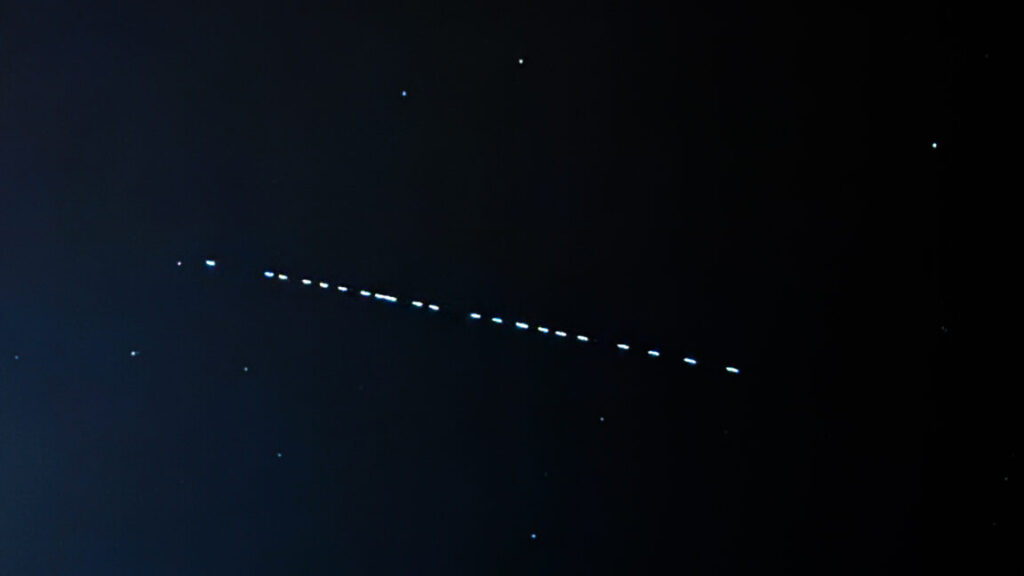
Airspace is busier than ever with air travel and consumer drones. More satellites are zooming around the planet as government agencies and companies like SpaceX deploy their constellations for Internet connectivity and surveillance. There’s more stuff up there to see.

“AARO increasingly receives cases that it is able to resolve to the Starlink satellite constellation,” the office said in this year’s annual report.

“For example, a commercial pilot reported white flashing lights in the night sky,” AARO said. “The pilot did not report an altitude or speed, and no data or imagery was recorded. AARO assessed that this sighting of flashing lights correlated with a Starlink satellite launch from Cape Canaveral, Florida, the same evening about one hour prior to the sighting.”

Jon Kosloski, director of AARO, said officials compared the parameters of these sightings with Starlink launches. When SpaceX releases Starlink satellites in orbit, the spacecraft are initially clustered together and reflect more sunlight down to Earth. This makes the satellites easier to see during twilight hours before they raise their orbits and become dimmer.

“We found some of those correlations in time, the direction that they were looking, and the location,” Kosloski said. “And we were able to assess that they were all in those cases looking at Starlink flares.”

SpaceX has more than 6,600 Starlink satellites in low-Earth orbit, more than half of all active spacecraft. Thousands more satellites for Amazon’s Kuiper broadband constellation and Chinese Internet network are slated to launch in the next few years.

“AARO is investigating if other unresolved cases may be attributed to the expansion of the Starlink and other mega-constellations in low-Earth orbit,” the report said.

The Starlink network is still relatively new. SpaceX launched the first Starlinks five years ago. Kosloski said he expects the number of erroneous UAP reports caused by satellites to go down as pilots and others understand what the Starlinks look like.

“It looks interesting and potentially anomalous. But we can model that, and we can show pilots what that anomaly looks like, so that that doesn’t get reported to us necessarily,” Kosloski said.

A lot of people are mistaking Elon Musk’s Starlink satellites for UAPs Read More »

there-are-some-things-the-crew-8-astronauts-aren’t-ready-to-talk-about

There are some things the Crew-8 astronauts aren’t ready to talk about


“I did not say I was uncomfortable talking about it. I said we’re not going to talk about it.”

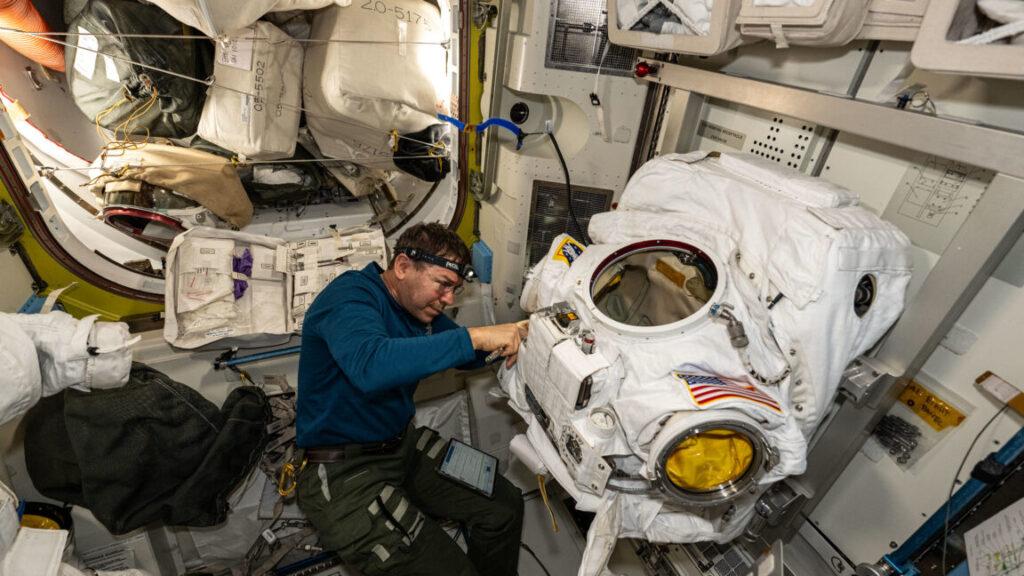
NASA astronaut Michael Barratt works with a spacesuit inside the Quest airlock of the International Space Station on May 31. Credit: NASA

The astronauts who came home from the International Space Station last month experienced some drama on the high frontier, and some of it accompanied them back to Earth.

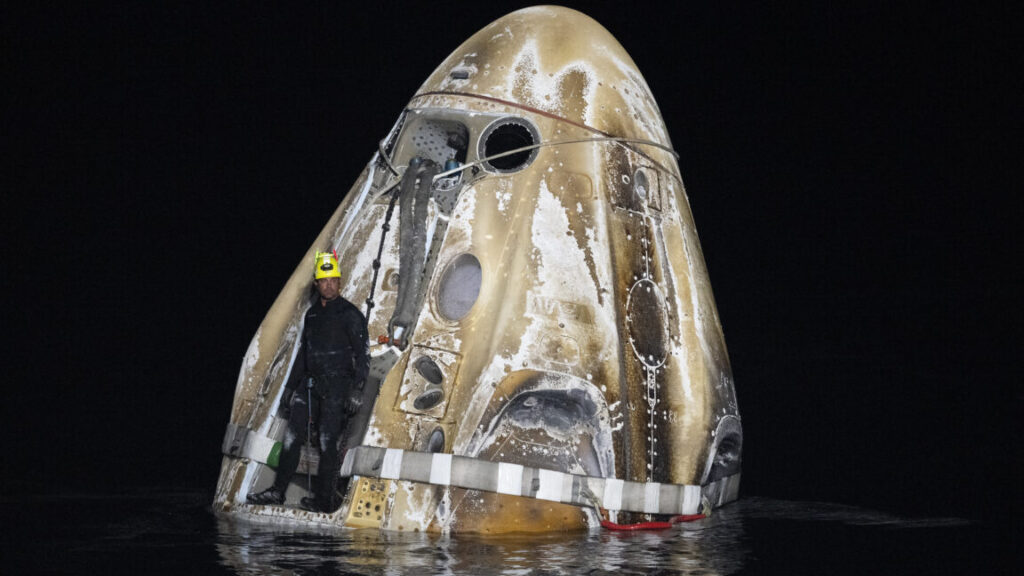
In orbit, the astronauts aborted two spacewalks, both under unusual circumstances. Then, on October 25, one of the astronauts was hospitalized due to what NASA called an unspecified “medical issue” after splashdown aboard a SpaceX Crew Dragon capsule that concluded the 235-day mission. After an overnight stay in a hospital in Florida, NASA said the astronaut was released “in good health” and returned to their home base in Houston to resume normal post-flight activities.

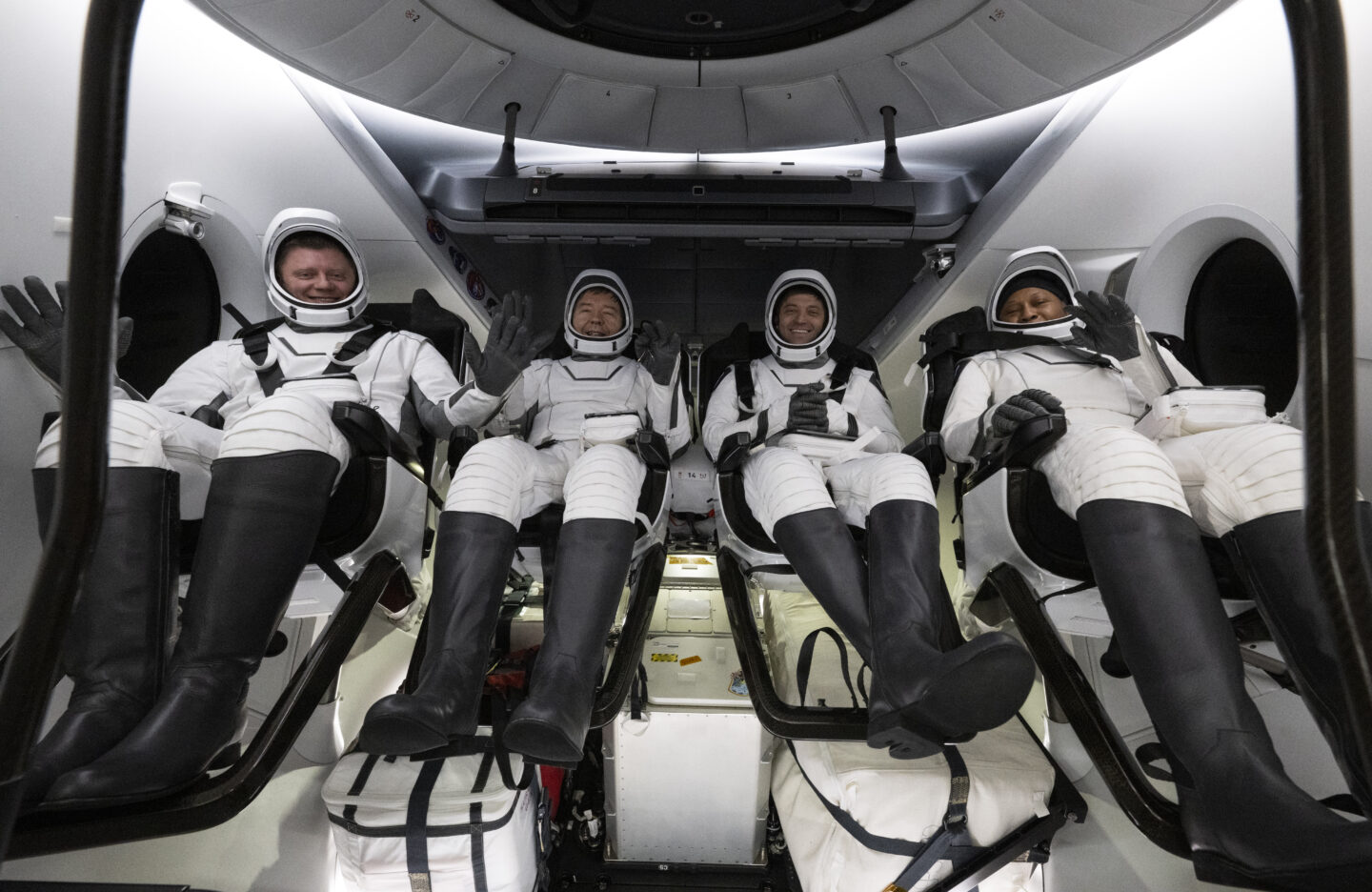
The space agency did not identify the astronaut or any details about their condition, citing medical privacy concerns. The three NASA astronauts on the Dragon spacecraft included commander Matthew Dominick, pilot Michael Barratt, and mission specialist Jeanette Epps. Russian cosmonaut Alexander Grebenkin accompanied the three NASA crew members. Russia’s space agency confirmed he was not hospitalized after returning to Earth.

Dominick, Barratt, and Epps answered media questions in a post-flight press conference Friday, but they did not offer more information on the medical issue or say who experienced it. NASA initially sent all four crew members to the hospital in Pensacola, Florida, for evaluation, but Grebenkin and two of the NASA astronauts were quickly released and cleared to return to Houston. One astronaut remained behind until the next day.

“Spaceflight is still something we don’t fully understand,” said Barratt, a medical doctor and flight surgeon. “We’re finding things that we don’t expect sometimes. This was one of those times, and we’re still piecing things together on this, and so to maintain medical privacy and to let our processes go forward in an orderly manner, this is all we’re going to say about that event at this time.”

NASA typically makes astronaut health data available to outside researchers, who regularly publish papers while withholding identifying information about crew members. NASA officials often tout gaining knowledge about the human body’s response to spaceflight as one of the main purposes of the International Space Station. The agency is subject to federal laws, including the Health Insurance Portability and Accountability Act (HIPAA) of 1996, restricting the release of private medical information.

“I did not say I was uncomfortable talking about it,” Barratt said. “I said we’re not going to talk about it. I’m a medical doctor. Space medicine is my passion … and how we adapt, how we experience human spaceflight is something that we all take very seriously.”

Maybe some day

Barratt said NASA will release more information about the astronaut’s post-flight medical issue “in the fullness of time.” This was Barratt’s third trip to space and the first spaceflight for Dominick and Epps.

One of the most famous incidents involving hospitalized astronauts was in 1975, before the passage of the HIPAA medical privacy law, when NASA astronauts Thomas Stafford, Deke Slayton, and Vance Brand stayed at a military hospital in Hawaii nearly two weeks after inhaling toxic propellant fumes that accidentally entered their spacecraft’s internal cabin as it descended under parachutes. They were returning to Earth at the end of the Apollo-Soyuz mission, in which they docked their Apollo command module to a Soviet Soyuz spacecraft in orbit.

NASA’s view—and perhaps the public’s, too—of medical privacy has changed in the nearly 50 years since. On that occasion, NASA disclosed that the astronauts suffered from lung irritation, and officials said Brand briefly passed out from the fumes after splashdown, remaining unconscious until his crewmates fitted an oxygen mask tightly over his face. NASA and the military also made doctors available to answer media questions about their condition.

The medical concern after splashdown last month was not the only part of the Crew-8 mission that remains shrouded in mystery. Dominick and NASA astronaut Tracy Dyson were supposed to go outside the International Space Station for a spacewalk June 13, but NASA called off the excursion, citing a “spacesuit discomfort issue.” NASA replaced Dominick with Barratt and rescheduled the spacewalk for June 24 to retrieve a faulty electronics box and collect microbial samples from the exterior of the space station. But that excursion ended after just 31 minutes, when Dyson reported a water leak in the service and cooling umbilical unit of her spacesuit.

While Barratt discussed the water leak in some detail Friday, Dominick declined to answer a question from Ars regarding the suit discomfort issue. “We’re still reviewing and trying to figure all the details,” he said.

Aging suits

Regarding the water leak, Barratt said he and Dyson noticed her suit had a “spewing umbilical, which was quite dramatic, actually.” The decision to abandon the spacewalk was a “no-brainer,” he said.

“It was not a trivial leak, and we’ve got footage,” Barratt said. “Anybody who was watching NASA TV at the time could see there was basically a snowstorm, a blizzard, spewing from the airlock because we already had the hatch open. So we were seeing flakes of ice in the airlock, and Tracy was seeing a lot of them on her helmet, on her gloves, and whatnot. Dramatic is the right word, to be real honest.”

Dyson, who came back to Earth in September on a Russian Soyuz spacecraft, reconnected the leaking umbilical with her gloves and helmet covered with ice, with restricted vision. “Tracy’s actions were nowhere short of heroic,” Barratt said.

Once the leak stabilized, the astronauts closed the hatch and began repressurizing the airlock.

“Getting the airlock closed was kind of me grabbing her legs and using her as an end effector to lever that thing closed, and she just made it happen,” Barratt said. “So, yeah,  there was this drama. Everything worked out fine. Again, normal processes and procedures saved our bacon.”

Barratt said the leak wasn’t caused by any procedural error as the astronauts prepared their suits for the spacewalk.

“It was definitely a hardware issue,” he said. “There was a little poppet valve on the interface that didn’t quite seat, so really, the question became why didn’t that seat? We solved that problem by changing out the whole umbilical.”

By then, NASA’s attention on the space station had turned to other tasks, such as experiments, the arrival of a new cargo ship, and testing of Boeing’s Starliner crew capsule docked at the complex, before it ultimately departed and left its crew behind. The spacewalk wasn’t urgent, so it had to wait. NASA now plans to attempt the spacewalk again as soon as January with a different set of astronauts.

Barratt thinks the spacesuits on the space station are good to go for the next spacewalk. However, the suits are decades old, and their original designs date back more than 40 years, when NASA developed the units for use on the space shuttle. Efforts to develop a replacement suit for use in low-Earth orbit have stalled. In June, Collins Aerospace dropped out of a NASA contract to build new spacesuits for servicing the International Space Station and future orbiting research outposts.

“None of our spacesuits are spring chickens, so we will expect to see some hardware issues with repeated use and not really upgrading,” Barratt said.

Photo of Stephen Clark

Stephen Clark is a space reporter at Ars Technica, covering private space companies and the world’s space agencies. Stephen writes about the nexus of technology, science, policy, and business on and off the planet.

There are some things the Crew-8 astronauts aren’t ready to talk about Read More »

rocket-report:-australia-says-yes-to-the-launch;-russia-delivers-for-iran

Rocket Report: Australia says yes to the launch; Russia delivers for Iran


The world’s first wooden satellite arrived at the International Space Station this week.

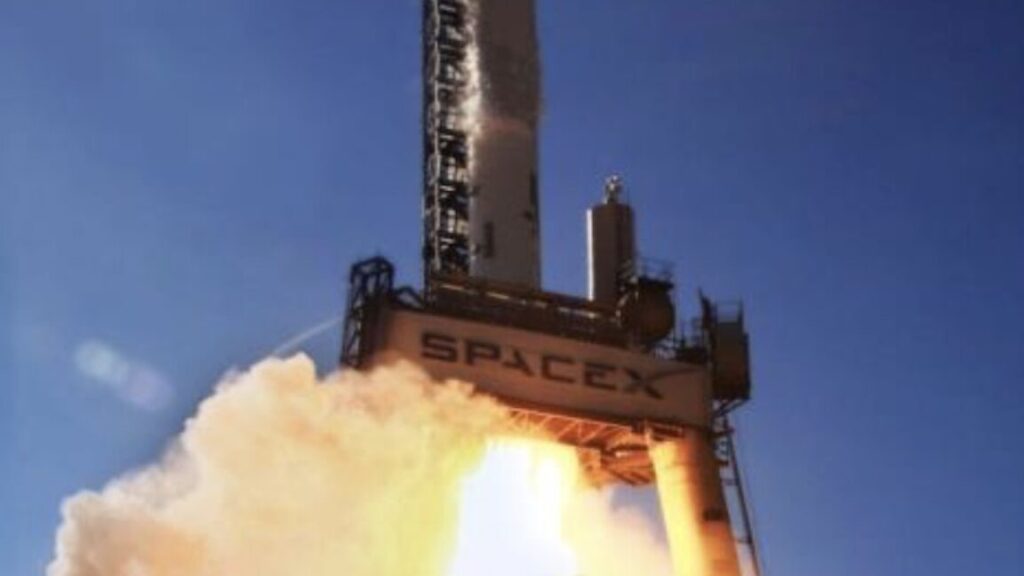
A Falcon 9 booster fires its engines on SpaceX’s “tripod” test stand in McGregor, Texas. Credit: SpaceX

Welcome to Edition 7.19 of the Rocket Report! Okay, we get it. We received more submissions from our readers on Australia’s approval of a launch permit for Gilmour Space than we’ve received on any other news story in recent memory. Thank you for your submissions as global rocket activity continues apace. We’ll cover Gilmour in more detail as they get closer to launch. There will be no Rocket Report next week as Eric and I join the rest of the Ars team for our 2024 Technicon in New York.

As always, we welcome reader submissions. If you don’t want to miss an issue, please subscribe using the box below (the form will not appear on AMP-enabled versions of the site). Each report will include information on small-, medium-, and heavy-lift rockets as well as a quick look ahead at the next three launches on the calendar.

Gilmour Space has a permit to fly. Gilmour Space Technologies has been granted a permit to launch its 82-foot-tall (25-meter) orbital rocket from a spaceport in Queensland, Australia. The space company, founded in 2012, had initially planned to lift off in March but was unable to do so without approval from the Australian Space Agency, the Australian Broadcasting Corporation reports. The government approved Gilmour’s launch permit Monday, although the company is still weeks away from flying its three-stage Eris rocket.

A first for Australia … Australia hosted a handful of satellite launches with US and British rockets from 1967 through 1971, but Gilmour’s Eris rocket would become the first all-Australian launch vehicle to reach orbit. The Eris rocket is capable of delivering about 670 pounds (305 kilograms) of payload mass into a Sun-synchronous orbit. Eris will be powered by hybrid rocket engines burning a solid fuel mixed with a liquid oxidizer, making it unique among orbital-class rockets. Gilmour completed a wet dress rehearsal, or practice countdown, with the Eris rocket on the launch pad in Queensland in September. The launch permit becomes active after 30 days, or the first week of December. “We do think we’ve got a good chance of launching at the end of the 30-day period, and we’re going to give it a red hot go,” said Adam Gilmour, the company’s co-founder and CEO. (submitted by Marzipan, mryall, ZygP, Ken the Bin, Spencer Willis, MarkW98, and EllPeaTea)

North Korea tests new missile. North Korea apparently completed a successful test of its most powerful intercontinental ballistic missile on October 31, lofting it nearly 4,800 miles (7,700 kilometers) into space before the projectile fell back to Earth, Ars reports. This solid-fueled, multi-stage missile, named the Hwasong-19, is a new tool in North Korea’s increasingly sophisticated arsenal of weapons. It has enough range—perhaps as much as 9,320 miles (15,000 kilometers), according to Japan’s government—to strike targets anywhere in the United States. It also happens to be one of the largest ICBMs in the world, rivaling the missiles fielded by the world’s more established nuclear powers.

Quid pro quo? … The Hwasong-19 missile test comes as North Korea deploys some 10,000 troops inside Russia to support the country’s war against Ukraine. The budding partnership between Russia and North Korea has evolved for several years. Russian President Vladimir Putin has met with North Korean leader Kim Jong Un on multiple occasions, most recently in Pyongyang in June. This has fueled speculation about what Russia is offering North Korea in exchange for the troops deployed on Russian soil. US and South Korean officials have some thoughts. They said North Korea is likely to ask for technology transfers in diverse areas related to tactical nuclear weapons, ICBMs, and reconnaissance satellites.

The easiest way to keep up with Eric Berger’s and Stephen Clark’s reporting on all things space is to sign up for our newsletter. We’ll collect their stories and deliver them straight to your inbox.

Sign Me Up!

Virgin Galactic is on the hunt for cash. Virgin Galactic is proposing to raise $300 million in additional capital to accelerate production of suborbital spaceplanes and a mothership aircraft the company says can fuel its long-term growth, Space News reports. The company, founded by billionaire Richard Branson, suspended operations of its VSS Unity suborbital spaceplane earlier this year. VSS Unity hit a monthly flight cadence carrying small groups of space tourists and researchers to the edge of space, but it just wasn’t profitable. Now, Virgin Galactic is developing larger Delta-class spaceplanes it says will be easier and cheaper to turn around between flights.

All-in with Delta … Michael Colglazier, Virgin Galactic’s CEO, announced the company’s appetite for fundraising in a quarterly earnings call with investment analysts Wednesday. He said manufacturing of components for Virgin Galactic’s first two Delta-class ships, which the company says it can fund with existing cash, is proceeding on schedule at a factory in Arizona. Virgin Galactic previously said it would use revenue from paying passengers on its first two Delta-class ships to pay for development of future vehicles. Instead, Virgin Galactic now says it wants to raise money to speed up work on the third and fourth Delta-class vehicles, along with a second airplane mothership to carry the spaceplanes aloft before they release and fire into space. (submitted by Ken the Bin and EllPeaTea)

ESA breaks its silence on Themis. The European Space Agency has provided a rare update on the progress of its Themis reusable booster demonstrator project, European Spaceflight reports. ESA is developing the Themis test vehicle for atmospheric flights to fine-tune technologies for a future European reusable rocket capable of vertical takeoffs and vertical landings. Themis started out as a project led by CNES, the French space agency, in 2018. ESA member states signed up to help fund the project in 2019, and the agency awarded ArianeGroup a contract to move forward with Themis in 2020. At the time, the first low-altitude hop test was expected to take place in 2022.

Some slow progress … Now, the first low-altitude hop is scheduled for 2025 from Esrange Space Centre in Sweden, a three-year delay. This week, ESA said engineers have completed testing of the Themis vehicle’s main systems, and assembly of the demonstrator is underway in France. A single methane-fueled Prometheus engine, also developed by ArianeGroup, has been installed on the rocket. Teams are currently adding avionics, computers, electrical systems, and cable harnesses. Themis’ stainless steel propellant tanks have been manufactured, tested, and cleaned and are now ready to be installed on the Themis demonstrator. Then, the rocket will travel by road from France to the test site in Sweden for its initial low-altitude hops. After those flights are complete, officials plan to add two more Prometheus engines to the rocket and ship it to French Guiana for high-altitude test flights. (submitted by Ken the Bin and EllPeaTea)

SpaceX will give the ISS a boost. A Cargo Dragon spacecraft docked to the International Space Station on Tuesday morning, less than a day after lifting off from Florida. As space missions go, this one is fairly routine, ferrying about 6,000 pounds (2,700 kilograms) of cargo and science experiments to the space station. One thing that’s different about this mission is that it delivered to the station a tiny 2 lb (900 g) satellite named LignoSat, the first spacecraft made of wood, for later release outside the research complex. There is one more characteristic of this flight that may prove significant for NASA and the future of the space station, Ars reports. As early as Friday, NASA and SpaceX have scheduled a “reboost and attitude control demonstration,” during which the Dragon spacecraft will use some of the thrusters at the base of the capsule. This is the first time the Dragon spacecraft will be used to move the space station.

Dragon’s breath … Dragon will fire a subset of its 16 Draco thrusters, each with about 90 pounds of thrust, for approximately 12.5 minutes to make a slight adjustment to the orbital trajectory of the roughly 450-ton space station. SpaceX and NASA engineers will analyze the results from the demonstration to determine if Dragon could be used for future space station reboost opportunities. The data will also inform the design of the US Deorbit Vehicle, which SpaceX is developing to perform the maneuvers required to bring the space station back to Earth for a controlled, destructive reentry in the early 2030s. For NASA, demonstrating Dragon’s ability to move the space station will be another step toward breaking free of reliance on Russia, which is currently responsible for providing propulsion to maneuver the orbiting outpost. Northrop Grumman’s Cygnus supply ship also previously demonstrated a reboost capability. (submitted by Ken the Bin and N35t0r)

Russia launches Soyuz in service of Iran. Russia launched a Soyuz rocket Monday carrying two satellites designed to monitor the space weather around Earth and 53 small satellites, including two Iranian ones, Reuters reports. The primary payloads aboard the Soyuz-2.1b rocket were two Ionosfera-M satellites to probe the ionosphere, an outer layer of the atmosphere near the edge of space. Solar activity can alter conditions in the ionosphere, impacting communications and navigation. The two Iranian satellites on this mission were named Kowsar and Hodhod. They will collect high-resolution reconnaissance imagery and support communications for Iran.

A distant third … This was only the 13th orbital launch by Russia this year, trailing far behind the United States and China. We know of two more Soyuz flights planned for later this month, but no more, barring a surprise military launch (which is possible). The projected launch rate puts Russia on pace for its quietest year of launch activity since 1961, the year Yuri Gagarin became the first person to fly in space. A major reason for this decline in launches is the decisions of Western governments and companies to move their payloads off of Russian rockets after the invasion of Ukraine. For example, OneWeb stopped launching on Soyuz in 2022, and the European Space Agency suspended its partnership with Russia to launch Soyuz rockets from French Guiana. (submitted by Ken the Bin)

H3 deploys Japanese national security satellite. Japan launched a defense satellite Monday aimed at speedier military operations and communication on an H3 rocket and successfully placed it into orbit, the Associated Press reports. The Kirameki 3 satellite will use high-speed X-band communication to support Japan’s defense ministry with information and data sharing, and command and control services. The satellite will serve Japanese land, air, and naval forces from its perch in geostationary orbit alongside two other Kirameki communications satellites.

Gaining trust … The H3 is Japan’s new flagship rocket, developed by Mitsubishi Heavy Industries (MHI) and funded by the Japan Aerospace Exploration Agency (JAXA). The launch of Kirameki 3 marked the third consecutive successful launch of the H3 rocket, following a debut flight in March 2023 that failed to reach orbit. This was the first time Japan’s defense ministry put one of its satellites on the H3 rocket. The first two Kirameki satellites launched on a European Ariane 5 and a Japanese H-IIA rocket, which the H3 will replace. (submitted by Ken the Bin, tsunam, and EllPeaTea)

Rocket Lab enters the race for military contracts. Rocket Lab is aiming to chip away at SpaceX’s dominance in military space launch, confirming its bid to compete for Pentagon contracts with its new medium-lift rocket, Neutron, Space News reports. Last month, the Space Force released a request for proposals from launch companies seeking to join the military’s roster of launch providers in the National Security Space Launch (NSSL) program. The Space Force will accept bids for launch providers to “on-ramp” to the NSSL Phase 3 Lane 1 contract, which doles out task orders to launch companies for individual missions. In order to win a task order, a launch provider must be on the Phase 3 Lane 1 contract. Currently, SpaceX, United Launch Alliance, and Blue Origin are the only rocket companies eligible. SpaceX won all of the first round of Lane 1 task orders last month.

Joining the club … The Space Force is accepting additional risk for Lane 1 missions, which largely comprise repeat launches deploying a constellation of missile-tracking and data-relay satellites for the Space Development Agency. A separate class of heavy-lift missions, known as Lane 2, will require rockets to undergo a thorough certification by the Space Force to ensure their reliability. In order for a launch company to join the Lane 1 roster, the Space Force requires bidders to be ready for a first launch by December 2025. Peter Beck, Rocket Lab’s founder and CEO, said he thinks the Neutron rocket will be ready for its first launch by then. Other new medium-lift rockets, such as Firefly Aerospace’s MLV and Relativity’s Terran-R, almost certainly won’t be ready to launch by the end of next year, leaving Rocket Lab as the only company that will potentially join incumbents SpaceX, ULA, and Blue Origin. (submitted by Ken the Bin)

Next Starship flight is just around the corner. Less than a month has passed since the historic fifth flight of SpaceX’s Starship, during which the company caught the booster with mechanical arms back at the launch pad in Texas. Now, another test flight could come as soon as November 18, Ars reports. The improbable but successful recovery of the Starship first stage with “chopsticks” last month, and the on-target splashdown of the Starship upper stage halfway around the world, allowed SpaceX to avoid an anomaly investigation by the Federal Aviation Administration. Thus, the company was able to press ahead on a sixth test flight if it flew a similar profile. And that’s what SpaceX plans to do, albeit with some notable additions to the flight plan.

Around the edges … Perhaps the most significant change to the profile for Flight 6 will be an attempt to reignite a Raptor engine on Starship while it is in space. SpaceX tried to do this on a test flight in March but aborted the burn because the ship’s rolling motion exceeded limits. A successful demonstration of a Raptor engine relight could pave the way for SpaceX to launch Starship into a higher stable orbit around Earth on future test flights. This is required for SpaceX to begin using Starship to launch Starlink Internet satellites and perform in-orbit refueling experiments with two ships docked together. (submitted by EllPeaTea)

China’s version of Starship. China has updated the design of its next-generation heavy-lift rocket, the Long March 9, and it looks almost exactly like a clone of SpaceX’s Starship rocket, Ars reports. The Long March 9 started out as a conventional-looking expendable rocket, then morphed into a launcher with a reusable first stage. Now, the rocket will have a reusable booster and upper stage. The booster will have 30 methane-fueled engines, similar to the number of engines on SpaceX’s Super Heavy booster. The upper stage looks remarkably like Starship, with flaps in similar locations. China intends to fly this vehicle for the first time in 2033, nearly a decade from now.

A vehicle for the Moon … The reusable Long March 9 is intended to unlock robust lunar operations for China, similar to the way Starship, and to some extent Blue Origin’s Blue Moon lander, promises to support sustained astronaut stays on the Moon’s surface. China says it plans to land its astronauts on the Moon by 2030, initially using a more conventional architecture with an expendable rocket named the Long March 10, and a lander reminiscent of NASA’s Apollo lunar lander. These will allow Chinese astronauts to remain on the Moon for a matter of days. With Long March 9, China could deliver massive loads of cargo and life support resources to sustain astronauts for much longer stays.

Ta-ta to the tripod. The large three-legged vertical test stand at SpaceX’s engine test site in McGregor, Texas, is being decommissioned, NASA Spaceflight reports. Cranes have started removing propellant tanks from the test stand, nicknamed the tripod, towering above the Central Texas prairie. McGregor is home to SpaceX’s propulsion test team and has 16 test cells to support firings of Merlin, Raptor, and Draco engines multiple times per day for the Falcon 9 rocket, Starship, and Dragon spacecraft.

Some history … The tripod might have been one of SpaceX’s most important assets in the company’s early years. It was built by Beal Aerospace for liquid-fueled rocket engine tests in the late 1990s. Beal Aerospace folded, and SpaceX took over the site in 2003. After some modifications, SpaceX installed the first qualification version of its Falcon 9 rocket on the tripod for a series of nine-engine test-firings leading up to the rocket’s inaugural flight in 2010. SpaceX test-fired numerous new Falcon 9 boosters on the tripod before shipping them to launch sites in Florida or California. Most recently, the tripod was used for testing of Raptor engines destined to fly on Starship and the Super Heavy booster.

Next three launches

Nov. 9:  Long March 2C | Unknown Payload | Jiuquan Satellite Launch Center, China | 03: 40 UTC

Nov. 9: Falcon 9 | Starlink 9-10 | Vandenberg Space Force Base, California | 06: 14 UTC

Nov. 10:  Falcon 9 | Starlink 6-69 | Cape Canaveral Space Force Station, Florida | 21: 28 UTC

Photo of Stephen Clark

Stephen Clark is a space reporter at Ars Technica, covering private space companies and the world’s space agencies. Stephen writes about the nexus of technology, science, policy, and business on and off the planet.

Rocket Report: Australia says yes to the launch; Russia delivers for Iran Read More »

nro-chief:-“you-can’t-hide”-from-our-new-swarm-of-spacex-built-spy-satellites

NRO chief: “You can’t hide” from our new swarm of SpaceX-built spy satellites


“A satellite is always coming over an area within a given reasonable amount of time.”

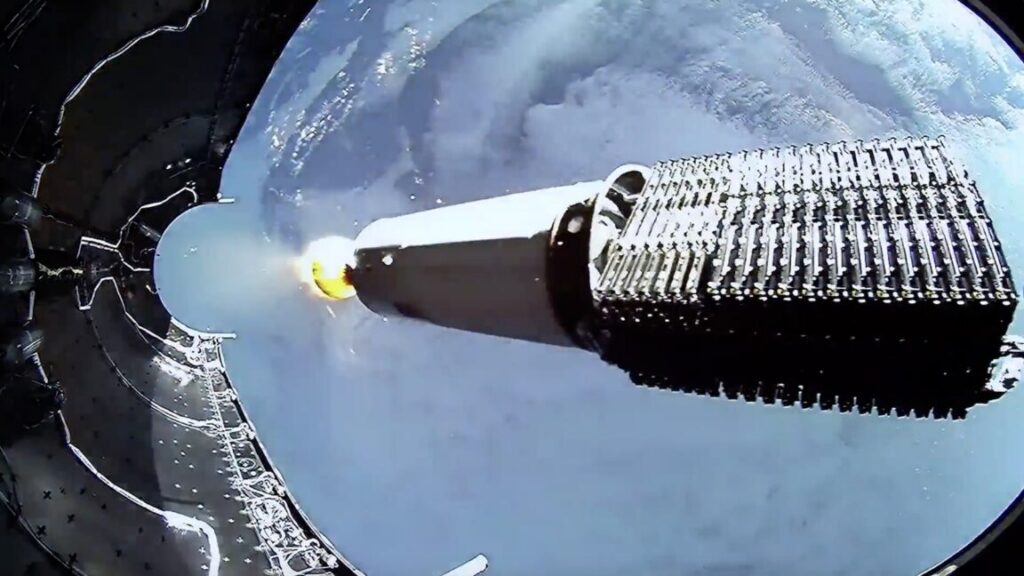
This frame from a SpaceX video shows a stack of Starlink Internet satellites attached to the upper stage of a Falcon 9 rocket, moments after jettison of the launcher’s payload fairing. Credit: SpaceX

The director of the National Reconnaissance Office has a message for US adversaries around the world.

“You can’t hide, because we’re constantly looking,” said Chris Scolese, a longtime NASA engineer who took the helm of the US government’s spy satellite agency in 2019.

The NRO is taking advantage of SpaceX’s Starlink satellite assembly line to build a network of at least 100 satellites, and perhaps many more, to monitor adversaries around the world. So far, more than 80 of these SpaceX-made spacecraft, each a little less than a ton in mass, have launched on four Falcon 9 rockets. There are more to come.

A large number of these mass-produced satellites, or what the NRO calls a “proliferated architecture,” will provide regularly updated imagery of foreign military installations and other sites of interest to US intelligence agencies. Scolese said the new swarm of satellites will “get us reasonably high-resolution imagery of the Earth, at a high rate of speed.”

This is a significant change in approach for the NRO, which has historically operated a smaller number of more expensive satellites, some as big as a school bus.

“We expect to quadruple the number of satellites we have to have on-orbit in the next decade,” said Col. Eric Zarybnisky, director of the NRO’s office of space launch, during an October 29 presentation at the Wernher von Braun Space Exploration Symposium in Huntsville, Alabama.

The NRO is not the only national security agency eyeing a constellation of satellites in low-Earth orbit. The Pentagon’s Space Development Agency plans to kick off a rapid-fire launch cadence next year to begin placing hundreds of small satellites in orbit to detect and track missiles threatening US or allied forces. The Space Force is also interested in buying its own set of SpaceX satellites for broadband connectivity.

The Pentagon started moving in this direction about a decade ago, when leaders raised concerns that the legacy fleets of military and spy satellites were at risk of attack. Now, Elon Musk’s SpaceX and a handful of other companies, many of them startups, specialize in manufacturing and launching small satellites at relatively low cost.

“Why didn’t we do this earlier? Well, launch costs were high, right?” said Troy Meink, the NRO’s principal deputy director, in an October 17 discussion hosted by the Mitchell Institute for Aerospace Studies. “The cost of entry was pretty high, which has come way down. Then, digital electronics has allowed us to build capability in a much smaller package, and a combination of those two is really what’s enabled it.”

A constant vigil

NRO officials still expect to require some large satellites with sharp-eyed optics—think of a Hubble Space Telescope pointed at Earth—to resolve the finest details of things like missile installations, naval fleets, or insurgent encampments. The drawback of this approach is that, at best, a few big optical or radar imaging satellites only fly over places of interest several times per day.

With the proliferated architecture, the NRO will capture views of most places on Earth a lot more often. Two of the most important metrics with a remote-sensing satellite system are imaging resolution and revisit time, or how often a satellite is over a specific location on Earth.

“We need to have persistence or fast revisit,” Scolese said on October 3 in a discussion at the Center for Strategic and International Studies, a nonprofit Washington think tank. “You can proliferate your architecture, put more satellites up there, so that a satellite is always coming over an area within a given reasonable amount of time that’s needed by the users. That’s what we’re doing with the proliferated architecture.

“That’s enabled by a really rich commercial industry that’s building hundreds or thousands of satellites,” Scolese said. “That allowed us to take those satellites, adapt them to our use at low cost, and apply whatever sensor is needed to go off and acquire the information that’s needed at whatever revisit time is required.”

The NRO’s logo for its proliferated satellite constellation, with the slogan “Strength in Numbers.”

Credit: National Reconnaissance Office

The NRO’s logo for its proliferated satellite constellation, with the slogan “Strength in Numbers.” Credit: National Reconnaissance Office

The NRO has identified other benefits, too. It’s a lot more difficult for a country like Russia or China to take out an entire constellation of satellites than to destroy or disable a single spy platform in orbit. Military officials have often referred to these expensive one-off satellites as “big juicy targets” for potential adversaries.

“It gives us a degree of resilience that we didn’t have before,” Scolese said.

The proliferated constellation also allows the NRO to be more nimble in responding to threats or new technologies. If a new type of sensor becomes available, or an adversary does something new that intelligence analysts want to look at, the NRO and its contractor can quickly swap out payloads on satellites going through the production line.

“That’s a huge change for an organization like the NRO,” Zarybnisky said. “It’s a catalyst. Another catalyst for innovation in the NRO is these smaller, lower price-point systems. Rapid turn time means you can introduce that next technology into the next generation and not wait for many years or even decades to introduce new technologies.”

Three-letter agencies

The NRO provides imaging, signals, and electronic intelligence data from its satellites to the National Security Agency, the National Geospatial-Intelligence Agency, and the Department of Defense. Scolese said the NRO wants to get actionable information into the hands of users across the federal government as quickly as possible, but the volume of data coming down from hundreds of satellites presents a challenge.

“Once you go to a proliferated architecture and you’re going from a few satellites to tens of satellites to now hundreds of satellites, you have to change a lot of things, and we’re in the process of doing that,” Scolese said.

With so many satellites, it “means that it’s no longer possible for an individual sitting at a control center to say, ‘I know what this satellite is doing,'” Scolese said. “So we have to have the machines to go off and help us there. We need artificial intelligence, machine learning, automated processes to help us do that.”

“We will deliver data in seconds, not minutes, and not hours,” Zarybnisky said.

The existence of this constellation was made public in March, when Reuters reported the NRO was working with SpaceX to develop and deploy a network of satellites in low-Earth orbit. SpaceX’s Starshield business unit is building the satellites under a $1.8 billion contract signed in 2021, according to Reuters. This is remarkably inexpensive by the standards of the NRO, which has spent more money just constructing a satellite processing facility at Cape Canaveral, Florida (thanks to Eric Berger’s reporting in Reentry for this juicy tidbit).

Chris Scolese appears before the Senate Armed Services Committee in 2019 during a confirmation hearing to become director of the National Reconnaissance Office.

Chris Scolese appears before the Senate Armed Services Committee in 2019 during a confirmation hearing to become director of the National Reconnaissance Office. Credit: Tom Williams/CQ Roll Call

Reuters reported Northrop Grumman is supplying sensors to mount on at least some of the SpaceX-built satellites, but their design and capabilities remain classified. The NRO, which usually keeps its work secret, officially acknowledged the program in April, a month before the first batch of satellites launched from Vandenberg Space Force Base, California.

SpaceX revealed the existence of the Starshield division in 2022, the year after signing the NRO contract, as a vehicle for applying the company’s experience manufacturing Starlink Internet satellites to support US national security missions. SpaceX has built and launched more than 7,200 Starlink satellites since 2019, with more than 6,000 currently operational, 10 times larger than any other existing satellite constellation.

The current generation of Starlink satellites launch in batches of 20 to 23 spacecraft on SpaceX’s Falcon 9 rocket. They’re flat-packed one on top of the other inside the Falcon 9’s payload shroud, then released all at once in orbit. The NRO’s new satellites likely use the same basic design, launching in groups of roughly 21 satellites on each mission.

According to Scolese, the NRO owns these SpaceX-built satellites, rather than SpaceX owning them and supplying data to the government through a service contract arrangement. By the end of the year, the NRO’s director anticipates having at least 100 of these satellites in orbit, with additional launches expected through 2028.

“We are going from the demo phase to the operational phase, where we’re really going to be able to start testing all of this stuff out in a more operational way,” Scolese said.

The NRO is buttressing its network of government-owned satellites with data buys from commercial remote-sensing companies, such as Maxar, Planet, and BlackSky. One advantage of commercial imagery is the NRO can share it widely with allies and the public because it isn’t subject to top-secret classification restrictions.

Scolese said it’s important to maintain a diversity of sources and observation methods to overcome efforts from other nations to hide what they’re doing. This means using more satellites, as the NRO is doing with SpaceX and other commercial partners. It also means using electro-optical, radar, thermal infrared, and electronic detection sensors to fully characterize what intelligence analysts are seeing.

The NRO is also studying more exotic methods like quantum remote sensing, using the principles of quantum physics at the atomic level.

“There’s camouflage,” Scolese said. “There are lots of techniques that can be used, which means we have to go off and look at very different phenomenologies, and we’ve developed and are developing capabilities that will allow us to defeat those types of activities. Quantum sensing is one of them. You can’t really hide from fundamental physics.”

Photo of Stephen Clark

Stephen Clark is a space reporter at Ars Technica, covering private space companies and the world’s space agencies. Stephen writes about the nexus of technology, science, policy, and business on and off the planet.

NRO chief: “You can’t hide” from our new swarm of SpaceX-built spy satellites Read More »

astronaut-hospitalized-after-returning-from-235-day-space-mission

Astronaut hospitalized after returning from 235-day space mission

NASA said Friday one its astronauts is in a hospital in Florida for medical observation after a “normal” predawn splashdown in the Gulf of Mexico inside a SpaceX capsule.

The mission’s other three crew members were cleared to return to their home base at Johnson Space Center in Houston after their own medical evaluations, NASA said.

The hospitalized astronaut “is in stable condition and under observation as a precautionary measure,” a NASA spokesperson said in a statement. The agency did not identify the astronaut or provide any more details about their condition, citing medical privacy protections.

Strapped into their seats onside SpaceX’s Crew Dragon Endeavour spacecraft, the four-person crew splashed down just south of Pensacola, Florida, at 3: 29 am EDT (07: 29 UTC) Friday, wrapping up a 235-day mission in low-Earth orbit.

NASA extended their stay at the International Space Station earlier this year to accommodate schedule changes caused by the troubled test flight of Boeing’s Starliner spacecraft, then to wait for better weather conditions in SpaceX’s recovery zones near Florida.

Commander Matthew Dominick, pilot Michael Barratt, mission specialist Jeanette Epps, and Russian cosmonaut Alexander Grebenkin were inside SpaceX’s Dragon spacecraft for reentry and splashdown. NASA said one of its astronauts “experienced a medical issue” after the splashdown, and all four crew members were flown to Ascension Sacred Heart Pensacola for medical evaluation.

Three of the crew members were later released and departed Pensacola on a NASA business jet to fly back to Houston, according to NASA. The unidentified astronaut remains at Ascension.

“We’re grateful to Ascension Sacred Heart for its support during this time, and we are proud of our team for its quick action to ensure the safety of our crew members,” the NASA spokesperson said. “NASA will provide additional information as it becomes available.”

Roscosmos cosmonaut Alexander Grebenkin, left, NASA astronauts Michael Barratt, second from left, Matthew Dominick, second from right, and Jeanette Epps, right are seen inside the SpaceX Dragon Endeavour spacecraft shortly after splashdown Friday morning.

Credit: NASA/Joel Kowsky

Roscosmos cosmonaut Alexander Grebenkin, left, NASA astronauts Michael Barratt, second from left, Matthew Dominick, second from right, and Jeanette Epps, right are seen inside the SpaceX Dragon Endeavour spacecraft shortly after splashdown Friday morning. Credit: NASA/Joel Kowsky

This mission, named Crew-8, was SpaceX’s eighth operational crew rotation flight to the space station under a multibillion-dollar commercial crew contract with NASA. This was the first flight to space for Dominick, Epps, and Grebenkin, and the third space mission for Barratt.

Roscosmos, the Russian space agency, released a photo of Grebenkin standing in Pensacola a few hours after splashdown. “After the space mission and splashdown, cosmonaut Alexander Grebenkin feels great!” Roscosmos posted on its Telegram channel.

Adapting to Earth

This is not the first time an astronaut has been hospitalized after returning to Earth, but it is uncommon. South Korean astronaut Yi So-yeon was hospitalized for back pain after experiencing higher-than-expected g-forces during reentry in a Russian Soyuz spacecraft in 2008.

Three NASA astronauts were hospitalized in Hawaii after splashing down at the end of the Apollo-Soyuz Test Project mission in 1975. The astronauts suffered lung irritation after breathing in toxic vapors from the Apollo spacecraft’s thrusters in the final moments before splashdown.

Astronaut hospitalized after returning from 235-day space mission Read More »