cape canaveral space force station

rivals-object-to-spacex’s-starship-plans-in-florida—who’s-interfering-with-whom?

Rivals object to SpaceX’s Starship plans in Florida—who’s interfering with whom?


“We’re going to continue to treat any LOX-methane vehicle with 100 percent TNT blast equivalency.”

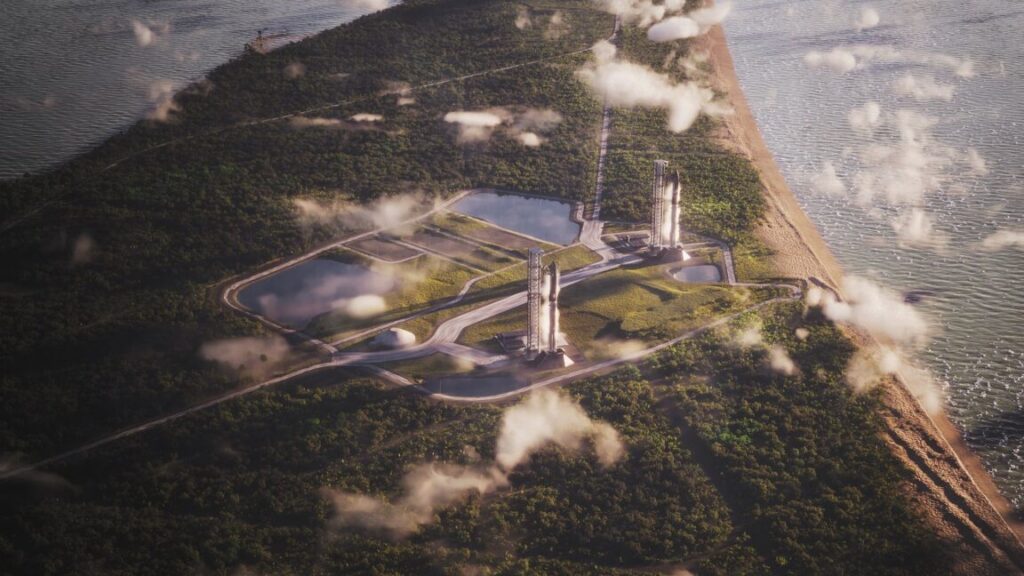
Artist’s illustration of Starships stacked on two launch pads at the Space Force’s Space Launch Complex 37 at Cape Canaveral, Florida. Credit: SpaceX

The commander of the military unit responsible for running the Cape Canaveral spaceport in Florida expects SpaceX to begin launching Starship rockets there next year.

Launch companies with facilities near SpaceX’s Starship pads are not pleased. SpaceX’s two chief rivals, Blue Origin and United Launch Alliance, complained last year that SpaceX’s proposal of launching as many as 120 Starships per year from Florida’s Space Coast could force them to routinely clear personnel from their launch pads for safety reasons.

This isn’t the first time Blue Origin and ULA have tried to throw up roadblocks in front of SpaceX. The companies sought to prevent NASA from leasing a disused launch pad to SpaceX in 2013, but they lost the fight.

Col. Brian Chatman, commander of a Space Force unit called Space Launch Delta 45, confirmed to reporters on Friday that Starship launches will sometimes restrict SpaceX’s neighbors from accessing their launch pads—at least in the beginning. Space Launch Delta 45, formerly known as the 45th Space Wing, operates the Eastern Range, which oversees launch safety from Cape Canaveral Space Force Station and NASA’s nearby Kennedy Space Center.

Chatman’s unit is responsible for ensuring all personnel remain outside of danger areas during testing and launch operations. The range’s responsibility extends to public safety outside the gates of the spaceport.

“There is no better time to be here on the Space Coast than where we are at today,” Chatman said. “We are breaking records on the launch manifest. We are getting capability on orbit that is essential to national security, and we’re doing that at a time of strategic challenge.”

SpaceX is well along in constructing a Starship launch site on NASA property at Kennedy Space Center within the confines of Launch Complex-39A, where SpaceX also launches its workhorse Falcon 9 rocket. The company wants to build another Starship launch site on Space Force property a few miles to the south.

“Early to mid-next year is when we anticipate Starship coming out here to be able to launch,” Chatman said. “We’ll have the range ready to support at that time.”

Enter the Goliath

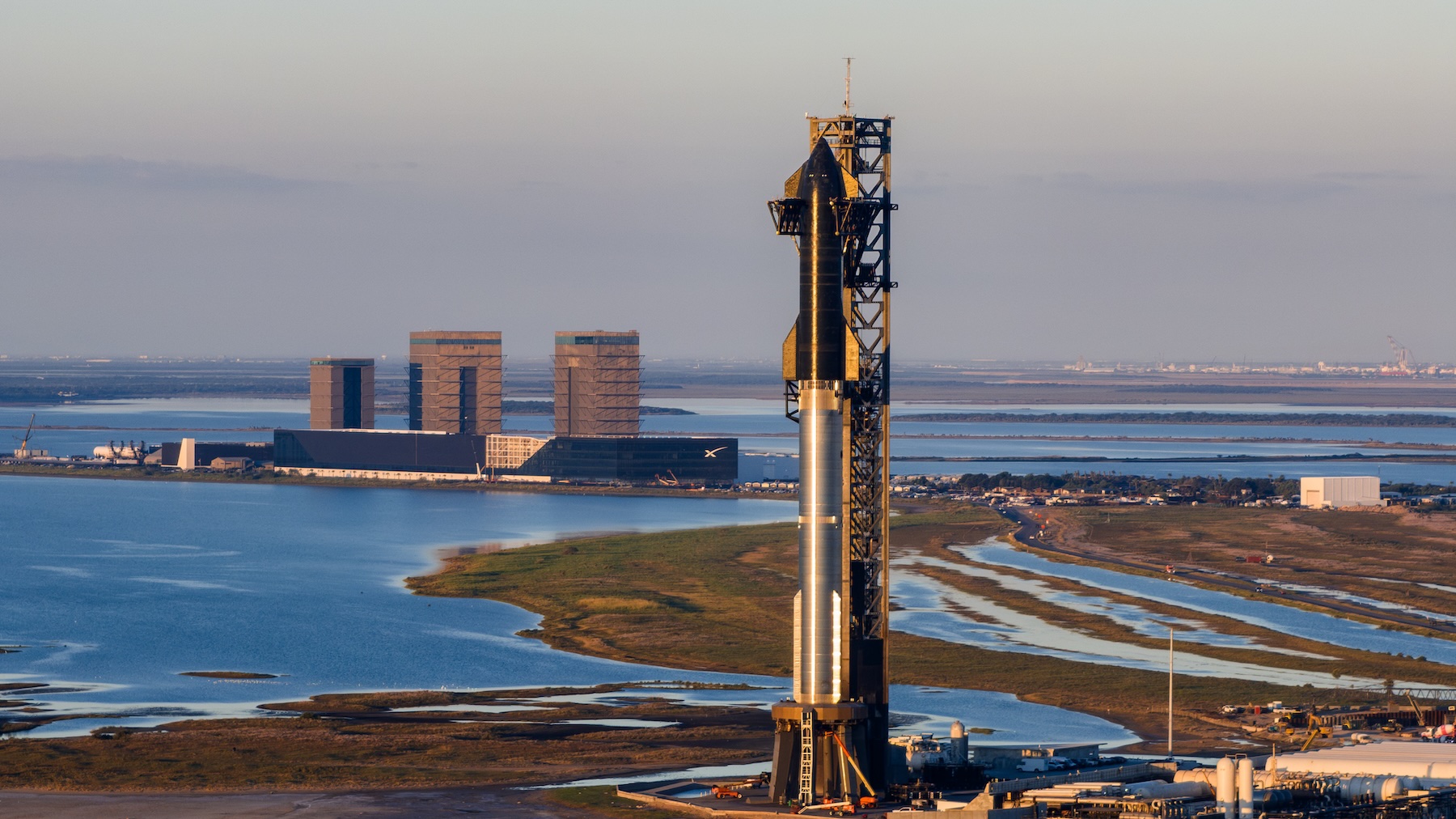
Starship and its Super Heavy booster combine to form the largest rocket ever built. Its newest version stands more than 400 feet (120 meters) tall with more than 11 million pounds (5,000 metric tons) of combustible methane and liquid oxygen propellants. That will be replaced by a taller rocket, perhaps as soon as 2027, with about 20 percent more propellant onboard.

While there’s also risk with Starships and Super Heavy boosters returning to Cape Canaveral from space, safety officials worry about what would happen if a Starship and Super Heavy booster detonated with their propellant tanks full. The concern is the same for all rockets, which is why officials evacuate predetermined keep-out zones around launch pads that are fueled up for flight.

But the keep-out zones around SpaceX’s Starship launch pads will extend farther than those around the other launch sites at Cape Canaveral. First, Starship is simply much bigger and uses more propellant than any other rocket. Secondly, Starship’s engines consume methane fuel in combination with liquid oxygen, a blend commonly known as LOX/methane or methalox.

And finally, Starship lacks the track record of older rockets like the Falcon 9, adding a degree of conservatism to the Space Force’s risk calculations. Other launch pads will inevitably fall within the footprint of Starship’s range safety keep-out zones, also known as blast danger areas, or BDAs.

SpaceX’s Starship and Super Heavy booster lift off from Starbase, Texas, in March 2025. Credit: SpaceX

The danger area will be larger for an actual launch, but workers will still need to clear areas closer to Starship launch pads during static fire tests, when the rocket fires its engines while remaining on the ground. This is what prompted ULA and Blue Origin to lodge their protests.

“They understand neighboring operations,” Chatman said in a media roundtable on Friday. “They understand that we will allow the maximum efficiency possible to facilitate their operations, but there will be times that we’re not going to let them go to their launch complex because it’s neighboring a hazardous activity.”

The good news for these other companies is that Eastern Range’s keep-out zones will almost certainly get smaller by the time SpaceX gets anywhere close to 120 Starship launches per year. SpaceX’s Falcon 9 is currently launching at a similar cadence. The blast danger areas for those launches are small and short-lived because the Space Force’s confidence in the Falcon 9’s safety is “extremely high,” Chatman said.

“From a blast damage assessment perspective, specific to the Falcon 9, we know what that keep-out area is,” Chatman said. “It’s the new combination of new fuels—LOX/methanewhich is kind of a game-changer as we look at some of the heavy vehicles that are coming to launch. We just don’t have the analysis on to be able to say, ‘Hey, from a testing perspective, how small can we reduce the BDA and be safe?’”

Methane has become a popular fuel choice, supplanting refined kerosene, liquid hydrogen, or solid fuels commonly used on previous generations of rockets. Methane leaves behind less soot than kerosene, easing engine reusability, while it’s simpler to handle than liquid hydrogen.

Aside from Starship, Blue Origin’s New Glenn and ULA’s Vulcan rockets use liquified natural gas, a fuel very similar to methane. Both rockets are smaller than Starship, but Blue Origin last week unveiled the design of a souped-up New Glenn rocket that will nearly match Starship’s scale.

A few years ago, NASA, the Space Force, and the Federal Aviation Administration decided to look into the explosive potential of methalox rockets. There had been countless tests of explosions of gaseous methane, but data on detonations of liquid methane and liquid oxygen was scarce at the time—just a couple of tests at less than 10 metric tons, according to NASA. So, the government’s default position was to assume an explosion would be equivalent to the energy released by the same amount of TNT. This assumption drives the large keep-out zones the Space Force has drawn around SpaceX’s future Starship launch pads, one of which is seen in the map below.
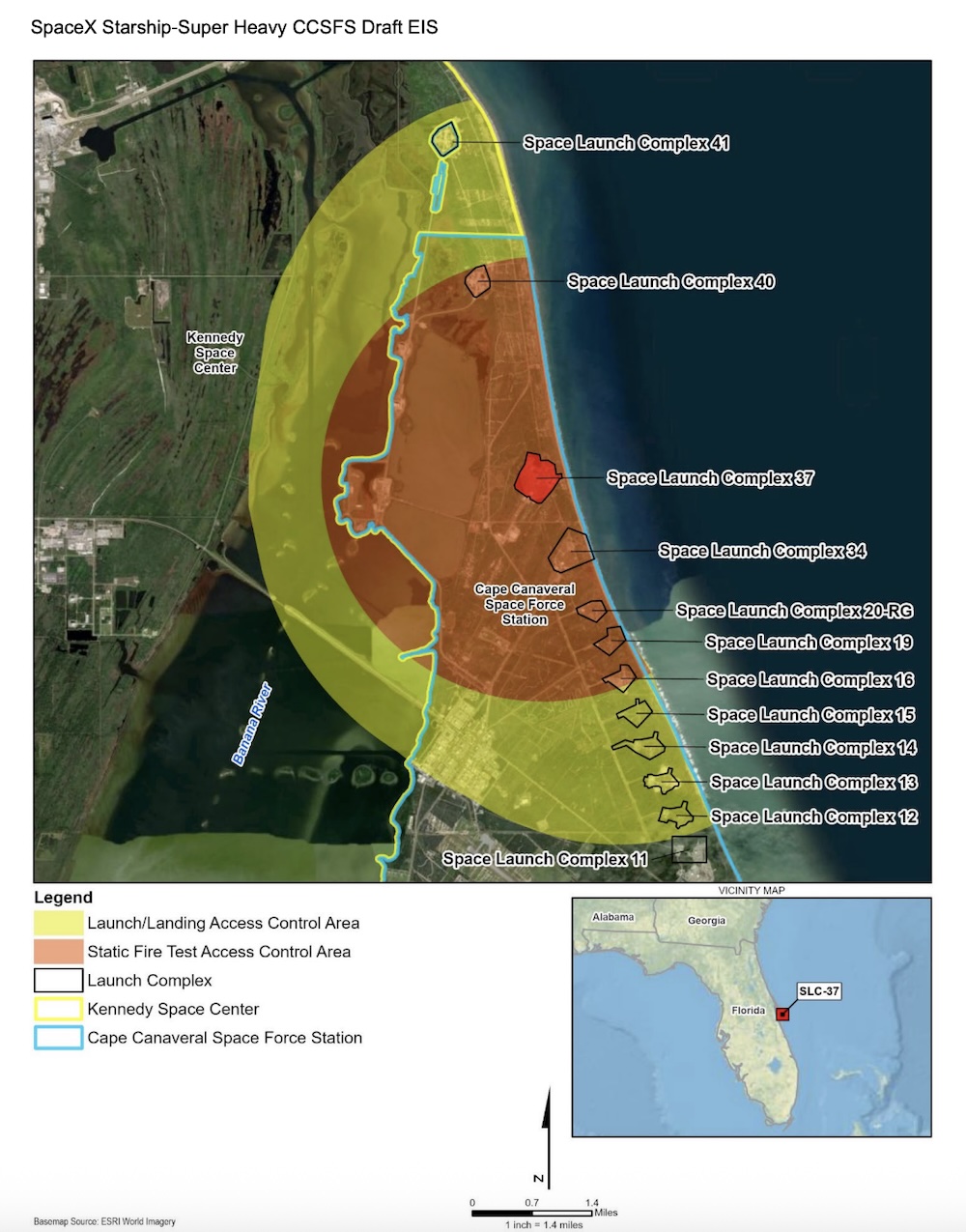
This map from a Space Force environmental impact statement shows potential restricted access zones around SpaceX’s proposed Starship launch site at Space Launch Complex-37. The restricted zones cover launch pads operated by United Launch Alliance, Relativity Space, and Stoke Space. Credit: SpaceX

Spending millions to blow stuff up

Chatman said the Space Force is prepared to update its blast danger areas once its government partners, SpaceX, and Blue Origin complete testing and analyze their results. Over dozens of tests, engineers are examining how methane and liquid oxygen react to different kinds of accidents, such as impact velocity, pressure, mass ratio, or how much propellant is in the mix.

“That is ongoing currently,” Chatman said. “[We are] working in close partnership with SpaceX and Blue Origin on the LOX/methane combination and the explicit equivalency to identify how much we can … reduce that blast radius. Those discussions are happening, have been happening the last couple years, and are looking to culminate here in ’26.

“Until we get that data from the testing that is ongoing and the analysis that needs to occur, we’re going to continue to treat any LOX-methane vehicle with 100 percent TNT blast equivalency, and have a maximized keep-out zone, simply from a public safety perspective,” Chatman said.

The data so far show promising results. “We do expect that BDA to shrink,” he said. “We expect that to shrink based on some of the initial testing that has been done and the initial data reviews that have been done.”

That’s imperative, not just for Starship’s neighbors at the Cape Canaveral spaceport, but for SpaceX itself. The company forecasts a future in which it will launch Starships more often than the Falcon 9, requiring near-continuous operations at multiple launch pads.

Chatman mentioned one future scenario in which SpaceX might want to launch Starships in close proximity to one another from neighboring pads.

“At that point in the future, I do anticipate the blast damage assessments to shrink down based on the testing that will have been accomplished and dataset will have been reviewed, [and] that we’ll be in a comfortable set to be able to facilitate all launch operations. But until we have that data, until I’m comfortable with what that data shows, with regards to reducing the BDA, keep-out zone, we’re going to continue with the 100 percent TNT equivalency just from a public safety perspective.”
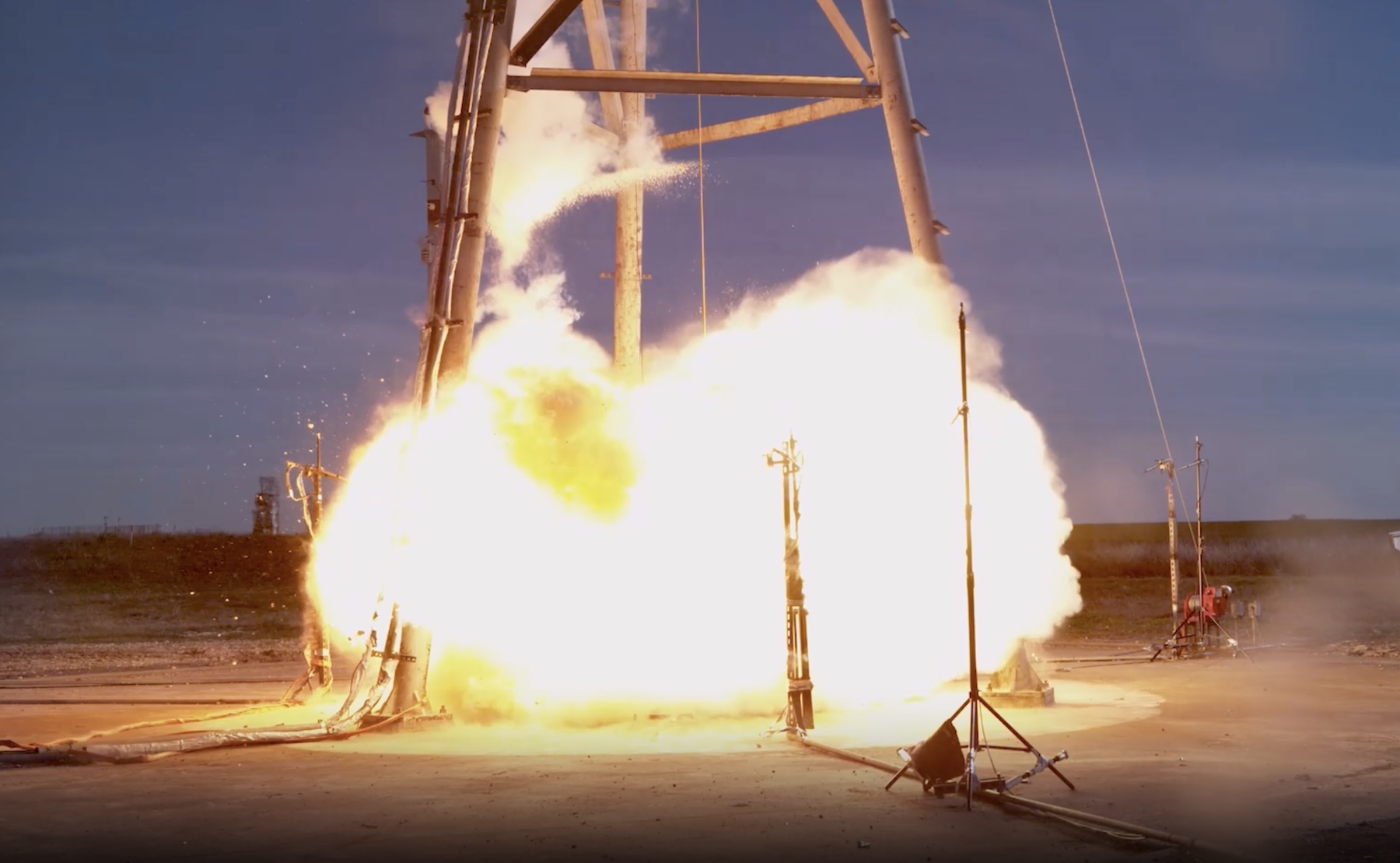
SpaceX has performed explosive LOX/methane tests, including the one seen here, at its development facility in McGregor, Texas. Credit: SpaceX

The Commercial Space Federation, a lobbying group, submitted written testimony to Congress in 2023 arguing the government should be using “existing industry data” to inform its understanding of the explosive potential methane and liquid oxygen. That data, the federation said, suggests the government should set its TNT blast equivalency to no greater than 25 percent, a change that would greatly reduce the size of keep-out zones around launch pads. The organization’s members include prominent methane users SpaceX, Blue Origin, Relativity Space, and Stoke Space, all of which have launch sites at Cape Canaveral.

The government’s methalox testing plans were expected to cost at least $80 million, according to the Commercial Space Federation.

The concern among engineers is that liquid oxygen and methane are highly miscible, meaning they mix together easily, raising the risk of a “condensed phase detonation” with “significantly higher overpressures” than rockets with liquid hydrogen or kerosene fuels. Small-scale mixtures of liquid oxygen and liquified natural gas have “shown a broad detonable range with yields greater than that of TNT,” NASA wrote in 2023.

SpaceX released some basic results of its own methalox detonation tests in September, before the government draws its own conclusions on the matter. The company said it conducted “extensive testing” to refine blast danger areas to “be commensurate with the physics of new launch systems.”

Like the Commercial Space Federation, SpaceX said government officials are relying on “highly conservative approaches to establishing blast danger areas, simply because they lack the data to make refined, accurate clear zones. In the absence of data, clear areas of LOX/methane rockets have defaulted to very large zones that could be disruptive to operations.”

More like an airport

SpaceX said it has conducted sub-scale methalox detonation tests “in close collaboration with NASA,” while also gathering data from full-scale Starship tests in Starbase, Texas, including information from test flights and from recent ground test failures. SpaceX controls much of the land around its South Texas facility, so there’s little interruption to third parties when Starships launch from there.

“With this data, SpaceX has been able to establish a scientifically robust, physics-based yield calculation that will help ‘fill the gap’ in scientific knowledge regarding LOX/methane rockets,” SpaceX said.

The company did not disclose the yield calculation, but it shared maps showing its proposed clear areas around the future Starship launch sites at Cape Canaveral and Kennedy Space Center. They are significantly smarter than the clear areas originally envisioned by the Space Force and NASA, but SpaceX says it uses “actual test data on explosive yield and include a conservative factor of safety.”

The proposed clear distances will have no effect on any other operational launch site or on traffic on the primary north-south road crossing the spaceport, the company said. “SpaceX looks forward to having an open, honest, and reasonable discussion based on science and data regarding spaceport operations with industry colleagues.”

SpaceX will have that opportunity next month. The Space Force and NASA are convening a “reverse industry day” in mid-December during which launch companies will bring their ideas for the future of the Cape Canaveral spaceport to the government. The spaceport has hosted 101 space launches so far this year, an annual record dominated by SpaceX’s rapid-fire Falcon 9 launch cadence.

Chatman anticipates about the same number—perhaps 100 to 115 launches—from Florida’s Space Coast next year, and some forecasts show 300 to 350 launches per year by 2035. The numbers could go down before they rise again. “As we bring on larger lift capabilities like Starship and follow-on large launch capabilities out here to the Eastern Range, that will reduce the total number of launches, because we can get more mass to orbit with heavier lift vehicles,” Chatman said.
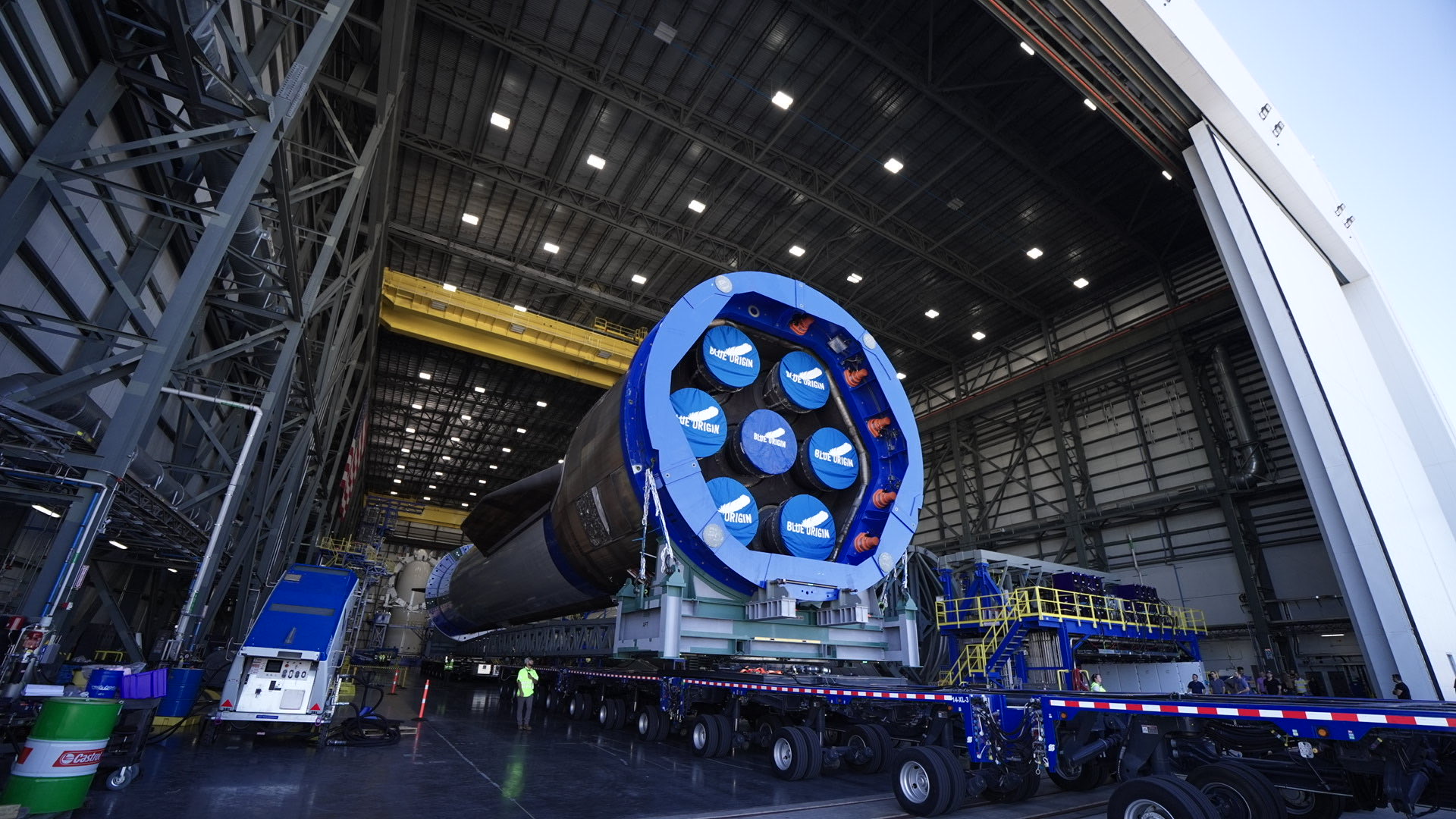
Blue Origin’s first recovered New Glenn booster returned to the company’s launch pad at Cape Canaveral, Florida, last week after a successful launch and landing. Credit: Blue Origin

Launch companies have some work to do to make those numbers become real. Space Force officials have identified their own potential bottlenecks, including a shortage of facilities for preparing satellites for launch and the flow of commodities like propellants and high-pressure gases into the spaceport.

Concerns as mundane as traffic jams are now enough of a factor to consider using automated scanners at vehicle inspection points and potentially adding a dedicated lane for slow-moving transporters carrying rocket boosters from one place to another across the launch base, according to Chatman. This is becoming more important as SpaceX, and now Blue Origin, routinely shuttle their reusable rockets from place to place.

Space Force officials largely attribute the steep climb in launch rates at Cape Canaveral to the launch industry’s embrace of automated self-destruct mechanisms. These pyrotechnic devices have largely replaced manual flight termination systems, which require ground support from a larger team of range safety engineers, including radar operators and flight control officers with the authority to send a destruct command to the rocket if it flies off course. Now, that is all done autonomously on most US launch vehicles.

The Space Force mandated that launch companies using military spaceports switch to autonomous safety systems by October 1 2025, but military officials issued waivers for human-in-the-loop destruct devices to continue flying on United Launch Alliance’s Atlas V rocket, NASA’s Space Launch System, and the US Navy’s ballistic missile fleet. That means those launches will be more labor-intensive for the Space Force, but the Atlas V is nearing retirement, and the SLS and the Navy only occasionally appear on the Cape Canaveral launch schedule.

Listing image: SpaceX

Photo of Stephen Clark

Stephen Clark is a space reporter at Ars Technica, covering private space companies and the world’s space agencies. Stephen writes about the nexus of technology, science, policy, and business on and off the planet.

Rivals object to SpaceX’s Starship plans in Florida—who’s interfering with whom? Read More »
with-another-record-broken,-the-world’s-busiest-spaceport-keeps-getting-busier

With another record broken, the world’s busiest spaceport keeps getting busier


It’s not just the number of rocket launches, but how much stuff they’re carrying into orbit.

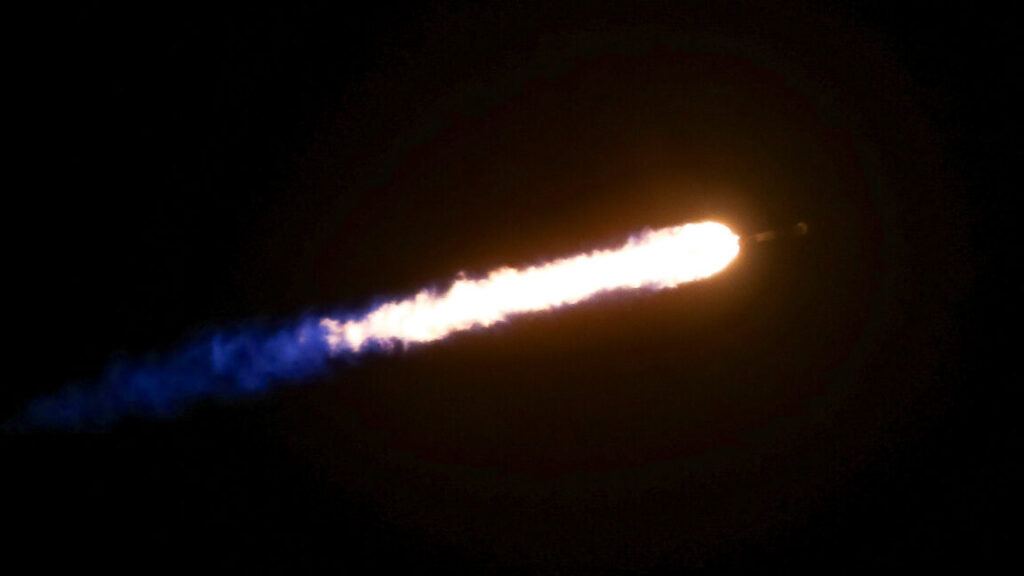
With 29 Starlink satellites onboard, a Falcon 9 rocket streaks through the night sky over Cape Canaveral Space Force Station, Florida, on Monday night. Credit: Stephen Clark/Ars Technica

CAPE CANAVERAL, Florida—Another Falcon 9 rocket fired off its launch pad here on Monday night, taking with it another 29 Starlink Internet satellites to orbit.

This was the 94th orbital launch from Florida’s Space Coast so far in 2025, breaking the previous record for the most satellite launches in a calendar year from the world’s busiest spaceport. Monday night’s launch came two days after a Chinese Long March 11 rocket lifted off from an oceangoing platform on the opposite side of the world, marking humanity’s 255th mission to reach orbit this year, a new annual record for global launch activity.

As of Wednesday, a handful of additional missions have pushed the global figure this year to 259, putting the world on pace for around 300 orbital launches by the end of 2025. This will more than double the global tally of 135 orbital launches in 2021.

Routine vs. complacency

Waiting in the darkness a few miles away from the launch pad, I glanced around at my surroundings before watching SpaceX’s Falcon 9 thunder into the sky. There were no throngs of space enthusiasts anxiously waiting for the rocket to light up the night. No line of photographers snapping photos. Just this reporter and two chipper retirees enjoying what a decade ago would have attracted far more attention.

Go to your local airport and you’ll probably find more people posted up at a plane-spotting park at the end of the runway. Still, a rocket launch is something special. On the same night that I watched the 94th launch of the year depart from Cape Canaveral, Orlando International Airport saw the same number of airplane departures in just three hours.

The crowds still turn out for more meaningful launches, such as a test flight of SpaceX’s Starship megarocket in Texas or Blue Origin’s attempt to launch its second New Glenn heavy-lifter here Sunday. But those are not the norm. Generations of aerospace engineers were taught that spaceflight is not routine for fear of falling into complacency, leading to failure, and in some cases, death.

Compared to air travel, the mantra remains valid. Rockets are unforgiving, with engines operating under extreme pressures, at high thrust, and unable to suck in oxygen from the atmosphere as a reactant for combustion. There are fewer redundancies in a rocket than in an airplane.

The Falcon 9’s established failure rate is less than 1 percent, well short of any safety standard for commercial air travel but good enough to be the most successful orbital-class in history. Given the Falcon 9’s track record, SpaceX seems to have found a way to overcome the temptation for complacency.

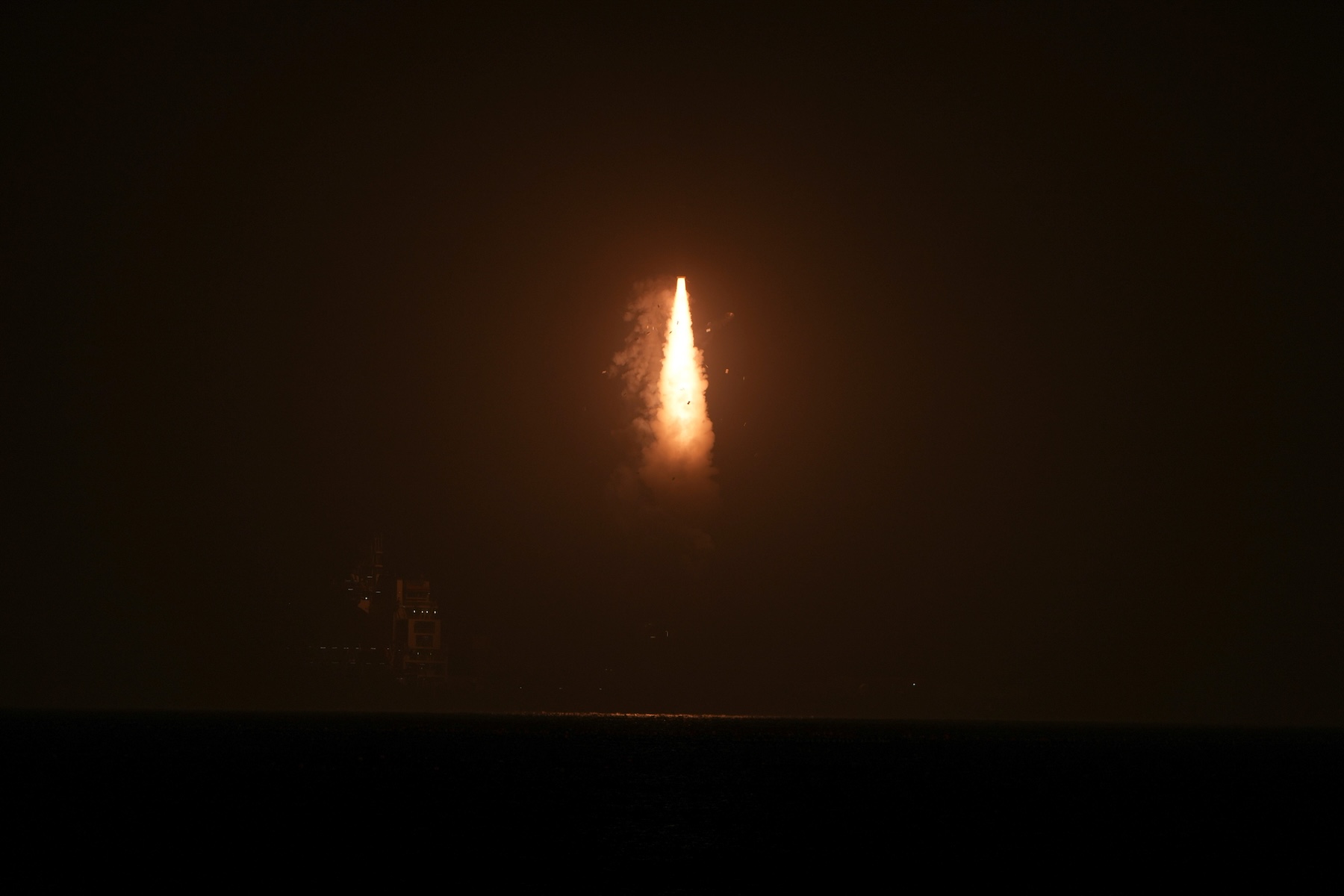
A Chinese Long March 11 rocket carrying three Shiyan 32 test satellites lifts off from waters off the coast of Haiyang in eastern China’s Shandong province on Saturday. Credit: Guo Jinqi/Xinhua via Getty Images

Following the trend

The upward trend in rocket launches hasn’t always been the case. Launch numbers were steady for most of the 2010s, following a downward trend in the 2000s, with as few as 52 orbital launches in 2005, the lowest number since the nascent era of spaceflight in 1961. There were just seven launches from here in Florida that year.

The numbers have picked up dramatically in the last five years as SpaceX has mastered reusable rocketry.

It’s important to look at not just the number of launches but also how much stuff rockets are actually putting into orbit. More than half of this year’s launches were performed using SpaceX’s Falcon 9 rocket, and the majority of those deployed Starlink satellites for SpaceX’s global Internet network. Each spacecraft is relatively small in size and weight, but SpaceX stacks up to 29 of them on a single Falcon 9 to max out the rocket’s carrying capacity.

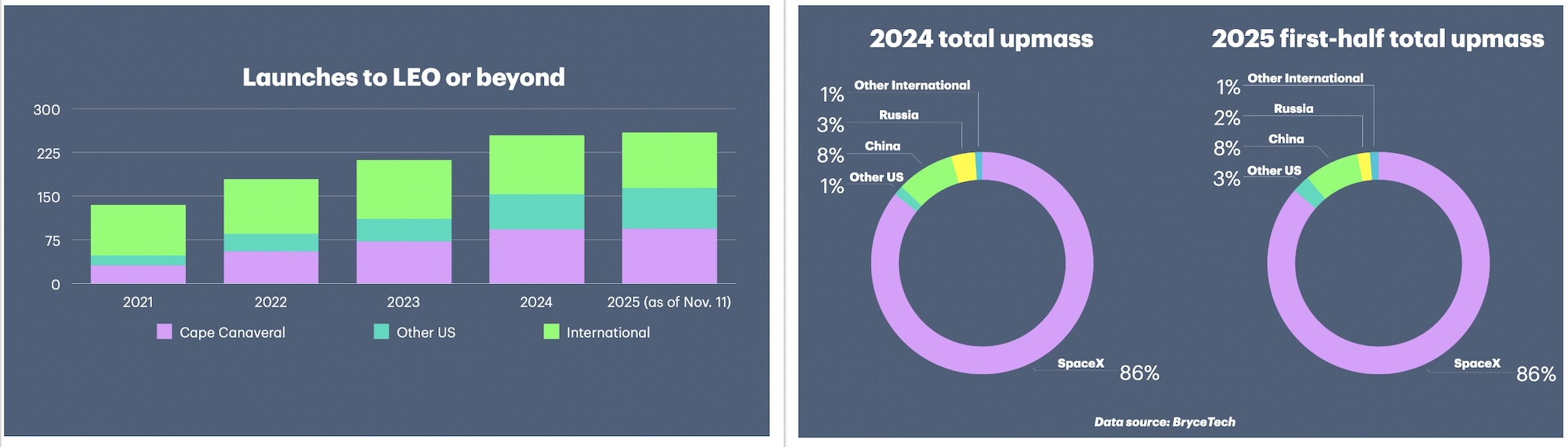
All this mass adds up to make SpaceX’s dominance of the launch industry appear even more absolute. According to analyses by BryceTech, an engineering and space industry consulting firm, SpaceX has launched 86 percent of all the world’s payload mass over the 18 months from the beginning of 2024 through June 30 of this year.

That’s roughly 2.98 million kilograms of the approximately 3.46 million kilograms (3,281 of 3,819 tons) of satellite hardware and cargo that all the world’s rockets placed into orbit during that timeframe.

The charts below were created by Ars Technica using publicly available launch numbers and payload mass estimates from BryceTech. The first illustrates the rising launch cadence at Cape Canaveral Space Force Station and NASA’s Kennedy Space Center, located next to one another in Florida. Launches from other US-licensed spaceports, primarily Vandenberg Space Force Base, California, and Rocket Lab’s base at Māhia Peninsula in New Zealand, are also on the rise.

These numbers represent rockets that reached low-Earth orbit. We didn’t include test flights of SpaceX’s Starship rocket in the chart because all of its launches to have intentionally flown on suborbital trajectories.

In the second chart, we break down the payload upmass to orbit from SpaceX, other US companies, China, Russia, and other international launch providers.

Launch rates are on a clear upward trend, while SpaceX has launched 86 percent of the world’s total payload mass to orbit since the beginning of 2024. Credit: Stephen Clark/Ars Technica/BryceTech

Will it continue?

It’s a good bet that payload upmass will continue to rise in the coming years, with heavy cargo heading to orbit to further expand SpaceX’s Starlink communications network and build out new megaconstellations from Amazon, China, and others. The US military’s Golden Dome missile defense shield will also have a ravenous appetite for rockets to get it into space.

SpaceX’s Starship megarocket could begin flying to low-Earth orbit next year, and if it does, SpaceX’s preeminence in delivering mass to orbit will remain assured. Starship’s first real payloads will likely be SpaceX’s next-generation Starlink satellites. These larger, heavier, more capable spacecraft will launch 60 at a time on Starship, further stretching SpaceX’s lead in the upmass war.

But Starship’s arrival will come at the expense of the workhorse Falcon 9, which lacks the capacity to haul the next-gen Starlinks to orbit. “This year and next year I anticipate will be the highest Falcon launch rates that we will see,” said Stephanie Bednarek, SpaceX’s vice president of commercial sales, at an industry conference in July.

SpaceX is on pace for between 165 and 170 Falcon 9 launches this year, with 144 flights already in the books for 2025. Last year’s total for Falcon 9 and Falcon Heavy was 134 missions. SpaceX has not announced how many Falcon 9 and Falcon Heavy launches it plans for next year.

Starship is designed to be fully and rapidly reusable, eventually enabling multiple flights per day. But that’s still a long way off, and it’s unknown how many years it might take for Starship to surpass the Falcon 9’s proven launch tempo.

A Starship rocket and Super Heavy booster lift off from Starbase, Texas. Credit: SpaceX

In any case, with Starship’s heavy-lifting capacity and upgraded next-gen satellites, SpaceX could match an entire year’s worth of new Starlink capacity with just two fully loaded Starship flights. Starship will be able to deliver 60 times more Starlink capacity to orbit than a cluster of satellites riding on a Falcon 9.

There’s no reason to believe SpaceX will be satisfied with simply keeping pace with today’s Starlink growth rate. There are emerging market opportunities in connecting satellites with smartphones, space-based computer processing and data storage, and military applications.

Other companies have medium-to-heavy rockets that are either new to the market or soon to debut. These include Blue Origin’s New Glenn, now set to make its second test flight in the coming days, with a reusable booster designed to facilitate a rapid-fire launch cadence.

Despite all of the newcomers, most satellite operators see a shortage of launch capacity on the commercial market. “The industry is likely to remain supply-constrained through the balance of the decade,” wrote Caleb Henry, director of research at the industry analysis firm Quilty Space. “That could pose a problem for some of the many large constellations on the horizon.”

United Launch Alliance’s Vulcan rocket, Rocket Lab’s Neutron, Stoke Space’s Nova, Relativity Space’s Terran R, and Firefly Aerospace and Northrop Grumman’s Eclipse are among the other rockets vying for a bite at the launch apple.

“Whether or not the market can support six medium to heavy lift launch providers from the US aloneplus Starshipis an open question, but for the remainder of the decade launch demand is likely to remain high, presenting an opportunity for one or more new players to establish themselves in the pecking order,” Henry wrote in a post on Quilty’s website.

China’s space program will need more rockets, too. That nation’s two megaconstellations, known as Guowang and Qianfan, will have thousands of satellites requiring a significant uptick on Chinese launches.

Taking all of this into account, the demand curve for access to space is sure to continue its upward trajectory. How companies meet this demand, and with how many discrete departures from Earth, isn’t quite as clear.

Photo of Stephen Clark

Stephen Clark is a space reporter at Ars Technica, covering private space companies and the world’s space agencies. Stephen writes about the nexus of technology, science, policy, and business on and off the planet.

With another record broken, the world’s busiest spaceport keeps getting busier Read More »

space-force-officials-take-secrecy-to-new-heights-ahead-of-key-rocket-launch

Space Force officials take secrecy to new heights ahead of key rocket launch

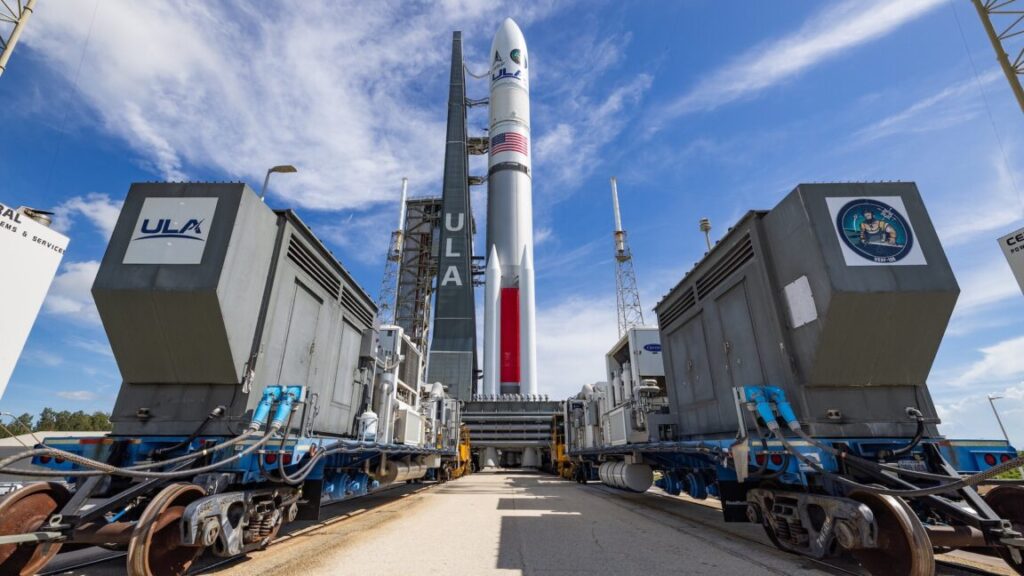
The Vulcan rocket checks off several important boxes for the Space Force. First, it relies entirely on US-made rocket engines. The Atlas V rocket it is replacing uses Russian-built main engines, and given the chilled relations between the two powers, US officials have long desired to stop using Russian engines to power the Pentagon’s satellites into orbit. Second, ULA says the Vulcan rocket will eventually provide a heavy-lift launch capability at a lower cost than the company’s now-retired Delta IV Heavy rocket.

Third, Vulcan provides the Space Force with an alternative to SpaceX’s Falcon 9 and Falcon Heavy, which have been the only rockets in their class available to the military since the last national security mission was launched on an Atlas V rocket one year ago.

Col. Jim Horne, mission director for the USSF-106 launch, said this flight marks a “pretty historic point in our program’s history. We officially end our reliance on Russian-made main engines with this launch, and we continue to maintain our assured access to space with at least two independent rocket service companies that we can leverage to get our capabilities on orbit.”

What’s onboard?

The Space Force has only acknowledged one of the satellites aboard the USSF-106 mission, but there are more payloads cocooned inside the Vulcan rocket’s fairing.

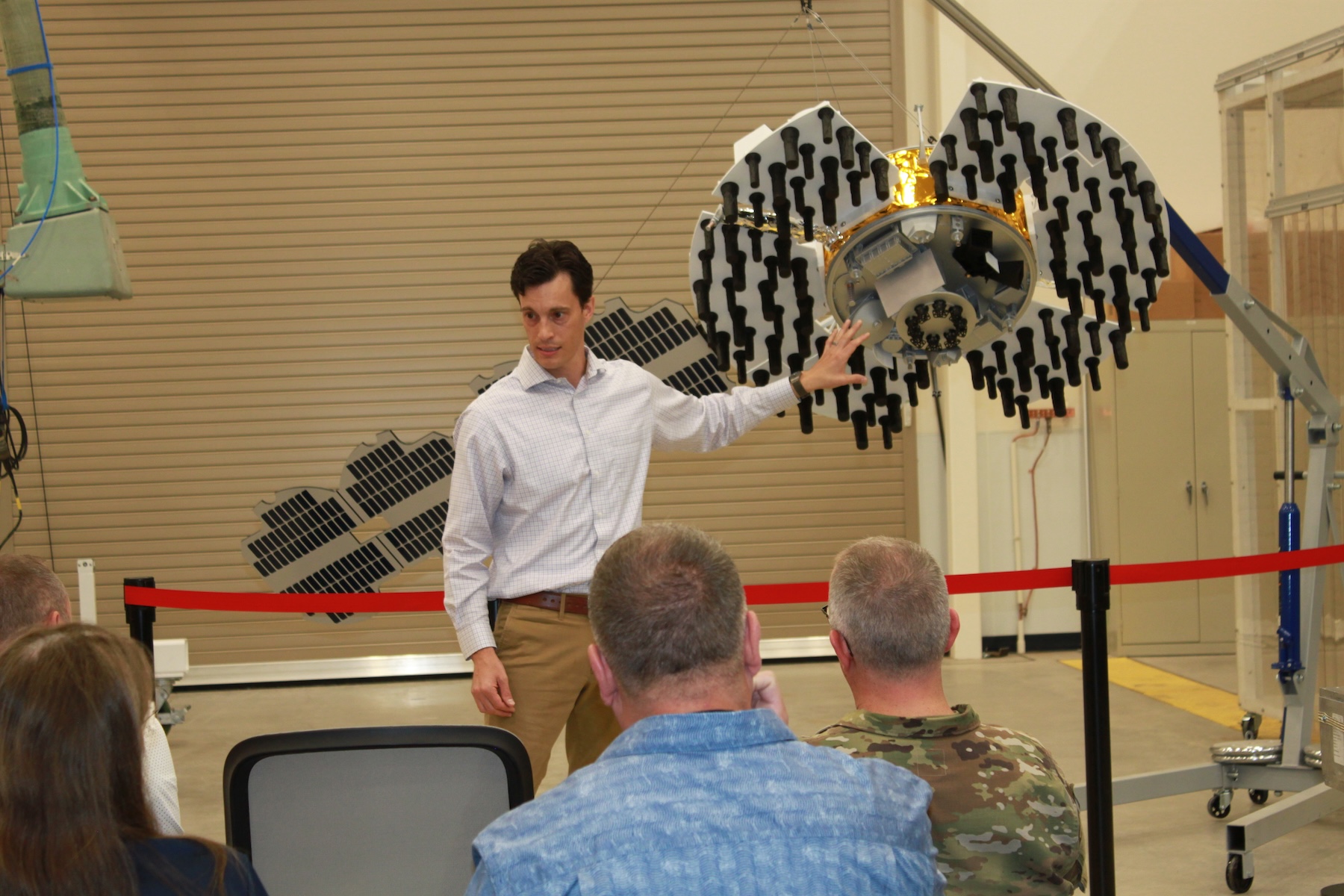
The $250 million mission that officials are willing to talk about is named Navigation Technology Satellite-3, or NTS-3. This experimental spacecraft will test new satellite navigation technologies that may eventually find their way on next-generation GPS satellites. A key focus for engineers who designed and will operate the NTS-3 satellite is to look at ways of overcoming GPS jamming and spoofing, which can degrade satellite navigation signals used by military forces, commercial airliners, and civilian drivers.

“We’re going to be doing, we anticipate, over 100 different experiments,” said Joanna Hinks, senior research aerospace engineer at the Air Force Research Laboratory’s space vehicles directorate, which manages the NTS-3 mission. “Some of the major areas we’re looking at—we have an electronically steerable phased array antenna so that we can deliver higher power to get through interference to the location that it’s needed.”

Arlen Biersgreen, then-program manager for the NTS-3 satellite mission at the Air Force Research Laboratory, presents a one-third scale model of the NTS-3 spacecraft to an audience in 2022. Credit: US Air Force/Andrea Rael

GPS jamming is especially a problem in and near war zones. Investigators probing the crash of Azerbaijan Airlines Flight 8243 last December determined GPS jamming, likely by Russian military forces attempting to counter a Ukrainian drone strike, interfered with the aircraft’s navigation as it approached its destination in the Russian republic of Chechnya. Azerbaijani government officials blamed a Russian surface-to-air missile for damaging the aircraft, ultimately leading to a crash in nearby Kazakhstan that killed 38 people.

“We have a number of different advanced signals that we’ve designed,” Hinks said. “One of those is the Chimera anti-spoofing signal… to protect civil users from spoofing that’s affecting so many aircraft worldwide today, as well as ships.”

The NTS-3 spacecraft, developed by L3Harris and Northrop Grumman, only takes up a fraction of the Vulcan rocket’s capacity. The satellite weighs less than 3,000 pounds (about 1,250 kilograms), about a quarter of what this version of the Vulcan rocket can deliver to geosynchronous orbit.

Space Force officials take secrecy to new heights ahead of key rocket launch Read More »

prepping-for-starship,-spacex-is-about-to-demolish-one-of-ula’s-launch-pads

Prepping for Starship, SpaceX is about to demolish one of ULA’s launch pads


SpaceX may soon have up to nine active launch pads. Most competitors have one or two.

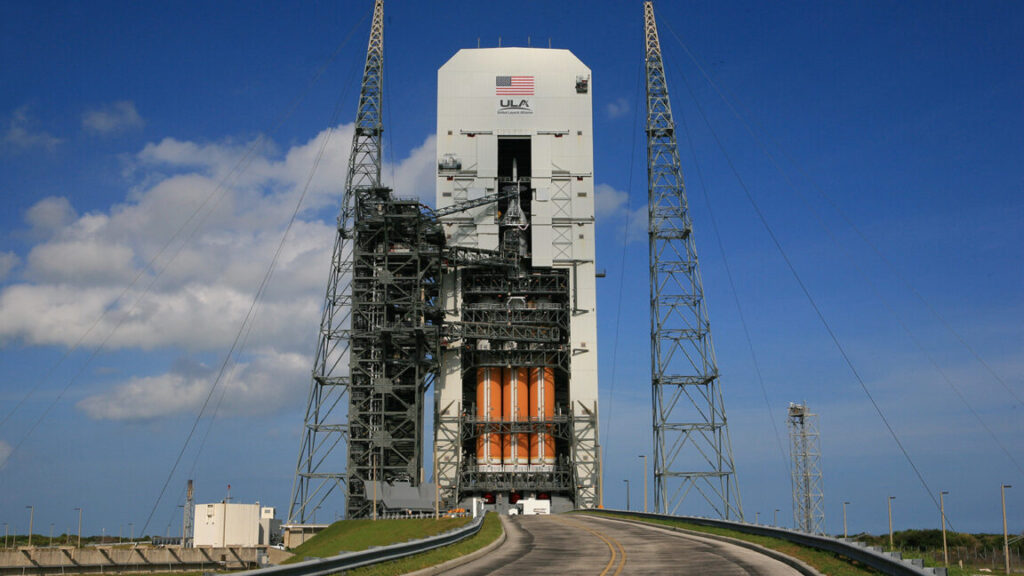
A Delta IV Heavy rocket stands inside the mobile service tower at Space Launch Complex-37 in this photo from 2014. SpaceX is set to demolish all of the structures seen here. Credit: United Launch Alliance

The US Air Force is moving closer to authorizing SpaceX to move into one of the largest launch pads at Cape Canaveral Space Force Station in Florida, with plans to use the facility for up to 76 launches of the company’s Starship rocket each year.

A draft Environmental Impact Statement (EIS) released this week by the Department of the Air Force, which includes the Space Force, found SpaceX’s planned use of Space Launch Complex 37 (SLC-37) at Cape Canaveral would have no significant negative impacts on local environmental, historical, social, and cultural interests. The Air Force also found SpaceX’s plans at SLC-37 will have no significant impact on the company’s competitors in the launch industry.

The Defense Department is leading the environmental review and approval process for SpaceX to take over the launch site, which the Space Force previously leased to United Launch Alliance, one of SpaceX’s chief rivals in the US launch industry. ULA launched its final Delta IV Heavy rocket from SLC-37 in April 2024, a couple of months after the military announced SpaceX was interested in using the launch pad.

Ground crews are expected to begin removing Delta IV-era structures at the launch pad this week. Multiple sources told Ars demolition could begin as soon as Thursday.

Emre Kelly, a Space Force spokesperson, deferred questions on the schedule for the demolition to SpaceX, which is overseeing the work. But he said the Delta IV’s mobile gantry, fixed umbilical tower, and both lightning towers will come down. Unlike other large-scale demolitions at Cape Canaveral, SpaceX and the Space Force don’t plan to publicize the event ahead of time.

“Demolition of these items will be conducted in accordance with federal and state laws that govern explosive demolition operations,” Kelly said.

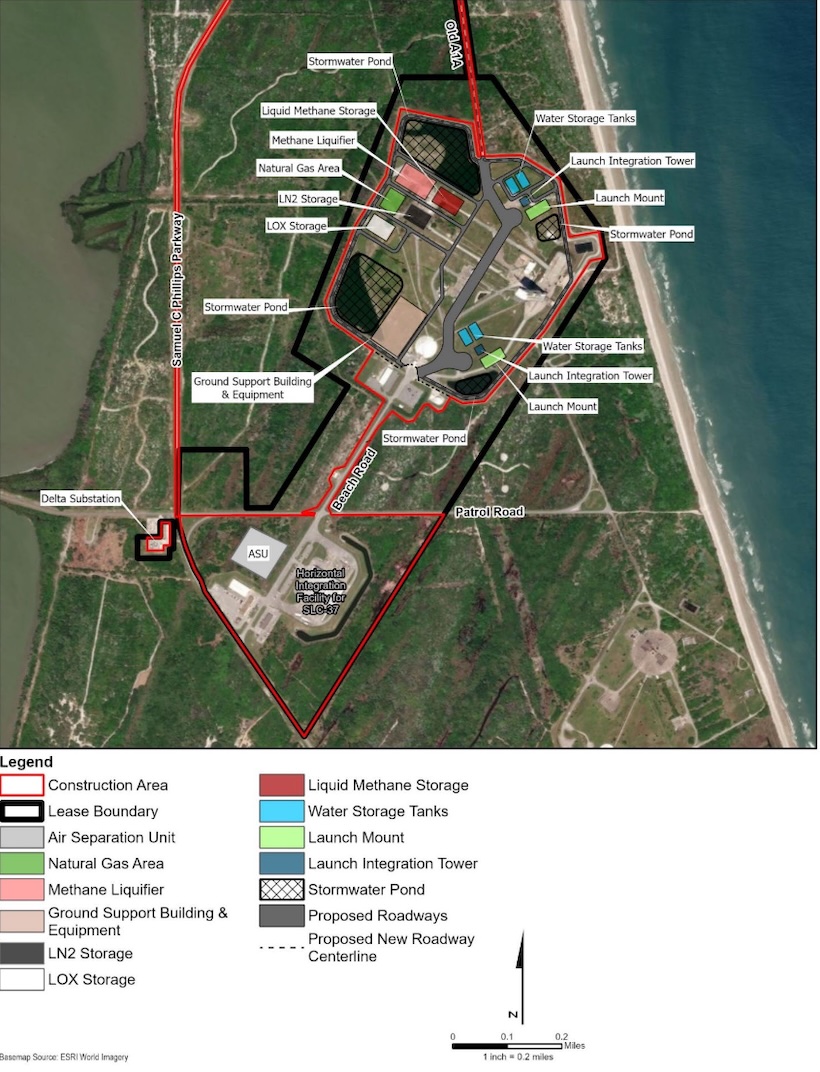
In their place, SpaceX plans to build two 600-foot-tall (180-meter) Starship launch integration towers within the 230-acre confines of SLC-37.

Tied at the hip

The Space Force’s willingness to turn over a piece of prime real estate at Cape Canaveral to SpaceX helps illustrate the government’s close relationship with—indeed, reliance on—Elon Musk’s space company. The breakdown of Musk’s relationship with President Donald Trump has, so far, only spawned a war of words between the two billionaires.

But Trump has threatened to terminate Musk’s contracts with the federal government and warned of “serious consequences” for Musk if he donates money to Democratic political candidates. Musk said he would begin decommissioning SpaceX’s Dragon spacecraft, the sole US vehicle ferrying astronauts to and from orbit, before backing off the threat last week.

NASA and the Space Force need SpaceX’s Dragon spacecraft and its Falcon 9 and Falcon Heavy rockets to maintain the International Space Station and launch the nation’s most critical military satellites. The super heavy-lift capabilities Starship will bring to the government could enable a range of new missions, such as global cargo delivery for the military and missions to the Moon and Mars in partnership with NASA.

Fully stacked, the Starship rocket stands more than 400 feet tall. Credit: SpaceX

SpaceX already has a “right of limited entry” to begin preparations to convert SLC-37 into a Starship launch pad. A full lease agreement between the Space Force and SpaceX is expected after the release of the final Environmental Impact Statement.

The environmental approval process began more than a year ago with a notice of intent, followed by studies, evaluations, and scope meetings that fed into the creation of the draft EIS. Now, government officials will host more public meetings and solicit public comments on SpaceX’s plans through late July. Then, sometime this fall, the Department of the Air Force will issue a final EIS and a “record of decision,” according to the project’s official timeline.

A growing footprint

This timeline could allow SpaceX to begin launching Starships from SLC-37 as soon as next year, although the site still requires the demolition of existing structures and construction of new towers, propellant farms, a methane liquefaction plant, water tanks, deluge systems, and other ground support equipment. The construction will likely take more than a year, so perhaps 2027 is a more realistic target.

The company is also studying an option to construct two separate towers for use exclusively as “catch towers” for recovery of Super Heavy boosters and Starship upper stages “if space allows” at SLC-37, according to the draft EIS. According to the Air Force, the initial review process eliminated an option for SpaceX to construct a standalone Starship launch pad on undeveloped property at Cape Canaveral because the site would have a “high potential” for impacting endangered species and is “less ideal” than developing an existing launch pad.

SpaceX’s plan for recovering its reusable Super Heavy and Starship vehicles involves catching them with articulating arms on a towereither a launch integration structure or a catch-only tower. SpaceX has already demonstrated catching the Super Heavy booster on three test flights at the company’s Starbase launch site in South Texas. An attempt to catch a Starship vehicle returning from low-Earth orbit might happen later this year, assuming SpaceX can correct the technical problems that have stalled the rocket’s advancement in recent months.

Construction crews are outfitting a second Starship launch tower at Starbase, called Pad B, that may also come online before the end of this year. A few miles north of SLC-37, SpaceX has built another Starship tower at Launch Complex 39A, a historic site on NASA property at Kennedy Space Center. Significant work remains ahead at LC-39A to install a new launch mount, finish digging a flame trench, and install all the tanks and plumbing necessary to store and load super-cold propellants into the rocket. The most recent official schedule from SpaceX suggests a first Starship launch from LC-39A could happen before the end of the year, but it’s probably a year or more away.

The Air Force’s draft Environmental Impact Statement includes this map showing SpaceX’s site plan for SLC-37. Credit: Department of the Air Force

Similar to the approach SpaceX is taking at SLC-37, a document released last year indicates the Starship team plans to construct a separate catch tower near the Starship launch tower at LC-39A. If built, these catch towers could simplify Starship operations as the flight rate ramps up, allowing SpaceX to catch a returning rocket at one location while stacking Starships for launch with the chopstick arms on nearby integration towers.

With SpaceX’s growing footprint in Texas and Florida, the company has built, is building, or revealed plans to build at least five Starship launch towers. This number is likely to grow in the coming years as Musk aims to eventually launch and land multiple Starships per day. This will be a gradual ramp-up as SpaceX works through Starship design issues, grows factory capacity, and brings new launch pads online.

Last month, the Federal Aviation Administration—which oversees environmental reviews for launch sites that aren’t on military propertyapproved SpaceX’s request to launch Starships as many as 25 times per year from Starbase, Texas. The previous limit was five, but the number will likely go up from here. Coming into 2025, SpaceX sought to launch as many as 25 Starships this year, but failures on three of the rockets’ most recent test flights have slowed development, and this goal is no longer achievable.

That’s a lot of launches

Meanwhile, in Florida, the FAA’s environmental review for LC-39A is assessing the impact of launching Starships up to 44 times per year from Kennedy Space Center. At nearby Cape Canaveral Space Force Station, the Air Force is evaluating SpaceX’s proposal for up to 76 Starship flights per year from SLC-37. The scope of each review also includes environmental assessments for Super Heavy and Starship landings within the perimeters of each launch complex.

While the draft EIS for SLC-37 is now public, the FAA hasn’t yet released a similar document for SpaceX’s planned expansion and Starship launch operations at LC-39A, also home to a launch pad used for Falcon 9 and Falcon Heavy flights.

SpaceX will continue launching its workhorse Falcon 9 and Falcon Heavy rockets as Starship launch pads heat up with more test flights. Within a few years, SpaceX could have as many as nine active launch pads spread across three states. The company’s most optimistic vision for Starship would require many more, potentially including offshore launch and landing sites.

At Vandenberg Space Force Base in California, SpaceX has leased the former West Coast launch pad for United Launch Alliance’s Delta IV rocket. SpaceX will prepare this launch pad, known as SLC-6, for Falcon 9 and Falcon Heavy launches starting as soon as next year, augmenting the capacity of the company’s existing Vandenberg launch pad, which is only configured for Falcon 9s. Like the demolition at SLC-37 in Florida, the work to prepare SLC-6 will include the razing of unnecessary towers and structures left over from the Delta IV (and the Space Shuttle) program.

SpaceX has not yet announced any plans to launch Starships from the California spaceport.

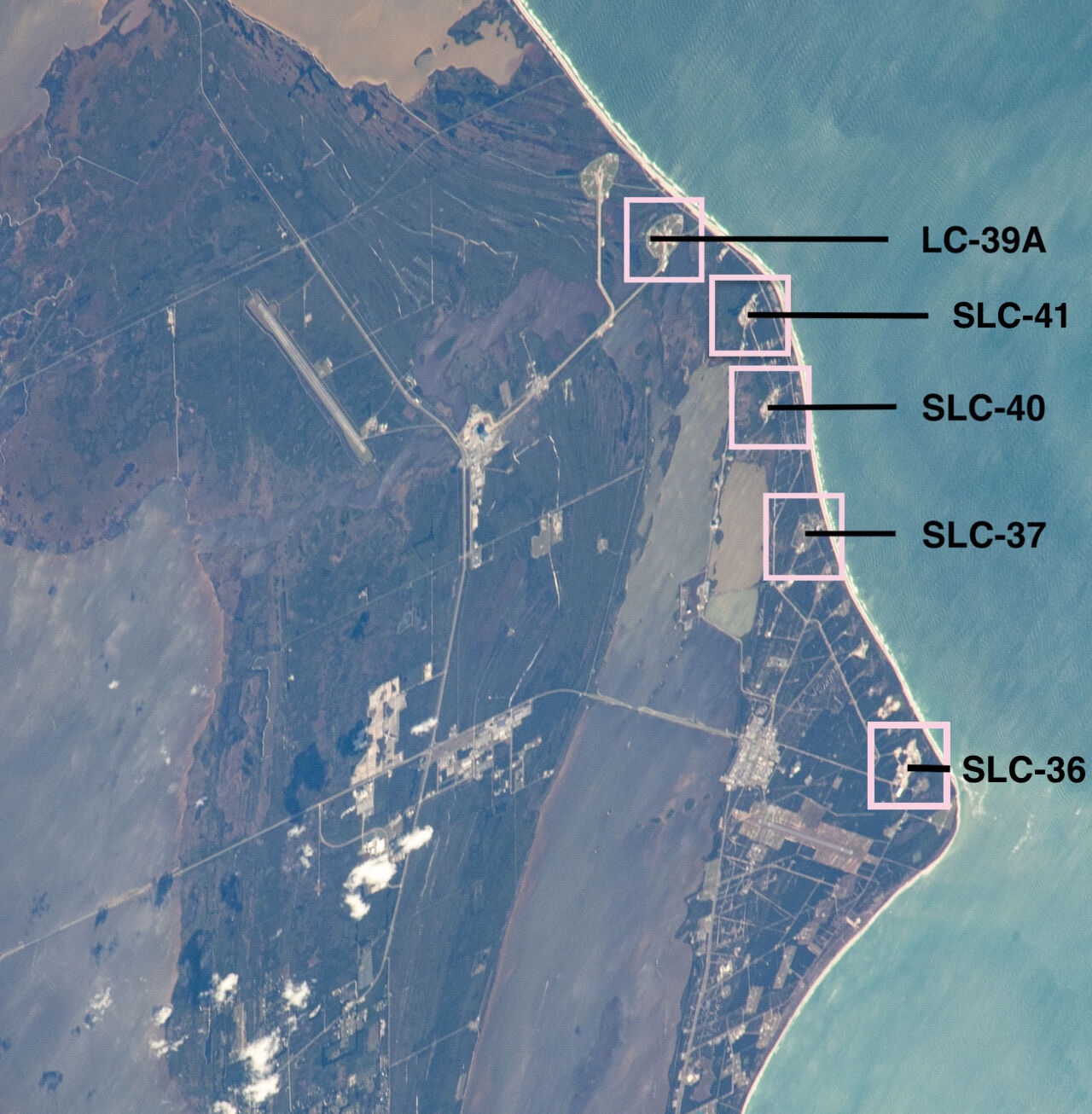
SpaceX launches Falcon 9 rockets from Pad 39A at NASA’s Kennedy Space Center and from Pad 40 at Cape Canaveral Space Force Station. The company plans to develop Starship launch infrastructure at Pad 39A and Pad 37. United Launch Alliance flies Vulcan and Atlas V rockets from Pad 41, and Blue Origin has based its New Glenn rocket at Pad 36. Credit: NASA (labels by Ars Technica)

The expansion of SpaceX’s launch facilities comes as most of its closest competitors limit themselves to just one or two launch pads. ULA has reduced its footprint from seven launch pads to two as a cost-cutting measure. Blue Origin, Jeff Bezos’ space company, operates a single launch pad at Cape Canaveral, although it has unannounced plans to open a launch facility at Vandenberg. Rocket Lab has three operational launch pads in New Zealand and Virginia for the light-class Electron rocket and will soon have a fourth in for the medium-lift Neutron launcher.

These were the top four companies in Ars’ most recent annual power ranking of US launch providers.

Two of these competitors, ULA and Blue Origin, complained last year that SpaceX’s target of launching as many as 120 Starships per year from Florida’s Space Coast could force them to clear their launch pads for safety reasons. The Space Force is responsible for ensuring all personnel remain outside of danger areas during testing and launch operations.

It could become quite busy at Cape Canaveral. Military officials forecast that launch providers not named SpaceX could fly more than 110 launches per year. The Air Force acknowledged in the draft EIS that SpaceX’s plans for up to 76 launches and 152 landings (76 Starships and 76 Super Heavy boosters) per year at SLC-37 “could result in planning constraints for other range user operations.” This doesn’t take into account the FAA’s pending approval for up to 44 Starship flights per year from LC-39A.

But the report suggests SpaceX’s plans to launch from SLC-37 won’t require the evacuation of ULA and Blue Origin’s launch pads. While the report doesn’t mention the specific impact of Starship launches on ULA and Blue Origin, the Air Force wrote that work could continue on SpaceX’s own Falcon 9 launch pad at SLC-40 during a Starship launch at SLC-37. Because SLC-40 is closer to SLC-37 than ULA and Blue Origin’s pads, this finding seems to imply workers could remain at those launch sites.

The Air Force’s environmental report also doesn’t mention possible impacts of Starship launches from NASA property on nearby workers. It also doesn’t include any discussion of how Starship launches from SLC-37 might affect workers’ access to other facilities, such as offices and hangars, closer to the launch pad.

The bottom line of this section of the Air Force’s environmental report concluded that Starship flights from SLC-37 “should have no significant impact” on “ongoing and future activities” at the spaceport.

Shipping Starships

While SpaceX builds out its Starship launch pads on the Florida coast, the company is also constructing a Starship integration building a few miles away at Kennedy Space Center. This structure, called Gigabay, will be located next to an existing SpaceX building used for Falcon 9 processing and launch control.

The sprawling Gigabay will stand 380 feet tall and provide approximately 46.5 million cubic feet of interior processing space with 815,000 square feet of workspace, according to SpaceX. The company says this building should be operational by the end of 2026. SpaceX is also planning a co-located Starship manufacturing facility, similar to the Starfactory building recently completed at Starbase, Texas.

Until this factory is up and running, SpaceX plans to transport Starships and Super Heavy boosters horizontally via barges from South Texas to Cape Canaveral.

Photo of Stephen Clark

Stephen Clark is a space reporter at Ars Technica, covering private space companies and the world’s space agencies. Stephen writes about the nexus of technology, science, policy, and business on and off the planet.

Prepping for Starship, SpaceX is about to demolish one of ULA’s launch pads Read More »