Author name: Rejus Almole

nvidia’s-new-ai-audio-model-can-synthesize-sounds-that-have-never-existed

Nvidia’s new AI audio model can synthesize sounds that have never existed

At this point, anyone who has been following AI research is long familiar with generative models that can synthesize speech or melodic music from nothing but text prompting. Nvidia’s newly revealed “Fugatto” model looks to go a step further, using new synthetic training methods and inference-level combination techniques to “transform any mix of music, voices, and sounds,” including the synthesis of sounds that have never existed.

While Fugatto isn’t available for public testing yet, a sample-filled website showcases how Fugatto can be used to dial a number of distinct audio traits and descriptions up or down, resulting in everything from the sound of saxophones barking to people speaking underwater to ambulance sirens singing in a kind of choir. While the results on display can be a bit hit or miss, the vast array of capabilities on display here helps support Nvidia’s description of Fugatto as “a Swiss Army knife for sound.”

You’re only as good as your data

In an explanatory research paper, over a dozen Nvidia researchers explain the difficulty in crafting a training dataset that can “reveal meaningful relationships between audio and language.” While standard language models can often infer how to handle various instructions from the text-based data itself, it can be hard to generalize descriptions and traits from audio without more explicit guidance.

To that end, the researchers start by using an LLM to generate a Python script that can create a large number of template-based and free-form instructions describing different audio “personas” (e.g., “standard, young-crowd, thirty-somethings, professional”). They then generate a set of both absolute (e.g., “synthesize a happy voice”) and relative (e.g., “increase the happiness of this voice”) instructions that can be applied to those personas.

The wide array of open source audio datasets used as the basis for Fugatto generally don’t have these kinds of trait measurements embedded in them by default. But the researchers make use of existing audio understanding models to create “synthetic captions” for their training clips based on their prompts, creating natural language descriptions that can automatically quantify traits such as gender, emotion, and speech quality. Audio processing tools are also used to describe and quantify training clips on a more acoustic level (e.g. “fundamental frequency variance” or “reverb”).

Nvidia’s new AI audio model can synthesize sounds that have never existed Read More »

openai-blamed-nyt-for-tech-problem-erasing-evidence-of-copyright-abuse

OpenAI blamed NYT for tech problem erasing evidence of copyright abuse


It’s not “lost,” just “inadvertently removed”

OpenAI denies deleting evidence, asks why NYT didn’t back up data.

OpenAI keeps deleting data that could allegedly prove the AI company violated copyright laws by training ChatGPT on authors’ works. Apparently largely unintentional, the sloppy practice is seemingly dragging out early court battles that could determine whether AI training is fair use.

Most recently, The New York Times accused OpenAI of unintentionally erasing programs and search results that the newspaper believed could be used as evidence of copyright abuse.

The NYT apparently spent more than 150 hours extracting training data, while following a model inspection protocol that OpenAI set up precisely to avoid conducting potentially damning searches of its own database. This process began in October, but by mid-November, the NYT discovered that some of the data gathered had been erased due to what OpenAI called a “glitch.”

Looking to update the court about potential delays in discovery, the NYT asked OpenAI to collaborate on a joint filing admitting the deletion occurred. But OpenAI declined, instead filing a separate response calling the newspaper’s accusation that evidence was deleted “exaggerated” and blaming the NYT for the technical problem that triggered the data deleting.

OpenAI denied deleting “any evidence,” instead admitting only that file-system information was “inadvertently removed” after the NYT requested a change that resulted in “self-inflicted wounds.” According to OpenAI, the tech problem emerged because NYT was hoping to speed up its searches and requested a change to the model inspection set-up that OpenAI warned “would yield no speed improvements and might even hinder performance.”

The AI company accused the NYT of negligence during discovery, “repeatedly running flawed code” while conducting searches of URLs and phrases from various newspaper articles and failing to back up their data. Allegedly the change that NYT requested “resulted in removing the folder structure and some file names on one hard drive,” which “was supposed to be used as a temporary cache for storing OpenAI data, but evidently was also used by Plaintiffs to save some of their search results (apparently without any backups).”

Once OpenAI figured out what happened, data was restored, OpenAI said. But the NYT alleged that the only data that OpenAI could recover did “not include the original folder structure and original file names” and therefore “is unreliable and cannot be used to determine where the News Plaintiffs’ copied articles were used to build Defendants’ models.”

In response, OpenAI suggested that the NYT could simply take a few days and re-run the searches, insisting, “contrary to Plaintiffs’ insinuations, there is no reason to think that the contents of any files were lost.” But the NYT does not seem happy about having to retread any part of model inspection, continually frustrated by OpenAI’s expectation that plaintiffs must come up with search terms when OpenAI understands its models best.

OpenAI claimed that it has consulted on search terms and been “forced to pour enormous resources” into supporting the NYT’s model inspection efforts while continuing to avoid saying how much it’s costing. Previously, the NYT accused OpenAI of seeking to profit off these searches, attempting to charge retail prices instead of being transparent about actual costs.

Now, OpenAI appears to be more willing to conduct searches on behalf of NYT that it previously sought to avoid. In its filing, OpenAI asked the court to order news plaintiffs to “collaborate with OpenAI to develop a plan for reasonable, targeted searches to be executed either by Plaintiffs or OpenAI.”

How that might proceed will be discussed at a hearing on December 3. OpenAI said it was committed to preventing future technical issues and was “committed to resolving these issues efficiently and equitably.”

It’s not the first time OpenAI deleted data

This isn’t the only time that OpenAI has been called out for deleting data in a copyright case.

In May, book authors, including Sarah Silverman and Paul Tremblay, told a US district court in California that OpenAI admitted to deleting the controversial AI training data sets at issue in that litigation. Additionally, OpenAI admitted that “witnesses knowledgeable about the creation of these datasets have apparently left the company,” authors’ court filing said. Unlike the NYT, book authors seem to suggest that OpenAI’s deleting appeared potentially suspicious.

“OpenAI’s delay campaign continues,” the authors’ filing said, alleging that “evidence of what was contained in these datasets, how they were used, the circumstances of their deletion and the reasons for” the deletion “are all highly relevant.”

The judge in that case, Robert Illman, wrote that OpenAI’s dispute with authors has so far required too much judicial intervention, noting that both sides “are not exactly proceeding through the discovery process with the degree of collegiality and cooperation that might be optimal.” Wired noted similarly the NYT case is “not exactly a lovefest.”

As these cases proceed, plaintiffs in both cases are struggling to decide on search terms that will surface the evidence they seek. While the NYT case is bogged down by OpenAI seemingly refusing to conduct any searches yet on behalf of publishers, the book author case is differently being dragged out by authors failing to provide search terms. Only four of the 15 authors suing have sent search terms, as their deadline for discovery approaches on January 27, 2025.

NYT judge rejects key part of fair use defense

OpenAI’s defense primarily hinges on courts agreeing that copying authors’ works to train AI is a transformative fair use that benefits the public, but the judge in the NYT case, Ona Wang, rejected a key part of that fair use defense late last week.

To win their fair use argument, OpenAI was trying to modify a fair use factor regarding “the effect of the use upon the potential market for or value of the copyrighted work” by invoking a common argument that the factor should be modified to include the “public benefits the copying will likely produce.”

Part of this defense tactic sought to prove that the NYT’s journalism benefits from generative AI technologies like ChatGPT, with OpenAI hoping to topple NYT’s claim that ChatGPT posed an existential threat to its business. To that end, OpenAI sought documents showing that the NYT uses AI tools, creates its own AI tools, and generally supports the use of AI in journalism outside the court battle.

On Friday, however, Wang denied OpenAI’s motion to compel this kind of evidence. Wang deemed it irrelevant to the case despite OpenAI’s claims that if AI tools “benefit” the NYT’s journalism, that “benefit” would be relevant to OpenAI’s fair use defense.

“But the Supreme Court specifically states that a discussion of ‘public benefits’ must relate to the benefits from the copying,” Wang wrote in a footnote, not “whether the copyright holder has admitted that other uses of its copyrights may or may not constitute fair use, or whether the copyright holder has entered into business relationships with other entities in the defendant’s industry.”

This likely stunts OpenAI’s fair use defense by cutting off an area of discovery that OpenAI previously fought hard to pursue. It essentially leaves OpenAI to argue that its copying of NYT content specifically serves a public good, not the act of AI training generally.

In February, Ars forecasted that the NYT might have the upper hand in this case because the NYT already showed that sometimes ChatGPT would reproduce word-for-word snippets of articles. That will likely make it harder to convince the court that training ChatGPT by copying NYT articles is a transformative fair use, as Google Books famously did when copying books to create a searchable database.

For OpenAI, the strategy seems to be to erect as strong a fair use case as possible to defend its most popular release. And if the court sides with OpenAI on that question, it won’t really matter how much evidence the NYT surfaces during model inspection. But if the use is not seen as transformative and then the NYT can prove the copying harms its business—without benefiting the public—OpenAI could risk losing this important case when the verdict comes in 2025. And that could have implications for book authors’ suit as well as other litigation, expected to drag into 2026.

Photo of Ashley Belanger

Ashley is a senior policy reporter for Ars Technica, dedicated to tracking social impacts of emerging policies and new technologies. She is a Chicago-based journalist with 20 years of experience.

OpenAI blamed NYT for tech problem erasing evidence of copyright abuse Read More »

what-delusions-can-tell-us-about-the-cognitive-nature-of belief

What delusions can tell us about the cognitive nature of belief

Natalie also recalled other beliefs, including that she was dead (known as Cotard delusion), which she did not share with clinicians at the time. She noted that she entertained this idea due to the failure of other explanations to account for her strange experiences and an idea from a television show.

Natalie said she eventually dismissed this idea as implausible while still holding other delusional ideas. This suggests that belief evaluation may involve different thresholds for different delusions. It also highlights the private nature of some delusions.

Across all of her delusions, Natalie described her active involvement in trying to explain and manage her experiences. She reported considering different explanations and testing these by seeking further information. For example, she asked questions of the people she thought were her in-laws. This suggests a surprisingly similar approach to how we typically form beliefs.

Natalie recalled the influence of television and movies on her ideas. She also recalled how she elaborated on her delusions, once formed, based on information in her surroundings.

These features challenge theories that delusions simply arise from anomalous sensory data. They instead highlight the role of the individual’s search for meaning and social context, as well as the subsequent impact of delusions on perception and thinking.

Implications

As a case study, Natalie’s experiences are not necessarily representative of all people who experience delusions or postpartum psychosis. However, Natalie’s case presents informative features that theories of delusions need to account for.

In particular, Natalie’s personalized insights highlight the critical role of the individual in actively trying to understand their experiences and bestow meaning. This is opposed to just passively accepting beliefs in response to anomalous sensory data or neuropsychological deficits. This suggests psychological therapies may be useful in treating psychosis, in combination with other treatments, in some cases.

More generally, Natalie’s account reveals commonalities between delusions and ordinary beliefs and supports the view that delusions can be understood in terms of cognitive processes across the stages of normal belief formation that we identified.

While there remain challenges in investigating delusions, further study may offer insights into the underpinnings of everyday belief and, in turn, of ourselves.The Conversation

Michael Connors, Conjoint Senior Lecturer in Psychiatry, UNSW Sydney, and Peter W Halligan, Hon Professor of Neuropsychology, Cardiff University. This article is republished from The Conversation under a Creative Commons license. Read the original article.

What delusions can tell us about the cognitive nature of belief Read More »

elizabeth-warren-calls-for-crackdown-on-internet-“monopoly”-you’ve-never-heard-of

Elizabeth Warren calls for crackdown on Internet “monopoly” you’ve never heard of

US Senator Elizabeth Warren of Massachusetts and Congressman Jerry Nadler of New York have called on government bodies to investigate what they allege is the “predatory pricing” of .com web addresses, the Internet’s prime real estate.

In a letter delivered today to the Department of Justice and the National Telecommunications and Information Administration, a branch of the Department of Commerce that advises the president, the two Democrats accuse VeriSign, the company that administers the .com top-level domain, of abusing its market dominance to overcharge customers.

In 2018, under the Donald Trump administration, the NTIA modified the terms on how much VeriSign could charge for .com domains. The company has since hiked prices by 30 percent, the letter claims, though its service remains identical and could allegedly be provided far more cheaply by others.

Wired logo

“VeriSign is exploiting its monopoly power to charge millions of users excessive prices for registering a .com top-level domain,” the letter claims. “VeriSign hasn’t changed or improved its services; it has simply raised prices because it holds a government-ensured monopoly.”

“We intend to respond to senator Warren and representative Nadler’s letter, which repeats inaccuracies and misleading statements that have been aggressively promoted by a small, self-interested group of domain-name investors for years,” said Verisign spokesperson David McGuire in a statement to WIRED. “We look forward to correcting the record and working with policymakers toward real solutions that benefit internet users.”

In an August blog post entitled “Setting the Record Straight,” the company claimed that discourse around its management of .com had been “distorted by factual inaccuracies, a misunderstanding of core technical concepts, and misinterpretations regarding pricing, competition, and market dynamics in the domain name industry.”

In the same blog post, the company argues that it is not operating a monopoly because there are 1,200 generic top-level domains operated by other entities, including .org, .shop, .ai, and .uk.

Though far from a household name, VeriSign takes in about $1.5 billion in revenue each year for servicing its particular section of the Internet’s inscrutable plumbing.

In their letter, Warren and Nadler allege that VeriSign has exploited its exclusive right to charge for highly sought-after .com addresses to juice its revenues and drive up its share price—all at the expense of customers for whom there is no viable alternative.

Elizabeth Warren calls for crackdown on Internet “monopoly” you’ve never heard of Read More »

spies-hack-wi-fi-networks-in-far-off-land-to-launch-attack-on-target-next-door

Spies hack Wi-Fi networks in far-off land to launch attack on target next door

While stalking its target, GruesomeLarch performed credential-stuffing attacks that compromised the passwords of several accounts on a web service platform used by the organization’s employees. Two-factor authentication enforced on the platform, however, prevented the attackers from compromising the accounts.

So GruesomeLarch found devices in physically adjacent locations, compromised them, and used them to probe the target’s Wi-Fi network. It turned out credentials for the compromised web services accounts also worked for accounts on the Wi-Fi network, only no 2FA was required.

Adding further flourish, the attackers hacked one of the neighboring Wi-Fi-enabled devices by exploiting what in early 2022 was a zero-day vulnerability in the Microsoft Windows Print Spooler.

Credit: Volexity

The 2022 hack demonstrates how a single faulty assumption can undo an otherwise effective defense. For whatever reason—likely an assumption that 2FA on the Wi-Fi network was unnecessary because attacks required close proximity—the target deployed 2FA on the Internet-connecting web services platform (Adair isn’t saying what type) but not on the Wi-Fi network. That one oversight ultimately torpedoed a robust security practice.

Advanced persistent threat groups like GruesomeLarch—a part of the much larger GRU APT with names including Fancy Bear, APT28, Forrest Blizzard, and Sofacy—excel in finding and exploiting these sorts of oversights.

Volexity’s post describing the 2022 attack provides plenty of technical details about the compromise on the many links in this sophisticated daisy chain attack flow. There’s also useful advice for protecting networks against these sorts of compromises.

Spies hack Wi-Fi networks in far-off land to launch attack on target next door Read More »

rocket-report:-next-vulcan-launch-slips-into-2025;-starship-gets-a-green-light

Rocket Report: Next Vulcan launch slips into 2025; Starship gets a green light


All the news that’s fit to lift

“Constellation companies and government satellite operators are desperate.”

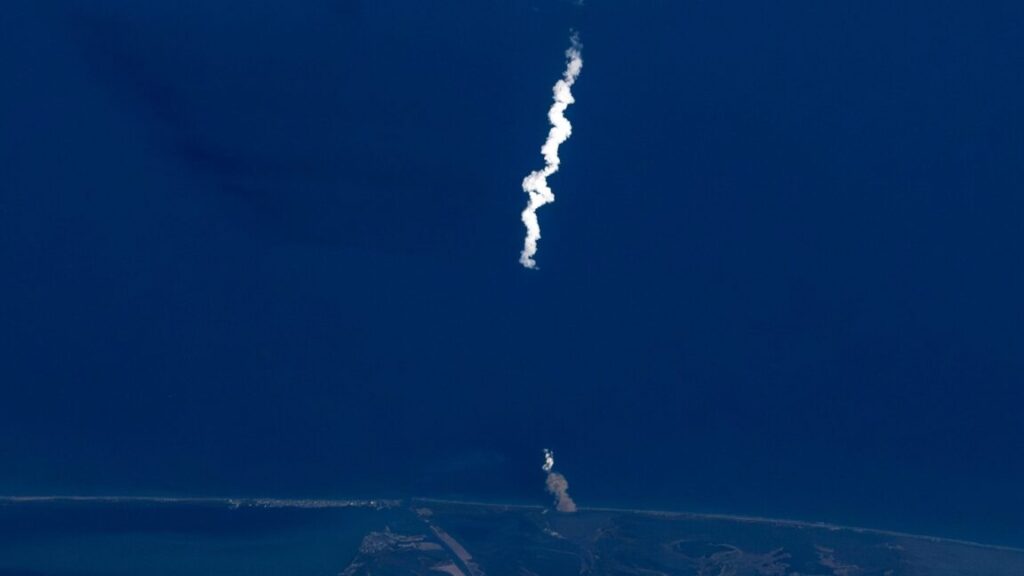
NASA Astronaut Don Pettit captured this photo of the sixth Starship launch from the International Space Station on Tuesday. Credit: Don Pettit/NASA

Welcome to Edition 7.20 of the Rocket Report! This is a super-long version of the newsletter because we did not publish last week, and there is just a ton of launch news of late. Also, I want to note that next week’s report will appear a day early, on Wednesday, due to the Thanksgiving holiday. Speaking of which, you all have our thanks for reading and sharing the Rocket Report with others.

On a completely unrelated note, Rocket Lab has had some amazing mission names over the years. But this weekend’s “Ice AIS Baby” launch is probably the best. I always appreciate their effort to find non-vanilla names and find a way to stop, collaborate, and listen.

Please subscribe using the box below (the form will not appear on AMP-enabled versions of the site). Each report will include information on small-, medium-, and heavy-lift rockets as well as a quick look ahead at the next three launches on the calendar.

Firefly raises a tidy sum as its ambitions soar. Firefly announced earlier this month that it has completed a $175 million Series D fundraising round, resulting in a valuation of more than $2 billion. This follows a banner year of fundraising in 2023, when Firefly reported investors funneled approximately $300 million into the company at a valuation of $1.5 billion, Ars reports. In a statement, Firefly said the money raised in the Series D round will help the company “expand market reach with its Elytra spacecraft, move to full rate production of its Alpha launch vehicle, and accelerate hardware qualification for new vehicles in development.”

A busy period ahead … Firefly will soon ship its first Blue Ghost lunar lander to Florida for final preparations to launch to the Moon and deliver 10 NASA-sponsored scientific instruments and tech demo experiments to the lunar surface. Firefly also boasts a healthy backlog of missions on its small Alpha rocket. In June, Lockheed Martin announced a deal for as many as 25 Alpha launches through 2029. And there’s the Medium Launch Vehicle, a rocket that Firefly and Northrop Grumman hope to launch as soon as 2026.

ABL departs the launch industry. At one point Firefly and ABL Space were competing to develop a credible 1-ton launcher. As Firefly soared this month, however, ABL decided to go in a different direction, turning its focus to missile defense, Ars reports. The founder and president of ABL Space Systems, Dan Piemont, announced the decision on LinkedIn, adding, “We’re consolidating our operational footprint and parting ways with some talented members of our team.”

Never made it to space … ABL made its first RS1 launch attempt in January 2023 from Kodiak, Alaska, but a catastrophic fire shortly after liftoff quickly doomed the rocket. A second attempt was precluded in July of this year after an explosion during a static-fire test in Alaska. The company laid off some of its staff in August to control costs. As the company was failing in its efforts to reach orbit, the launch market was also changing, Piemont said. Although not directly mentioning SpaceX and its Falcon 9 rocket, Piemont said ABL’s ability to impact the launch industry has diminished over the last seven years. (submitted by Ken the Bin)

The easiest way to keep up with Eric Berger’s and Stephen Clark’s reporting on all things space is to sign up for our newsletter. We’ll collect their stories and deliver them straight to your inbox.

Sign Me Up!

ESA provides another funding boost. The European Space Agency has awarded Boost! contract extensions worth 44.2 million euros ($46.3 million) to HyImpulse, Isar Aerospace, Orbex, and Rocket Factory Augsburg, European Spaceflight reports. ESA member states adopted the Boost! initiative in late 2019. The primary aim of the initiative is to provide co-funding to support the development of commercial space transportation services. Each of the four companies has won awards of varying amounts in earlier Boost! competitions.

Getting across the finish line … According to ESA, the new funding awarded through the Boost! contract extensions is aimed at alleviating the pressure in the months before an inaugural flight when costs are high and the potential to generate revenue is limited. While the ESA press release did not disclose the specific amounts awarded to each company, announcements from the companies have revealed that Orbex will receive 5.6 million euros ($5.9 million), Isar Aerospace 15 million euros ($15.7 million), and both Rocket Factory Augsburg and HyImpulse 11.8 million euros each ($12.4 million). (submitted by Ken the Bin and EllPeaTea)

Oman preparing for its debut launch. The nation on the southeastern coast of the Arabian Peninsula is developing a spaceport in the port town of Duqm, with the aim of supporting commercial operations by the year 2030. However, the country’s National Aerospace Services Company will attempt an experimental rocket launch in December, The National reports. The port area will allow launches to the south and east over the Arabian Sea.

Seeking a niche in Mideast space … The National Aerospace Services Company did not specify a date for the launch, nor name the launch vehicle. The firm also said the launch would not be “publicly accessible” and that details about it would only be shared after the fact. The project is part of Oman’s efforts to diversify its economy and secure a competitive edge in the global space industry.

Swedish site launches its 600th rocket. The Esrange Space Center, located 200 km north of the Arctic Circle in northern Sweden, recently hit a significant milestone: It launched its 600th suborbital rocket. The MAPHEUS-15 science rocket reached an altitude of 309 km carrying a payload containing 21 different experiments, the Swedish Space Corporation reports. The payloads were later recovered by helicopter.

Orbital flights coming next? … “I am very proud of this milestone which shines a light on the many years of international collaboration at Esrange,” said Lennart Poromaa, head of Esrange Space Center. “This has been instrumental in achieving hundreds of successful rocket missions, providing invaluable access to space for scientists worldwide.” The site was established in 1966 and recently saw the construction of an orbital launch complex for future missions.

Neutron inks multi-launch contract. The launch company said earlier this month it has signed an agreement with an unnamed customer for two Neutron launches beginning in mid-2026. In a release, Rocket Lab characterized the agreement as “the beginning of a productive collaboration” that could allow Neutron to launch the commercial customer’s entire constellation. Intended to be reusable, Neutron is targeted to be capable of lifting 13 metric tons to low-Earth orbit.

Competition wanted … “Constellation companies and government satellite operators are desperate for a break in the launch monopoly,” Rocket Lab founder Peter Beck said. “They need a reliable rocket from a trusted provider, and one that’s reusable to keep launch costs down and make space more frequently accessible—and Neutron is strongly positioned to be that rocket.” With that said, Rocket Lab still has to deliver the booster. It’s currently targeting 2025 for this, but as always, bringing new launch vehicles into the world is a difficult and time-consuming process. (submitted by Ken the Bin and Tom Nelson)

Russia is pursuing its own Grasshopper rocket. Like a lot of competitors in the global launch industry, Russia, for a long time, dismissed the prospects of a reusable first stage for a rocket. As late as 2016, an official with the Russian agency that develops strategy for the country’s main space corporation, Roscosmos, concluded, “The economic feasibility of reusable launch systems is not obvious.” Well, times change as the company is developing its next-generation Amur rocket, Ars reports. Then the Falcon 9 happened.

A good name, apparently … Similar to what SpaceX did about a dozen years ago, Roscosmos is now planning to develop a prototype vehicle to test the ability to land the Amur rocket’s first stage vertically. According to the state-run news agency TASS, constructing this test vehicle will enable the space corporation to solve key challenges. “Next year preparation of an experimental stage of the (Amur) rocket, which everyone is calling ‘Grasshopper,’ will begin,” said Igor Pshenichnikov, the Roscosmos deputy director of the department of future programs. It’s not entirely clear why Russia adopted the exact same nickname as SpaceX.

Don’t forget Europe has a (much more expensive) hopper, too. The European Space Agency announced that it has awarded two new contracts to ArianeGroup to build a second Themis demonstrator and to refine the design of its Prometheus rocket engine, European Spaceflight reports. The two contracts have a combined value of 230 million euros ($241 million). The space agency has already spent hundreds of millions of euros on the project to develop a reusable engine and the Themis test vehicle, dating back more than six years. No tests have yet taken place.

Please build something, at some point … According to the agency, the funding will enable the development of a second Themis demonstrator, an upgraded Prometheus engine, and the renovation of testing and ground infrastructure. “The contract extensions signed today at ESA’s headquarters in Paris, France, are to further demonstrate and test evolutions of the Prometheus engine and the Themis demonstrator with higher and more hop-tests,” explained an ESA statement. Seems like it’s a good deal for ArianeGroup, at least. (submitted by EllPeaTea and Ken the Bin)

Starship completes its sixth flight test. SpaceX launched its sixth Starship rocket Tuesday, proving for the first time that the stainless steel ship can maneuver in space and paving the way for an even larger upgraded vehicle slated to debut on the next test flight, Ars reports. The only hiccup was an abortive attempt to catch the rocket’s Super Heavy booster back at the launch site in South Texas, something SpaceX achieved on the previous flight on October 13.

A small burn … One of the most important new things engineers wanted to test on this flight occurred about 38 minutes after liftoff. That’s when Starship reignited one of its six Raptor engines for a brief burn to make a slight adjustment to its flight path. The burn lasted only a few seconds, and the impulse was small—just a 48 mph (77 km/hour) change in velocity, or delta-V—but it demonstrated that the ship can safely deorbit itself on future missions. With this achievement, Starship will likely soon be cleared to travel into orbit around Earth and deploy Starlink Internet satellites or conduct in-space refueling experiments, two of the near-term objectives on SpaceX’s Starship development roadmap.

Vulcan’s third launch slips into 2025. The Space Force is now preparing for a 2025 Vulcan national security launch debut instead of the originally planned 2024 launches, Space News reports. Lt. Gen. Philip Garrant, head of the Space Force’s Space Systems Command, made the disclosure during a conversation with reporters on Thursday. Garrant said ULA’s Vulcan remains on track for certification. The rocket’s second certification launch in October was technically successful, with the payload reaching its intended orbit. However, an anomaly with one of the solid rocket boosters continues to be reviewed.

For now the military flies on Falcons … The anomaly itself isn’t a showstopper for certification, said Garrant. But the cumulative delays and uncertainties are a concern, he said, “as we aim to maintain assured access to space with two certified providers.” Two missions—USSF-106 and USSF-87—are currently waiting in the wings, with payloads ready but no confirmed launch dates. ULA had been targeting a November launch for USSF-106. But with only six weeks left in the year, a 2024 launch window is increasingly unlikely, said Garrant. ULA chief Tory Bruno had been promising to complete two national security launches this year. (submitted by Ken the Bin and EllPeaTea)

NASA begins stacking Artemis II booster. NASA said ground teams inside the Vehicle Assembly Building at Kennedy Space Center in Florida lifted the aft assembly of the rocket’s left booster onto the mobile launch platform, marking the beginning of operations to ‘stack’ the second Space Launch System rocket. Using an overhead crane, teams hoisted the left aft booster assembly—already filled with pre-packed solid propellant—from the VAB transfer aisle, over a catwalk dozens of stories high and then down onto mounting posts on the mobile launcher, Ars reports.

Say goodbye to September … The Artemis II mission is slated to send NASA astronauts Reid Wiseman, Victor Glover, Christina Koch, and Canadian astronaut Jeremy Hansen on a 10-day flight around the far side of the Moon. A NASA spokesperson told Ars it should take around four months to fully stack the SLS rocket for Artemis II. Officially, Artemis II is projected to launch in September of next year, but there’s little chance of meeting that schedule due to an issue with Orion’s heat shield. It’s possible that, within the next month or two, NASA could announce a new target launch date for Artemis II at the end of 2025 or, more likely, in 2026.

Shotwell predicts rapid increase in Starship launches. As SpaceX made its final preparations for the sixth launch of its Starship rocket last week, the company’s chief operating officer and president spoke at a financial conference on Friday about various topics, including the future of the massive rocket and the Starlink satellite system. The Starship launch system is about to reach a tipping point, Gwynne Shotwell said, as it moves from an experimental rocket toward operational missions, Ars reports.

Those are lofty goals … “We just passed 400 launches on Falcon, and I would not be surprised if we fly 400 Starship launches in the next four years,” Shotwell said at the Baron Investment Conference in New York City. “We want to fly it a lot.” That lofty goal seems aspirational, not just because of the hardware challenges but also due to the ground systems (SpaceX currently has just one operational launch tower) as well as the difficulty of supplying that much liquid oxygen and methane for such a high flight rate. However, it’s worth noting that SpaceX will launch Starship four times this year, twice the number of Falcon Heavy missions. An acceleration of Starship is highly likely.

AST signs launch deals for its BlueBird constellation. During a third-quarter earnings call, AST SpaceMobile revealed new launch agreements with Blue Origin, the Indian Space Research Organization, and SpaceX to launch its large satellites over the course of 2025 and 2026, Spaceflight Now reports. Andrew Johnson, chief financial officer and chief legal officer at AST SpaceMobile, said that the launches “enable us to launch up to approximately 45 Block 2 BlueBird satellites, with options for additional launch vehicles for approximately 60 Block 2 BlueBird satellites.”

Glenns and Falcons … The company’s next launch will use India’s Geosynchronous Satellite Launch Vehicle. After that, the company will shift its focus to launching with Blue Origin’s New Glenn rocket and SpaceX’s Falcon 9, which are capable of carrying eight and four Block 2 BlueBird satellites, respectively. The company said its Block 2 constellation will be capable of delivering “peak data transmission speeds up to 120Mbps, supporting voice, full data, and video applications.” AST will be competing with SpaceX’s Starlink constellation in providing direct-to-cell communications. (submitted by EllPeaTea)

FAA gives SpaceX a green light for South Texas launches. A day after SpaceX launched its Starship rocket for the sixth time, the company received good news from the Federal Aviation Administration regarding future launch operations from its Starbase facility in South Texas. In a draft version of what is known as an “Environmental Assessment,” the FAA indicated that it will grant SpaceX permission to increase the number of Starship launches in South Texas to 25 per year from the current limit of five. Additionally, the company will likely be allowed to continue increasing the size and power of the Super Heavy booster stage and Starship upper stage, Ars reports.

A final decision is coming next year … The FAA regulates the launch of rockets from the United States and is responsible for the safety of people and property on the ground. The ongoing environmental review stems from SpaceX’s desire to increase the scope of its operations from South Texas and is not yet finalized. Beginning today, the FAA will open a public comment period that will close on January 17. In addition, the FAA will hold five public meetings to solicit feedback from the local community and other stakeholders. A final assessment will likely be issued sometime early next year.

ESA wants a reusable super heavy lift rocket. The European Space Agency has announced that it will commission a study to detail the development of a reusable rocket capable of delivering 60 tons to low-Earth orbit, European Spaceflight reports. The space agency believes it is necessary to have a launch system of this kind to fulfill “critical European space exploration needs beyond LEO, while providing wider space exploitation potentials to answer the growing market opportunities (e.g. mega constellations).”

Studies of studies … The agency launched its PROTEIN (Preparatory Activities for European Heavy Lift Launcher) initiative in June 2022, aiming to explore the feasibility of developing a European super heavy-lift rocket with a focus on reducing launch costs. ArianeGroup and Rocket Factory Augsburg were selected to lead studies. The European 60T LEO Reusable Launch System Pathfinder initiative seems to build upon the agency’s PROTEIN studies, even though this link is not explicitly stated. (submitted by EllPeaTea)

Next three launches

Nov. 22: New Shepard | NS-28 | Launch Site One, Texas | 15: 30 UTC

Nov. 24: Falcon 9 | Starlink 9-13 | Vandenberg Space Force Base, California | 03: 26 UTC

Nov. 24: Electron | Ice AIS Baby | Māhia Peninsula, New Zealand | 03: 55 UTC

Photo of Eric Berger

Eric Berger is the senior space editor at Ars Technica, covering everything from astronomy to private space to NASA policy, and author of two books: Liftoff, about the rise of SpaceX; and Reentry, on the development of the Falcon 9 rocket and Dragon. A certified meteorologist, Eric lives in Houston.

Rocket Report: Next Vulcan launch slips into 2025; Starship gets a green light Read More »

Navigating Technological Sovereignty in the Digital Age

Depending on who you speak to, technological sovereignty is either a hot topic, or something that other organizations need to deal with. So, should it matter to you and your organization? Let’s first consider what’s driving it, not least the crystal in the solute of the US Cloud Act, which ostensibly gives the US government access to any data managed by a US provider. This spooked EU authorities and nations, as well as others who saw it as a step too far. 

Whilst this accelerated activity across Europe, Africa and other continents, moves were already afoot to preserve a level of sovereignty across three axes: data movement, local control, and what is increasingly seen as the big one – a desire for countries to develop and retain skills and innovate, rather than being passive participants in a cloud-based brain drain. 

This is impacting not just government departments and their contractors, but also suppliers to in-country companies. A couple of years ago, I spoke to a manufacturing materials organization in France that provided goods to companies in Nigeria. “What’s your biggest headache,” I asked the CIO as a conversation starter. “Sovereignty,” he said. “If I can’t show my clients how I will keep data in-country, I can’t supply my goods.”

Such themes like the Cloud Act have made cross-border data management tricky. With different countries enforcing different laws, navigating where and how your data is stored has become a significant challenge. If it matters to you, it really matters. In principle, technological sovereignty solves this, but there’s no single, clear definition. It’s a concept that’s easy to understand at a high level, but tricky to pin down.

Technological sovereignty is all about ensuring you have control over your digital assets—your data, infrastructure, and the systems that run your business. But it’s not just about knowing where your data is stored. It’s about making sure that data is handled in a way that aligns with the country’s regulations and your business strategy and values.

For organizations in Europe, the rules and regs are quite specific. The upcoming EU Data Act focuses on data sharing and access across different sectors, whilst the AI Act introduces rules around artificial intelligence systems. Together, these evolving regulations are pushing organizations to rethink their technology architectures and data management strategies.

As ever, this means changing the wheels on a moving train. Hybrid/multi-cloud environments and complex data architectures add layers of complexity, whilst artificial intelligence is transforming how we interact with and manage data. AI is a sovereignty blessing and a curse – it can both enable data to be handled more effectively, but as AI models become more sophisticated, organizations need to be even more careful about how they process data from a compliance perspective. 

So, where does this leave organizations that want the flexibility of cloud services but need to maintain control over their data? Organizations have several options:

  • Sovereign Hyper-Scalers: Over the next year, cloud giants like AWS and Azure will be rolling out sovereign cloud offerings tailored to the needs of organizations that require stricter data controls. 
  • Localized Providers: Working with local managed service providers (MSPs) can give organizations more control within their own country or region, helping them keep data close to home.
  • On-premise Solutions: This is the go-to option if you want full control. However, on-premise solutions can be costly and come with their own set of complexities. It’s about balancing control with practicality.

The likelihood is a combination of all three will be required, at least in the short-medium term. Inertia will play its part: given that it’s already a challenge to move existing workloads beyond the lower-hanging fruit into the cloud, sovereignty creates yet another series of reasons to leave them where they are, for better or worse. 

There’s a way forward for sovereignty as both a goal and a burden, centered on the word governance. Good governance is about setting clear policies for how your data and systems are managed, who has access, and how you stay compliant with regulations for both your organization and your customers. This is a business-wide responsibility: every level of your organization should be aligned on what sovereignty means for your company and how you will enforce it. 

This may sound onerous to the point of impossibility, but that is the nature of governance, compliance and risk (GRC) – the trick is to assess, prioritize and plan, building sovereignty criteria into the way the business is designed. Want to do business in certain jurisdictions? If so, you need to bake their requirements into your business policies, which can then be rolled out into your application, data and operational policies. 

Get this the other way around, and it will always be harder than necessary. However, done right, technological sovereignty can also offer a competitive advantage. Organizations with a handle on their data and systems can offer their customers more security and transparency, building trust. By embedding sovereignty into your digital strategy, you’re not just protecting your organization—you’re positioning yourself as a leader in responsible business, and building a stronger foundation for growth and innovation. 

Technological sovereignty should be a strategic priority for any organization that wants to stay ahead in today’s complex digital landscape. It’s not just about choosing the right cloud provider or investing in the latest security tools—it’s about building a long-term, business-driven strategy that ensures you stay in control of your data, wherever in the world it is.

The future of sovereignty is about balance. Balancing cloud and on-premise solutions, innovation and control, and security with flexibility. If you can get that balance right, you’ll be in a strong position to navigate whatever the digital world throws at you next.

Navigating Technological Sovereignty in the Digital Age Read More »

amazon-pours-another-$4b-into-anthropic,-openai’s-biggest-rival

Amazon pours another $4B into Anthropic, OpenAI’s biggest rival

Anthropic, founded by former OpenAI executives Dario and Daniela Amodei in 2021, will continue using Google’s cloud services along with Amazon’s infrastructure. The UK Competition and Markets Authority reviewed Amazon’s partnership with Anthropic earlier this year and ultimately determined it did not have jurisdiction to investigate further, clearing the way for the partnership to continue.

Shaking the money tree

Amazon’s renewed investment in Anthropic also comes during a time of intense competition between cloud providers Amazon, Microsoft, and Google. Each company has made strategic partnerships with AI model developers—Microsoft with OpenAI (to the tune of $13 billion), Google with Anthropic (committing $2 billion over time), for example. These investments also encourage the use of each company’s data centers as demand for AI grows.

The size of these investments reflects the current state of AI development. OpenAI raised an additional $6.6 billion in October, potentially valuing the company at $157 billion. Anthropic has been eyeballing a $40 billion valuation during a recent investment round.

Training and running AI models is very expensive. While Google and Meta have their own profitable mainline businesses that can subsidize AI development, dedicated AI firms like OpenAI and Anthropic need constant infusions of cash to stay afloat—in other words, this won’t be the last time we hear of billion-dollar-scale AI investments from Big Tech.

Amazon pours another $4B into Anthropic, OpenAI’s biggest rival Read More »

microsoft’s-controversial-recall-scraper-is-finally-entering-public-preview

Microsoft’s controversial Recall scraper is finally entering public preview

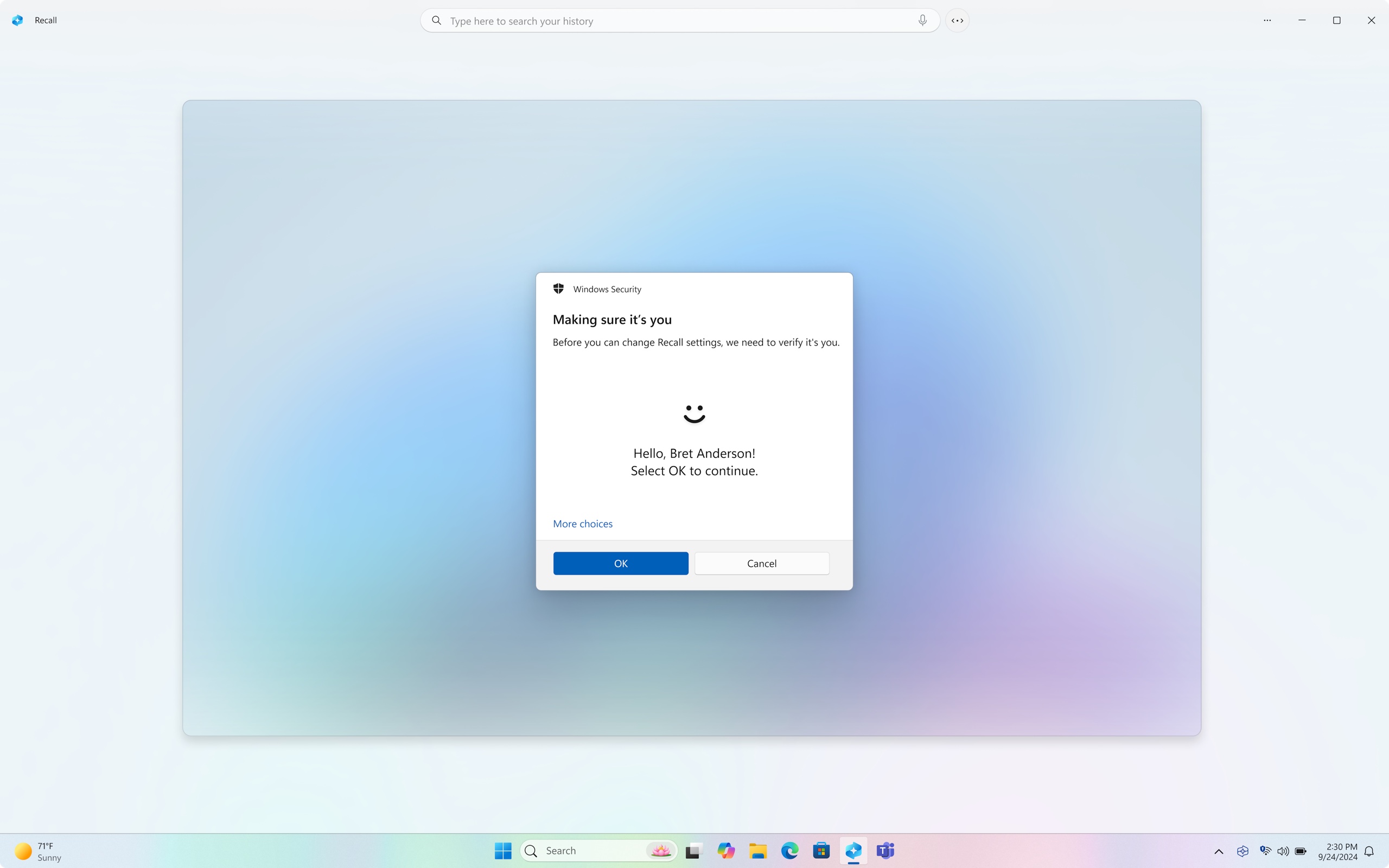
Users will be asked to reauthenticate with Windows Hello every time they access their Recall database. Credit: Microsoft

Microsoft has now delayed the feature multiple times to address those concerns, and it outlined multiple security-focused additions to Recall in a blog post in September. Among other changes, the feature is now opt-in by default and is protected by additional encryption. Users must also re-authenticate with Windows Hello each time they access the database. Turning on the feature requires Secure Boot, BitLocker disk encryption, and Windows Hello to be enabled. In addition to the manual exclusion lists for sites and apps, the new Recall also attempts to mask sensitive data like passwords and credit card numbers so they aren’t stored in the Recall database.

The new version of Recall can also be completely uninstalled for users who have no interest in it, or by IT administrators who don’t want to risk it exposing sensitive data.

Testers will need to kick the tires on all of these changes to make sure that they meaningfully address all the risks and issues that the original version of Recall had, and this Windows Insider preview is their chance to do it.

“Do security”

Part of the original Recall controversy was that Microsoft wasn’t going to run it through the usual Windows Insider process—it was intended to be launched directly to users of the new Copilot+ PCs via a day-one software update. This in itself was a big red flag; usually, even features as small as spellcheck for the Notepad app go through multiple weeks of Windows Insider testing before Microsoft releases them to the public. This gives the company a chance to fix bugs, collect and address user feedback, and even scrub new features altogether.

Microsoft is supposedly re-orienting itself to put security over all other initiatives and features. CEO Satya Nadella recently urged employees to “do security” when presented with the option to either launch something quickly or launch something securely. In Recall’s case, the company’s rush to embrace generative AI features almost won out over that “do security” mandate. If future AI features go through the typical Windows Insider testing process first, that will be a sign that Microsoft is taking its commitment to security seriously.

Microsoft’s controversial Recall scraper is finally entering public preview Read More »

a-former-orion-manager-has-surprisingly-credible-plans-to-fly-european-astronauts

A former Orion manager has surprisingly credible plans to fly European astronauts

She found herself wanting to build something more modern. Looking across the Atlantic, she drew inspiration from what SpaceX was doing with its reusable Falcon 9 rocket. She watched humans launch into space aboard Crew Dragon and saw that same vehicle fly again and again. “I have a huge admiration for what SpaceX has done,” she said.

Huby also saw opportunity in that company’s success. SpaceX is the only provider of crew transportation in the Western world. It’s likely that Boeing’s Starliner spacecraft will never become a serious competitor. India’s human spaceflight program is making some progress, but it’s unclear whether the Gaganyaan vehicle will serve non-Indian customers.

The opportunity she saw was to provide an alternative to SpaceX based in Europe. This would yield 100 percent of the market in Europe and offer an option to countries like Saudi Arabia, the United Arab Emirates, Australia, and other nations interested in going to space.

“I know it’s super hard, and I know it was crazy,” Huby said. “But I wanted to try.”

Starting small

She founded The Exploration Company in August 2021 with $50,000 in the bank and a small team of four people. Three years later, the company has 200 employees and recently announced that it had raised $160 million in Series B funding. It marked the first time that two European sovereign funds, French Tech and Germany-based DTCF, invested together. The news even scored a congratulatory post on LinkedIn from French President Emmanuel Macron, who wrote, “The history of space continues to be written in Europeans.”

To date, then, Huby has raised nearly $230 million. Her company has already flown a mission, the “Bikini” reentry demonstrator, on the debut flight of the Ariane 6 rocket this last summer. The small capsule was intended to demonstrate the company’s reentry technology. Unfortunately, the rocket’s upper stage failed on its deorbit burn, so the Bikini capsule remains stuck in space.

Still, the company is already hard at work on a second demonstration vehicle, about 2.5 meters in diameter, that will have more than a dozen customers on board. The spacecraft for this demonstration flight, named Mission Possible, is fully assembled, Huby said, and it will launch on SpaceX’s Transporter 14 mission next summer, likely in July. This mission was developed in 2.5 years at a cost of $20 million, plus $10 million for the launch.

A former Orion manager has surprisingly credible plans to fly European astronauts Read More »

directv-announces-termination-of-deal-to-buy-dish-satellite-business

DirecTV announces termination of deal to buy Dish satellite business

DirecTV CEO Bill Morrow indicated his company wasn’t willing to change the deal to satisfy Dish bondholders. “We have terminated the transaction because the proposed Exchange Terms were necessary to protect DirecTV’s balance sheet and our operational flexibility,” Morrow said.

AT&T still selling DirecTV stake

AT&T owns 70 percent of DirecTV but plans to sell its stake to private equity firm TPG, which owns the other 30 percent. DirecTV said this separate deal is still moving forward.

“The termination of the Dish acquisition does not affect TPG’s acquisition of the remaining 70 percent stake in DirecTV from AT&T, which is expected to close in the second half of 2025,” DirecTV said.

EchoStar was hoping to get rid of the declining satellite TV business and focus on its cellular ambitions. When the deal was announced on September 30, EchoStar said it would be able “to focus more clearly on enhancing and further deploying its nationwide 5G Open RAN wireless network.”

DirecTV and Dish tried to merge over two decades ago. The deal was scrapped after the US Department of Justice filed an antitrust lawsuit, saying the merger “would eliminate competition between the nation’s two most significant direct broadcast satellite services.”

AT&T bought DirecTV for $48.5 billion in 2015 but lost nearly 10 million subscribers in the ensuing years before completing a spinoff in 2021. The subscriber losses continued after the spinoff; DirecTV lost 1.8 million subscribers in 2023, bringing it down to an estimated 11.3 million.

EchoStar recently reported having 5.89 million Dish TV subscribers and 2.14 million Sling TV subscribers after the latest customer losses in the satellite division and customer gains for the Sling streaming service.

DirecTV announces termination of deal to buy Dish satellite business Read More »

russian-ballistic-missile-attack-on-ukraine-portends-new-era-of-warfare

Russian ballistic missile attack on Ukraine portends new era of warfare

The Oreshnik missiles strike their targets at speeds of up to Mach 10, or 2.5 to 3 kilometers per second, Putin said. “The existing air defense systems around the world, including those being developed by the US in Europe, are unable to intercept such missiles.”

A global war?

In perhaps the most chilling part of his remarks, Putin said the conflict in Ukraine is “taking on global dimensions” and said Russia is entitled to use missiles against Western countries supplying weapons for Ukraine to use against Russian targets.

“In the event of escalation, we will respond decisively and in kind,” Putin said. “I advise the ruling elites of those countries planning to use their military forces against Russia to seriously consider this.”

The change in nuclear doctrine authorized by Putin earlier this week also lowers the threshold for Russia’s use of nuclear weapons to counter a conventional attack that threatens Russian “territorial integrity.”

This seems to have already happened. Ukraine launched an offensive into Russia’s Kursk region in August, taking control of more than 1,000 square kilometers of Russian land. Russian forces, assisted by North Korean troops, are staging a counteroffensive to try to retake the territory.

Singh called Russia’s invitation of North Korean troops “escalatory” and said Putin could “choose to end this war today.”

US officials say Russian forces are suffering some 1,200 deaths or injuries per day in the war. In September, The Wall Street Journal reported that US intelligence sources estimated that a million Ukrainians and Russians had been killed or wounded in the war.

The UN Human Rights Office most recently reported that 11,973 civilians have been killed, including 622 children, since the start of the full-scale Russian invasion in February 2022.

“We warned Russia back in 2022 not to do this, and they did it anyways, so there are consequences for that,” Singh said. “But we don’t want to see this escalate into a wider regional conflict. We don’t seek war with Russia.”

Russian ballistic missile attack on Ukraine portends new era of warfare Read More »