Trump

cybersecurity-takes-a-big-hit-in-new-trump-executive-order

Cybersecurity takes a big hit in new Trump executive order

Cybersecurity practitioners are voicing concerns over a recent executive order issued by the White House that guts requirements for: securing software the government uses, punishing people who compromise sensitive networks, preparing new encryption schemes that will withstand attacks from quantum computers, and other existing controls.

The executive order (EO), issued on June 6, reverses several key cybersecurity orders put in place by President Joe Biden, some as recently as a few days before his term ended in January. A statement that accompanied Donald Trump’s EO said the Biden directives “attempted to sneak problematic and distracting issues into cybersecurity policy” and amounted to “political football.”

Pro-business, anti-regulation

Specific orders Trump dropped or relaxed included ones mandating (1) federal agencies and contractors adopt products with quantum-safe encryption as they become available in the marketplace, (2) a stringent Secure Software Development Framework (SSDF) for software and services used by federal agencies and contractors, (3) the adoption of phishing-resistant regimens such as the WebAuthn standard for logging into networks used by contractors and agencies, (4) the implementation new tools for securing Internet routing through the Border Gateway Protocol, and (5) the encouragement of digital forms of identity.

In many respects, executive orders are at least as much performative displays as they are a vehicle for creating sound policy. Biden’s cybersecurity directives were mostly in this second camp.

The provisions regarding the secure software development framework, for instance, was born out of the devastating consequences of the SolarWinds supply chain attack of 2020. During the event, hackers linked to the Russian government breached the network of a widely used cloud service, SolarWinds. The hackers went on to push a malicious update that distributed a backdoor to more than 18,000 customers, many of whom were contractors and agencies of the federal government.

Cybersecurity takes a big hit in new Trump executive order Read More »

trump’s-epa-to-“reconsider”-ban-on-cancer-causing-asbestos

Trump’s EPA to “reconsider” ban on cancer-causing asbestos

Despite touting ambitious goals of making America healthier, the Trump administration on Monday revealed in court documents that it is backpedaling on a ban on cancer-causing asbestos.

Last year, under the Biden administration, the Environmental Protection Agency took a long-awaited step to ban the last type of asbestos still used in the US—chrysotile asbestos, aka “white asbestos.” While use of chrysotile asbestos was on the decline, the dangerous mineral has lingered in various gaskets, brake blocks, aftermarket automotive brakes and linings, other vehicle friction products, and some diaphragms used to make sodium hydroxide and chlorine.

With the ban, the US joined over 50 other countries around the world that had already banned its use due to health risks. Generally, asbestos is known to cause lung cancer, mesothelioma, ovarian cancer, and laryngeal cancer. Asbestos exposure is linked to more than 40,000 deaths in the US alone each year, the EPA noted at the time.

“The science is clear—asbestos is a known carcinogen that has severe impacts on public health. President Biden understands that this [is a] concern that has spanned generations and impacted the lives of countless people. That’s why EPA is so proud to finalize this long-needed ban on ongoing uses of asbestos,” Michael Regan, EPA administrator at the time, said in a statement.

“100% safe”

While the move was decades in the making and hailed by health proponents, it still allowed companies a generous period to phase out use of asbestos—in some cases up to 12 years. That didn’t stop industry from taking legal action against the regulation shortly after the EPA’s announcement. The litigation, brought by a number of companies and trade groups, including the American Chemistry Council, has been ongoing since then.

Trump’s EPA to “reconsider” ban on cancer-causing asbestos Read More »

protesters-summon,-burn-waymo-robotaxis-in-los-angeles-after-ice-raids

Protesters summon, burn Waymo robotaxis in Los Angeles after ICE raids

The robotaxi company Waymo has suspended service in some parts of Los Angeles after some of its vehicles were summoned and then vandalized by protesters angry with ongoing raids by US Immigration and Customs Enforcement. Five of Waymo’s autonomous Jaguar I-Pace electric vehicles were summoned downtown to the site of anti-ICE protests, at which point they were vandalized with slashed tires and spray-painted messages. Three were set on fire.

The Los Angeles Police Department warned people to avoid the area due to risks from toxic gases given off by burning EVs. And Waymo told Ars that it is “in touch with law enforcement” regarding the matter.

The protesters in Los Angeles were outraged after ICE, using brutal tactics, began detaining people in raids across the city. Thousands of Angelenos took to the streets over the weekend to confront the masked federal enforcers and, in some cases, forced them away.

In response, the Trump administration mobilized more than 300 National Guard soldiers without consulting with or being requested to do so by the California governor.

California Governor Gavin Newsom has promised to sue the administration. “Donald Trump has created the conditions you see on your TV tonight. He’s exacerbated the conditions. He’s, you know, lit the proverbial match. He’s putting fuel on this fire, ever since he announced he was taking over the National Guard—an illegal act, an immoral act, an unconstitutional act,” Newsom said in an interview.

Waymo began offering rides in Los Angeles last November, and by January, the company said it had driven almost 2 million miles in the city. But there is some animosity toward robotaxis and food delivery robots, which are now being used by the Los Angeles Police Department as sources of surveillance footage. In April, the LAPD published footage obtained from a Waymo that it used to investigate a hit-and-run.

Protesters summon, burn Waymo robotaxis in Los Angeles after ICE raids Read More »

what-would-happen-if-trump-retaliated-against-musk’s-companies?

What would happen if Trump retaliated against Musk’s companies?

The reason that Biden did not terminate these contracts, as Trump asserts he might well have, is because SpaceX has generally provided space services to the US government at a lower cost and on a faster timeline than its competitors. Were the Trump administration to sever its relationship with SpaceX, it would effectively set the US space enterprise back a decade or more and give China’s ascendant space program clear supremacy on the world stage.

Tesla

Although Tesla has received federal contracts over the years, these have mostly been rather small, considering the company’s size—less than $42 million between 2008 and 2024. But federal subsidies are far more important to the carmaker. The IRS clean vehicle tax credit provides up to $7,500 off the purchase price of a new EV for many buyers, and all new leased Teslas are eligible for a $7,500 commercial clean vehicle tax credit. Other tax credits exist for solar and Powerwall customers.

Additionally, Tesla has benefited extensively from selling emissions credits to other automakers, although California’s “Zero Emissions Vehicles” program and the European Union are also sources of these credits in addition to the federal government.

If the Trump administration really wanted to hurt Musk’s companies, it might be more effective to do so through regulatory agencies rather than terminating contracts that, by and large, benefit the US government.

For example, the National Highway Traffic Safety Administration could put the screws to Tesla’s efforts to develop Full Self Driving and Autopilot features in its vehicles. And the Federal Aviation Administration could stall SpaceX’s ambitious Starship program and prevent further expansion of its launch facilities.

Regardless of what actions the Trump administration could take to harm Tesla, shares of the EV maker are suffering. As of this writing, the share price is down nearly 15 percent since the market opened.

With Trump’s willingness to use the vast power of the federal government for his own whims, there really is no end to the ways in which he could harm Musk. But some of these measures would also do some self-harm to the country. Would Trump care? Will there be a rapprochement? As Musk likes to say about Starship launches, “Excitement guaranteed.”

Ars automotive editor Jonathan Gitlin contributed to this report. This post was updated on June 5 to add comments from Musk about decommissioning the Dragon spacecraft.

What would happen if Trump retaliated against Musk’s companies? Read More »

trump-pulls-isaacman-nomination-for-space.-source:-“nasa-is-f***ed”

Trump pulls Isaacman nomination for space. Source: “NASA is f***ed”

Musk was a key factor behind Isaacman’s nomination as NASA administrator, and with his backing, Isaacman was able to skip some of the party purity tests that have been applied to other Trump administration nominees. One mark against Isaacman is that he had recently donated money to Democrats. He also indicated opposition to some of the White House’s proposed cuts to NASA’s science budget.

Musk’s role in the government was highly controversial, winning him enemies both among opponents of Trump’s “Make America Great Again” agenda as well as inside the administration. One source told Ars that, with Musk’s exit, his opponents within the administration sought to punish him by killing Isaacman’s nomination.

The loss of Isaacman is almost certainly a blow to NASA, which faces substantial budget cuts. The Trump Administration’s budget request for fiscal year 2026, released Friday, seeks $18.8 billion for the agency next year—a 24 percent cut from the agency’s budget of $24.8 billion for FY 2025.

Going out of business?

Isaacman is generally well-liked in the space community and is known to care deeply about space exploration. Officials within the space agency—and the larger space community—hoped that having him as NASA’s leader would help the agency restore some of these cuts.

Now? “NASA is f—ed,” one current leader in the agency told Ars on Saturday.

“NASA’s budget request is just a going-out-of-business mode without Jared there to innovate,” a former senior NASA leader said.

The Trump administration did not immediately name a new nominee, but two people told Ars that former US Air Force Lieutenant General Steven L. Kwast may be near the top of the list. Now retired, Kwast has a distinguished record in the Air Force and is politically loyal to Trump and MAGA.

However, his background seems to be far less oriented toward NASA’s civil space mission and far more focused on seeing space as a battlefield—decidedly not an arena for cooperation and peaceful exploration.

Trump pulls Isaacman nomination for space. Source: “NASA is f***ed” Read More »

trump-bans-sales-of-chip-design-software-to-china

Trump bans sales of chip design software to China

Johnson, who heads China Strategies Group, a risk consultancy, said that China had successfully leveraged its stranglehold on rare earths to bring the US to the negotiating table in Geneva, which “left the Trump administration’s China hawks eager to demonstrate their export control weapons still have purchase.”

While it accounts for a relatively small share of the overall semiconductor industry, EDA software allows chip designers and manufacturers to develop and test the next generation of chips, making it a critical part in the supply chain.

Synopsys, Cadence Design Systems, and Siemens EDA—part of Siemens Digital Industries Software, a subsidiary of Germany’s Siemens AG—account for about 80 percent of China’s EDA market. Synopsys and Cadence did not immediately respond to requests for comment.

In fiscal year 2024, Synopsys reported almost $1 billion in China sales, roughly 16 percent of its revenue. Cadence said China accounted for $550 million or 12 percent of its revenue.

Synopsys shares fell 9.6 percent on Wednesday, while those of Cadence lost 10.7 percent.

Siemens said in a statement the EDA industry had been informed last Friday about new export controls. It said it had supported customers in China “for more than 150 years” and would “continue to work with our customers globally to mitigate the impact of these new restrictions while operating in compliance with applicable national export control regimes.”

In 2022, the Biden administration introduced restrictions on sales of the most sophisticated chip design software to China, but the companies continued to sell export control-compliant products to the country.

In his first term as president, Donald Trump banned China’s Huawei from using American EDA tools. Huawei is seen as an emerging competitor to Nvidia with its “Ascend” AI chips.

Nvidia chief executive Jensen Huang recently warned that successive attempts by American administrations to hamstring China’s AI ecosystem with export controls had failed.

Last year Synopsys entered into an agreement to buy Ansys, a US simulation software company, for $35 billion. The deal still requires approval from Chinese regulators. Ansys shares fell 5.3 percent on Wednesday.

On Wednesday the US Federal Trade Commission announced that both companies would need to divest certain software tools to receive its approval for the deal.

The export restrictions have encouraged Chinese competitors, with three leading EDA companies—Empyrean Technology, Primarius, and Semitronix—significantly growing their market share in recent years.

Shares of Empyrean, Primarius, and Semitronix rose more than 10 percent in early trading in China on Thursday.

© 2025 The Financial Times Ltd. All rights reserved. Not to be redistributed, copied, or modified in any way.

Trump bans sales of chip design software to China Read More »

with-us-out,-who-director-says-it’s-running-on-budget-of-a-local-hospital

With US out, WHO director says it’s running on budget of a local hospital

After a recent investment round and with the assumption that member states allow an increase in dues, the WHO is confident it will have more than $2.6 billion in funding, or about 60 percent of the reduced budget goal for 2026–2027, Tedros said. That leaves an anticipated budget gap of $1.7 billion.

“Extremely difficult”

Tedros was determined to keep working to fill that gap and dismissed concerns that even the $4.2 billion budget was a stretch.

“US$ 4.2 billion dollars—or US$ 2.1 billion a year—is not ambitious,” Tedros said, noting that the organization works on the ground in more than 150 countries.

“At current exchange rates, the HUG hospital here in Geneva operates on the same budget—slightly larger than WHO, in fact, Tedros noted. “How can WHO be expected to serve the whole world on the same budget as one hospital in a mid-sized European city? Especially at a time when many countries are facing severe disruptions to health services due to a sudden and sharp drop in official development assistance.”

In a January press release, HUG reported an annual budget of 1.9 billion Swiss francs, which would currently be around US$2.27 billion. For context, the 2024 operating expenses of Mass General Brigham in the US was $20.5 billion.

Tedros went on to list the agency’s top leadership who have survived the cuts, describing it as an “extremely difficult and painful decision for me.” Absent from the list was Irish-born epidemiologist Michael Ryan, who most recently served as executive director of WHO’s Health Emergencies Program and became a prominent global figure amid the COVID-19 pandemic.

In a letter to WHO staff obtained by the Irish Times, Tedros wrote that Ryan’s “dedication to emergency response has changed how we work, helping us face unprecedented challenges with compassion and effectiveness. … His steady presence has been instrumental during our toughest times, especially during the Covid-19 pandemic.”

Also gone is Canadian epidemiologist Bruce Aylward, previously an assistant director-general, who led a joint mission in China in the early days of the pandemic.

With US out, WHO director says it’s running on budget of a local hospital Read More »

if-congress-actually-cancels-the-sls-rocket,-what-happens-next?

If Congress actually cancels the SLS rocket, what happens next?


Here’s what NASA’s exploration plans would actually look like if the White House got its way.

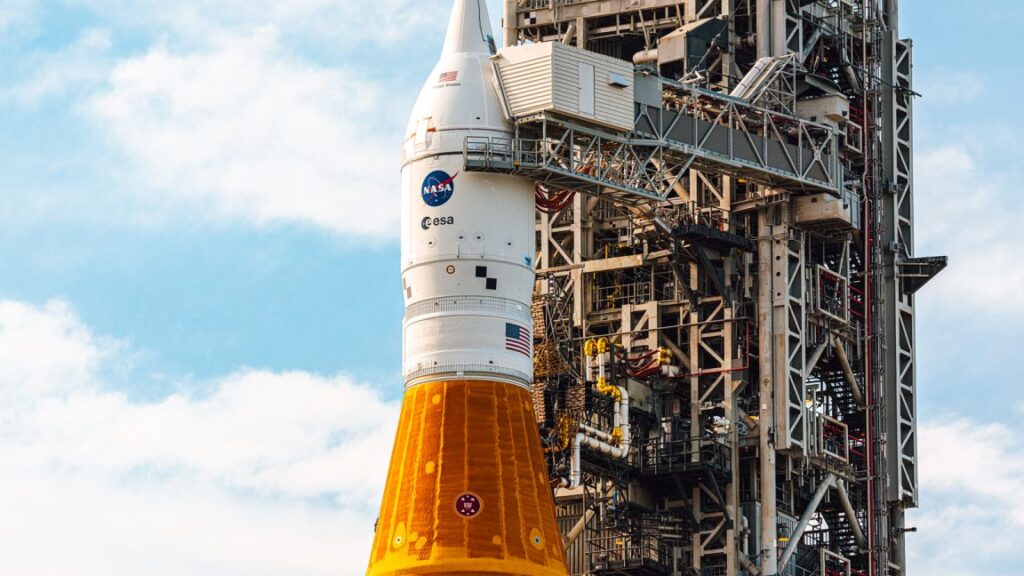
A technician works on the Orion spacecraft, atop the SLS rocket, in January 2022. Credit: NASA

The White House Office of Management and Budget dropped its “skinny” budget proposal for the federal government earlier this month, and the headline news for the US space program was the cancellation of three major programs: the Space Launch System rocket, Orion spacecraft, and Lunar Gateway.

Opinions across the space community vary widely about the utility of these programs—one friend in the industry predicted a future without them to be so dire that Artemis III would be the last US human spaceflight of our lifetimes. But there can be no question that if such changes are made they would mark the most radical remaking of NASA in two decades.

This report, based on interviews with multiple sources inside and out of the Trump administration, seeks to explain what the White House is trying to do with Moon and Mars exploration, what this means for NASA and US spaceflight, and whether it could succeed.

Will it actually happen?

The first question is whether these changes proposed by the White House will be accepted by the US Congress. Republican and Democratic lawmakers have backed Orion for two decades, the SLS rocket for 15 years, and the Gateway for 10 years. Will they finally give up programs that have been such a reliable source of good-paying jobs for so long?

In general, the answer appears to be yes. We saw the outlines of a deal during the confirmation hearing for private astronaut Jared Isaacman to become the next NASA administrator in April. He was asked repeatedly whether he intended to use the SLS rocket and Orion for Artemis II (a lunar fly around) and Artemis III (lunar landing). Isaacman said he did.

However nothing was said about using this (very costly) space hardware for Artemis IV and beyond. Congress did not ask, presumably because it knows the answer. And that answer, as we saw in the president’s skinny budget, is that the rocket and spacecraft will be killed after Artemis III. This is a pragmatic time to do it, as canceling the programs after Artemis III saves NASA billions of dollars in upgrading the rocket for a singular purpose: assembling a Lunar Gateway of questionable use.

But this will not be a normal budget process. The full budget request from the White House is unlikely to come out before June, and it will probably be bogged down in Congress. One of the few levers that Democrats in Congress presently have is the requirement of 60 Senators to pass appropriations bills. So compromise is necessary, and a final budget may not pass by the October 1 start of the next fiscal year.

Then, should Congress not acquiesce to the budget request, there is the added threat of the White House Office of Management and Budget to use “impoundment” to withhold funding and implement its budget priorities. This process would very quickly get bogged down in the courts, and no one really knows how the Supreme Court would rule.

Leadership alignment

To date, the budget process for NASA has not been led by space policy officials. Rather, the White House Office of Management and Budget, and its leader, Russell Vought, have set priorities and funding. This has led to “budget-driven” policy that has resulted in steep cuts to science that often don’t make much sense (i.e., ending funding for the completed Nancy Grace Roman Space Telescope).

However, there soon will be some important voices to implement a more sound space policy and speak for NASA’s priorities, rather than those of budget cutters.

One of these is President Trump’s nominee to lead NASA, Isaacman. He is awaiting floor time in the US Senate for a final vote. That could happen during the next week or two, allowing Isaacman to become the space agency’s administrator and begin to play an important role in decision-making.

But Isaacman will need allies in the White House itself to carry out sweeping space policy changes. To that end, the report in Politico last week—which Ars has confirmed—that there will be a National Space Council established in the coming months is important. Led by Vice President JD Vance, the space council will provide a counterweight to Vought’s budget-driven process.

Thus, by this summer, there should be key leadership in place to set space policy that advances the country’s exploration goals. But what are those goals?

What happens to Artemis

After the Artemis III mission the natural question is, what would come next if the SLS rocket and Orion spacecraft are canceled?

The most likely answer is that NASA turns to an old but successful playbook: COTS. This stands for Commercial Orbital Transportation System and was created by NASA two decades ago to develop cargo transport systems (eventually this became SpaceX’s Dragon and Northrop’s Cygnus spacecraft) for the International Space Station. Since then, NASA has adopted this same model for crew services as well as other commercial programs.

Under the COTS model, NASA provides funding and guidance to private companies to develop their own spacecraft, rockets, and services, and then buys those at a “market” rate.

The idea of a Lunar COTS program is not new. NASA employees explored the concept in a research paper a decade ago, finding that “a future (Lunar) COTS program has the great potential of enabling development of cost-effective, commercial capabilities and establishing a thriving cislunar economy which will lead the way to an economical and sustainable approach for future human missions to Mars.”

Sources indicate NASA would go to industry and seek an “end-to-end” solution for lunar missions. That is, an integrated plan to launch astronauts from Earth, land them on the Moon, and return them to Earth. One of the bidders would certainly be SpaceX, with its Starship vehicle already having been validated during the Artemis III mission. Crews could launch from Earth either in Dragon or Starship. Blue Origin is the other obvious bidder. The company might partner with Lockheed Martin to commercialize the Orion spacecraft or use the crew vehicle it is developing internally.

Other companies could also participate. The point is that NASA would seek to buy astronaut transportation to the Moon, just as it already is doing with cargo and science experiments through the Commercial Lunar Payload Services program.

The extent of an Artemis lunar surface presence would be determined by several factors, including the cost and safety of this transportation program and whether there are meaningful things for astronauts to do on the Moon.

What about Mars?

The skinny budget contained some intriguing language about Mars exploration: “By allocating over $7 billion for lunar exploration and introducing $1 billion in new investments for Mars-focused programs, the Budget ensures that America’s human space exploration efforts remain unparalleled, innovative, and efficient.”

This was, in fact, the only budget increase proposed by the Trump White House. So what does it mean?

No one is saying for sure, but this funding would probably offer a starting point for a robust Mars COTS program. This would begin with cargo missions to Mars. But eventually it would expand to include crewed missions, thus fulfilling Trump’s promise to land humans on the red planet.

Is this a gift to Elon Musk? Critics will certainly cast it as such, and that is understandable. But the plan would be open to any interested companies, and there are several. Rocket Lab, for example, has already expressed its interest in sending cargo missions to Mars. Impulse Space, too, has said it is building a spacecraft to ferry cargo to Mars and land there.

The Trump budget proposal also kills a key element of NASA’s Mars exploration plans, the robotic Mars Sample Return mission to bring rocks and soil from the red planet to Earth in the 2030s. However, this program was already frozen by the Biden administration because of delays and cost overruns.

Sources said the goal of this budget cut, rather than having a single $8 billion Mars Sample Return mission, is to create an ecosystem in which such missions are frequent. The benefit of opening a pathway to Mars with commercial companies is that it would allow for not just a single Mars Sample Return mission, but multiple efforts at a lower cost.

“The fact is we want to land large things, including crew cabins, on the Moon and Mars and bring them back to Earth,” one Republican space policy consultant said. “Instead of building a series of expensive bespoke robotic landers to do science, let’s develop cost-effective reusable landers that can, with minimal changes, support both cargo and crew missions to the Moon and Mars.”

Photo of Eric Berger

Eric Berger is the senior space editor at Ars Technica, covering everything from astronomy to private space to NASA policy, and author of two books: Liftoff, about the rise of SpaceX; and Reentry, on the development of the Falcon 9 rocket and Dragon. A certified meteorologist, Eric lives in Houston.

If Congress actually cancels the SLS rocket, what happens next? Read More »

europe-launches-program-to-lure-scientists-away-from-the-us

Europe launches program to lure scientists away from the US

At the same time, international interest in working in the United States has declined significantly. During the first quarter of the year, applications from scientists from Canada, China, and Europe to US research centers fell by 13 percent, 39 percent, and 41 percent, respectively.

Against this backdrop, European institutions have intensified their efforts to attract US talent. Aix-Marseille University, in France, recently launched A Safe Place for Science, a program aimed at hosting US researchers dismissed, censored, or limited by Trump’s policies. This project is backed with an investment of approximately €15 million.

Along the same lines, the Max Planck Society in Germany has announced the creation of the Max Planck Transatlantic Program, whose purpose is to establish joint research centers with US institutions. “Outstanding investigators who have to leave the US, we will consider for director positions,” the society’s director Patrick Cramer said in a speech discussing the program.

Spain seeks a leading role

Juan Cruz Cigudosa, Spain’s secretary of state for science, innovation, and universities, has stressed that Spain is also actively involved in attracting global scientific talent, and is prioritizing areas such as quantum biotechnology, artificial intelligence, advanced materials, and semiconductors, as well as anything that strengthens the country’s technological sovereignty.

To achieve this, the government of Pedro Sánchez has strengthened existing programs. The ATRAE program—which aims to entice established researchers into bringing their work to Spain—has been reinforced with €45 million to recruit scientists who are leaders in strategic fields, with a special focus on US experts who feel “looked down upon.” This program is offering additional funding of €200,000 euros per project to those selected from the United States.

Similarly, the Ramón y Cajal program—created 25 years ago to further the careers of young scientists—has increased its funding by 150 percent since 2018, allowing for 500 researchers to be funded per year, of which 30 percent are foreigners.

“We are going to intensify efforts to attract talent from the United States. We want them to come to do the best science possible, free of ideological restrictions. Scientific and technological knowledge make us a better country, because it generates shared prosperity and a vision of the future,” said Cigudosa in a statement to the Spanish international news agency EFE after the announcement of the Choose Europe for Science program.

This story originally appeared on WIRED en Español and has been translated from Spanish.

Europe launches program to lure scientists away from the US Read More »

trump-kills-broadband-grants,-calls-digital-equity-program-“racist-and-illegal”

Trump kills broadband grants, calls digital equity program “racist and illegal”

President Donald Trump said he is killing a broadband grant program that was authorized by Congress, claiming that the Digital Equity Act of 2021 is racist and unconstitutional.

“I have spoken with my wonderful Secretary of Commerce, Howard Lutnick, and we agree that the Biden/Harris so-called ‘Digital Equity Act’ is totally UNCONSTITUTIONAL. No more woke handouts based on race! The Digital Equity Program is a RACIST and ILLEGAL $2.5 BILLION DOLLAR giveaway. I am ending this IMMEDIATELY, and saving Taxpayers BILLIONS OF DOLLARS!” Trump wrote in a Truth Social post yesterday.

The Digital Equity Act provided $2.75 billion for three grant programs. As a National Telecommunications and Information Administration webpage says, the grants “aim to ensure that all people and communities have the skills, technology, and capacity needed to reap the full benefits of our digital economy.”

The digital equity law, approved as part of the Infrastructure Investment and Jobs Act, allows for grants benefitting a wide range of Americans who lack reliable and affordable Internet access. The law covers low-income households, people who are at least 60 years old, people incarcerated in state or local prisons and jails, veterans, people with disabilities, people with language barriers, people who live in rural areas, and people who are members of a racial or ethnic minority group.

“President Trump’s move to end the Digital Equity Act is blatantly unconstitutional,” consumer advocacy group Public Knowledge said. While Trump is “labeling efforts to address racial inequity as discriminatory themselves,” his action “will also severely impact his voter base of white Americans who live in rural areas in red states, including veterans and the elderly,” the group said.

Some states already received funding last year. If Trump cancels grants that haven’t yet been distributed, it will likely result in lawsuits against the administration.

The law allows funding to be used in a variety of ways, including “to make available equipment, instrumentation, networking capability, hardware and software, or digital network technology for broadband services to covered populations at low or no cost,” and “to construct, upgrade, expend, or operate new or existing public access computing centers for covered populations through community anchor institutions.” It can also cover training programs for using technology and workforce development programs.

Trump kills broadband grants, calls digital equity program “racist and illegal” Read More »

trump-and-doj-try-to-spring-former-county-clerk-tina-peters-from-prison

Trump and DOJ try to spring former county clerk Tina Peters from prison

President Donald Trump is demanding the release of Tina Peters, a former election official who parroted Trump’s 2020 election conspiracy theories and is serving nine years in prison for compromising the security of election equipment.

In a post on Truth Social last night, Trump wrote that “Radical Left Colorado Attorney General Phil Weiser ignores Illegals committing Violent Crimes like Rape and Murder in his State and, instead, jailed Tina Peters, a 69-year-old Gold Star mother who worked to expose and document Democrat Election Fraud. Tina is an innocent Political Prisoner being horribly and unjustly punished in the form of Cruel and Unusual Punishment.”

Trump said he is “directing the Department of Justice to take all necessary action to help secure the release of this ‘hostage’ being held in a Colorado prison by the Democrats, for political reasons.”

The former Mesa County clerk was indicted in March 2022 on charges related to the leak of voting-system BIOS passwords and other confidential information. Peters was convicted in August 2024 and later sentenced in a Colorado state court.

“Your lies are well-documented and these convictions are serious,” 21st Judicial District Judge Matthew Barrett told Peters at her October 2024 sentencing. “I am convinced you would do it all over again. You are as defiant a defendant as this court has ever seen.”

DOJ reviews case for “abuse” of process

After Peters’ August 2024 conviction, Colorado Secretary of State Jena Griswold said that “Tina Peters willfully compromised her own election equipment trying to prove Trump’s big lie.”

Peters appealed her conviction in a Colorado appeals court and separately sought relief in US District Court for the District of Colorado. She asked the federal court to order her release on bond while the state court system handles her appeal and said her health has deteriorated while being incarcerated.

Trump’s Justice Department submitted a filing on Peters’ behalf in March, saying the US has concerns about “the exceptionally lengthy sentence imposed relative to the conduct at issue, the First Amendment implications of the trial court’s October 2024 assertions relating to Ms. Peters, and whether Colorado’s denial of bail pending appeal was arbitrary or unreasonable under the Eighth and Fourteenth Amendments.”

Trump and DOJ try to spring former county clerk Tina Peters from prison Read More »

editorial:-censoring-the-scientific-enterprise,-one-grant-at-a-time

Editorial: Censoring the scientific enterprise, one grant at a time


Recent grant terminations are a symptom of a widespread attack on science.

Over the last two weeks, in response to Executive Order 14035, the National Science Foundation (NSF) has discontinued funding for research on diversity, equity, and inclusion (DEI), as well as support for researchers from marginalized backgrounds. Executive Order 14168 ordered the NSF (and other federal agencies) to discontinue any research that focused on women, women in STEM, gender variation, and transsexual or transgender populations—and, oddly, transgenic mice.

Then, another round of cancellations targeted research on misinformation and disinformation, a subject (among others) that Republican Senator Ted Cruz views as advancing neo-Marxist perspectives and class warfare.

During the previous three years, I served as a program officer at the NSF Science of Science (SOS) program. We reviewed, recommended, and awarded competitive research grants on science communication, including research on science communication to the public, communication of public priorities to scientists, and citizen engagement and participation in science. Projects my team reviewed and funded on misinformation are among the many others at NSF that have now been canceled (see the growing list here).

Misinformation research is vital to advancing our understanding of how citizens understand and process evidence and scientific information and put that understanding into action. It is an increasingly important area of research given our massive, ever-changing digital information environment.

A few examples of important research that was canceled because it threatens the current administration’s political agenda:

  • A project that uses computational social sciences, computer science, sociology, and statistics to understand the fundamentals of information spread through social media, because understanding how information flows and its impact on human behavior is important for determining how to protect society from the effects of misinformation, propaganda, and “fake news.”
  • A project investigating how people and groups incentivize others to spread misinformation on social media platforms.
  • A study identifying the role of social media influencers in addressing misconceptions and inaccurate information related to vaccines, which would help us develop guidance on how to ensure accurate information reaches different audiences.

Misinformation research matters

This work is critical on its own. Results of misinformation research inform how we handle education, public service announcements, weather warnings, emergency response broadcasts, health advisories, agricultural practices, product recalls, and more. It’s how we get people to integrate data into their work, whether their work involves things like farming, manufacturing, fishing, or something else.

Understanding how speech on technical topics is perceived, drives trust, and changes behavior can help us ensure that our speech is more effective. Beyond its economic impact, research on misinformation helps create an informed public—the foundation of any democracy. Contrary to the president’s executive order, it does not “infringe on the constitutionally protected speech rights of American citizens.”

Misinformation research is only a threat to the speech of people who seek to spread misinformation.

Politics and science

Political attacks on misinformation research is censorship, driven by a dislike for the results it produces. It is also part of a larger threat to the NSF and the economic and social benefits that come from publicly funded research.

The NSF is a “pass through agency”—most of its annual budget (around $9 billion) passes through the agency and is returned to American communities in the form of science grants (80 percent of the budget) and STEM education (13 percent). The NSF manages these programs via a staff that is packed full of expert scientists in physics, psychology, chemistry, geosciences, engineering, sociology, and other fields. These scientists and the administrative staff (1,700 employees, who account for around 5 percent of its budget) organize complex peer-review panels that assess and distribute funding to cutting-edge science.

In normal times, presidents may shift the NSF’s funding priorities—this is their prerogative. This process is political. It always has been. It always will be. Elected officials (both presidents and Congress) have agendas and interests and want to bring federal dollars to their constituents. Additionally, there are national priorities—pandemic response, supercomputing needs, nanotechnology breakthroughs, space exploration goals, demands for microchip technologies, and artificial intelligence advancements.

Presidential agendas are meant to “steer the ship” by working with Congress to develop annual budgets, set appropriations and earmarks, and focus on specific regions (e.g., EPSCoR), topics, or facilities (e.g., federal labs).

While shifting priorities is normal, cancellation of previously funded research projects is NOT normal. Unilaterally banning funding for specific types of research (climate science, misinformation, research on minoritized groups) is not normal.

It’s anti-scientific, allowing politics rather than expertise to determine which research is most competitive. Canceling research grants because they threaten the current regime’s political agenda is a violation of the NSF’s duty to honor contracts and ethically manage the funds appropriated by the US Congress. This is a threat not just to individual scientists and universities, but to the trust and norms that underpin our scientific enterprise. It’s an attempt to terrorize researchers with the fear that their funding may be next and to create backlash against science and expertise (another important area of NSF-funded research that has also been canceled).

Scientific values and our responsibilities

Political interference in federal funding of scientific research will not end here. A recent announcement notes the NSF is facing a 55 percent cut to its annual budget and mass layoffs. Other agencies have been told to prepare for similar cuts. The administration’s actions will leave little funding for R&D that advances the public good. And the places where the research happens—especially universities and colleges—are also under assault. While these immediate cuts are felt first by scientists and universities, they will ultimately affect people throughout the nation—students, consumers, private companies, and residents.

The American scientific enterprise has been a world leader, and federal funding of science is a key driver of this success. For the last 100 years, students, scientists, and entrepreneurs from around the world have flocked to the US to advance science and innovation. Public investments in science have produced economic health and prosperity for all Americans and advanced our national security through innovation and soft diplomacy.

These cuts, combined with other actions taken to limit research funding and peer review at scientific agencies, make it clear that the Trump administration’s goals are to:

  • Roll back education initiatives that produce an informed public
  • Reduce evidence-based policy making
  • Slash public investment in the advancement of science

All Americans who benefit from the outcomes of publicly funded science—GPS and touch screens on your phone, Google, the Internet, weather data on an app, MRI, kidney exchanges, CRISPR, 3D printing, tiny hearing aids, bluetooth, broadband, robotics at the high school, electric cars, suspension bridges, PCR tests, AlphaFold and other AI tools, Doppler radar, barcodes, reverse auctions, and far, far more—should be alarmed and taking action.

Here are some ideas of what you can do:

  1. Demand that Congress restore previous appropriations, 5Calls
  2. Advocate through any professional associations you’re a member of
  3. Join science action groups (Science for the People, Union of Concerned Scientists, American Association for the Advancement of Science)
  4. Talk to university funders, leadership, and alumni about the value of publicly funded science
  5. Educate the public (including friends, family, and neighbors) about the value of science and the role of federally funded research
  6. Write an op-ed or public outreach materials through your employer
  7. Support federal employees
  8. If you’re a scientist, say yes to media & public engagement requests
  9. Attend local meetings: city council, library board, town halls
  10. Attend a protest
  11. Get offline and get active, in-person

There is a lot going on in the political environment right now, making it easy to get caught up in the implications cuts have on individual research projects or to be reassured by things that haven’t been targeted yet. But the threat looms large, for all US science. The US, through agencies like the NSF, has built a world-class scientific enterprise founded on the belief that taxpayer investments in basic science can and do produce valuable economic and social outcomes for all of us. Censoring research and canceling misinformation grants is a small step in what is already a larger battle to defend our world-class scientific enterprise. It is up to all of us to act now.

Mary K. Feeney is the Frank and June Sackton chair and professor in the School of Public Affairs at Arizona State University. She is a fellow of the National Academy of Public Administration and served as the program director for the Science of Science: Discovery, Communication and Impact program at the National Science Foundation (2021–2024).

Editorial: Censoring the scientific enterprise, one grant at a time Read More »