Trump

cdc-tormented:-hr-workers-summoned-from-furlough-to-lay-off-themselves,-others

CDC tormented: HR workers summoned from furlough to lay off themselves, others


Traumatized CDC has lost 33% of its workforce this year, union says.

ATLANTA, GEORGIA – AUGUST 9: Bullet holes are seen in windows at the Centers For Disease Control (CDC) Global Headquarters following a shooting that left two dead, on August 9, 2025 in Atlanta, Georgia. On August 8, a gunman opened fire near the headquarters of the Centers for Disease Control, killing a DeKalb County Police Department officer before being found dead by gunfire. Credit: Getty | Elijah Nouvelage

The dust is still settling at the Centers for Disease Control and Prevention after a mass layoff on Friday, which former employees at the beleaguered agency are describing as a massacre.

In separate press briefings on Tuesday, a network of terminated CDC staff that goes by the name the National Public Health Coalition, and the union representing employees at the agency discussed what the wide-scale cuts mean for the American people, as well as the trauma, despair, and damage they have wreaked on the workers of the once-premier public health agency.

In a normal federal layoff—called a reduction in force, or RIF—the agency would be given a full outline of the roles and branches or divisions affected, as well as some explanation for the cuts, such as alleged fraud, abuse, or redundancy. However, the Trump administration has provided no such information or explanation, leaving current and former employees to essentially crowdsource what has been lost and only guess at the possible reasons.

The numbers

The union representing CDC workers, the American Federation of Government Employees (AFGE) Local 2883, has been assessing the cuts since termination emails began arriving in employee inboxes late Friday. The union estimates that the Trump administration sent termination notices to 1,300 CDC employees on Friday, in what they called an illegal “politically-motivated stunt.” Of those 1,300 terminations, around 700 were rescinded, beginning on Saturday.

The Trump administration said the 700 rescinded terminations were sent due to a “coding error.” But CDC workers didn’t buy that explanation, saying all the terminations were intentional, and some were only reversed after backlash erupted when people realized what the administration was trying to cut—for example, terminating the experts responding to domestic measles outbreaks and those responding to an Ebola outbreak in the Democratic Republic of the Congo who received RIF notices that were later rescinded. Still, with the rescissions, some 600 terminations appear to remain.

In all, the union estimated that the CDC has lost 33 percent of its workforce since the start of the Trump administration. In January, there were roughly 13,000 CDC workers total. Since then, about 3,000 have been fully separated from the agency, including 600 laid off in a RIF on April 1, and 2,400 who were either fired or forced out amid pressure campaigns. An additional 1,300 have been laid off but are not yet fully separated from the agency; they remain on paid administrative leave but are unable to do their work.

In the RIF Friday, laid-off employees said they were given notices that list their termination effective date as December 8, leaving a 60-day period in which they would be on administrative leave.

The RIF was carried out amid an ongoing government shutdown over a health care funding dispute, and the Trump administration has claimed that the RIF is a consequence of the shutdown. But the union, along with federal employment lawyers and even some senior government officials, say a RIF during a shutdown is illegal; a temporary lapse in government funding is not a legitimate reason for a RIF under federal regulations, and it runs afoul of a federal law that prohibits the government from incurring new costs during a shutdown, such as by promising severance packages.

Brutal cuts

In practice, a RIF amid a shutdown added more trauma to the demoralized staff. In opening remarks, Local AFGE 2883 President Yolanda Jacobs noted that the CDC Human Resources staff had been furloughed during the shutdown but were temporarily brought back into work just so they could process termination letters—including their own. A terminated CDC employee who spoke on condition of anonymity said that more than 90 percent of the HR staff is now gone.

Among the terminations were also mental health workers who were helping CDC staff recover from an August attack, in which a gunman fired over 500 rounds at CDC buildings full of agency employees and killed a local police officer.

Another terminated CDC worker who spoke on the condition of anonymity discussed the personal toll of the RIF. She had worked at the agency for over two decades and learned of her termination Friday night as she was doing dishes after making homemade pizza with her family—money worries kept them from ordering out. Her phone “started going crazy” as coworkers were checking in after receiving their RIF notices. She dug out her work laptop, which had been set aside since she was furloughed, to find her own RIF notice at the top of her inbox.

As text messages continued to come in through the night, she said it was “heartbreaking and devastating” when she realized the Trump administration was “actually dismantling us.”

“These are just hardworking Americans who just want to do their job, who just want to help people, who want to make sure the correct information is out there [and] that we are preventing things from happening,” she said.

Since the RIF has sunk in, she has started to worry more for her family and their finances. During the furlough, paychecks are uncertain. And her effective termination date in December will land between holidays, when hiring is slow. She worried about affording Christmas presents for her family.

She also said that staff have asked about getting other jobs while on administrative leave but were told that in order to do that, they would need to get approval from the CDC’s ethics office to ensure there were no conflicts of interest. But staff can’t actually do that because everyone at the ethics office also got RIF notices.

Losses

Throughout the briefings yesterday, staff highlighted that the RIF did not just trim here and there, as one might expect with cuts designed to make the organization leaner. Instead, it lopped off entire teams and branches, completely shutting down whole lines of work.

One former CDC employee spoke broadly of big hits to experts in chronic disease, global health, and the National Center for Health Statistics, which runs critical data collection that states and local health departments rely on. The CDC’s library staff are all gone. Suicide prevention experts have been cut, as well as communications and policy staff, who develop briefings and provide information to Congress members.

Abigail Tighe, a former CDC employee with National Public Health Coalition, tried to put the cuts in context, saying: “We are losing the people with all the knowledge to prevent childhood drownings, child abuse, and suicide. We’re losing the experts who help us track and understand the health and safety needs of our communities [and] the brave and brilliant professionals who, on a moment’s notice, respond to new and unknown outbreaks across the world. And that’s just a few examples.”

A terminated scientist who spoke on condition of anonymity said that her entire office was eliminated in the RIF. “My heart breaks for my colleagues and friends who have been tormented, traumatized, shot at, threatened daily. These are kind, hardworking, thoughtful people whose lives are being overturned,” she said.

But, “ultimately,” she said, “I am terrified for the public safety of our country.”

Photo of Beth Mole

Beth is Ars Technica’s Senior Health Reporter. Beth has a Ph.D. in microbiology from the University of North Carolina at Chapel Hill and attended the Science Communication program at the University of California, Santa Cruz. She specializes in covering infectious diseases, public health, and microbes.

CDC tormented: HR workers summoned from furlough to lay off themselves, others Read More »

layoffs,-a-“coding-error,”-chaos:-trump-admin-ravages-the-health-dept.

Layoffs, a “coding error,” chaos: Trump admin ravages the health dept.

Federal health agencies are reeling from mass layoffs on Friday that appear to have particularly devastated the Centers for Disease Control and Prevention, despite some terminations being rescinded on Saturday.

Numbers are still sketchy, but reports from Friday indicate that more than 4,000 federal workers overall were initially targeted for layoffs. The Trump administration linked the firings to the ongoing government shutdown, which legal experts have suggested is illegal. Unions representing federal workers have already filed a lawsuit challenging the move.

Of the reported 4,000 terminations, about 1,100 to 1,200 were among employees in the Department of Health and Human Services (HHS). HHS is a massive department that houses critical federal agencies, including the Centers for Disease Control and Prevention, the National Institutes of Health, the Food and Drug Administration, and the Centers for Medicare & Medicaid Services, among others. Before Trump’s second term, the HHS workforce was about 82,000, but that was slashed to about 62,000 earlier this year amid initial cuts and efforts to push civil servants out.

While it’s unclear where all the new cuts occurred, reports from anonymous and external sources describe a major gutting of the CDC, an agency that has already been severely wounded, losing significant numbers this year. Its former leaders have accused the Trump administration of censoring its scientific work. It suffered a dramatic ousting of its Senate-confirmed director in August. And it was the target of a gunman weeks earlier, who shot over 500 rounds at its employees, killing a local police officer.

As terminations went out Friday, reports indicated that the terminations hit staff who produce the CDC’s esteemed journal Morbidity and Mortality Weekly Report, employees responding to the measles outbreaks in the US, others responding to the Ebola outbreak in the Democratic Republic of the Congo, workers in the Global Health Center, and disease detectives in the Epidemic Intelligence Service.

Layoffs, a “coding error,” chaos: Trump admin ravages the health dept. Read More »

not-a-game:-cards-against-humanity-avoids-tariffs-by-ditching-rules,-adding-explanations

Not a game: Cards Against Humanity avoids tariffs by ditching rules, adding explanations

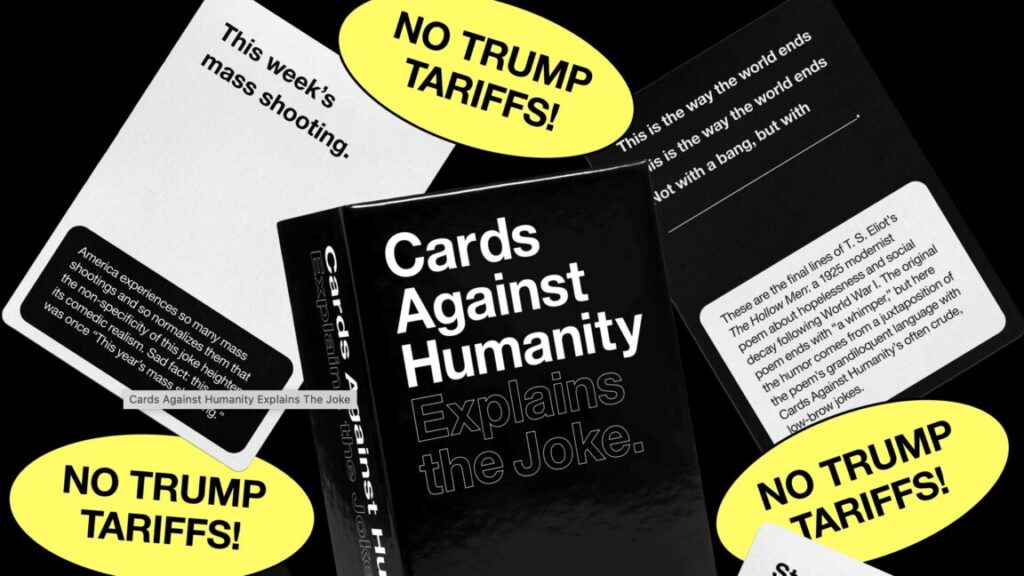
Cards Against Humanity, the often-vulgar card game, has launched a limited edition of its namesake product without any instructions and with a detailed explanation of each joke, “why it’s funny, and any relevant social, political, or historical context.”

Why? Because, produced in this form, “Cards Against Humanity Explains the Joke” is not a game at all, which would be subject to tariffs as the cards are produced overseas. Instead, the product is “information material” and thus not sanctionable under the law Trump has been using—and CAH says it has obtained a ruling to this effect from Customs and Border Patrol.

“What if DHS Secretary and Dog Murderer Kristi Noem gets mad and decides that Cards Against Humanity Explains the Joke is not informational material?” the company asks in an FAQ about the new edition. (If you don’t follow US politics, Noem really did kill her dog Cricket.) Answer: “She can fuck right off, because we got a binding ruling from Trump’s own government that confirms this product is informational and 100% exempt from his stupid tariffs.”

Pre-orders for the $25 product end on October 15, and it will allegedly never be reprinted. All profits will be donated to the American Library Association “to fight censorship.”

This is the way

Now, I would never claim that Cards Against Humanity is a particularly highbrow form of entertainment; for instance, the website promoting the new edition opens with “Trump is Going to Fuck Christmas” in giant white letters. (That headline refers to Trump’s tariffs… I hope.)

“This holiday season, give your loved ones the gift of knowledge, give America’s libraries the gift of cash, and don’t give Donald Trump a fucking cent,” the site says.

Not a game: Cards Against Humanity avoids tariffs by ditching rules, adding explanations Read More »

trump-admin-defiles-even-the-“out-of-office”-email-auto-reply

Trump admin defiles even the “out of office” email auto-reply

Well—not “Democrats,” exactly, but “Democrat Senators.” The use of the noun “Democrat” as an adjective (e.g., “the Democrat Party”) is a long-standing and deliberate right-wing refusal to call the opposition by its name. (If you visit the Democrats’ website, the very first words below the site header are “We are the Democratic Party”; the party is run by the “Democratic National Committee.”) Petty? Sure! But that’s a feature, not a bug.

Similar out-of-office suggestions have been made to employees at the Small Business Administration and the Department of Health and Human Services. Such messages appear to be violations of the Hatch Act, which prohibits partisan speech from most executive branch employees while they are on duty, since these people represent and work for all Americans.

The Office of Special Counsel, which is supposed to prosecute violations of the Hatch Act, notes in a training flyer that most executive branch workers “may not engage in political activity—i.e., activity directed at the success or failure of a political party.”

Employees may also not “use any e-mail account or social media to distribute, send, or forward content that advocates for or against a partisan political party.”

When asked about its suggested out-of-office message blaming Democrats, the Department of Health and Human Services told CNN that yes, it had suggested this—but added that this was okay because the partisan message was accurate.

“Employees were instructed to use out-of-office messages that reflect the truth: Democrats have shut the government down,” the agency said.

Truly, as even a sitting Supreme Court justice has noted, the “rule of law” has now become “Calvinball.”

Websites, too

Department websites have also gotten in on the partisan action. The Department of Housing and Urban Development’s site now loads with a large floating box atop the page, which reads, “The Radical Left in Congress shut down the government.” When you close the box, you see atop the main page itself an eye-searingly red banner that says… the same thing. Thanks, I think we got it!

Trump admin defiles even the “out of office” email auto-reply Read More »

anti-vaccine-allies-cheer-as-trump-claims-shots-have-“too-much-liquid”

Anti-vaccine allies cheer as Trump claims shots have “too much liquid”


Why babies don’t pop like water balloons when they get vaccines—and other info for Trump.

President Donald Trump, flanked by senior health officials, speaks during a news conference on September 22, 2025 inside the Roosevelt Room at The White House in Washington. Credit: Getty | Tom Brenner

When the bar is set at suggesting that people inject bleach into their veins, it’s hard to reach a new low. But in a deranged press event on autism Monday evening, President Trump seemed to go for it—sharing “rumors” and his “strong feelings” not just on Tylenol but also his bonkers views on childhood vaccines.

Trump was there with his health secretary, anti-vaccine activist Robert F. Kennedy Jr., to link autism to the use of Tylenol (acetaminophen) during pregnancy. While medical experts condemn the claim as unproven and dangerous (which it is), Kennedy’s anti-vaccine followers decried it as a distraction from their favored false and dangerous explanation—that vaccines cause autism (which they don’t).

Pinning the blame on Tylenol instead of vaccines enraged Kennedy’s own anti-vaccine organization, Children’s Health Defense. In the run-up to the event Monday evening, CHD retweeted an all-caps defense of Tylenol, and CHD President Mary Holland called the announcement a “sideshow” in an interview with Steve Bannon.

But fear not. The rift was short-lived, as their big feelings were soothed mere minutes into Monday’s event. After smearing Tylenol, the president’s unscripted remarks quickly veered into an incoherent rant linking vaccines to autism as well.

At one point in his comments, he rattled off a list of anti-vaccine activists’ most vilified vaccine components (mercury and aluminum). But his attack largely ignored the content of vaccines and instead surprisingly focused on volume. Overall, his comments were incoherent, but again and again, he seemed to swirl back to this bizarre concern.

Wut?

If you piece together Trump’s sentence- and thought-fragments, his comments created a horrifying picture of what he thinks childhood vaccinations look like:

They pump so much stuff into those beautiful little babies. It’s a disgrace. I don’t see it. I think it is very bad. They’re pumping. It looks like they’re pumping into a horse. You have a little child, little fragile child, and you get a vat of 80 different vaccines, I guess, 80 different blends and they pump it in.

It seemed that Trump’s personal solution to this imagined problem is to space out and delay vaccines so they are not given at one time:

Break it up because it’s too much liquid. Too many different things are going into that baby at too big a number. The size of this thing, when you look at it, it’s like 80 different vaccines and beyond vaccines and 80. Then you give that to a little kid.

From Trump’s loony descriptions, you might be imagining an evil cartoon doctor wielding a bazooka-sized syringe and cackling maniacally while injecting a baby with a vat’s worth of 80 different vaccines until it inflates like a water balloon ready to burst.

But this cuckoo take is not how childhood vaccinations go in routine well-baby doctor’s visits. First, most vaccines have a volume of 0.5 milliliters, which is about a tenth of a teaspoon. And babies and children do not get 80 different vaccines ever, let alone at one time. In fact, no recommendations would see anyone get 80 different types of vaccines cumulatively.

By age 18, it’s recommended that people get vaccinated against 17 diseases, including seasonal flu and COVID-19. And some vaccines are combination shots, knocking out three or four diseases with one injection, such as the measles, mumps, rubella (MMR) vaccine or the Diphtheria, tetanus, & acellular pertussis (DTaP) vaccine. And again, even those combination shots are 0.5 mL total.

Modern vaccines

Trump’s claim of 80 vaccines doesn’t even stand up when you count vaccine doses rather than different vaccines. Some childhood vaccines require multiple doses—MMR is given in two doses, and DTaP is a five-dose series, for example. According to current recommendations, by age 18, kids should have 36 vaccine doses against childhood diseases. If you add in a flu shot every year, that’s 54 doses. If you add in a COVID-19 vaccine every year, that’s 72.

While 72 might seem like a big number, again, that’s spread out over 18 years and includes seasonal shots. And medical experts point to another key fact—the vaccines that children get today are much more streamlined and efficient than vaccines of yore. A helpful myth-busting info sheet from experts with Yale’s School of Public Health points out that in the mid-1980s, children under age 2 were vaccinated against seven diseases, but those old-school vaccines included more than 3,000 germ components that can spur immune responses (aka antigens). Today, children under age 2 get vaccinated against 15 diseases, but today’s more sophisticated vaccine designs include just 180 antigens, making the protection more targeted and reducing the risk of errant immune responses.

In all, the facts should dash any worries of nefarious doctors inflating children with vast volumes of noxious concoctions. But for those who may hew closely to the cautionary principle, Trump’s “space the shots out” plan may still seem reasonable. It’s not.

At most, children might get five or six vaccines at one time. But again, the number of antigens in those shots is far lower than those in vaccines children received decades ago. And the number of antigens in those vaccines is just a fraction of the number kids are exposed to every day just from their environments. If you’ve ever watched a kindergartener touch every surface and object in a classroom and then shove their fingers in their nose and mouth, you understand the point.

Vaccinations don’t overwhelm children’s immune systems. And there’s no evidence that spacing them out avoids any of the very small risks they pose.

Data against dogma

After Trump shared his personal feelings about vaccines, the American Academy of Pediatrics rushed to release a statement, first refuting any link between vaccines and autism and then warning against spacing out vaccine doses.

“Pediatricians know firsthand that children’s immune systems perform better after vaccination against serious, contagious diseases like polio, measles, whooping cough, and hepatitis B,” the AAP said. “Spacing out or delaying vaccines means children will not have immunity against these diseases at times when they are most at risk.”

Such messages make no impact on the impervious dogma of anti-vaccine activists, of course. While medical experts and organizations like AAP scrambled to combat the misinformation and assure pregnant people and parents that Tylenol was still safe and vaccines don’t cause autism, anti-vaccine activists cheered Trump’s comments.

“We knew today was going to be about acetaminophen,” CHD President Mary Holland said, speaking on Bannon’s podcast again after the event. “We didn’t know if he’d touch on vaccines—and he was all over it. It was an amazing, amazing speech.

“I’m happy to say he basically gave parents permission not to vaccinate their kids—and definitely not to take Tylenol.”

In a new pop-up message on Tylenol’s website, the maker of the common pain reliever and fever reducer pushed back on Trump’s feelings.

Tylenol is one of the most studied medications in history–and is safe when used as directed by expecting mothers, infants, and children.

The facts remain unchanged: over a decade of rigorous research, endorsed by leading medical professionals, confirm there is no credible evidence linking acetaminophen to autism.

The same is true for vaccines.

Photo of Beth Mole

Beth is Ars Technica’s Senior Health Reporter. Beth has a Ph.D. in microbiology from the University of North Carolina at Chapel Hill and attended the Science Communication program at the University of California, Santa Cruz. She specializes in covering infectious diseases, public health, and microbes.

Anti-vaccine allies cheer as Trump claims shots have “too much liquid” Read More »

supreme-court-chief-justice-lets-trump-fire-ftc-democrat,-at-least-for-now

Supreme Court Chief Justice lets Trump fire FTC Democrat, at least for now

1935 Supreme Court is key precedent

The key precedent in the case is Humphrey’s Executor v. United States, a 1935 ruling in which the Supreme Court unanimously held that the president can only remove FTC commissioners for inefficiency, neglect of duty, or malfeasance in office. Trump’s termination notices to Slaughter and Bedoya said they were being fired simply because their presence on the commission “is inconsistent with my Administration’s priorities.”

The Trump administration argues that Humphrey’s Executor shouldn’t apply to the current version of the FTC because it exercises significant executive power. But the appeals court, in a 2-1 ruling, said “the present-day Commission exercises the same powers that the Court understood it to have in 1935 when Humphrey’s Executor was decided.”

“The government has no likelihood of success on appeal given controlling and directly on point Supreme Court precedent,” the panel majority said.

But while the government was found to have no likelihood of success in the DC Circuit appeals court, its chances are presumably much better in the Supreme Court. The Supreme Court previously stayed District Court decisions in cases involving Trump’s removal of Democrats from the National Labor Relations Board, the Merit Systems Protection Board, and the Consumer Product Safety Commission.

In a 2020 decision involving the Consumer Financial Protection Bureau, the court said in a footnote that its 1935 “conclusion that the FTC did not exercise executive power has not withstood the test of time.” If the Supreme Court ultimately rules in favor of Trump, it could throw out the Humphrey’s Executor ruling or clarify it in a way that makes it inapplicable to the FTC.

But Humphrey’s Executor is still a binding precedent, Slaughter’s opposition to the administrative stay said. “This Court should not grant an administrative stay where the court below simply ‘follow[ed] the case which directly controls,’ as it was required to do,” the Slaughter filing said.

Supreme Court Chief Justice lets Trump fire FTC Democrat, at least for now Read More »

congress-and-trump-may-compromise-on-the-sls-rocket-by-axing-its-costly-upper-stage

Congress and Trump may compromise on the SLS rocket by axing its costly upper stage

There are myriad questions about how NASA’s budget process will play out in the coming weeks, with the start of the new fiscal year on October 1 looming.

For example, the Trump administration may seek to shut off dozens of science missions that are either already in space or in development. Although Congress has signaled a desire to keep these missions active, absent a confirmed budget, the White House has made plans to turn off the lights.

Some answers may be forthcoming this week, as the House Appropriations Committee will take up the Commerce, Justice, and Science budget bill on Wednesday morning. However great uncertainty remains about whether there will be a budget passed by October 1 (unlikely), a continuing resolution, or a government shutdown.

Behind the scenes, discussions are also taking place about NASA’s Artemis Program in general and the future of the Space Launch System rocket specifically.

$4 billion a launch is too much

From the beginning, the second Trump administration has sought to cancel the costly, expendable rocket. Some officials wanted to end the rocket immediately,  but eventually the White House decided to push for cancellation after Artemis III. This seemed prudent because it allowed the United States the best possible chance to land humans back on the Moon before China got there, and then transition to a more affordable lunar program as quickly as possible.

Congress, particularly US Sen. Ted. Cruz, R-Texas, was not amenable. And so, in supplemental funding as part of the “One Big Beautiful Bill,” Cruz locked in billions of dollars to ensure that Artemis IV and Artemis V flew on the SLS rocket, with the promise of additional missions.

Since the release of its budget proposal in May, which called for an end to the SLS rocket after Artemis III, the White House has largely been silent, offering no response to Congress. However that changed last week, when interim NASA Administrator Sean Duffy addressed the issue on a podcast hosted by one of the agency’s public relations officials, Gary Jordan:

Congress and Trump may compromise on the SLS rocket by axing its costly upper stage Read More »

trump-admin-issues-stop-work-order-for-offshore-wind-project

Trump admin issues stop-work order for offshore wind project

In a statement to Politico’s E&E News days after the order was lifted in May, the White House claimed that Hochul “caved” and struck an agreement to allow “two natural gas pipelines to advance” through New York.

Hochul denied that any such deal was made.

Trump has made no effort to conceal his disdain for wind power and other renewable energies, and his administration has actively sought to stymie growth in the industry while providing what critics have described as “giveaways” to fossil fuels.

In a Truth Social post on Wednesday, Trump called wind and solar energy the “SCAM OF THE CENTURY,” criticizing states that have built and rely on them for power.

“We will not approve wind or farmer destroying Solar,” Trump wrote. “The days of stupidity are over in the USA!!!”

On Trump’s first day in office, the president issued a memorandum halting approvals, permits, leases, and loans for both offshore and onshore wind projects.

The GOP also targeted wind energy in the One Big Beautiful Bill Act, accelerating the phaseout of tax credits for wind and solar projects while mandating lease sales for fossil fuels and making millions of acres of federal land available for mining.

The administration’s subsequent consideration of rules to further restrict access to tax credits for wind and solar projects alarmed even some Republicans, prompting Iowa Sen. Chuck Grassley and Utah Sen. John Curtis to place holds on Treasury nominees as they awaited the department’s formal guidance.

Those moves have rattled the wind industry and created uncertainty about the viability of ongoing and future projects.

“The unfortunate message to investors is clear: the US is no longer a reliable place for long-term energy investments,” said the American Clean Power Association, a trade association, in a statement on Friday.

To Kathleen Meil, local clean energy deployment director at the League of Conservation Voters, that represents a loss not only for the environment but also for the US economy.

“It’s really easy to think about the visible—the 4,200 jobs across all phases of development that you see… They’ve hit more than 2 million union work hours on Revolution Wind,” Meil said.

“But what’s also really transformational is that it’s already triggered $1.3 billion in investment through the supply chain. So it’s not just coastal communities that are benefiting from these jobs,” she said.

“This hurts so many people. And why? There’s just no justification.”

This article originally appeared on Inside Climate News, a nonprofit, non-partisan news organization that covers climate, energy, and the environment. Sign up for their newsletter here.

Trump admin issues stop-work order for offshore wind project Read More »

new-executive-order-puts-all-grants-under-political-control

New executive order puts all grants under political control

On Thursday, the Trump administration issued an executive order asserting political control over grant funding, including all federally supported research. The order requires that any announcement of funding opportunities be reviewed by the head of the agency or someone they designate, which means a political appointee will have the ultimate say over what areas of science the US funds. Individual grants will also require clearance from a political appointee and “must, where applicable, demonstrably advance the President’s policy priorities.”

The order also instructs agencies to formalize the ability to cancel previously awarded grants at any time if they’re considered to “no longer advance agency priorities.” Until a system is in place to enforce the new rules, agencies are forbidden from starting new funding programs.

In short, the new rules would mean that all federal science research would need to be approved by a political appointee who may have no expertise in the relevant areas, and the research can be canceled at any time if the political winds change. It would mark the end of a system that has enabled US scientific leadership for roughly 70 years.

We’re in control

The text of the executive order recycles prior accusations the administration has used to justify attacks on the US scientific endeavor: Too much money goes to pay for the facilities and administrative staff that universities provide researchers; grants have gone to efforts to diversify the scientific community; some studies can’t be replicated; and there have been instances of scientific fraud. Its “solution” to these problems (some of which are real), however, is greater control of the grant-making process by non-expert staff appointed by the president.

In general, the executive order inserts a layer of political control over both the announcement of new funding opportunities and the approval of individual grants. It orders the head of every agency that issues grants—meaning someone appointed by the president—to either make funding decisions themselves, or to designate another senior appointee to do it on their behalf. That individual will then exert control over whether any funding announcements or grants can move forward. Decisions will also require “continuation of existing coordination with OMB [Office of Management and Budget].” The head of OMB, Russell Vought, has been heavily involved in trying to cut science funding, including a recent attempt to block all grants made by the National Institutes of Health.

New executive order puts all grants under political control Read More »

trump-claims-europe-won’t-make-big-tech-pay-isps;-eu-says-it-still-might

Trump claims Europe won’t make Big Tech pay ISPs; EU says it still might

We asked the White House and European Commission for more details today and will update this article with any new information.

If the White House fact sheet’s reference to network usage fees has at least some truth to it, it may refer only to a tentative agreement between Trump and von der Leyen. The overall trade deal, which includes a 15 percent cap on tariffs for most EU exports into the US, is not final, as the European Commission pointed out in its announcement.

“The political agreement of 27 July 2025 is not legally binding,” a European Commission announcement said. “Beyond taking the immediate actions committed, the EU and the US will further negotiate, in line with their relevant internal procedures, to fully implement the political agreement.”

Big Tech hopeful that usage fees are dead

The European Union government sought public input on network fees in 2023, drawing opposition from US tech companies and the Biden administration. While European ISPs pushed for new fees from online companies that accounted for over 5 percent of average peak traffic, the Biden administration said the plan “could reinforce the dominant market position of the largest operators… give operators a new bottleneck over customers, raise costs for end users,” and undermine net neutrality.

As tech industry analyst Dean Bubley wrote today, the White House statement on network usage fees is vague, and “the devil is in the detail here.” One thing to watch out for, he said, is whether Europe prohibits back-door methods of charging network usage fees, such as having the government regulate disputes over IP interconnection.

Bubley speculated that the EC might have “received a boatload of negative feedback” about network usage fees in a recent public consultation on the Digital Networks Act and that the trade deal provides “a nice, Trump-shaped excuse to boot out the whole idea, which in any case had huge internal flaws and contradictions—and specifically worked against the EU’s own objectives in having a robust AI industry, which I’d wager is seen in Brussels as much more important.”

Trump claims Europe won’t make Big Tech pay ISPs; EU says it still might Read More »

court-rules-trump-broke-us-law-when-he-fired-democratic-ftc-commissioner

Court rules Trump broke US law when he fired Democratic FTC commissioner

“Without removal protections, that independence would be jeopardized… Accordingly, the Court held that the FTC Act’s for-cause removal protections were constitutional,” wrote AliKhan, who was appointed to the District Court by President Biden in 2023.

Judge: Facts almost identical to 1935 case

The Supreme Court reaffirmed its Humphrey’s Executor findings in cases decided in 2010 and 2020, AliKhan wrote. “Humphrey’s Executor remains good law today. Over the span of ninety years, the Supreme Court has declined to revisit or overrule it,” she wrote. Congress has likewise not disturbed FTC commissioners’ removal protection, and “thirteen Presidents have acquiesced to its vitality,” she wrote.

AliKhan said the still-binding precedent clearly supports Slaughter’s case against Trump. “The answer to the key substantive question in this case—whether a unanimous Supreme Court decision about the FTC Act’s removal protections applies to a suit about the FTC Act’s removal protections—seems patently obvious,” AliKhan wrote. “In arguing for a different result, Defendants ask this court to ignore the letter of Humphrey’s Executor and embrace the critiques from its detractors.”

The 1935 case and the present case are similar in multiple ways, the judge wrote. “Humphrey’s Executor involved the exact same provision of the FTC Act that Ms. Slaughter seeks to enforce here: the for-cause removal protection within 15 U.S.C. § 41 prohibiting any termination except for ‘inefficiency, neglect of duty, or malfeasance in office,'” she wrote.

The “facts almost identically mirror those of Humphrey’s Executor,” she continued. In both Roosevelt’s removal of Humphrey and Trump’s removal of Slaughter, the president cited disagreements in priorities and “did not purport to base the removal on inefficiency, neglect of duty, or malfeasance.”

Trump and fellow defendants assert that the current FTC is much different from the 1935 version of the body, saying it now “exercises significant executive power.” That includes investigating and prosecuting violations of federal law, administratively adjudicating claims itself, and issuing rules and regulations to prevent unfair business practices.

Court rules Trump broke US law when he fired Democratic FTC commissioner Read More »

trump’s-claims-of-a-coca-cola-agreement-quickly-go-flat-as-nutritionists-groan

Trump’s claims of a Coca-Cola agreement quickly go flat as nutritionists groan

The cloying praise for the still-unconfirmed switch that Coca-Cola has, in fact, not announced was doused with some cold reality from Coca-Cola. While continuing not to confirm the agreement, the soda maker seemed to respond to the “artificial” bit in Fox’s post, saying that HFCS is “just a sweetener made from corn. It’s safe; it has about the same number of calories per serving as table sugar and is metabolized in a similar way by your body.”

The beverage maker also said that the American Medical Association “confirmed that HFCS is no more likely to contribute to obesity than table sugar or other full-calorie sweeteners.”

A 2008 report from the AMA concluded that “Because the composition of HFCS and sucrose are so similar, particularly on absorption by the body, it appears unlikely that HFCS contributes more to obesity or other conditions than sucrose.” Though the medical association noted a lack of research directly comparing the sweeteners.

While political critics suggest that the fizzy Coke fuss is just a distraction from the president’s ongoing Epstein file scandal, health experts are shaking their heads.

Nutrition expert Marion Nestle, professor emeritus at New York University, told Stat News that the push for cane sugar, just like the push to remove artificial dyes from processed foods, was “nutritionally hilarious.” Whether Coke is sweetened with cane sugar or HFCS, it still contains the equivalent of about 10 teaspoons of sugar per 12-ounce can and poses risks for conditions such as Type 2 diabetes and cardiovascular disease. “It’s the kind of thing that makes nutritionists roll their eyes, because it doesn’t make any difference,” Nestle said.

Trump’s claims of a Coca-Cola agreement quickly go flat as nutritionists groan Read More »