Tech

cnn,-record-holder-for-shortest-streaming-service,-wants-another-shot

CNN, record holder for shortest streaming service, wants another shot

CNN++? —

New CNN head thinks CNN+ “was abandoned rather briskly.” 
: The logo of the US tv channel CNN is shown on the display of a smartphone on April 22, 2020

On March 29, 2022, CNN+, CNN’s take on a video streaming service, debuted. On April 28, 2022, it shuttered, making it the fastest shutdown of any launched streaming service. Despite that discouraging superlative, CNN has plans for another subscription-based video streaming platform, Financial Times (FT) reported on Wednesday.

Mark Thompson, who took CNN’s helm in August 2023, over a year after CNN+’s demise, spoke with FT about evolving the company. The publication reported that Thompson is “working on plans for a digital subscription streaming service.” The executive told the publication that a digital subscription, including digital content streaming, is “a serious possibility,” adding, “no decisions had been made, but I think it’s quite likely that we’ll end up there.”

CNN++, or whatever a new CNN streaming package might be named, would not just be another CNN+, per Thompson.

“We’ll know in a few years time if we’re beginning to make progress, even if that still doesn’t look like it because of the aggregation of declining platforms and growing ones,” he said, requesting patience regarding the next chapter in CNN streaming.

Thompson noted that success “won’t happen overnight,” which suggests a slow timeline.

CNN+’s short ride

Thompson told FT that CNN+ was “a big, bold experiment which was abandoned rather briskly.”

Company executives discussed plans for a CNN streaming service as early as December 2020, and in May 2021, employees learned that CNN+ was happening, Deadline reported. By July 2021, CNN confirmed the plans publicly.

But under a year later, CNN+ was no longer available, with the closure largely viewed as a casualty of parent company WarnerMedia merging with Discovery to form Warner Bros. Discovery (WBD) 10 days after CNN+’s launch. The merger meant CNN now had a parent company that already owned the Discovery+ streaming service and HBO Max; it also had interest in merging Discovery content with that of HBO. In August 2022, a few months after CNN+ closed, WBD announced Max as its flagship streaming service, merging what was formerly HBO Max with Discovery+.

“In a complex streaming market, consumers want simplicity and an all-in[-one] service which provides a better experience and more value than stand-alone offerings,” Discovery’s streaming boss J.B. Perrette said in statement regarding CNN+’s closure.

CNN+ accrued high-profile news anchors, and in its three weeks of availability, it had an estimated subscriber count of 100,000–150,000, according to Variety, which reported that the early figure put the streaming service on track for year-one quotas. However, CNBC later reported that daily viewership was just around 4,000, citing an anonymous source.

In an internal meeting, Perrette showed “frustration” that CNN moved forward with CNN+’s rollout despite its parent company’s merger plans, according to CNN. Perrette reportedly told employees that “some of this was avoidable.” CNN’s report noted that during the merger process, Discovery executives were not legally allowed to communicate with CNN executives.

CNN+’s 29-day existence makes it the shortest-lived streaming service. It took the record from Quibi, which launched in April 8, 2020, and announced on October 21, 2020, that it was throwing in the towel (Roku eventually bought Quibi for cheap).

CNN, record holder for shortest streaming service, wants another shot Read More »

huawei-phone-has-a-pop-out-camera-lens,-just-like-a-point-and-shoot-camera

Huawei phone has a pop-out camera lens, just like a point-and-shoot camera

Bigger lens, better photos; it’s not complicated —

The retractable camera lens works like a mini point-and-shoot!

The Huawei Pura 70 Ultra. That red ring around the camera lens is how far it moves.

Enlarge / The Huawei Pura 70 Ultra. That red ring around the camera lens is how far it moves.

Huawei

Huawei is still out there making phones, even if it has been shunned by the US government and the US-aligned tech ecosystem. The latest phone has a new name: “Huawei Pura 70.” While you wouldn’t ever want to deal with the cobbled-together SoC or whatever is going on with Huawei’s software, the “Ultra” model does have a cool party trick up its sleeve: a pop-out main camera lens.

In the years before the smartphone took over all entry-level photography, there used to be a thing called a “point-and-shoot camera.” This was a purpose-built device that only took photos, couldn’t go on the Internet, and wouldn’t let you watch the latest TikTok videos. The trademark feature of these devices was a retractable camera lens, where the front lens (there was only one!) would grow out of the front of the camera when you turned it on. This would give your camera better, longer lens geometry to work with when the camera was on, and would collapse down for easier storage when it was off.

Huawei’s latest phone is replicating that. The giant rear camera lens actually grows out of the phone somewhat, thanks to some complicated gearing inside the phone. It’s only the tiniest few millimeters, but it’s a start. Smartphone manufacturers often resist adding bigger lenses to their devices because they want to still have pocketable devices. A pop-up lens would give the camera engineers more room to work with while still maintaining pocketability.

The retractable camera lens uses a 50MP, 1-inch sensor and apparently also has an adjustable aperture of F1.6~F4.0. There’s no optical zoom (which could be a justification for the pop-out lens)—so it looks like the lens movement is just to get set up to the base lens configuration. (We’re working from a machine-translated Chinese-language website, in our defense.) There are two other cameras in the rear triangle-shaped camera bump: a 40MP ultrawide and a 50MP 3.5x telephoto.

  • Here’s a good look at just how much this camera bump sticks out, it’s huge! There is a lot going on here.

    Huawei

  • Here’s a complicated gif about how this all works.

    Huawei

  • The front and back.

    Huawei

  • The back looks really nice with that leathery texture and an argyle pattern.

    Huawei

  • Colors! Green and brown are certainly choices.

    Huawei

  • A side view. Is that a flat screen?

    Huawei

Huawei’s spec sheet makes zero mention of the SoC. There is not even a name or model number—we’re just left to assume that there must be an SoC in there somewhere. According to Geekbench uploads, it’s called the “Kirin 9010,” which sounds like a minor upgrade over Huawei’s current chip. US sanctions mean Huawei is stuck attempting to build chips without the help of current state-of-the-art chip production tools and facilities from US-aligned countries. A lot has been made of these chips in the tech press—Huawei doesn’t have access to new chip manufacturing equipment, can’t get the newest designs from ARM, and can’t have its designs made at the industry-leading chip fab, TSMC. The company has been relying on Chinese partner SMIC for fabrication, using the old machines from the pre-sanction era, and has kept on trucking with less competitive chips that seem frozen in time.

Huawei, to its credit, hasn’t hyped up its post-sanction chips that much (it’s not even talking about this one!). In November 2020, before US sanctions had really taken hold, the company worked with Arm to create the Kirin 9000, a 5 nm SoC with four Cortex A77 CPUs and four Cortex A55 CPUs. Three years later, Huawei’s first post-sanction chip was the modestly named “Kirin 9000s,” a reportedly 7 nm chip that was scraped together with whatever technology Huawei could find. The general vibe you get from the model number change of 9000 to 9000s is “not much of an improvement,” and the benchmarks have proven that to be true. The new chip in the Pura 70 is a “Kirin 9010” and is probably still 7 nm. So even Huawei is admitting it’s not making much progress without the US-aligned chip ecosystem.

Other specs include a whopping 16GB of RAM and 512GB of storage on the “Ultra” model. There’s a 6.8-inch, 120 Hz OLED with a 2844×1260 resolution, and the battery is 5200 mAh. The phone only has Wi-Fi 6e, not Wi-Fi 7, presumably thanks to Uncle Sam. All of these components are going to be from random, off-the-beaten-path manufacturers who are brave enough to go against the will of the US government, so who knows how well anything works.

Anyway, we just wanted to write about the neat camera lens. It’s only for sale in China starting today, with the Ultra model clocking in at 9,999 Yuan, or about $1,380.

Correction: We updated this at 5: 41pm to change the Kirin 9000 from 5 nm to 7 nm, so the switch to SMIC went backward one generation.

Huawei phone has a pop-out camera lens, just like a point-and-shoot camera Read More »

roku-forcing-2-factor-authentication-after-2-breaches-of-600k-accounts

Roku forcing 2-factor authentication after 2 breaches of 600K accounts

Roku account breach —

Accounts with stored payment information went for as little as $0.50 each.

Roku logo on TV with remote in foreground

Getty Images

Everyone with a Roku TV or streaming device will eventually be forced to enable two-factor authentication after the company disclosed two separate incidents in which roughly 600,000 customers had their accounts accessed through credential stuffing.

Credential stuffing is an attack in which usernames and passwords exposed in one leak are tried out against other accounts, typically using automated scripts. When people reuse usernames and passwords across services or make small, easily intuited changes between them, actors can gain access to accounts with even more identifying information and access.

In the case of the Roku attacks, that meant access to stored payment methods, which could then be used to buy streaming subscriptions and Roku hardware. Roku wrote on its blog, and in a mandated data breach report, that purchases occurred in “less than 400 cases” and that full credit card numbers and other “sensitive information” was not revealed.

The first incident, “earlier this year,” involved roughly 15,000 user accounts, Roku stated. By monitoring these accounts, Roku identified a second incident, one that touched 576,000 accounts. These were collectively “a small fraction of Roku’s more than 80M active accounts,” the post states, but the streaming giant will work to prevent future such stuffing attacks.

The affected accounts will have their passwords reset and will be notified, along with having charges reversed. Every Roku account, when next requiring a login, will now need to verify their account through a link sent to their email address. Alternatively, one can use the device ID of any linked Roku device, according to Roku’s support page. (Forcing this upgrade yourself is probably a good idea for past or present Roku owners.)

Security blog BleepingComputer reported around the time of the incident that breached Roku accounts were sold for as little as 50 cents each and likely obtained using commonly available stuffing tools that bypass brute-force protections through proxies and other means. BleepingComputer reported that “a source” tied Roku’s recent updates to its Dispute Resolution Terms, which all but locked Roku devices until a customer agreed, to the fraudulent activity. Roku told BleepingComputer that the two were not related.

Roku forcing 2-factor authentication after 2 breaches of 600K accounts Read More »

prime-video-looking-to-fix-“extremely-sloppy-mistakes”-in-library,-report-says

Prime Video looking to fix “extremely sloppy mistakes” in library, report says

Morfydd Clark is Galadriel in <em>The Lord of the Rings: The Rings of Power</em>.” src=”https://cdn.arstechnica.net/wp-content/uploads/2022/07/lotr-rings-of-power-listing-800×450.png”></img><figcaption>
<p><a data-height=Enlarge / Morfydd Clark is Galadriel in The Lord of the Rings: The Rings of Power.

Amazon Studios

Subscribers lodged thousands of complaints related to inaccuracies in Amazon’s Prime Video catalog, including incorrect content and missing episodes, according to a Business Insider report this week. While Prime Video users aren’t the only streaming users dealing with these problems, Insider’s examination of leaked “internal documents” brings more perspective into the impact of mislabeling and similar errors on streaming platforms.

Insider didn’t publish the documents but said they show that “60 percent of all content-related customer-experience complaints for Prime Video last year were about catalogue errors,” such as movies or shows labeled with wrong or missing titles.

Specific examples reportedly named in the document include Season 1, Episode 2 of The Rings of Power being available before Season 1, Episode 1; character names being mistranslated; Continuum displaying the wrong age rating; and the Spanish-audio version of Die Hard With a Vengeance missing a chunk of audio.

The documents reportedly pointed to problems with content localization, noting the “poor linguistic quality of assets” related to a “lack of in-house expertise” of some languages. Prime Video pages with these problems suffered from 20 percent more engagement drop-offs, BI said, citing one of the documents.

Following Insider’s report, however, Quartz reported that an unnamed source it described as “familiar with the matter” said the documents were out of date, despite Insider claiming that the leaked reports included data from 2023. Quartz’s source also claimed that customer engagement was not affected,

Ars Technica reached out to Amazon for comment but didn’t hear back in time for publication. The company told Insider that “catalogue quality is an ongoing priority” and that Amazon takes “it seriously and work[s] relentlessly alongside our global partners and dedicated internal teams to continuously improve the overall customer experience.”

Other streaming services have errors, too

Insider’s report focuses on leaked documents regarding Prime Video, but rival streaming services make blunders, too. It’s unclear how widespread the problem is on Prime Video or across the industry. There are examples of people reporting Prime Video inaccuracies online, like on Amazon’s forum or on Reddit. But with some platforms not offering online forums and it being impossible to know how frequently users actually report spotted problems, we can’t do any apples-to-apples comparisons. We also don’t know if these problems are more prevalent for subscribers living outside of the US.

Beyond Prime Video, users have underscored similar inaccuracies within the past year on rival services, like Disney+, Hulu, and Netflix. A former White Collar executive producer pointed out that the show’s episodes were mislabeled and out of order on Netflix earlier this month. Inaccurate content catalogs appear more widespread if you go back two years or more. Some video streamers (like (Disney and Netflix) have pages explaining how to report such problems.

Streaming services have only gotten more expensive and competitive, making such mistakes feel out of place for the flagship video platform of a conglomerate in 2024.

And despite content errors affecting more than just Prime Video, Insider’s report provides a unique look at the problem and efforts to fix it.

Prime Video looking to fix “extremely sloppy mistakes” in library, report says Read More »

google-merges-the-android,-chrome,-and-hardware-divisions

Google merges the Android, Chrome, and hardware divisions

Someone explain the firewall to me —

Google says the new “Platform and Devices” team will let it move faster.

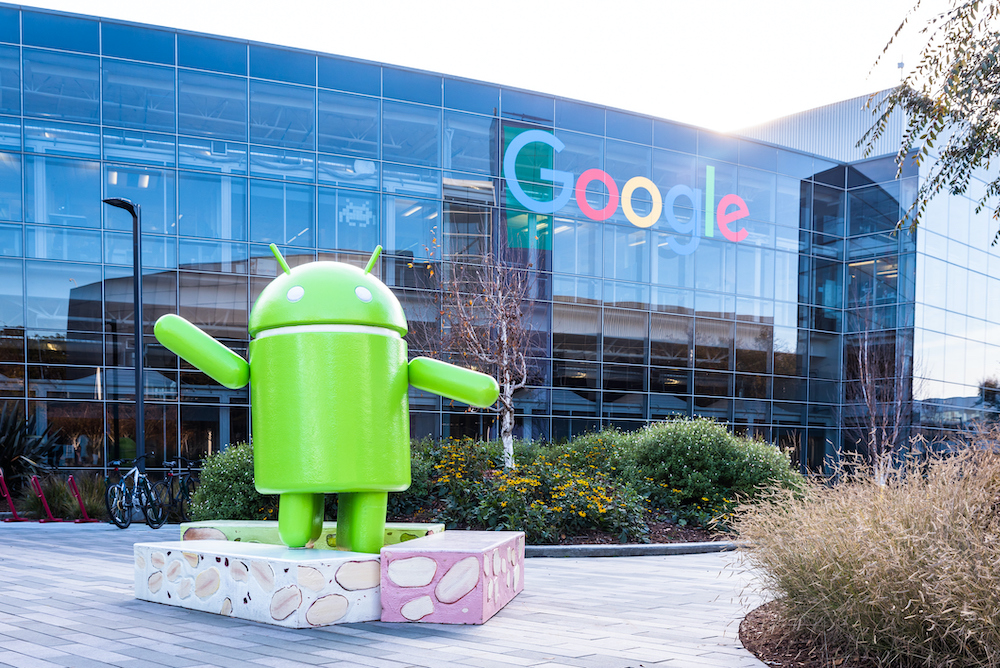
Google HQ.

Enlarge / Google HQ.

Google is doing a major re-org of Android, Chrome, and the Google hardware division: They’re merging! Google Hardware SVP Rick Osterloh will lead the new “Platforms and Devices” division. Hiroshi Lockheimer, Google’s previous head of software platforms like Android and ChromeOS, will be headed to “some new projects” at Google.

“Having a unified team across Platforms & Devices will help us deliver higher quality products and experiences for our users and partners,” writes Google CEO Sundar Pichai. “It will help us turbocharge the Android and Chrome ecosystems, and bring the best innovations to partners faster — as we did with Circle to Search with Samsung. And internally, it will also speed up decision-making.”

Google also justifies the decision the same way it does most decisions nowadays: by saying it’s AI-related. The announcement is a few paragraphs in a wide-ranging post by Pichai, titled, “Building for our AI future,” and the new division is taking a chunk of Google Research along with it, specifically the group that has been working on computational photography. Pichai wants the team to live in “the intersection of hardware, software, and AI.”

Osterloh’s tweet on the reorganization reads: “Excited to take on this new challenge and accelerate AI innovation across the Android ecosystem, I look forward to working with @Cristianoamon [Qualcomm’s CEO] and his team and increasing our strategic collaboration with @Qualcomm and @Snapdragon for Android, not just in mobile but across compute, XR and auto.” Dedicating the entire second half of that post to Qualcomm is interesting. Google’s development of the in-house Pixel Tensor chip with Samsung has put Osterloh’s hardware division at odds with Qualcomm, Android’s biggest chip partner. At the Pixel 6 launch, Osterloh said Google was “held back for years” in AI before it started making its own chips, which was a shot at the Qualcomm chips it was previously using. Qualcomm CEO Cristiano Amon replied, too—apparently the two executives are publicly making nice.

We’ll see exactly how the rest of the Android ecosystem reacts to this, though they’ve probably already been briefed about it. When Google started making Pixel phones, there was supposed to be a “firewall” between the Android and hardware teams—an assurance to partners that Google wouldn’t play favorites with its in-house hardware team. That also means Osterloh, specifically, is the person who has been “firewalled” off from the rest of the Android ecosystem, and now he’s in charge of everything. Longtime Googler Sameer Samat is taking over as president of Android Ecosystem, and since he was previously the VP of that role under Lockheimer, he has all the ecosystem relationships already.

Somewhat undercutting the announcement is an interview Osterloh gave to The Verge about the re-org, where, when asked about the legendary firewall, he indicated it would still stick around: “We have always kept distinct teams between Android and our ecosystem partners, and our first-party hardware efforts.” Hope that clears everything up.

Google merges the Android, Chrome, and hardware divisions Read More »

boston-dynamics’-new-humanoid-moves-like-no-robot-you’ve-ever-seen

Boston Dynamics’ new humanoid moves like no robot you’ve ever seen

The hockey stick will save us from the robot uprising —

All-electric, 360-degree joints give the new Atlas plenty of inhuman movements.

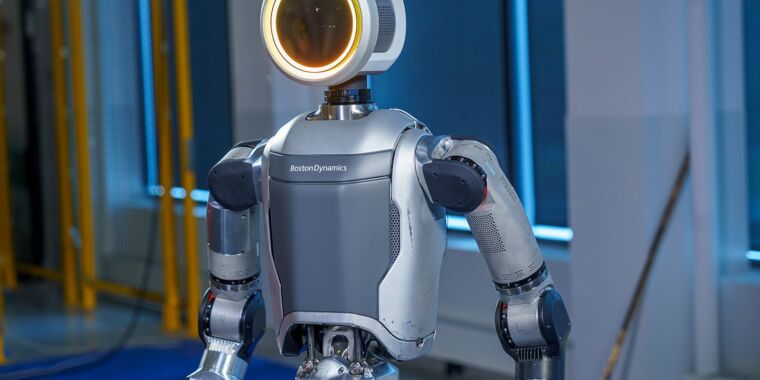
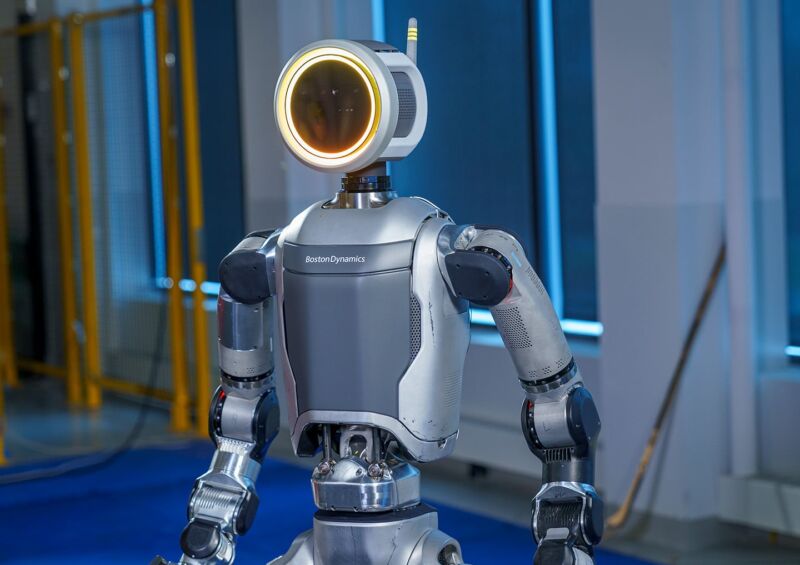
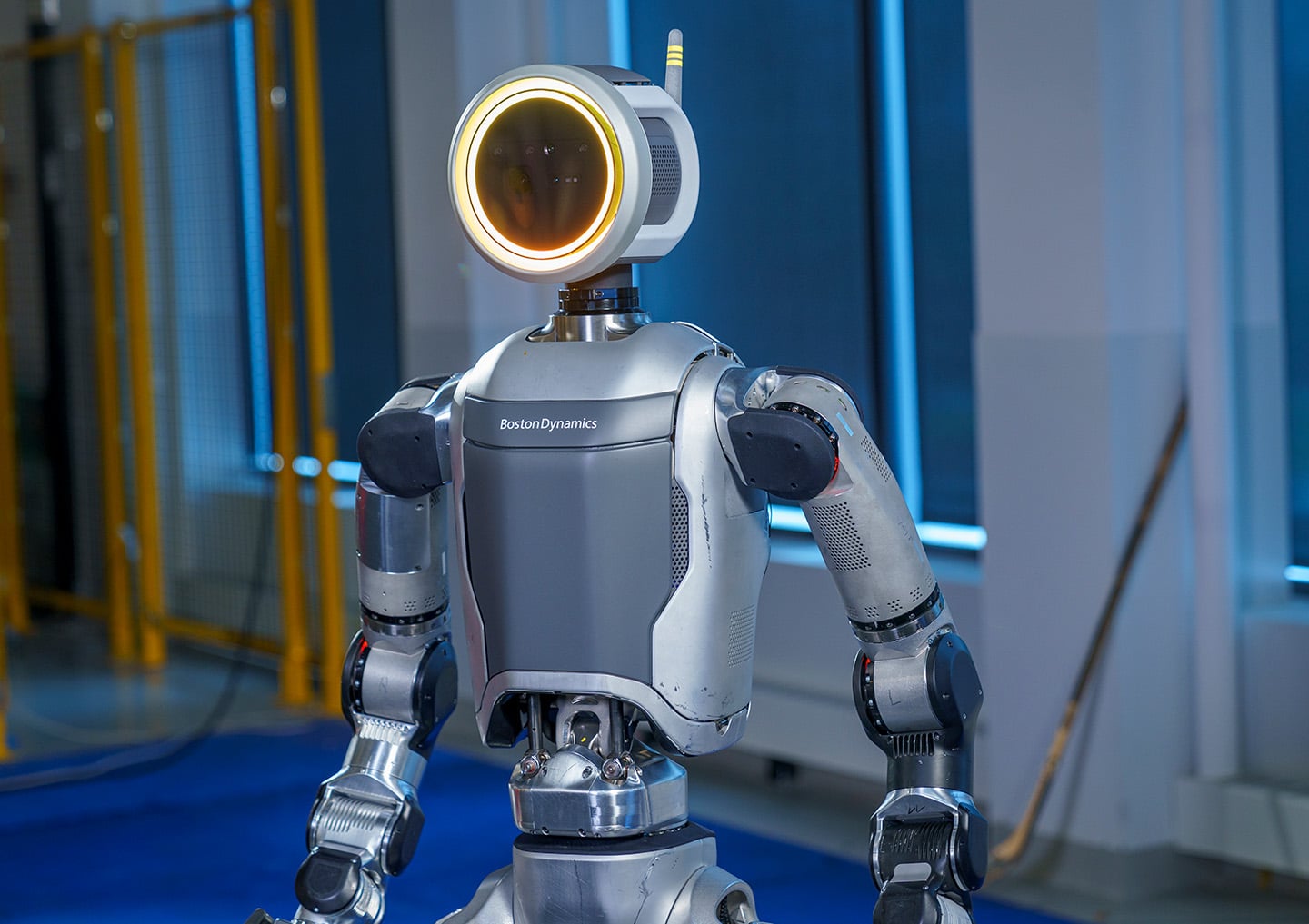
The new, all-electric Atlas.

Enlarge / The new, all-electric Atlas.

Boston Dynamics

The humanoid robotics market is starting to heat up, and the company that’s been doing this the longest isn’t going to sit by and watch. Boston Dynamics has a new humanoid robot that the company says represents a path to commercialization. It’s the company’s next-generation, all-electric “Atlas” robot.

While new Atlas and old Atlas share a name, they couldn’t be more different when it comes to construction. The old Atlas—a research platform and viral sensation that could handle nearly any terrain, do backflips, and pick up heavy objects—was powered by a heavy, complicated hydraulics system. The new Atlas is all-electric and looks like it’s a fraction of the size and weight of the hydraulic version. It also looks like a product, with covers around all the major components and consumer-friendly design touches like a giant status light in the head and a light-up power button that looks like it was ripped right from the Spot assembly line.

Hydraulic Atlas is being retired to make way for the all-electric version. The company posted one last goodbye video for the hydraulic model on its YouTube page, showing the history of the project. Atlas has done a lot of neat tricks over the years, but getting there has required a lot of learning—part of that is taking some absolutely gnarly slams, which are highlighted in the video. The video seemed to go out of its way to show just how cumbersome hydraulics can be. At one point, it looks like Atlas’ foot completely breaks off, and hydraulic fluid gushes all over the floor. Other times, the robot just springs a leak, and a fine mist of high-pressure fluid sprays everywhere as the robot goes limp. The fluid has a red tinge to it, so with a little imagination, it can look pretty gory!

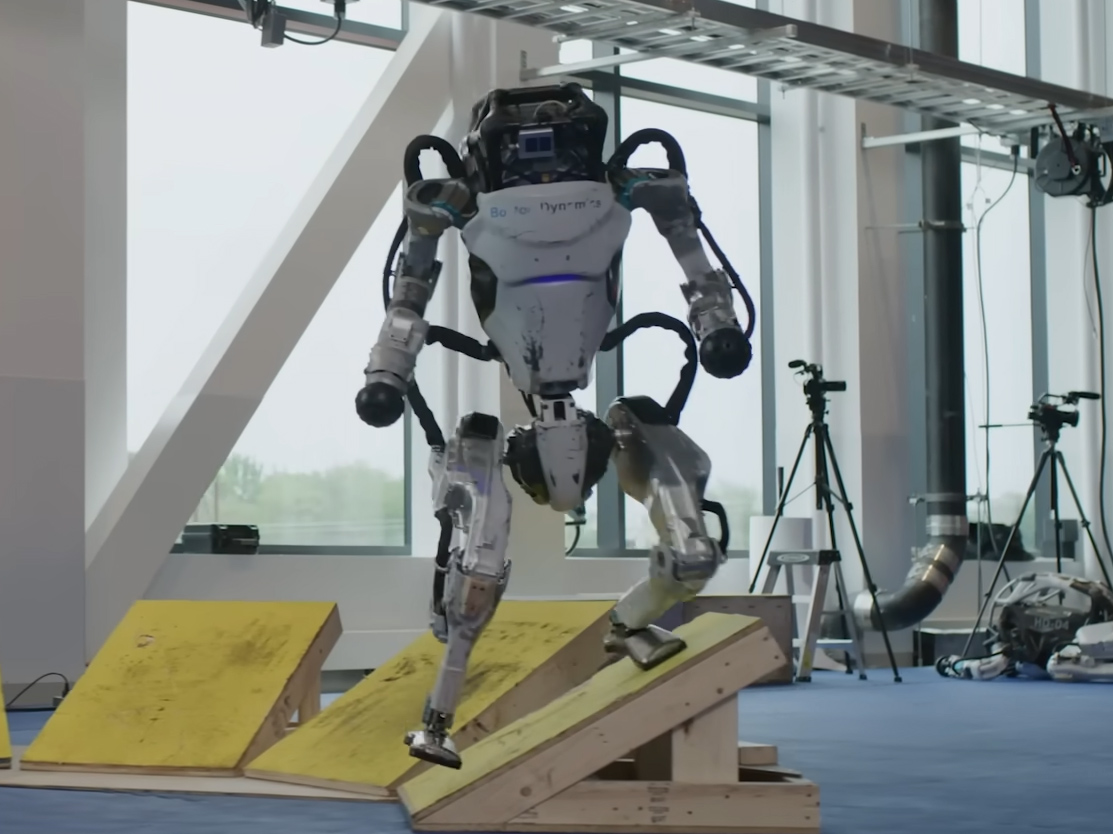
Old Atlas and the many black hydraulic lines that hang off the robot.

Enlarge / Old Atlas and the many black hydraulic lines that hang off the robot.

Boston Dynamics

Look at any clear picture of old Atlas, and you will see a constantly wobbling halo of thick, black hydraulic lines hanging all over the robot. Two lines come out of the backpack and form big hoops around the shoulders, running down the arms to the hands. Two more hoses come out of the bottom of the backpack around the robot’s hips and run down either leg.

The new Atlas removes that complicated and messy hydraulic system. We only get a 30-second look at the new robot, but it shows off some impressive capabilities. It seems like a basic thing, but have you ever seen a humanoid robot stand up? Atlas can do it, and probably in the creepiest way possible. The body is lying face down, and the legs swing up into the air, backward, and get placed down to the left and right side of the robot’s butt in a crazy contortionist’s pretzel position. Both feet get placed flat on the floor, and the robot completes the deepest squat you’ve ever seen, with the hips rotating something like 270 degrees.

From there, the robot’s body is facing away from the camera (we’re not worrying about the head just yet), and then it does the wildest robot turn-around you’ve ever seen. Just below the hip joint, there is another 360 joint in the thigh with no human analog, allowing each leg to longitudinally spin around. So, without moving the hips or robot body at all, the right leg does a 180 spin in place and goes from “knees and toes pointing away from the camera” to “knees and toes pointing at the camera,” and then the left leg does the same. Then the whole torso does a 180 and suddenly the robot is facing a different direction. It’s a zero-radius turnaround, but even that doesn’t seem like an adequate description.

Besides it being creepy to see anything move like this, there’s a point to the madness. This kind of movement would be impossible with hydraulic lines hanging all over the place. Every movement of the old Atlas needed to be made with the limitations of the hydraulic line spaghetti in mind. Move a limb too far, and you will rip a line off and spray fluid everywhere. Just like a human, every joint had a “home” position that you needed to return to, so that everything untangled.

There’s no need for any range-of-motion limits with electric joints. While the knees of the robot look normal, it looks like the head, torso, hips, shoulders, and thigh spinners all look like limitless 360-degree joints. With things like slip rings that can pass electrical wires to a rotating object, all these joints can probably just spin forever and have no home position. Boston Dynamics is calling the new Atlas the “world’s most dynamic humanoid robot.”

Boston Dynamics’ new humanoid moves like no robot you’ve ever seen Read More »

billions-of-public-discord-messages-may-be-sold-through-a-scraping-service

Billions of public Discord messages may be sold through a scraping service

Discord chat-scraping service —

Cross-server tracking suggests a new understanding of “public” chat servers.

Discord logo, warped by vertical perspective over a phone displaying the app

Getty Images

It’s easy to get the impression that Discord chat messages are ephemeral, especially across different public servers, where lines fly upward at a near-unreadable pace. But someone claims to be catching and compiling that data and is offering packages that can track more than 600 million users across more than 14,000 servers.

Joseph Cox at 404 Media confirmed that Spy Pet, a service that sells access to a database of purportedly 3 billion Discord messages, offers data “credits” to customers who pay in bitcoin, ethereum, or other cryptocurrency. Searching individual users will reveal the servers that Spy Pet can track them across, a raw and exportable table of their messages, and connected accounts, such as GitHub. Ominously, Spy Pet lists more than 86,000 other servers in which it has “no bots,” but “we know it exists.”

  • An example of Spy Pet’s service from its website. Shown are a user’s nicknames, connected accounts, banner image, server memberships, and messages across those servers tracked by Spy Pet.

    Spy Pet

  • Statistics on servers, users, and messages purportedly logged by Spy Pet.

    Spy Pet

  • An example image of the publicly available data gathered by Spy Pet, in this example for a public server for the game Deep Rock Galactic: Survivor.

    Spy Pet

As Cox notes, Discord doesn’t make messages inside server channels, like blog posts or unlocked social media feeds, easy to publicly access and search. But many Discord users many not expect their messages, server memberships, bans, or other data to be grabbed by a bot, compiled, and sold to anybody wishing to pin them all on a particular user. 404 Media confirmed the service’s function with multiple user examples. Private messages are not mentioned by Spy Pet and are presumably still secure.

Spy Pet openly asks those training AI models, or “federal agents looking for a new source of intel,” to contact them for deals. As noted by 404 Media and confirmed by Ars, clicking on the “Request Removal” link plays a clip of J. Jonah Jameson from Spider-Man (the Tobey Maguire/Sam Raimi version) laughing at the idea of advance payment before an abrupt “You’re serious?” Users of Spy Pet, however, are assured of “secure and confidential” searches, with random usernames.

This author found nearly every public Discord he had ever dropped into for research or reporting in Spy Pet’s server list. Those who haven’t paid for message access can only see fairly benign public-facing elements, like stickers, emojis, and charted member totals over time. But as an indication of the reach of Spy Pet’s scraping, it’s an effective warning, or enticement, depending on your goals.

Ars has reached out to Spy Pet for comment and will update this post if we receive a response. A Discord spokesperson told Ars that the company is investigating whether Spy Pet violated its terms of service and community guidelines. It will take “appropriate steps to enforce our policies,” the company said, and could not provide further comment.

Billions of public Discord messages may be sold through a scraping service Read More »

linus-torvalds-reiterates-his-tabs-versus-spaces-stance-with-a-kernel-trap

Linus Torvalds reiterates his tabs-versus-spaces stance with a kernel trap

Tabs Versus Space 2024: The Sabotage —

One does not simply suggest changing a kernel line to help out a parsing tool.

Updated

Tab soda displayed on a grocery shelf

Enlarge / Cans of Tab diet soda on display in 2011. Tab was discontinued in 2020. There has never been a soda named “Spaces” that had a cult following.

Getty Images

Anybody can contribute to the Linux kernel, but any person’s commit suggestion can become the subject of the kernel’s master and namesake, Linus Torvalds. Torvalds is famously not overly committed to niceness, though he has been working on it since 2018. You can see glimpses of this newer, less curse-laden approach in how Torvalds recently addressed a commit with which he vehemently disagreed. It involves tabs.

The commit last week changed exactly one thing on one line, replacing a tab character with a space: “It helps Kconfig parsers to read file without error.” Torvalds responded with a commit of his own, as spotted by The Register, which would “add some hidden tabs on purpose.” Trying to smooth over a tabs-versus-spaces matter seemed to awaken Torvalds to the need to have tab-detecting failures be “more obvious.” Torvalds would have added more, he wrote, but didn’t “want to make things uglier than necessary. But it *mightbe necessary if it turns out we see more of this kind of silly tooling.”

If you’ve read this far and don’t understand what’s happening, please allow me, a failed CS minor, to offer a quick explanation: Tabs Versus Spaces will never be truly resolved, codified, or set right by standards, and the energy spent on the issue over time could, if harnessed, likely power one or more small nations. Still, the Linux kernel has its own coding style, and it directly cites “K&R,” or Kernighan & Ritchie, the authors of the coding bible The C Programming Language, which is a tabs book. If you are submitting kernel code, it had better use tabs (eight-character tabs, ideally, though that is tied in part to teletype and line-printer history).

By attempting to smooth over one tiny part of the kernel so that a parsing tool could see a space character as a delineating whitespace, Prasad Pandit inadvertently spurred a robust rebuttal:

It wasn’t clear what tool it was, but let’s make sure it gets fixed. Because if you can’t parse tabs as whitespace, you should not be parsing the kernel Kconfig files.

In fact, let’s make such breakage more obvious than some esoteric ftrace record size option. If you can’t parse tabs, you can’t have page sizes.

Yes, tab-vs-space confusion is sadly a traditional Unix thing, and ‘make’ is famous for being broken in this regard. But no, that does not mean that it’s ok.

Torvalds’ hidden tabs appear in the fourth release candidate for Linux kernel 6.9, which Torvlads wrote had “nothing particularly unusual going on” the week of its release.

Disclosure: The author is a tab person insofar as he has any idea what he’s doing.

This post was updated at 6: 33 pm Eastern to fix some line-break issues in the Torvalds blockquote. The irony was duly noted. A better link regarding the Tabs Vs. Spaces debate was also swapped in.

Linus Torvalds reiterates his tabs-versus-spaces stance with a kernel trap Read More »

the-lines-between-streaming-and-cable-continue-to-blur

The lines between streaming and cable continue to blur

Here we go again —

Disney+ to offer 24/7 channels to play Star Wars content, commercials.

O.B., aka Ouroboros, in Marvel's <em>Loki</em> show, which streams on Disney+.” src=”https://cdn.arstechnica.net/wp-content/uploads/2024/04/ARC-201-10072_R-1200×800-5b2df79-800×533.jpg”></img><figcaption>
<p><a data-height=Enlarge / O.B., aka Ouroboros, in Marvel’s Loki show, which streams on Disney+.

Despite promises of new and improved TV and movie viewing experiences, streaming services remain focused on growing revenue and app usage. As a result of that focus, streaming companies are mimicking the industry they sought to replace—cable.

On Monday, The Information reported that Disney plans to add “a series” of channels to the Disney+ app. Those channels would still be streamed and require a Disney+ subscription to access. But they would work very much like traditional TV channels, featuring set programming that runs 24/7 with commercials. Disney hasn’t commented on the report.

Disney is exploring adding channels to Disney+ with “programming in specific genres, including either Star Wars or Marvel-branded shows,” The Information said, citing anonymous “people involved in the planning.” It’s unknown when the Disney+ channels are expected to launch.

The report comes as streaming services continue trying to find ways to capitalize off cable companies’ customer base. NBCUniversal’s Peacock streaming service already offers subscribers over 50 always-on live channels. Hulu and Paramount+ offer live TV with cable channels. Streaming platforms are also eager to license content normally delegated to traditional TV channels, including old shows like Suits, the 2023 streaming record-setter, and live sporting events like WWE Raw.

Channel surfing 2.0

If you’ve followed the streaming industry lately, you won’t be surprised to hear that ad dollars are reportedly behind the push for live channels. Disney+, like many streaming services, aims to be profitable by the end of Disney’s 2024 fiscal year and extract as much revenue from each subscriber as possible (including by using tactics like password crackdowns) to fuel profits.

The news follows similar moves by Disney, including adding Hulu to the Disney+ app, as well as plans to add ESPN to Disney+, too, according to The Information. Disney is also attempting to launch a joint sports-streaming app with Fox and Warner Bros. Discovery (WBD). It’s not hard to imagine Disney one day (assuming the app ever debuts) making the sports app’s content accessible through Disney+.

“The idea is to make Disney+ a service that has something for everyone, anytime,” The Information reported.

That sounds an awful lot like cable, which spent years growing customers’ monthly bills by adding more channels and bundles aimed at specific interests, like children’s entertainment, sports, and lifestyle. The ability to hop from on-demand Disney kids’ movies to on-demand sitcoms on Hulu to live programming centered on (the seemingly endless piles of) Marvel and Star Wars content feels a lot like channel surfing. It wasn’t too long ago when channel surfing was viewed as a time-suck.

Netflix has also reportedly considered ways to unite other streaming platforms with Netflix in order to extend the amount of time spent on Netflix. In late 2022, Netflix “explored creating a store within its app for users to subscribe to and watch other streaming services, all without leaving the Netflix app,” The Information said, citing an unnamed person “who was involved in those exploratory discussions.” Netflix reportedly decided not to move ahead with the plans for now but still could. It hasn’t commented on The Information’s report.

As we saw with Netflix’s password crackdown and streaming’s shift to ads, streaming companies tend to copy each other’s strategies for revenue growth. And live channels could be something more streaming companies get involved in, as WBD and Amazon, as examples, already have (albeit separate from their flagship, on-demand streaming apps, which differs from what Disney+’s live channel reportedly will reportedly be like).

Disney, notably, is no stranger to the business of online live channels, having 21 similar offerings within the ABC.com app, including a channel for ABC News and another for General Hospital.

Subscription-based streaming services may even have an easier time competing for ad dollars than free, ad-supported TV (FAST) streaming channels, such as those on Tubi and Pluto TV. Susan Schiekofer, chief digital investment officer for GroupM, the top US ad-buying company, told The Information that advertisers might feel more comfortable allotting dollars to ad-supported channels that are tied to users who have already spent money on a subscription.

Streaming services initially were a way to get only the content you wanted on demand and commercial-free. But the report about Disney+ and Netflix are just two examples of growing interest in reinvigorating the strategies of linear TV. Instead of jumping from network to network within cable, there’s interest in getting people to jump from one streaming service to another within one platform—with plenty of commercials along the way.

The lines between streaming and cable continue to blur Read More »

youtube-puts-third-party-clients-on-notice:-show-ads-or-get-blocked

YouTube puts third-party clients on notice: Show ads or get blocked

Blocking the ad blockers —

Google would really like it if everyone just paid for YouTube Premium instead.

YouTube app icon on a TV screen.

Getty Images | Chris McGrath

YouTube is putting third-party ad-blocking apps on notice. An ominous post on the official YouTube Community Help forum titled “Enforcement on Third Party Apps” says the company is “strengthening our enforcement on third-party apps that violate YouTube’s Terms of Service, specifically ad-blocking apps.” Google would really like it if you all paid for YouTube Premium.

YouTube has been coming down on third-party apps, which often enable YouTube ad blocking. The company shut down one of the most popular third-party apps, “YouTube Vanced,” in 2022. Vanced was open source, though, so new alternatives sprung up almost immediately. Vanced takes the official YouTube Android client and installs a duplicate, alternative version with a bunch of patches. It turns on all the YouTube Premium features like ad-blocking, background playback, and downloading without paying for the Premium sub. It also adds features the official app doesn’t have, like additional themes and accessibility features, “repeat” and “dislike” buttons, and the ability to turn off addictive “suggestions” that appear all over the app.

Another popular option is “NewPipe,” a from-scratch YouTube player that follows the open source ethos and is available on the FOSS-only store F-Droid. NewPipe wants a lightweight client without the proprietary code and million permissions that YouTube needs, but it also blocks ads.

Rather than going after the projects, Google says it’s going to start disrupting users who are using these apps. The post writes, “Viewers who are using these third-party apps may experience buffering issues or see the error ‘The following content is not available on this app’ when trying to watch a video.” The company continues: “We want to emphasize that our terms don’t allow third-party apps to turn off ads because that prevents the creator from being rewarded for viewership, and Ads on YouTube help support creators and let billions of people around the world use the streaming service.”

If you remember back to when Google aggressively fought to keep third-party YouTube apps off of Windows Phone, the company seemed to take a similar stance against all third-party YouTube clients, even if they wanted to integrate ads. Today Google says that’s no longer the case, and it would allow third-party YouTube clients provided “they follow our API Services Terms of Service.” We don’t know of any apps that are actually taking Google up on that offer, though.

YouTube puts third-party clients on notice: Show ads or get blocked Read More »

the-pixel-9-reportedly-gears-up-for-satellite-sos-support

The Pixel 9 reportedly gears up for satellite SOS support

Android’s testbed, for better or worse —

No one wants to build an Android satellite phone, so Google is going to do it.

The smaller Pixel 9, with three cameras?!

Enlarge / The smaller Pixel 9, with three cameras?!

Google has been doing a lot of work in Android to support satellite-based messaging, and it sure would be nice if someone actually shipped some hardware it could use. Despite the feature launching with the iPhone 14 in 2022, Android manufacturers haven’t been super receptive to copying the idea of satellite messaging. Qualcomm and satellite company Iridium built a working solution and incorporated it into Qualcomm’s Snapdragon chips, only for zero Android manufacturers to support the feature, leading to the dissolution of the partnership. If Google wants an Android satellite SMS phone to play with, it seems like it will need to build the device itself.

Reliable leaker Kamila Wojciechowska over at Android Authority says Google is working on doing just that. It looks like the Pixel 9 will be getting emergency satellite SOS. Since the Pixel 6, Pixel phones have been the rare devices that don’t use Qualcomm modems. Google partners with Samsung and bases its Pixel Tensor chips on Samsung Exynos chips, and that means using Samsung’s (usually much maligned) modems, too. Citing a source, Wojciechowska says the Pixel 9 would use the new Exynos Modem 5400, along with its optional NTN (non-terrestrial network) capabilities, allowing the phone to be “the first to support Android’s native satellite implementation.” The initial service provider would be T-Mobile (just like the good old days).

The move would make sense. The whole original point of the Nexus/Pixel line was to give Google something to build Android on. By incorporating the latest hardware features into the next Pixel, Android gets a target to program for and test on. Otherwise, we’d have a chicken-and-egg problem where no one makes the hardware because there’s no software support, and no one makes software because there’s no hardware to program for. Google just does it all at once.

As for who would be powering T-Mobile’s satellite network, the company has a high-profile partnership with SpaceX, but those are LTE towers in space and work on regular devices with no special software (the recent demo was on a regular set of iPhones). The whole point of Android’s satellite implementation is dealing with traditional satellite problems like aiming at a far-away satellite, compressing the message a ton to actually make it to the satellite, and dealing with an unreliable connection. That’s not really relevant to the SpaceX partnership since that is trying to be a next-generation solution of “regular LTE in space,” designed around the world’s largest rocket and satellite network.

We’re just speculating here, but a better target for a “current-generation” system would be Skylo, which resells service from traditional satellite companies like Viasat and Inmarsat, so it would need all that aiming and unreliable connection software. In a wild coincidence, Skylo already has a press release out saying it has certified the Samsung Exynos Modem 5400 for use on its network. Skylo already has a relationship with T-Mobile, and the company powered the Motorola Satellite Link hotspot.

The Pixel 9 reportedly gears up for satellite SOS support Read More »

framework’s-software-and-firmware-have-been-a-mess,-but-it’s-working-on-them

Framework’s software and firmware have been a mess, but it’s working on them

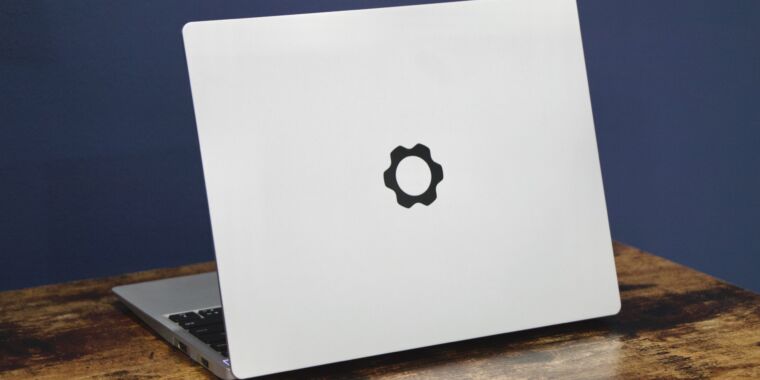
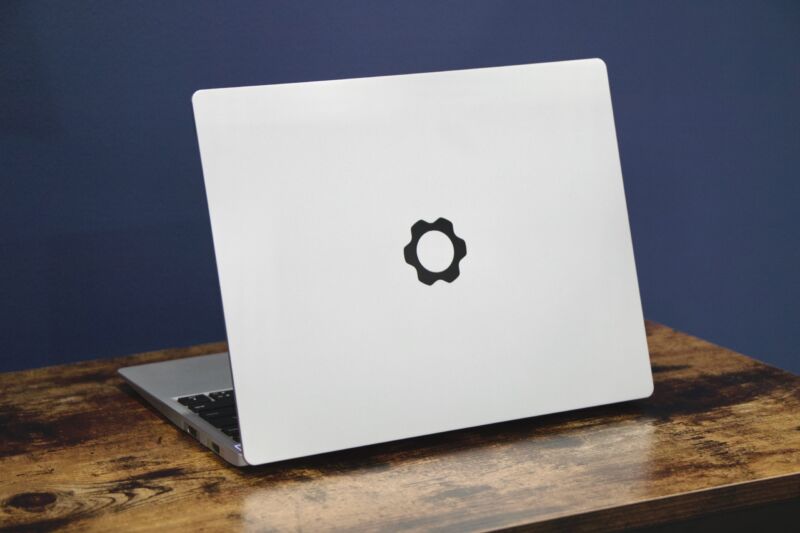
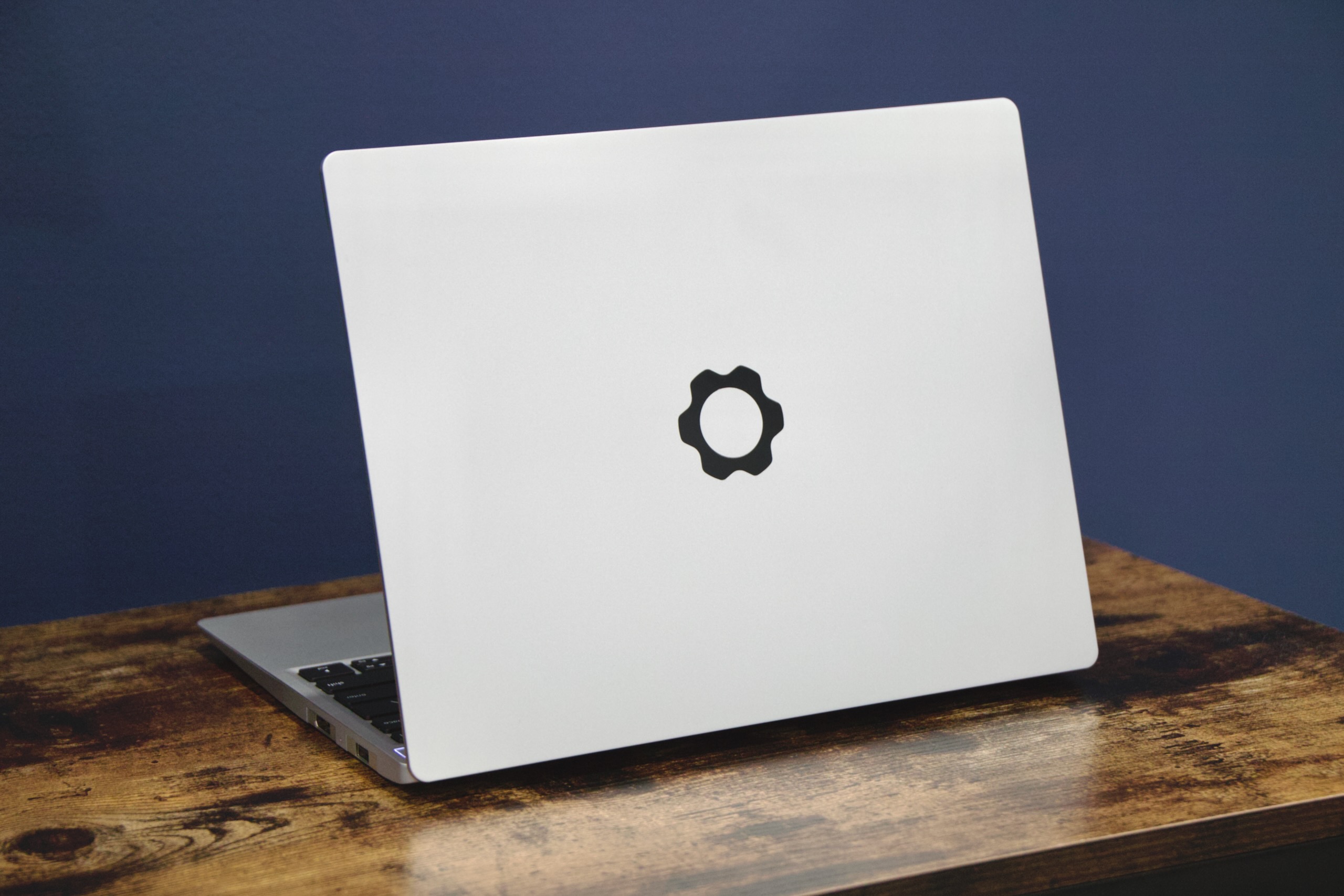
The Framework Laptop 13.

Enlarge / The Framework Laptop 13.

Andrew Cunningham

Since Framework showed off its first prototypes in February 2021, we’ve generally been fans of the company’s modular, repairable, upgradeable laptops.

Not that the company’s hardware releases to date have been perfect—each Framework Laptop 13 model has had quirks and flaws that range from minor to quite significant, and the Laptop 16’s upsides struggle to balance its downsides. But the hardware mostly does a good job of functioning as a regular laptop while being much more tinkerer-friendly than your typical MacBook, XPS, or ThinkPad.

But even as it builds new upgrades for its systems, expands sales of refurbished and B-stock hardware as budget options, and promotes the re-use of its products via external enclosures, Framework has struggled with the other side of computing longevity and sustainability: providing up-to-date software.

Driver bundles remain un-updated for years after their initial release. BIOS updates go through long and confusing beta processes, keeping users from getting feature improvements, bug fixes, and security updates. In its community support forums, Framework employees, including founder and CEO Nirav Patel, have acknowledged these issues and promised fixes but have remained inconsistent and vague about actual timelines.

But according to Patel, the company is working on fixing these issues, and it has taken some steps to address them. We spoke to him about the causes of and the solutions to these issues, and the company’s approach to the software side of its efforts to promote repairability and upgradeability.

Promises made

Here’s a case in point: the 12th-generation Intel version of the Framework Laptop 13, which prompted me to start monitoring Framework’s software and firmware updates in the first place.

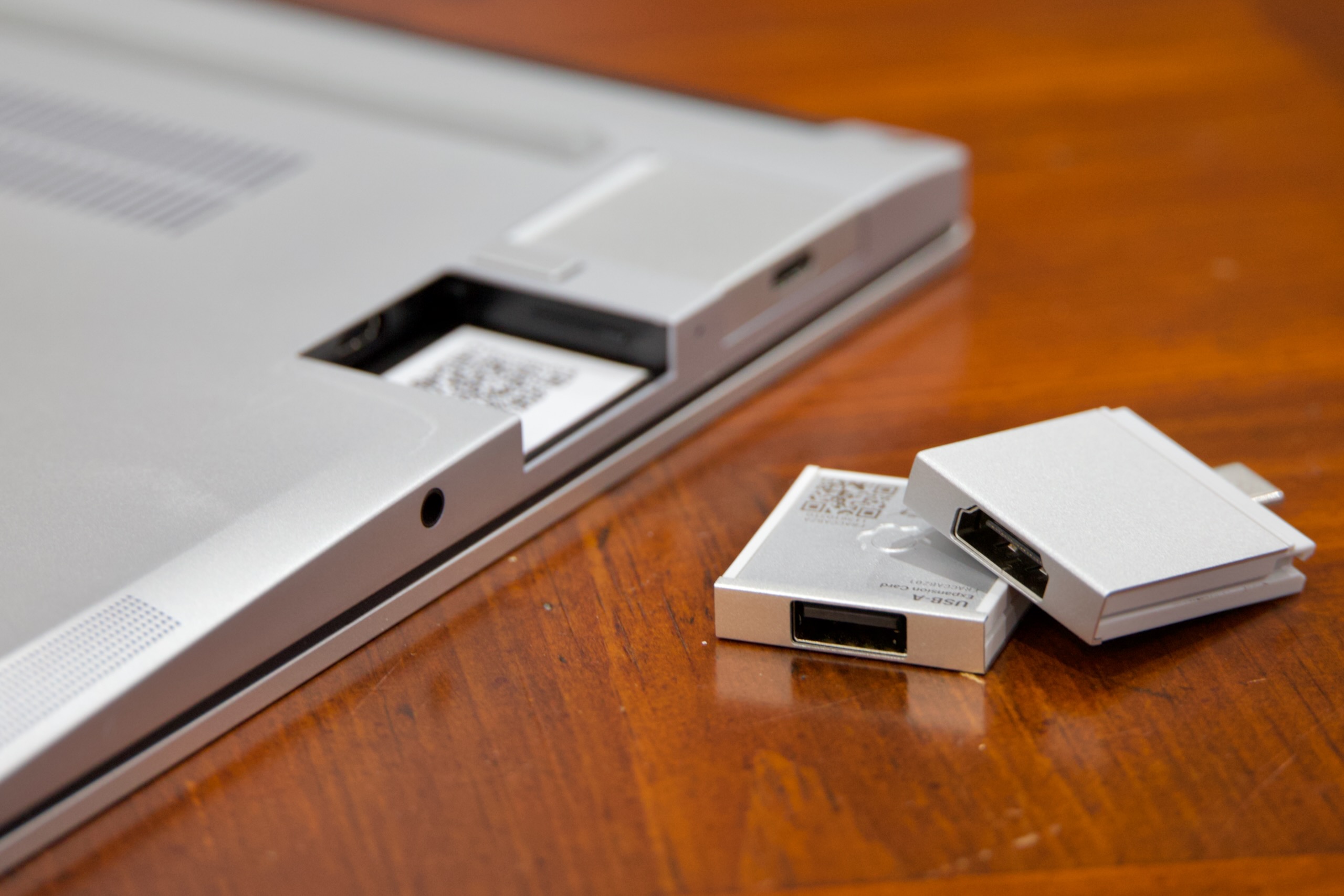
In November 2022, Patel announced that this model, then the latest version, was getting a nice, free-of-charge spec bump. All four of the laptop’s recessed USB-C ports would now become full-speed Thunderbolt ports. This wasn’t a dramatic functional change, especially for people who were mostly using those ports for basic Framework expansion modules like USB-A or HDMI, but the upgrade opened the door to high-speed external accessories, and all it would need was a BIOS update.

The recessed USB-C ports in the 12th-gen Intel version of the Framework Laptop 13 can be upgraded to fully certified Thunderbolt ports, but only if you're willing to install one in a long series of still-in-testing beta BIOSes.

Enlarge / The recessed USB-C ports in the 12th-gen Intel version of the Framework Laptop 13 can be upgraded to fully certified Thunderbolt ports, but only if you’re willing to install one in a long series of still-in-testing beta BIOSes.

Andrew Cunningham

A final version of this BIOS update finally showed up this week, nearly a year and a half later. Up until last week, Framework’s support page for that 12th-gen Intel laptop still said that there was “no new BIOS available” for a laptop that began shipping in the summer of 2022. This factory-installed BIOS, version 3.04, also didn’t include fixes for the LogoFAIL UEFI security vulnerability or any other firmware-based security patches that have cropped up in the last year and a half.

And it’s not just that the updates don’t come out in a timely way; the company has been bad about estimating when they might come out. That old12th-gen Framework BIOS also didn’t support the 61 WHr battery that the company released in early 2023 alongside the 13th-gen Intel refresh. Framework originally told me that BIOS update would be out in May of 2023. A battery-supporting update for the 11th-gen Intel version was also promised in May 2023; it came out this past January.

Framework has been trying, but it keeps running into issues. A beta 3.06 BIOS update with the promised improvements for the 12th-gen Intel Framework Laptop was posted back in December of 2022, but a final version was never released. The newer 3.08 BIOS beta entered testing in January 2024 but still gave users some problems. Users would go for weeks or months without any communication from anyone at Framework.

The result is multiple long forum threads of frustrated users asking for updates, interspersed with not-untrue but unsatisfying responses from Framework employees (some version of “we’re a small company” is one of the most common).

Framework’s software and firmware have been a mess, but it’s working on them Read More »