Star Trek

a-decade-of-star-trek-themed-fart-jokes:-the-greatest-generation-podcast-turns-10

A decade of Star Trek-themed fart jokes: The Greatest Generation podcast turns 10


How two podcasters turned a Star Trek side project into a full-time career.

A decade is a long time for a TV series; no single iteration of Star Trek has made it that far.

But “a Star Trek podcast by two guys just a little bit embarrassed to have a Star Trek podcast” has now passed the milestone. January 25, 2026, marks a full decade since The Greatest Generation, my favorite podcast, debuted. Like a bottle of Château Picard, the show has only improved with age. (I interviewed the guys behind the show back in 2016 when they were just getting started.)

The podcast helped me rediscover, and appreciate more fully, Star Trek: The Next Generation—which is also my favorite TV show. The Greatest Generation continues to delight with its irreverent humor, its celebration of the most minor of characters, and its technical fascination with how a given episode was made.

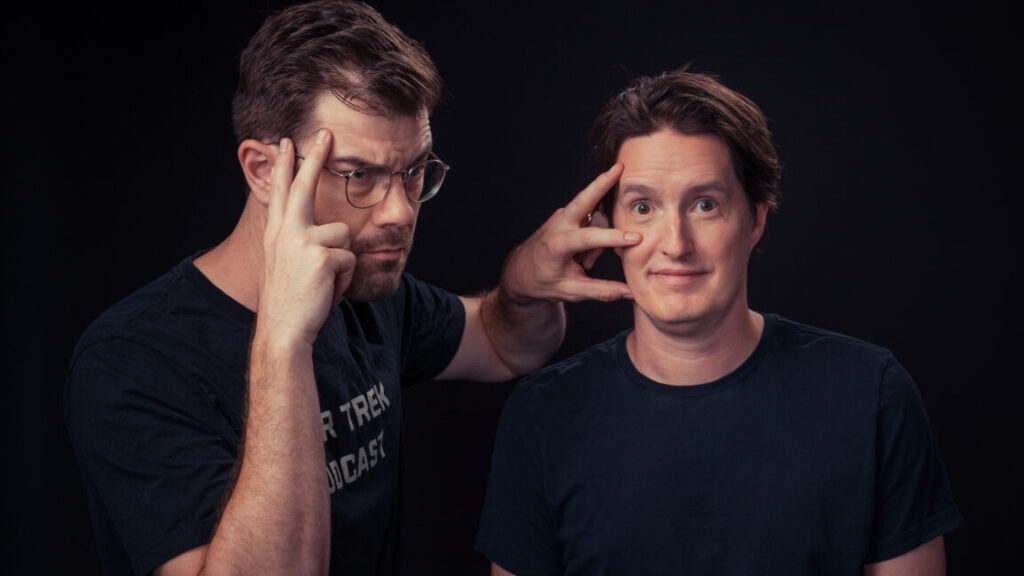
Over the last decade, hosts Ben Harrison and Adam Pranica have both moved to Los Angeles and become full-time podcasters. They have completed an episode-by-episode recap of all of The Next Generation, Deep Space Nine, and Voyager, and they’re now nearing the end of Enterprise. When finished, they’re threatening/promising to start over again.

The podcast has spawned its own (sometimes NSFW!) lexicon (a “friend of DeSoto” means a listener to and fan of The Greatest Generation), its own recurring and hilarious segments (“Drunk Shimoda,” “Bad Bit Moment,” and “Polo? Polo? Or Pollo?”), and most importantly, its own delightful fandom. It’s the coolest and dorkiest secret club that I will ever be a part of.

In 2016, the podcast was folded into the Maximum Fun organization. Harrison and Pranica formed their own company, Uxbridge-Shimoda LLC, that takes its name from two obscure TNG-era characters.

Like the original Star Trek, the podcast even spawned its own 2017 spinoff—now called The Greatest Trek—entirely devoted to the newer series in the Star Trek universe.

Harrison and Pranica also produce two irregularly released, members-only podcasts called Santa Monica Mountains (about the 1980s and 1990s TV show Baywatch) and Factory Seconds (where they eat at various Cheesecake Factory restaurants). Last year, they also started—in conjunction with YouTube cooking star Adam Ragusea—yet another podcast, called Wholesome, which is only available to Patreon subscribers.

In a world replete with chaos and awfulness, I’m just here for the hang.

(This interview, which was conducted earlier this month, has been lightly edited for clarity and flow.)

Ars: When I first spoke to you guys back in 2016, Adam was living in Seattle. Ben, I believe you were living in New York. You guys were still working in film production. As best as I could tell, this was just a fun little side project. Who knew how long it would run?


Ben: I think that us talking to you has a lot to do with it taking over our lives.

Ars: Sorry, not sorry? I don’t know! [laughs]

Adam: Your Ars article was one of the reasons we catapulted into the sort of audience we got afterward. It’s an audience that has meant we’ve been able to do the show professionally for 10 years.

Ben: Yeah. And when we meet people—all the time—people will say: “Oh, I’ve been listening to you guys since the beginning. Like, I was on at episode five because of that Ars Technica article.”

Ars: Do you feel like you are over it? It’s been a decade now. Is Greatest Gen as we know it going to continue? 

Adam: I think the thing that’s changed is that in the beginning, it felt like a fun hobby. But when you professionalize a thing and you hire employees and you are depended on for the thing that you make in a way that you’ve never been before, it’s serious business.

It’s serious funny business, you know?

This is the best job I’ve ever had, but it’s also the most seriously I’ve ever taken a job because it means so much to our well-being, but also the folks who appreciate what we do.

Ben: Yeah, one thing that Adam has said many times is we’re going to die in these chairs.

And I think also, as we come toward the end of Enterprise and have sort of run out of the well of Old Trek, as it were, I have been thinking about [what] if I hadn’t had this show? I would still be about ready to start my next TNG rewatch.

Loving Star Trek is a lot about watching it over again, you know? In the same way that I’ll put on an old rerun of The Simpsons or Seinfeld. And I love rewatching those shows. I love rewatching Star Trek.

I think Adam and I have grown as both a comedy duo but also as observers of Star Trek and what it means on an ongoing basis. So I feel like it would be unfair for us not to go back and start painting the bridge from the beginning.

Adam: I think one of the things that we’ve learned from doing the show, especially live in front of people, is that we are told by the people who enjoy this show that it’s about Star Trek, sure, but that’s not the thing that people love the most about the show.

And I think that’s what makes a return to the beginning of it make so much sense in the way Ben’s describing. It’s about the hang and your life as it relates to a Star Trek rerun that you’re watching in that moment.

Ars: I have watched zero minutes of Baywatch in my life. But I have listened to every single episode of the Santa Monica MountainsI enjoy hearing you guys talk about it.

I think you’ve hit on a format: “Let’s talk about a thing in the way that we like to talk about it and make jokes in the way that we like to make jokes about it.” Which for me really resonates more than the format of a podcast that’s like: “Let’s get comedians to talk about a thing.” 

Adam: Or let’s get celebrities in a room to talk about anything and have that be good enough.

Ben: The format that our shows tend to follow is something that I think just kind of was an emergent property of the way Adam and I talked to each other, much more so than it was us attempting to create a show that was our version of anything else.

I don’t really listen to other recap podcasts. It’s kind of a funny thing, but we weren’t really inspired by any recap podcasts in particular. I guess the Flop House a little bit for me, but what they do is so different and such its own thing.

It’s hard to feel like we are connected to the universe of recap podcasts. Like when we go to add our show to a podcast service like iTunes or Apple Podcasts, you have to pick the category that you’re going to be in, and we’ve always picked comedy.

Properly, I guess we probably would be in the television recap podcast section. We just never really thought of ourselves as being that. We were just doing what we wanted to do.

You know, we’re just making a show that makes us laugh. Making each other laugh has always been the primary goal of the show.  So it’s very funny to me that we’re in a category that we’ve never really aspired to be in or compared ourselves to in any way.

Ars: Any favorite moments, perhaps at live shows, that have happened to you over the last 10 years?

Ben: Getting to do live shows at all has been a total shock to me. When we talked to you for that first article, we barely knew what we were doing as entertainers. And I’ve taken improv classes and stuff but never really had any personal aspirations to be someone who gets up on a stage and does something. And I found that I fucking love it!

I really love doing the show in front of an audience! And we just have had so many amazing adventures getting to go all over the country doing that.

And all over the world—we’ve done the show in Canada and London now. That was a total surprise to me.

Like, if you grabbed me on the street 15 years ago and said, “Hey, you’re going to have a show that you get to travel around and do in front of audiences of 300 people someday!” I would have said, “Get the hell out of here! That’s not possible. That’s not something I am working toward in any way.”

Adam: There’s an unexpected quality to the type of—I mean, barf, right? I’m going to say the word “celebrity.” But David Letterman said that when you achieve a certain amount of notoriety, the world becomes a neighborhood to you.

A week ago, I was at a bar with friends, and a stranger came up and told me that they really like our show and they thanked me for making it. And that is something that happens in my life in a way that I never could have anticipated at all.

It’s those little moments that you have with people. Those perfect interactions where it’s just like: “I like what you do and thanks for doing it.”

That makes my life seem meaningful in a way that any previous job did not create the conditions for, you know? You do the work and you think it matters and it’s important, and largely it is in its own way, in its own ecosystem.

But to have a broad interest from folks in what you do and that it matters to them and what they do in their lives? That’s the very best part of this entire thing: knowing that the times that I can make Ben laugh are also the times that I can make 500 people laugh in a room or 25,000 people laugh on a Monday when the episode drops, you know?

That’s really powerful stuff! And it keeps me on my best behavior when I’m out in public in case an FOD is out there watching what I’m doing.

Ben: Oh, yeah. You don’t want to see all the videos of Adam on Worldstar.

Adam: Exactly. Yeah. So lock it up!
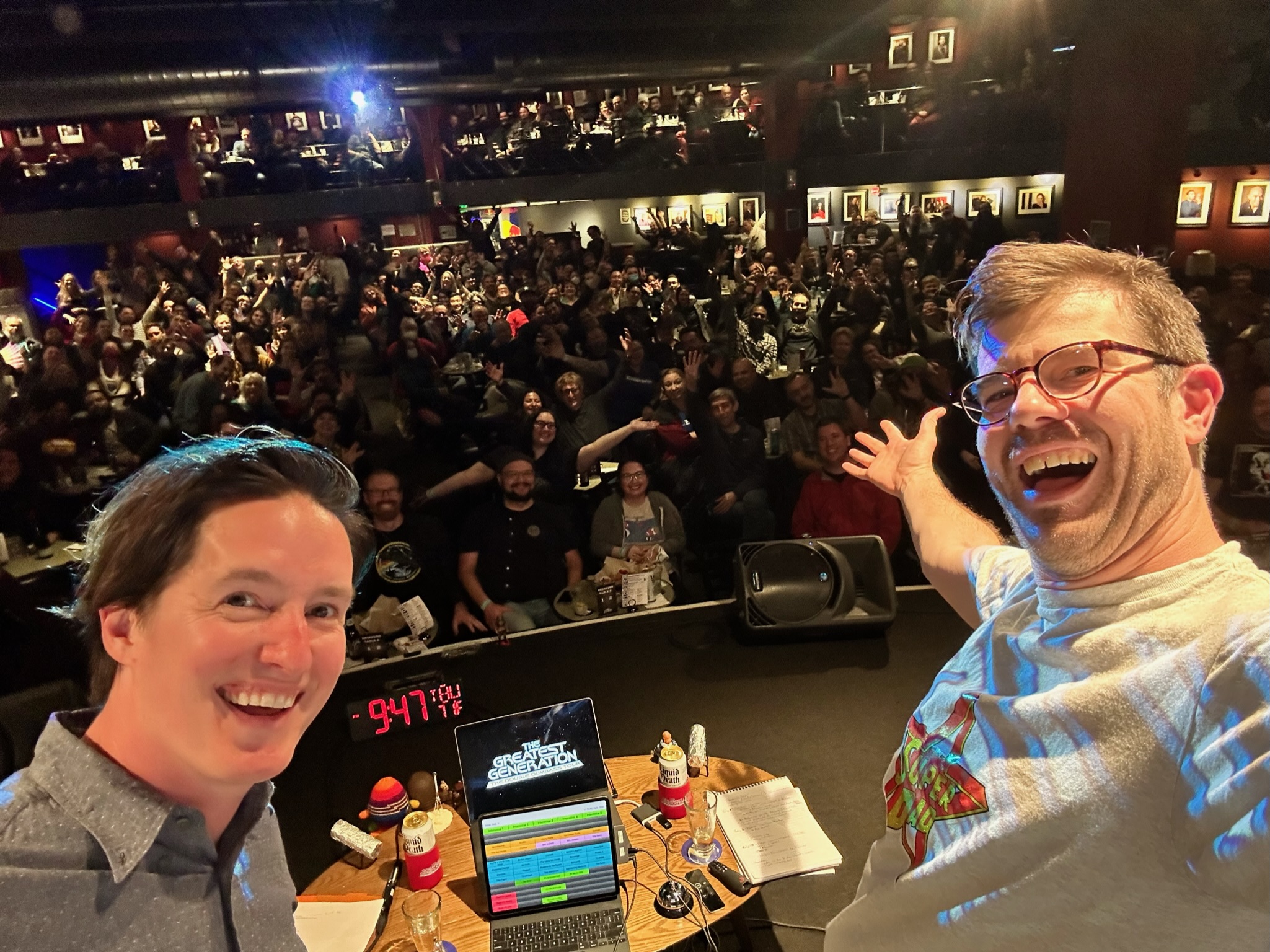
Adam and Ben at a live show.

Adam and Ben at a live show.

Ars: You try really hard to make the show sound great, which it does. It is well-engineered. It is well mixed. You guys put a lot of care into the production of the show. 

But also, to my knowledge, you have never missed a show’s publish date. I’m curious about how you balance all of that with whatever else is going on in your lives. Ben, you have two young kids. I know Adam has martinis to drink and golf to play.

Ben: I think the best thing that has happened to us as a duo over the years has been all of the people who have been here to help us along the way.

You know, for a while, we were working with a producer named Rob Schulte, who was really great. And we’re now very fortunate to have a full-time producer named Wynde Priddy, who is so good at anticipating things that are coming up and keeping our minds on what we need to be prepping for the future. And also taking all of the stuff off of our plate that involves the day-in, day-out of editing and producing the shows.

So when it’s all running as it should be, which is most of the time—Adam and I get to focus on prepping, sitting down and recording, and then listening back to basically finished episodes. At that point, we’re just pitching jokes. Like: “Hey, we could add a little audio here to illustrate this point or whatever.” But 90 percent of the time we listen to an episode that’s pretty much ready to go and are just signing off on it for Wynde.

I think that the logistics of making this are complex in some ways. But at its core, it’s just me and Adam having to watch a TV show and then talk to each other about it. And that period of the day, that period of the week where I’m talking to my buddy about a thing we both really love is still the best part of my week.

Adam: We’ve been doing this for 10 years. If you need to take some time off, we know about it usually a month before, and we prepare for it. We know that we record two or three or four episodes a week, every week.

We know that if one of us gets sick, we will have to record more than that in a given week. And I think part of it is if you know that’s what your life is, it’s not stressful or disappointing when that’s your responsibility. That’s just what it takes.

We were both in alignment right away initially that you cannot miss a week doing this because people depend on it for the rhythm of their own weeks. But also, be a fucking professional! Are you telling me you don’t have an afternoon in a given week to do the thing that you’re doing professionally? Get out of here. Of course you do! Find a way.

And this is why, when people over the years have told us, “I really want to do a podcast,” the first advice is: “The same time, the same day, every week. Forever.” And that’s the only advice I give because if you can do that for a year and you ask me what else you need to do, then we can have that conversation.

But if you’re not willing to be a pro like that, good luck. I doubt your ability to get traction with an audience, because I think so much depends on that.

Ben: The podcasts that I listen to throughout the week are something I really look forward to—those shows being there at that time when I do the thing that I do when I listen to them. And so we’ve been very lucky to burrow under the skin of a lot of people—

Adam: I wonder if that’s how we know, Ben? Like, we’re not just the president of Hair Club, we’re also the clients? I think we know what’s meaningful to a podcast listener because we are them ourselves. In a way, I feel like nouveau podcasting right now is often made up of hosts who are doing it because it’s lucrative in their niche, you know?

Ben: Wait, this can be lucrative? Shit, what have we been doing?

Ars: I’m at a place in my life right now—and maybe you guys are, too—where I find it very hard to emotionally engage with the news. I find myself turning off the news on the radio, on my phone, in ways that I didn’t three years ago, five years ago. I used to be hyper-on: all the news, all the things, all the time. And I just can’t now. I just want to hear some guys talk about martinis.  

Ben, you mentioned earlier that this is a show about the hang, and it’s sort of loosely anchored around the thing that you love, Star Trek

Do you have that same feeling when it’s chatting with Adam Pranica about BaywatchDoes the subject for you, both of you, matter at all? Or does Star Trek have a particular emotional resonance in a way that, you know, lawns don’t?

Ben: I think that the Trek of it all is still really important to the show. And I think that we’re in an era where the news is devastating and exhausting in equal measure, and, you know, Trek has a lot of politics in it.

Adam and I share a lot of politics, but we also, I think, are pretty conscious of this being a place where the horrors of the world aren’t the center of attention.

So we’ve been pretty intentional about trying to make a thing that is a refuge and not a giant bummer.

And I think in its own way, that is an act of defiance. Still being able to have the hang despite all of the horrific shit going on is a sort of powerful statement—no, we’re not going to be ground into bummer pulp.

Adam: Yeah, I agree. I mean, I’m not interested in introducing that into our programs at all. I think a person’s politics is largely their behavior, and I don’t want to compare the things that I’m watching to the things that are happening in the real world generally.

But I think I might take a different side than Ben, about how Star Trek-located the project needs to be for it to be—I don’t know—fun or enriching.

I think those other projects, whether they’re about Baywatch or food or whatever—I’m interested in interesting conversations that are challenging or comedically interesting to me. It largely doesn’t matter what the subject is at its core. I want to be the sort of person that could make anything funny in conversation and through our various other types of shows, that’s become the truth, I hope.

Ben: That’s very fair. I still sort of think it’s the on-ramp for a lot of people. Like, oh, yeah, I like Star Trek. I’ll give that a try. And then it becomes about more than that.

Ultimately, I couldn’t make a show with Adam Pranica and Adam Ragusea if I wasn’t delighted by their perspective on things on an ongoing basis. The thing that’s amazing about this is we’ve made 600-something episodes of The Greatest Generation and 300-something episodes of Greatest Trek and dozens and dozens of episodes of Wholesome, and Adam says stuff every single time we sit down that surprises and delights me. That’s a complete magic trick.

Adam: You can’t do this for 10 years if it’s a bummer-hate show with a bunch of politics in it. That would have been exhausting nine years ago, you know? I don’t listen to any news or politics podcasts. Why would you? Look for the light where you can find it.

Ars: Going back to our original interview, you guys didn’t have very much in the way of established bits and jokes in the way that you do now.

I’m looking here at the Wikia and there’s a long list of bits and phrases: 50-year-old Ensign. Anybody Canyon. Bangers. Ball-kicking machine. Big Rod. McLaughlin Group. Miriam. Mount Armis. Natural Yeager.

Do you feel like any bits are played out? As I read through this, I’m like, “Oh yeah, I totally forgot about ‘Fuck Bokai.’ That’s pretty funny!”

Ben: Oh man, Fuck Bokai. That may have been the high-water mark! I think that one of the cool things about some of these is that they sort of ebb and flow depending on what we’re covering, you know?

There were things that were kind of jokes that stayed within the confines of Deep Space Nine or Voyager that sometimes you get an idea and you can pull one out of the cold storage.

But often the group of active working runners is very influenced by what we are actively covering. I think it’ll be very interesting to see how that long list of old inside jokes interacts with the show when we start going back through the second time.

Because I’m kind of tempted to not reference any of that stuff. I don’t know. I will have to see what happens when we start doing it.

Adam: I feel the same way, Ben. I think we don’t do a bit just because it’s “time to do the bit.” I have felt for a long time that it’s not funny if you’re trying to be funny. If we choose to turn it around and go back from the beginning—these are going to be new experiences for the time that we record them.

And they’re going to feel brand new. I wouldn’t expect a retread of much of anything. Because that doesn’t sound funny to me.

Ben: Well, also 10 years older. Our lives are different. Our world is different.

We will see new things in the show. And that’s one of the things that’s so cool about Star Trek: I feel like I experience it in new ways each time I watch it. So I think it’s kind of inevitable that it will get something that is really different and novel. And maybe some of those old runners will find their way back because they happen to be the funny thing at that moment.

But generally speaking, I’m really excited for crumpling up the paper and throwing it away and writing something fresh, you know?

Adam: Cyrus, you mentioned the Wiki, and I just want to say, one of the best things that’s happened to us over the 10 years of making the show has been the community that formed around it to do things, like making the wiki, making the Discord, that have formed groups where they watch movies together and date each other and marry each other and whatever.

This is a thing that we didn’t intend—imagine doing a thing so important that a large audience would enjoy it—but this large audience has their own lives, and they’re enjoying this thing that we do completely separate from us in their own way.

In a way, that’s great. Neither Ben nor I have the time or the inclination to make a wiki about our show, for example. And yet the folks that put in the effort here to make the experience of listening to the show better for everyone—that’s selfless and good and appreciated.

Ars: Given that there’s such a large body of work that you guys have produced, do you ever get people asking: “You guys have done a thousand episodes. Where do I start?”

I’ll give my answer first. I always tell people who are Star Trek fans but who have maybe not listened to Greatest Gen, “Choose a Star Trek episode that you love or that is memorable to you in some way and listen to the podcast episode about that episode.” 

Adam: That’s my answer, too.

Ben: I like that, too. I also get the question “Oh, you know a lot about Star Trek. I want to get my kid into it. Where should we start?” And I don’t really think that there’s a right answer to that kind of question. Like, going back to the beginning doesn’t necessarily work for me or doesn’t necessarily work as an answer for everybody.

So I like the suggestion to jump in somewhere where you feel like you’ve got some fluency, but I also think it’s totally cool to jump in midstream on the show now or, you know, start at the beginning of one of the series that you really like or jump around. We hear from people that do it all different kinds of ways.

We’ve heard from people who got into the Greatest Generation because of Greatest Trek. We’ve heard from people who started listening to the Greatest Generation and were like: “Well, there’s a lot of references to old stuff in here. So I better go back and listen from the beginning.”

And then they binge the entire thing in three months. And I’m concerned that there may be some kind of exposure toxicity!

Adam: It’s an interesting quality to consider because a lot of the podcasts I listen to are about sports, and the sports that just happened over the weekend. No one listens to that show a month after it comes out.

But 10 years of our conversations are still being listened to in a way that I feel [isn’t the case] if you’re podcasting about the football game.

Ben: As many things as we’ve done in the past of the show, they stay in the present for a lot of people—I think more than half of our downloads in a given week are old episodes.

So that is a place where people hang out, and I think a lot of people that have jobs where they’re working with their hands but they don’t need to be processing language—[they] love podcasts. So we hear from a lot of graphic designers and truckers who like the show.

And that huge back catalog is such a boon to them because by the time you’re on your second listen through, you’re not going to remember exactly how the bit went from episode 324. So the comedy works again for that person.

Ars: I presume you guys have received screeners for Starfleet Academy. How are you feeling about Starfleet Academy as a show? And how are you guys feeling about doing it for your own show?

Ben: I’ve watched two episodes now. And I remain pretty optimistic about Starfleet Academy as a show. I think that there is some melancholy to it being the only one that’s actively being made now of any of the shows. I think they’ve wrapped on Strange New Worlds, even though they haven’t released season four. And none of the others are, like, in production at this point.

Adam: I’m also two episodes in—two very long episodes. I think that one of the qualities to Starfleet Academy that’s been surprising is the hour-long nature of it.

I think many years ago I coined the phrase “Star Trek is a place.” And what that means definitionally is that it’s not a ship or a particular captain or a planet or a federation. It’s a place to tell stories.

That’s just my way of saying that Starfleet Academy at this point, two episodes in, feels like the expression of that idea. Like, Starfleet Academy exists in a place that is Star Trek.

So I don’t hate it because they put out a cheesy poster. I don’t hate it at all! I am enjoying what I’ve seen so far. It’s interesting and new. I think the feeling that I have about it is something that Ben touched on a little bit there, which was like, are we getting near the end of it? Are we going to go back into the desert of ten years without Star Trek?

I hope not because I think my preference is going to always be that I would rather have Star Trek even if it’s difficult or disliked by folks or whatever, than to go without it at all because it provokes thought. I mean, even when it’s not your Star Trek, I think it’s still fun to talk about.

Ars: One of your greatest wishes—maybe the greatest wish of your lives—is to be blown out of an airlock in a new episode of Star Trek. How close are we to seeing that on screen? 

Adam: It’s happened in comic books.

Ars: Have you actually pitched this to somebody who could make it happen?

Ben: There are people inside the walled garden that are aware that a lot of people are invested in this idea. And yeah, it’s happened in comics, it’s happened in fan productions several times now.

We leap at every opportunity we have to get blown out of an airlock. If and when the call comes from inside the Star Trek house, it will be the thrill of a lifetime. That remains the overarching goal of the show, I would say.

We’ve gone so far as to say that if the offer is made, we will fly ourselves to Toronto. If [Paramount is] obligated by some kind of agreement with the union to pay us, we will donate that money to a charity.

This is not about fame or fortune for us. It is about getting blown out of an airlock, which…

Adam: It’s about finally experiencing the sweet, sweet peace of death.

A decade of Star Trek-themed fart jokes: The Greatest Generation podcast turns 10 Read More »
musk-and-hegseth-vow-to-“make-star-trek-real”-but-miss-the-show’s-lessons

Musk and Hegseth vow to “make Star Trek real” but miss the show’s lessons

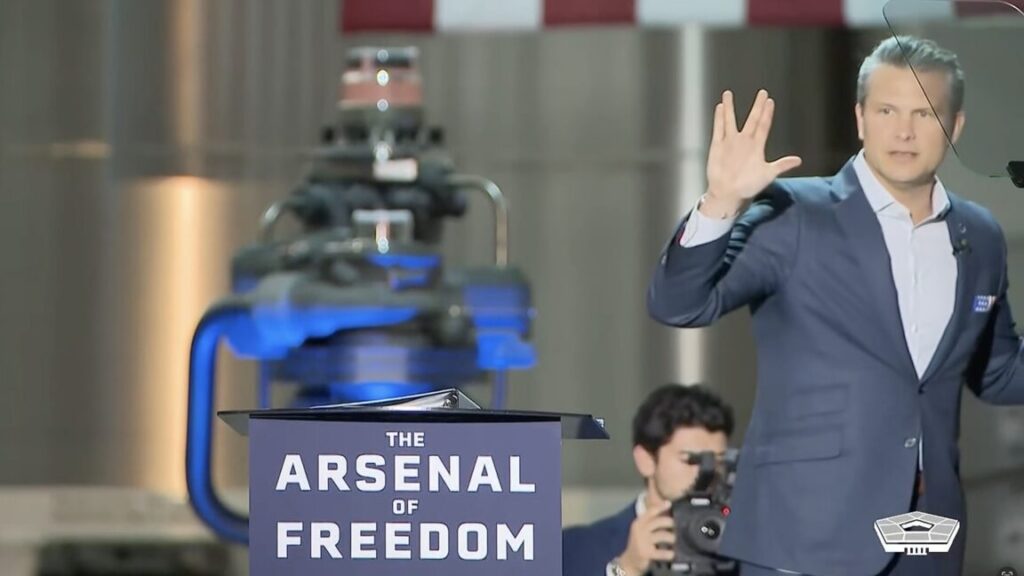
This week, SpaceX CEO Elon Musk and Secretary of Defense Pete Hegseth touted their desire to “make Star Trek real”—while unconsciously reminding us of what the utopian science fiction franchise is fundamentally about.

Their Tuesday event was the latest in Hegseth’s ongoing “Arsenal of Freedom” tour, which was held at SpaceX headquarters in Starbase, Texas. (Itself a newly created town that takes its name from a term popularized by Star Trek.)

Neither Musk nor Hegseth seemed to recall that the “Arsenal of Freedom” phrase—at least in the context of Star Trek—is also the title of a 1988 episode of Star Trek: The Next Generation. That episode depicts an AI-powered weapons system, and its automated salesman, which destroys an entire civilization and eventually threatens the crew of the USS Enterprise. (Some Trekkies made the connection, however.)

In his opening remarks this week, Musk touted his grandiose vision for SpaceX, saying that he wanted to “make Starfleet Academy real.” (Starfleet Academy is the fictional educational institution at the center of an upcoming new Star Trek TV series that debuts on January 15.)

When Musk introduced Hegseth, the two men shook hands. Then Hegseth flashed the Vulcan salute to the crowd and echoed Musk by saying, “Star Trek real!”

Hegseth honed in on the importance of innovation and artificial intelligence to the US military.

“Very soon, we will have the world’s leading AI models on every unclassified and classified network throughout our department. Long overdue,” Hegseth said.

“To further that, today at my direction, we’re executing an AI acceleration strategy that will extend our lead in military AI established during President Trump’s first term. This strategy will unleash experimentation, eliminate bureaucratic barriers, focus on investments and demonstrate the execution approach needed to ensure we lead in military AI and that it grows more dominant into the future.”

Musk and Hegseth vow to “make Star Trek real” but miss the show’s lessons Read More »

lego-boldly-goes-into-the-star-trek-universe-with-$400,-3,600-piece-enterprise-d

Lego boldly goes into the Star Trek universe with $400, 3,600-piece Enterprise-D

Star Trek fans who have long envied the Star Wars franchise’s collaboration with Lego are finally getting something to celebrate: Lego is introducing a version of Star Trek’s USS Enterprise, specifically the Enterprise-D from Star Trek: The Next Generation.

Because we don’t live in the post-money utopian society of the 24th century, the kit will cost you, and unfortunately, it’s priced well into the for-superfans-only zone. The 3,600-piece starship and collection of minifigs will run you $400 when the set officially leaves spacedock on November 28.

Though the Enterprise-D is far from our favorite Enterprise, it does make sense as a starting point for the Lego Group. The Next Generation‘s seven-year run in the late ’80s and early ’90s represents a creative and cultural peak for the franchise, and a 2010s-era remaster that painstakingly re-scanned and upgraded all of the original footage and effects for high-definition TVs has kept the old episodes looking fresher than other ’90s Trek shows like Deep Space Nine and Voyager.

As a Star Trek and Lego aficionado, I appreciate the company’s typical attention to detail, especially in the nine included minifigs (Picard, Riker, Data, Crusher, Troi, Worf, and Geordi are all here, plus Guinan and Wesley, though fans of Dr. Pulaski will be disappointed to hear she isn’t included). Each includes a thematically appropriate accessory, from Worf’s phaser to Riker’s trombone. The ship’s saucer section can also separate from the rest of the ship, and the attention to detail for logos and decals is still strong.

Lego boldly goes into the Star Trek universe with $400, 3,600-piece Enterprise-D Read More »

ars-technica-and-gog-team-up-to-bring-you-a-pile-of-our-favorite-games

Ars Technica and GOG team up to bring you a pile of our favorite games

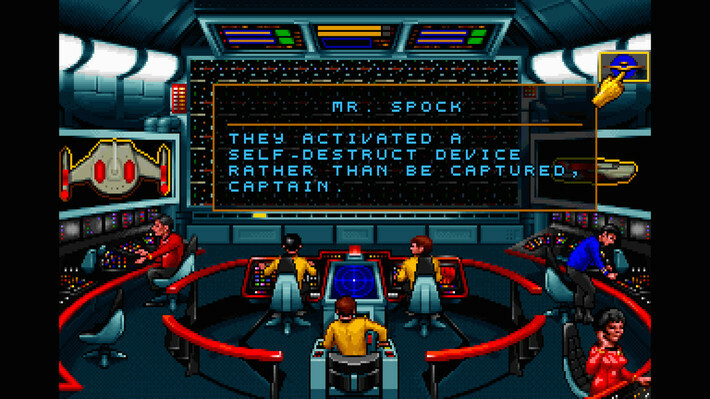
That changed with the 1992 release of Star Trek: 25th Anniversary, or ST25 to its friends, which brought the original series Enterprise and its crew to life in glorious 256-color VGA. And to players’ vast relief, it was not a half-baked effort—locations like the Enterprise bridge were lovingly recreated, with beautiful atmospheric sound effects lifted straight from the TV show permeating every scene. The character art is sharp, and it’s easy to tell Bones from Spock. The entire game is like a love letter to OG Trek.

Screenshot of ST25 showing bridge crew

Ah, that old Enterprise bridge feeling.

Credit: GOG / Interplay

Ah, that old Enterprise bridge feeling. Credit: GOG / Interplay

Perhaps unsurprisingly given the time, ST25 is a mouse-driven point-and-click adventure game. It’s broken up into seven discrete chapters, with each chapter being a self-contained mission with problems to solve and objectives to accomplish. Starfleet Command is always watching—complete the minimum number of objectives and an admiral will give you a middling performance review. Go above and beyond and do everything, even your bonus objectives, and you’ll have lavish praise heaped upon you by a grateful admiralty.

The missions themselves tend to follow a pattern. Each starts with the crew of the Enterprise on the bridge as Kirk makes a log entry. Starting with the CD-ROM issue of the game, all the lines are fully voiced by the original cast, so every mission kicks off with Bill Shatner’s familiar “Captain’s log…” lead-in telling us what we need to examine, investigate, locate, or shoot at. (Sadly, the only major voice cast omission in this one is Majel Barrett as the computer.)

Then there’s what I always felt was the weakest part of the game: Most missions kick off with some sort of space battle, where the player has to awkwardly maneuver the Enterprise with the mouse, dodging phaser blasts and photon torpedoes (or just eating them because the controls are just that awful) and trying to blow the other ship up before it does the same to you.

Ars Technica and GOG team up to bring you a pile of our favorite games Read More »

there’s-not-much-for-anyone-to-like-in-the-star-trek:-section-31-movie

There’s not much for anyone to like in the Star Trek: Section 31 movie

It is, in a word, awful. Which is really a shame!

Putting the “TV” in “TV movie”

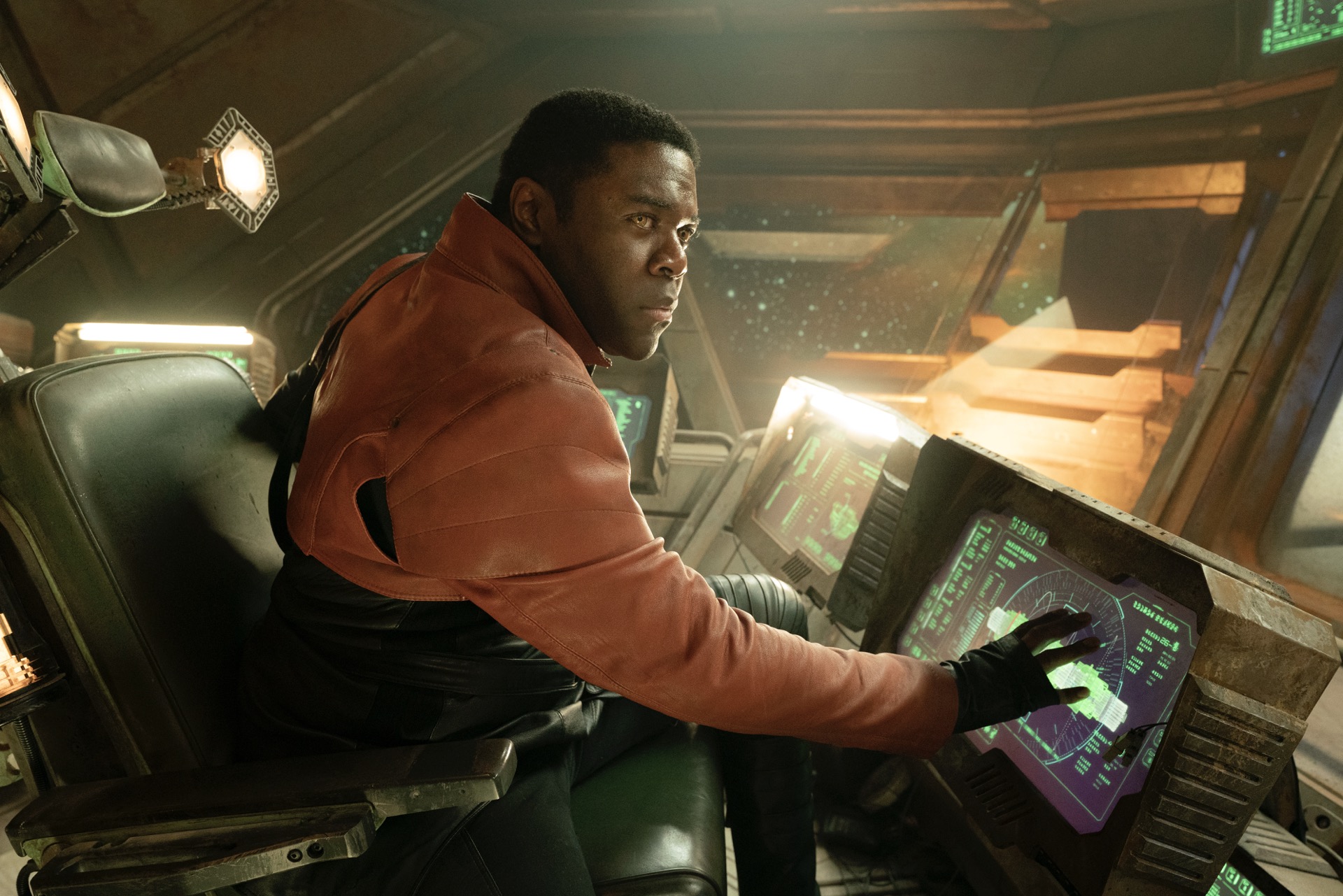
Sam Richardson as Quasi, a shape-shifter. Comedy and melodrama coexist uneasily throughout Section 31. Credit: Michael Gibson/Paramount+

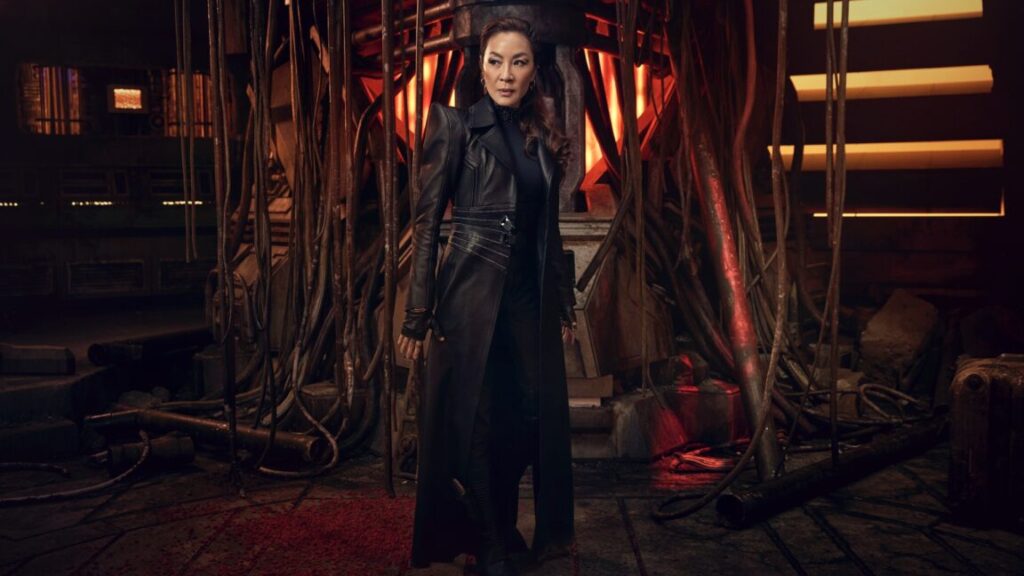
The movie explains its premise clearly enough, albeit in a clumsy exposition-heavy voiceover section near the beginning: Philippa Georgiou (Michelle Yeoh) was once the ruler of the bloodthirsty Terran Empire, an evil mirror of Star Trek’s utopian United Federation of Planets. She crossed over into “our” universe and gradually reformed, sort of, before vanishing. Now Section 31—Starfleet’s version of the CIA, more or less—needs to track her down and enlist her to help them save the galaxy from another threat that has crossed over from the evil universe to ours.

Emperor Georgiou originated on Star Trek: Discovery, and she was a consistently fun presence on a very uneven show. Yeoh clearly had a blast playing a sadistic, horny version of the kind and upstanding Captain Georgiou who died in Discovery‘s premiere.

But that fun is mostly absent here. To the extent that anything about Section 31 works, it’s as a sort of brain-off generic sci-fi action movie, Star Trek’s stab at a Suicide Squad-esque antihero story. Things happen in space, sometimes in a spaceship. There is some fighting, though nearly all of it involves punching instead of phasers or photon torpedoes. There is an Important Item that needs to be chased down, for the Fate of the Universe is at stake.

But the movie also feels more like a failed spin-off pilot that never made it to series, and it suffers for it; it’s chopped up into four episodes “chapters” and has to establish an entire crew’s worth of quirky misfits inside a 10-minute montage.

That might work if the script or the performers could make any of the characters endearing, but it isn’t, and they don’t. Performances are almost uniformly bad, ranging from inert to unbearable to “not trying particularly hard” (respectively: Omari Hardwick’s Alok, a humorless genetically augmented human; Sven Ruygrok’s horrifically grating Fuzz, a tiny and inexplicably Irish alien piloting a Vulkan-shaped robot; and Sam Richardson’s Quasi, whose amiable patter is right at home on Detroiters and I Think You Should Leave but is mostly distracting here). Every time one of these characters ends up dead, you feel a sense of relief because there’s one fewer one-note character to have to pay attention to.

There’s not much for anyone to like in the Star Trek: Section 31 movie Read More »

it’s-the-enterprise-vs.-the-gorn-in-strange-new-worlds-clip

It’s the Enterprise vs. the Gorn in Strange New Worlds clip

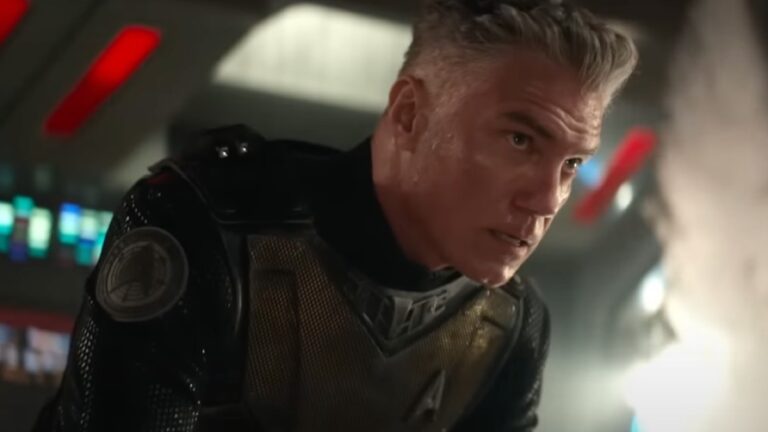
The S2 finale found the Enterprise under vicious attack by the Gorn, who were in the midst of invading one of the Federation’s colony worlds. The new footage shown at NYCC picked up where the finale left off, giving us the kind of harrowing high-stakes pitched space battle against a ferocious enemy that has long been a hallmark of the franchise. With the ship’s shields down to 50 percent, Captain Pike (Anson Mount) and his team brainstorm possible counter-strategies to ward off the Gorn and find a way to rendezvous with the rest of Starfleet. They decide to try to jam the Gorns’ communications so they can’t coordinate their attacks, which involves modulating the electromagnetic spectrum since the Gorn use light for ship-to-ship communications.

They also need to figure out how to beam crew members trapped on a Gorn ship back onto the Enterprise—except the Gorn ships are transporter-resistant. The best of all the bad options is a retreat and rescue, tracking the Gorn ship across light-years of space using “wolkite, a rare element that contains subspace gauge bosons,” per Spock (Ethan Peck). Finally, the crew decides to just ram the Gorn Destroyer, and the footage ends with a head-to-head collision, firing torpedoes, and the Enterprise on the brink of warping itself out of there, no doubt in the nick of time.

Oh, and apparently Rhys Darby (Our Flag Means Death) will guest star in an as-yet-undisclosed role, which should be fun. Strange New Worlds S3 will premiere sometime in 2025, and the series has already been renewed for a fourth season.

Lower Decks

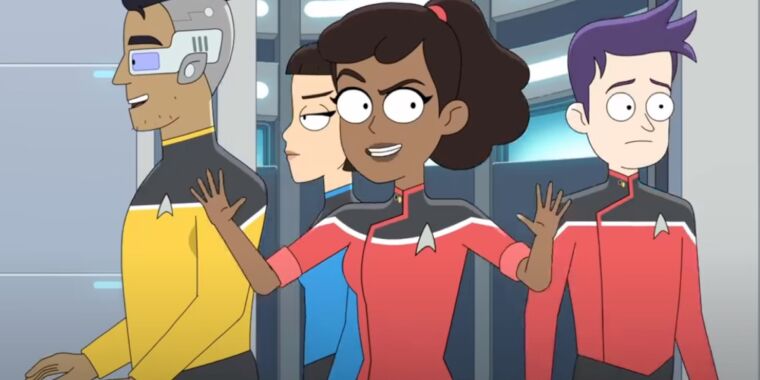
The final season of Star Trek: Lower Decks premieres this week.

Ars staffers are big fans of Lower Decks, so we were saddened when we learned that the animated series would be ending with its fifth season. Paramount gave us a teaser in July during San Diego Comic-Con, in which we learned that their plucky crew’s S5 mission involves a “quantum fissure” that is causing “space potholes” to pop up all over the Alpha Quadrant (“boo interdimensional portals!”), and the Cerritos crew must close them—while navigating angry Klingons and an Orion war.

The new clip opens with Mariner walking in and asking “What’s the mish?” only to discover it’s another quantum fissure. When the fissure loses integrity, the Cerritos gets caught in the gravitational wake, and when it emerges, seemingly unscathed, the ship is hailed—by the Cerritos from an alternate dimension, captained by none other than Mariner, going by Captain Becky Freeman. (“Stupid dimensional rifts!”) It’s safe to assume that wacky hijinks ensue.

The final season of Lower Decks premieres on Paramount+ on October 24, 2024, and will run through December 19.

poster art for Section 31 featuring Michelle Yeoh in striking purple outfit against yellow background

Credit: Paramount+

Credit: Paramount+

It’s the Enterprise vs. the Gorn in Strange New Worlds clip Read More »

star-trek:-lower-decks-s5-teaser-gives-cerritos-crew-one-last-mission

Star Trek: Lower Decks S5 teaser gives Cerritos crew one last mission

“Lower decks! Lower decks!” The fifth season of Star Trek: Lower Decks will be the animated series’ last (boo!).

Star Trek: Lower Decks is a particular favorite among Ars staffers; it’s arguably the best of the recent crop of Star Trek shows, along with Star Trek: Strange New Worlds. So we were disappointed when we learned that the animated series would be ending with its fifth season. Paramount+ debuted the first teaser for S5 during the Star Trek panel at San Diego Comic-Con over the weekend, along with a teaser for Star Trek: Section 31—a spinoff film from Star Trek: Discovery featuring Michelle Yeoh’s Philippa Georgiou—a clip from Strange New Worlds S3, and the latest news about Star Trek: Starfleet Academy.

The Lower Decks teaser opens with a suitably nostalgic recap of some of the highlights of the adventures of the plucky crew of the USS Cerritos, inviting viewers to join them for one last adventure. Cue Boimler (Jack Quaid) and Mariner (Tawny Newsome) in voiceover objecting to that description (“Yeah, right, we’re not done voyaging—we’ve hardly even cracked one quadrant yet”). Their S5 mission involves a “quantum fissure” that is causing “space potholes” to pop up all over the Alpha Quadrant (“boo interdimensional portals!”), and the Cerritos crew must close them—while navigating angry Klingons, an Orion war, and who knows what other crazy developments?

The final season of Lower Decks premieres on Paramount+ on October 24, 2024, and will run through December 19.

Newsome is already committed to her first post-Lower Decks project: co-writing the first live-action Star Trek comedy with franchise head honcho Alex Kurtzman. There’s no title yet, but Deadline Hollywood reports that the premise will involve “Federation outsiders serving a gleaming resort planet [who] find out their day-to-day exploits are being broadcast to the entire quadrant.” So, a Star Trek Truman Show? Color us intrigued.

Star Trek: Strange New Worlds S3

A first look at what’s coming in the third season of Star Trek: Strange New Worlds.

Strange New Worlds marked a welcome return to Star Trek’s original episodic structure. The franchise’s Comic-Con panel featured a special sneak peek at the upcoming first season. The clip is a callback to the S2 episode “Charades,” in which a higher-dimensional race, the Kerkohvians, accidentally reconfigured Spock’s half-human, half-Vulcan physiology to that of a full-blooded human—just before Spock was supposed to meet his Vulcan fiancee’s parents.

The S3 clip has the situation reversed: The human crew must make themselves Vulcan to succeed on a new mission. They succeed in record time but aren’t able to change back. The Vulcan versions of the Enterprise crew are hilariously on point, and a long-suffering Spock must endure repeated references to his inferior half-Vulcan status.

We also learned that Cillian O’Sullivan will join the recurring cast as Dr. Roger Korby. ToS fans will recognize that name; it’s a legacy character (originally played by Michael Strong). Korby was a renowned archaeologist in the field of medical archaeology, introduced in the episode “What Are Little Girls Made Of?‘ as Nurse Chapel’s long-missing fiancé. That’s bound to cause problems for SNW‘s Nurse Christine Chapel (Jess Bush), who is currently romantically involved with Spock. SNW S5 will premiere sometime in 2025, and the series has already been renewed for a fourth season

Speaking of Strange New Worlds, remember that fantastic S2 episode (“Substance Rhapsody”) in which a quantum probability field caused the entire crew to break into song? Executive producer Akira Goldman revealed during the panel that he is toying with the idea of a Star Trek stage musical, although he cautioned that “We’re in the very early stages of figuring out whether we can bring a version of [“Substance Rhapsody”] to the stage.”

Star Trek: Lower Decks S5 teaser gives Cerritos crew one last mission Read More »

long-lost-model-of-the-uss-enterprise-returned-to-roddenberry-family

Long-lost model of the USS Enterprise returned to Roddenberry family

To Boldly Return —

It showed up in an eBay listing; now Roddenberry’s son wants to show it to fans.

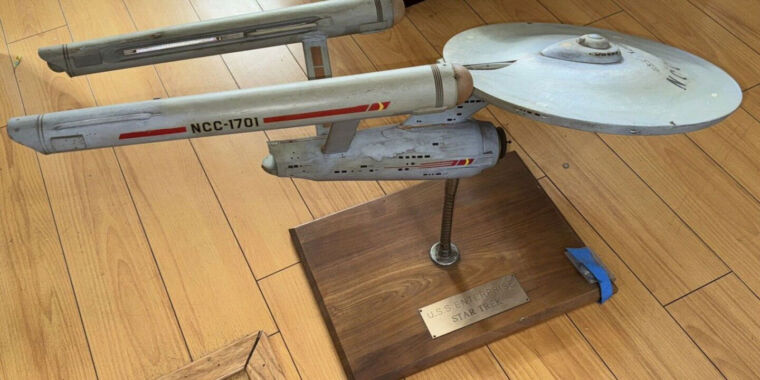
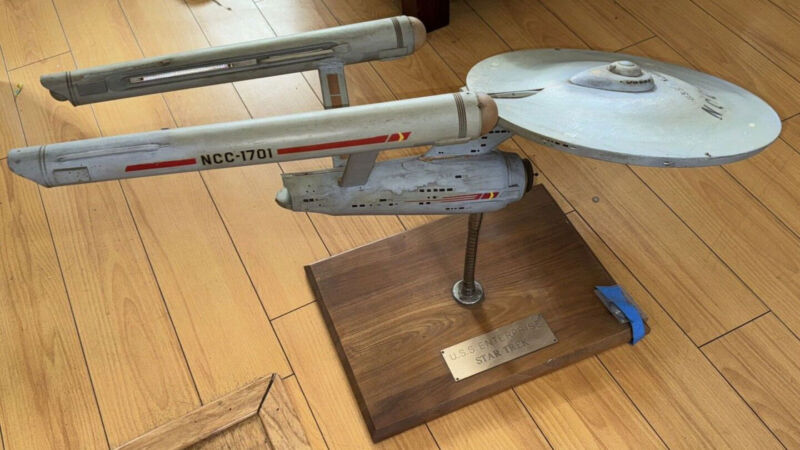
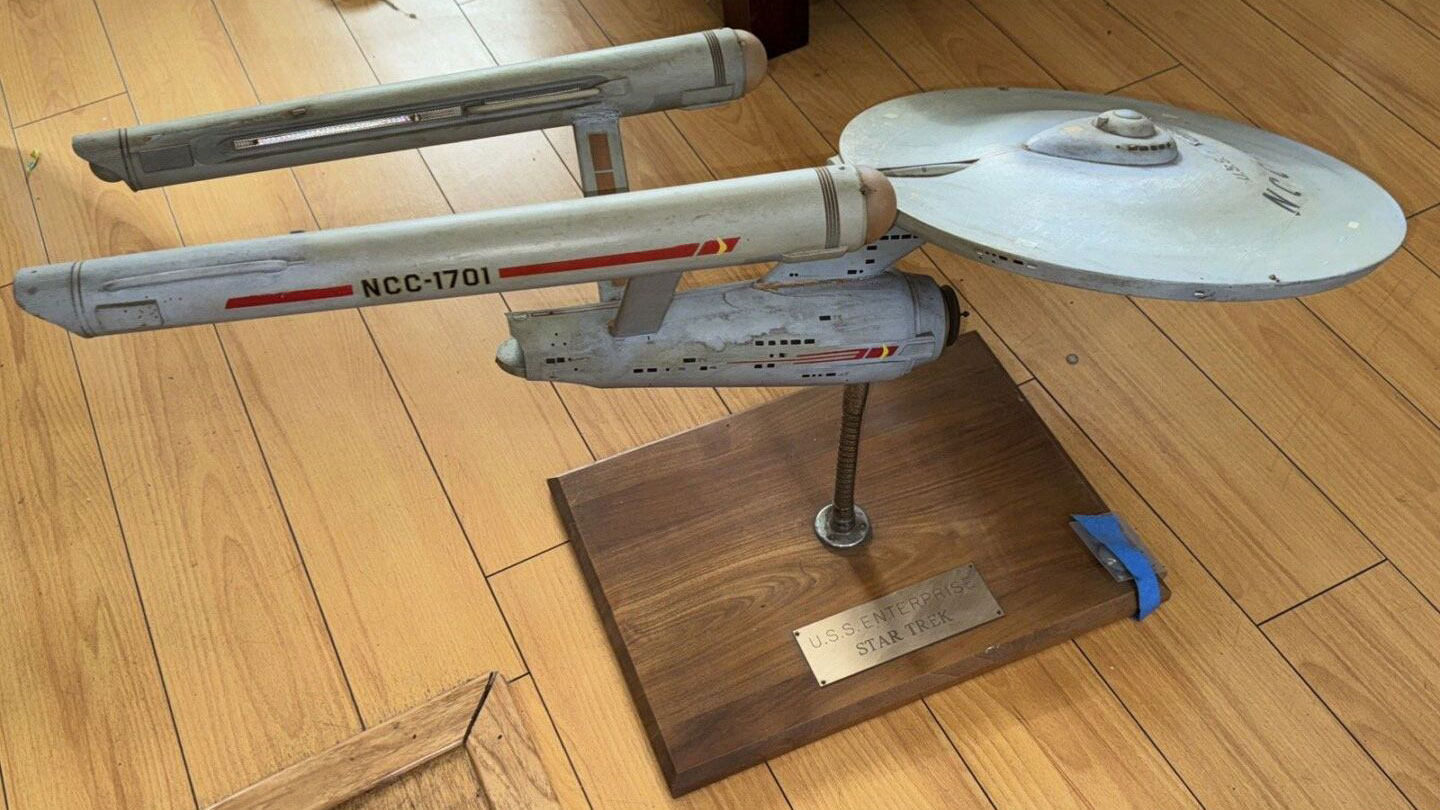
This mysterious model appeared on eBay with little fanfare.

Enlarge / This mysterious model appeared on eBay with little fanfare.

eBay

The first-ever model of Star Trek’s USS Enterprise NCC-1701 has been returned to the Roddenberry family, according to an ABC News report.

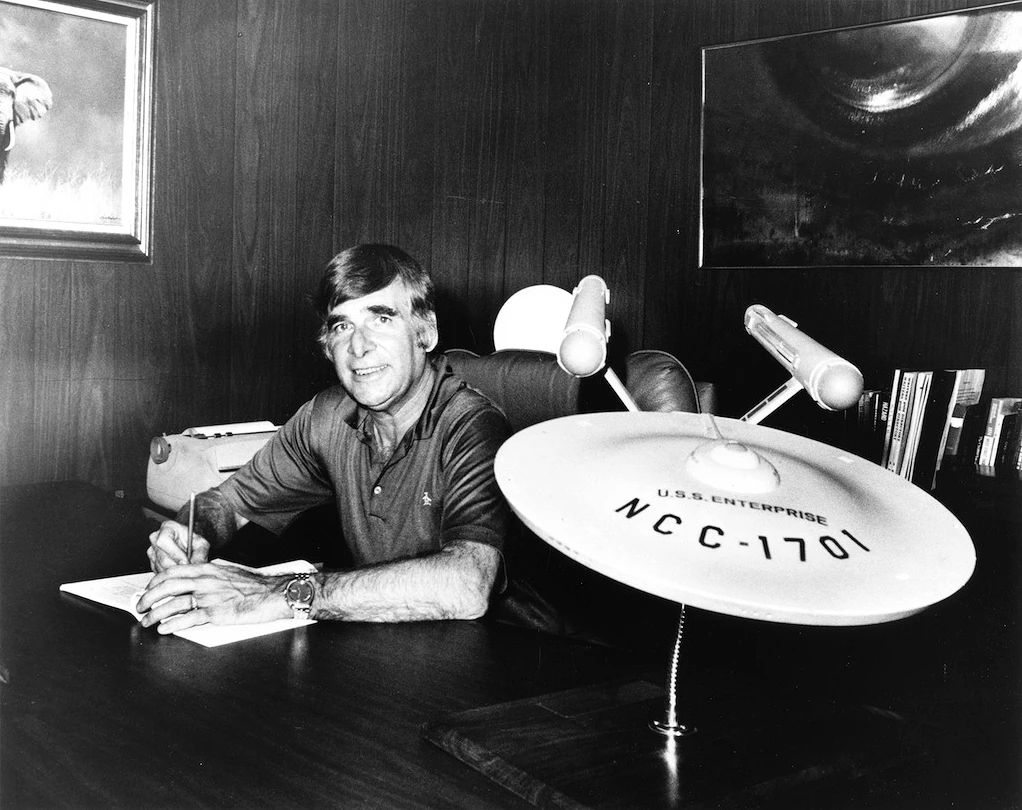
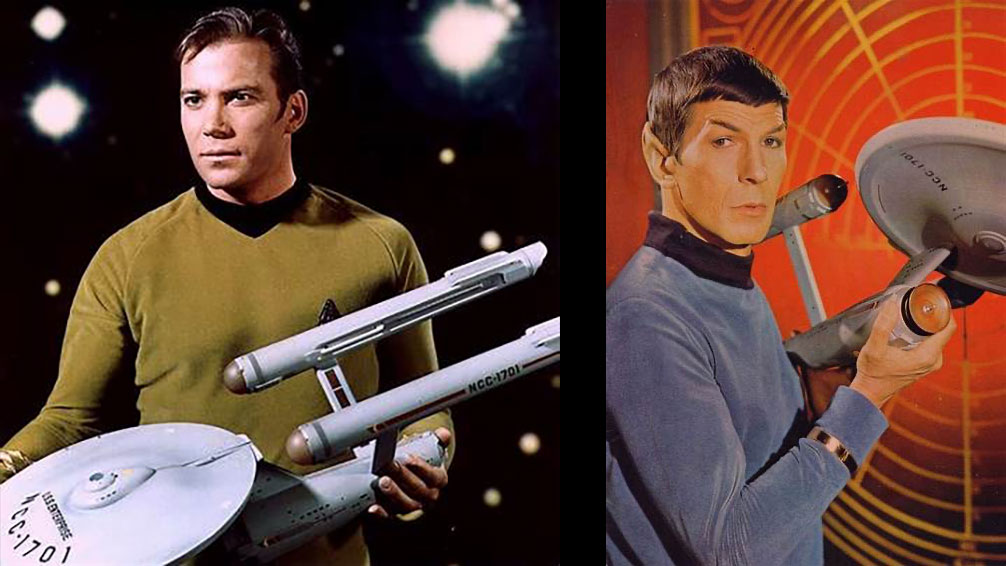
The three-foot model was used to shoot the pilot and credits scene for Star Trek’s original series in the 1960s and was used occasionally for shots throughout the series. (Typically, a larger, 11-foot model was used for shots after the pilot.) The model also sat on series creator Gene Roddenberry’s desk for several years.

It went missing in the late 1970s; historians and collectors believe it belonged to Roddenberry himself, that he lent it to a production house working on Star Trek: The Motion Picture, and that it was never returned. Its whereabouts were unknown until last fall, when a listing for a mysterious model of the Enterprise appeared on eBay.

Enthusiasts analyzed the pictures in the listing and came to believe it was the long-lost three-foot production model. They contacted the seller, who quickly took down the listing.

The eBay account that posted the item specialized in selling artifacts found in storage lockers that end up without an owner, either because of failure to pay or death.

The model appeared in this promotional image with Roddenberry.

The model appeared in this promotional image with Roddenberry.

CBS

The model was turned over by the eBay seller to Texas-based Heritage Auctions. News spread that it had been discovered, and Gene Roddenberry’s son, Eugene “Rod” Roddenberry, made public statements that he would like to see it returned to his family.

After that, there were months of silence, and its fate was unknown—until now. Heritage Auctions announced that it had given the model to Rod Roddenberry. Details of the exchange have not been shared, but Roddenberry said he did compensate Heritage in some way.

Heritage reached out directly to Roddenberry upon acquiring the object and reportedly decided to return it because it was “the right thing to do.” Roddenberry said that he “felt it important to reward that and show appreciation for that” but didn’t disclose a sum.

Promotional images of the model with William Shatner and Leonard Nimoy.

Promotional images of the model with William Shatner and Leonard Nimoy.

Roddenberry also revealed what he has planned for the model:

This is not going home to adorn my shelves. This is going to get restored and we’re working on ways to get it out so the public can see it, and my hope is that it will land in a museum somewhere.

He runs a group called the Roddenberry Foundation that has scanned and digitized many relics from Star Trek’s ideation and production over the years, so it’s likely the Foundation will get a crack at the model, too.

Listing image by eBay

Long-lost model of the USS Enterprise returned to Roddenberry family Read More »

the-restored-star-trek-enterprise-d-bridge-goes-on-display-in-may

The restored Star Trek Enterprise-D bridge goes on display in May

engage! —

The bridge is going on display at Sci-Fi World Musem in Santa Monica, California.

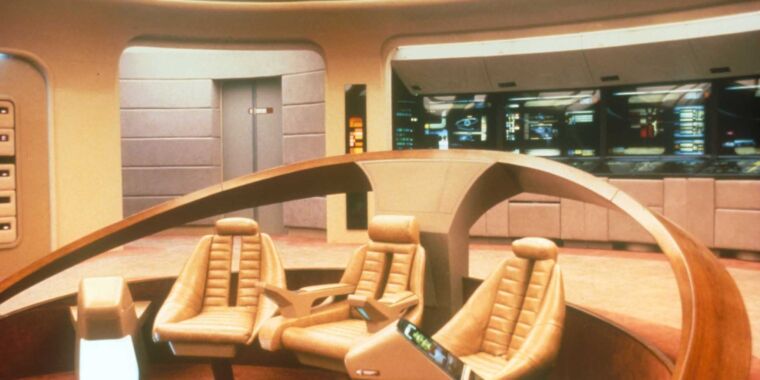
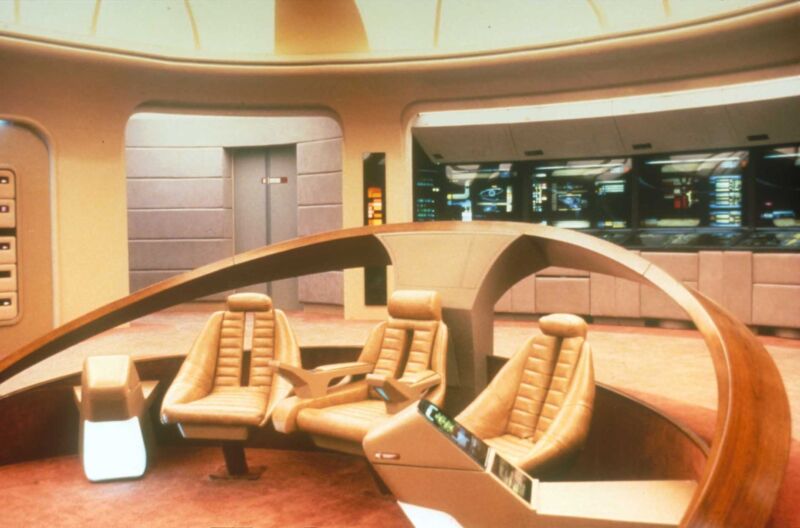
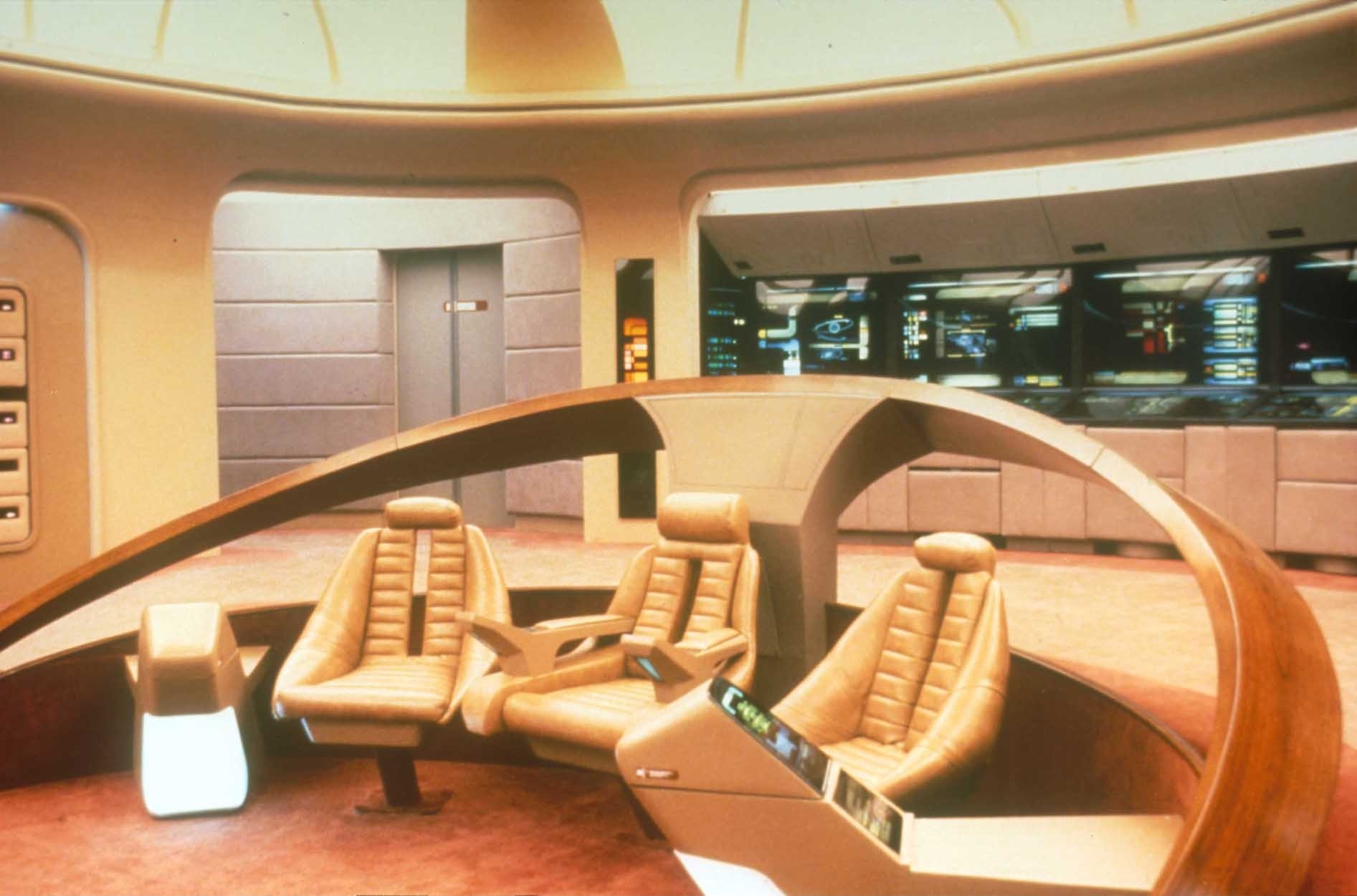
A recreation of the Star Trek The Next Generation Enterprise-D bridge

Enlarge / The Enterprise-D bridge recreation, seen in London in 2002.

Peter Bischoff/Getty Images

More than a decade has gone by since three Star Trek: The Next Generation fans first decided to restore the bridge from the Enterprise-D. Plans for the restored bridge morphed from opening it up to non-commercial uses like weddings or educational events into a fully fledged museum, and now that museum is almost ready to open. Backers of the project on Kickstarter have been notified that Sci-Fi World Museum will open to them in Santa Monica, California, on May 27, with general admission beginning in June.

It’s not actually the original set from TNG, as that was destroyed while filming Star Trek: Generations, when the saucer section crash-lands on Veridian III. But three replicas were made, overseen by Michael Okuda and Herman Zimmerman, the show’s set designers. Two of those welcomed Trekkies at Star Trek: The Experience, an attraction in Las Vegas until it closed in 2008.

The third spent time in Hollywood, then traveled to Europe and Asia for Star Trek: World Tour before it ended up languishing in a warehouse in Long Beach. It’s this third globe-trotting Enterprise-D bridge that—like the grit that gets an oyster to create a pearl—now finds a science-fiction museum accreted around it. Well, mostly—the chairs used by Riker, Troi, Data, and some other bits were salvaged from the Las Vegas exhibit.

Unlike the actual set, which was made from wood, the replica is made of metal and fiberglass. The restoration was originally supposed to take up to two years, but the project ended up being a far bigger challenge.

When Ars checked in with the Enterprise-D bridge restoration in 2014, the science-fiction museum plan had taken shape. But that change of plans did not sit well with some of the project’s original supporters, particularly after an imperfect re-creation of the captain’s chair—which remained lost until recently—was sold on eBay.

Things got even uglier in 2018 when Huston Huddleston, who led the project, was arrested and then convicted for possessing child pornography. Although Huddleston still appears listed as the project’s CEO on its Kickstarter page, that appears to be an artifact of its creation, and John Purdy is listed as the CEO of the Sci-Fi World Museum on its About Us page.

The Enterprise-D isn’t the only bridge you’ll be able to find at the museum—there’s also a replica of the bridge from Star Trek: The Original Series, which previously lived in a wax museum in Buena Park, California. Other exhibits include a hall of robots, as well as the “Bubbleship” and a drone from the movie Oblivion.

It’s also not the only recent re-creation of the Enterprise-D’s bridge. Okuda and his wife Denise both helped Paramount re-create the iconic set for the third season of Picard. The new Enterprise-D set can even be explored on Google Maps.

And earlier this month, it looked like Jean-Luc Picard’s long-lost chair might be sold at auction. However, the day saw an agreement between CBS Studios and the auctioneer Propstore, which will return the chair to CBS’s Star Trek Archive, which plans to restore and display it in the coming year.

The restored Star Trek Enterprise-D bridge goes on display in May Read More »

plucky-crew-of-star-trek:-discovery-seeks-a-strange-artifact-in-s5-trailer

Plucky crew of Star Trek: Discovery seeks a strange artifact in S5 trailer

Their final adventure begins —

“It has been a hell of a journey. But everything ends someday.”

Star Trek: Discovery returns for its fifth and final season after a two-year hiatus.

It’s been two years since we had new episodes of Star Trek: Discovery, which debuted in 2017. Now Paramount+ has dropped the official trailer for the fifth and final season of the spinoff series.

(Spoilers for prior seasons below.)

As previously reported, Sonequa Martin-Green plays Michael Burnham, an orphaned human raised on the planet Vulcan by none other than Sarek (James Frain) and his human wife, Amanda Grayson (Mia Kirshner)—aka, Spock’s (Ethan Peck) parents. So, she is Spock’s adoptive sister. As I’ve written previously, the S2 season-long arc involved the mysterious appearances of a “Red Angel” and a rogue Starfleet AI called Control that sought to wipe out all sentient life in the universe.

The big reveal was that the Red Angel was actually a time-travel suit worn by Michael’s biological mother. She had accidentally jumped 950 years into a bleak future in which Control had achieved its nefarious goal and had been traveling through time, leaving signals (in the form of the visions), hoping to alter that future. In the S2 finale, Michael donned a copy of her mother’s suit to lead Discovery over 900 years into the future. The crew of the Enterprise told Starfleet that Discovery was destroyed in the battle and was ordered never to speak of the ship or her crew again.

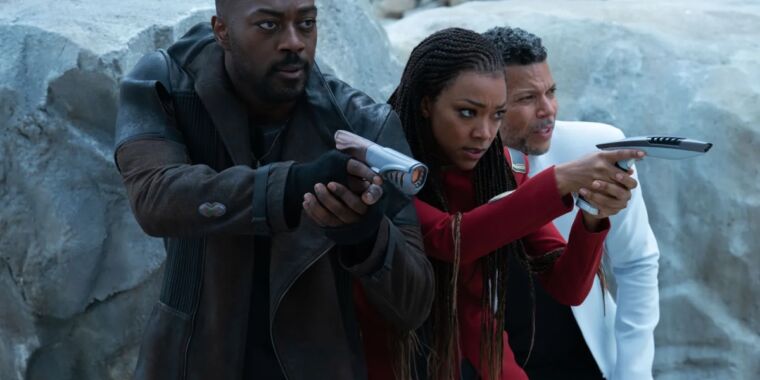
In S3, Michael, Discovery, and her crew arrived in the future and found that Control’s plan had been thwarted: Life still exists. But the galaxy was very different thanks to something called The Burn, a catastrophic event that caused all the dilithium in the Milky Way to explode and destroy much of Starfleet in the process. In the aftermath, with no warp drive possible, all the planets had become disconnected and were no longer governed by the Federation. Michael did, however, manage to locate one sole Federation liaison on a remote space station with the help of a new ally, Book (David Ajala).

The Discovery crew reunited with what was left of Starfleet, figured out what caused The Burn, and managed to defeat a rival syndicate known as the Emerald Chain, inspiring planets to start rejoining the Federation. Burnham finally became captain of Discovery after Saru (Doug Jones) opted to return to his home planet of Kaminar for a spell. And we bid a sorrowful farewell to Philippa Georgiou (Michelle Yeoh).

S4 opened with the plucky crew—including Saru as first officer—helping rebuild the Federation and celebrating the reopening of Starfleet Academy. They soon encountered a “gravitational anomaly” five light-years in diameter that destroyed Book’s home planet of Kwejian as it moved through the galaxy. It turned out to be a powerful technology belonging to an alien species with interconnected minds called 10-C, whose language employed mathematical equations. In the S4 finale, the aliens ultimately agreed to turn off their technology, thereby sparing Earth and other Federation planets.

The fifth season was already in development by March 2020, and the plan was to film those episodes back-to-back with S4. Then, the COVID-19 pandemic hit and put those plans on hold. Filming didn’t happen until 2022. While S5 was originally meant to air last year, once Paramount decided to pull the plug and make it the final season, they needed to shoot additional footage in order to wrap up the series properly. Per the official premise:

The fifth and final season will find Captain Michael Burnham (Sonequa Martin-Green) and the crew of the U.S.S. Discovery uncovering a mystery that will send them on an epic adventure across the galaxy to find an ancient power whose very existence has been deliberately hidden for centuries. But there are others on the hunt as well… dangerous foes who are desperate to claim the prize for themselves and will stop at nothing to get it.

In addition to Martin-Green, Jones, and Ajala, much of the main cast is returning for S5: Anthony Rapp as Stamets; Mary Wiseman as Tilly; Wilson Cruz as Dr. Culber; Blu del Barrio as Adira Tal; and Callum Keith Rennie as Rayner. Eve Harlow and Elias Toufexis will reprise their recurring roles as Moll and L’ak, respectively. Returning as notable guest stars in S5: Oded Fehr as Starfleet Commander-in-Chief Charles Vance; Chelah Horsdal as Lair Rillak; Tara Rowling as T’Rina; David Cronenberg as Kovich; and Tig Notaro as Jett Reno.

The first two episodes of the fifth and final season of Star Trek: Discovery will premiere on Paramount+ on April 4, 2024; the remaining eight episodes will air weekly after that through May 30.

Listing image by Paramount+

Plucky crew of Star Trek: Discovery seeks a strange artifact in S5 trailer Read More »