Space

rocket-report:-vulcan-stacked-for-launch;-starship-aces-test-ahead-of-third-flight

Rocket Report: Vulcan stacked for launch; Starship aces test ahead of third flight

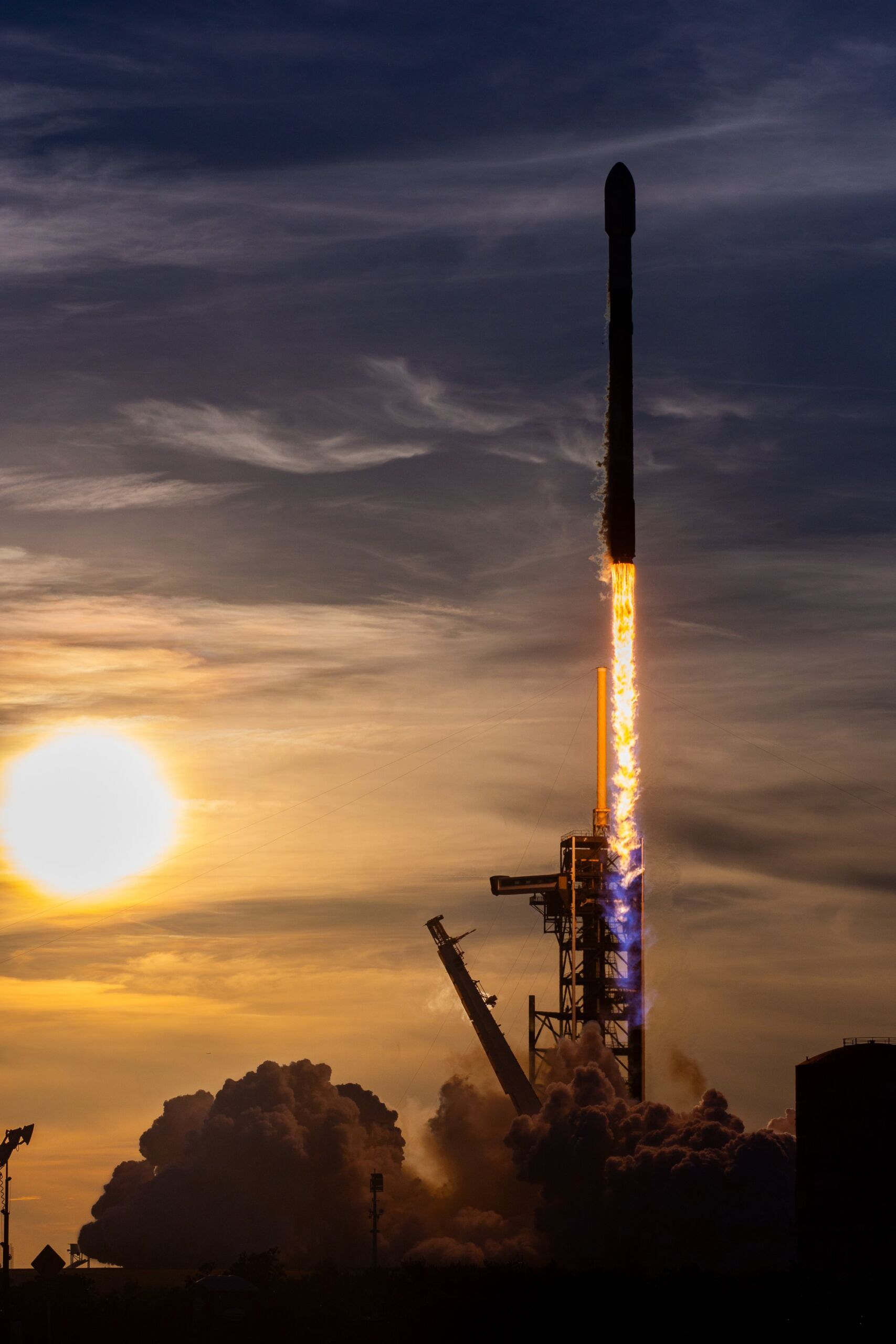
Electron returned to flight successfully this week.

Enlarge / Electron returned to flight successfully this week.

Rocket Lab

Welcome to Edition 6.24 of the Rocket Report! This will be the final edition of this newsletter until January 4—hey, space enthusiasts need a holiday break too! And given all that’s expected to happen in 2024 in the world of launch, a bit of a recharge seems like a smart move. Stephen and I wish everyone happy holidays and a healthy and prosperous new year. Until then!

As always, we welcome reader submissions, and if you don’t want to miss an issue, please subscribe using the box below (the form will not appear on AMP-enabled versions of the site). Each report will include information on small-, medium-, and heavy-lift rockets as well as a quick look ahead at the next three launches on the calendar.

Ranking the top 10 US launch companies of 2023. Oops, we did it again and published a list of the most accomplished US commercial launch companies. It’s no surprise that SpaceX is atop the list, but what comes after is more intriguing, including a new company in second position. I hope the list sparks debate, discussion, and appreciation for the challenge of operating a successful rocket company.

This is a really hard business … The article closes with this message, which I think is a fitting way to end the calendar year and kick off the holiday season: “As ever, I remain in awe of all the talented engineers and business people out there trying to make a go of it in the launch industry. This is a difficult and demanding business, replete with problems. I salute your hard work and hope for your success.”

New Shepard finally flies again. With redesigned engine components, Blue Origin’s New Shepard rocket took off from West Texas and flew to the edge of space on Tuesday with a package of scientific research and technology demonstration experiments, Ars reports. This was the first flight of Blue Origin’s New Shepard rocket since September 12, 2022, when an engine failure destroyed the booster and triggered an in-flight abort for the vehicle’s pressurized capsule during an uncrewed flight.

Does “soon'” really mean soon? … It took 15 months for Blue Origin to return to flight with New Shepard, but Tuesday’s successful launch puts the company on a path to resuming human missions. So when will Blue Origin start flying people again? “Following a thorough review of today’s mission, we look forward to flying our next crewed flight soon,” said Erika Wagner, a longtime Blue Origin manager who co-hosted the company’s webcast of Tuesday’s flight. (submitted by EllPeaTea and Ken the Bin)

The easiest way to keep up with Eric Berger’s space reporting is to sign up for his newsletter, we’ll collect his stories in your inbox.

Electron successfully returns to flight. Rocket Lab successfully launched a Japanese radar imaging satellite on the first flight of its Electron rocket since a failure nearly three months ago, Space News reports. The Electron lifted off from the company’s Launch Complex 1 in New Zealand at 11: 05 pm ET on December 14. The vehicle deployed its payload, the QPS-SAR-5 or Tsukuyomi-1 satellite, for Japanese company iQPS, afterward.

A record number of launches this year … The launch was the first for Electron since a September 19 failure during a launch of another radar-imaging satellite for Capella Space. On that mission, the first stage performed as expected, but the second stage’s engine appeared to shut down immediately after ignition, preventing it from reaching orbit. The launch was the 10th flight of the Electron this year, including one launch of a suborbital version of Electron called HASTE. (submitted by Ken the Bin)

Shetland approved for UK launches. SaxaVord Spaceport on the small island of Unst has been given approval from the Civil Aviation Authority to begin orbital launches in 2024, the BBC reports. It will be the first fully licensed spaceport in Western Europe able to launch vertically into orbit. It permits up to 30 launches a year that will be used to take satellites and other payloads into space.

Launches this summer? … The site, which is the first spaceport in Scotland, has several launch operators around the world currently developing rockets. It is anticipated that German rocket firm HyImpulse will attempt sub-orbital launches as early as this August. Full orbital launches are expected to take place at SaxaVord from 2025. Cornwall Spaceport was the UK’s first licensed spaceport; however, its rockets are launched horizontally and carried by an aircraft. (submitted by gizmo23 and Ken the Bin)

Rocket Report: Vulcan stacked for launch; Starship aces test ahead of third flight Read More »

galaxy-scale-winds-spotted-in-the-distant-universe

Galaxy-scale winds spotted in the distant Universe

Out in the wind —

These winds can drive gas out of galaxies, shaping their future evolution.

Image of a galaxy with a purple blob superimposed on its center.

Enlarge / X-ray emissions (purple) superimposed on a visible light image of a galaxy shows the galaxy winds being launched. CREDIT: X-ray: NASA/CXC/Ohio StateH-alpha and Optical: NSF/NOIRLab/AURA/KPNO/CTIO; Infrared: NASA/JPL-Caltech/Spitzer/ Optical: ESO/La Silla Observatory.

One of the ways massive stars, those at least 10-times bigger than the Sun, reach their end is in a supernova—an enormous explosion caused by the star’s core running out of fuel.

One consequence of a supernova is the production of galactic winds, which play a key role in regulating star formation. Although galactic winds have already been observed in several nearby galaxies, a team of scientists has now made the first direct observations of this phenomenon in a large population of galaxies in the distant Universe, at a time when galaxies are in their early stages of formation.

Feedback

According to the study’s lead author, Yucheng Guo, of the Centre de Recherche Astrophysique de Lyon, galactic winds are an important part of the galaxy evolution models.

“It was assumed there should be galactic winds that can regulate galaxies’ growth. However, it was very difficult to directly observe these winds. With our study, we show that at the early stage of the Universe, every normal galaxy had such winds,” Guo said.

According to Guo, galactic winds form a key part of the so-called feedback process that is important in our understanding of galaxy evolution. “Galactic winds originate as a result of star formation activity. These winds inject a lot of energy and momentum into the gas, resulting in it [being] expelled from the galaxy. If there is not enough gas in the galaxy, the star formation stops. This is called the feedback process,” he said.

According to Guo, galactic winds also enable exchange of matter between galaxies and their surroundings. “Each galaxy is surrounded by a gas halo. Galaxies can breathe out as well as breathe in gas,” Guo said.

Hard to see

He said that traditionally it has been very difficult to observe galactic winds, because the gas halos are almost transparent.

Guo and his team overcame this hurdle by using the Multi-Unit Spectroscopic Explorer (MUSE) instrument on the Very Large Telescope. “The instrument is able to observe the galaxies at redshift z ≈ 1, which corresponds to 7 billion years of the cosmic evolution.” Guo said at that wavelength, the MUSE instrument is able to detect and directly observe the emission from magnesium atoms in the galactic winds.

He said the other important feature of the research is that they managed to observe the galactic winds in more than 100 galaxies. “We also managed to detect the average shape of these winds, which is like an ice cream cone,” he said.

Guo said the direct observation of the galactic winds outside the local Universe was the first step of their research. “We still don’t know about their physical properties such as size, power, and also how they change with time and in different kinds of galaxies.”

Nature, 2023. DOI: 10.1038/s41586-023-06718-w


Dhananjay Khadilkar is a journalist based in Paris.

Galaxy-scale winds spotted in the distant Universe Read More »

us-commits-to-landing-an-international-astronaut-on-the-moon

US commits to landing an international astronaut on the Moon

This decade —

This ticket to the Moon will probably go to a European or Japanese astronaut.

Vice President Kamala Harris speaks at a National Space Council meeting Wednesday in Washington.

Enlarge / Vice President Kamala Harris speaks at a National Space Council meeting Wednesday in Washington.

NASA/Joel Kowsky

One of the core tenets of NASA’s Artemis program to return astronauts to the Moon is its inclusion of international partners. This intertwines the program, like the International Space Station, with considerations of geopolitics and international relations, alongside key themes like US national prestige, exploration, and scientific discovery.

Earlier this year, NASA named a Canadian astronaut, Jeremy Hansen, to the Artemis II crew training to fly around the far side of the Moon, a mission that will likely launch sometime in 2025. This flight won’t land on the Moon, but NASA plans a series of lunar landing missions beginning with Artemis III later this decade.

On Wednesday, Vice President Kamala Harris announced an international astronaut will land on the Moon during one of NASA’s Artemis missions.

“Today, in recognition of the essential role that our allies and partners play in the Artemis program, I am proud to announce that alongside American astronauts, we intend to land an international astronaut on the surface of the Moon by the end of the decade,” Harris said at a meeting of the National Space Council.

Although the National Space Council is useful in aggregating disparate interests across the US government to help form more cohesive space policies, public meetings like the one Wednesday can seem perfunctory. Harris departed the stage soon after her speech, and other government officials read from prepared remarks during the rest of the event.

Nevertheless, Harris’ announcement highlighted the role the space program plays in elevating the soft power of the United States. It was widely assumed an international astronaut would eventually land on the Moon with NASA. Harris put a deadline on achieving this goal.

Among friends

NASA has long included astronauts from its international partners on human spaceflight missions, dating back to the ninth flight of the space shuttle in 1983, when West German astronaut Ulf Merbold joined five Americans on a flight to low-Earth orbit. This was seen by US government officials as a way to foster closer relations with like-minded countries. The inclusion of foreign astronauts on US missions also repays partner nations who make financial commitments to US-led space projects with a high-profile flight opportunity for one of their citizens.

In a similar way, the Soviet Union provided its Cold War allies with seats on Soyuz flights to low-Earth orbit. For several years, China has extended invitations for international astronauts to fly to its Tiangong space station. So far, only Chinese astronauts have visited Tiangong.

NASA managers dole out crew assignments on the International Space Station based on each partner’s financial contribution to the operating costs of the US-led segment of the complex. NASA is responsible for more than three-quarters of this part of the ISS budget, followed by Japan, the European Space Agency (ESA), and Canada. Russia is responsible for paying operating costs for its section of the ISS.

Among the international partners contributing to Artemis, it seems most likely a European astronaut would get the first slot for a landing with NASA.

ESA funded the development of the service modules used on NASA’s Orion spacecraft, which will ferry astronauts from Earth to the Moon and back. These modules provide power and propulsion for Orion. ESA is also developing refueling and communications infrastructure for the Gateway mini-space station to be constructed in orbit around the Moon.

A Japanese astronaut might also have a shot at getting a seat on an Artemis landing. Japan’s government has committed to providing the life-support system for the Gateway’s international habitation module, along with resupply services to deliver cargo to Gateway. Japan is also interested in building a pressurized rover for astronauts to drive across the lunar surface. In recognition of Japan’s contributions, NASA last year committed to flying a Japanese astronaut aboard Gateway.

Canada is building a robotic arm for Gateway, but a Canadian astronaut already has a seat on NASA’s first crewed Artemis mission, albeit without a trip to the lunar surface.

US commits to landing an international astronaut on the Moon Read More »

daily-telescope:-a-simple-shot-of-the-milky-way-high-above-france-and-spain

Daily Telescope: A simple shot of the Milky Way high above France and Spain

Daily moment of zen —

“Both the daytime and nighttime vistas there were just bloody marvelous.”

The Milky Way Galaxy above the Pyrenees, right on the French and Spanish border.

Enlarge / The Milky Way Galaxy above the Pyrenees, right on the French and Spanish border.

bulbs_01_frizzle

Welcome to the Daily Telescope. There is a little too much darkness in this world and not enough light, a little too much pseudoscience and not enough science. We’ll let other publications offer you a daily horoscope. At Ars Technica, we’re going to take a different route, finding inspiration from very real images of a universe that is filled with stars and wonder.

Good morning. It’s December 21, and today’s image showcases our very own Milky Way Galaxy above the Pyrenees mountain range, which separates Spain from the rest of Europe.

It was sent in by a reader who captured it while hiking through the mountains and in their words bivvying—a new word for “minimalist camping” that I learned about five minutes ago. I’m jealous. Hiking through the Pyrenees and gazing at the stars at night sounds like a wonderful dream. The photographer told me they are no great astrophotographer, but that the skies were so dark and brilliant that even this single exposure photo taken with a Fuji X100 APS camera looks stunning.

“It’s still one of my favorite starry skies memories from hiking the Haute Randonnée Pyrénéenne, a high mountain route going all the way coast to coast along the French‑Spanish border,” the photographer said. “Because both the daytime and nighttime vistas there were just bloody marvelous.”

I have greatly enjoyed writing these Daily Telescope entries and seeing the amazing work you all have sent in. We’ve published everything from the very best images taken by NASA’s space telescopes down to iPhone photos. We all share the skies, and see and document them in our own way. Thank you so much for your submissions; there have been many more than we can publish. But I treasure them all and your time in sending them in. I can’t wait to see what delights the new year will bring. Until then, happy holidays, and may your stars be merry and bright.

Source: bulbs_01_frizzle

Do you want to submit a photo for the Daily Telescope? Reach out and say hello.

Daily Telescope: A simple shot of the Milky Way high above France and Spain Read More »

for-the-first-time,-ula’s-vulcan-rocket-is-fully-stacked-at-cape-canaveral

For the first time, ULA’s Vulcan rocket is fully stacked at Cape Canaveral

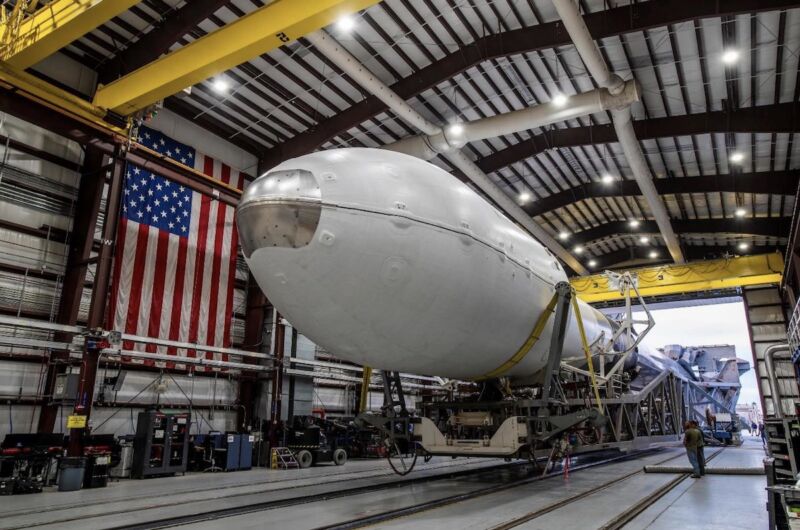
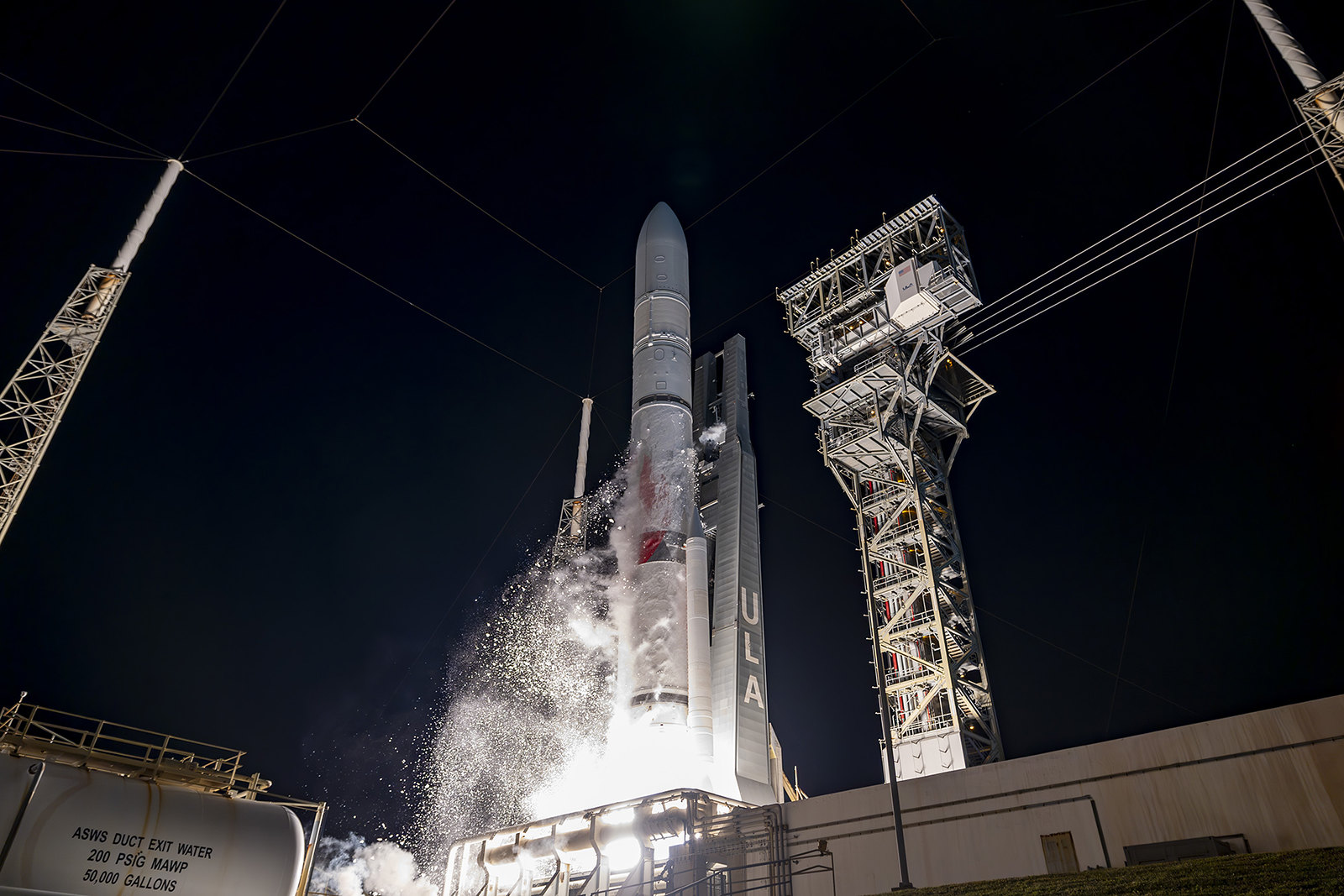
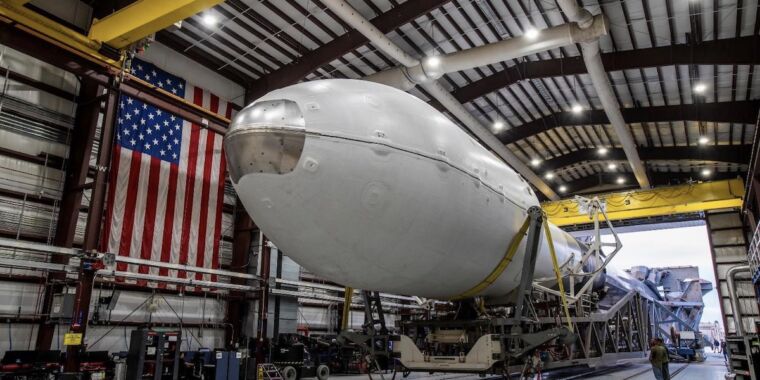
United Launch Alliance's first Vulcan rocket stands 202 feet (61.6 meters) tall with the addition of its payload fairing.

Enlarge / United Launch Alliance’s first Vulcan rocket stands 202 feet (61.6 meters) tall with the addition of its payload fairing.

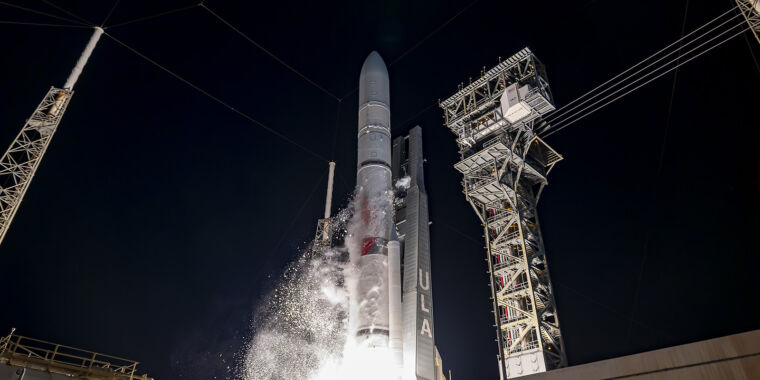
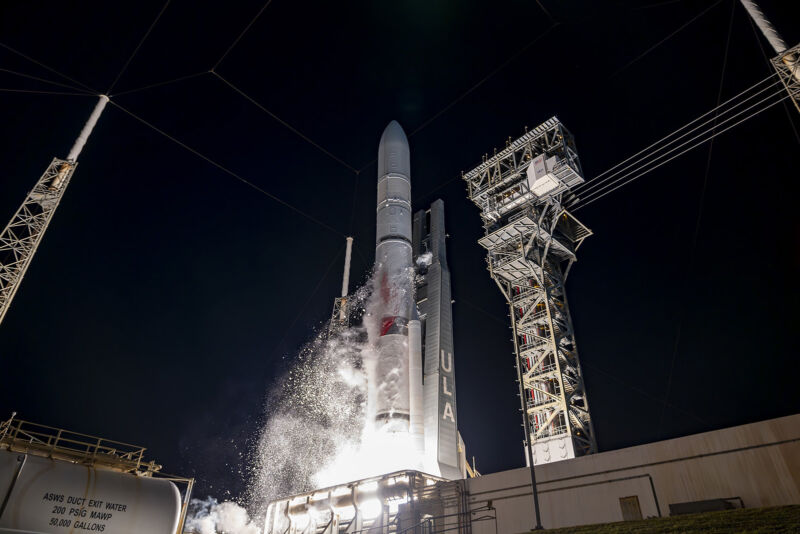
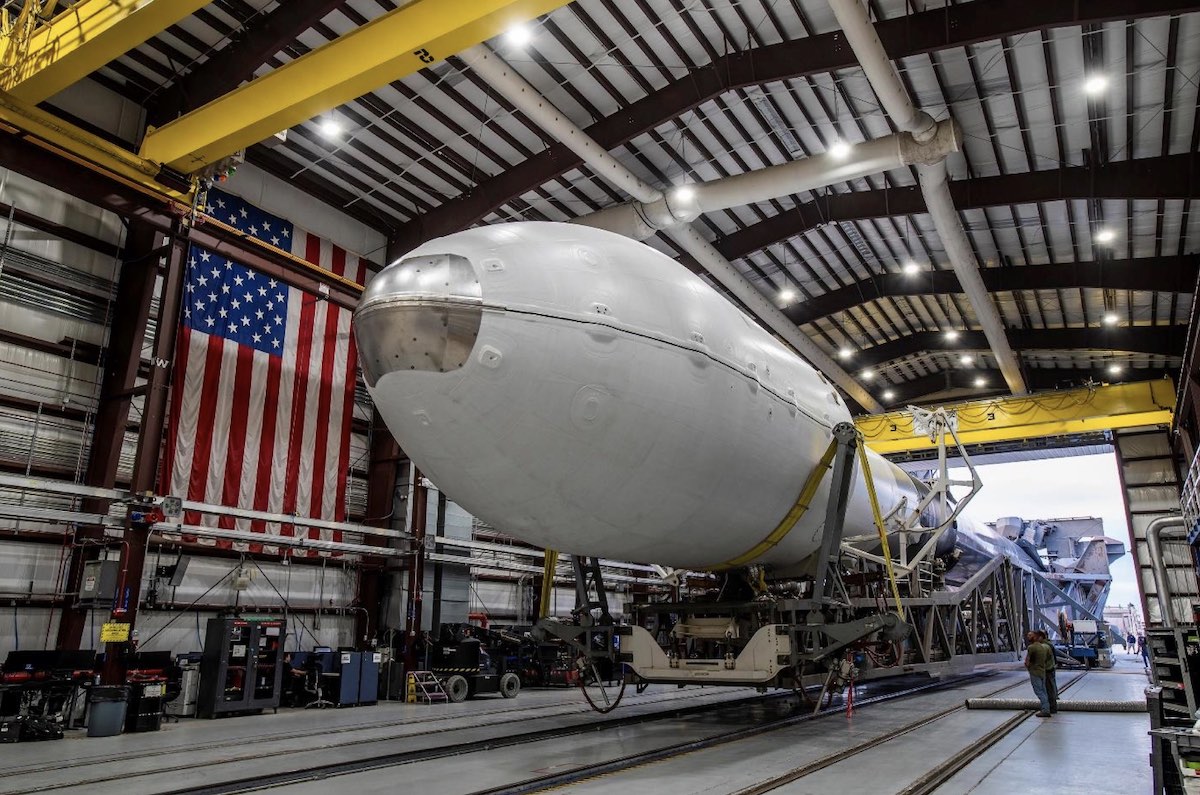
United Launch Alliance’s first Vulcan rocket has been fully assembled at Cape Canaveral, Florida, in preparation for its inaugural flight next month.

Technicians hoisted the Vulcan rocket’s payload fairing, containing a commercial lunar lander from Astrobotic, on top of the launch vehicle Wednesday morning at ULA’s Vertical Integration Facility. This milestone followed the early morning transfer of the payload fairing from a nearby facility where Astrobotic’s lunar lander was fueled for its flight to the Moon.

ULA’s new rocket has rolled between its vertical hangar and the launch pad at Cape Canaveral Space Force Station several times for countdown rehearsals and fueling tests. But ULA only needed the Vulcan rocket’s first stage and upper stage to complete those tests. The addition of the payload shroud Wednesday marked the first time ULA has fully stacked a Vulcan rocket, standing some 202 feet (61.6 meters) tall, still surrounded by scaffolding and work platforms inside its assembly building.

This moves the launch company closer to the first flight of Vulcan, the vehicle slated to replace ULA’s Atlas V and Delta IV rockets. After some final checkouts and a holiday break, ground crews will transport the Vulcan rocket to its launch pad in preparation for liftoff at 2: 18 am ET (07: 18 UTC) on January 8.

The launch was previously scheduled for December 24, but ULA delayed the flight until the next launch window to resolve ground system issues uncovered during one of the recent Vulcan countdown rehearsals. Astrobotic’s first robotic lunar lander, named Peregrine Mission One, only has a few days per month when it can depart Earth and take a course toward the Moon. The launch and trajectory must be timed to allow the spacecraft to reach its landing site with the proper lighting conditions.

First full stack

United Launch Alliance, a 50-50 joint venture between Boeing and Lockheed Martin, has been under pressure from rival SpaceX for the last few years. While SpaceX has launched more than 90 times this year, ULA’s rockets have only flown three times as the company winds down its Atlas V and Delta IV programs.

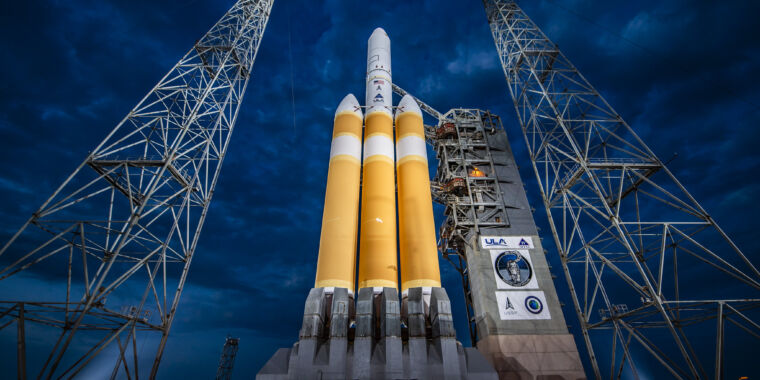
One Delta IV-Heavy rocket remains in ULA’s inventory. It’s supposed to launch next year with a classified payload for the National Reconnaissance Office, the US government’s spy satellite agency. There are 17 Atlas V rockets left to fly.

With Vulcan, ULA is poised to ramp up its launch rate. Tory Bruno, the company’s chief executive, says ULA has sold 70 Vulcan launches—more than half to commercial customers and the rest to the US military. Amazon has booked 38 Vulcan missions to deploy satellites for its Project Kuiper broadband network. Vulcan will initially be fully expendable, but ULA plans to introduce engine recovery and reuse later this decade.

ULA’s goal is to launch an average of two Vulcan rockets per month by the end of 2025. This would be a remarkably fast launch cadence just two years after the first flight of Vulcan. For comparison, it took longer for the Atlas V rocket and SpaceX’s Falcon 9 to get to four flights.

Astrobotic's Peregrine lander was recently encapsulated inside the Vulcan rocket's payload fairing.

Enlarge / Astrobotic’s Peregrine lander was recently encapsulated inside the Vulcan rocket’s payload fairing.

The Vulcan rocket was originally slated to launch in 2019 but faced repeated delays, primarily due to late deliveries of rocket engines from Blue Origin, Jeff Bezos’ space company. ULA bypassed a launch opportunity in May after a Vulcan upper stage exploded during a ground test.

Unlike the debuts of most rockets, the Vulcan will launch with a functioning payload. Astrobotic’s uncrewed Peregrine Mission One will carry 20 payloads to the lunar surface, including five for NASA through the agency’s Commercial Lunar Payload Services (CLPS) program. This will be the first mission to launch under the CLPS initiative, which NASA set up in 2018 to purchase commercial transportation services to the Moon for scientific instruments and experiments.

For the first time, ULA’s Vulcan rocket is fully stacked at Cape Canaveral Read More »

spacex-completes-static-fire-test-in-push-toward-third-starship-launch

SpaceX completes static fire test in push toward third Starship launch

IFT-3 goes whee? —

The rocket and test equipment looked undamaged after the test.

Ship 28 is seen after being moved to SpaceX's launch site in South Texas.

Enlarge / Ship 28 is seen after being moved to SpaceX’s launch site in South Texas.

SpaceX

Just one month after the second flight of its massive Starship rocket, SpaceX is making progress toward a third attempt.

On Wednesday, at 1: 37 pm local time in South Texas, the company performed a static fire test of the next Starship—which bears the serial number Ship 28. The test of the rocket’s six engines appeared to be nominal as the Raptors ignited for a handful of seconds. The rocket and ground support equipment looked undamaged after the test.

Also this week SpaceX rolled the booster to be used for the next attempt—Booster 10—to the launch site at its Starbase facility in South Texas. The vehicle has since been lifted onto the orbital launch mount. Presumably this rocket, too, will undergo a static fire test in the coming days.

After these tests are complete the Starship upper stage is likely to be stacked on top of the booster to complete the launch vehicle. At this point it seems likely that the hardware for “Integrated Flight Test 3” would be substantially ready to launch.

With this third flight, SpaceX will seek to fly further into a profile that will see Starship ultimately make a controlled landing into the ocean north of Kauai, Hawaii. SpaceX may also perform an in-space propellant transfer test, but this has not been confirmed.

Starship’s second launch attempt, on November 18, was notably more successful than the first attempt in April 2023. The second flight test demonstrated substantial improvements in engine reliability and provided valuable data about a challenging “hot staging” maneuver to separate the Super Heavy booster from the Starship upper stage.

Another test flight soon?

Recently Kathy Lueders, SpaceX’s general manager for the Starbase launch site near Brownsville, said the company will target the first quarter of next year for this third test flight. “It would be great if we were in the first quarter, definitely,” she said. “Elon [Musk] obviously would probably say the end of December, but I don’t think we’ll get there.”

Since the second test flight occurred, neither the company nor SpaceX founder Elon Musk has provided a technical update on what ultimately went wrong with the Starship upper stage, which failed a few minutes into its flight, or why the booster was ultimately lost after it separated from the Starship vehicle.

Booster 10, with a few holiday decorations, is rolled to the launch site in South Texas.

Enlarge / Booster 10, with a few holiday decorations, is rolled to the launch site in South Texas.

SpaceX

However, far fewer modifications have been made to the rocket hardware or the launch site ahead of this third attempt, suggesting that at least some of the problems may have been flight software-related.

SpaceX has yet to receive regulatory approval for a third launch of Starship. The Federal Aviation Administration characterized the second attempt in November as a “mishap,” while acknowledging that no injuries or public property damage were reported.

After the anomaly, the agency said, via the social media site X, that “the FAA will oversee the @SpaceX-led mishap investigation to ensure SpaceX complies with its FAA-approved mishap investigation plan and other regulatory requirements.” The FAA has provided no additional information in the month since then.

SpaceX completes static fire test in push toward third Starship launch Read More »

blue-origin’s-suborbital-rocket-flies-for-first-time-in-15-months

Blue Origin’s suborbital rocket flies for first time in 15 months

RTF —

An engine failure destroyed a New Shepard rocket on its previous flight.

Blue Origin's New Shepard booster comes in for landing in West Texas at the conclusion of Tuesday's suborbital flight.

Enlarge / Blue Origin’s New Shepard booster comes in for landing in West Texas at the conclusion of Tuesday’s suborbital flight.

Blue Origin

With redesigned engine components, Blue Origin’s New Shepard rocket took off from West Texas and flew to the edge of space on Tuesday with a package of scientific research and technology demonstration experiments.

This was the first flight of Blue Origin’s 60-foot-tall (18-meter) New Shepard rocket since September 12, 2022, when an engine failure destroyed the booster and triggered an in-flight abort for the vehicle’s pressurized capsule. There were no passengers aboard for that mission, and the capsule safely separated from the failed booster and parachuted to a controlled landing.

The flight on Tuesday also didn’t carry people. Instead, Blue Origin, Jeff Bezos’s space company, lofted 33 payloads from NASA, research institutions, and commercial companies. Some of these payloads were flown again on Tuesday’s launch after failing to reach space on the failed New Shepard mission last year. Among these payloads were an experiment to demonstrate hydrogen fuel cell technology in microgravity and an investigation studying the strength of planetary soils under different gravity conditions.

Blue Origin’s capsule, mounted on top of the rocket, also flew 38,000 postcards submitted by students through Club for the Future, the company’s nonprofit.

For Tuesday’s return-to-flight mission, the New Shepard rocket ignited its BE-3PM engine and climbed away from Blue Origin’s remote launch site near Van Horn, Texas, at 10: 42 am CST (16: 42 UTC). The hydrogen-fueled engine fired for more than two minutes, then shut down as scheduled as the rocket continued coasting upward, reaching an altitude of more than 347,000 feet (106 kilometers).

The booster returned for a precision propulsive landing a short distance from the launch pad, and Blue Origin’s capsule deployed three parachutes to settle onto the desert floor, completing a 10-minute up-and-down flight.

Blue Origin has launched 24 missions with its reusable New Shepard rocket, including six flights carrying people just over the Kármán line, the internationally recognized boundary of space 100 kilometers above Earth.

“A special thank you to all of our customers who flew important science today and the students who contributed postcards to advance our future of living and working in space for the benefit of Earth,” said Phil Joyce, Blue Origin’s senior vice president for the New Shepard program, in a statement. “Demand for New Shepard flights continues to grow and we’re looking forward to increasing our flight cadence in 2024.”

Blue Origin will fly people again “soon”

It took 15 months for Blue Origin to return to flight with New Shepard, but Tuesday’s successful launch puts the company on a path to resuming human missions. Most of Blue Origin’s customers for these suborbital flights have been wealthy individuals or special guests invited to strap in for a ride to space. Blue Origin’s passengers have included Bezos, aviation pioneer Wally Funk, and actor William Shatner, eager for a taste of spaceflight. New Shepard passengers experience a few minutes of microgravity before returning to Earth.

Blue Origin hasn’t disclosed its ticket price, but seats on a New Shepard flight last year reportedly sold for $1.25 million. This is more than double the price for a seat on Virgin Galactic’s suborbital spaceship.

So when will Blue Origin start flying people again? “Following a thorough review of today’s mission, we look forward to flying our next crewed flight soon,” said Erika Wagner, a longtime Blue Origin manager who co-hosted the company’s webcast of Tuesday’s flight.

But “soon” is a conveniently vague term. In March, when Blue Origin announced the results of its investigation into last year’s launch failure, the company said it would return to flight “soon” with New Shepard. Nine months later, New Shepard finally flew again.

Engineers probing the New Shepard accident last year concluded a nozzle failure on the rocket’s BE-3PM was the direct cause of the launch failure. The engine operated at higher temperatures than expected, leading to thermal damage to the nozzle, Blue Origin announced earlier this year.

Blue Origin said corrective actions to address the cause of the failure included design changes to the engine combustion chamber and adjustments to operating parameters. These changes were expected to reduce operating temperatures. Engineers also redesigned parts of the nozzle to help it better handle thermal and dynamic loads, the company said.

In September, the Federal Aviation closed its investigation into the New Shepard launch failure, and Blue Origin targeted an uncrewed return-to-flight mission in early October. However, Ars previously reported that an additional two-month delay was caused by an issue with certifying an engine part intended for flight.

The long-term grounding of the New Shepard rocket caused speculation about the program’s future, particularly at a time when Blue Origin is ramping up preparations for the inaugural flight of the much larger orbital-class New Glenn launcher. Last year’s launch failure left Blue Origin with just one New Shepard booster in its inventory—the rocket that made its ninth flight to space on Tuesday.

This particular booster has been exclusively used for uncrewed research missions. Blue Origin hasn’t confirmed whether it has another New Shepard rocket in production for human flights.

But statements from Blue Origin officials Tuesday suggest New Shepard has a future. Wagner said Blue Origin aims to open New Shepard missions to researchers on future flights, allowing scientists to directly work with their experiments in microgravity.

Blue Origin’s suborbital rocket flies for first time in 15 months Read More »

daily-telescope:-tracking-the-sun’s-path-every-day-across-the-sky

Daily Telescope: Tracking the Sun’s path every day across the sky

On the horizon —

The image is a vivid demonstration of the changing of the seasons.

The path of the Sun over Germany.

Enlarge / The path of the Sun over Germany.

Frank Niessen/IAU OAE

Welcome to the Daily Telescope. There is a little too much darkness in this world and not enough light, a little too much pseudoscience and not enough science. We’ll let other publications offer you a daily horoscope. At Ars Technica, we’re going to take a different route, finding inspiration from very real images of a universe that is filled with stars and wonder.

Good morning. It’s December 18, and today’s photo is an homage to the forthcoming winter solstice—which will visit the Northern Hemisphere on Thursday evening.

This image was a second-place finisher in a recent competition by the International Astronomical Union’s Office of Education. This year’s contest welcomed astrophotography enthusiasts at all skill levels, including images taken with smartphones.

The image, created by Frank Niessen, was captured in Germany between the summer solstice and winter solstice in 2018. It combines images taken at different times of day over the course of six months, and each curve tracks the Sun’s path across the sky on a particular day. Gaps indicate cloudy days. The image was captured using a simple pinhole camera fashioned from a coffee can. I find the effect stunning.

Stay warm out there in the Northern Hemisphere, y’all.

Source: Frank Niessen

Do you want to submit a photo for the Daily Telescope? Reach out and say hello.

Daily Telescope: Tracking the Sun’s path every day across the sky Read More »

daily-telescope:-one-of-the-most-stunning-andromeda-photos-i’ve-ever-seen

Daily Telescope: One of the most stunning Andromeda photos I’ve ever seen

Gorgeous galaxy —

The image is the result of 100 hours of observing.

The Andromeda Galaxy.

Enlarge / The Andromeda Galaxy.

The Association of Widefield Astrophotographers

Welcome to the Daily Telescope. There is a little too much darkness in this world and not enough light, a little too much pseudoscience and not enough science. We’ll let other publications offer you a daily horoscope. At Ars Technica, we’re going to take a different route, finding inspiration from very real images of a universe that is filled with stars and wonder.

Good morning. It’s December 15, and I have a real treat for you today. This is an image of the Andromeda Galaxy, the nearest major galaxy to our Milky Way. Astronomers believe our galaxy is shaped much as this one is.

The photograph comes from a group that calls itself the Association of Widefield Astrophotographers, and the photo was a 100-hour project by six participants in the United States, Poland, and the United Kingdom. They collected data over several months to produce the image.

According to the organization, “Our goal with this project was to prove that very expensive equipment and dark skies aren’t required to create unique images of faint objects. Since most of us are high schoolers and college students with a passion for astronomy, our summer jobs did not allow us to afford the expensive gear used by most astrophotographers.”

Most participants worked within a city, with light pollution levels ranging from Bortle 4 to Bortle 9. While it would be difficult for an individual to reveal the faint structures in this image, they said that by working together with other astrophotographers, they could produce such a result. It is truly extraordinary.

Source: The Association of Widefield Astrophotographers

Do you want to submit a photo for the Daily Telescope? Reach out and say hello.

Daily Telescope: One of the most stunning Andromeda photos I’ve ever seen Read More »

rocket-report:-signs-of-life-from-blue-origin;-spacex-preps-next-starship

Rocket Report: Signs of life from Blue Origin; SpaceX preps next Starship

Pain Cher —

There’s also an update on Baguette One. No, I haven’t become a food critic.

Relativity Space's Aeon R engine fires up on a test stand in Mississippi.

Enlarge / Relativity Space’s Aeon R engine fires up on a test stand in Mississippi.

Welcome to Edition 6.23 of the Rocket Report! In last week’s report, my colleague Eric Berger mentioned what a year 2023 has been for rocket debuts. Several new launch vehicles flew for the first time this year, including SpaceX’s Starship and Japan’s H3. In this week’s report, we have some news on some major rocket debuts planned for 2024, namely United Launch Alliance’s Vulcan (now set for January) and Blue Origin’s long-awaited New Glenn.

As always, we welcome reader submissions, and if you don’t want to miss an issue, please subscribe using the box below (the form will not appear on AMP-enabled versions of the site). Each report will include information on small-, medium-, and heavy-lift rockets, as well as a quick look ahead at the next three launches on the calendar.

Lost tanks will delay final Vega launch. Remember last week’s report that Avio, the Italian rocket-maker, lost track of propellant tanks needed for the final launch of Europe’s Vega rocket? Well, it looks like Avio and the European Space Agency have a plan to remedy the situation, but it’s risky and will delay the Vega launch by several months, Space News reports. “Avio has confirmed to ESA that there is an issue with tanks for the last Vega flight,” said Toni Tolker-Nielsen, ESA director of space transportation, without addressing the earlier report that the tanks for Vega’s upper stage were found in a landfill, crushed and unusable.

Hard to believe … It’s baffling how a space company could lose track of such critical pieces of rocket hardware. Tolker-Nielsen said managers considered two remedies to move forward with the final launch of the Vega rocket. The most likely solution is to use larger tanks for the upgraded Vega C rocket, which is replacing the base model of the light-class Vega launch vehicle. “It would necessitate some structural modification of the inner structure of the AVUM (upper stage),” Tolker-Nielsen said. “It seems a good, feasible solution.” That approach would support a Vega launch in September 2024. The payload for this mission is the Sentinel 2C remote sensing satellite, part of Europe’s Copernicus Earth-monitoring constellation. (submitted by Ken the Bin)

China’s methane-fueled rocket flies again. Chinese launch startup Landspace successfully sent satellites into orbit for the first time on December 8, Space News reports. This was the third flight of Landspace’s Zhuque 2 rocket. Zhuque 2, also known as Vermillion Bird 2, failed to reach orbit on its first test flight, then became the first methane-fueled rocket to successfully achieve orbit on its second test flight in July. This launch of Zhuque 2 was the first to actually place working satellites into orbit. Onboard the rocket were three small satellites, including one from Spacety, a Chinese commercial satellite company sanctioned earlier this year by the US Treasury Department. The Zhuque 2 has the ability to put 1.5 metric tons of payload into a 500-kilometer orbit.

Avian evolution … Established in 2015, Landspace is one of the most advanced companies in China’s ecosystem of launch startups. Its first launch in 2018 used a solid-fueled rocket called Zhuque 1, but it failed before entering orbit. Now, the Zhuque 2 has made history as the first methane-fueled orbital rocket, and stands with a record of two successful flights in three attempts. Landspace’s next step will be the Zhuque 3 rocket, a larger stainless steel launcher in roughly the same class as SpaceX’s Falcon 9. The first stage of Landspace’s next rocket will be reusable, and the company aims to launch it for the first time in 2025. (submitted by Egudahl, EllPeaTea, and Ken the Bin)

Northrop Grumman test-fires new solid rocket motor. A new solid rocket motor developed on a rapid timeline was recently test-fired by Northrop Grumman. This test is the first of an annual test series to demonstrate new technologies and materials for incorporation into the company’s line of solid rocket motors, which are used by a range of rockets, including NASA’s Space Launch System, United Launch Alliance’s Vulcan, and the US military’s next-generation Sentinel ICBM. This first Solid Motor Annual Rocket Technology Demonstrator, or SMART Demo, test-firing occurred at Northrop Grumman’s facilities in Utah.

Moving faster and smarter … According to Northrop Grumman, the SMART Demo successfully demonstrated several innovative technologies, alternate manufacturing materials and processes to reduce lead times by 75 percent. These include several advanced, long-lead tooling products as well as components of the solid rocket motor’s nozzle structure, constructed with additive manufacturing techniques. Other items tested on the solid rocket motor were a new solid propellant capable of operating at cold temperatures, and components from alternative suppliers that could address concerns stemming from supply chain problems. (submitted by Ken the Bin)

Rocket Report: Signs of life from Blue Origin; SpaceX preps next Starship Read More »

a-top-secret-chinese-spy-satellite-just-launched-on-a-supersized-rocket

A top-secret Chinese spy satellite just launched on a supersized rocket

A Long March 5 rocket, the largest launcher in China's inventory, deployed a classified Chinese military satellite into orbit Friday.

Enlarge / A Long March 5 rocket, the largest launcher in China’s inventory, deployed a classified Chinese military satellite into orbit Friday.

China’s largest rocket apparently wasn’t big enough to launch the country’s newest spy satellite, so engineers gave the rocket an upgrade.

The Long March 5 launcher flew with a payload fairing some 20 feet (6.2 meters) taller than its usual nose cone when it took off on Friday with a Chinese military spy satellite. This made the Long March 5, with a height of some 200 feet, the tallest rocket China has ever flown.

Adding to the intrigue, the Chinese government claimed the spacecraft aboard the Long March 5 rocket, named Yaogan-41, is a high-altitude optical remote sensing satellite. These types of surveillance satellites usually fly much closer to Earth to obtain the sharpest images possible of an adversary’s military forces and strategically important sites.

This could mean a few things. First, assuming China’s official description is accurate, the satellite could be heading for a perch in geosynchronous orbit, a position that would afford any Earth-facing sensors continuous views of a third of the world’s surface. In this orbit, the spacecraft would circle Earth once every 24 hours, synchronizing its movement with the planet’s rotation.

Because this mission launched on China’s most powerful rocket, with the longer payload fairing added on, the Yaogan-41 spacecraft is presumably quite big. The US military’s space tracking network found the Yaogan-41 satellite in an elliptical, or oval-shaped, soon after Friday’s launch. Yaogan-41’s trajectory takes it between an altitude of about 121 miles (195 kilometers) and 22,254 miles (35,815 kilometers), according to publicly available tracking data.

This is a standard orbit for spacecraft heading into geosynchronous orbit. It’s likely in the coming weeks that the Yaogan-41 satellite will maneuver into this more circular orbit, where it would maintain an altitude of 22,236 miles (35,786 kilometers) and perhaps nudge itself into an orbit closer to the equator.

Staring down from space

In an official statement, China’s state-run Xinhua news agency claimed Yaogan-41 will be used for civilian purposes, such as land surveys and agricultural monitoring. In reality, China uses the Yaogan name as a blanket identifier for most of its military satellites.

US military officials will closely watch to see where Yaogan-41 ends up. If it settles into geosynchronous orbit over the Indian or Pacific Oceans, as analysts expect, Yaogan-41 would have a constant view of China, Taiwan, and neighboring countries.

From such a high altitude, Yaogan-41’s optical imager won’t have the sharp vision of a satellite closer to Earth. But it’s easy to imagine the benefits of all-day coverage, even at lower resolution, without China’s military needing to wait hours for a follow-up pass over a potential target from another satellite in low-Earth orbit.

In August, China launched a synthetic aperture radar surveillance satellite into a geosynchronous-type orbit using a medium-lift Long March 7 rocket. This spacecraft can achieve 20-meter (66-foot) resolution at Earth’s surface with its radar instrument, which is capable of day-and-night all-weather imaging.

Optical payloads, like the one on Yaogan-41, are restricted to daytime observations over cloud-free regions. China launched a smaller optical remote sensing satellite into geosynchronous orbit in 2015, ostensibly for civilian purposes.

Although Chinese officials did not disclose the exact capabilities of Yaogan-41, it would almost certainly have the sensitivity to continually track US Navy ships and allied vessels across a wide swath of the Indo-Pacific. Aside from its use of the larger payload fairing, the Long March 5 rocket used to launch Yaogan-41 can haul approximately 31,000 pounds (14 metric tons) of payload mass into the orbit it reached on Friday’s launch.

This suggests China could have equipped Yaogan-41 with a large telescope to stare down from space. Notably, China acknowledged Yaogan-41’s purpose as an optical imaging satellite. China’s government doesn’t always do that. Perhaps this is a signal to US officials.

A top-secret Chinese spy satellite just launched on a supersized rocket Read More »
space-force-chief:-timing-of-chinese-spaceplane-launch-“no-coincidence”

Space Force chief: Timing of Chinese spaceplane launch “no coincidence”

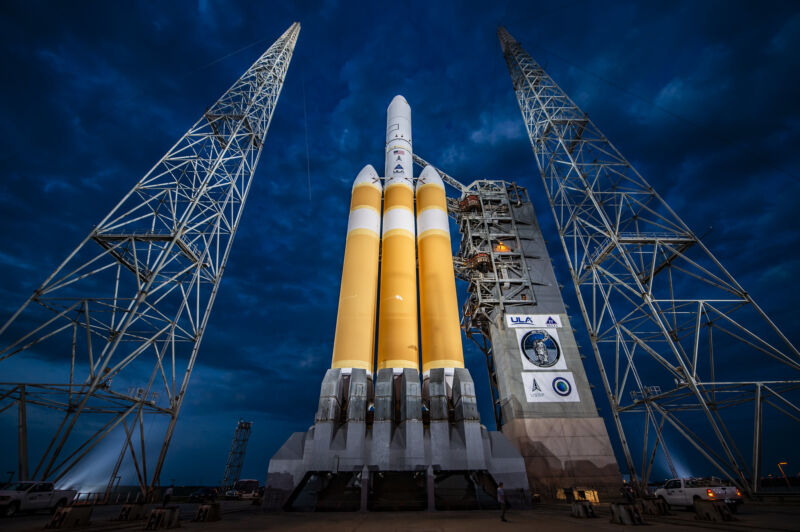
File photo of the US military's X-37B test vehicle after a landing in 2012.

File photo of the US military’s X-37B test vehicle after a landing in 2012.

Boeing

China has launched its top-secret military spaceplane for a third time, days after the US military’s winged spacecraft was grounded for several weeks due to problems with its SpaceX rocket.

Observers believe China’s spaceplane looks much like the US military’s X-37B, a reusable craft that Pentagon officials are similarly tight-lipped about. But there’s a distinction in that US officials will publicly discuss, at least in broad terms, the purpose of the X-37B and release images of the spacecraft.

The US military has two X-37Bs in its inventory, each with a cargo bay that could fit a large refrigerator. They resemble small space shuttles, with dimensions about one-quarter those of NASA’s retired shuttle orbiters. The X-37B spaceplanes have flown in space six times, logging missions as long as two-and-a-half years, thanks to deployable solar panels that generate power for greater endurance.

The seventh X-37B flight was supposed to launch this week from Florida, but officials called off the launch to resolve technical issues with its Falcon Heavy rocket.

Then, on Thursday, China sent its own spaceplane aloft on a Long March 2F rocket from the Jiuquan launch base in northwestern China. The Long March 2F is typically used to launch Chinese astronaut crews into orbit but has been modified to accommodate China’s unpiloted robotic spaceplane inside its payload fairing.

An even plane

There’s no suggestion that the US and Chinese spaceplanes are spying on one another because their orbits do not bring them close together. However, the supposed similarities between the US and Chinese military spaceplanes are hard to ignore.

“It’s no surprise that the Chinese are extremely interested in our spaceplane, and we’re extremely interested in theirs,” said Gen. Chance Saltzman, the US Space Force’s senior officer serving as the military’s chief of Space Operations. “The ability to put something into orbit, do some things, and bring it home and take a look at the results is powerful.

“These are the two of the most watched objects on orbit while they’re on orbit,” Saltzman said Wednesday in response to a question from Ars at the Space Force Association’s Spacepower Conference in Orlando, Florida.

“It’s probably no coincidence that they’re trying to match us in timing and sequence of this,” he added.

In a brief statement, China’s top state-owned space industry contractor, CASC, referred to the payload on Thursday’s super-secret rocket launch as a “reusable test spacecraft.” China hasn’t published any photos.

“The test spacecraft will operate in orbit for a period of time and then return to a scheduled landing site in China,” CASC said. “During this period, reusable technology verification and space science experiments will be carried out as planned to provide technical support for the peaceful use of space.”

Despite describing the spaceplane as a vehicle for peaceful use, Chinese officials closely guard details about it. In all likelihood, the spaceplane is actually carrying out a military mission, perhaps testing new space technology for use in various military applications like surveillance, propulsion, or communication.

This is the third flight of China’s spaceplane, following a 2020 mission that lasted two days and the longer 276-day mission that ended in May. On both missions, China’s winged spacecraft released a small object in orbit, perhaps to shadow the spaceplane and test rendezvous, proximity operations, or in-orbit inspection tech.

On both occasions, the Chinese spaceplane returned for landing on a runway near the Lop Nur nuclear testing site in northwestern China.

Space Force chief: Timing of Chinese spaceplane launch “no coincidence” Read More »