space history

‘not-that-into-peace-doves’:-the-apollo-soyuz-patch-nasa-rejected

‘Not that into peace doves’: The Apollo-Soyuz patch NASA rejected

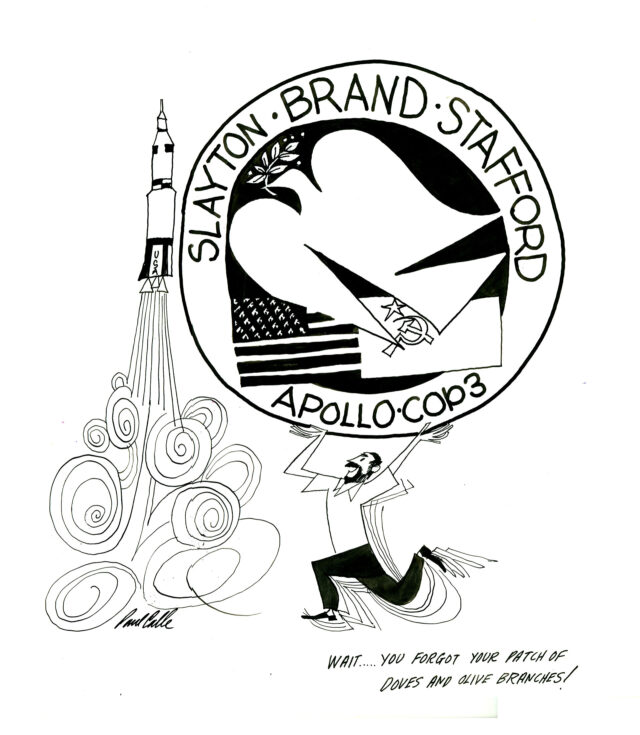
a black and white ink drawing of a man carrying an oversized space mission patch running towards a launching rocket

Paul Calle’s July 1975 cartoon poking fun at his own rejected mission patch for the joint Apollo-Soyuz Test Project. Credit: Calle Space Art

Rejects and revivals

Calle’s patch design was not the only one ruled out by NASA’s officials.

At first, Stafford, Brand, and Slayton chose a design from a contest among the US space program’s workforce. The winner, Jean Pinataro of North American Rockwell (the prime contractor for the Apollo command module), came up with a concept that the astronauts liked, but the agency’s leaders rejected it for not having enough “international significance” (unofficially, it was also said to be “cartoonish”).

That led to NASA accepting the cost of hiring an artist from the NASA art program and Calle being invited to offer his ideas. It also resulted in the patch that flew.

When Calle stepped away, the decision was made to repurpose the work of Bob McCall, an artist who had designed the Apollo 17 mission patch and in 1974 had painted the scene of the Apollo and Soyuz spacecraft nearing a docking. McCall would go on to create similar art for a pair of postage stamps issued in the United States and the Soviet Union, while Pinataro adapted McCall’s original painting as the central image of the US ASTP emblem.

The cosmonauts had their own design—in fact, it was the first Russian mission patch to involve the crew’s input—but wore both their own and the US patch during their six days in space.

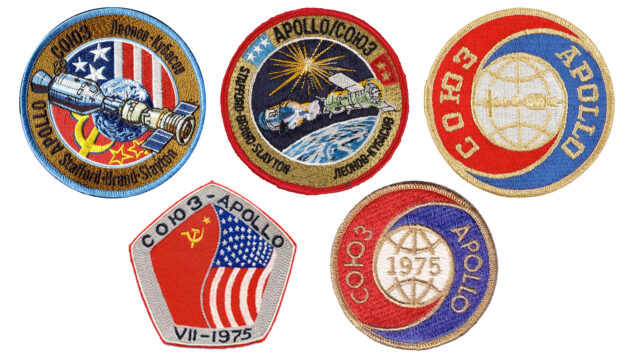
five colorful embroidered space patches each related to the 1975 Apollo -Soyuz Test Project

Apollo-Soyuz Test Project (ASTP) patches, from top left to right: 2021 embroidered replica of Jean Pinataro’s original design; the Soviet Soyuz 18 crew patch; the Apollo-Soyuz Test Project crew patch; souvenir ASTP program patch; and ASTP program patch. Credit: AB Emblem/Roscosmos/collectSPACE.com

Today, 50 years later, the McCall-inspired design, the cosmonauts’ patch, and the Apollo-Soyuz program insignia are used interchangeably to represent the mission. Calle’s designs have been largely forgotten but are now getting a revival for the golden anniversary.

“I wanted to reimagine them. Not redo them, but bring them to life,” said Chris.

Working with a fellow artist Tim Gagnon, who created a number of the mission patches worn by space shuttle and International Space Station crews, Chris has begun the process of producing a limited number of embroidered patches based on his and his late father’s ideas.

Chris primarily focused on Calle’s dove and olive branch design.

“It certainly keeps to the spirit of my dad’s original idea,” Chris said.

Chris Calle asks readers to contact him via his website to be kept informed of when the limited edition Apollo-Soyuz patches are available.

Click through to collectSPACE to see more of Paul Calle’s original designs and the reimagined versions by Chris Calle and Tim Gagnon.

‘Not that into peace doves’: The Apollo-Soyuz patch NASA rejected Read More »

“it’s-a-heist”:-senator-calls-out-texas-for-trying-to-steal-shuttle-from-smithsonian

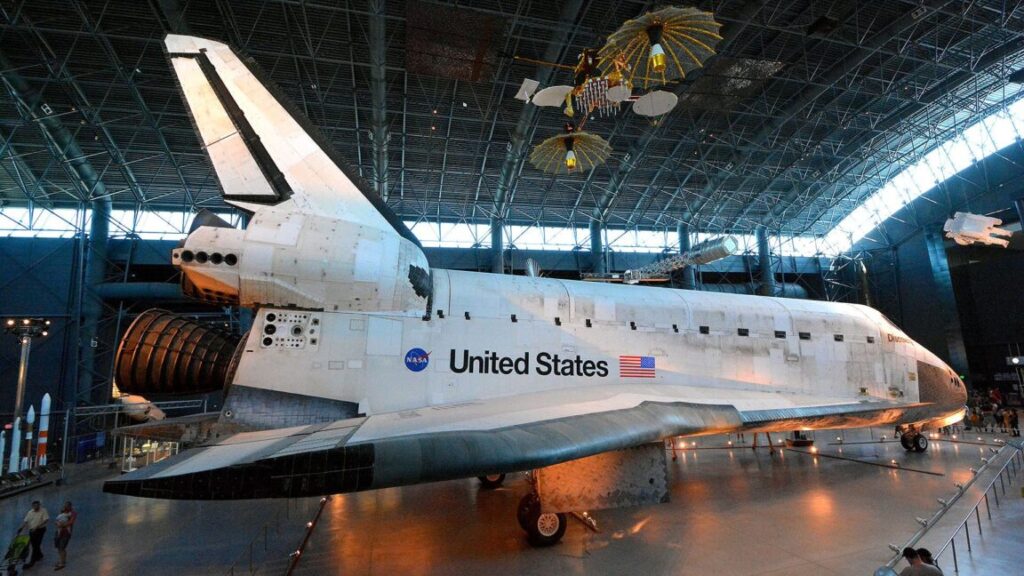
“It’s a heist”: Senator calls out Texas for trying to steal shuttle from Smithsonian

Citing research by NASA and the Smithsonian, Durbin said that the total was closer to $305 million and that did not include the estimated $178 million needed to build a facility to house and display Discovery once in Houston.

Furthermore, it was unclear if Congress even has the right to remove an artifact, let alone a space shuttle, from the Smithsonian’s collection. The Washington, DC, institution, which serves as a trust instrumentality of the US, maintains that it owns Discovery. The paperwork signed by NASA in 2012 transferred “all rights, interest, title, and ownership” for the spacecraft to the Smithsonian.

“This will be the first time ever in the history of the Smithsonian someone has taken one of their displays and forcibly taken possession of it. What are we doing here? They don’t have the right in Texas to claim this,” said Durbin.

Houston was not the only city to miss out on displaying a retired space shuttle. In 2011, Durbin and fellow Illinois Senator Mark Kirk appealed to NASA to exhibit one of the winged spacecraft at the Adler Planetarium in Chicago. The agency ultimately decided to award the shuttles to the National Air and Space Museum, the Kennedy Space Center Visitor Complex in Florida, and the California Science Center in Los Angeles.

Houston, we have a problem

A prototype orbiter that was exhibited where Discovery is now was transferred to the Intrepid Museum in New York City.

To be able to bring up his points at Thursday’s hearing, Durbin introduced the “Houston, We Have a Problem” amendment to “prohibit the use of funds to transfer a decommissioned space shuttle from one location to another location.”

He then withdrew the amendment after having voiced his objections.

“I think we’re dealing with something called waste. Eighty-five million dollars worth of waste. I know that this is a controversial issue, and I know that there are other agencies, Smithsonian, NASA, and others that are interested in this issue; I’m going to withdraw this amendment, but I’m going to ask my colleagues be honest about it,” said Durbin. “I hope that we think about this long and hard.”

“It’s a heist”: Senator calls out Texas for trying to steal shuttle from Smithsonian Read More »

ars-reflects-on-apollo-13-turning-30

Ars reflects on Apollo 13 turning 30


Ron Howard’s 1995 love letter to NASA’s Apollo program takes a few historical liberties but it still inspires awe.

Credit: Universal Pictures

This year marks the 30th anniversary of the 1995 Oscar-winning film, Apollo 13, director Ron Howard’s masterful love letter to NASA’s Apollo program in general and the eponymous space mission in particular. So we’re taking the opportunity to revisit this riveting homage to American science, ingenuity, and daring.

(Spoilers below.)

Apollo 13 is a fictional retelling of the aborted 1970 lunar mission that became a “successful failure” for NASA because all three astronauts made it back to Earth alive against some pretty steep odds. The film opens with astronaut Jim Lovell (Tom Hanks) hosting a watch party in July 1969 for Neil Armstrong’s historic first walk on the Moon. He is slated to command the Apollo 14 mission, and is ecstatic when he and his crew—Ken Mattingly (Gary Sinise) and Fred Haise (Bill Paxton)—are bumped to Apollo 13 instead. His wife, Marilyn (Kathleen Quinlan) is more superstitious and hence less thrilled: “It had to be 13.” To which her pragmatic husband replies, “It comes after 12.”

A few days before launch, Mattingly is grounded because he was exposed to the measles and replaced with backup Jack Swigert (Kevin Bacon), who is the only one happy about the situation. But Lovell and Haise rebound from the disappointment and the launch goes off without a hitch. The public, alas, just isn’t interested in what they think has become routine. But the mission is about to become anything but that.

During a maintenance task to stir the oxygen tanks, an electrical short causes one of the tanks to explode, with the other rapidly venting its oxygen into space. The crew has less than an hour to evacuate the command module Odyssey into the lunar module Aquarius, using it as a lifeboat. There is no longer any chance of landing on the Moon; the new mission is to keep the astronauts alive long enough to figure out how to bring them safely home. That means overcoming interpersonal tensions, freezing conditions, dwindling rations, and unhealthy CO2 levels, among other challenges, as well as taking on a pulse-pounding manual course correction with no navigational computer. (Spoiler alert: they make it!)

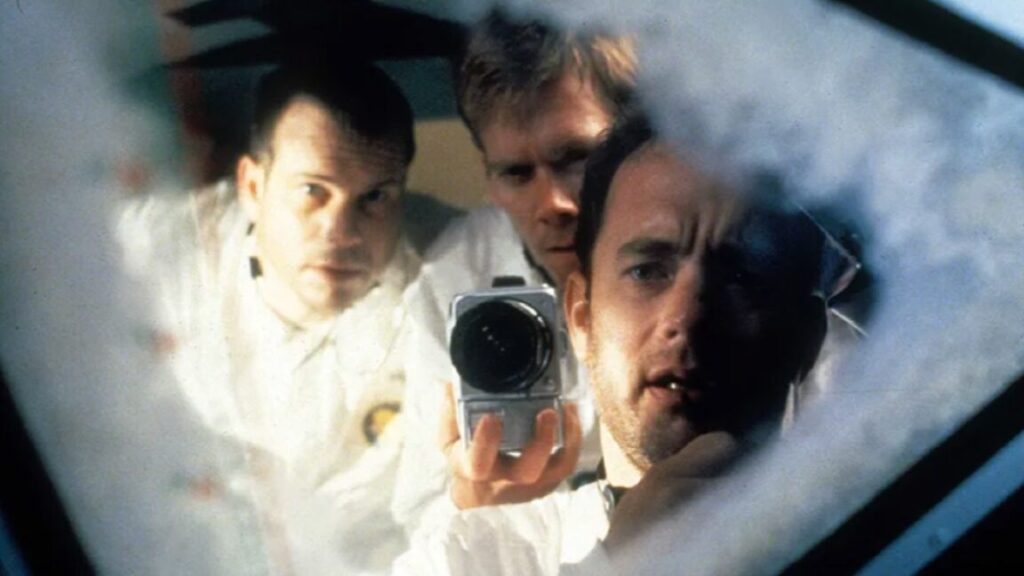
The Apollo 13 crew: Jim Lovell (Tom Hanks), Jack Swigert (Kevin Bacon), and Fred Haise (Bill Paxton). Universal Pictures

The film is loosely based on Lovell’s 1994 memoir, Lost Moon. While Lovell initially hoped Kevin Costner would portray him, Howard ultimately cast Hanks in the role, in part because the latter already had extensive knowledge of the Apollo program and space history. Hanks, Paxton, and Bacon all went to US Space Camp to prepare for their roles, participating in astronaut training exercises and flying on the infamous “Vomit Comet” (the KC-135) to experience simulated weightlessness. Howard ultimately shot most of the weightless scenes aboard the KC-135 since recreating those conditions on a soundstage and with CGI would have been prohibitively expensive.

In fact, Howard didn’t rely on archival mission footage at all, insisting on shooting his own footage. That meant constructing realistic spacecraft interiors—incorporating some original Apollo materials—and reproducing exactly the pressure suits worn by astronauts. (The actors, once locked in, breathed air pumped into the suits just like the original Apollo astronauts.) The Mission Control set at Universal Studios was so realistic that one NASA consultant kept looking for the elevator when he left each day, only to remember he was on a movie set.

The launch sequence was filmed using miniature models augmented with digital image stitching. Ditto for the splashdown, in which actual parachutes and a prop capsule were tossed out of a helicopter to shoot the scene. Only the exhaust from the attitude control thrusters was generated with CGI. A failed attempt at using CGI for the in-space urine dump was scrapped in favor of just spraying droplets from an Evian bottle.

It all paid off in the end. Apollo 13 premiered on June 30, 1995, to critical acclaim and racked up over $355 million globally at the box office. It was nominated for nine Oscars and won two—Best Film Editing and Best Sound—although it lost Best Picture to another Hanks film, Forrest Gump. (We can’t quite believe it either.) And the film has stood the test of time, capturing the essence of America’s early space program for posterity. A few Ars staffers shared their thoughts on Apollo 13‘s enduring legacy.

Failure should be an option

White Team Flight Director Gene Krantz (Ed Harris) insists, “We are not losing those men!” Universal Pictures

The tagline for Apollo 13 is “Failure is not an option.” But this is a bit of Hollywood magic. It turns out that NASA Flight Director Gene Kranz never said the line during the actual Apollo 13 mission to the Moon, or the subsequent efforts to save the crew.

Instead the line was conceived after the script writers, Al Reinert and Bill Broyles, interviewed Kranz at his home Texas, south of Johnson Space Center. They were so taken by the notion it became synonymous with the film and with Kranz himself, one of NASA most storied flight directors. He has lived with the line in the decades since, and embraced it by using it as the title of his autobiography. Ever since then the public has associated the idea that NASA would never accept failure with the space agency.

Of course it is great that the public believes so strongly in NASA. But this also turned out to be a millstone around the agency’s neck. This is not really the fault of Kranz. However, as the public became unaccepting of failure, so did Congress, and NASA’s large programs became intolerant of failure. This is one of the reasons why the timeline and cost of NASA’s rockets and spacecraft and interplanetary missions have ballooned. There are so many people looking for things that could possibly go wrong, the people actually trying to build hardware and fly missions are swamped by requirements.

This is why companies like SpaceX, with an iterative design methodology that accepts some level of failure in order to go more quickly, have thrived. They have moved faster, and at significantly less cost, than the government. I asked Kranz about this a few years ago, the idea that NASA (and its Congressional paymasters) should probably be a little more tolerant of failure.

“Space involves risk, and I think that’s the one thing about Elon Musk and all the various space entrepreneurs: they’re willing to risk their future in order to accomplish the objective that they have decided on,” he told me. “I think we as a nation have to learn that, as an important part of this, to step forward and accept risk.”

Eric Berger

The perfect gateway drug

“Gentlemen, that’s not good enough.” Universal Pictures

Technically I am a child of the ’60s (early Gen-X), but I was far too young to grasp the significance of the Apollo 11 moon landing in 1969, or just how impressive NASA’s achievement really was. The adults made us sit around the TV in our PJs and seemed very excited about the grainy picture. That’s it. That’s all I remember. My conscious knowledge of space exploration was more influenced by Star Wars and the 1986 Challenger explosion. So going to see Apollo 13 in 1995 as a young science writer was a revelation. I walked out of the theater practically vibrating with excitement, turned to my friends and exclaimed, “Oh my god, we went to the Moon in a souped-up Buick!”

Apollo 13 makes space exploration visceral, makes the audience feel like they are right there in the capsule with the crew battling the odds to get back home. It perfectly conveys the huge risks and stalwart courage of everyone involved in the face of unimaginable pressure. Nerds are the heroes and physics and math are critical: I love the scene where Lovell has to calculate gimbal conversions by hand and asks mission control to check his work. A line of men with slide rules feverishly make their own calculations and one-by-one give the thumbs up.

Then there’s the pragmatic ingenuity of the engineers who had to come up with a way to fit square air filters into a round hole using nothing but items already onboard the spacecraft. There’s a reason I rewatch Apollo 13 every couple of years when I’m in the mood for a “let’s work the problem, people” pick-me-up. (Shoutout to Lovell’s mother, Blanche—played by Howard’s mother, the late Jean Speegle Howard—and her classic line: “If they could get a washing machine to fly, my Jimmy could land it.”)

Naturally, Howard had to sacrifice some historical accuracy in the name of artistic license, sparking the inevitable disgruntled griping among hardcore space nerds. For instance, the mission’s original commander, Alan Shepard, wasn’t grounded because of an ear infection but by Meniere’s disease (an inner ear issue that can cause dizziness). Mission control didn’t order the shutdown of the fuel cells; they were already dead. Swigert and Haise didn’t really argue about who was to blame for the accident. And the film ignores the critical role of Flight Director Glynn Lunney and his Black Team (among others), choosing to focus on Kranz’s White Team to keep the story streamlined.

Look, I get it: nobody wants to see a topic they’re passionate about misrepresented in a movie. But there’s no question that thanks to Howard’s narrative instincts, the film continues to resonate with the general public in ways that a by-the-book docudrama obsessing over the tiniest technical details never could.

In the grand scheme of things, that matters far more than whether Lovell really said, “Houston, we have a problem” in those exact words.  If you want the public to support space exploration and—crucially—for Congress to fund it, you need to spark their imaginations and invite them to share in the dream. Apollo 13 is the perfect gateway drug for future space fans, who might find themselves also vibrating with excitement afterward, so inspired by the film that they decide they want to learn more—say, by watching the 12-part Emmy-winning docuseries From the Earth to the Moon that Howard and Hanks co-produced (which is historically accurate). And who knows? They might even decide they want to be space explorers themselves one day.

Jennifer Ouellette

A common touchstone

Lift-off! Universal Pictures

My relationship with Apollo 13 is somewhat different from most folks: I volunteer as a docent at Space Center Houston, the visitor’s center for Houston’s Johnson Space Center. Specifically, I’m an interpretive guide for the center’s Saturn V exhibit—the only one of the three remaining Saturn V exhibits in the world composed of tip-to-tip of flight stages.

I reference Apollo 13 constantly during guide shifts because it’s a common touchstone that I can count on most folks visiting SCH to have seen, and it visually explicates so many of the more technical aspects of the Apollo program. If I’m explaining that the near-avalanche of white stuff one sees falling off of a Saturn V at launch is actually ice (the rocket’s cryogenic fuels are fantastically cold, and the launch pad at Florida is usually warm and humid, so ice forms on the rocket’s outer skin over the liquid oxygen and liquid hydrogen tanks as it sits on the pad), I reference the launch scene in the movie. If I’m explaining the transposition and docking maneuver by which the Apollo command module docked with and extracted the lunar module from its little garage, I reference the T&D scene in the movie.

Questions about breathing and carbon dioxide? Movie scene. The well-known tension between the astronaut corps and the flight surgeons? Movie scene. And the list goes on. It’s the most amazing reference material I could possibly have.

The film has its detractors, of course, and most geeks wanting to take issue with it will fire shots at the film’s historical accuracy. (Apollo EECOM Sy Liebergot, played in the film by director Ron Howard’s brother Clint, griped once to me that the movie had the audacity to depict the Apollo spacecraft’s trans-lunar injection burn as occurring with the Moon visible in the windows instead of on the far side of the planet—an apparently unforgivable astronavigational sin.) The movie amps up the drama in all respects, adds dialog no astronaut or controller would say, mashes people together into composite characters, compresses or expands the timelines of many of the events in the mission, shows many of those same events happening out of order, and puts people (like Gary Sinise’s Ken Mattingly) in places and roles they were never in.

All these things are true—but they’re also necessary additions in order to get one’s hands around a messy historical event (an event, like all events, that was basically just a whole bunch of stuff all happening at the same time) and fit it into a three-act structure that preserves the important things and that non-technical non-astronaut audiences can follow and understand. And the film succeeds brilliantly, telling a tale that both honors the historicity and technical details of the mission, and that also continues to function as a powerful interpretive tool that teaches people even 35 years after release.

Is every button pressed in the right way? No. Does it bug the crap out of me every time Kevin Bacon answers Tom Hanks’ “How’s the alignment?” question by nonsensically saying “GDC align” and pressing the GDC align button, which is neither what Lovell was asking nor the proper procedure to get the answer Lovell was looking for? Yes. But’s also pure competence porn—an amazing love letter to the space program and the 400,000 men and women who put humans on the Moon.

And like Lovell says: “It’s not a miracle. We just decided to go.”

Lee Hutchinson

Photo of Jennifer Ouellette

Jennifer is a senior writer at Ars Technica with a particular focus on where science meets culture, covering everything from physics and related interdisciplinary topics to her favorite films and TV series. Jennifer lives in Baltimore with her spouse, physicist Sean M. Carroll, and their two cats, Ariel and Caliban.

Ars reflects on Apollo 13 turning 30 Read More »