Security

microsoft-network-breached-through-password-spraying-by-russian-state-hackers

Microsoft network breached through password-spraying by Russian-state hackers

Microsoft network breached through password-spraying by Russian-state hackers

Getty Images

Russia-state hackers exploited a weak password to compromise Microsoft’s corporate network and accessed emails and documents that belonged to senior executives and employees working in security and legal teams, Microsoft said late Friday.

The attack, which Microsoft attributed to a Kremlin-backed hacking group it tracks as Midnight Blizzard, is at least the second time in as many years that failures to follow basic security hygiene has resulted in a breach that has the potential to harm customers. One paragraph in Friday’s disclosure, filed with the Securities and Exchange Commission, was gobsmacking:

Beginning in late November 2023, the threat actor used a password spray attack to compromise a legacy non-production test tenant account and gain a foothold, and then used the account’s permissions to access a very small percentage of Microsoft corporate email accounts, including members of our senior leadership team and employees in our cybersecurity, legal, and other functions, and exfiltrated some emails and attached documents. The investigation indicates they were initially targeting email accounts for information related to Midnight Blizzard itself. We are in the process of notifying employees whose email was accessed.

Microsoft didn’t detect the breach until January 12, exactly a week before Friday’s disclosure. Microsoft’s account raises the prospect that the Russian hackers had uninterrupted access to the accounts for as long as two months.

A translation of the 93 words quoted above: A device inside Microsoft’s network was protected by a weak password with no form of two-factor authentication employed. The Russian adversary group was able to guess it by peppering it with previously compromised or commonly used passwords until they finally landed on the right one. The threat actor then accessed the account, indicating that either 2FA wasn’t employed or the protection was somehow bypassed.

Furthermore, this “legacy non-production test tenant account” was somehow configured so that Midnight Blizzard could pivot and gain access to some of the company’s most senior and sensitive employee accounts.

As Steve Bellovin, a computer science professor and affiliate law prof at Columbia University with decades of experience in cybersecurity, wrote on Mastodon:

A lot of fascinating implications here. A successful password spray attack suggests no 2FA and either reused or weak passwords. Access to email accounts belonging to “senior leadership… cybersecurity, and legal” teams using just the permissions of a “test tenant account” suggests that someone gave that test account amazing privileges. Why? Why wasn’t it removed when the test was over? I also note that it took Microsoft about seven weeks to detect the attack.

While Microsoft said that it wasn’t aware of any evidence that Midnight Blizzard gained access to customer environments, production systems, source code, or AI systems, some researchers voiced doubts, particularly about whether the Microsoft 365 service might be or have been susceptible to similar attack techniques. One of the researchers was Kevin Beaumont, who has had a long cybersecurity career that has included a stint working for Microsoft. On LinkedIn, he wrote:

Microsoft staff use Microsoft 365 for email. SEC filings and blogs with no details on Friday night are great.. but they’re going to have to be followed with actual detail. The age of Microsoft doing tents, incident code words, CELA’ing things and pretending MSTIC sees everything (threat actors have Macs too) are over — they need to do radical technical and cultural transformation to retain trust.

CELA is short for Corporate, External, and Legal Affairs, a group inside Microsoft that helps draft disclosures. MSTIC stands for the Microsoft Threat Intelligence Center.

Microsoft network breached through password-spraying by Russian-state hackers Read More »

just-10-lines-of-code-can-steal-ai-secrets-from-apple,-amd,-and-qualcomm-gpus

Just 10 lines of code can steal AI secrets from Apple, AMD, and Qualcomm GPUs

massive leakage —

Patching all affected devices, which include some Macs and iPhones, may be tough.

ai brain

MEHAU KULYK/Getty Images

As more companies ramp up development of artificial intelligence systems, they are increasingly turning to graphics processing unit (GPU) chips for the computing power they need to run large language models (LLMs) and to crunch data quickly at massive scale. Between video game processing and AI, demand for GPUs has never been higher, and chipmakers are rushing to bolster supply. In new findings released today, though, researchers are highlighting a vulnerability in multiple brands and models of mainstream GPUs—including Apple, Qualcomm, and AMD chips—that could allow an attacker to steal large quantities of data from a GPU’s memory.

The silicon industry has spent years refining the security of central processing units, or CPUs, so they don’t leak data in memory even when they are built to optimize for speed. However, since GPUs were designed for raw graphics processing power, they haven’t been architected to the same degree with data privacy as a priority. As generative AI and other machine learning applications expand the uses of these chips, though, researchers from New York-based security firm Trail of Bits say that vulnerabilities in GPUs are an increasingly urgent concern.

“There is a broader security concern about these GPUs not being as secure as they should be and leaking a significant amount of data,” Heidy Khlaaf, Trail of Bits’ engineering director for AI and machine learning assurance, tells WIRED. “We’re looking at anywhere from 5 megabytes to 180 megabytes. In the CPU world, even a bit is too much to reveal.”

To exploit the vulnerability, which the researchers call LeftoverLocals, attackers would need to already have established some amount of operating system access on a target’s device. Modern computers and servers are specifically designed to silo data so multiple users can share the same processing resources without being able to access each others’ data. But a LeftoverLocals attack breaks down these walls. Exploiting the vulnerability would allow a hacker to exfiltrate data they shouldn’t be able to access from the local memory of vulnerable GPUs, exposing whatever data happens to be there for the taking, which could include queries and responses generated by LLMs as well as the weights driving the response.

In their proof of concept, as seen in the GIF below, the researchers demonstrate an attack where a target—shown on the left—asks the open source LLM Llama.cpp to provide details about WIRED magazine. Within seconds, the attacker’s device—shown on the right—collects the majority of the response provided by the LLM by carrying out a LeftoverLocals attack on vulnerable GPU memory. The attack program the researchers created uses less than 10 lines of code.

An attacker (right) exploits the LeftoverLocals vulnerability to listen to LLM conversations.

Last summer, the researchers tested 11 chips from seven GPU makers and multiple corresponding programming frameworks. They found the LeftoverLocals vulnerability in GPUs from Apple, AMD, and Qualcomm and launched a far-reaching coordinated disclosure of the vulnerability in September in collaboration with the US-CERT Coordination Center and the Khronos Group, a standards body focused on 3D graphics, machine learning, and virtual and augmented reality.

The researchers did not find evidence that Nvidia, Intel, or Arm GPUs contain the LeftoverLocals vulnerability, but Apple, Qualcomm, and AMD all confirmed to WIRED that they are impacted. This means that well-known chips like the AMD Radeon RX 7900 XT and devices like Apple’s iPhone 12 Pro and M2 MacBook Air are vulnerable. The researchers did not find the flaw in the Imagination GPUs they tested, but others may be vulnerable.

Just 10 lines of code can steal AI secrets from Apple, AMD, and Qualcomm GPUs Read More »

apple-airdrop-leaks-user-data-like-a-sieve-chinese-authorities-say-they’re-scooping-it-up.

Apple AirDrop leaks user data like a sieve. Chinese authorities say they’re scooping it up.

Apple AirDrop leaks user data like a sieve. Chinese authorities say they’re scooping it up.

Aurich Lawson | Getty Images

Chinese authorities recently said they’re using an advanced encryption attack to de-anonymize users of AirDrop in an effort to crack down on citizens who use the Apple file-sharing feature to mass-distribute content that’s outlawed in that country.

According to a 2022 report from The New York Times, activists have used AirDrop to distribute scathing critiques of the Communist Party of China to nearby iPhone users in subway trains and stations and other public venues. A document one protester sent in October of that year called General Secretary Xi Jinping a “despotic traitor.” A few months later, with the release of iOS 16.1.1, the AirDrop users in China found that the “everyone” configuration, the setting that makes files available to all other users nearby, automatically reset to the more contacts-only setting. Apple has yet to acknowledge the move. Critics continue to see it as a concession Apple CEO Tim Cook made to Chinese authorities.

The rainbow connection

On Monday, eight months after the half-measure was put in place, officials with the local government in Beijing said some people have continued mass-sending illegal content. As a result, the officials said, they were now using an advanced technique publicly disclosed in 2021 to fight back.

“Some people reported that their iPhones received a video with inappropriate remarks in the Beijing subway,” the officials wrote, according to translations. “After preliminary investigation, the police found that the suspect used the AirDrop function of the iPhone to anonymously spread the inappropriate information in public places. Due to the anonymity and difficulty of tracking AirDrop, some netizens have begun to imitate this behavior.”

In response, the authorities said they’ve implemented the technical measures to identify the people mass-distributing the content.

  • Screenshot showing log files containing the hashes to be extracted

  • Screenshot showing a dedicated tool converting extracted AirDrop hashes.

The scant details and the quality of Internet-based translations don’t explicitly describe the technique. All the translations, however, have said it involves the use of what are known as rainbow tables to defeat the technical measures AirDrop uses to obfuscate users’ phone numbers and email addresses.

Rainbow tables were first proposed in 1980 as a means for vastly reducing what at the time was the astronomical amount of computing resources required to crack at-scale hashes, the one-way cryptographic representations used to conceal passwords and other types of sensitive data. Additional refinements made in 2003 made rainbow tables more useful still.

When AirDrop is configured to distribute files only between people who know each other, Apple says, it relies heavily on hashes to conceal the real-world identities of each party until the service determines there’s a match. Specifically, AirDrop broadcasts Bluetooth advertisements that contain a partial cryptographic hash of the sender’s phone number and/or email address.

If any of the truncated hashes match any phone number or email address in the address book of the other device, or if the devices are set to send or receive from everyone, the two devices will engage in a mutual authentication handshake. When the hashes match, the devices exchange the full SHA-256 hashes of the owners’ phone numbers and email addresses. This technique falls under an umbrella term known as private set intersection, often abbreviated as PSI.

In 2021, researchers at Germany’s Technical University of Darmstadt reported that they had devised practical ways to crack what Apple calls the identity hashes used to conceal identities while AirDrop determines if a nearby person is in the contacts of another. One of the researchers’ attack methods relies on rainbow tables.

Apple AirDrop leaks user data like a sieve. Chinese authorities say they’re scooping it up. Read More »

linux-devices-are-under-attack-by-a-never-before-seen-worm

Linux devices are under attack by a never-before-seen worm

NEW WORM ON THE BLOCK —

Based on Mirai malware, self-replicating NoaBot installs cryptomining app on infected devices.

Linux devices are under attack by a never-before-seen worm

Getty Images

For the past year, previously unknown self-replicating malware has been compromising Linux devices around the world and installing cryptomining malware that takes unusual steps to conceal its inner workings, researchers said.

The worm is a customized version of Mirai, the botnet malware that infects Linux-based servers, routers, web cameras, and other so-called Internet of Things devices. Mirai came to light in 2016 when it was used to deliver record-setting distributed denial-of-service attacks that paralyzed key parts of the Internet that year. The creators soon released the underlying source code, a move that allowed a wide array of crime groups from around the world to incorporate Mirai into their own attack campaigns. Once taking hold of a Linux device, Mirai uses it as a platform to infect other vulnerable devices, a design that makes it a worm, meaning it self-replicates.

Dime-a-dozen malware with a twist

Traditionally, Mirai and its many variants have spread when one infected device scans the Internet looking for other devices that accept Telnet connections. The infected devices then attempt to crack the telnet password by guessing default and commonly used credential pairs. When successful, the newly infected devices target additional devices using the same technique. Mirai has primarily been used to wage DDoSes. Given the large amounts of bandwidth available to many such devices, the floods of junk traffic are often huge, giving the botnet as a whole tremendous power.

On Wednesday, researchers from network security and reliability firm Akamai revealed that a previously unknown Mirai-based network they dubbed NoaBot has been targeting Linux devices since at least last January. Instead of targeting weak telnet passwords, the NoaBot targets weak passwords connecting SSH connections. Another twist: Rather than performing DDoSes, the new botnet installs cryptocurrency mining software, which allows the attackers to generate digital coins using victims’ computing resources, electricity, and bandwidth. The cryptominer is a modified version of XMRig, another piece of open source malware. More recently, NoaBot has been used to also deliver P2PInfect, a separate worm researchers from Palo Alto Networks revealed last July.

Akamai has been monitoring NoaBot for the past 12 months in a honeypot that mimics real Linux devices to track various attacks circulating in the wild. To date, attacks have originated from 849 distinct IP addresses, almost all of which are likely hosting a device that’s already infected. The following figure tracks the number of attacks delivered to the honeypot over the past year.

Noabot malware activity over time.

Enlarge / Noabot malware activity over time.

“On the surface, NoaBot isn’t a very sophisticated campaign—it’s ‘just’ a Mirai variant and an XMRig cryptominer, and they’re a dime a dozen nowadays,” Akamai Senior Security Researcher Stiv Kupchik wrote in a report Wednesday. “However, the obfuscations added to the malware and the additions to the original source code paint a vastly different picture of the threat actors’ capabilities.”

The most advanced capability is how NoaBot installs the XMRig variant. Typically, when crypto miners are installed, the wallets’ funds are distributed to are specified in configuration settings delivered in a command line issued to the infected device. This approach has long posed a risk to threat actors because it allows researchers to track where the wallets are hosted and how much money has flowed into them.

NoaBot uses a novel technique to prevent such detection. Instead of delivering the configuration settings through a command line, the botnet stores the settings in encrypted or obfuscated form and decrypts them only after XMRig is loaded into memory. The botnet then replaces the internal variable that normally would hold the command line configuration settings and passes control to the XMRig source code.

Kupchik offered a more technical and detailed description:

In the XMRig open source code, miners can accept configurations in one of two ways — either via the command line or via environment variables. In our case, the threat actors chose not to modify the XMRig original code and instead added parts before the main function. To circumvent the need for command line arguments (which can be an indicator of compromise IOC and alert defenders), the threat actors had the miner replace its own command line (in technical terms, replacing argv) with more “meaningful” arguments before passing control to the XMRig code. The botnet runs the miner with (at most) one argument that tells it to print its logs. Before replacing its command line, however, the miner has to build its configuration. First, it copies basic arguments that are stored plaintext— the rig-id flag, which identifies the miner with three random letters, the threads flags, and a placeholder for the pool’s IP address (Figure 7).

Curiously, because the configurations are loaded via the xmm registers, IDA actually misses the first two loaded arguments, which are the binary name and the pool IP placeholder.

NoaBot code that copies miner configurations

Enlarge / NoaBot code that copies miner configurations

Akamai

Next, the miner decrypts the pool’s domain name. The domain name is stored, encrypted, in a few data blocks that are decrypted via XOR operations. Although XMRig can work with a domain name, the attackers decided to go the extra step, and implemented their own DNS

resolution function. They communicate directly with Google’s DNS server (8.8.8.8) and parse its response to resolve the domain name to an IP address.

The last part of the configuration is also encrypted in a similar way, and it is the passkey for the miner to connect to the pool. All in all, the total configuration of the miner looks something like this:

-o --rig-id --threads –pass espana*tea

Notice anything missing? Yep, no wallet address.

We believe that the threat actors chose to run their own private pool instead of a public one, thereby eliminating the need to specify a wallet (their pool, their rules!). However, in our samples, we observed that miner’s domains were not resolving with Google’s DNS, so we can’t really prove our theory or gather more data from the pool, since the domains we have are no longer resolvable. We haven’t seen any recent incident that drops the miner, so it could also be that the threat actors decided to depart for greener pastures

Linux devices are under attack by a never-before-seen worm Read More »

hackers-can-infect-network-connected-wrenches-to-install-ransomware

Hackers can infect network-connected wrenches to install ransomware

TORQUE THIS —

Researchers identify 23 vulnerabilities, some of which can exploited with no authentication.

The Rexroth Nutrunner, a line of torque wrench sold by Bosch Rexroth.

Enlarge / The Rexroth Nutrunner, a line of torque wrench sold by Bosch Rexroth.

Bosch Rexroth

Researchers have unearthed nearly two dozen vulnerabilities that could allow hackers to sabotage or disable a popular line of network-connected wrenches that factories around the world use to assemble sensitive instruments and devices.

The vulnerabilities, reported Tuesday by researchers from security firm Nozomi, reside in the Bosch Rexroth Handheld Nutrunner NXA015S-36V-B. The cordless device, which wirelessly connects to the local network of organizations that use it, allows engineers to tighten bolts and other mechanical fastenings to precise torque levels that are critical for safety and reliability. When fastenings are too loose, they risk causing the device to overheat and start fires. When too tight, threads can fail and result in torques that are too loose. The Nutrunner provides a torque-level indicator display that’s backed by a certification from the Association of German Engineers and adopted by the automotive industry in 1999. The NEXO-OS, the firmware running on devices, can be controlled using a browser-based management interface.

NEXO-OS's management web application.

Enlarge / NEXO-OS’s management web application.

Nozomi

Nozomi researchers said the device is riddled with 23 vulnerabilities that, in certain cases, can be exploited to install malware. The malware could then be used to disable entire fleets of the devices or to cause them to tighten fastenings too loosely or tightly while the display continues to indicate the critical settings are still properly in place. B

Bosch officials emailed a statement that included the usual lines about security being a top priority. It went on to say that Nozomi reached out a few weeks ago to reveal the vulnerabilities. “Bosch Rexroth immediately took up this advice and is working on a patch to solve the problem,” the statement said. “This patch will be released at the end of January 2024.”

In a post, Nozomi researchers wrote:

The vulnerabilities found on the Bosch Rexroth NXA015S-36V-B allow an unauthenticated attacker who is able to send network packets to the target device to obtain remote execution of arbitrary code (RCE) with root privileges, completely compromising it. Once this unauthorized access is gained, numerous attack scenarios become possible. Within our lab environment, we successfully reconstructed the following two scenarios:

  • Ransomware: we were able to make the device completely inoperable by preventing a local operator from controlling the drill through the onboard display and disabling the trigger button. Furthermore, we could alter the graphical user interface (GUI) to display an arbitrary message on the screen, requesting the payment of a ransom. Given the ease with which this attack can be automated across numerous devices, an attacker could swiftly render all tools on a production line inaccessible, potentially causing significant disruptions to the final asset owner.
A PoC ransomware running on the test nutrunner.

Enlarge / A PoC ransomware running on the test nutrunner.

Nozomi

  • Manipulation of Control and View: we managed to stealthily alter the configuration of tightening programs, such as by increasing or decreasing the target torque value. At the same time, by patching in-memory the GUI on the onboard display, we could show a normal value to the operator, who would remain completely unaware of the change.
A manipulation of view attack. The actual torque applied in this tightening was 0.15 Nm.

A manipulation of view attack. The actual torque applied in this tightening was 0.15 Nm.

Hackers can infect network-connected wrenches to install ransomware Read More »
ivanti-warns-of-critical-vulnerability-in-its-popular-line-of-endpoint-protection-software

Ivanti warns of critical vulnerability in its popular line of endpoint protection software

RCE STANDS FOR REMOTE CODE EXECUTION —

Customers of the Ivanti Endpoint Protection Manager should patch or mitigate ASAP.

Ivanti warns of critical vulnerability in its popular line of endpoint protection software

Software maker Ivanti is urging users of its end-point security product to patch a critical vulnerability that makes it possible for unauthenticated attackers to execute malicious code inside affected networks.

The vulnerability, in a class known as a SQL injection, resides in all supported versions of the Ivanti Endpoint Manager. Also known as the Ivanti EPM, the software runs on a variety of platforms, including Windows, macOS, Linux, Chrome OS, and Internet of Things devices such as routers. SQL injection vulnerabilities stem from faulty code that interprets user input as database commands or, in more technical terms, from concatenating data with SQL code without quoting the data in accordance with the SQL syntax. CVE-2023-39336, as the Ivanti vulnerability is tracked, carries a severity rating of 9.6 out of a possible 10.

“If exploited, an attacker with access to the internal network can leverage an unspecified SQL injection to execute arbitrary SQL queries and retrieve output without the need for authentication,” Ivanti officials wrote Friday in a post announcing the patch availability. “This can then allow the attacker control over machines running the EPM agent. When the core server is configured to use SQL express, this might lead to RCE on the core server.”

RCE is short for remote code execution, or the ability for off-premises attackers to run code of their choice. Currently, there’s no known evidence the vulnerability is under active exploitation.

Ivanti has also published a disclosure that is restricted only to registered users. A copy obtained by Ars said Ivanti learned of the vulnerability in October. The private disclosure in full is:

It’s unclear what “attacker with access to the internal network” means. Under the official explanation of the Common Vulnerability Scoring System, the code Ivanti used in the disclosure, AV:A, is short for “Attack Vector: Adjacent.” The scoring system defined it as:

The vulnerable component is bound to the network stack, but the attack is limited at the protocol level to a logically adjacent topology. This can mean an attack must be launched from the same shared physical or logical (e.g. local IP subnet) network…

In a thread on Mastodon, several security experts offered interpretations. One person who asked not to be identified by name, wrote:

Everything else about the vulnerability [besides the requirement of access to the network] is severe:

  • Attack complexity is low
  • Privileges not required
  • No user interaction necessary
  • Scope of the subsequent impact to other systems is changed
  • Impact to Confidentiality, Integrity and Availability is High

Reid Wightman, a researcher specializing in the security of industrial control systems at Dragos, provided this analysis:

Speculation but it appears that Ivanti is mis-applying CVSS and the score should possibly be 10.0.

They say AV:A (meaning, “adjacent network access required”). Usually this means that one of the following is true: 1) the vulnerable network protocol is not routable (this usually means it is not an IP-based protocol that is vulnerable), or 2) the vulnerability is really a person-in-the-middle attack (although this usually also has AC:H, since a person-in-the-middle requires some existing access to the network in order to actually launch the attack) or 3) (what I think), the vendor is mis-applying CVSS because they think their vulnerable service should not be exposed aka “end users should have a firewall in place”.

The assumption that the attacker must be an insider would have a CVSS modifier of PR:L or PR:H (privileges required on the system), or UI:R (tricking a legitimate user into doing something that they shouldn’t). The assumption that the attacker has some other existing access to the network should add AC:H (attack complexity high) to the score. Both would reduce the numeric score.

I’ve had many an argument with vendors who argue (3), specifically, “nobody should have the service exposed so it’s not really AV:N”. But CVSS does not account for “good network architecture”. It only cares about default configuration, and whether the attack can be launched from a remote network…it does not consider firewall rules that most organizations should have in place, in part because you always find counterexamples where the service is exposed to the Internet. You can almost always find counterexamples on Shodan and similar. Plenty of “Ivanti Service Managers” exposed on Shodan for example, though, I’m not sure if this is the actual vulnerable service.

A third participant, Ron Bowes of Skull Security, wrote: “Vendors—especially Ivanti—have a habit of underplaying security issues. They think that making it sound like the vuln is less bad makes them look better, when in reality it just makes their customers less safe. That’s a huge pet peeve. I’m not gonna judge vendors for having a vuln, but I am going to judge them for handling it badly.”

Ivanti representatives didn’t respond to emailed questions.

Putting devices running Ivanti EDM behind a firewall is a best practice and will go a long way to mitigating the severity of CVE-2023-39336, but it would likely do nothing to prevent an attacker who has gained limited access to an employee workstation from exploiting the critical vulnerability. It’s unclear if the vulnerability will come under active exploitation, but the best course of action is for all Ivanti EDM users to install the patch as soon as possible.

Ivanti warns of critical vulnerability in its popular line of endpoint protection software Read More »

a-“ridiculously-weak“-password-causes-disaster-for-spain’s-no.-2-mobile-carrier

A “ridiculously weak“ password causes disaster for Spain’s No. 2 mobile carrier

A “ridiculously weak“ password causes disaster for Spain’s No. 2 mobile carrier

Getty Images

Orange España, Spain’s second-biggest mobile operator, suffered a major outage on Wednesday after an unknown party obtained a “ridiculously weak” password and used it to access an account for managing the global routing table that controls which networks deliver the company’s Internet traffic, researchers said.

The hijacking began around 9: 28 Coordinated Universal Time (about 2: 28 Pacific time) when the party logged into Orange’s RIPE NCC account using the password “ripeadmin” (minus the quotation marks). The RIPE Network Coordination Center is one of five Regional Internet Registries, which are responsible for managing and allocating IP addresses to Internet service providers, telecommunication organizations, and companies that manage their own network infrastructure. RIPE serves 75 countries in Europe, the Middle East, and Central Asia.

“Things got ugly”

The password came to light after the party, using the moniker Snow, posted an image to social media that showed the orange.es email address associated with the RIPE account. RIPE said it’s working on ways to beef up account security.

Screenshot showing RIPE account, including the orange.es email address associated with it.

Enlarge / Screenshot showing RIPE account, including the orange.es email address associated with it.

Security firm Hudson Rock plugged the email address into a database it maintains to track credentials for sale in online bazaars. In a post, the security firm said the username and “ridiculously weak” password were harvested by information-stealing malware that had been installed on an Orange computer since September. The password was then made available for sale on an infostealer marketplace.

Partially redacted screenshot from Hudson Rock database showing the credentials for the Orange RIPE account.

Enlarge / Partially redacted screenshot from Hudson Rock database showing the credentials for the Orange RIPE account.

HJudson Rock

Researcher Kevin Beaumont said thousands of credentials protecting other RIPE accounts are also available in such marketplaces.

Once logged into Orange’s RIPE account, Snow made changes to the global routing table the mobile operator relies on to specify what backbone providers are authorized to carry its traffic to various parts of the world. These tables are managed using the Border Gateway Protocol (BGP), which connects one regional network to the rest of the Internet. Specifically, Snow added several new ROAs, short for Route Origin Authorizations. These entries allow “autonomous systems” such as Orange’s AS12479 to designate other autonomous systems or large chunks of IP addresses to deliver its traffic to various regions of the world.

In the initial stage, the changes had no meaningful effect because the ROAs Snow added announcing the IP addresses—93.117.88.0/22 and 93.117.88.0/21, and 149.74.0.0/16—already originated with Orange’s AS12479. A few minutes later, Snow added ROAs to five additional routes. All but one of them also originated with the Orange AS, and once again had no effect on traffic, according to a detailed writeup of the event by Doug Madory, a BGP expert at security and networking firm Kentik.

The creation of the ROA for 149.74.0.0/16 was the first act by Snow to create problems, because the maximum prefix length was set to 16, rendering any smaller routes using the address range invalid

“It invalidated any routes that are more specific (longer prefix length) than a 16,” Madory told Ars in an online interview. “So routes like 149.74.100.0/23 became invalid and started getting filtered. Then [Snow] created more ROAs to cover those routes. Why? Not sure. I think, at first, they were just messing around. Before that ROA was created, there was no ROA to assert anything about this address range.”

A “ridiculously weak“ password causes disaster for Spain’s No. 2 mobile carrier Read More »

researchers-come-up-with-better-idea-to-prevent-airtag-stalking

Researchers come up with better idea to prevent AirTag stalking

Picture of AirTag

BackyardProduction via Getty Images

Apple’s AirTags are meant to help you effortlessly find your keys or track your luggage. But the same features that make them easy to deploy and inconspicuous in your daily life have also allowed them to be abused as a sinister tracking tool that domestic abusers and criminals can use to stalk their targets.

Over the past year, Apple has taken protective steps to notify iPhone and Android users if an AirTag is in their vicinity for a significant amount of time without the presence of its owner’s iPhone, which could indicate that an AirTag has been planted to secretly track their location. Apple hasn’t said exactly how long this time interval is, but to create the much-needed alert system, Apple made some crucial changes to the location privacy design the company originally developed a few years ago for its “Find My” device tracking feature. Researchers from Johns Hopkins University and the University of California, San Diego, say, though, that they’ve developed a cryptographic scheme to bridge the gap—prioritizing detection of potentially malicious AirTags while also preserving maximum privacy for AirTag users.

The Find My system uses both public and private cryptographic keys to identify individual AirTags and manage their location tracking. But Apple developed a particularly thoughtful mechanism to regularly rotate the public device identifier—every 15 minutes, according to the researchers. This way, it would be much more difficult for someone to track your location over time using a Bluetooth scanner to follow the identifier around. This worked well for privately tracking the location of, say, your MacBook if it was lost or stolen, but the downside of constantly changing this identifier for AirTags was that it provided cover for the tiny devices to be deployed abusively.

In reaction to this conundrum, Apple revised the system so an AirTag’s public identifier now only rotates once every 24 hours if the AirTag is away from an iPhone or other Apple device that “owns” it. The idea is that this way other devices can detect potential stalking, but won’t be throwing up alerts all the time if you spend a weekend with a friend who has their iPhone and the AirTag on their keys in their pockets.

In practice, though, the researchers say that these changes have created a situation where AirTags are broadcasting their location to anyone who’s checking within a 30- to 50-foot radius over the course of an entire day—enough time to track a person as they go about their life and get a sense of their movements.

“We had students walk through cities, walk through Times Square and Washington, DC, and lots and lots of people are broadcasting their locations,” says Johns Hopkins cryptographer Matt Green, who worked on the research with a group of colleagues, including Nadia Heninger and Abhishek Jain. “Hundreds of AirTags were not near the device they were registered to, and we’re assuming that most of those were not stalker AirTags.”

Apple has been working with companies like Google, Samsung, and Tile on a cross-industry effort to address the threat of tracking from products similar to AirTags. And for now, at least, the researchers say that the consortium seems to have adopted Apple’s approach of rotating the device public identifiers once every 24 hours. But the privacy trade-off inherent in this solution made the researchers curious about whether it would be possible to design a system that better balanced both privacy and safety.

Researchers come up with better idea to prevent AirTag stalking Read More »

4-year-campaign-backdoored-iphones-using-possibly-the-most-advanced-exploit-ever

4-year campaign backdoored iPhones using possibly the most advanced exploit ever

NO ORDINARY VULNERABILITY —

“Triangulation” infected dozens of iPhones belonging to employees of Moscow-based Kaspersky.

iphone with text background

Researchers on Wednesday presented intriguing new findings surrounding an attack that over four years backdoored dozens if not thousands of iPhones, many of which belonged to employees of Moscow-based security firm Kaspersky. Chief among the discoveries: the unknown attackers were able to achieve an unprecedented level of access by exploiting a vulnerability in an undocumented hardware feature that few if anyone outside of Apple and chip suppliers such as ARM Holdings knew of.

“The exploit’s sophistication and the feature’s obscurity suggest the attackers had advanced technical capabilities,” Kaspersky researcher Boris Larin wrote in an email. “Our analysis hasn’t revealed how they became aware of this feature, but we’re exploring all possibilities, including accidental disclosure in past firmware or source code releases. They may also have stumbled upon it through hardware reverse engineering.”

Four zero-days exploited for years

Other questions remain unanswered, wrote Larin, even after about 12 months of intensive investigation. Besides how the attackers learned of the hardware feature, the researchers still don’t know what, precisely, its purpose is. Also unknown is if the feature is a native part of the iPhone or enabled by a third-party hardware component such as ARM’s CoreSight

The mass backdooring campaign, which according to Russian officials also infected the iPhones of thousands of people working inside diplomatic missions and embassies in Russia, according to Russian government officials, came to light in June. Over a span of at least four years, Kaspersky said, the infections were delivered in iMessage texts that installed malware through a complex exploit chain without requiring the receiver to take any action.

With that, the devices were infected with full-featured spyware that, among other things, transmitted microphone recordings, photos, geolocation, and other sensitive data to attacker-controlled servers. Although infections didn’t survive a reboot, the unknown attackers kept their campaign alive simply by sending devices a new malicious iMessage text shortly after devices were restarted.

A fresh infusion of details disclosed Wednesday said that “Triangulation”—the name Kaspersky gave to both the malware and the campaign that installed it—exploited four critical zero-day vulnerabilities, meaning serious programming flaws that were known to the attackers before they were known to Apple. The company has since patched all four of the vulnerabilities, which are tracked as:

Besides affecting iPhones, these critical zero-days and the secret hardware function resided in Macs, iPods, iPads, Apple TVs, and Apple Watches. What’s more, the exploits Kaspersky recovered were intentionally developed to work on those devices as well. Apple has patched those platforms as well. Apple declined to comment for this article.

Detecting infections is extremely challenging, even for people with advanced forensic expertise. For those who want to try, a list of Internet addresses, files, and other indicators of compromise is here.

Mystery iPhone function proves pivotal to Triangulation’s success

The most intriguing new detail is the targeting of the heretofore-unknown hardware feature, which proved to be pivotal to the Operation Triangulation campaign. A zero-day in the feature allowed the attackers to bypass advanced hardware-based memory protections designed to safeguard device system integrity even after an attacker gained the ability to tamper with memory of the underlying kernel. On most other platforms, once attackers successfully exploit a kernel vulnerability they have full control of the compromised system.

On Apple devices equipped with these protections, such attackers are still unable to perform key post-exploitation techniques such as injecting malicious code into other processes, or modifying kernel code or sensitive kernel data. This powerful protection was bypassed by exploiting a vulnerability in the secret function. The protection, which has rarely been defeated in exploits found to date, is also present in Apple’s M1 and M2 CPUs.

Kaspersky researchers learned of the secret hardware function only after months of extensive reverse engineering of devices that had been infected with Triangulation. In the course, the researchers’ attention was drawn to what are known as hardware registers, which provide memory addresses for CPUs to interact with peripheral components such as USBs, memory controllers, and GPUs. MMIOs, short for Memory-mapped Input/Outputs, allow the CPU to write to the specific hardware register of a specific peripheral device.

The researchers found that several of MMIO addresses the attackers used to bypass the memory protections weren’t identified in any so-called device tree, a machine-readable description of a particular set of hardware that can be helpful to reverse engineers. Even after the researchers further scoured source codes, kernel images, and firmware, they were still unable to find any mention of the MMIO addresses.

4-year campaign backdoored iPhones using possibly the most advanced exploit ever Read More »

alphv-ransomware-site-is-“seized”-by-the-fbi-then-it’s-“unseized”-and-so-on.

AlphV ransomware site is “seized” by the FBI. Then it’s “unseized.” And so on.

DUELING SEIZURES —

In a bizarre twist, both groups issue dueling notices to ransomware website.

Shortly after the FBI posted a notice saying it had seized the dark-web site of AlphV, the ransomware group posted this notice claiming otherwise.

Enlarge / Shortly after the FBI posted a notice saying it had seized the dark-web site of AlphV, the ransomware group posted this notice claiming otherwise.

The FBI spent much of Tuesday locked in an online tug-of-war with one of the Internet’s most aggressive ransomware groups after taking control of infrastructure the group has used to generate more than $300 million in illicit payments to date.

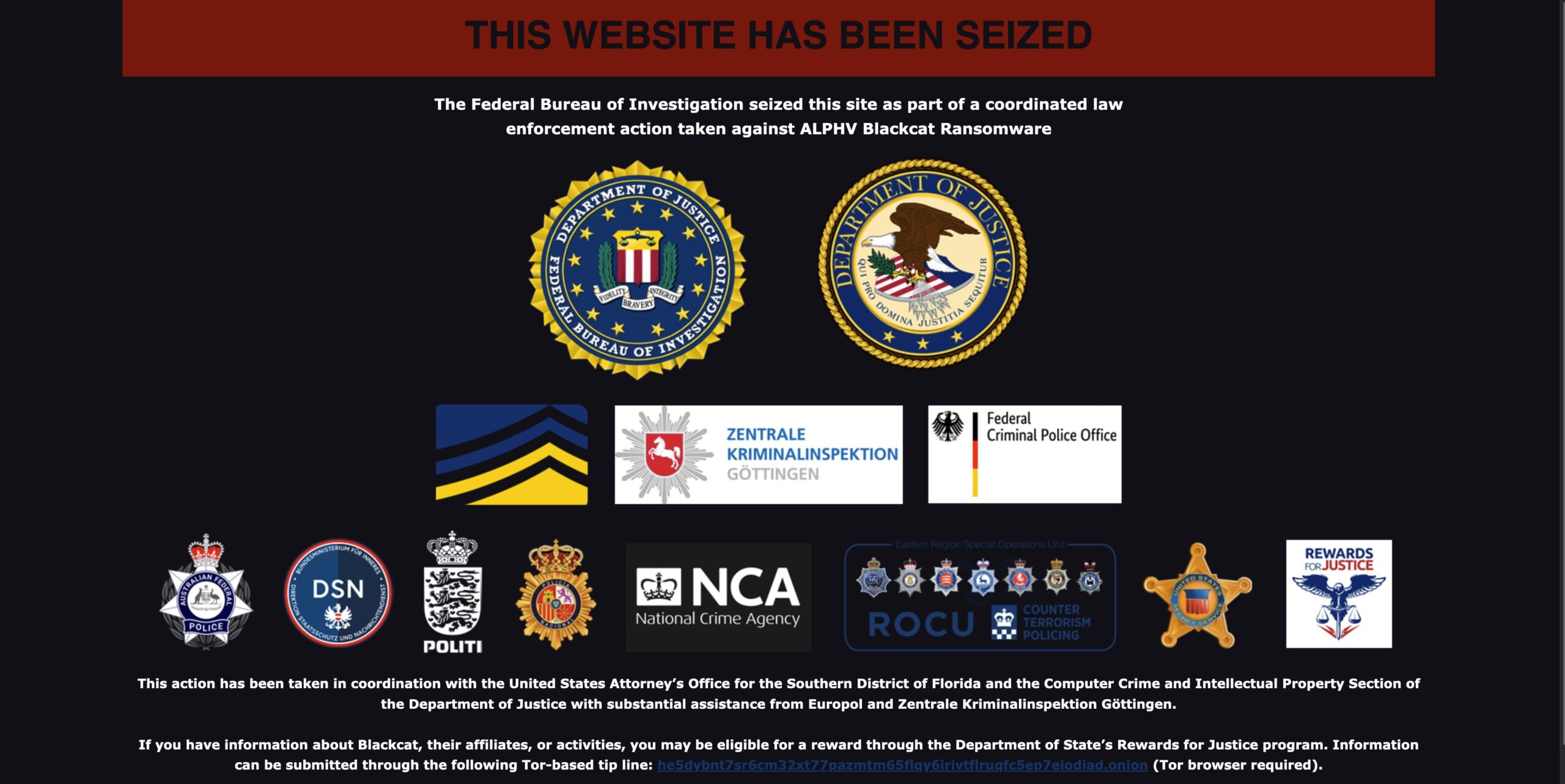
Early Tuesday morning, the dark-web site belonging to AlphV, a ransomware group that also goes by the name BlackCat, suddenly started displaying a banner that said it had been seized by the FBI as part of a coordinated law enforcement action. Gone was all the content AlphV had posted to the site previously.

Around the same time, the Justice Department said it had disrupted AlphV’s operations by releasing a software tool that would allow roughly 500 AlphV victims to restore their systems and data. In all, Justice Department officials said, AlphV had extorted roughly $300 million from 1,000 victims.

An affidavit unsealed in a Florida federal court, meanwhile, revealed that the disruption involved FBI agents obtaining 946 private keys used to host victim communication sites. The legal document said the keys were obtained with the help of a confidential human source who had “responded to an advertisement posted to a publicly accessible online forum soliciting applicants for Blackcat affiliate positions.”

“In disrupting the BlackCat ransomware group, the Justice Department has once again hacked the hackers,” Deputy Attorney General Lisa O. Monaco said in Tuesday’s announcement. “With a decryption tool provided by the FBI to hundreds of ransomware victims worldwide, businesses and schools were able to reopen, and health care and emergency services were able to come back online. We will continue to prioritize disruptions and place victims at the center of our strategy to dismantle the ecosystem fueling cybercrime.”

Within hours, the FBI seizure notice displayed on the AlphV dark-web site was gone. In its place was a new notice proclaiming: “This website has been unseized.” The new notice, written by AlphV officials, downplayed the significance of the FBI’s action. While not disputing the decryptor tool worked for 400 victims, AlphV officials said that the disruption would prevent data belonging to another 3,000 victims from being decrypted.

“Now because of them, more than 3,000 companies will never receive their keys.”

As the hours went on, the FBI and AlphV sparred over control of the dark-web site, with each replacing the notices of the other.

One researcher described the ongoing struggle as a “tug of Tor,” a reference to Tor, the network of servers that allows people to browse and publish websites anonymously. Like most ransomware groups, AlphV hosts its sites over Tor. Not only does this arrangement prevent law enforcement investigators from identifying group members, it also hampers investigators from obtaining court orders compelling the web host to turn over control of the site.

The only way to control a Tor address is with possession of a dedicated private encryption key. Once the FBI obtained it, investigators were able to publish Tuesday’s seizure notice to it. Since AlphV also maintained possession of the key, group members were similarly free to post their own content. Since Tor makes it impossible to change the private key corresponding to an address, neither side has been able to lock the other out.

With each side essentially deadlocked, AlphV has resorted to removing some of the restrictions it previously placed on affiliates. Under the common ransomware-as-a-service model, affiliates are the ones who actually hack victims. When successful, the affiliates use the AlphV ransomware and infrastructure to encrypt data and then negotiate and facilitate a payment by bitcoin or another cryptocurrency.

Up to now, AlphV placed rules on affiliates forbidding them from targeting hospitals and critical infrastructure. Now, those rules no longer apply unless the victim is located in the Commonwealth of Independent States—a list of countries that were once part of the former Soviet Union.

“Because of their actions, we are introducing new rules, or rather, we are removing ALL rules except one, you cannot touch the CIS, you can now block hospitals, nuclear power plants, anything, anywhere,” the AlphV notice said. The notice said that AlphV was also allowing affiliates to retain 90 percent of any ransom payments they get, and that ‘VIP’ affiliates would receive a private program on separate isolated data centers. The move is likely an attempt to stanch the possible defection by affiliates spooked by the FBI’s access to the AlphV infrastructure.

The back and forth has prompted some to say that the disruption failed, since AlphV retains control of its site and continues to possess the data it stole from victims. In a discussion on social media with one such critic, ransomware expert Allan Liska pushed back.

“The server and all of its data is still in possession of FBI—and ALPHV ain’t getting none of that back,” Liska, a threat researcher at security firm Recorded Future, wrote.

Social media post by Liska arguing the FBI maintains access to AlphV infrastructure.

Enlarge / Social media post by Liska arguing the FBI maintains access to AlphV infrastructure.

“But, hey you are correct and I am 100% wrong. I encourage you, and all ransomware groups to sign up to be an ALPHV affiliate now, it is definitely safe. Do it, Chicken!”

AlphV ransomware site is “seized” by the FBI. Then it’s “unseized.” And so on. Read More »