Science

animals-use-physics?-let-us-count-the-ways

Animals use physics? Let us count the ways
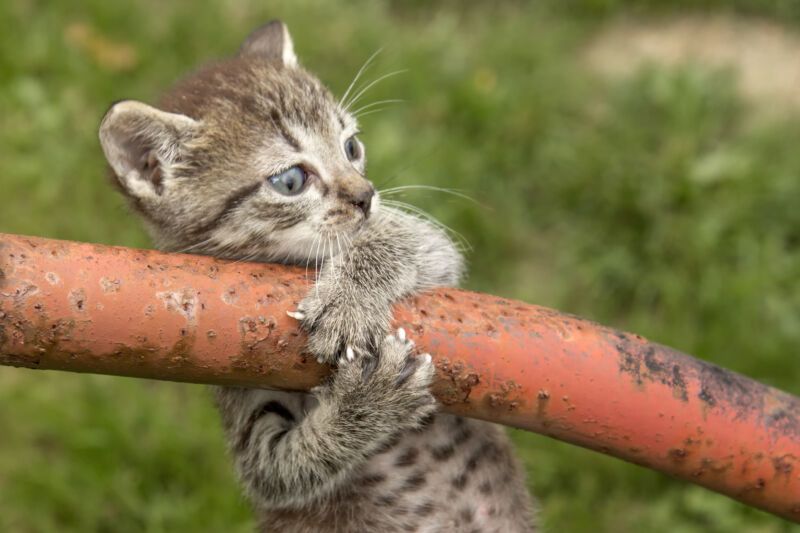
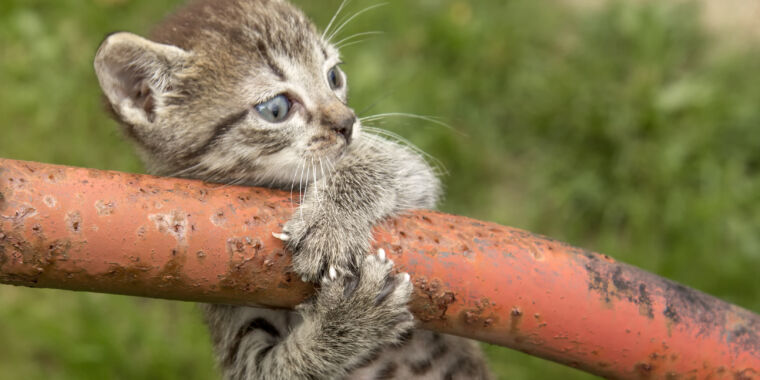
kitten latches on to a pole with its two front paws

Isaac Newton would never have discovered the laws of motion had he studied only cats.

Suppose you hold a cat, stomach up, and drop it from a second-story window. If a cat is simply a mechanical system that obeys Newton’s rules of matter in motion, it should land on its back. (OK, there are some technicalities—like this should be done in a vacuum, but ignore that for now.) Instead, most cats usually avoid injury by twisting themselves on the way down to land on their feet.

Most people are not mystified by this trick—everybody has seen videos attesting to cats’ acrobatic prowess. But for more than a century, scientists have wondered about the physics of how cats do it. Clearly, the mathematical theorem analyzing the falling cat as a mechanical system fails for live cats, as Nobel laureate Frank Wilczek points out in a recent paper.

“This theorem is not relevant to real biological cats,” writes Wilczek, a theoretical physicist at MIT. They are not closed mechanical systems, and can “consume stored energy … empowering mechanical motion.”

Nevertheless, the laws of physics do apply to cats—as well as every other kind of animal, from insects to elephants. Biology does not avoid physics; it embraces it. From friction on microscopic scales to fluid dynamics in water and air, animals exploit physical laws to run or swim or fly. Every other aspect of animal behavior, from breathing to building shelters, depends in some way on the restrictions imposed, and opportunities permitted, by physics.

“Living organisms are … systems whose actions are constrained by physics across multiple length scales and timescales,” Jennifer Rieser and coauthors write in the current issue of the Annual Review of Condensed Matter Physics.

While the field of animal behavior physics is still in its infancy, substantial progress has been made in explaining individual behaviors, along with how those behaviors are shaped via interactions with other individuals and the environment. Apart from discovering more about how animals perform their diverse repertoire of skills, such research may also lead to new physics knowledge gained by scrutinizing animal abilities that scientists don’t yet understand.

Critters in motion

Physics applies to animals in action over a wide range of spatial scales. At the smallest end of the range, attractive forces between nearby atoms facilitate the ability of geckos and some insects to climb up walls or even walk on ceilings. On a slightly larger scale, textures and structures provide adhesion for other biological gymnastics. In bird feathers, for instance, tiny hooks and barbs act like Velcro, holding feathers in position to enhance lift when flying, Rieser and colleagues report.

Biological textures also aid movement by facilitating friction between animal parts and surfaces. Scales on California king snakes possess textures that allow rapid forward sliding, but increase friction to retard backward or sideways motion. Some sidewinding snakes have apparently evolved different textures that reduce friction in the direction of motion, recent research suggests.

Small-scale structures are also important for animals’ interaction with water. For many animals, microstructures make the body “superhydrophobic”—capable of blocking the penetration of water. “In wet climates, water droplet shedding can be essential in animals, like flying birds and insects, where weight and stability are crucially important,” note Rieser, of Emory University, and coauthors Chantal Nguyen, Orit Peleg and Calvin Riiska.

Water-blocking surfaces also help animals keep their skins clean. “This self-cleansing mechanism … can be important to help protect the animal from dangers like skin-borne parasites and other infections,” the Annual Review authors explain. And in some cases, removing foreign material from an animal’s surface may be necessary to preserve the surface properties that enhance camouflage.

Animals use physics? Let us count the ways Read More »
in-the-south,-sea-level-rise-accelerates-at-some-of-the-most-extreme-rates-on-earth

In the South, sea level rise accelerates at some of the most extreme rates on Earth

migrating inland —

The surge is startling scientists, amplifying impacts such as hurricane storm surges.

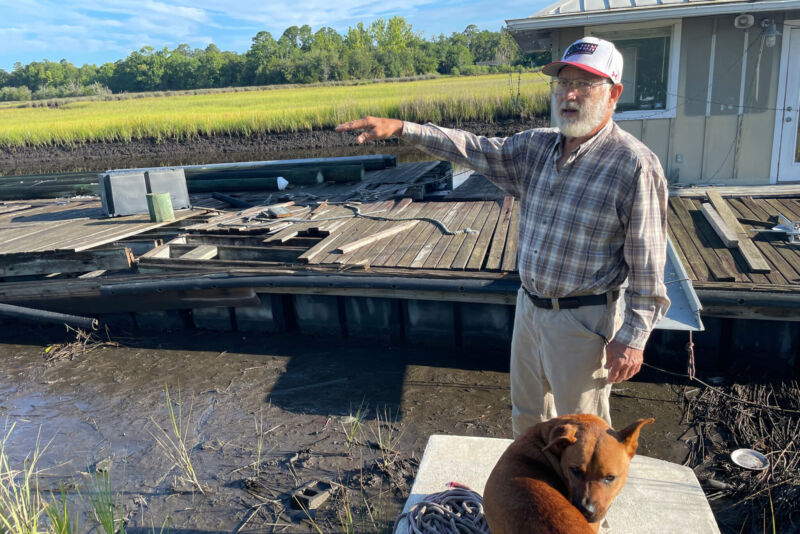
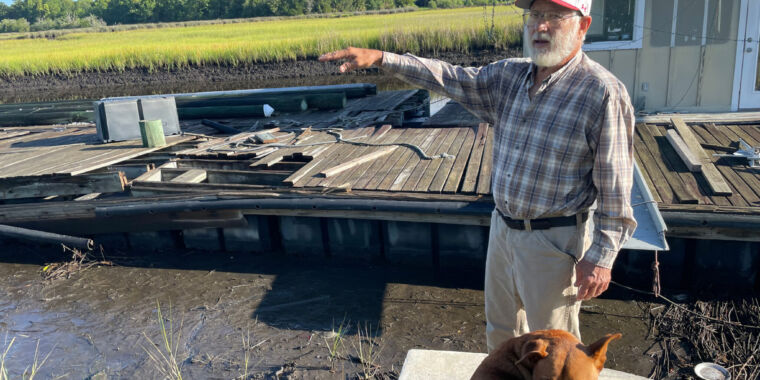
Older man points to the rising tide while standing on a dock.

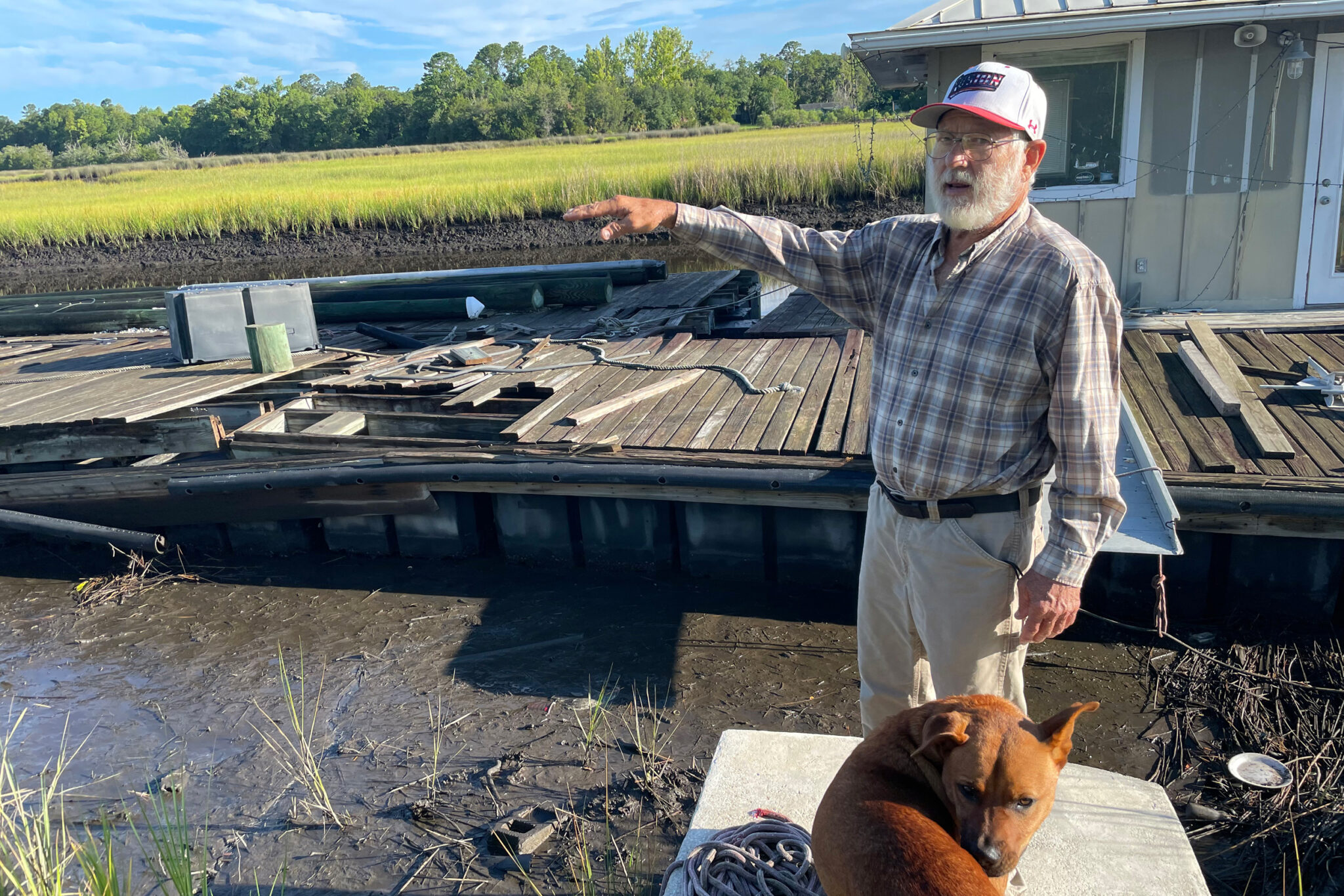
Enlarge / Steve Salem is a 50-year boat captain who lives on a tributary of the St. Johns River. The rising tides in Jacksonville are testing his intuition.

This article originally appeared on Inside Climate News, a nonprofit, independent news organization that covers climate, energy, and the environment. It is republished with permission. Sign up for their newsletter here

JACKSONVILLE, Fla.—For most of his life, Steve Salem has led an existence closely linked with the rise and fall of the tides.

Salem is a 50-year boat captain who designed and built his 65-foot vessel by hand.

“Me and Noah, we’re related somewhere,” said Salem, 75, whose silver beard evokes Ernest Hemingway.

Salem is familiar with how the sun and moon influence the tides and feels an innate sense for their ebb and flow, although the tides here are beginning to test even his intuition.

He and his wife live in a rust-colored ranch-style house along a tributary of the St. Johns River, Florida’s longest. Before they moved in the house had flooded, in 2017, as Hurricane Irma swirled by. The house flooded again in 2022, when Hurricane Nicole defied his expectations. But Salem believes the house is sturdy and that he can manage the tides, as he always has.

“I’m a water dog to begin with. I’ve always been on the water,” said Salem, who prefers to go by Captain Steve. “I worry about things that I have to do something about. If I can’t do anything about it, then worrying about it is going to do what?”

Across the American South, tides are rising at accelerating rates that are among the most extreme on Earth, constituting a surge that has startled scientists such as Jeff Chanton, professor in the Department of Earth, Ocean and Atmospheric Science at Florida State University.

“It’s pretty shocking,” he said. “You would think it would increase gradually, it would be a gradual thing. But this is like a major shift.”

Worldwide sea levels have climbed since 1900 by some 1.5 millimeters a year, a pace that is unprecedented in at least 3,000 years and generally attributable to melting ice sheets and glaciers and also the expansion of the oceans as their temperatures warm. Since the middle of the 20th century the rate has gained speed, exceeding 3 millimeters a year since 1992.

In the South the pace has quickened further, jumping from about 1.7 millimeters a year at the turn of the 20th century to at least 8.4 millimeters by 2021, according to a 2023 study published in Nature Communications based on tidal gauge records from throughout the region. In Pensacola, a beachy community on the western side of the Florida Panhandle, the rate soared to roughly 11 millimeters a year by the end of 2021.

“I think people just really have no idea what is coming, because we have no way of visualizing that through our own personal experiences, or that of the last 250 years,” said Randall Parkinson, a coastal geologist at Florida International University. “It’s not something where you go, ‘I know what that might look like because I’ve seen that.’ Because we haven’t.

“It’s the same everywhere, from North Carolina all the way down to the Florida Keys and all the way up into Alabama,” he said. “All of these areas are extremely vulnerable.”

The acceleration is poised to amplify impacts such as hurricane storm surges, nuisance flooding and land loss. In recent years the rising tides have coincided with record-breaking hurricane seasons, pushing storm surges higher and farther inland. In 2022 Hurricane Ian, which came ashore in southwest Florida, was the costliest hurricane in state history and third-costliest to date in the United States, after Katrina in 2005 and Harvey in 2017.

“It doesn’t even take a major storm event anymore. You just get these compounding effects,” said Rachel Cleetus, a policy director at the Union for Concerned Scientists, an advocacy group. “All of a sudden you have a much more impactful flooding event, and a lot of the infrastructure, frankly, like the stormwater infrastructure, it’s just not built for this.”

In the South, sea level rise accelerates at some of the most extreme rates on Earth Read More »

nato-allies-pledge-$1-billion-to-promote-sharing-of-space-based-intel

NATO allies pledge $1 billion to promote sharing of space-based intel

Breaking barriers —

Agreement marks the largest investment in space-based capabilities in NATO’s history.

Heads of state pose for a group photo at an event Tuesday celebrating the 75th anniversary of NATO.

Enlarge / Heads of state pose for a group photo at an event Tuesday celebrating the 75th anniversary of NATO.

During their summit in Washington, DC, this week, NATO member states committed more than $1 billion to improve the sharing of intelligence from national and commercial reconnaissance satellites.

The agreement is a further step toward integrating space assets into NATO military commands. It follows the bloc’s adoption of an official space policy in 2019, which recognized space as a fifth war-fighting domain alongside air, land, maritime, and cyberspace. The next step was the formation of the NATO Space Operations Center in 2020 to oversee space support for NATO military operations.

On June 25, NATO announced the establishment of a “space branch” in its Allied Command Transformation, which identifies trends and incorporates emerging capabilities into the alliance’s security strategy.

Breaking down barriers

The new intelligence-sharing agreement was signed on July 9 by representatives from 17 NATO nations, including the United States, to support the Alliance Persistent Surveillance from Space (APSS) program. In a statement, NATO called the agreement “the largest multinational investment in space-based capabilities in NATO’s history.”

The agreement for open sharing of intelligence data comes against the backdrop of NATO’s response to the Russian invasion of Ukraine. Space-based capabilities, including battlefield surveillance and communications, have proven crucial to both sides in the war.

“The ongoing war in Ukraine has further underscored intelligence’s growing dependence on space-based data and assets,” NATO said.

The program will improve NATO’s ability to monitor activities on the ground and at sea with unprecedented accuracy and timeliness, the alliance said in a statement. The 17 parties to the agreement pledged more than $1 billion transition the program into an implementation phase over the next five years. Six of the 17 signatories currently operate or plan to launch their own national reconnaissance satellites, while several more nations are home to companies operating commercial space-based surveillance satellites.

The APSS program won’t involve the development and launch of any NATO spy satellites. Instead, each nation will make efforts to share observations from their own government and commercial satellites.

Luxembourg, one of the smallest NATO member states, set up the APSS program with an initial investment of roughly $18 million (16.5 million euros) in 2023. At the time, NATO called the program a “data-centric initiative” aimed at bringing together intelligence information for easier dissemination among allies and breaking down barriers of secrecy and bureaucracy.

“APSS is not about creating NATO-owned and operated space assets,” officials wrote in the program’s fact sheet. “It will make use of existing and future space assets in allied countries, and connect them together in a NATO virtual constellation called ‘Aquila.'”

Another element of the program involves processing and sharing intelligence information through cloud solutions and technologies. NATO said AI analytical tools will also better manage growing amounts of surveillance data from space, and ensure decision-makers get faster access to time-sensitive observations.

“The APSS initiative may be regarded as a game changer for NATO’s intelligence, surveillance and reconnaissance. It will largely contribute to build NATO’s readiness and reduce its dependency on other intelligence and surveillance capabilities,” said Ludwig Decamps, general manager of the NATO Communications and Information Agency.

NATO allies pledge $1 billion to promote sharing of space-based intel Read More »

500-million-year-old-fossil-is-the-earliest-branch-of-the-spider’s-lineage

500 million-year-old fossil is the earliest branch of the spider’s lineage

Creepy, but no longer crawly —

A local fossil collector in Morocco found the specimen decades ago.

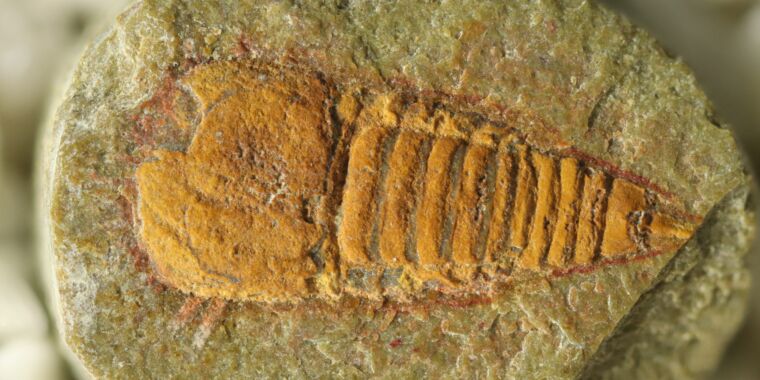
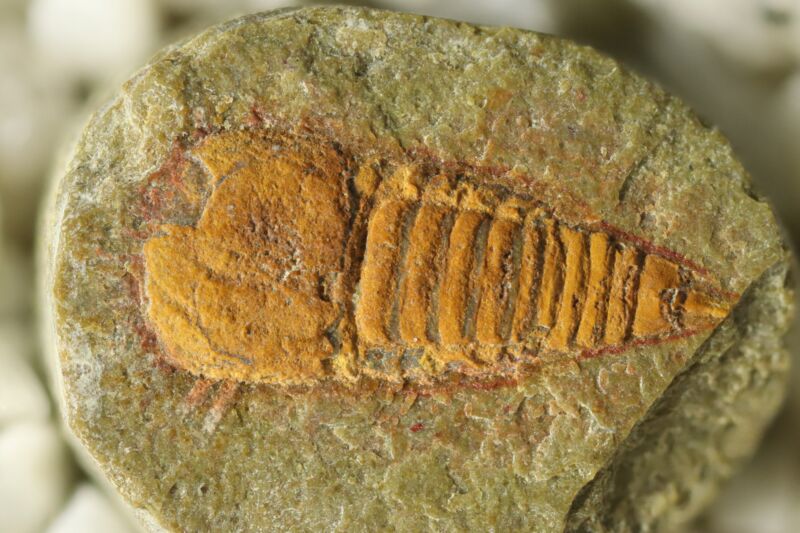
Image of a brown fossil with a large head and many body segments, embedded in a grey-green rock.

In the early 2000s, local fossil collector Mohamed ‘Ou Said’ Ben Moula discovered numerous fossils at Fezouata Shale, a site in Morocco known for its well-preserved fossils from the Early Ordovician period, roughly 480 million years ago. Recently, a team of researchers at the University of Lausanne (UNIL) studied 100 of these fossils and identified one of them as the earliest ancestor of modern-day chelicerates, a group that includes spiders, scorpions, and horseshoe crabs.

The fossil preserves the species Setapedites abundantis, a tiny animal that crawled and swam near the bottom of a 100–200-meter-deep ocean near the South Pole 478 million years ago. It was 5 to 10 millimeters long and fed on organic matter in the seafloor sediments. “Fossils of what is now known as S. abundantis have been found early on—one specimen mentioned in the 2010 paper that recognized the importance of this biota. However, this creature wasn’t studied in detail before simply because scientists focused on other taxa first,” Pierre Gueriau, one of the researchers and a junior lecturer at UNIL, told Ars Technica.

The study from Gueriau and his team is the first to describe S. abundantis and its connection to modern-day chelicerates (also called euchelicerates). It holds great significance, because “the origin of chelicerates has been one of the most tangled knots in the arthropod tree of life, as there has been a lack of fossils between 503 to 430 million years ago,” Gueriau added.

An ancestor of spiders

The study authors used X-ray scanners to reconstruct the anatomy of 100 fossils from the Fezouata Shale in 3D. When they compared the anatomical features of these ancient animals with those of chelicerates, they noticed several similarities between S. abundantis and various ancient and modern-day arthropods, including horseshoe crabs, scorpions, and spiders.

For instance, the nature and arrangement of the head appendages or ‘legs’ in S. abundantis were homologous with those of present-day horseshoe crabs and Cambrian arthropods that existed between 540 to 480 million years ago. Moreover, like spiders and scorpions, the organism exhibited body tagmosis, where the body is organized into different functional sections.

Setapedites abundantis contributes to our understandings of the origin and early evolution of two key euchelicerate characters: the transition from biramous to uniramous prosomal appendages, and body tagmosis,” the study authors note.

Currently, two Cambrian-era arthropods, Mollisonia plenovenatrix and Habelia optata are generally considered the earliest ancestors of chelicerates (not all scientists accept this idea). Both lived around 500 million years ago. When we asked how these two differ from S. abundantis, Gueriau replied, “Habelia and Mollisonia represent at best early-branching lineages in the phylogenetic tree. While S. abundantis is found to represent, together with a couple of other fossils, the earliest branching lineage within chelicerates.”

This means Habelia and Mollisonia are relatives of the ancestors of modern-day chelicerates. On the other side, S. abundantis represents the first group that split after the chelicerate clade was established, making it the earliest member of the lineage. “These findings bring us closer to untangling the origin story of arthropods, as they allow us to fill the anatomical gap between Cambrian arthropods and early-branching chelicerates,” Gueriau told Ars Technica.

S. abundantis connects other fossils

The researchers faced many challenges during their study. For instance, the small size of the fossils made observations and interpretation complicated. They overcame this limitation by examining a large number of specimens—fortunately, S. abundantis fossils were abundant in the samples they studied. However, these fossils have yet to reveal all their secrets.

“Some of S. abundantis’ anatomical features allow for a deeper understanding of the early evolution of the chelicerate group and may even link other fossil forms, whose relationships are still highly debated, to this group,” Gueriau said. For instance, the study authors noticed a ventral protrusion at the rear of the organism. Such a feature is observed for the first time in chelicerates but is known in other primitive arthropods.

“This trait could thus bring together many other fossils with chelicerates and further resolve the early branches of the arthropod tree. So the next step for this research is to investigate deeper this feature on a wide range of fossils and its phylogenetic implications,” Gueriau added.

Nature Communications, 2023. DOI: 10.1038/s41467-024-48013-w  (About DOIs)

Rupendra Brahambhatt is an experienced journalist and filmmaker. He covers science and culture news, and for the last five years, he has been actively working with some of the most innovative news agencies, magazines, and media brands operating in different parts of the globe.

500 million-year-old fossil is the earliest branch of the spider’s lineage Read More »

peer-review-is-essential-for-science-unfortunately,-it’s-broken.

Peer review is essential for science. Unfortunately, it’s broken.

Peer review is essential for science. Unfortunately, it’s broken.

Aurich Lawson | Getty Images

Rescuing Science: Restoring Trust in an Age of Doubt was the most difficult book I’ve ever written. I’m a cosmologist—I study the origins, structure, and evolution of the Universe. I love science. I live and breathe science. If science were a breakfast cereal, I’d eat it every morning. And at the height of the COVID-19 pandemic, I watched in alarm as public trust in science disintegrated.

But I don’t know how to change people’s minds. I don’t know how to convince someone to trust science again. So as I started writing my book, I flipped the question around: is there anything we can do to make the institution of science more worthy of trust?

The short answer is yes. The long answer takes an entire book. In the book, I explore several different sources of mistrust—the disincentives scientists face when they try to communicate with the public, the lack of long-term careers, the complicitness of scientists when their work is politicized, and much more—and offer proactive steps we can take to address these issues to rebuild trust.

The section below is taken from a chapter discussing the relentless pressure to publish that scientists face, and the corresponding explosion in fraud that this pressure creates. Fraud can take many forms, from the “hard fraud” of outright fabrication of data, to many kinds of “soft fraud” that include plagiarism, manipulation of data, and careful selection of methods to achieve a desired result. The more that fraud thrives, the more that the public loses trust in science. Addressing this requires a fundamental shift in the incentive and reward structures that scientists work in. A difficult task to be sure, but not an impossible one—and one that I firmly believe will be worth the effort.

Modern science is hard, complex, and built from many layers and many years of hard work. And modern science, almost everywhere, is based on computation. Save for a few (and I mean very few) die-hard theorists who insist on writing things down with pen and paper, there is almost an absolute guarantee that with any paper in any field of science that you could possibly read, a computer was involved in some step of the process.

Whether it’s studying bird droppings or the collisions of galaxies, modern-day science owes its very existence—and continued persistence—to the computer. From the laptop sitting on an unkempt desk to a giant machine that fills up a room, “S. Transistor” should be the coauthor on basically all three million journal articles published every year.

The sheer complexity of modern science, and its reliance on customized software, renders one of the frontline defenses against soft and hard fraud useless. That defense is peer review.

The practice of peer review was developed in a different era, when the arguments and analysis that led to a paper’s conclusion could be succinctly summarized within the paper itself. Want to know how the author arrived at that conclusion? The derivation would be right there. It was relatively easy to judge the “wrongness” of an article because you could follow the document from beginning to end, from start to finish, and have all the information you needed to evaluate it right there at your fingerprints.

That’s now largely impossible with the modern scientific enterprise so reliant on computers.

To makes matters worse, many of the software codes used in science are not publicly available. I’ll say this again because it’s kind of wild to even contemplate: there are millions of papers published every year that rely on computer software to make the results happen, and that software is not available for other scientists to scrutinize to see if it’s legit or not. We simply have to trust it, but the word “trust” is very near the bottom of the scientist’s priority list.

Why don’t scientists make their code available? It boils down to the same reason that scientists don’t do many things that would improve the process of science: there’s no incentive. In this case, you don’t get any h-index points for releasing your code on a website. You only get them for publishing papers.

This infinitely agitates me when I peer-review papers. How am I supposed to judge the correctness of an article if I can’t see the entire process? What’s the point of searching for fraud when the computer code that’s sitting behind the published result can be shaped and molded to give any result you want, and nobody will be the wiser?

I’m not even talking about intentional computer-based fraud here; this is even a problem for detecting basic mistakes. If you make a mistake in a paper, a referee or an editor can spot it. And science is better off for it. If you make a mistake in your code… who checks it? As long as the results look correct, you’ll go ahead and publish it and the peer reviewer will go ahead and accept it. And science is worse off for it.

Science is getting more complex over time and is becoming increasingly reliant on software code to keep the engine going. This makes fraud of both the hard and soft varieties easier to accomplish. From mistakes that you pass over because you’re going too fast, to using sophisticated tools that you barely understand but use to get the result that you wanted, to just totally faking it, science is becoming increasingly wrong.

Peer review is essential for science. Unfortunately, it’s broken. Read More »

rocket-report:-chinese-firm-suffers-another-failure;-ariane-6-soars-in-debut

Rocket Report: Chinese firm suffers another failure; Ariane 6 soars in debut

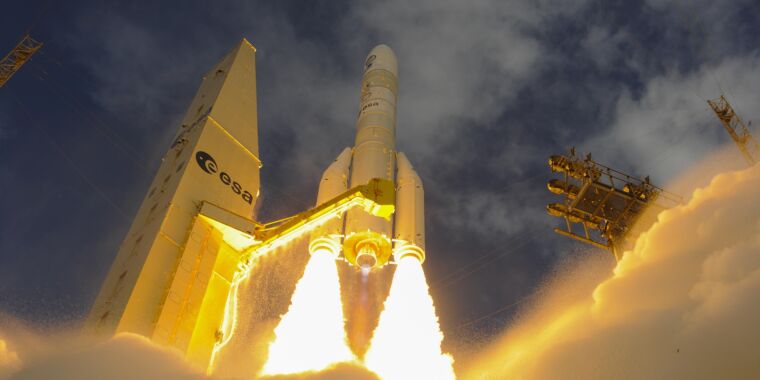
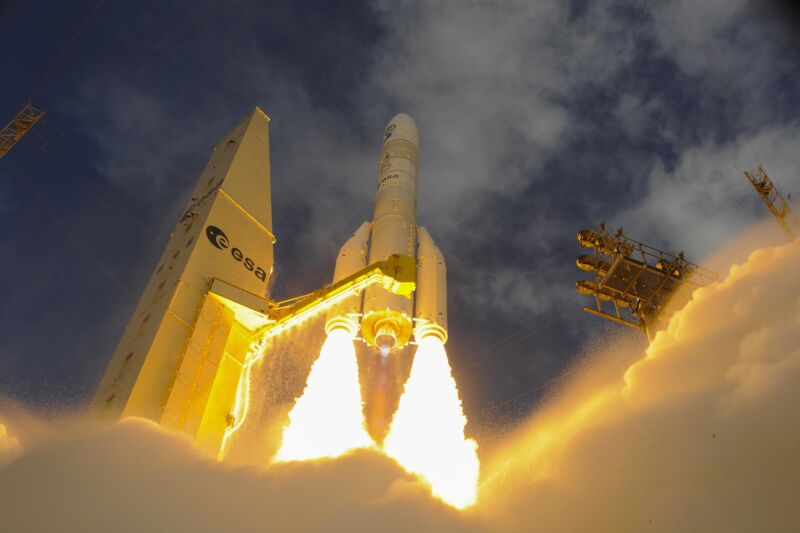
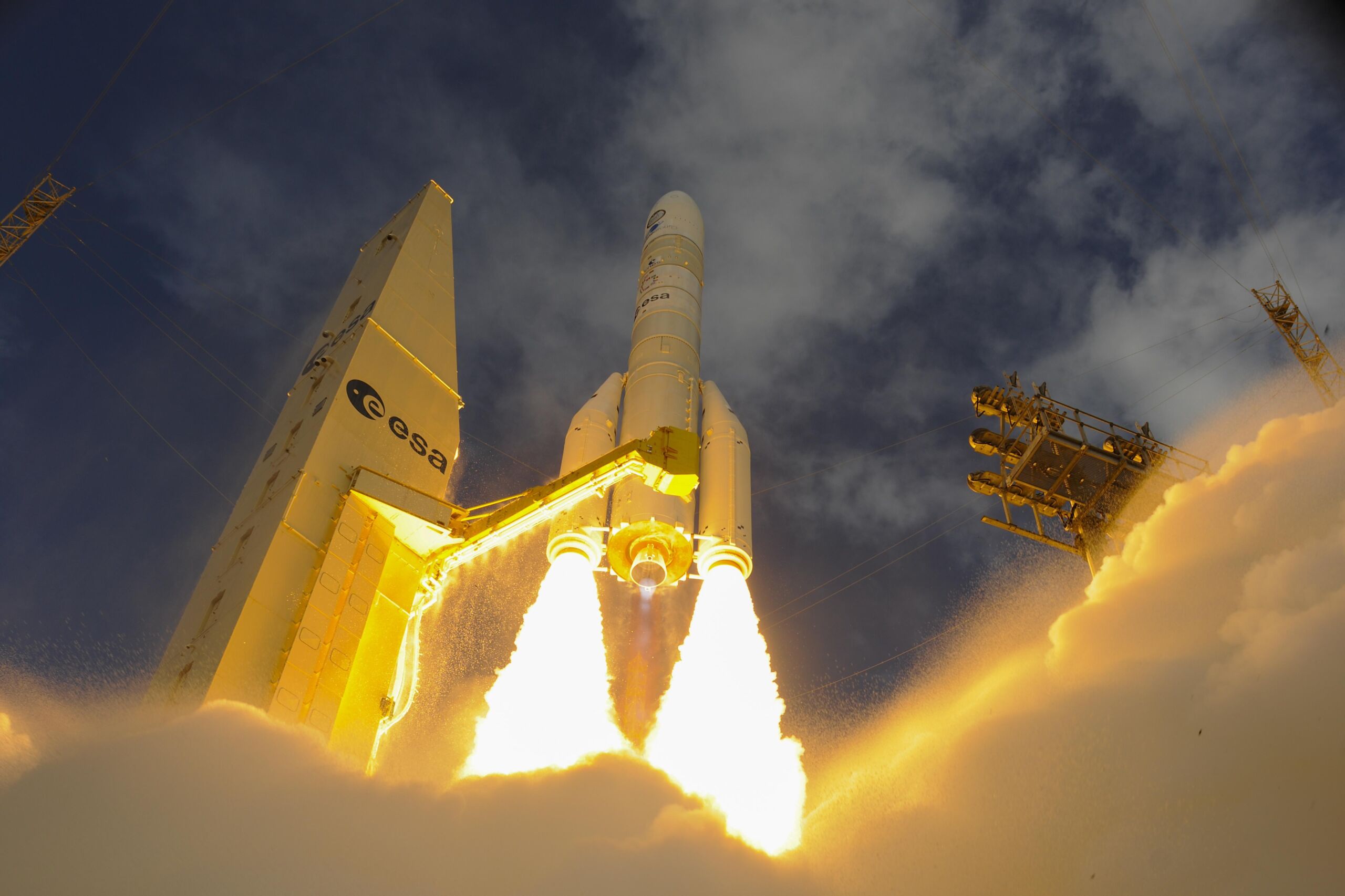
The Ariane 6 rocket takes flight for the first time on July 9, 2024.

Enlarge / The Ariane 6 rocket takes flight for the first time on July 9, 2024.

ESA – S. Corvaja

Welcome to Edition 7.02 of the Rocket Report! The highlight of this week was the hugely successful debut of Europe’s Ariane 6 rocket. They will address the upper stage issue, I am sure. Given Europe’s commitment to zero debris, stranding the second stage is not great. But for a debut launch of a large new vehicle, this was really promising.

As always, we welcome reader submissions, and if you don’t want to miss an issue, please subscribe using the box below (the form will not appear on AMP-enabled versions of the site). Each report will include information on small-, medium-, and heavy-lift rockets as well as a quick look ahead at the next three launches on the calendar.

Chinese launch company suffers another setback. Chinese commercial rocket firm iSpace suffered a launch failure late Wednesday in a fresh setback for the company, Space News reports. The four-stage Hyperbola-1 solid rocket lifted off from Jiuquan spaceport in the Gobi Desert at 7: 40 pm ET (23: 40 UTC) on Wednesday. Beijing-based iSpace later issued a release stating that the rocket’s fourth stage suffered an anomaly. The statement did not reveal the name nor nature of the payloads lost on the flight.

Early troubles are perhaps to be expected … Beijing Interstellar Glory Space Technology Ltd., or iSpace, made history in 2019 as the first privately funded Chinese company to reach orbit, with the solid-fueled Hyperbola-1. However the rocket suffered three consecutive failures following that feat. The company recovered with two successful flights in 2023 before the latest failure. The loss could add to reliability concerns over China’s commercial launch industry as it follows Space Pioneer’s recent catastrophic static-fire explosion. (submitted by EllPeaTea)

Feds backtrack on former Firefly investor. A long, messy affair between US regulators and a Ukrainian businessman named Max Polyakov seems to have finally been resolved, Ars reports. On Tuesday, Polyakov’s venture capital firm Noosphere Venture Partners announced that the US government has released him and his related companies from all conditions imposed upon them in the run-up to the Russian invasion of Ukraine. This decision comes more than two years after the Committee on Foreign Investment in the United States and the US Air Force forced Polyakov to sell his majority stake in the Texas-based launch company Firefly.

Not a spy … This rocket company was founded in 2014 by an engineer named Tom Markusic, who ran into financial difficulty as he sought to develop the Alpha rocket. Markusic had to briefly halt Firefly’s operations before Polyakov, a colorful and controversial Ukrainian businessman, swooped in and provided a substantial infusion of cash into the company. “The US government quite happily allowed Polyakov to pump $200 million into Firefly only to decide he was a potential spy just as the company’s first rocket was ready to launch,” Ashlee Vance, a US journalist who chronicled Polyakov’s rise, told Ars. It turns out, Polyakov wasn’t a spy.

The easiest way to keep up with Eric Berger’s space reporting is to sign up for his newsletter, we’ll collect his stories in your inbox.

Pentagon ICBM costs soar. The price tag for the Pentagon’s next-generation nuclear-tipped Sentinel ICBMs has ballooned by 81 percent in less than four years, The Register reports. This triggered a mandatory congressional review. On Monday, the Department of Defense released the results of this review, with Under-secretary of Defense for Acquisition and Sustainment William LaPlante saying the Sentinel missile program met established criteria for being allowed to continue after his “comprehensive, unbiased review of the program.”

Trust us, the military says … The Sentinel project is the DoD’s attempt to replace its aging fleet of ground-based nuclear-armed Minuteman III missiles (first deployed in 1970) with new hardware. When it passed its Milestone B decision (authorization to enter the engineering and manufacturing phase) in September 2020, the cost was a fraction of the $141 billion the Pentagon now estimates Sentinel will cost, LaPlante said. To give that some perspective, the proposed annual budget for the Department of Defense for its fiscal 2025 is nearly $850 billion. (submitted by EllPeaTea)

Rocket Report: Chinese firm suffers another failure; Ariane 6 soars in debut Read More »

spacex’s-unmatched-streak-of-perfection-with-the-falcon-9-rocket-is-over

SpaceX’s unmatched streak of perfection with the Falcon 9 rocket is over

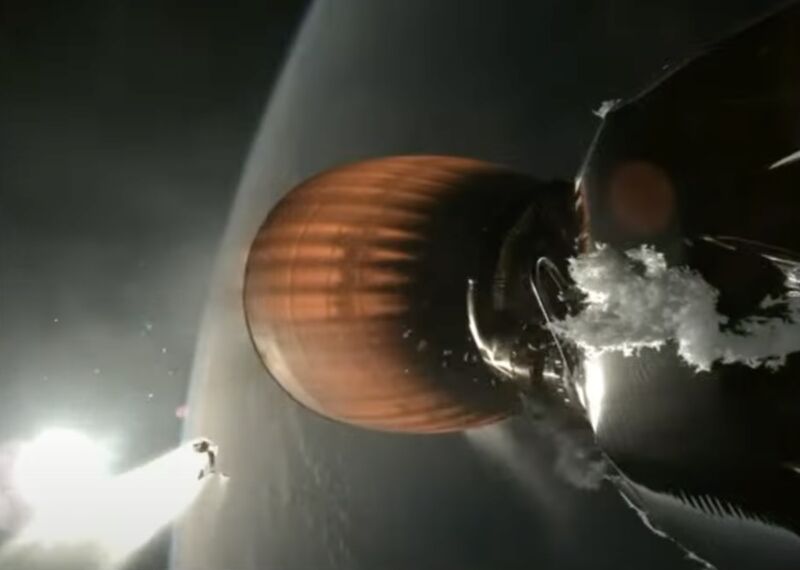
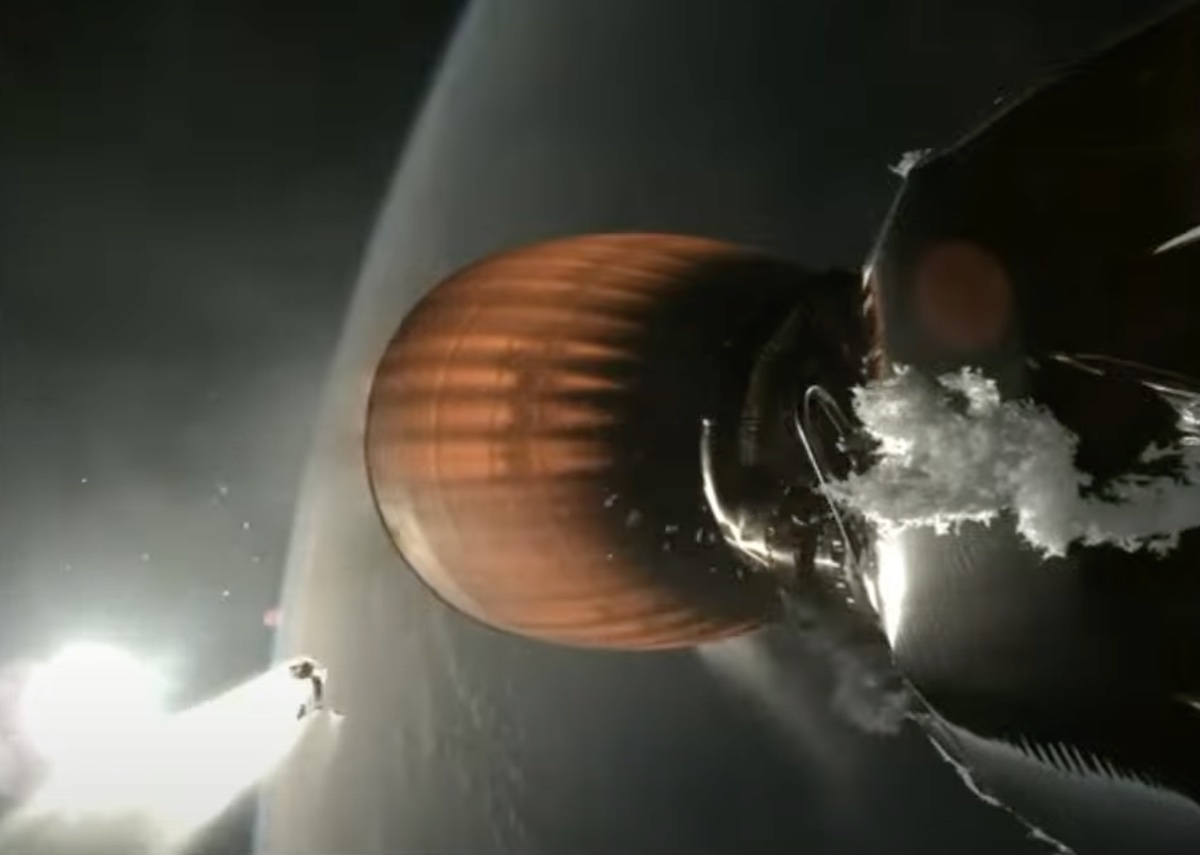
Numerous pieces of ice fell off the second stage of the Falcon 9 rocket during its climb into orbit from Vandenberg Space Force Base, California.

Enlarge / Numerous pieces of ice fell off the second stage of the Falcon 9 rocket during its climb into orbit from Vandenberg Space Force Base, California.

SpaceX

A SpaceX Falcon 9 rocket suffered an upper stage engine failure and deployed a batch of Starlink Internet satellites into a perilously low orbit after launch from California Thursday night, the first blemish on the workhorse launcher’s record in more than 300 missions since 2016.

Elon Musk, SpaceX’s founder and CEO, posted on X that the rocket’s upper stage engine failed when it attempted to reignite nearly an hour after the Falcon 9 lifted off from Vandenberg Space Force Base, California, at 7: 35 pm PDT (02: 35 UTC).

Frosty evidence

After departing Vandenberg to begin SpaceX’s Starlink 9-3 mission, the rocket’s reusable first stage booster propelled the Starlink satellites into the upper atmosphere, then returned to Earth for an on-target landing on a recovery ship parked in the Pacific Ocean. A single Merlin Vacuum engine on the rocket’s second stage fired for about six minutes to reach a preliminary orbit.

A few minutes after liftoff of SpaceX’s Starlink 9-3 mission, veteran observers of SpaceX launches noticed an unusual build-up of ice around the top of the Merlin Vacuum engine, which consumes a propellant mixture of super-chilled kerosene and cryogenic liquid oxygen. The liquid oxygen is stored at a temperature of several hundred degrees below zero.

Numerous chunks of ice fell away from the rocket as the upper stage engine powered into orbit, but the Merlin Vacuum, or M-Vac, engine appeared to complete its first burn as planned. A leak in the oxidizer system or a problem with insulation could lead to ice accumulation, although the exact cause, and its possible link to the engine malfunction later in flight, will be the focus of SpaceX’s investigation into the failure.

A second burn with the upper stage engine was supposed to raise the perigee, or low point, of the rocket’s orbit well above the atmosphere before releasing 20 Starlink satellites to continue climbing to their operational altitude with their own propulsion.

“Upper stage restart to raise perigee resulted in an engine RUD for reasons currently unknown,” Musk wrote in an update two hours after the launch. RUD (rapid unscheduled disassembly) is a term of art in rocketry that usually signifies a catastrophic or explosive failure.

“Team is reviewing data tonight to understand root cause,” Musk continued. “Starlink satellites were deployed, but the perigee may be too low for them to raise orbit. Will know more in a few hours.”

Telemetry from the Falcon 9 rocket indicated it released the Starlink satellites into an orbit with a perigee just 86 miles (138 kilometers) above Earth, roughly 100 miles (150 kilometers) lower than expected, according to Jonathan McDowell, an astrophysicist and trusted tracker of spaceflight activity. Detailed orbital data from the US Space Force was not immediately available.

Ripple effects

While ground controllers scramble to salvage the 20 Starlink satellites, SpaceX engineers began probing what went wrong with the second stage’s M-Vac engine. For SpaceX and its customers, the investigation into the rocket malfunction is likely the more pressing matter.

SpaceX could absorb the loss of 20 Starlink satellites relatively easily. The company’s satellite assembly line can produce 20 Starlink spacecraft in a few days. But the Falcon 9 rocket’s dependability and high flight rate have made it a workhorse for NASA, the US military, and the wider space industry. An investigation will probably delay several upcoming SpaceX flights.

The first in-flight failure for SpaceX’s Falcon rocket family since June 2015, a streak of 344 consecutive successful launches until tonight.

A lot of unusual ice was observed on the Falcon 9’s upper stage during its first burn tonight, some of it falling into the engine plume. https://t.co/1vc3P9EZjj pic.twitter.com/fHO73MYLms

— Stephen Clark (@StephenClark1) July 12, 2024

Depending on the cause of the problem and what SpaceX must do to fix it, it’s possible the company can recover from the upper stage failure and resume launching Starlink satellites soon. Most of SpaceX’s launches aren’t for external customers, but deploy satellites for the company’s own Starlink network. This gives SpaceX a unique flexibility to quickly return to flight with the Falcon 9 without needing to satisfy customer concerns.

The Federal Aviation Administration, which licenses all commercial space launches in the United States, will require SpaceX to conduct a mishap investigation before resuming Falcon 9 flights.

“The FAA will be involved in every step of the investigation process and must approve SpaceX’s final report, including any corrective actions,” an FAA spokesperson said. “A return to flight is based on the FAA determining that any system, process, or procedure related to the mishap does not affect public safety.”

Two crew missions are supposed to launch on SpaceX’s human-rated Falcon 9 rocket in the next six weeks, but those launch dates are now in doubt.

The all-private Polaris Dawn mission, commanded by billionaire Jared Isaacman, is scheduled to launch on a Falcon 9 rocket on July 31 from NASA’s Kennedy Space Center in Florida. Isaacman and three commercial astronaut crewmates will spend five days in orbit on a mission that will include the first commercial spacewalk outside their Crew Dragon capsule, using new pressure suits designed and built by SpaceX.

NASA’s next crew mission with SpaceX is slated to launch from Florida aboard a Falcon 9 rocket around August 19. This team of four astronauts will replace a crew of four who have been on the International Space Station since March.

Some customers, especially NASA’s commercial crew program, will likely want to see the results of an in-depth inquiry and require SpaceX to string together a series of successful Falcon 9 flights with Starlink satellites before clearing their own missions for launch. SpaceX has already launched 70 flights with its Falcon family of rockets since January 1, an average cadence of one launch every 2.7 days, more than the combined number of orbital launches by all other nations this year.

With this rapid-fire launch cadence, SpaceX could quickly demonstrate the fitness of any fixes engineers recommend to resolve the problem that caused Thursday night’s failure. But investigations into rocket failures often take weeks or months. It was too soon, early on Friday, to know the true impact of the upper stage malfunction on SpaceX’s launch schedule.

SpaceX’s unmatched streak of perfection with the Falcon 9 rocket is over Read More »

scientists-built-real-life-“stillsuit”-to-recycle-astronaut-urine-on-space-walks

Scientists built real-life “stillsuit” to recycle astronaut urine on space walks

shot of Fremen woman in a stillsuit kneeling

Enlarge / The Fremen on Arrakis wear full-body “stillsuits” that recycle absorbed sweat and urine into potable water.

Warner Bros.

The Fremen who inhabit the harsh desert world of Arrakis in Frank Herbert’s Dune must rely on full-body “stillsuits” for their survival, which recycle absorbed sweat and urine into potable water. Now science fiction is on the verge of becoming science fact: Researchers from Cornell University have designed a prototype stillsuit for astronauts that will recycle their urine into potable water during spacewalks, according to a new paper published in the journal Frontiers in Space Technologies.

Herbert provided specific details about the stillsuit’s design when planetologist Liet Kynes explained the technology to Duke Leto Atreides I:

It’s basically a micro-sandwich—a high-efficiency filter and heat-exchange system. The skin-contact layer’s porous. Perspiration passes through it, having cooled the body … near-normal evaporation process. The next two layers … include heat exchange filaments and salt precipitators. Salt’s reclaimed. Motions of the body, especially breathing and some osmotic action provide the pumping force. Reclaimed water circulates to catchpockets from which you draw it through this tube in the clip at your neck… Urine and feces are processed in the thigh pads. In the open desert, you wear this filter across your face, this tube in the nostrils with these plugs to ensure a tight fit. Breathe in through the mouth filter, out through the nose tube. With a Fremen suit in good working order, you won’t lose more than a thimbleful of moisture a day…

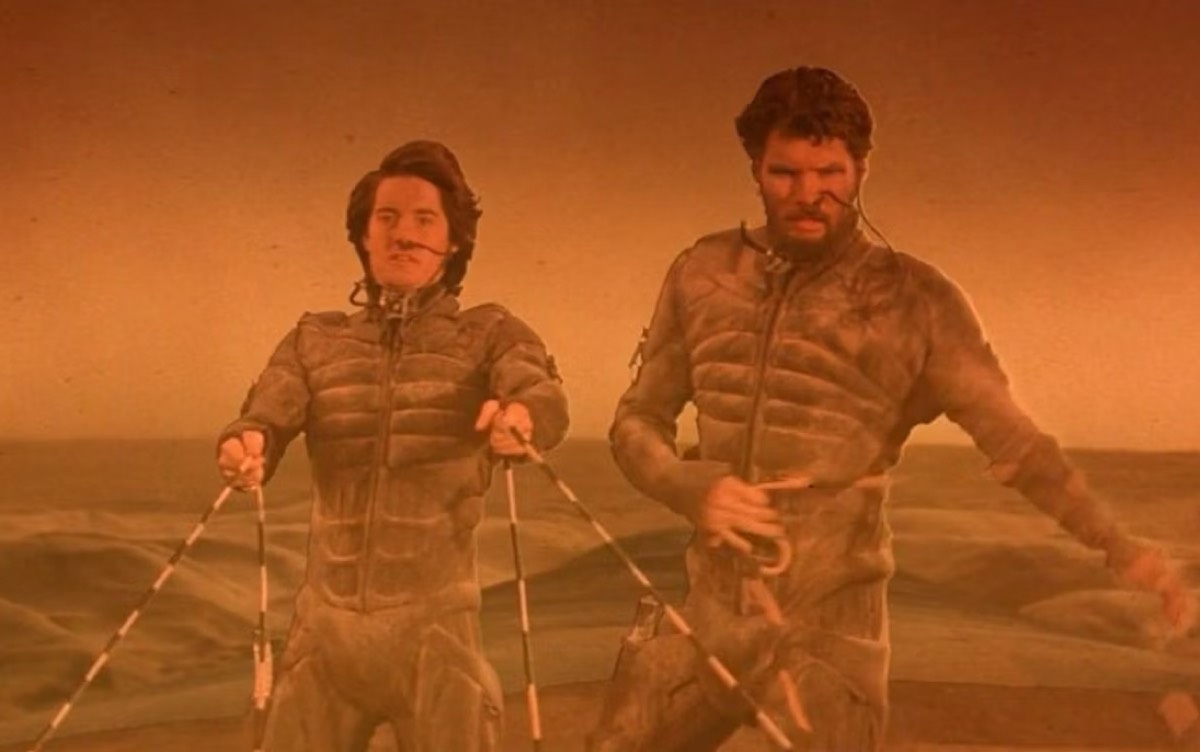
The Illustrated Dune Encyclopedia interpreted the stillsuit as something akin to a hazmat suit, without the full face covering. In David Lynch’s 1984 film, Dune, the stillsuits were organic and very form-fitting compared to the book description, almost like a second skin. The stillsuits in Denis Villeneuve’s most recent film adaptations (Dune Part 1 and Part 2) tried to hew more closely to the source material, with “micro-sandwiches” of acrylic fibers and porous cottons and embedded tubes for better flexibility.

Dune, the stillsuits were organic and very form-fitting.” height=”401″ src=”https://cdn.arstechnica.net/wp-content/uploads/2024/07/stillsuit2-640×401.jpg” width=”640″>

Enlarge / In David Lynch’s 1984 film, Dune, the stillsuits were organic and very form-fitting.

Universal Pictures

The Cornell team is not the first to try to build a practical stillsuit. Hacksmith Industries did a “one day build” of a stillsuit just last month, having previously tackled Thor’s Stormbreaker ax, Captain America’s electromagnetic shield, and a plasma-powered lightsaber, among other projects. The Hacksmith team dispensed with the icky urine and feces recycling aspects and focused on recycling sweat and moisture from breath.

Their version consists of a waterproof baggy suit (switched out for a more form-fitting bunny suit in the final version) with a battery-powered heat exchanger in the back. Any humidity condenses on the suit’s surface and drips into a bottle attached to a CamelBak bladder. There’s a filter mask attached to a tube that allows the wearer to breathe in filtered air, but it’s one way; the exhaled air is redirected to the condenser so the water content can be harvested into the CamelBak bladder and then sent back to the mask so the user can drink it. It’s not even close to achieving Herbert’s stated thimbleful a day in terms of efficiency since it mostly recycles moisture from sweat on the wearer’s back. But it worked.

Scientists built real-life “stillsuit” to recycle astronaut urine on space walks Read More »
nasa’s-flagship-mission-to-europa-has-a-problem:-vulnerability-to-radiation

NASA’s flagship mission to Europa has a problem: Vulnerability to radiation

Tripping transistors —

“What keeps me awake right now is the uncertainty.”

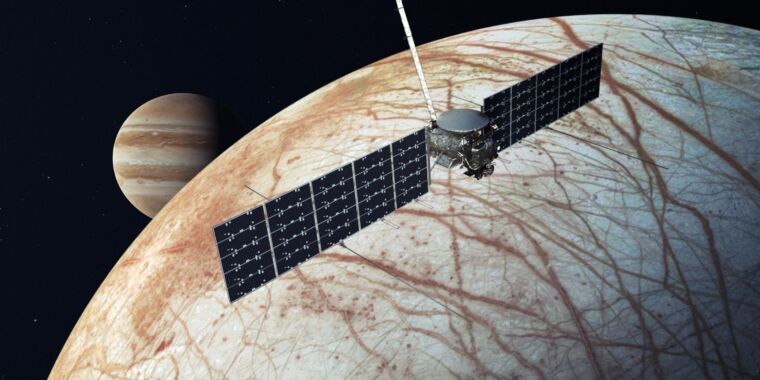
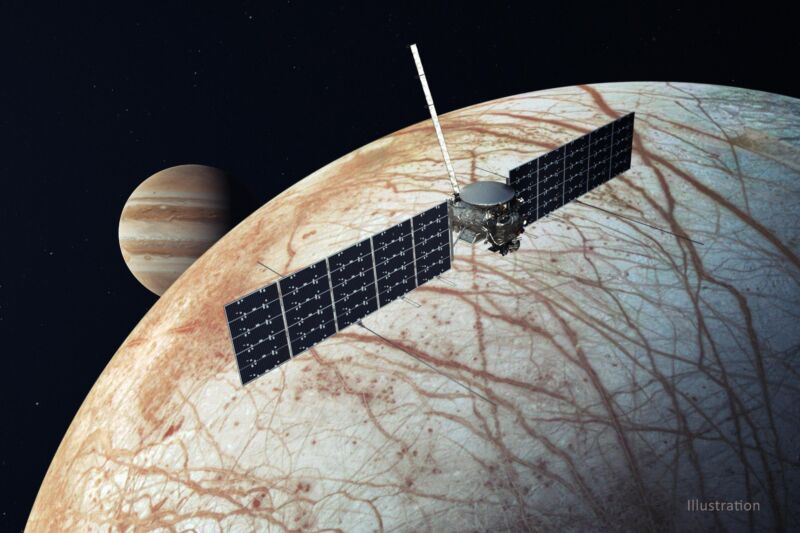
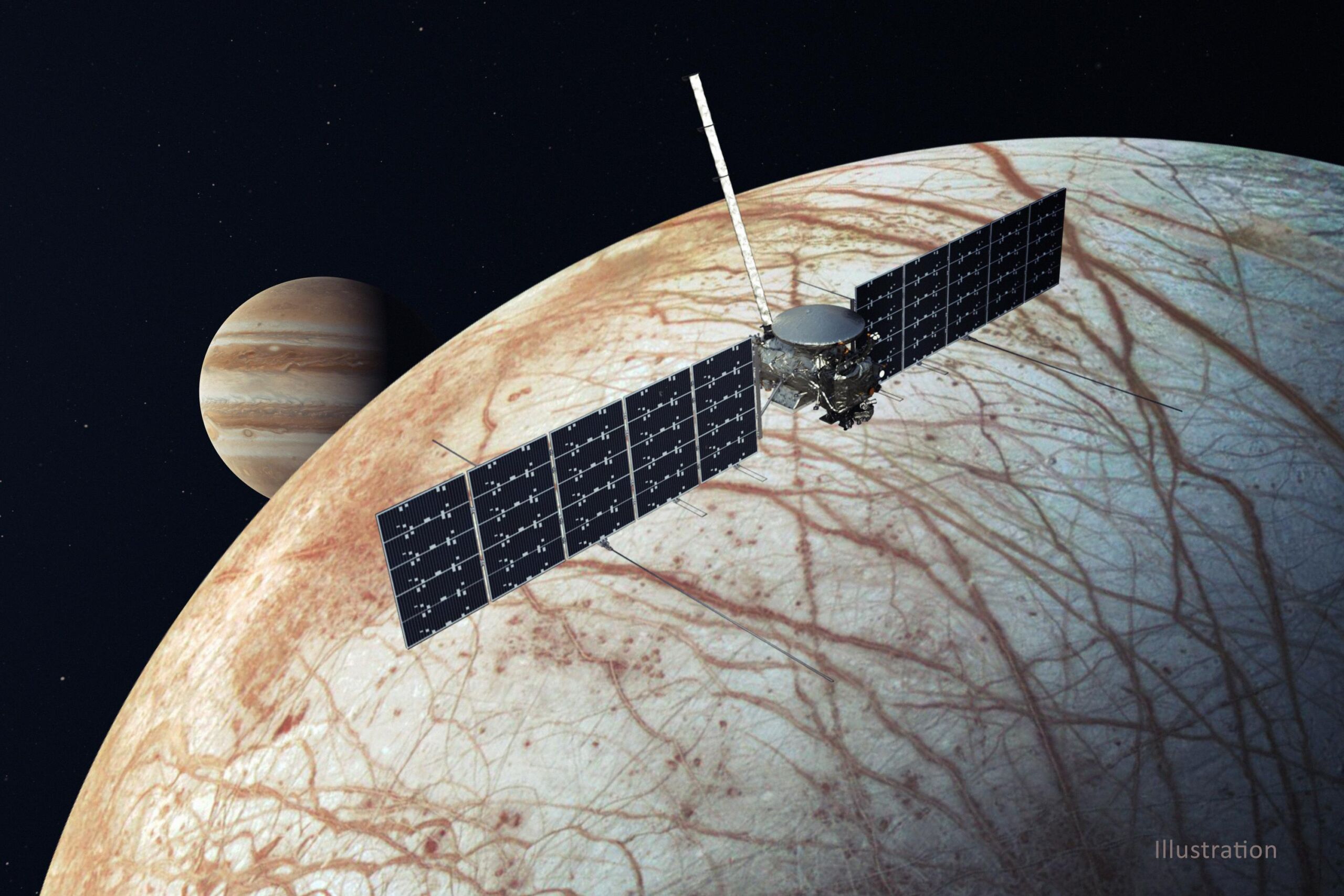
An artist's illustration of the Europa Clipper spacecraft during a flyby close to Jupiter's icy moon.

Enlarge / An artist’s illustration of the Europa Clipper spacecraft during a flyby close to Jupiter’s icy moon.

The launch date for the Europa Clipper mission to study the intriguing moon orbiting Jupiter, which ranks alongside the Cassini spacecraft to Saturn as NASA’s most expensive and ambitious planetary science mission, is now in doubt.

The $4.25 billion spacecraft had been due to launch in October on a Falcon Heavy rocket from Kennedy Space Center in Florida. However, NASA revealed that transistors on board the spacecraft may not be as radiation-hardened as they were believed to be.

“The issue with the transistors came to light in May when the mission team was advised that similar parts were failing at lower radiation doses than expected,” the space agency wrote in a blog post Thursday afternoon. “In June 2024, an industry alert was sent out to notify users of this issue. The manufacturer is working with the mission team to support ongoing radiation test and analysis efforts in order to better understand the risk of using these parts on the Europa Clipper spacecraft.”

The moons orbiting Jupiter, a massive gas giant planet, exist in one of the harshest radiation environments in the Solar System. NASA’s initial testing indicates that some of the transistors, which regulate the flow of energy through the spacecraft, could fail in this environment. NASA is currently evaluating the possibility of maximizing the transistor lifetime at Jupiter and expects to complete a preliminary analysis in late July.

To delay or not to delay

NASA’s update is silent on whether the spacecraft could still make its approximately three-week launch window this year, which gets Clipper to the Jovian system in 2030.

Ars reached out to several experts familiar with the Clipper mission to gauge the likelihood that it would make the October launch window, and opinions were mixed. The consensus view was between a 40 to 60 percent chance of becoming comfortable enough with the issue to launch this fall. If NASA engineers cannot become confident with the existing setup, the transistors would need to be replaced.

The Clipper mission has launch opportunities in 2025 and 2026, but these could lead to additional delays. This is due to the need for multiple gravitational assists. The 2024 launch follows a “MEGA” trajectory, including a Mars flyby in 2025 and an Earth flyby in late 2026—Mars-Earth Gravitational Assist. If Clipper launches a year late, it would necessitate a second Earth flyby. A launch in 2026 would revert to a MEGA trajectory. Ars has asked NASA for timelines of launches in 2025 and 2026 and will update if they provide this information.

Another negative result of delays would be costs, as keeping the mission on the ground for another year likely would result in another few hundred million dollars in expenses for NASA, which would blow a hole in its planetary science budget.

NASA’s blog post this week is not the first time the space agency has publicly mentioned these issues with the metal-oxide-semiconductor field-effect transistor, or MOSFET. At a meeting of the Space Studies Board in early June, Jordan Evans, project manager for the Europa Clipper Mission, said it was his No. 1 concern ahead of launch.

“What keeps me awake at night”

“The most challenging thing we’re dealing with right now is an issue associated with these transistors, MOSFETs, that are used as switches in the spacecraft,” he said. “Five weeks ago today, I got an email that a non-NASA customer had done some testing on these rad-hard parts and found that they were going before (the specifications), at radiation levels significantly lower than what we qualified them to as we did our parts procurement, and others in the industry had as well.”

At the time, Evans said things were “trending in the right direction” with regard to the agency’s analysis of the issue. It seems unlikely that NASA would have put out a blog post five weeks later if the issue were still moving steadily toward a resolution.

“What keeps me awake right now is the uncertainty associated with the MOSFETs and the residual risk that we will take on with that,” Evans said in June. “It’s difficult to do the kind of low-dose rate testing in the timeframes that we have until launch. So we’re gathering as much data as we can, including from missions like Juno, to better understand what residual risk we might launch with.”

These are precisely the kinds of issues that scientists and engineers don’t want to find in the final months before the launch of such a consequential mission. The stakes are incredibly high—imagine making the call to launch Clipper only to have the spacecraft fail six years later upon arrival at Jupiter.

NASA’s flagship mission to Europa has a problem: Vulnerability to radiation Read More »
much-of-neanderthal-genetic-diversity-came-from-modern-humans

Much of Neanderthal genetic diversity came from modern humans

A large, brown-colored skull seen in profile against a black background.

The basic outline of the interactions between modern humans and Neanderthals is now well established. The two came in contact as modern humans began their major expansion out of Africa, which occurred roughly 60,000 years ago. Humans picked up some Neanderthal DNA through interbreeding, while the Neanderthal population, always fairly small, was swept away by the waves of new arrivals.

But there are some aspects of this big-picture view that don’t entirely line up with the data. While it nicely explains the fact that Neanderthal sequences are far more common in non-African populations, it doesn’t account for the fact that every African population we’ve looked at has some DNA that matches up with Neanderthal DNA.

A study published on Thursday argues that much of this match came about because an early modern human population also left Africa and interbred with Neanderthals. But in this case, the result was to introduce modern human DNA to the Neanderthal population. The study shows that this DNA accounts for a lot of Neanderthals’ genetic diversity, suggesting that their population was even smaller than earlier estimates had suggested.

Out of Africa early

This study isn’t the first to suggest that modern humans and their genes met Neanderthals well in advance of our major out-of-Africa expansion. The key to understanding this is the genome of a Neanderthal from the Altai region of Siberia, which dates from roughly 120,000 years ago. That’s well before modern humans expanded out of Africa, yet its genome has some regions that have excellent matches to the human genome but are absent from the Denisovan lineage.

One explanation for this is that these are segments of Neanderthal DNA that were later picked up by the population that expanded out of Africa. The problem with that view is that most of these sequences also show up in African populations. So, researchers advanced the idea that an ancestral population of modern humans left Africa about 200,000 years ago, and some of its DNA was retained by Siberian Neanderthals. That’s consistent with some fossil finds that place anatomically modern humans in the Mideast at roughly the same time.

There is, however, an alternative explanation: Some of the population that expanded out of Africa 60,000 years ago and picked up Neanderthal DNA migrated back to Africa, taking the Neanderthal DNA with them. That has led to a small bit of the Neanderthal DNA persisting within African populations.

To sort this all out, a research team based at Princeton University focused on the Neanderthal DNA found in Africans, taking advantage of the fact that we now have a much larger array of completed human genomes (approximately 2,000 of them).

The work was based on a simple hypothesis. All of our work on Neanderthal DNA indicates that their population was relatively small, and thus had less genetic diversity than modern humans did. If that’s the case, then the addition of modern human DNA to the Neanderthal population should have boosted its genetic diversity. If so, then the stretches of “Neanderthal” DNA found in African populations should include some of the more diverse regions of the Neanderthal genome.

Much of Neanderthal genetic diversity came from modern humans Read More »

giant-salamander-species-found-in-what-was-thought-to-be-an-icy-ecosystem

Giant salamander species found in what was thought to be an icy ecosystem

Feeding time —

Found after its kind were thought extinct, and where it was thought to be too cold.

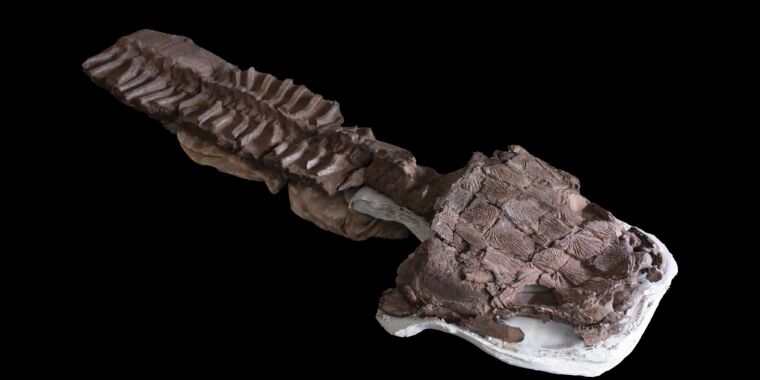
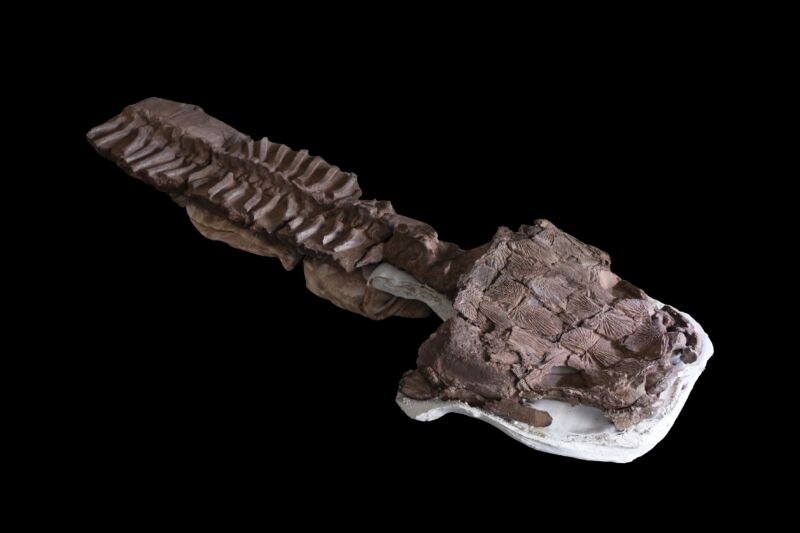
A black background with a brown fossil at the center, consisting of the head and a portion of the vertebral column.

C. Marsicano

Gaiasia jennyae, a newly discovered freshwater apex predator with a body length reaching 4.5 meters, lurked in the swamps and lakes around 280 million years ago. Its wide, flattened head had powerful jaws full of huge fangs, ready to capture any prey unlucky enough to swim past.

The problem is, to the best of our knowledge, it shouldn’t have been that large, should have been extinct tens of millions of years before the time it apparently lived, and shouldn’t have been found in northern Namibia. “Gaiasia is the first really good look we have at an entirely different ecosystem we didn’t expect to find,” says Jason Pardo, a postdoctoral fellow at Field Museum of Natural History in Chicago. Pardo is co-author of a study on the Gaiasia jennyae discovery recently published in Nature.

Common ancestry

“Tetrapods were the animals that crawled out of the water around 380 million years ago, maybe a little earlier,” Pardo explains. These ancient creatures, also known as stem tetrapods, were the common ancestors of modern reptiles, amphibians, mammals, and birds. “Those animals lived up to what we call the end of Carboniferous, about 370–300 million years ago. Few made it through, and they lasted longer, but they mostly went extinct around 370 million ago,” he adds.

This is why the discovery of Gaiasia jennyae in the 280 million-year-old rocks of Namibia was so surprising. Not only wasn’t it extinct when the rocks it was found in were laid down, but it was dominating its ecosystem as an apex predator. By today’s standards, it was like stumbling upon a secluded island hosting animals that should have been dead for 70 million years, like a living, breathing T-rex.

“The skull of gaiasia we have found is about 67 centimeters long. We also have a front end of her upper body. We know she was at minimum 2.5 meters long, probably 3.5, 4.5 meters—big head and a long, salamander-like body,” says Pardo. He told Ars that gaiasia was a suction feeder: she opened her jaws under water, which created a vacuum that sucked her prey right in. But the large, interlocked fangs reveal that a powerful bite was also one of her weapons, probably used to hunt bigger animals. “We suspect gaiasia fed on bony fish, freshwater sharks, and maybe even other, smaller gaiasia,” says Pardo, suggesting it was a rather slow, ambush-based predator.

But considering where it was found, the fact that it had enough prey to ambush is perhaps even more of a shocker than the animal itself.

Location, location, location

“Continents were organized differently 270–280 million years ago,” says Pardo. Back then, one megacontinent called Pangea had already broken into two supercontinents. The northern supercontinent called Laurasia included parts of modern North America, Russia, and China. The southern supercontinent, the home of gaiasia, was called Gondwana, which consisted of today’s India, Africa, South America, Australia, and Antarctica. And Gondwana back then was pretty cold.

“Some researchers hypothesize that the entire continent was covered in glacial ice, much like we saw in North America and Europe during the ice ages 10,000 years ago,” says Pardo. “Others claim that it was more patchy—there were those patches where ice was not present,” he adds. Still, 280 million years ago, northern Namibia was around 60 degrees southern latitude—roughly where the northernmost reaches of Antarctica are today.

“Historically, we thought tetrapods [of that time] were living much like modern crocodiles. They were cold-blooded, and if you are cold-blooded the only way to get large and maintain activity would be to be in a very hot environment. We believed such animals couldn’t live in colder environments. Gaiasia shows that it is absolutely not the case,” Pardo claims. And this turned upside-down lots of what we knew about life on Earth back in gaiasia’s time.

Giant salamander species found in what was thought to be an icy ecosystem Read More »
frozen-mammoth-skin-retained-its-chromosome-structure

Frozen mammoth skin retained its chromosome structure

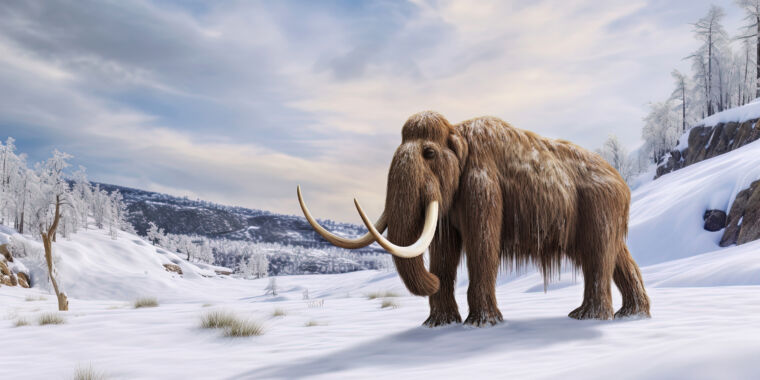
Artist's depiction of a large mammoth with brown fur and huge, curving tusks in an icy, tundra environment.

One of the challenges of working with ancient DNA samples is that damage accumulates over time, breaking up the structure of the double helix into ever smaller fragments. In the samples we’ve worked with, these fragments scatter and mix with contaminants, making reconstructing a genome a large technical challenge.

But a dramatic paper released on Thursday shows that this isn’t always true. Damage does create progressively smaller fragments of DNA over time. But, if they’re trapped in the right sort of material, they’ll stay right where they are, essentially preserving some key features of ancient chromosomes even as the underlying DNA decays. Researchers have now used that to detail the chromosome structure of mammoths, with some implications for how these mammals regulated some key genes.

DNA meets Hi-C

The backbone of DNA’s double helix consists of alternating sugars and phosphates, chemically linked together (the bases of DNA are chemically linked to these sugars). Damage from things like radiation can break these chemical linkages, with fragmentation increasing over time. When samples reach the age of something like a Neanderthal, very few fragments are longer than 100 base pairs. Since chromosomes are millions of base pairs long, it was thought that this would inevitably destroy their structure, as many of the fragments would simply diffuse away.

But that will only be true if the medium they’re in allows diffusion. And some scientists suspected that permafrost, which preserves the tissue of some now-extinct Arctic animals, might block that diffusion. So, they set out to test this using mammoth tissues, obtained from a sample termed YakInf that’s roughly 50,000 years old.

The challenge is that the molecular techniques we use to probe chromosomes take place in liquid solutions, where fragments would just drift away from each other in any case. So, the team focused on an approach termed Hi-C, which specifically preserves information about which bits of DNA were close to each other. It does this by exposing chromosomes to a chemical that will link any pieces of DNA that are close physical proximity. So, even if those pieces are fragments, they’ll be stuck to each other by the time they end up in a liquid solution.

A few enzymes are then used to convert these linked molecules to a single piece of DNA, which is then sequenced. This data, which will contain sequence information from two different parts of the genome, then tells us that those parts were once close to each other inside a cell.

Interpreting Hi-C

On its own, a single bit of data like this isn’t especially interesting; two bits of genome might end up next to each other at random. But when you have millions of bits of data like this, you can start to construct a map of how the genome is structured.

There are two basic rules governing the pattern of interactions we’d expect to see. The first is that interactions within a chromosome are going to be more common than interactions between two chromosomes. And, within a chromosome, parts that are physically closer to each other on the molecule are more likely to interact than those that are farther apart.

So, if you are looking at a specific segment of, say, chromosome 12, most of the locations Hi-C will find it interacting with will also be on chromosome 12. And the frequency of interactions will go up as you move to sequences that are ever closer to the one you’re interested in.

On its own, you can use Hi-C to help reconstruct a chromosome even if you start with nothing but fragments. But the exceptions to the expected pattern also tell us things about biology. For example, genes that are active tend to be on loops of DNA, with the two ends of the loop held together by proteins; the same is true for inactive genes. Interactions within these loops tend to be more frequent than interactions between them, subtly altering the frequency with which two fragments end up linked together during Hi-C.

Frozen mammoth skin retained its chromosome structure Read More »