doge

report:-doge-supercharges-mass-layoff-software,-renames-it-to-sound-less-dystopian

Report: DOGE supercharges mass-layoff software, renames it to sound less dystopian

“It is not clear how AutoRIF has been modified or whether AI is involved in the RIF mandate (through AutoRIF or independently),” Kunkler wrote. “However, fears of AI-driven mass-firings of federal workers are not unfounded. Elon Musk and the Trump Administration have made no secret of their affection for the dodgy technology and their intentions to use it to make budget cuts. And, in fact, they have already tried adding AI to workforce decisions.”

Automating layoffs can perpetuate bias, increase worker surveillance, and erode transparency to the point where workers don’t know why they were let go, Kunkler said. For government employees, such imperfect systems risk triggering confusion over worker rights or obscuring illegal firings.

“There is often no insight into how the tool works, what data it is being fed, or how it is weighing different data in its analysis,” Kunkler said. “The logic behind a given decision is not accessible to the worker and, in the government context, it is near impossible to know how or whether the tool is adhering to the statutory and regulatory requirements a federal employment tool would need to follow.”

The situation gets even starker when you imagine mistakes on a mass scale. Don Moynihan, a public policy professor at the University of Michigan, told Reuters that “if you automate bad assumptions into a process, then the scale of the error becomes far greater than an individual could undertake.”

“It won’t necessarily help them to make better decisions, and it won’t make those decisions more popular,” Moynihan said.

The only way to shield workers from potentially illegal firings, Kunkler suggested, is to support unions defending worker rights while pushing lawmakers to intervene. Calling on Congress to ban the use of shadowy tools relying on unknown data points to gut federal agencies “without requiring rigorous external testing and auditing, robust notices and disclosure, and human decision review,” Kunkler said rolling out DOGE’s new tool without more transparency should be widely condemned as unacceptable.

“We must protect federal workers from these harmful tools,” Kunkler said, adding, “If the government cannot or will not effectively mitigate the risks of using automated decision-making technology, it should not use it at all.”

Report: DOGE supercharges mass-layoff software, renames it to sound less dystopian Read More »

a-doge-recruiter-is-staffing-a-project-to-deploy-ai-agents-across-the-us-government

A DOGE recruiter is staffing a project to deploy AI agents across the US government


“does it still require Kremlin oversight?

A startup founder said that AI agents could do the work of tens of thousands of government employees.

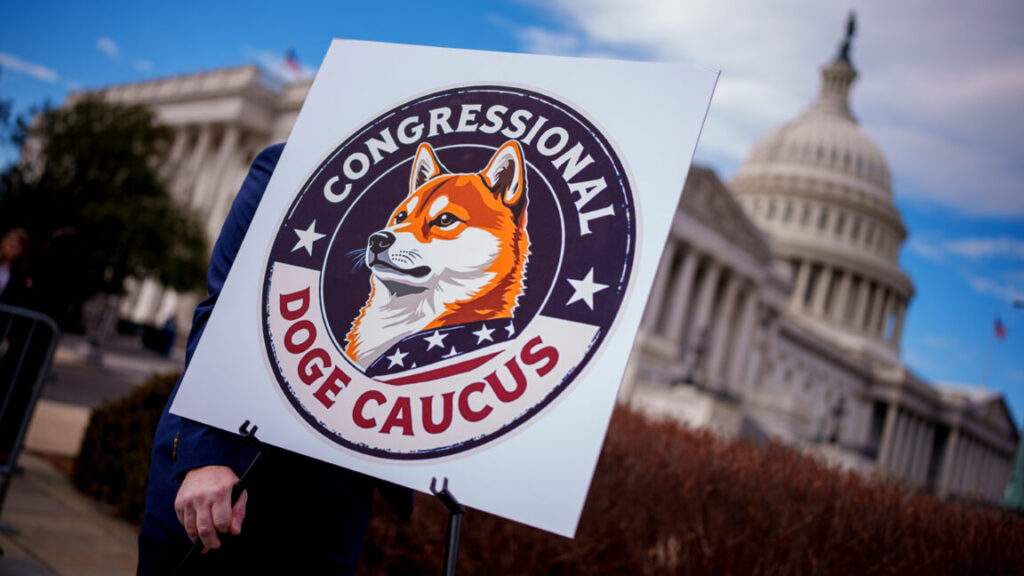
An aide sets up a poster depicting the logo for the DOGE Caucus before a news conference in Washington, DC. Credit: Andrew Harnik/Getty Images

A young entrepreneur who was among the earliest known recruiters for Elon Musk’s so-called Department of Government Efficiency (DOGE) has a new, related gig—and he’s hiring. Anthony Jancso, cofounder of AcclerateX, a government tech startup, is looking for technologists to work on a project that aims to have artificial intelligence perform tasks that are currently the responsibility of tens of thousands of federal workers.

Jancso, a former Palantir employee, wrote in a Slack with about 2000 Palantir alumni in it that he’s hiring for a “DOGE orthogonal project to design benchmarks and deploy AI agents across live workflows in federal agencies,” according to an April 21 post reviewed by WIRED. Agents are programs that can perform work autonomously.

We’ve identified over 300 roles with almost full-process standardization, freeing up at least 70k FTEs for higher-impact work over the next year,” he continued, essentially claiming that tens of thousands of federal employees could see many aspects of their job automated and replaced by these AI agents. Workers for the project, he wrote, would be based on site in Washington, DC, and would not require a security clearance; it isn’t clear for whom they would work. Palantir did not respond to requests for comment.

The post was not well received. Eight people reacted with clown face emojis, three reacted with a custom emoji of a man licking a boot, two reacted with custom emoji of Joaquin Phoenix giving a thumbs down in the movie Gladiator, and three reacted with a custom emoji with the word “Fascist.” Three responded with a heart emoji.

“DOGE does not seem interested in finding ‘higher impact work’ for federal employees,” one person said in a comment that received 11 heart reactions. “You’re complicit in firing 70k federal employees and replacing them with shitty autocorrect.”

“Tbf we’re all going to be replaced with shitty autocorrect (written by chatgpt),” another person commented, which received one “+1” reaction.

“How ‘DOGE orthogonal’ is it? Like, does it still require Kremlin oversight?” another person said in a comment that received five reactions with a fire emoji. “Or do they just use your credentials to log in later?”

AccelerateX was originally called AccelerateSF, which VentureBeat reported in 2023 had received support from OpenAI and Anthropic. In its earliest incarnation, AccelerateSF hosted a hackathon for AI developers aimed at using the technology to solve San Francisco’s social problems. According to a 2023 Mission Local story, for instance, Jancso proposed that using large language models to help businesses fill out permit forms to streamline the construction paperwork process might help drive down housing prices. (OpenAI did not respond to a request for comment. Anthropic spokesperson Danielle Ghiglieri tells WIRED that the company “never invested in AccelerateX/SF,” but did sponsor a hackathon AccelerateSF hosted in 2023 by providing free access to its API usage at a time when its Claude API “was still in beta.”)

In 2024, the mission pivoted, with the venture becoming known as AccelerateX. In a post on X announcing the change, the company posted, “Outdated tech is dragging down the US Government. Legacy vendors sell broken systems at increasingly steep prices. This hurts every American citizen.” AccelerateX did not respond to a request for comment.

According to sources with direct knowledge, Jancso disclosed that AccelerateX had signed a partnership agreement with Palantir in 2024. According to the LinkedIn of someone described as one of AccelerateX’s cofounders, Rachel Yee, the company looks to have received funding from OpenAI’s Converge 2 Accelerator. Another of AccelerateSF’s cofounders, Kay Sorin, now works for OpenAI, having joined the company several months after that hackathon. Sorin and Yee did not respond to requests for comment.

Jancso’s cofounder, Jordan Wick, a former Waymo engineer, has been an active member of DOGE, appearing at several agencies over the past few months, including the Consumer Financial Protection Bureau, National Labor Relations Board, the Department of Labor, and the Department of Education. In 2023, Jancso attended a hackathon hosted by ScaleAI; WIRED found that another DOGE member, Ethan Shaotran, also attended the same hackathon.

Since its creation in the first days of the second Trump administration, DOGE has pushed the use of AI across agencies, even as it has sought to cut tens of thousands of federal jobs. At the Department of Veterans Affairs, a DOGE associate suggested using AI to write code for the agency’s website; at the General Services Administration, DOGE has rolled out the GSAi chatbot; the group has sought to automate the process of firing government employees with a tool called AutoRIF; and a DOGE operative at the Department of Housing and Urban Development is using AI tools to examine and propose changes to regulations. But experts say that deploying AI agents to do the work of 70,000 people would be tricky if not impossible.

A federal employee with knowledge of government contracting, who spoke to WIRED on the condition of anonymity because they were not authorized to speak to the press, says, “A lot of agencies have procedures that can differ widely based on their own rules and regulations, and so deploying AI agents across agencies at scale would likely be very difficult.”

Oren Etzioni, cofounder of the AI startup Vercept, says that while AI agents can be good at doing some things—like using an internet browser to conduct research—their outputs can still vary widely and be highly unreliable. For instance, customer service AI agents have invented nonexistent policies when trying to address user concerns. Even research, he says, requires a human to actually make sure what the AI is spitting out is correct.

“We want our government to be something that we can rely on, as opposed to something that is on the absolute bleeding edge,” says Etzioni. “We don’t need it to be bureaucratic and slow, but if corporations haven’t adopted this yet, is the government really where we want to be experimenting with the cutting edge AI?”

Etzioni says that AI agents are also not great 1-1 fits for job replacements. Rather, AI is able to do certain tasks or make others more efficient, but the idea that the technology could do the jobs of 70,000 employees would not be possible. “Unless you’re using funny math,” he says, “no way.”

Jancso, first identified by WIRED in February, was one of the earliest recruiters for DOGE in the months before Donald Trump was inaugurated. In December, Jancso, who sources told WIRED said he had been recruited by Steve Davis, president of the Musk-founded Boring Company and a current member of DOGE, used the Palantir alumni group to recruit DOGE members. On December 2nd, 2024, he wrote, “I’m helping Elon’s team find tech talent for the Department of Government Efficiency (DOGE) in the new admin. This is a historic opportunity to build an efficient government, and to cut the federal budget by 1/3. If you’re interested in playing a role in this mission, please reach out in the next few days.”

According to one source at SpaceX, who asked to remain anonymous as they are not authorized to speak to the press, Jancso appeared to be one of the DOGE members who worked out of the company’s DC office in the days before inauguration along with several other people who would constitute some of DOGE’s earliest members. SpaceX did not respond to a request for comment.

Palantir was cofounded by Peter Thiel, a billionaire and longtime Trump supporter with close ties to Musk. Palantir, which provides data analytics tools to several government agencies including the Department of Defense and the Department of Homeland Security, has received billions of dollars in government contracts. During the second Trump administration, the company has been involved in helping to build a “mega API” to connect data from the Internal Revenue Service to other government agencies, and is working with Immigration and Customs Enforcement to create a massive surveillance platform to identify immigrants to target for deportation.

This story originally appeared at WIRED.com.

Photo of WIRED

Wired.com is your essential daily guide to what’s next, delivering the most original and complete take you’ll find anywhere on innovation’s impact on technology, science, business and culture.

A DOGE recruiter is staffing a project to deploy AI agents across the US government Read More »

doge-put-a-college-student-in-charge-of-using-ai-to-rewrite-regulations

DOGE put a college student in charge of using AI to rewrite regulations


The DOGE operative has been tasked with rewrites to the Department of Housing and Urban Development.

A young man with no government experience who has yet to even complete his undergraduate degree is working for Elon Musk’s so-called Department of Government Efficiency (DOGE) at the Department of Housing and Urban Development (HUD) and has been tasked with using artificial intelligence to rewrite the agency’s rules and regulations.

Christopher Sweet was introduced to HUD employees as being originally from San Francisco and, most recently, a third-year student at the University of Chicago, where he was studying economics and data science, in an email sent to staffers earlier this month.

“I’d like to share with you that Chris Sweet has joined the HUD DOGE team with the title of special assistant, although a better title might be ‘Al computer programming quant analyst,’” Scott Langmack, a DOGE staffer and chief operating officer of an AI real estate company, wrote in an email widely shared within the agency and reviewed by WIRED. “With family roots from Brazil, Chris speaks Portuguese fluently. Please join me in welcoming Chris to HUD!”

Sweet’s primary role appears to be leading an effort to leverage artificial intelligence to review HUD’s regulations, compare them to the laws on which they are based, and identify areas where rules can be relaxed or removed altogether. (He has also been given read access to HUD’s data repository on public housing, known as the Public and Indian Housing Information Center, and its enterprise income verification systems, according to sources within the agency.)

Plans for the industrial-scale deregulation of the US government were laid out in detail in the Project 2025 policy document that the Trump administration has effectively used as a playbook during its first 100 days in power. The document, written by a who’s who of far-right figures, many of whom now hold positions of power within the administration, pushes for deregulation in areas like the environment, food and drug enforcement, and diversity, equity, and inclusion policies.

One area Sweet is focusing on is regulation related to the Office of Public and Indian Housing (PIH), according to sources who spoke to WIRED on the condition of anonymity as they were not authorized to speak to the press.

Sweet—who two sources have been told is the lead on the AI deregulation project for the entire administration—has produced an Excel spreadsheet with around a thousand rows containing areas of policy where the AI tool has flagged that HUD may have “overreached” and suggesting replacement language.

Staffers from PIH are, specifically, asked to review the AI’s recommendations and justify their objections to those they don’t agree with. “It all sounds crazy—having AI recommend revisions to regulations,” one HUD source says. “But I appreciated how much they’re using real people to confirm and make changes.”

Once the PIH team completes the review, their recommendations will be submitted to the Office of the General Counsel for approval.

One HUD source says they were told that the AI model being used for this project is “being refined by our work to be used across the government.” To do this, the source says they were told in a meeting attended by Sweet and Jacob Altik, another known DOGE member who has worked as an attorney at Weil, Gotshal & Manges, that the model will crawl through the Code of Federal Regulations (eCFR).

Another source told WIRED that Sweet has also been using the tool at other parts of HUD. WIRED reviewed a copy of the output of the AI’s review of one HUD department, which features columns displaying text that the AI model found to be needing an adjustment while also including suggestions from the AI for alterations to be made, essentially proposing rewrites. The spreadsheet details how many words can be eliminated from individual regulations and gives a percentage figure indicating how noncompliant the regulations are. It isn’t clear how these percentages are calculated.

Sweet did not respond to requests for comment regarding his work. In response to a request to clarify Sweet’s role at HUD, a spokesperson for the agency said they do not comment on individual personnel. The University of Chicago confirmed to WIRED that Sweet is “on leave from the undergraduate college.”

It’s unclear how Sweet was recruited to DOGE, but a public GitHub account indicates that he was working on this issue even before he joined Musk’s demolition crew.

The “CLSweet” GitHub account, which WIRED has linked to Sweet, created an application that tracks and analyzes federal government regulations “showing how regulatory burden is distributed across government agencies.” The application was last updated in March 2025, weeks before Sweet joined HUD.

One HUD source who heard about Sweet’s possible role in revising the agency’s regulations said the effort was redundant, since the agency was already “put through a multi-year multi-stakeholder meatgrinder before any rule was ever created” under the Administrative Procedure Act. (This law dictates how agencies are allowed to establish regulations and allows for judicial oversight over everything an agency does.)

Another HUD source said Sweet’s title seemed to make little sense. “A programmer and a quantitative data analyst are two very different things,” they noted.

Sweet has virtually no online footprint. One of the only references to him online is a short biography on the website of East Edge Securities, an investment firm Sweet founded in 2023 with two other students from the University of Chicago.

The biography is short on details but claims that Sweet has worked in the past with several private equity firms, including Pertento Partners, which is based in London, and Tenzing Global Investors, based in San Francisco. He is also listed as a board member of Paragon Global Investments, which is a student-run hedge fund.

The biography also mentions that Sweet “will be joining Nexus Point Capital as a private equity summer analyst.” The company has headquarters in Hong Kong and Shanghai and describes itself as “an Asian private equity fund with a strategic focus on control opportunities in the Greater China market.”

East Edge Securities, Pertento Partners, Tenzing Global Investors, Paragon Global Investments, and Nexus Point Capital did not respond to requests for comment.

The only other online account associated with Sweet appears to be a Substack account using the same username as the GitHub account. That account has not posted any content and follows mostly finance and market-related newsletters. It also follows Bari Weiss’ The Free Press and the newsletter of Marc Andreessen, the Silicon Valley billionaire investor and group chat enthusiast who said he spent a lot of time advising Trump and his team after the election.

DOGE representatives have been at HUD since February, when WIRED reported that two of those staffers were given application-level access to some of the most critical and sensitive systems inside the agency.

Earlier this month, US representative Maxine Waters, the top Democrat on the House Financial Services Committee, said DOGE had “infiltrated our nation’s housing agencies, stealing funding Congress provided to communities, illegally terminating staff, including in your districts, and accessing confidential data about people living in assisted housing, including sexual assault survivors.”

This story originally appeared at WIRED.com

Photo of WIRED

Wired.com is your essential daily guide to what’s next, delivering the most original and complete take you’ll find anywhere on innovation’s impact on technology, science, business and culture.

DOGE put a college student in charge of using AI to rewrite regulations Read More »

government-it-whistleblower-calls-out-doge,-says-he-was-threatened-at-home

Government IT whistleblower calls out DOGE, says he was threatened at home


“Stay out of DOGE’s way”: IT worker details how Musk group infiltrated US agency.

Elon Musk at the White House on March 9, 2025 in Washington, DC. Credit: Getty Images | Samuel Corum

A government whistleblower told lawmakers that DOGE’s access to National Labor Relations Board (NLRB) systems went far beyond what was needed to analyze agency operations and apparently led to a data breach. NLRB employee Daniel Berulis, a DevSecOps architect, also says he received a threat when he was preparing his whistleblower disclosure.

“Mr. Berulis is coming forward today because of his concern that recent activity by members of the Department of Government Efficiency (‘DOGE’) have resulted in a significant cybersecurity breach that likely has and continues to expose our government to foreign intelligence and our nation’s adversaries,” said a letter from the group Whistleblower Aid to the Senate Select Committee on Intelligence leaders and the US Office of Special Counsel.

The letter, Berulis’ sworn declaration, and an exhibit with screenshots of technical data are available here. “This declaration details DOGE activity within NLRB, the exfiltration of data from NLRB systems, and—concerningly—near real-time access by users in Russia,” Whistleblower Aid Chief Legal Counsel Andrew Bakaj wrote. “Notably, within minutes of DOGE personnel creating user accounts in NLRB systems, on multiple occasions someone or something within Russia attempted to login using all of the valid credentials (e.g. Usernames/Passwords). This, combined with verifiable data being systematically exfiltrated to unknown servers within the continental United States—and perhaps abroad—merits investigation.”

Bakaj said they notified law enforcement about an “absolutely disturbing” threat Berulis received on April 7. Someone “taped a threatening note to Mr. Berulis’ home door with photographs—taken via a drone—of him walking in his neighborhood,” Bakaj wrote. “The threatening note made clear reference to this very disclosure he was preparing for you, as the proper oversight authority. While we do not know specifically who did this, we can only speculate that it involved someone with the ability to access NLRB systems.”

NLRB denies breach

Berulis’ disclosure said that several days before receiving this threat, he had been instructed to drop his investigation and not report his concerns to US security officials.

Bakaj’s letter to senators and the Office of Special Counsel requested “that both law enforcement agencies and Congress initiate an immediate investigation into the cybersecurity breach and data exfiltration at NLRB and any other agencies where DOGE has accessed internal systems.”

An NLRB spokesperson denied that there was any breach. “Tim Bearese, the NLRB’s acting press secretary, denied that the agency granted DOGE access to its systems and said DOGE had not requested access to the agency’s systems,” according to NPR. “Bearese said the agency conducted an investigation after Berulis raised his concerns but ‘determined that no breach of agency systems occurred.'”

We contacted the NLRB and will update this article if it provides further comment.

There have been numerous lawsuits over the access to government systems granted to DOGE, the Trump administration entity led by Elon Musk. One such lawsuit described DOGE’s access as “the largest and most consequential data breach in US history.” There have been mixed results in the cases so far; a US appeals court decided last week that DOGE can access personal data held by the US Department of Education and Office of Personnel Management (OPM), overturning a lower-court ruling.

After the whistleblower disclosure, US Rep. Gerry Connolly (D-Va.) sent a letter urging inspectors general at the NLRB and Department of Labor to investigate. Connolly said the whistleblower report indicates “that Department of Government Efficiency (DOGE) employees may be engaged in technological malfeasance and illegal activity at the National Labor Relations Board (NLRB) and the Department of Labor (DOL).” Connolly asked for a report to Congress on “the nature of the work the DOGE team has performed at NLRB and DOL, including any and all attempts to exfiltrate data and any attempts to cover up their activities.”

Because of Musk’s role at DOGE and the fact that his “companies face a series of enforcement actions from NLRB and DOL,” there is “an inherent conflict of interest for him to direct any work at either agency—let alone benefit from stolen nonpublic information,” Connolly wrote.

Login attempts from Russia

Berulis’ disclosure said that on March 11, internal metrics indicated there had been “abnormal usage” over the past week with higher-than-usual response times and “increased network output above anywhere it had been historically.” When examining the data, “we noticed a user with an IP address in Primorsky Krai, Russia started trying to log in. Those attempts were blocked, but they were especially alarming,” he wrote.

The person logging in from Russia apparently had the correct credentials for a DOGE account, according to Berulis. “Whoever was attempting to log in was using one of the newly created accounts that were used in the other DOGE-related activities, and it appeared they had the correct username and password due to the authentication flow only stopping them due to our no-out-of-country logins policy activating,” he wrote. “There were more than 20 such attempts, and what is particularly concerning is that many of these login attempts occurred within 15 minutes of the accounts being created by DOGE engineers.”

This was not the first troubling sign described in the disclosure. On March 7, Berulis says he had “started tracking what appeared to be sensitive data leaving the secured location.” About 10GB of data was exfiltrated, but it was “unclear which files were copied and removed,” he wrote.

Berulis said the evidence indicated there was “a data breach facilitated by an internal actor,” and that he observed “the exact behaviors (Indicators of Compromise) of one who was trying to erase records of activities, retard detection, and covertly hide what data was being extracted after the fact.”

The NLRB hosts lots of private information that is supposed to remain confidential, he noted. This includes “sensitive information on unions, ongoing legal cases, and corporate secrets.” The database involved in the apparent breach contains “PII [personally identifiable information] of claimants and respondents with pending matters before the agency” and confidential business information “gathered or provided during investigations and litigation that were not intended for public release,” he wrote.

Berulis has almost two decades of experience, and his “work often includes high-level coordination with executive teams, establishing red-blue war game security events, and building cross-functional teams to align IT capabilities with mission-critical goals,” he said in his declaration. “Having worked at sensitive US Government institutions, I have held a Top Secret security clearance with eligibility for access to Sensitive Compartmented Information, commonly known as TS/SCI.”

“Stay out of DOGE’s way”

In late February, Berulis and his team were notified of DOGE’s impending arrival. “On or around March 3, 2025, we saw a black SUV and police escort enter the garage, after which building security let the DOGE staffers in. They interacted with only a small group of NLRB staff, never introducing themselves to those of us in Information Technology,” he wrote.

An assistant chief information officer (ACIO) was given instructions that IT employees “were not to adhere to SOP [standard operating procedure] with the DOGE account creation in regards to creating records,” Berulis wrote. “He specifically was told that there were to be no logs or records made of the accounts created for DOGE employees.”

DOGE officials were to be given “the highest level of access and unrestricted access to internal systems,” specifically “tenant owner” accounts in Microsoft Azure that come “with essentially unrestricted permission to read, copy, and alter data,” Berulis wrote. These “permissions are above even my CIO’s access level to our systems” and “well above what level of access is required to pull metrics, efficiency reports, and any other details that would be needed to assess utilization or usage of systems in our agency.”

The NLRB systems “have built-in roles that auditors can use and have used extensively in the past,” which do not have “the ability to make changes or access subsystems without approval,” Berulis wrote. DOGE apparently wasn’t willing to use these accounts. “The suggestion that they use these accounts instead was not open to discussion,” he wrote.

Berulis said IT staff were ordered “to hand over any requested accounts, stay out of DOGE’s way entirely, and assist them when they asked. We were further directed not to resist them in any way or deny them any access.”

More suspicious events

Berulis described several more suspicious events that followed DOGE’s arrival. There was a new container that he described as “basically an opaque, virtual node that has the ability to build and run programs or scripts without revealing its activities to the rest of the network.” There was also a token that “was configured to expire quickly after creation and use, making it harder to gain insight into what it was used for during its lifetime.”

To Berulis, these were signs of an attack on the NLRB systems. The methods used seemed to reflect “the desire of the attackers to work invisibly, leaving little to no obvious trace of their activities once removed.”

On March 6, various users “reported login issues to the service desk and, upon inspection, I found some conditional access policies were updated recently,” he wrote. This was odd because “policies that had been in place for over a year were suddenly found to have been changed with no corresponding documentation or approvals,” he wrote. “Upon my discovery of these changes, I asked the security personnel and information assurance team about it, but they had no knowledge of any planned changes or approvals.”

On March 7, Berulis says he “started tracking what appeared to be sensitive data leaving the secured location.” About 10GB of data was exfiltrated, but it was “unclear which files were copied and removed,” he wrote. On that same day, Berulis says he reported his concerns about sensitive data being exfiltrated to CIO Prem Aburvasmy.

Aburvasmy took the concerns seriously and put together a leadership group “to discuss insider threat response on an ongoing cadence and how we could get better at detecting it,” Berulis wrote. “Going forward after this, the team met every Friday and continue to do so to this day.”

Berulis described some shortcomings in the NLRB’s ability to detect attacks. “During one of these meetings, it was confirmed that our team did not have the technical capability to detect or respond in real time to internal threat actors, and that we likely did not have the ability to obtain more details about the past events,” he wrote.

The department subsequently “shifted budget to allow for better tooling going forward,” which “has vastly improved our detection and logging so we can provide more concrete evidence if covert exfiltration occurs by an insider threat again,” Berulis wrote. “We also shut down a public endpoint and corrected rogue policies that had been altered to allow much broader traffic in/out of our network.”

Berulis: “We were directed not to… create an official report”

On March 10, Berulis found that controls in Microsoft Purview to prevent insecure or unauthorized access from mobile devices had been disabled, he wrote. “In addition, outside of expected baselines and with no corresponding approvals or records I could find I noted the following: an interface exposed to the public Internet, a few internal alerting and monitoring systems in the off state, and multi-factor authentication changed,” he wrote.

The team observed more odd activity in the ensuing weeks, Berulis wrote. Data was sent to “an unknown external endpoint,” but the network team was unable to obtain connection logs or determine what data was removed, he wrote. There were also “spikes in billing in Mission Systems related to storage input/output” associated with projects that could no longer be found in the NLRB system, indicating that “resources may have been deleted or short-lived,” he wrote.

During the week of March 24, an assistant CIO for security at the NLRB “concluded that following a review of data, we should report it” to US-CERT, the US Computer Emergency Readiness Team at the Cybersecurity and Infrastructure Security Agency (CISA), according to Berulis.

“Accordingly, we launched a formal review and I provided all evidence of what we deemed to be a serious, ongoing security breach or potentially illegal removal of personally identifiable information,” he wrote.

But on April 3 or 4, the assistant CIO “and I were informed that instructions had come down to drop the US-CERT reporting and investigation and we were directed not to move forward or create an official report,” Berulis wrote.

Photo of Jon Brodkin

Jon is a Senior IT Reporter for Ars Technica. He covers the telecom industry, Federal Communications Commission rulemakings, broadband consumer affairs, court cases, and government regulation of the tech industry.

Government IT whistleblower calls out DOGE, says he was threatened at home Read More »

victory-for-doge-as-appeals-court-reinstates-access-to-personal-data

Victory for DOGE as appeals court reinstates access to personal data

A US appeals court ruled yesterday that DOGE can access personal data held by the US Department of Education and Office of Personnel Management (OPM), overturning an order issued by a lower-court judge.

The US government has “met its burden of a strong showing that it is likely to succeed on the merits of their appeal,” said yesterday’s ruling by the US Court of Appeals for the 4th Circuit. In a 2-1 decision, a panel of judges granted the Trump administration’s motion to stay the lower-court ruling pending appeal.

“The Supreme Court has told us that, unlike a private party, the government suffers an irreparable harm when it cannot carry out the orders of its elected representatives… Judicial management of agency operations offends the Executive Branch’s exclusive authority to enforce federal law,” wrote Court of Appeals Judge Steven Agee, a George W. Bush appointee.

Agee was joined by Judge Julius Richardson, a Trump appointee, in voting to grant the motion to stay pending appeal. Judge Robert King, a Clinton appointee, voted to deny the motion.

Judge “strongly” dissents

In a separate 8-7 vote, the full court denied King’s request for an en banc hearing. King’s dissent said:

Given the exceptional importance of this matter, I sought initial en banc consideration of the government’s motion for a stay pending appeal of the district court’s award of preliminary injunctive relief—an injunction that bars the defendant federal agencies and officials from disclosing to affiliates of the President’s new Department of Government Efficiency, or “DOGE,” highly sensitive personal information belonging to millions of Americans. Regrettably, my request for initial hearing en banc has been denied on an 8-7 vote, and the panel majority has granted the government’s motion for a stay pending appeal on a 2-1 vote. I strongly dissent from both decisions.

At stake is some of the most sensitive personal information imaginable—including Social Security numbers, income and assets, federal tax records, disciplinary and other personnel actions, physical and mental health histories, driver’s license information, bank account numbers, and demographic and family details. This information was entrusted to the government, which for many decades had a record of largely adhering to the Privacy Act of 1974 and keeping the information safe. And then suddenly, the defendants began disclosing the information to DOGE affiliates without substantiating that they have any need to access such highly sensitive materials.

Yesterday’s decision overturned a ruling by US District Judge Deborah Boardman in the District of Maryland. Plaintiffs include the American Federation of Teachers; the International Association of Machinists and Aerospace Workers; the National Active and Retired Federal Employees Association; the National Federation of Federal Employees; and the International Federation of Professional & Technical Engineers. There are also six individual plaintiffs who are military veterans.

Victory for DOGE as appeals court reinstates access to personal data Read More »

doge-staffer’s-youtube-nickname-accidentally-revealed-his-teen-hacking-activity

DOGE staffer’s YouTube nickname accidentally revealed his teen hacking activity

A SpaceX and X engineer, Christopher Stanley—currently serving as a senior advisor in the Deputy Attorney General’s office at the Department of Justice (DOJ)—was reportedly caught bragging about hacking and distributing pirated e-books, bootleg software, and game cheats.

The boasts appeared on archived versions of websites, of which several, once flagged, were quickly deleted, Reuters reported.

Stanley was assigned to the DOJ by Elon Musk’s Department of Government Efficiency (DOGE). While Musk claims that DOGE operates transparently, not much is known about who the staffers are or what their government roles entail. It remains unclear what Stanley does at DOJ, but Reuters noted that the Deputy Attorney General’s office is in charge of investigations into various crimes, “including hacking and other malicious cyber activity.” Declining to comment further, the DOJ did confirm that as a “special government employee,” like Musk, Stanley does not draw a government salary.

The engineer’s questionable past seemingly dates back to 2006, Reuters reported, when Stanley was still in high school. The news site connected Stanley to various sites and forums by tracing various pseudonyms he still uses, including Reneg4d3, a nickname he still uses on YouTube. The outlet then further verified the connection “by cross-referencing the sites’ registration data against his old email address and by matching Reneg4d3’s biographical data to Stanley’s.”

Among his earliest sites was one featuring a “crude sketch of a penis” called fkn-pwnd.com, where Stanley, at 15, bragged about “fucking up servers,” a now-deleted Internet Archive screenshot reportedly showed. Another, reneg4d3.com, was launched when he was 16. There, Stanley branded a competing messaging board “stupid noobs” after supposedly gaining admin access through an “easy exploit,” Reuters reported. On Bluesky, an account called “doge whisperer” alleges even more hacking activity, some of which appears to be corroborated by an IA screenshot of another site Stanley created, electonic.net (sic), which as of this writing can still be accessed.

DOGE staffer’s YouTube nickname accidentally revealed his teen hacking activity Read More »

what-could-possibly-go-wrong?-doge-to-rapidly-rebuild-social-security-codebase.

What could possibly go wrong? DOGE to rapidly rebuild Social Security codebase.

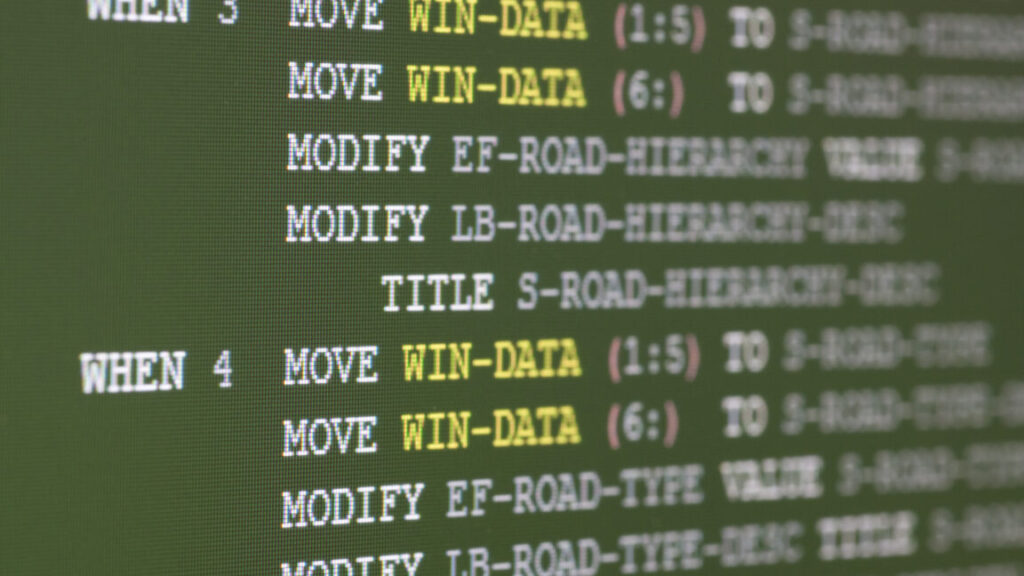
Like many legacy government IT systems, SSA systems contain code written in COBOL, a programming language created in part in the 1950s by computing pioneer Grace Hopper. The Defense Department essentially pressured private industry to use COBOL soon after its creation, spurring widespread adoption and making it one of the most widely used languages for mainframes, or computer systems that process and store large amounts of data quickly, by the 1970s. (At least one DOD-related website praising Hopper’s accomplishments is no longer active, likely following the Trump administration’s DEI purge of military acknowledgements.)

As recently as 2016, SSA’s infrastructure contained more than 60 million lines of code written in COBOL, with millions more written in other legacy coding languages, the agency’s Office of the Inspector General found. In fact, SSA’s core programmatic systems and architecture haven’t been “substantially” updated since the 1980s when the agency developed its own database system called MADAM, or the Master Data Access Method, which was written in COBOL and Assembler, according to SSA’s 2017 modernization plan.

SSA’s core “logic” is also written largely in COBOL. This is the code that issues social security numbers, manages payments, and even calculates the total amount beneficiaries should receive for different services, a former senior SSA technologist who worked in the office of the chief information officer says. Even minor changes could result in cascading failures across programs.

“If you weren’t worried about a whole bunch of people not getting benefits or getting the wrong benefits, or getting the wrong entitlements, or having to wait ages, then sure go ahead,” says Dan Hon, principal of Very Little Gravitas, a technology strategy consultancy that helps government modernize services, about completing such a migration in a short timeframe.

It’s unclear when exactly the code migration would start. A recent document circulated amongst SSA staff laying out the agency’s priorities through May does not mention it, instead naming other priorities like terminating “non-essential contracts” and adopting artificial intelligence to “augment” administrative and technical writing.

What could possibly go wrong? DOGE to rapidly rebuild Social Security codebase. Read More »

judge-orders-musk-and-doge-to-delete-personal-data-taken-from-social-security

Judge orders Musk and DOGE to delete personal data taken from Social Security

The lawsuit was filed by the American Federation of State, County and Municipal Employees; the Alliance for Retired Americans; and American Federation of Teachers. “Never before has a group of unelected, unappointed, and unvetted individuals—contradictorily described as White House employees, employees of either existing or putative agencies (multiple and many), and undefined ‘advisors’—sought or gained access to such sensitive information from across the federal government,” the lawsuit said.

A temporary restraining order preserves the status quo until a preliminary injunction hearing can be held, although the legal standards for granting a temporary restraining order or preliminary injunction are essentially the same, Hollander wrote. A temporary restraining order lasts 14 days by default but can be extended.

“In my view, plaintiffs have shown a likelihood of success on the merits as to their claim that the access to records provided by SSA to the DOGE Team does not fall within the need-to-know exception to the Privacy Act. Therefore, the access violates both the Privacy Act and the APA,” Hollander wrote.

The SSA has meanwhile been hit with DOGE-fueled budget cuts affecting its operations.

The order

The order says the SSA must cut off DOGE’s access. Musk, Gleason, and all other DOGE team members and affiliates “shall disgorge and delete all non-anonymized PII [personally identifiable information] data in their possession or under their control, provided from or obtained, directly or indirectly, from any SSA system of record to which they have or have had access, directly or indirectly, since January 20, 2025,” it says.

The DOGE defendants are also prohibited “from installing any software on SSA devices, information systems, or systems of record, and shall remove any software that they previously installed since January 20, 2025, or which has been installed on their behalf,” and are prohibited “from accessing, altering, or disclosing any SSA computer or software code.”

The SSA is allowed to provide DOGE with redacted or anonymized records, and may provide “access to discrete, particularized, and non-anonymized data, in accordance with the Privacy Act” under certain conditions. “SSA must first obtain from the DOGE Team member, in writing, and subject to possible review by the Court, a detailed explanation as to the need for the record and why, for said particular and discrete record, an anonymized or redacted record is not suitable for the specified use,” the order said. “The general and conclusory explanation that the information is needed to search for fraud or waste is not sufficient to establish need.”

Judge orders Musk and DOGE to delete personal data taken from Social Security Read More »

us-tries-to-keep-doge-and-musk-work-secret-in-appeal-of-court-ordered-discovery

US tries to keep DOGE and Musk work secret in appeal of court-ordered discovery

The petition argues that discovery is unnecessary to assess the plaintiff states’ claims. “Plaintiffs allege a violation of the Appointments Clause and USDS’s statutory authority on the theory that USDS and Mr. Musk are directing decision-making by agency officeholders,” it said. “Those claims present pure questions of law that can be resolved—and rejected—on the basis of plaintiffs’ complaint. In particular, precedent establishes that the Appointments Clause turns on proper appointment of officeholders; it is not concerned with the de facto influence over those who hold office.”

States: Discovery can confirm Musk’s role at DOGE

The states’ lawsuit alleged that “President Trump has delegated virtually unchecked authority to Mr. Musk without proper legal authorization from Congress and without meaningful supervision of his activities. As a result, he has transformed a minor position that was formerly responsible for managing government websites into a designated agent of chaos without limitation and in violation of the separation of powers.”

States argued that discovery “may confirm what investigative reporting has already indicated: Defendants Elon Musk and the Department of Government Efficiency (‘DOGE’) are directing actions within federal agencies that have profoundly harmed the States and will continue to harm them.”

Amy Gleason, the person the White House claims is running DOGE instead of Musk, has reportedly been working simultaneously at the Department of Health and Human Services since last month.

“Defendants assert that Mr. Musk is merely an advisor to the President, with no authority to direct agency action and no role at DOGE,” the states’ filing said. “The public record refutes that implausible assertion. But only Defendants possess the documents and information that Plaintiffs need to confirm public reporting and identify which agencies Defendants will target next so Plaintiffs can seek preliminary relief and mitigate further harm.”

“Notably, Plaintiffs seek no emails, text messages, or other electronic communications at this stage, meaning Defendants will not need to sort through such exchanges for relevance or possible privilege,” the states said. “The documents that Plaintiffs do seek—planning, implementation, and organizational documents—are readily available to Defendants and do not implicate the same privilege concerns.”

Discovery related to DOGE and Musk’s conduct

Chutkan wrote that the plaintiffs’ “document requests and interrogatories generally concern DOGE’s and Musk’s conduct in four areas: (1) eliminating or reducing the size of federal agencies; (2) terminating or placing federal employees on leave; (3) cancelling, freezing, or pausing federal contracts, grants, or other federal funding; and (4) obtaining access, using, or making changes to federal databases or data management systems.”

US tries to keep DOGE and Musk work secret in appeal of court-ordered discovery Read More »

ftc-can’t-afford-to-fight-amazon’s-allegedly-deceptive-sign-ups-after-doge-cuts

FTC can’t afford to fight Amazon’s allegedly deceptive sign-ups after DOGE cuts

The Federal Trade Commission is moving to push back a trial set to determine if Amazon tricked customers into signing up for Prime subscriptions.

At a Zoom status hearing on Wednesday, the FTC officially asked US District Judge John Chun to delay the trial. According to the FTC’s attorney, Jonathan Cohen, the agency needs two months to prepare beyond the September 22 start date, blaming recent “staffing and budgetary shortfalls” stemming from the Trump administration’s Department of Government Efficiency (DOGE), CNBC reported.

“We have lost employees in the agency, in our division, and on our case team,” Cohen said, explaining that “there is an extremely severe resource shortfall in terms of money and personnel,” Bloomberg reported. Cuts are apparently so bad, Cohen told Chun that the FTC is stuck with a $1 cap on any government credit card charges and “may not be able to purchase the transcript from Wednesday’s hearing,” Bloomberg reported.

Further threatening to scramble the agency’s trial preparation, the FTC anticipates that downsizing may require a move to another office “unexpectedly,” Cohen told Chun.

Amazon does not agree that a delay is necessary. The e-commerce giant’s attorney, John Hueston, told Chun that “there has been no showing on this call that the government does not have the resources to proceed to trial with the trial date as presently set.”

FTC can’t afford to fight Amazon’s allegedly deceptive sign-ups after DOGE cuts Read More »

china-aims-to-recruit-top-us-scientists-as-trump-tries-to-kill-the-chips-act

China aims to recruit top US scientists as Trump tries to kill the CHIPS Act


Tech innovation in US likely to stall if Trump ends the CHIPS Act.

On Tuesday, Donald Trump finally made it clear to Congress that he wants to kill the CHIPS and Science Act—a $280 billion bipartisan law Joe Biden signed in 2022 to bring more semiconductor manufacturing into the US and put the country at the forefront of research and innovation.

Trump has long expressed frustration with the high cost of the CHIPS Act, telling Congress on Tuesday that it’s a “horrible, horrible thing” to “give hundreds of billions of dollars” in subsidies to companies that he claimed “take our money” and “don’t spend it,” Reuters reported.

“You should get rid of the CHIPS Act, and whatever is left over, Mr. Speaker, you should use it to reduce debt,” Trump said.

Instead, Trump potentially plans to shift the US from incentivizing chips manufacturing to punishing firms dependent on imports, threatening a 25 percent tariff on all semiconductor imports that could kick in as soon as April 2, CNBC reported.

The CHIPS Act was supposed to be Biden’s legacy, and because he made it a priority, much of the $52.7 billion in subsidies that Trump is criticizing has already been finalized. In 2022, Biden approved $39 billion in subsidies for semiconductor firms, and in his last weeks in office, he finalized more than $33 billion in awards, Reuters noted.

Among the awardees are leading semiconductor firms, including the Taiwan Semiconductor Manufacturing Co. (TSMC), Micron, Intel, Nvidia, and Samsung Electronics. Although Trump claims the CHIPS Act is one-sided and only serves to benefit firms, according to the Semiconductor Industry Association, the law sparked $450 billion in private investments increasing semiconductor production across 28 states by mid-2024.

With the CHIPS Act officially in Trump’s crosshairs, innovation appears likely to stall the longer that lawmakers remain unsettled on whether the law stays or goes. Some officials worried that Trump might interfere with Biden’s binding agreements with leading firms already holding up their end of the bargain, Reuters reported. For example, Micron plans to invest $100 billion in New York, and TSMC just committed to spending the same over the next four years to expand construction of US chips fabs, which is already well underway.

So far, Commerce Secretary Howard Lutnick has only indicated that he will review the finalized awards, noting that the US wouldn’t be giving TSMC any new awards, Reuters reported.

But the CHIPS Act does much more than provide subsidies to lure leading semiconductor companies into the US. For the first time in decades, the law created a new arm of the National Science Foundation (NSF)—the Directorate of Technology, Innovation, and Partnerships (TIP)—which functions unlike any other part of NSF and now appears existentially threatened.

Designed to take the country’s boldest ideas from basic research to real-world applications as fast as possible to make the US as competitive as possible, TIP helps advance all NSF research and was supposed to ensure US leadership in breakthrough technologies, including AI, 6G communications, biotech, quantum computing, and advanced manufacturing.

Biden allocated $20 billion to launch TIP through the CHIPS Act to accelerate technology development not just at top firms but also in small research settings across the US. But as soon as the Department of Government Efficiency (DOGE) started making cuts at NSF this year, TIP got hit the hardest. Seemingly TIP was targeted not because DOGE deemed it the least consequential but simply because it was the youngest directorate at NSF with the most workers in transition when Trump took office and DOGE abruptly announced it was terminating all “probationary” federal workers.

It took years to get TIP ready to flip the switch to accelerate tech innovation in the US. Without it, Trump risks setting the US back at a time when competitors like China are racing ahead and wooing US scientists who suddenly may not know if or when their funding is coming, NSF workers and industry groups told Ars.

Without TIP, NSF slows down

Last month, DOGE absolutely scrambled the NSF by forcing arbitrary cuts of so-called probationary employees—mostly young scientists, some of whom were in transition due to promotions. All those cuts were deemed illegal and finally reversed Monday by court order after weeks of internal chaos reportedly stalling or threatening to delay some of the highest-priority research in the US.

“The Office of Personnel Management does not have any authority whatsoever under any statute in the history of the universe to hire and fire employees at another agency,” US District Judge William Alsup said, calling probationary employees the “life blood” of government agencies.

Ars granted NSF workers anonymity to discuss how cuts were impacting research. At TIP, a federal worker told Ars that one of the probationary cuts in particular threatened to do the most damage.

Because TIP is so new, only one worker was trained to code automated tracking forms that helped decision-makers balance budgets and approve funding for projects across NSF in real time. Ars’ source likened it to holding the only key to the vault of NSF funding. And because TIP is so different from other NSF branches—hiring experts never pulled into NSF before and requiring customized resources to coordinate projects across all NSF fields of research—the insider suggested another government worker couldn’t easily be substituted. It could take possibly two years to hire and train a replacement on TIP’s unique tracking system, the source said, while TIP’s (and possibly all of NSF’s) efficiency is likely strained.

TIP has never been fully functional, the TIP insider confirmed, and could be choked off right as it starts helping to move the needle on US innovation. “Imagine where we are in two years and where China is in two years in quantum computing, semiconductors, or AI,” the TIP insider warned, pointing to China’s surprisingly advanced AI model, DeepSeek, as an indicator of how quickly tech leadership in global markets can change.

On Monday, NSF emailed all workers to confirm that all probationary workers would be reinstated “right away.” But the damage may already be done as it’s unclear how many workers plan to return. When TIP lost the coder—who was seemingly fired for a technicality while transitioning to a different payscale—NSF workers rushed to recommend the coder on LinkedIn, hoping to help the coder quickly secure another opportunity in industry or academia.

Ars could not reach the coder to confirm whether a return to TIP is in the cards. But Ars’ source at TIP and another NSF worker granted anonymity said that probationary workers may be hesitant to return because they are likely to be hit in any official reductions in force (RIFs) in the future.

“RIFs done the legal way are likely coming down the pipe, so these staff are not coming back to a place of security,” the NSF worker said. “The trust is broken. Even for those that choose to return, they’d be wise to be seeking other opportunities.”

And even losing the TIP coder for a couple of weeks likely slows NSF down at a time when the US seemingly can’t afford to lose a single day.

“We’re going to get murdered” if China sets the standard on 6G or AI, the TIP worker fears.

Rivals and allies wooing top US scientists

On Monday, six research and scientific associations, which described themselves as “leading organizations representing more than 305,000 people in computing, information technology, and technical innovation across US industry, academia, and government,” wrote to Congress demanding protections for the US research enterprise.

The groups warned that funding freezes and worker cuts at NSF—and other agencies, including the Department of Energy, the National Institute of Standards & Technology, the National Aeronautics and Space Administration, the National Institutes of Health—”have caused disruption and uncertainty” and threaten “long-lasting negative consequences for our competitiveness, national security, and economic prosperity.”

Deeming America’s technology leadership at risk, the groups pointed out that “in computing alone, a federal investment in research of just over $10 billion annually across 24 agencies and offices underpins a technology sector that contributes more than $2 trillion to the US GDP each year.” Cutting US investment “would be a costly mistake, far outweighing any short-term savings,” the groups warned.

In a separate statement, the Computing Research Association (CRA) called NSF cuts, in particular, a “deeply troubling, self-inflicted setback to US leadership in computing research” that appeared “penny-wise and pound-foolish.”

“NSF is one of the most efficient federal agencies, operating with less than 9 percent overhead costs,” CRA said. “These arbitrary terminations are not justified by performance metrics or efficiency concerns; rather, they represent a drastic and unnecessary weakening of the US research enterprise.”

Many NSF workers are afraid to speak up, the TIP worker told Ars, and industry seems similarly tight-lipped as confusion remains. Only one of the organizations urging Congress to intervene agreed to talk to Ars about the NSF cuts and the significance of TIP. Kathryn Kelley, the executive director of the Coalition for Academic Scientific Computation, confirmed that while members are more aligned with NSF’s Directorate for Computer and Information Science and Engineering and the Office of Advanced Cyberinfrastructure, her group agrees that all NSF cuts are “deeply” concerning.

“We agree that the uncertainty and erosion of trust within the NSF workforce could have long-lasting effects on the agency’s ability to attract and retain top talent, particularly in such specialized areas,” Kelley told Ars. “This situation underscores the need for continued investment in a stable, well-supported workforce to maintain the US’s leadership in science and innovation.”

Other industry sources unwilling to go on the record told Ars that arbitrary cuts largely affecting the youngest scientists at NSF threatened to disrupt a generation of researchers who envisioned long careers advancing US tech. There’s now a danger that those researchers may be lured to other countries heavily investing in science and currently advertising to attract displaced US researchers, including not just rivals like China but also allies like Denmark.

Those sources questioned the wisdom of using the Elon Musk-like approach of breaking the NSF to rebuild it when it’s already one of the leanest organizations in government.

Ars confirmed that some PhD programs have been cancelled, as many academic researchers are already widely concerned about delayed or cancelled grants and generally freaked out about where to get dependable funding outside the NSF. And in industry, some CHIPS Act projects have already been delayed, as companies like Intel try to manage timelines without knowing what’s happening with CHIPS funding, AP News reported.

“Obviously chip manufacturing companies will slow spending on programs they previously thought they were getting CHIPS Act funding for if not cancel those projects outright,” the Semiconductor Advisors, an industry group, forecasted in a statement last month.

The TIP insider told Ars that the CHIPS Act subsidies for large companies that Trump despises mostly fuel manufacturing in the US, while funding for smaller research facilities is what actually advances technology. Reducing efficiency at TIP would likely disrupt those researchers the most, the TIP worker suggested, proclaiming that’s why TIP must be saved at all costs.

Photo of Ashley Belanger

Ashley is a senior policy reporter for Ars Technica, dedicated to tracking social impacts of emerging policies and new technologies. She is a Chicago-based journalist with 20 years of experience.

China aims to recruit top US scientists as Trump tries to kill the CHIPS Act Read More »

federal-firings-could-wreak-havoc-on-great-lakes-fishery

Federal firings could wreak havoc on Great Lakes fishery

Her performance reviews for the last year had been glowing, so the letter made no sense. “It’s not a real explanation,” she said.

The USFWS layoffs will not affect the sea lamprey control program in Canada, McClinchey said. “The Canadian government has assured us that the money from Canada will continue to be there and we’re on track to deliver a full program in Canadian waters,” he said. “That’s great, but this program works because it’s border blind.”

In other words: Cuts to lamprey control in US waters are a threat to fish and fishermen everywhere on the Great Lakes.

Just a week ago, the Great Lakes Fishery Commission faced a more dire staffing situation, as the USFWS informed directors they’d also be unable to hire seasonal workers to spread lampricide come April. Within a few days, that hiring freeze was reversed, said McClinchey.

This reversal gives him a bit of hope. “That at least tells us no one is rooting for the lamprey,” he said.

McClinchey is currently in DC for appropriation season, presenting the commission’s work to members of Congress and defending the agency’s budget. It’s an annual trip, but this year he’s also advocating for the reinstatement of laid-off lamprey control employees.

He is optimistic. “It seems clear to me that it’s important we preserve this program, and so far everyone we’ve encountered thinks that way and are working to that end,” he said.

Cutting back the program isn’t really on the table for the commission. Even minor cuts to scope would be devastating for the fishery, he said.

Even the former USFWS employee from Marquette is remaining hopeful. “I still think that they’re going to scramble to make it happen,” she said. “Because it’s not really an option to just stop treating for a whole season.”

This story originally appeared on Inside Climate News.

Federal firings could wreak havoc on Great Lakes fishery Read More »