china

over-the-weekend,-china-debuted-a-new-rocket-on-the-nation’s-path-to-the-moon

Over the weekend, China debuted a new rocket on the nation’s path to the Moon


Depending on how you count them, China now has roughly 18 types of active space launchers.

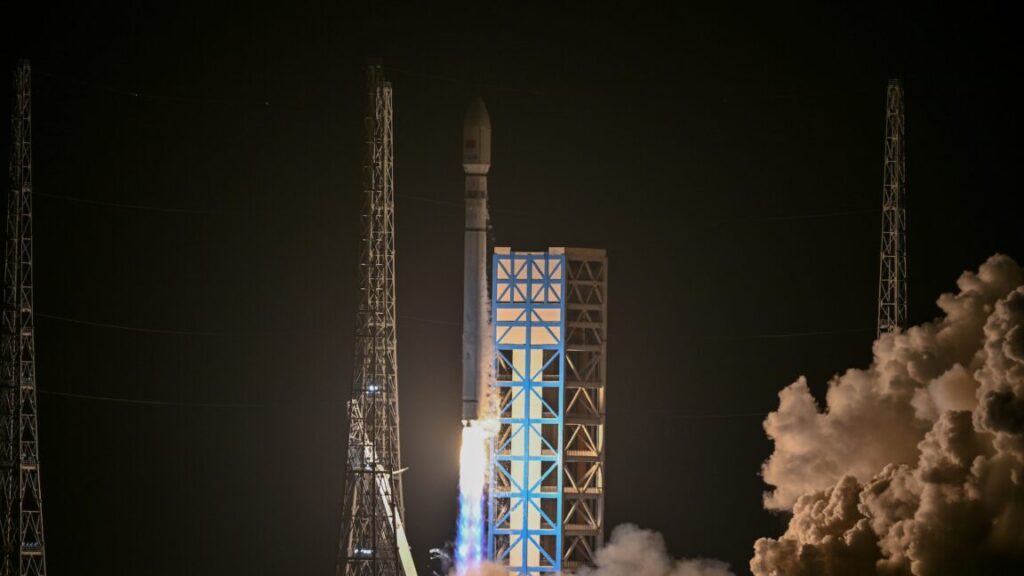
China’s new Long March 12 rocket made a successful inaugural flight Saturday, placing two experimental satellites into orbit and testing uprated, higher-thrust engines that will allow a larger Chinese launcher in development to send astronauts to the Moon.

The 203-foot-tall (62-meter) Long March 12 rocket lifted off at 9: 25 am EST (14: 25 UTC) Saturday from the Wenchang commercial launch site on Hainan Island, China’s southernmost province. This was also the first rocket launch from a new commercial spaceport at Wenchang, consisting of two launch sites a short distance from a pair of existing launch pads used by heavier rockets primarily geared for government missions.

The two-stage rocket delivered two technology demonstration satellites into a near-circular 50-degree-inclination orbit with an average altitude of nearly 650 miles (about 1,040 kilometers), according to US military tracking data.

The Long March 12 is the newest member of China’s Long March rocket family, which has been flying since China launched its first satellite into orbit in 1970. The Long March rockets have significantly evolved since then and now include a range of launch vehicles of different sizes and designs.

Versions of the Long March 2, 3, and 4 rockets have been flying since the 1970s and 1980s, burning the same toxic mix of hypergolic propellants as China’s early ICBMs. More recently, China debuted the Long March 5, 6, 7, and 8 rockets consuming the cleaner combination of kerosene and liquid oxygen propellants. These new rockets provide China with a spectrum of small, medium, and heavy-lift launch capabilities.

So many rockets

So, why bother with yet another Long March rocket? One reason is that Chinese officials seek a less expensive rocket to deploy thousands of small satellites for the country’s Internet mega-constellations to rival SpaceX’s Starlink network. Another motivation is to demonstrate the performance of upgraded rocket engines, new technologies, and fresh designs, some of which appear to copy SpaceX’s workhorse Falcon 9 rocket.

Like all of China’s other existing rockets, the Long March 12 configuration that flew Saturday is fully disposable. At the Zhuhai Airshow earlier this month, China’s largest rocket company displayed another version of the Long March 12 with a reusable first stage but with scant design details.

The Long March 12 is powered by four kerosene-fueled YF-100K engines on its first stage, generating more than 1.1 million pounds, or 5,000 kilonewtons of thrust at full throttle. These engines are upgraded, higher-thrust versions of the YF-100 engines used on several other types of Long March rockets.

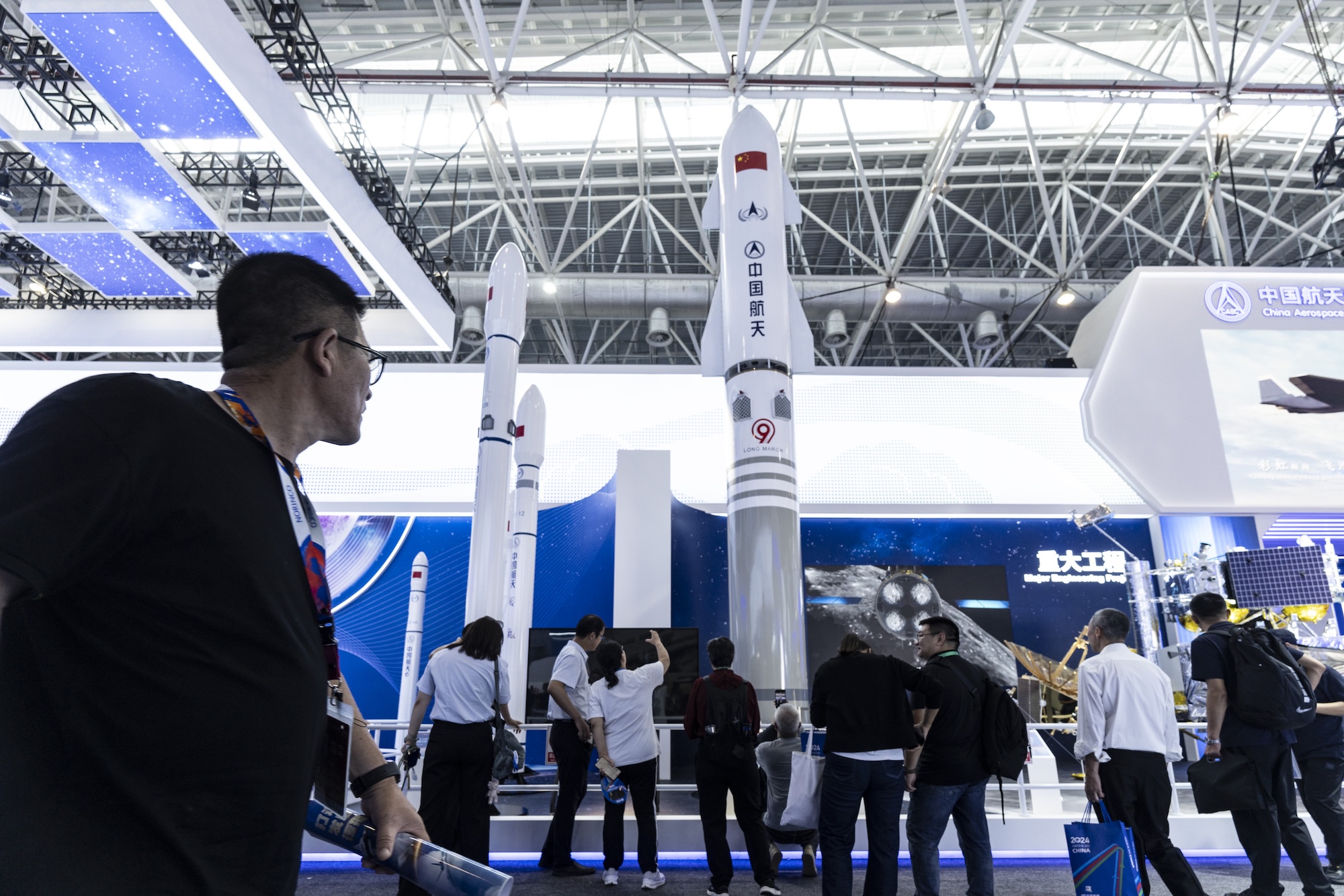
Models of the Long March rockets on display at the China National Space Administration (CNSA) booth during the China International Aviation & Aerospace Exhibition in Zhuhai, China, on November 12, 2024. In this image, models of a future reusable version of the Long March 12 (left) and the super-heavy Long March 9 (right) are visible. Credit: Qilai Shen/Bloomberg via Getty Images

Notably, China will use the YF-100K variant on the heavy-lift Long March 10 rocket in development to launch Chinese astronauts to the Moon. The heaviest version of the Long March 10 will use 21 of these YF-100K engines on its core stage and strap-on boosters. Now, Chinese engineers have tested the upgraded YF-100K in flight, with favorable results from Saturday’s launch.

China is also developing a new crew-rated spacecraft and lunar lander that will launch on Long March 10 rockets, eyeing a human landing on the lunar surface by 2030. The Long March 10 will have a reusable first stage like the Falcon 9, and China is now working on a super-heavy fully reusable rocket that appears to be a clone of SpaceX’s Starship. This Long March 9 rocket, which probably won’t fly until the 2030s, will enable larger-scale sustained lunar exploration by China.

And now, the details

The Long March 12 was developed by the Shanghai Academy of Spaceflight Technology, also known as SAST, one of the two main state-owned organizations in charge of designing and manufacturing Long March rockets. Together with the Beijing-based China Academy of Launch Vehicle Technology, SAST is part of the China Aerospace Science and Technology Corporation, the largest government-run enterprise overseeing the Chinese space program.

According to SAST, the Long March 12 is capable of delivering a payload of at least 12 metric tons (26,455 pounds) into low-Earth orbit and about half that to a somewhat higher Sun-synchronous orbit. Two kerosene-fueled YF-115 engines power the Long March 12’s upper stage.

The Long March 12 is also China’s first 3.8-meter (12.5-foot) diameter rocket, which is an optimal match between the width of the booster and lift capability, allowing it to be transported by railway to launch sites across China, according to the state-run Xinhua news agency.

China’s older Long March rocket variants are slimmer and generally require engineers to strap together multiple first-stage boosters in a cluster arrangement to achieve performance similar to the Long March 12. The core of the heavy-lift Long March 5 is around 5 meters in diameter and must be transported by sea.

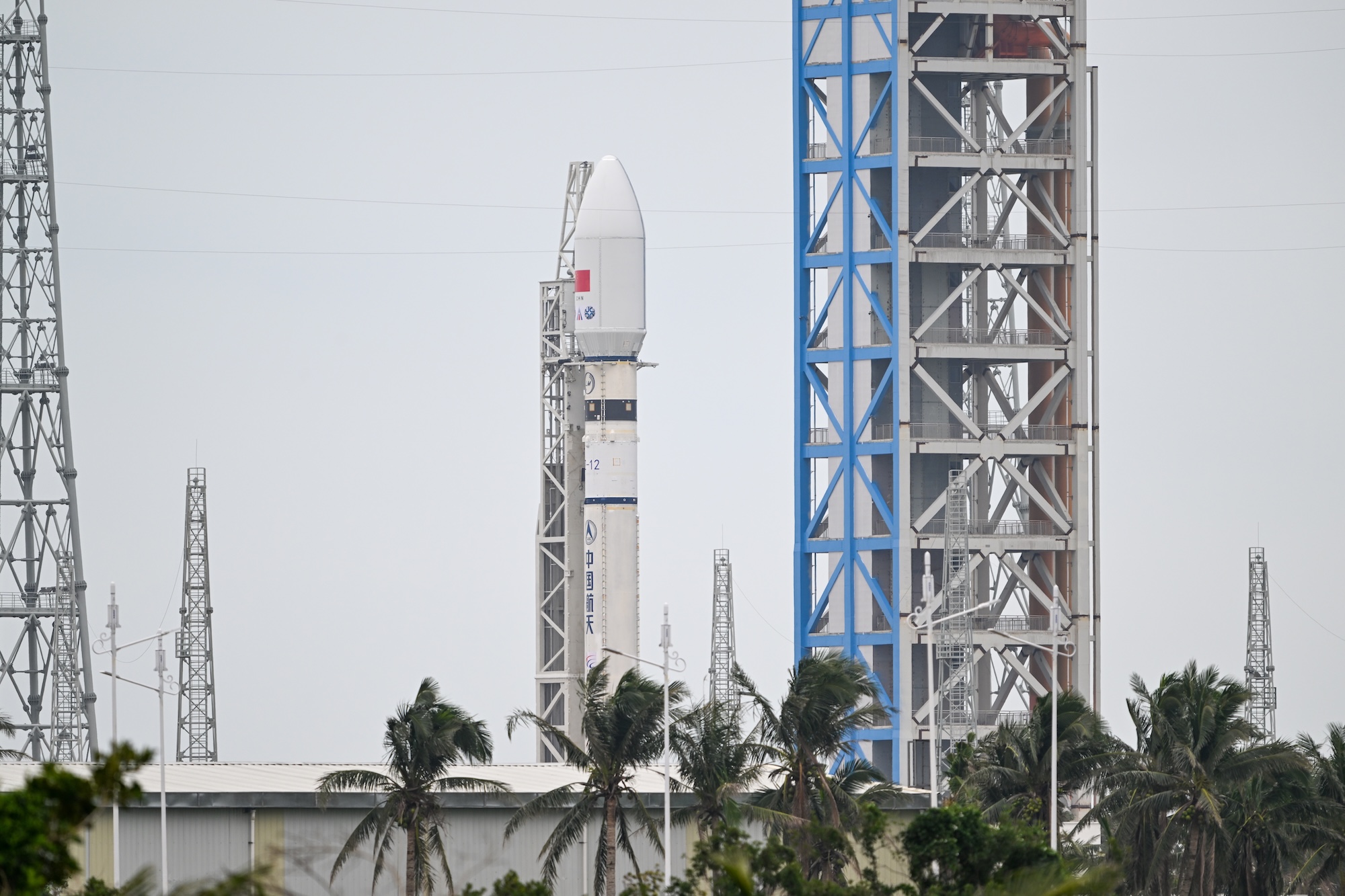
China’s first Long March 12 rocket on its launch pad before liftoff. Credit: Photo by VCG/VCG via Getty Images

In a post-launch press release, SAST identified several other “technology breakthroughs” flying on the Long March 12 rocket. These include a health management system that can diagnose anomalies in flight and adjust the rocket’s trajectory in real time to compensate for any minor problems. The Long March 12 is also China’s first rocket to use cryogenic helium to pressurize its liquid oxygen tanks, and its tanks are made of an aluminum-lithium alloy to save weight.

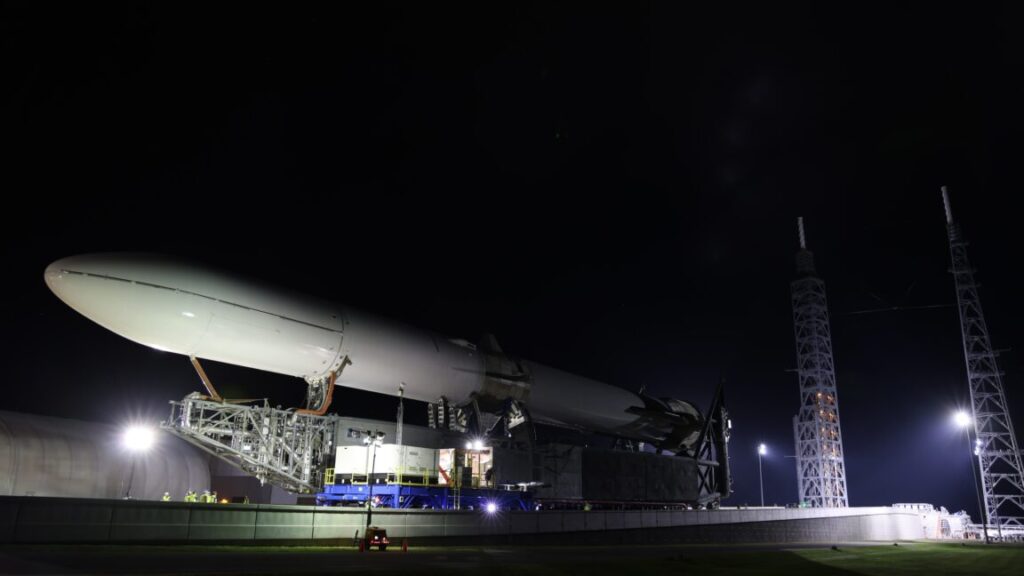
The Long March 12 is also the first rocket of its size in the Long March family to be assembled on its side instead of stacked vertically on its launch mount. After integrating the rocket in a nearby hangar, technicians transferred the first Long March 12 to its launch pad horizontally, then raised it vertical with an erector system. This is the same way SpaceX integrates and transports Falcon 9 rockets to the launch pad. SpaceX copied this horizontal integration approach from older Soviet-era rockets, and it offers several advantages, allowing teams to assemble rockets faster without the need for large overhead cranes in tall, cavernous vertical assembly buildings.

A bug or a feature?

We’ve already mentioned the proliferation of different types of Long March rockets, with nine classes of Long March launchers currently in operation. And each of these comes in multiple sub-variants.

This is a starkly different approach from SpaceX, which flies standardized rockets like the Falcon 9 and Falcon Heavy, which almost always fly in the same configuration, regardless of the payload or destination for each mission. The only exception is when SpaceX launches Dragon crew or cargo capsules on the Falcon 9.

Depending on how you count them, China now has roughly 18 different types of active space launchers. This number doesn’t include the Long March 9 or Long March 10, but it counts all the other Long March configurations, plus numerous small- and medium-class rockets fielded by China’s quasi-commercial space industry.

These startups operate with the blessing of China’s government and, in many cases, got their start by utilizing surplus military equipment and investment from Chinese local or provincial governments. However, the Chinese Communist Party has allowed them to raise capital from private sources, and they operate on a commercial basis, almost exclusively to serve domestic Chinese markets.

In some cases, these launch startups compete for commercial contracts directly with the government-backed Long March rocket family. The Long March 12 could be in the mix for launching large batches of spacecraft for China’s planned satellite Internet networks.

Some of these launch companies are working on reusable rockets similar in appearance to SpaceX’s Falcon 9. All of these rockets, government and commercial, are part of an ecosystem of Chinese launchers tasked with hauling military and commercial satellites into orbit.

The Long March 12 launch Saturday was China’s 58th orbital launch attempt of 2024, and no single subvariant of a Chinese rocket has flown more than seven times this year. This is in sharp contrast to the United States, which has logged 142 orbital launch attempts so far this year, 119 of them by SpaceX’s Falcon 9 or Falcon Heavy rockets.

There are around a dozen US orbital-class launch vehicle types you might call operational. But a few of these, such as Northrop Grumman’s Pegasus XL and Minotaur, and NASA’s Space Launch System, haven’t flown for several years.

SpaceX’s Falcon 9 is now the dominant leader in the US launch industry. Most of the Falcon 9 launches are filled to capacity with SpaceX’s own Starlink Internet satellites, but many missions fly with their payload fairings only partially full. Still, the Falcon 9 is more affordable on a per-kilogram basis than any other US rocket.

In China, on the other hand, none of the commercial launch startups have emerged as a clear leader. When that happens, if China allows the market to function in a truly commercial manner, some of these Chinese rocket companies will likely fold.

However, China’s government has a strategic interest in maintaining a portfolio of rockets and launch sites, same as the US government. For example, Chinese officials said the new launch site at Wenchang, where the Long March 12 took off from over the weekend, can accommodate 10 or more different types of rockets.

Photo of Stephen Clark

Stephen Clark is a space reporter at Ars Technica, covering private space companies and the world’s space agencies. Stephen writes about the nexus of technology, science, policy, and business on and off the planet.

Over the weekend, China debuted a new rocket on the nation’s path to the Moon Read More »

rocket-report:-a-good-week-for-blue-origin;-italy-wants-its-own-launch-capability

Rocket Report: A good week for Blue Origin; Italy wants its own launch capability


Blue Origin is getting ready to test-fire its first fully integrated New Glenn rocket in Florida.

Blue Origin’s first fully integrated New Glenn rocket rolls out to its launch pad at Cape Canaveral Space Force Station, Florida. Credit: Blue Origin

Welcome to Edition 7.21 of the Rocket Report! We’re publishing the Rocket Report a little early this week due to the Thanksgiving holiday in the United States. We don’t expect any Thanksgiving rocket launches this year, but still, there’s a lot to cover from the last six days. It seems like we’ve seen the last flight of the year by SpaceX’s Starship rocket. A NASA filing with the Federal Aviation Administration requests approval to fly an aircraft near the reentry corridor over the Indian Ocean for the next Starship test flight. The application suggests the target launch date is January 11, 2025.

As always, we welcome reader submissions. If you don’t want to miss an issue, please subscribe using the box below (the form will not appear on AMP-enabled versions of the site). Each report will include information on small-, medium-, and heavy-lift rockets as well as a quick look ahead at the next three launches on the calendar.

Another grim first in Ukraine. For the first time in warfare, Russia launched an Intermediate Range Ballistic Missile against a target in Ukraine, Ars reports. This attack on November 21 followed an announcement from Russian President Vladimir Putin earlier the same week that the country would change its policy for employing nuclear weapons in conflict. The IRBM, named Oreshnik, is the longest-range weapon ever used in combat in Europe, and could be refitted to carry nuclear warheads on future strikes.

Putin’s rationale … Putin says his ballistic missile attack on Ukraine is a warning to the West after the US and UK governments approved Ukraine’s use of Western-supplied ATACMS and Storm Shadow tactical ballistic missiles against targets on Russian territory. The Russian leader said his forces could attack facilities in Western countries that supply weapons for Ukraine to use on Russian territory, continuing a troubling escalatory ladder in the bloody war in Eastern Europe. Interestingly, this attack has another rocket connection. The target was apparently a factory in Dnipro that, not long ago, produced booster stages for Northrop Grumman’s Antares rocket.

Blue Origin hops again. Blue Origin launched its ninth suborbital human spaceflight over West Texas on November 22, CollectSpace reports. Six passengers rode the company’s suborbital New Shepard booster to the edge of space, reaching an altitude of 347,661 feet (65.8 miles or 106 kilometers), flying 3 miles (4.8 km) above the Kármán line that serves as the internationally-accepted border between Earth’s atmosphere and outer space. The pressurized capsule carrying the six passengers separated from the booster, giving them a taste of microgravity before parachuting back to Earth.

Dreams fulfilled … These suborbital flights are getting to be more routine, and may seem insignificant compared to Blue Origin’s grander ambitions of flying a heavy-lift rocket and building a human-rated Moon lander. However, we’ll likely have to wait many years before truly routine access to orbital flights becomes available for anyone other than professional astronauts or multimillionaires. This means tickets to ride on suborbital spaceships from Blue Origin or Virgin Galactic are currently the only ways to get to space, however briefly, for something on the order of $1 million or less. That puts the cost of one of these seats within reach for hundreds of thousands of people, and within the budgets of research institutions and non-profits to fund a flight for a scientist, student, or a member of the general public. The passengers on the November 22 flight included Emily Calandrelli, known online as “The Space Gal,” an engineer, Netflix host, and STEM education advocate who became the 100th woman to fly to space. (submitted by Ken the Bin)

The easiest way to keep up with Eric Berger’s and Stephen Clark’s reporting on all things space is to sign up for our newsletter. We’ll collect their stories and deliver them straight to your inbox.

Sign Me Up!

Rocket Lab flies twice in one day. Two Electron rockets took flight Sunday, one from New Zealand’s Mahia Peninsula and the other from Wallops Island, Virginia, making Rocket Lab the first commercial space company to launch from two different hemispheres in a 24-hour period, Payload reports. One of the missions was the third of five launches for the French Internet of Things company Kinéis, which is building a satellite constellation. The other launch was an Electron modified to act as a suborbital technology demonstrator for hypersonic research. Rocket Lab did not disclose the customer, but speculation is focused on the defense contractor Leidos, which signed a four-launch deal with Rocket Lab last year.

Building cadence … SpaceX first launched two Falcon 9 rockets in 24 hours in 2021. This year, the company launched three Falcon 9s in a single day from pads at Cape Canaveral Space Force Station, Florida, and Vandenberg Space Force Base, California. Rocket Lab has now launched 14 Electron rockets this year, more than any other Western company other than SpaceX. “Two successful launches less than 24 hours apart from pads in different hemispheres. That’s unprecedented capability in the small launch market and one we’re immensely proud to deliver at Rocket Lab,” said Peter Beck, the company’s founder and CEO. (submitted by Ken the Bin)

Italy to reopen offshore launch site. An Italian-run space center located in Kenya will once again host rocket launches from an offshore launch platform, European Spaceflight reports. The Italian minister for enterprises, Adolfo Urso, recently announced that the country decided to move ahead with plans to again launch rockets from the Luigi Broglio Space Center near Malindi, Kenya. “The idea is to give a new, more ambitious mission to this base and use it for the launch of low-orbit microsatellites,” Urso said.

Decades of dormancy … Between 1967 and 1988, the Italian government and NASA partnered to launch nine US-made Scout rockets from the Broglio Space Center to place small satellites into orbit. The rockets lifted off from the San Marco platform, a converted oil platform in equatorial waters off the Kenyan coast. Italian officials have not said what rocket might be used once the San Marco platform is reactivated, but Italy is the leading contributor on the Vega C rocket, a solid-fueled launcher somewhat larger than the Scout. Italy will manage the reactivation of the space center, which has remained in service as a satellite tracking station, under the country’s Mattei Plan, an initiative aimed at fostering stronger economic partnerships with African nations. (submitted by Ken the Bin)

SpaceX flies same rocket twice in two weeks. Less than 14 days after its previous flight, a Falcon 9 booster took off again from Florida’s Space Coast early Monday to haul 23 more Starlink internet satellites into orbit, Spaceflight Now reports. The booster, numbered B1080 in SpaceX’s fleet of reusable rockets, made its 13th trip to space before landing on SpaceX’s floating drone ship in the Atlantic Ocean. The launch marked a turnaround of 13 days, 12 hours, and 44 minutes from this booster’s previous launch November 11, also with a batch of Starlink satellites. The previous record turnaround time between flights of the same Falcon 9 booster was 21 days.

400 and still going … SpaceX’s launch prior to this one was on Saturday night, when a Falcon 9 carried a set of Starlinks aloft from Vandenberg Space Force Base, California. The flight Saturday night was the 400th launch of a Falcon 9 rocket since 2010, and SpaceX’s 100th launch from the West Coast. (submitted by Ken the Bin)

Chinese firm launches upgraded rocket. Chinese launch startup LandSpace put two satellites into orbit late Tuesday with the first launch of an improved version of the Zhuque-2 rocket, Space News reports. The enhanced rocket, named the Zhuque-2E, replaces vernier steering thrusters with a thrust vector control system on the second stage engine, saving roughly 880 pounds (400 kilograms) in mass. The Zhuque-2E rocket is capable of placing a payload of up to 8,800 pounds (4,000 kilograms) into a polar Sun-synchronous orbit, according to LandSpace.

LandSpace in the lead … Founded in 2015, LandSpace is a leader among China’s crop of quasi-commercial launch startups. The company hasn’t launched as often as some of its competitors, but it became the first launch operator in the world to successfully reach orbit with a methane/liquid oxygen (methalox) rocket last year. Now, LandSpace has improved on its design to create the Zhuque-2E rocket, which also has a large niobium allow nozzle extension on the second stage engine for reduced weight. LandSpace also claims the Zhuque-2E is China’s first rocket to use fully supercooled propellant loading, similar to the way SpaceX loads densified propellants into its rockets to achieve higher performance. (submitted by Ken the Bin)

NASA taps Falcon Heavy for another big launch. A little more than a month after SpaceX launched NASA’s flagship Europa Clipper mission on a Falcon Heavy rocket, the space agency announced its next big interplanetary probe will also launch on a Falcon Heavy, Ars reports. What’s more, the Dragonfly mission the Falcon Heavy will launch in 2028 is powered by a plutonium power source. This will be the first time SpaceX launches a rocket with nuclear materials onboard, requiring an additional layer of safety certification by NASA. The agency’s most recent nuclear-powered spacecraft have all launched on United Launch Alliance Atlas V rockets, which are nearing retirement.

The details … Dragonfly is one of the most exciting robotic missions NASA has ever developed. The mission is to send an automated rotorcraft to explore Saturn’s largest moon, Titan, where Dragonfly will soar through a soupy atmosphere in search of organic molecules, the building blocks of life. It’s a hefty vehicle, about the size of a compact car, and much larger than NASA’s Ingenuity Mars helicopter. The launch period opens July 5, 2028, to allow Dragonfly to reach Titan in 2034. NASA is paying SpaceX $256.6 million to launch the mission on a Falcon Heavy. (submitted by Ken the Bin)

New Glenn is back on the pad. Blue Origin has raised its fully stacked New Glenn rocket on the launch pad at Cape Canaveral Space Force Station ahead of pre-launch testing, Florida Today reports. The last time this new 322-foot-tall (98-meter) rocket was visible to the public eye was in March. Since then, Blue Origin has been preparing the rocket for its inaugural launch, which could yet happen before the end of the year. Blue Origin has not announced a target launch date.

But first, more tests … Blue Origin erected the New Glenn rocket vertical on the launch pad earlier this year for ground tests, but this is the first time a flight-ready (or close to it) New Glenn has been spotted on the pad. This time, the first stage booster has its full complement of seven methane-fueled BE-4 engines. Before the first flight, Blue Origin plans to test-fire the seven BE-4 engines on the pad and conduct one or more propellant loading tests to exercise the launch team, the rocket, and ground systems before launch day.

Second Ariane 6 incoming. ArianeGroup has confirmed that the first and second stages for the second Ariane 6 flight have begun the transatlantic voyage from Europe to French Guiana aboard the sail-assisted transport ship Canopée, European Spaceflight reports. The second Ariane 6 launch, previously targeted before the end of this year, has now been delayed to no earlier than February 2025, according to Arianespace, the rocket’s commercial operator. This follows a mostly successful debut launch in July.

An important passenger … While the first Ariane 6 launch carried a cluster of small experimental satellites, the second Ariane 6 rocket will carry a critical spy satellite into orbit for the French armed forces. Shipping the core elements of the second Ariane 6 to the launch site in Kourou, French Guiana, is a significant step in the launch campaign. Once in Kourou, the stages will be connected together and rolled out to the launch pad, where technicians will install two strap-on solid rocket boosters and the payload fairing containing France’s CSO-3 military satellite.

Next three launches

Nov. 29: Soyuz-2.1a | Kondor-FKA 2 | Vostochny Cosmodrome, Russia | 21: 50 UTC

Nov. 30: Falcon 9 | Starlink 6-65 | Cape Canaveral Space Force Station, Florida | 05: 00 UTC

Nov. 30: Falcon 9 | NROL-126 | Vandenberg Space Force Base, California | 08: 08 UTC

Photo of Stephen Clark

Stephen Clark is a space reporter at Ars Technica, covering private space companies and the world’s space agencies. Stephen writes about the nexus of technology, science, policy, and business on and off the planet.

Rocket Report: A good week for Blue Origin; Italy wants its own launch capability Read More »

trump-targets-mexico-and-canada-with-tariffs,-plus-an-extra-10%-for-china

Trump targets Mexico and Canada with tariffs, plus an extra 10% for China

Trump had in particular targeted Mexico on the campaign trail, threatening to impose “whatever tariffs are required—100 percent, 200 percent, 1,000 percent” to stop Chinese cars from crossing the southern border.

He has also warned Mexico’s president, Claudia Sheinbaum, he would impose tariffs of 25 percent if she did not crack down on the “onslaught of criminals and drugs” crossing the border.

The levies could be imposed using executive powers that would override the USMCA, the free trade agreement Trump signed with Canada and Mexico during his first term as president.

“There’s a lot of integration of North American manufacturing in a lot of sectors, particularly autos, so this would be pretty disruptive for a lot of US companies and industries,” said Warren Maruyama, former general counsel at the Office of the US Trade Representative. “Tariffs are inflationary and will drive up prices,” he added.

Ricardo Monreal, leader of Mexico’s ruling party in the lower house of congress, said tariffs would “not solve the underlying issue” at the border. “Escalating trade retaliation would only hurt people’s pockets,” he wrote on X.

Diego Marroquín Bitar at the Wilson Center think tank warned that unilateral tariffs “would shatter confidence in USMCA and harm all three economies.”

In a joint statement, Canada’s deputy prime minister, Chrystia Freeland, and public safety minister Dominic LeBlanc hailed the bilateral relationship with the US as “one of the strongest and closest… particularly when it comes to trade and border security.”

They also noted that Canada “buys more from the United States than China, Japan, France, and the UK combined,” and last year supplied “60 percent of US crude oil imports.”

“Even if this is a negotiating strategy, I don’t see what Canada has to offer that Trump is not already getting,” said Carlo Dade at the Canada West Foundation.

While Trump put tariffs at the center of his economic pitch to voters, President Joe Biden has also increased levies on Chinese imports. In May, Biden’s administration sharply increased tariffs on a range of imported clean-energy technologies, including boosting tariffs on electric vehicles from China to 100 percent.

Biden’s administration has also pushed Beijing for several years to crack down on the production of ingredients for fentanyl, which it estimated claimed the lives of almost 75,000 Americans in 2023. Beijing this year agreed to impose controls on chemicals crucial to manufacturing fentanyl following meetings with senior US officials.

Additional reporting by William Sandlund and Haohsiang Ko in Hong Kong, Christine Murray in Mexico City, Ilya Gridneff in Toronto, Joe Leahy in Beijing, and Alex Rogers in Washington.

© 2024 The Financial Times Ltd. All rights reserved. Not to be redistributed, copied, or modified in any way.

Trump targets Mexico and Canada with tariffs, plus an extra 10% for China Read More »

microsoft-president-asks-trump-to-“push-harder”-against-russian-hacks

Microsoft president asks Trump to “push harder” against Russian hacks

Smith testified before the US Senate in September that Russia, China, and Iran had stepped up their digital efforts to interfere in global elections this year, including in the US.

However, Microsoft’s own security standards have come under fire in recent months. A damning report by the US Cyber Safety Review Board in March said its security culture was “inadequate,” pointing to a “cascade… of avoidable errors” that last year allowed Chinese hackers to access hundreds of email accounts, including those belonging to senior US government security officials, that were hosted on Microsoft’s cloud systems.

Microsoft chief executive Satya Nadella has said in response that the company would prioritize security “above all else,” including by tying staff remuneration to security.

The company is also making changes to its Windows operating system to help its customers recover more quickly from incidents such as July’s global IT outage caused by CrowdStrike’s botched security update.

Beyond cyber security, Smith said it was “a little early” to determine the precise impact of a second Trump administration on the technology industry. Any anticipated liberalization of M&A regulation in the US would have to be weighed up against continued scrutiny of dealmaking in other parts of the world, he said.

Smith also reiterated his plea for the US government to “help accelerate exports of key American digital technologies,” especially to the Middle East and Africa, after the Biden administration imposed export controls on AI chips, fearing the technology could leak to China.

“We really need now to standardize processes so that American technology can reach these other parts of the world as fast as Chinese technology,” he said.

© 2024 The Financial Times Ltd. All rights reserved. Not to be redistributed, copied, or modified in any way.

Microsoft president asks Trump to “push harder” against Russian hacks Read More »

tsmc-will-stop-making-7-nm-chips-for-chinese-customers

TSMC will stop making 7 nm chips for Chinese customers

The company is understood to be particularly wary of being targeted as unreliable or uncooperative as Donald Trump is set to become the next US president.

This year, Trump accused Taiwan of “stealing” the US chip industry, and suggested TSMC could move its production back home after pocketing billions of dollars in subsidies from Washington for building fabrication plants in the US.

A person close to TSMC said its move was “not a show for Trump but definitely designed to underscore that we are the good guys and not acting against US interests.”

Being cut off from TSMC could hurt Chinese tech giants that have bet on making their most advanced AI chips in Taiwan. Search giant Baidu, in particular, is aiming to build a full stack of software and hardware to underpin its AI business.

Near the center of those efforts is its Kunlun series of AI chips. Its Kunlun II processor is made by TSMC on its 7-nanometer level of miniaturization, according to Bernstein Research.

“Kunlun chips are now especially well-suited for large model inference and will eventually be suitable for training,” Baidu founder Robin Li told a conference last year. Li added that the group had been effective in cutting costs by designing its own chips.

The people briefed on the situation said TSMC’s new rules were clear in targeting AI processors, but it was so far unclear how widely that would be applied to other chips. China has a number of leading start-ups designing AI chips for self-driving, including Hong Kong-listed Horizon Robotics and Black Sesame International Holding.

Executives and company materials at both groups have indicated their newest generation of chips would be made by TSMC on the 7-nanometer node.

The people close to TSMC said its new restrictions would not have a major impact on its revenue. TSMC’s October revenue increased 29.2 percent to NT$314 billion ($9.8 billion), a slight deceleration of growth compared with preceding months.

In a statement, TSMC said it was a “law-abiding company and we are committed to complying with all applicable rules and regulations, including applicable export controls.”

The news was first reported by Chinese media site ijiwei.com.

Nian Liu contributed reporting from Beijing.

© 2024 The Financial Times Ltd. All rights reserved. Not to be redistributed, copied, or modified in any way.

TSMC will stop making 7 nm chips for Chinese customers Read More »

rocket-report:-australia-says-yes-to-the-launch;-russia-delivers-for-iran

Rocket Report: Australia says yes to the launch; Russia delivers for Iran


The world’s first wooden satellite arrived at the International Space Station this week.

A Falcon 9 booster fires its engines on SpaceX’s “tripod” test stand in McGregor, Texas. Credit: SpaceX

Welcome to Edition 7.19 of the Rocket Report! Okay, we get it. We received more submissions from our readers on Australia’s approval of a launch permit for Gilmour Space than we’ve received on any other news story in recent memory. Thank you for your submissions as global rocket activity continues apace. We’ll cover Gilmour in more detail as they get closer to launch. There will be no Rocket Report next week as Eric and I join the rest of the Ars team for our 2024 Technicon in New York.

As always, we welcome reader submissions. If you don’t want to miss an issue, please subscribe using the box below (the form will not appear on AMP-enabled versions of the site). Each report will include information on small-, medium-, and heavy-lift rockets as well as a quick look ahead at the next three launches on the calendar.

Gilmour Space has a permit to fly. Gilmour Space Technologies has been granted a permit to launch its 82-foot-tall (25-meter) orbital rocket from a spaceport in Queensland, Australia. The space company, founded in 2012, had initially planned to lift off in March but was unable to do so without approval from the Australian Space Agency, the Australian Broadcasting Corporation reports. The government approved Gilmour’s launch permit Monday, although the company is still weeks away from flying its three-stage Eris rocket.

A first for Australia … Australia hosted a handful of satellite launches with US and British rockets from 1967 through 1971, but Gilmour’s Eris rocket would become the first all-Australian launch vehicle to reach orbit. The Eris rocket is capable of delivering about 670 pounds (305 kilograms) of payload mass into a Sun-synchronous orbit. Eris will be powered by hybrid rocket engines burning a solid fuel mixed with a liquid oxidizer, making it unique among orbital-class rockets. Gilmour completed a wet dress rehearsal, or practice countdown, with the Eris rocket on the launch pad in Queensland in September. The launch permit becomes active after 30 days, or the first week of December. “We do think we’ve got a good chance of launching at the end of the 30-day period, and we’re going to give it a red hot go,” said Adam Gilmour, the company’s co-founder and CEO. (submitted by Marzipan, mryall, ZygP, Ken the Bin, Spencer Willis, MarkW98, and EllPeaTea)

North Korea tests new missile. North Korea apparently completed a successful test of its most powerful intercontinental ballistic missile on October 31, lofting it nearly 4,800 miles (7,700 kilometers) into space before the projectile fell back to Earth, Ars reports. This solid-fueled, multi-stage missile, named the Hwasong-19, is a new tool in North Korea’s increasingly sophisticated arsenal of weapons. It has enough range—perhaps as much as 9,320 miles (15,000 kilometers), according to Japan’s government—to strike targets anywhere in the United States. It also happens to be one of the largest ICBMs in the world, rivaling the missiles fielded by the world’s more established nuclear powers.

Quid pro quo? … The Hwasong-19 missile test comes as North Korea deploys some 10,000 troops inside Russia to support the country’s war against Ukraine. The budding partnership between Russia and North Korea has evolved for several years. Russian President Vladimir Putin has met with North Korean leader Kim Jong Un on multiple occasions, most recently in Pyongyang in June. This has fueled speculation about what Russia is offering North Korea in exchange for the troops deployed on Russian soil. US and South Korean officials have some thoughts. They said North Korea is likely to ask for technology transfers in diverse areas related to tactical nuclear weapons, ICBMs, and reconnaissance satellites.

The easiest way to keep up with Eric Berger’s and Stephen Clark’s reporting on all things space is to sign up for our newsletter. We’ll collect their stories and deliver them straight to your inbox.

Sign Me Up!

Virgin Galactic is on the hunt for cash. Virgin Galactic is proposing to raise $300 million in additional capital to accelerate production of suborbital spaceplanes and a mothership aircraft the company says can fuel its long-term growth, Space News reports. The company, founded by billionaire Richard Branson, suspended operations of its VSS Unity suborbital spaceplane earlier this year. VSS Unity hit a monthly flight cadence carrying small groups of space tourists and researchers to the edge of space, but it just wasn’t profitable. Now, Virgin Galactic is developing larger Delta-class spaceplanes it says will be easier and cheaper to turn around between flights.

All-in with Delta … Michael Colglazier, Virgin Galactic’s CEO, announced the company’s appetite for fundraising in a quarterly earnings call with investment analysts Wednesday. He said manufacturing of components for Virgin Galactic’s first two Delta-class ships, which the company says it can fund with existing cash, is proceeding on schedule at a factory in Arizona. Virgin Galactic previously said it would use revenue from paying passengers on its first two Delta-class ships to pay for development of future vehicles. Instead, Virgin Galactic now says it wants to raise money to speed up work on the third and fourth Delta-class vehicles, along with a second airplane mothership to carry the spaceplanes aloft before they release and fire into space. (submitted by Ken the Bin and EllPeaTea)

ESA breaks its silence on Themis. The European Space Agency has provided a rare update on the progress of its Themis reusable booster demonstrator project, European Spaceflight reports. ESA is developing the Themis test vehicle for atmospheric flights to fine-tune technologies for a future European reusable rocket capable of vertical takeoffs and vertical landings. Themis started out as a project led by CNES, the French space agency, in 2018. ESA member states signed up to help fund the project in 2019, and the agency awarded ArianeGroup a contract to move forward with Themis in 2020. At the time, the first low-altitude hop test was expected to take place in 2022.

Some slow progress … Now, the first low-altitude hop is scheduled for 2025 from Esrange Space Centre in Sweden, a three-year delay. This week, ESA said engineers have completed testing of the Themis vehicle’s main systems, and assembly of the demonstrator is underway in France. A single methane-fueled Prometheus engine, also developed by ArianeGroup, has been installed on the rocket. Teams are currently adding avionics, computers, electrical systems, and cable harnesses. Themis’ stainless steel propellant tanks have been manufactured, tested, and cleaned and are now ready to be installed on the Themis demonstrator. Then, the rocket will travel by road from France to the test site in Sweden for its initial low-altitude hops. After those flights are complete, officials plan to add two more Prometheus engines to the rocket and ship it to French Guiana for high-altitude test flights. (submitted by Ken the Bin and EllPeaTea)

SpaceX will give the ISS a boost. A Cargo Dragon spacecraft docked to the International Space Station on Tuesday morning, less than a day after lifting off from Florida. As space missions go, this one is fairly routine, ferrying about 6,000 pounds (2,700 kilograms) of cargo and science experiments to the space station. One thing that’s different about this mission is that it delivered to the station a tiny 2 lb (900 g) satellite named LignoSat, the first spacecraft made of wood, for later release outside the research complex. There is one more characteristic of this flight that may prove significant for NASA and the future of the space station, Ars reports. As early as Friday, NASA and SpaceX have scheduled a “reboost and attitude control demonstration,” during which the Dragon spacecraft will use some of the thrusters at the base of the capsule. This is the first time the Dragon spacecraft will be used to move the space station.

Dragon’s breath … Dragon will fire a subset of its 16 Draco thrusters, each with about 90 pounds of thrust, for approximately 12.5 minutes to make a slight adjustment to the orbital trajectory of the roughly 450-ton space station. SpaceX and NASA engineers will analyze the results from the demonstration to determine if Dragon could be used for future space station reboost opportunities. The data will also inform the design of the US Deorbit Vehicle, which SpaceX is developing to perform the maneuvers required to bring the space station back to Earth for a controlled, destructive reentry in the early 2030s. For NASA, demonstrating Dragon’s ability to move the space station will be another step toward breaking free of reliance on Russia, which is currently responsible for providing propulsion to maneuver the orbiting outpost. Northrop Grumman’s Cygnus supply ship also previously demonstrated a reboost capability. (submitted by Ken the Bin and N35t0r)

Russia launches Soyuz in service of Iran. Russia launched a Soyuz rocket Monday carrying two satellites designed to monitor the space weather around Earth and 53 small satellites, including two Iranian ones, Reuters reports. The primary payloads aboard the Soyuz-2.1b rocket were two Ionosfera-M satellites to probe the ionosphere, an outer layer of the atmosphere near the edge of space. Solar activity can alter conditions in the ionosphere, impacting communications and navigation. The two Iranian satellites on this mission were named Kowsar and Hodhod. They will collect high-resolution reconnaissance imagery and support communications for Iran.

A distant third … This was only the 13th orbital launch by Russia this year, trailing far behind the United States and China. We know of two more Soyuz flights planned for later this month, but no more, barring a surprise military launch (which is possible). The projected launch rate puts Russia on pace for its quietest year of launch activity since 1961, the year Yuri Gagarin became the first person to fly in space. A major reason for this decline in launches is the decisions of Western governments and companies to move their payloads off of Russian rockets after the invasion of Ukraine. For example, OneWeb stopped launching on Soyuz in 2022, and the European Space Agency suspended its partnership with Russia to launch Soyuz rockets from French Guiana. (submitted by Ken the Bin)

H3 deploys Japanese national security satellite. Japan launched a defense satellite Monday aimed at speedier military operations and communication on an H3 rocket and successfully placed it into orbit, the Associated Press reports. The Kirameki 3 satellite will use high-speed X-band communication to support Japan’s defense ministry with information and data sharing, and command and control services. The satellite will serve Japanese land, air, and naval forces from its perch in geostationary orbit alongside two other Kirameki communications satellites.

Gaining trust … The H3 is Japan’s new flagship rocket, developed by Mitsubishi Heavy Industries (MHI) and funded by the Japan Aerospace Exploration Agency (JAXA). The launch of Kirameki 3 marked the third consecutive successful launch of the H3 rocket, following a debut flight in March 2023 that failed to reach orbit. This was the first time Japan’s defense ministry put one of its satellites on the H3 rocket. The first two Kirameki satellites launched on a European Ariane 5 and a Japanese H-IIA rocket, which the H3 will replace. (submitted by Ken the Bin, tsunam, and EllPeaTea)

Rocket Lab enters the race for military contracts. Rocket Lab is aiming to chip away at SpaceX’s dominance in military space launch, confirming its bid to compete for Pentagon contracts with its new medium-lift rocket, Neutron, Space News reports. Last month, the Space Force released a request for proposals from launch companies seeking to join the military’s roster of launch providers in the National Security Space Launch (NSSL) program. The Space Force will accept bids for launch providers to “on-ramp” to the NSSL Phase 3 Lane 1 contract, which doles out task orders to launch companies for individual missions. In order to win a task order, a launch provider must be on the Phase 3 Lane 1 contract. Currently, SpaceX, United Launch Alliance, and Blue Origin are the only rocket companies eligible. SpaceX won all of the first round of Lane 1 task orders last month.

Joining the club … The Space Force is accepting additional risk for Lane 1 missions, which largely comprise repeat launches deploying a constellation of missile-tracking and data-relay satellites for the Space Development Agency. A separate class of heavy-lift missions, known as Lane 2, will require rockets to undergo a thorough certification by the Space Force to ensure their reliability. In order for a launch company to join the Lane 1 roster, the Space Force requires bidders to be ready for a first launch by December 2025. Peter Beck, Rocket Lab’s founder and CEO, said he thinks the Neutron rocket will be ready for its first launch by then. Other new medium-lift rockets, such as Firefly Aerospace’s MLV and Relativity’s Terran-R, almost certainly won’t be ready to launch by the end of next year, leaving Rocket Lab as the only company that will potentially join incumbents SpaceX, ULA, and Blue Origin. (submitted by Ken the Bin)

Next Starship flight is just around the corner. Less than a month has passed since the historic fifth flight of SpaceX’s Starship, during which the company caught the booster with mechanical arms back at the launch pad in Texas. Now, another test flight could come as soon as November 18, Ars reports. The improbable but successful recovery of the Starship first stage with “chopsticks” last month, and the on-target splashdown of the Starship upper stage halfway around the world, allowed SpaceX to avoid an anomaly investigation by the Federal Aviation Administration. Thus, the company was able to press ahead on a sixth test flight if it flew a similar profile. And that’s what SpaceX plans to do, albeit with some notable additions to the flight plan.

Around the edges … Perhaps the most significant change to the profile for Flight 6 will be an attempt to reignite a Raptor engine on Starship while it is in space. SpaceX tried to do this on a test flight in March but aborted the burn because the ship’s rolling motion exceeded limits. A successful demonstration of a Raptor engine relight could pave the way for SpaceX to launch Starship into a higher stable orbit around Earth on future test flights. This is required for SpaceX to begin using Starship to launch Starlink Internet satellites and perform in-orbit refueling experiments with two ships docked together. (submitted by EllPeaTea)

China’s version of Starship. China has updated the design of its next-generation heavy-lift rocket, the Long March 9, and it looks almost exactly like a clone of SpaceX’s Starship rocket, Ars reports. The Long March 9 started out as a conventional-looking expendable rocket, then morphed into a launcher with a reusable first stage. Now, the rocket will have a reusable booster and upper stage. The booster will have 30 methane-fueled engines, similar to the number of engines on SpaceX’s Super Heavy booster. The upper stage looks remarkably like Starship, with flaps in similar locations. China intends to fly this vehicle for the first time in 2033, nearly a decade from now.

A vehicle for the Moon … The reusable Long March 9 is intended to unlock robust lunar operations for China, similar to the way Starship, and to some extent Blue Origin’s Blue Moon lander, promises to support sustained astronaut stays on the Moon’s surface. China says it plans to land its astronauts on the Moon by 2030, initially using a more conventional architecture with an expendable rocket named the Long March 10, and a lander reminiscent of NASA’s Apollo lunar lander. These will allow Chinese astronauts to remain on the Moon for a matter of days. With Long March 9, China could deliver massive loads of cargo and life support resources to sustain astronauts for much longer stays.

Ta-ta to the tripod. The large three-legged vertical test stand at SpaceX’s engine test site in McGregor, Texas, is being decommissioned, NASA Spaceflight reports. Cranes have started removing propellant tanks from the test stand, nicknamed the tripod, towering above the Central Texas prairie. McGregor is home to SpaceX’s propulsion test team and has 16 test cells to support firings of Merlin, Raptor, and Draco engines multiple times per day for the Falcon 9 rocket, Starship, and Dragon spacecraft.

Some history … The tripod might have been one of SpaceX’s most important assets in the company’s early years. It was built by Beal Aerospace for liquid-fueled rocket engine tests in the late 1990s. Beal Aerospace folded, and SpaceX took over the site in 2003. After some modifications, SpaceX installed the first qualification version of its Falcon 9 rocket on the tripod for a series of nine-engine test-firings leading up to the rocket’s inaugural flight in 2010. SpaceX test-fired numerous new Falcon 9 boosters on the tripod before shipping them to launch sites in Florida or California. Most recently, the tripod was used for testing of Raptor engines destined to fly on Starship and the Super Heavy booster.

Next three launches

Nov. 9:  Long March 2C | Unknown Payload | Jiuquan Satellite Launch Center, China | 03: 40 UTC

Nov. 9: Falcon 9 | Starlink 9-10 | Vandenberg Space Force Base, California | 06: 14 UTC

Nov. 10:  Falcon 9 | Starlink 6-69 | Cape Canaveral Space Force Station, Florida | 21: 28 UTC

Photo of Stephen Clark

Stephen Clark is a space reporter at Ars Technica, covering private space companies and the world’s space agencies. Stephen writes about the nexus of technology, science, policy, and business on and off the planet.

Rocket Report: Australia says yes to the launch; Russia delivers for Iran Read More »

us-space-force-warns-of-“mind-boggling”-build-up-of-chinese-capabilities

US Space Force warns of “mind-boggling” build-up of Chinese capabilities

Both Russia and China have tested satellites with capabilities that include grappling hooks to pull other satellites out of orbit and “kinetic kill vehicles” that can target satellites and long-range ballistic missiles in space.

In May, a senior US defense department official told a House Armed Services Committee hearing that Russia was developing an “indiscriminate” nuclear weapon designed to be sent into space, while in September, China made a third secretive test of an unmanned space plane that could be used to disrupt satellites.

The US is far ahead of its European allies in developing military space capabilities, but it wanted to “lay the foundations” for the continent’s space forces, Saltzman said. Last year UK Air Marshal Paul Godfrey was appointed to oversee allied partnerships with NATO with the US Space Force—one of the first times that a high-ranking allied pilot had joined the US military.

But Saltzman warned against a rush to build up space forces across the continent.

“It is resource-intensive to separate out and stand up a new service. Even … in America where we think we have more resources, we underestimated what it was going to take,” he said.

The US Space Force, which monitors more than 46,000 objects in orbit, has about 10,000 personnel but is the smallest department of the US military. Its officers are known as “guardians.”

The costs of building up space defense capabilities mean the US is heavily reliant on private companies, raising concerns about the power of billionaires in a sector where regulation remains minimal.

SpaceX, led by prominent Trump backer Elon Musk, is increasingly working with US military and intelligence through its Starshield arm, which is developing low Earth orbit satellites that track missiles and support intelligence gathering.

This month, SpaceX was awarded a $734 million contract to provide space launch services for US defense and intelligence agencies.

Despite concerns about Musk’s erratic behavior and reports that the billionaire has had regular contact with Russian President Vladimir Putin, Saltzman said he had no concerns about US government collaboration with SpaceX.

“I’m very comfortable that they’ll execute those [contracts] exactly the way they’re designed. All of the dealings I’ve had with SpaceX have been very professional,” he said.

Additional reporting by Kathrin Hille in Taipei.

© 2024 The Financial Times Ltd. All rights reserved. Not to be redistributed, copied, or modified in any way.

US Space Force warns of “mind-boggling” build-up of Chinese capabilities Read More »

rocket-report:-sneak-peek-at-the-business-end-of-new-glenn;-france-to-fly-frog

Rocket Report: Sneak peek at the business end of New Glenn; France to fly FROG


“The vehicle’s max design gimbal condition is during ascent when it has to fight high-altitude winds.”

Blue Origin’s first New Glenn rocket, with seven BE-4 engines installed inside the company’s production facility near NASA’s Kennedy Space Center in Florida. Credit: Blue Origin

Welcome to Edition 7.17 of the Rocket Report! Next week marks 10 years since one of the more spectacular launch failures of this century. On October 28, 2014, an Antares rocket, then operated by Orbital Sciences, suffered an engine failure six seconds after liftoff from Virginia and crashed back onto the pad in a fiery twilight explosion. I was there and won’t forget seeing the rocket falter just above the pad, being shaken by the deafening blast, and then running for cover. The Antares rocket is often an afterthought in the space industry, but it has an interesting backstory touching on international geopolitics, space history, and novel engineering. Now, Northrop Grumman and Firefly Aerospace are developing a new version of Antares.

As always, we welcome reader submissions. If you don’t want to miss an issue, please subscribe using the box below (the form will not appear on AMP-enabled versions of the site). Each report will include information on small-, medium-, and heavy-lift rockets as well as a quick look ahead at the next three launches on the calendar.

Astra gets a lifeline from DOD. Astra, the launch startup that was taken private again earlier this year for a sliver of its former value, has landed a new contract with the Defense Innovation Unit (DIU) to support the development of a next-gen launch system for time-sensitive space missions, TechCrunch reports. The contract, which the DIU awarded under its Novel Responsive Space Delivery (NRSD) program, has a maximum value of $44 million. The money will go toward the continued development of Astra’s Launch System 2, designed to perform rapid, ultra-low-cost launches.

Guarantees? … It wasn’t clear from the initial reporting how much money DIU is actually committing to Astra, which said the contract will fund continued development of Launch System 2. Launch System 2 includes a small-class launch vehicle with a similarly basic name, Rocket 4, and mobile ground infrastructure designed to be rapidly set up at austere spaceports. Adam London, founder and chief technology officer at Astra, said the contract award is a “major vote of confidence” in the company. If Astra can capitalize on the opportunity, this would be quite a remarkable turnaround. After going public at an initial valuation of $2.1 billion, or $12.90 per share, Astra endured multiple launch failures with its previous rocket and risked bankruptcy before the company’s co-founders, Chris Kemp and Adam London, took the company private again this year at a price of just $0.50 per share. (submitted by Ken the Bin and EllPeaTea)

Blue Origin debuts a new New Shepard. Jeff Bezos’ Blue Origin space venture successfully sent a brand-new New Shepard rocket ship on an uncrewed shakedown cruise Wednesday, with the aim of increasing the company’s capacity to take people on suborbital space trips, GeekWire reports. The capsule, dubbed RSS Karman Line, carried payloads instead of people when it lifted off from Blue Origin’s Launch Site One in West Texas. But if all the data collected during the 10-minute certification flight checks out, it won’t be long before crews climb aboard for similar flights.

Now there are two … With this week’s flight, Blue Origin now has two human-rated suborbital capsules in its fleet, along with two boosters. This should allow the company to ramp up the pace of its human missions, which have historically flown at a cadence of about one flight every two to three months. The new capsule, named for the internationally recognized boundary of space 62 miles (100 kilometers) above Earth, features upgrades to improve performance and ease reusability. (submitted by Ken the Bin and EllPeaTea)

The easiest way to keep up with Eric Berger’s and Stephen Clark’s reporting on all things space is to sign up for our newsletter. We’ll collect their stories and deliver them straight to your inbox.

Sign Me Up!

China has a new space tourism company. Chinese launch startup Deep Blue Aerospace targets providing suborbital tourism flights starting in 2027, Space News reports. The company was already developing a partially reusable orbital rocket named Nebula-1 for satellite launches and recently lost a reusable booster test vehicle during a low-altitude test flight. While Deep Blue moves forward with more Nebula-1 testing before its first orbital launch, the firm is now selling tickets for rides to suborbital space on a six-person capsule. The first two tickets were expected to be sold Thursday in a promotional livestream event.

Architectural considerations … Deep Blue has a shot at becoming China’s first space tourism company and one of only a handful in the world, joining US-based Blue Origin and Virgin Galactic in the market for suborbital flights. Deep Blue’s design will be a single-stage reusable rocket and crew capsule, similar to Blue Origin’s New Shepard, capable of flying above the Kármán line and providing up to 10 minutes of microgravity experience for its passengers before returning to the ground. A ticket, presumably for a round trip, will cost about $210,000. (submitted by Ken the Bin)

France’s space agency aims to launch a FROG. French space agency CNES will begin flight testing a small reusable rocket demonstrator called FROG-H in 2025, European Spaceflight reports. FROG is a French acronym that translates to Rocket for GNC demonstration, and its purpose is to test landing algorithms for reusable launch vehicles. CNES manages the program in partnership with French nonprofits and universities. At 11.8 feet (3.6 meters) tall, FROG is the smallest launch vehicle prototype at CNES, which says it will test concepts and technologies at small scale before incorporating them into Europe’s larger vertical takeoff/vertical landing test rockets like Callisto and Themis. Eventually, the idea is for all this work to lead to a reusable European orbital-class rocket.

Building on experience … CNES flew a jet-powered demonstrator named FROG-T on five test flights beginning in May 2019, reaching a maximum altitude of about 100 feet (30 meters). FROG-H will be powered by a hydrogen peroxide rocket engine developed by the Łukasiewicz Institute of Aviation in Poland under a European Space Agency contract. The first flights of FROG-H are scheduled for early 2025. The structure of the FROG project seeks to “break free from traditional development methods” by turning to “teams of enthusiasts” to rapidly develop and test solutions through an experimental approach, CNES says on its website. (submitted by EllPeaTea and Ken the Bin)

Falcon 9 sweeps NSSL awards. The US Space Force’s Space Systems Command announced on October 18 it has ordered nine launches from SpaceX in the first batch of dozens of missions the military will buy in a new phase of competition for lucrative national security launch contracts, Ars reports. The parameters of the competition limited the bidders to SpaceX and United Launch Alliance (ULA). SpaceX won both task orders for a combined value of $733.5 million, or roughly $81.5 million per mission. Six of the nine missions will launch from Vandenberg Space Force Base, California, beginning as soon as late 2025. The other three will launch from Cape Canaveral Space Force Station, Florida.

Head-to-head … This was the first set of contract awards by the Space Force’s National Security Space Launch (NSSL) Phase 3 procurement round and represents one of the first head-to-head competitions between SpaceX’s Falcon 9 and ULA’s Vulcan rocket. The nine launches were divided into two separate orders, and SpaceX won both. The missions will deploy payloads for the National Reconnaissance Office and the Space Development Agency. (submitted by Ken the Bin)

SpaceX continues deploying NRO megaconstellation. SpaceX launched more surveillance satellites for the National Reconnaissance Office Thursday aboard a Falcon 9 rocket, Spaceflight Now reports. While the secretive spy satellite agency did not identify the number or exact purpose of the satellites, the Falcon 9 likely deployed around 20 spacecraft believed to be based on SpaceX’s Starshield satellite bus, a derivative of the Starlink spacecraft platform, with participation from Northrop Grumman. These satellites host classified sensors for the NRO.  This is the fourth SpaceX launch for the NRO’s new satellite fleet, which seeks to augment the agency’s bespoke multibillion-dollar spy satellites with a network of smaller, cheaper, more agile platforms in low-Earth orbit.

The century mark … This mission, officially designated NROL-167, was the 100th flight of a Falcon 9 rocket this year and the 105th SpaceX launch overall in 2024. The NRO has not said how many satellites will make up its fleet when completed, but the intelligence agency says it will be the US government’s largest satellite constellation in history. By the end of the year, the NRO expects to have 100 or more of these satellites in orbit, allowing the agency to transition from a demonstration mode to an operational mode to deliver intelligence data to military and government users. Many more launches are expected through 2028. (submitted by Ken the Bin)

ULA is stacking its third Vulcan rocket. United Launch Alliance has started assembling its next Vulcan rocket—the first destined to launch a US military payload—as the Space Force prepares to certify it to loft the Pentagon’s most precious national security satellites, Ars reports. Space Force officials expect to approve ULA’s Vulcan rocket for military missions without requiring another test flight, despite an unusual problem on the rocket’s second demonstration flight earlier this month, when one of Vulcan’s two strap-on solid-fueled boosters lost its nozzle shortly after liftoff.

Pending certification … Despite the nozzle failure, the Vulcan rocket continued climbing into space and eventually reached its planned injection orbit, and the Space Force and ULA declared the test flight a success. Still, engineers want to understand what caused the nozzle to break apart and decide on corrective actions before the Space Force clears the Vulcan rocket to launch a critical national security payload. This could take a little longer than expected due to the booster problem, but Space Force officials still hope to certify the Vulcan rocket in time to support a national security launch by the end of the year.

Blue Origin’s first New Glenn has all its engines. Blue Origin published a photo Thursday on X showing all seven first-stage BE-4 engines installed on the base of the company’s first New Glenn rocket. This is a notable milestone as Blue Origin proceeds toward the first launch of the heavy-lifter, possibly before the end of the year. But there’s a lot of work for Blue Origin to accomplish before then. These steps include rolling the rocket to the launch pad, running through propellant loading tests and practice countdowns, and then test-firing all seven BE-4 engines on the pad at Cape Canaveral Space Force Station, Florida.

Seven for seven … The BE-4 engines will consume methane fuel mixed with liquid oxygen for the first few minutes of the New Glenn flight, generating more than 3.8 million pounds of combined thrust. The seven BE-4s on New Glenn are similar to the BE-4 engines that fly two at a time on ULA’s Vulcan rocket. Dave Limp, Blue Origin’s CEO, said three of the seven engines on the New Glenn first stage have thrust vector control capability to provide steering during launch, reentry, and landing on the company’s offshore recovery vessel. “That gimbal capability, along with the landing gear and Reaction Control System thrusters, are key to making our booster fully reusable,” Limp wrote on X. “Fun fact: The vehicle’s max design gimbal condition is during ascent when it has to fight high-altitude winds.”

Next Super Heavy booster test-fired in Texas. SpaceX fired up the Raptor engines on its next Super Heavy booster, numbered Booster 13, Thursday evening at the company’s launch site in South Texas. This happened just 11 days after SpaceX launched and caught the Super Heavy booster on the previous Starship test flight and signals SpaceX could be ready for the next Starship test flight sometime in November. SpaceX has already test-fired the Starship upper stage for the next flight.

Great expectations … We expect the next Starship flight, which will be program’s sixth full-scale demo mission, will include another booster catch back at the launch tower at Starbase, Texas. SpaceX may also attempt to reignite a Raptor engine on the Starship upper stage while it is in space, demonstrating the capability to steer itself back into the atmosphere on future flights. So far, SpaceX has only launched Starships on long, arcing suborbital trajectories that carry the vehicle halfway around the world before reentry. In order to actually launch a Starship into a stable orbit around Earth, SpaceX will want to show it can bring the vehicle back so it doesn’t reenter the atmosphere in an uncontrolled manner. An uncontrolled reentry of a large spacecraft like Starship could pose a public safety risk.

Next three launches

Oct. 26: Falcon 9 | Starlink 10-8 | Cape Canaveral Space Force Station, Florida | 21: 47 UTC

Oct. 29: Falcon 9 | Starlink 9-9 | Vandenberg Space Force Base, California | 11: 30 UTC

Oct. 30: H3 | Kirameki 3 | Tanegashima Space Center, Japan | 06: 46 UTC

Photo of Stephen Clark

Stephen Clark is a space reporter at Ars Technica, covering private space companies and the world’s space agencies. Stephen writes about the nexus of technology, science, policy, and business on and off the planet.

Rocket Report: Sneak peek at the business end of New Glenn; France to fly FROG Read More »

bytedance-intern-fired-for-planting-malicious-code-in-ai-models

ByteDance intern fired for planting malicious code in AI models

After rumors swirled that TikTok owner ByteDance had lost tens of millions after an intern sabotaged its AI models, ByteDance issued a statement this weekend hoping to silence all the social media chatter in China.

In a social media post translated and reviewed by Ars, ByteDance clarified “facts” about “interns destroying large model training” and confirmed that one intern was fired in August.

According to ByteDance, the intern had held a position in the company’s commercial technology team but was fired for committing “serious disciplinary violations.” Most notably, the intern allegedly “maliciously interfered with the model training tasks” for a ByteDance research project, ByteDance said.

None of the intern’s sabotage impacted ByteDance’s commercial projects or online businesses, ByteDance said, and none of ByteDance’s large models were affected.

Online rumors suggested that more than 8,000 graphical processing units were involved in the sabotage and that ByteDance lost “tens of millions of dollars” due to the intern’s interference, but these claims were “seriously exaggerated,” ByteDance said.

The tech company also accused the intern of adding misleading information to his social media profile, seemingly posturing that his work was connected to ByteDance’s AI Lab rather than its commercial technology team. In the statement, ByteDance confirmed that the intern’s university was notified of what happened, as were industry associations, presumably to prevent the intern from misleading others.

ByteDance’s statement this weekend didn’t seem to silence all the rumors online, though.

One commenter on ByteDance’s social media post disputed the distinction between the AI Lab and the commercial technology team, claiming that “the commercialization team he is in was previously under the AI Lab. In the past two years, the team’s recruitment was written as AI Lab. He joined the team as an intern in 2021, and it might be the most advanced AI Lab.”

ByteDance intern fired for planting malicious code in AI models Read More »

is-china-pulling-ahead-in-ai-video-synthesis?-we-put-minimax-to-the-test

Is China pulling ahead in AI video synthesis? We put Minimax to the test

In the spirit of not cherry-picking any results, everything you see was the first generation we received for the prompt listed above it.

“A highly intelligent person reading ‘Ars Technica’ on their computer when the screen explodes”

“A cat in a car drinking a can of beer, beer commercial”

“Will Smith eating spaghetti

“Robotic humanoid animals with vaudeville costumes roam the streets collecting protection money in tokens”

“A basketball player in a haunted passenger train car with a basketball court, and he is playing against a team of ghosts”

“A herd of one million cats running on a hillside, aerial view”

“Video game footage of a dynamic 1990s third-person 3D platform game starring an anthropomorphic shark boy”

“A muscular barbarian breaking a CRT television set with a weapon, cinematic, 8K, studio lighting”

Limitations of video synthesis models

Overall, the Minimax video-01 results seen above feel fairly similar to Gen-3’s outputs, with some differences, like the lack of a celebrity filter on Will Smith (who sadly did not actually eat the spaghetti in our tests), and the more realistic cat hands and licking motion. Some results were far worse, like the one million cats and the Ars Technica reader.

Is China pulling ahead in AI video synthesis? We put Minimax to the test Read More »

openai-asked-us-to-approve-energy-guzzling-5gw-data-centers,-report-says

OpenAI asked US to approve energy-guzzling 5GW data centers, report says

Great scott! —

OpenAI stokes China fears to woo US approvals for huge data centers, report says.

OpenAI asked US to approve energy-guzzling 5GW data centers, report says

OpenAI hopes to convince the White House to approve a sprawling plan that would place 5-gigawatt AI data centers in different US cities, Bloomberg reports.

The AI company’s CEO, Sam Altman, supposedly pitched the plan after a recent meeting with the Biden administration where stakeholders discussed AI infrastructure needs. Bloomberg reviewed an OpenAI document outlining the plan, reporting that 5 gigawatts “is roughly the equivalent of five nuclear reactors” and warning that each data center will likely require “more energy than is used to power an entire city or about 3 million homes.”

According to OpenAI, the US needs these massive data centers to expand AI capabilities domestically, protect national security, and effectively compete with China. If approved, the data centers would generate “thousands of new jobs,” OpenAI’s document promised, and help cement the US as an AI leader globally.

But the energy demand is so enormous that OpenAI told officials that the “US needs policies that support greater data center capacity,” or else the US could fall behind other countries in AI development, the document said.

Energy executives told Bloomberg that “powering even a single 5-gigawatt data center would be a challenge,” as power projects nationwide are already “facing delays due to long wait times to connect to grids, permitting delays, supply chain issues, and labor shortages.” Most likely, OpenAI’s data centers wouldn’t rely entirely on the grid, though, instead requiring a “mix of new wind and solar farms, battery storage and a connection to the grid,” John Ketchum, CEO of NextEra Energy Inc, told Bloomberg.

That’s a big problem for OpenAI, since one energy executive, Constellation Energy Corp. CEO Joe Dominguez, told Bloomberg that he’s heard that OpenAI wants to build five to seven data centers. “As an engineer,” Dominguez said he doesn’t think that OpenAI’s plan is “feasible” and would seemingly take more time than needed to address current national security risks as US-China tensions worsen.

OpenAI may be hoping to avoid delays and cut the lines—if the White House approves the company’s ambitious data center plan. For now, a person familiar with OpenAI’s plan told Bloomberg that OpenAI is focused on launching a single data center before expanding the project to “various US cities.”

Bloomberg’s report comes after OpenAI’s chief investor, Microsoft, announced a 20-year deal with Constellation to re-open Pennsylvania’s shuttered Three Mile Island nuclear plant to provide a new energy source for data centers powering AI development and other technologies. But even if that deal is approved by regulators, the resulting energy supply that Microsoft could access—roughly 835 megawatts (0.835 gigawatts) of energy generation, which is enough to power approximately 800,000 homes—is still more than five times less than OpenAI’s 5-gigawatt demand for its data centers.

Ketchum told Bloomberg that it’s easier to find a US site for a 1-gigawatt data center, but locating a site for a 5-gigawatt facility would likely be a bigger challenge. Notably, Amazon recently bought a $650 million nuclear-powered data center in Pennsylvania with a 2.5-gigawatt capacity. At the meeting with the Biden administration, OpenAI suggested opening large-scale data centers in Wisconsin, California, Texas, and Pennsylvania, a source familiar with the matter told CNBC.

During that meeting, the Biden administration confirmed that developing large-scale AI data centers is a priority, announcing “a new Task Force on AI Datacenter Infrastructure to coordinate policy across government.” OpenAI seems to be trying to get the task force’s attention early on, outlining in the document that Bloomberg reviewed the national security and economic benefits its data centers could provide for the US.

In a statement to Bloomberg, OpenAI’s spokesperson said that “OpenAI is actively working to strengthen AI infrastructure in the US, which we believe is critical to keeping America at the forefront of global innovation, boosting reindustrialization across the country, and making AI’s benefits accessible to everyone.”

Big Tech companies and AI startups will likely continue pressuring officials to approve data center expansions, as well as new kinds of nuclear reactors as the AI explosion globally continues. Goldman Sachs estimated that “data center power demand will grow 160 percent by 2030.” To ensure power supplies for its AI, according to the tech news site Freethink, Microsoft has even been training AI to draft all the documents needed for proposals to secure government approvals for nuclear plants to power AI data centers.

OpenAI asked US to approve energy-guzzling 5GW data centers, report says Read More »

us-can’t-ban-tiktok-for-security-reasons-while-ignoring-temu,-other-apps

US can’t ban TikTok for security reasons while ignoring Temu, other apps

Andrew J. Pincus, attorney for TikTok and ByteDance, leaves the E. Barrett Prettyman US Court House with members of his legal team as the U.S. Court of Appeals hears oral arguments in the case <em>TikTok Inc. v. Merrick Garland</em> on September 16 in Washington, DC. ” src=”https://cdn.arstechnica.net/wp-content/uploads/2024/09/GettyImages-2172424134-800×620.jpg”></img><figcaption>
<p><a data-height=Enlarge / Andrew J. Pincus, attorney for TikTok and ByteDance, leaves the E. Barrett Prettyman US Court House with members of his legal team as the U.S. Court of Appeals hears oral arguments in the case TikTok Inc. v. Merrick Garland on September 16 in Washington, DC.

The fight to keep TikTok operating unchanged in the US reached an appeals court Monday, where TikTok and US-based creators teamed up to defend one of the world’s most popular apps from a potential US ban.

TikTok lawyer Andrew Pincus kicked things off by warning a three-judge panel that a law targeting foreign adversaries that requires TikTok to divest from its allegedly China-controlled owner, ByteDance, is “unprecedented” and could have “staggering” effects on “the speech of 170 million Americans.”

Pincus argued that the US government was “for the first time in history” attempting to ban speech by a specific US speaker—namely, TikTok US, the US-based entity that allegedly curates the content that Americans see on the app.

The government justified the law by claiming that TikTok may in the future pose a national security risk because updates to the app’s source code occur in China. Essentially, the US is concerned that TikTok collecting data in the US makes it possible for the Chinese government to both spy on Americans and influence Americans by manipulating TikTok content.

But Pincus argued that there’s no evidence of that, only the FBI warning “about the potential that the Chinese Communist Party could use TikTok to threaten US homeland security, censor dissidents, and spread its malign influence on US soil.” And because the law carves out China-owned and controlled e-commerce apps like Temu and Shein—which a US commission deemed a possible danger and allegedly process even more sensitive data than TikTok—the national security justification for targeting TikTok is seemingly so under-inclusive as to be fatal to the government’s argument, Pincus argued.

Jeffrey Fisher, a lawyer for TikTok creators, agreed, warning the panel that “what the Supreme Court tells us when it comes to under-inclusive arguments is” that they “often” are “a signal that something else is at play.”

Daniel Tenny, a lawyer representing the US government, defended Congress’ motivations for passing the law, explaining that the data TikTok collects is “extremely valuable to a foreign adversary trying to compromise the security” of the US. He further argued that a foreign adversary controlling “what content is shown to Americans” is just as problematic.

Rather than targeting Americans’ expression on the app, Tenny argued that because ByteDance controls TikTok’s source code, the speech on TikTok is not American speech but “expression by Chinese engineers in China.” This is the “core point” that the US hopes the appeals court will embrace, that as long as ByteDance oversees TikTok’s source code, the US will have justified concerns about TikTok data security and content manipulation. The only solution, the US government argues, is divestment.

TikTok has long argued that divestment isn’t an option and that the law will force a ban. Pincus told the court that the “critical issue” with the US government’s case is that the US does not have any evidence that TikTok US is under Chinese control. Because the US is only concerned about some “future Chinese control,” the burden that the law places on speech must meet the highest standard of constitutional scrutiny. Any finding otherwise, Pincus warned the court, risked turning the First Amendment “on its head,” potentially allowing the government to point to foreign ownership to justify regulating US speech on any platform.

But as the panel explained, the US government had tried for two years to negotiate with ByteDance and find through Project Texas a way to maintain TikTok in the US while avoiding national security concerns. Because every attempt to find a suitable national security arrangement has seemingly failed, Congress was potentially justified in passing the law, the panel suggested, especially if the court rules that the law is really just trying to address foreign ownership—not regulate content. And even though the law currently only targets TikTok directly, the government could argue that’s seemingly because TikTok is so far the only foreign adversary-controlled company flagged as a potential national security risk, the panel suggested.

TikTok insisted that divestment is not the answer and that Congress has made no effort to find a better solution. Pincus argued that the US did not consider less restrictive means for achieving the law’s objectives without burdening speech on TikTok, such as a disclosure mechanism that could prevent covert influence on the app by a foreign adversary.

But US circuit judge Neomi Rao pushed back on this, suggesting that disclosure maybe isn’t “always” the only appropriate mechanism to block propaganda in the US—especially when the US government has no way to quickly assess constantly updated TikTok source code developed in China. Pincus had confirmed that any covert content manipulation uncovered on the app would only be discovered after users were exposed.

“They say it would take three years to just review the existing code,” Rao said. “How are you supposed to have disclosure in that circumstance?”

“I think disclosure has been the historic answer for covert content manipulation,” Pincus told the court, branding the current law as “unusual” for targeting TikTok and asking the court to overturn the alleged ban.

The government has given ByteDance until mid-January to sell TikTok, or else the app risks being banned in the US. The appeals court is expected to rule by early December.

US can’t ban TikTok for security reasons while ignoring Temu, other apps Read More »