Biz & IT

ai-in-space:-karpathy-suggests-ai-chatbots-as-interstellar-messengers-to-alien-civilizations

AI in space: Karpathy suggests AI chatbots as interstellar messengers to alien civilizations

The new golden record —

Andrej Karpathy muses about sending a LLM binary that could “wake up” and answer questions.

Close shot of Cosmonaut astronaut dressed in a gold jumpsuit and helmet, illuminated by blue and red lights, holding a laptop, looking up.

On Thursday, renowned AI researcher Andrej Karpathy, formerly of OpenAI and Tesla, tweeted a lighthearted proposal that large language models (LLMs) like the one that runs ChatGPT could one day be modified to operate in or be transmitted to space, potentially to communicate with extraterrestrial life. He said the idea was “just for fun,” but with his influential profile in the field, the idea may inspire others in the future.

Karpathy’s bona fides in AI almost speak for themselves, receiving a PhD from Stanford under computer scientist Dr. Fei-Fei Li in 2015. He then became one of the founding members of OpenAI as a research scientist, then served as senior director of AI at Tesla between 2017 and 2022. In 2023, Karpathy rejoined OpenAI for a year, leaving this past February. He’s posted several highly regarded tutorials covering AI concepts on YouTube, and whenever he talks about AI, people listen.

Most recently, Karpathy has been working on a project called “llm.c” that implements the training process for OpenAI’s 2019 GPT-2 LLM in pure C, dramatically speeding up the process and demonstrating that working with LLMs doesn’t necessarily require complex development environments. The project’s streamlined approach and concise codebase sparked Karpathy’s imagination.

“My library llm.c is written in pure C, a very well-known, low-level systems language where you have direct control over the program,” Karpathy told Ars. “This is in contrast to typical deep learning libraries for training these models, which are written in large, complex code bases. So it is an advantage of llm.c that it is very small and simple, and hence much easier to certify as Space-safe.”

Our AI ambassador

In his playful thought experiment (titled “Clearly LLMs must one day run in Space”), Karpathy suggested a two-step plan where, initially, the code for LLMs would be adapted to meet rigorous safety standards, akin to “The Power of 10 Rules” adopted by NASA for space-bound software.

This first part he deemed serious: “We harden llm.c to pass the NASA code standards and style guides, certifying that the code is super safe, safe enough to run in Space,” he wrote in his X post. “LLM training/inference in principle should be super safe – it is just one fixed array of floats, and a single, bounded, well-defined loop of dynamics over it. There is no need for memory to grow or shrink in undefined ways, for recursion, or anything like that.”

That’s important because when software is sent into space, it must operate under strict safety and reliability standards. Karpathy suggests that his code, llm.c, likely meets these requirements because it is designed with simplicity and predictability at its core.

In step 2, once this LLM was deemed safe for space conditions, it could theoretically be used as our AI ambassador in space, similar to historic initiatives like the Arecibo message (a radio message sent from Earth to the Messier 13 globular cluster in 1974) and Voyager’s Golden Record (two identical gold records sent on the two Voyager spacecraft in 1977). The idea is to package the “weights” of an LLM—essentially the model’s learned parameters—into a binary file that could then “wake up” and interact with any potential alien technology that might decipher it.

“I envision it as a sci-fi possibility and something interesting to think about,” he told Ars. “The idea that it is not us that might travel to stars but our AI representatives. Or that the same could be true of other species.”


AI in space: Karpathy suggests AI chatbots as interstellar messengers to alien civilizations Read More »

these-dangerous-scammers-don’t-even-bother-to-hide-their-crimes

These dangerous scammers don’t even bother to hide their crimes

brazenly out in the open —

Cybercriminals openly run dozens of scams across social media and messaging apps.

One hundred dollar bill Benjamin Franklin portrait looks behind brown craft ripped paper

Most scammers and cybercriminals operate in the digital shadows and don’t want you to know how they make money. But that’s not the case for the Yahoo Boys, a loose collective of young men in West Africa who are some of the web’s most prolific—and increasingly dangerous—scammers.

Thousands of people are members of dozens of Yahoo Boy groups operating across Facebook, WhatsApp, and Telegram, a WIRED analysis has found. The scammers, who deal in types of fraud that total hundreds of millions of dollars each year, also have dozens of accounts on TikTok, YouTube, and the document-sharing service Scribd that are getting thousands of views.

Inside the groups, there’s a hive of fraudulent activity with the cybercriminals often showing their faces and sharing ways to scam people with other members. They openly distribute scripts detailing how to blackmail people and how to run sextortion scams—that have driven people to take their own lives—sell albums with hundreds of photographs, and advertise fake social media accounts. Among the scams, they’re also using AI to create fake “nude” images of people and real-time deepfake video calls.

The Yahoo Boys don’t disguise their activity. Many groups use “Yahoo Boys” in their name as well as other related terms. WIRED’s analysis found 16 Yahoo Boys Facebook groups with almost 200,000 total members, a dozen WhatsApp channels, around 10 Telegram channels, 20 TikTok accounts, a dozen YouTube accounts, and more than 80 scripts on Scribd. And that’s just the tip of the iceberg.

Broadly, the companies do not allow content on their platforms that encourages or promotes criminal behavior. The majority of the Yahoo Boys accounts and groups WIRED identified were removed after we contacted the companies about the groups’ overt existence. Despite these removals, dozens more Yahoo Boys groups and accounts remain online.

“They’re not hiding under different names,” says Kathy Waters, the co-founder and executive director of the nonprofit Advocating Against Romance Scammers, which has tracked the Yahoo Boys for years. Waters says the social media companies are essentially providing the Yahoo Boys with “free office space” to organize and conduct their activities. “They’re selling scripts, selling photos, identifications of people, all online, all on the social media platforms,” she says. “Why these accounts still remain is beyond me.”

The Yahoo Boys aren’t a single, organized group. Instead, they’re a collection of thousands of scammers who work individually or in clusters. Often based in Nigeria, their name comes from formerly targeting users of Yahoo services, with links back to the Nigerian Prince email scams of old. Groups in West Africa can be often organized in various confraternities, which are cultish gangs.

“Yahoo is a set of knowledge that allows you to conduct scams,” says Gary Warner, the director of intelligence at DarkTower and director of the University of Alabama at Birmingham’s Computer Forensics Research Laboratory. While there are different levels of sophistication of Yahoo Boys, Warner says, many simply operate from their phones. “Most of these threat actors are only using one device,” he says.

The Yahoo Boys run dozens of scams—from romance fraud to business email compromise. When making contact with potential victims, they’ll often “bomb” people by sending hundreds of messages to dating app accounts or Facebook profiles. “They will say anything they can in order to get the next dime in their pocket,” Waters says.

Searching for the Yahoo Boys on Facebook brings up two warnings: Both say the results may be linked to fraudulent activity, which isn’t allowed on the website. Clicking through the warnings reveals Yahoo Boy groups with thousands of members—one had more than 70,000.

Within the groups—alongside posts selling SIM cards and albums with hundreds of pictures—many of the scammers push people toward other messaging platforms such as Meta’s WhatsApp or Telegram. Here, the Yahoo Boys are at their most bold. Some groups and channels on the two platforms receive hundreds of posts per day and are part of their wider web of operations.

After WIRED asked Facebook about the 16 groups we identified, the company removed them, and some WhatsApp groups were deactivated. “Scammers use every platform available to them to defraud people and constantly adapt to avoid getting caught,” says Al Tolan, a Meta spokesperson. They did not directly address the accounts that were removed or that they were easy to find. “Purposefully exploiting others for money is against our policies, and we take action when we become aware of it,” Tolan says. “We continue to invest in technology and cooperate with law enforcement so they can prosecute scammers. We also actively share tips on how people can protect themselves, their accounts, and avoid scams.”

Groups on Telegram were removed after WIRED messaged the company’s press office; however, the platform did not respond about why it had removed them.

Across all types of social media, Yahoo Boys scammers share “scripts” that they use to socially manipulate people—these can run to thousands of words long and can be copied and pasted to different victims. Many have been online for years. “I’ve seen some scripts that are 30 and 60 layers deep, before the scammer actually would have to go and think of something else to say,” says Ronnie Tokazowski, the chief fraud fighter at Intelligence for Good, which works with cybercrime victims. “It’s 100 percent how they’ll manipulate the people,” Tokazowski says.

Among the many scams, they pretend to be military officers, people offering “hookups,” the FBI, doctors, and people looking for love. One “good morning” script includes around a dozen messages the scammers can send to their targets. “In a world full of deceit and lies, I feel lucky when see the love in your eyes. Good morning,” one says. But things get much darker.

These dangerous scammers don’t even bother to hide their crimes Read More »

microsoft-plans-to-lock-down-windows-dns-like-never-before-here’s-how.

Microsoft plans to lock down Windows DNS like never before. Here’s how.

Microsoft plans to lock down Windows DNS like never before. Here’s how.

Getty Images

Translating human-readable domain names into numerical IP addresses has long been fraught with gaping security risks. After all, lookups are rarely end-to-end encrypted. The servers providing domain name lookups provide translations for virtually any IP address—even when they’re known to be malicious. And many end-user devices can easily be configured to stop using authorized lookup servers and instead use malicious ones.

Microsoft on Friday provided a peek at a comprehensive framework that aims to sort out the Domain Name System (DNS) mess so that it’s better locked down inside Windows networks. It’s called ZTDNS (zero trust DNS). Its two main features are (1) encrypted and cryptographically authenticated connections between end-user clients and DNS servers and (2) the ability for administrators to tightly restrict the domains these servers will resolve.

Clearing the minefield

One of the reasons DNS has been such a security minefield is that these two features can be mutually exclusive. Adding cryptographic authentication and encryption to DNS often obscures the visibility admins need to prevent user devices from connecting to malicious domains or detect anomalous behavior inside a network. As a result, DNS traffic is either sent in clear text or it’s encrypted in a way that allows admins to decrypt it in transit through what is essentially an adversary-in-the-middle attack.

Admins are left to choose between equally unappealing options: (1) route DNS traffic in clear text with no means for the server and client device to authenticate each other so malicious domains can be blocked and network monitoring is possible, or (2) encrypt and authenticate DNS traffic and do away with the domain control and network visibility.

ZTDNS aims to solve this decades-old problem by integrating the Windows DNS engine with the Windows Filtering Platform—the core component of the Windows Firewall—directly into client devices.

Jake Williams, VP of research and development at consultancy Hunter Strategies, said the union of these previously disparate engines would allow updates to be made to the Windows firewall on a per-domain name basis. The result, he said, is a mechanism that allows organizations to, in essence, tell clients “only use our DNS server, that uses TLS, and will only resolve certain domains.” Microsoft calls this DNS server or servers the “protective DNS server.”

By default, the firewall will deny resolutions to all domains except those enumerated in allow lists. A separate allow list will contain IP address subnets that clients need to run authorized software. Key to making this work at scale inside an organization with rapidly changing needs. Networking security expert Royce Williams (no relation to Jake Williams) called this a “sort of a bidirectional API for the firewall layer, so you can both trigger firewall actions (by input *tothe firewall), and trigger external actions based on firewall state (output *fromthe firewall). So instead of having to reinvent the firewall wheel if you are an AV vendor or whatever, you just hook into WFP.”

Microsoft plans to lock down Windows DNS like never before. Here’s how. Read More »

counterfeit-cisco-gear-ended-up-in-us-military-bases,-used-in-combat-operations

Counterfeit Cisco gear ended up in US military bases, used in combat operations

Cisno —

“One of the largest counterfeit-trafficking operations ever.”

Cisco Systems headquarters in San Jose, California, US, on Monday, Aug. 14, 2023.

Enlarge / Cisco Systems headquarters in San Jose, California.

A Florida resident was sentenced to 78 months for running a counterfeit scam that generated $100 million in revenue from fake networking gear and put the US military’s security at risk, the US Department of Justice (DOJ) announced Thursday.

Onur Aksoy, aka Ron Aksoy and Dave Durden, pleaded guilty on June 5, 2023, to two counts of an indictment charging him with conspiring with others to traffic in counterfeit goods, to commit mail fraud, and to commit wire fraud. His sentence, handed down on May 1, also includes an order to pay $100 million in restitution to Cisco, a $40,000 fine, and three years of supervised release. Aksoy will also have to pay his victims a sum that a court will determine at an unspecified future date, the DOJ said.

According to the indictment [PDF], Aksoy began plotting the scam around August 2013, and the operation ran until at least April 2022. Aksoy used at least 19 companies and about 15 Amazon storefronts, 10 eBay ones, and direct sales—known collectively as Pro Network Entities—to sell tens of thousands of computer networking devices. He imported the products from China and Hong Kong and used fake Cisco packaging, labels, and documents to sell them as new and real. Legitimate versions of the products would’ve sold for over $1 billion, per the indictment.

The DOJ’s announcement this week said the devices had an estimated retail value of “hundreds of millions of dollars” and that Aksoy personally received millions of dollars.

Fake Cisco tech used in Air Force, Army, and Navy applications

The US military used gear purchased from Aksoy’s scheme, which jeopardized sensitive applications, including support platforms for US fighter jets and other types of military aircraft, per government officials.

In a statement this week, Bryan Denny, special agent in charge of the US Department of Defense (DoD) Office of Inspector General, Defense Criminal Investigative Service in the Western Field Office, said that Aksoy “knowingly defrauded the Department of Defense by introducing counterfeit products into its supply chain that routinely failed or did not work at all.” He added:

In doing so, he sold counterfeit Cisco products to the DoD that were found on numerous military bases and in various systems, including but not limited to US Air Force F-15 and US Navy P-8 aircraft flight simulators.

The DOJ’s announcement said that Aksoy’s counterfeit devices ended up “used in highly sensitive military and governmental applications—including classified information systems—some involving combat and non-combat operations of the US Navy, US Air Force, and US Army, including platforms supporting the F-15, F-18, and F-22 fighter jets, AH-64 Apache attack helicopter, P-8 maritime patrol aircraft, and B-52 Stratofortress bomber aircraft.”

Devices purchased through the scam also wound up in hospitals and schools, the announcement said.

Counterfeit Cisco gear ended up in US military bases, used in combat operations Read More »

microsoft-ties-executive-pay-to-security-following-multiple-failures-and-breaches

Microsoft ties executive pay to security following multiple failures and breaches

lock it down —

Microsoft has been criticized for “preventable” failures and poor communication.

A PC running Windows 11.

Enlarge / A PC running Windows 11.

It’s been a bad couple of years for Microsoft’s security and privacy efforts. Misconfigured endpoints, rogue security certificates, and weak passwords have all caused or risked the exposure of sensitive data, and Microsoft has been criticized by security researchers, US lawmakers, and regulatory agencies for how it has responded to and disclosed these threats.

The most high-profile of these breaches involved a China-based hacking group named Storm-0558, which breached Microsoft’s Azure service and collected data for over a month in mid-2023 before being discovered and driven out. After months of ambiguity, Microsoft disclosed that a series of security failures gave Storm-0558 access to an engineer’s account, which allowed Storm-0558 to collect data from 25 of Microsoft’s Azure customers, including US federal agencies.

In January, Microsoft disclosed that it had been breached again, this time by Russian state-sponsored hacking group Midnight Blizzard. The group was able “to compromise a legacy non-production test tenant account” to gain access to Microsoft’s systems for “as long as two months.”

All of this culminated in a report (PDF) from the US Cyber Safety Review Board, which castigated Microsoft for its “inadequate” security culture, its “inaccurate public statements,” and its response to “preventable” security breaches.

To attempt to turn things around, Microsoft announced something it called the “Secure Future Initiative” in November 2023. As part of that initiative, Microsoft today announced a series of plans and changes to its security practices, including a few changes that have already been made.

“We are making security our top priority at Microsoft, above all else—over all other features,” wrote Microsoft Security Executive Vice President Charlie Bell. “We’re expanding the scope of SFI, integrating the recent recommendations from the CSRB as well as our learnings from Midnight Blizzard to ensure that our cybersecurity approach remains robust and adaptive to the evolving threat landscape.”

As part of these changes, Microsoft will also make its Senior Leadership Team’s pay partially dependent on whether the company is “meeting our security plans and milestones,” though Bell didn’t specify how much executive pay would be dependent on meeting those security goals.

Microsoft’s post describes three security principles (“secure by design,” “secure by default,” and “secure operations”) and six “security pillars” meant to address different weaknesses in Microsoft’s systems and development practices. The company says it plans to secure 100 percent of all its user accounts with “securely managed, phishing-resistant multifactor authentication,” enforce least-privilege access across all applications and user accounts, improve network monitoring and isolation, and retain all system security logs for at least two years, among other promises. Microsoft is also planning to put new deputy Chief Information Security Officers on different engineering teams to track their progress and report back to the executive team and board of directors.

As for concrete fixes that Microsoft has already implemented, Bell writes that Microsoft has “implemented automatic enforcement of multifactor authentication by default across more than 1 million Microsoft Entra ID tenants within Microsoft,” removed 730,000 old and/or insecure apps “to date across production and corporate tenants,” expanded its security logging, and adopted the Common Weakness Enumeration (CWE) standard for its security disclosures.

In addition to Bell’s public security promises, The Verge has obtained and published an internal memo from Microsoft CEO Satya Nadella that re-emphasizes the company’s publicly stated commitment to security. Nadella also says that improving security should be prioritized over adding new features, something that may affect the constant stream of tweaks and changes that Microsoft releases for Windows 11 and other software.

“The recent findings by the Department of Homeland Security’s Cyber Safety Review Board (CSRB) regarding the Storm-0558 cyberattack, from summer 2023, underscore the severity of the threats facing our company and our customers, as well as our responsibility to defend against these increasingly sophisticated threat actors,” writes Nadella. “If you’re faced with the tradeoff between security and another priority, your answer is clear: Do security. In some cases, this will mean prioritizing security above other things we do, such as releasing new features or providing ongoing support for legacy systems.”

Microsoft ties executive pay to security following multiple failures and breaches Read More »

maximum-severity-gitlab-flaw-allowing-account-hijacking-under-active-exploitation

Maximum-severity GitLab flaw allowing account hijacking under active exploitation

A 10 OUT OF 10 —

The threat is potentially grave because it could be used in supply-chain attacks.

Maximum-severity GitLab flaw allowing account hijacking under active exploitation

A maximum severity vulnerability that allows hackers to hijack GitLab accounts with no user interaction required is now under active exploitation, federal government officials warned as data showed that thousands of users had yet to install a patch released in January.

A change GitLab implemented in May 2023 made it possible for users to initiate password changes through links sent to secondary email addresses. The move was designed to permit resets when users didn’t have access to the email address used to establish the account. In January, GitLab disclosed that the feature allowed attackers to send reset emails to accounts they controlled and from there click on the embedded link and take over the account.

While exploits require no user interaction, hijackings work only against accounts that aren’t configured to use multifactor authentication. Even with MFA, accounts remained vulnerable to password resets, but the attackers ultimately are unable to access the account, allowing the rightful owner to change the reset password. The vulnerability, tracked as CVE-2023-7028, carries a severity rating of 10 out of 10.

On Wednesday, the US Cybersecurity and Infrastructure Security Agency said it is aware of “evidence of active exploitation” and added the vulnerability to its list of known exploited vulnerabilities. CISA provided no details about the in-the-wild attacks. A GitLab representative declined to provide specifics about the active exploitation of the vulnerability.

The vulnerability, classified as an improper access control flaw, could pose a grave threat. GitLab software typically has access to multiple development environments belonging to users. With the ability to access them and surreptitiously introduce changes, attackers could sabotage projects or plant backdoors that could infect anyone using software built in the compromised environment. An example of a similar supply chain attack is the one that hit SolarWinds in 2020 and pushed malware to more than 18,000 of its customers, 100 of whom received follow-on hacks. Other recent examples of supply chain attacks are here, here, and here.

These sorts of attacks are powerful. By hacking a single, carefully selected target, attackers gain the means to infect thousands of downstream users, often without requiring them to take any action at all.

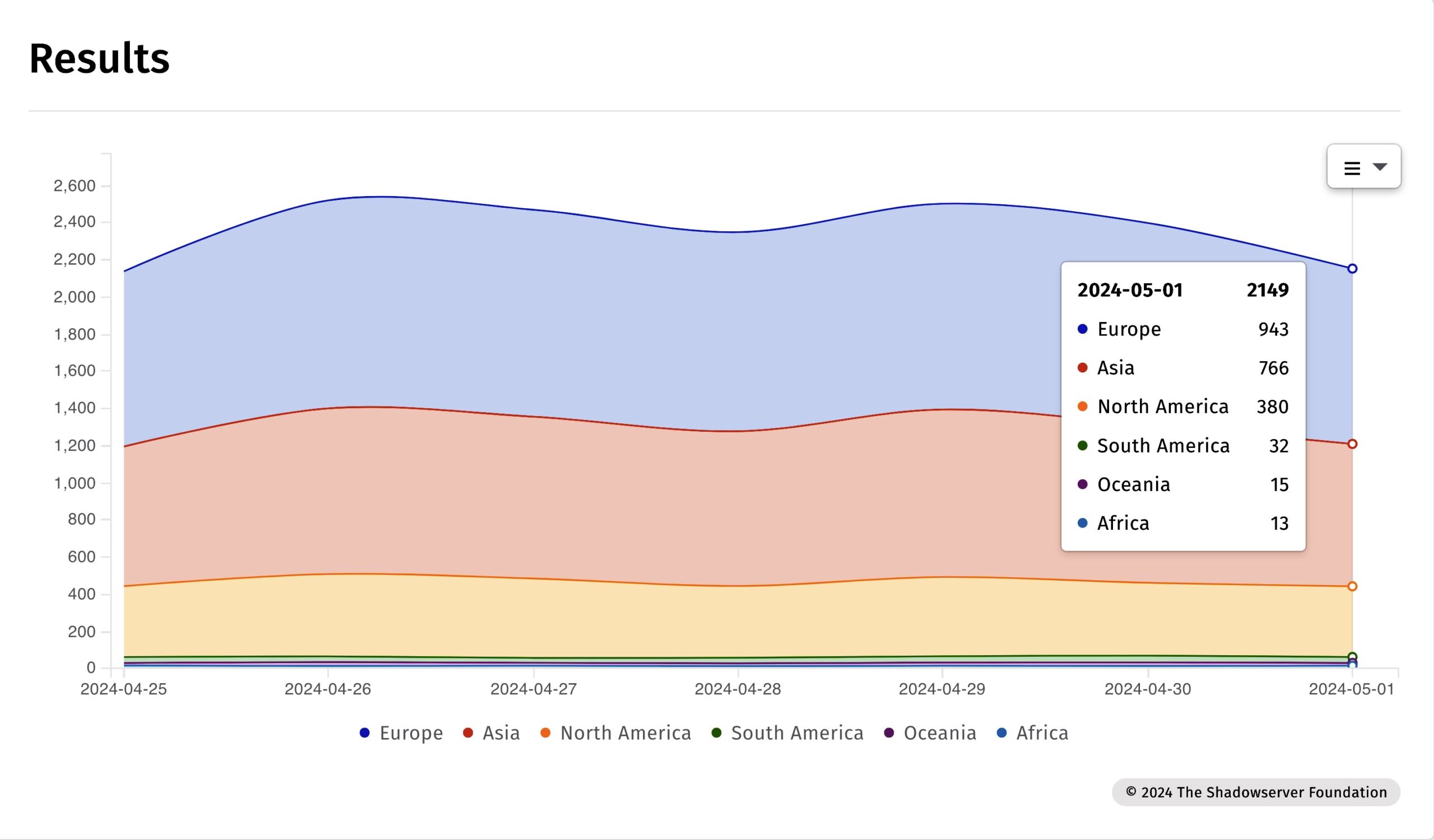
According to Internet scans performed by security organization Shadowserver, more than 2,100 IP addresses showed they were hosting one or more vulnerable GitLab instances.

Shadowserver

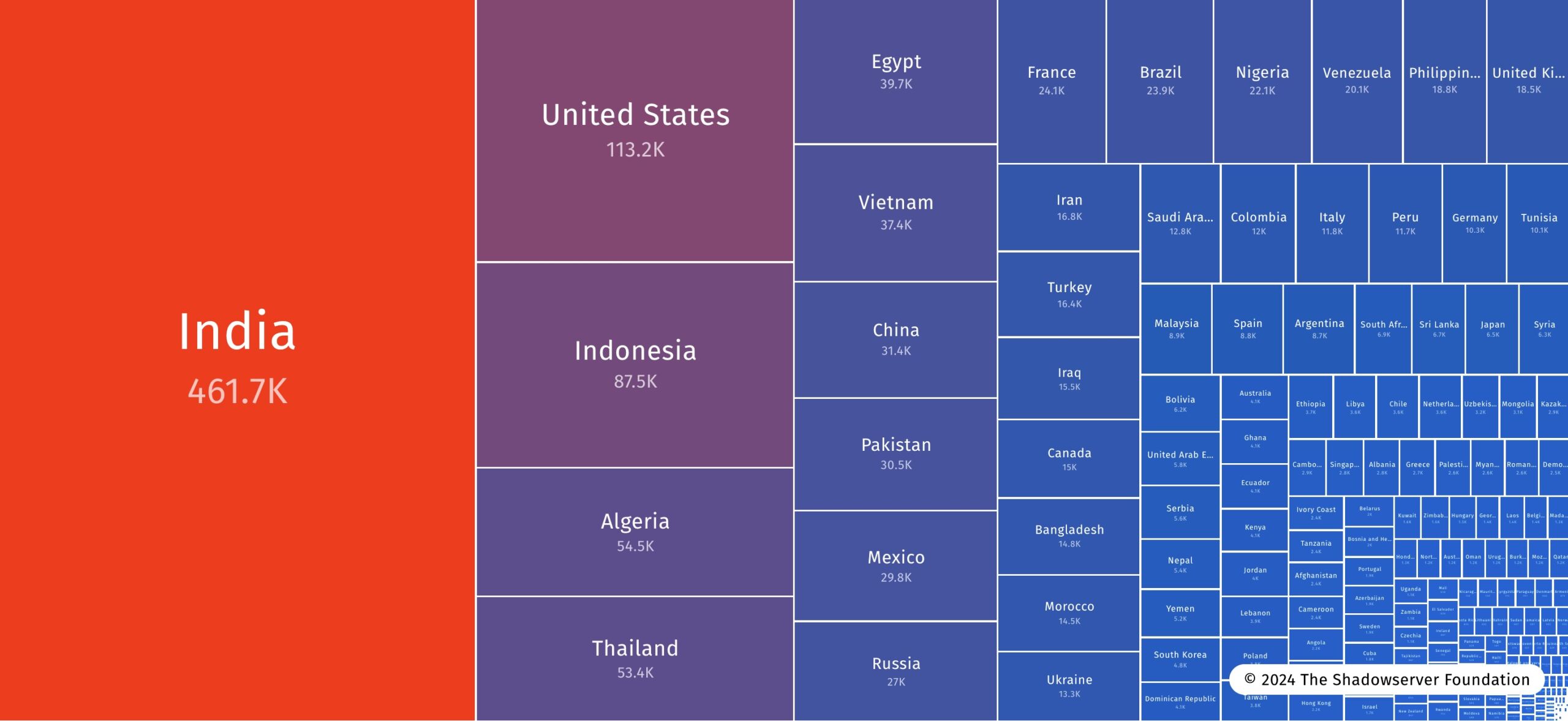
The biggest concentration of IP addresses was in India, followed by the US, Indonesia, Algeria, and Thailand.

Shadowserver

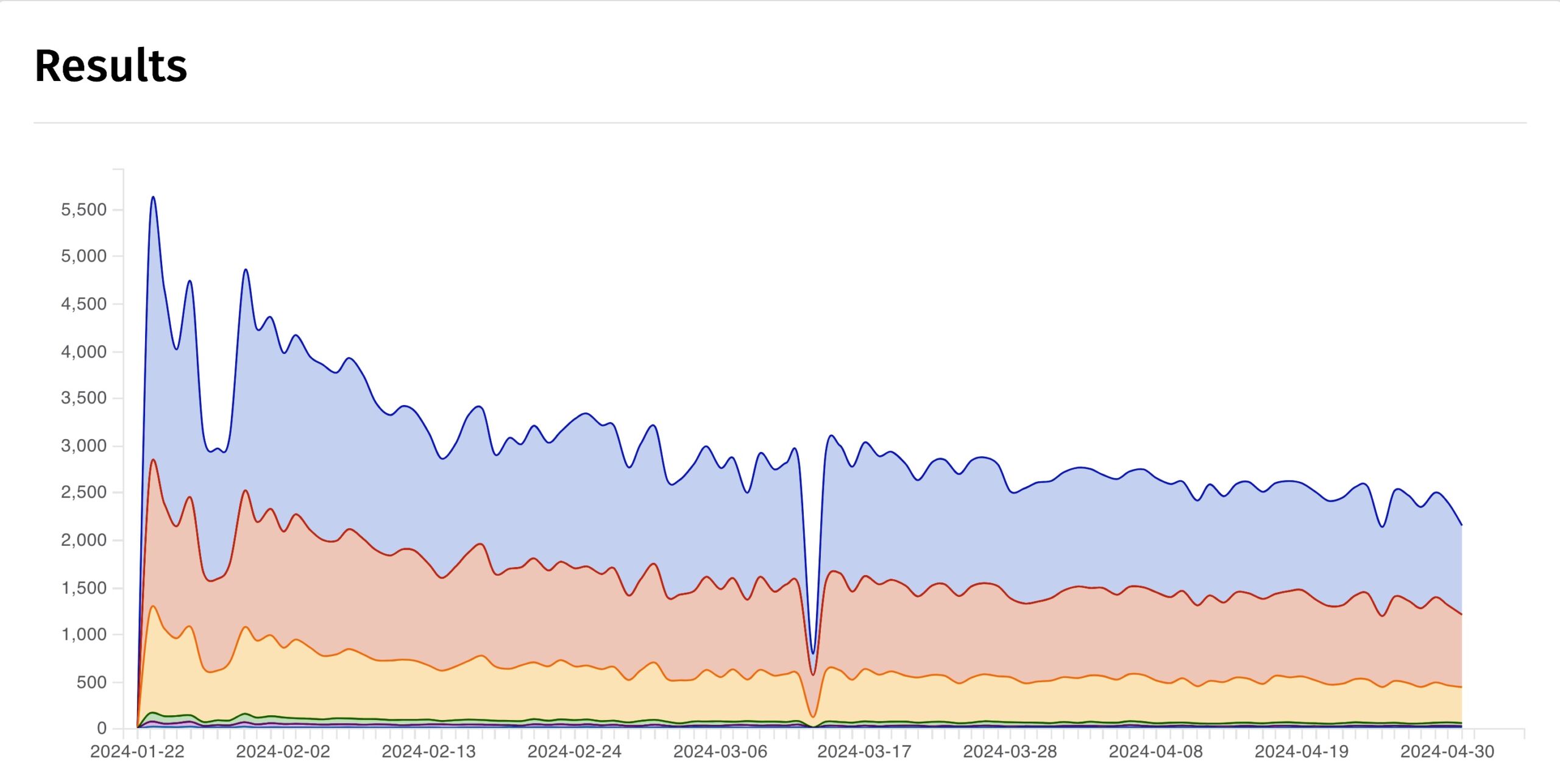
The number of IP addresses showing vulnerable instances has fallen over time. Shadowserver shows that there were more than 5,300 addresses on January 22, one week after GitLab issued the patch.

Shadowserver

The vulnerability is classed as an improper access control flaw.

CISA has ordered all civilian federal agencies that have yet to patch the vulnerability to do so immediately. The agency made no mention of MFA, but any GitLab users who haven’t already done so should enable it, ideally with a form that complies with the FIDO industry standard.

GitLab users should also remember that patching does nothing to secure systems that have already been breached through exploits. GitLab has published incident response guidance here.

Maximum-severity GitLab flaw allowing account hijacking under active exploitation Read More »

hacker-free-for-all-fights-for-control-of-home-and-office-routers-everywhere

Hacker free-for-all fights for control of home and office routers everywhere

Rows of 1950s-style robots operate computer workstations.

Cybercriminals and spies working for nation-states are surreptitiously coexisting inside the same compromised name-brand routers as they use the devices to disguise attacks motivated both by financial gain and strategic espionage, researchers said.

In some cases, the coexistence is peaceful, as financially motivated hackers provide spies with access to already compromised routers in exchange for a fee, researchers from security firm Trend Micro reported Wednesday. In other cases, hackers working in nation-state-backed advanced persistent threat groups take control of devices previously hacked by the cybercrime groups. Sometimes the devices are independently compromised multiple times by different groups. The result is a free-for-all inside routers and, to a lesser extent, VPN devices and virtual private servers provided by hosting companies.

“Cybercriminals and Advanced Persistent Threat (APT) actors share a common interest in proxy anonymization layers and Virtual Private Network (VPN) nodes to hide traces of their presence and make detection of malicious activities more difficult,” Trend Micro researchers Feike Hacquebord and Fernando Merces wrote. “This shared interest results in malicious internet traffic blending financial and espionage motives.”

Pawn Storm, a spammer, and a proxy service

A good example is a network made up primarily of EdgeRouter devices sold by manufacturer Ubiquiti. After the FBI discovered it had been infected by a Kremlin-backed group and used as a botnet to camouflage ongoing attacks targeting governments, militaries, and other organizations worldwide, it commenced an operation in January to temporarily disinfect them.

The Russian hackers gained control after the devices were already infected with Moobot, which is botnet malware used by financially motivated threat actors not affiliated with the Russian government. These threat actors installed Moobot after first exploiting publicly known default administrator credentials that hadn’t been removed from the devices by the people who owned them. The Russian hackers—known by a variety of names including Pawn Storm, APT28, Forest Blizzard, Sofacy, and Sednit—then exploited a vulnerability in the Moobot malware and used it to install custom scripts and malware that turned the botnet into a global cyber espionage platform.

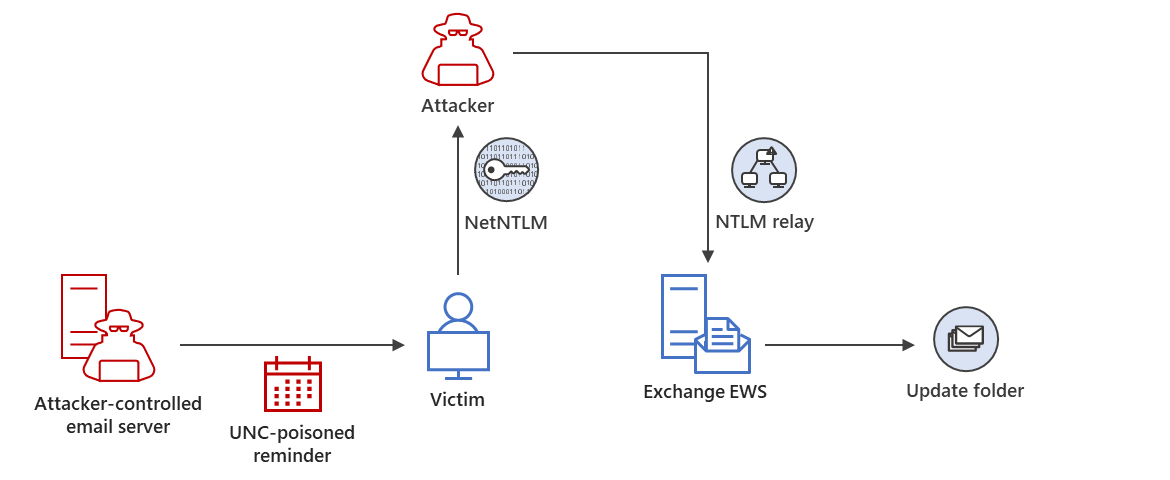
The Trend Micro researchers said that Pawn Storm was using the hijacked botnet to proxy (1) logins that used stolen account credentials and (2) attacks that exploited a critical zero-day vulnerability in Microsoft Exchange that went unfixed until March 2023. The zero-day exploits allowed Pawn Storm to obtain the cryptographic hash of users’ Outlook passwords simply by sending them a specially formatted email. Once in possession of the hash, Pawn Storm performed a so-called NTLMv2 hash relay attack that funneled logins to the user accounts through one of the botnet devices. Microsoft provided a diagram of the attack pictured below:

Microsoft

Trend Micro observed the same botnet being used to send spam with pharmaceutical themes that have the hallmarks of what’s known as the Canadian Pharmacy gang. Yet another group installed malware known as Ngioweb on botnet devices. Ngioweb was first found in 2019 running on routers from DLink, Netgear, and other manufacturers, as well as other devices running Linux on top of x86, ARM, and MIPS hardware. The purpose of Ngioweb is to provide proxies individuals can use to route their online activities through a series of regularly changing IP addresses, particularly those located in the US with reputations for trustworthiness. It’s not clear precisely who uses the Ngioweb-powered service.

The Trend Micro researchers wrote:

In the specific case of the compromised Ubiquiti EdgeRouters, we observed that a botnet operator has been installing backdoored SSH servers and a suite of scripts on the compromised devices for years without much attention from the security industry, allowing persistent access. Another threat actor installed the Ngioweb malware that runs only in memory to add the bots to a commercially available residential proxy botnet. Pawn Storm most likely easily brute forced the credentials of the backdoored SSH servers and thus gained access to a pool of EdgeRouter devices they could abuse for various purposes.

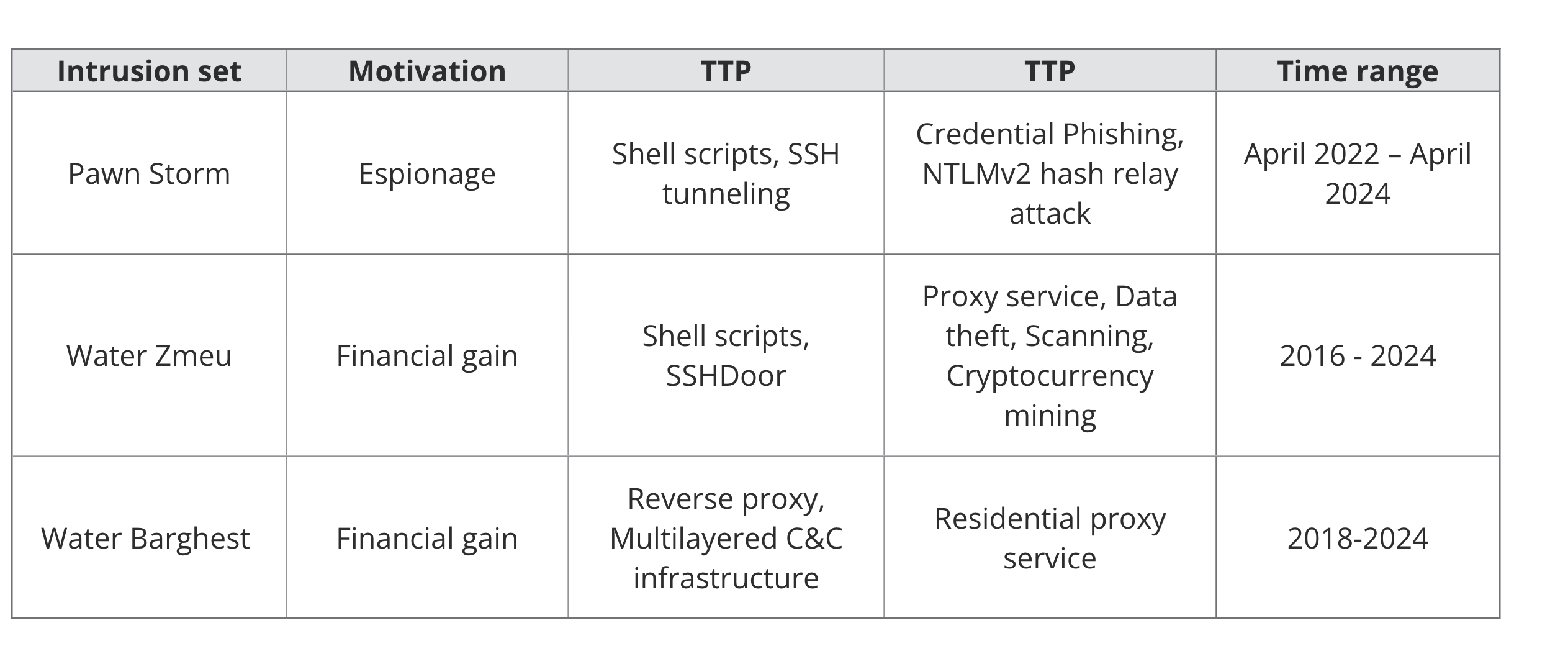
The researchers provided the following table, summarizing the botnet-sharing arrangement among Pawn Storm and the two other groups, tracked as Water Zmeu and Water Barghest:

Trend Micro


It’s unclear if either of the groups was responsible for installing the previously mentioned Moobot malware that the FBI reported finding on the devices. If not, that would mean routers were independently infected by three financially motivated groups, in addition to Pawn Storm, further underscoring the ongoing rush by multiple threat groups to establish secret listening posts inside routers. Trend Micro researchers weren’t available to clarify.

The post went on to report that while the January operation by the FBI put a dent in the infrastructure Pawn Storm depended on, legal constraints prevented the operation from preventing reinfection. What’s more, the botnet also comprised virtual public servers and Raspberry Pi devices that weren’t affected by the FBI action.

“This means that despite the efforts of law enforcement, Pawn Storm still has access to many other compromised assets, including EdgeServers,” the Trend Micro report said. “For example, IP address 32[.]143[.]50[.]222 was used as an SMB reflector around February 8, 2024. The same IP address was used as a proxy in a credential phishing attack on February 6 2024 against various government officials around the world.”

Hacker free-for-all fights for control of home and office routers everywhere Read More »

anthropic-releases-claude-ai-chatbot-ios-app

Anthropic releases Claude AI chatbot iOS app

AI in your pocket —

Anthropic finally comes to mobile, launches plan for teams that includes 200K context window.

The Claude AI iOS app running on an iPhone.

Enlarge / The Claude AI iOS app running on an iPhone.

Anthropic

On Wednesday, Anthropic announced the launch of an iOS mobile app for its Claude 3 AI language models that are similar to OpenAI’s ChatGPT. It also introduced a new subscription tier designed for group collaboration. Before the app launch, Claude was only available through a website, an API, and other apps that integrated Claude through API.

Like the ChatGPT app, Claude’s new mobile app serves as a gateway to chatbot interactions, and it also allows uploading photos for analysis. While it’s only available on Apple devices for now, Anthropic says that an Android app is coming soon.

Anthropic rolled out the Claude 3 large language model (LLM) family in March, featuring three different model sizes: Claude Opus, Claude Sonnet, and Claude Haiku. Currently, the app utilizes Sonnet for regular users and Opus for Pro users.

While Anthropic has been a key player in the AI field for several years, it’s entering the mobile space after many of its competitors have already established footprints on mobile platforms. OpenAI released its ChatGPT app for iOS in May 2023, with an Android version arriving two months later. Microsoft released a Copilot iOS app in January. Google Gemini is available through the Google app on iPhone.

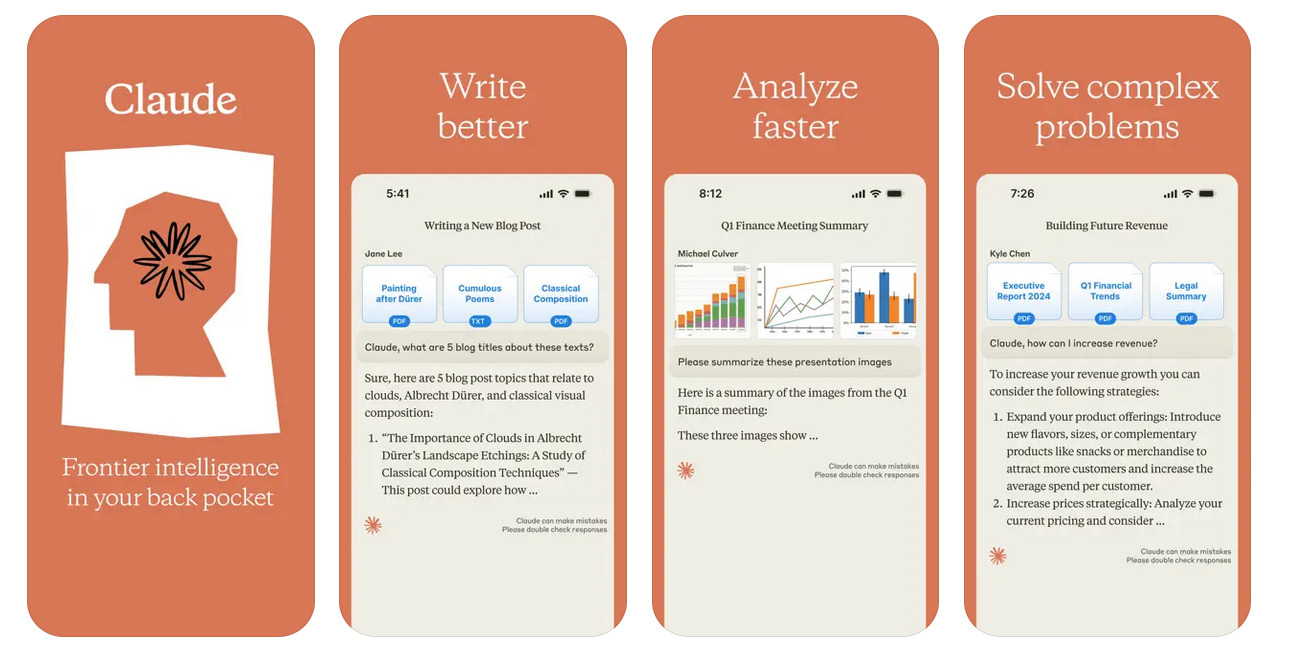
Screenshots of the Claude AI iOS app running on an iPhone.

Enlarge / Screenshots of the Claude AI iOS app running on an iPhone.

Anthropic

The app is freely available to all users of Claude, including those using the free version, subscribers paying $20 per month for Claude Pro, and members of the newly introduced Claude Team plan. Conversation history is saved and shared between the web app version of Claude and the mobile app version after logging in.

Speaking of that Team plan, it’s designed for groups of at least five and is priced at $30 per seat per month. It offers more chat queries (higher rate limits), access to all three Claude models, and a larger context window (200K tokens) for processing lengthy documents or maintaining detailed conversations. It also includes group admin tools and billing management, and users can easily switch between Pro and Team plans.

Anthropic releases Claude AI chatbot iOS app Read More »

here’s-your-chance-to-own-a-decommissioned-us-government-supercomputer

Here’s your chance to own a decommissioned US government supercomputer

But can it run Crysis —

145,152-core Cheyenne supercomputer was 20th most powerful in the world in 2016.

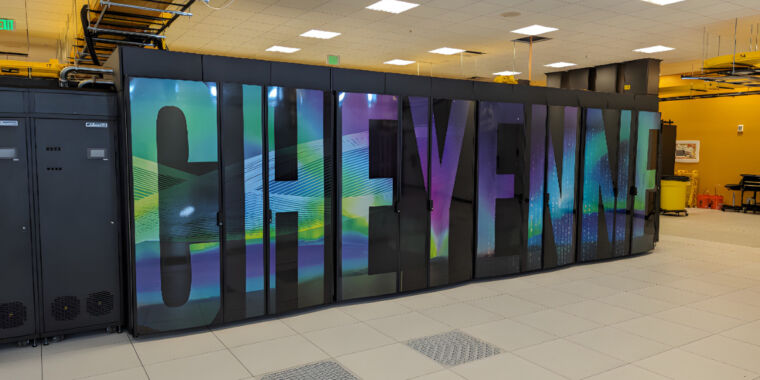
A photo of the Cheyenne supercomputer, which is now up for auction.

Enlarge / A photo of the Cheyenne supercomputer, which is now up for auction.

On Tuesday, the US General Services Administration began an auction for the decommissioned Cheyenne supercomputer, located in Cheyenne, Wyoming. The 5.34-petaflop supercomputer ranked as the 20th most powerful in the world at the time of its installation in 2016. Bidding started at $2,500, but it’s price is currently $27,643 with the reserve not yet met.

The supercomputer, which officially operated between January 12, 2017, and December 31, 2023, at the NCAR-Wyoming Supercomputing Center, was a powerful (and once considered energy-efficient) system that significantly advanced atmospheric and Earth system sciences research.

“In its lifetime, Cheyenne delivered over 7 billion core-hours, served over 4,400 users, and supported nearly 1,300 NSF awards,” writes the University Corporation for Atmospheric Research (UCAR) on its official Cheyenne information page. “It played a key role in education, supporting more than 80 university courses and training events. Nearly 1,000 projects were awarded for early-career graduate students and postdocs. Perhaps most tellingly, Cheyenne-powered research generated over 4,500 peer-review publications, dissertations and theses, and other works.”

UCAR says that Cheynne was originally slated to be replaced after five years, but the COVID-19 pandemic severely disrupted supply chains, and it clocked in two extra years in its tour of duty. The auction page says that Cheyenne recently experienced maintenance limitations due to faulty quick disconnects in its cooling system. As a result, approximately 1 percent of the compute nodes have failed, primarily due to ECC errors in the DIMMs. Given the expense and downtime associated with repairs, the decision was made to auction off the components.

  • A photo gallery of the Cheyenne supercomputer up for auction.

With a peak performance of 5,340 teraflops (4,788 Linpack teraflops), this SGI ICE XA system was capable of performing over 3 billion calculations per second for every watt of energy consumed, making it three times more energy-efficient than its predecessor, Yellowstone. The system featured 4,032 dual-socket nodes, each with two 18-core, 2.3-GHz Intel Xeon E5-2697v4 processors, for a total of 145,152 CPU cores. It also included 313 terabytes of memory and 40 petabytes of storage. The entire system in operation consumed about 1.7 megawatts of power.

Just to compare, the world’s top-rated supercomputer at the moment—Frontier at Oak Ridge National Labs in Tennessee—features a theoretical peak performance of 1,679.82 petaflops, includes 8,699,904 CPU cores, and uses 22.7 megawatts of power.

The GSA notes that potential buyers of Cheyenne should be aware that professional movers with appropriate equipment will be required to handle the heavy racks and components. The auction includes seven E-Cell pairs (14 total), each with a cooling distribution unit (CDU). Each E-Cell weighs approximately 1,500 lbs. Additionally, the auction features two air-cooled Cheyenne Management Racks, each weighing 2,500 lbs, that contain servers, switches, and power units.

As of this writing, 12 potential buyers have bid on this computing monster so far. The auction closes on May 5 at 6: 11 pm Central Time if you’re interested in bidding. But don’t get too excited by photos of the extensive cabling: As the auction site notes, “fiber optic and CAT5/6 cabling are excluded from the resale package.”

Here’s your chance to own a decommissioned US government supercomputer Read More »

health-care-giant-comes-clean-about-recent-hack-and-paid-ransom

Health care giant comes clean about recent hack and paid ransom

HEALTH CARE PROVIDER, HEAL THYSELF —

Ransomware attack on the $371 billion company hamstrung US prescription market.

Health care giant comes clean about recent hack and paid ransom

Getty Images

Change Healthcare, the health care services provider that recently experienced a ransomware attack that hamstrung the US prescription market for two weeks, was hacked through a compromised account that failed to use multifactor authentication, the company CEO told members of Congress.

The February 21 attack by a ransomware group using the names ALPHV or BlackCat took down a nationwide network Change Healthcare administers to allow healthcare providers to manage customer payments and insurance claims. With no easy way for pharmacies to calculate what costs were covered by insurance companies, payment processors, providers, and patients experienced long delays in filling prescriptions for medicines, many of which were lifesaving. Change Healthcare has also reported that hackers behind the attacks obtained personal health information for a “substantial portion” of the US population.

Standard defense not in place

Andrew Witty, CEO of Change Healthcare parent company UnitedHealth Group, said the breach started on February 12 when hackers somehow obtained an account password for a portal allowing remote access to employee desktop devices. The account, Witty admitted, failed to use multifactor authentication (MFA), a standard defense against password compromises that requires additional authentication in the form of a one-time password or physical security key.

“The portal did not have multi-factor authentication,” Witty wrote in comments submitted before his scheduled testimony on Wednesday to the House Energy and Commerce Committee’s Subcommittee on Oversight and Investigations. “Once the threat actor gained access, they moved laterally within the systems in more sophisticated ways and exfiltrated data.” Witty is also scheduled to appear at a separate Wednesday hearing before the Senate Committee on Finance.

Witty didn’t explain why the account, on a portal platform provided by software maker Citrix, wasn’t configured to use MFA. The failure is likely to be a major focus during Wednesday’s hearing.

After burrowing into the Change Healthcare network undetected for nine days, the attackers deployed ransomware that prevented the company from accessing its IT environment. In response, the company severed its connection to its data centers. The company spent the next two weeks rebuilding its entire IT infrastructure “from the ground up.” In the process, it replaced thousands of laptops, rotated credentials, and added new server capacity. By March 7, 99 percent of pre-incident pharmacies were once again able to process claims.

Witty also publicly confirmed that Change Healthcare paid a ransom, a practice that critics say incentivizes ransomware groups who often fail to make good on promises to destroy stolen data. According to communications uncovered by Dmitry Smilyanets, product management director at security firm Recorded Future, Change Healthcare paid $22 million to ALPHV. Principal members of the group then pocketed the funds rather than sharing it with an affiliate group that did the actual hacking, as spelled out in a pre-existing agreement. The affiliate group published some of the stolen data, largely validating a chief criticism of ransomware payments.

“As chief executive officer, the decision to pay a ransom was mine,” Witty wrote. “This was one of the hardest

decisions I’ve ever had to make. And I wouldn’t wish it on anyone.”

Bleeping Computer reported that Change Healthcare may have paid both ALPHV and the affiliate through a group calling itself RansomHub.

Two weeks ago, UnitedHealth Group reported the ransomware attack resulted in a $872 million cost in its first quarter. That amount included $593 million in direct response costs and $279 million in disruptions. Witty’s written testimony added that as of last Friday, his company had advanced more than $6.5 billion in accelerated payments and no-interest, no-fee loans to thousands of providers that were left financially struggling during the prolonged outage. UnitedHealth Care reported $99.8 billion in sales for the quarter. The company had an annual revenue of $371.6 billion in 2023.

Payment processing by Change Healthcare is currently about 86 percent of its pre-incident levels and will increase as the company further restores its systems, Witty said. The number of pharmacies it serves remains a “fraction of a percent” below pre-incident levels.

Health care giant comes clean about recent hack and paid ransom Read More »

aws-s3-storage-bucket-with-unlucky-name-nearly-cost-developer-$1,300

AWS S3 storage bucket with unlucky name nearly cost developer $1,300

Not that kind of bucket list —

Amazon says it’s working on stopping others from “making your AWS bill explode.”

A blue bucket, held by red and yellow brackets, being continuously filled and overflowing

Enlarge / Be careful with the buckets you put out there for anybody to fill.

Getty Images

If you’re using Amazon Web Services and your S3 storage bucket can be reached from the open web, you’d do well not to pick a generic name for that space. Avoid “example,” skip “change_me,” don’t even go with “foo” or “bar.” Someone else with the same “change this later” thinking can cost you a MacBook’s worth of cash.

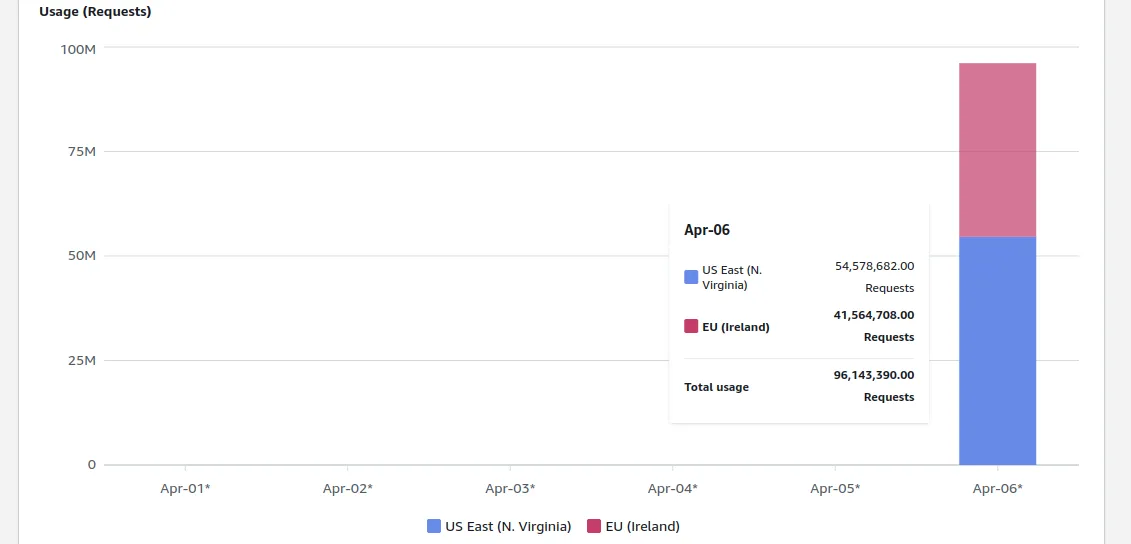
Ask Maciej Pocwierz, who just happened to pick an S3 name that “one of the popular open-source tools” used for its default backup configuration. After setting up the bucket for a client project, he checked his billing page and found nearly 100 million unauthorized attempts to create new files on his bucket (PUT requests) within one day. The bill was over $1,300 and counting.

Nothing, nothing, nothing, nothing, nothing … nearly 100 million unauthorized requests.

Nothing, nothing, nothing, nothing, nothing … nearly 100 million unauthorized requests.

“All this actually happened just a few days after I ensured my client that the price for AWS services will be negligible, like $20 at most for the entire month,” Pocwierz wrote over chat. “I explained the situation is very unusual but it definitely looked as if I didn’t know what I’m doing.”

Pocwierz declined to name the open source tool that inadvertently bum-rushed his S3 account. In a Medium post about the matter, he noted a different problem with an unlucky default backup. After turning on public writes, he watched as he collected more than 10GB of data in less than 30 seconds. Other people’s data, that is, and they had no idea that Pocwierz was collecting it.

Some of that data came from companies with customers, which is part of why Pocwierz is keeping the specifics under wraps. He wrote to Ars that he contacted some of the companies that either tried or successfully backed up their data to his bucket, and “they completely ignored me.” “So now instead of having this fixed, their data is still at risk,” Pocwierz writes. “My lesson is if I ever run a company, I will definitely have a bug bounty program, and I will treat such warnings seriously.”

As for Pocwierz’s accounts, both S3 and bank, it mostly ended well. An AWS representative reached out on LinkedIn and canceled his bill, he said, and was told that anybody can request refunds for excessive unauthorized requests. “But they didn’t explicitly say that they will necessarily approve it,” he wrote. He noted in his Medium post that AWS “emphasized that this was done as an exception.”

In response to Pocwierz’s story, Jeff Barr, chief evangelist for AWS at Amazon, tweeted that “We agree that customers should not have to pay for unauthorized requests that they did not initiate.” Barr added that Amazon would have more to share on how the company could prevent them “shortly.” AWS has a brief explainer and contact page on unexpected AWS charges.

The open source tool did change its default configuration after Pocwierz contacted them. Pocwierz suggested to AWS that it should restrict anyone else from creating a bucket name like his, but he had yet to hear back about it. He suggests in his blog post that, beyond random bad luck, adding a random suffix to your bucket name and explicitly specifying your AWS region can help avoid massive charges like the one he narrowly dodged.

AWS S3 storage bucket with unlucky name nearly cost developer $1,300 Read More »

mysterious-“gpt2-chatbot”-ai-model-appears-suddenly,-confuses-experts

Mysterious “gpt2-chatbot” AI model appears suddenly, confuses experts

Robot fortune teller hand and crystal ball

On Sunday, word began to spread on social media about a new mystery chatbot named “gpt2-chatbot” that appeared in the LMSYS Chatbot Arena. Some people speculate that it may be a secret test version of OpenAI’s upcoming GPT-4.5 or GPT-5 large language model (LLM). The paid version of ChatGPT is currently powered by GPT-4 Turbo.

Currently, the new model is only available for use through the Chatbot Arena website, although in a limited way. In the site’s “side-by-side” arena mode where users can purposely select the model, gpt2-chatbot has a rate limit of eight queries per day—dramatically limiting people’s ability to test it in detail.

So far, gpt2-chatbot has inspired plenty of rumors online, including that it could be the stealth launch of a test version of GPT-4.5 or even GPT-5—or perhaps a new version of 2019’s GPT-2 that has been trained using new techniques. We reached out to OpenAI for comment but did not receive a response by press time. On Monday evening, OpenAI CEO Sam Altman seemingly dropped a hint by tweeting, “i do have a soft spot for gpt2.”

A screenshot of the LMSYS Chatbot Arena

Enlarge / A screenshot of the LMSYS Chatbot Arena “side-by-side” page showing “gpt2-chatbot” listed among the models for testing. (Red highlight added by Ars Technica.)

Benj Edwards

Early reports of the model first appeared on 4chan, then spread to social media platforms like X, with hype following not far behind. “Not only does it seem to show incredible reasoning, but it also gets notoriously challenging AI questions right with a much more impressive tone,” wrote AI developer Pietro Schirano on X. Soon, threads on Reddit popped up claiming that the new model had amazing abilities that beat every other LLM on the Arena.

Intrigued by the rumors, we decided to try out the new model for ourselves but did not come away impressed. When asked about “Benj Edwards,” the model revealed a few mistakes and some awkward language compared to GPT-4 Turbo’s output. A request for five original dad jokes fell short. And the gpt2-chatbot did not decisively pass our “magenta” test. (“Would the color be called ‘magenta’ if the town of Magenta didn’t exist?”)

  • A gpt2-chatbot result for “Who is Benj Edwards?” on LMSYS Chatbot Arena. Mistakes and oddities highlighted in red.

    Benj Edwards

  • A gpt2-chatbot result for “Write 5 original dad jokes” on LMSYS Chatbot Arena.

    Benj Edwards

  • A gpt2-chatbot result for “Would the color be called ‘magenta’ if the town of Magenta didn’t exist?” on LMSYS Chatbot Arena.

    Benj Edwards

So, whatever it is, it’s probably not GPT-5. We’ve seen other people reach the same conclusion after further testing, saying that the new mystery chatbot doesn’t seem to represent a large capability leap beyond GPT-4. “Gpt2-chatbot is good. really good,” wrote HyperWrite CEO Matt Shumer on X. “But if this is gpt-4.5, I’m disappointed.”

Still, OpenAI’s fingerprints seem to be all over the new bot. “I think it may well be an OpenAI stealth preview of something,” AI researcher Simon Willison told Ars Technica. But what “gpt2” is exactly, he doesn’t know. After surveying online speculation, it seems that no one apart from its creator knows precisely what the model is, either.

Willison has uncovered the system prompt for the AI model, which claims it is based on GPT-4 and made by OpenAI. But as Willison noted in a tweet, that’s no guarantee of provenance because “the goal of a system prompt is to influence the model to behave in certain ways, not to give it truthful information about itself.”

Mysterious “gpt2-chatbot” AI model appears suddenly, confuses experts Read More »