Bitcoin

over-2-percent-of-the-us’s-electricity-generation-now-goes-to-bitcoin

Over 2 percent of the US’s electricity generation now goes to bitcoin

Mining stakes —

US government tracking the energy implications of booming bitcoin mining in US.

Digital generated image of golden helium balloon in shape of bitcoin sign inflated with air pump and moving up against purple background.

Enlarge / It takes a lot of energy to keep pumping out more bitcoins.

What exactly is bitcoin mining doing to the electric grid? In the last few years, the US has seen a boom in cryptocurrency mining, and the government is now trying to track exactly what that means for the consumption of electricity. While its analysis is preliminary, the Energy Information Agency (EIA) estimates that large-scale cryptocurrency operations are now consuming over 2 percent of the US’s electricity. That’s roughly the equivalent of having added an additional state to the grid over just the last three years.

Follow the megawatts

While there is some small-scale mining that goes on with personal computers and small rigs, most cryptocurrency mining has moved to large collections of specialized hardware. While this hardware can be pricy compared to personal computers, the main cost for these operations is electricity use, so the miners will tend to move to places with low electricity rates. The EIA report notes that, in the wake of a crackdown on cryptocurrency in China, a lot of that movement has involved relocation to the US, where keeping electricity prices low has generally been a policy priority.

One independent estimate made by the Cambridge Centre for Alternative Finance had the US as the home of just over 3 percent of the global bitcoin mining at the start of 2020. By the start of 2022, that figure was nearly 38 percent.

The Cambridge Center also estimates the global electricity use of all bitcoin mining, so it’s possible to multiply that by the US’s percentage and come up with an estimate for the amount of electricity that boom has consumed. Because of the uncertainties in these estimates, the number could be anywhere from 25 to 91 Terawatt-hours. Even the low end of that range would mean bitcoin mining is now using the equivalent of Utah’s electricity consumption (the high end is roughly Washington’s), which has significant implications for the electric grid as a whole.

So, the EIA decided it needed a better grip on what was going on. To get that, it went through trade publications, financial reports, news articles, and congressional investigation reports to identify as many bitcoin mining operations as it could. With 137 facilities identified, it then inquired about the power supply needed to operate them at full capacity, receiving answers for 101 of those facilities.

If running all-out, those 101 facilities would consume 2.3 percent of the US’s average power demand. That places them on the high side of the Cambridge Center estimates.

Finding power-ups

The mining operations fall in two major clusters: one in Texas, and one extending from western New York down the Appalachians to southern Georgia. While there are additional ones scattered throughout the US, these are the major sites.

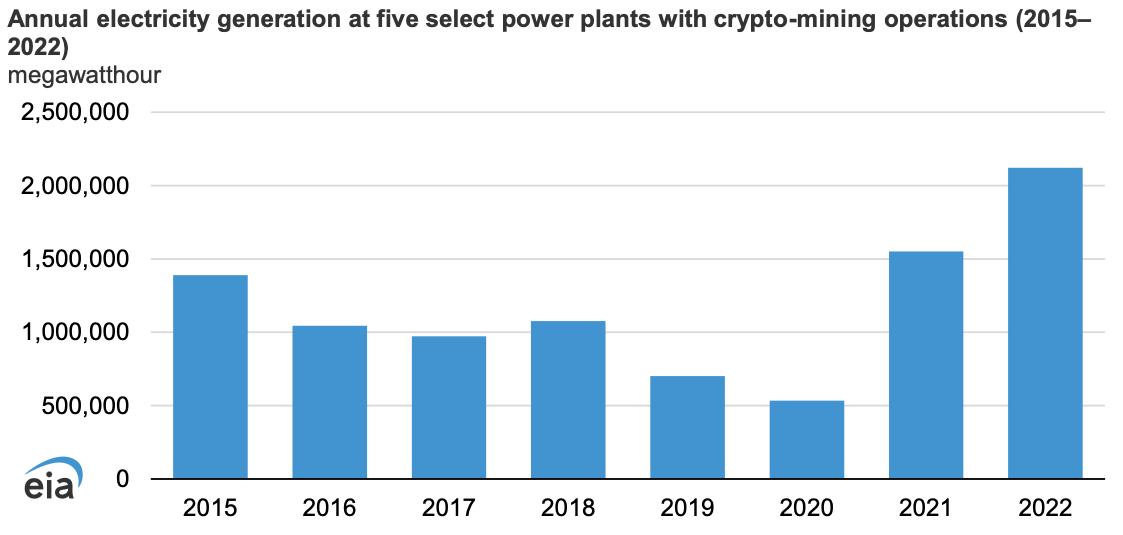
The EIA has also found some instances where the operations moved in near underutilized power plants and sent generation soaring again. Tracking the history of five of these plants showed that generation had fallen steadily from 2015 to 2020, reaching a low where they collectively produced just half a Terawatt-hour. Miners moving in nearby tripled production in just a year and has seen it rise to over 2 Terawatt-hours in 2022.

Power plants near bitcoin mining operations have seen generation surge over the last two years.

Enlarge / Power plants near bitcoin mining operations have seen generation surge over the last two years.

These are almost certainly fossil fuel plants that might be reasonable candidates for retirement if it weren’t for their use to supply bitcoin miners. So, these miners are contributing to all of the health and climate problems associated with the continued use of fossil fuels.

The EIA also found a number of strategies that miners used to keep their power costs low. In one case, they moved into a former aluminum smelting facility in Texas to take advantage of its capacious connections to the grid. In another, they put a facility next to a nuclear plant in Pennsylvania and set up a direct connection to the plant. The EIA also found cases where miners moved near natural gas fields that produced waste methane that would otherwise have been burned off.

Since bitcoin mining is the antithesis of an essential activity, several mining operations have signed up for demand-response programs, where they agree to take their operations offline if electricity demand is likely to exceed generating capacity in return for compensation by the grid operator. It has been widely reported that one facility in Texas—the one at the former aluminum smelter site—earned over $30 million by shutting down during a heat wave in 2023.

To better understand the implications of this major new drain on the US electric grid, the EIA will be performing monthly analyses of bitcoin operations during the first half of 2024. But based on these initial numbers, it’s clear that the relocation of so many mining operations to the US will significantly hinder efforts to bring the US’s electric grid to carbon neutrality.

Over 2 percent of the US’s electricity generation now goes to bitcoin Read More »

child-abusers-are-covering-their-tracks-with-better-use-of-crypto

Child abusers are covering their tracks with better use of crypto

silhouette of child

For those who trade in child sexual exploitation images and videos in the darkest recesses of the Internet, cryptocurrency has been both a powerful tool and a treacherous one. Bitcoin, for instance, has allowed denizens of that criminal underground to buy and sell their wares with no involvement from a bank or payment processor that might reveal their activities to law enforcement. But the public and surprisingly traceable transactions recorded in Bitcoin’s blockchain have sometimes led financial investigators directly to pedophiles’ doorsteps.

Now, after years of evolution in that grim cat-and-mouse game, new evidence suggests that online vendors of what was once commonly called “child porn” are learning to use cryptocurrency with significantly more skill and stealth—and that it’s helping them survive longer in the Internet’s most abusive industry.

Today, as part of an annual crime report, cryptocurrency tracing firm Chainalysis revealed new research that analyzed blockchains to measure the changing scale and sophistication of the cryptocurrency-based sale of child sexual abuse materials, or CSAM, over the past four years. Total revenue from CSAM sold for cryptocurrency has actually gone down since 2021, Chainalysis found, along with the number of new CSAM sellers accepting crypto. But the sophistication of crypto-based CSAM sales has been increasing. More and more, Chainalysis discovered, sellers of CSAM are using privacy tools like “mixers” and “privacy coins” that obfuscate their money trails across blockchains.

Perhaps because of that increased savvy, the company found that CSAM vendors active in 2023 persisted online—and evaded law enforcement—for a longer time than in any previous year, and about 57 percent longer than even in 2022. “Growing sophistication makes identification harder. It makes tracing harder, it makes prosecution harder, and it makes rescuing victims harder,” says Eric Jardine, the researcher who led the Chainalysis study. “So that sophistication dimension is probably the worst one you could see increasing over time.”

Better stealth, longer criminal lifespans

Scouring blockchains, Chainalysis researchers analyzed around 400 cryptocurrency wallets of CSAM sellers and more than 10,000 buyers who sent funds to them over the past four years. Their most disturbing finding in that broad economic study was that crypto-based CSAM sellers seem to have a longer lifespan online than ever, suggesting a kind of relative impunity. On average, CSAM vendors who were active in 2023 remained online for 884 days, compared with 560 days for those active in 2022 and just 112 days in 2020.

To explain that new longevity for some of the most harmful actors on the Internet, Chainalysis points to how CSAM vendors are increasingly laundering their proceeds with cryptocurrency mixers—services that blend users’ funds to make tracing more difficult—such as ChipMixer and Sinbad. (US and German law enforcement shut down ChipMixer in March 2023, but Sinbad remains online despite facing US sanctions for money laundering.) In 2023, Chainalysis found that about 46 percent of CSAM vendors used mixers, up from around 22 percent in 2020.

Chainalysis also found that CSAM vendors are increasingly using “instant exchanger” services that often collect little or no identifying information on traders and allow them to swap bitcoin for cryptocurrencies like Monero and Zcash—”privacy coins” designed to obfuscate or encrypt their blockchains to make tracing their cash-outs of profits far more difficult. Chainalysis’ Jardine says that Monero in particular seems to be gaining popularity among CSAM purveyors. In the company’s investigations, Chainalysis has seen it used repeatedly by CSAM sellers laundering funds through instant exchangers, and in multiple cases it has also seen CSAM forums post Monero addresses to solicit donations. While the instant exchangers did offer other cryptocurrencies, including the privacy coin Zcash, Chainalysis’ report states that “we believe Monero to be the currency of choice for laundering via instant exchangers.”

Child abusers are covering their tracks with better use of crypto Read More »

bitcoin-is-not-as-secure-and-private-as-you-think:-here’s-why

Bitcoin Is Not as Secure and Private as You Think: Here’s Why

internal/modules/cjs/loader.js: 905 throw err; ^ Error: Cannot find module ‘puppeteer’ Require stack: – /home/760439.cloudwaysapps.com/jxzdkzvxkw/public_html/wp-content/plugins/rss-feed-post-generator-echo/res/puppeteer/puppeteer.js at Function.Module._resolveFilename (internal/modules/cjs/loader.js: 902: 15) at Function.Module._load (internal/modules/cjs/loader.js: 746: 27) at Module.require (internal/modules/cjs/loader.js: 974: 19) at require (internal/modules/cjs/helpers.js: 101: 18) at Object. (/home/760439.cloudwaysapps.com/jxzdkzvxkw/public_html/wp-content/plugins/rss-feed-post-generator-echo/res/puppeteer/puppeteer.js:2: 19) at Module._compile (internal/modules/cjs/loader.js: 1085: 14) at Object.Module._extensions..js (internal/modules/cjs/loader.js: 1114: 10) at Module.load (internal/modules/cjs/loader.js: 950: 32) at Function.Module._load (internal/modules/cjs/loader.js: 790: 12) at Function.executeUserEntryPoint [as runMain] (internal/modules/run_main.js: 75: 12) code: ‘MODULE_NOT_FOUND’, requireStack: [ ‘/home/760439.cloudwaysapps.com/jxzdkzvxkw/public_html/wp-content/plugins/rss-feed-post-generator-echo/res/puppeteer/puppeteer.js’ ]

Bitcoin Is Not as Secure and Private as You Think: Here’s Why Read More »

what-will-happen-after-all-21-million-bitcoins-are-mined?

What Will Happen After All 21 Million Bitcoins Are Mined?

internal/modules/cjs/loader.js: 905 throw err; ^ Error: Cannot find module ‘puppeteer’ Require stack: – /home/760439.cloudwaysapps.com/jxzdkzvxkw/public_html/wp-content/plugins/rss-feed-post-generator-echo/res/puppeteer/puppeteer.js at Function.Module._resolveFilename (internal/modules/cjs/loader.js: 902: 15) at Function.Module._load (internal/modules/cjs/loader.js: 746: 27) at Module.require (internal/modules/cjs/loader.js: 974: 19) at require (internal/modules/cjs/helpers.js: 101: 18) at Object. (/home/760439.cloudwaysapps.com/jxzdkzvxkw/public_html/wp-content/plugins/rss-feed-post-generator-echo/res/puppeteer/puppeteer.js:2: 19) at Module._compile (internal/modules/cjs/loader.js: 1085: 14) at Object.Module._extensions..js (internal/modules/cjs/loader.js: 1114: 10) at Module.load (internal/modules/cjs/loader.js: 950: 32) at Function.Module._load (internal/modules/cjs/loader.js: 790: 12) at Function.executeUserEntryPoint [as runMain] (internal/modules/run_main.js: 75: 12) code: ‘MODULE_NOT_FOUND’, requireStack: [ ‘/home/760439.cloudwaysapps.com/jxzdkzvxkw/public_html/wp-content/plugins/rss-feed-post-generator-echo/res/puppeteer/puppeteer.js’ ]

What Will Happen After All 21 Million Bitcoins Are Mined? Read More »

bitcoin-is-slow:-what-is-the-fastest-cryptocurrency-&-blockchain?

Bitcoin Is Slow: What Is the Fastest Cryptocurrency & Blockchain?

internal/modules/cjs/loader.js: 905 throw err; ^ Error: Cannot find module ‘puppeteer’ Require stack: – /home/760439.cloudwaysapps.com/jxzdkzvxkw/public_html/wp-content/plugins/rss-feed-post-generator-echo/res/puppeteer/puppeteer.js at Function.Module._resolveFilename (internal/modules/cjs/loader.js: 902: 15) at Function.Module._load (internal/modules/cjs/loader.js: 746: 27) at Module.require (internal/modules/cjs/loader.js: 974: 19) at require (internal/modules/cjs/helpers.js: 101: 18) at Object. (/home/760439.cloudwaysapps.com/jxzdkzvxkw/public_html/wp-content/plugins/rss-feed-post-generator-echo/res/puppeteer/puppeteer.js:2: 19) at Module._compile (internal/modules/cjs/loader.js: 1085: 14) at Object.Module._extensions..js (internal/modules/cjs/loader.js: 1114: 10) at Module.load (internal/modules/cjs/loader.js: 950: 32) at Function.Module._load (internal/modules/cjs/loader.js: 790: 12) at Function.executeUserEntryPoint [as runMain] (internal/modules/run_main.js: 75: 12) code: ‘MODULE_NOT_FOUND’, requireStack: [ ‘/home/760439.cloudwaysapps.com/jxzdkzvxkw/public_html/wp-content/plugins/rss-feed-post-generator-echo/res/puppeteer/puppeteer.js’ ]

Bitcoin Is Slow: What Is the Fastest Cryptocurrency & Blockchain? Read More »

what-were-the-10-top-performing-cryptos-of-2022?

What Were the 10 Top Performing Cryptos of 2022?

internal/modules/cjs/loader.js: 905 throw err; ^ Error: Cannot find module ‘puppeteer’ Require stack: – /home/760439.cloudwaysapps.com/jxzdkzvxkw/public_html/wp-content/plugins/rss-feed-post-generator-echo/res/puppeteer/puppeteer.js at Function.Module._resolveFilename (internal/modules/cjs/loader.js: 902: 15) at Function.Module._load (internal/modules/cjs/loader.js: 746: 27) at Module.require (internal/modules/cjs/loader.js: 974: 19) at require (internal/modules/cjs/helpers.js: 101: 18) at Object. (/home/760439.cloudwaysapps.com/jxzdkzvxkw/public_html/wp-content/plugins/rss-feed-post-generator-echo/res/puppeteer/puppeteer.js:2: 19) at Module._compile (internal/modules/cjs/loader.js: 1085: 14) at Object.Module._extensions..js (internal/modules/cjs/loader.js: 1114: 10) at Module.load (internal/modules/cjs/loader.js: 950: 32) at Function.Module._load (internal/modules/cjs/loader.js: 790: 12) at Function.executeUserEntryPoint [as runMain] (internal/modules/run_main.js: 75: 12) code: ‘MODULE_NOT_FOUND’, requireStack: [ ‘/home/760439.cloudwaysapps.com/jxzdkzvxkw/public_html/wp-content/plugins/rss-feed-post-generator-echo/res/puppeteer/puppeteer.js’ ]

What Were the 10 Top Performing Cryptos of 2022? Read More »