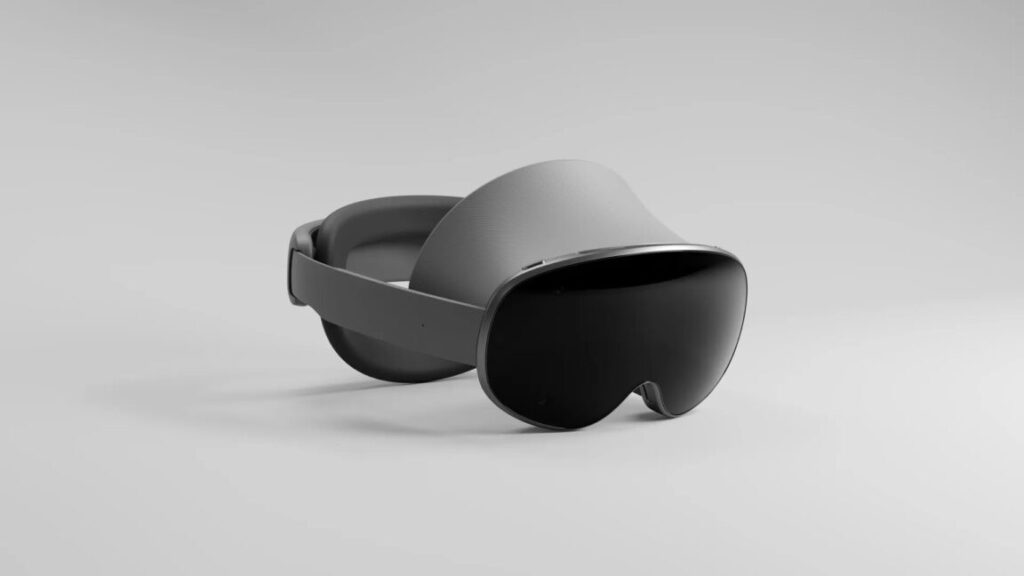
Citing “years of investment in AI, AR, and VR,” Google is stepping into the augmented reality market once more with Android XR. It’s an operating system that Google says will power future headsets and glasses that “transform how you watch, work, and explore.”
The first version you’ll see is Project Moohan, a mixed-reality headset built by Samsung. It will be available for purchase next year, and not much more is known about it. Developers have access to the new XR version of Android now.
“We’ve been in this space since Google Glass, and we have not stopped,” said Juston Payne, director of product at Google for XR in Android XR’s launch video. Citing established projects like Google Lens, Live View for Maps, instant camera translation, and, of course, Google’s general-purpose Gemini AI, XR promises to offer such overlays in both dedicated headsets and casual glasses.
Android XR announcement video.
There are few additional details right now beyond a headset rendering, examples in Google’s video labeled as “visualization for concept purposes.” Google’s list of things that will likely be on board includes Gemini, Maps, Photos, Translate, Chrome, Circle to Search, and Messages. And existing Android apps, or at least those updated to do so, should make the jump, too.
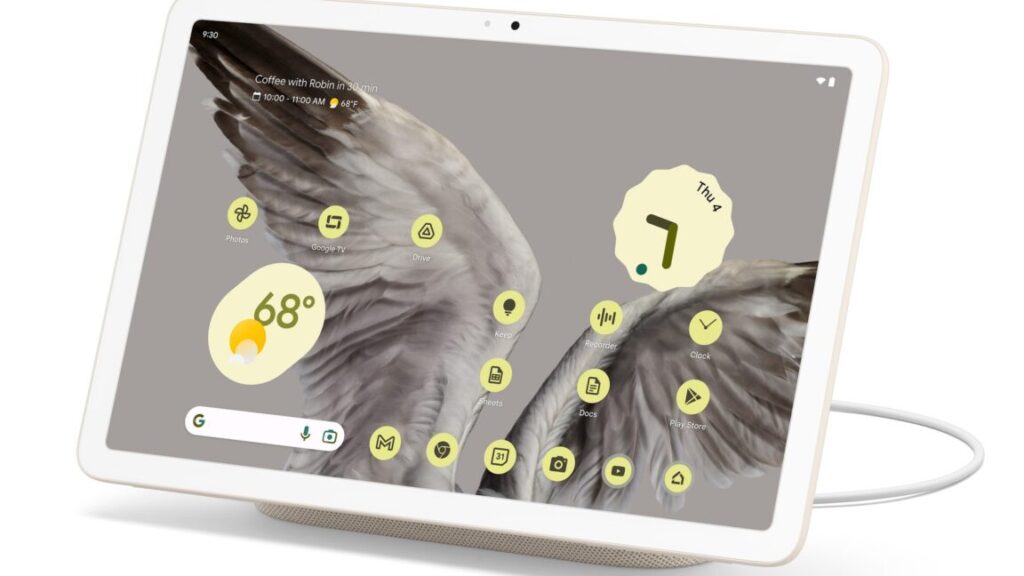
Depending on which Android-focused site you believe, either a third Pixel Tablet was apparently in the works at Google and canceled, as Android Headlines reported, or the second one, as Android Authority has it. Either way, there was reportedly a team at Google working on the next flagship Pixel-branded tablet, and now, seemingly due to profitability concerns, that work is over. At least until, maybe, a third Pixel Tablet in the future.
The Pixel Tablet, released last fall, was generally regarded as Google’s second re-entry into the tablet market that the iPad all but owns, at least at the consumer level. As such, it sought to distinguish itself from Apple’s slab by launching with a home-friendly dock and speaker cradle, taking on the appearance of a big smart home display when docked to it.
While there are no public sales figures, the device has not kick-started a resurgence of interest in Android tablets beyond the baseline sales of Amazon’s Kindle Fire devices (based on a Google-less fork of Android). Google will likely continue to support and promote Android tablets for other manufacturers and now has its own Pixel Fold devices occupying that middle space between phone and tablet forms.
Ars has contacted Google for comment and confirmation and will update this post with its response.
Hepner expects that the DOJ plan may be measured enough that the court may only “be interested in a nip-tuck, not a wholesale revision of what plaintiffs have put forward.”
Kamyl Bazbaz, SVP of public affairs for Google’s more privacy-focused rival DuckDuckGo, released a statement agreeing with Hepner.
“The government has put forward a proposal that would free the search market from Google’s illegal grip and unleash a new era of innovation, investment, and competition,” Bazbaz said. “There’s nothing radical about this proposal: It’s firmly based on the court’s extensive finding of fact and proposes solutions in line with previous antitrust actions.”
Bazbaz accused Google of “cynically” invoking privacy among chief concerns with a forced Chrome sale. That “is rich coming from the Internet’s biggest tracker,” Bazbaz said.
Will Apple finally compete with Google in search?
The remedies the DOJ has proposed could potentially be game-changing, Bazbaz told Ars, not just for existing rivals but also new rivals and startups the court found were previously unable to enter the market while it was under Google’s control.
If the DOJ gets its way, Google could be stuck complying with these proposed remedies for 10 years. But if the company can prove after five years that competition has substantially increased and it controls less than 50 percent of the market, the remedies could be terminated early, the DOJ’s proposed final judgment order said.
That’s likely cold comfort for Google as it prepares to fight the DOJ’s plan to break up its search empire and potentially face major new competitors. The biggest risk to Google’s dominance in AI search could even be its former partner, whom the court found was being paid handsomely to help prop up Google’s search monopoly: Apple.
On X (formerly Twitter), Hepner said that cutting off Google’s $20 billion payments to Apple for default placements in Safari alone could “have a huge effect and may finally kick Apple to enter the market itself.”
If you lose your iPhone or buy an upgrade, you could reasonably expect to be up and running after an hour, presuming you backed up your prior model. Your Apple stuff all comes over, sure, but most of your third-party apps will still be signed in.
Doing the same swap with an Android device is more akin to starting three-quarters fresh. After one or two Android phones, you learn to bake in an extra hour of rapid-fire logging in to all your apps. Password managers, or just using a Google account as your authentication, are a godsend.
That might change relatively soon, as Google has announced a new Restore Credentials feature, which should do what it says in the name. Android apps can “seamlessly onboard users to their accounts on a new device,” with the restore keys handled by Android’s native backup and restore process. The experience, says Google, is “delightful” and seamless. You can even get the same notifications on the new device as you were receiving on the old.
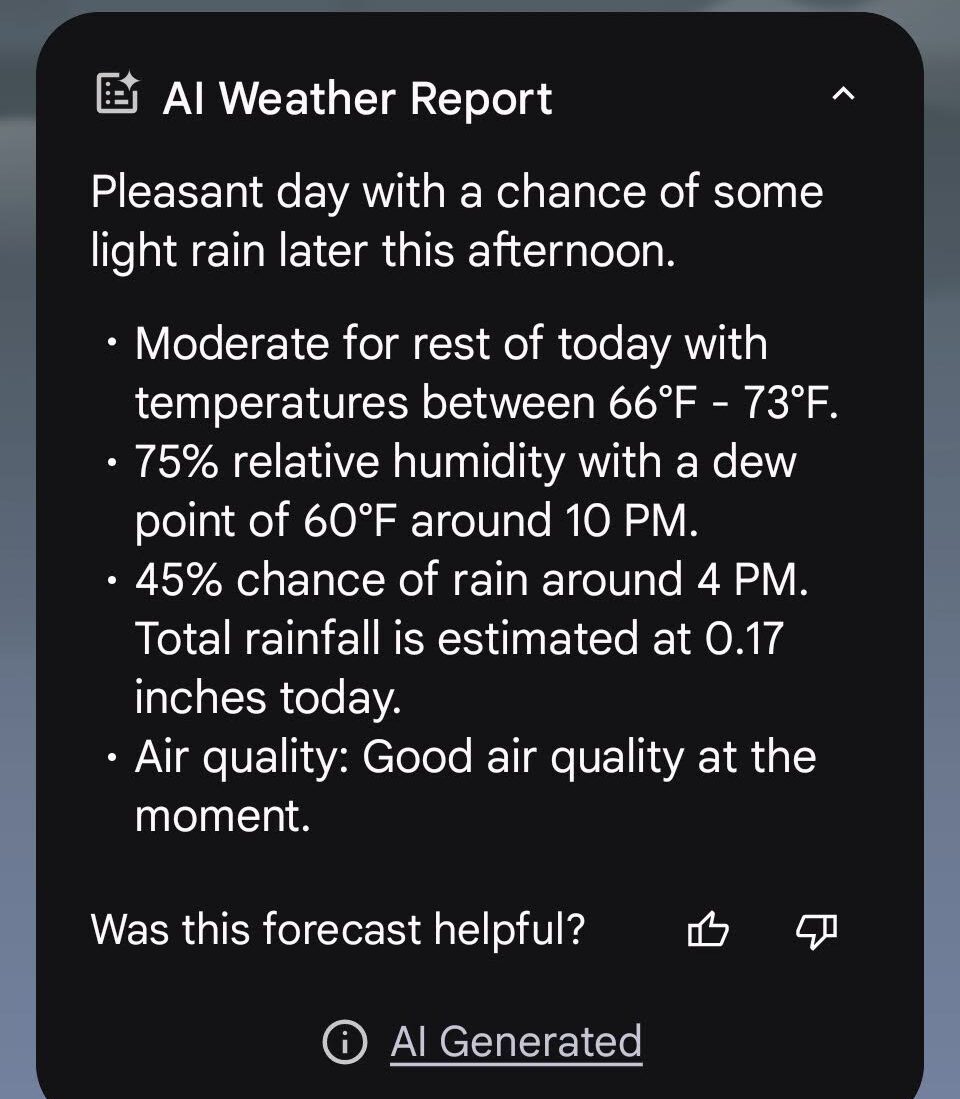
There’s a prominent “AI generated weather report” on top of the weather stack, which is a combination of summary and familiarity. “Cold and rainy day, bring your umbrella and hold onto your hat!” is Google’s example; I can’t provide another one, because an update to “Gemini Nano” is pending.
Credit: Kevin Purdy
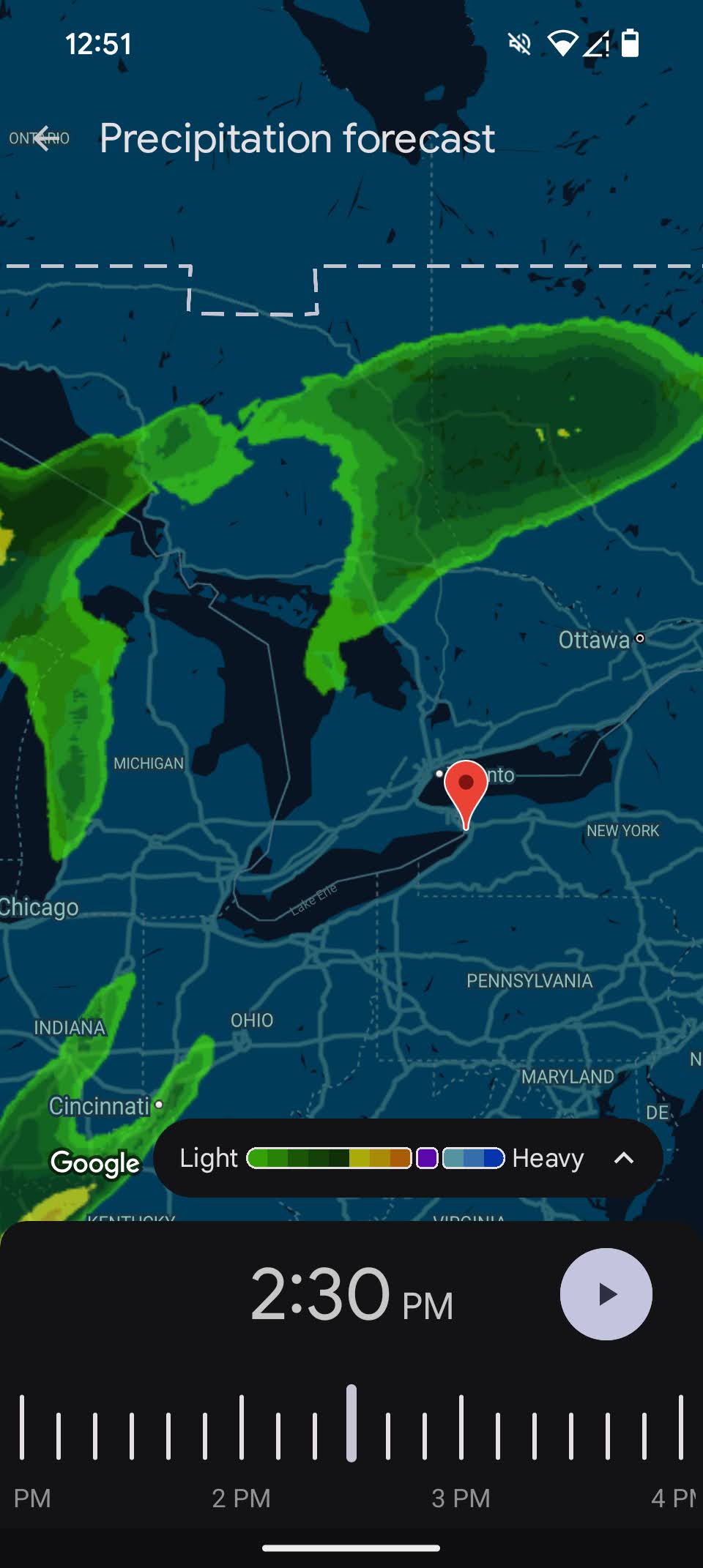
You can see weather radar for your location, along with forecasted precipitation movement. The app offers “Nowcasting” precipitation guesses, like “Rain continuing for 2 hours” or “Light rain in 10 minutes.”
Credit: Kevin Purdy
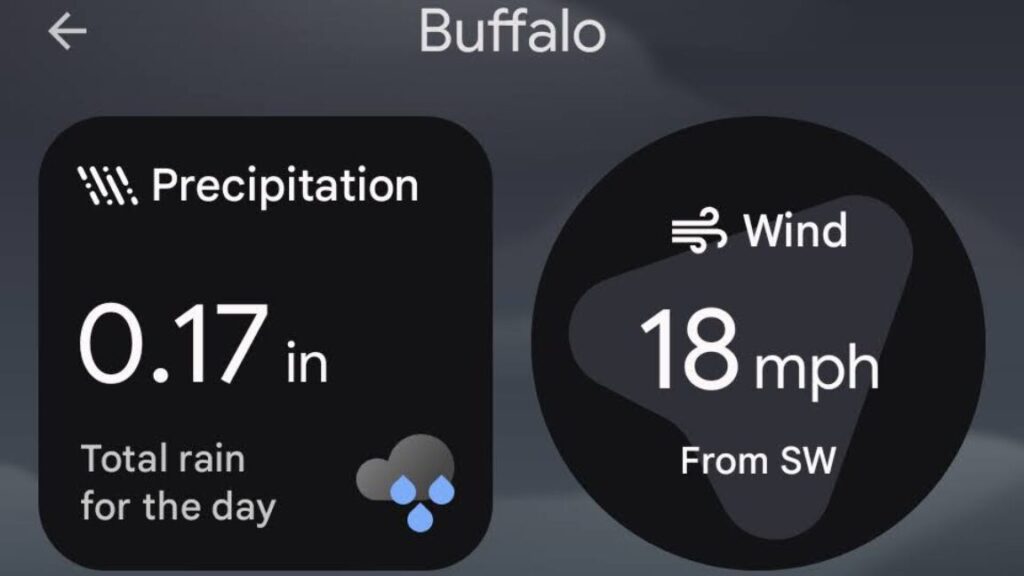
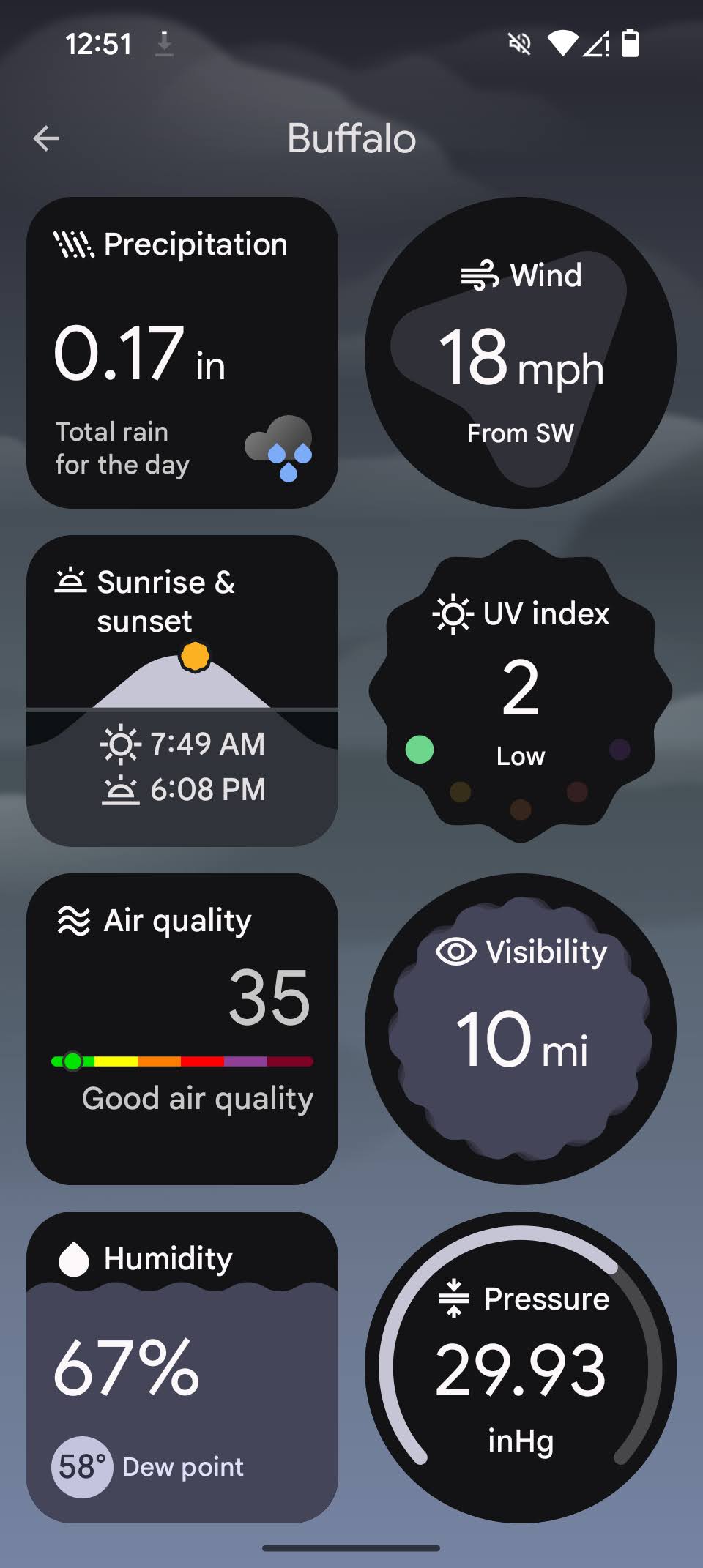
The best feature, one seen on the version of Weather that shipped to the Pixel Tablet and Fold, is that you can rearrange the order of data shown on your weather screen. I moved the UV index, humidity, sunrise/sunset, and wind conditions as high as they could go on my setup. It’s a trade-off, because the Weather app’s data widgets are so big as to require scrolling to get the full picture of a day, and you can’t move the AI summary or 10-day forecast off the top. But if you only need a few numbers and like a verbal summary, it’s handy.
Sadly, if you’re an allergy sufferer and you’re not in the UK, Germany, France, or Italy, Google can’t offer you any pollen data or forecasts. There is also, I am sad to say, no frog.
Google’s Weather app isn’t faring so well with Play Store reviewers. Users are miffed that they can’t see a location’s weather without adding it to their saved locations list; that other Google apps, including the “At a Glance” app on every Pixel’s default launcher, send you to the Google app’s summary instead of this app; the look of the weather map; and, most of all, that it does not show up in some phones’ app list, but only as a widget.
Much of the new obfuscation is the result of hiding malicious code in a dynamically decrypted and loaded .dex file of the apps. As a result, Zimperium initially believed the malicious apps they were analyzing were part of a previously unknown malware family. Then the researchers dumped the .dex file from an infected device’s memory and performed static analysis on it.
“As we delved deeper, a pattern emerged,” Ortega wrote. “The services, receivers, and activities closely resembled those from an older malware variant with the package name com.secure.assistant.” That package allowed the researchers to link it to the FakeCall Trojan.
Many of the new features don’t appear to be fully implemented yet. Besides the obfuscation, other new capabilities include:
Bluetooth Receiver
This receiver functions primarily as a listener, monitoring Bluetooth status and changes. Notably, there is no immediate evidence of malicious behavior in the source code, raising questions about whether it serves as a placeholder for future functionality.
Screen Receiver
Similar to the Bluetooth receiver, this component only monitors the screen’s state (on/off) without revealing any malicious activity in the source code.
Accessibility Service
The malware incorporates a new service inherited from the Android Accessibility Service, granting it significant control over the user interface and the ability to capture information displayed on the screen. The decompiled code shows methods such as onAccessibilityEvent() and onCreate() implemented in native code, obscuring their specific malicious intent.
While the provided code snippet focuses on the service’s lifecycle methods implemented in native code, earlier versions of the malware give us clues about possible functionality:
Monitoring Dialer Activity: The service appears to monitor events from the com.skt.prod.dialer package (the stock dialer app), potentially allowing it to detect when the user is attempting to make calls using apps other than the malware itself.
Automatic Permission Granting: The service seems capable of detecting permission prompts from the com.google.android.permissioncontroller (system permission manager) and com.android.systemui (system UI). Upon detecting specific events (e.g., TYPE_WINDOW_STATE_CHANGED), it can automatically grant permissions for the malware, bypassing user consent.
Remote Control: The malware enables remote attackers to take full control of the victim’s device UI, allowing them to simulate user interactions, such as clicks, gestures, and navigation across apps. This capability enables the attacker to manipulate the device with precision.
Phone Listener Service
This service acts as a conduit between the malware and its Command and Control (C2) server, allowing the attacker to issue commands and execute actions on the infected device. Like its predecessor, the new variant provides attackers with a comprehensive set of capabilities (see the table below). Some functionalities have been moved to native code, while others are new additions, further enhancing the malware’s ability to compromise devices.
The Kaspersky post from 2022 said that the only language supported by FakeCall was Korean and that the Trojan appeared to target several specific banks in South Korea. Last year, researchers from security firm ThreatFabric said the Trojan had begun supporting English, Japanese, and Chinese, although there were no indications people speaking those languages were actually targeted.
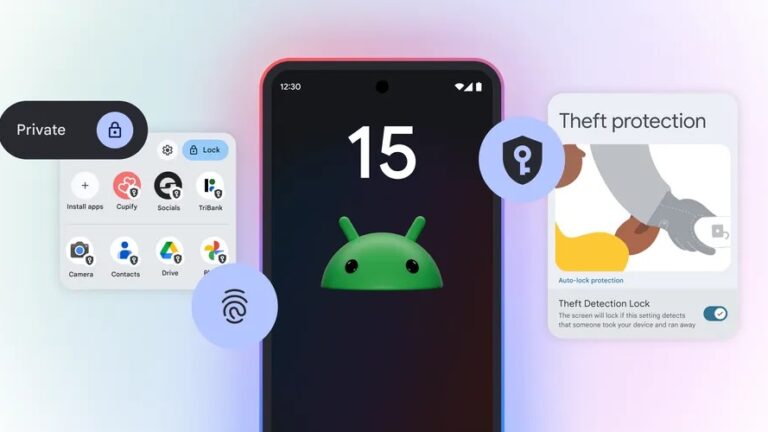
Android 15 started rolling out to Pixel devices Tuesday and will arrive, through various third-party efforts, on other Android devices at some point. There is always a bunch of little changes to discover in an Android release, whether by reading, poking around, or letting your phone show you 25 new things after it restarts.
In Android 15, some of the most notable involve making your device less appealing to snoops and thieves and more secure against the kids to whom you hand your phone to keep them quiet at dinner. There are also smart fixes for screen sharing, OTP codes, and cellular hacking prevention, but details about them are spread across Google’s own docs and blogs and various news site’s reports.
Here’s what is notable and new in how Android 15 handles privacy and security.
Private Space for apps
In the Android 15 settings, you can find “Private Space,” where you can set up a separate PIN code, password, biometric check, and optional Google account for apps you don’t want to be available to anybody who happens to have your phone. This could add a layer of protection onto sensitive apps, like banking and shopping apps, or hide other apps for whatever reason.
In your list of apps, drag any app down to the lock space that now appears in the bottom right. It will only be shown as a lock until you unlock it; you will then see the apps available in your new Private Space. After that, you should probably delete it from the main app list. Dave Taylor has a rundown of the process and its quirks.
It’s obviously more involved than Apple’s “Hide and Require Face ID” tap option but with potentially more robust hiding of the app.
Hiding passwords and OTP codes
A second form of authentication is good security, but allowing apps to access the notification text with the code in it? Not so good. In Android 15, a new permission, likely to be given only to the most critical apps, prevents the leaking of one-time passcodes (OTPs) to other apps waiting for them. Sharing your screen will also hide OTP notifications, along with usernames, passwords, and credit card numbers.
Google called the DOJ extending search remedies to AI “radical,” an “overreach.”
The US Department of Justice finally proposed sweeping remedies to destroy Google’s search monopoly late yesterday, and, predictably, Google is not loving any of it.
On top of predictable asks—like potentially requiring Google to share search data with rivals, restricting distribution agreements with browsers like Firefox and device makers like Apple, and breaking off Chrome or Android—the DOJ proposed remedies to keep Google from blocking competition in “the evolving search industry.” And those extra steps threaten Google’s stake in the nascent AI search world.
This is only the first step in the remedies stage of litigation, but Google is already showing resistance to both expected and unexpected remedies that the DOJ proposed. In a blog from Google’s vice president of regulatory affairs, Lee-Anne Mulholland, the company accused the DOJ of “overreach,” suggesting that proposed remedies are “radical” and “go far beyond the specific legal issues in this case.”
From here, discovery will proceed as the DOJ makes a case to broaden the scope of proposed remedies and Google raises its defense to keep remedies as narrowly tailored as possible. After that phase concludes, the DOJ will propose its final judgement on remedies in November, which must be fully revised by March 2025 for the court to then order remedies.
Even then, however, the trial is unlikely to conclude, as Google plans to appeal. In August, Mozilla’s spokesperson told Ars that the trial could drag on for years before any remedies are put in place.
In the meantime, Google plans to continue focusing on building out its search empire, Google’s president of global affairs, Kent Walker, said in August. This presumably includes innovations in AI search that the DOJ fears may further entrench Google’s dominant position.
Scrutiny of Google’s every move in the AI industry will likely only be heightened in that period. As Google has already begun seeking exclusive AI deals with companies like Apple, it risks appearing to engage in the same kinds of anti-competitive behavior in AI markets as the court has already condemned. And giving that impression could not only impact remedies ordered by the court, but also potentially weaken Google’s chances of winning on appeal, Lee Hepner, an antitrust attorney monitoring the trial for the American Economic Liberties Project, told Ars.
Ending Google’s monopoly starts with default deals
In the DOJ’s proposed remedy framework, the DOJ says that there’s still so much more to consider before landing on final remedies that it reserves “the right to add or remove potential proposed remedies.”
Through discovery, DOJ said that it plans to continue engaging experts and stakeholders “to learn not just about the relevant markets themselves but also about adjacent markets as well as remedies from other jurisdictions that could affect or inform the optimal remedies in this action.
“To be effective, these remedies… must include some degree of flexibility because market developments are not always easy to predict and the mechanisms and incentives for circumvention are endless,” the DOJ said.
Ultimately, the DOJ said that any remedies sought should be “mutually reinforcing” and work to “unfetter” Google’s current monopoly in general search services and general text advertising markets. That effort would include removing barriers to competition—like distribution and revenue-sharing agreements—as well as denying Google monopoly profits and preventing Google from monopolizing “related markets in the future,” the DOJ said.
Any effort to undo Google’s monopoly starts with ending Google’s control over “the most popular distribution channels,” the DOJ said. At one point during the trial, for example, a witness accidentally blurted out that Apple gets a 36 percent cut from its Safari deal with Google. Lucrative default deals like that leave rivals with “little-to-no incentive to compete for users,” the DOJ said.
“Fully remedying these harms requires not only ending Google’s control of distribution today, but also ensuring Google cannot control the distribution of tomorrow,” the DOJ warned.
To dislodge this key peg propping up Google’s search monopoly, some options include ending Google’s default deals altogether, which would “limit or prohibit default agreements, preinstallation agreements, and other revenue-sharing arrangements related to search and search-related products, potentially with or without the use of a choice screen.”
A breakup could be necessary
Behavior and structural remedies may also be needed, the DOJ proposed, to “prevent Google from using products such as Chrome, Play, and Android to advantage Google search and Google search-related products and features—including emerging search access points and features, such as artificial intelligence—over rivals or new entrants.” That could mean spinning off the Chrome browser or restricting Google from preinstalling its search engine as the default in Chrome or on Android devices.
In her blog, Mulholland conceded that “this case is about a set of search distribution contracts” but claimed that “overbroad restrictions on distribution contracts” would create friction for Google users and “reduce revenue for companies like Mozilla” as well as Android smart phone makers.
Asked to comment on supposedly feared revenue losses, a Mozilla spokesperson told Ars, “[We are] closely monitoring the legal process and considering its potential impact on Mozilla and how we can positively influence the next steps. Mozilla has always championed competition and choice online, particularly in search. Firefox continues to offer a range of search options, and we remain committed to serving our users’ preferences while fostering a competitive market.”
Mulholland also warned that “splitting off” Chrome or Android from Google’s search business “would break them” and potentially “raise the cost of devices,” because “few companies would have the ability or incentive to keep them open source, or to invest in them at the same level we do.”
“We’ve invested billions of dollars in Chrome and Android,” Mulholland wrote. “Chrome is a secure, fast, and free browser and its open-source code provides the backbone for numerous competing browsers. Android is a secure, innovative, and free open-source operating system that has enabled vast choice in the smartphone market, helping to keep the cost of phones low for billions of people.”
Google has long argued that its investment in open source Chrome and Android projects benefits developers whose businesses and customers would be harmed if those efforts lost critical funding.
“Features like Chrome’s Safe Browsing, Android’s security features, and Play Protect benefit from information and signals from a range of Google products and our threat-detection expertise,” Mulholland wrote. “Severing Chrome and Android would jeopardize security and make patching security bugs harder.”
Hepner told Ars that Android could potentially thrive if broken off from Google, suggesting that through discovery, it will become clearer what would happen if either Google product was severed from the company.
“I think others would agree that Android is a company that is capable [being] a standalone entity,” Hepner said. “It could be independently monetized through relationships with device manufacturers, web browsers, alternative Play Stores that are not under Google’s umbrella. And that if that were the case, what you would see is that Android and the operating system marketplace begins to evolve to meet the needs and demands of innovative products that are not being created just by Google. And you’ll see that dictating the evolution of the marketplace and fundamentally the flow of information across our society.”
Mulholland also claimed that sharing search data with rivals risked exposing users to privacy and security risks, but the DOJ vowed to be “mindful of potential user privacy concerns in the context of data sharing” while distinguishing “genuine privacy concerns” from “pretextual arguments” potentially misleading the court regarding alleged risks.
One possible way around privacy concerns, the DOJ suggested, would be prohibiting Google from collecting the kind of sensitive data that cannot be shared with rivals.
Finally, to stop Google from charging supra-competitive prices for ads, the DOJ is “evaluating remedies” like licensing or syndicating Google’s ad feed “independent of its search results.” Further, the DOJ may require more transparency, forcing Google to provide detailed “search query reports” featuring currently obscured “information related to its search text ads auction and ad monetization.”
Stakeholders were divided on whether the DOJ’s initial framework is appropriate.
Matt Schruers, the CEO of a trade association called the Computer & Communications Industry Association (which represents Big Tech companies like Google), criticized the DOJ’s “hodgepodge of structural and behavioral remedies” as going “far beyond” what’s needed to address harms.
“Any remedy should be narrowly tailored to address specific conduct, which in this case was a set of search distribution contracts,” Schruers said. “Instead, the proposed DOJ remedies would reshape numerous industries and products, which would harm consumers and innovation in these dynamic markets.”
But a senior vice president of public affairs for Google search rival DuckDuckGo, Kamyl Bazbaz, praised the DOJ’s framework as being “anchored to the court’s ruling” and appropriately broad.
“This proposal smartly takes aim at breaking Google’s illegal hold on the general search market now and ushers in a new era of enduring competition moving forward,” Bazbaz said. “The framework understands that no single remedy can undo Google’s illegal monopoly, it will require a range of behavioral and structural remedies to free the market.”
Bazbaz expects that “Google is going to use every resource at its disposal to discredit this proposal,” suggesting that “should be taken as a sign this framework can create real competition.”
AI deals could weaken Google’s appeal, expert says
Google appears particularly disturbed by the DOJ’s insistence that remedies must be forward-looking and prevent Google from leveraging its existing monopoly power “to feed artificial intelligence features.”
As Google sees it, the DOJ’s attempt to attack Google’s AI business “comes at a time when competition in how people find information is blooming, with all sorts of new entrants emerging and new technologies like AI transforming the industry.”
But the DOJ has warned that Google’s search monopoly potentially feeding AI features “is an emerging barrier to competition and risks further entrenching Google’s dominance.”
The DOJ has apparently been weighing some of the biggest complaints about Google’s AI training when mulling remedies. That includes listening to frustrated site owners who can’t afford to block Google from scraping data for AI training because the same exact crawler indexes their content in Google search results. Those site owners have “little choice” but to allow AI training or else sacrifice traffic from Google search, The Seattle Times reported.
Remedy options may come with consequences
Remedies in the search trial might change that. In their proposal, the DOJ said it’s considering remedies that would “prohibit Google from using contracts or other practices to undermine rivals’ access to web content and level the playing field by requiring Google to allow websites crawled for Google search to opt out of training or appearing in any Google-owned artificial-intelligence product or feature on Google search,” such as Google’s controversial AI summaries.
Hepner told Ars that “it’s not surprising at all” that remedies cover both search and AI because “at the core of Google’s monopoly power is its enormous scale and access to data.”
“The Justice Department is clearly thinking creatively,” Hepner said, noting that “the ability for content creators to opt out of having their material and work product used to train Google’s AI systems is an interesting approach to depriving Google of its immense scale.”
The DOJ is also eyeing controls on Google’s use of scale to power AI advertising technologies like Performance Max to end Google’s supracompetitive pricing on text ads for good.
It’s critical to think about the future, the DOJ argued in its framework, because “Google’s anticompetitive conduct resulted in interlocking and pernicious harms that present unprecedented complexities in a highly evolving set of markets”—not just in the markets where Google holds monopoly powers.
Google disagrees with this alleged “government overreach.”
“Hampering Google’s AI tools risks holding back American innovation at a critical moment,” Mulholland warned, claiming that AI is still new and “competition globally is fierce.”
“There are enormous risks to the government putting its thumb on the scale of this vital industry—skewing investment, distorting incentives, hobbling emerging business models—all at precisely the moment that we need to encourage investment, new business models, and American technological leadership,” Mulholland wrote.
Hepner told Ars that he thinks that the DOJ’s proposed remedies framework actually “meets the moment and matches the imperative to deprive Google of its monopoly hold on the search market, on search advertising, and potentially on future related markets.”
To ensure compliance with any remedies pursued, the DOJ also recommended “protections against circumvention and retaliation, including through novel paths to preserving dominance in the monopolized markets.”
That means Google might be required to “finance and report to a Court-appointed technical committee” charged with monitoring any Google missteps. The company may also have to agree to retain more records for longer—including chat messages that the company has been heavily criticized for deleting. And through this compliance monitoring, Google may also be prohibited from owning a large stake in any rivals.
If Google were ever found willfully non-compliant, the DOJ is considering a “range of provisions,” including risking more extreme structural or behavioral remedies or enduring extensions of compliance periods.
As the remedies stage continues through the spring, followed by Google’s prompt appeal, Hepner suggested that the DOJ could fight to start imposing remedies before the appeal concludes. Likely Google would just as strongly fight for any remedies to be delayed.
While the trial drags on, Hepner noted that Google already appears to be trying to strike another default deal with Apple that appears pretty similar to the controversial distribution deals at the heart of the search monopoly trial. In March, Apple started mulling using Google’s Gemini to exclusively power new AI features for the iPhone.
“This is basically the exact same anticompetitive behavior that they were found liable for,” Hepner told Ars, suggesting this could “weaken” Apple’s defense both against the DOJ’s broad framework of proposed remedies and during the appeal.
“If Google is actually engaging in the same anti-competitive conduct and artificial intelligence markets that they were found liable for in the search market, the court’s not going to look kindly on that relative to an appeal,” Hepner said.
Ashley is a senior policy reporter for Ars Technica, dedicated to tracking social impacts of emerging policies and new technologies. She is a Chicago-based journalist with 20 years of experience.
Thunderbird’s Android app, which is actually the K-9 Mail project reborn, is almost out. You can check it out a bit early in a beta that will feel pretty robust to most users.
Thunderbird, maintained by the Mozilla Foundation subsidiary MZLA, acquired the source code and naming rights to K-9 Mail, as announced in June 2022. The group also brought K-9 maintainer Christian Ketterer (or “cketti”) onto the project. Their initial goals, before a full rebrand into Thunderbird, involved importing Thunderbird’s automatic account setup, message filters, and mobile/desktop Thunderbird syncing.
At the tail end of 2023, however, Ketterer wrote on K-9’s blog that the punchlist of items before official Thunderbird-dom was taking longer than expected. But when it’s fully released, Thunderbird for Android will have those features. As such, beta testers are asked to check out a specific list of things to see if they work, including automatic setup, folder management, and K-9-to-Thunderbird transfer. The beta will not be “addressing longstanding issues,” Thunderbird’s blog post notes.
Launching Thunderbird for Android from K-9 Mail’s base makes a good deal of sense. Thunderbird’s desktop client has had a strange, disjointed life so far and is only just starting to regain a cohesive vision for what it wants to provide. For a long time now, K-9 Mail has been the Android email of choice for people who don’t want Gmail or Outlook, will not tolerate the default “Email” app on non-Google-blessed Android systems, and just want to see their messages.
“Picture a massive football stadium filled with fans month after month,” Reichenstein wrote to Ars. In that stadium, he writes:
5 percent (max) have a two-week trial ticket
2 percent have a yearly ticket
0.5 percent have a monthly ticket
0.5 percent are buying “all-time” tickets
But even if every lifetime ticket buyer showed up at once, that’s 10 percent of the stadium, Reichenstein said. Even without full visibility of every APK—”and what is happening in China at all,” he wrote—iA can assume 90 percent of users are “climbing over the fence.”
“Long story short, that’s how you can end up with 50,000 users and only 1,000 paying you,” Reichenstein wrote in the blog post.
Piracy doesn’t just mean lost revenue, Reichenstein wrote, but also increased demands for support, feature requests, and chances for bad ratings from people who never pay. And it builds over time. “You sell less apps through the [Play Store], but pirated users keep coming in because pirate sites don’t have such reviews. Reviews don’t matter much if the app is free.”
The iA numbers on macOS hint at a roughly 10 percent piracy rate. On iOS, it’s “not 0%,” but it’s “very, very hard to say what the numbers are”; there is also no “reset trick” or trials offered there.
A possible future unfreezing
Reichenstein wrote in the post and to Ars that sharing these kinds of numbers can invite critique from other app developers, both armchair and experienced. He’s seen that happening on Mastodon, Hacker News, and X (formerly Twitter). But “critical people are useful,” he noted, and he’s OK with people working backward to figure out how much iA might have made. (Google did not offer comment on aspects of iA’s post outside discussing Drive access policy.)
iA suggests that it might bring back Writer on Android, perhaps in a business-to-business scenario with direct payments. For now, it’s a slab of history, albeit far less valuable to the metaphorical Darth Vader that froze it.
Five years ago, researchers made a grim discovery—a legitimate Android app in the Google Play market that was surreptitiously made malicious by a library the developers used to earn advertising revenue. With that, the app was infected with code that caused 100 million infected devices to connect to attacker-controlled servers and download secret payloads.
Now, history is repeating itself. Researchers from the same Moscow, Russia-based security firm reported Monday that they found two new apps, downloaded from Play 11 million times, that were infected with the same malware family. The researchers, from Kaspersky, believe a malicious software developer kit for integrating advertising capabilities is once again responsible.
Clever tradecraft
Software developer kits, better known as SDKs, are apps that provide developers with frameworks that can greatly speed up the app-creation process by streamlining repetitive tasks. An unverified SDK module incorporated into the apps ostensibly supported the display of ads. Behind the scenes, it provided a host of advanced methods for stealthy communication with malicious servers, where the apps would upload user data and download malicious code that could be executed and updated at any time.
The stealthy malware family in both campaigns is known as Necro. This time, some variants use techniques such as steganography, an obfuscation method rarely seen in mobile malware. Some variants also deploy clever tradecraft to deliver malicious code that can run with heightened system rights. Once devices are infected with this variant, they contact an attacker-controlled command-and-control server and send web requests containing encrypted JSON data that reports information about each compromised device and application hosting the module.
The server, in turn, returns a JSON response that contains a link to a PNG image and associated metadata that includes the image hash. If the malicious module installed on the infected device confirms the hash is correct, it downloads the image.
The SDK module “uses a very simple steganographic algorithm,” Kaspersky researchers explained in a separate post. “If the MD5 check is successful, it extracts the contents of the PNG file—the pixel values in the ARGB channels—using standard Android tools. Then the getPixel method returns a value whose least significant byte contains the blue channel of the image, and processing begins in the code.”
The researchers continued:
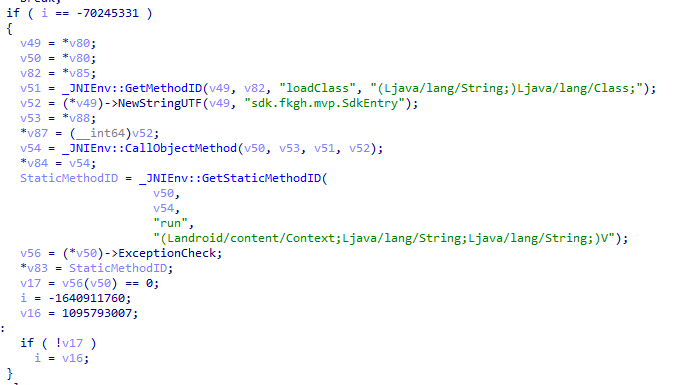
If we consider the blue channel of the image as a byte array of dimension 1, then the first four bytes of the image are the size of the encoded payload in Little Endian format (from the least significant byte to the most significant). Next, the payload of the specified size is recorded: this is a JAR file encoded with Base64, which is loaded after decoding via DexClassLoader. Coral SDK loads the sdk.fkgh.mvp.SdkEntry class in a JAR file using the native library libcoral.so. This library has been obfuscated using the OLLVM tool. The starting point, or entry point, for execution within the loaded class is the run method.
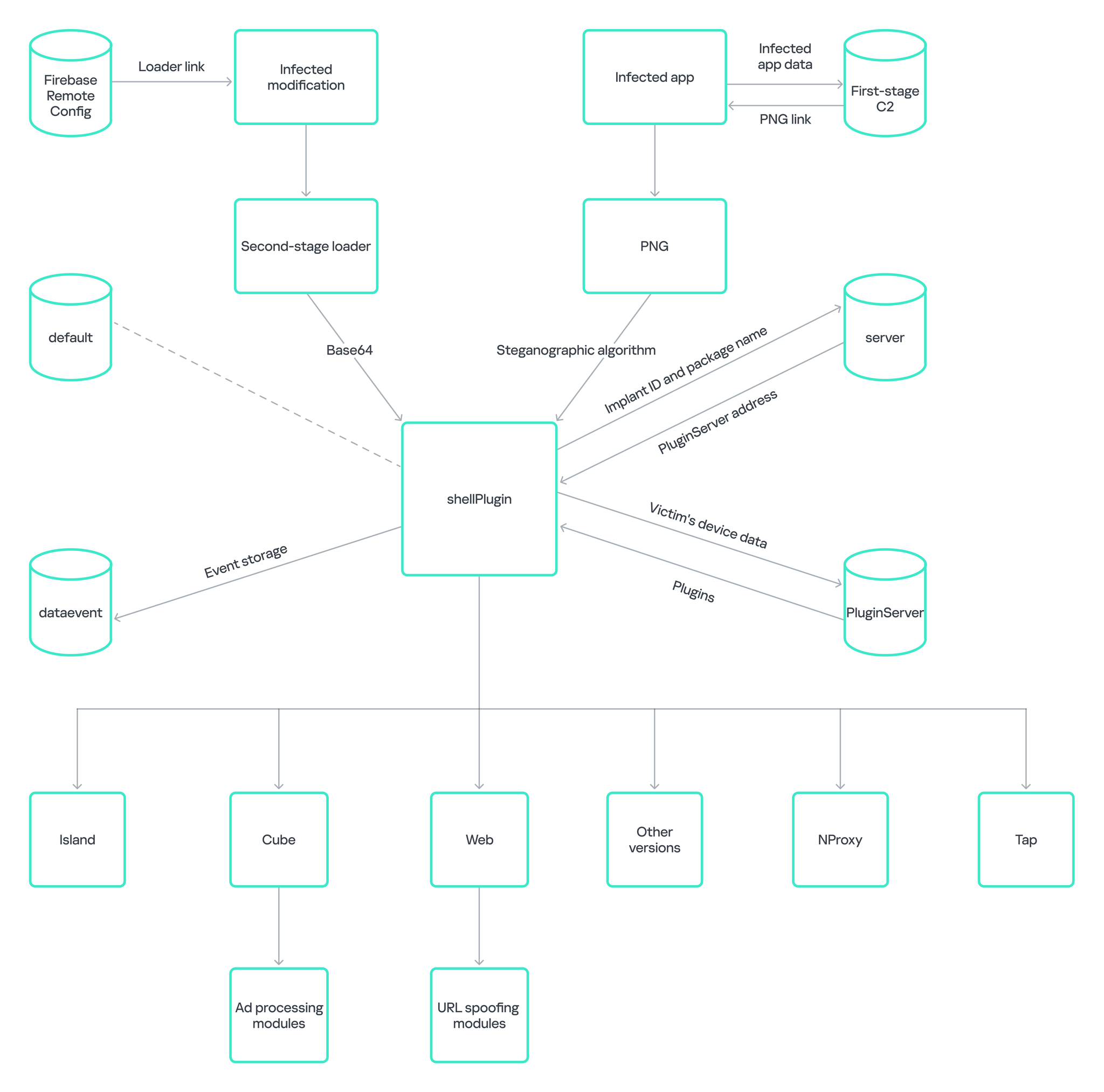
Follow-on payloads that get installed download malicious plugins that can be mixed and matched for each infected device to perform a variety of different actions. One of the plugins allows code to run with elevated system rights. By default, Android bars privileged processes from using WebView, an extension in the OS for displaying webpages in apps. To bypass this safety restriction, Necro uses a hacking technique known as a reflection attack to create a separate instance of the WebView factory.
This plugin can also download and run other executable files that will replace links rendered through WebView. When running with the elevated system rights, these executables have the ability to modify URLs to add confirmation codes for paid subscriptions and download and execute code loaded at links controlled by the attacker. The researchers listed five separate payloads they encountered in their analysis of Necro.
The modular design of Necro opens myriad ways for the malware to behave. Kaspersky provided the following image that provides an overview.
The researchers found Necro in two Google Play apps. One was Wuta Camera, an app with 10 million downloads to date. Wuta Camera versions 6.3.2.148 through 6.3.6.148 contained the malicious SDK that infects apps. The app has since been updated to remove the malicious component. A separate app with roughly 1 million downloads—known as Max Browser—was also infected. That app is no longer available in Google Play.
The researchers also found Necro infecting a variety of Android apps available in alternative marketplaces. Those apps typically billed themselves as modified versions of legitimate apps such as Spotify, Minecraft, WhatsApp, Stumble Guys, Car Parking Multiplayer, and Melon Sandbox.
People who are concerned they may be infected by Necro should check their devices for the presence of indicators of compromise listed at the end of this writeup.
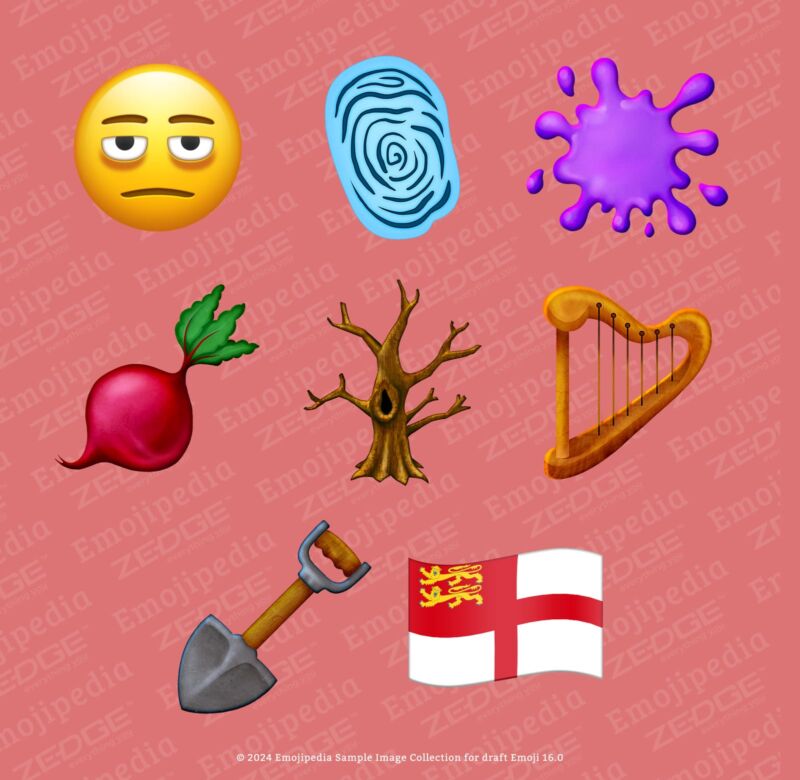
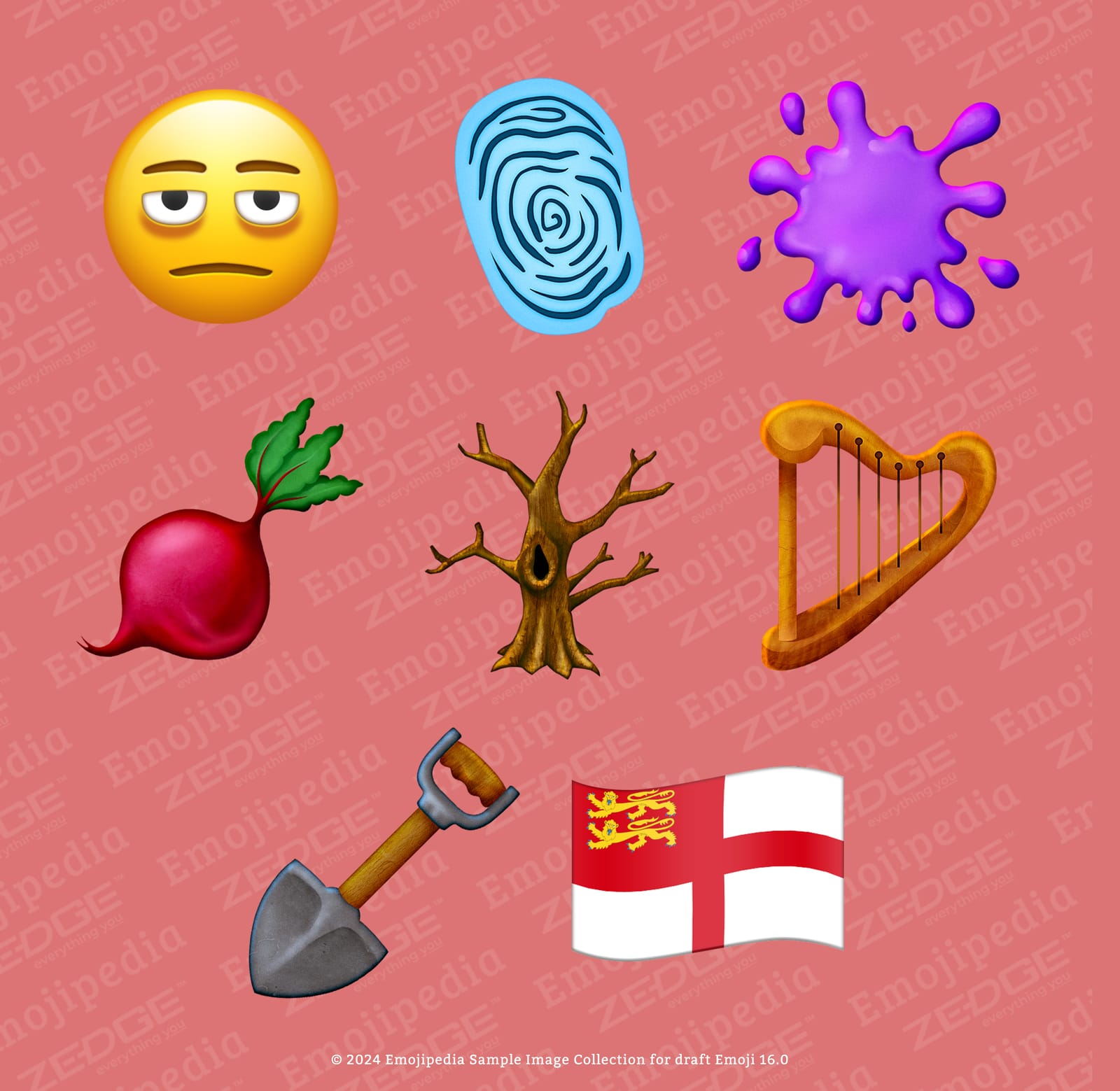
Enlarge/ Emojipedia sample images of the new Unicode 16.0 emoji.
The Unicode Consortium has finalized and released version 16.0 of the Unicode standard, the elaborate character set that ensures that our phones, tablets, PCs, and other devices can all communicate and interoperate with each other. The update adds 5,185 new characters to the standard, bringing the total up to a whopping 154,998.
Of those 5,185 characters, the ones that will get the most attention are the eight new emoji characters, including a shovel, a fingerprint, a leafless tree, a radish (formally classified as “root vegetable”), a harp, a purple splat that evokes the ’90s Nickelodeon logo, and a flag for the island of Sark. The standout, of course, is “face with bags under eyes,” whose long-suffering thousand-yard stare perfectly encapsulates the era it has been born into. Per usual, Emojipedia has sample images that give you some idea of what these will look like when they’re implemented by various operating systems, apps, and services.
We last got new emoji in 2023’s Unicode 15.1 update, though all of these designs were technically modifications of existing emoji rather than new characters—many emoji, most notably for skin and hair color variants, use a base emoji plus a modifier emoji, combined together with a “zero-width joiner” (ZWJ) character that makes them display as one character instead. The lime emoji in Unicode 15.1 was actually a lemon emoji combined with the color green; the phoenix was a regular bird joined to the fire emoji. This was likely because 15.1 was only intended as a minor update to 2022’s Unicode 15.0 standard.
Most of the Unicode 16.0 emoji, by contrast, are their own unique characters. The one exception is the Sark flag emoji; flag sequences are created by placing two “regional indicator letters” directly next to each other and don’t require a ZWJ character between them.
Incorporation into the Unicode standard is only the first step that new emoji and other characters take on their journey from someone’s mind to your phone or computer; software makers like Apple, Google, Microsoft, Samsung, and others need to design iterations that fit with their existing spin on the emoji characters, they need to release software updates that use the new characters, and people need to download and install them.
We’ve seen a few people share on social media that the Unicode 16.0 release includes a “greenwashing” emoji designed by Shepard Fairey, an artist best known for the 2008 Barack Obama “Hope” poster. This emoji, and an attempt to gin up controversy around it, is all an elaborate hoax: there’s a fake Unicode website announcing it, a fake lawsuit threat that purports to be from a real natural gas industry group, and a fake Cory Doctorow article about the entire “controversy” published in a fake version of Wired. These were all published to websites with convincing-looking but fake domains, all registered within a couple of weeks of each other in August 2024. The face-with-bags-under-eyes emoji feels like an appropriate response.