Author name: Rejus Almole

amazon-defends-$4b-anthropic-ai-deal-from-uk-monopoly-concerns

Amazon defends $4B Anthropic AI deal from UK monopoly concerns

Amazon defends $4B Anthropic AI deal from UK monopoly concerns

The United Kingdom’s Competition and Markets Authority (CMA) has officially launched a probe into Amazon’s $4 billion partnership with the AI firm Anthropic, as it continues to monitor how the largest tech companies might seize control of AI to further entrench their dominant market positions.

Through the partnership, “Amazon will become Anthropic’s primary cloud provider for certain workloads, including agreements for purchasing computing capacity and non-exclusive commitments to make Anthropic models available on Amazon Bedrock,” the CMA said.

Amazon and Anthropic deny there’s anything wrong with the deal. But because the CMA has seen “some” foundational model (FM) developers “form partnerships with major cloud providers” to “secure access to compute” needed to develop models, the CMA is worried that “incumbent firms” like Amazon “could use control over access to compute to shape FM-related markets in their own interests.”

Due to this potential risk, the CMA said it is “considering” whether Amazon’s partnership with Anthropic “has resulted in the creation of a relevant merger situation under the merger provisions of the Enterprise Act 2002 and, if so, whether the creation of that situation has resulted, or may be expected to result, in a substantial lessening of competition within any market or markets” in the UK.

It’s not clear yet if Amazon’s partnership with Anthropic is problematic, but the CMA confirmed that after a comment period last April, it now has “sufficient information” to kick off this first phase of its merger investigation.

By October 4, this first phase will conclude, after which the CMA may find that the partnership does not qualify as a merger situation, the UK regulator said. Or it may determine that it is a merger situation “but does not raise competition concerns,” clearing Amazon to proceed with the deal.

However, if a merger situation exists, and “it may result in a substantial lessening of competition” in a UK market, the CMA may refer the investigation to the next phase, allowing a panel of independent experts to dig deeper to illuminate potential risks and concerns. If Amazon wants to avoid that deeper probe potentially ordering steep fines, the tech giant would then have the option to offer fixes to “resolve the CMA’s concerns,” the CMA said.

An Amazon spokesperson told Reuters that its “collaboration with Anthropic does not raise any competition concerns or meet the CMA’s own threshold for review.”

“Amazon holds no board seat nor decision-making power at Anthropic, and Anthropic is free to work with any other provider (and indeed has multiple partners),” Amazon’s spokesperson said, defending the deal.

Anthropic’s spokesperson agreed that nothing was amiss, telling Reuters that “our strategic partnerships and investor relationships do not diminish our corporate governance independence or our freedom to partner with others. We intend to cooperate with the CMA and provide them with a comprehensive understanding of Amazon’s investment and our commercial collaboration.”

Amazon defends $4B Anthropic AI deal from UK monopoly concerns Read More »
sci-fi-writer-and-wordstar-lover-re-releases-the-cult-dos-app-for-free

Sci-fi writer and WordStar lover re-releases the cult DOS app for free

I love it, and I need it, I bleed it —

“Compared to it, Microsoft Word is pure madness”—Anne Rice.

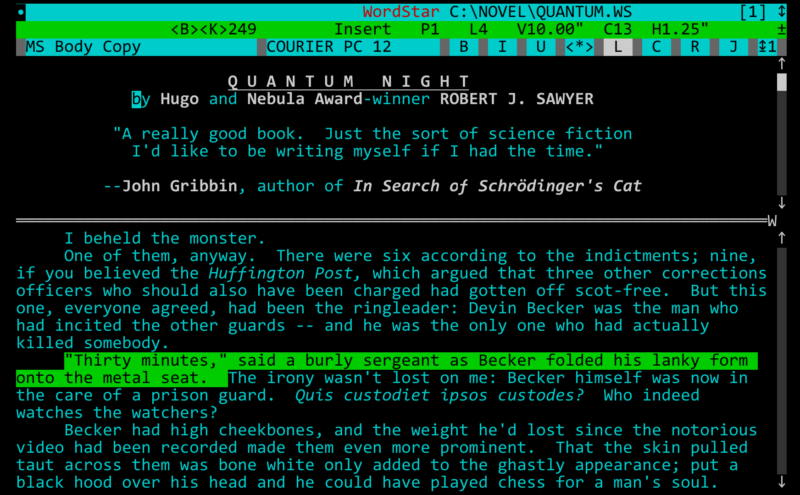
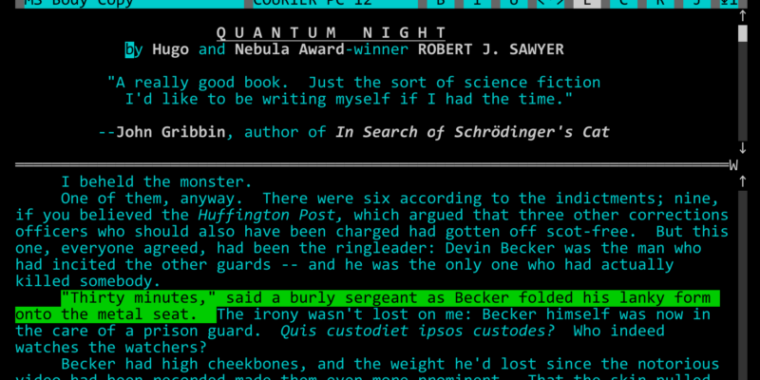
WordStar running under emulation

Robert J. Sawyer

WordStar’s most recent claim to fame might be that it’s the word processing application on which George R.R. Martin is still not finishing A Song of Ice and Fire.

But many writers loved and still love WordStar, a word processor notably good for actual writing. As computers moved on from DOS to Windows, and word programs grew to encompass features that strayed far from organizing words on a page, WordStar hung back, whether in DOS emulation or in the hearts of its die-hard fans.

One of those fans is Robert J. Sawyer, an award-winning science fiction author still using the program last updated in 1992. Deciding that the app is now “abandonware,” Sawyer recently put together as complete a version of WordStar 7 as might exist. He bundled together over 1,000 pages of scanned manuals that came with WordStar, related utilities, his own README guidance, ready-to-run versions of DOSBox-X and VDosPlus, and WordStar 7 Rev. D and posted them on his website as the “Complete WordStar 7.0 Archive.”

Why would Sawyer—and Michael Chabon and Anne Rice and Arthur C. Clarke and James Gunn—keep using a DOS program, decades past its last update, with quite a few workarounds needed for modern systems? Because it’s meant to help writers keep on writing. Like Vim or Emacs, it can be used with a system of keyboard commands entirely without a mouse; unlike Vim or Emacs, it is built for words and paragraphs, not code. Sawyer detailed this in an essay on his site, republished on Ars Technica in 2017. WordStar puts powerful commands near your strongest fingers and makes navigating text, bookmarking, and leaving unpublished notes for yourself far easier than WordPerfect, Word, or almost anything since.

As noted by The Register, Sawyer is also taking on the calculated risk of publicly declaring WordStar 7 abandoned. The program’s path from a CP/M app by MicroPro onward is winding, being shoved into a half-baked office suite, acquired by SoftKey, which became the Learning Company, acquired by Mattel, spun off to Houghton Mifflin Riverdeep, and is now the archival property of—well, nobody’s quite sure. The history of WordMaster, WordStar, NewWord, and their offshoots and intermixing is fascinating, with a hospital bedside power-grab, lawsuits, and names like Corel and Xoom you haven’t heard in some time.

The full package

If you download the entire 700-ish MB package, you can see all of this for yourself. Sawyer’s README (included in full on the archive page) details the tweaks he recommends for getting WordStar running in DOSBox-X, like setting the screen to 80 columns and 25 lines of text, picking a good font, and switching CapsLock and Ctrl keys to make use of WordStar’s home-row-oriented shortcuts. There’s even a utility for converting WordStar files to something Word or other modern tools can read, handily named CONVERT.EXE.

I wasn’t able to get WordStar working on Windows, Mac, or Linux; it would boot, but it would complain that it “Can’t find C:WSDSPCH.OVR” and shut down soon after, even when I would cravenly mount and provide DOSBox with full access to my root Windows drive. But I’m a relative newcomer to DOSBox-X, so I’m sure it’s something quite simple—yet profound.

Sci-fi writer and WordStar lover re-releases the cult DOS app for free Read More »

return-to-office-mandates-hurt-employee-retention,-productivity,-survey-says

Return-to-office mandates hurt employee retention, productivity, survey says

RT-Oh No —

Survey of 4,400 US employees who are at least 18 years old.

Businessman leaning on corridor wall

US workers who work remotely are 27 percent more likely to look forward to doing their job, according to a survey of over 4,400 employees aged 18 and older.

The survey from Great Place to Work took place in July 2023, which was “the third year of an ongoing market study of US workplaces,” according to the report entitled “Return-to-Office Mandates and the Future of Work” (PDF). Of the participants, 51 percent were female, 49 percent were male, and less than 1 percent were “non-binary or other gender,” according to Great Place to Work. In terms of roles, half were “individual contributors,” 25 percent were “frontline managers,” 20 percent were mid-level managers, and 5 percent were executives. Eighty-eight percent were full-time workers versus part-time.

The survey also found that remote workers were 23 percent more likely to say they have “a psychologically and emotionally healthy workplace,” 19 percent were more likely to cite “high levels of cooperation,” and 18 percent were more likely to say that people avoid office politics and backstabbing.

Notably, however, survey respondents were unevenly on-site (65 percent) versus people who work remote all the time (16 percent) or sometimes (20 percent). When Ars Technica asked about this, a Great Place to Work spokesperson said that the report uses a confidence interval of 95 percent. They added: “Because of the overall size of our sample with 4,400 responses, we are still able to have statistically significant findings that illustrate the different needs of these two groups.”

The report says:

One explanation for the gap between remote and on-site workers: Employees of color reported finding a reprieve from unconscious bias and code switching when working remotely.

That doesn’t mean that companies must embrace fully remote work to be inclusive. Instead, great workplaces are finding ways to meet the needs of their employees and provide support to all workers regardless of where they work.

A theme of the report is highlighting the benefits of workplaces working with employees to understand their views on remote work and whether remote work options fit specific needs within the company. It’s also important to consider why people want to work remotely; if it’s due to factors like a toxic work environment, there are other ways to address worker concerns besides remote work, the authors said.

Earlier this year, another survey pointed to return-to-office (RTO) mandates hurting company morale. The survey of some companies on the S&P 500 list by University of Pittsburgh researchers found that RTO policies hurt employee satisfaction while failing to boost company value.

RTO mandates hurt employee retention

Great Place to Work’s report encourages companies to ensure that workers without remote work options “find special meaning in their work.” Companies should talk with in-person workers “about how their efforts are delivering on your brand mission” and hold valued in-person activities, the report said. Cisco, which the report notes doesn’t have an RTO mandate, tries to lure people to the office with things like hackathons, career coaching, and team gatherings, for example.

The report also says RTO mandates can hurt employee retention:

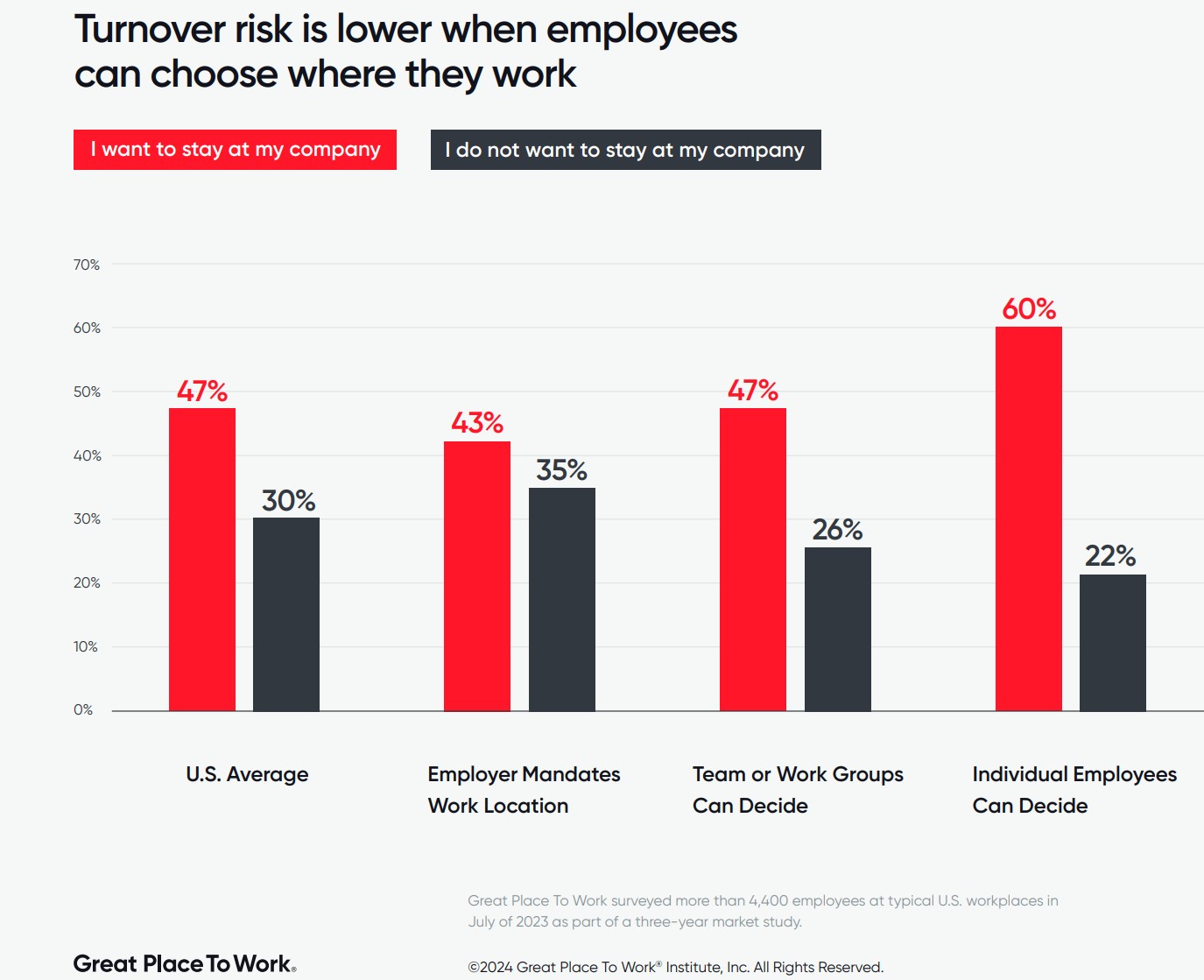
When employees have a say in where they work, retention improves.

Employees who report being able to decide where they work are more likely to stay with their company long-term.

More specifically, the report’s authors concluded that employees who are allowed to choose between in-person, remote, or hybrid work are three times more likely to want to stay at their company. They also found that workers who aren’t facing RTO mandates are 14 times less likely to “quit and stay.”

Great Place to Work

This isn’t the first survey we’ve seen suggesting that RTO mandates have driven workers away. In May, a study published by University of Chicago and University of Michigan researchers examining a reported 260 million résumés from People Data Labs reported that mandates requiring workers to return to the office either full or part-time led to a higher rate of employees, particularly of a senior level, leaving Apple, Microsoft, and SpaceX. (In 2022, numerous prominent Apple staff publicly resigned over RTO mandates.) A March survey of 1,504 full-time employees, including 504 HR workers, found that some firms have issued RTO mandates in the hopes of making people quit.

Return-to-office mandates hurt employee retention, productivity, survey says Read More »

court-blocks-net-neutrality,-says-isps-are-likely-to-win-case-against-fcc

Court blocks net neutrality, says ISPs are likely to win case against FCC

FCC Commissioner Jessica Rosenworcel speaks outside in front of a sign that says

Enlarge / Federal Communication Commission Chairwoman Jessica Rosenworcel, then a commissioner, rallies against repeal of net neutrality rules in December 2017.

Getty Images | Chip Somodevilla

The Federal Communications Commission’s hopes of enforcing net neutrality rules was dealt a major setback last week. A panel of appeals court judges blocked the regulations on Thursday in a ruling that said broadband providers are likely to win the case on the merits.

The US Court of Appeals for the 6th Circuit previously issued an administrative stay that delayed enforcement of the rules for a few weeks, which didn’t necessarily indicate much about the judges’ view of the lawsuit. But on Thursday, the judges issued an order that stays the net neutrality rules until the court makes a final ruling, and judges made it clear they believe the Internet service providers have a stronger case than the FCC.

“Because the broadband providers have shown that they are likely to succeed on the merits and that the equities support them, we grant the stay,” a panel of three judges wrote in the unanimous ruling.

The FCC in April voted to revive net neutrality rules that were previously discarded by the Trump-era commission. To get the rules upheld, the FCC must convince judges that it has authority to classify broadband as a telecommunications service, a necessary step for imposing Title II common-carrier regulations.

The FCC’s task got harder when the Supreme Court decision in Loper Bright Enterprises v. Raimondo overturned the 40-year-old Chevron precedent that gave agencies leeway to interpret ambiguous laws as long as the agency’s conclusion was reasonable. Even before that, ISPs were hoping that the Supreme Court’s evolving approach to what are deemed “major questions” would prevent the FCC from defining broadband as telecommunications without explicit instructions from Congress.

ISPs likely to succeed on the merits

The 6th Circuit panel found that broadband providers “are likely to succeed on the merits because the final rule implicates a major question, and the Commission has failed to satisfy the high bar for imposing such regulations.”

Net neutrality, the judges wrote, “is likely a major question requiring clear congressional authorization,” and the “Communications Act likely does not plainly authorize the Commission to resolve this signal question. Nowhere does Congress clearly grant the Commission the discretion to classify broadband providers as common carriers. To the contrary, Congress specifically empowered the Commission to define certain categories of communications services—and never did so with respect to broadband providers specifically or the Internet more generally.”

Although the ISPs now have a clear advantage in the case, net neutrality supporters say there is still hope.

“The grant of a stay definitely gives the edge to the ISPs. That said, the outcome is far from certain. The case goes to a different set of judges, which means that it may get a fresh look,” Andrew Jay Schwartzman, senior counselor for the Benton Institute for Broadband & Society, told Ars today.

The three 6th Circuit judges who ruled against the FCC last week are Chief Judge Jeffrey Sutton, Judge Eric Clay, and Judge Stephanie Dawkins Davis. Sutton was appointed by George W. Bush, while Clay is a Clinton appointee, and Davis was appointed by Biden.

New panel of judges on the way

The current case is Ohio Telecom Association v. FCC. Oral arguments may be held as early as October 28, but a different set of judges will hear the arguments and make a ruling on the merits. “The clerk is directed to schedule this case for oral argument at the court’s fall sitting, October 28-November 1, 2024, so that a randomly drawn merits panel may consider the case,” the Thursday ruling said.

Which three judges will decide the case on the merits hasn’t been announced. Even after that panel rules, the losing side could seek an en banc rehearing with all the court’s judges, and the case could eventually go to the Supreme Court.

Schwartzman, who is involved in the 6th Circuit case on the pro-net neutrality side, told Ars that there are “some factual mistakes in the stay order; once they are properly explained, the merits panel might see things differently.” The judges who granted the stay “seem to think [of] ISPs’ offering of DNS and caching as essential elements of their offerings; that was true in 2005, but not today,” Schwartzman said.

Schwartzman was referring to a passage in the ruling that said “broadband providers offer data processing and storage to users through DNS and caching services.” The judges’ panel said that because DNS and caching “provide users with a comprehensive capability for manipulating information,” broadband seems to be more accurately described as an information service than a telecommunications service.

Court blocks net neutrality, says ISPs are likely to win case against FCC Read More »

crowdstrike-claps-back-at-delta,-says-airline-rejected-offers-for-help

CrowdStrike claps back at Delta, says airline rejected offers for help

Who’s going to pay for this mess? —

Delta is creating a “misleading narrative,” according to CrowdStrike’s lawyers.

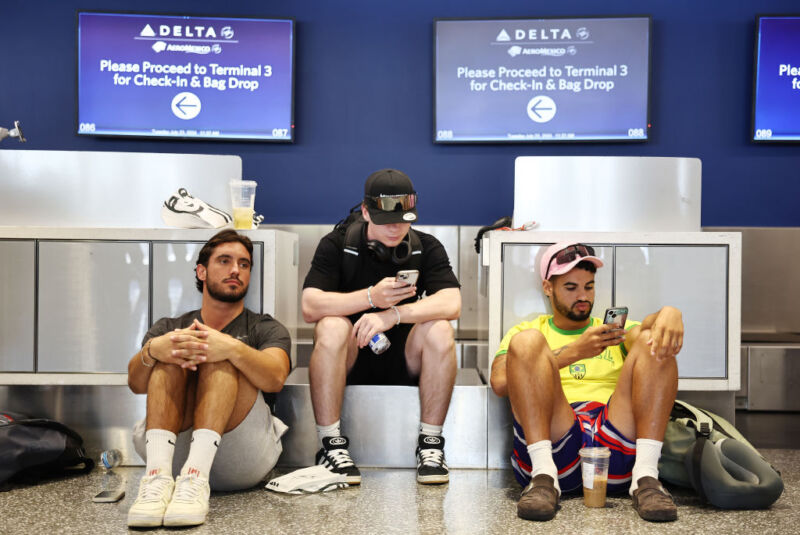
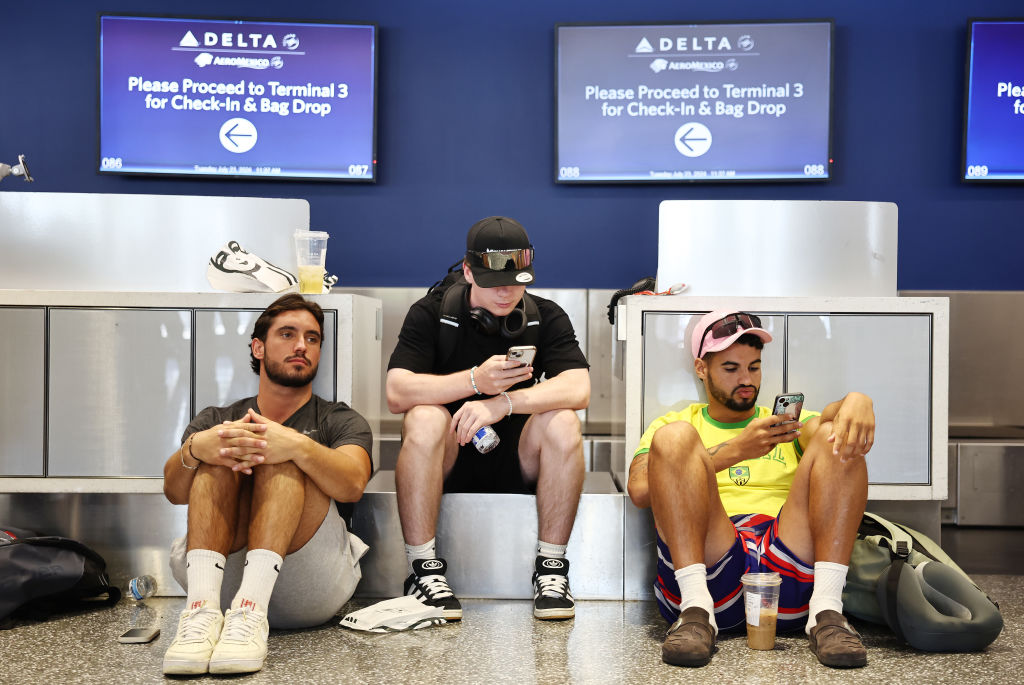
LOS ANGELES, CALIFORNIA - JULY 23: Travelers from France wait on their delayed flight on the check-in floor of the Delta Air Lines terminal at Los Angeles International Airport (LAX) on July 23, 2024 in Los Angeles, California.

Enlarge / LOS ANGELES, CALIFORNIA – JULY 23: Travelers from France wait on their delayed flight on the check-in floor of the Delta Air Lines terminal at Los Angeles International Airport (LAX) on July 23, 2024 in Los Angeles, California.

CrowdStrike has hit back at Delta Air Lines’ threat of litigation against the cyber security company over a botched software update that grounded thousands of flights, denying it was responsible for the carrier’s own IT decisions and days-long disruption.

In a letter on Sunday, lawyers for CrowdStrike argued that the US carrier had created a “misleading narrative” that the cyber security firm was “grossly negligent” in an incident that the US airline has said will cost it $500 million.

Delta took days longer than its rivals to recover when CrowdStrike’s update brought down millions of Windows computers around the world last month. The airline has alerted the cyber security company that it plans to seek damages for the disruptions and hired litigation firm Boies Schiller Flexner.

CrowdStrike addressed Sunday’s letter to the law firm, whose chair, David Boies, has previously represented the US government in its antitrust case against Microsoft and Harvey Weinstein, among other prominent clients.

Microsoft has estimated that about 8.5 million Windows devices were hit by the faulty update, which stranded airline passengers, interrupted hospital appointments and took broadcasters off air around the world. CrowdStrike said last week that 99 percent of Windows devices running the affected Falcon software were now back online.

Major US airlines Delta, United, and American briefly grounded their aircraft on the morning of July 19. But while United and American were able to restore their operations over the weekend, Delta’s flight disruptions continued well into the following week.

The Atlanta-based carrier in the end canceled more than 6,000 flights, triggering an investigation from the US Department of Transportation amid claims of poor customer service during the operational chaos.

CrowdStrike’s lawyer, Michael Carlinsky, co-managing partner of Quinn Emanuel Urquhart & Sullivan, wrote that, if it pursues legal action, Delta Air Lines would have to explain why its competitors were able to restore their operations much faster.

He added: “Should Delta pursue this path, Delta will have to explain to the public, its shareholders, and ultimately a jury why CrowdStrike took responsibility for its actions—swiftly, transparently and constructively—while Delta did not.”

CrowdStrike also claimed that Delta’s leadership had ignored and rejected offers for help: “CrowdStrike’s CEO personally reached out to Delta’s CEO to offer onsite assistance, but received no response. CrowdStrike followed up with Delta on the offer for onsite support and was told that the onsite resources were not needed.”

Delta Chief Executive Ed Bastian said last week that CrowdStrike had not “offered anything” to make up for the disruption at the airline. “Free consulting advice to help us—that’s the extent of it,” he told CNBC on Wednesday.

While Bastian has said that the disruption would cost Delta $500 million, CrowdStrike insisted that “any liability by CrowdStrike is contractually capped at an amount in the single-digit millions.”

A spokesperson for CrowdStrike accused Delta of “public posturing about potentially bringing a meritless lawsuit against CrowdStrike” and said it hoped the airline would “agree to work cooperatively to find a resolution.”

Delta Air Lines declined to comment.

© 2024 The Financial Times Ltd. All rights reserved. Not to be redistributed, copied, or modified in any way.

CrowdStrike claps back at Delta, says airline rejected offers for help Read More »

data-centers-demand-a-massive-amount-of-energy-here’s-how-some-states-are-tackling-the-industry’s-impact.

Data centers demand a massive amount of energy. Here’s how some states are tackling the industry’s impact.

rethinking incentives —

States that offer tax exemptions to support the industry are reconsidering their approach.

A Google data center in Douglas County, Georgia.

A Google data center in Douglas County, Georgia.

This article was produced for ProPublica’s Local Reporting Network in partnership with The Seattle Times. Sign up for Dispatches to get stories like this one as soon as they are published.

When lawmakers in Washington set out to expand a lucrative tax break for the state’s data center industry in 2022, they included what some considered an essential provision: a study of the energy-hungry industry’s impact on the state’s electrical grid.

Gov. Jay Inslee vetoed that provision but let the tax break expansion go forward. As The Seattle Times and ProPublica recently reported, the industry has continued to grow and now threatens Washington’s effort to eliminate carbon emissions from electricity generation.

Washington’s experience with addressing the power demand of data centers parallels the struggles playing out in other states around the country where the industry has rapidly grown and tax breaks are a factor.

Virginia, home to the nation’s largest data center market, once debated running data centers on carbon-emitting diesel generators during power shortages to keep the lights on in the area. (That plan faced significant public pushback from environmental groups, and an area utility is exploring other options.)

Dominion Energy, the utility that serves most of Virginia’s data centers, has said that it intends to meet state requirements to decarbonize the grid by 2045, but that the task would be more challenging with rising demands driven largely by data centers, Inside Climate News reported. The utility also has indicated that new natural gas plants will be needed.

Some Virginia lawmakers and the state’s Republican governor have proposed reversing or dramatically altering the clean energy goals.

A northern Virginia lawmaker instead proposed attaching strings to the state’s data center tax break. This year, he introduced legislation saying data centers would only qualify if they maximized energy efficiency and found renewable resources. The bill died in Virginia’s General Assembly. But the state authorized a study of the industry and how tax breaks impact the grid.

“If we’re going to have data centers, which we all know to be huge consumers of electricity, let’s require them to be as efficient as possible,” said state Delegate Richard “Rip” Sullivan Jr., the Democrat who sponsored the original bill. “Let’s require them to use as little energy as possible to do their job.”

Inslee’s 2022 veto of a study similar to Virginia’s cited the fact that Northwest power planners already include data centers in their estimates of regional demand. But supporters of the legislation said their goal was to obtain more precise answers about Washington-specific electricity needs.

Georgia lawmakers this year passed a bill to halt the state’s data center tax break until data center power use could be analyzed. In the meantime, according to media reports, the state’s largest utility said it would use fossil fuels to make up an energy shortfall caused in part by data centers. Georgia Gov. Brian Kemp then vetoed the tax break pause in May.

Lawmakers in Connecticut and South Carolina have also debated policies to tackle data center power usage in the past year.

“Maybe we want to entice more of them to come. I just want to make sure that we understand the pros and the cons of that before we do it,” South Carolina’s Senate Majority Leader Shane Massey said in May, according to the South Carolina Daily Gazette.

Countries such as Ireland, Singapore, and the Netherlands have at times forced data centers to halt construction to limit strains on the power grid, according to a report by the nonprofit Tony Blair Institute for Global Change. The report’s recommendations for addressing data center power usage include encouraging the private sector to invest directly in renewables.

Sajjad Moazeni, a University of Washington professor who studies artificial intelligence and data center power consumption, said states should consider electricity impacts when formulating data center legislation. Moazeni’s recent research found that in just one day, ChatGPT, a popular artificial intelligence tool, used roughly as much power as 33,000 U.S. households use in a year.

“A policy can help both push companies to make these data centers more efficient and preserve a cleaner, better environment for us,” Moazeni said. “Policymakers need to consider a larger set of metrics on power usage and efficiency.”

Eli Sanders contributed research while a student with the Technology, Law and Public Policy Clinic at the University of Washington School of Law.

Data centers demand a massive amount of energy. Here’s how some states are tackling the industry’s impact. Read More »

memo-to-the-supreme-court:-clean-air-act-targeted-co2-as-climate-pollutant,-study-says

Memo to the Supreme Court: Clean Air Act targeted CO2 as climate pollutant, study says

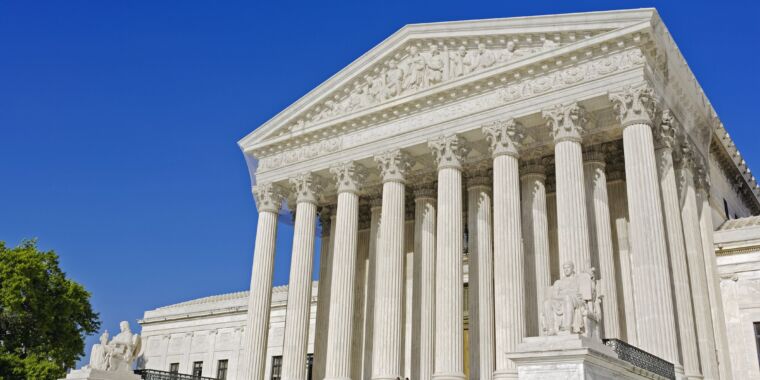
The exterior of the US Supreme Court building during daytime.

Getty Images | Rudy Sulgan

This article originally appeared on Inside Climate News, a nonprofit, independent news organization that covers climate, energy, and the environment. It is republished with permission. Sign up for its newsletter here

Among the many obstacles to enacting federal limits on climate pollution, none has been more daunting than the Supreme Court. That is where the Obama administration’s efforts to regulate power plant emissions met their demise and where the Biden administration’s attempts will no doubt land.

A forthcoming study seeks to inform how courts consider challenges to these regulations by establishing once and for all that the lawmakers who shaped the Clean Air Act in 1970 knew scientists considered carbon dioxide an air pollutant, and that these elected officials were intent on limiting its emissions.

The research, expected to be published next week in the journal Ecology Law Quarterly, delves deep into congressional archives to uncover what it calls a “wide-ranging and largely forgotten conversation between leading scientists, high-level administrators at federal agencies, members of Congress” and senior staff under Presidents Lyndon Johnson and Richard Nixon. That conversation detailed what had become the widely accepted science showing that carbon dioxide pollution from fossil fuels was accumulating in the atmosphere and would eventually warm the global climate.

The findings could have important implications in light of a legal doctrine the Supreme Court established when it struck down the Obama administration’s power plant rules, said Naomi Oreskes, a history of science professor at Harvard University and the study’s lead author. That so-called “major questions” doctrine asserted that when courts hear challenges to regulations with broad economic and political implications, they ought to consider lawmakers’ original intent and the broader context in which legislation was passed.

“The Supreme Court has implied that there’s no way that the Clean Air Act could really have been intended to apply to carbon dioxide because Congress just didn’t really know about this issue at that time,” Oreskes said. “We think that our evidence shows that that is false.”

The work began in 2013 after Oreskes arrived at Harvard, she said, when a call from a colleague prompted the question of what Congress knew about climate science in the 1960s as it was developing Clean Air Act legislation. She had already co-authored the book Merchants of Doubt, about the efforts of industry-funded scientists to cast doubt about the risks of tobacco and global warming, and was familiar with the work of scientists studying climate change in the 1950s. “What I didn’t know,” she said, “was how much they had communicated that, particularly to Congress.”

Oreskes hired a researcher to start looking, and what they both found surprised her. The evidence they uncovered includes articles cataloged by the staff of the act’s chief architect, proceedings of scientific conferences attended by members of Congress, and correspondence with constituents and scientific advisers to Johnson and Nixon. The material included documents pertaining not only to environmental champions but also to other prominent members of Congress.

“These were people really at the center of power,” Oreskes said.

When Sen. Edmund Muskie, a Maine Democrat, introduced the Clean Air Act of 1970, he warned his colleagues that unchecked air pollution would continue to “threaten irreversible atmospheric and climatic changes.” The new research shows that his staff had collected reports establishing the science behind his statement. He and other senators had attended a 1966 conference featuring discussion of carbon dioxide as a pollutant. At that conference, Wisconsin Sen. Gaylord Nelson warned about carbon dioxide pollution from fossil fuel combustion, which he said “is believed to have drastic effects on climate.”

The paper also cites a 1969 letter to Sen. Henry “Scoop” Jackson of Washington from a constituent who had watched the poet Allen Ginsberg warning of melting polar ice caps and widespread global flooding on the Merv Griffin Show. The constituent was skeptical of the message, called Ginsberg “one of America’s premier kooks” and sought a correction of the record from the senator: “After all, quite a few million people watch this show, people of widely varying degrees of intelligence, and the possibility of this sort of charge—even from an Allen Ginsberg—being accepted even in part, is dangerous.”

Memo to the Supreme Court: Clean Air Act targeted CO2 as climate pollutant, study says Read More »

google-pulls-its-terrible-pro-ai-“dear-sydney”-ad-after-backlash

Google pulls its terrible pro-AI “Dear Sydney” ad after backlash

Gemini, write me a fan letter! —

Taking the “human” out of “human communication.”

A picture of the Gemini prompt box from the

Enlarge / The Gemini prompt box in the “Dear Sydney” ad.

Google

Have you seen Google’s “Dear Sydney” ad? The one where a young girl wants to write a fan letter to Olympic hurdler Sydney McLaughlin-Levrone? To which the girl’s dad responds that he is “pretty good with words but this has to be just right”? And so, to be just right, he suggests that the daughter get Google’s Gemini AI to write a first draft of the letter?

If you’re watching the Olympics, you have undoubtedly seen it—because the ad has been everywhere. Until today. After a string of negative commentary about the ad’s dystopian implications, Google has pulled the “Dear Sydney” ad from TV. In a statement to The Hollywood Reporter, the company said, “While the ad tested well before airing, given the feedback, we have decided to phase the ad out of our Olympics rotation.”

The backlash was similar to that against Apple’s recent ad in which an enormous hydraulic press crushed TVs, musical instruments, record players, paint cans, sculptures, and even emoji into… the newest model of the iPad. Apple apparently wanted to show just how much creative and entertainment potential the iPad held; critics read the ad as a warning image about the destruction of human creativity in a technological age. Apple apologized soon after.

Now Google has stepped on the same land mine. Not only is AI coming for human creativity, the “Dear Sydney” ad suggests—but it won’t even leave space for the charming imperfections of a child’s fan letter to an athlete. Instead, AI will provide the template, just as it will likely provide the template for the athlete’s response, leading to a nightmare scenario in which huge swathes of human communication have the “human” part stripped right out.

“Very bad”

The generally hostile tone of the commentary to the new ad was captured by Alexandra Petri’s Washington Post column on the ad, which Petri labeled “very bad.”

This ad makes me want to throw a sledgehammer into the television every time I see it. Given the choice between watching this ad and watching the ad about how I need to be giving money NOW to make certain that dogs do not perish in the snow, I would have to think long and hard. It’s one of those ads that makes you think, perhaps evolution was a mistake and our ancestor should never have left the sea. This could be slight hyperbole but only slight!

If you haven’t seen this ad, you are leading a blessed existence and I wish to trade places with you.

A TechCrunch piece said that it was “hard to think of anything that communicates heartfelt inspiration less than instructing an AI to tell someone how inspiring they are.”

Shelly Palmer, a Syracuse University professor and marketing consultant, wrote that the ad’s basic mistake was overestimating “AI’s ability to understand and convey the nuances of human emotions and thoughts.” Palmer would rather have a “heartfelt message over a grammatically correct, AI-generated message any day,” he said. He then added:

I received just such a heartfelt message from a reader years ago. It was a single line email about a blog post I had just written: “Shelly, you’re to [sic] stupid to own a smart phone.” I love this painfully ironic email so much, I have it framed on the wall in my office. It was honest, direct, and probably accurate.

But his conclusion was far more serious. “I flatly reject the future that Google is advertising,” Palmer wrote. “I want to live in a culturally diverse world where billions of individuals use AI to amplify their human skills, not in a world where we are used by AI pretending to be human.”

Things got saltier from there. NPR host Linda Holmes wrote on social media:

This commercial showing somebody having a child use AI to write a fan letter to her hero SUCKS. Obviously there are special circumstances and people who need help, but as a general “look how cool, she didn’t even have to write anything herself!” story, it SUCKS. Who wants an AI-written fan letter?? I promise you, if they’re able, the words your kid can put together will be more meaningful than anything a prompt can spit out. And finally: A fan letter is a great way for a kid to learn to write! If you encourage kids to run to AI to spit out words because their writing isn’t great yet, how are they supposed to learn? Sit down with your kid and write the letter with them! I’m just so grossed out by the entire thing.

The Atlantic was more succinct with its headline: “Google Wins the Gold Medal for Worst Olympic Ad.”

All of this largely tracks with our own take on the ad, which Ars Technica’s Kyle Orland called a “grim” vision of the future. “I want AI-powered tools to automate the most boring, mundane tasks in my life, giving me more time to spend on creative, life-affirming moments with my family,” he wrote. “Google’s ad seems to imply that these life-affirming moments are also something to be avoided—or at least made pleasingly more efficient—through the use of AI.”

Getting people excited about their own obsolescence and addiction is a tough sell, so I don’t envy the marketers who have to hawk Big Tech’s biggest products in a climate of suspicion and hostility toward everything from AI to screen time to social media to data collection. I’m sure the marketers will find a way—but clearly “Dear Sydney” isn’t it.

Google pulls its terrible pro-AI “Dear Sydney” ad after backlash Read More »

doj-sues-tiktok,-alleging-“massive-scale-invasions-of-children’s-privacy”

DOJ sues TikTok, alleging “massive-scale invasions of children’s privacy”

DOJ sues TikTok, alleging “massive-scale invasions of children’s privacy”

The US Department of Justice sued TikTok today, accusing the short-video platform of illegally collecting data on millions of kids and demanding a permanent injunction “to put an end to TikTok’s unlawful massive-scale invasions of children’s privacy.”

The DOJ said that TikTok had violated the Children’s Online Privacy Protection Act of 1998 (COPPA) and the Children’s Online Privacy Protection Rule (COPPA Rule), claiming that TikTok allowed kids “to create and access accounts without their parents’ knowledge or consent,” collected “data from those children,” and failed to “comply with parents’ requests to delete their children’s accounts and information.”

The COPPA Rule requires TikTok to prove that it does not target kids as its primary audience, the DOJ said, and TikTok claims to satisfy that “by requiring users creating accounts to report their birthdates.”

However, even if a child inputs their real birthdate, the DOJ said, TikTok does nothing to stop them from restarting the process and using a fake birthdate. Dodging TikTok’s age gate has been easy for millions of kids, the DOJ alleged, and TikTok knows that, collecting their information anyway and neglecting to delete information even when child users “identify themselves as children.”

“The precise magnitude” of TikTok’s violations “is difficult to determine,” the DOJ’s complaint said. But TikTok’s “internal analyses show that millions of TikTok’s US users are children under the age of 13.”

“For example, the number of US TikTok users that Defendants classified as age 14 or younger in 2020 was millions higher than the US Census Bureau’s estimate of the total number of 13- and 14-year-olds in the United States, suggesting that many of those users were children younger than 13,” the DOJ said.

TikTok seemingly risks huge fines if the DOJ proves its case. The DOJ has asked a jury to agree that damages are owed for each “collection, use, or disclosure of a child’s personal information” that violates the COPPA Rule, with likely multiple violations spanning millions of children’s accounts. And any recent violations could cost more, as the DOJ noted that the FTC Act authorizes civil penalties up to $51,744 “for each violation of the Rule assessed after January 10, 2024.”

A TikTok spokesperson told Ars that TikTok plans to fight the lawsuit, which is part of the US’s ongoing battle with the app. Currently, TikTok is fighting a nationwide ban that was passed this year, due to growing political tensions with its China-based owner and lawmakers’ concerns over TikTok’s data collection and alleged repeated spying on Americans.

“We disagree with these allegations, many of which relate to past events and practices that are factually inaccurate or have been addressed,” TikTok’s spokesperson told Ars. “We are proud of our efforts to protect children, and we will continue to update and improve the platform. To that end, we offer age-appropriate experiences with stringent safeguards, proactively remove suspected underage users, and have voluntarily launched features such as default screentime limits, Family Pairing, and additional privacy protections for minors.”

The DOJ seems to think damages are owed for past as well as possibly current violations. It claimed that TikTok already has more sophisticated ways to identify the ages of child users for ad-targeting but doesn’t use the same technology to block underage sign-ups because TikTok is allegedly unwilling to dedicate resources to widely police kids on its platform.

“By adhering to these deficient policies, Defendants actively avoid deleting the accounts of users they know to be children,” the DOJ alleged, claiming that “internal communications reveal that Defendants’ employees were aware of this issue.”

DOJ sues TikTok, alleging “massive-scale invasions of children’s privacy” Read More »

who-are-the-two-major-hackers-russia-just-received-in-a-prisoner-swap?

Who are the two major hackers Russia just received in a prisoner swap?

friends in high places —

Both men committed major financial crimes—and had powerful friends.

Who are the two major hackers Russia just received in a prisoner swap?

Getty Images

As part of today’s blockbuster prisoner swap between the US and Russia, which freed the journalist Evan Gershkovich and several Russian opposition figures, Russia received in return a motley collection of serious criminals, including an assassin who had executed an enemy of the Russian state in the middle of Berlin.

But the Russians also got two hackers, Vladislav Klyushin and Roman Seleznev, each of whom had been convicted of major financial crimes in the US. The US government said that Klyushin “stands convicted of the most significant hacking and trading scheme in American history, and one of the largest insider trading schemes ever prosecuted.” As for Seleznev, federal prosecutors said that he has “harmed more victims and caused more financial loss than perhaps any other defendant that has appeared before the court.”

What sort of hacker do you have to be to attract the interest of the Russian state in prisoner swaps like these? Clearly, it helps to have hacked widely and caused major damage to Russia’s enemies. By bringing these two men home, Russian leadership is sending a clear message to domestic hackers: We’ve got your back.

But it also helps to have political connections. To learn more about both men and their exploits, we read through court documents, letters, and government filings to shed a little more light on their crimes, connections, and family backgrounds.

Vladislav Klyushin

In court filings, Vladislav Klyushin claimed to be a stand-up guy, the kind of person who paid for acquaintances’ medical bills and local monastery repairs. He showed, various letters from friends suggested, “extraordinary compassion, generosity, and civic and charitable commitment.”

According to the US government, though, Klyushin made tens of millions of dollars betting for and against (“shorting”) US companies by using hacked, nonpublic information to make stock trades. He was arrested in 2021 after arriving in Switzerland on a private jet but before he could get into the helicopter that would have taken him to a planned Alps ski vacation.

Klyushin never met his father, he said, a man who drank “excessively” and then was killed during a car theft gone bad when Klyushin was 14. Klyushin’s mother was only 19 when she had him, and the family “occasionally had limited food and clothing.” Klyushin tried to help out by joining the workforce at 13, but he managed to graduate high school, college, and even graduate school, ending up with a doctorate.

After various jobs, including a stint at the Moscow State Linguistic University, Klyushin took a job at M-13, a Moscow IT company that did penetration testing and “Advanced Persistent Threat emulation”—that is, M-13 could be hired to act just like a group of hackers, probing corporate or government cybersecurity. Oddly enough for an infosec company, M-13 also offered investment advice; give them your money and fantastic returns were promised, with M-13 keeping 60 percent of any profits it made.

This was not mere puffery, either. According to the US government, the M-13 team “had an improbable win rate of 68 percent” on its stock trades, and it “generated phenomenal, eight-figure returns,” turning $9 million into $100 million (“a return of more than 900 percent during a period in which the broader stock market returned just over 25 percent,” said the government).

But Klyushin and his associates were not stock-picking wizards. Instead, they had begun hacking Donnelly Financial and Toppan Merrill, two “filing agents” that many large companies use to submit quarterly and annual earning reports to the Securities and Exchange Commission. These reports were uploaded to the filing agents’ systems several days before their public release. All the M-13 team had to do was liberate the files early, read through them, and buy up stocks of companies that had overperformed while shorting stocks of companies that had underperformed. When the reports went public a few days later and the markets responded to them, the M-13 team made huge returns. Klyushin himself earned several tens of millions of dollars between 2018 and 2020.

To avoid consequences for this flagrantly illegal behavior, all Klyushin had to do was stay in Russia—or, at least, not visit or transit through a country that might extradite him to the US—and he could keep buying up yachts, cars, and real estate. That’s because Russia—along with China and Iran, the largest three sources of hackers who attack US targets—doesn’t do much to stop attacks directed against US interests. As the US government notes, none of these governments “respond to grand jury subpoenas and rarely if ever provide the kinds of forensic information that helps to identify cybercriminals. Nor do they extradite their nationals, leaving the government to rely on the chance that an indicted defendant will travel.”

But when you have tens of millions of dollars, you often want to spend it abroad, so Klyushin did travel—and got nabbed upon his arrival in Switzerland. He was extradited to the US in 2021, was found guilty at trial, and was sentenced to nine years in prison and the forfeiture of $34 million. It is unclear if the US government was able to get its hands on any of that money, which was stashed in bank accounts around the world.

Klyushin’s fellow conspirators have wisely stayed in Russia, so with his release as part of today’s prisoner swap, all are likely to enjoy their ill-gotten gains without further consequence. One of Klyushin’s colleagues at M-13, Ivan Ermakov, is said to be a “former Russian military intelligence officer” who used to run disinformation programs “targeting international anti-doping agencies, sporting federations, and anti-doping officials.”

Who are the two major hackers Russia just received in a prisoner swap? Read More »

us-probes-nvidia’s-acquisition-of-israeli-ai-startup

US probes Nvidia’s acquisition of Israeli AI startup

“monopoly choke points” —

Justice Department has increased scrutiny of the chipmaker’s power in the emerging sector.

US probes Nvidia’s acquisition of Israeli AI startup

Getty Images

The US Department of Justice is investigating Nvidia’s acquisition of Run:ai, an Israeli artificial intelligence startup, for potential antitrust violations, said a person familiar with discussions the government agency has had with third parties.

The DoJ has asked market participants about the competitive impact of the transaction, which Nvidia announced in April. The price was not disclosed but a report from TechCrunch estimated it at $700 million.

The scope of the probe remains unclear, the person said. But the DoJ has inquired about matters including whether the deal could quash emerging competition in the up-and-coming sector and entrench Nvidia’s dominant market position.

Nvidia on Thursday said the company “wins on merit” and “scrupulously adher[es] to all laws.”

“We’ll continue to support aspiring innovators in every industry and market and are happy to provide any information regulators need,” it added.

Run:ai did not immediately respond to a request for comment. The DoJ declined to comment.

The investigation comes as US regulators and enforcers have heightened scrutiny of anti-competitive behavior in AI, particularly where it dovetails with big tech groups such as Nvidia.

Jonathan Kanter, head of the DoJ’s antitrust division, told the Financial Times in June that he was examining “monopoly choke points” in areas including the data used to train large language models as well as access to essential hardware such as graphics processing unit chips. He added that the GPUs needed to train LLMs had become a “scarce resource.”

Nvidia dominates sales of the most advanced GPUs. Run:ai, which had an existing collaboration with the tech giant, has developed a platform that optimizes the use of GPUs.

As part of the probe, which was first reported by Politico, the DoJ is seeking information on how Nvidia decides the allocation of its chips, the person said.

Government lawyers are also inquiring about Nvidia’s software platform, Cuda, which enables chips originally designed for graphics to speed up AI applications and is seen by industry figures as one of Nvidia’s most critical tools.

The DoJ and the US Federal Trade Commission, a competition regulator, in June reached an agreement that divided antitrust oversight of critical AI players. The DoJ will spearhead probes into Nvidia, while the FTC will oversee the assessment of Microsoft and OpenAI, the startup behind ChatGPT.

© 2024 The Financial Times Ltd. All rights reserved. Please do not copy and paste FT articles and redistribute by email or post to the web.

US probes Nvidia’s acquisition of Israeli AI startup Read More »