Author name: Rejus Almole

sergey-brin-says-agi-is-within-reach-if-googlers-work-60-hour-weeks

Sergey Brin says AGI is within reach if Googlers work 60-hour weeks

Sergey Brin co-founded Google in the 1990s along with Larry Page, but both stepped away from the day to day at Google in 2019. However, the AI boom tempted Brin to return to the office, and he thinks everyone should follow his example. In a new internal memo, Brin has advised employees to be in the office every weekday so Google can win the AI race.

Just returning to the office isn’t enough for the Google co-founder. According to the memo seen by The New York Times, Brin says Googlers should try to work 60 hours per week to support the company’s AI efforts. That works out to 12 hours per day, Monday through Friday, which Brin calls the “sweet spot of productivity.” This is not a new opinion for Brin.

Brin, like many in Silicon Valley, is seemingly committed to the dogma that the current trajectory of generative AI will lead to the development of artificial general intelligence (AGI). Such a thinking machine would be head and shoulders above current AI models, which can only do a good impression of thinking. An AGI would understand concepts and think more like a human being, which some would argue makes it a conscious entity.

To hear Brin tell it, Google is in the best position to make this AI computing breakthrough. He cites the company’s strong workforce of programmers and data scientists as the key, but he also believes the team must strive for greater efficiency by using Google’s own Gemini AI tools as much as possible. Oh, and don’t work from home.

Brin and Page handed the reins to current CEO Sundar Pichai in 2015, so his pronouncement doesn’t necessarily signal a change to the company’s current in-office policy. Google still operates on a hybrid model, with workers expected to be in the office three days per week. But as a founder, Brin’s voice carries weight. We reached out to Google to ask if the company intends to reassess its policies, but a Google rep says there are no planned changes to the return-to-office mandate.

Sergey Brin says AGI is within reach if Googlers work 60-hour weeks Read More »

new-ai-text-diffusion-models-break-speed-barriers-by-pulling-words-from-noise

New AI text diffusion models break speed barriers by pulling words from noise

These diffusion models maintain performance faster than or comparable to similarly sized conventional models. LLaDA’s researchers report their 8 billion parameter model performs similarly to LLaMA3 8B across various benchmarks, with competitive results on tasks like MMLU, ARC, and GSM8K.

However, Mercury claims dramatic speed improvements. Their Mercury Coder Mini scores 88.0 percent on HumanEval and 77.1 percent on MBPP—comparable to GPT-4o Mini—while reportedly operating at 1,109 tokens per second compared to GPT-4o Mini’s 59 tokens per second. This represents roughly a 19x speed advantage over GPT-4o Mini while maintaining similar performance on coding benchmarks.

Mercury’s documentation states its models run “at over 1,000 tokens/sec on Nvidia H100s, a speed previously possible only using custom chips” from specialized hardware providers like Groq, Cerebras, and SambaNova. When compared to other speed-optimized models, the claimed advantage remains significant—Mercury Coder Mini is reportedly about 5.5x faster than Gemini 2.0 Flash-Lite (201 tokens/second) and 18x faster than Claude 3.5 Haiku (61 tokens/second).

Opening a potential new frontier in LLMs

Diffusion models do involve some trade-offs. They typically need multiple forward passes through the network to generate a complete response, unlike traditional models that need just one pass per token. However, because diffusion models process all tokens in parallel, they achieve higher throughput despite this overhead.

Inception thinks the speed advantages could impact code completion tools where instant response may affect developer productivity, conversational AI applications, resource-limited environments like mobile applications, and AI agents that need to respond quickly.

If diffusion-based language models maintain quality while improving speed, they might change how AI text generation develops. So far, AI researchers have been open to new approaches.

Independent AI researcher Simon Willison told Ars Technica, “I love that people are experimenting with alternative architectures to transformers, it’s yet another illustration of how much of the space of LLMs we haven’t even started to explore yet.”

On X, former OpenAI researcher Andrej Karpathy wrote about Inception, “This model has the potential to be different, and possibly showcase new, unique psychology, or new strengths and weaknesses. I encourage people to try it out!”

Questions remain about whether larger diffusion models can match the performance of models like GPT-4o and Claude 3.7 Sonnet, and if the approach can handle increasingly complex simulated reasoning tasks. For now, these models offer an alternative for smaller AI language models that doesn’t seem to sacrifice capability for speed.

You can try Mercury Coder yourself on Inception’s demo site, and you can download code for LLaDA or try a demo on Hugging Face.

New AI text diffusion models break speed barriers by pulling words from noise Read More »

trump-should-block-biden’s-ai-“gift”-to-china,-microsoft-argues

Trump should block Biden’s AI “gift” to China, Microsoft argues

“Countries including Brazil, India, Israel, and the UAE are eminently capable of ramping up investments aimed at securing new ways to access increased computing capacity,” the Brookings Institute said. “Preventing companies in middle-tier countries from relying on the US to supply computing chips is a surefire way to push them into building non-US alliances that include stronger technology ties with China.”

The rule could also complicate the global AI landscape in ways the US may not anticipate, the Center for Strategic and International Studies (CSIS), a bipartisan, nonprofit policy research organization, forecast last week. It could “breed resentment, not cooperation” in tier-two countries that will likely “bristle at the fact that their AI ambitions depend on Washington’s goodwill and that they are being deliberately kept a generation behind the frontier,” CSIS wrote. And it could drive more open source AI like DeepSeek to be key to development in tier-two nations, perhaps further endangering US global leadership in AI, CSIS suggested.

“Ironically, the AI Diffusion Framework, meant to lock in American advantage, may instead midwife the very outcome it sought to prevent—an alternate AI stack and increased open-source development where China, as its most prolific contributor, emerges as the de facto leader,” CSIS reported.

China wooing countries targeted by rule, Microsoft says

But according to Smith, some parts of the rule should be preserved, like datacenter restrictions, including “qualitative provisions” that “ensure that AI technology components are deployed in certified, secure, and trusted datacenters.” That part of the rule, Smith suggested, “helps reduce the risk of chip diversion to China.”

And other parts of the rule can be strengthened, Smith wrote, such as ensuring the Commerce Department has resources to enforce it and “expedite approvals” for any countries in the middle tier who may appeal to either move into the top tier or limit tier-two restrictions.

Trump should block Biden’s AI “gift” to China, Microsoft argues Read More »

wb-axes-shadow-of-mordor-maker-in-setback-for-clever,-sadly-patented-game-system

WB axes Shadow of Mordor maker in setback for clever, sadly patented game system

Game studio Monolith, part of Warner Bros. Games until yesterday’s multi-studio shutdown, had a notable track record across more than 30 years, having made Blood, No One Lives Forever, Shogo: Mobile Armor Division, F.E.A.R., and, most recently, the Lord of the Rings series, Shadow of Mordor and Shadow of War.

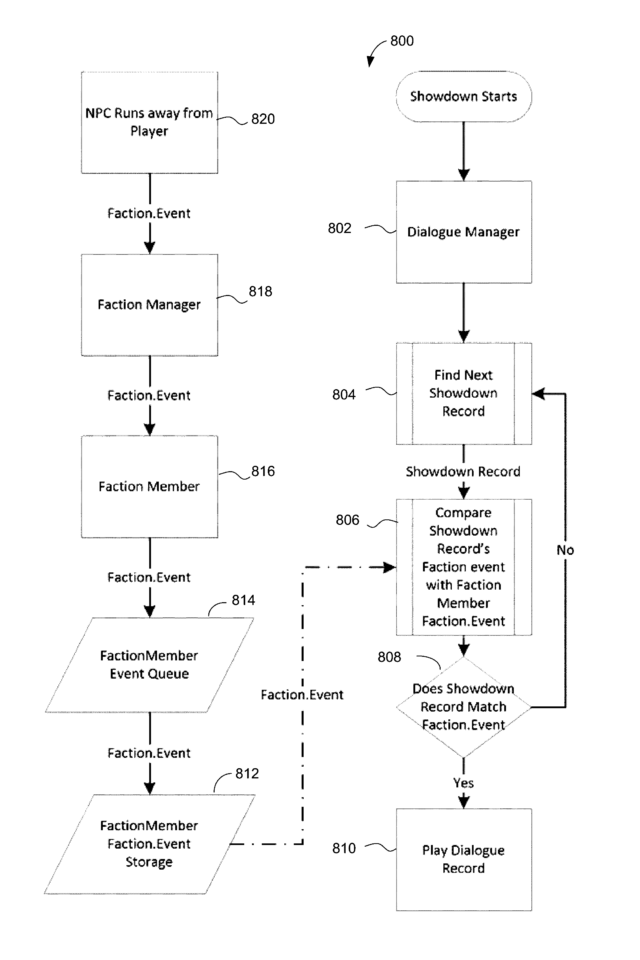
Those games, derived from J.R.R. Tolkien’s fiction, had a “Nemesis System,” in which the enemies that beat the player or survive a battle with them can advance in level, develop distinct strengths and weaknesses, and become an interesting subplot and motivation in the game. Monolith’s next game, the now-canceled Wonder Woman, was teased more than three years ago, and said to be “powered by the Nemesis System.”

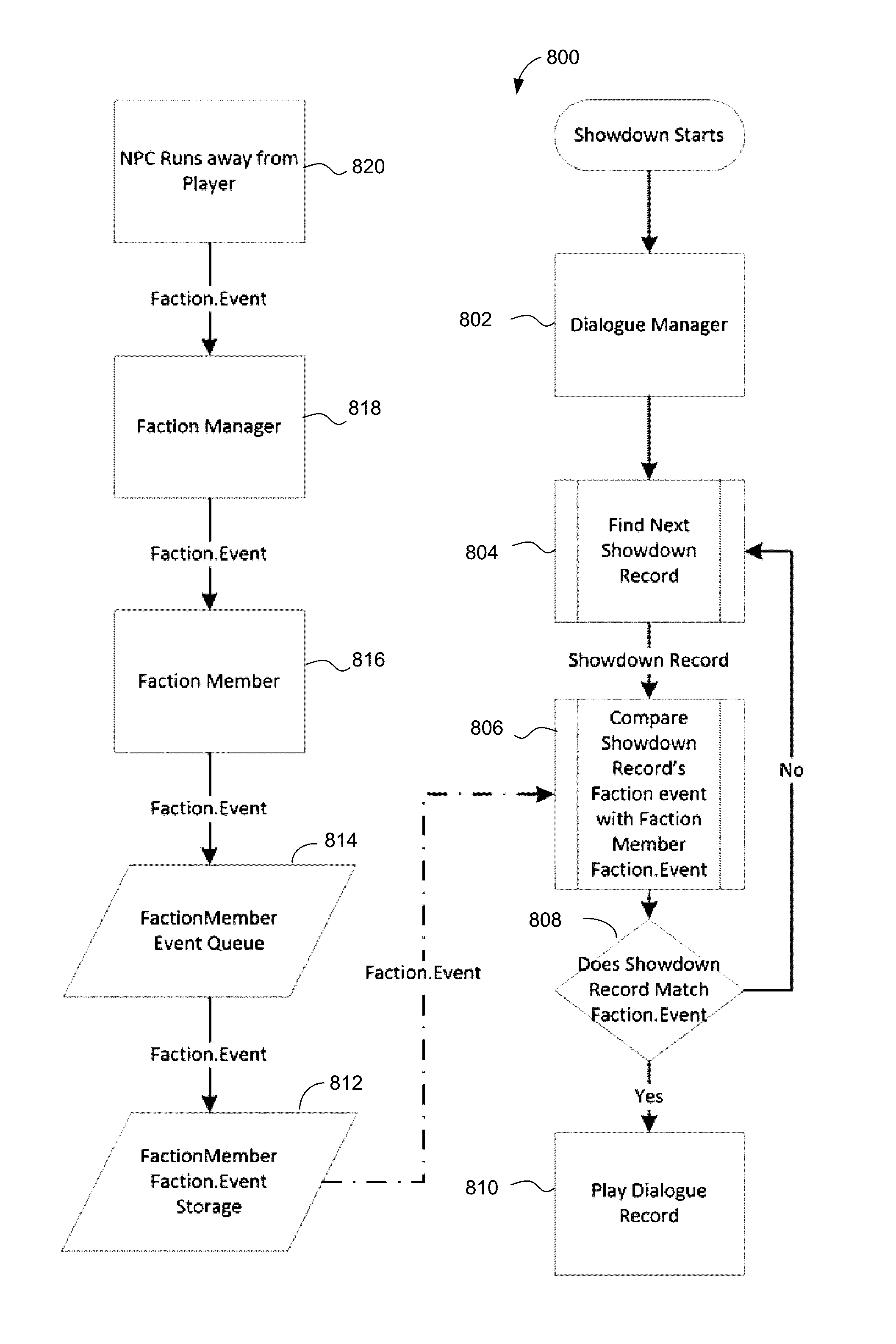
Not only will Wonder Woman not be powered by the Nemesis System, but likely no other games will be, either, at least until August 2036. That’s when “Nemesis characters, nemesis forts, social vendettas and followers in computer games,” patent US2016279522A1, is due to expire. Until then, any game that wants to implement gameplay involving showdowns, factions, and bitter NPC feelings toward a player must either differentiate it enough to avoid infringement, license it from Warner Brothers, or gamble on WB Games’ legal attention.

It’s bad enough that talented developers were let go. That one of their most notable innovations ends up locked up in a corporate vault, for more than a decade after they ceased to exist, is quite the sad footnote.

Nobody wants to end up Crazy Taxi‘d

Patent filing showing the process workflow for WB Games'

Credit: Warner Bros./USPTO

That WB Games was granted this patent is eye-opening, but not necessarily shocking. For 20 years, Namco held a patent on loading screen mini-games. That patent was issued despite plenty of “loading screen games” existing before 1995, including Invade-a-load. Similar patents have been issued for the Mass Effect dialogue wheel, a “sanity meter” in Eternal Darkness, and basically the entire concept of Crazy Taxi, such that Sega tried to eliminate The Simpsons: Road Rage entirely and recoup all its revenue. That case was settled out of court, and you haven’t seen Crazy Taxi-like arrows above game vehicles to this day. Ars’ Kyle Orland wrote in 2007 about how a 1989 patent for racing against your best time, or a “ghost racer,” led to license payments from games made in the mid-2000s.

WB axes Shadow of Mordor maker in setback for clever, sadly patented game system Read More »

amazon’s-subscription-based-alexa+-looks-highly-capable—and-questionable

Amazon’s subscription-based Alexa+ looks highly capable—and questionable


Alexa+ will be free for Prime members, $20/month for everyone else.

NEW YORK—After teasing it in September 2023 and reportedly suffering delays, Amazon today announced that its more capable and conversational version of Alexa will start rolling out to US Prime members for free in the next few weeks.

Those who aren’t Prime subscribers will be able to get Alexa+ for $20 a month. Amazon didn’t provide a specific release date but said availability would start with the Echo Show 8, 10, 15, and 21 smart displays.

Amazon is hoping Alexa+ will be a lifeline for its fledgling voice assistant business that has failed to turn a profit. Alexa has reportedly cost Amazon tens of billions of dollars over the years. Although Alexa is on 600 million purchased devices, per remarks CEO Andy Jassy made at a press conference on Wednesday, it’s primarily used for simple tasks that don’t generate much money, like checking the weather. Exacerbating the problem, generative AI chatbots are a new, shinier approach to AI assistants that have quickly outperformed what people could do with today’s Alexa.

By using the large language models (LLMs) available under the Amazon Bedrock service and technology from Anthropic, as well as Amazon Web Services, Amazon has re-architected Alexa to, per demos Ars saw today, be significantly more useful. From its demonstrated speech and ability to respond to casual language (that doesn’t include saying the “Alexa” prompt repeatedly), to its ability to perform actions, like book dinner reservations or put appointments in your digital calendar, Alexa+ looks way more capable than the original Alexa.

Alexa+ in action

For example, Amazon representatives showed Alexa+ learning what a family member likes to eat and later recalling that information to recommend appropriate recipes. In another demo, Alexa+ appeared to set a price monitor for ticket availability on Ticketmaster. Alexa+ told the user it would notify them of price drops via their Echo or Alexa.

I also saw Alexa+ identify, per the issued prompt, “that song Bradley Cooper sings. It’s, like, in a duet” and stream it off of Amazon Music via Echo devices placed around the room. The user was able to toggle audio playing from Echo devices on the left or right side of the room. He then had Alexa+ quickly play the scene from the movie A Star Is Born (that the song is from) on a Fire TV.

Notably, Alexa+ understood directions delivered in casual speak (for example: “can you just jump to the scene in the movie?”). During the demos, the Echo Show in use showed a transcription of the user and voice assistant’s conversation on-screen. At times, I saw the transcription fix mistakes. For example, when a speaker said “I’m in New York,” Alexa first heard “I’m imminent,” but by the time the speaker was done talking, the transcribed prompt was corrected.

I even saw Alexa+ use some logic. In one demo, a user requested tickets for Seattle Storm games in Seattle in March. Since there were none, Alexa+ asked if the user wanted to look for games in April. This showed Alexa+ anticipating a user’s potential response, while increasing the chances that Amazon would be compensated for helping to drive a future ticket sale.

Unlike with today’s Alexa, Alexa+ is supposed to be able to interpret shared documents. An Amazon rep appeared to show Alexa+ reading a homeowner’s association contract to determine if the user is allowed to install solar panels on their home. Although, as some have learned recently, there are inherent risks with relying on AI to provide totally accurate information about contracts, legal information, or, really anything.

Alexa+ also aims to make navigating smart homes easier. For example, on stage, Panos Panay, Amazon’s SVP of devices and services, asked Alexa+ if anyone took his dog out or brought a package to his house in the last couple of days. The AI was able to sift through Ring camera footage and relay the information (supposedly accurately) within seconds.

Subscription Alexa has a new, friendlier tone, which I’d hope you can scale back for getting more direct, succinct information (I don’t need a voice assistant telling me I have a “great idea!”). But ultimately, Alexa’s agenda remains the same: get information about you and be a part of your purchasing process.

A vast web of partnerships

Making Alexa+ wasn’t “as easy as taking an LLM and jacking it into the original Alexa,” Daniel Rausch, VP of Amazon Alexa and Fire TV, said today.

Alexa+ relies on a pile of partnerships to provide users with real-time information and the ability to complete tasks, like schedule someone from Thumbtack to come to the house to fix the sink.

The logos of some of Alexa+'s partners on display.

Some of Alexa+’s partners on display at Amazon’s Alexa+ press conference. Credit: Scharon Harding

At launch, Alexa+ will work with “tens of thousands of other devices and services from our partners,” said Rausch. He explained:

Experts are groups of systems, capabilities, APIs, and instructions that accomplish specific tasks. So they bring together all the technology it takes to deliver on a customer’s particular request. And building any single expert is actually super complicated. And having LLMs orchestrate across hundreds of them is definitely something that’s never been done.

Amazon trained Alexa+ to use partner APIs so that Alexa+ can work with and accomplish tasks with third-party services. Many of Amazon’s partners don’t have a full set of external APIs, though. In these cases, Alexa+ gathers information through what Amazon called “agentic capabilities,” which is basically like having Alexa+ navigate the web on its own. Amazon also sees Alexa+ performing actions with third parties by having its LLM work with third-party LLMs. Developers can request previews of Alexa+’s three new SDKs as of today.

Interestingly, Amazon’s partners include over 200 publications, like Reuters, Forbes, Elle, and Ars Technica parent company Condé Nast. Based on Amazon’s announcement and the need for Alexa+ to provide real-time information to maximize usefulness, it’s likely that Amazon is relying on content licensing deals with these publishers and pulling in information via APIs and other tools. Training AI models on hundreds of publications would be expensive and time-consuming and would require frequent re-training. Amazon hasn’t confirmed training deals with these publications.

Commerce complications

Alexa+ looks like it could potentially use AI in ways that most people haven’t experienced before. However, there are obvious limitations.

To start, it seems that users need to be working with one of Amazon’s partners for the best experience. For example, Alexa+ can book a reservation for you at a restaurant—but not if that restaurant isn’t on OpenTable. In such cases, Alexa+ could, an Amazon representative said, provide you with the restaurant’s phone number, which it will have taken from the web. But I wonder if Alexa+ will prioritize Amazon partners when it comes to showing results and providing information.

Also, Amazon must still convince people that Alexa+ is a better way to buy and schedule things than your computer, phone, or even your (non-Fire) smart TV. Compared to the other types of gadgets vying to be the intermediary in our buying process, Alexa+ has serious disadvantages.

For one, most Alexa users access the AI from a speaker. However, the voice assistant’s advanced features look much easier to navigate and leverage fully with a screen, namely an Echo Show or Fire TV. I’d happily bet that there are many more people who want a laptop or phone than who want an Echo Show or Amazon TV. Other gadgets can also make it easier to dive deeper into tasks by enabling things like comparing products across competitors, understanding reviews, or marking critical parts of important documents.

Amazon is using a clever approach to dealing with fatigue with subscriptions and, more specifically, subscription spending. By including Alexa+ with Prime, Prime members may feel like they’re getting something extra for free, rather than suddenly paying for Alexa. For some who aren’t subscribed to Prime, Alexa+ could be the extra nudge needed to get them to pay for Prime. For most non-Prime members, though, the idea of paying $20 per month for Alexa is laughable, especially if you only use Alexa through an Echo.

And those with access to Alexa through a screen will still be challenged to change how they do things—critically—choosing to not rely on a technology and company with a checkered past around protecting customer privacy, including when it comes to Alexa and Amazon smart cameras.

If Alexa+ works like the demos I saw today (which, of course, isn’t a guarantee), Amazon will have succeeded in making AI gadgets that outperform expectations. Then, one of the biggest questions remaining will be: Who is willing to pay to have Amazon manage their schedules, smart homes, and purchases?

Photo of Scharon Harding

Scharon is a Senior Technology Reporter at Ars Technica writing news, reviews, and analysis on consumer gadgets and services. She’s been reporting on technology for over 10 years, with bylines at Tom’s Hardware, Channelnomics, and CRN UK.

Amazon’s subscription-based Alexa+ looks highly capable—and questionable Read More »

single-fiber-computer-could-one-day-track-your-health

Single-fiber computer could one day track your health

Imagine heading out for a run on a cold winter day clad in athletic gear with sensors and microelectronics woven into the very fiber to constantly monitor your vital signs, even running the occasional app. MIT scientists have manufactured a single fiber computer embedded with all the components to do just that, according to a new paper published in the journal Nature.

“Our bodies broadcast gigabytes of data through the skin every second in the form of heat, sound, biochemicals, electrical potentials, and light, all of which carry information about our activities, emotions, and health,” said co-author Yoel Fink, a materials scientist and engineer at MIT. “Unfortunately, most if not all of it gets absorbed and then lost in the clothes we wear. Wouldn’t it be great if we could teach clothes to capture, analyze, store, and communicate this important information in the form of valuable health and activity insights?”

As previously reported, consumers scooped up more than 100 million units of such wearable devices as smartwatches, fitness trackers, augmented reality glasses, and similar tech in the first quarter of 2021 alone. Sales in the category increased 34.4 percent in the second quarter from Q2 2020, making it one of the fastest-growing categories of personal electronics. But while these devices do produce useful data, there are drawbacks. They can be heavy, uncomfortable when worn for long periods, and inaccurate since they usually only measure bodily signals from one spot (e.g., the wrist, chest, or finger).

A fiber computer woven into apparel, by contrast, could monitor sensors and collect data from many points distributed across the body, according to the authors. In 2021, Fink’s group successfully created the first fiber, sewn into a shirt, with the ability to digitally sense, store, and analyze a person’s activity. Until then, electronic fibers had been analog. Hundreds of square silicone microchips were embedded in a polymer preform to create the fiber, and by controlling the polymer flow during manufacture, the team was able to ensure continuous electrical connection among the microchips in a fiber tens of meters long.

The resulting fiber was thin, flexible, easily sewn into fabrics, and washable and could incorporate optical diodes, memory units, sensors, and other components. As proof of principle, Fink’s team stored a 767-kilobit short movie file and a 0.48 megabyte music file in the fiber, envisioning a day when one could store one’s wedding playlist in the bride’s gown (or groom’s tuxedo).

Single-fiber computer could one day track your health Read More »

automattic’s-“nuclear-war”-over-wordpress-access-sparks-potential-class-action

Automattic’s “nuclear war” over WordPress access sparks potential class action

WordPress software, Keller’s complaint explained, “has long been promised to be free and available to everyone forever.” This promise propelled WordPress’ popularity to, by its own estimates, “encompass more than 40 percent of all websites in the world,” his complaint said.

In the 10 years Keller used WPE, he never had any issues accessing the WordPress ecosystem, and he thought WordPress had guaranteed that it would stay that way—especially since WPE’s use of the trademark appeared to be “expressly permitted on the WordPress foundation website.”

But in the past few years, WPE’s business has substantially grown, Keller explained, attracting big customers like Yelp, Thomson Reuters, and Dropbox, which otherwise may have paid WordPress for similar services.

This seemingly frustrated Mullenweg, who accused WPE of abusing the WordPress trademark to charge customers for access to WordPress’ free tools. The founder took the extraordinary step of blocking WPE’s access to software updates and patches, security updates, and plugins last September. And although Automattic eventually allowed WPE three days to mirror certain data to fulfill its contracts with clients, access was permanently blocked after that, forcing WPE customers to waste time and resources finding workarounds or ways to migrate sites to new web platforms after WPE’s mirroring proved faulty.

“Even if Defendants’ trademark case had merit (it likely does not), it does not excuse Defendants’ deliberate and vindictive targeting of Plaintiff and Class’s contracts with WPE,” Keller’s complaint said, calling Automattic’s reneging on its promise to always provide free access “an appalling deception.”

Automattic could harm the entire Internet

Further, Keller alleged that Automattic took steps to “poach” WPE customers.

That effort included sending emails to WPE customers “claiming they could restore access to the website if the WPE customer left WPE” and posting a list calling out all of WPE’s customers. Automattic also allegedly threatened WPE customers, required all WordPress users to tick a checkbox confirming they were unaffiliated with WPE to access resources, and “stole WPE’s most popular plugin and renamed the author to give themselves credit for the product.”

Automattic’s “nuclear war” over WordPress access sparks potential class action Read More »

bitcoin-plunges-as-crypto-fans-didn’t-get-everything-they-wanted-from-trump

Bitcoin plunges as crypto fans didn’t get everything they wanted from Trump

The price of bitcoin hit a record high of $109,114.88 during intraday trading on January 20, the day of President Trump’s inauguration, but has plummeted since and went as low as $83,741.94 during today’s trading.

That’s a 23.3 percent drop from the intraday record to today’s low, though it was back over $84,000 as of this writing. Bitcoin had been above $100,000 as recently as February 7, and was over $96,000 on Monday this week.

Bitcoin’s drop is part of a wider rout in which over $800 billion of nominal value “has been wiped off global cryptocurrency markets in recent weeks, as the enthusiasm that swept the crypto industry after Donald Trump’s election victory last year ebbs away,” the Financial Times wrote today.

Bitcoin hit a then-record of $89,623 in November, a week after the election, amid optimism about Trump’s plans for crypto-friendly policies. It hit $100,000 for the first time in early December after Trump announced his planned nomination of Paul Atkins to lead the Securities and Exchange Commission.

Trump made several early moves to support crypto. “After pouring tens of millions of dollars into Trump’s 2024 campaign for president, the crypto industry has been paid back handsomely during his first week in the White House,” CNBC wrote on January 25.

For example, the SEC rescinded a 2022 accounting rule “that forced banks to treat bitcoin and other tokens as a liability on their balance sheets,” a change that is said to make it easier for “regulated institutions to adopt crypto as an asset class that they support on behalf of the clients.”

Trump impact overestimated

But enthusiasm waned as crypto investors apparently expected Trump to do more to boost the market in the five weeks since his inauguration. Traders hoped the US would start buying bitcoin and “rapidly enact new rules to encourage large financial institutions to buy crypto,” today’s Financial Times article said.

“There has been a recalibration of expectations regarding the Trump administration’s crypto stance,” Gadi Chait, investment manager at Xapo Bank, told the Financial Times. Michael Dempsey, managing partner at venture capital firm Compound, was quoted as saying that many crypto enthusiasts “materially overestimated [Trump’s] positive impact on the space.”

Bitcoin plunges as crypto fans didn’t get everything they wanted from Trump Read More »

it’s-easier-than-ever-to-scrub-your-personal-info-from-google-search

It’s easier than ever to scrub your personal info from Google Search

As Google’s 2024 antitrust loss proved, the company has worked very, very hard to ensure its search engine is the primary roadmap for the Internet. Google scours the Internet for data about everything—even you. And if you don’t want your personal info to wind up in Google search results, you can use the just-redesigned “Results About You” tool. The tool, which began its rollout in 2022, is easier to use now, and some of the most useful features are now better integrated with search results.

The first step in using Results About You—which has not changed—is a bit alarming when you’ve set out to obscure your personal information. Just head to the new hub for Results About You and enter your personal information. Google probably already knows your phone number, email, and even physical address, but this tells the tool what specific information to pluck out of search results. If that data is out there, Google has it whether or not you remove it from search results.

Before this update, most of the Results About You features were limited to this console, but the most important features are now integrated with the search results. They’re not exactly prominently displayed, though. When scrolling through a Google search (after the AI overview, ads, knowledge graph, and more ads), you can use the three-dot menu next to a result to get data about it. This menu now includes options to remove the result right at the top.

If you request a removal due to the presence of personal information, Google will ask for more details, but that only takes a few seconds. The same interface includes non-personal removal requests—for example, if you’ve spotted illegal content. If you’re requesting a personal data removal, it has to be your data. These requests are logged in the Results About You tool for later review. Importantly, Google can’t remove content from webpages—you’re on your own there.

It’s easier than ever to scrub your personal info from Google Search Read More »

framework-laptop-12-is-a-cheaper,-more-colorful-take-on-a-repairable-laptop-pc

Framework Laptop 12 is a cheaper, more colorful take on a repairable laptop PC

Framework has been selling and upgrading the upgrade-and-repair-friendly Framework Laptop 13 for nearly four years now, and in early 2024 it announced a larger, more powerful Framework Laptop 16. At a product event today, the company showed off what it called “an early preview” of its third laptop design, the convertible, budget-focused Framework Laptop 12.

This addition to Framework’s lineup centers on a 12.2-inch, 1920×1200 convertible touchscreen that flips around to the back with a flexible hinge, a la Lenovo’s long-running Yoga design. Framework CEO Nirav Patel said it had originally designed the systems with “students in mind,” and to that end it comes in five colors and uses a two-tone plastic body with an internal metal frame rather than the mostly aluminum exterior Framework has used for the 13 and 16. Framework will also sell the laptop with an optional stylus.

For better or worse, the Framework Laptop 12 appears to be its own separate system, with motherboards, accessories, and a refresh schedule distinct from the 13-inch laptop. While the Laptop 13 already offers first-generation Intel Core Ultra-based and (as of today) AMD Ryzen AI 300-based processors, the first Framework Laptop 12 motherboard is going to use Intel’s 13th-generation Core i3 and i5 processors, originally launched back in late 2022. Despite the age of these chips, Framework claims the laptop will be “unusually powerful for its class.”

Framework Laptop 12 is a cheaper, more colorful take on a repairable laptop PC Read More »

economics-roundup-#5

Economics Roundup #5

While we wait for the verdict on Anthropic’s Claude Sonnet 3.7, today seems like a good day to catch up on the queue and look at various economics-related things.

  1. The Trump Tax Proposals.

  2. Taxing Unrealized Capital Gains.

  3. Extremely High Marginal Tax Rates.

  4. Trade Barriers By Any Name Are Terrible.

  5. Destroying People’s Access to Credit.

  6. Living Paycheck to Paycheck.

  7. Oh California.

  8. Chinese Venture Capital Death Spiral.

  9. There is Someone Elon Musk Forgot to Ask.

  10. Should Have Gone With the Sports Almanac.

  11. Are You Better Off Than You Were Right Before the Election?.

  12. Are You Better Off Than You Were Before the Price Level Rose?.

  13. Most People Have No Idea How Insurance Works.

  14. Do Not Spend Too Much Attention on Your Investments.

  15. Preferences About Insider Training are Weird.

  16. I Will Not Allocate Scarce Resources Via Price.

  17. Minimum Wages, Employment and the Equilibrium.

  18. The National Debt.

  19. In Brief.

The Grumpy Economist goes over Trump’s tax proposals, taking it as given this is not the big tax reform bill America needs and probably will never get (pre-AGI).

  1. No tax on tips. It’s dumb, but it’s a campaign promise. He notes that as long as people still have to declare their tips, and we don’t allow those with high incomes to pretend to take half their income in tips, not taxing tips directly won’t matter much, so we should relax.

    1. I think this is far too big an assumption of competence, but given this has to get through Congress, we’re probably safe from the madness.

  2. No tax on social security. He explains why the benefits shouldn’t be taxed.

    1. I get that, but this is a big benefits increase, in a way that doesn’t seem necessary, that transfers money from young to elderly, and which puts a lie to every other ‘we are running out of money’ complaint.

  3. No tax on overtime pay. This one is sufficiently stupid that he can’t pretend that it would not be a huge disaster, the incentives are so awful.

  4. Renewing the Trump tax cuts. Yeah, yeah. Probably a good idea.

  5. Adjusting the SALT cap. He’s against this because of the incentive it gives to states to raise their income taxes.

    1. I notice that when SALT was capped no states lowered their income taxes? He’s only going to fiddle at margins anyway.

  6. Closing the carried interest “loophole.” He says this one is unclear. He points out actual capital gains taxes are stupid, so we should be thankful the rate on those is lower (true), and given this is the case the financial wizards would only find a new loophole.

    1. The level of friction required to get loopholes matters, and indeed many out there already do actually pay their taxes, myself included.

    2. Most of this tax break is going to hedge funds and private equity, I don’t see any reason the tax code should be encouraging these forms of business. I’m not against them, but we are likely allocating too much capital and talent here.

    3. A small portion of the tax break goes to venture capitalists, and yes this part is good policy and we should try to preserve that part of it or make up for it some other way.

Norway doubles down on its unrealized capital gains tax strategy, including an exit tax of 38% of net assets including unrealized gains, despite having a gigantic sovereign wealth fund from its oil wealth. Norway has a lot of ruin in it due to the oil and high human capital, but this is painful to see.

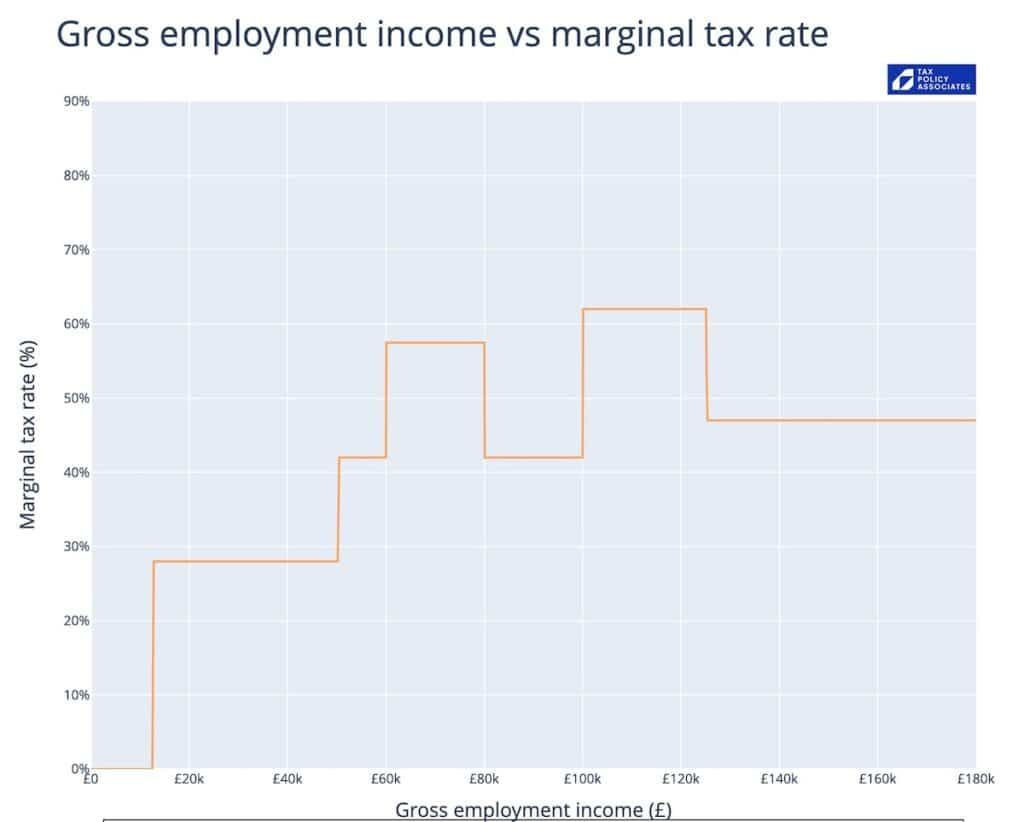
Mirroring similar epic fail graphs in America: United Kingdom has absurdly high marginal tax rates everywhere, and also does not understand what a ‘phase-out’ is, it seems? This is for couples in London with two children under 3, for the extreme case:

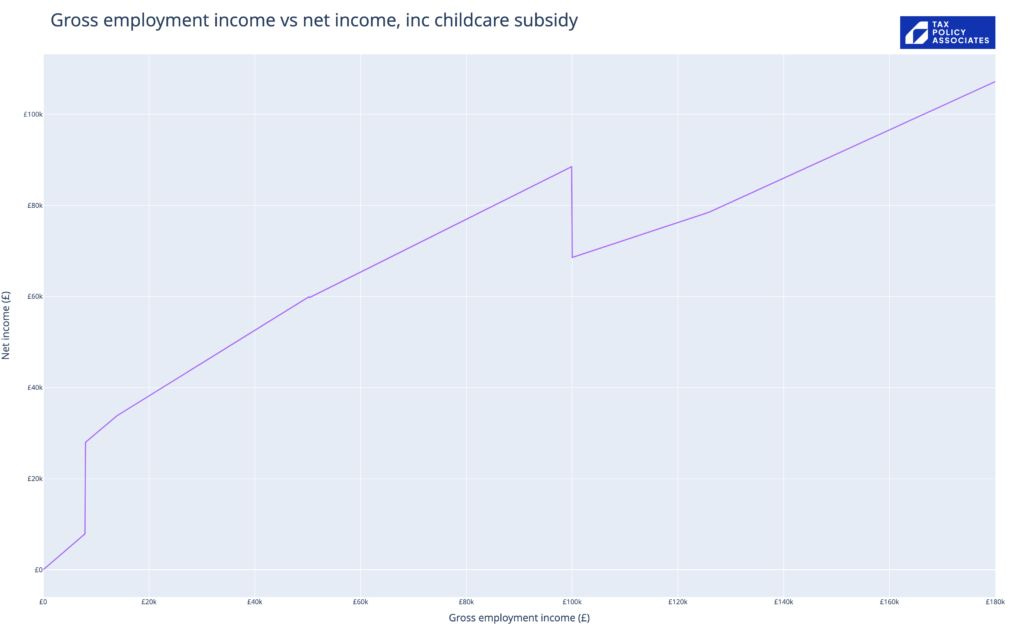
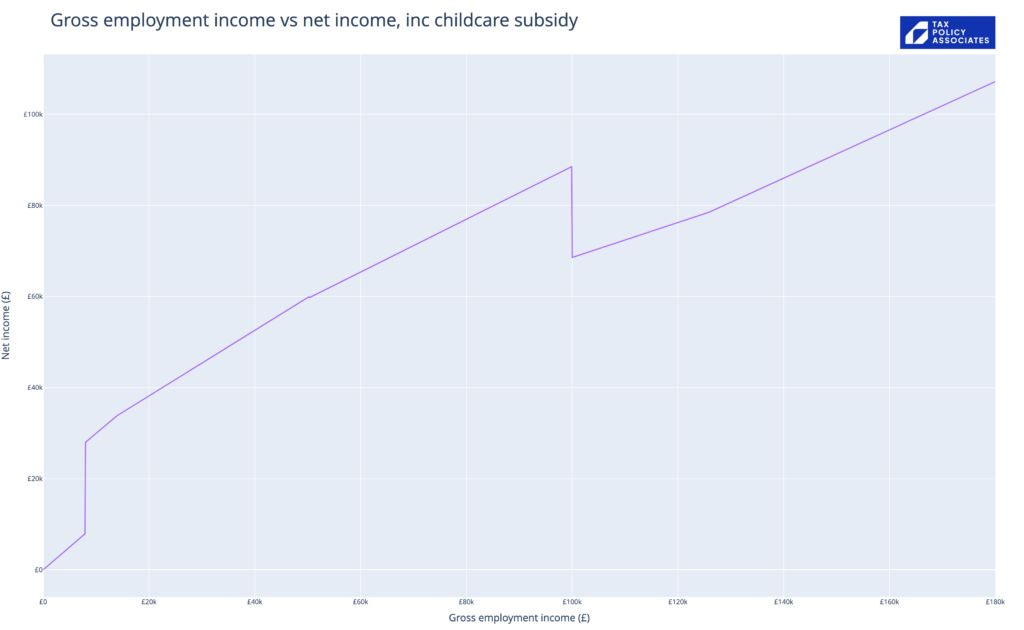
Dan Neidle: The 20,000% spike at £100,000 is absolutely not a joke – someone earning £99,999.99 with two children under three in London will lose an immediate £20k if they earn a penny more. The practical effect is clearer if we plot gross vs net income:

David Algonquin: This must be one of the worst pieces of tax policy design ever. I know people who have dropped down to a 4-day week or, if self-employed, take on less work to avoid this trap.

That’s hard to see, but it means that in this scenario you are better off making 99k than 100k+, unless you can make over ~145k. Normally it’s nowhere near this crazy, but you can be a lot less crazy than this and still rather crazy.

Dan’s entire thread offers more detail, and he also offers this interactive set of charts, and this article version of the thread.

Dan Neidle: It’s perfectly coherent and rational to think high earners should pay 62% tax (and of course also coherent and rational to disagree).

But surely nobody thinks we should have 62% tax on people earning £100k-125k, and 47% on people earning more than £125k?

And it can get worse. If Jane’s still repaying her student loan, that’s another 9% – the student loan system behaves like a crude graduate tax. Jane’s marginal rate reaches 71%.

Europe still has sufficiently strong trade barriers that they are equivalent to a 45% tariff on manufacturing and 110% for services, according to Mario Draghi. That’s without even considering the ‘trade barriers’ that exist within-countries in the form of ‘EU being the EU.’ o3-mini-high estimated that this costs the EU RGDP growth in the range 0.2%-0.5% per year, versus taking those barriers down.

A similar situation exists between Canadian provinces, which continues to blow my mind because not only is it a huge own goal for no reason, it is so profoundly unpopular and everyone wants to get rid of it, and somehow it is still there.

One serious danger with the new administration is a potential cap on credit card interest rates at 10%, with Senators Sanders and Hawley planning to work on this with President Trump. This would severely limit the ability of the poor, or those with poor credit, to access credit cards, and the alternatives to credit cards are all vastly worse.

We also had yet another round of people falsely claiming that 60% of Americans live paycheck to paycheck, for various reasons this claim simply will not die despite a majority of Americans having actual cash savings that can pay for 3 months of expenses, even before dipping into credit cards, and the median household having a net worth of $193k. There are horrible crimes of statistics happening around such claims, in both directions, but the central truth is very clear.

Someone help his friend, their family is dying? Or living ‘paycheck to paycheck.’

Damon Chen: My friend told me he and his wife live paycheck to paycheck.

I don’t believe it because they both are high earners in tech, and he even works for Google. But after doing a little bit of math, I found out he didn’t lie.

• Mortgage: $17,000/month for a $3M home

• Property Tax: $3,000/month

• Private School: $3,000/month for 1 kid

• Travel: $2,000/month (assuming $20k/year)

• Utilities: $1,000/month

• Groceries: $2,000/month

• Eating Out: $1,000/month

• 2 cars: $1,000/month

So in total $30k per month, not including other misc costs like house maintenance, paying for Netflix, etc.

W-2 employees usually take home only 50% of their salary, so they have to make $60k per month pretax, which is $720k in annual TC.

What’s the point of living a life like this?

This is almost entirely housing and taxes. They’re paying California taxes, which is an extra 10% or so of gross income in this income range, or about $6k/month at $720k annual, and the property costs $21k including utilities (which seem strangely high for a region without much need for heat or AC, are they doing a ton of EV charging maybe? If so that half of it should be filed under the cars). That’s $27k, everything else costs a combined $9k.

Cutting other spending won’t make that much difference for them. Yes, $20k/year for travel (that can’t be expensed) seems crazy to me, but some people value it. Others are saying groceries and eating out are too high here, again there is room to cut but I do think you can get a lot of value from the premium there. So it really does come down to, how much does a family of three want a $3 million home (with a not fun interest rate)?

I’d also question buying both a $3 million home and a private school. If you’re paying that much, presumably (since he’s working at Google) they’re in Palo Alto, which does kind of justify the home price if you want to go large enough to plan for a big family, but then that area is said to have excellent public schools. It’s a hell of a lot to pay for that shorter commute.

California businesses forced to foot the bill for some of the $20 billion in loans California took from the Federal Government to pay unemployment during the pandemic, after the state defaulted on payment, er, ‘failed to allocate funds.’

Chinese venture capital firms are hounding failed founders, pursuing personal assets and adding them to the national debtor blacklist, which means they can’t do things like start a business, fly, take trains, stay in hotels or leave China. China has no personal bankruptcy law, so there’s no way out. If you want VC money in China, if you can get it at all, it now probably means effectively taking on personal debt.

Presumably this is because the franchise value and forward deal flow of VC firms was cratered so much by government crackdowns that the firms have chosen to hound past founders despite knowing this destroys their future deal flow. All that’s left is to get what they can from their existing obligations, which in China technically gave them the opportunity to do this, and now they’re actually doing it at scale.

One assumes that no sane person would sign such terms now that the equilibrium has shifted. It’s one thing to have confidence in your startup and take a shot knowing the odds are against you. It’s another thing to do that when failure ruins your life.

A Delaware judge again rejected Elon Musk’s stock compensation package, despite the shareholders overwhelmingly ratifying it post-hoc when it was vastly more valuable than it originally appeared. He plans to appeal to the Delaware Supreme Court, and if that fails presumably try again in Texas.

From most perspectives I know, this makes absolutely no sense. It is the ultimate ‘isn’t there someone you forgot to ask’ meme. It’s not even a reduction to what the judge considered reasonable, it’s throwing out the entire package.

Paul Graham: It used to be automatic for startups to incorporate in Delaware. That will stop being the case if activist judges start overruling shareholders.

This evening the CEO of a public company told me that all startups should reincorporate in Nevada. That’s apparently the best alternative, and for startups that are still private it’s trivially easy.

The judge’s explanations are, again by most perspectives I know, absurd.

Judge McCormick: Even if a stockholder vote could have a ratifying effect, it could not do so here. Were the court to condone the practice of allowing defeated parties to create new facts for the purpose of revising judgments, lawsuits would become interminable.

“We can’t allow defeated parties to create new facts”? What the actual ? I mean, do you even hear yourself? This makes no sense.

Similarly, claims that the disclosures on the current round were not good enough? They literally stapled the judge’s previous ruling to the disclosures, and were very very clear what Musk was getting, even though it was now vastly more valuable. Absurd.

I presume Judge McCormick’s actual logic is something else entirely. I presume it is some combination of:

  1. Elon Musk broke the rules, and potentially committed outright fraud, by using a compliant board to give him an absurd pay package. We cannot allow him to use this to create an anchor from which he will then benefit.

  2. I don’t think it’s reasonable to pay this much money, and I have the right to impose that opinion on Tesla.

  3. Seriously, though, fthis guy.

Should startups respond to this by reincorporating in Nevada? I have not done the research on the host of other consequences, but my assumption would be no. This is an extraordinary case that is unlikely to be a meaningful precedent. Most of the time, when someone has the level of chutzpah and obviously unacceptable self-dealing that Musk has, invalidating their absurdly huge pay package is a reasonable decision. I see why people would be concerned, but I see this as a one off.

I also see this as part of the standard warning from the startup and Paul Graham crowd, or the Marc Andreessen crowd, that if anyone ever does something they don’t like, that entity will rue the day, rue the day I tell you, because either the startup ecosystem will be Ruined Forever or everyone involved will pick up their balls and go elsewhere. The sky is always about to be falling. Usually, the sky is fine.

Via Tyler Cowen, Spencer Jakab at WSJ asks: Would a time machine make you a good investor?

I mean, obviously, if you had a full time machine. The sky’s the limit, then. But what if you only had a glimpse to work with and limited options?

In the ‘Crystal Ball Trading Game’ players are given $1 million in play money, and 15 opportunities to see the front page from two days in the future (on the same 15 randomly chosen days) and then trade, with up to 50 times leverage, the S&P 500 and 30-Year Treasuries, evaluated at tomorrow’s close. They report that the median trader, from a mostly savvy pool, had only $687,986 left.

Spencer Jakab: But how does one explain the median loss of 31%? Surely being able to bet heavily on the really obvious, no-brainer newspaper headlines should make up for a few errors? In fact that proved to be many players’ financial undoing, with a not-insignificant number having negative money by the end. The first lesson from the game, then, might be to curb your enthusiasm in such cases.

Any true inhabitant of The River would think very differently about this.

You are being given a one-time unique opportunity. There are no transaction or financing costs, so you definitely have an edge however small, but you only get 15 moves, some with clearer edge than others. The more money you make early, the more you can bet later.

Yes, there are decreasing marginal returns to money, but you’re not in that much danger of hitting them. If you bet at random with the maximum 50x leverage on the S&P for 15 random uncorrelated days, you probably don’t even go broke.

So in that situation, you would correctly want to risk ‘going broke’ within the experiment, bet with giant leverage, and act such that, unless you are outstandingly good at directional predictions, more often than not you lose money.

This contrasts with the story of giving someone 30 minutes of 60/40 coin flips and $25 to bet, with a maximum win of $250. If you can’t win the max almost all the time there, you’re doing something very wrong. Indeed, you should play remarkably conservatively, exactly because you should have no trouble hitting the cap. So instead of betting Kelly’s 20% each time, you should bet substantially less than that.

However, suppose the experiment was very different and you didn’t have a $250 limit. But again, you only have 30 minutes. So you get a 60/40 flip as fast as you can name the sizing and do the flip. Let’s say you can, if you do your sizing quickly, do 4 flips a minute, so you get 120 flips. Kelly only wins you a few thousand dollars on average. If you instead bet half each time, you average a few million. You should definitely be at least that aggressive here given the time limit, at least until you get quite a lot of funds in hand.

Remember Ocean’s 11. The house always wins, unless when you have the edge, you bet big, and then you take the house.

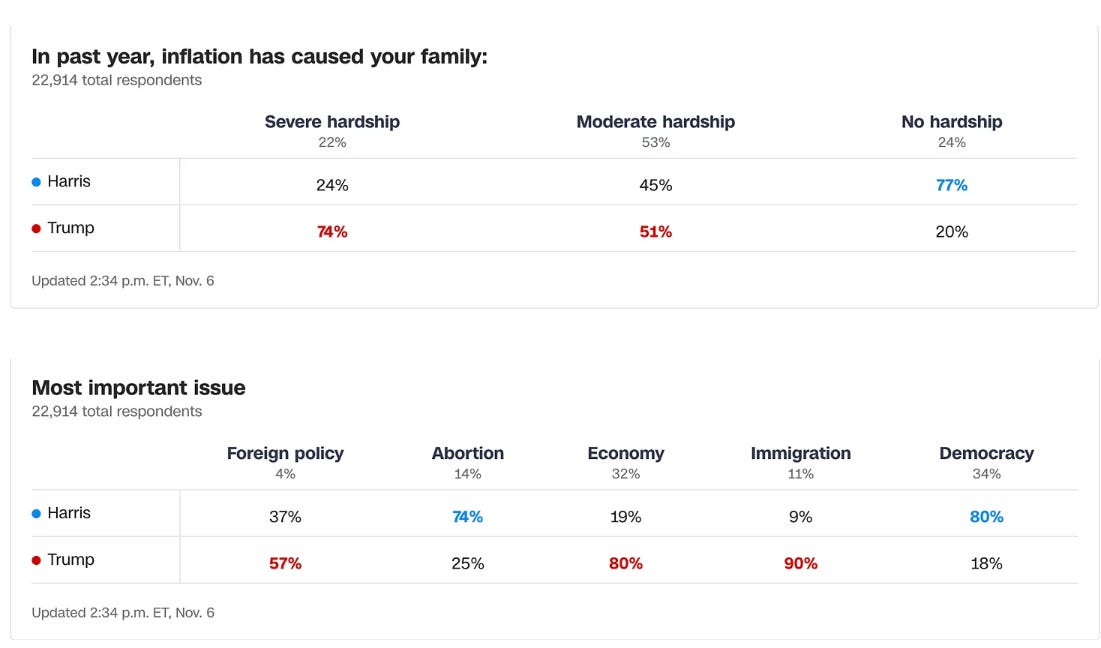
As always, the answer to whether you’re financially better off than a year ago shifts 15 points the moment the election is over. So take people’s answers appropriately seriously.

Did inflation make the median voter poorer? Zachary Mazlish argues that it did, but what he actually argues is more that the median voter got poorer overall. Which is also an important point, and while I quibble below, overall it is a very good post.

Among other things, he cites this data:

This data very clearly says that people’s economic perceptions are being heavily warped by that hell of a drug, partisanship, in both directions. There’s no other way this data makes sense. What are people thinking?

Zachary Mazlish: Well, turns out, if you are so bold as to close FRED for a second and ask people, 81% of people believe that prices increase faster than wages during inflationary times, and 73% of people believe their purchasing power decreases.

But are they right?

I myself have been extremely confused about this issue, and after having spent the bulk of my post-election haze trying to decipher things, I can now report in high spirits that I am only somewhat confused.

Inflation did make the median voter poorer during Biden’s term.

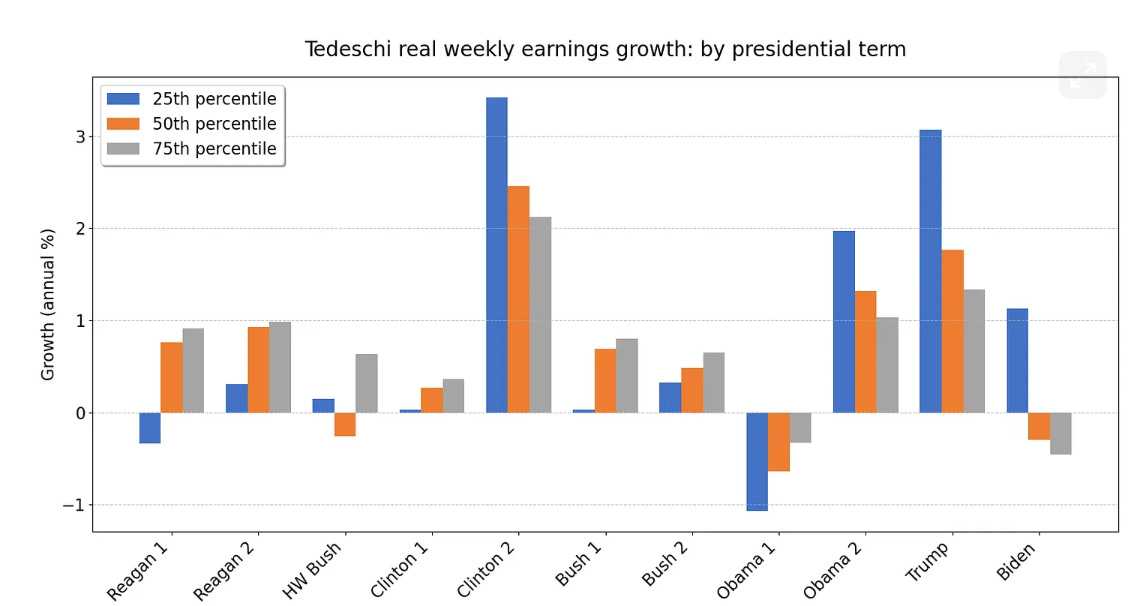
  1. In no part of the income distribution did wages grow faster while Biden was President than they did 2012-2020.

    1. This is true in the raw data, and even more stark after compositional adjustment.

    2. In particular, the change in median incomes was well below its 2012-20 run-rate.

  2. But, the change in median wages is not what matters; it is the median change in wages that does. And this metric was even weaker under Biden: lower than any period in the last 30 years other than the Great Recession.

  3. People do not feel wages, they feel total income. And median growth in total income — post taxes and transfers — was not just historically low: it collapsed and was deeply negative from 2021 onwards.

    1. Much of this decline is due to timing of pandemic stimulus and even less the “fault of Biden” than other things.

  1. So on #1, the obvious response is, that wasn’t the question. That does not tell you whether people were made poorer, it tells you they became overall less richer. But that’s fine, this was only the setup.

  2. Why is this what matters? It’s a bizarre metric. Why should we care what the median change was, instead of some form of mean change, or change in the mean or median wage? Unless the claim is that voter perception is shaped primarily by their own change in income. That could be a political story but it isn’t a story about economic reality.

  3. So we’re saying that what is happening here is that voters are evaluating income post taxes and transfers, purely for themselves, and then blaming the result on inflation? Perhaps they are indeed doing that, and you can’t do that. I mean, obviously you can, but it’s not a map that matches the territory, again unless the territory you care about is perception.

The attempt to justify #2 is… not great:

To see why the median change in wages is the relevant object for thinking about the election, imagine a world where you had 3 different people: person A with an income of $4, person B with an income of $5, and person C with an income of $10. If four years later person A is now only making $1, person B is making $6, and person C is also making $6, the median income has increased!

But if there were an election, the median worker — who is also the median voter2 did not have a good last four years, financially speaking. Hence why the median change in income is the object of interest.

In this world, mean income went from $6.66 to $4.33. Of course everyone thinks things got a lot worse. The median income happened to go up, but wages overall are dramatically down. It’s a perverse example, where median income happens to be horribly misleading.

Contrast that with this world (all numbers in real terms):

  1. Time period 1: A makes $1, B makes $6, C makes $10.

  2. Time period 2: A makes $10, B makes $5, C makes $9.

The median change in income is negative, two out of three people saw their wages decline. Do you think this means the economy got worse?

Here’s another graph.

That does look like poor (although still net slightly positive) performance for Biden.

In my opinion, weekly earnings are more relevant than hourly earnings for understanding voter psychology, and likewise, annual earnings are more relevant than weekly earnings: it is annual earnings that determines the overall state of your finances.

This seems to me like a well researched story about voter psychology, that is then being portrayed as inflation making people actually poorer, when we can’t even attribute the voter psychological reaction to the inflation, without knowing the counterfactual.

And indeed, the third point makes clear a lot of what this was about:

Point 3: Post all taxes and transfers, the median household’s real income collapsed while Biden was in office — due to the timing of the Pandemic stimulus.

Yes, exactly. The story is that the big subsidies happened under Trump, and then got taken away, and voters blamed Biden for the difference, plus things overall were unimpressive especially relative to the previous boom decade once we pulled out of the Great Financial Crisis. And indeed, the author notes explicitly this is not the fault of either Biden or inflation.

This thread is a clean summary.

If you put this all together, saying ‘inflation’ gave the voters a way to blame Biden for the decline in their real purchasing power that came in large part from the end of the stimulus, in addition to its other effects. You also see the partisan splits in perception of the economy, as you always do. In a world where a majority of voters dislike each party, and Biden was unpopular, it’s easy for people to use any excuse to think the economic times are bad.

Could Biden have done anything about all this? To some extent absolutely. There were any number of pro-growth policies he left on the table, and ways he actively got in the way of growth, and he overspent. But he was also, as many have noted, dealt a rather terrible hand on this, with the timing of the stimulus and resulting inflation. The fact that we outperformed almost all other countries economically during this period? Irrelevant to the median voter, who wouldn’t notice or care.

People think insurance should be some sort of magic thing, and complain when insurance companies price their products based on their costs plus a profit margin, and attempt to actually model the risks involved. Yes, insurance companies will act like scum to weasel out of paying if they can, but that’s a distinct issue.

The most pure version of this was an old Chris Rock routine where he says that they should call insurance ‘in case shit.’ And then he says, ‘if shit don’t happen, shouldn’t I get my money back?’ And the audience cheers. Except, well, yeah.

And no, this isn’t a weird Chris Rock thing. It’s common.

Spooky Werewolf Media: To be fair it’s not just that people don’t understand rudimentary aspects but that these things are propagandized and confused and marketed to hell and back by legions of bullshit artists.

Jeremy Kauffman: The degree to which society functions despite massive swathes not understanding even rudimentary aspects is a huge testament to capitalism.

(Nothing I write is ever investment advice, etc etc)

I write this note every so often, I think it’s important.

Duderichy: People vastly underestimate the alpha you have in your career!

If you’re in tech, you should be focusing on locking in a $500,000+ staff job instead of getting an extra $20,000 per year off your investments.

You can make a lot off your investments, but it’s hard to turn a lot of extra time into a lot of extra alpha, especially when your net worth is not large compared to your earning potential.

You do want to put in enough time to do something ‘reasonable’ but the answer (assuming you’re not planning for AGI) is plausibly things like ‘just find the right place to live, have an emergency savings account and then buy index funds, maybe buy index funds in industries that look promising and throw in some individual stocks and then forget about it.’

Beyond that, if your shower thoughts are focused on your investments, that will usually be a mistake until your investments are large compared to your income and career potential. Even when the amount of money at stake look large, that doesn’t mean the difference in alpha available from more attention is very high.

This study of insider trading regulatory preferences is bizarre. It says outsiders prefer insider trading be allowed because it increases liquidity and price efficiency, but that seems wrong?

Insider trading increases liquidity from insiders that you don’t want to trade against. It decreases liquidity you do want from everyone else, who are subject to adverse selection.

In my experience, markets vulnerable to insider trading see their liquidity shrink dramatically – a clean example is if there is important unknown injury information in a sporting event, it all but kills the action until the information gets out, and markets for potentially fixed leagues are super thin.

Or: Who do you think is paying the insider traders their profits?

Insider trading might increase price efficiency, or it might not. Insiders have the incentive to fix prices, but others have far less incentive to do so. If I see Nvidia trading at 400 and my analysis says it should be 360 or 440, how do I know this isn’t because of insiders, and given that how do I dare trade? Or as they say in sports trading when the odds look weird: “Somebody knows something.” Maybe.

Whereas the insiders, this says, are against insider trading. Which I could see if it was due to it killing liquidity and ability to raise capital, but then that feeds back into the previous claim.

Apollo Bagels is fighting an attempt by the landlord to evict them over long lines. Whatever could a Bagel store do when the demand got so large that people were forming very long lines, that might solve this problem in a net positive fashion? Nope, I can’t think of anything.

Raising minimum wages 10% increases the injury rate for ‘fully exposed’ industries by 11% in a working paper, with an elasticity of 1.4. On its own that’s perhaps not a big deal but it is indicative of what else is happening.

Amazon fulfillment centers increase local employment and wages.

Alex Tabarrok asserts an evolving new consensus on the minimum wage, that effects are heterogeneous and take place on more margins than employment. I don’t know about the claim of an emerging consensus, but the claims themselves seem obviously true. In particular, those hurt by minimum wage laws are typically the worst off among us, with others largely unaffected, as economics 101 would suggest.

Whenever I see warnings about the national debt, like this one by Arnold Kling, they usually employ calculations like this one, where Kling quotes Cowen pointing the Rauh.

Joseph Rauh: if I use CBO projections to calculate the interest-to-revenue ratio, it reaches 22.9% by 2034.

The important warning that Kling is the latest to reiterate is that the bond market is currently in the good but unstable equilibrium of everyone expecting the government to pay its debts in valuable dollars, at least on a rolling basis. That means interest rates are reasonable. If we shift to the bad equilibrium, where investors do not assume this and demand higher prices, then we won’t be able to pay our debts without some form of large default, we will be vastly poorer, and there is no easy way back.

When we take on more debt, we raise both the danger that this happens, and the damage it would cause if it did happen. The good reason not to take on more debt is this tail risk.

There are remarkable similarities to things like AI existential risk – we know that going down this road will at some point start introducing steadily increasing risk of catastrophe, but until then we likely enjoy good times. There’s huge value in taking on a non-trivially risky amount of debt.

As we enjoy those good times, we don’t know what level of debt is how risky, with some even saying we can take on essentially unlimited debt and it’s fine, and every time we take on more debt people update that it’s safe to take on yet more debt – either you respond before the crisis, or you respond too late. As Kling puts it, ‘pretending there is no problem means that a sudden crisis is likely.’

How much debt is unsustainable? What is the actual current or anticipated debt burden? Tracking interest as a percentage of revenue is asking the wrong question.

There are essentially two questions that seem like they should matter here.

  1. Can the good equilibrium be sustained? If we retain the ability to borrow at the risk-free rate of interest, or something not too far above it, can we keep the debt-to-GDP ratio from rising?

  2. What will the bond market think is the bond market’s future answer to #1?

Japan, among other examples, shows us that we have a poor model of #2, as does the continued willingness to keep buying the debt of Argentina cycle after cycle. The coyote absolutely can sometimes run across thin air for longer than you think. That’s not the kind of thing I am in a position to model well, so I tend to focus more on #1.

According to Google, America pays about 3.35% on its monthly interest-bearing debt, and an average of 3.28% overall. Nominal GDP growth is higher than that, at 4.96%, similar to its historical average of 6.17% from 1948 to 2024. At current prices, the actual effective amount we pay in interest on the debt is less than zero – we could have debt of 100% of GDP, then have a primary deficit of 1.5% of GDP, and end the year with a better debt-to-GDP ratio than when we started.

That tells me that the answer here is more about demand for market priced safe government debt than it is about market price, similarly to the situation in Japan. My expectation is that the limiting factor here is that the ‘giant pool of money’ chasing safe assets is only so large. For now, demand exceeds supply by a lot, so we’re fine, and if someone dumps their supply that’s not an issue. If we try to borrow too much at once, we would exhaust demand, and have to adjust price in order to drum up more demand, not because of risk but because demand curves slope upward. So that’s what I would want to study, to find out where we should worry about potential breaking points.

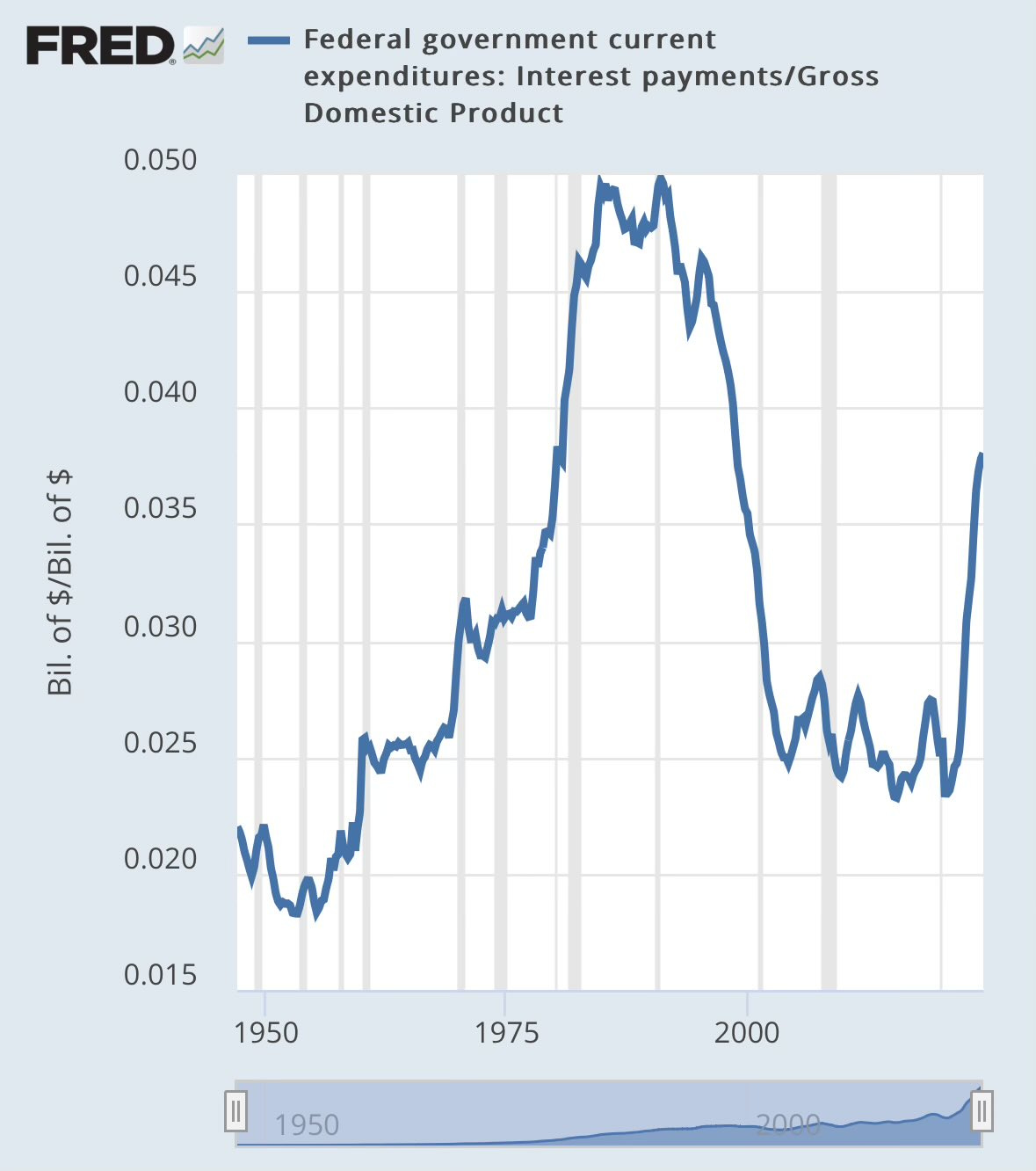
Another way to measure this is GDP share of interest payments, but as always keep in mind that this is nominal:

Paying 5% of GDP in interest definitely sounds like a lot. It makes sense that everyone was actively concerned with the deficit and debt back then. But again, I’d be asking more about the steady-state cost of debt. What would it cost to make payments sufficient to prevent the debt from growing as a share of GDP, if the primary budget was in balance?

Which again brings us back to the question of multiple equilibria. The debt is fine, except for the risk that suddenly it very much isn’t. How far dare we go?

New SBF interview from prison, somehow with less candor than before.

Strong recommendation for SBF: How the FTX Bankruptcy Unwound Crypto’s Very Bad Good Guy, if you are in finance or crypto. Patrick McKenzie has a thread on it.

Jim Babcock explains how many memecoins and ‘market caps’ work, and how very often there is vastly less there than meets the eye. I find the whole thing deeply stupid, and if you propose I get involved with one I will absolutely block you.

Arguments and data in favor of the Peter Principle, that employees get promoted to their level of incompetence. To me this is one of those principles that is obviously true, the question is magnitude. The idea that ‘oh firms know about that, they’d successfully control for it so it wouldn’t happen at all’ is Obvious Nonsense.

Yay economies of scale. Much of what we consume has almost zero marginal product, and its marginal prices are usually falling rapidly to zero. An excellent reason to want more people around.

Our tax code continues to punish married couples when both parents work, or alternatively it relatively rewards ‘traditional’ one income households. Given we do not seem to culturally agree with this on reflection, we should fix it.

Discussion about this post

Economics Roundup #5 Read More »

how-north-korea-pulled-off-a-$1.5-billion-crypto-heist—the-biggest-in-history

How North Korea pulled off a $1.5 billion crypto heist—the biggest in history

The cryptocurrency industry and those responsible for securing it are still in shock following Friday’s heist, likely by North Korea, that drained $1.5 billion from Dubai-based exchange Bybit, making the theft by far the biggest ever in digital asset history.

Bybit officials disclosed the theft of more than 400,000 ethereum and staked ethereum coins just hours after it occurred. The notification said the digital loot had been stored in a “Multisig Cold Wallet” when, somehow, it was transferred to one of the exchange’s hot wallets. From there, the cryptocurrency was transferred out of Bybit altogether and into wallets controlled by the unknown attackers.

This wallet is too hot, this one is too cold

Researchers for blockchain analysis firm Elliptic, among others, said over the weekend that the techniques and flow of the subsequent laundering of the funds bear the signature of threat actors working on behalf of North Korea. The revelation comes as little surprise since the isolated nation has long maintained a thriving cryptocurrency theft racket, in large part to pay for its weapons of mass destruction program.

Multisig cold wallets, also known as multisig safes, are among the gold standards for securing large sums of cryptocurrency. More shortly about how the threat actors cleared this tall hurdle. First, a little about cold wallets and multisig cold wallets and how they secure cryptocurrency against theft.

Wallets are accounts that use strong encryption to store bitcoin, ethereum, or any other form of cryptocurrency. Often, these wallets can be accessed online, making them useful for sending or receiving funds from other Internet-connected wallets. Over the past decade, these so-called hot wallets have been drained of digital coins supposedly worth billions, if not trillions, of dollars. Typically, these attacks have resulted from the thieves somehow obtaining the private key and emptying the wallet before the owner even knows the key has been compromised.

How North Korea pulled off a $1.5 billion crypto heist—the biggest in history Read More »