Author name: Rejus Almole

cybertrucks’-faulty-trim-prompts-biggest-recall-yet,-stokes-tesla-investor-panic

Cybertrucks’ faulty trim prompts biggest recall yet, stokes Tesla investor panic

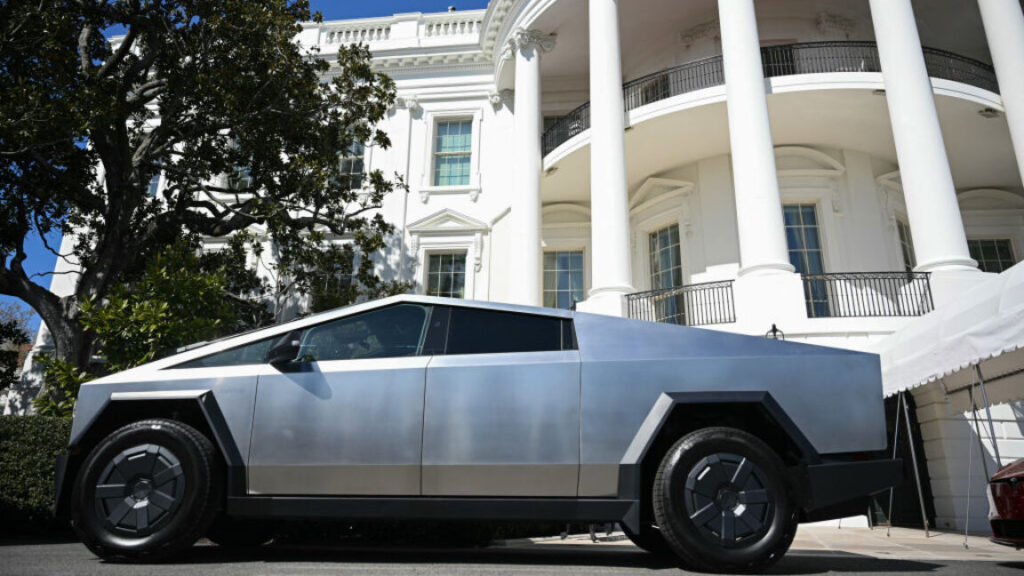
Every Tesla Cybertruck ever sold is being recalled so Tesla can fix an exterior panel that could potentially come unglued and detach while driving.

If the “panel separates from the vehicle while in drive, it could create a road hazard for following motorists and increase their risk of injury or a collision,” Tesla explained in a safety recall report submitted Tuesday to the National Highway Traffic Safety Administration (NHTSA).

Tesla initially became aware of the issue in January and launched a study of the problem as more complaints came in, the report said. By March, social media complaints were getting louder as Tesla wrapped up its probe, concluding that a voluntary recall was necessary.

The recall affects any 2024 or 2025 Cybertruck manufactured between November 13, 2023, to February 27, 2025, the report said. According to Reuters, this represents “a vast majority of the Cybertruck vehicles on the road, based on analyst estimates.” Potentially more than 46,000 vehicles could require the fix, Tesla said, while conservatively estimating that only 1 percent of cars are likely defective.

Cybertruck drivers unsure if their vehicle needs the fix can look out for warning signs, like “a detectable noise inside the cabin” or visible signs the panel is detaching, Tesla said.

Anyone whose car is covered by the recall can get the fix at no charge, Tesla said. The repair both replaces the adhesive used for the panel with one that’s more durable and reinforces the attachment “with a stud welded to the stainless panel with a nut clamping the steel panel to the vehicle structure,” Tesla said.

Starting tomorrow, all new Cybertrucks that Tesla produces will have this fix, Tesla said, while any vehicles that Tesla currently possesses will be retrofitted before delivery to any customers.

Tesla is currently notifying dealers about the recall, then plans to start reaching out to customers with recall notices on May 19. Any Cybertruck owners interested in pursuing repairs now can call NHTSA’s Vehicle Safety Hotline at 888-327-4236 (TTY 888-275-9171) or go to nhtsa.gov, the agency said.

Investors panicked by Tesla’s “brand tornado crisis moment”

Last year, Tesla had several rounds of recalls, notifying drivers of widely varied problems, from software issues to faulty accelerator pedals or inverters. As recalls have been announced, Cybertruck sales have seemingly slumped, as Tesla obscured the true figures by lumping numbers in with sales of Model X and Model S, MotorTrend reported. This new recall is the first glimpse industry analysts have had of total Cybertruck sales, MotorTrend noted, and compared to other popular trucks, Cybertruck sales overall appear remarkably stunted.

Cybertrucks’ faulty trim prompts biggest recall yet, stokes Tesla investor panic Read More »

the-early-2000s-capacitor-plague-is-probably-not-just-a-stolen-recipe

The early 2000s capacitor plague is probably not just a stolen recipe

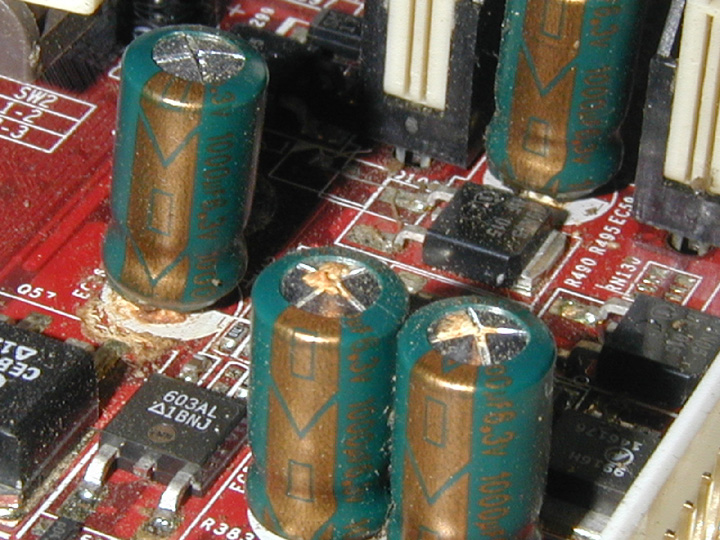
It’s a widely known problem with roots in urban legend: Devices with motherboards failing in the early 2000s with a sudden pop, a gruesome spill, or sometimes a burst of flames. And it was allegedly all due to one guy who didn’t copy a stolen formula correctly.

The “capacitor plague” of the early 2000s was real and fairly widespread among devices, even if the majority of those devices didn’t go bad at the same time or even in the same year. The story of this widespread failure, passing between industry insider stories and media reports, had a specific culprit, but also a broad narrative about the shift from Japanese to Taiwanese manufacturers and about outsourcing generally.

The Asianometry channel on YouTube recently dug into the “capacitor plague” in a video that asks, “What happened to the capacitors in 2002?” and comes to some informed, broad, and layered answers. It explains the specifics of what’s happening inside both a working capacitor and the faulty models, relays the reporting on the companies blamed and affected, and, crucially, puts the plague in the wider context of hotter chips, complex supply chains, counterfeits, and, sure, some industrial sabotage.

“We will never know what exactly happened, but let’s try,” the host says at the start. It is recommended you follow along.

“What Happened to the Capacitors in 2002?” by Asianometry.

Without replicating too much of the video and larger mythos, the basic story is that, according to various disputed timelines, electrolytic capacitors put into electronics between 1999 and 2003 or so failed in dire ways from 2002 through (perhaps) 2007. Boards and computers bought from Abit, HP, IBM, and, infamously, Dell, among others, suffered these faulty capacitors and were handled with recalls, repairs, or, sometimes, silence.

A finely balanced cocktail

The “Low equivalent series resistance,” or “low impedance” aluminum capacitors at issue, contained an electrolyte solution that, when doing its job, served as a cathode and kept the paper separating two files inside the rolled-up capacitor saturated. Because the electrolyte is roughly 70 percent water, and the capacitor could take on wider fluctuations of voltage, it became a cheap, popular component in many devices.

The early 2000s capacitor plague is probably not just a stolen recipe Read More »

dad-demands-openai-delete-chatgpt’s-false-claim-that-he-murdered-his-kids

Dad demands OpenAI delete ChatGPT’s false claim that he murdered his kids

Currently, ChatGPT does not repeat these horrible false claims about Holmen in outputs. A more recent update apparently fixed the issue, as “ChatGPT now also searches the Internet for information about people, when it is asked who they are,” Noyb said. But because OpenAI had previously argued that it cannot correct information—it can only block information—the fake child murderer story is likely still included in ChatGPT’s internal data. And unless Holmen can correct it, that’s a violation of the GDPR, Noyb claims.

“While the damage done may be more limited if false personal data is not shared, the GDPR applies to internal data just as much as to shared data,” Noyb says.

OpenAI may not be able to easily delete the data

Holmen isn’t the only ChatGPT user who has worried that the chatbot’s hallucinations might ruin lives. Months after ChatGPT launched in late 2022, an Australian mayor threatened to sue for defamation after the chatbot falsely claimed he went to prison. Around the same time, ChatGPT linked a real law professor to a fake sexual harassment scandal, The Washington Post reported. A few months later, a radio host sued OpenAI over ChatGPT outputs describing fake embezzlement charges.

In some cases, OpenAI filtered the model to avoid generating harmful outputs but likely didn’t delete the false information from the training data, Noyb suggested. But filtering outputs and throwing up disclaimers aren’t enough to prevent reputational harm, Noyb data protection lawyer, Kleanthi Sardeli, alleged.

“Adding a disclaimer that you do not comply with the law does not make the law go away,” Sardeli said. “AI companies can also not just ‘hide’ false information from users while they internally still process false information. AI companies should stop acting as if the GDPR does not apply to them, when it clearly does. If hallucinations are not stopped, people can easily suffer reputational damage.”

Dad demands OpenAI delete ChatGPT’s false claim that he murdered his kids Read More »

john-wick-has-a-new-target-in-latest-ballerina-trailer

John Wick has a new target in latest Ballerina trailer

Ana de Armas stars as an assassin in training in From the World of John Wick: Ballerina.

Lionsgate dropped a new trailer for Ballerina—or, as the studio is now calling it, From the World of John Wick: Ballerina, because what every film needs is a needlessly clunky title. There’s nothing clunky about this new trailer, however: It’s the stylized, action-packed dose of pure adrenaline one would expect from the franchise, and it ends with Ana de Armas’ titular ballerina facing off against none other than John Wick himself (Keanu Reeves).

(Spoilers for 2019’s John Wick Chapter 3: Parabellum.)

Chronologically, Ballerina takes place during the events of John Wick Chapter 3: Parabellum. As previously reported, Parabellum found Wick declared excommunicado from the High Table for killing crime lord Santino D’Antonio on the grounds of the Continental. On the run with a bounty on his head, he makes his way to the headquarters of the Ruska Roma crime syndicate, led by the Director (Anjelica Huston). That’s where we learned Wick was originally named Jardani Jovonovich and trained as an assassin with the syndicate. The Director also trains young girls to be ballerina-assassins, and one young ballerina (played by Unity Phelan) is shown rehearsing in the scene. That dancer, Eve Macarro, is the main character in Ballerina, now played by de Armas.

Huston returns as the Director, Ian McShane is back as Winston, and Lance Reddick makes one final (posthumous) appearance as the Continental concierge, Charon. New cast members include Gabriel Byrne as main villain the Chancellor, who turns an entire town against Eve; Sharon Duncan-Brewster as Nogi, Eve’s mentor; Norman Reedus as Daniel Pine; and Catalina Sandino Moreno and David Castaneda in as-yet-undisclosed roles.

John Wick has a new target in latest Ballerina trailer Read More »

us-tries-to-keep-doge-and-musk-work-secret-in-appeal-of-court-ordered-discovery

US tries to keep DOGE and Musk work secret in appeal of court-ordered discovery

The petition argues that discovery is unnecessary to assess the plaintiff states’ claims. “Plaintiffs allege a violation of the Appointments Clause and USDS’s statutory authority on the theory that USDS and Mr. Musk are directing decision-making by agency officeholders,” it said. “Those claims present pure questions of law that can be resolved—and rejected—on the basis of plaintiffs’ complaint. In particular, precedent establishes that the Appointments Clause turns on proper appointment of officeholders; it is not concerned with the de facto influence over those who hold office.”

States: Discovery can confirm Musk’s role at DOGE

The states’ lawsuit alleged that “President Trump has delegated virtually unchecked authority to Mr. Musk without proper legal authorization from Congress and without meaningful supervision of his activities. As a result, he has transformed a minor position that was formerly responsible for managing government websites into a designated agent of chaos without limitation and in violation of the separation of powers.”

States argued that discovery “may confirm what investigative reporting has already indicated: Defendants Elon Musk and the Department of Government Efficiency (‘DOGE’) are directing actions within federal agencies that have profoundly harmed the States and will continue to harm them.”

Amy Gleason, the person the White House claims is running DOGE instead of Musk, has reportedly been working simultaneously at the Department of Health and Human Services since last month.

“Defendants assert that Mr. Musk is merely an advisor to the President, with no authority to direct agency action and no role at DOGE,” the states’ filing said. “The public record refutes that implausible assertion. But only Defendants possess the documents and information that Plaintiffs need to confirm public reporting and identify which agencies Defendants will target next so Plaintiffs can seek preliminary relief and mitigate further harm.”

“Notably, Plaintiffs seek no emails, text messages, or other electronic communications at this stage, meaning Defendants will not need to sort through such exchanges for relevance or possible privilege,” the states said. “The documents that Plaintiffs do seek—planning, implementation, and organizational documents—are readily available to Defendants and do not implicate the same privilege concerns.”

Discovery related to DOGE and Musk’s conduct

Chutkan wrote that the plaintiffs’ “document requests and interrogatories generally concern DOGE’s and Musk’s conduct in four areas: (1) eliminating or reducing the size of federal agencies; (2) terminating or placing federal employees on leave; (3) cancelling, freezing, or pausing federal contracts, grants, or other federal funding; and (4) obtaining access, using, or making changes to federal databases or data management systems.”

US tries to keep DOGE and Musk work secret in appeal of court-ordered discovery Read More »

new-portal-pinball-table-may-be-the-closest-we’re-gonna-get-to-portal-3

New Portal pinball table may be the closest we’re gonna get to Portal 3

A bargain at twice the price

The extensive Portal theming on the table seems to extend to the gameplay as well. As you might expect, launching a ball into a lit portal on one side of the playfield can lead to it (or a ball that looks a lot like it) immediately launching from another portal elsewhere. The speed of the ball as it enters one portal and exits the other seems like it might matter to the gameplay, too: A description for an “aerial portal” table feature warns that players should “make sure to build enough momentum or else your ball will land in the pit!”

The table is full of other little nods to the Portal games, from a physical Weighted Companion Cube that can travel through a portal to lock balls in place for eventual multiball to an Aerial Faith Plate that physically flings the ball up to a higher level. There’s also a turret-themed multiball, which GLaDOS reminds you is based around “the pale spherical things that are full of bullets. Oh wait, that’s you in five seconds.”

You can purchase a full Portal pinball table starting at $11,620 (plus shipping), which isn’t unreasonable as far as brand-new pinball tables are concerned these days. But if you already own the base table for Multimorphic’s P3 Pinball Platform, you can purchase a “Game Kit” upgrade—with the requisite game software and physical playfield pieces to install on your table—starting at just $3,900.

Even players that invested $1,000 or more in an Index VR headset just to play Half-Life Alyx might balk at those kinds of prices for the closest thing we’ve got to a new, “official” Portal game. For true Valve obsessives, though, it might be a small price to pay for the ultimate company collector’s item and conversation piece.

New Portal pinball table may be the closest we’re gonna get to Portal 3 Read More »

spiderbot-experiments-hint-at-“echolocation”-to-locate-prey

SpiderBot experiments hint at “echolocation” to locate prey

It’s well understood that spiders have poor eyesight and thus sense the vibrations in their webs whenever prey (like a fly) gets caught; the web serves as an extension of their sensory system. But spiders also exhibit less-understood behaviors to locate struggling prey. Most notably, they take on a crouching position, sometimes moving up and down to shake the web or plucking at the web by pulling in with one leg. The crouching seems to be triggered when prey is stationary and stops when the prey starts moving.

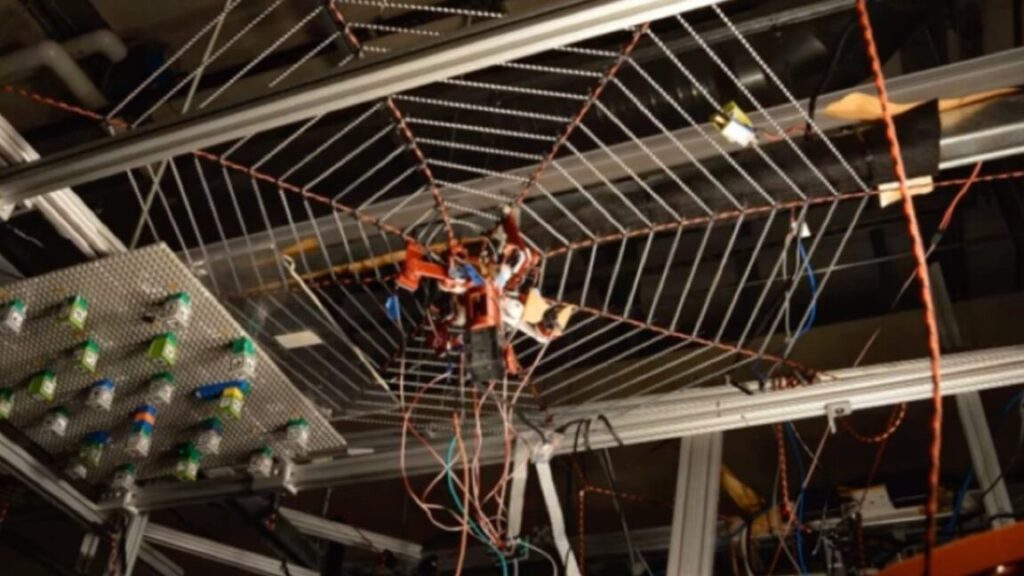
But it can be difficult to study the underlying mechanisms of this behavior because there are so many variables at play when observing live spiders. To simplify matters, researchers at Johns Hopkins University’s Terradynamics Laboratory are building crouching spider robots and testing them on synthetic webs. The results provide evidence for the hypothesis that spiders crouch to sense differences in web frequencies to locate prey that isn’t moving—something analogous to echolocation. The researchers presented their initial findings today at the American Physical Society’s Global Physics Summit in Anaheim, California.

“Our lab investigates biological problems using robot physical models,” team member Eugene Lin told Ars. “Animal experiments are really hard to reproduce because it’s hard to get the animal to do what you want to do.” Experiments with robot physical models, by contrast, “are completely repeatable. And while you’re building them, you get a better idea of the actual [biological] system and how certain behaviors happen.” The lab has also built robots inspired by cockroaches and fish.

The research was done in collaboration with two other labs at JHU. Andrew Gordus’ lab studies spider behavior, particularly how they make their webs, and provided biological expertise as well as videos of the particular spider species (U. diversus) of interest. Jochen Mueller’s lab provided expertise in silicone molding, allowing the team to use their lab to 3D-print their spider robot’s flexible joints.

Crouching spider, good vibrations

A spider exhibiting crouching behavior.

A spider exhibiting crouching behavior. Credit: YouTube/Terradynamics Lab/JHU

The first spider robot model didn’t really move or change its posture; it was designed to sense vibrations in the synthetic web. But Lin et al. later modified it with actuators so it could move up and down. Also, there were only four legs, with two joints in each and two accelerometers on each leg; real spiders have eight legs and many more joints. But the model was sufficient for experimental proof of principle. There was also a stationary prey robot.

SpiderBot experiments hint at “echolocation” to locate prey Read More »

openai-#11:-america-action-plan

OpenAI #11: America Action Plan

Last week I covered Anthropic’s submission to the request for suggestions for America’s action plan. I did not love what they submitted, and especially disliked how aggressively they sidelines existential risk and related issues, but given a decision to massively scale back ambition like that the suggestions were, as I called them, a ‘least you can do’ agenda, with many thoughtful details.

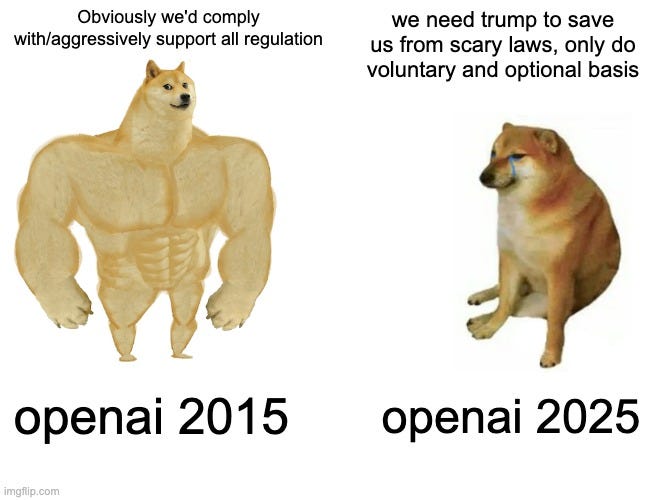
OpenAI took a different approach. They went full jingoism in the first paragraph, framing this as a race in which we must prevail over the CCP, and kept going. A lot of space is spent on what a kind person would call rhetoric and an unkind person corporate jingoistic propaganda.

Their goal is to have the Federal Government not only not regulate AI or impose any requirements on AI whatsoever on any level, but also prevent the states from doing so, and ensure that existing regulations do not apply to them, seeking ‘relief’ from proposed bills, including exemption from all liability, explicitly emphasizing immunity from regulations targeting frontier models in particular and name checking SB 1047 as an example of what they want immunity from, all in the name of ‘Freedom to Innovate,’ warning of undermining America’s leadership position otherwise.

None of which actually makes any sense from a legal perspective, that’s not how any of this works, but that’s clearly not what they decided to care about. If this part was intended as a serious policy proposal it would have tried to pretend to be that. Instead it’s a completely incoherent proposal, that goes halfway towards something unbelievably radical but pulls back from trying to implement it.

Meanwhile, they want the United States to not only ban Chinese ‘AI infrastructure’ but also coordinate with other countries to ban it, and they want to weaken the compute diffusion rules for those who cooperate with this, essentially only restricting countries with a history or expectation of leaking technology to China, or those who won’t play ball with OpenAI’s anticompetitive proposals.

They refer to DeepSeek as ‘state controlled.’

They claim that DeepSeek could be ordered to alter its models to cause harm, if one were to build upon them, seems to fundamentally misunderstand that DeepSeek is releasing open models. You can’t modify an open model like that. Nor can you steal someone’s data if they’re running their own copy. The parallel to Huawei is disingenuous at best, especially given the source.

They cite the ‘Belt and Road Initiative’ and claim to expect China to coerce people into using DeepSeek’s models.

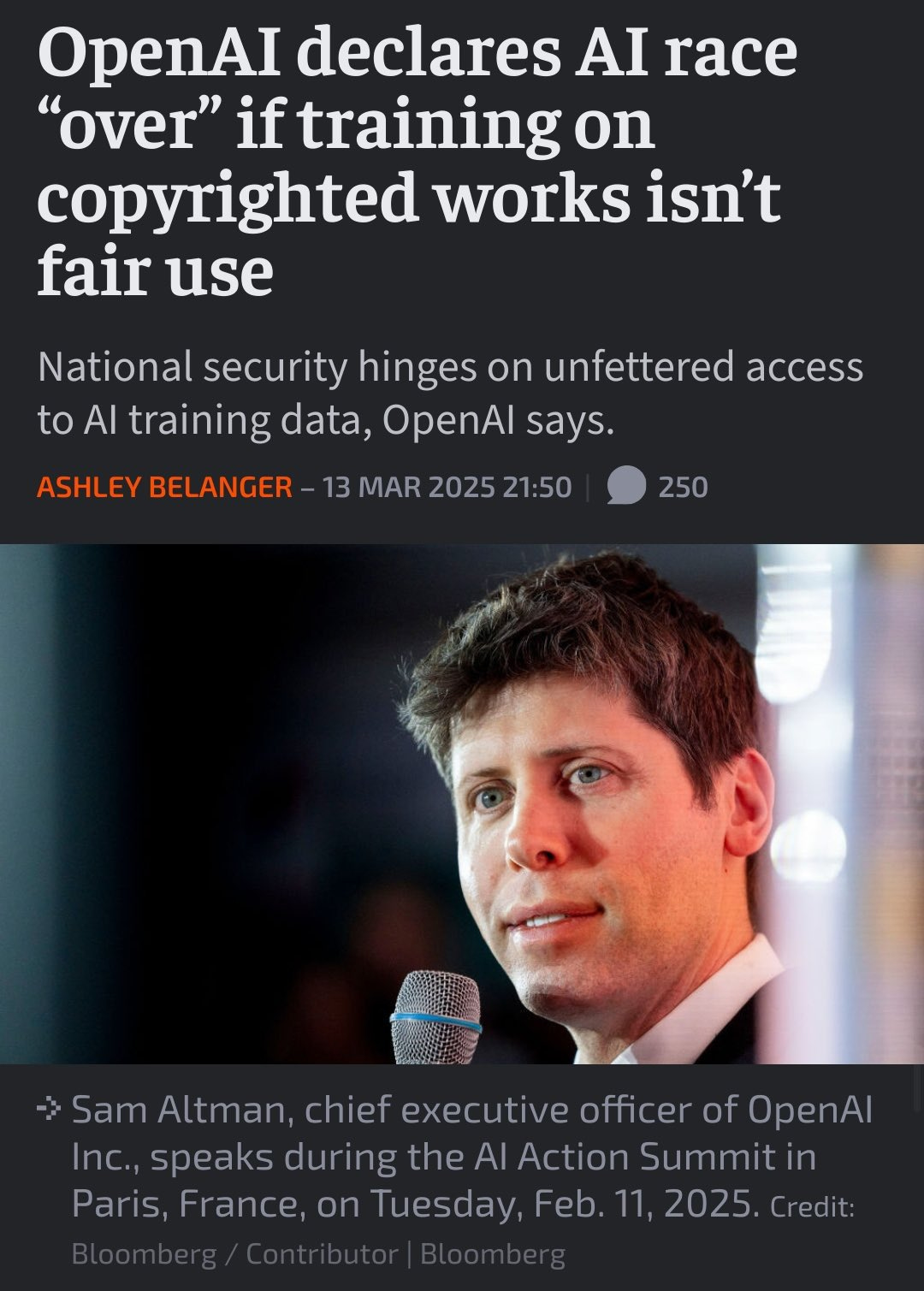
For copyright they proclaim the need for ‘freedom to learn’ and asserts that AI training is fully fair use and immune from copyright. I think this is a defensible position, and myself support mandatory licensing similar to radio for music, in a way that compensates creators. I think the position here is defensible. But the rhetoric?

They all but declare that if we don’t apply fair use, the authoritarians will conquer us.

If the PRC’s developers have unfettered access to data and American companies are left without fair use access, the race for AI is effectively over. America loses, as does the success of democratic AI.

It amazes me they wrote that with a straight face. Everything is power laws. Suggesting that depriving American labs of some percentage of data inputs, even if that were to happen and the labs were to honor those restrictions (which I very much do not believe they have typically been doing), would mean ‘the race is effectively over’ is patently absurd. They know that better than anyone. Have they no shame? Are they intentionally trying to tell us that they have no shame? Why?

This document is written in a way that seems almost designed to make one vomit. This is vice signaling. As I have said before, and with OpenAI documents this has happened before, when that happens, I think it is important to notice it!

I don’t think the inducing of vomit is a coincidence. They chose to write it this way. They want people to see that they are touting disingenuous jingoistic propaganda in a way that seems suspiciously corrupt. Why would they want to signal that? You tell me.

You don’t publish something like this unless you actively want headlines like this:

Evan Morrison: Altman translated – if you don’t give Open AI free access to steal all copyrighted material by writers, musicians and filmmakers without legal repercussions then we will lose the AI race with China – a communist nation which nonetheless protects the copyright of individuals.

There are other similar and similarly motivated claims throughout.

The claim that China can circumvent some regulatory restrictions present in America is true enough, and yes that constitutes an advantage that could be critical if we do EU-style things, but the way they frame it goes beyond hyperbolic. Every industry, everywhere, would like to say ‘any requirements you place upon me make our lives harder and helps our competitors, so you need to place no restrictions on us of any kind.’

Then there’s a mix of proposals, some of which are good, presented reasonably:

Their proposal for a ‘National Transmission Highway Act’ on par with the 1956 National Interstate and Defense Highways Act seems like it should be overkill, but our regulations in these areas are deeply fed, so if as they suggest here it is focused purely on approvals I am all for that one. They also want piles of government money.

Similarly their idea of AI ‘Opportunity Zones’ is great if it only includes sidestepping permitting and various regulations. The tax incentives or ‘credit enhancements’ I see as an unnecessary handout, private industry is happy to make these investments if we clear the way.

The exception is semiconductor manufacturing, where we do need to provide the right incentives, so we will need to pay up.

Note that OpenAI emphasizes the need for solar and wind projects on top of other energy sources.

Digitization of government data currently in analog form is a great idea, we should do it for many overdetermined reasons. But to point out the obvious, are we then going to hide that data from PRC? It’s not an advantage to American AI companies if everyone gets equal access.

The Compact for AI proposal is vague but directionally seems good.

Their ‘national AI Readiness Strategy’ is part of a long line of ‘retraining’ style government initiatives that, frankly, don’t work, and also aren’t necessary here. I’m fine with expanding 529 savings plans to cover AI supply chain-related training programs, I mean sure why not, but don’t try to do much more than that. The private sector is far better equipped to handle this one, especially with AI help.

I don’t get the ‘creating AI research labs’ strategy here, it seems to be a tax on AI companies payable to universities? This doesn’t actually make economic sense at all.

The section on Government Adaptation of AI is conceptually fine, but the emphasis on private-public partnerships is telling.

Some others are even hasher than I was. Andrew Curran has similar even blunter thoughts on both of the DeepSeek and fair use rhetorical moves.

Alexander Doria: The main reason OpenAI is calling to reinforce fair use for model training: their new models directly compete with writers, journalists, wikipedia editors. We have deep research (a “wikipedia killer”, ditto Noam Brown) and now the creative writing model.

The fundamental doctrine behind the google books transformative exception: you don’t impede on the normal commercialization of the work used. No longer really the case…

We have models trained exclusively on open data.

Gallabytes (on the attempt to ban Chinese AI models): longshoremen level scummy move. @OpenAI this is disgraceful.

As we should have learned many times in the past, most famously with the Jones Act, banning the competition is not The Way. You don’t help your industry compete, you instead risk destroying your industry’s ability to compete.

This week, we saw for example that Saudi Aramco chief says DeepSeek AI makes ‘big difference’ to operations. The correct response is to say, hey, have you tried Claude and ChatGPT, or if you need open models have you tried Gemma? Let’s turn that into a reasoning model for you.

The response that says you’re ngmi? Trying to ban DeepSeek, or saying if you don’t get exemptions from laws then ‘the race is over.’

From Peter Wildeford, seems about right:

The best steelman of OpenAI’s response I’ve seen comes from John Pressman. His argument is, yes there is cringe here – he chooses to focus here on a line about DeepSeek’s willingness to do a variety of illicit activities and a claim that this reflects CCP’s view of violating American IP law. Which is certainly another cringy line. But, he points out, the Trump administration asked how America can get ahead and stay ahead in AI, so in that context why shouldn’t OpenAI respond with a jingoistic move towards regulatory capture and a free pass to do as they want?

And yes, there is that, although his comments also reinforce that the price in ‘gesture towards open model support’ for some people to cheer untold other horrors is remarkably cheap.

This letter is part of a recurring pattern in OpenAI’s public communications.

OpenAI have issued some very good documents on the alignment and technical fronts, including their model spec and statement on alignment philosophy, as well as their recent paper on The Most Forbidden Technique. They have been welcoming of detailed feedback on those fronts. In these places they are being thoughtful and transparent, and doing some good work, and I have updated positively. OpenAI’s actual model deployment decisions have mostly been fine in practice, with some troubling signs such as the attempt to pretend GPT-4.5 was not a frontier model.

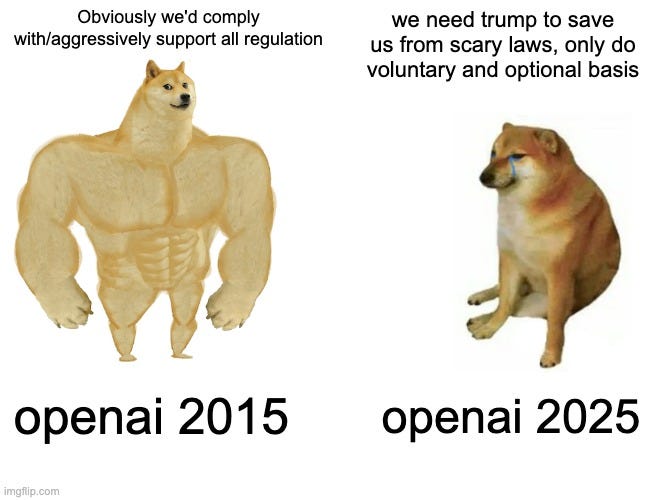
Alas, their public relations and lobbying departments, and Altman’s public statements in various places, have been consistently terrible and getting even worse over time, to the point of being consistent and rather blatant vice signaling. OpenAI is intentionally presenting themselves as disingenuous jingoistic villains, seeking out active regulatory protections, doing their best to kill attempts to keep models secure, and attempting various forms of government subsidy and regulatory capture.

I get why they would think it is strategically wise to present themselves in this way, to appeal to both the current government and to investors, especially in the wake of recent ‘vibe shifts.’ So I get why one could be tempted to say, oh, they don’t actually believe any of this, they’re only being strategic, obviously not enough people will penalize them for it so they need to do it, and thus you shouldn’t penalize them for it either, that would only be spite.

I disagree. When people tell you who they are, you should believe them.

Discussion about this post

OpenAI #11: America Action Plan Read More »

report:-mrna-vaccines-are-in-rfk-jr’s-crosshairs;-funding-in-question

Report: mRNA vaccines are in RFK Jr’s crosshairs; funding in question

Ars Technica has reached out to the NIH and HHS for comment and will update this story with any new information provided. The agencies did not respond to comment requests from KFF.

Kennedy’s misinformation

Before becoming the top health official in America, Kennedy had long railed against vaccines, becoming one of the world’s most prominent anti-vaccine advocates and most prolific spreaders of misinformation and disinformation about vaccines. A 2019 study found Kennedy was the single leading source of anti-vaccine ads on Facebook. Kennedy subsequently faced bans from YouTube, Facebook, and Instagram for spreading misinformation.

Researchers directly blame Kennedy and the Trump administration for the attack on vaccine research.

“Kennedy’s war on vaccines has started,” the mRNA vaccine researcher in Philadelphia told KFF.

“There will not be any research funded by NIH on mRNA vaccines,” the scientist in New York similar told the outlet. “MAGA people are convinced that these vaccines have killed and maimed tens of thousands of people. It’s not true, but they believe that.”

Kennedy has made various statements against vaccines generally, as well as mRNA vaccines specifically. He falsely claimed the vaccine causes severe harms, including causing neurodegenerative diseases, such as Parkinson’s. In 2021, during the height of the pandemic, Kennedy petitioned the Food and Drug Administration to revoke the authorization of COVID-19 vaccines and refrain from approving any future COVID-19 vaccines. A study in 2022, meanwhile, estimated that the vaccines had saved more than 3 million lives and prevented more than 18 million hospitalizations.

The NIH’s recent moves aren’t the first sign that Kennedy will use his powerful position to attack mRNA vaccines. Late last month, Bloomberg reported that HHS was considering canceling a $590 million grant to vaccine maker Moderna to develop mRNA vaccines against potential pandemic influenza viruses. That includes the H5N1 virus that is currently devastating US poultry and spreading wildly in dairy cows.

An HHS spokesperson told media at the time that “While it is crucial that the US Department and Health and Human Services support pandemic preparedness, four years of the Biden administration’s failed oversight have made it necessary to review agreements for vaccine production.”

It remains unclear what is happening with that grant review. Moderna declined to comment when Ars reached out for any potential updates Monday.

Report: mRNA vaccines are in RFK Jr’s crosshairs; funding in question Read More »

windows-11-updates-are-accidentally-getting-rid-of-copilot,-at-least-for-now

Windows 11 updates are accidentally getting rid of Copilot, at least for now

Microsoft’s Windows updates over the last couple of years have mostly been focused on adding generative AI features to the operating system, including multiple versions of the Copilot assistant. Copilot has made it into Windows 11 (and even, to a more limited extent, the aging Windows 10) as a native app, and then a wrapper around a web app, and soon as a native app again.

But this month’s Windows updates are removing the Copilot app from some Windows 11 PCs and unpinning it from the taskbar, according to this Microsoft support document. This bug obviously won’t affect systems where Copilot had already been uninstalled, but it has already led to confusion among some Windows users.

Microsoft says it is “working on a resolution to address the issue” but that users who want to get Copilot back can reinstall the app from the Microsoft Store and repin it to the taskbar, the same process you use to install Copilot on PCs where it has been removed.

Though some version of Copilot has been included in fresh Windows 11 installs since mid-2023, and Microsoft even added a Copilot key into the standard Windows keyboard in early 2024, Copilot’s appearance and capabilities have shifted multiple times since then.

Windows 11 updates are accidentally getting rid of Copilot, at least for now Read More »

why-wait?-google-is-already-dismantling-assistant-as-it-switches-to-gemini.

Why wait? Google is already dismantling Assistant as it switches to Gemini.

Google Assistant is not long for this world. Google confirmed what many suspected last week, that it will transition everyone to Gemini in 2025. Assistant holdouts may find it hard to stay on Google’s old system until the end, though. Google has confirmed some popular Assistant features are being removed in the coming weeks. You may not miss all of them, but others could force a change to your daily routine.

As Google has increasingly become totally consumed by Gemini, it was a foregone conclusion that Assistant would get the ax eventually. In 2024, Google removed features like media alarms and voice messages, but that was just the start. The full list of removals is still available on its support page (spotted by 9to5Google), but there’s now a new batch of features at the top. Here’s a rundown of what’s on the chopping block.

  • Favorite, share, and ask where and when your photos were taken with your voice
  • Change photo frame settings or ambient screen settings with your voice
  • Translate your live conversation with someone who doesn’t speak your language with interpreter mode
  • Get birthday reminder notifications as part of Routines
  • Ask to schedule or hear previously scheduled Family Bell announcements
  • Get daily updates from your Assistant, like “send me the weather everyday”
  • Use Google Assistant on car accessories that have a Bluetooth connection or AUX plug

Some of these are no great loss—you’ll probably live without the ability to get automatic birthday reminders or change smart display screensavers by voice. However, others are popular features that Google has promoted aggressively. For example, interpreter mode made a splash in 2019 and has been offering real-time translations ever since; Assistant can only translate a single phrase now. Many folks also use the scheduled updates in Assistant as part of their morning routine. Family Bell is much beloved, too, allowing Assistant to make custom announcements and interactive checklists, which can be handy for getting kids going in the morning. Attempting to trigger some of these features will offer a warning that they will go away soon.

Why wait? Google is already dismantling Assistant as it switches to Gemini. Read More »

large-enterprises-scramble-after-supply-chain-attack-spills-their-secrets

Large enterprises scramble after supply-chain attack spills their secrets

Open-source software used by more than 23,000 organizations, some of them in large enterprises, was compromised with credential-stealing code after attackers gained unauthorized access to a maintainer account, in the latest open-source supply-chain attack to roil the Internet.

The corrupted package, tj-actions/changed-files, is part of tj-actions, a collection of files that’s used by more than 23,000 organizations. Tj-actions is one of many Github Actions, a form of platform for streamlining software available on the open-source developer platform. Actions are a core means of implementing what’s known as CI/CD, short for Continuous Integration and Continuous Deployment (or Continuous Delivery).

Scraping server memory at scale

On Friday or earlier, the source code for all versions of tj-actions/changed-files received unauthorized updates that changed the “tags” developers use to reference specific code versions. The tags pointed to a publicly available file that copies the internal memory of severs running it, searches for credentials, and writes them to a log. In the aftermath, many publicly accessible repositories running tj-actions ended up displaying their most sensitive credentials in logs anyone could view.

“The scary part of actions is that they can often modify the source code of the repository that is using them and access any secret variables associated with a workflow,” HD Moore, founder and CEO of runZero and an expert in open-source security, said in an interview. “The most paranoid use of actions is to audit all of the source code, then pin the specific commit hash instead of the tag into the … the workflow, but this is a hassle.”

Large enterprises scramble after supply-chain attack spills their secrets Read More »