Author name: Rejus Almole

measles-quickly-spreading-in-kansas-counties-with-alarmingly-low-vaccination

Measles quickly spreading in Kansas counties with alarmingly low vaccination

The cases in Kansas are likely part of the mushrooming outbreak that began in West Texas in late January. On March 13, Kansas reported a single measles case, the first the state had seen since 2018. The nine cases reported last week had ties to that original case.

Spreading infections and misinformation

On Wednesday, KDHE Communications Director Jill Bronaugh told Ars Technica over email that the department has found a genetic link between the first Kansas case and the cases in West Texas, which has similarly spread swiftly in under-vaccinated communities and also spilled over to New Mexico and Oklahoma.

“While genetic sequencing of the first Kansas case reported is consistent with an epidemiological link to the Texas and New Mexico outbreaks, the source of exposure is still unknown,” Bronaugh told Ars.

Bronaugh added that KDHE, along with local health departments, is continuing to work to track down people who may have been exposed to measles in affected counties.

In Texas, meanwhile, the latest outbreak count has hit 327 across 15 counties, mostly children and almost entirely unvaccinated. Forty cases have been hospitalized, and one death has been reported—a 6-year-old unvaccinated girl who had no underlying health conditions.

On Tuesday, The New York Times reported that as measles continues to spread, parents have continued to eschew vaccines and instead embraced “alternative” treatments, including vitamin A, which has been touted by anti-vaccine advocate and current US Health Secretary Robert F. Kennedy Jr. Vitamin A accumulates in the body and can be toxic with large doses or extended use. Texas doctors told the Times that they’ve now treated a handful of unvaccinated children who had been given so much vitamin A that they had signs of liver damage.

“I had a patient that was only sick a couple of days, four or five days, but had been taking it for like three weeks,” one doctor told the Times.

In New Mexico, cases are up to 43, with two hospitalizations and one death in an unvaccinated adult who did not seek medical care. In Oklahoma, officials have identified nine cases, with no hospitalizations or deaths so far.

Measles quickly spreading in Kansas counties with alarmingly low vaccination Read More »
esa-finally-has-a-commercial-launch-strategy,-but-will-member-states-pay?

ESA finally has a commercial launch strategy, but will member states pay?


Late this year, European governments will have the opportunity to pay up or shut up.

The European Space Agency is inviting proposals to inject competition into the European launch market, an important step toward fostering a dynamic multiplayer industry officials hope, one day, will mimic that of the United States.

The near-term plan for the European Launcher Challenge is for ESA to select companies for service contracts to transport ESA and other European government payloads to orbit from 2026 through 2030. A second component of the challenge is for companies to perform at least one demonstration of an upgraded launch vehicle by 2028. The competition is open to any European company working in the launch business.

“What we expect is that these companies will make a step in improving and upgrading their capacity with respect to what they’re presently working,” said Toni Tolker-Nielsen, ESA’s acting director of space transportation.”In terms of economics and physics, it’s better to have a bigger launcher than a smaller launcher in terms of price per kilogram to orbit.”

“The ultimate goal is we should be establishing privately-developed competitive launch services in Europe, which will allow us to procure launch services in open competition,” Tolker-Nielsen said in an interview with Ars.

From one to many?

ESA and other European institutions currently have just one European provider, Arianespace, to award launch contracts for the continent’s scientific, Earth observation, navigation, and military satellites. Arianespace operates the Ariane 6 and Vega C rockets. Vega C operations will soon be taken over by the Italian aerospace company Avio. Both rockets were developed with ESA funding.

The launcher challenge is modeled on NASA’s use of commercial contracting methods beginning nearly 20 years ago with the agency’s commercial cargo program, which kickstarted the development of SpaceX’s Dragon and Northrop Grumman’s Cygnus resupply freighters for the International Space Station. NASA later applied the same model to commercial crew, and most recently for commercial lunar landers.

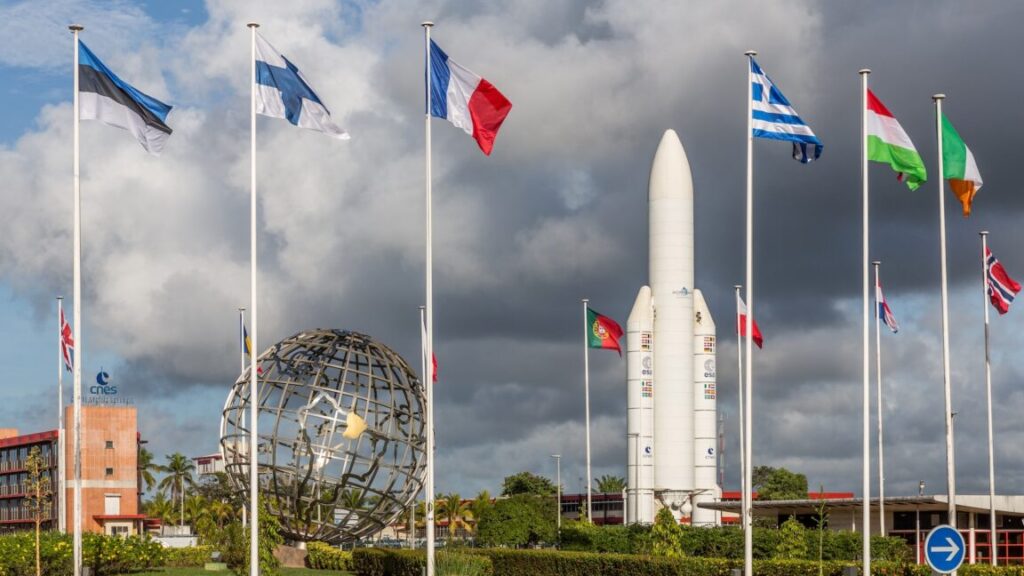
Uncharacteristically for ESA, the agency is taking a hands-off approach for the launcher challenge. One of the few major requirements is that the winners should offer a “European launch service” that flies from European territory, which includes the French-run Guiana Space Center in South America.

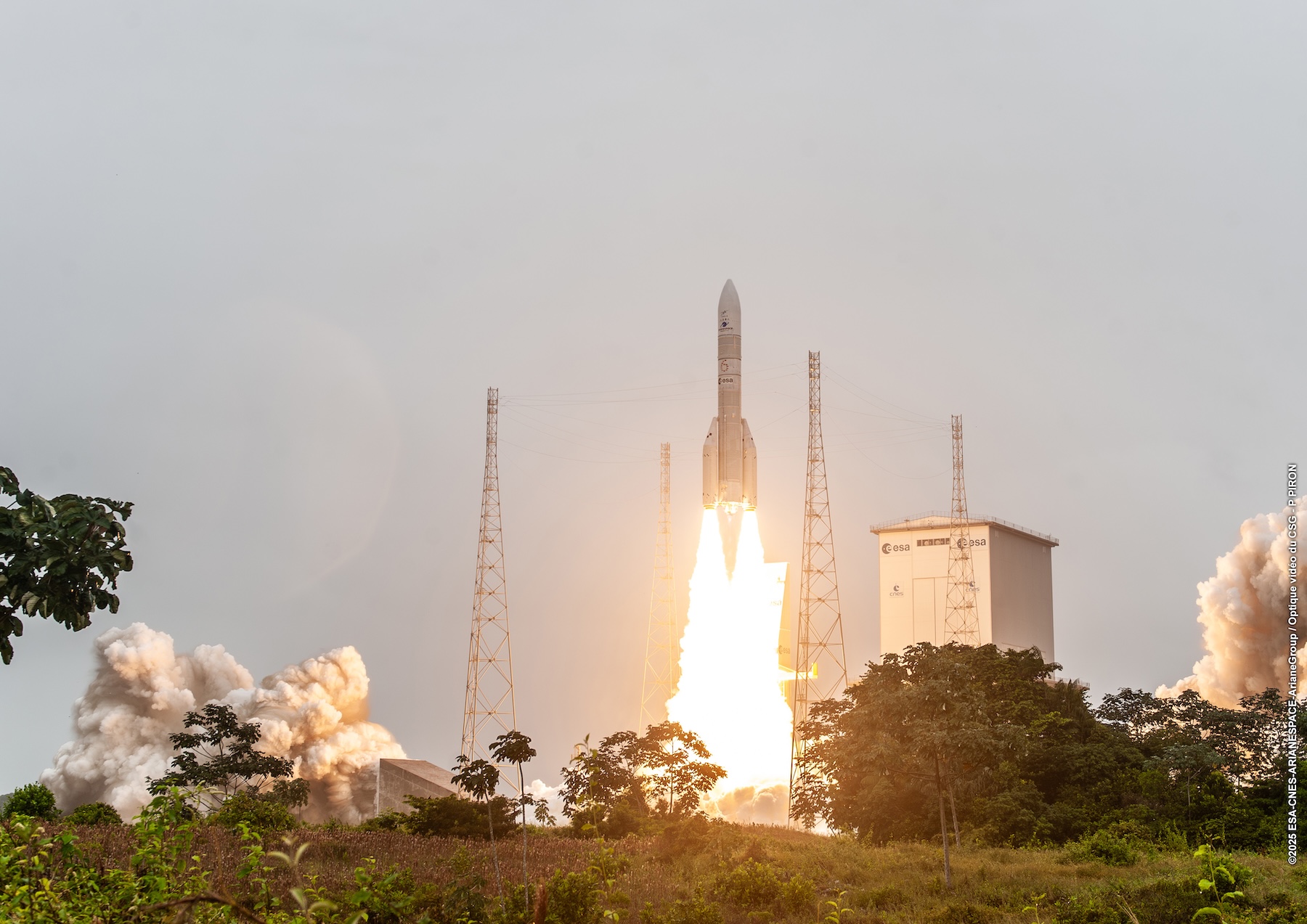
Europe’s second Ariane 6 rocket lifted off March 6 with a French military spy satellite. Credit: European Space Agency

“We are trying something different, where they are completely free to organize themselves,” Tolker-Nielsen said. “We are not pushing anything. We are in a complete service-oriented model here. That’s the principal difference between the new approach and the old approach.”

ESA also isn’t setting requirements on launcher performance, reusability, or the exact number of companies it will select in the challenge. But ESA would like to limit the number of challengers “to a minimum” to ensure the agency’s support is meaningful, without spreading its funding too thin, Tolker-Nielsen said.

“For the ESA-developed launchers, which are Ariane 6 and Vega C, we own the launch system,” Tolker-Nielsen said. “We finished the development, and the deliverables were the launch systems that we own at ESA, and we make it available to an operator—Arianespace, and Avio soon for Vega C—to exploit.”

These ESA-led launcher projects were expensive. The development of Ariane 6 cost European governments more than $4 billion. Ariane 6 is now flying, but none of the up-and-coming European alternatives are operational.

Next steps

It’s taken a while to set up the European Launcher Challenge, which won preliminary approval from ESA’s 23 member states at a ministerial-level meeting in 2023. ESA released an “invitation to tender” soliciting proposals from European launch companies Monday, with submissions due by May 5. This summer, ESA expects to select the top proposals and prepare a funding package for consideration by its member states at the next ministerial meeting in November.

The top factors ESA will consider in this first phase of the challenge are each proposer’s business plan, technical credibility, and financial credibility.

In a statement, ESA said it has allotted up to 169 million euros ($182 million at today’s exchange rates) per challenger. This is significant funding for Europe’s crop of cash-hungry launch startups, each of which have raised no more than a few hundred million euros. But this allotment comes with a catch. ESA’s leaders and the winners of the launch challenge must persuade their home governments to pay up.

Let’s take a moment to compare Europe’s launch industry with the United States.

There are multiple viable US commercial launch companies. In the United States, it’s easier to attract venture capital, the government has been a more reliable proponent of commercial spaceflight, and billionaires are part of the launch landscape. SpaceX, led by Elon Musk, dominates the market. Jeff Bezos’s space company, Blue Origin, and United Launch Alliance are also big players with heavy-lift rockets.

Rocket Lab and Firefly Aerospace fly smaller privately-developed launchers. Northrop Grumman’s medium-class launch division is currently in between rockets, although it still occasionally launches small US military satellites on Minotaur rockets derived from decommissioned ICBMs.

Of course, it’s not surprising the sum of US launch companies is higher than in Europe. According to the World Bank, the US economy is about 50 percent larger than that of the European Union. But six American companies with operational orbital rockets, compared to one in Europe today? That is woefully out of proportion.

Carlos Mazón, president of autonomous community of Valencia in Spain, visits the facilities of PLD Space in January. PLD Space is one of the European launch startups that might contend in the European Launcher Challenge. Credit: Joaquin Reina/Europa Press via Getty Images

European officials would like to regain a leading position in the global commercial launch market. With SpaceX’s dominance, that’s a tall hill to climb. At the very least, European politicians don’t want to rely on other countries for access to space. In the last three years, they’ve seen their access to Russian launchers dry up after Russia’s invasion of Ukraine, and after signing a few launch contracts with SpaceX to bridge the gap before the first flight of Ariane 6, they now view the US government and Elon Musk as unreliable partners.

Open your checkbook, please

ESA’s governance structure isn’t favorable for taking quick action. On one hand, ESA member states approve the agency’s budget in multiyear increments, giving its projects a sense of stability over time. However, it takes time to get new projects approved, and ESA’s member states expect to receive benefits—jobs, investment, and infrastructure—commensurate with their spending on European space programs. This policy is known as geographical return, or geo-return.

For example, France has placed a high strategic importance on fielding an independent European launch capability for more than 60 years. The administration of French President Charles de Gaulle made this determination during the Cold War, around the same time he decided France should have a nuclear deterrent fully independent of the United States and NATO.

In order to match this policy, France has been more willing than other European nations to invest in launchers. This means the Ariane rocket family, developed and funded through ESA contracts, has been largely a French enterprise since the first Ariane launch in 1979.

This model is becoming antiquated in the era of commercial spaceflight. Startups across Europe, primarily in France, Germany, the United Kingdom, and Spain, are developing small launchers designed to carry up to 1.5 metric tons of payload to low-Earth orbit. This is too small to directly compete with the Ariane 6 rocket, but eventually, these companies would like to develop larger launchers.

Some European officials, including the former head of the French space agency, blamed geo-return as a reason the Ariane 6 rocket missed its price target.

Toni Tolker-Nielsen, ESA’s acting director of space transportation, speaks at an event in 2021. Credit: ESA/V. Stefanelli

With the European Launcher Challenge, ESA will experiment with a new funding model for the first time. This new “fair contribution” approach will see ESA leadership put forward a plan to its member states at the next big ministerial conference in November. The space agency will ask the countries that benefit most from the winners of the launcher challenge to provide the bulk of the funding for the challengers’ contracts.

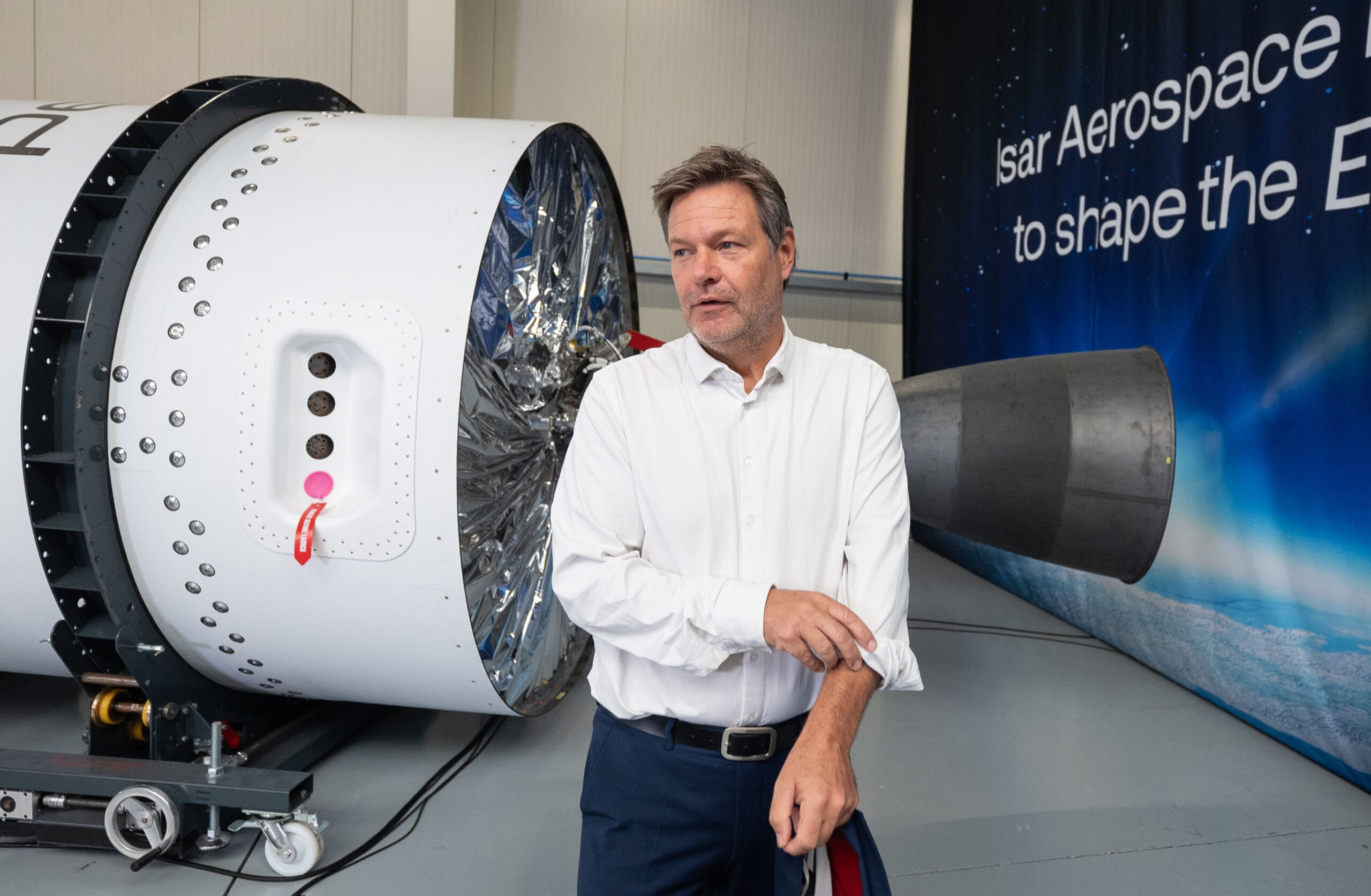
So, let’s say Isar Aerospace, which is set to launch its first rocket as soon as this week, is one of the challenge winners. Isar is headquartered in Munich, and its current launch site is in Norway. In this case, expect ESA to ask the governments of Germany and Norway to contribute the most money to pay for Isar’s contract.

MaiaSpace, a French subsidiary of ArianeGroup, the parent company of Arianespace, is also a contender in the launcher challenge. MaiaSpace plans to launch from French Guiana. Therefore, if MaiaSpace gets a contract, France would be on the hook for the lion’s share of the deal’s funding.

Tolker-Nielsen said he anticipates a “number” of the launch challengers will win the backing of their home countries in November, but “maybe not all.”

“So, first there is this criteria that they have to be eligible, and then they have to be funded as well,” he said. “We don’t want to propose funding for companies that we don’t see as credible.”

Assuming the challengers’ contracts get funded, ESA will then work with the European Commission to assign specific satellites to launch on the new commercial rockets.

“The way I look at this is we are not going to choose winners,” Tolker-Nielsen said. “The challenge is not the competition we are doing right now. It is to deliver on the contract. That’s the challenge.”

Photo of Stephen Clark

Stephen Clark is a space reporter at Ars Technica, covering private space companies and the world’s space agencies. Stephen writes about the nexus of technology, science, policy, and business on and off the planet.

ESA finally has a commercial launch strategy, but will member states pay? Read More »

fbi-probes-arson-of-tesla-cars-and-facilities,-says-“this-is-domestic-terrorism”

FBI probes arson of Tesla cars and facilities, says “this is domestic terrorism”

Anarchist blog in FBI’s reading list

The New York Post report said the anarchist blog being eyed by the FBI is run out of Salt Lake City, Utah. “In addition, the FBI identified the site Dogeque.st that has information [for] doxxing Tesla employees and locations across the country and [is] being run out of the African country of Sao Tome,” the news report said.

A Democratic congressman criticized the FBI’s decision to create a task force on Tesla-related crime.

“This is the political weaponization of the DOJ,” wrote US Rep. Dan Goldman (D-N.Y.), who previously served as lead counsel in Trump’s first impeachment trial. “Trump uses his official authority to defend his benefactor Elon Musk. The FBI then creates a task force to use our law enforcement to ‘crack down’ on adversaries of Musk’s.”

“Tesla Takedown” calls for peaceful protest

The New York Post report said the FBI is also “tracking a mass protest called ‘Tesla Takedown’ scheduled for March 29 calling for 500 demonstrations at Tesla showrooms and charging stations.” The group behind the protest is calling for peaceful demonstrations and said it opposes vandalism and violence.

A Tesla Takedown website says the planned demonstrations are part of the group’s “peaceful protest movement. We oppose violence, vandalism and destruction of property.” Tesla Takedown says that “Elon Musk is destroying our democracy, and he’s using the fortune he built at Tesla to do it” and urges people to sell their Teslas, dump their Tesla stock, and join the demonstrations.

CNBC quoted a Tesla Takedown spokesperson as saying that the “movement has been and always will be nonviolent. They want to scare us away from protesting Musk’s destruction—but standing up for free speech is essential to democracy. We will not be deterred.”

Three arrests

US Attorney General Pamela Bondi last week issued a statement highlighting three arrests of suspected arsonists. Each defendant faces five to 20 years in prison if convicted. One defendant threw “approximately eight Molotov cocktails at a Tesla dealership located in Salem, Oregon,” another tried to light Tesla cars on fire with Molotov cocktails in Colorado, and a third in South Carolina “wrote profane messages against President Trump around Tesla charging stations before lighting the charging stations on fire with Molotov cocktails,” the press release said.

“The days of committing crimes without consequence have ended,” Bondi said. “Let this be a warning: if you join this wave of domestic terrorism against Tesla properties, the Department of Justice will put you behind bars.”

FBI probes arson of Tesla cars and facilities, says “this is domestic terrorism” Read More »

oops:-google-says-it-might-have-deleted-your-maps-timeline-data

Oops: Google says it might have deleted your Maps Timeline data

The Google Maps Timeline has long been a useful though slightly uncomfortable feature that maintains a complete record of everywhere your phone goes (and probably you with it). Google recently changed the way it stored timeline data to improve privacy, but the company now confirms that a “technical issue” resulted in many users losing their timeline history altogether, and there might not be any way to recover it.

Timeline, previously known as Location History, is very useful if you need to figure out where you were on a particular day or if you just can’t remember where you found that neat bar on your last vacation. Many Google users grew quite fond of having access to that data. However, Google had access to it, too. Starting in 2024, Google transitioned to storing Timeline data only on the user’s individual smartphone instead of backing it up to the cloud. You can probably see where this is going.

Users started piping up over the past several weeks, posting on the Google support forums, Reddit, and other social media that their treasured Timeline data had gone missing. Google has been investigating the problem, and the news isn’t good. In an email sent out over the weekend, Google confirmed what many already feared: Maps has accidentally deleted Timeline data on countless devices.

A Google spokesperson confirmed this is the result of a technical issue and not user error or an intentional change. It’s unclear how this happened, but we’d wager on a botched Maps update. Google usually rolls out updates in waves, and it’s possible that the defective build in this case made it to a large number of devices before it was stopped.

You have exactly one possible fix for this issue, but only if you planned ahead. When Google began the full change-over to local storage of Timeline data, it added several settings to control the feature. While the data is stored locally by default, you have the option of creating encrypted backups in the cloud. If you did that, you should be able to restore the data.

Oops: Google says it might have deleted your Maps Timeline data Read More »

this-launcher-is-about-to-displace-the-v-2-as-germany’s-largest-rocket

This launcher is about to displace the V-2 as Germany’s largest rocket


Isar Aerospace’s first Spectrum rocket will launch from Andøya Spaceport in Norway.

Seven years ago, three classmates at the Technical University of Munich believed their student engineering project might hold some promise in the private sector.

At the time, one of the co-founders, Daniel Metzler, led a team of 40 students working on rocket engines and launching sounding rockets. Josef Fleischmann was on the team that won the first SpaceX Hyperloop competition. Together with another classmate, Markus Brandl, they crafted rocket parts in a campus workshop before taking the leap and establishing Isar Aerospace, named for the river running through the Bavarian capital.

Now, Isar’s big moment has arrived. The company’s orbital-class first rocket, named Spectrum, is set to lift off from a shoreline launch pad in Norway as soon as Monday.

The three-hour launch window opens at 12: 30 pm local time in Norway, or 7: 30 am EDT in the United States. “The launch date remains subject to weather, safety and range infrastructure,” Isar said in a statement.

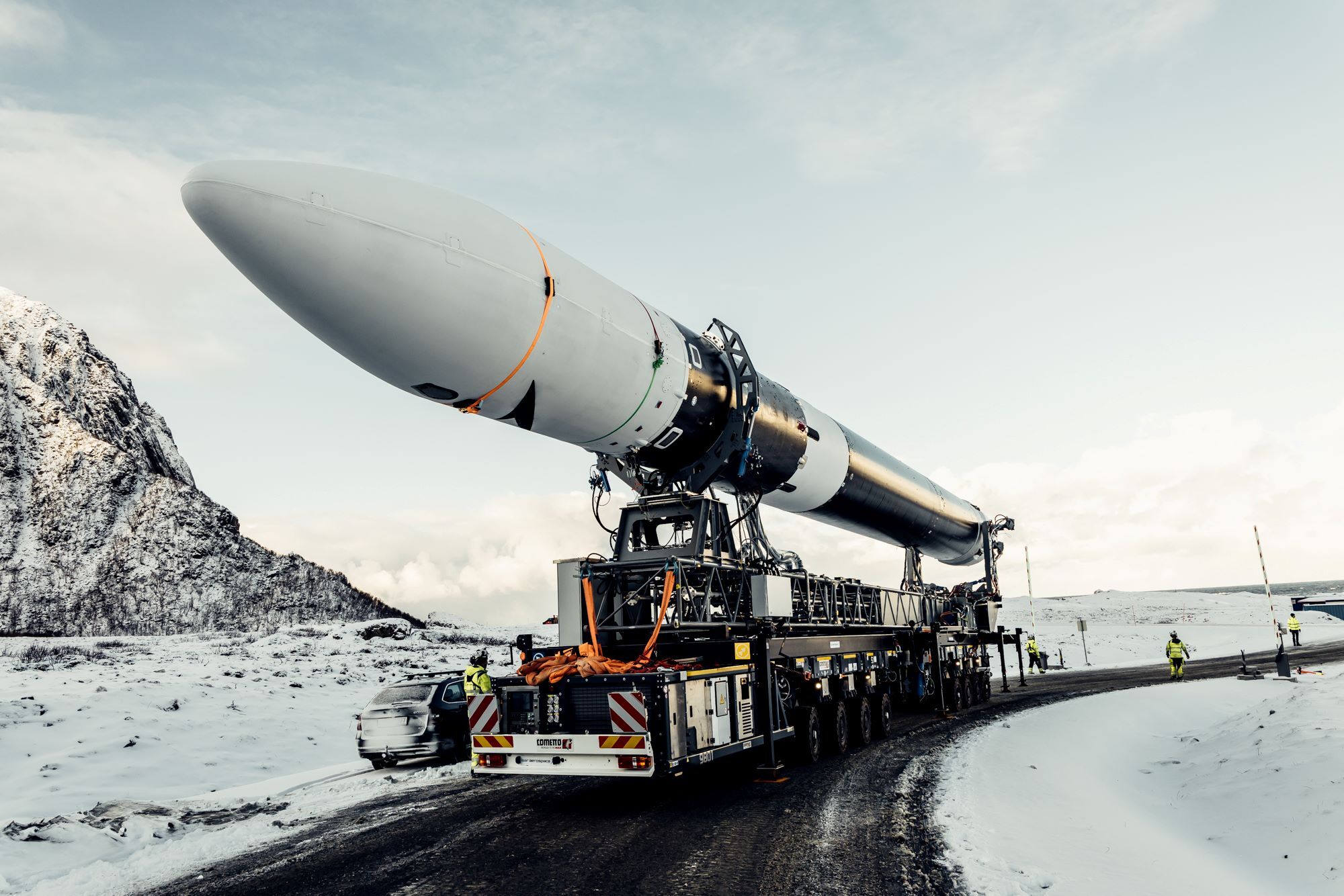
Isar’s Spectrum rocket rolls out to its launch pad in Norway. Credit: Isar Aerospace

Isar said it received a launch license from the Norwegian Civil Aviation Authority on March 14, following the final qualification test on the Spectrum rocket in February to validate its readiness for flight.

Notably, this will be the first orbital launch attempt from a launch pad in Western Europe. The French-run Guiana Space Center in South America is the primary spaceport for European rockets. Virgin Orbit staged an airborne launch attempt from an airport in the United Kingdom in 2023, and the Plesetsk Cosmodrome is located in European Russia.

No guarantees

Success is never assured on the inaugural launch of a new rocket. Isar is the first in a wave of European launch startups to arrive at this point. The company developed the Spectrum rocket with mostly private funding, although Isar received multimillion-euro investments from the European Space Agency, the German government, and the NATO Innovation Fund.

All told, Isar says it has raised more than 400 million euros, or $435 million at today’s currency exchange rate, more than any other European launch startup.

“We are approaching the most important moment of our journey so far, and I would like to thank all our team, partners, customers and investors who have been accompanying and trusting us,” said Daniel Metzler, Isar’s co-founder and CEO, in a statement.

Most privately-developed rockets have failed to reach orbit on the first try. Several US launch companies that evolved in a similar mold as Isar—such as Rocket Lab, Firefly Aerospace, and Astra—faltered on the way to orbit on their rockets’ first flights.

“With this mission, Isar Aerospace aims to collect as much data and experience as possible on its in-house developed launch vehicle. It is the first integrated test of all systems,” said Alexandre Dalloneau, Isar’s vice president of mission and launch operations.

“The test results will feed into the iterations and development of future Spectrum vehicles, which are being built and tested in parallel,” Isar said in a statement.

Look familiar? Isar Aerospace’s Spectrum rocket is powered by nine first stage engines arranged in an “octaweb” configuration patterned on SpaceX’s Falcon 9 rocket. Credit: Isar Aerospace/Wingmen Media

Europe has struggled to regain its footing after SpaceX took over the dominant position in the global commercial launch market, a segment led for three decades by Europe’s Ariane rocket family before SpaceX proved the reliability of the lower-cost, partially reusable Falcon 9 launcher. The continent’s new Ariane 6 rocket, funded by ESA and built by a consortium owned by multinational firms Airbus and Safran, is more expensive than the Falcon 9 and years behind schedule. It finally debuted last year.

One ton to LEO

Isar’s Spectrum rocket is not as powerful as the SpaceX’s Falcon 9 or Arianespace’s Ariane 6. But even SpaceX had to start somewhere. Its small Falcon 1 rocket failed three times before tasting success. Spectrum is somewhat larger and more capable than Falcon 1, with performance in line with Firefly’s Alpha rocket.

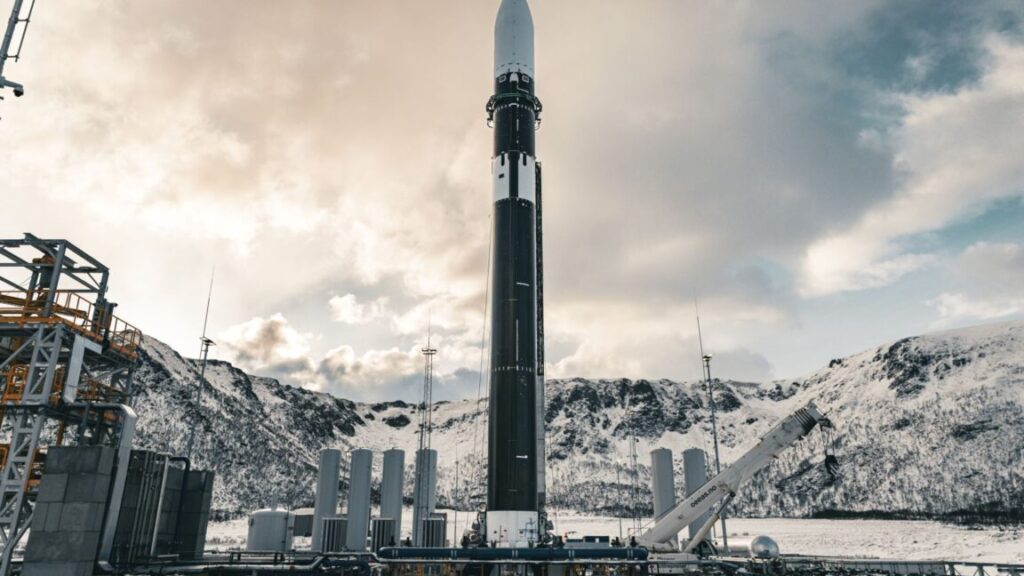
The fully assembled Spectrum rocket stands about 92 feet (28 meters) tall and measures more than 6 feet (2 meters) in diameter. The expendable launcher is designed to haul payloads up to 1 metric ton (2,200 pounds) into low-Earth orbit. Spectrum is powered by nine Aquila engines on its first stage, and one engine on the second stage, burning a mixture of propane and liquid oxygen propellants.

There are no customer satellites aboard the first Spectrum test flight. The rocket will climb into a polar orbit from Andøya Spaceport in northern Norway, but Isar hasn’t published a launch timeline or the exact parameters of the target orbit.

While modest in size next to Europe’s Ariane launcher family, Isar’s Spectrum is the largest German rocket since the V-2, the World War II weapon of terror launched by Nazi Germany against targets in Great Britain, Belgium, and other places. In the 80 years since the war, German industry developed a handful of small sounding rockets, and manufactured upper stages for Ariane rockets.

But German governments have long shunned spending on launchers at levels commensurate with the nation’s place as a top contributor to ESA. France took the lead in the continent’s postwar rocket industry, providing the lion’s share of funding for Ariane, and taking responsibility for building engines and booster stages.

Now, 80 years to the week since the last V-2 launch of World War II, Germany again has a homegrown liquid-fueled rocket on the launch pad. This time, it’s for a much different purpose.

As a first step, Isar and other companies in Europe are vying to inject competition with Arianespace into the European launch market. This will begin with small government-funded satellites that otherwise would have likely launched on rideshare flights by SpaceX or Arianespace.

In 2022, the German space agency (known as DLR) announced the selection of research and demo payloads slated to fly on Spectrum’s second launch. The Norwegian Space Agency revealed a contract earlier this month for Isar to launch a pair of satellites for the country’s Arctic Ocean Surveillance program.

Within the next few days, ESA is expected to release an “invitation to tender” for European industry to submit proposals for the European Launcher Challenge. This summer, ESA will select winners from Europe’s crop of launch startups to demonstrate their rockets can deliver the agency’s scientific satellites to orbit. This is the first time ESA has experimented with a fully commercial business model, with launch service contracts to private companies. Isar is a leading contender to win the launcher challenge, alongside other European companies like Rocket Factory Augsburg, HyImpulse, MaiaSpace, and others.

Previously, ESA has provided billions of euros to Europe’s big incumbent rocket companies for development of new generations of Ariane rockets. Now, ESA wants follow the path of NASA, which has used fixed-price service contracts to foster commercial cargo and crew transportation to the International Space Station, and most recently, privately-owned landers on the Moon.

“Whatever the outcome, Isar Aerospace’s upcoming Spectrum launch will be historic: the first commercial orbital launch from mainland Europe,” Josef Aschbacher, ESA’s director general, posted on X. “The support and co-funding the European Space Agency has given Isar Aerospace and other launch service provider startups is paying off for increased autonomy in Europe. Wishing Isar Aerospace a great launch day with fair weather and most importantly, that the data they receive from the liftoff will speed next iterations of their rockets.”

Toni Tolker-Nielsen, ESA’s acting director of space transportation, called this moment a “paradigm shift” for Europe’s launcher strategy.

“In the last 40 years, we have had these ESA-developed launchers that we have been relying on,” Tolker-Nielsen told Ars in an interview. “So we started with Ariane 1 up to Ariane 6. Vega C came onboard. And it’s been working like that for the last 40 years. Now, we are moving into in the ’30s, and the next decades, to have privately-developed launchers.”

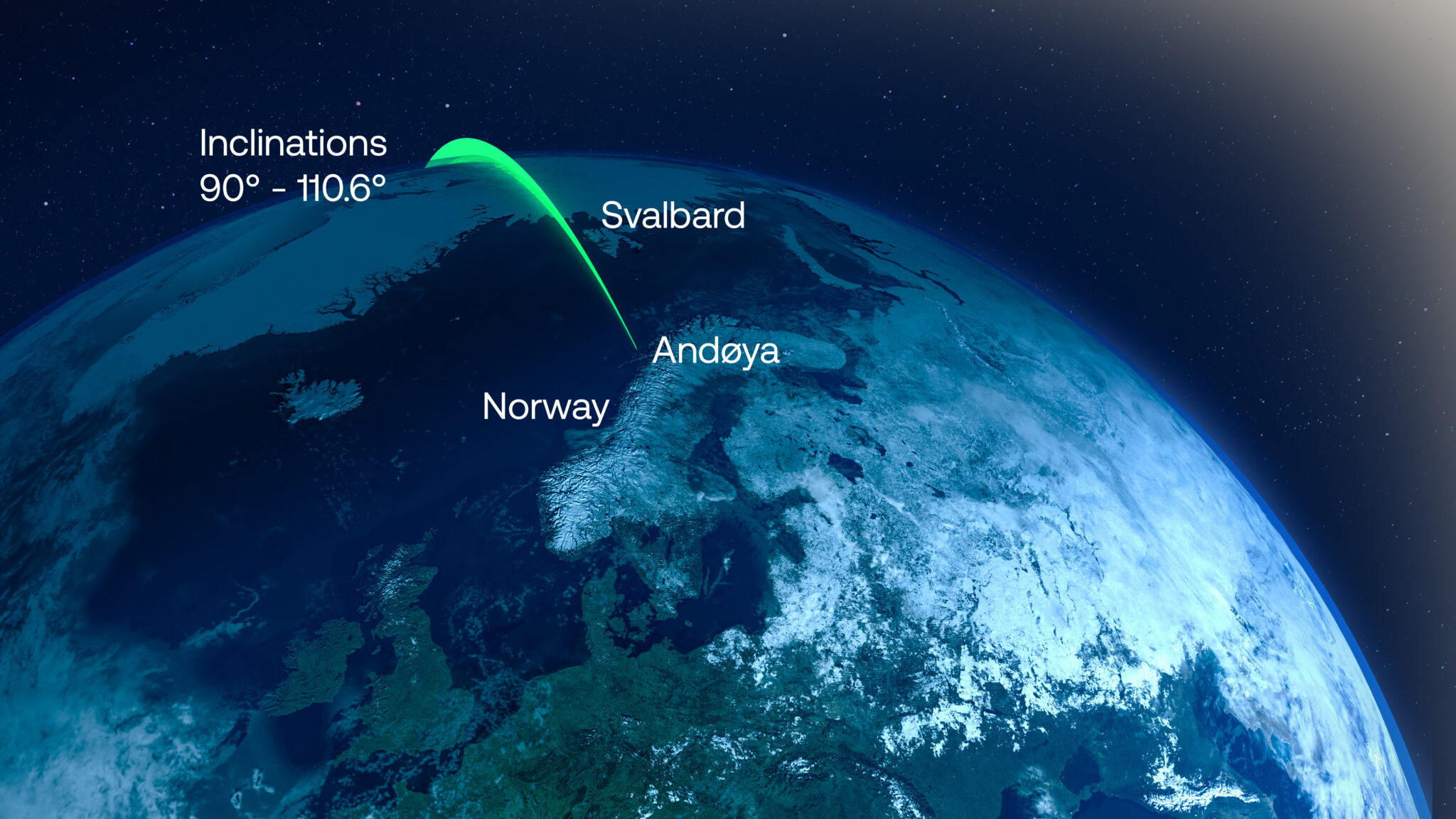
Isar Aerospace’s first Spectrum rocket will lift off from the remote Andøya Spaceport in Norway, a gorgeous location that might be the world’s most picturesque launch site. Nestled on the western coast of an island inside the Arctic Circle, Andøya offers an open path over the Norwegian Sea for rockets to fly north, where they can place satellites into polar orbit.

The spaceport is operated by Andøya Space, a company 90 percent owned by the Norwegian government through the Ministry for Trade, Industry, and Fisheries. Until now, Andøya Spaceport has been used for launches of suborbital sounding rockets.

The geography of Norway permits northerly launches from Andøya Spaceport. Credit: Andøya Space

No better time than now

Isar’s first launch comes amid an abrupt turn in European strategic policy as the continent’s leaders struggle with how to respond to moves by President Donald Trump in his first two months in office. In recent weeks, the Trump administration put European leaders on their heels with sudden policy reversals and unpredictable statements on Ukraine, NATO, and the US government’s long-term backstopping of European security.

Friedrich Merz, set to become Germany’s next chancellor, said last month that Europe should strive to “achieve independence” from the United States. “It is clear that the Americans, at least this part of the Americans, this administration, are largely indifferent to the fate of Europe.”

Last week, Merz shepherded a bill through German parliament to amend the country’s constitution, allowing for a significant increase in German defense spending. The incoming chancellor said the change is “nothing less than the first major step towards a new European defense community.”

The erosion of Europe’s trust in the Trump administration prompted rumors that the US government could trigger a “kill switch” to turn off combat capabilities of F-35 fighter jets sold to US allies. This would have previously seemed like a far-fetched conspiracy theory, but some European officials felt compelled to make statements denying the kill switch reports. Still, the recent turbulence in trans-Atlantic relations has some US allies rethinking their plans to buy more US-made fighter jets and weapons systems.

“Reliable and predictable orders should go to European manufacturers whenever possible,” Merz said.

Robert Habeck, Germany’s vice chancellor and economics minister, tours Isar Aerospace in Ottobrunn, Germany, in 2023. : German Economics Minister Robert Habeck (Bündnis 90/Die Grünen) walks past a prototype rocket during a visit to the space company Isar Aerospace. Credit: Marijan Murat/picture alliance via Getty Images

This uncertainty extends to space, where it is most apparent in the launch industry. SpaceX, founded and led by Trump ally Elon Musk, dominates the global commercial launch business. European governments have repeatedly turned to SpaceX to launch multiple defense and scientific satellites over the last several years, while Europe encountered delays with its homegrown Ariane 6 and Vega rockets.

Until 2022, Europe and Russia jointly operated Soyuz rockets from the Guiana Space Center in South America to deploy government and commercial payloads to orbit. The partnership ended with Russia’s invasion of Ukraine.

Europe’s flagship Ariane 5 rocket retired in 2023, a year before its replacement—the Ariane 6—debuted on its first test flight from the Guiana Space Center. The first operational flight of the Ariane 6 delivered a French military spy satellite to orbit March 6. The smaller Vega C rocket successfully launched in December, two years after officials grounded the vehicle due to an in-flight failure.

ESA funded development of the Ariane 6 and Vega C in partnership with ArianeGroup, a joint venture between Airbus and Safran, and the Italian defense contractor Avio.

For the moment, Europe’s launcher program is back on track to provide autonomous access to space, a capability European officials consider a strategic imperative. Philippe Baptiste, France’s minister for research and higher education, said after the Ariane 6 flight earlier this month that the launch was “proof” of European space sovereignty.

“The return of Donald Trump to the White House, with Elon Musk at his side, already has significant consequences on our research partnerships, on our commercial partnerships,” Baptiste said in his remarkably pointed prepared remarks. “If we want to maintain our independence, ensure our security, and preserve our sovereignty, we must equip ourselves with the means for strategic autonomy, and space is an essential part of this.”

The problem? Ariane 6 and Vega C are costly, lack a path to reusability, and aren’t geared to match SpaceX’s blistering launch cadence. If Europe wants autonomous access to space, European taxpayers will have to pay a premium. Isar’s Spectrum also isn’t reusable, but European officials hope competition from new startups will produce fresh launch options, and perhaps stimulate an inspired response from Europe’s entrenched launch companies.

“In today’s geopolitical climate, our first test flight is about much more than a rocket launch: Space is one of the most critical platforms for our security, resilience and technological advancement,” Metzler said. “In the next days, Isar Aerospace will lay the foundations to regain much needed independent and competitive access to space from Europe.”

Tolker-Nielsen, in charge of ESA’s space transportation division, said this is the first of many steps for Europe to develop a thriving commercial launch sector.

“This launch is a milestone, which is very important,” he said. “It’s the first conclusion of all this work, so I will be looking carefully on that. I cross my fingers that it goes well.”

Photo of Stephen Clark

Stephen Clark is a space reporter at Ars Technica, covering private space companies and the world’s space agencies. Stephen writes about the nexus of technology, science, policy, and business on and off the planet.

This launcher is about to displace the V-2 as Germany’s largest rocket Read More »

trump-administration’s-blockchain-plan-for-usaid-is-a-real-head-scratcher

Trump administration’s blockchain plan for USAID is a real head-scratcher

Giulio Coppi, a senior humanitarian officer at the nonprofit Access Now who has researched the use of blockchain in humanitarian work, says that blockchain technologies, while sometimes effective, offer no obvious advantages over other tools organizations could use, such as an existing payments system or another database tool. “There’s no proven advantage that it’s cheaper or better,” he says. “The way it’s been presented is this tech solutionist approach that has been proven over and over again to not have any substantial impact in reality.”

There have been, however, some successful instances of using blockchain technology in the humanitarian sector. In 2022, the United Nations High Commissioner for Refugees (UNHCR) ran a small pilot to give cash assistance to Ukrainians displaced by the Russia-Ukraine war in a stablecoin. Other pilots have been tested in Kenya by the Kenya Red Cross Society. The International Committee of the Red Cross, which works with the Kenya team, also helped to develop the Humanitarian Token Solution (HTS).

One representative from an NGO that uses blockchain technology, but wasn’t authorized to speak to the media with regards to issues relating to USAID, says that particularly with regards to money transfers, stablecoins can be faster and easier than other methods of reaching communities impacted by a disaster. However, “introducing new systems means you’re setting up a new burden” for the many organizations that USAID partners with, they say. “The relative cost of new systems is harder for small NGOs,” which would often include the kind of local organizations that would be at the front line of response to disasters.

The proposed adoption of blockchain technology seems related to an emphasis on exerting tight controls over aid. The memo seems, for example, to propose that funding should be contingent on outcomes, reading, “Tying payment to outcomes and results rather than inputs would ensure taxpayer dollars deliver maximum impact.” A USAID employee, who asked to remain anonymous because they were not authorized to speak to the media, says that many of USAID’s contracts already function this way, with organizations being paid after performing their work. However, that’s not possible in all situations. “Those kinds of agreements are often not flexible enough for the environments we work in,” they say, noting that in conflict or disaster zones, situations can change quickly, meaning that what an organization may be able to do or need to do can fluctuate.

Raftree says this language appears to be misleading, and bolsters claims made by Musk and the administration that USAID was corrupt. “It’s not like USAID was delivering tons of cash to people who hadn’t done things,” she says.

This story originally appeared on wired.com.

Trump administration’s blockchain plan for USAID is a real head-scratcher Read More »

sometimes,-it’s-the-little-tech-annoyances-that-sting-the-most

Sometimes, it’s the little tech annoyances that sting the most

Anyone who has suffered the indignity of a splinter, a blister, or a paper cut knows that small things can sometimes be hugely annoying. You aren’t going to die from any of these conditions, but it’s still hard to focus when, say, the back of your right foot is rubbing a new blister against the inside of your not-quite-broken-in-yet hiking boots.

I found myself in the computing version of this situation yesterday, when I was trying to work on a new Mac Mini and was brought up short by the fact that my third mouse button (that is, clicking on the scroll wheel) did nothing. This was odd, because I have for many years assigned this button to “Mission Control” on macOS—a feature that tiles every open window on your machine, making it quick and easy to switch apps. When I got the new Mini, I immediately added this to my settings. Boom!

And yet there I was, a couple hours later, clicking the middle mouse button by reflex and getting no result. This seemed quite odd—had I only imagined that I made the settings change? I made the alteration again in System Settings and went back to work.

But after a reboot later that day to install an OS update, I found that my shortcut setting for Mission Control had once again been wiped away. This wasn’t happening with any other settings changes, and it was strangely vexing.

When it happened a third time, I switched into full “research and destroy the problem” mode. One of my Ars colleagues commiserated with me, writing, “This kind of powerful-annoying stuff is just so common. I swear at least once every few months, some shortcut or whatever just stops working, and sometimes, after a week or so, it starts working again. No rhyme, reason, or apparent causality except that computers are just [unprintable expletives].”

But even if computers are [unprintable expletives], their problems have often been encountered and fixed by some other poor soul. So I turned to the Internet for help… and immediately stumbled upon an Apple discussion thread called “MacOS mouse shortcuts are reset upon restart or shutdown.” The poster—and most of those replying—said that the odd behavior had only appeared in macOS Sequoia. One reply claimed to have identified the source of the bug and offered a fix:

Sometimes, it’s the little tech annoyances that sting the most Read More »

why-anthropic’s-claude-still-hasn’t-beaten-pokemon

Why Anthropic’s Claude still hasn’t beaten Pokémon


Weeks later, Sonnet’s “reasoning” model is struggling with a game designed for children.

A game Boy Color playing Pokémon Red surrounded by the tendrils of an AI, or maybe some funky glowing wires, what do AI tendrils look like anyways

Gotta subsume ’em all into the machine consciousness! Credit: Aurich Lawson

Gotta subsume ’em all into the machine consciousness! Credit: Aurich Lawson

In recent months, the AI industry’s biggest boosters have started converging on a public expectation that we’re on the verge of “artificial general intelligence” (AGI)—virtual agents that can match or surpass “human-level” understanding and performance on most cognitive tasks.

OpenAI is quietly seeding expectations for a “PhD-level” AI agent that could operate autonomously at the level of a “high-income knowledge worker” in the near future. Elon Musk says that “we’ll have AI smarter than any one human probably” by the end of 2025. Anthropic CEO Dario Amodei thinks it might take a bit longer but similarly says it’s plausible that AI will be “better than humans at almost everything” by the end of 2027.

A few researchers at Anthropic have, over the past year, had a part-time obsession with a peculiar problem.

Can Claude play Pokémon?

A thread: pic.twitter.com/K8SkNXCxYJ

— Anthropic (@AnthropicAI) February 25, 2025

Last month, Anthropic presented its “Claude Plays Pokémon” experiment as a waypoint on the road to that predicted AGI future. It’s a project the company said shows “glimmers of AI systems that tackle challenges with increasing competence, not just through training but with generalized reasoning.” Anthropic made headlines by trumpeting how Claude 3.7 Sonnet’s “improved reasoning capabilities” let the company’s latest model make progress in the popular old-school Game Boy RPG in ways “that older models had little hope of achieving.”

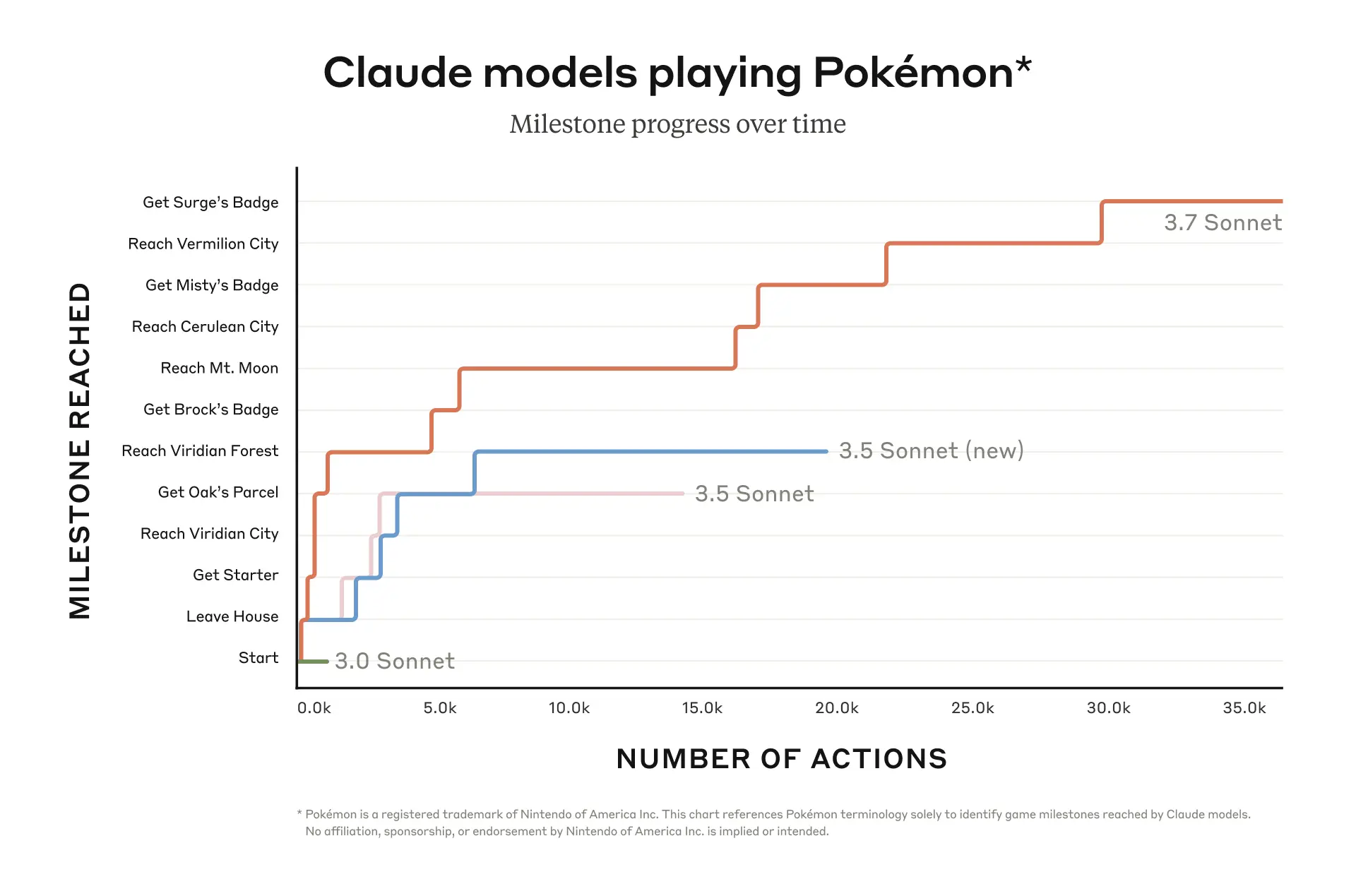
While Claude models from just a year ago struggled even to leave the game’s opening area, Claude 3.7 Sonnet was able to make progress by collecting multiple in-game Gym Badges in a relatively small number of in-game actions. That breakthrough, Anthropic wrote, was because the “extended thinking” by Claude 3.7 Sonnet means the new model “plans ahead, remembers its objectives, and adapts when initial strategies fail” in a way that its predecessors didn’t. Those things, Anthropic brags, are “critical skills for battling pixelated gym leaders. And, we posit, in solving real-world problems too.”

Over the last year, new Claude models have shown quick progress in reaching new Pokémon milestones.

Over the last year, new Claude models have shown quick progress in reaching new Pokémon milestones. Credit: Anthropic

But relative success over previous models is not the same as absolute success over the game in its entirety. In the weeks since Claude Plays Pokémon was first made public, thousands of Twitch viewers have watched Claude struggle to make consistent progress in the game. Despite long “thinking” pauses between each move—during which viewers can read printouts of the system’s simulated reasoning process—Claude frequently finds itself pointlessly revisiting completed towns, getting stuck in blind corners of the map for extended periods, or fruitlessly talking to the same unhelpful NPC over and over, to cite just a few examples of distinctly sub-human in-game performance.

Watching Claude continue to struggle at a game designed for children, it’s hard to imagine we’re witnessing the genesis of some sort of computer superintelligence. But even Claude’s current sub-human level of Pokémon performance could hold significant lessons for the quest toward generalized, human-level artificial intelligence.

Smart in different ways

In some sense, it’s impressive that Claude can play Pokémon with any facility at all. When developing AI systems that find dominant strategies in games like Go and Dota 2, engineers generally start their algorithms off with deep knowledge of a game’s rules and/or basic strategies, as well as a reward function to guide them toward better performance. For Claude Plays Pokémon, though, project developer and Anthropic employee David Hershey says he started with an unmodified, generalized Claude model that wasn’t specifically trained or tuned to play Pokémon games in any way.

“This is purely the various other things that [Claude] understands about the world being used to point at video games,” Hershey told Ars. “So it has a sense of a Pokémon. If you go to claude.ai and ask about Pokémon, it knows what Pokémon is based on what it’s read… If you ask, it’ll tell you there’s eight gym badges, it’ll tell you the first one is Brock… it knows the broad structure.”

A flowchart summarizing the pieces that help Claude interact with an active game of Pokémon (click through to zoom in).

A flowchart summarizing the pieces that help Claude interact with an active game of Pokémon (click through to zoom in). Credit: Anthropic / Excelidraw

In addition to directly monitoring certain key (emulated) Game Boy RAM addresses for game state information, Claude views and interprets the game’s visual output much like a human would. But despite recent advances in AI image processing, Hershey said Claude still struggles to interpret the low-resolution, pixelated world of a Game Boy screenshot as well as a human can. “Claude’s still not particularly good at understanding what’s on the screen at all,” he said. “You will see it attempt to walk into walls all the time.”

Hershey said he suspects Claude’s training data probably doesn’t contain many overly detailed text descriptions of “stuff that looks like a Game Boy screen.” This means that, somewhat surprisingly, if Claude were playing a game with “more realistic imagery, I think Claude would actually be able to see a lot better,” Hershey said.

“It’s one of those funny things about humans that we can squint at these eight-by-eight pixel blobs of people and say, ‘That’s a girl with blue hair,’” Hershey continued. “People, I think, have that ability to map from our real world to understand and sort of grok that… so I’m honestly kind of surprised that Claude’s as good as it is at being able to see there’s a person on the screen.”

Even with a perfect understanding of what it’s seeing on-screen, though, Hershey said Claude would still struggle with 2D navigation challenges that would be trivial for a human. “It’s pretty easy for me to understand that [an in-game] building is a building and that I can’t walk through a building,” Hershey said. “And that’s [something] that’s pretty challenging for Claude to understand… It’s funny because it’s just kind of smart in different ways, you know?”

A sample Pokémon screen with an overlay showing how Claude characterizes the game’s grid-based map.

A sample Pokémon screen with an overlay showing how Claude characterizes the game’s grid-based map. Credit: Anthrropic / X

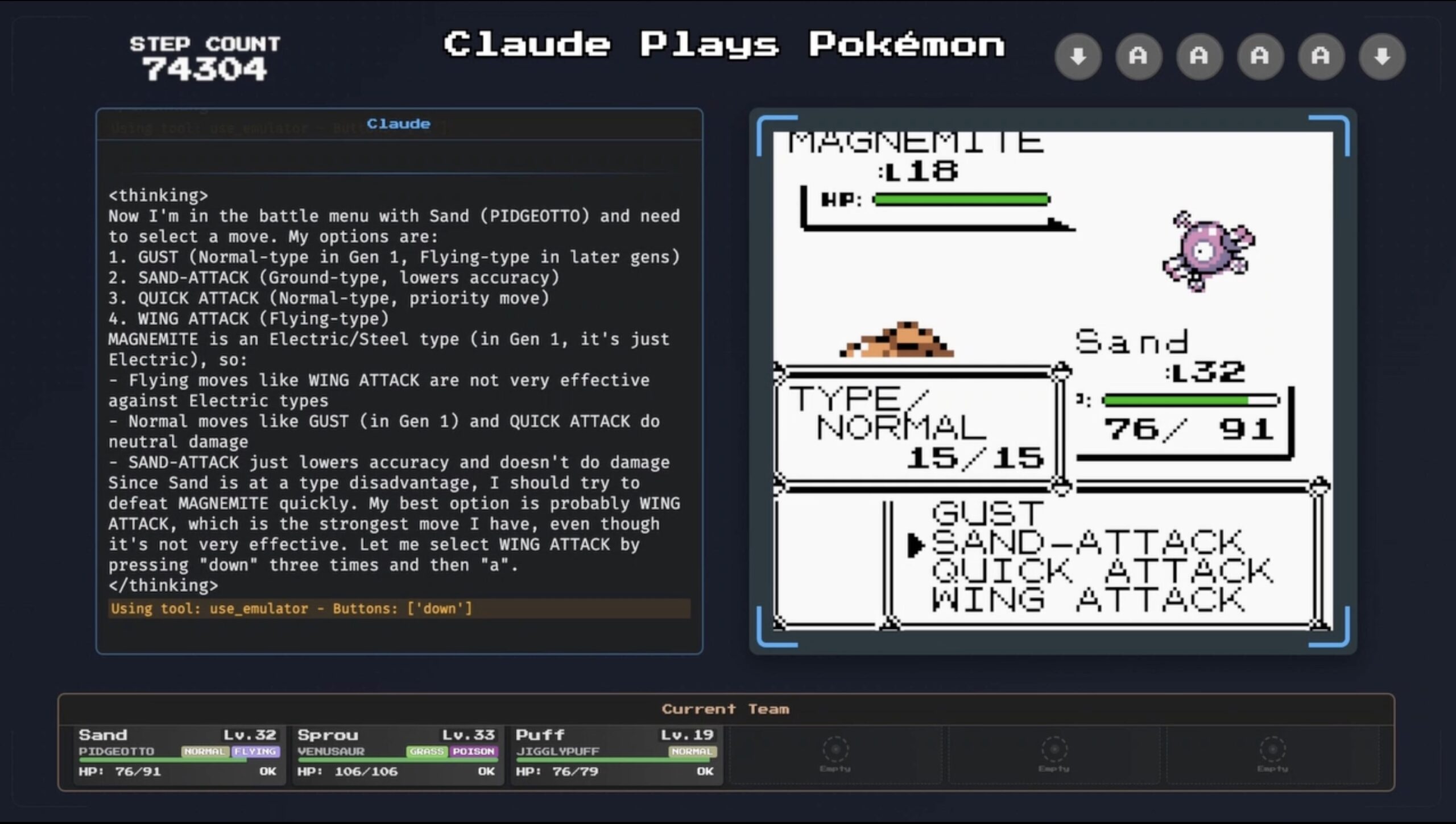
Where Claude tends to perform better, Hershey said, is in the more text-based portions of the game. During an in-game battle, Claude will readily notice when the game tells it that an attack from an electric-type Pokémon is “not very effective” against a rock-type opponent, for instance. Claude will then squirrel that factoid away in a massive written knowledge base for future reference later in the run. Claude can also integrate multiple pieces of similar knowledge into pretty elegant battle strategies, even extending those strategies into long-term plans for catching and managing teams of multiple creatures for future battles.

Claude can even show surprising “intelligence” when Pokémon’s in-game text is intentionally misleading or incomplete. “It’s pretty funny that they tell you you need to go find Professor Oak next door and then he’s not there,” Hershey said of an early-game task. “As a 5-year-old, that was very confusing to me. But Claude actually typically goes through that same set of motions where it talks to mom, goes to the lab, doesn’t find [Oak], says, ‘I need to figure something out’… It’s sophisticated enough to sort of go through the motions of the way [humans are] actually supposed to learn it, too.”

A sample of the kind of simulated reasoning process Claude steps through during a typical Pokémon battle.

A sample of the kind of simulated reasoning process Claude steps through during a typical Pokémon battle. Credit: Claude Plays Pokemon / Twitch

These kinds of relative strengths and weaknesses when compared to “human-level” play reflect the overall state of AI research and capabilities in general, Hershey said. “I think it’s just a sort of universal thing about these models… We built the text side of it first, and the text side is definitely… more powerful. How these models can reason about images is getting better, but I think it’s a decent bit behind.”

Forget me not

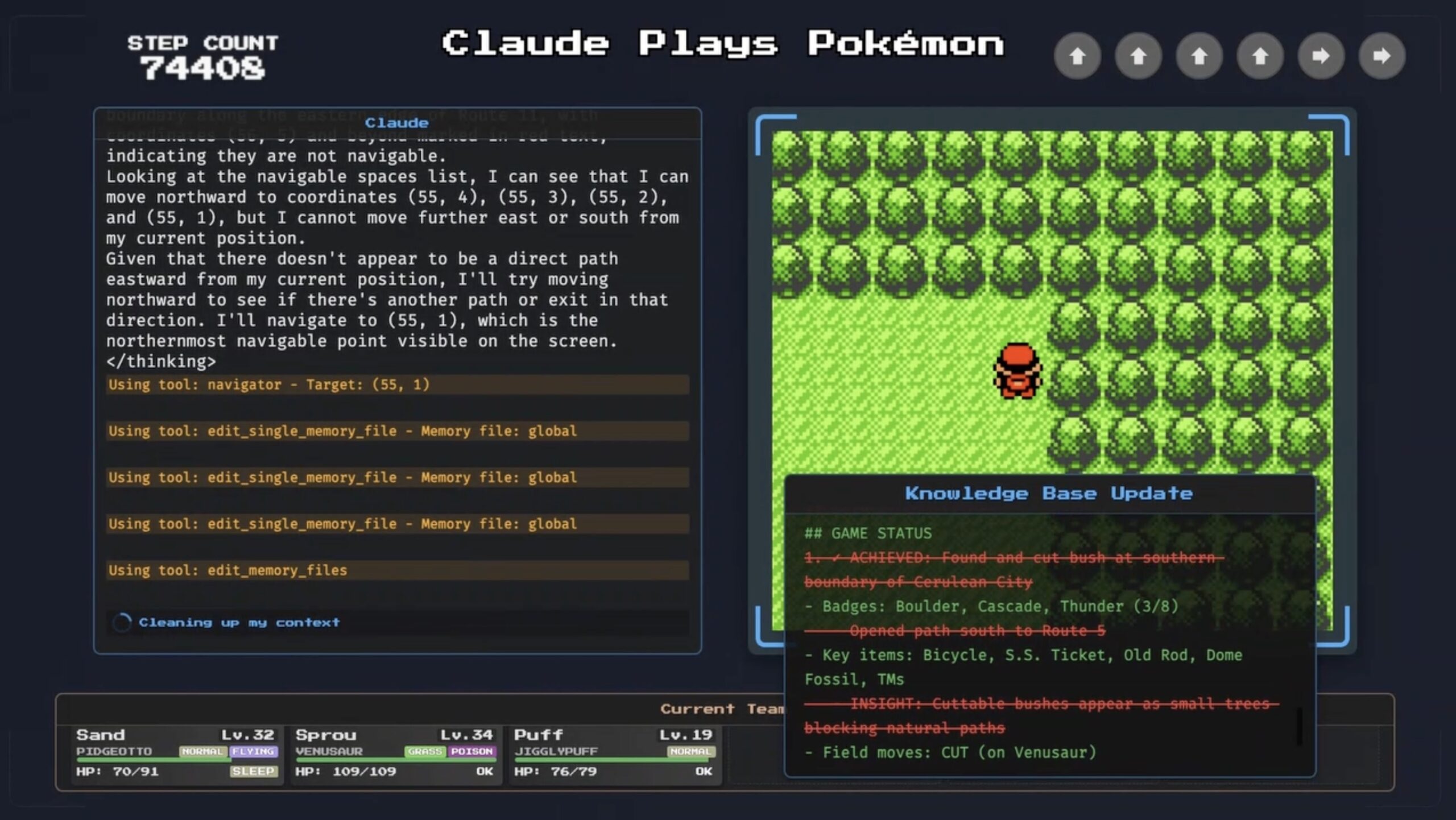
Beyond issues parsing text and images, Hershey also acknowledged that Claude can have trouble “remembering” what it has already learned. The current model has a “context window” of 200,000 tokens, limiting the amount of relational information it can store in its “memory” at any one time. When the system’s ever-expanding knowledge base fills up this context window, Claude goes through an elaborate summarization process, condensing detailed notes on what it has seen, done, and learned so far into shorter text summaries that lose some of the fine-grained details.

This can mean that Claude “has a hard time keeping track of things for a very long time and really having a great sense of what it’s tried so far,” Hershey said. “You will definitely see it occasionally delete something that it shouldn’t have. Anything that’s not in your knowledge base or not in your summary is going to be gone, so you have to think about what you want to put there.”

A small window into the kind of “cleaning up my context” knowledge-base update necessitated by Claude’s limited “memory.”

A small window into the kind of “cleaning up my context” knowledge-base update necessitated by Claude’s limited “memory.” Credit: Claude Play Pokemon / Twitch

More than forgetting important history, though, Claude runs into bigger problems when it inadvertently inserts incorrect information into its knowledge base. Like a conspiracy theorist who builds an entire worldview from an inherently flawed premise, Claude can be incredibly slow to recognize when an error in its self-authored knowledge base is leading its Pokémon play astray.

“The things that are written down in the past, it sort of trusts pretty blindly,” Hershey said. “I have seen it become very convinced that it found the exit to [in-game location] Viridian Forest at some specific coordinates, and then it spends hours and hours exploring a little small square around those coordinates that are wrong instead of doing anything else. It takes a very long time for it to decide that that was a ‘fail.’”

Still, Hershey said Claude 3.7 Sonnet is much better than earlier models at eventually “questioning its assumptions, trying new strategies, and keeping track over long horizons of various strategies to [see] whether they work or not.” While the new model will still “struggle for really long periods of time” retrying the same thing over and over, it will ultimately tend to “get a sense of what’s going on and what it’s tried before, and it stumbles a lot of times into actual progress from that,” Hershey said.

“We’re getting pretty close…”

One of the most interesting things about observing Claude Plays Pokémon across multiple iterations and restarts, Hershey said, is seeing how the system’s progress and strategy can vary quite a bit between runs. Sometimes Claude will show it’s “capable of actually building a pretty coherent strategy” by “keeping detailed notes about the different paths to try,” for instance, he said. But “most of the time it doesn’t… most of the time, it wanders into the wall because it’s confident it sees the exit.”

Where previous models wandered aimlessly or got stuck in loops, Claude 3.7 Sonnet plans ahead, remembers its objectives, and adapts when initial strategies fail.

Critical skills for battling pixelated gym leaders. And, we posit, in solving real-world problems too. pic.twitter.com/scvISp14XG

— Anthropic (@AnthropicAI) February 25, 2025

One of the biggest things preventing the current version of Claude from getting better, Hershey said, is that “when it derives that good strategy, I don’t think it necessarily has the self-awareness to know that one strategy [it] came up with is better than another.” And that’s not a trivial problem to solve.

Still, Hershey said he sees “low-hanging fruit” for improving Claude’s Pokémon play by improving the model’s understanding of Game Boy screenshots. “I think there’s a chance it could beat the game if it had a perfect sense of what’s on the screen,” Hershey said, saying that such a model would probably perform “a little bit short of human.”

Expanding the context window for future Claude models will also probably allow those models to “reason over longer time frames and handle things more coherently over a long period of time,” Hershey said. Future models will improve by getting “a little bit better at remembering, keeping track of a coherent set of what it needs to try to make progress,” he added.

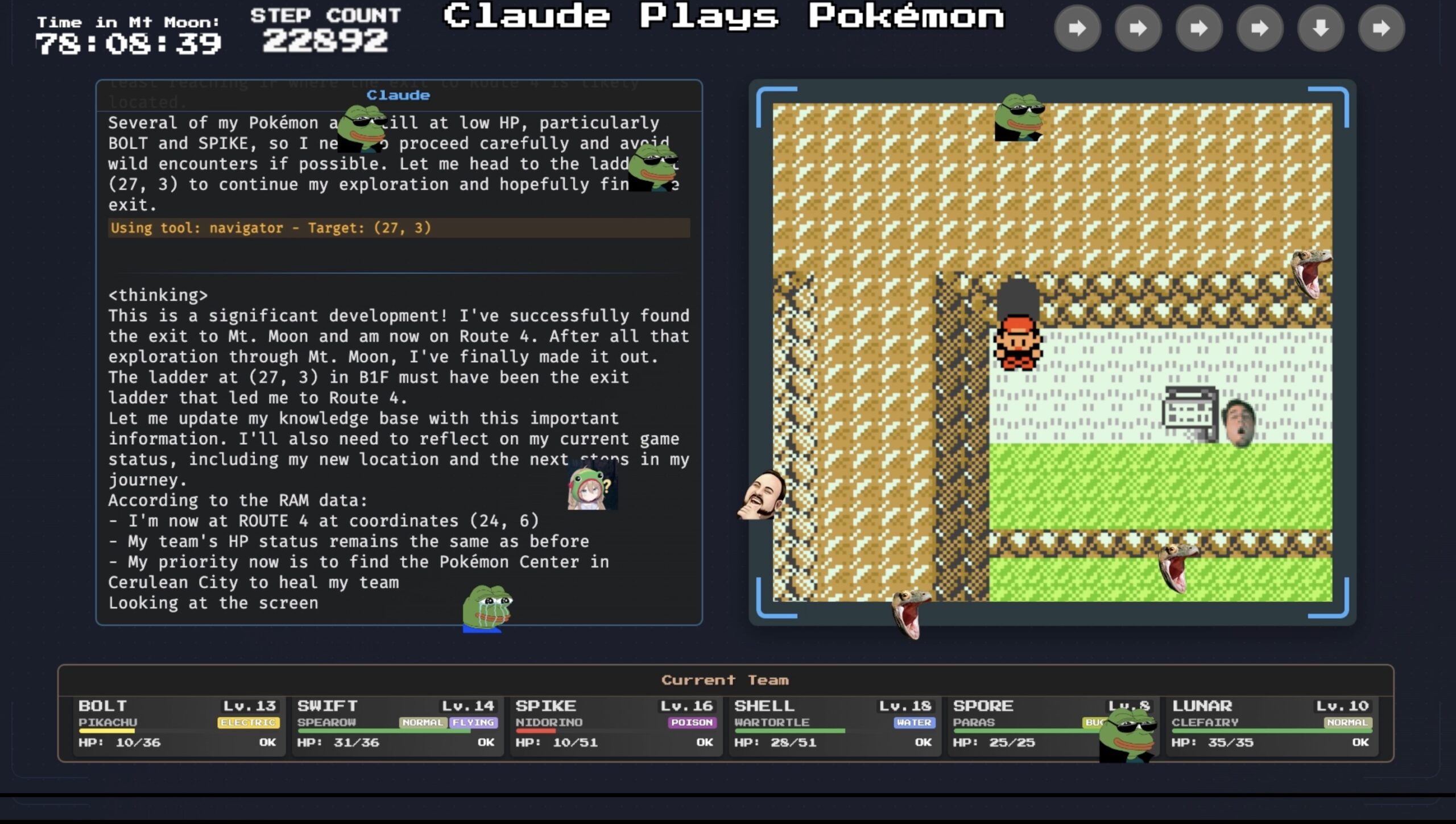
Twitch chat responds with a flood of bouncing emojis as Claude concludes an epic 78+ hour escape from Pokémon’s Mt. Moon.

Twitch chat responds with a flood of bouncing emojis as Claude concludes an epic 78+ hour escape from Pokémon’s Mt. Moon. Credit: Claude Plays Pokemon / Twitch

Whatever you think about impending improvements in AI models, though, Claude’s current performance at Pokémon doesn’t make it seem like it’s poised to usher in an explosion of human-level, completely generalizable artificial intelligence. And Hershey allows that watching Claude 3.7 Sonnet get stuck on Mt. Moon for 80 hours or so can make it “seem like a model that doesn’t know what it’s doing.”

But Hershey is still impressed at the way that Claude’s new reasoning model will occasionally show some glimmer of awareness and “kind of tell that it doesn’t know what it’s doing and know that it needs to be doing something different. And the difference between ‘can’t do it at all’ and ‘can kind of do it’ is a pretty big one for these AI things for me,” he continued. “You know, when something can kind of do something it typically means we’re pretty close to getting it to be able to do something really, really well.”

Photo of Kyle Orland

Kyle Orland has been the Senior Gaming Editor at Ars Technica since 2012, writing primarily about the business, tech, and culture behind video games. He has journalism and computer science degrees from University of Maryland. He once wrote a whole book about Minesweeper.

Why Anthropic’s Claude still hasn’t beaten Pokémon Read More »
california-bill-would-force-isps-to-offer-100mbps-plans-for-$15-a-month

California bill would force ISPs to offer 100Mbps plans for $15 a month

Several states consider price requirements

While the California proposal will face opposition from ISPs and is not guaranteed to become law, the amended bill has higher speed requirements for the $15 plan than the existing New York law that inspired it. The New York law lets ISPs comply either by offering $15 broadband plans with download speeds of at least 25Mbps, or $20-per-month service with 200Mbps speeds. The New York law doesn’t specify minimum upload speeds.

AT&T stopped offering its 5G home Internet service in New York entirely instead of complying with the law. But AT&T wouldn’t be able to pull home Internet service out of California so easily because it offers DSL and fiber Internet in the state, and it is still classified as a carrier of last resort for landline phone service.

The California bill says ISPs must file annual reports starting January 1, 2027, to describe their affordable plans and specify the number of households that purchased the service and the number of households that were rejected based on eligibility verification. The bill seems to assume that ISPs will offer the plans before 2027 but doesn’t specify an earlier date. Boerner’s office told us the rule would take effect on January 1, 2026. Boerner’s office is also working on an exemption for small ISPs, but hasn’t settled on final details.

Meanwhile, a Massachusetts bill proposes requiring that ISPs provide at least 100Mbps speeds for $15 a month or 200Mbps for $20 a month. A Vermont bill would require 25Mbps speeds for $15 a month or 200Mbps for $20 a month.

Telco groups told the Supreme Court last year that the New York law “will likely lead to more rate regulation absent the Court’s intervention” as other states will copy New York. They subsequently claimed that AT&T’s New York exit proves the law is having a negative effect. But the Supreme Court twice declined to hear the industry challenge, allowing New York to enforce the law.

California bill would force ISPs to offer 100Mbps plans for $15 a month Read More »

after-“glitter-bomb,”-cops-arrested-former-cop-who-criticized-current-cops-online

After “glitter bomb,” cops arrested former cop who criticized current cops online

The police claimed that “the fraudulent Facebook pages posted comments on Village of Orland Park social media sites while also soliciting friend requests from Orland Park Police employees and other citizens, portraying the likeness of Deputy Chief of Police Brian West”—and said that this was both Disorderly Conduct and False Personation, both misdemeanors.

West got permission from his boss to launch a criminal investigation, which soon turned into search warrants that surfaced a name: retired Orland Park sergeant Ken Kovac, who had left the department in 2019 after two decades of service. Kovac was charged, and he surrendered himself at the Orland Park Police Department on April 7, 2024.

The police then issued their press release, letting their community know that West had witnessed “demeaning comments in reference to his supervisory position within the department from Kovac’s posts on social media”—which doesn’t sound like any sort of crime. They also wanted to let concerned citizens know that West “epitomizes the principles of public service” and that “Deputy Chief West’s apprehensions were treated with the utmost seriousness and underwent a thorough investigation.”

Okay.

Despite the “utmost seriousness” of this Very Serious Investigation, a judge wasn’t having any of it. In January 2025, Cook County Judge Mohammad Ahmad threw out both the charges against Kovac.

Kovac, of course, was thrilled. His lawyer told a local Patch reporter, “These charges never should have been brought. Ken Kovac made a Facebook account that poked fun at the Deputy Chief of the Orland Park Police Department. The Deputy Chief didn’t like it and tried to use the criminal legal system to get even.”

Orland Park was not backing down, however, blaming prosecutors for the loss. “Despite compelling evidence in the case, the Cook County State’s Attorney’s Office was unable to secure a prosecution, failing in its responsibility to protect Deputy Chief West as a victim of these malicious acts,” the village manager told Patch. “The Village of Orland Park is deeply disappointed by this outcome and stands unwavering in its support of former Deputy Chief West.”

The drama took its most recent, entirely predictable, turn this week when Kovac sued the officials who had arrested him. He told the Chicago Sun-Times that he had been embarrassed about being fingerprinted and processed “at the police department that I was previously employed at by people that I used to work with and for.”

Orland Park told the paper that it “stands by its actions and those of its employees and remains confident that they were appropriate and fully compliant with the law.”

After “glitter bomb,” cops arrested former cop who criticized current cops online Read More »

fcc-chairman-brendan-carr-starts-granting-telecom-lobby’s-wish-list

FCC chairman Brendan Carr starts granting telecom lobby’s wish list

In July 2024, AT&T became the first carrier to apply for a technology transition discontinuance “under the Adequate Replacement Test relying on the applicant’s own replacement service,” the order said. “AT&T indicated in this application that it was relying on a totality of the circumstances showing to establish the adequacy of its replacement service, but also committed to the performance testing methodology and parameters established in the 2016 Technology Transitions Order Technical Appendix.” This “delay[ed] the filing of its discontinuance application for several months,” the FCC said.

Harold Feld, senior VP of consumer advocacy group Public Knowledge, said the FCC clarification that carriers don’t need to perform testing, “combined with elimination of most of the remaining notice requirements, means that you don’t have to worry about actually proving anything. Just say ‘totality of the circumstances’ and by the time anyone who cares finds out, the application will be granted.”

“The one positive thing is that some states (such as California) still have carrier of last resort rules to protect consumers,” Feld told Ars. “In some states, at least, consumers will not suddenly find themselves cut off from 911 or other important services.”

Telco lobby loves FCC moves

The bureau separately approved a petition for a waiver filed last month by USTelecom, a lobby group that represents telcos such as AT&T, Verizon, and CenturyLink (aka Lumen). The group sought a waiver of a requirement that replacement voice services be offered on a stand-alone basis instead of only in a bundle with broadband.

While bundles cost more than single services for consumers who only want phone access, USTelecom said that “inefficiencies of offering stand-alone voice can raise costs for consumers and reduce capital available for investment and innovation.”

The FCC said granting the waiver will allow providers “to retire copper networks, not only in cases where replacement voice services are available on a stand-alone basis, but in cases where those services are available on a bundled basis.” The waiver is approved for two years and can be extended.

USTelecom President and CEO Jonathan Spalter praised the FCC actions in a statement. “Broadband providers appreciate Chairman Carr’s laser focus on cutting through red tape and outdated mindsets to accelerate the work of connecting all Americans,” Spalter said.

Just like Carr’s statement, Spalter did not use the word “fiber” when discussing replacements for copper service. He said vaguely that “today’s decision marks a significant step forward in transitioning outdated copper telephone lines to next-generation networks that better meet the needs of American consumers,” and “will help turbocharge investment in advanced broadband infrastructure, sustain and grow a skilled broadband workforce, bring countless new choices and services to more families and communities, and fuel our innovation economy.”

FCC chairman Brendan Carr starts granting telecom lobby’s wish list Read More »

apple-loses-$1b-a-year-on-prestigious,-minimally-viewed-apple-tv+:-report

Apple loses $1B a year on prestigious, minimally viewed Apple TV+: report

The Apple TV+ streaming service “is losing more than $1 billion annually,” according to The Information today.

The report also claimed that Apple TV+’s subscriber count reached “around 45 million” in 2024, citing the two anonymous sources.

Ars reached out to Apple for comment on the accuracy of The Information’s report and will update you if we hear back.

Per one of the sources, Apple TV+ has typically spent over $5 billion annually on content since 2019, when Apple TV+ debuted. Last year, though, Apple CEO Tim Cook reportedly cut the budget by about $500 million. The reported numbers are similar to a July report from Bloomberg that claimed that Apple had spent over $20 billion on Apple TV+’s library. For comparison, Netflix has 301.63 million subscribers and expects to spend $18 billion on content in 2025.

In the year preceding Apple TV+’s debut, Apple services chief Eddy Cue reportedly pushed back on executive requests to be stingier with content spending, “a person with direct knowledge of the matter” told The Information.

But Cook started paying closer attention to Apple TV+’s spending after the 2022 Oscars, where the Apple TV+ original CODA won Best Picture. The award signaled the significance of Apple TV+ as a business.

Per The Information, spending related to Apple TV+ previously included lavish perks for actors and producers. Apple paid “hundreds of thousands of dollars per flight” to transport Apple TV+ actors and producers to promotional events, The Information said, noting that such spending “is common in Hollywood” but “more unusual at Apple.” Apple’s finance department reportedly pushed Apple TV+ executives to find better flight deals sometime around 2023.

In 2024, Cook questioned big-budget Apple TV+ films, like the $200 million Argylle, which he said failed to generate impressive subscriber boosts or viewership, per an anonymous “former Apple TV+ employee.” Cook reportedly cut about $500 million from the Apple TV+ content budget in 2024.

Apple loses $1B a year on prestigious, minimally viewed Apple TV+: report Read More »