Author name: Rejus Almole

‘the-light-brigade’-review-–-the-gun-toting-spiritual-successor-to-‘in-death’

‘The Light Brigade’ Review – The Gun-toting Spiritual Successor to ‘In Death’

The Light Brigade is a roguelike shooter that I would mostly describe as a spiritual successor to In Death: Unchained, the critically acclaimed bowshooter from Sólfar Studios and Superbright. While at times a little less visually polished than In Death, the game’s variety of upgrades and array of WWII-era weaponry gives it a definite Wolfenstein bend that fans of the shooter genre will instantly be able to click into.

Available On: SteamVR, PSVR 2 & PSVR, Quest 2

Release Date:  February 22nd, 2023

Price: $25

Developer:  Funktronic Labs

Reviewed On:  Quest 2 (native), Quest 2 via PC Link

Gameplay

There’s a definite story in The Light Brigade, although past the opening scene I really couldn’t remember what was actually at stake up until I completed my first full run. The game doesn’t chock too much story your way (or over tutorialize either), leaving you to just fight the bad guys while you save the culty good guys. Really, all you need to know is the demon-eyed, Nazi-adjacent baddies aren’t friendly, and the hellish fantasy-scape composed of discrete and sequentially connected levels must be cleared out and scoured methodically for loot.

It’s just pure action-adventure fun, as the meat of the game presents plenty of interesting upgrade paths which not only prolong your current run, but importantly give you enough reason to come back for more upon your inevitable death.

The Light Brigade feels forgiving enough to really keep you grinding for that next gun mod or class upgrade too, which gives you access to cooler-looking and more powerful versions of each weapon. Meanwhile, the game is busy serving up a good difficulty ramp that means your next run may not be necessarily easier despite progressively wider access to guns, magic, and upgrades.

That’s all well and good, but what about the guns? Thankfully, The Light Brigade really gets its WWII weaponry right, providing physics-based rifles and pistols which each come with their own immersive reloading mechanics. Loading and shooting the M3 submachine gun requires you to grab its stick-style magazine and chunk back the charging handle to chamber the first round, while shooting a K98 rifle is totally different, making you jam down stripper clips to feed the bolt-action rifle.

Practically speaking, sticking to a single class isn’t a terrible strategy as you get your grips with the game, as you’re probably looking to maximize your rank and unlock permanent upgrades since they don’t sync across classes.

In practice though, you’ll probably do a fair amount of class hopping once you progressively unlock the next available class, taking you from the starter Rifleman class with its semi-automatic Gewehr 43 rifle all the way through the other iconic WWII weapon-wielding classes the game has to offer, including the Sturmgewehr 44 submachine gun, the M3 submachine gun (aka ‘Grease Gun’), the powerful K98 battle rifle, and even a class that has dualie Colt 1911s for some John Wick-style madness.

As for enemies, the world’s baddies come in a pretty standard range, starting with your standard goons, which include shooters and archers. You’ll eventually come across shielded goons, tanks, and versions that fly, snipe, and lob bombs too. There always seems to be a new type added to the mix after each attempt though, so there may be more I don’t know about.

By this point, I’ve already made it through one full run, although that was after many (many) failed attempts spanning over about eight hours of gameplay—another thing that makes The Light Brigade a little more generous than In Death, which is probably there to keep it a little more of a fast-paced experience.

Levels are fairly linear, although there’s plenty of cover to hide behind as you make your forward march. That also means finding the remaining enemies can sometimes be tough, but thankfully prayer actually works in this universe, helping you to locate remaining loot and baddies. Enemies are revealed by showing you small red dots while chests are yellow.

And once you’ve finally cleared out the level’s baddies—you get a big ‘LEVEL CLEAR’ popup—then it’s time to scour for loot, oftentimes hidden in breakable vases and chests.

Here, you can find gold to buy consumables, weapon upgrades like scopes and magical trinkets, souls which increase your rank level, and the occasional key, which can open locked chests.

Mostly though, you’re looking for souls, the whispy white things that you’ll earn after killing enemies or finding soul containers. There’s also cards that give each run a unique set of possible upgrades. Choose one of three presented to you, and you might just significantly increase the damage you can deal, injecting a bit of luck into each run’s loot haul.

It’s not all WWII guns and demon Nazis though. The world is also magic-based, giving you upgradeable magic wands that can do things like provide shields, shoot fireballs, etc.

All of this effectively combines to offer a good selection of gameplay styles, letting you attack the world as you want.

Still, I have my gripes with The Light Brigade, the worst offender being its inventory holters attached to your belt. In practice, this makes reloading quickly and consistently an absolute pain. Instead of having a fixed area where you can reliably train muscle memory, shifting your body around physically or virtually with any of the artificial locomotion schemes has a funny way of shifting the belt holster around your waist in weird an unpredictable ways.

I get it: you should be covering and assessing your ammo situation at all times so you don’t run dry during critical moments, but having to crane your neck down every few seconds to make sure your hand is actually hovering over the right area is decidedly a dull spot on an otherwise shining example of great VR gaming.

I’m still working on getting the last remaining achievements and consistently beating the first boss as I attempt my successive runs. Considering the array of gun upgrades and magical weapons to explore, it’s safe to say I’m nowhere personally finished with this well-crafted roguelike. I won’t talk too much about bosses, although they are hard, and offer up unique bossy ways of dealing out damage—pretty much what’d you expect from a fantasy shooter, i.e., they can shield, do magic, and surprise you throughout the encounter, so they aren’t just glorified bullet sponges.

Immersion

I get it: The Light Brigade is all about bringing light back to a dark and corrupted world, but it is very dark. At times, I felt it offered less visual contrast than Quest 2’s LCD displays can rightly handle, making some levels appear more muddy and generally more difficult to resolve visually.

Road to VR has a PSVR 2 in hand, although I don’t personally. I have had a chance to preview the headset though, and its OLED displays with HDR will undoubtedly be more capable of serving up better visual contrast. Still, if you’re playing on Quest 2 natively, or any number of PC VR headset running the Steam version, you may find later bits of the game very difficult to resolve visually.

Image courtesy Funktronic Labs

Were it not for the beady red eyes that shine in the darkness, enemies would be maybe too difficult to make out in the ever-present fog of war. Still, it’s a fairly muddy palette any way you slice it; level design and variety as you move forward are always interesting at least.

The star of the show though is inevitably the game’s weapons, which provide subtle articulations that really make it feel more of a realistic experience. For example, you can cycle a magazine’s worth of cartridges just because you mechanically can. You don’t need to, but the fact that The Light Brigade’s guns functionally work like real guns means the player should be able to if they want to. See my magazine empty as I eject unfired bullets:

Another immersive touch is the gun’s physical weight, which affects how you hold and steady it. A pistol requires a steadier hand because it’s lighter and easier to swing around, while a rifle is more forgiving with movement since the game registers as it being substantially heavier in the player’s hand. Suitably, some guns let you steady with your non-dominant hand, providing discrete attach points to do so.

I was hoping for some amount of melee, although there’s none present to speak of, meaning if your gun runs dry, you better find cover and reload, or pull out your trusty sidearm.

A note one positional audio: enemies provide good spatial audio cues for their relative locations—something important once levels start getting more claustrophobic, like in the sewers.

Comfort

The Light Brigade has a good swath of standard comfort options which, include optional smooth or snap-turn, and smooth locomotion or teleport.

Playing seated is possible, and the game comes with a seated mode, although it’s not advisable since your belt holster may be awkwardly positioned at any time, making standing play the least encumbering way to interface.

The Light Brigade’ Comfort Settings – February 15th, 2023

Turning
Artificial turning
Snap-turn
Quick-turn
Smooth-turn
Movement
Artificial movement
Teleport-move
Dash-move
Smooth-move
Blinders
Head-based
Controller-based
Swappable movement hand

Posture

Standing mode
Seated mode
Artificial crouch
Real crouch

Accessibility

Subtitles
Languages

English, Portuguese, Spanish, Italian, German, French, Russian, Chinese (Simplified), Chinese (Traditional) , Korean, Japanese

Dialogue audio
Languages English
Adjustable difficulty
Two hands required
Real crouch required
Hearing required
Adjustable player height

‘The Light Brigade’ Review – The Gun-toting Spiritual Successor to ‘In Death’ Read More »

7-key-takeaways-about-the-dutch-tech-startup-ecosystem-you-need-to-know

7 key takeaways about the Dutch tech startup ecosystem you need to know

The Dutch tech startup ecosystem has been steadily flourishing over the past five years, establishing itself as one of Europe’s most vibrant hubs. Yet, there are still hurdles the Netherlands needs to overcome in order to reach its full potential and successfully compete on a global scale.

That’s according to the annual State of Dutch Tech report by TechLeap, a non-profit organisation which helps quantify and accelerate the ecosystem in the Netherlands.

Here are seven key takeaways from the report you need to know about:

The Netherlands houses the EU’s most successful ecosystem

In 2022, the Amsterdam-Delta region was the leading ecosystem in the EU, overtaking Paris and Berlin. Globally, it ranks on the fourteenth place, behind cities in the US, Asia, and the UK.

However, the combined valuations of Dutch startups stagnated, with

the tech sector in the country dropping from the fourth to the sixth position globally at €0.4T in aggregate public market cap. The Netherlands is still the leader in the EU thanks to tech giants ASML, Prosus, and Adyen.

Fintech and healthcare were the dominant startup sectors in the country, with the first producing the greatest number of scaleups as well. The Netherlands also welcomed one new unicorn in 2022, bringing its total to 1.4 unicorns per million inhabitants. This places it above France (0.7) and Germany (0.5), but below Sweden (2.4) and the UK (1.7).

The tech sector is also growing outside the Amsterdam-Delta

Although the North Holland region remains the largest startup centre in the country, generating 38% of startups jobs, other local hubs are also growing thanks to regional specialisations and mutual cooperation.

For instance, North Brabant showed a 27% year-on-year growth in deeptech jobs, Utrecht increased its numbers of startups by 900, and Gelderland has become a leader in foodtech.

Job creation increases, but attracting talent remains a challenge

In 2022, startup-generated jobs reached 135K, rising from 109K in 2020 and 130K in 2021. Attracting tech talent, however, presents to be challenging for many startups.

Specifically, the percentage of hard-to-fill tech jobs has increased to 59%. On average, these types of vacancies stay open for more than 60 days.

This phenomenon occurred in other ecosystems as well, including Sweden, Germany, France, and the US.

Dutch startups struggle scaling up mainly due to lack of funding

The startup to scaleup ratio in the Netherlands (22%) is lower compared to other European hubs, such as Germany (37%), the UK (30%), and France (26%). That’s mainly because of insufficient capital.

In 2022, total VC funding in the Netherlands was €2.6 billion with the average funding being €0.26 million per startup. This was significantly lower than other major EU startup ecosystems. For reference, Sweden’s average was €0.9 million per startup.

Despite the Netherlands’ prowess in scientific and academic research, deeptech is amongst the underinvested sectors with €0.7 billion in funding in 2022 and a 23% startup to scaleup ratio.

On the brightside, investments on impact startups are on the rise with over €1 billion raised in 2022. And investments in all sectors overperformed pre-pandemic levels.

The gender gap

The gender gap is still a problematic issue within the industry. Just 10% of Dutch tech startups are run by women, and funding for female entrepreneurs is similarly insufficient. Only 0.7% of venture capital investments have been raised — since 2019 — by businesses with female founding teams, lagging behind the UK (2%), Germany (1.5%), and France (1.2%).

The potential for further growth

According to the report, the Dutch tech ecosystem has a massive potential of growth. In particular, it could add 250K jobs and €400 billion in value by 2030. This could be done by supporting the growth and impact of university spin-offs, bridging the talent and diversity gap, and cultivating a more resilient and internationally-embedded VC market.

7 key takeaways about the Dutch tech startup ecosystem you need to know Read More »

ray-tracing-comes-to-snap-lens-studio

Ray Tracing Comes to Snap Lens Studio

One of the most powerful recent breakthroughs in graphics and rendering is coming to mobile AR thanks to a recent update to Snap’s Lens Studio. We’re talking about ray tracing.

What Is Ray Tracing?

Ray tracing is a rendering technique that helps to bring digital assets to life in the environment around them – whether that environment is digital or viewed in augmented reality. Recent examples in gaming include convincingly reflective surfaces like water, believable dynamic shadows, and improved light effects.

The technique can be fairly computing-heavy, which can be a problem depending on the program and how it is accessed. For example, when some existing games are updated to use ray tracing, users accessing that game on an older or less fully-featured computer or console may have to turn the feature off to avoid problematic latency.

Fortunately, ray tracing is being developed at the same time as new computing and connectivity methods like cloud and edge computing. These advancements allow the heavy lifting of advanced computing techniques to take place off of the device, allowing older or less fully-featured devices to run more high-level experiences smoothly.

While Snap releases detailing the update didn’t mention Lens Cloud, it’s likely that that feature is behind the update. Announced at the 2022 Snap Partner Summit, which also announced ray tracing for the first time, Lens Cloud provides improved off-device storage and compute, among other advancements.

The Road to Lens Studio

If you closely follow Snap, you’ve known for almost a year that this was coming. Snap also discussed ray tracing at the fifth annual Lens Fest in December. There we learned that the update has been in the hands of select developers for a while now, and they’ve been working with Snap partners to create experiences pioneering the software.

The news announced yesterday is that the feature is now in Lens Studio, meaning that any Lens creator can use it. We also have a new demonstration of the technology: a Lens created with Snap partner Tiffany & Co.

Snap ray tracing - Tiffany & Co

The company has likely been so involved in the development and showcasing of Snap’s ray tracing at least in part because the jewelry that the company is known for provides both a great challenge for and an excellent demonstration of the technology. However, Snap is already looking forward to the feature finding other use cases.

“Now, Lenses that feature AR diamond jewelry, clothing and so much more can reach ultra-realistic quality,” Snap said in the announcement.

The principal use case presented by Snap in the announcement is virtual try-on for clothing retail, like the Tiffany & Co. Lens. However, it is likely only a matter of time before the new feature finds its way into other kinds of AR experiences as well.

What’s Next?

Ray tracing is likely to be a topic yet again at the upcoming Snap Partner Summit in April, and ARPost will be there to hear about it. The online event doesn’t have the same energy as Lens Fest but as we saw here, the Partner Summit is often the first look at Snap’s developing software offerings. We always look forward to seeing what they’ll roll out next.

Ray Tracing Comes to Snap Lens Studio Read More »

eu-launches-e3.75-billion-fund-of-funds-to-help-tech-startups-scale-up

EU launches €3.75 billion fund of funds to help tech startups scale up

Five EU member states and the European Investment Bank (EIB) Group have launched a new fund to support the late-stage growth of promising European tech startups and increase the continent’s competitiveness in innovation.

The so-called European Tech Champions Initiative (ETCI) aims to address the issue with inadequate late-stage funding, especially for companies seeking more than €50 million in capital.

Boosting European investment

“Europe’s tech startups often do not have sufficient capital to compete on a global scale and are pushed to relocate overseas. Closing this scale-up gap could create a large number of highly skilled jobs and boost growth,” the ECTI’s founders said in a statement.

“The European Investment Bank estimates that approximately 75% of European high-tech companies are acquired by non-European investors — predominantly American and Chinese — in late-stage development,” Nick Swan, serial entrepreneur and founder of SEOTesting, told TNW. “For the fund to be successful long-term, it will need to curb the trend of EU tech startups pushing to relocate overseas. It will also be telling if UK businesses begin to consider relocating to the EU to be able to get access to this big pot of funding.”

The ETCI has secured so far a total budget of €3.75 billion. Spain, Germany, and France have committed €1 billion each, Italy €150 million, and Belgium €100 million. The EIB Group has provided an additional €500 million. The funding capacity is expected to increase further in the future.

“This initiative is a striking example of what we can achieve collectively to strengthen the EU’s economic and industrial sovereignty,” Bruno Le Maire, French Minister of the Economy, Finance, and Industrial and Digital Sovereignty, noted.

The ETCI won’t subsidise startups directly, but will instead work as a fund of funds. In other words, it will deepen Europe’s scaleup venture capital (VC) funds “by bridging gaps in financing availability.” This way, it will help European institutional investors diversify their portfolio, while ensuring a continuous flow of capital to the continent-based scaleups.

“Much of this has to do with European strategic autonomy, which is something that leaders on the continent have to think about. By boosting the financial capacity of existing venture capital funds (and therefore financing scale-ups indirectly), they can make sure that European companies don’t get acquired by non-European investors, generally from the US and China,” Michaela Jeffery-Morisson, CEO and founder of Ascend Global Media (the company behind Women in Tech World Series), told TNW.

“There’s real value in supporting home-grown talent,” Jeffery-Morisson added. “Doing so will give European tech companies the freedom to concentrate on what they do and not get distracted wondering where money will come from. And this will also allow a distinctly European tech ecosystem with its own unique culture to develop.”

The way forward

While the ETCI is an exciting and promising opportunity for innovative entrepreneurs across the continent, financial support alone might not be enough.

Reduced bureaucracy and easier access to funds are critical, Oana Jinga, co-founder and CMO at previously EIC-funded Dexory, told TNW. “Startups need to operate at speed — the main advantage of being in innovation is to be first! So lengthy and time-consuming processes will quickly be dismissed for other options as they hold these high-growth companies back,” she explained.

Speaking to TNW, Lena Hackelöer, CEO of Swedish-based Brite Payments, identified two more requirements for home-grown innovation: cultivating a “startup-friendly environment” and implementing regulation that “supports” and “sets clear boundaries” for tech companies.

With the approval of the first investment applications under the ETCI potentially starting as early as next week, it will become clearer how the process will work out in action.

EU launches €3.75 billion fund of funds to help tech startups scale up Read More »

playin-pickleball-on-quest-2-–-review-from-a-pickleball-newcomer

Playin Pickleball on Quest 2 – Review From a Pickleball Newcomer

Pickleball is the new court sensation that’s sweeping the nation, and it didn’t take long for someone to bring it into VR. How does someone who’s a VR veteran, but green on the pickleball court take to the game? We’ll find out in this review of Playin Pickleball.

“Pickleball,” You Say?

If you know what pickleball is, just skip ahead a little bit. If you need a little explainer, here’s a very little explainer:

Pickleball is kind of like tennis, but played with a ping-pong paddle and a whiffle ball. It can be played in singles or doubles format. That’s it from a thousand-foot view, but there are a lot of more specific rules going over how the ball can be played, from where, and how it has to be served, as well as the points system.

As becomes apparent over the course of this review, I have never played pickleball in real life. And, after having played a few (and won even fewer) games in VR, I still don’t really understand a lot of the rules. But, that doesn’t mean that it’s not fun.

Getting Started With Playin Pickleball

The basic mechanics of how pickleball works in a VR game are explained in an automated tutorial as soon as you start up Playin Pickleball for the first time. Let me just say here, that you owe it to yourself to make it through the tutorial.

You can’t skip this opening tutorial, and you can’t fail out of it either. One of the challenges is landing three serves within a designated area of the court and if you want to leave the tutorial you’ll do it if it takes you a thousand tries. And it might have taken me a thousand tries.

This initial tutorial tells you how to do things like spawn a ball and move around the court, but it doesn’t do anything to tell you how the game of pickleball actually works. This is a blessing for people who already know the rules of the game from playing in real life, because they don’t have to sit through an avatar explaining the rules to them.

If you aren’t familiar with the rules, you can choose to move straight from the initial tutorial into a short explainer on the court, the points system, and some of the other more intricate rules. However, this second tutorial is optional so you can skip it if you already know the rules.

Whether you’re about to play your first match or your one-millionth match, you can also access training exercises from the main menu that help you practice skills like serving and just hitting the ball. The training exercises pit you against the merciless pitching machine from the first tutorial, but you can also practice by playing against AIs on three difficulty settings.

Gameplay

So, how is Playin Pickleball’s gameplay?

Physics

I know that I said that the tutorial was torturous. But, I’ve been around VR long enough to know that that’s because I haven’t been around paddle sports at all. The physics of Playin Pickleball are out of this world.

I imagined that the paddle would essentially be a pong paddle that the ball either hit or it didn’t. This is far from the case. The ball behaves differently based on where it strikes the paddle. This includes wild ricochets if the ball hits the edges of the paddle.

While this can make the game more challenging at first, it also makes it a very realistic experience. I later learned that the flat sides of the paddle are actually textured so that advanced players (more advanced than me) can deliberately put a spin on the ball by glancing it just right off of the paddle’s surface.

Display and Avatars

Playing the Playin Pickleball on Quest 2 (review) via App Lab, the game automatically uses your Quest avatar. If you want to change your outfit into something a little more sporty, a menu option in the game takes you to the Quest avatar editor without closing the game.

spectate - Playin Pickleball

The environment, including the three different courts, provides a good visual home for the Quest avatars. The graphics are cartoony enough for a cohesive aesthetic, but realistic enough to make gameplay easy and enjoyable.

Movement and Mechanics

Playin Pickleball allows for three movement modes. 

Manually running lets you move via the joysticks. It provides the most precise and smooth movement around the court, but also means another control to keep track of that may be too challenging for new players.

Automatic running moves your avatar smoothly into the path of the ball. This setting feels natural but some people who experience motion sickness in VR may find it too disorienting. (For the record, I often feel motion sickness after extended VR sessions, but this is still my favorite setting and I didn’t have any problems using it over multiple consecutive matches in a session.)

Automatic teleport places your avatar in the best place to hit the ball based on its trajectory. This option feels less natural than the running options but may be more comfortable for players subject to motion sickness in VR.

city - Playin Pickleball

In any movement mode, players can press the left joystick to immediately move to “the kitchen” – a smaller field-of-play on either side of the net where short-range volleys take place.

A final note on gameplay: Even with teleport modes, you have to move your arms – including serving from below the waist and returning above your head. In my review of The Thrill of the Fight, I mentioned that you can get away with a pretty small play area. That is not the case with Playin Pickleball. You don’t need a full-sized court to play in, but you’ve got to give yourself room.

Finding Games Anytime

In addition to the training modes, Playin Pickleball has singles and doubles matches available at any time. These include free play modes so you and a pal can knock a ball back and forth without worrying about the score or even whose serve it is.

wating for others to join - Playin Pickleball

Friends can invite you to join their games, or you can team up with a friend to form a party. If you have enough friends online at the same time, you can play in closed games with each other.

If you don’t have enough friends online at once, you can look for open matches with random online players. In the event that there aren’t enough players online at a given time (which does happen in the game, as Playin Pickleball is still fairly new), live players are paired with AI bots.

An Amazing Gaming Community

The best way that I know of to find games, and to get into Playin Pickleball in general, is through their Discord server. As soon as I joined the Discord server, other players sent welcoming messages. One even scheduled a time for some free play during which he helped me understand the rules and mechanics better than any of the tutorials did.

A special page in the Discord server allows players to fill in information about themselves, including their levels of pickleball experience and what regions they live in. This automatically assigns players to different channels where players can learn about upcoming Playin Pickleball tournaments and see or schedule pick-up games.

The first online doubles game that I played included my new friend from Discord as well as two other players that I had never played with but that seem to be regulars at that particular time of day. Despite having only put an hour or so into Playin Pickleball since surviving the tutorials, I was able to play competitively with others. And the other players are great sports!

stadium - Playin Pickleball

It helps that many of the basics of the game are automated. For example, despite my time in the app, I still don’t really understand how the serve rotation works. But, a message appears above my off hand, letting me know that it’s my turn to spawn a ball and start a round. That means that my new (and patient) pickleball friends don’t have to tell me it’s my turn when I can’t keep track.

Get to Playin!

You can learn more about Playin Pickleball through the website, which includes video explainers, links to their Discord channel and other social media, and more. If you want to get straight into it, you can purchase the game from the Meta Quest App Lab for $19.99.

Playin Pickleball on Quest 2 – Review From a Pickleball Newcomer Read More »

vr-veteran-studio-behind-‘bigscreen’-unveils-thin-&-light-pc-vr-headset-‘beyond’

VR Veteran Studio Behind ‘Bigscreen’ Unveils Thin & Light PC VR Headset ‘Beyond’

The team behind social VR viewing app Bigscreen today unveiled a thin and light PC VR headset that not only promises a few intriguing enthusiast-grade specs, but also a custom-made fit based on a 3D scan of your face. In short, it’s a big first for the VR veterans, who are responsible for one of the most beloved VR content viewing platforms.

Called Bigscreen Beyond, the $999 headset presents an interesting set of features which are squarely aimed at PC VR enthusiasts: dual OLED microdisplays offering 2,560 × 2,560 per-eye resolution, pancake optics, and 6DOF SteamVR tracking support.

The company is billing the tethered PC VR headset as the smallest and lightest of its kind, weighing in at just 127 grams and measuring less than 1-inch at its thinnest point.

Image courtesy Bigscreen

Bigscreen Beyond starts pre-orders today, priced at $999. Ostensibly, Beyond is targeting PC VR users who likely already in the SteamVR ecosystem but want something thinner and lighter than the last generation of headsets, such as Valve Index. Notably, the headset doesn’t include the requiste SteamVR tracking base stations or SteamVR-compatible controllers like the Valve Index controller or HTC Vive wand—you’ll have to purchase those separately.

The reasoning: Bigscreen founder and CEO Darshan Shankar says the VR software studio wanted to build “the VR headset we wanted for ourselves.”

“Today’s leading VR headsets have doubled in weight compared to headsets from 2016. We built Beyond because we felt VR was too heavy, bulky, and uncomfortable,” Shankar says. “We invented new technologies to increase comfort, and developed ultra-high-end components like OLED microdisplays and pancake optics to increase immersion. To deliver the best software experience for watching movies in Bigscreen, we also had to build the best hardware with Bigscreen Beyond.”

Image courtesy Bigscreen

Like many forthcoming VR headsets, Beyond is able to slim down thanks to the inclusion of pancake lenses, which Bigscreen says are a three-element optical design composed of glass, plastic polymers, films, and coatings.

Paired with two OLED microdisplays, each with a resolution of 2,560 × 2,560 pixels, Beyond boasts a high fill-factor with its 7.2-μm wide pixels and RGB stripe subpixels, resulting in what the company says eliminates the screen door effect—when the non-illuminated spaces between pixels make it seem like you’re viewing VR content through a screen door.

Resolution alone doesn’t tell the whole story, although for reference Valve Index is 1,440 × 1,600 per-eye, Meta Quest Pro is 1,920 × 1,800 pixels per-eye, and Pico 4 is 2,160 × 2,160 pixels per-eye.

Another one of Beyond’s big enthusiast-grade features is owed to Bigscreen’s ability to customize the fit of the headset to each user, which will be done by doing a one-time scan of the user’s face using an iPhone XR or more recent Apple mobile device. The dedicated Bigscreen scanning app is said to measure the shape of the user’s face and the position of their eyes, which allows the company to form a facial interface a unique to the individual and determine interpupillar distance.

The hand-washable facial interface is said to provide “even weight distribution, zero light leakage, and aligns the eyes and optics correctly.” Additionally, glasses wearers will have to spring for custom prescription lenses that magnetically fit into Beyond, as glasses do not fit inside the small form factor.

Although it ships with a soft strap, users can also spring for the optional audiostrap. We haven’t confirmed pricing for that yet, however we’ll update once we do.

Image courtesy Bigscreen

Granted, some things we’d consider ‘nex-gen’ are notably missing from Beyond, such as eye-tracking, face-tracking, optical 6DOF tracking, and the ability to use it wirelessly. As the first VR headset from a long-time VR veteran though, Beyond does check a lot of boxes for users such as simulator fans, and anyone looking for a better long-term VR media viewer.

Bigscreen Beyond is slate to ship in waves based on region. Preorders, which are fully cancellable and refundable up until shipping, are set to ship in the United States sometime in Q3 2023.

Second wave shipments will begin in Q4 2023 in Canada and Europe including the United Kingdom, Germany, France, Spain, Netherlands, Italy, and Belgium. A third wave of will come sometime in late 2023, including Japan, Australia, New Zealand. The company says Beyond will be available in more countries and regions in 2024.

Check out the spec sheet below:

Bigscreen Beyond Specs

Display Resolution 5120 x 2560 pixels (2560 x 2560 per eye) cloed at max 90Hz
Field Of View (FOV) 93° HFOV x 90° VFOV
Pixels Per Degree (PPD) 28°
Interpupillary Distance (IPD)

56mm-74mm accommodated (fixed IPD per device, 58mm-72mm)

Optics Type Custom Pancake Optics
6DOF Tracking SteamVR Tracking (aka Lighthouse)
Version V1.0 or V2.0 Base Stations. Not included.
Controllers SteamVR controllers (ex. Valve Index, HTC Vive). Not included.
Full-Body Tracking

SteamVR trackers (ex. HTC Vive Tracker, Tundra Tracker). Not included.

Audio Not built-in (USB C port for Audio), or optional Audio Strap
Ports USB-C accessory port (USB 2.0)
Microphone Input Stereo microphones
PC Connection DisplayPort 1.4 (video) and dual USB 3.0 ports (power, data)
Accessory ports USB-C (USB 2.0 speed)
Cable 5-meter custom fiber optic cable and Link Box
PC Requirements
CPU Quad Core Intel or AMD
GPU

Nvidia RTX 2070 or AMD RX 5700 XT or newer (DisplayPort 1.4 and DSC required)

Ports 1 x DisplayPort 1.4, 2 x USB 3.0 ports

VR Veteran Studio Behind ‘Bigscreen’ Unveils Thin & Light PC VR Headset ‘Beyond’ Read More »

scientific-breakthrough-could-take-us-closer-to-impactful-quantum-computers

Scientific breakthrough could take us closer to impactful quantum computers

Scientific breakthrough could take us closer to impactful quantum computers

Ioanna Lykiardopoulou

Story by

Ioanna Lykiardopoulou

Ioanna is a writer at SHIFT. She likes the transition from old to modern, and she’s all about shifting perspectives. Ioanna is a writer at SHIFT. She likes the transition from old to modern, and she’s all about shifting perspectives.

In a world first, scientists from the University of Sussex and Universal Quantum, a spin-off of the university, have demonstrated that quantum bits (qubits) can directly transfer between quantum computer microchips.

This breakthrough is expected to overcome a major obstacle in building quantum computers that are large and powerful enough to address the crucial societal challenges they’re envisioned to: from medicine development, to the creation of new materials and climate change solutions.

To address these issues, experts estimate that millions of qubits are required — a number currently out of reach, with existing quantum computers operating on the 100-qubit scale.

“As quantum computers grow, we will eventually be constrained by the size of the microchip, which limits the number of quantum bits such a chip can accommodate,” Winfried Hensinger, Professor of Quantum Technologies at the University of Sussex and Chief Scientist and co-founder at Universal Quantum explained.

As a solution, the research team developed a novel technique, named “UQ Connect.” This method enabled the researchers to use electric field links that allow qubits to move from one quantum computing microchip module to another with record-breaking speed and accuracy. Specifically, the researchers were successful in transporting 2,424 ion qubits per second with a 99.999993% success rate.

“We knew a modular approach was key to make quantum computers powerful enough to solve step-changing industry problems. In demonstrating that we can connect two quantum computing chips — a bit like a jigsaw puzzle — and, crucially, that it works so well, we unlock the potential to scale up by connecting hundreds, or even thousands of quantum computing microchips,” Hensinger added.

Universal Quantum, which was recently named one of the 2022 Institute of Physics winners in the Business Startup category, has now been awarded €67 million from the German Aerospace Center (DLR) to build two quantum computers that will deploy the new technology.

“The DLR contract was likely one of the largest government quantum computing contracts ever handed out to a single company. This is a huge validation of our technology. Universal Quantum is now working hard to deploy this technology in our upcoming commercial machines,” Dr Sebastian Weidt, CEO and co-founder of Universal Quantum, and Senior Lecturer in Quantum Technologies at the University of Sussex, said.

You can find the full research here.

Scientific breakthrough could take us closer to impactful quantum computers Read More »

eu-awards-e50k-to-three-pioneers-in-social-innovation

EU awards €50K to three pioneers in social innovation

The EU has announced the three winners of the European Social Innovation Competition (EUSIC), which seeks to find pioneering solutions to societal challenges.

The 2022 challenge, named “the future of living,” was designed to attract participants who can advance the affordability, sustainability, and re-invention of European housing districts.

“Social innovation is crucial to increase resilience and support the transformation of our economies, while putting people first,” Hubert Gambs, the Commission’s Deputy Director General for Internal Market, Industry, Entrepreneurship, and SMEs,  said.

“With this competition, which celebrates its tenth edition this year, we support social innovations that will bring social, environmental, and economic value at once. The three winners of the 2022 edition are social innovators greatly contributing through their innovative projects to the future of our living,” Gambs added.

The three winners, who will receive a prize of €50,000, are the following:

ReLearn (Italy)

The Torino-based startup has developed smart sensors that can be installed on existing bins. The sensors monitor daily waste production and sorting in designated bins using AI. They then provide reports and suggest the best waste management practices through a gamification approach that facilitates community engagement.

That way, ReLearn can help companies and municipalities reduce their environmental impact. The company says that its product can achieve a 60% increase in recycling rates. So far, it’s active in three countries and eight different cities.

Sostre Cívic (Spain)

Sostre Cívic is implementing an alternative housing model to address the accessibility and affordability issues of private ownership. It promotes cooperative housing, where collective ownership prevents speculation, as it renders individual profit-making from selling or renting a property impossible.

Members of the collective, who are also the property owners, can reside in the houses either for a very long time, or indefinitely. They are required to make an initial contribution and pay monthly installments that derive from the costs of acquisition, maintenance, and operation of the housing project — but not from the trends of the real estate market.

Sostre Cívic, which originally started as an association, is the first housing cooperative in Catalonia, and so far counts 17 projects and 86 homes in use.

Efficient Energy Technology (Austria)

To help residents use solar energy without the need to install solar panels, Efficient Energy Technology has developed a small solar power plant, designed for installation on balconies.

The so-called SolMate can be plugged into a socket and supply the apartment with renewable energy. Thanks to its proprietary measuring technology, SolMate supplies electricity when needed and stores the rest. This way it can also work as a back-up electricity generator in the event of power failures. The product comes together with an app, and, according to the startup, can cover about 60% of a home’s electricity needs, while saving around 16,000kg of CO2.

EU awards €50K to three pioneers in social innovation Read More »

why-groningen-is-the-coolest-tech-city-you’ve-never-heard-of

Why Groningen is the coolest tech city you’ve never heard of

It’s no secret that the Netherlands is a European leader when it comes to the tech and startup sectors. The country attracted €1.8bn in investment in 2021 alone, more than double the €790m raised in 2020.

While many people think of Amsterdam as the country’s startup capital and a global tech powerhouse — and with success stories like Adyen, MessageBird and Mollie, they’re not wrong — the Netherlands’ lesser-known cities are becoming favorites amongst expats who want to be part of the country’s dynamic tech scene, without the hustle of big city life.

Take Groningen. Known as the country’s “capital of the north,” Groningen is a thousand-year-old city with a thriving student population thanks to its universities. This plethora of young, international talent, ground breaking research, and the presence of corporate powerhouses like IBM and Google, make Groningen’s tech scene one to watch.

For international talent looking to launch their tech career abroad, Groningen may be the answer.

Small in size but big in opportunities

Groningen may not be big, but it’s quickly becoming recognized for its startup scene.

The province of Groningen has just had its second consecutive year as the fastest-growing region in the Netherlands in terms of job growth, with around 1.2k local jobs being created by local startups.

Margarita Bernal-Cabas, Operations Resource Manager at EV Biotech, a company that develops microbial cell factories for industrial production, tells TNW that Groningen is an exciting place to be for its emerging biotech sector, which is churning out innovative companies thanks to its proximity to universities and wealth of local professors, research, and sector meetups.

Margarita Bernal-Cabas, Operations Resource Manager at EV Biotech

“There’s been a load of new startup companies… there’s a vibrant and growing biotech community with an exciting future and limitless possibilities,” she says.

And while it may seem like a drawback, one benefit that sets a startup ecosystem like Groningen apart from larger cities like Amsterdam is its small size.

Stella Tsoutsouri, a mobile developer at telecommunications startup Voys, says because the city’s ecosystem is small, it allows easier access for people to network and make meaningful professional connections: “There are plenty of meetups, conferences (one of the biggest Python conferences is in Groningen), there is a new library/cultural center that holds tech talks, the University has plenty of initiatives like venture lectures and conferences, so there’s a lot of great things happening.”

Tsoutsouri says that Groningen’s size makes it easier for new startups, initiatives, and groups to take off. For example, when she moved to Groningen from Greece, Tsoutsouri was surprised to find that the gender gap in IT students was worse in the Netherlands than in her home country. She went on to found the Women Devs group, a community dedicated to women developers working or studying in tech.

“Here, the people who are active in the tech scene are so visible, that makes it very easy to create a company or an initiative with those people because they’re very accessible… For example, last year my group Women Devs connected with another group in the city, Lean In Groningen, and together we organized a web conference on International Women’s Day to share more knowledge with the women of Groningen about tech and other topics.”

Arne Bos, Managing Director at Parkos, a booking platform for airport parking, added that many of his friends who have moved to Amsterdam and the Randstad area face the challenge of finding affordable housing. But, for the same price as a tiny apartment in the outskirts of Amsterdam, you could easily find a nice accommodation in the heart of Groningen.

Arne Bos, Managing Director at Parkos

“There are a lot of new young ambitious companies, which makes it a great place to find a job. Combine this with affordable housing and life in a relaxed, calm but vibrant city.”

Top universities fuel innovation and student life

Groningen is home to top universities such as the University of Groningen, which is ranked in the top 100 universities in the world and has several Nobel Prize winners amongst its alumnae.

This means several things for the city’s tech ecosystem: a wealth of young international talent, spin-off funding opportunities, easy access to research institutions and professors leading in their field, and opportunities to network with a tight-knit community.

Groningen is home to two leading universities, the University of Groningen and the Hanze [University of Applied Sciences], bringing with it a great academic energy and student life.

“There’s quite a lot of study programs… we have a really big microbiology department and molecular genetics,” says Bernal-Cabas. “So there’s a really long history of the University. Very skilled professors, masters and PhD students. That creates a lot of opportunities and a lot of ideas.”

Proximity to universities means fresh opportunities for university spinoffs. The University of Groningen has seen several success stories including BioBTX, The Ocean Grazer Project, and the Sustainable Buildings initiative, which helps make buildings more energy efficient. There have also been a number of healthtech spinoffs from the University’s medical center including Ancora Health and VRelax.

For Tsoutsouri, this proximity made it possible to achieve a long-term goal:

“There is something that Groningen gave me that I wasn’t sure would be possible in any other city in the Netherlands: combining work with studies so I could support myself financially. I am working four days and doing a Masters in Artificial Intelligence at the same time. The way Groningen is structured gives you the opportunity to leave the office, go to class, and even go back if needed so it kept me present and energized both in the classroom and at the office. I think in a city like Amsterdam it would be impossible because of the distances. I’m very happy I could accomplish my dream: to get a great education, while still working in the industry.”

As she explained, for young and less experienced talent this can also make it easier to break into the professional world:

“Local companies want to absorb students as much as possible to keep that knowledge in the city. Companies do a lot of projects with the University and take on interns. They’re also more open to taking on junior professionals.”

A bite-sized cosmopolitan culture

“For me, the choice to move to Groningen was very easy,” says Victor Flick, Customer Success Manager at Klippa, a scaleup providing smart document processing powered by machine learning tech.

Victor Flick, Customer Success Manager at Klippa

“I visited the city once before and had a great feeling about it: not too big, not too small, clean, nice architecture, lots of young people and it felt dynamic! Plus, the Netherlands is a really good country to live in, so I didn’t think too long about taking the opportunity.”

“I think we’re close to over 200,000 inhabitants, so it’s like 1/5 of Amsterdam,” says Bos. “But having a really young population means there’s also a really vibrant nightlife. I think Groningen is the only city in the Netherlands where bars don’t have a closing time. But also culture-wise, there are a lot of cool things going on with Eurosonic, which is a really nice music festival. It has all the facilities you need from the city such as cinemas, shops, etc. It combines the coziness of a smaller city with the facilities of a bigger city.”

This coziness, as Bos points out, makes Groningen highly accessible — everything from nature to museums and nightclubs is all within reach.

“On a bike, you can go within 10 minutes from one side of the city to the other which people really appreciate,” says Bos. “Also access to nature. I heard a colleague say he can just cycle in a few minutes to a lot of different parks, which is really nice.”

But a small population doesn’t mean a small-town mindset. Groningen is also praised for its international appeal, thanks to its universities and emerging tech sectors. “You hear a lot of English and German on the streets and occasionally also other languages, like Spanish, French, Chinese…” says Flick. “It gives expats a sense of belonging, and a sense that there are other people in this city living a similar life to mine: being in another country, and building a life here.”

So for international people looking to relocate and make Groningen their home, what should they keep in mind?

“Moving here, I would say the most important things to consider are the ‘legal’ things: registering in the city, getting health insurance, registering at a dentist/doctor. Also getting a bike, and lights for the bike,” says Flick. “On the other hand, as a non-Dutch person, you need to be aware of the straightforwardness of Dutch people… As a foreigner, it can sometimes be uncomfortable at first. So that’s a process you need to go through once you arrive here. Adapt to that directness and blend in. I would also say that Dutch people will really respect you if you are actually down-to-earth and direct like them, they see you more as one of their own.

But once you adjust, says Flick, “it’s such a great city to live in. You’re never bored.”

If you’re thinking of making a move to Groningen, here are some great resources to check out:

Why Groningen is the coolest tech city you’ve never heard of Read More »

launching-a-startup-with-friends?-follow-these-4-basic-tips

Launching a startup with friends? Follow these 4 basic tips

The new Netflix murder mystery film Glass Onion is a cautionary tale – but not about influencers, tech bros, or ironic architecture, as some have suggested. Glass Onion (along with HBO’s Succession) is actually a warning about the potential perils of going into business with your friends or family.

Such businesses are a huge contributor to any economy. Globally, between 70 and 80% of firms are co-owned or co-managed by family or friends. Close relations can be a great source of support and positive influence on a new idea or business.

My research, focusing on new business development within universities, shows that friends can be successful business partners. For students especially, entrepreneurial colleges and universities offer a range of support for friends to realize business dreams.

There are a few challenges when you start a business with someone that can be made easier when working with people you’re close to. Founders should trust one another, and understand each other’s likes, dislikes, and ambitions. If you and your partner have similar values and approaches to life, you’ll likely be able to predict how they’ll react in times of crisis or uncertainty. With this in mind, turning an existing relationship into a business relationship can be easily done.

The pitfalls

Of course, things don’t always work out. What can start as occasional bickering or disagreement about the direction of a new venture can lead to resentment, a decline in the business (and relationship) and even legal trouble.

A business involving family or friends can seriously disrupt work-life balance — which is critical to business success. Lack of boundaries and additional time spent discussing work can interfere with your personal relationship, leading to fatigue and resentment. It’s not realistic or healthy to talk about work all the time.

A family business spanning decades with the same people at the top may eventually stagnate, becoming overly reliant on what are now exhausted markets. This complacency, as with any type of business, can creep in and affect customer relationships, knowledge of competitors, and ability to innovate.

Without proper care, these issues can become commonplace. As happens in Succession, personality battles and power grabs can distract from productivity and threaten to derail the venture.

Protecting yourself and your business

Before getting started, it’s important to plan ahead. This should include creating a strategy for business partners to amicably exit the firm when necessary. It also must involve a consideration of the legal implications of a disagreement, and a plan to protect ideas, business contributions, and other intellectual property.

Research shows that in longstanding family businesses the existence of known successors can influence how seriously the founders take intellectual asset protection. Even with friends and loved ones, you should still document and register ideas, designs, prototypes, products, processes, and slogans.

Before you sign your ideas away (or write them on a napkin), here are five things to consider:

1. Transparency – what are everyone’s plans?

When embarking on a new business venture, it’s important to be upfront about intentions and goals – in the short and long term. What brought you all to this potential startup? What do you wish to achieve? These are questions you should ask.

2. Security – seek legal advice early

Along with officially registering the company, the owners should contact an intellectual property lawyer to receive expert guidance on fairly protecting initial and ongoing contributions with appropriate trademarks, patents, and copyrights where required.

3. Prioritise – stick to your strengths

This is what adds distinct value to businesses: remembering what skills you bring to the table. Even with friends, this isn’t an opportunity to simply hang out and have fun. Yes, you must enjoy your work, but time, money and livelihoods are at stake. A team comprised of many people with a variety of skills and experiences brings creativity, multiple perspectives, and resilience amid inevitable change.

4. Be kind – appreciate and consider life changes

Like the volatility of business, our lives can change instantly. Co-owners should be mindful of changes to working patterns, lifestyles, and important events to maintain health and happiness. This can be particularly relevant when friends co-owning a business are at similar life stages, such as starting a family or getting married. Showing compassion and preparing for these factors, when they arise, can reduce tension and conflict in the day-to-day running of a business.The Conversation

Robert Crammond, Senior Lecturer in Enterprise, University of the West of Scotland

This article is republished from The Conversation under a Creative Commons license. Read the original article.

Launching a startup with friends? Follow these 4 basic tips Read More »

psvr-2-unboxing-–-close-up-with-the-final-version-of-sony’s-new-vr-headset

PSVR 2 Unboxing – Close-up with the Final Version of Sony’s New VR Headset

Ahead of the launch of PSVR 2, we’ve got a close-up look at the finished version of the headset and what you can expect to find when you crack open the box.

It’s just two weeks until Sony’s newest VR headset hits the streets, and while we’re not yet allowed to go into detail, today we’ve got a close-up look at the production hardware and Sony’s official controller dock. Stay tuned for our full PSVR 2 review.

Photo by Road to VR

The very first thing to notice about PSVR 2 compared to the original is the simplicity of setup… this is everything you’ll see in the box.

PSVR 2 | Photo by Road to VR

Compare that to the original PSVR which had a breakout box requiring extra cables and its own power adapter—not to mention the PS Eye camera that was required for the headset (and the photo below doesn’t even include the Move controllers).

PSVR 1 | Photo by Road to VR

Compared to the original, PSVR 2’s single-cable operation and inside-out tracking makes it so much easier to use.

Getting closer to the headset itself, we get a good look at its range of adjustments. On the top there’s an IPD dial for dialing in the distance between the lenses. Also on top is a button to adjust eye-relief (the range of which is pretty impressive). And on the back is the crank to tighten the headstrap, with the center of the crank acting as a button which releases the springy tension.

As we learned in our early preview of PSVR 2, the headset has an assisted calibration step which helps the user hone in their individual headset orientation and IPD settings, thanks to the in-built eye-tracking.

On the bottom of the headset is the power button and a button to activate PSVR 2’s passthrough view. Alongside those is the built-in microphone.

Photo by Road to VR

While PSVR 2 doesn’t have directly integrated audio, it comes with a pair of custom earbuds which attached to the underside of the rear headstrap and stow in little holes at the sides of the headset. You can use your own 3.5mm headphones instead if you’d like to.

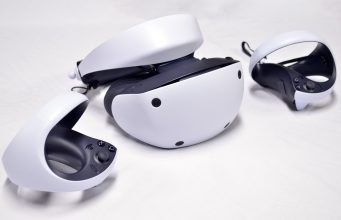
And then there’s the PSVR 2 ‘Sense’ controllers, which have a particularly interesting shape to them. Inside the circular strut is hidden infrared LEDs which can be seen by the headset to track the controllers.

Compared to something like Quest 2, the unique shape and placement of the ring does a good job of reducing the likelihood that you’ll bump the controllers into each other during hand-to-hand interactions. However, the design has a somewhat off-kilter balance to it.

The wrist-straps are mounted on the inside of the tracking ring and can be removed if desired.

The PSVR 2 controllers are rechargeable via USB-C, but Sony is also selling a purpose-built PSVR 2 controller charging dock to make it easy to charge your controllers without fiddling with cables. While its existence is appreciated, and it generally gets the job done, it’s a bit funky to sit the controllers in just the right spot to initiate the charge. Still, I’d rather this than plugging in two cables every time I’m done playing.

We’re looking forward to sharing our full PSVR 2 review in the near future—if you’ve got questions for us, drop them in the comments below!

PSVR 2 Unboxing – Close-up with the Final Version of Sony’s New VR Headset Read More »

uk-strikes-seven-russians-with-first-ever-joint-cyber-crime-sanctions

UK strikes seven Russians with first-ever joint cyber crime sanctions

In a coordinated action with US authorities, the UK has imposed sanctions on seven Russian cyber criminals associated with the deployment of the Conti and Ryuk ransomware as well as the Trickbot banking trojan. This follows a thorough investigation led by the National Crime Agency (NCA) and marks the UK’s first-ever joint cyber crime sanctions.

According to the British government, ransomware is a “tier one national security threat” that’s increasingly used to attack businesses and public sector organisations.

Ransomware groups known as Conti, Wizard Spider, UNC1878, Gold Blackburn, Trickman, and Trickbot have been responsible for the deployment of ransomware strains including Conti, Ryuk, and Trickbot.

The groups target organisations they expect would pay the most and time their attacks to cause the maximum damage. Conti and Ryuk alone have affected 149 UK individuals and businesses, extracting at least an estimated £27 million.

Conti’s recent victims in the UK include the Scottish Environment Protection Agency, food distribution firm Reed Boardall, Cleveland Council, and forensic laboratory Eurofins.

“These criminals and those that support them are not immune to UK action.

Conti was also one of the first cyber crime groups to declare support to Russia’s war in Ukraine, while the National Cyber Security Centre (NCSC) has assessed that key members of the group are “highly likely” to “maintain links” with the Russian Intelligence services.

And although the group was disbanded in May 2022, government reporting suggests that members continue to be involved in threatening UK security with new ransomware strains.

“The sanctions are the first of their kind for the UK and signal the continuing campaign targeting those responsible for some of the most sophisticated and damaging ransomware that has impacted the UK and our allies,” Graeme Biggar, NCA’s General Director, said in a statement.

“The United States and the United Kingdom are taking coordinated action targeting cyber criminals who launched assaults against our critical infrastructure,” Antony J. Blinker, US Secretary of State, highlighted in an associated press release. “We will continue to work with the United Kingdom and with other international partners to expose and disrupt cyber crime emanating from Russia.”

The people sanctioned include the following individuals:

UK and US sanction seven Russian cyber criminals
Credit: NCA

The seven individuals are now subject to travel bans and asset freezes. In addition, making funds available to them, such as paying ransomware — including crypto assets — has been strictly prohibited.

The US Treasury Department warned that “any foreign financial institution that knowingly facilitates a significant transaction, or provides significant financial services for any of the individuals or entities designated today could be subject to US correspondent or payable-through account sanctions.”

Through their collaboration, the UK and US authorities said they will continue to expose cyber criminals associated with the ransomware groups and crack down on their activities, aiming to reinforce their cyber security.

UK strikes seven Russians with first-ever joint cyber crime sanctions Read More »