Author name: Rejus Almole

tech-job-opportunities-remain-strong-despite-layoffs-—-here’s-why

Tech job opportunities remain strong despite layoffs — here’s why

Tech job opportunities remain strong despite layoffs — here’s why

Kirstie McDermott

Story by

Kirstie McDermott

If you’ve been reading about the current state of the tech industry in traditional media reports, you’d be forgiven for assuming that the industry is trembling on a precipice, about to plunge into the inky abyss.

The truth, though, is somewhat more nuanced. While sites such as layoffs.fyi, which tracks tech redundancies, are reporting that around 616 tech companies have laid off 184,101 employees so far this year, those layoffs should be viewed within a wider context.

Gartner’s Mbula Schoen, a senior director analyst, said in a recent blog post, “Gartner research found that the companies behind the 10 largest layoffs in tech talent still employ over 150,000 more people in total than at the beginning of 2020.”

Without diminishing the impact this has had on those who have lost their jobs, in the main, layoffs aren’t happening because companies are failing.

Rather they are happening because of a number of factors which include over-hiring during the pandemic and corrections around that, wider economic factors, inflation and higher interest rates, as well as cost-cutting.

Jeffrey Pfeffer, a professor at the Stanford Graduate School of Business, also posits that, “layoffs are basically an instance of social contagion, in which companies imitate what others are doing.”

Muddying the waters further is the fact that many of the roles that have been made redundant aren’t technical ones, for example, coding, machine learning, or data scientist jobs.

“Contrary to what we’re seeing in the headlines, many of those being impacted by layoffs are in business functions, rather than tech roles,” says Schoen.

Layoffs.fyi founder Roger Lee agrees. “Sales is the most common role, accounting for 20% of the laid-off tech workers. Recruiting and HR are the functions most disproportionately affected relative to their size; it’s becoming quite common for companies to lay off 50% or more of their talent teams.”

Layoffs and a talent crunch

As a result, we are in an environment where thousands of people at tech firms are losing their jobs––and yet employers are experiencing a talent crunch; struggling to fill specific roles.

A survey of recently laid off workers echoed this demand. It found that those who have been let go have been swiftly re-hired elsewhere. About 79% of workers recently hired after a tech-company layoff or termination landed their new job within three months of starting their search.

In another study from 2022, Gartner confirmed that a skills shortage exists, with 86% of CIOs saying they were experiencing more competition for qualified candidates, and 73% worried about IT talent attrition.

Because there simply isn’t a large pool of tech talent active in the job market, as a result, there are a number of sought-after, in-demand skills, such as web development, DevOps and database software, according to data from Statista. Those skills are closely followed by AI and ML, mobile development, cloud computing, and UI/UX.

The European Software Skills Alliance (ESSA) said in its 2021 Needs Analysis Report that, “There is a shift to new kinds of developers, like full stack developers and low code developers, but the most important insight is that developers are becoming more and more part of the regular organisation instead of a separate entity. Soft skills and knowledge of the business are therefore increasingly important for developers to be able to function.”

ESSA also identified skills gaps in the areas of data analysis and said that the key areas influencing software skills are AI, Big Data, Industry 4.0, and modelling, particularly in research.

If you’re in the market for a data job, Amsterdam-based RevoData B.V. is seeking the unusual title of Data Revolutionist to be the company’s data and AI champion, and work as part of a highly-talented, digital-native team to develop revolutionary data and AI solutions with DataBricks.

Also of interest is this Java Full Stack Developer for Industry X at Accenture in Berlin. This digital transformation role is ideal for someone whose expertise lay in the sophisticated design and implementation of high-quality software solutions with JavaScript and Java.

The AI field also needs more talent. Those with skills in augmented and virtual reality (AR/VR) are in particularly high demand, feeding into the requirements of Internet of Things companies, the metaverse, and Industry 4.0.

Those with machine learning skills should check out this role at Apple in Berlin. The Machine Learning High-Performance C++ Software Engineer will work on complex problems in computer vision that require robust, efficient, well tested, and clean solutions.

Still more jobs are set to be created as a whole new breed of startups launch. In what could be a symptom of big tech’s layoffs, the startup accelerator Y Combinator said applications increased by 20% in 2022, and in total it received over 38,000 applications. This means exciting new career opportunities are just on the horizon.

Want a new job in an emerging field? Discover thousands of employers actively hiring on the House of Talent Job Board

Get the TNW newsletter

Get the most important tech news in your inbox each week.

Also tagged with


Tech job opportunities remain strong despite layoffs — here’s why Read More »

chatgpt-has-generated-a-brand-new-app-sector-—-and-european-devs-are-leading-it

ChatGPT has generated a brand new app sector — and European devs are leading it

ChatGPT has generated a brand new app sector — and European devs are leading it

Thomas Macaulay

Story by

Thomas Macaulay

Senior reporter

Thomas is a senior reporter at TNW. He covers European tech, with a focus on deeptech, startups, and government policy. Thomas is a senior reporter at TNW. He covers European tech, with a focus on deeptech, startups, and government policy.

ChatGPT has spawned a new sector of AI chat apps — and Europe’s at its epicentre. Since the tool launched in November 2022, these apps have been downloaded 23.6 million times from the Google Play Store, according to research by App Radar.

The study uncovered 40 AI chat apps with over 10,000 users that harness ChatGPT or similar tech. Europe emerged as the global leader of the nascent segment. The continent was the birthplace of 14 apps that bagged a total of 8m downloads — 34% of the entire sector.

The remainder was divided between the Americas (nine apps with 2.7m downloads) and Asia (seven apps with 7.4m downloads). A further eight apps with 5.2m downloads had an unknown country of origin.

Thomas Kriebernegg, co-founder and managing director at App Radar, ranks the boom among the most explosive he’s ever witnessed for a new sector. He largely credits media interest in generative AI and the perception that ChatGPT is groundbreaking. In Europe, the growth has been further accelerated by talented devs and a receptive public.

“Generally speaking, European consumers are much more willing to experiment with new technology than people in other regions. You can see that clearly when you compare usage numbers for fintech apps and solutions in the UK with the US,” Kriebernegg told TNW via email.

“This culture enables European app developers to grow their consumer base faster before expanding into new territories.”

The continent’s standout country is Turkey,  which has attracted 5.9m downloads across four apps — including the top three. With a rising development ecosystem, a mobile gaming hub, regulations supporting startups, and an expanding list of tech successes topped by Getir, the country is a potential powerhouse in the segment. But converting its early advantage into a lucrative ecosystem will be challenging.

In the new wave of AI chat apps, promising user bases haven’t yet produced high revenues.

At present, AI chat apps are typically monetised with ad revenue and premium subscriptions, but basic use is essentially free. To secure a large, paying customer base, devs will need to offer unique services that add major value. Unfortunately for the app-makers, existing users appear reluctant to invest.

Nonetheless, Kriebernegg expects the sector to continue growing — for now.

“Oftentimes app segments end up getting dominated by 10 or 20 apps that account for the vast majority of users,” he says. “At the moment eight apps have more than a million users, so there’s plenty of room for new challengers.

“As the market starts to coalesce and leaders emerge it will become much more difficult for new entrants to compete unless they bring something unique and innovative to the table.”

“It’s clear that this is just the beginning.

Most of the current apps are in the ‘Productivity’ and ‘Tools’ categories of the Google Play Store, which suggests that they’re designed for day-to-day work and tasks. A smaller group within the ‘Entertainment’ category is intended for companionship.

Analysts expect new use cases to emerge fairly quickly, but it’s still unclear whether customers will ultimately prefer specialist AI apps or ‘one-stop shops’ that cover various tasks.

For the early app users, ChatGPT appears to predominantly provide a smarter search function or a quicker way to draft messages. The model’s Q&A capabilities are particularly popular, which may further alarm Google about the future of search.

“ChatGPT apps enable this type of natural searching, presenting information in a really intuitive way,” says Kriebernegg. “It can be more accurate and much faster than using these questions or keywords on Google. As a result, people are really embracing ChatGPT apps as assistants.

“However, it’s clear that this is just the beginning. I would expect, once people really get to grips with generative AI, they will start to look at how they can automate daily tasks or assist with creativity — such as producing imagery or music.”

Get the TNW newsletter

Get the most important tech news in your inbox each week.

Also tagged with


ChatGPT has generated a brand new app sector — and European devs are leading it Read More »

the-park-playground’s-newest-vr-experience-for-battle-game-fans-is-here

The Park Playground’s Newest VR Experience for Battle Game Fans Is Here

Europe-based virtual reality experiences provider The Park Playground recently launched its latest offering, a new esports-inspired VR experience called NanoClash Focus. A first in the industry, this new virtual reality game allows two opposing teams to battle it out simultaneously on two independent fields. It’s a fully mobile, free-roam game that aims to provide an immersive and engaging VR experience for players.

An Exciting Combo of VR Experience and Esports

For NanoClash Focus The Park Playground partnered with HTC and Triangle Factory. The company was encouraged by the success of one of its past VR experiences that allowed players to compete remotely in a virtual battlefield in separate cities. This led to the development of NanoClash Focus, which used elements from esports in its design and artificial intelligence technology to ensure an enhanced user experience.

VR experience NanoClash Focus The Park Playground

Players of NanoClash Focus are virtually transported to a hanging platform in a futuristic setting, where they compete against another team in a laser shoot-out, sports battle-style. Each team consists of four to eight people, and the goal is to be the first to reach the arena floor and prevent opponents from doing so by shooting with either laser guns or laser cannons.

Using HTC VIVE Focus 3 wireless headsets that offer greater mobility, players can freely roam the playing field. “Power-ups” are up for grabs in the game, giving teams a solid advantage when they utilize them strategically. The game is a VR experience combined with the exciting features of esports, a move that The Park Playground wants to pursue.

NanoClash Focus VR experience The Park Playground

“With two teams positioned on two independent free roam fields and rewards given for teamwork and strategic thinking, NanoClash Focus is an exciting example of how we’re driving technological innovations in LBE VR alongside our partners,” The Park Playground CEO Peter Vindevogel said in a press release shared with ARPost.

According to Vindevogel, the company plans to develop more experiences that use elements of other gaming formats. NanoClash Focus is an example of a location-based VR experience that is inspired by esports for a more immersive, interactive, and inclusive experience. “We’ll be seeing this cross-pollination between LBE VR and elements more traditionally associated with gaming surfacing much more frequently in the future,” Vindevogel further explained.

Developing More VR Experiences with AI

The release of NanoClash Focus is an exciting achievement for The Park Playground. The company has only recently begun experimenting with AI technology and data management in its game development process. The result is a more efficient way of developing seamless and innovative VR experiences that The Park Playground aims to achieve.

“Tapping into emerging technologies like AI is something LBE VR providers must consider doing to remain relevant and drive innovative VR experiences that keep people coming back for more,” said the company’s CTO Gilles-Adrien Cenni.

With the launch of NanoClash Focus, The Park Playground seems poised to enter more markets in Europe, Australia, and the US. Headquartered in the Netherlands, the VR experience company currently has 13 owned and franchised locations around the world.

It recently opened two new locations in Brisbane, Australia, and Leeds, UK, and is set to open another venue in Birmingham this year. NanoClash Focus is available for players to try out in all of The Park Playground’s locations globally.

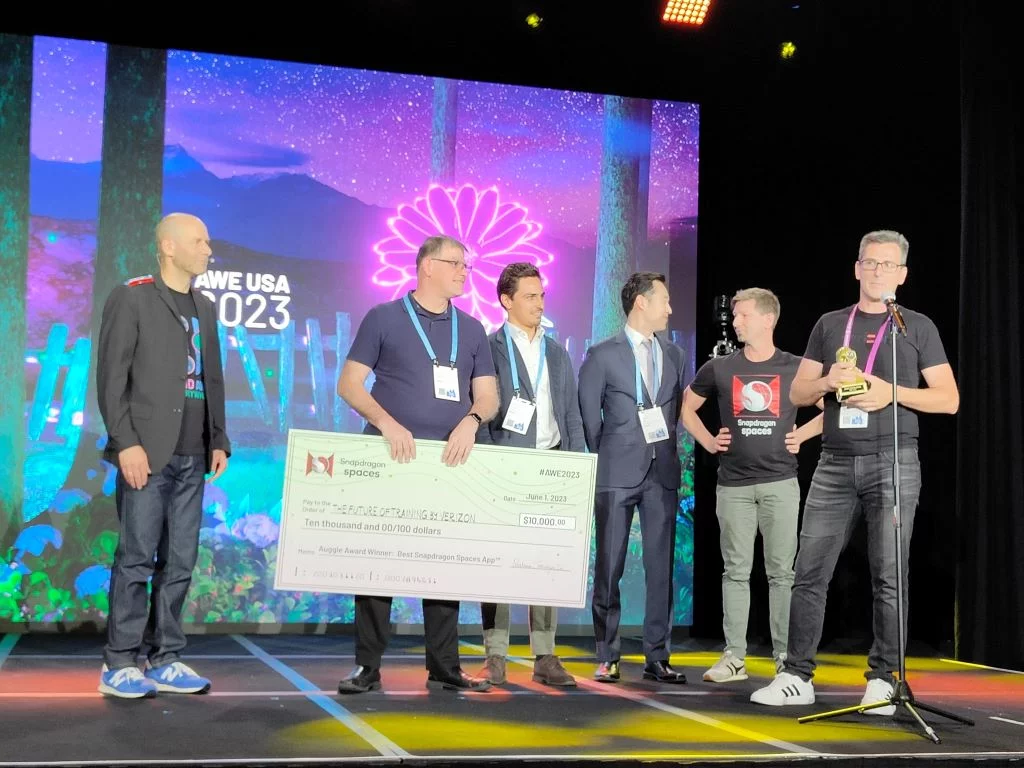
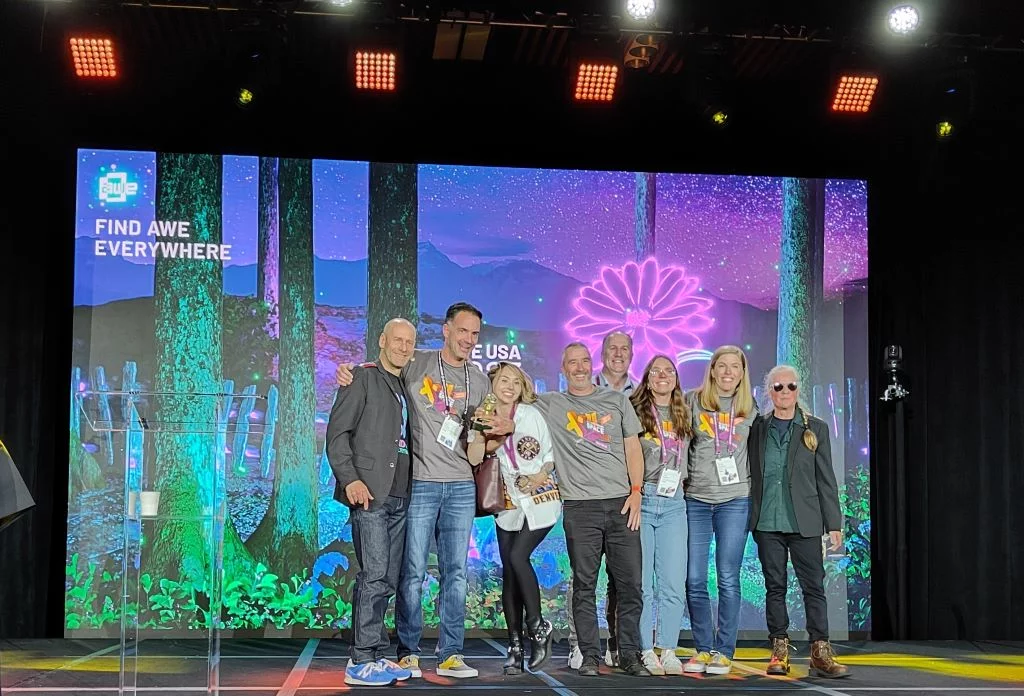
AWE USA 2023 giveaway

The Park Playground’s Newest VR Experience for Battle Game Fans Is Here Read More »

new-promo-video-suggests-standalone-‘asgard’s-wrath’-game-coming-to-quest

New Promo Video Suggests Standalone ‘Asgard’s Wrath’ Game Coming to Quest

Meta is putting on its Quest Gaming Showcase in June, and while we’re not certain what standalone goodies the company has in store, a promo video seems to suggest we’ll be getting something from the universe of hit Rift exclusive Asgard’s Wrath (2019).

We say ‘universe’ and not ‘direct port’ because we simply can’t tell for now based on the few seconds of footage, which seems to show Loki’s helmet with what appears to be a shadowy god-like figure in the background.

What suggests the promo may not be a flat-out Rift to Quest port is the desert environment. If you’ve played Asgard’s Wrath on Rift, you may remember some post-credits sequel bait, where you find an Egyptian ankh that suggests a follow-up will take place in an Egyptian-inspired environment.

Meta largely abandoned PC VR gaming almost immediately after releasing Rift S and Asgard’s Wrath in 2019 however, afterwards devoting its clutch of VR gaming studios to produce content for Quest and putting the kibosh on a direct-to-Rift sequel in the process. Maybe the next in the series will live on as a Quest native from the get-go?

It would certainly make more sense than Meta’s Sanzaru Games going back and completely overhauling the original Asgard’s Wrath for Quest, although we haven’t heard anything from the studio since it was acquired by Meta in early 2020. It’s not inconceivable that the original and a sequel could be in the works for Quest.

Meanwhile, we’ll be waiting to hear about the other rash of long-promised Quest content yet to come, including Grand Theft Auto: San Andreas, Assassin’s Creed Nexus, and Vertigo Games’ upcoming work with Deep Silver’s IP, which could be anything from Metro to Dead Island.

Follow along with us on June at at 10 AM PT to find out, as Meta is slated to share over 40 minutes of content, including new game announcements, gameplay first-looks, updates to existing games, and more.

New Promo Video Suggests Standalone ‘Asgard’s Wrath’ Game Coming to Quest Read More »

the-hidden-design-behind-the-ingenious-room-scale-gameplay-in-‘eye-of-the-temple’

The Hidden Design Behind the Ingenious Room-Scale Gameplay in ‘Eye of the Temple’

Eye of the Temple is one of the rare VR games that focuses on not just on pure room-scale movement, but dynamic room-scale movement. The result is a uniquely immersive experience that required some clever design behind the scenes to make it all work. This guest article by developer Rune Skovbo Johansen explains the approach.

Guest Article by Rune Skovbo Johansen

Rune Skovbo Johansen is a Danish independent game developer based in Turku, Finland. His work spans games and other interactive experiences, focused on tech, wonder, and exploration. After positive reception of the 2016 VR game jam game Chrysalis Pyramid, he started working on a more ambitious spiritual successor, Eye of the Temple, and at the end of 2020 he quit his day job to pursue indie game development full-time.

In Eye of the Temple, you move through a vast environment, not by teleportation or artificial locomotion, but by using your own feet. It makes unique use of room-scale VR to deliver an experience of navigating an expansive space.

In Eye of the Temple you move around large environments using your own feet

But how does it work behind the scenes? To mark the upcoming release of Eye of the Temple on Quest 2, I wanted to take the time to explain these aspects of the game’s design that I’ve never fully gone into detail with before. In this article we’ll go over a variety of the tricks the game uses to make it all work. Let’s start with the basics of keeping the player in the play area

Keeping the Player in the Play Area

Say you need to go from one tall pillar in the game to another via a moving platform. You step forward onto the platform, the platform moves, and then you step forward onto the next pillar. But now you’re outside your physical play area.

Moving platforms are positioned in a way to keep players inside the play area

If we instead position the moving platform to the side, it goes like this: You sidestep onto the platform, it moves, and you sidestep onto the next pillar. Since you took a step right, and then left, you’re back where you started in the center of the play area. So the game’s tricks are all about how the platforms are positioned relative to each other.

Now, to get a better sense for it, let’s look at some mixed reality footage (courtesy of Naysy) where a grid representing the play area is overlaid on top.

Mixed reality footage with a grid overlaid on top which represents the play area

Keeping an Overview in the Level Design

Now that we’ve seen how the trick works, let’s take a look at how I keep track of it all when doing the level design for the game. First things first – I made this pattern, which represents the player’s entire play area – or the part of it the game takes advantage of anyway:

A pattern representing the physical play area

As you can see, there’s a thick white border along the edge, and a thick circle in the center.

Every platform in the game has a designated spot in the play area and a pattern overlay that shows what that spot is. For platforms that are a single tile large, it’s generally one of nine positions. The overlay makes it easy to see if a given platform is positioned in the center of the play area, or at an edge or corner.

The play area pattern overlaid on each platform and its end positions make it easy to see if they are lined up correctly in the level design

Additional overlays show a ghostly version of the pattern at both the start and end positions of a moving platform. This is the real trick of keeping track of how the platforms connect together, because these ghostly overlays at the end positions make it trivial to see if the platforms are lined up correctly in the level design when they touch each other. If the adjacent ghostly patterns are continuous like puzzle pieces that fit together, then the platforms work correctly together.

It still took a lot of ingenuity to work out how to position all the platforms so they both fit correctly together and also take the player where they need to go in the virtual world, but now you know how I kept the complexity of it manageable.

Getting the Player’s Cooperation

The whole premise of getting around the world via these moving platforms is based on an understanding that the player should step from one platform to another when they’re lined up, and not at other times. The most basic way the game establishes this is by just telling it outright to the player in safety instructions displayed prior to starting the game.

One of the safety instructions shown before the game begins

This instructions is shown for two reasons:

One is safety. You should avoid jumping over gaps, otherwise you would risk jumping right out of your play area and into a wall, for example.

The other is that the game’s system of traversal only works correctly when stepping from one platform to another when they line up. This is not as critical – I’ll get back to later what happens if stepping onto a platform that’s misaligned – but it still provides the best play experience.

Apart from the explicit instructions, the game also employs more subtle tricks to help ensure the player only steps over when blocks are correctly aligned. Consider the following example of a larger 2 x 2 tile static platform the player can step onto. A moving platform arrives from the side in a way that would allow the player to step off well before the platform has stopped moving, but that would break the game’s traversal logic.

In this room, ‘foot fences’ are used to discourage the player from stepping from one platform to another when they are not correctly aligned

To avoid this, “foot fences” were placed to discourage the player from stepping over onto the static platform (or away from it) at incorrect positions. The fences are purely visual and don’t technically prevent anything. The player can still step over them if they try, or right through them for that matter. However, psychologically it feels like less effort to not step over or through a fence and instead step onto the static platform where there’s a gap in the fence. In this way, a purely non-technical solution is used as part of the game’s arsenal of tricks.

Continued on Page 2: Correcting for Unaligned Platforms »

The Hidden Design Behind the Ingenious Room-Scale Gameplay in ‘Eye of the Temple’ Read More »

can-ai-save-lives?-cancer-detection-study-suggests-yes

Can AI save lives? Cancer detection study suggests yes

Can AI save lives? Cancer detection study suggests yes

Linnea Ahlgren

Story by

Linnea Ahlgren

Much of the world may currently be fretting about how to limit the impact (lack of privacy, copyright issues, loss of jobs, world domination, etc.) of artificial intelligence. However, that does not mean that there isn’t enormous potential for AI to improve quality of life on earth. 

One such application is healthcare. With the ability to process big data sets, the deployment of AI could lead to significant advances in predictive diagnostics, including early detection of cancer. While more research is needed, one of the latest studies in the field shows promising results for AI-assisted diagnosis of lung cancer. 

Doctors and researchers at the Royal Marsden NHS foundation trust, the Institute of Cancer Research, and Imperial College London have built an AI algorithm they say can diagnose cancerous growths more efficiently than current methods. 

In the study named OCTAPUS-AI, researchers used imaging and clinical data from over 900 patients from the UK and Netherlands following curative radiotherapy to develop and test ML algorithms to see how accurately the models could predict recurrence. 

Specifically, the study looked at if AI could help identify the risk of cancer returning in non-small cell lung cancer (NSCLC) patients. Researchers used CT scans to develop an AI algorithm using radiomics. This is a quantitative approach which extracts novel data and predictive biomarkers from medical imaging. 

Research algorithm superior to current technology

NSCLC patients make up 85% of lung cancer cases. While the disease is often treatable when caught early, in over a third of patients, the cancer returns. The study found that using the algorithm, clinicians may eventually be able to identify recurrence earlier in high-risk patients. 

The scientists used a measure called area under the curve (AUC) to see how efficient the model was at detecting cancer. A perfect 100% accuracy score would be a 1, whereas a model that was purely guessing 50-50 would get 0.5. In the study, the AI algorithm built by the researchers scored 0.87. This can be compared to the 0.67 score of the technology currently in use. 

“Next, we want to explore more advanced machine learning techniques, such as deep learning, to see if we can get even better results,” Dr Sumeet Hindocha, Clinical Oncology Specialist Registrar at The Royal Marsden NHS Foundation Trust, and Clinical Research Fellow at Imperial College London, said. “We then want to test this model on newly diagnosed NSCLC patients and follow them to see if the model can accurately predict their risk of recurrence.”

Support for practitioners – and patients

Rather than believing it will replace doctors, most now view AI in healthtech as a tool that will assist practitioners in providing the best possible care – including improved bedside manners. Despite investors growing gradually more risk-averse over the past year, the healthcare AI sector is still expected to grow from close to $14 billion in 2023 to $103 billion by 2028. 

The UK is teeming with AI healthtech startups. Many are focused on drug development, genomic analysis or more consumer-centric telehealth symptom checking and wearables. However, some are intent on improving disease detection and diagnosis. These include the likes of Mendelian, who just received close to £1.5 million to roll out its AI-based solution for rare disease diagnosis as part of the government’s investment into AI technology within the NHS. 

The rest of Europe also has its fair share of diagnostic AI startups. Among them are Liége-based Radiomics. The company focuses on the detection and phenotypic quantification of solid tumours based on standard-of-care imaging. In Norway, DoMore diagnostics is using AI and deep learning to increase the prognostic and predictive value of cancer tissue biopsies. The company’s founders also say it could help guide the selection of therapy to avoid over- and undertreatment. 

Meanwhile, a few percentage points of more accurate diagnosis, vital though they may be for the affected individual, may not be the only positive impact AI could have on our care systems. 

According to Eric Topol, the author of Deep Medicine: How Artificial Intelligence Can Make Healthcare Human Again, “the greatest opportunity offered by AI is not reducing errors or workloads, or even curing cancer: it is the opportunity to restore the precious and time-honoured connection and trust—the human touch—between patients and doctors.”

Get the TNW newsletter

Get the most important tech news in your inbox each week.

Also tagged with


Can AI save lives? Cancer detection study suggests yes Read More »

chatgpt-is-back-in-italy

ChatGPT is back in Italy

ChatGPT is back in Italy

Ioanna Lykiardopoulou

Story by

Ioanna Lykiardopoulou

Ioanna is a writer at TNW. She covers the full spectrum of the European tech ecosystem, with a particular interest in startups, sustainabili Ioanna is a writer at TNW. She covers the full spectrum of the European tech ecosystem, with a particular interest in startups, sustainability, green tech, AI, and EU policy. With a background in the humanities, she has a soft spot for social impact-enabling technologies.

In March, Italy became the first Western country to temporarily ban access to ChatGPT within its borders. Citing concerns over “unlawful” data collection and the lack of an age verification mechanism for minors, the country’s data protection agency — Garante — blocked the service, requiring OpenAI to meet a series of demands for the suspension to be lifted.

As of April 28, Italian users have regained access to the AI system, after OpenAI implemented the majority of the measures ordered by Garante. These address age verification, transparency, and the rights of users and non-users alike.

First off, the US-based company has introduced a “welcome back” pop-up box, which asks users to confirm they’re above 18 years-old, or that they have obtained parental consent if they’re aged between 13 and 18. They also need to specify their birthday on the sign-up page to gain access.

ChatGPT Italy
The pop-up box upon entering ChatGPT using an Italian IP address.

In addition, the pop-up’s text contains links to OpenAI’s new privacy policy and a help center article on how ChatGPT is developed and trained. This information notice is easily visible both on the log-in and the sign-up page.

By clicking on the links, users can get information about what kind of data is being processed for training purposes and under what conditions. OpenAI has now clarified that it’ll continue processing certain types of data on a contractual basis to enable the performance of its services, but for algorithm training data processing will be on the legal basis of legitimate interest.

To enable users and non-users to better exercise their rights, as requested by Garante, the company has further included an opt-out form for the processing of personal data. Users can also obtain erasure for inaccurate information, although, for now, OpenAI claims it’s “technically impossible” to provide rectifications.

While the Italian regulator welcomed OpenAI’s new measures, it called on the company to comply with the extra requests it had ordered as well.

Besides the age gate, OpenAI has to introduce an age verification system that prevents minors from using the service. It also needs to conduct a campaign informing Italians that their personal data may have been used for ChatGPT’s training, while raising awareness of the new information policy and attached data rights.

The Italian agency said that it “acknowledges the steps forward made by OpenAI to reconcile technological advancements with respect for the rights of individuals and hopes that the company will continue in its efforts to comply with European data protection legislation.” Nevertheless, it will continue its investigation into the company’s compliance with GDPR.

While Italy’s ChatGPT ban didn’t last for more than a month, it’s the first attempt in the Western world to regulate a generative AI tool like OpenAI’s model. The company’s compliance may set a precedent for other European countries as well — with several other data protection agencies (including France’s, Ireland’s, and Spain’s) paying close attention to the developments. 

Get the TNW newsletter

Get the most important tech news in your inbox each week.

Also tagged with


ChatGPT is back in Italy Read More »

getir-eyes-flink-takeover-as-europe’s-rapid-grocery-delivery-sector-consolidates

Getir eyes Flink takeover as Europe’s rapid grocery delivery sector consolidates

Getir eyes Flink takeover as Europe’s rapid grocery delivery sector consolidates

Siôn Geschwindt

Story by

Siôn Geschwindt

The COVID-19 pandemic was a veritable gold rush for food delivery startups — as the world shut down, people ordered in. These companies promised rapid delivery of groceries from local stores using bikes and scooters, and as demand skyrocketed, investors poured cash into the booming industry. 

But now, amid soaring inflation and a post-pandemic downturn, the ‘quick commerce’ market is undergoing rapid consolidation with small companies being swallowed up by a few big players.

Founded in 2020 at the height of the pandemic, German-based grocery delivery startup Flink remains one of Europe’s last remaining independent grocery delivery groups. But that could be about to change: Turkish competitor Getir is in talks to acquire the startup, Financial Times reports

The talks come just five months since Getir acquired Berlin-based rival Gorillas in a $1.2bn deal that valued the combined group at $10bn, making it Europe’s largest quick commerce company. Getir operates in around 50 cities across seven European countries, including the UK, Germany, France, Italy, Spain, Netherlands, and Portugal.

Parallel to the takeover talks, Flink is looking to raise $100m from existing investors at a valuation of $1bn for the entire company. This is a major departure from mid-2022, when the startup, which is still loss-making, was valued at $5bn. 

Despite turbulent economic times and less demand from consumers, the startup’s core German business aims to become profitable by the end of this year. It also has subsidiaries in France and the Netherlands and hopes its overall business will be in the green by the end of 2024.  

It is yet unclear how much Getir is willing to pay for Flink. There is no guarantee of an agreement being reached, either, said FT, citing people familiar with the matter. However, an eventual takeover could be streamlined by the fact that Abu Dhabi sovereign wealth fund Mubadala Investment Company holds a stake in both companies.  

The merger would further consolidate Europe’s food delivery market, which has seen a number of major acquisitions in recent years. In addition to Getir’s blockbuster buy-out of Gorillas, it also acquired UK’s Weezy and Spain’s Blok in 2021, while US-based Gopuff bought British startups Dija and Fancy in the same year, and Flink acquired French startup Cajoo in 2022.  

If the takeover is completed, Getir’s only competition in the European market would be GoPuff, which recently downsized and only operates in the UK and France. This would essentially give Getir a monopoly over rapid grocery delivery on the continent. 

While Deliveroo and UberEats also offer grocery delivery, they have a different business model, relying on third-party shops while Getir has its own warehouses or dark stores, which offers a “competitive advantage”, says the company’s CEO. The only other potential competitor is Zapp, but it operates solely in London.  

Despite its apparent success, Getir’s place at the top is anything but secure. The company is not yet profitable in Europe, and in May 2022 it has cut 14% of its global workforce, citing soaring inflation. But there is hope that as competition lessens the remaining big players like Getir will be able to cash in on demand for rapid grocery delivery, which still remains relatively high.       

Get the TNW newsletter

Get the most important tech news in your inbox each week.

Also tagged with


Getir eyes Flink takeover as Europe’s rapid grocery delivery sector consolidates Read More »

immerse-yourself-in-sandbox-vr’s-new-multi-story-vr-game-“dragonfire”

Immerse Yourself in Sandbox VR’s New Multi-Story VR Game “Dragonfire”

Sandbox VR, known for its location-based VR games, announced today the launch of its newest VR experience. Seekers of the Shard: Dragonfire is the company’s first VR game that features multiple storylines, created by the company’s AAA in-house gaming studio.

VR game “Dragonfire”: A New Immersive Experience Each Time

After a successful partnership with Netflix that will see its hit series Squid Game developed into an immersive VR experience later this year, Sandbox VR continues to explore new ways to develop VR worlds for its customers. Dragonfire’s multiple storylines allow players to experience something different each time they play, even after completing it.

Developed by experts in the VR industry, Dragonfire was helmed by the former lead designer on Assassin’s Creed franchise and Sandbox VR’s VP of Content and Creative Director, Michael Hampden.

The new VR game makes full use of Sandbox VR’s proprietary technology that lets players experience a fully immersive, VR-powered adventure. It’s the first game that features branching storylines, making each experience different from others.

Sandbox VR Develops Unique VR Experiences

For Sandbox VR CEO Steve Zhao, developing Dragonfire is a step toward the company’s goal of providing unique VR experiences. “With each experience we create, our goal is to push ourselves to invent new ways to immerse players in virtual worlds,” he stated in a press release shared with ARPost.

Set in a castle in a fantasy world, VR game Seekers of the Shard: Dragonfire sees players come together as a group of explorers. They encounter a variety of enemies and mysteries and go through several different areas to accomplish their mission.

Sandbox VR Multi-Story VR Game Dragonfire

Because of the branching story arcs within the game, players can choose from many options during gameplay. In essence, players can experience different versions of Dragonfire, depending on their choices. In fact, younger gamers will be able to play an age-appropriate version of the game that does not contain violence.

Consequently, such a complex design posed a big challenge for Sandbox VR in the development of Dragonfire.

“There’s a reason why there isn’t anything like Dragonfire available out there, because so many features have to be designed from the ground up,” Hampden said.  “Melee combat, magic weapons and spells, unlockable items, and choosing where to go next are just a few of the new features we have added to make this perhaps the deepest and most replayable location-based VR experience yet.” 

Expanding Sandbox VR’s Virtual Worlds

Sandbox VR is a location-based VR startup with over 35 locations around the world. It provides immersive VR experiences to guests, which the company describes as similar to the fictional “holodecks” popularized by the Star Trek franchise. Up to six guests can participate in each experience.

Sandbox VR uses motion capture technology and high-quality haptics to give players a sense of realism while they explore virtual worlds. Each gameplay is designed to be a social experience where friends and family work together to complete game objectives.

Seekers of the Shard: Dragonfire is the seventh exclusive immersive experience developed by Sandbox VR, along with Amber Sky 2088, Star Trek: Discovery, Deadwood Mansion, Deadwood Valley, UFL: Unbound Fighting League, and Curse of Davy Jones. Squid Game, the highly anticipated VR experience in partnership with Netflix, is currently under development, set to launch in late 2023.

Immerse Yourself in Sandbox VR’s New Multi-Story VR Game “Dragonfire” Read More »

meta-to-host-quest-gaming-showcase-just-days-ahead-of-rumored-apple-headset-announcement

Meta to Host Quest Gaming Showcase Just Days Ahead of Rumored Apple Headset Announcement

Meta announced its third annual Quest Gaming Showcase is arriving next month, coming only a few days before Apple’s rumored XR headset announcement at Worldwide Developers Conference (WWDC).

Meta is livestreaming the Quest Gaming Showcase on June 1st, a bit unusual for the company, as it traditionally holds the annual event in late April.

Calling it their “biggest celebration of the depth and breadth of content across the Meta Quest Platform yet,” Meta is slated to share over 40 minutes of content, including a brand-new pre-show covering game updates and debut trailers, starting 15 minutes before the show begins.

Meta says to expect new game announcements, gameplay first-looks, updates to existing games, and more. There’s also set to be a post-show developer roundtable, which will feature conversation around upcoming games.

There could be at least one clue to what’s in store, as we get a brief glimpse at a horned helmet in the showcase’s promo video, which seems very much like Loki’s helmet from Rift exclusive Asgard’s Wrath (2019). Maybe Meta’s Sanzaru Games has slimmed down the Norse-inspired RPG?

Meanwhile, previous reports maintain Apple is finally set to unveil its long rumored mixed reality headset during the company’s WWDC keynote, taking place on Monday, June 5th.

Provided Apple indeed plans to announce its headset at WWDC, Meta could be looking to generate so called ‘strategic noise’ to better manage market reactions, and potentially offset any negative sentiment prior to Apple’s expected announcement—undoubtedly slated to be a pivotal moment for the entire XR industry.

Meta recently released its Q1 2023 earnings report, showing a consistent investment of around $4 billion per quarter into its XR division Reality Labs. With Apple rumored to be unveiling their own XR headset and a host of apps, reportedly set to include everything from fitness to VR/AR gaming, Meta may want to showcase where some of that investment is going.

Who knows? We may even hear more about Meta’s promised Quest 3 at the gaming showcase, which the company has confirmed will “fire up enthusiasts” when its released at some point this year, notably targeting a higher price point than its Quest 2 headset.

To find out, tune into the Quest Gaming Showcase on June 1st at 10AM PT (local time here), livestreamed across the company’s various channels, including TwitchFacebookYouTube, and in Meta Horizon Worlds.

Meta to Host Quest Gaming Showcase Just Days Ahead of Rumored Apple Headset Announcement Read More »

major-vcs-unite-in-alliance-to-help-startups-and-investors-reach-net-zero

Major VCs unite in alliance to help startups and investors reach net zero

Major VCs unite in alliance to help startups and investors reach net zero

Ioanna Lykiardopoulou

Story by

Ioanna Lykiardopoulou

Ioanna is a writer at TNW. She covers the full spectrum of the European tech ecosystem, with a particular interest in startups, sustainabili Ioanna is a writer at TNW. She covers the full spectrum of the European tech ecosystem, with a particular interest in startups, sustainability, green tech, AI, and EU policy. With a background in the humanities, she has a soft spot for social impact-enabling technologies.

A group of over 23 VCs across Europe and the US have joined forces this week to guide startups and their early-stage investors towards net zero, in an effort to decarbonise the global economy and the venture capital industry.

The Venture Climate Alliance (VCA) consists of both generalist and climate-focused firms, and its members manage a combined $62.3 billion in assets, according to Crunchbase figures.

To begin with, participating VCs pledge to inventory their Scope 1-3 emissions and, in turn, reach either net zero or negative emissions for their own operations (such as office energy consumption and employee commuting) by 2030 or earlier.

VCA’s members will also encourage their portfolio startups to align with the net zero goals by 2050 or sooner, and will help founders in setting the right targets for their businesses. For climate-focused companies, this could include support to existing efforts. For non-climate-focused companies, this could entail providing access to additional resources, such as specific tools and methodologies.

Once startups have set their net zero transition goals, the VCA will offer further assistance depending on their needs, such as supporting response mechanisms to climate-related risks, or adapting to regulatory developments.

The alliance’s members will share annual updates on both their own and their portfolio companies’ progress.

“Our goal is to bridge the gap between what’s happening in public markets, where hundreds of companies have made bold forward-looking net zero commitments, and early stage innovation, which has the potential to decarbonise legacy industries through a combination of better products, more efficient processes, and lower costs,” said Alexandra Harbour, founder & chair of the VCA and a principal at Prelude Ventures — one of the alliance’s founding members.

“By harnessing the collective expertise of top venture capitalists from both sides of the Atlantic, the VCA has the potential to significantly influence the funding decisions that shape the future of climate startups and technologies,” added Danijel Višević, Founding Partner at VCA member World Fund.

The Venture Capital Alliance counts 10 founding members: Prelude Ventures, Capricorn Investment Group, DCVC, Energy Impact Partners, Galvanize Climate Solutions, S2G Ventures, Union Square Ventures, Tiger Global, World Fund and 2150.

The following firms are also participating: Obvious Ventures, Congruent Ventures, Valo Ventures, Clean Energy Ventures, Fifth Wall, Overture Ventures, Blackhorn Ventures, Spring Lane Capital, Azolla Ventures, Systemiq Capital, The Westly Group, Innovation Endeavors, and ReGen Ventures.

The VCA is also an official partner of the Glasgow Financial Alliance for Net Zero (GFANZ) and the UN Climate Change High-Level Champions as part of its Race to Zero campaign.

Membership to the alliance is open to any VC that agrees to pledge to its commitments.

Get the TNW newsletter

Get the most important tech news in your inbox each week.

Also tagged with


Major VCs unite in alliance to help startups and investors reach net zero Read More »

“operation-money-grab”:-get-your-spy-gear-ready-for-the-greatest-heist-in-valoarena

“Operation Money Grab”: Get Your Spy Gear Ready for the Greatest Heist in ValoArena

Operation Money Grab is all systems go. The heist is officially on. Valo Motion has launched the latest addition to its growing game library of multiplayer mixed reality games for ValoArena. This heist-themed game is set to challenge players physically and mentally as they become immersed in a spy adventure that’s almost straight out of a Hollywood movie. To complete all the missions, you’d need to keep your wits and work well with your team.

Grab Your Squad and Pull Off the Greatest Heist in MR

Recruit a team of up to six players and attempt to pull off the greatest heist in ValoArena. Be spies or thieves and grab as much money and valuables as you can while outmaneuvering high-tech security systems and evading capture.

Operation Money Grab MR game ValoArena Valo Motion

Upon entering the game arena, be transported to the lobby of the Museum of Money. Enter the elevator and brace yourself for a highly interactive and mentally stimulating spy adventure. As the elevator door opens, figure out how to get past the unique security system and snatch valuable items. Work as a team to solve puzzles and go through physical obstacles on every floor of the building. Once all floors are cleared, head to the roof of the building, then board the helicopter on standby for your grand escape.

Throughout the game, references to popular spy and heist movies add humor and make you feel like the lead star in a Hollywood film. Download the Valo Motion app to create shareable play videos and release your “trailer” on social media.

Powered by Valo Motion Technology

Like all other mixed reality games for Valo Arena, Operation Money Grab is powered by the proprietary motion tracking technology of Valo Motion. With full body tracking, players can roam freely around the game arena and play untethered without using any wearables.

Large digital screens, visually stunning graphics, and spatial audio create a hyper-realistic virtual environment that immerses players in the game.

MR game Operation Money Grab ValoArena Valo Motion

According to Lauri Lehtonen, Lead Developer in Valo Motion, the popularity of the game Groundfall, inspired by The Floor is Lava, made their team think of other playground games they could draw inspiration from. Lehtonen recounts,

“We noticed that quite a few of them are played by moving back and forth in a limited space. This gave rise to the idea of designing a game with a series of different challenges players must go through in the ValoArena play area,” Lehtonen said in a press release shared with ARPost“That idea eventually developed into the espionage and robbery-themed game Operation Money Grab, where the game challenges vary a lot during one game, and the players are taken on a kind of mini-adventure through a building to be robbed.”

Innovative Games That Keep People Active

Along with Astro Blade, Runway Zero, Toywatch Island, and Groundfall, Operation Money Grab highlights Valo Motion’s aim to encourage people to lead active and healthy lives through interactive experiences. “Valo Motion takes great pride in developing ValoArena experiences that get people on their feet and moving,” said Raine Kajastila, CEO and founder of Valo Motion.

By creating innovative games that are entertaining and highly interactive, Valo Motion hopes to make it easier and much more fun for people to develop and maintain healthy habits. We expect to see its game library grow with more themed games that would pique the different interests of players of all ages.

“Operation Money Grab”: Get Your Spy Gear Ready for the Greatest Heist in ValoArena Read More »