Author name: Rejus Almole

awe-usa-2023-day-one:-xr,-ai,-metaverse,-and-more

AWE USA 2023 Day One: XR, AI, Metaverse, and More

AWE USA 2023 saw a blossoming industry defending itself from negative press and a perceived rivalry with other emerging technologies. Fortunately, Day One also brought big announcements, great discussions, and a little help from AI itself.

Ori Inbar’s Welcome Address

Historically, AWE has started with an address from founder Ori Inbar. This time, it started with an address from a hologram of Ori Inbar appearing on an ARHT display.
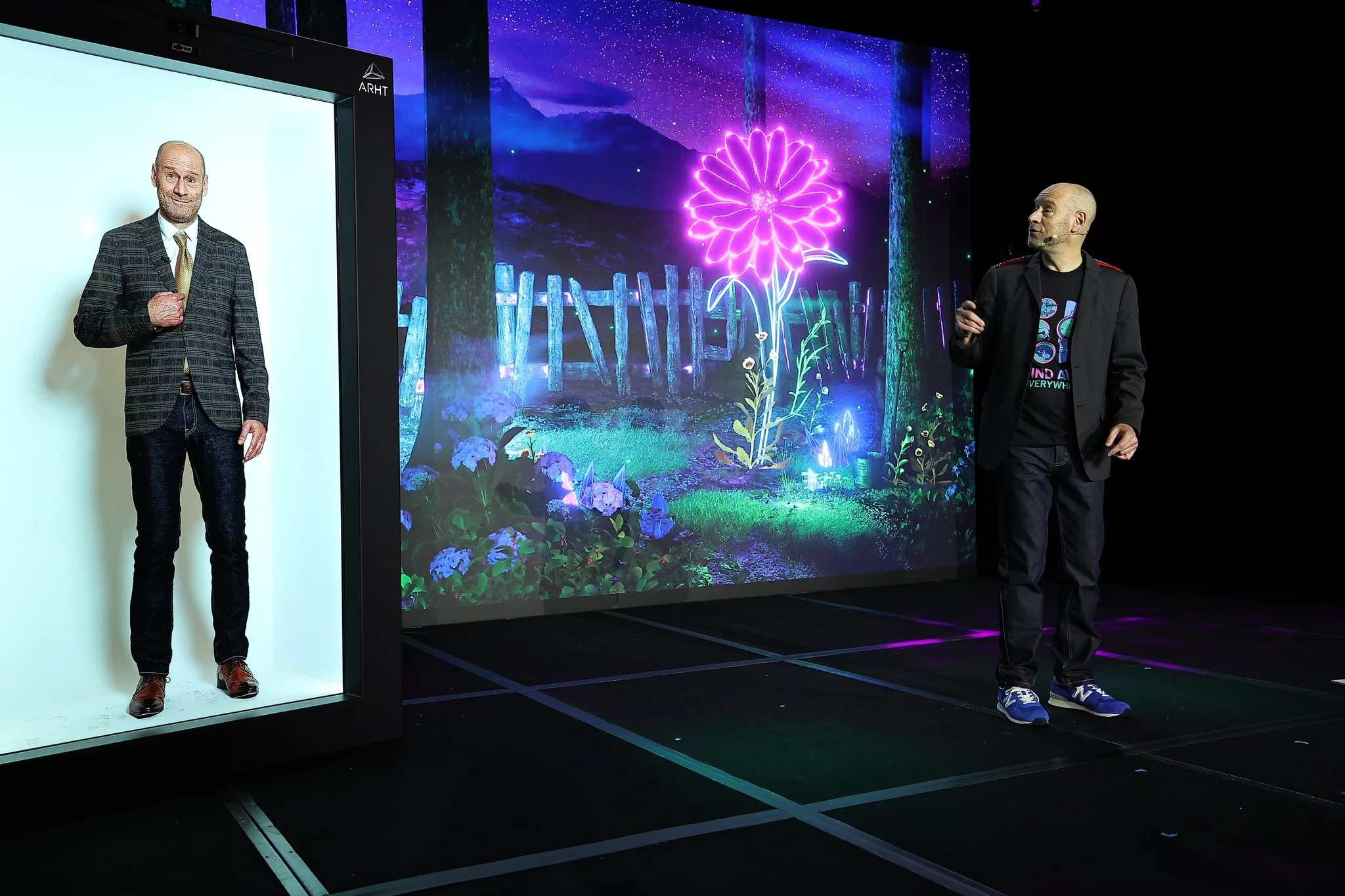
Ori Inbar hologram at AWE USA 2023 Day 1
Ori Inbar hologram

The hologram waxed on for a few minutes about progress in the industry and XR’s incredible journey. Then the human Ori Inbar appeared and told the audience that everything that the hologram said was written by ChatGPT.

While (the real) Inbar quipped that he uses artificial intelligence to show him how not to talk, he addressed recent media claims that AI is taking attention and funding away from XR. He has a different view.

it’s ON !!!

Ori Inbar just started his opening key note at #AWE2023

Holo-Ori was here thanks to our friends from @arht_tech.@como pic.twitter.com/Do23hjIkST

— AWE (@ARealityEvent) May 31, 2023

“We industry insiders know this is not exactly true … AI is a good thing for XR. AI accelerates XR,” said Inbar. “XR is the interface for AI … our interactions [with AI] will become a lot less about text and prompts and a lot more about spatial context.”

“Metaverse, Shmetaverse” Returns With a Very Special Guest

Inbar has always been bullish on XR. He has been skeptical of the metaverse.

At the end of his welcome address last year, Inbar praised himself for not saying “the M word” a single time. The year before that, he opened the conference with a joke game show called “Metaverse, Shmetaverse.” Attendees this year were curious to see Inbar share the stage with a special guest: Neal Stephenson.

Neal Stephenson at AWE USA 2023 Day 1
Neal Stephenson

Stephenson’s 1992 book, Snow Crash, introduced the world to the word “metaverse” – though Stephenson said that he wasn’t the first one to imagine the concept. He also addressed the common concern that the term for shared virtual spaces came from a dystopian novel.

“The metaverse described in Snow Crash was my best guess about what spatial computing as a mass medium might look like,” said Stephenson. “The metaverse itself is neither dystopian nor utopian.”

Stephenson then commented that the last five years or so have seen the emergence of the core technologies necessary to create the metaverse, though it still suffers from a lack of compelling content. That’s something that his company, Lamina1, hopes to address through a blockchain-based system for rewarding creators.

“There have to be experiences in the metaverse that are worth having,” said Stephenson. “For me, there’s a kind of glaring and frustrating lack of support for the people who make those experiences.”

AWE 2023 Keynotes and Follow-Ups

Both Day One and Day Two of AWE start out with blocks of keynotes on the main stage. On Day One, following Inbar’s welcome address and conversation with Stephenson, we heard from Qualcomm and XREAL (formerly Nreal). Both talks kicked off themes that would be taken up in other sessions throughout the day.

Qualcomm

From the main stage, Qualcomm Vice President and General Manager of XR, Hugo Swart, presented “Accelerating the XR Ecosystem: The Future Is Open.” He commented on the challenge of developing AR headsets, but mentioned the half-dozen or so Qualcomm-enabled headsets released in the last year, including the Lenovo ThinkReality VRX announced Tuesday.
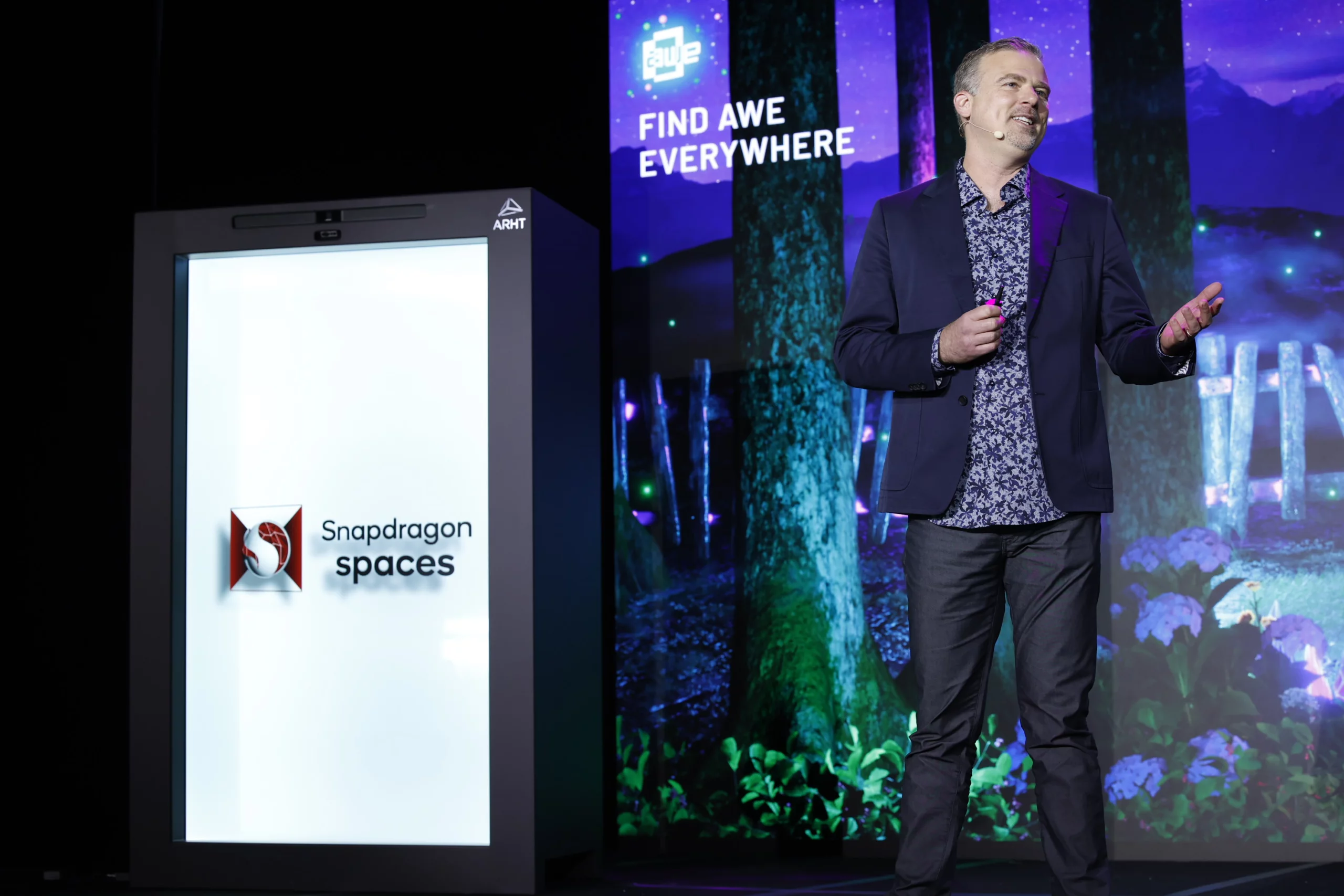
Hugo Swart Qualcomm at AWE USA 2023 Day 1
Hugo Swart

Swart was joined on the stage by OPPO Director of XR Technology, Yi Xu, who announced a new Qualcomm-powered MR headset that would become available as a developer edition in the second half of this year.

As exciting as those announcements were, it was a software announcement that really made a stir. It’s a new Snapdragon Spaces tool called “Dual Render Fusion.”

“We have been working very hard to reimagine smartphone XR when used with AR glasses,” said Swart. “The idea is that mobile developers designing apps for 2D expand those apps to world-scale apps without any knowledge of XR.”

Keeping the Conversation Going

Another talk, “XR’s Inflection Point” presented by Qualcomm Director of Product Management Steve Lukas, provided a deeper dive into Dual Render Fusion. The tool allows an experience to use a mobile phone camera and a headworn device’s camera simultaneously. Existing app development tools hadn’t allowed this because (until now) it didn’t make sense.

Steve Lukas at AWE 2023 Day 1
Steve Lukas

“To increase XR’s adoption curve, we must first flatten its learning curve, and that’s what Qualcomm just did,” said Lukas. “We’re not ready to give up on mobile phones so why don’t we stop talking about how to replace them and start talking about how to leverage them?”

A panel discussion, “Creating a New Reality With Snapdragon Today” moderated by Qualcomm Senior Director of Product Management XR Said Bakadir, brought together Xu, Lenovo General Manager of XR and Metaverse Vishal Shah, and DigiLens Vice President of Sales and Marketing Brian Hamilton. They largely addressed the need to rethink AR content and delivery.
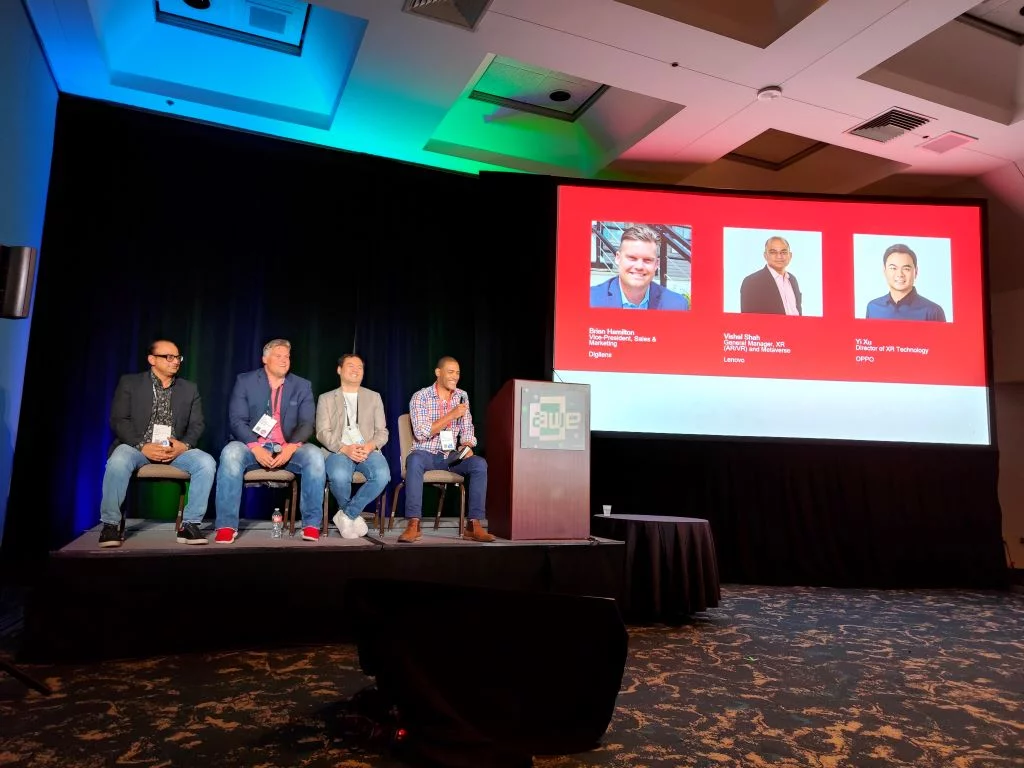
Vishal Shah, Brian Hamilton, Yi Xu, and Said Bakadir at AWE USA 2023 Day 1
From left to right: Vishal Shah, Brian Hamilton, Yi Xu, and Said Bakadir

“When I talk to the developers, they say, ‘Well there’s no hardware.’ When I talk to the hardware guys, they say, ‘There’s no content.’ And we’re kind of stuck in that space,” said Bakadir.

Hamilton and Shah both said, in their own words, that Qualcomm is creating “an all-in-one platform” and “an end-to-end solution” that solves the content/delivery dilemma that Bakadir opened with.

XREAL

In case you blinked and missed it, Nreal is now XREAL. According to a release shared with ARPost, the name change had to do with “disputes regarding the Nreal mark” (probably how similar it was to “Unreal”). But, “the disputes were solved amicably.”
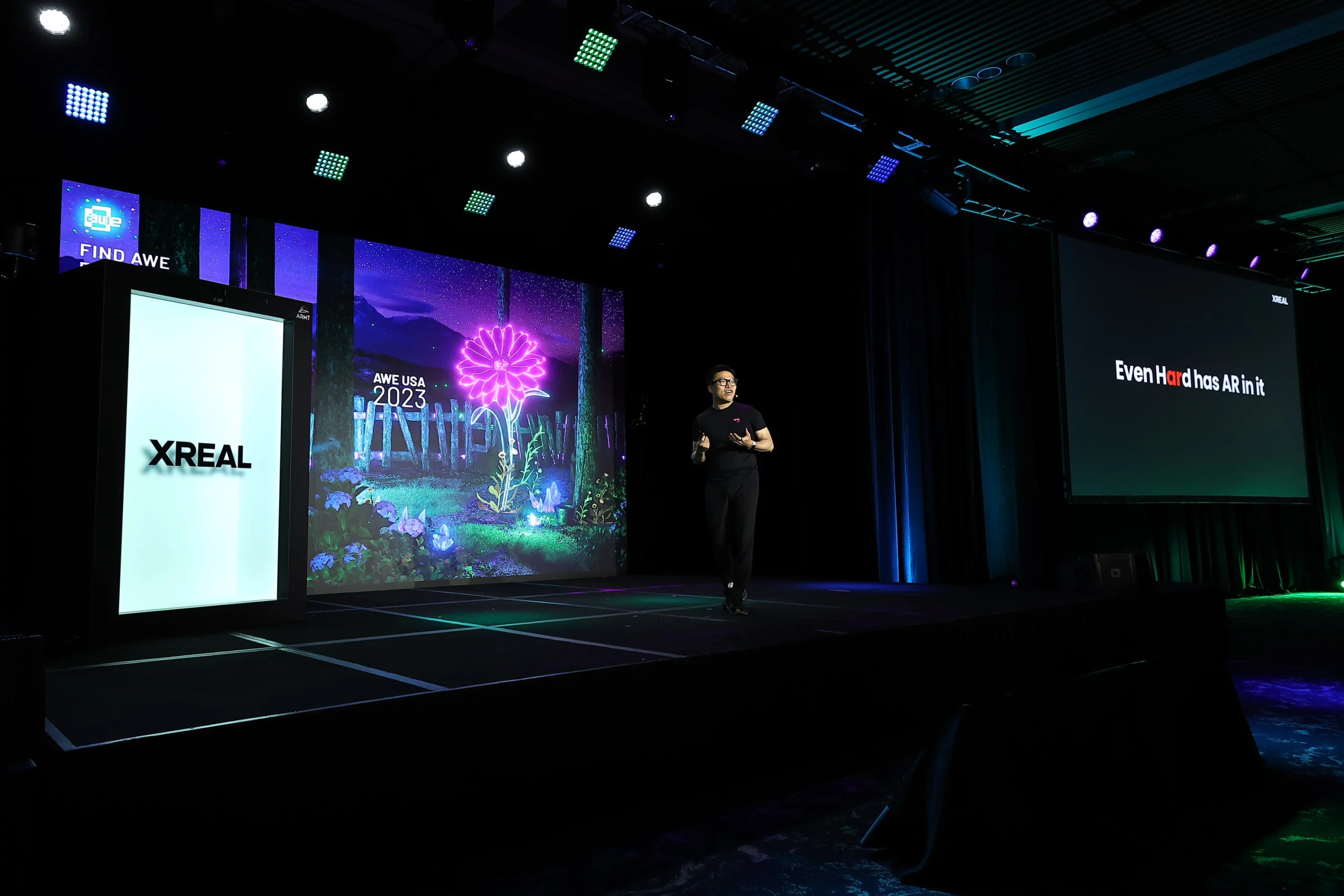
Chi Xu XREAL AWE 2023
Chi Xu

The only change is the name – the hardware and software are still the hardware and software that we know and love. So, when CEO Chi Xu took the stage to present “Unleashing the Potential of Consumer AR” he just focused on progress.

From one angle, that progress looks like a version of XREAL’s AR operating system for Steam Deck, which Xu said is “coming soon.” From another angle, it looked like the partnership with Sightful which recently resulted in “Spacetop” – the world’s first AR laptop.

XREAL also announced Beam, a controller and compute box that can connect wirelessly or via hard connection to XREAL glasses specifically for streaming media. Beam also allows comfort and usability settings for the virtual screen that aren’t currently supported by the company’s current console and app integrations. Xu called it “the best TV innovation since TV.”

AI and XR

A number of panels and talks also picked up on Inbar’s theme of AI and XR. And they all (as far as I saw) unanimously agreed with Inbar’s assessment that there is no actual competition between the two technologies.

The most in-depth discussion on the topic was “The Intersection of AI and XR” a panel discussion between XR ethicist Kent Bye, Lamina1 CPO Tony Parisi, HTC Global VP of Corporate Development Alvin Graylin, and moderated by WXR Fund Managing Partner Amy LaMeyer.

Amy LaMeyer, Tony Parisi, Alvin Graylin, Kent Bye AWE 2023 Day 1
From left to right: Amy LaMeyer, Tony Parisi, Alvin Graylin, Kent Bye

“There’s this myth that AI is here so now XR’s dead, but it’s the complete opposite,” said Graylin. Graylin pointed out that most forms of tracking and input as well as approaches to scene understanding are all driven by AI. “AI has been part of XR for a long time.”

While they all agreed that AI is a part of XR, the group disagreed on the extent to which AI could take over content creation.

“A lot of people think AI is the solution to all of their content creation and authoring needs in XR, but that’s not the whole equation,” said Parisi.

Graylin countered that AI will increasingly be able to replace human developers. Bye in particular was vocal that we should be reluctant and suspicious of handing over too much creative power to AI in the first place.

“The differentiating factor is going to be storytelling,” said Bye. “I’m seeing a lot of XR theater that has live actors doing things that AI could never do.”

Web3, WebXR, and the Metaverse

The conversation is still continuing regarding the relationship between the metaverse and Web3. With both the metaverse and Web3 focusing on the ideas of openness and interoperability, WebXR has become a common ground between the two. WebXR is also the most accessible from a hardware perspective.

“VR headsets will remain a niche tech like game consoles: some people will have them and use them and swear by them and won’t be able to live without them, but not everyone will have one,” Nokia Head of Trends and Innovation Scouting, Leslie Shannon, said in her talk “What Problem Does the Metaverse Solve?”
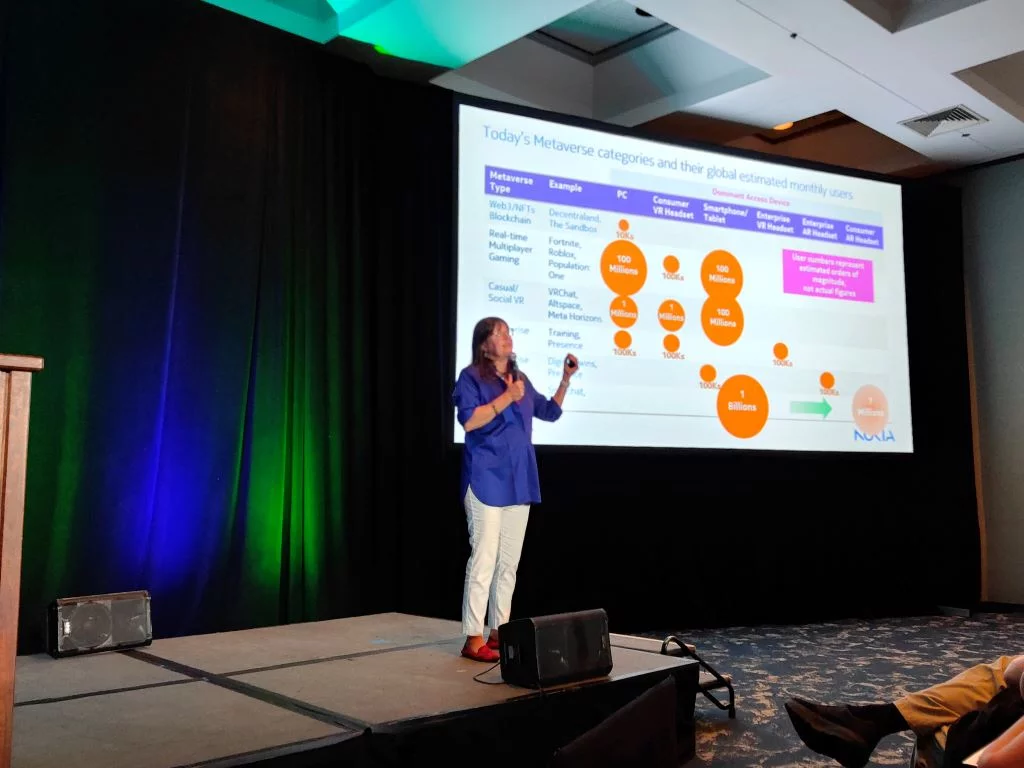
Leslie Shannon AWE 2023 Day 1
Leslie Shannon

“The majority of metaverse experiences are happening on mobile phones,” said Shannon. “Presence is more important than immersion.”

Wonderland Engine CEO Jonathan Hale asked “Will WebXR Replace Native XR” with The Fitness Resort COO Lydia Berry. Berry commented that the availability of WebXR across devices helps developers make their content accessible as well as discoverable.
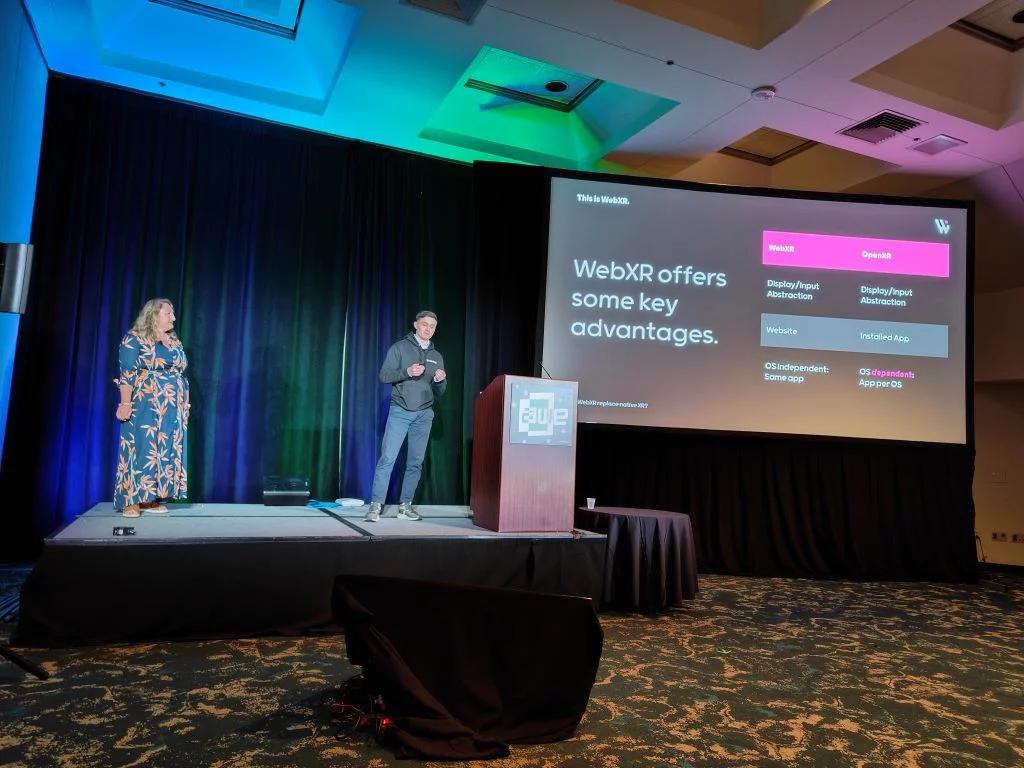
Lydia Berry and Jonathan Hale AWE 2023 Day 1
Lydia Berry and Jonathan Hale

“The adoption challenges around glasses are there. We’re still in the really early adoption phase,” said Berry. “We need as many headsets out there as possible.”

Hale also added that WebXR is being taken more seriously as a delivery method by hardware manufacturers who were previously mainly interested in pursuing native apps.

“More and more interest is coming from hardware manufacturers every day,” said Hale. “We just announced that we’re working with Qualcomm to bring Wonderland Engine to Snapdragon Spaces.”

Keep Coming Back

AWE Day One was a riot but there’s a lot more where that came from. Day Two kicks off with keynotes by Magic Leap and Niantic, there are more talks, more panels, more AI, and the Expo Floor opens up for demos. We’ll see you tomorrow.

AWE USA 2023 Day One: XR, AI, Metaverse, and More Read More »

5-vr-games-we’re-most-excited-for-from-quest-gaming-showcase

5 VR Games We’re Most Excited for From Quest Gaming Showcase

Meta dumped an avalanche of VR news today in its hour-long Quest Gaming Showcase livestream, revealing trailers and info on more than a dozen new games coming to Quest 2, Quest Pro, and probably also the newly unveiled Quest 3 headset.

Here’s what we’re most excited about:

Asgard’s Wrath 2

Image courtesy Sanzaru Games

That’s right, the sequel to hit Rift title Asgard’s Wrath (2019) is coming to Quest this winter, bringing with it a ton of new places to explore and a cast of new companions and puzzles. Meta’s Sanzaru Games says we should expect phsyics-based melee and a more intuitive combat system altogether, not to mention a brand-new realm to explore which will bring us to a reimagined Ancient Egypt. Catch the full announce here. Also, check out the trailer on YouTube (age-restricted).

I Expect You To Die 3: Cog in the Machine

We’ve known about the upcoming sequel to the hit spy-flavored puzzle game I Expect You To Die, but it seems every new trailer that pops up is just another opportunity to salivate at the Bond-style escape room’s ingenious puzzles and patently dastardly villains. It’s coming to the Quest platform and PSVR 2 “soon,” developers Schell Games says. Catch the full announce here.

Attack on Titan VR: Unbreakable

The trailer for Attack on Titan VR:  Unbreakable is admittedly not gameplay, although it’s easy to see where it’s headed, as Japanese studio UNIVRS seems to be heavily suggesting gameplay elements here. It’s bringing both single player and co-op modes to the Titan-killing, swing-tastic game, letting you play in Japanese or English, subs included. It’s coming to Quest platform in winter 2023, which is a little later than the promised summer 2023 launch window previously announced, but better late than never. Catch the full announce here.

Dungeons of Eternity

Although it’s hard to get super excited about a roguelike dungeon crawler—there are a few really great ones out there already—Dungeons of Eternity is coming to the Quest platform this year from a studio called Othergate, which was founded by a bunch of ex-Oculus Studios game designers. The 1-3 player co-op dungeon crawling RPG also incorporates physics-based combat, which is pretty refreshing to see since it focuses on melee as well as archery and magic. Catch the full announce here.

Stranger Things VR

TV show game tie-ins are pretty hit and miss (mostly miss), but we can actually vouch for the studio developing this Stranger Things VR game, coming to Quest this fall from VR pioneers Tender Claws. You may know Tender Claws for its games Virtual Virtual Reality 1 and 2 and The Under Presents, three spectacular titles that really just get what makes VR great. Be the bad guy, Vecna. Do bad shit. Catch the full announce here.

– – — – –

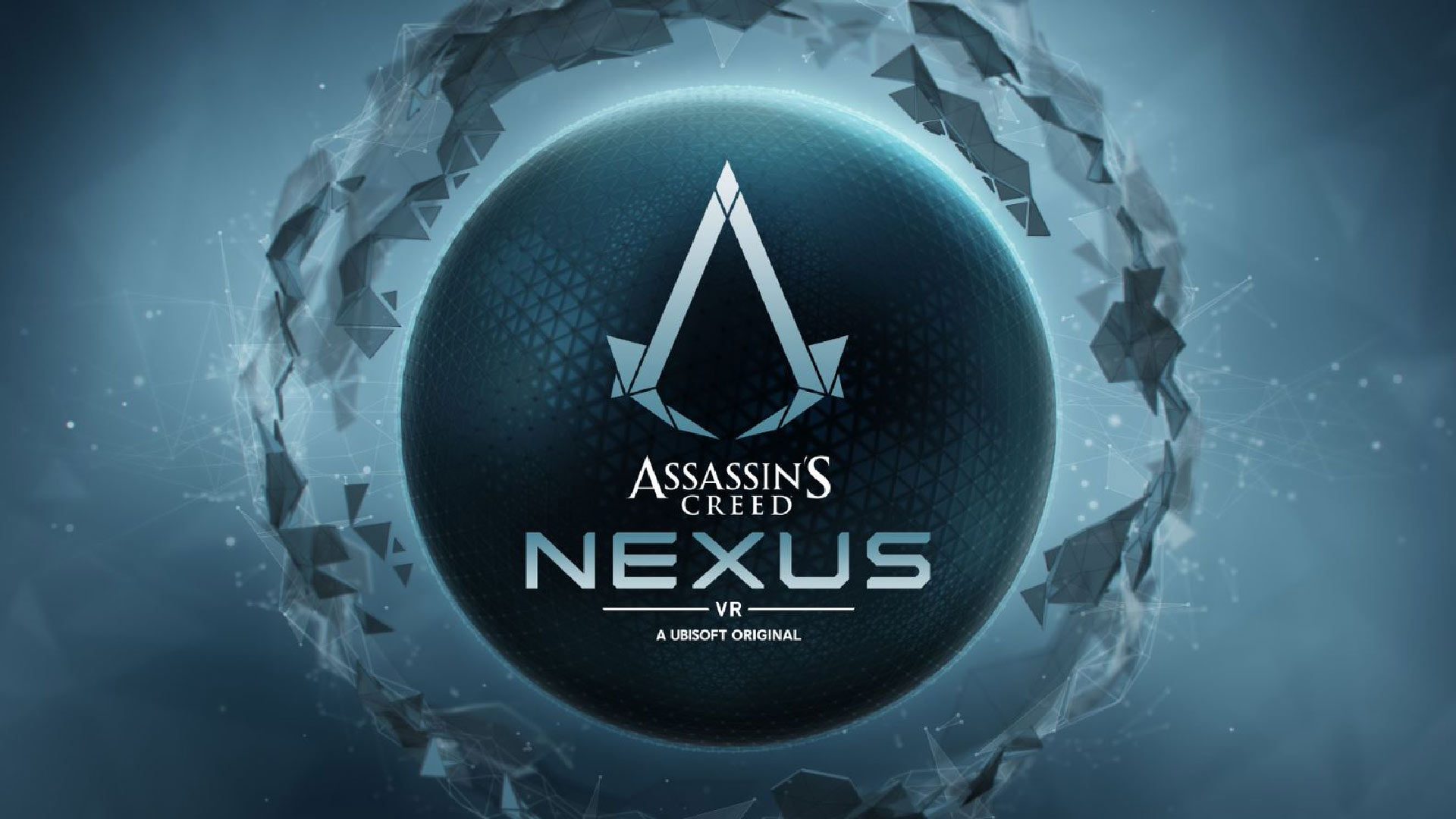
Assassin’s Creed: Nexus VR

Image courtesy Ubisoft

Ok, just one more, but it’s definitely outside of our lineup since we didn’t exactly get an eye-full of Ubisoft’s upcoming Assassin’s Creed game today like we hoped, which is now confirmed to be officially called Assassin’s Creed: Nexus VR (the only real news about AC from the showcase).

The actual reveal is said to come during Ubisoft’s Forward livestream event taking place on June 12th though, so we’re closer than ever to learning whether Ubisoft is set to faithfully translate the franchise’s high-flying, time-tripping assassin into VR. Catch the full announce here.


There were a ton of games announced today. Which one are you looking forward to the most? Let us know in the comments below!

5 VR Games We’re Most Excited for From Quest Gaming Showcase Read More »

‘asgard’s-wrath’-sequel-revealed,-coming-to-quest-this-winter

‘Asgard’s Wrath’ Sequel Revealed, Coming to Quest This Winter

During Meta’s Quest Gaming Showcase today the company revealed the hotly awaited sequel to Asgard’s Wrath, the single-player adventure which launched on Rift in 2019.

Called Agard’s Wrath 2, the game is slated to launch on Quest 2 and Quest Pro in Winter 2023. Picking up where it last left off, the sequel suddenly thrusts you into a battle with a creature from an Ancient Egypt-inspired realm. There, you encounter the ‘Weavers of Fate’ who set you on a mission to find and stop a certain trickster god.

Check out the reveal trailer, which is only available on YouTube due to its age rating.

Meta-owned studio Sanzaru Games says the sequel includes a host of new realms to explore, including Asgardian realms in addition to vast desert expanses of ancient Egypt. You’ll be able to battle and puzzle your way through temples, caves, and dungeons, where you’re encounter monsters, main quests, sidequests, crafting resources, mini-games and more.

Like the first, you’ll have access to a cast of warrior-followers to help you solve puzzles and help you take on enemies. God-scale perspective

Asgard’s Wrath 2 includes an updated combat system that departs from the last, which previously required you to block and parry hits, destroy shields and armor, then kill the enemy itself. Now you’ll be able to hack away at defenses naturally in addition to parrying for opportune melee windows. It also includes elemental types and a wider variety of enemies in addition to physics-based melee. Upgradeable abilities and weapons extend beyond the player, as companions also have their own skill trees.

Enemies are said to scale to user level and ability, giving them access to better moves and defensive measures. In addition to the main game, there’s also set to be an infinite dungeon crawling mode to help you bone up on tactics.

Pre-orders for Agard’s Wrath 2 are available today, with a Quest launch scheduled for winter 2023. In the meantime, learn a little more about the game in this nine-minute developer walkthrough, again, only on YouTube.

‘Asgard’s Wrath’ Sequel Revealed, Coming to Quest This Winter Read More »

‘bulletstorm’-to-bring-skillshot-carnage-in-standalone-vr-version,-gameplay-trailer-here

‘Bulletstorm’ to Bring Skillshot Carnage in Standalone VR Version, Gameplay Trailer Here

Among Meta’s avalanche of Quest gaming news today, the company revealed that Bulletstorm, the co-op shooter first launched on flatscreen in 2011, is coming to VR for the first time.

The game is currently under development by Incuvo, known for Green Hell VR, and the game’s original developers People Can Fly.

If you haven’t played the original, or the remastered version Bulletstorm: Full Clip Edition (2017) on flatscreen, Bulletstorm sets itself apart from other shooters by emphasizing skill points, which you earn by creatively dispatching the enemy.

Here’s how Incuvo describes the VR version:

Back in 2011, Bulletstorm introduced the world to the “Skillshot.” Kick an enemy into a cactus? Skillshot. Crush one under a hot dog cart? Skillshot. Grab one with your Energy Leash and fling ‘em into a burner? Definitely a skill shot. Today, People Can Fly and Incuvo (developer of Green Hell VR) announced they’re bringing Bulletstorm to the Meta Quest Store. Skillshots new and old, as well as the action-packed story—all of it recreated from the ground up to take advantage of VR.

Today’s announcement of the co-op shooter also arrived with a gameplay trailer, showing off the game’s skill-based carnage, fast-paced locomotion, and massive monsters.

It’s not clear when we’ll see Bulletstorm on Quest 2, or what other platforms it might arrive on in the future. In the meantime, take a look at the trailer below:

‘Bulletstorm’ to Bring Skillshot Carnage in Standalone VR Version, Gameplay Trailer Here Read More »

‘stranger-things-vr’-to-release-on-major-vr-headsets-this-fall,-new-gameplay-trailer-here

‘Stranger Things VR’ to Release on Major VR Headsets This Fall, New Gameplay Trailer Here

Things are about to get a little stranger later this year as Meta’s Quest Gaming Showcase today included a new look at Stranger Things VRthe upcoming psychological horror title coming to major VR headsets. It’s also coming a little earlier than the Winter 2023 release date previously mentioned at last year’s debut.

Stranger Things VR is being developed and published by Tender Claws, the studio behind VR titles Virtual Virtual Reality and The Under Presents.

Here’s how the studio describes the upcoming single player horror-action game:

Experience the world of Stranger Things from the never-before-seen perspective of Vecna as he explores unknown realities, forms the hive mind, and enacts his plan for revenge against Eleven and Hawkins. Players will invade the dreams and memories of fan-favorite characters and harness telekinetic powers to possess minds and battle creatures, as Henry Creel’s transformation into Vecna and his influence on the events of prior seasons is revealed.

● Grab, crush and throw your opponents using telekinesis

● Relive memories from Henry’s time at Hawkins Lab with Dr. Brenner as you explore an otherworldly, interconnected hive mind

● Inhabit the dreams and memories of fan-favorite characters like Will Byers and Billy Hargrove as you manipulate them to do your bidding

● Wielding powers that subvert and defy Vecna’s own, make a final stand to save your friends in a climactic finale

● Open and close portals between worlds and realities… at your peril

The studio says it’s bringing the game to Quest 2 and Quest Pro at some point this Fall, although it’s also hitting “major VR platforms” too, which nowadays typically means PSVR 2, Pico, and SteamVR headsets.

Stranger Things VR was previously projected to arrive in Winter 2023, so it seems to be anticipating a glut of other games announced today which are slated to launch this winter.

Stranger Things VR is set to cost $30. While we wait on a more precise launch date, you can wishlist the game here.

‘Stranger Things VR’ to Release on Major VR Headsets This Fall, New Gameplay Trailer Here Read More »

classic-90s-adventure-‘the-7th-guest’-is-getting-a-vr-remake-this-year,-from-‘arizona-sunshine’-studio

Classic 90s Adventure ‘The 7th Guest’ is Getting a VR Remake This Year, From ‘Arizona Sunshine’ Studio

Vertigo Games, the VR pioneers behind the Arizona Sunshine franchise and After the Fall, announced a new VR game during Meta’s Quest Gaming Showcase that takes you to a haunted house for some eerily lifelike encounters with the paranormal. Well, not exactly new.

Called The 7th Guest, the single player VR adventure is actually based on the classic ’90s CD-ROM title that tosses you into a haunted mansion for puzzles and full-motion video (FMV) characters spirits who bring the early adventure game to life.

Instead of flat video though, the new 7th Guest is being built with volumetric video capture alongside a complete overhaul of everything, top to bottom. Here’s how Fast Travel Games describes it:

The team is using volumetric video capture to recreate the FMV (full-motion video) storytelling of the original game, bringing the classic adventure to life like never before. And for the first time ever, the iconic mansion is being recreated in full 3D—though don’t be surprised if it starts shifting around you. After all, it’s haunted. Spooky but never gory, The 7th Guest is like a thrilling amusement park ride you can experience at home, packed with puzzles that pay homage to the original point-and-click adventure while taking full advantage of VR.

The 7th Guest is being developed by Vertigo Studios Rotterdam, a division of Vertigo Games based in Rotterdam, Netherlands.

There’s no exact release date yet, however the studio says it’s coming to Quest 2 and Quest Pro sometime this year.

Classic 90s Adventure ‘The 7th Guest’ is Getting a VR Remake This Year, From ‘Arizona Sunshine’ Studio Read More »

world-of-darkness-vr-game-‘vampire:-the-masquerade-–-justice’-revealed,-coming-to-quest-in-late-2023

World of Darkness VR Game ‘Vampire: The Masquerade – Justice’ Revealed, Coming to Quest in Late 2023

During Meta’s Quest Gaming Showcase today VR pioneers Fast Travel Games unveiled a new VR game set in the ‘World of Darkness’ universe called Vampire: The Masquerade – Justice.

Billed as a single player adventure RPG, Vampire: The Masquerade – Justice puts you in the role of a vampire who must strike from the shadows and drink the blood of both mortal and vampire prey.

Fast Travel Games, which is also known for its other ‘World of Darkness’ VR game Wraith: The Oblivion – Afterlife (2021), says its new title features a “gritty main narrative that includes several side missions and dialogue options,” all of which is set in a dark and mysterious Venice.

Here’s how Fast Travel describes some features of Vampire: The Masquerade – Justice:

BE A STEALTHY VAMPIRE: Hide from the guilty in plain sight with Cloak of Shadows, boil the insides of your victims with Cauldron of Blood, or place a Shadow Trap to drag them into Oblivion. Drink the blood of mortals and other vampires to keep your Hunger at bay. The crossbow attached to your arm can be used for both puzzle solving and combat.

BECOME THE APEX PREDATOR: You start off as a strong vampire, but can grow even more powerful by upgrading and purchasing new disciplines in skill trees for stealth, combat, and high speed traversal. Explore, complete missions and optional objectives to gain XP and become the ultimate arbiter of Justice.

A DARK & MYSTERIOUS VENICE: Uncover a conspiracy in a Venice you don’t see in the tourist guides… Explore dark alleyways, blood-soaked canals, forgotten catacombs, and opulent palazzos in your quest to bring your sire’s murderer to justice. Play a gritty main narrative with several side missions, where your dialogues with NPCs and choices you make bring you closer to the truth.

You can wishlist the game on Quest here. When it launches at some point in late 2023, it will be priced at $30. Notably, the trailer says it’s targeting Quest 2 and Quest 3, one of the first games to officially say so; that could mean Fast Travel is working closely with Meta.

To boot, there’s no word on whether it’s coming to other headsets, such as PSVR 2 or SteamVR, however we’ll be keeping an eye on Fast Travel’s Twitter in the meantime.

World of Darkness VR Game ‘Vampire: The Masquerade – Justice’ Revealed, Coming to Quest in Late 2023 Read More »

vr-sport-‘racket-club’-action-revealed-in-new-trailer,-created-by-‘demeo’-&-‘blaston’-studio

VR Sport ‘Racket Club’ Action Revealed in New Trailer, Created by ‘Demeo’ & ‘Blaston’ Studio

Resolution Games, the studio behind Blaston (2020) and Demeo (2021), showed off its upcoming VR sports game Racket Club for the first time during Meta’s Quest Gaming Showcase.

Taking inspiration from many of the world’s most popular racket games, such as Tennis, Padel, Pickleball, and Squash, the new trailer released today shows off what Resolution Games calls “the first real look at how Racket Club is played.”

Here’s how the describes the action:

When players step onto the court, they’ll find the play area for their matches surrounded by four clear walls — each providing a surface for the ball to bounce off to keep it in play and provide a new dimension for strategic gameplay. The more times players can hit the ball back and forth during each rally, the higher the points value for the player that takes it. This “points rally” mechanic introduces a unique blend of risk and reward that’s not typically found in racket sports. Players will need to read their opponent’s behavior to determine just the right time to break their reluctant cooperation on any given rally and win the points for themselves.

The court size in Racket Club has been designed with living rooms in mind, giving players the ability to fully immerse themselves in racket sport VR play while keeping their footwork within a safe boundary. This allows for natural movement in all its forms, from traversing the court to taking big swings at just the right angles.

The built-for-VR racket sport is set to include both single player and online multiplayer, which at launch will include singles (1v1) and doubles (2v2) multiplayer in addition to single player career mode. You can wishlist the game today on the Quest Store.

VR Sport ‘Racket Club’ Action Revealed in New Trailer, Created by ‘Demeo’ & ‘Blaston’ Studio Read More »

here’s-how-unilever-is-harnessing-ai-to-innovate-your-favourite-products

Here’s how Unilever is harnessing AI to innovate your favourite products

Here’s how Unilever is harnessing AI to innovate your favourite products

Ioanna Lykiardopoulou

Story by

Ioanna Lykiardopoulou

Ioanna is a writer at TNW. She covers the full spectrum of the European tech ecosystem, with a particular interest in startups, sustainabili Ioanna is a writer at TNW. She covers the full spectrum of the European tech ecosystem, with a particular interest in startups, sustainability, green tech, AI, and EU policy. With a background in the humanities, she has a soft spot for social impact-enabling technologies.

This article features an interview with Alberto Prado, Head of R&D Digital and Partnerships at Unilever. Prado will be speaking at TNW Conference, which takes place on June 15 & 16 in Amsterdam. If you want to experience the event (and say hi to our editorial team!), we’ve got something special for our loyal readers. Use the promo code READ-TNW-25 and get a 25% discount on your business pass for TNW Conference. See you in Amsterdam!

From microbiome-protecting skincare to a vegan bee-saving lipstick, Unilever is transforming how it innovates its portfolio products by harnessing the power of AI.

Alberto Prado, Head of Unilever’s R&D Digital and Partnerships, is leading this transformation. According to Prado, leveraging digital technologies enables the R&D department to innovate “better, faster, and more effectively.” And that’s where artificial intelligence comes in.

“It starts with helping us understand the external world much better and in a much more predictive way,” Prado tells TNW. Innovating in our fast-paced and rapidly evolving world has become more complex, he adds.

It’s not simply about responding to consumer trends and addressing consumer needs — which are changing faster than ever before. It’s also about embracing sustainability and reacting to supply disruptions caused by the climate crisis and the volatile geopolitical environment. For instance, think of the sunflower oil shortage following Russia’s war in Ukraine.

“The only way to deal with that complexity and the speed at which things change is through the more widespread use of artificial intelligence,” Prado notes. But how exactly does AI help?

First off, artificial intelligence tools accelerate scientific discovery by taking on multiple tasks that previously required laborious work in a physical lab.

Thanks to access to large-scale data, machine learning and high-performance computing, Unilever’s R&D team has been able to make significant discoveries about human biology and new material use that would have otherwise been inconceivable. For example, the company is close to commercialising plant-based, sustainable palm oil alternatives for use in everyday cleaning and personal care products.

“The ability for us to leverage experimental data to create virtual models that can simulate parameters — which would normally have happened in the physical lab — is speeding up a lot of our work, but also solving problems that may have not been solvable,” Prado notes.

This product design method, also known as “in-silico,” can not only shed light on the interaction of molecular compounds faster and more effectively, but also replace animal testing.

The benefits of this technology have already gone into everyday products such as Dove and Vaseline. Through AI-powered analysis of 12 terabytes of data, Unilever has researched the microbiome (the 100 trillion+ microorganisms living in and on our body), and discovered how to combine it with skin ceramides for products that address issues in skin quality and hydration.

Beyond discovery and design, AI is also used to simulate the manufacturing process, Prado tells TNW. “We need to define the best ways of manufacturing a product,” he explains. “That particular formula, for example, that is energy efficient, reduces waste, and carbon emissions, and that is optimised to enter the development process in our manufacturing plants — which may have very different configurations and setups, depending on the market.”

At the same time, artificial intelligence helps improve Unilever’s supply chain and reaction to shortages. It can uncover alternative ingredients, or simplify products by reducing the number of components without impacting their quality or effectiveness.

And by optimising the discovery, design, and manufacturing processes with AI-powered tools, the company is also improving its operational efficiency.

“Think of innovation as a triangle,” Prado says. It needs to be impactful, sustainable, and cost-efficient. But optimising a product across all three vectors is complex, he explains, which is even more challenging when a big firm’s organisational complexity is added to the mix.

This, for Prado, coupled with all the changes happening around us means that to innovate effectively, it’s crucial to deploy AI at a scale that will help companies remain competitive.

Alberto Prado is one of many tech luminaries speaking at TNW Conference on June 15-16. Use the promo code READ-TNW-25 and get a 25% discount on your business pass for TNW Conference.

Get the TNW newsletter

Get the most important tech news in your inbox each week.

Also tagged with


Here’s how Unilever is harnessing AI to innovate your favourite products Read More »

digilens-expands-ecosystem-with-hardware,-software-announcements

DigiLens Expands Ecosystem With Hardware, Software Announcements

DigiLens may not be on every XR user’s mind, but we all owe them a lot. The optical components manufacturer only recently released its first branded wearable, but the organization makes parts for a number of XR companies and products. That’s why it’s so exciting that the company announced a wave of new processes and partnerships over the last few weeks.

SRG+

“Surface Relief Gratings” is one complicated process within the production of the complicated system that is a waveguide – the optical component that put DigiLens on the map. The short of it is that waveguides are the translucent screen on which a feed is cast by an accompanying “light engine” in this particular approach to AR displays.

DigiLens doesn’t make light engines, but the methods that they use to produce lenses can reduce “eye glow” – which is essentially wasted light. The company’s new “SRG+” waveguide process achieves these ends at a lower cost, while also increasing the aspect ratio for an improved field of view on a lighter lens that can be produced more efficiently at a larger scale.

DigiLens announces SRG+

Lens benefits aside, this process improvement also allows for a more efficient light engine. A more efficient light engine translates to less energy consumption and a smaller form factor for the complete device. All of those are good selling points for a head-worn display. Many of those benefits are also true for Micro OLED lenses, a different approach to AR displays.

“I am excited about Digilens’ recent SRG+ developments, which provide a new, low-cost replication technology satisfying such drastic nanostructure requirements,” Dr. Bernard Kress, President of SPIE, the international society for optics and photonics, said in a release. “The AR waveguides field is the tip of the iceberg.”

A New Partner in Mojo Vision

The first major partner to take advantage of this new process is Mojo Vision, a Micro-LED manufacturer that became famous in the industry for pursuing AR contact lenses. While that product has yet to materialize, its pursuit has resulted in Mojo Vision holding records for large displays on small tech. And, it can get even larger and lighter thanks to SRG+.

“Bringing our technologies together will raise the bar on display performance, and efficiency in the AR/XR industry,” Mojo Vision CEO Nikhil Balram said in a release shared with ARPost. “Partnering with DigiLens brings AR glasses closer to mass-scale consumer electronics.”

This partnership may also help to solve another one of AR’s persistent challenges: the sunny problem. AR glasses to date are almost always tinted. That’s because, to see AR elements in high ambient light conditions, the display either needs to be exceptionally bright or artificially darkened. Instead of cranking up the brightness, manufacturers opt for tinted lenses.

“The total form factor of the AR glasses can finally be small and light enough for consumers to wear for long periods of time and bright enough to allow them to see the superimposed digital information — even on a sunny day — without needing to darken the lenses,” DigiLens CEO Chris Pickett said in the release.

ARGO Is DigiLens’ Golden Fleece

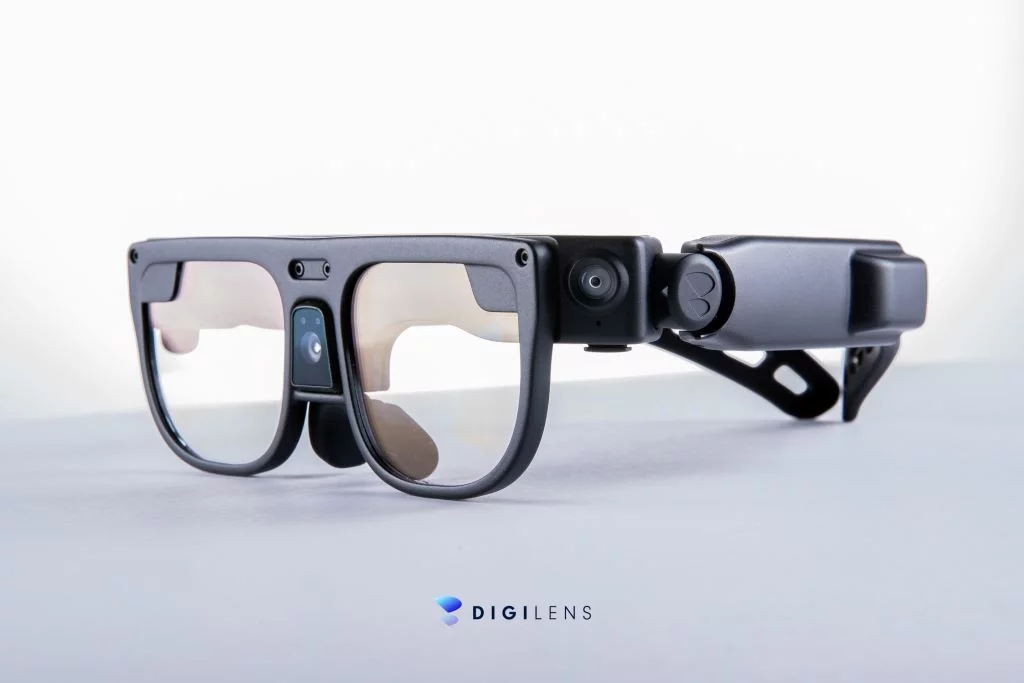
After years of working backstage for device manufacturers, DigiLens announced ARGO at the beginning of this year, calling it “the first purpose-built stand-alone AR/XR device designed for enterprise and industrial-lite workers.” The glasses use the company’s in-house waveguides and a custom-built Android-based operating system running on Qualcomm’s Snapdragon XR2 chip.

DigiLens ARGO glasses

“This is a big milestone for DigiLens at a very high level. We have always been a component manufacturer,” DigiLens VP and GM of Product, Nima Shams told ARPost at the time. “At the same time, we want to push the market and meet the market and it seems like the market is kind of open and waiting.”

More Opportunities With Qualcomm

Close followers of Qualcomm’s XR operations may recall that the company often saves major news around its XR developer platform Snapdragon Spaces for AWE. The platform launched at AWE in 2021 and became available to the public at AWE last year. This year, among other announcements, Qualcomm announced Spaces compatibility with ARGO.

“We are excited to support the democratization of the XR industry by offering Snapdragon Spaces through DigiLens’ leading all-in-one AR headset,” Qualcomm Senior Director of Product Management XR, Said Bakadir, said in a release shared with ARPost.

“DigiLens’ high-transparency and sunlight-readable optics combined with the universe of leading XR application developers from Snapdragon Spaces are critical in supporting the needs of the expanding enterprise and industrial markets,” said Bakadir.

Snapdragon Spaces bundles developer tools including hand and position tracking, scene understanding and persistent anchors, spatial mapping, and plane detection. So, while we’re likely to see more partnerships with more existing applications, this strengthened relationship with Qualcomm could mean more native apps on ARGO.

Getting Rugged With Taqtile

“Industrial-lite” might be getting a bit heavier as DigiLens partners with Taqtile on a “rugged AR-enabled solution for industrial and defense customers” – presumably a more durable version of the original ARGO running Manifest, Taqtile’s flagship enterprise AR solution. Taqtile recently released a free version of Manifest to make its capabilities more available to potential clients.

“ARGO represents just the type of head-mounted, hands-free device that Manifest customers have been looking for,” Taqtile CTO John Tomizuka said in a release. “We continue to evaluate hardware solutions that will meet the unique needs of our deskless workers, and the combination of Manifest and ARGO has the ability to deliver performance and functionality.”

Getting Smart With Wisear

Wisear is a neural interface company that uses “smart earphones” to allow users to control connected devices with their thoughts rather than with touch, gesture, or even voice controls.

For the average consumer, that might just be really cool. For consumers with neurological disorders, that might be a new way to connect to the world. For enterprise, it solves another problem.

wisear smart earphones

Headworn devices mean frontline workers aren’t holding the device, but if they need their hands to interact with it, that still means taking their hands off of the job. Voice controls get around this but some environments and circumstances make voice controls inconvenient or difficult to use. Neural inputs solve those problems too. And Wisear is bringing those solutions to ARGO.

“DigiLens and Wisear share a common vision of using cutting-edge technology to revolutionize the way frontline workers work,” Pickett said in a release shared with ARPost. “Our ARGO smart glasses, coupled with Wisear’s neural interface-powered earphones, will provide frontline workers with the tools they need to work seamlessly and safely.”

More Tracking Options With Ultraleap

Ultraleap is another components manufacturer. They make input accessories like tracking cameras, controllers, and haptics. A brief shared with ARPost only mentions “a groundbreaking partnership” between the companies “offering a truly immersive and user-friendly experience across diverse applications, from gaming and education to industrial training and healthcare.”

That sounds a lot like it hints at more wide availability for ARGO, but don’t get your hopes up yet. This is the announcement about which we know the least. Most of this article has come together from releases shared with ARPost in advance of AWE, which is happening now. So, watch our AWE coverage articles as they come out for more concrete information.

So Much More to Come

Announcements from component manufacturers can be tantalizing. We know that they have huge ramifications for the whole industry, but we know that those ramifications aren’t immediate. We’re closely watching DigiLens and its partners to see when some of these announcements might bear tangible fruit but keep in mind that this company also has its own full model out now.

DigiLens Expands Ecosystem With Hardware, Software Announcements Read More »

how-to-deal-with-an-egotistical-ceo

How to deal with an egotistical CEO

How to deal with an egotistical CEO

Sarah Geraghty

Story by

Sarah Geraghty

Sarah Geraghty is Head of Careers with The Communications Clinic where she oversees interviewee and interviewer preparation training to hund Sarah Geraghty is Head of Careers with The Communications Clinic where she oversees interviewee and interviewer preparation training to hundreds of individuals at all levels in public and private sector organisations every year. As a senior training consultant, Sarah designs and delivers leadership programmes for clients in multinational companies and industry groups as well as Media Skills and Presentation skills training. Formerly a contributor to The Irish Times, Sarah regularly appears in national print and broadcast media as a careers expert and is a graduate of Trinity College Dublin and the University of Edinburgh.

Here’s the thing, it doesn’t take long for an outsized ego to manifest itself in the workplace.

Everything is self-referential. Any topic leads back to wonderful them.

One of my clients was offered a job recently that would pay roughly twice what she’s earning now. She nailed the interview, so I figured all she had to do was read and sign the contract. I was surprised when she said she wasn’t taking the position.

Why not? Because the boss of the new company had led the interview panel.

The HR manager asked relevant, open questions. The external interview panellist probed her skills and listened to examples. That took up maybe 11 minutes out of the 30-minute interview. The rest was occupied by the boss who asked one or maybe two questions, but for the most part, simply talked about himself, his company and its values, his preferences, his triumphs, and so on.

“If he’s that self-absorbed in the recruitment interview, and has so little regard for what the interview should have been finding out about me and the other candidates, I’d be plain stupid to go work for him,” my client told me. “Of course, I could cope. But really, would it be worth it?”

In short, the answer is no, for a myriad of reasons including prioritising your mental health and ensuring you have a healthy work-life balance.

But if you’re already stuck in a position with an egotistical CEO, you’ll need to be tactical and pragmatic in how you deal with them.

Firstly, don’t take it personally (do sums in your head while the egotist talks) and always keep your cool, even in stressful situations where they’re clearly in the wrong. At the same time, that doesn’t mean you have to sit back and become their in-office emotional punching bag. Instead, keep a written record of dates and times your egotistical boss was inappropriate, unprofessional, or took you to task over something menial or outside of your control.

Similarly, keep a paper trail with regard to regular appraisals, so you have a measurable record of your progress and achievements to hand. This can help resolve any conflict that might arise, swiftly and professionally without any emotion.

Getting support from your colleagues can also really help your mental health. As the adage goes, a problem shared is a problem halved. While gossiping at the water cooler (virtual or otherwise) in hushed tones is never a good look, having a trusted circle of colleagues that can lend professional support and advice will not only keep you sane but keep your work and professional progress on track.

And while it might pain you to do so, sometimes leaning into their ego, complimenting them and even poking a little bit of fun at their personality can make the egotist feel even more important and acknowledged. I know someone who used judicious teasing to manage a sibling’s ego. Little raised-eyebrow digs while saying things like, “given our sister’s outsized humility…” Sometimes she would laugh, but even when she didn’t, the reference would tend to comfort the other family members.

However, knowing how to cope with a big ego boss doesn’t necessarily make that coping worthwhile. There comes a point when exercising the skills required comes close to pandering, and where too much of your time is going towards the inflation of an already oversized ego. So, is it worth it?

Is a CEO who’s built their success — deserved or not — on such outdated behaviour likely to change? They’ve got this far leading in a way they believe to be productive, warranted, and necessary. Why change now?

If the answer is no — and with an egoistical boss at the helm, this is likely — that’s the point when you need to quietly start looking for another job (while continuing to maintain good relationships in your current one).

A leader lacking in emotional intelligence — and particularly self-awareness — is potentially disastrous for the culture of a company. And this type of work environment isn’t sustainable long-term.

According to Herminia Ibarra and Anne Scoular, excellent leaders, “ask questions instead of providing answers, support employees instead of judging them, and facilitate their development instead of dictating what has to be done.”

Looking for a role in a company whose senior management understands that effective, sustainable leadership is about you, not them? Check out these new roles:

The Dock, Accenture, Dublin

Established in 2017, The Dock is Accenture’s flagship R&D and global innovation centre based in Dublin. Over 250 designers, developers, researchers, and experts bring design, business, and technology together to help solve complex problems facing their clients in industries ranging from Financial Services to Public Services. If you’re interested in joining a team that “takes people development really seriously,” explore open roles at Accenture today.

Binance, Paris

Paris-based Binance is the blockchain company behind the world’s largest digital asset exchange by trading volume and users. Its mission is to accelerate cryptocurrency adoption and increase the freedom of money and it offers “great career development opportunities in a growing company.” Check out opportunities for a role that suits you at Binance here.

Delivery Hero, Berlin

Delivery Hero is a German multinational online food ordering and food delivery based in Berlin, operating in over 70 countries. Its open roles highlight that it wants “to empower our Heroes and that means caring about all aspects of their wellbeing, such as career, community, social, physical, and financial.” If this sounds like the kind of place you’d thrive in, explore some of the positions currently up for grabs at Delivery Hero here.

For even more roles at companies where your contribution will be valued, check out the House of Talent Job Board today

Get the TNW newsletter

Get the most important tech news in your inbox each week.

Also tagged with


How to deal with an egotistical CEO Read More »

italy-to-launch-e150m-fund-for-ai-startups

Italy to launch €150M fund for AI startups

Italy to launch €150M fund for AI startups

Linnea Ahlgren

Story by

Linnea Ahlgren

Linnea is the senior editor at TNW, having joined in April 2023. She has a background in international relations and covers clean and climat Linnea is the senior editor at TNW, having joined in April 2023. She has a background in international relations and covers clean and climate tech, AI and quantum computing. But first, coffee.

Italy is the latest country looking to quickly shore up domestic development of an AI ecosystem. As part of its Strategic Program for Artificial Intelligence, the government will “soon” launch a €150 million fund to support startups in the field, backed by development bank Cassa Depositi e Prestiti (CDP). 

As reported by Corriere Communazione, Alessio Butti, Italy’s cabinet undersecretary in charge of technological innovation, relayed the news of the state-backed fund yesterday. While he didn’t provide specific details on the amount to be made available, government sources subsequently told Reuters the figure being discussed in Rome was in the vicinity of €150 million. 

“Our goal is to increase the independence of Italian industry and cultivate our national capacity to develop skills and research in the sector,” Butti said. “This is why we are working with CDP on the creation of an investment fund for the most innovative startups, so that study, research, and programming on AI can be promoted in Italy.”

Navigating regulation and support

Indeed, the AI boom is here in earnest. Yesterday, Nvidia became the first chipmaker to hit $1 trillion in valuation. The boost to stocks followed a prediction of sales reaching $11 billion in Q2 off the back of the company’s chips powering OpenAI’s ChatGPT (which, coincidentally got off on a bit of a bad foot with Italy).

Those who do not yet have their hands in the (generative) AI pie are now racing to be part of the algorithm-driven gold rush of the 21st Century. 

While intent on regulatory oversight, governments are also, for various reasons, keen on supporting domestic developers in the field of artificial intelligence. Last month, the UK made £100 million in funding available for a task force to help build and adopt the “next generation of safe AI.” 

Italy is also looking to set up its own “ad hoc” task force. Butti stated, “In Italy we must update the strategy of the sector, and therefore the Department for Digital Transformation is working on the establishment of an authoritative group of Italian experts and scholars.”

Part of national AI strategy

Italy adopted the Strategic Program for Artificial Intelligence 2022-2024 in 2021 but, of course, the industry is evolving at breakneck speed. The strategy is a joint project between the ministries for university and research, economic development, and technological innovation and digital transition. Additionally, it is guided by a working group on the national strategy for AI. 

The program outlines 24 policies the government will have implemented over the course of the three years. Beyond measures to support the domestic development of AI, these include promotion of STEM subjects, and increasing the number of doctorates to attract international researchers. Furthermore, they target the creation of data infrastructure for public administration and specific support for startups working in GovTech and looking to solve critical problems in the public sector.

Get the TNW newsletter

Get the most important tech news in your inbox each week.

Also tagged with


Italy to launch €150M fund for AI startups Read More »