Author name: Rejus Almole

generative-ai-will-help-your-business-handle-more-customer-issues,-faster

Generative AI will help your business handle more customer issues, faster

Generative AI will help your business handle more customer issues, faster

Andrea Hak

Story by

Andrea Hak

Andrea is TNW’s Branded Content Editor and, as a writer, she’s covered a wide range of topics from ClimateTech to AI and gender bias. She’s Andrea is TNW’s Branded Content Editor and, as a writer, she’s covered a wide range of topics from ClimateTech to AI and gender bias. She’s always on the lookout for stories that explore the social and political impact of emerging technology.

There’s a lot of buzz around generative AI’s potential to push productivity into hyperspeed, from quickly spitting out lines of code for developers to text and image tools that allow marketing teams to produce new campaigns faster.

But one area where it can really make a direct and measurable impact for your customers is by adopting it within your support and customer experience teams.

Perhaps you’ve heard that consumers are less patient than ever before?

Zoom recently conducted a survey with Morning Consult to learn more about what consumers think about their customer support experiences with businesses. Over half of the respondents said they’d switch to a competitor after just one or two bad customer support experiences.

And let’s not forget how many potential customers will detract as soon as they read the negative reviews these experiences can generate.

On the flip side, the study also found that respondents who had a positive customer support experience would be surprisingly likely to sing said company’s praises publicly:

  • 79% would recommend the company to others
  • 60% would write a positive review online
  • 46% would mention the company on social media

Patience isn’t just something affecting customers. Employees (including customer service reps) are suffering from digital overload which is hurting focus, productivity, and ultimately engagement. In fact, a recent study by Gallup found that employee engagement has remained stable but low at 21% globally over the last few years. That’s where generative AI has the potential to make the most significant impact in the workplace, by automating repetitive tasks and becoming a virtual assistant to busy teams.

Companies like Zoom have been using AI for years to improve the user experience and automate business processes.

But not all companies are taking full advantage of its capabilities. Let’s dive into a few stats around what consumers actually expect and how generative AI can help you, not only meet those expectations but go above and beyond.

What consumers want: Less waiting and better problem solving

It’s important to keep in mind that your customers don’t love Kenny G as much as you do, so keeping them listening to that smooth jazz on a loop won’t dull the pain of having to be on hold all afternoon to speak to a service rep. Zoom found that, while a majority of customers expect short wait times (85%), only 51% actually experience them.

Once they do get through, another factor that causes frustration for customers is inaccurate resolutions to their problems (54%). What’s more, customers expect representatives to be knowledgeable (90%), friendly (89%), and easy-to-contact (89%).

This may sound pretty obvious but catering to each customer individually – with a smile – can wear your customer service team thin as your business scales.

In the last few years, chatbots have become every customer service agent’s favourite technology, helping them to cut waiting times by providing self-service support for customers. However, today most companies have chatbots that operate on a preset range of questions — any question that goes even slightly out of those bounds and your chatbot is utterly useless.

Next generation chatbots

Generative AI allows your chatbot to go off-script. Instead of reaching for a set copy/paste responses, these intelligent operators can search through a much broader database to generate unique answers. This helps relieve customer service teams by allowing for more self-service. For example, Zoom has reported it’s now able to successfully resolve 93 out of 100 customer conversations through self-service (without needing to involve a customer service agent).

And, the longer they interact with your customers, the more they learn about your product/service and the types of queries and issues customers commonly encounter.

Add to this the fact that they can easily be trained to answer in a wider range of languages, providing better support to global businesses.

What’s more, you can employ generative AI algorithms to analyse customer feedback, reviews, and social media data to get a complete picture of each customer’s interactions with the brand. This ensures a more complete and accurate handover to human customer service reps if needed. Additionally, it even allows for predictive support, so that your team can detect and solve issues before they become actual problems.

Voice and speech generation will be the next frontier. Generative AI can be used to develop realistic and natural-sounding voice interfaces, enabling customers to interact with devices, applications, or customer support using voice commands.

Keeping customers happy beyond basic needs

Most customer service reps spend time putting out fires, but the promise of smarter self-service bots means your team can move from spending time on problems to building a base of happy and loyal customers.

In fact, Zoom found that customers are more than twice as likely to buy from a company after a positive support experience (87%) than after a negative one (35%), providing a unique window of opportunity. Here are a few ways your team can take advantage of generative AI to make customers happy:

Personalised recommendations

As mentioned previously, a great strength of generative AI is its ability to analyse a broad set of customer data, preferences, and behaviours. These insights can also be used to generate personalised recommendations. If your chatbot helps a customer successfully exchange a product for the right size, why not suggest an add-on or a complimentary product based on their order history?

Content generation for dynamic customer segments

With more time, customer service teams can redirect their attention toward building engaging customer loyalty programs. With the help of generative AI, they can create dynamic customer segments based on purchase history, allowing for a personalised approach. Generative AI can also help generate content in seconds for newsletters, a dedicated website, or community page.

AI innovation and human connection

If you’re excited about the possibilities generative AI could bring to your business, check out Zoom’s Work Transformation Summit EMEA on-demand to learn what this year’s speakers had to say on the topics of generative AI, the future of work, and customer experience.

Get the TNW newsletter

Get the most important tech news in your inbox each week.

Also tagged with


Generative AI will help your business handle more customer issues, faster Read More »
awe-usa-2023-day-three:-eyes-on-apple

AWE USA 2023 Day Three: Eyes on Apple

The last, third day of AWE USA 2023 took place on Friday, June 2. The first day of AWE is largely dominated by keynotes. A lot of air on the second day is taken up by the expo floor opening. By the third day, the keynotes are done, the expo floor starts to get packed away, and panel discussions and developer talks rule the day. And Apple ruled a lot of those talks.

Bracing for Impact From Apple

A big shift is expected this week as Apple is expected to announce its entrance into the XR market. The writing has been on the wall for a long time.

Rumors have probably been circulating for longer than many readers have even been watching XR. ARPost started speculating in 2018 on a 2019 release. Five years of radio silence later and we had reports that the product would be delayed indefinitely.

The rumor mill is back in operation with an expected launch this week (Apple’s WWDC23 starts today) – with many suggesting that Meta’s sudden announcement of the Quest 3 is a harbinger. Whether an Apple entrance is real this time or not, AWE is bracing itself.

Suspicion on Standards

Let’s take a step back and look at a conversation that happened on AWE USA 2023 Day Two, but is very pertinent to the emerging Apple narrative.

The “Building Open Standards for the Metaverse” panel moderated by Moor Insights and Strategy Senior Analyst Anshel Sag brought together XR Safety Initiative (XRSI) founder and CEO Kavya Pearlman, XRSI Advisor Elizabeth Rothman, and Khronos Group President Neil Trevett.

Apple’s tendency to operate outside of standards was discussed. Even prior to their entrance into the market, this has caused problems for XR app developers – Apple devices even have a different way of sensing depth than Android devices. XR glasses tend to come out first or only on Android in part because of Android’s more open ecosystem.

“Apple currently holds so much power that they could say ‘This is the way we’re going to go.’ and the Metaverse Standards Forum could stand up and say ‘No.’,” said Pearlman, expressing concern over accessibility of “the next generation of the internet”.

Trevett expressed a different approach, saying that standards should present the best option, not the only option. While standards are more useful the more groups use them, competition is helpful and shows diversity in the industry. And diversity in the industry is what sets Apple apart.

“If Apple does announce something, they’ll do a lot of education … it will progress how people use the tech whether they use open standards or not,” said Trevett. “If you don’t have a competitor on the proprietary end of the spectrum, that’s when you should start to worry because it means that no one cares enough about what you’re doing.”

Hope for New Displays

On Day Three, KGOn Tech LLC’s resident optics expert Karl Guttag presented an early morning developer session on “Optical Versus Passthrough Mixed Reality.” Guttag has been justifiably critical of Meta Quest Pro’s passthrough in particular. Even for optical XR, he expressed skepticism about a screen replacement, which is what the Apple headset is largely rumored to be.

karl guttag AWE 2023 Day 3
Karl Guttag

“One of our biggest issues in the market is expectations vs. reality,” said Guttag. “What is hard in optical AR is easy in passthrough and vice versa. I see very little overlap in applications … there is also very little overlap in device requirements.”

A New Generation of Interaction

“The Quest 3 has finally been announced, which is great for everyone in the industry,” 3lbXR and 3lb Games CEO Robin Moulder said in her talk “Expand Your Reach: Ditch the Controllers and Jump into Mixed Reality.” “Next week is going to be a whole new level when Apple announces something – hopefully.”

robin moulder AWE 2023 Day 3
Robin Moulder

Moulder presented the next round of headsets as the first of a generation that will hopefully be user-friendly enough to increase adoption and deployment bringing more users and creators into the XR ecosystem.

“By the time we have the Apple headset and the new Quest 3, everybody is going to be freaking out about how great hand tracking is and moving into this new world of possibilities,” said Moulder.

More on AI

AI isn’t distracting anyone from XR and Apple isn’t distracting anyone from AI. Apple appearing as a conference theme doesn’t mean that anyone was done talking about AI. If you’re sick of reading about AI, at least read the first section below.

Lucid Realities: A Glimpse Into the Current State of Generative AI

After two full days of people talking about how AI is a magical world generator that’s going to take the task of content creation off of the shoulders of builders, Microsoft Research Engineer Jasmine Roberts set the record straight.

jasmine roberts AWE 2023
Jasmine Roberts

“We’ve passed through this techno-optimist state into dystopia and neither of those are good,” said Roberts. “When people think that [AI] can replace writers, it’s not really meant to do that. You still need human supervisors.”

AI not being able to do everything that a lot of people think it can isn’t the end of the world. A lot of the things that people want AI to do is already possible through other less glamorous tools.

“A lot of what people want from generative AI, they can actually get from procedural generation,” said Roberts. “There are some situations where you need bespoke assets so generative AI wouldn’t really cut it.”

Roberts isn’t against AI – her presentation was simply illustrating that it doesn’t work the way that some industry outsiders are being led to believe. That isn’t the same as saying that it doesn’t work. In fact, she brought a demo of an upcoming AI-powered Clippy. (You remember Clippy, right?)

Augmented Ecologies

Roberts was talking about the limitations of AI. The “Augmented Ecologies” panel moderated by AWE co-founder Tish Shute, saw Three Dog Labs founder Sean White,  Morpheus XR CTO Anselm Hook, and Croquet founder and CTO David A. Smith talking about what happens when AI is the new dominant life form on planet Earth.

Tish Shute, Sean White, Anselm Hook, and David Smith - AWE 2023 Day 3
From left to right: Tish Shute, Sean White, Anselm Hook, and David Smith

“We’re kind of moving to a probabilistic model, it’s less deterministic, which is much more in line with ecological models,” said White.

This talk presented the scenario in which developers are no longer the ones running the show. AI takes on a life of its own, and that life is more capable than ours.

“In an ecology, we’re not necessarily at the center, we’re part of the system,” said Hook. “We’re not necessarily able to dominate the technologies that are out there anymore.”

This might scare you, but it doesn’t scare Smith. Smith described a future in which AI becomes the legacy that can live in environments that humans never can, like the reaches of space.

“The metaverse and AI are going to redefine what it means to be human,” said Smith. “Ecosystems are not healthy if they are not evolving.”

“No Longer the Apex”

On the morning of Day Two, the Virtual World Society and the VR/AR Association hosted a very special breakfast. Invited were some of the most influential leaders in the immersive technology space. The goal was to discuss the health and future of the XR industry.

The findings will be presented in a report, but some of the concepts were also presented at “Spatial Computing for All” – a fireside chat with Virtual World Society Founder Tom Furness, HTC China President Alvin Graylin, and moderated by technology consultant Linda Ricci.

The major takeaway was that the industry insiders aren’t particularly worried about the next few years. After that, the way in which we do work might start to change and that might have to change the ways that we think about ourselves and value our identities in a changing society.

AWE Is Changing Too

During the show wrap-up, Ori Inbar had some big news. “AWE is leveling up to LA.” This was the fourteenth AWE. Every AWE, except for one year when the entire conference was virtual because of the COVID-19 pandemic, has been in Santa Clara. But, the conference has grown so much that it’s time to move.

AWE 2024 in LA

“I think we realized this year that we were kind of busting at the seams,” said Inbar. “We need a lot more space.”

The conference, which will take place from June 18-20 will be in Long Beach, with “super, super early bird tickets” available for the next few weeks.

Yes, There’s Still More

Most of the Auggie Awards and the winners of Inbar’s climate challenge were announced during a ceremony on the evening of Day Two. During the event wrap-up, the final three Auggies were awarded. We didn’t forget, we just didn’t have room for them in our coverage.

So, there is one final piece of AWE coverage just on the Auggies. Keep an eye out. Spoiler alert, Apple wasn’t nominated in any of the categories.

AWE USA 2023 Day Three: Eyes on Apple Read More »

apple-to-open-locations-for-devs-to-test-vision-pro-this-summer,-sdk-this-month

Apple to Open Locations for Devs to Test Vision Pro This Summer, SDK This Month

Ahead of the Apple Vision Pro’s release in ‘early 2024’, the company says it will open several centers in a handful of locations around the world, giving some developers a chance to test the headset before it’s released to the public.

It’s clear that developers will need time to start building Apple Vision Pro apps ahead of its launch, and it’s also clear that Apple doesn’t have heaps of headsets on hand for developers to start working with right away. In an effort to give developers the earliest possible chance to test their immersive apps, the company says it plans to open ‘Apple Vision Pro Developer Labs’ in a handful of locations around the world.

Starting this Summer, the Apple Vision Pro Developer Labs will open in London, Munich, Shanghai, Singapore, Tokyo, and Cupertino.

Apple also says developers will be able to submit a request to have their apps tested on Vision Pro, with testing and feedback being done remotely by Apple.

Image courtesy Apple

Of course, developers still need new tools to build for the headset in the first place. Apple says devs can expect a visionOS SDK and updated versions of Reality Composer and Xcode by the end of June so support development on the headset. That will be accompanied by new Human Interface Guidelines to help developers follow best practices for spatial apps on Vision Pro.

Additionally, Apple says it will make available a Vision Pro Simulator, an emulator that allows developers to see how their apps would look through the headset.

Developers can find more info when it’s ready at Apple’s developer website. Closer to launch Apple says Vision Pro will be available for the public to test in stores.

Apple to Open Locations for Devs to Test Vision Pro This Summer, SDK This Month Read More »

apple-unveils-vision-pro,-its-first-xr-headset

Apple Unveils Vision Pro, Its First XR Headset

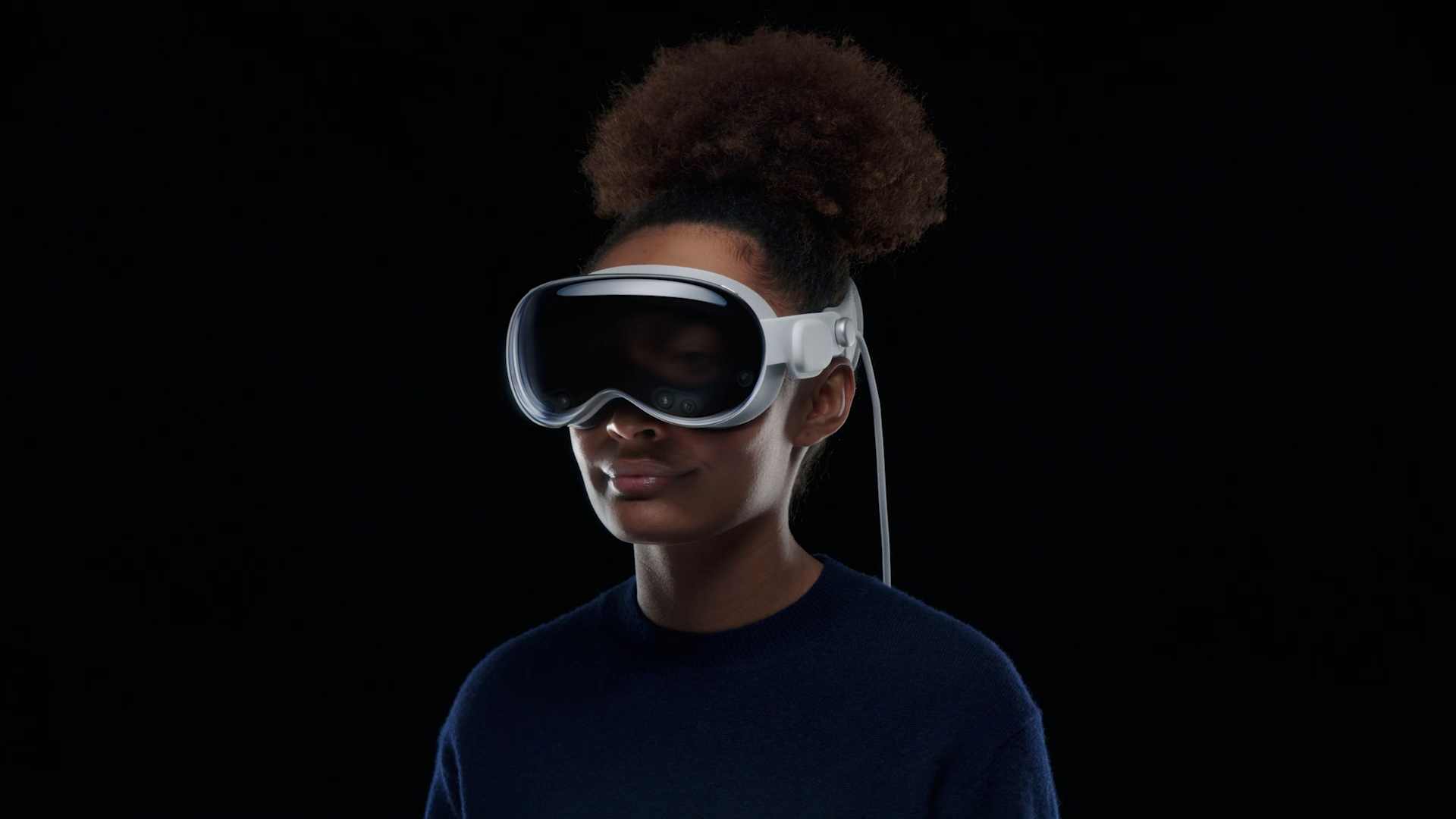
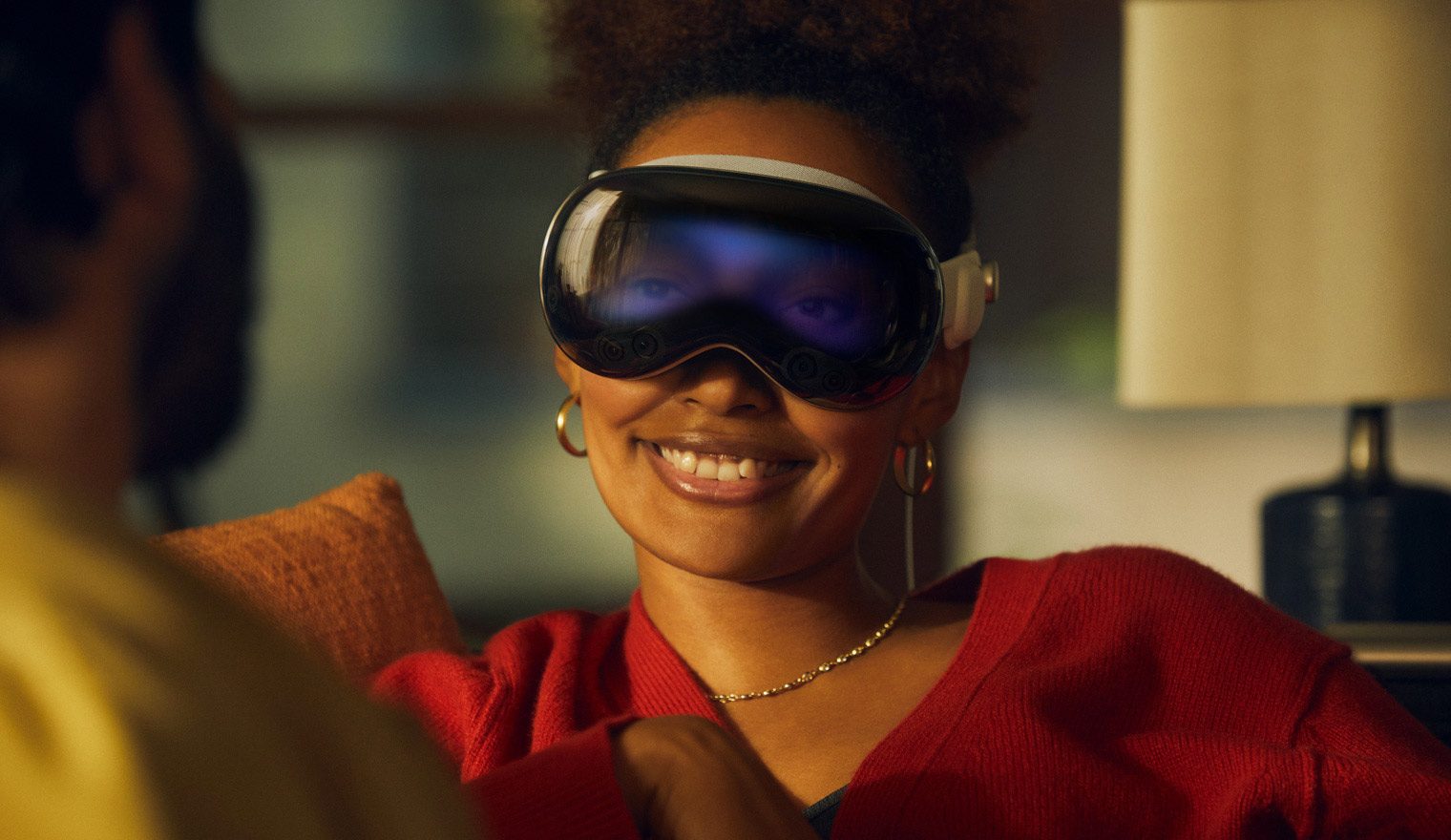
Today at Apple’s Worldwide Developers Conference (WWDC) the Cupertino tech giant unveiled its long-awaited XR headset, dubbed Vision Pro.

Similar to Meta’s Quest Pro and newly unveiled Quest 3 headset, Apple’s first mixed reality headset is capable of both virtual reality and augmented reality thanks to its color passthrough cameras, however it appears the company is focusing much more on AR tasks.

Called a “spatial computer” by Apple, the device is in large part targeting general computing tasks such as content consumption, video chatting, and productivity apps–the sort you might find on the company’s iPads and Macs, albeit available through its own device-specific App Store.

Apple Vision Pro’s input is based on optical hand tracking, eye-tracking, and voice input, and doesn’t feature controllers like headsets decidedly more dedicated to gaming.

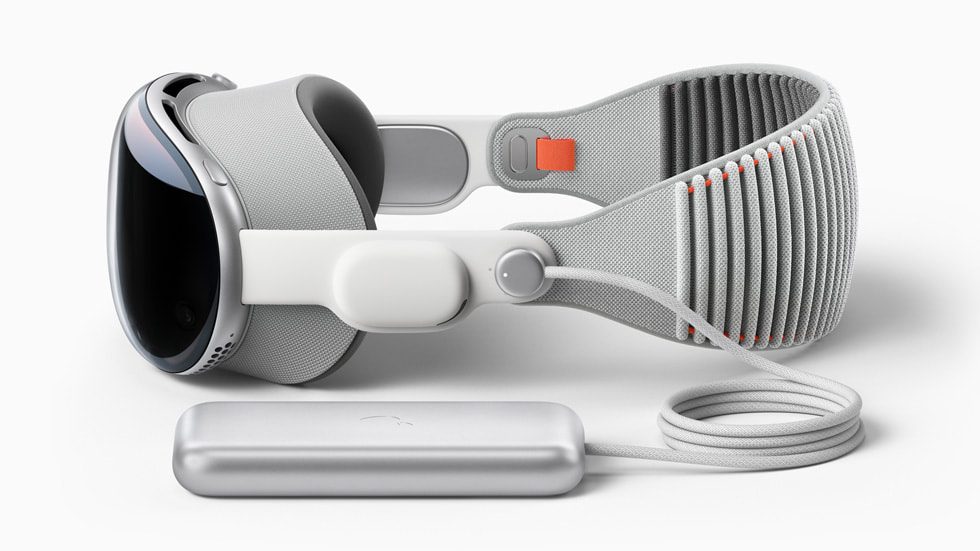
Image courtesy Apple

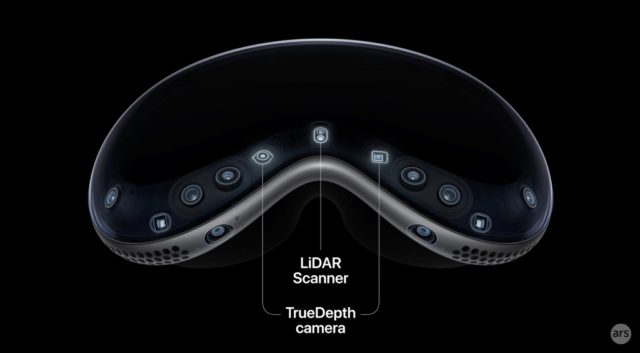
Here’s a brief breakdown of the spec shared with us today: Apple’s M2 chipset runs the standalone headset, while its new R1 chip processes input from 12 cameras, five sensors, and six microphones. R1 is said to stream new images to the displays “within 12 milliseconds — 8x faster than the blink of an eye,” the company says. That cable and pack you see in the image above is actually a battery, which the company says provides two hours of use.

Image courtesy Apple, via ArsTechnica

Vision Pro features custom micro‑OLED display system which the company says packs in 23 million pixels, or more than a 4K TV. We’re still learning about more specific hardware specs, such as field-of-view (FOV) and more concrete numbers for its displays.

The headset also features an exterior display to show a user’s eyes. A system, called EyeSight, can either obscure the digital version of your eyes to other people in the room, or show them to indicate you’re ready to talk face-to-face.

Image courtesy Apple

Vision Pro is coming to the US first in early 2024, priced starting at $3,500, putting it clearly in the “enthusiast” camp. Apple calls it its “most advanced personal electronics device ever.”

We’re at Apple’s campus for WWDC today and are going hands-on with Vision Pro today. Check back soon for our full impressions, and to find out if Apple’s first big entry into XR was worth the wait.


This story is breaking. Check back soon for more info.

Apple Unveils Vision Pro, Its First XR Headset Read More »

finally,-a-useful-blockchain-application:-tracing-halal-meat

Finally, a useful blockchain application: Tracing halal meat

Thomas Macaulay

Story by

Thomas Macaulay

Senior reporter

Thomas is a senior reporter at TNW. He covers European tech, with a focus on deeptech, startups, and government policy. Thomas is a senior reporter at TNW. He covers European tech, with a focus on deeptech, startups, and government policy.

Blockchain is frequently derided as a solution in search of a problem. But buried beneath the crypto scams and Web3 utopianism hide some intriguing use cases.

Some of the most powerful applications are in traceability. When embedded in supply chains, blockchain can track the entire product lifecycle, from origin to consumption. As the tech provides permanent, indelible, and unalterable records, extensive data about items and transactions can be securely stored and authenticated.

In the food sector, the benefits are particularly attractive. In one pilot project by UK startup Provenance, blockchain and smart tagging were used to track illegal tuna fishing, seafood fraud, and forced labour. As well as ensuring ethical practices, the scheme exposed blockchain’s potential for corporate auditing, tackling counterfeits, and reducing administrative costs.

In Wales, blockchain boffins have found another promising target for traceability: halal meat. In a European first, British startup iov42 is developing a data-sharing platform that provides secure records of compliance with halal standards — which are often breached by fraudulent products. 

The culprits range from sole traders to international organised crime groups. One of the most notorious transgressions emerged in 2020, when a Malaysian “meat cartel” was exposed for bribing customs officials, distributing meat from uncertified slaughterhouses, and passing off kangaroo and horse flesh as halal beef.

The scandal sparked an outcry in Malaysia — where Muslims comprise about 60% of the population — and across the Islamic world. It also threatened to cause deep financial problems. Malaysia was aiming to become a global hub for the $2.3 trillion halal market, and was already exporting $9bn in halal-certified products.

iov42 is betting that blockchain can reduce the risks of such offences. By tracing produce from the farm to the table, the company aims to embed provenance tracking, boost certification schemes, and increase impartiality in the halal market.

“Our technology was designed to help improve traceability in industries just like this,” said David Coleman, Chief Product Officer at iov42.

To bring the project to life, iov42 is collaborating with certification experts at  Prime UK, a Cardiff-based compliance services provider. Last week, the companies announced that they’ve attracted a cash injection from the Welsh government’s Blockchain Demonstrator Challenge Fund.

The government scheme was launched to develop the local blockchain sector. If the halal project is a success, it could provide a rare example of the real-world benefits that blockchain can bring to Wales.

Get the TNW newsletter

Get the most important tech news in your inbox each week.

Also tagged with


Finally, a useful blockchain application: Tracing halal meat Read More »

hands-on:-creal’s-light-field-display-brings-a-new-layer-of-immersion-to-ar

Hands-on: CREAL’s Light-field Display Brings a New Layer of Immersion to AR

More than four years after I first caught wind of their tech, CREAL’s light-field display continues to be one of the most interesting and promising solutions for bringing light-fields to immersive headsets. At AWE 2023 I got to check out the company’s latest tech and saw first hand what light-fields mean for immersion in AR headsets.

More Than One Way to Focus

So first, a quick recap. A light-field is a fundamentally different way of showing light to your eyes compared to the typical displays used in most headsets today. The key difference is about how your eyes can focus on the virtual scene.

Your eyes have two focus methods. The one most people are familiar with is vergence (also called stereoscopy), where both eyes point at the same object to bring overlapping views of that object into focus. This is also what makes things look ‘3D’ to us.

But each individual eye is also capable of focusing in a different way by bending the lens of the eye to focus on objects at different distances—the same way that a camera with only one lens focuses. This is called accomodation.

Vergence-Accommodation Conflict

Most XR headsets today support vergenge (stereoscopic focus), but not accomodation (single-eye focus). You may have heard this called Vergence-Accomodation Conflict; also known to the industry as ‘VAC’ because it’s a pervasive challenge for immersive displays.

The reason for the ‘conflict’ is that normally the vergence and accommodation of your eyes work in tandem to achieve optimal focus on the thing you want to look at. But in a headset that supports vergence, but not accomodation, your eyes need to break these typically synchronous functions into independent functions.

It might not be something you ‘feel’ but it’s the reason why in a headset it’s hard to focus on things very near to you—especially objects in your hands that you want to inspect up close.

The conflict between vergence and accommodation can be not just uncomfortable for your eyes, but in a surprising way also rob the scene of immersion.

Creal’s Solution

And this is where we get back to Creal, a company that wants to solve the Vergence-Accommodation Conflict with a light-field display. Light-field displays structure light in the same way that we see it in the real world, allowing both of the focus functions of the eyes—vergence and accommodation—to work in tandem as they normally do.

At AWE 2023 this week, I got to check out the company’s latest light-field display tech, and came away with an added sense of immersion that I haven’t felt in any other AR headset to date.

I’ve seen Creal’s static bench-top demos before, which show static floating imagery through the lens to a single eye, demonstrating that you can indeed focus (accommodate) at different depths. But you won’t really see the magic until you see a light-field with both eyes and head-tracking. Which is exactly what I got to do this week at AWE.

Photo by Road to VR

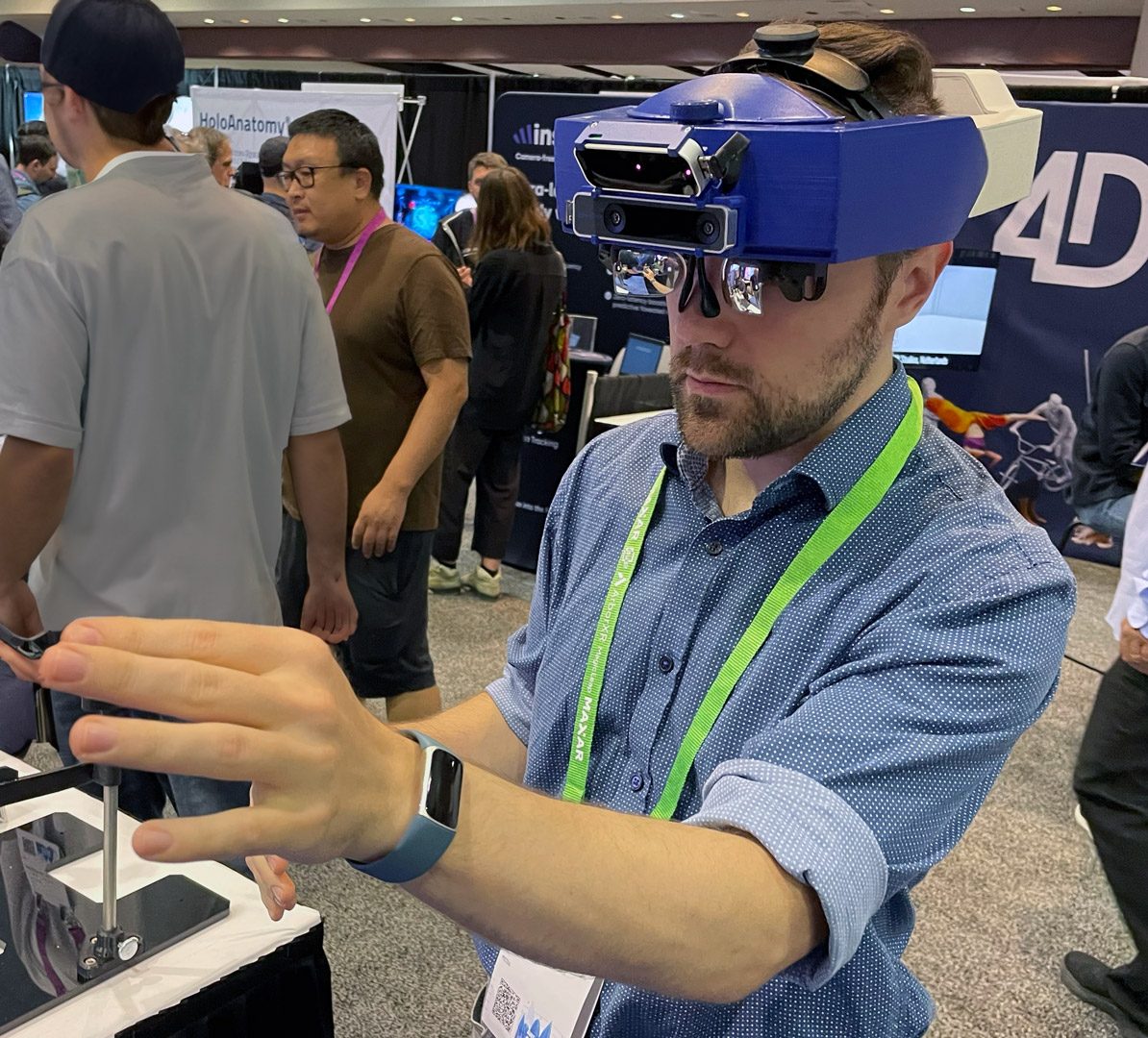
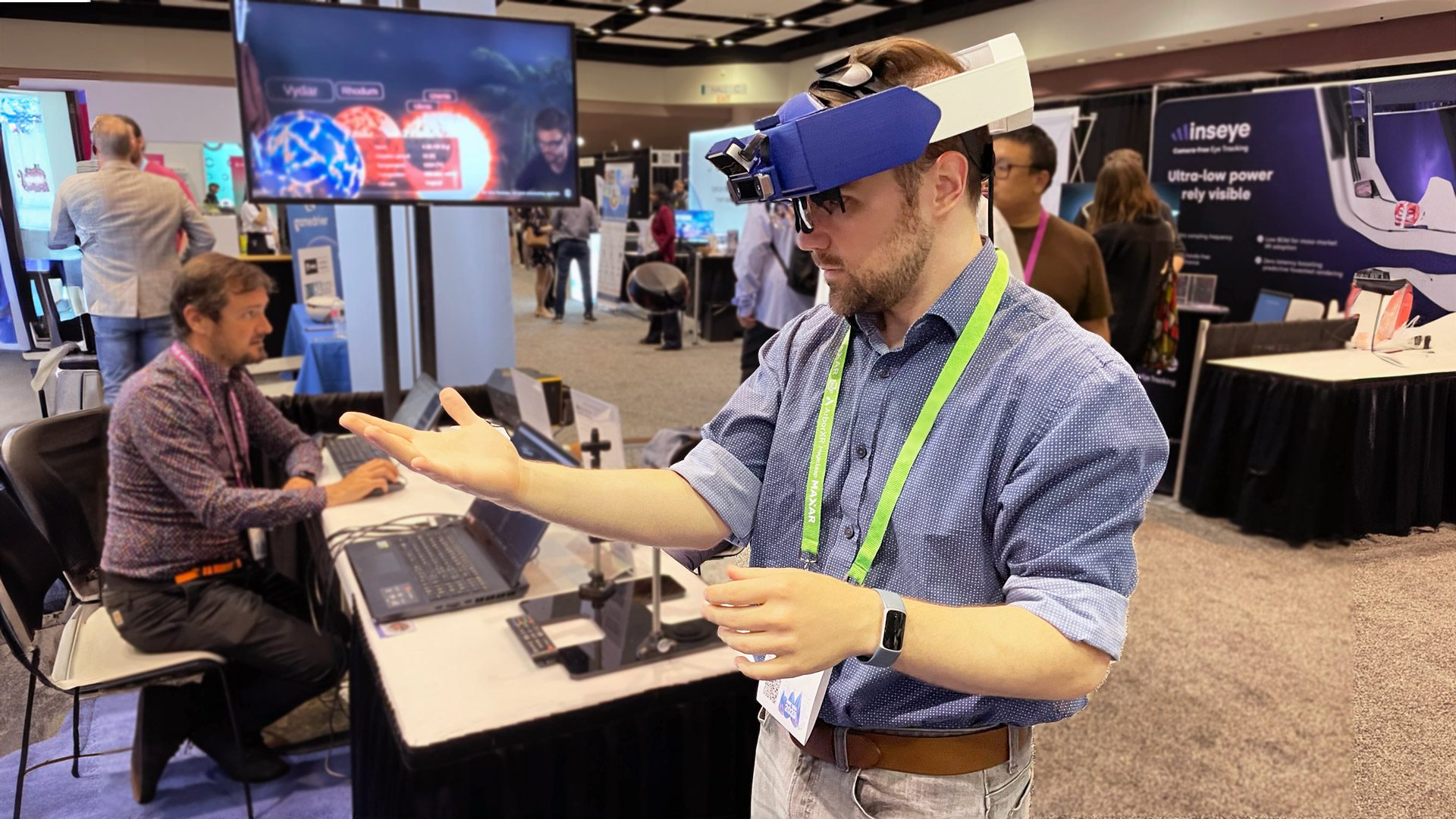
On an admittedly bulky proof-of-concept AR headset, I got to see the company’s light-field display in its natural habitat—floating immersively in front of me. What really impressed me was when I held my hand out and a little virtual turtle came floating over to the palm of my hand. Even though it was semi-transparent, and not exceptionally high resolution or accurately colored, it felt… weirdly real.

I’ve seen all kinds of immersive XR experiences over the years, and holding something in your hand sounds like a banal demo at this point. But there was just something about the way this little turtle looked—thanks to the fact that my eyes could focus on it in the same way they would in the real world—that made it feel more real than I’ve ever really felt in other headsets. Like it was really there in my hand.

Photo by Road to VR

The trick is that, thanks to the light-field, when I focused my eyes on the turtle in my hand, both the turtle (virtual) and my hand (real) were each in proper focus—something that isn’t possible with conventional displays—making both my hand and the turtle feel more like they were inhabiting the same space right in front of me.

It’s frustratingly impossible to explain exactly how it appeared via text alone; this video from Creal shot through-the-lens gives some idea of what I saw, but can’t quite show how it adds immersion over other AR headsets:

It’s a subtle thing, and such added immersion probably only meaningful impacts objects within arms reach or closer—but then again, that distance is where things have the potential to feel most real to use because they’re in our carefully watched personal space.

Digital Prescriptions

Beyond just adding a new layer of visual immersion, light-field displays stand to solve another key problem, which is vision correction. Most XR headsets today do not support any kind of prescription vision correction, which for maybe even more than half of the population means they either need to wear their correctives while using these devices, buy some kind of clip-on lens, or just suffer through a blurry image.

But the nature of light-fields means you can apply a ‘digital prescription’ to the virtual content that exactly matches the user’s corrective prescription. And because it’s digital, this can be done on-the-fly, meaning the same headset could have its digital corrective vision setting change from one user to the next. Doing so means the focus of virtual image can match the real world image for those with and without glasses.

Continue on Page 2: A More Acceptable Form-factor »

Hands-on: CREAL’s Light-field Display Brings a New Layer of Immersion to AR Read More »

psychedelics-startups-counter-stereotypes-to-bring-hallucinogens-into-mental-healthcare

Psychedelics startups counter stereotypes to bring hallucinogens into mental healthcare

Thomas Macaulay

Story by

Thomas Macaulay

Senior reporter

Thomas is a senior reporter at TNW. He covers European tech, with a focus on deeptech, startups, and government policy. Thomas is a senior reporter at TNW. He covers European tech, with a focus on deeptech, startups, and government policy.

LSD, magic mushrooms, MDMA, ketamine, DMT… it’s a suspicious product line for a legitimate business — and psychedelics startups know it. With that in mind, it’s unsurprising that the sector are wary of the stereotypes around hallucinogens.

“What the industry really needs is the most boring person in the room to be presenting the topic,” says Clara Burtenshaw, co-founder of Neo Kuma Ventures, Europe’s largest VC fund for psychedelic healthcare.

It would be harsh to call Burtenshaw the most boring person in the room, but she’s not the clichéd lover of trips. More polished entrepreneur than kaleidoscopic hippy, Burtenshaw was a corporate lawyer before pivoting to psychedelic healthcare.

It was an uncommon career switch with a familiar root: seeing loved ones struggle with their mental health. Burtenshaw thought psychedelics could provide a better remedy.

In late 2019, she cofounded Neo Kuma (Greek for “New Wave”) to invest in the treatments. Her timing proved prescient. Within weeks, the world was being plunged into a mental health epidemic.

In the first year of the COVID-19 outbreak, the global prevalence of anxiety and depression increased by 25%, according to the World Health Organisation (WHO). Already understaffed and underfunded, mental health services were pushed beyond their limits.

Inevitably, a surging demand for medications followed. But that was merely accelerating the prevailing trend. In Europe, antidepressant consumption has more than doubled in the last 20 years. 

The medication can be life-saving, but the benefits aren’t equally distributed. Over a third of patients are resistant to the treatment’s mood improvements. Others can suffer from side effects, dependence, or withdrawal symptoms.

“It’s about developing the blockbuster drugs of tomorrow.

As the uptake of antidepressants soared, some researchers began to assert that they were barely better than placebos. A recent study found that 10 of the most popularly prescribed medications made a meaningful difference in only 15% of the patients who took them.

Psychedelic treatments offer an alternative. While conventional antidepressants are taken regularly over extended periods, just one trip alongside therapy can have lifelong benefits.

That transformative potential offers big business opportunities. The global mental health market was already valued at $380bn (€356bn) in 2020. By 2030, it’s projected to reach $538bn (€503bn). 

The chunk that Burtenshaw’s targeting will come from psychedelic drug development — a subsector that Europe is leading

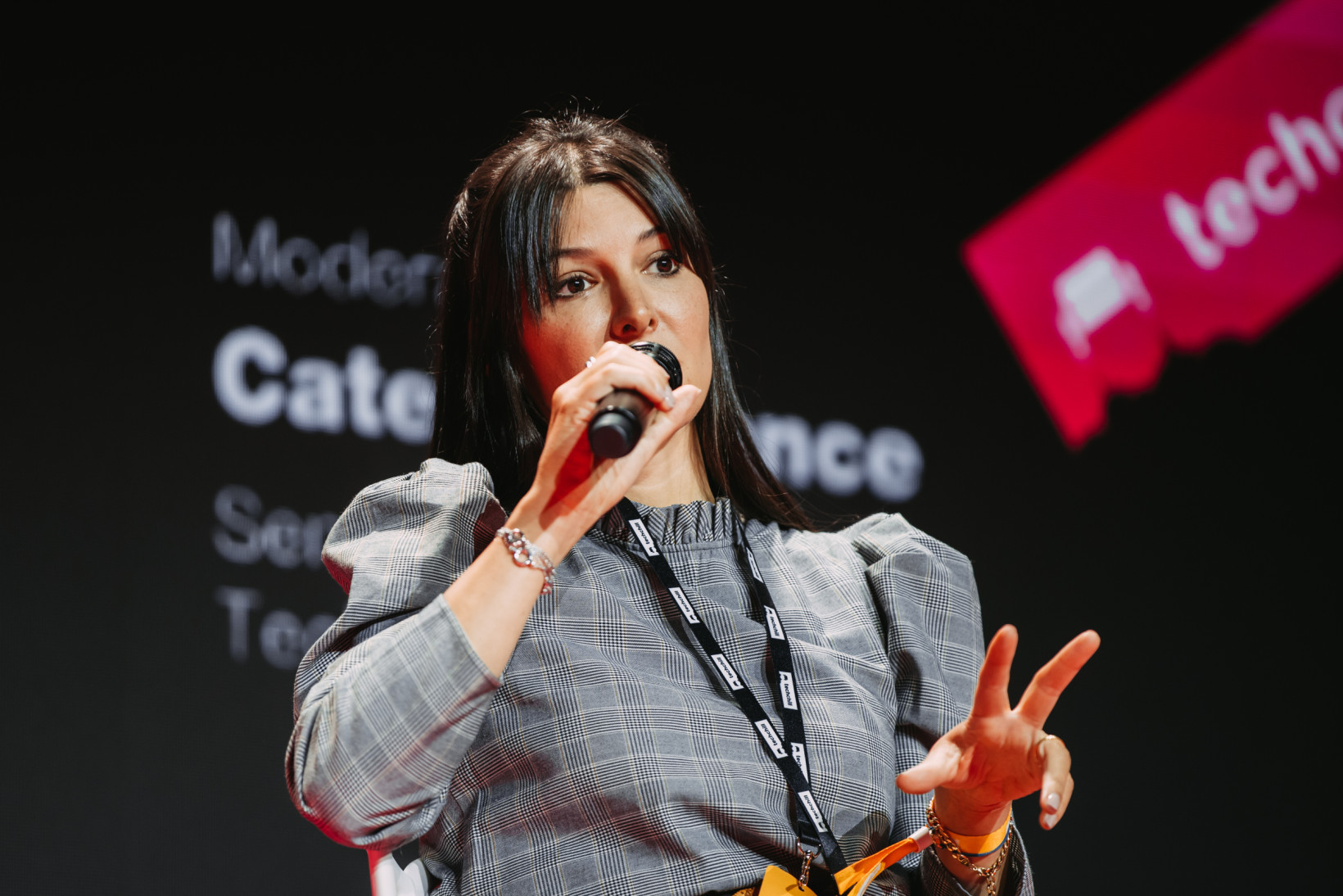
Clara Burtenshaw
Burtenshaw spoke to TNW at TechChill Riga in April. Credit: TechChill

The continent is home to some of the space’s key players, from Atai Life Sciences, a German startup that’s trialling an MDMA derivative for PTSD, to the UK’s Beckley Psytech, which recently won FDA approval to test a compound found in toads as a treatment for alcoholism. The riches, Burtenshaw hopes, will emerge after patenting the intellectual property.

“That’s how you see your return on investment,” she says. “It’s about developing the blockbuster drugs of tomorrow.”

The blockbuster drugs of tomorrow won’t be ready overnight. The process of developing, testing, licensing, and distributing new medications is a long one — but the pay-off could be enormous.

Analysts predict that the psychedelic healthcare industry will be worth $6.9bn (€6.4bn)  by 2027.  But before the sector reaps those rewards, it must first convince the sceptics.

Once regulators approve a drug, it moves from an illicit substance to a recognised medicine. But the route to psychedelics is long and perilous. To earn their backing, the sector needs to win clinical arguments.

“Psychedelics does attract evangelists who talk about all of the wonderful things about the treatment and perhaps gloss over the risks,” says Burtenshaw. “But we need to take a data-driven, evidence-based approach to looking at these treatments.”

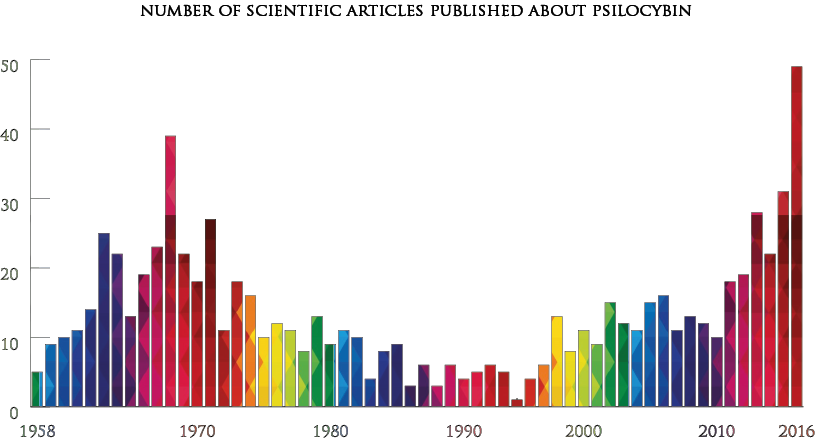
And that evidence base is growing. A growing body of research has shown that psychoactive substances can drive therapeutic breakthroughs for various mental health issues. 

In one study Neo supported, veterans were given controlled doses of MDMA. Over two-thirds (68%) experienced complete remission from PTSD. The other 32% felt significant relief. 

“That was completely unheard of in psychiatry — we don’t see results like that,” says Burtenshaw. “And many of these patients are veterans who had really ingrained PTSD and had been through a number of unsuccessful treatments in the past.”

A wave of post-WWII research into psychedelics was curtailed when the US government escalated the war on drugs
A wave of post-WWII research into psychedelics was curtailed when the US government escalated the war on drugs. It’s been revitalised in recent years. Credit: Beckley Foundation

Promising results have also emerged at Compass Pathways, a startup that was listed on the Nasdaq in September 2020. Based in the UK, the company has developed a synthetic form of psilocybin — a psychoactive component in magic mushrooms — for treatment-resistant depression (TRD), which is diagnosed after conventional medicine proves ineffective.

A study published last year found that the substance can significantly allay severe depression. After taking a single 25mg dose alongside psychological support, around 39% of participants were in remission by week three. Notably, the biggest impact came a day after receiving the treatment. Standard antidepressants, by contrast, take several weeks to reach maximum effect.

Both treatments are now targeting regulatory review — which would open them up to the market. Burtenshaw believes they can push psychedelic healthcare more broadly towards the mainstream.

“What we’ve seen with psychedelics is this potential for people to really understand the root cause of their trauma, directly face it head on, work with a therapist to come to terms with it, and then get on with their lives,” she says.

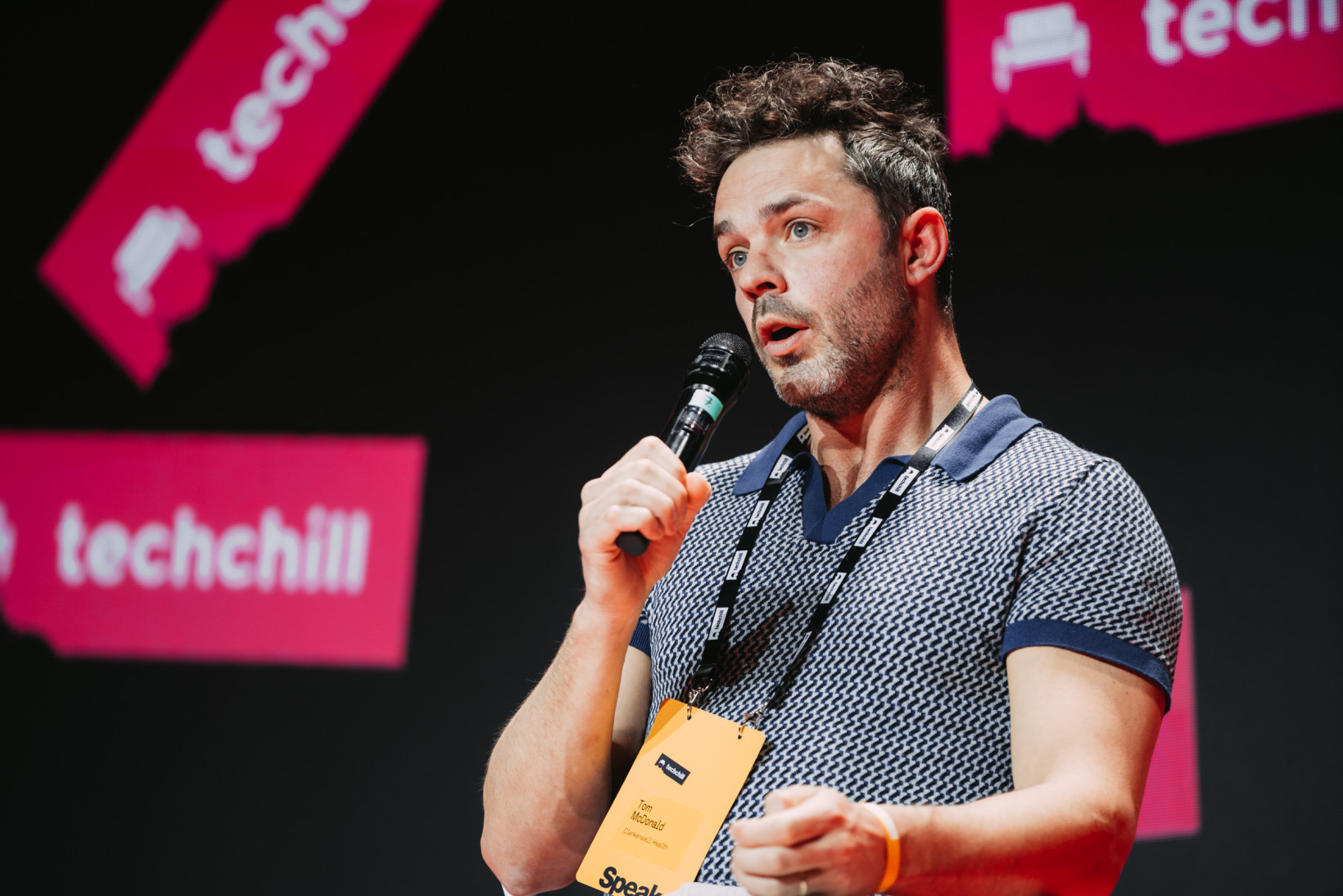
Like Burtenshaw, Clerkenwell Health CEO Tom McDonald isn’t the archetypal lover of hallucinogens. McDonald spent 10 years working in management consulting with big pharma before joining Clerkenwell, a British startup that runs clinical trials for psychedelic treatments.

Tom McDonald
McDonald spoke on a panel at TechChill Riga in April. Credit: TechChill

The career change “definitely raised eyebrows from friends and family,” says McDonald. 

“There’s still a lot of stigma around, but everyone in the space is trying to normalise it. And data speaks — as do emotive stories.”

Such stories are powerful tools for changing perceptions, but the most effective narratives are localised.

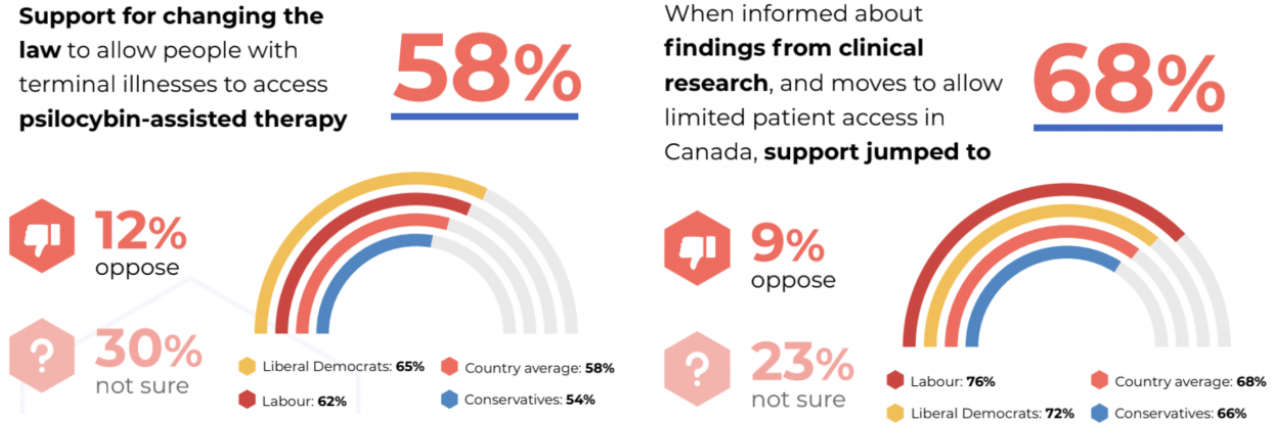
In the US, for instance, tales of military veterans using psychedelics to overcome trauma have won over sceptics. In the UK, meanwhile, the impacts on patients with terminal illnesses have garnered more public sympathy. That sympathy could bring the benefits closer to home.

Research shows the combined power of stories and data.
Surveys have shown that stories combined with data can win public support. Credit: Drug Science

Currently, most European citizens would need to travel abroad to access psychedelic therapies, but there are signs that the regional gap is narrowing.

In the UK, for instance, politicians from across the political spectrum are rallying support for the treatment. Last month, Conservative politician Crispin Blunt warned that the country’s regulation of psychedelics was “trailing behind Australia, Canada, and the United States.” 

Blunt said the substances “will help address the miserable dependence of too many” on antidepressants. The veteran MP wants psilocybin to be moved from a Schedule 1 drug to the lower-risk Schedule 2, which would allow researchers to further explore its potential as a medicine.

“The science highlights their immense potential.

His plea echoes recent petitions in the EU. Just last week, a cross-party faction of lawmakers launched a new group to advance access to affordable and safe novel therapeutic applications of psychedelics in the bloc.

“Millions of Europeans are in need of better treatments,” said Czech MEP Mikuláš Peksa. “We need to ensure that novel psychedelic treatments are being considered, as the science behind them highlights their immense potential.”

That immense potential doesn’t only appeal to politicians. Relaxing rules would also create diverse openings for tech — and startups are poised to capitalise.

Europe’s psychedelics startups have already explored extensive digital applications. They range from April19’s AI drug discovery platform and Beckley Psytech’s biomarkers for tracking patients to Homecoming’s app for therapists and Wavepaths’ personalised music for treatment.

One of their most notable features is adaptability, which could extend their applications from psychedelics to the broader health and wellness markets.

Whilst wearing an eye mask, each individual listens to a carefully designed series of musical programs, and receives person-centred support from trained psychotherapists.
In Wavepaths’ psychedelics sessions, patients wear an eye mask and listen to of music while receiving in-person support from psychotherapists. Credit: Wavepaths

With such breadth of opportunities, the sector has grounds for optimism. But startups will have to play the long game and attract patient capital.  

“I think the market landscape is going to look so different in five years’ time to where it is now,” says Burtenshaw. “What we’re expecting to see is this dovetailing of destigmatisation alongside a rollout of these treatments.”

The route to market, however, appears long and treacherous. Regulatory barriers, a perilous financial landscape, and slow paths to profit have somewhat dimmed the excitement around psychedelics. But in the crucial fight for hearts and minds, the prospects of victory are growing.

Get the TNW newsletter

Get the most important tech news in your inbox each week.

Also tagged with


Psychedelics startups counter stereotypes to bring hallucinogens into mental healthcare Read More »

awe-usa-2023-day-two:-more-keynotes,-more-panels,-and-the-open-expo-floor

AWE USA 2023 Day Two: More Keynotes, More Panels, and the Open Expo Floor

The second day of AWE is the day that the expo floor opens. That is always thrilling, and we’ll get there, but first – more keynotes and conversations.

AWE Day Two Keynotes

Day One kickstarted the keynotes, but AWE Day Two saw exciting presentations and announcements from Magic Leap and Niantic. Both affirmed a theme from the day before: meaningful XR is already here.

Magic Leap: Let’s Get to Work

“The vision of AR that some legacy tech companies are promising is still years out, is not years or months or days out,” Magic Leap CEO Peggy Johnson said in her keynote. “The small team at Magic Leap has made something that many larger companies are still struggling to achieve.”

Peggy Johnson, Magic Leap's CEO AWE Day 2
Peggy Johnson

Johnson also continued another theme from AWE Day One: AI and XR aren’t in competition – they help each other. Inbar’s opening talk included a line that quickly became a motto for almost the whole event: “XR is the interface for AI.”

“I honestly believe AR systems are going to become the endpoints for a lot of AI,” said Johnson. “The ability to provide contract input and get contextual output will really be a game changer.”

Magic Leap’s big announcement wasn’t to do with AI, but it will still be thrilling to developers: an Unreal Engine plugin is coming in August.

“AR Everywhere” With Niantic

While enterprise companies and hardware manufacturers are still struggling with adoption to since degree, few companies have done as much for AR consumer adoption as Niantic.

Brian McClendon Niantic Labs AWE Day 2
Brian McClendon

In his AWE keynote, “Empowering AR Everywhere”, Niantic Senior Vice President of Engineering, Brian McClendon, laid out a number of major updates coming to the company – as well as coming to or through 8th Wall.

First, ARDK 3.0 will allow developers using Niantic tools to also use outside AR asset libraries. It will also enable a QR code-triggered “lobby system” for multi-user shared AR experiences. The updated ARDK will enter a beta phase later this month. A new maps SDK compatible with Unity is also coming to 8th Wall.

Further, 8th Wall’s “Metaversal Deployment” announced at AWE 2021 is now compatible with mixed reality via Quest 2, Quest Pro, “and probably all future MR headsets.”

Big Picture Panel Discussions

One of the things that really makes AWE special is its ability to bring together the industry’s big thinkers. A number of insightful panel discussions from Day Two explored some of the biggest topics in XR today.

XR’s Inflection Point

The panel discussion “How Immersive Storytelling Can Deepen Human Understanding of Critical Issues” brought together Unity CEO John Riccitiello, journalist Ashlan Cousteau, and TRIPP CEO and co-founder Nanea Reeves. The talk included further affirmations that, contrary to some media pieces, XR as an industry is thriving.

John Riccitiello, Ashlan Cousteau, Nanea Reeves - AWE Day 2
From left to right: John Riccitiello, Ashlan Cousteau, and Nanea Reeves

“I now cancel what I said seven years ago about this not being a good time to build a business in this space,” said Riccitiello. “We’re at a time right now where it makes a lot of sense to look forward with optimism around XR. … Companies are born around technology transitions.”

Reeves echoed the sentiment, but included some of the cautious caveats expressed by XR ethicist Kent Bye during a panel discussion yesterday.

“We’re at such an interesting point of technology and the evolution of it, especially with AI and XR,” said Reeves. “What’s the next level of storytelling and what should we be aware of as we bring AI into it?”

Building Open Standards for the Metaverse

The good news is that the metaverse isn’t dead. The bad news is that it arguably hasn’t been born yet either. One of the most important features of the metaverse is also one of its most elusive.

It was also the crux of a panel discussion bringing together XR Safety Initiative founder and CEO Kavya Pearlman, XRSI Advisor Elizabeth Rothman, and Khronos Group President Neil Trevett, moderated by Moor Insights and Strategy Senior Analyst Anshel Sag.

Kavya Pearlman, Neil Trevett, Elizabeth Rothman, and Anshel Sag - AWE 2023 Day 2
From left to right: Kavya Pearlman, Neil Trevett, Elizabeth Rothman, and Anshel Sag

“Whichever way you come to the metaverse, you need interoperability,” said Trevett. “It’s foundational.”

The panel also addresses the lasting and fleeting effects of the wave of attention that has seemingly passed over the metaverse.

“We go through these hype cycles and bubbles,” said Rothman. “There are always technological innovations that come out of them.”

The panel also addressed AI, an overarching theme of the conference. However, the panel brought up one concern with the technology that had not been addressed elsewhere.

“This convergence has a way more visceral impact on children’s brains even than social media,” said Pearlman.

So far, the “solution” to this problem has been for content publishers to age-restrict experiences. However, this approach has crucial shortcomings. First, most approaches to age restrictions aren’t foolproof. Second, when they are, this measure excludes young users rather than protecting them.

“We run the risk of regulating children right out of the metaverse,” said Rothman. “We need to strike a balance.”

Hitting the AWE Floor

I first started covering AWE during the pandemic when the entire conference was virtual. AWE is a lot more fun in-person but, practically speaking, the demos are the only component that can’t really happen remotely.

Meeting Wol

I actually met Wol in the Niantic Lounge before the very first session on Day One. While this is where arranging this content makes sense to me, Wol was possibly my first impression of AWE. And it was a good one. But wait, who’s Wol?

Niantic Lounge AWE 2023
Niantic Lounge

Wol is a collaboration between 8th Wall, Liquid City, and InWorld AI. He’s an artificially intelligent character virtually embodied as an owl. His only job is to educate people about the Redwood Forest but he’s also passionate about mushrooms, fairies, and, well, you just have to meet him.

“Wol has a lot of personal knowledge about his own life, and he can talk to you about the forest through his own experience,” explained Liquid City Director Keiichi Matsuda. “Ultimately, Wol has a mind of its own and we can only provide parameters for it.”

Wol

I met Wol through the Quest Pro in passthrough AR via a portal that appeared in the room directly into the Redwoods – and, now that I think about it, this was the day before Niantic announced that 8th Wall supported Quest Pro MR. In any case, the whole experience was magical, and I can’t wait to get home and show it to the family.

Visiting Orlando via Santa Clara

Largely thanks to a group called the Orlando Economic Partnership, Orlando is quickly becoming a global epicenter of metaverse development. Just one of their many initiatives is an 800-square-mile virtual twin of the Orlando area. The digital twin has its own in-person viewing room in Orlando but it also exists in a more bite-size iteration that runs on a Quest 2.

“The idea was to showcase the entire region – all of its assets in terms of data points that we could present,” explained the OEP’s Director of Marketing and Communications Justin Braun. “It’s going to become a platform for the city to build on.”

I was able to see at AWE featured photorealistic 3D models of Orlando landmarks, complete with informational slides and quiz questions. The full version, which took 11 months, is a lot more fully featured. It just doesn’t fit in Braun’s backpack.

“At some point, this will be able to do things that are beneficial for the city and its utilities, like shower power outages,” said the OEP’s Chief Information Officer David Adelson. “It’s community-driven.”

Gathering Around the Campfire

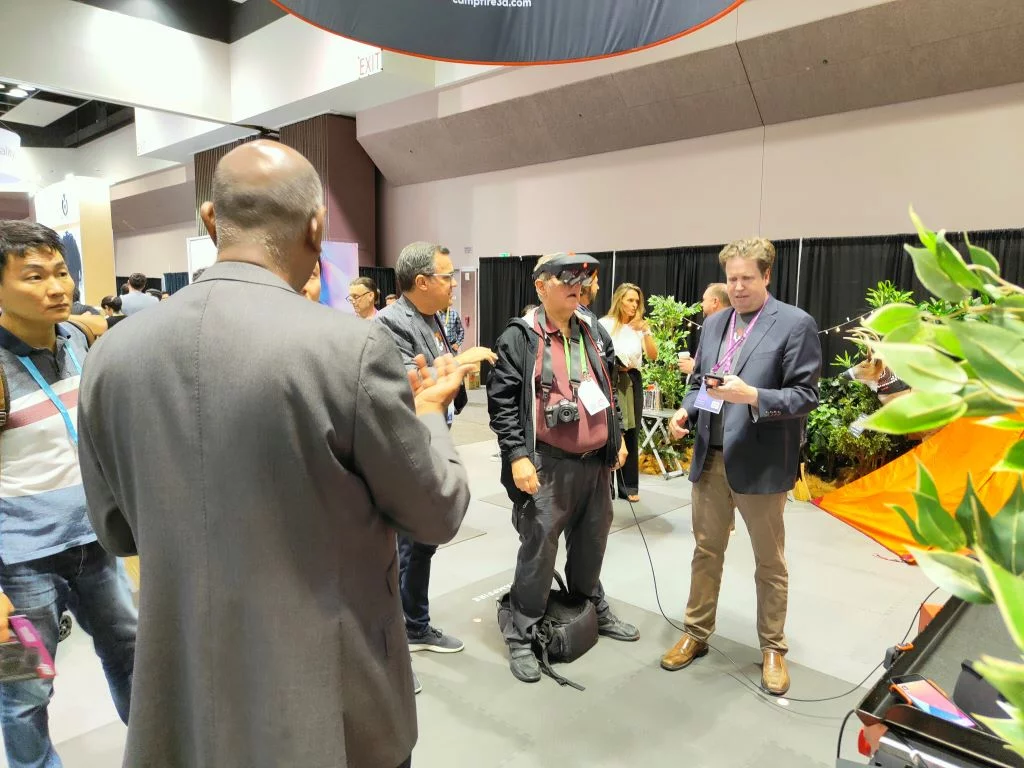
I opened by saying that demos can’t be done remotely. I remotely demoed Campfire recently, but that was their desktop view. Campfire also offers tabletop and room-scale 3D interactions that require the company’s custom-made headset and markers. I got to try these solutions out hands-on when I reconnected with CEO and co-founder Jay Wright on the AWE floor.

campfire at AWE 2023 Day 2
Campfire at AWE USA 2023

“The perception system is designed to do one thing very well, and that’s to make multi-user AR as high-fidelity as desktop,” said Wright. And they’ve done it.

Models and mockups that I viewed in mixed reality using Campfire’s hardware were beautifully rendered. The internet connectivity at AWE is notoriously spotty and, while the controller disconnected a few times, the display never skipped a beat.

Wright demonstrated the visor that switches Campfire from MR to VR on a virtually reconstructed art museum that I could view from above in a “dollhouse mode” or travel through in a 1:1 model. In addition to showcasing more hardware and software ease-of-use, it might have been the most graphically impressive showcase I’ve seen from XR hardware ever.

The Lenovo VRX

With Lenovo ThinkReality’s new headset announced the day before AWE started, this might be the record for the shortest passage of time between a headset releasing and my putting it on – and it’s all thanks to ARPost’s longtime Lenovo contact Bill Adams.

“We think we have one of the best passthrough headsets and most comfortable headsets in the industry,” said Adams, who made a gentleman’s wager that I would (finally) be able to see my notes through the Lenovo VRX.

I couldn’t read my writing, but I could tell where the writing was on the page – which, honestly, is enough. Having tried the same experiment on the Quest Pro earlier that day, I can back up what Adams said about the headset’s passthrough quality.

As for comfort, ditto. The headset features a removable overhead strap, but it was so comfortable that I forgot that the strap was there anyway. Switching from VR to passthrough is a simple button press.

Catching Up With Snap

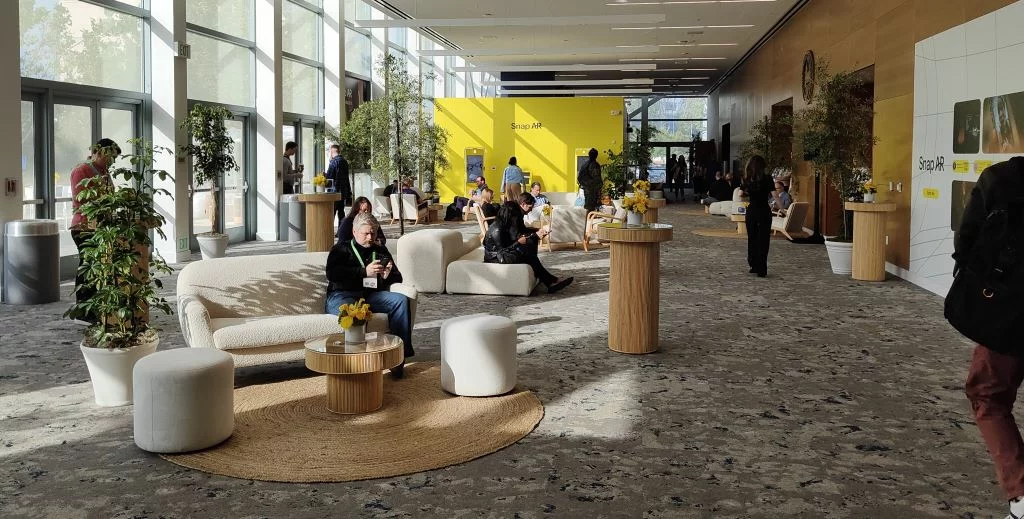
The average user can have a great AR experience with just a phone, and the average creator can make a really advanced experience without creating their own app, according to Snap Senior Product Communications Manager Cassie Bumgarner.

Snap AR at AWE 2023
Snap at AWE 2023

“There’s a lot of chatter on the hardware front, but what we want to show is that there’s so much more left to unlock on the mobile front,” said Bumgarner.

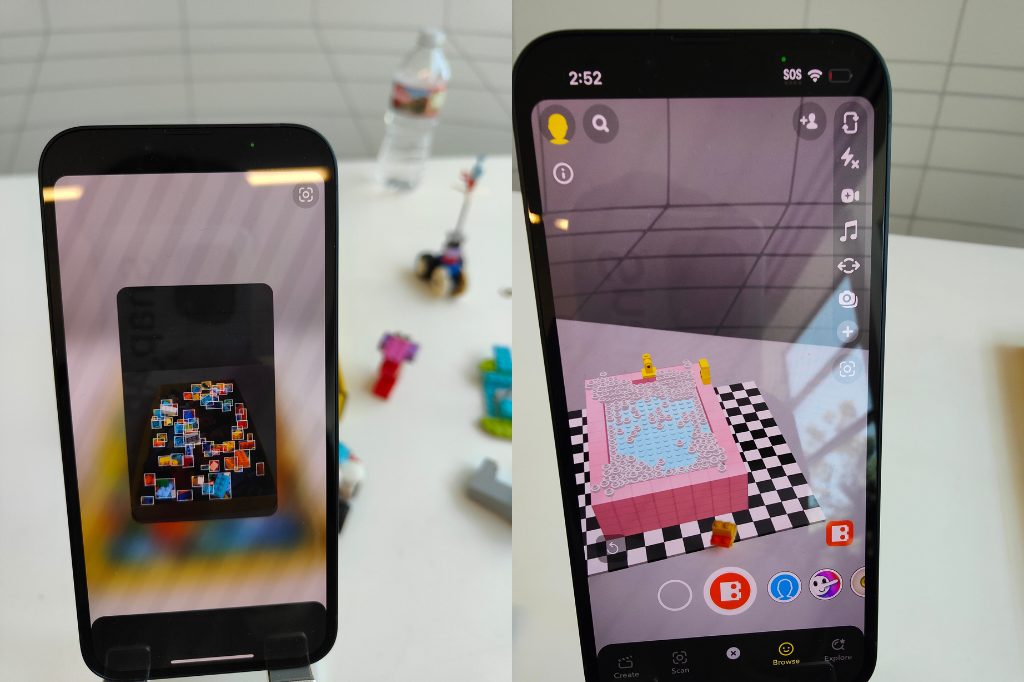
A Snap Lense made with QReal uses AI to identify LEGO bricks in a tub. A quick scan, and the lens recommends small models that can be made with the available pieces. Bumgarner and I still get the fun of digging out the pieces and assembling them, and then the app creates a virtual LEGO set to match our creation – in this case, a bathtub to go with the duck we made.

Snap bricks AWE 2023 Day 2

Of course, Snap has hardware too. On display at AWE, the company showed off the virtual try-on mirrors debuted at the Snap Partner Summit that took place in April.

One More Day of AWE

Two days down and there’s still so much to look forward to from AWE. The expo floor is still open tomorrow. There are no more keynotes, but that just means that there’s more time for panel discussions and insightful conversations. And don’t think we forgot about the Auggies. While most of the Auggies were awarded last evening, there are still three to be awarded.

AWE USA 2023 Day Two: More Keynotes, More Panels, and the Open Expo Floor Read More »

quest-3-will-continue-to-support-pc-vr-thanks-to-oculus-link

Quest 3 Will Continue to Support PC VR Thanks to Oculus Link

Like its predecessors, Quest 3 will be able to plug into high-end gaming PCs to play top PC VR titles.

Meta might have largely abandoned PC VR, but it’s not ready to pull the plug completely.

A spokesperson for the company has confirmed with Road to VR that Quest 3 will continue to support Oculus Link (also known as Quest Link) and Air Link.

Oculus Link allows users to plug Quest headsets into their PC via USB-C to interface with the Oculus PC software. From there users can use the headsets, including Quest 3 when it launches, to play Oculus PC games like Lone Echo and SteamVR games like Half-Life: Alyx.

Air Link, which offers the same PC VR capability—except wirelessly over Wi-Fi—is also confirmed for Quest 3.

As with prior versions of the headset, this could be a lifeline for the PC VR space which would otherwise be shrinking if not for a glut of Quest 2 users using their headset to play PC VR games. Quest 2 became the most popular headset used on SteamVR shortly after it launched, and has remained there ever since, holding a significantly larger share of usage than any other headset on the platform (including Meta’s older dedicated PC VR headsets like Rift and Rift S).

Quest 3 Will Continue to Support PC VR Thanks to Oculus Link Read More »
‘racket:-nx’-studio-reveals-mech-fighting-game-‘underdogs’,-coming-to-quest-early-2024

‘Racket: NX’ Studio Reveals Mech Fighting Game ‘UNDERDOGS’, Coming to Quest Early 2024

One Hamsa, the studio behind VR sports game Racket: NX (2018), announced their next game during Meta’s Quest Gaming Showcase today, this time delving into futuristic, physics-based robot fighting.

Called UNDERDOGS, the single player roguelike pits you against a cast of robo-baddies in the underground robot fighting scene, letting you gear up with 100+ items, including power tools like chainsaws and wrecking balls.

From the screenshots, it also appears UNDERDOGS is also getting some comic-book style narrative inserts too.

Here’s how One Hamsa describes the game:

[H]ire hackers and saboteurs, hustle and deal with the gangsters and psychos that run these streets as you claw your way up the food chain. This city is a dog-eat-dog s#@^ show, but luckily you ain’t alone. Your little bruv King is in your corner – hacking your enemies and giving you lip while you fight like a wild animal, smashing car sized pit bots that wanna kill you dead to the the deafening roars of the blood thirsty crowds. This is New Brakka – The Mech Fighting Capital of the World.

As a physics-based combat game, it also seems like there’s a fair bit of punching and weapon melee.

You’ll have some time to reorder your space for all the room-scale slashing and bashing. UNERDOGS is slated to hit the Quest Store sometime in early 2024. In the meantime, we’ll be following along with One Hamsa’s Twitter for all of the latest developments on its first post-Racket: NX VR game.

‘Racket: NX’ Studio Reveals Mech Fighting Game ‘UNDERDOGS’, Coming to Quest Early 2024 Read More »

eu-wants-to-create-100-deep-tech-unicorns-in-digital,-green-push

EU wants to create 100 deep tech unicorns in digital, green push

EU wants to create 100 deep tech unicorns in digital, green push

Siôn Geschwindt

Story by

Siôn Geschwindt

Siôn is a reporter at TNW. With a background in environmental science, he loves to write about climate tech, policy, and the built environme Siôn is a reporter at TNW. With a background in environmental science, he loves to write about climate tech, policy, and the built environment.

The European Commission launched a new initiative this week to help 100 deep tech startups become unicorns, as the bloc looks to accelerate growth in green and digital technologies. 

“We will identify one hundred of Europe’s future tech champions, engage them, and provide them with support on their scaleup journey,” said EU tech chief Margrethe Vestager, who announced the EIC Scale Up 100 initiative at a deep tech conference in Stockholm yesterday.  

These “future tech champions” will be picked from a pool of startups already enrolled in national and EU-led innovation programmes across the Continent. Only the “best performing” startups will make the cut, the EU executive said in a statement. 

Startups will be selected in areas that contribute to Europe’s green and digital transition such as climate, energy, digital, and health. “Supporting scaleups is not only our best chance to produce home-grown tech giants: it is a critical choice for digital and energy resilience,” said Vestager.

The European Innovation Council (EIC) will oversee the process. The Council, which Vestager likened to a “factory of European unicorns,” has already produced 12 startups valued at $1bn or more, such as Dutch vertifical farming startup Infarm and Swedish 3D bioprinting startup Cellink. The EIC has also produced 112 ‘centaur’ companies — firms with an annual recurring revenue exceeding $100m.  

EU member states and countries associated with the bloc’s scientific research initiative, Horizon Europe, will be invited to nominate companies from their ecosystems, with their participation pending the selection process. 

The selected startups will receive support from a group called the EIC Scaling Club which includes 100 investors from VC, growth, and government funds, 100 companies with innovation units, and 100 independent mentors. 

The initiative aims to help the startups grow annually by 40% in their valuation, new investments, partnerships, and jobs and by 50% across the same parameters for the 20 top performing companies in two years.

“EIC Scale Up 100 will prove that Europe is the most attractive location for future global unicorns and their investors,” said Vestager. 

The programme falls under the New European Innovation Agenda, launched last year, which aims to boost scaleup funding, nurture deep tech skills, and implement improved policy tools. 

Get the TNW newsletter

Get the most important tech news in your inbox each week.

Also tagged with


EU wants to create 100 deep tech unicorns in digital, green push Read More »

you-can-now-book-seats-on-all-electric-flights-in-scandinavia-—-but-read-the-small-print

You can now book seats on all-electric flights in Scandinavia — but read the small print

You can now book seats on all-electric flights in Scandinavia — but read the small print

Thomas Macaulay

Story by

Thomas Macaulay

Senior reporter

Thomas is a senior reporter at TNW. He covers European tech, with a focus on deeptech, startups, and government policy. Thomas is a senior reporter at TNW. He covers European tech, with a focus on deeptech, startups, and government policy.

A European airline today opened reservations for its first-ever commercial electric flights — but don’t expect a booking for this year’s summer holiday. Or the next four after that. Scandinavian Airlines (SAS) aims to make the maiden voyages within Sweden, Norway, and Denmark in 2028 — and even that sounds ambitious.

The company still hasn’t chosen the aircraft for the trip, which is unsurprising as the planes are still being built. SAS also isn’t ready to tell customers the date, departure location, distance, or duration of their flights. The airline promises to reveal further details “when decided.”

Another potential obstacle is regulatory hurdles. The new certification rules for electric aviation have, thus far, lagged behind technological development.

All of this makes it natural to have doubts about the timeline. According to SAS, the projections are based on talks with potential suppliers and the first electric flight “is estimated to be carried out in 2028.” Notably, that’s when the ES-30 airliner is due to enter service.

Designs for the ES-30 bear a strong resemblance to promotional images SAS used in its announcement of the flight bookings.
Designs for the ES-30 bear a strong resemblance to the images SAS used to promote its electric-flight bookings. Credit: Heart Aerospace

Developed by Swedish startup Heart Aerospace, the ES30 is expected to carry 30 passengers along a 200km all-electric range. In September 2022, SAS signed a “letter of support” about adding the model to its regional fleet.

The airline, however, says it still hasn’t made a final decision on which aircraft will operate the first flight. Nonetheless, it’s billing the ticket sales alone as a historic moment.

“The fact that we can now invite our passengers to the next major milestone in the future of aviation is a natural continuation of that pioneering spirit and a significant step on our journey towards more sustainable aviation,” said Anko van der Werff, CEO of SAS, in a statement.

Despite the apparent confidence, SAS isn’t willing to guarantee takeoffs in 2028. On the plus side, tickets are priced at a relatively reasonable 1946 Swedish krona (€168) — a nod to the year SAS started flying. And if your plans change, you can transfer the reservation to someone else.

If that convinces you to take the chance, you can reserve a seat here. There are 30 seats available on each of the three inaugural flights.

Get the TNW newsletter

Get the most important tech news in your inbox each week.

Also tagged with


You can now book seats on all-electric flights in Scandinavia — but read the small print Read More »