Happy Gemini Week to those who celebrate. Coverage of the new release will begin on Friday. Meanwhile, here’s this month’s things that don’t go anywhere else.
Google has partnered with Polymarket to include Polymarket odds into Google Search and Google Finance. This is fantastic and suggests we should expand the number of related markets on Polymarket.
Twitter will experiment with telling us what nation accounts are posting from, what date they joined and when they last changed their username. They say there will be privacy toggles, but of course then everyone knows you have something to hide, and they’ll highlight that you did it. I’m mostly in support of this, as it should help control various bot and astroturfing problems. I think that’s worth the cost.
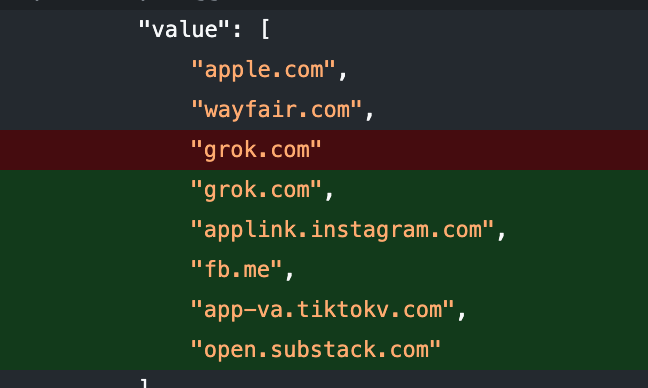
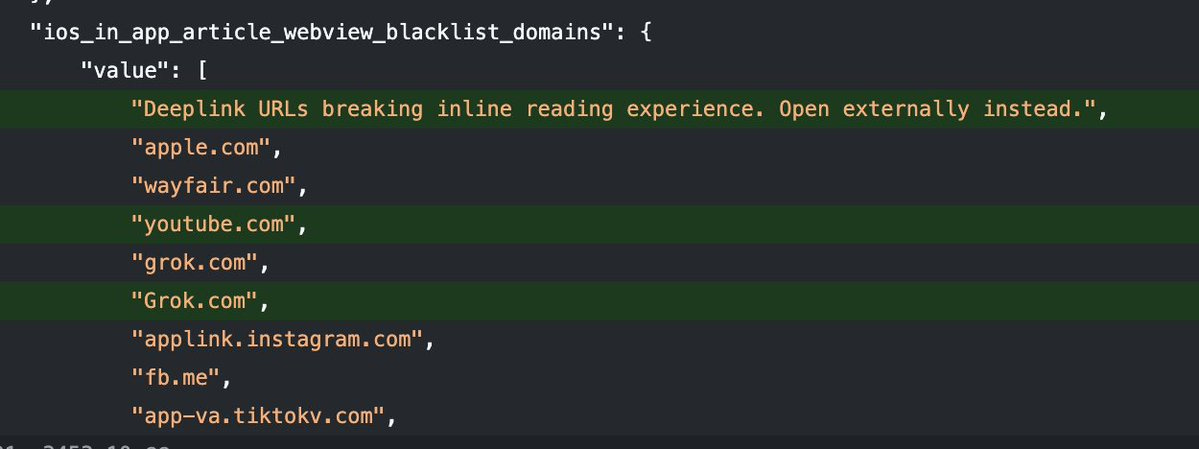
The plan to avoid penalizing Twitter links is that when you click on a link in the iOS app it will keep the post itself accessible on the bottom of the screen so that you can easily like, repost or respond to the original post while you read. I guess this is a marginal improvement?
Alternatively, you could do these things more often with tweets that have links or longer articles, especially the likes and retweets.
The unfortunate natural pattern is that if you provide a witty comment, the barrier to liking it is low. Whereas if you provide actual value in the form of a link or Twitter article, or you read something on Substack, the threshold for liking it is ‘I actually read the damn thing and not only liked it but didn’t have any issues with anything in it, and also remembered to like it afterwards’ which makes it highly unlikely.
Therefore, I’m going to make a request: If you think the world would be better off if more people read the link or article on Twitter, then like the post with the link or article. If not, not. Thank you for your attention to this matter.
The bulk of ‘social media’ is now actually short form television that uses an algorithm. This, as Matthew Yglesias notes, is bad. Short form algorithmic video is bad news. Social media as originally intended, where you are social and consume various media from people you are social with, is a mixed bag, but the new thing is terrible. Regular television has big downsides, but also advantages. This seems obviously much worse, and I’ve said it before but it bears repeating.
This is not good business on the part of Elon Musk. Even if your goal is only to advance conservative causes, you need to draw new users in. This doesn’t do that.
We are rolling back tariffs on “products that cannot be grown, mined or naturally produced in the United States.” Good. I almost always have a policy of praising rather than criticizing people when they stop hitting themselves but man, we did not need to spend the better part of a year figuring that one out.
Always be gracious when someone does something good, you don’t necessarily have to ask how we got there, especially since everybody knows:
White House: Thanks to President Trump’s deal-making, we’re making trade fair again, & winning BIG.
Coffee, tea, cocoa, spices, bananas, oranges, tomatoes, beef, fertilizers, & more are now exempt from reciprocal tariffs.
America First policies delivering for American workers & families🇺🇸
Alex Tabarrok: Frank Sinatra? Heck of a guy – real prince. Saved my life once. We were doing a show at the Sands, and between sets, I took a break in the parking lot. Next thing I know, three guys are working me over real good. Then I hear Frank say, ‘OK, boys, that’s enough.’”
Shecky Greene
Home and auto insurance rates are rising, so the state governments are governmenting and telling insurers to cap prices. If you have lots of insurance providers and rates keep going up, there’s a reason. If you don’t have lots of insurance providers, there’s a reason for that, too. As California has learned, if you cap insurance prices where they’re unprofitable, insurers pick up and leave. No one seems to be asking about how to lower the real cost of insurance, as in the need for payouts.
Trump explicitly says on Fox News we don’t have enough talent, we have to bring in talent, in reference to H1-Bs, and also reveals he had nothing to do with the raid on the South Korean battery factory and was wisely upset when it happened. It’s good that he understands the principle but we still observe what the White House is actually doing, which is not great.
Bobby Kogan: The mechanism through which Trump is paying the troops is the most blatant large Antideficiency Act (ADA) violation in US history. It’s also clearly willful. No one has been charged under the ADA before, but violations carry a 2 year jail term. Statute of limitations is 5 years.
Under the Constitution and under the ADA, it is illegal to spend money without funding for that purpose. The president may not spend money to do something unless there’s actually money to carry it out and that action is expressly allowed.
… Military pay is appropriated one year at a time, with a one-year period of availability. The fiscal year ended on September 30th, and we did not pass new appropriations bills (the government is shut down), so there’s no money available to pay the troops (or to do lots of things).
… [various technical reasons what they’re doing is very not legal] …
… And the craziest part is this was needless. Congress would’ve passed a military pay bill with near unanimous support! Congressional Ds have been begging Rs to bring a bill to pay the military to the floor! But Johnson refuses to gavel in because he doesn’t want an Epstein vote.
So just how bad is this? I got a text from an appropriator friend saying “The Republic has fallen. Pack it in.”
I think there are five levels of potential badness here. Once you’ve decided to violate the ADA, you’re only bound by self-imposed limitations. But depending on what the White House is self-imposing, this can range from “BAD” to “The Republic has fallen, pack it in.”
… Taken together w/ impoundments, this’d break everything. The president is claiming the power to not spend money he doesn’t want to and now also to spend money where it’s not allowed. And SCOTUS might say no one has standing to stop him. That would make him an appropriations king.
In this case everyone agrees you pay the troops and the money can be reconciled (if it hasn’t been already) so the de facto fig leaf is ‘it is common knowledge this would have been approved’ but that’s not a norm you can rely on in this spot, the violations of principles here are rather egregious, and once you do it once what stops it happening again? What stops them from spending any and all public funds on whatever the hell they feel like?
In general, we follow a pattern of:
A rule is broken that, if fully and properly exploited, would mean the Republic has fallen, and it’s time to pack it in.
Things get a little bit worse but the thing is not exploited maximally.
The Republic does not fall and we do not pack it in.
For now. It doesn’t seem great that we keep playing that game.
Trump administration will be setting price floors across a range of industries to combat market manipulation by China. Price floors have a long history of causing markets to not clear and reducing supply, see minimum wages, and certainly they do not help you lower prices, but in this case I actually think this is a reasonable response? You have a rival strategically flooding your market as part of a strategy to drive you out of business. The worry is it is highly prone to abuse, or to becoming permanent, but if implemented wisely, it does seem like the right tool.
Not to harp on the H1-B visa thing but here’s another ‘the wage levels principle is completely absurd’ illustrative post. We’re prioritizing the most experienced people working in the lowest paid professions. If that sounds crazy, it’s probably because it is, especially since the correct answer (‘those who make the most money’) is right there. We’re also keeping it a weighted lottery instead of a sorting algorithm. What you actually want is certainty, so people know if they’re getting in or not.
Patrick McKenzie: I think it’s important, in the cases where people do things for wildly irrational reasons, to carefully listen to their explanation, both for understanding their worldview and for recording mistakes for future versions of the game.
One of the takeaways here is “A bad news cycle and a system which allows coalition management primacy over decision making will allow a generally effective technocratic government to, with eyes wide open, pick policies which are obviously foreseeable catastrophes.”
And when you ask, years later, “What possessed you to do that?”, the people who did it will say they were boxed in, that their coalition partners invested all their points in X, and when then happens during a bad news cycle well you just have to roll with it.
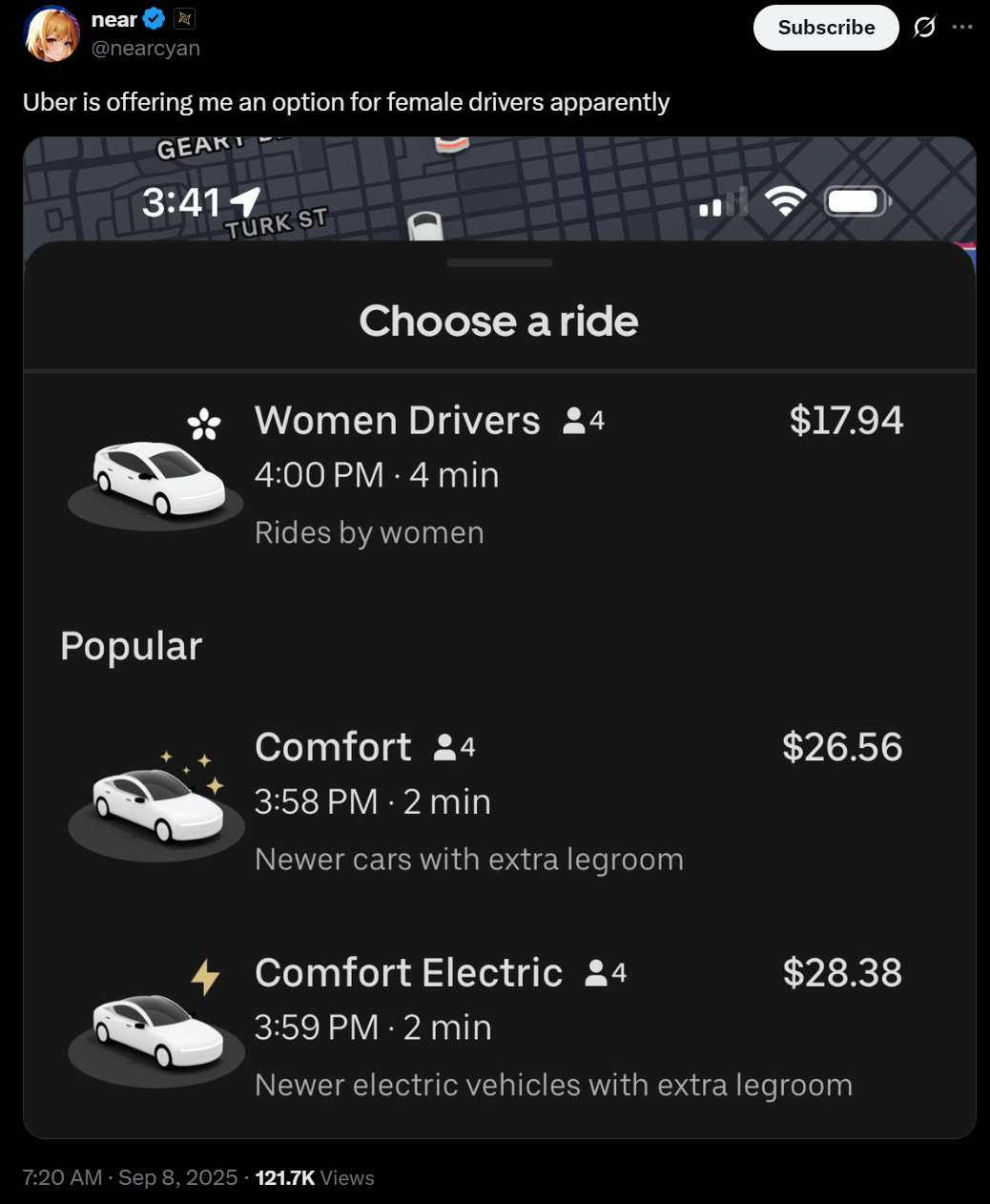
Germany continues to attempt to stop Uber from existing because they don’t direct rides through the central offices of a car rental company, which means they would be unfair competition. Expectation is that this won’t actually work, but still, wow.
There are calls to privatize air traffic control, because air traffic controllers are impacted by government shutdowns. I suppose if you’re locked into shutdowns and into the shutdowns impacting air traffic controllers this could end up working out. But rather obviously this is completely crazy? That you need something to reliably happen and not shut down so you need to privatize it?
The obviously correct thing is to exempt air traffic controllers from shutdowns. This seems super doable? You can pass a bill that automatically funds the FAA indefinitely from a trust fund. It’s what we do for USPS. It’s not like anyone want the FAA to shut down.
We are going to require cars and trucks, including electric vehicles, to include AM radios? What? In 2025, when we didn’t do this before? Some in the comments argue that AM radio is indeed important because the 0.1% of the time you need it you really need it, and I can buy that there might even be a market failure here, but the very obvious response is that this bill would have made ten times more sense in 1995 or 1975, and we didn’t have it then, so why now? Also, if this is important it’s like $25 to buy an AM radio and stick it in the glove compartment for when you need one.
Rep. Ed Case (D-HI) points out that we have the Jones Act and ‘despite this’ our shipbuilding, repair capacity and such are all withering away to nothing, so arguing that the Jones Act protects national security makes no sense. I agree with him, except that instead of ‘despite’ he should be saying ‘because of,’ the Jones Act actively makes these problems worse.
This is from a full event, Assessing the Jones Act: Perspectives from the Noncontiguous States and Territories. Everyone is harmed except the rent seekers, but the noncontiguous areas are hurt quite a lot more than the rest of us.
Alexander Berger: Our ambition has always been to work with more donors once we had enough bandwidth to support Good Ventures.
We started in earnest in 2024, directing over $100m from other donors. We more than doubled that so far in 2025. We’re aiming for a lot more in years to come.
Our new name reflects various aspects of this new chapter:
“Co” -> collaborating with other donors
“Efficient” -> a nod to cost-effectiveness
“Coefficient” -> multiplying others’ impact, ROI
(And “giving” is much less of a mouthful than “philanthropy”)
It kills resistant parasites, too, and probably blocks transmission better than current drugs
Approval is expected next year!
Roon: malaria of course has killed billions of people through human history and just like that another foe is ~vanquished
Scottt Alexander: > Go to the drug’s Wikipedia article > “This drug [was] developed with support from the Bill and Melinda Gates foundation via their Medicine for Malaria Venture.”
If you mean Effective Altruists (TM), the compound was discovered in 2007, before effective altruism was founded, so we can hardly be blamed for not contributing to it! EA leader Open Philanthropy (founded 2017) has since funded research into other pioneering antimalarials.
From what I have seen, the ‘spreadsheet altruism’ absolutely includes strategies like ‘research new malaria drug’ and otherwise funding science and making similar bets.
Somehow this got 3 million views…
Gina: You can only pick one option!!!
The funny answer is the ‘life extension’ or ‘defense against existential risk’ move if you interpret the $700k as definitely living to 65.
But if you take it as intended, that you if you die early you still die in real life, then I really hope one would take $1.1 million here? Putting the amount this high is bizarre.
A remarkably large number of people went for the $900k, without even stopping to think that there was no assurance you would even get away with it. Well, that’s engagement farming, I guess.
This seems like a good note. I think the actual limiting factor here is mostly time.
Will Manidis: with the exception of museum quality/rareness, antique prices have fallen off a cliff over the past 10 years. you can decorate your home like a 18th century royal with pieces unthinkable 99% of humans across history, but instead you live amongst minimalist ikea slop
David Perell: I’ve been interviewing people who have beautiful homes about how they decorated them, and the biggest surprise is how they almost all insist that good design is more about taste than money.
Yes, it costs more to buy a great sofa than a bad one. But there are plenty of millionaires living in homes that feel like an airport lounge.
The actual limiting factor is taste and time. The taste to know what looks good and the time it takes to find what you’re looking for. What’s key is that the second-hand furniture market is quite inefficient.
To be sure, there is a spectrum: at one end, you have thrift stores (cheap, chaotic, and unvetted). At the other, you have Sotheby’s (curated, clean, and highly vetted). The sweet spot is somewhere in the middle.
So how do you find pockets of glorious inefficiency?
One way is to make friends with people who own antique shops. I have a friend in San Francisco who knows a few collectors in town. They know her taste, and when something comes in that matches her style, they call her. And because of this, she never has to wait 17 weeks for a backordered couch from CB2.
Here’s the key point: If you have a strong sense of taste and understand the game, you’ll consistently spend less to design a house that feels alive and uniquely yours.
Good design, it turns out, is a byproduct of taste and attention, not money.
Matthew Speiser: In NYC and the Hudson Valley there are numerous vintage and antique furniture stores selling great stuff at reasonable prices. Far from chaotic and unvetted.
And “taste” isn’t about “efficiency.” It takes a lot of time browsing pieces and observing decor you enjoy to develop your taste.
In NYC: Dobbins Street Vintage, Dream Fishing Tackle, Lichen, tihngs, Humble House, Shop 86, Sterling Place
In HV: Newburgh Vintage Emporium (2 locations), The Antique Warehouse, Magic Hill Mercantile, Hyde Park Antiques Center + lots of small shops in Hudson, Kingston, Saugerties, etc.
If you try to buy antiques or otherwise develop taste you need to worry about matching and you need to get buy-in from others, and it all takes time, alas. Getting consensus is tough. Also once you decorate the first time, it takes a lot of activation energy to start changing, and to shift to a new equilibrium. So I get it. But when I look over at our IKEA-style drawers in this room do I wish they were old school? Oh yeah.
There’s also the functionality of the room, which you have to pay attention to and understand. Know your Christopher Alexander.
(EDIT: This section originally identified this as being by someone else, for reasons that are lost to time.)
Henrick Karlsson: I got to run something like an experiment on my capacity to predict which exhibitions would end up great, and which would be a waste of time. It was easy. As soon as someone was slow at answering their email, or complained, or wanted us to be their therapist as they worked through the creative worries, I would tell my boss, “I think we should cancel this.” And my boss—whose strength and weakness is that she thinks the best of people and makes everyone feel held—would say, “Ah, but they are just a bit sloppy with email” “if we just fix this thing it will be fine. . .”
I was right every time; it ended in pain.
And this is quite nice actually: it means it doesn’t take some Tyler Cowen-level taste in talent to figure out who will do good work.
Harvard cuts the majority of its PhD seats across the next two years, citing financial uncertainty about funding and potential endowment taxes. Of what use is Harvard’s giant endowment, if not to keep the lights on in a situation like this? There is nonzero worry about this ‘rewarding’ the cuts in funding, but in this case the people cutting the funding are happy you’re cutting the PhD slots, so I don’t think that argument plays. Some cost cutting makes sense, but this seems crazy.
We’d rather replace a microwave than try to get it repaired. Is that a failure in the handyman market? We actually just relaced our microwave, and in our case clearly it wasn’t, yes you could have tried to repair it but the time cost of even getting it to a repair shop or arranging a visit would already have exceeded the replacement cost. To get the handyman market to clear here, you would need to be able to summon someone as easily as with an Uber, and the total cost per successful repair would need to be kept at roughly $100, so yeah, not going to happen in New York City.
In a forecasting competition, evaluators failed to find better predictors more persuasive. They did notice the better predictors showed signs of intelligence, rationality and motivation, but this was counteracted by others presenting with higher confidence. This suggests an easy fix if people care to get it right.
Listed under bad news because I wouldn’t want this playbook to be the right book, Andreesen and Collision discuss Elon Musk’s management style.
Engineer-first organizations and find truth by speaking with those working on the floor (avoid management layers).
Every week, find the most important bottleneck at a company and parachute in to fix it.
Keep model of all engineering and business moving parts in his head (obviously, not many can do this).
Create cult of personality in and outside of the company (continually drive attention, without marketing or PR).
Pick single most import target metric for business at a time (eg. SpaceX = $ per kilo to orbit)
Constantly create urgency (which often shortens time horizons for projects).
Focus on capital efficiency
My theory is this is all very much a package deal if you try do more than about two of them. If you try to do half these things, it won’t work. You have to do most or all of them, or try a different approach, and as noted few people can do #3 and I would also add #4, or #2 in any useful sense. You need to be able to keep all the pieces in place, do the engineering work and also create a widespread cult of personality to justify that you keep fing with everyone and everything and making everyone’s lives miserable all the time.
Looking back on MetaMed in this light, I think we often fell into the ‘do many but not enough of these things and not hardcore and consistently enough’ bucket (not intentionally, I wasn’t modeling on Musk at all), and that’s one high level explanation of why it didn’t work. If I’d been able to go harder in the key missing places, then it plausibly would have worked to the extent the plan was workable at all (or pivoted).
Why do people care so much about bans on plastic straws? Let us count the ways.
Gearoid Reidy: McDonald’s Japan is finally abandoning its unpopular paper straws, replacing them with lids that diners can drink from directly.
Sam D’Amico: A nine year old wrote a “study” for a school project and we all ended up drinking glue for over a decade.
no_on_15: I will never understand how people became so distressed over paper straws.
– they fall apart within minutes of use – they impart taste to what you’re drinking
– there’s evidence they leach more and worse chemicals than plastic
– they have a weird texture when you put your mouth on them
– the seam and softness and weird pliability _feel_ off
– ocean plastics have never been about single use plastics in the west
– legislators burned up time, political capital, and credibility advancing these laws
– we’re probably going to find out plastic straws use less total GHG anyway
Kelsey Piper: One more for your list: My toddler absolutely cannot use a paper straw at all. She bites it a bit, which plastic can handle and which destroys paper immediately.
Shea Levy (quoting Marcel Dumas): One more: The only answer to “It’s no big deal” is “fine, then let me win.”
Kelsey Piper: I think part of why the straws are such a flashpoint is because they’re such a pure example of making things worse and then going ‘why do you care so much? get a life’ when people observe that now their lives are worse.
Kelsey is spot on. It’s not that it’s such a huge deal, it’s that every time it happens it is so obvious that your life has been made worse essentially out of spite and stupidity and innumeracy, and every time it rubs this in your face. And then they lie to you, and say the paper straws are fine. They’re not fine, they are worse than nothing. That’s why it fills me with rage, even though I cannot remember the last time I used a straw.
Tyler Cowen worries about ‘affordability politics.’ He’s not against the abstract concept, but the ways people respond to lack of affordability don’t correspond to the good ways to create real affordability. We respond in such spots by restricting supply and subsidizing demand instead of expanding supply, so we find a problem and then go make it worse.
So yes, I worry about this too. In general, any time people say ‘the market has failed to provide what we want’ you are not going to like the proposed intervention.
Recommended: Derek Thompson writes about The Monks In The Casino, as in the young men in America who don’t live nominally healthy and ascetic lives in many senses but stay home, isolated, in front of computer monitors, without even feeling lonely, often addicted to things like porn and gambling as the economy looks increasingly like a casino. They take financial risks online, but no risks in physical space. Betting is getting easier while living gets harder.
I may say more later, for now read the whole thing.
Zen: “I procrastinated for days and then it only took 20m when I sat down to do it 😭”
Give your system more credit. A few days of subconscious processing to prepare for 20 minutes of execution. Subtract all the self-guilt and reprobation and U’ve got efficient functioning.
Loopy: I instead let the avoidance process run its course, and then I am resourced to do the task.
Yeah, look, no, that’s usually hogwash and it’s important to know it’s hogwash. Are there times when you actually need more subconscious processing? I mean I guess but mostly that’s the flimsiest of excuses. Do the thing already.
Robin Hanson: Top people have more conflicting stories about them as both nice and jerks. Because, I think, their behavior is in fact more context dependent. As that is in fact a more winning social strategy.
Triangulation: Also: high status attracts both detractors and sycophants.
In most situations for most people, even top people, I believe nice is correct regardless, jerk is a mistake, this pays dividends over time.
As you get to the top the jerk stories get amplified a lot more. You do have to be willing to be hard nosed in some situations, and there are those who are more willing to consider you a jerk because you’re successful. That doesn’t mean be a jerk, even to someone with no power.
However, there is a particular strategy based around maximal incentive gradients, and its final form only works at the top. Trump is the avatar of this.
One minute you’re the best, the next you’re the worst, and then you’re back to the best. So you have maximum reason to be sure you’re the best and not the worst.
If you’re high enough in relative status and power or usefulness that people still want to deal with you at all, this can be very powerful. If you’re not, it doesn’t work, because no one will want to associate with you at all. So you can only deploy this strategy to the extent, and in the contexts, where people have no choice but to engage.
In some places there’s an equilibrium that drives such strategies out, and I prefer such spaces. But the top of business and politics reward it.
Venezuelan President Maduro did not actually say (to our knowledge) that if the US gives him amnesty, removes his bounty and gives a comfortable exile he’ll leave office. But let’s suppose that he made this offer. Should we take it?
Andrew Rettek: It’s like the trolley problem but instead of one person it’s a bag of money and instead of 5 people it’s an entire country.
In terms of causal decision theory, of the direct consequences, obviously yes. You greatly improve an entire nation in exchange for a tiny bag of money. Great deal.
Alas, that is not the full deal. The deal also is that future dictators will know they likely have a similar option, even if they are pretty terrible. This goes both ways.
First the good news:
If others take similar deals, you can rescue other countries similarly.
If others know they have this option, they can invest fewer resources in regime stability and buying off loyalty of their chain of command, since failure to maintain power is now often much less bad.
Then the bad news:
This makes being a dictator a much, much better deal.
This encourages them to maintain strong bargaining positions.
This also gives them more incentive to steal money and squirrel it away.
We face similar hostage situations all the time at smaller scale. We strike a balance. We do often pay ransoms, negotiate for hostages and so forth. We also have limits. I think in general we are too willing to negotiate, and should more often tell such folks to go to hell and accept that this particular situation will often end poorly as a result.
On the dictator level it is less clear. In this case I would take the deal, if it came not only with him leaving but with a transition to democracy. Indeed, one could make a conditional deal, where his immunity depends on the transition.
If the job interview was too easy, perhaps you don’t want the job. Worthwhile interviews are two ways, you want to be sure you will have good colleagues who work hard and the job will challenge you, and that is a fit for your interests. I the interview is too easy, you probably could have aimed higher. The paper here finds that the perceptions from a job interview are indeed informative about the job.
When I left my interview at Jane Street Capital, I was very excited to work there. When I did my other finance interview? Not so much.
I strongly agree with Roon here, for most (but not all) classes of intellectual tasks. For physical tasks it will probably suck to be you doing it but in terms of productivity you can 996 (work 12 hours a day 6 days a week) all you want.
Roon: most likely you will not get the most out of yourself by 996ing. generally that’s a way to destroy the self. I subscribe to the Ferris bueller’s day off theology that says you’ll probably get the most out of yourself by being maximally uninhibited so the universe sings with you.
it’s more important to Go To War when dharma is calling, and you will know when it happens, than to 996 as a permanent way of life. for people like elon [musk] and sam [altman] that may be every day but it’s probably not yours.
They are pitching us… anti-suicide chairs? It seems a lot of the argument here is literally ‘the chair doesn’t help you physically kill yourself’ and a bunch of weird claims about things like ‘creating a supportive and inclusive environment and reducing stigma and encouraging dialogue’ and I’m calling full BS on all that.
Indeed, my guess is the best thing you can do for people in trouble via chairs is to get them actually comfy chairs, so they feel better.
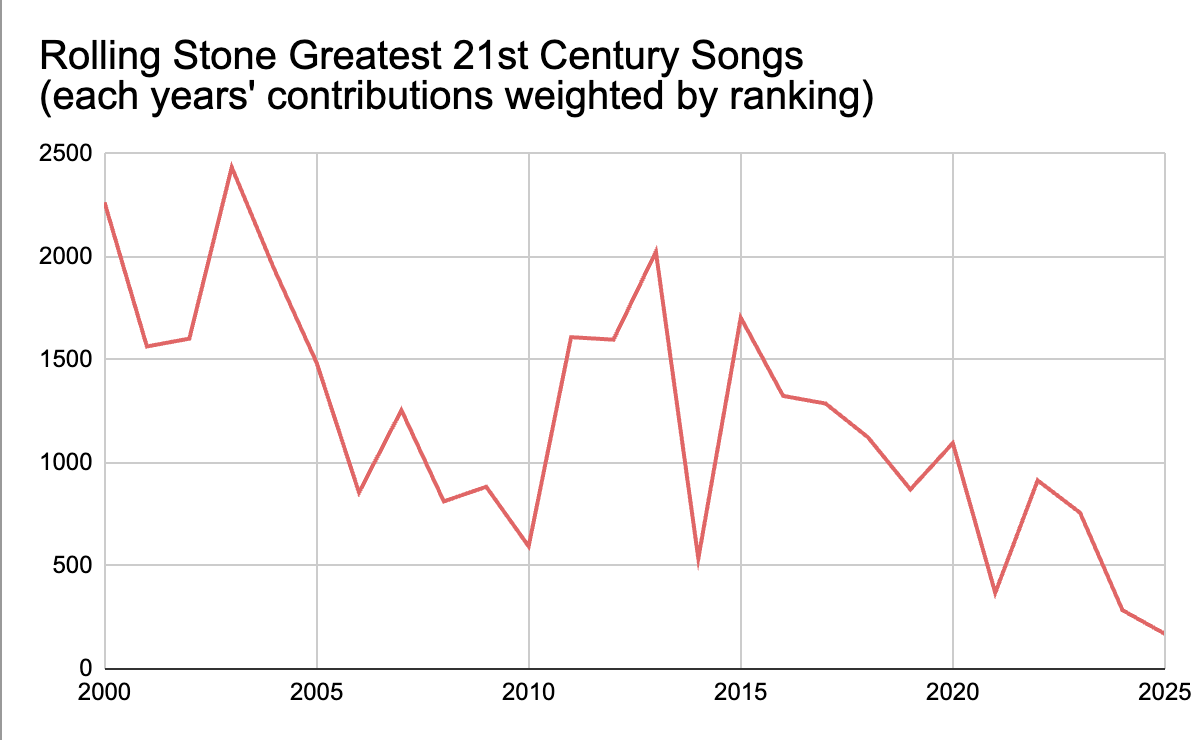
I noticed a bias towards the early 2000s so I ran the numbers.
I tallied the number of entries per year, and there’s a steady and linear decline, with a very clear dip in the last half of the Aughts. Then I weighted the entries (so that a #1 was worth much more than a #250), and it tells a similar story, although 2013 shows a resurgence before things collapse again.
There will always be some anti-recency bias in canon-building, because new things have yet to prove their long-term value, but there’s also a clear bias here towards “long ‘90s” songs like “B.O.B.” and “Get Ur Freak On” and lingering respect for the post-9/11 rock revival.
The resurgent 2013 winners list doesn’t have a clear narrative (although interested in your ideas): Lorde, Drake, Kacey Musgraves, Haim, DJ Snake feat. Lil Jon, Paramore, Arctic Monkeys, Justin Timberlake, Miley Cyrus, Sky Ferreira, Jason Isbell, Alvvays.
Also: it’s a real Neptunes / PW shutout. Sure, no “Blurred Lines” but no “Drop It Like It’s Hot” or “Grindin’”?
Steve Sailer: Rolling Stone subscribers are really, really old.
I don’t know how much of this is anti-recency bias, and how much of this is those involved being super old, but also the idea of having a canon of music songs, that are listened to over decades, seems itself pretty old now, something only old people would care about?
I also checked some of the list, and it’s remarkable how much there simply isn’t a canon from this century, or at least how easy it is to ignore. If you’d made a similar list from the 20th century, I expect I’d have known most of the songs. When I browsed this list, I was running at maybe 15%, and that’s simply to know them, not like them. To be fair to the list, the ones I did recognize seemed like mostly good picks.
Tanmay Khale emailed Tyler Cowen to suggest that modern songs are suffering from unfair regularization of scores, where they are compared to other modern songs or to how much better they are than prior efforts, so they don’t look great. I agree there is some of this going on, our standards to break through are higher, but I think that’s more about the low hanging fruit being picked, you don’t need to be ‘better’ so much as you need to be original, which is increasingly hard. There’s some amount of better necessary to break through into a canon to overcome familiarity barriers, but also people can get really familiar with big hits quickly.
Music is different from sports here because you don’t only play against simultaneous competition. A song from 2025 and one from 1975 are both on Spotify, you can choose which one to play or prefer.
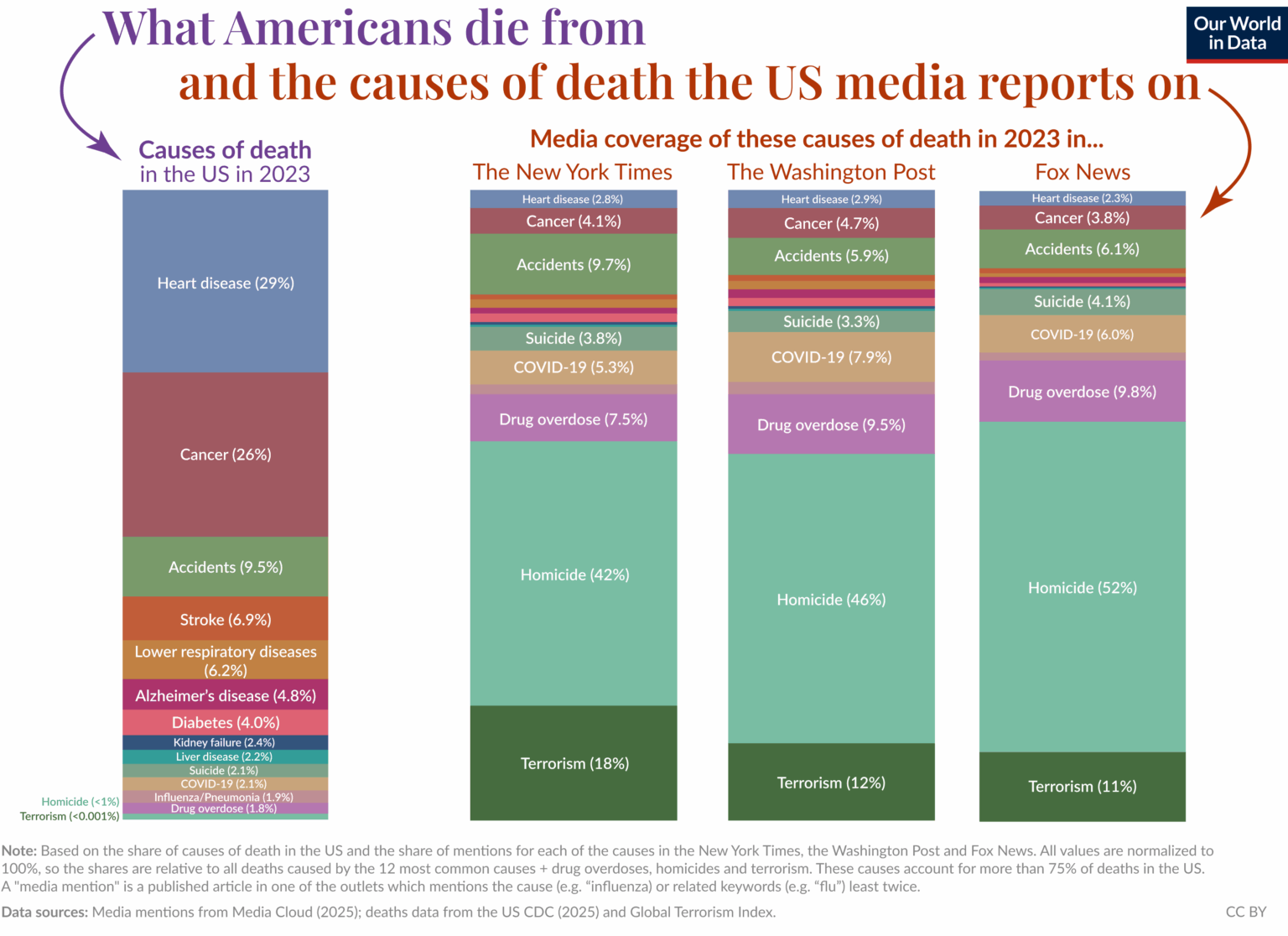
Nathan Lazerus: From @mattyglesias today (quotes the classic newsroom finding from the early internet era that what people click on is very different from what they say they want to read):
I feel like the ad vs. subscription model matters a lot here. People will sign up for a subscription to a news source that fits their high-minded aspirations, while they don’t want to pay for some guilty pleasure/clickbait.
So journalists of old were maybe not wrong to keep putting out the high-quality reporting they did—it drove subscriptions. But when pay/reach was determined by views, the profit-maximizing type of content changed.
I mean, yes, ‘person has heart attack and dies’ is not news. I do wish they’d stop being so damn lazy with all the car accidents in fictional media.
Vince Gilligan is still proud of Breaking Bad and Better Call Saul but thinks we have too many antiheroes and it is harmful, which his new show Pluribus seeks to address, by all reports it is cool but I’m waiting for the full season drop. Article is a fun extended profile.
And so the new cable package era continues to slowly create itself, as AppleTV+ and Peacock offer a combined package for $20/month (or $15 if you’re willing to accept Peacock ads). On their own AppleTV+ is $13/month and Peacock is $10/$15 depending on if you accept ads, so that’s a deep discount. That’s in addition to the $30 HBO/Hulu/Disney+ package, which is also strong. You should have Amazon Prime anyway, so throw in Netflix and YouTube Premium, Paramount+ is optional, and you’re all set unless you watch sports.
The problem is you’re then very tempted to rotate between packages. The long term equilibrium is presumably one package with all of it, so you aren’t constantly either toggling between services or feeling bad about not doing so. Alternatively, they should up their yearly subscription discount game, which I would also find acceptable.
Meanwhile there’s a war. Disney owns ESPN and ABC, as well as Hulu and Fubo. Google wants Disney to agree to incorporate their Hulu offerings into the YouTubeTV experience, and Disney is having none of it, and as a result of that (and some amount of pricing argument) we’ve now gone weeks with Disney not available on YouTubeTV.
This is wreaking havoc on my ability to experience college football in particular, because the only alternative services, ESPN and Hulu, have remarkably awful experiences for anyone trying to view sports that aren’t live, in a ‘seriously considering not to bother’ way.
Andrej Karpathy: TV in the 90s: you turn it on, you watch.
TV 2025:
– turn on, wait for it to load
– popup: TV wants to update, 1.5GB. No.
– scroll sideways, find prime video app or etc
– popup: now app wants to update, 500MB. No!!
– App launching… App loading…
– select account screen
– 🫠
There is a movement I found on Instagram where people deliberately choose to live in 90s, refusing all technology after 2000. Like an intermediate form of the Amish.
That sometimes (rarely) happens, and yes it’s annoying. There’s substantial startup costs. But have you tried watching TV that is 30% advertisements that you cannot skip, and that cannot be paused? Have you tried managing a VCR? Have you tried having to call the cable guy?
Yeah, no thanks.
Nate argues television peaked in 2014. I agree there were some good times, 2014 is definitely a better television case than the 1990s (although movies peaking in 1999 is a highly reasonable argument!), but a lot of this is again forgetting all the old annoyances, and forgetting that we used to have actual scarcity. Yes, now you have to figure out where to watch something, but usually there is an answer. Before you turned on the television and watched, because if it wasn’t on some channel you were out of luck.
Overall I am firmly on the side that the television experience has never been better, or at least that this will be true once Disney and YouTubeTV resolve their dispute.
As in, it’s not only AI that has jagged capabilities.
Sarah Constantin: It feels like every time I’m “bad at” something, it’s actually that I’m good at some subskills and not doing other subskills AT ALL.
Like, underneath every 50% there’s a bunch of 100% and 0% pieces.
eg:
“I’m not so good at sales” is actually “I have a good pipeline and offer a good service but I’m essentially not even trying to be persuasive on sales calls”
“I’m not so good at the videogame Hades” is actually “there are some moves i never learned to do at all, so i don’t use em”
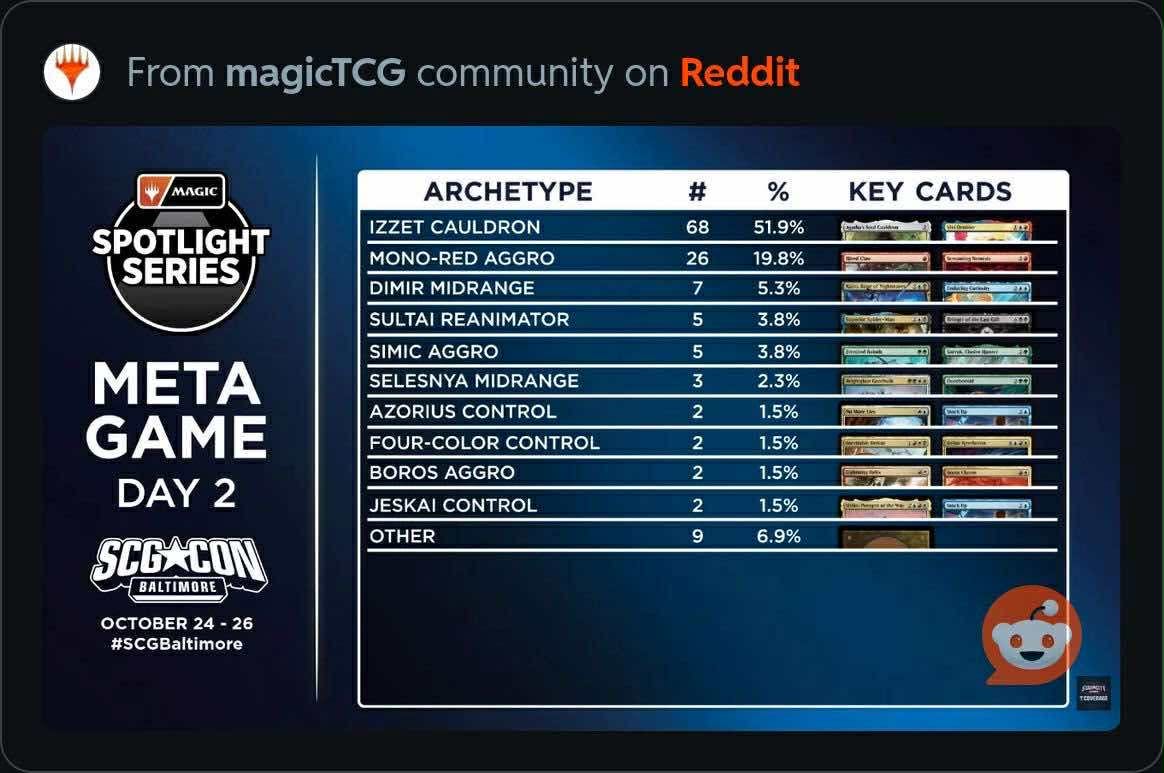
Occasionally we see Standard formats that end up in this failure mode. The price of printing fun and cool cards, and of the current theory of design, is that this will sometimes happen. When it happens by accident, that’s unfortunate, and I think they could do a better job putting stabilizers into sets to guard against this, but the correct risk of this to take is not zero.
The official response is that this would have required an emergency ban, and formats need stability, so they’re not doing it.
I’m sorry, but that’s ridiculous. As of SCG Con, it had been two full months. If you’re unwilling to ‘emergency’ ban then you need more B&R days than this.
I’m also sympathetic to ‘balancing Standard is not the top priority of Wizards R&D anymore,’ and I realize this will increase the rate of mistakes made, except that this consideration cannot apply to Standard itself or to its banned list. Standard participation needs to be continuous to keep up with card access, breaking it is deadly. As someone excited to try and find the time to do a fully Limited PT, I cannot overstate how much this failure makes me uninterested in returning to Standard.
Sam Black assembles a list of every card in Magic’s Premodern format that one could possibly want to play. It’s a fun list and includes some deep cuts, while letting you skip the cuts that are too deep.
Sam Black warns us that in Magic draft, 17lands data on win rates is often misleading because cards that only go in the better decks will end up showing artificially high win rates when drawn. Cards that only go in one particular strong deck type look great because they don’t make the cut at all otherwise, whereas Sol Ring goes in almost every deck. Also you need to worry about your skill level versus average skill level.
The caveat back is that while in theory full flexibility is good, and for experts like Sam Black it’s very good, it can also be a trap (in terms of short term win rates) to be tempted into decks that aren’t good or that you don’t know how to draft, whereas you actually should be forcing the good stuff far more if you care only about winning now.
I see the risk in going to a niche service like AppleTV+ over ESPN, given that every serious sports fan presumably will still need ESPN access, but in exchange they hopefully get to present a better product, in a unified way. The obvious deal would have been Netflix, why not unify the core broadcast with Drive to Survive, but I don’t mind what they ended up doing. Apple is also a powerful ally.
I think AppleTV+ is exactly on point in saying it wants to own entire entire sports. It is maddening to have to hunt for different games or events and feel forced to buy multiple services. I think this played a substantial part in driving me away from baseball this year.
I do warn AppleTV+ to fix their spoiler problem. Their current interface actively spoils everything, constantly, it’s a disgrace. Someone reading this must know someone who knows someone. Fix it.
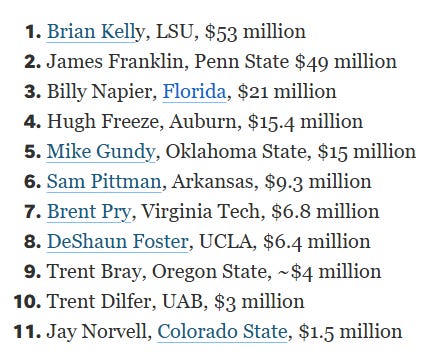
College football coaches have been paid a combined $185 million this season to go away. I get how we got here, the coaches are in high demand and shop for the best deal, want to lock in profits, are definitely not looking to get fired so there isn’t actual moral hazard, and the patience teams show has worn paper thin, and the buyout serves are protection against being poached by another school. Also the transition to the NIL era has invalidated many past strategies, making previously excellent coaches no longer good, see Dabo Swinney (probably).
It still does not make sense to me. You might not love the coach but at an 80%+ discount you think you can do better? You need to be firing them in the middle of the season like this? It’s madness, I tell you.
I think with Franklin and Kelly in particular the problem is that they did great jobs in recruiting, so expectations got very high, then the teams didn’t deliver and they thought let’s axe the coach. Big mistake.
The other note is that if the coaches get rehired then the cost will be a lot less, and one expects the top names on this list to get new jobs. LSU and Penn State might not want them, but plenty of schools would love Kelly or Franklin. I’d love to get Franklin for Wisconsin, it seems like a perfect fit.
Whereas one I definitely agree with here is Mike Gundy. Gundy is a prime example of a previously excellent coach who is adrift in the new era, you have to cut your losses.
One obvious suggestion is to tie the buyouts directly to the record. You say, okay, if we fire you without cause you are owed 85% of the contract, but if you have X losses or fail to hit some milestone, then that’s cause. Seems simple enough, and the coaches at this level have big egos and don’t expect to fail.
Jonathan Jones: NFL EVP Troy Vincent told team owners today that it may be time to look at the fourth-and-15 proposal that has been offered as an alternate to the onside kick. The lack of recoveries on onside has disappointed the league.
Seth Burn: This will be a disaster if teams can bait the refs into giving cheap defensive holding or DPI flags.
You want to calibrate about how often the team can convert. Right now the onside kick recovery rate is too low. The yards to go can be adjusted to taste, and with many yards to go you don’t have to give the refs an excuse.
If the refs are actively looking to throw a flag in order to extend the game, and are basically cheating in this particular spot, that’s a different problem. I presume they wouldn’t do it because this is bad for the game.
Also the cheap automatic first downs from such penalties should be clamped down on in any case. There are any number of rules changes to fix this, the most obvious being that there can be two types of such flags, the way there’s both running into and roughing the kicker, and you don’t get an automatic first down unless it’s flagrant.
Nate Silver offers his thoughts on the NBA betting scandal. Our perspectives on this are broadly similar. Sports betting can be good fun and good business, and the context of odds can enhance sports, but the current regime of legalized sports gambling on your phone is terrible and current books do not deserve your sympathy.
They especially don’t deserve sympathy for when their whales (big customers getting taken for huge amounts that are allowed to do basically anything for huge limits without questions) end up becoming beards (as in placing bets on behalf of actual professional gamblers) and bet $100k or more on an obscure player prop. They’re choosing to do game theoretically unsound things and taking calculated risks. If you’re gonna play with fire then sometimes you’re gonna get burned.
My view of player props is that people who seek them out should be allowed to have their fun, sure why not, it’s cool info and a cool mini-game and in some cases it’s even a loss leader (since the wise person betting can pick off your mistakes and passes otherwise), but that the sportsbooks pushing them (and also pushing parlays) on recreational players is predatory behavior. And if they raise the limits on the props, especially on obscure players, that’s at their own risk.
I also don’t have much sympathy for the recreational gamblers who take the other side of insider NBA bets. The NBA lines are, as Nate says, full of information about injuries and player usage and intent to tank, often not publicly known, to the point where this is the main thing driving lines away from where they naively ‘should’ be, and where most NBA fans at a sports bar could tell you what the line ‘should’ be if everyone potentially available was healthy and playing. Evaluating and tracking injuries is the main skill. That’s the game you’re playing. Either play it, or don’t.
One place I disagree is where Nate mentions in his point #7 that if we banned FanDuel and DraftKings that 70% of that volume might move offshore rather than vanishing. I agree some percentage would move if there were no alternatives, but I would be utterly shocked if it was on the order of 70%. All the advertising would be gone. All the integration with media and teams and stadiums would be gone. Funding would be non-trivial again, as Nate notes you’d largely need to use crypto. You wouldn’t have an app with an optimized UI and wouldn’t be getting all the hyper aggressive customized push notifications on your phone. The entire context would change. No, it wouldn’t go fully back to the old level of activity, but it would drop a lot.
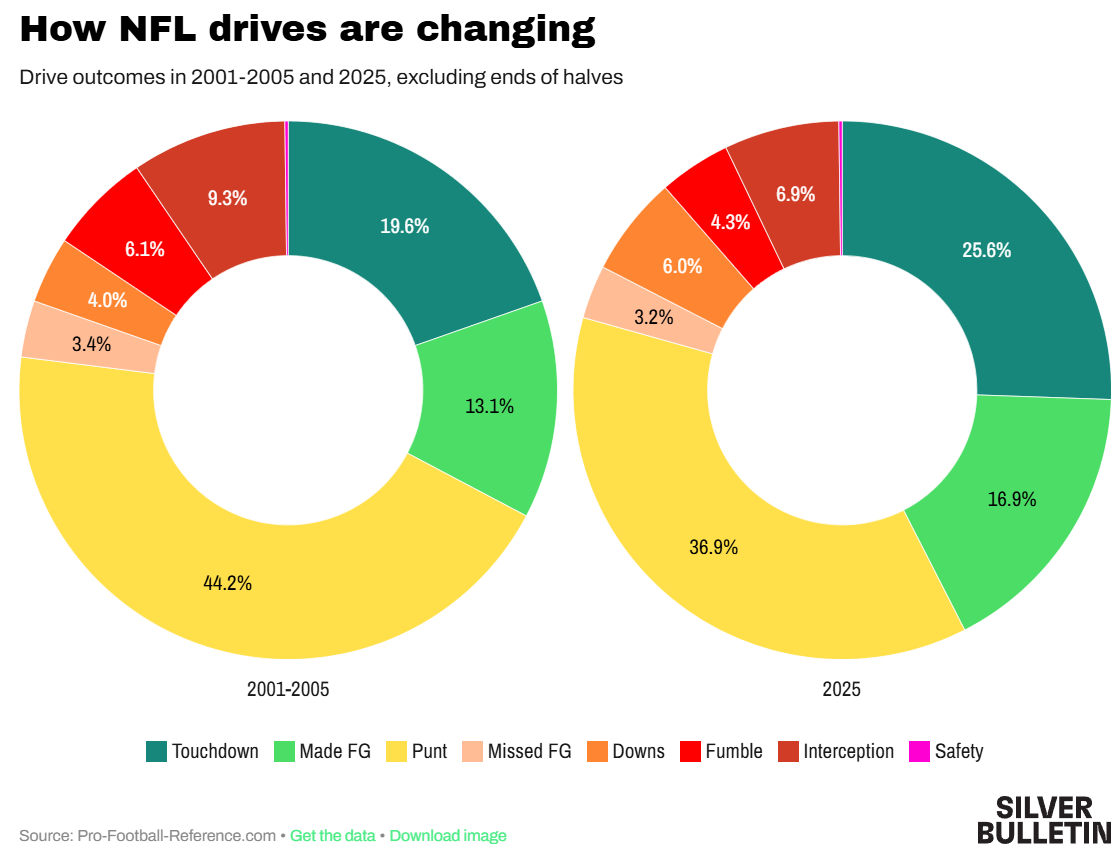
The broader NFL shift is that not only are kickers getting better (as per this very fun article from Nate Silver), offenses are getting better across the board and also making better decisions, and the reason we don’t notice the extent of this is that drives are taking up more time so the scores don’t fully reflect the shift.
When NFL teams depart from draft consensus on player value they consistently do worse. So teams should use the consensus board for player value, except for when they have particular private information (such as on injuries), especially teams like the Jets with poor track records.
You do still have to account for positional value, and what you in particular need because the trading market is illiquid. It’s fine to make small departures based on what you do and don’t need, but that should be it.
Lindsay Owens here claims that teams are outright making mistakes, that in Atlanta raising ticket prices while lowering concession prices increased sales volume and revenue and fan satisfaction. I buy it.
My read is that the higher concession prices raise marginally more revenue, but that you don’t want to be at the top of the revenue curve on this because the bad feeling of overpaying too much not only drives fans away from purchases, it makes the overall experience worse, as the stadium experience is Out To Get You. What you want is to be able to basically order whatever you want and not feel bad about it, and the team should want this for you too.
It makes the overall experience much better, keeps people coming back, and turns them into long term fans. In general, teams should be doing less short term profit maximizing at their stadiums. I bet that on most current margins this outweighs the value of the price discrimination.
This is not the same as requiring ‘all-in pricing’ on tickets, which I think is just good, and yes you lose the ability to do price discrimination which in theory leaves something on the table. However, I think there are enough differences that I do not want to ‘force them into a good move’ via law.
Nate also discusses the poker cheating scandal, where I’m happy to defer to him and his notes match my understanding. Poker is fun, either with your buddies or at a casino, but if you’re not at a casino avoid raked games where the host turns a profit, there’s too much cheating risk and risk of involvement with people who are bad news. If you get invited to a home game, don’t go unless you understand why you’re invited.
I’d highlight the note that cheaters are usually extremely greedy and unable to keep their cheating subtle, as per Nate’s #39. If they were capable of only ‘cheating small’ then they wouldn’t be cheating, so if you pay attention you can usually sense things aren’t right even if you can’t prove it.
Hence the ability of Matt Berkey to call out the Billups game as rigged two years ago. If you listen to the podcast clip, everything was the opposite of subtle, with players constantly making plays that make absolutely no sense unless cheating is involved.
Also, as per #40, it doesn’t matter if you think the game is good enough you can win anyway, don’t play in a game where you’re being cheated, period.
A similar phenomenon exists in Magic: The Gathering. If someone is cheating, they’re almost always highly suspicious. The problem is that unlike poker you often don’t choose who you play your Magic matches against, so you can be stuck against a likely cheater who hasn’t formally been caught yet.
I strongly recommend going to the Secular Solstice itself if you have the opportunity, either in NYC, SF or other places it is offered. If you are local, and the rationalist megameetup is self-recommending to you, then you should definitely go. If not, consider going anyway. I’m usually there for one of the days.
If you’re looking for an idea of what the music is like, this playlist gives you an idea.
Rob Henderson (Quoting from The Social Paradox by William von Hippel): “If two people anywhere on earth look into each other’s eyes for more than five seconds, then either they’re going to have sex or one of them is going to kill the other.”
Robin Hanson: I’d bet a lot of money that this is simply not true. In fact the % of random pairs for which either of those happens must be well below 5%.
Matthew Yglesias: Hmmmm so they are considering trading away enduring spiritual values in exchange for short-term material gain, wonder if anything has ever been written that would be relevant to this.
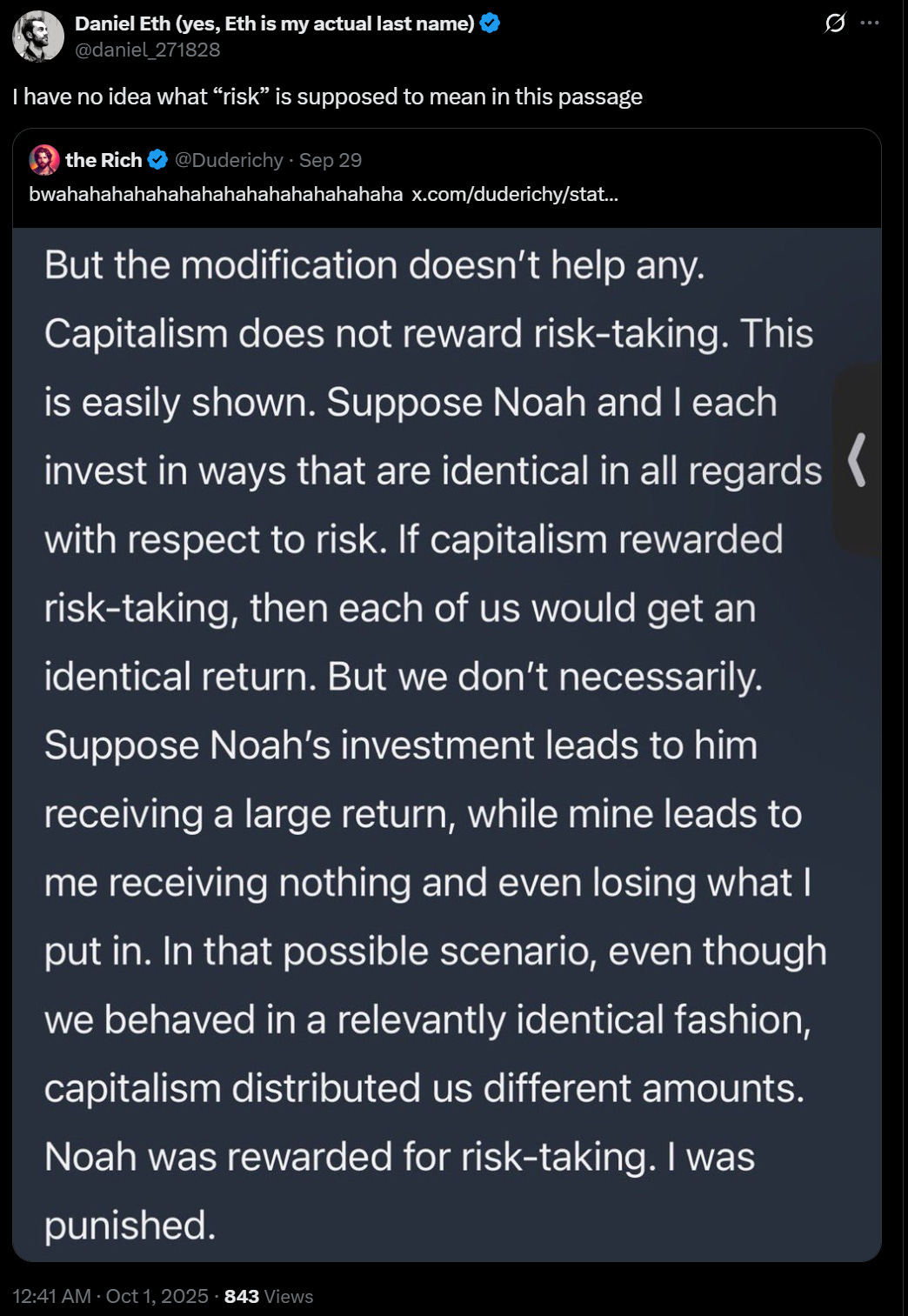
You do not get reliably rewarded for risk taking. It’s true!
It’s actually not as true as you might think. In many cases you can repeatedly take uncorrelated risks at good odds, and over time you will reliably get rewarded for this.
And then it gets better, in response:
James Surowiecki (Author, The Wisdom of Crowds): Does capitalism systematically reward risk-taking? In other words, is there a tight correlation, empirically, between the amount of risk one takes on and the returns one earns?
And better than that, even!
No, I’m not going to explain this one.
Perhaps the crowds are not so wise, after all. Or perhaps they weren’t consulted.
courtney: ordering from the indian restaurant and I just burst out laughing
A response suggests another way:
Bookem Code Monkey: I go to one with an Indian friend. Ordered something spicy. It was bland, bland. My Indian friends snaps his fingers and the guy comes over. falkfjlkjakljagaffadfa or whatever he said to the guy. Guy responds, Oh no, we don’t give that to white people. WTH.
Sven-Hajo Sieber: Had that experience in Tasmania, ordered very spicy and it was quite mild. When they asked if it was okay at the end I commented on it and they said: oh, order Indian spicy next time, we brought you Australian spicy.
Nina: My friend has the same experience with his Malaysian boyfriend when ordering food in London. They bring the boyfriend REAL spicy food, but not his British partner!
Victory is hers!
Aella: omg I did it.
Eliezer Yudkowsky: Exactly half of your followers are insane.
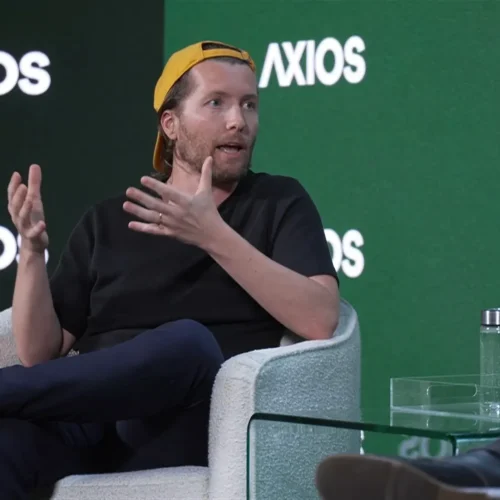
There’s been a lot of talk of an AI bubble lately, especially with regards to circular funding involving companies like OpenAI and Anthropic—but Clem Delangue, CEO of machine learning resources hub Hugging Face, has made the case that the bubble is specific to large language models, which is just one application of AI.
“I think we’re in an LLM bubble, and I think the LLM bubble might be bursting next year,” he said at an Axios event this week, as quoted in a TechCrunch article. “But ‘LLM’ is just a subset of AI when it comes to applying AI to biology, chemistry, image, audio, [and] video. I think we’re at the beginning of it, and we’ll see much more in the next few years.”
At Ars, we’ve written at length in recent days about the fears around AI investment. But to Delangue’s point, almost all of those discussions are about companies whose chief product is large language models, or the data centers meant to drive those—specifically, those focused on general-purpose chatbots that are meant to be everything for everybody.
That’s exactly the sort of application Delangue is bearish on. “I think all the attention, all the focus, all the money, is concentrated into this idea that you can build one model through a bunch of compute and that is going to solve all problems for all companies and all people,” he said.
Librarian vows to stop invasive ed tech after ending lawsuit with Proctorio.
Librarian Ian Linkletter remains one of Proctorio’s biggest critics after 5-year legal battle. Credit: Ashley Linkletter
Nobody expects to get sued for re-posting a YouTube video on social media by using the “share” button, but librarian Ian Linkletter spent the past five years embroiled in a copyright fight after doing just that.
Now that a settlement has been reached, Linkletter told Ars why he thinks his 2020 tweets sharing public YouTube videos put a target on his back.
Linkletter’s legal nightmare started in 2020 after an education technology company, Proctorio, began monitoring student backlash on Reddit over its AI tool used to remotely scan rooms, identify students, and prevent cheating on exams. On Reddit, students echoed serious concerns raised by researchers, warning of privacy issues, racist and sexist biases, and barriers to students with disabilities.
At that time, Linkletter was a learning technology specialist at the University of British Columbia. He had been aware of Proctorio as a tool that some professors used, but he ultimately joined UBC students criticizing Proctorio, as, practically overnight, it became a default tool that every teacher relied on during the early stages of the pandemic.
To Linkletter, the AI tool not only seemed flawed, but it also seemingly made students more anxious about exams. However, he didn’t post any tweets criticizing the tech—until he grew particularly disturbed to see Proctorio’s CEO, Mike Olsen, “showing up in the comments” on Reddit to fire back at one of his university’s loudest student critics. Defending Proctorio, Olsen roused even more backlash by posting the student’s private chat logs publicly to prove the student “lied” about a support interaction, The Guardian reported.
“If you’re gonna lie bro … don’t do it when the company clearly has an entire transcript of your conversation,” Olsen wrote, later apologizing for the now-deleted post.
“That set me off, and I was just like, this is completely unacceptable for a CEO to be going after our students like this,” Linkletter told Ars.
The more that Linkletter researched Proctorio, the more concerned he became. Taking to then-Twitter, he posted a series of seven tweets over a couple days that linked to YouTube videos that Proctorio hosted in its help center. He felt the videos—which showed how Proctorio flagged certain behaviors, tracked “abnormal” eye and head movements, and scanned rooms—helped demonstrate why students were so upset. And while he had fewer than 1,000 followers, he hoped that the influential higher education administrators who followed him would see his posts and consider dropping the tech.
Rather than request Linkletter remove the tweets—which was the company’s standard practice—Proctorio moved quickly to delete the videos. Proctorio supposedly expected that the removals would put Linkletter on notice to stop tweeting out help center videos. Instead, Linkletter posted a screenshot of the help center showing all the disabled videos, while suggesting that Proctorio seemed so invested in secrecy that it was willing to gut its own support resources to censor criticism of their tools.
Together, the videos, the help center screenshot, and another screenshot showing course material describing how Proctorio works were enough for Proctorio to take Linkletter to court.
The ed tech company promptly filed a lawsuit and obtained a temporary injunction by spuriously claiming that Linkletter shared private YouTube videos containing confidential information. Because the YouTube videos—which were public but “unlisted” when Linkletter shared them—had been removed, Linkletter did not have to delete the seven tweets that initially caught Proctorio’s attention, but the injunction required that he remove two tweets, including the screenshots.
In the five years since, the legal fight dragged on, with no end in sight until last week, as Canadian courts tangled with copyright allegations that tested a recently passed law intended to shield Canadian rights to free expression, the Protection of Public Participation Act.
To fund his defense, Linkletter said in a blog announcing the settlement that he invested his life savings “ten times over.” Additionally, about 900 GoFundMe supporters and thousands of members of the Association of Administrative and Professional Staff at UBC contributed tens of thousands more. For the last year of the battle, a law firm, Norton Rose Fulbright, agreed to represent him on a pro bono basis, which Linkletter said “was a huge relief to me, as it meant I could defend myself all the way if Proctorio chose to proceed with the litigation.”
The terms of the settlement remain confidential, but both Linkletter and Proctorio confirmed that no money was exchanged.
For Proctorio, the settlement made permanent the injunction that restricted Linkletter from posting the company’s help center or instructional materials. But it doesn’t stop Linkletter from remaining the company’s biggest critic, as “there are no other restrictions on my freedom of expression,” Linkletter’s blog noted.
“I’ve won my life back!” Linkletter wrote, while reassuring his supporters that he’s “fine” with how things ended.
“It doesn’t take much imagination to understand why Proctorio is a nightmare for students,” Linkletter wrote. “I can say everything that matters about Proctorio using public information.”
In a statement to Ars, Kevin Rockmael, Proctorio’s head of marketing, suggested that the ed tech company sees the settlement as a win.
“After years of successful litigation, we are pleased that this settlement (which did not include any monetary compensation) protects our interests by making our initial restraining order permanent,” Rockmael said. “Most importantly, we are glad to close this chapter and focus our efforts on helping teachers and educational institutions deliver valuable and secure assessments.”
Responding to Rockmael, Linkletter clarified that the settlement upholds a modified injunction, noting that Proctorio’s initial injunction was significantly narrowed after a court ruled it overly broad. Linkletter also pointed to testimony from Proctorio’s former head of marketing, John Devoy, whose affidavit “mistakenly” swearing that Linkletter was sharing private YouTube videos was the sole basis for the court approving the injunction. That testimony, Linkletter told Ars, suggested that Proctorio knew that the librarian had shared videos the company had accidentally made public and used it as “some sort of excuse to pull the trigger” on a lawsuit after Linkletter commented on the sub-Reddit incident.
“Even a child understands how YouTube works, so how are we supposed to trust a surveillance company that doesn’t?” Linkletter wrote in his blog.
Grilled by Linkletter’s lawyer, Devoy insisted that he was not “lying” when he claimed the videos Linkletter shared came from a private channel. Instead—even though he knew the difference between a private and public channel—Devoy claimed that he made a simple mistake, even suggesting that the inaccurate claim was a “typo.”
Linkletter maintains that Proctorio’s lawsuit had nothing to do with the videos he shared—which his legal team discovered had been shared publicly by many parties, including UBC, none of which Proctorio decided to sue. Instead, he felt targeted to silence his criticism of the company, and he successfully fought to keep Proctorio from accessing his private communications, which seemed to be a fishing expedition to find other critics to monitor.
“In my opinion, and this is just my opinion, one of the purposes of the lawsuit was to have a chilling effect on public discourse around proctoring,” Linkletter told Ars. “And it worked. I mean, a lot of people were scared to use the word Proctorio, especially in writing.”
Joe Mullin, a senior policy analyst who monitored Linkletter’s case for the nonprofit digital rights group the Electronic Frontier Foundation, agreed that Proctorio’s lawsuit risked chilling speech.
“We’re glad to see this lawsuit finally resolved in a way that protects Ian Linkletter’s freedom to speak out,” Mullin told Ars, noting that Linkletter “raised serious concerns about proctoring software at a time when students were subjected to unprecedented monitoring.”
“This case should never have dragged on for five years,” Mullin said. “Using copyright claims to retaliate against critics is wrong, and it chills public debate about surveillance technology.”
Preventing the “next” Proctorio
Linkletter is not the only critic to be targeted by Proctorio, Lia Holland, campaigns and communications director for a nonprofit digital rights group called Fight for the Future, told Ars.
Holland’s group was subpoenaed in a US fight after Proctorio sent a copyright infringement notice to Erik Johnson, a then-18-year-old college freshman who shared one of Linkletter’s screenshots. The ensuing litigation was similarly settled after Proctorio “threw every semi-plausible legal weapon at Johnson full force,” Holland told Ars. The pressure forced Johnson to choose between “living his life and his life being this suit from Proctorio,” Holland said.
Linkletter suspected that he and Johnson were added to a “list” of critics that Proctorio closely monitored online, but Proctorio has denied that such a list exists. Holland pushed back, though, telling Ars that Proctorio has “an incredibly long history of fudging the truth in the interest of profit.”
“We’re no strangers to Proctorio’s shady practices when it comes to oppressing dissent or criticism of their technologies,” Holland said. “I am utterly not shocked that they would employ tactics that appear to be doing the same thing when it comes to Ian Linkletter’s case.”
Regardless of Proctorio’s tactics for brand management, it seems clear that public criticism has impacted Proctorio’s sales, though. In 2021, Vice reported that student backlash led some schools to quickly abandon the software. UBC dropped Proctorio in 2021, too, citing “ethical concerns.”
Today, Linkletter works as an emerging technology and open education librarian at the British Columbia Institute of Technology (BCIT). While he considers himself an expert on Proctorio and continues to give lectures discussing harms of academic surveillance software, he’s ready to get away from discussing Proctorio now that the lawsuit has ended.
“I think I will continue to pay attention to what they do and say, and if there’s any new reports of harm that I can elevate,” Linkletter told Ars. “But I have definitely made my points in terms of my specific concerns, and I feel less obliged to spend more and more and more time repeating myself.”
Instead, Linkletter is determined to “prevent the next Proctorio” from potentially blindsiding students on his campus. In his role as vice chair of BCIT’s educational technology and learning design committee, he’s establishing “checks and balances” to ensure that if another pandemic-like situation arises forcing every student to work from home, he can stop “a bunch of creepy stuff” from being rolled out.
“I spent the last year advocating for and implementing algorithmic impact assessments as a mandatory thing that the institute has to do, including identifying how risk is going to be mitigated before we approve any new ed tech ever again,” Linkletter explained.
He also created the Canadian Privacy Library, where he posts privacy impact assessments that he collects by sending freedom-of-information requests to higher education institutions in British Columbia. That’s one way local students could monitor privacy concerns as AI use expands across campuses, increasingly impacting not just how exams are proctored, but how assignments are graded.
Holland told Ars that students concerned about ed tech surveillance “are most powerful when they act in solidarity with each other.” While the pandemic was widely forcing remote learning, student groups were able to successfully remove harmful proctoring tech by “working together so that there was not one single scapegoat or one single face that the ed tech company could go after,” she suggested. Those movements typically start with one or two students learning how the technology works, so that they can educate others about top concerns, Holland said.
Since Linkletter’s lawsuit started, Proctorio has stopped fighting with students on Reddit and suing critics over tweets, Holland said. But Linkletter told Ars that the company still seems to leave students in the dark when it comes to how its software works, and that “could lead to academic discipline for honest students, and unnecessary stress for everyone,” his earliest court filing defending his tweets said.
“I was and am gravely concerned about Proctorio’s lack of transparency about how its algorithms work, and how it labels student behaviours as ‘suspicious,’” Linkletter swore in the filing. One of his deleted tweets urged that all schools have to demand transparency and ask why Proctorio was “hiding” information about how the software worked. But in the end, Linkletter saw no point in continuing to argue over whether two deleted tweets re-posting Proctorio’s videos using YouTube’s sharing tool violated Proctorio’s copyrights.
“I didn’t feel too censored,” Linkletter told Ars. “But yeah, I guess it’s censorship, and I do believe they filed it to try and censor me. But as you can see, I just refused to go down, and I remained their biggest critic.”
As universities prepare to break ahead of the winter holidays, Linkletter told Ars that he’s looking forward to a change in dinner table conversation topics.
“It’s one of those things where I’m 41 and I have aging parents, and I’ve had to waste the last five Christmases talking to them about the lawsuit and their concerns about me,” Linkletter said. “So I’m really looking forward to this Thanksgiving, this Christmas, with this all behind me and the ability to just focus with my parents and my family.”
Ashley is a senior policy reporter for Ars Technica, dedicated to tracking social impacts of emerging policies and new technologies. She is a Chicago-based journalist with 20 years of experience.
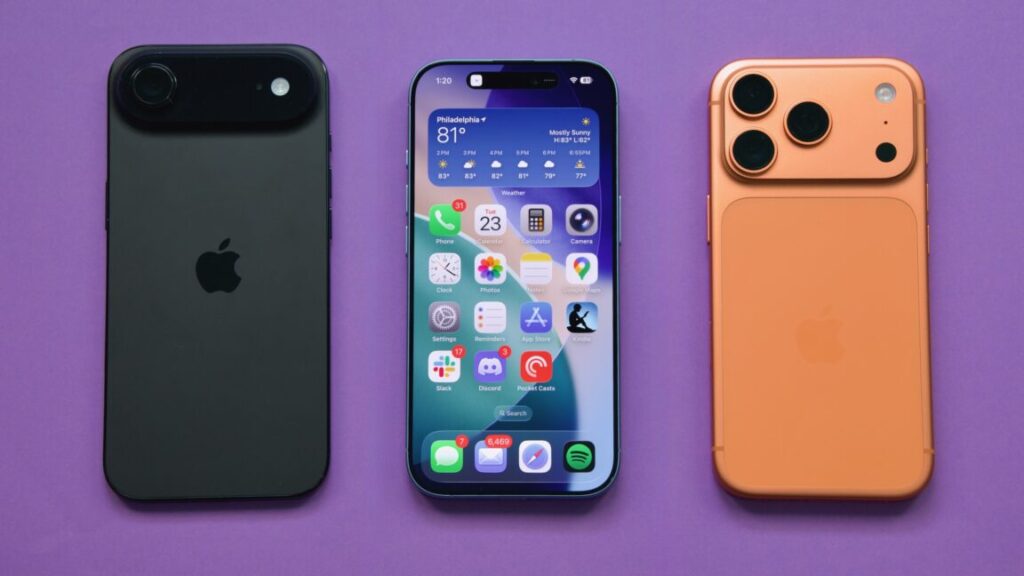
This year’s newest iPhones included one momentous change that marked a new phase in the evolution of Apple Silicon: the Apple N1, Apple’s first in-house chip made to handle local wireless connections. The N1 supports Wi-Fi 7, Bluetooth 6, and the Thread smart home communication protocol, and it replaces the third-party wireless chips (mostly made by Broadcom) that Apple used in older iPhones.
Apple claimed that the N1 would enable more reliable connectivity for local communication features like AirPlay and AirDrop but didn’t say anything about how users could expect it to perform. But Ookla, the folks behind the SpeedTest app and website, have analyzed about five weeks’ worth of users’ testing data to get an idea of how the iPhone 17 lineup stacks up to the iPhone 16, as well as Android phones with Wi-Fi chips from Qualcomm, MediaTek, and others.
While the N1 isn’t at the top of the charts, Ookla says Apple’s Wi-Fi chip “delivered higher download and upload speeds on Wi-Fi compared to the iPhone 16 across every studied percentile and virtually every region.” The median download speed for the iPhone 17 series was 329.56Mbps, compared to 236.46Mbps for the iPhone 16; the upload speed also jumped from 73.68Mbps to 103.26Mbps.
Ookla noted that the N1’s best performance seemed to improve scores most of all in the bottom 10th percentile of performance tests, “implying Apple’s custom silicon lifts the floor more than the ceiling.” The iPhone 17 also didn’t top Ookla’s global performance charts—Ookla found that the Pixel 10 Pro series slightly edges out the iPhone 17 in download speed, while a Xiaomi 15T Pro with MediaTek Wi-Fi silicon featured better upload speeds.
This 9171 subtype “continues, unfortunately uninterrupted, across multiple jurisdictions,” David Sugerman, who leads the CDC measles response, said on the call.
According to the Times, local health officials are pessimistic that they’ll be able to stamp out the virus’ spread, saying that vaccination efforts have had “limited” impact. As Ars reported previously, vaccination rates are dangerously low in two measles hotspots: northwestern Mohave County, Arizona, and the southwest health district of Utah. Vaccination rates among kindergartners in the 2024–2025 school year were 78.4 percent and 80.7 percent, respectively. That’s well below the 95 percent target needed to keep the virus from spreading onward in the communities.
In addition, public health officials in Arizona and Utah have reported barriers to responding to the outbreak. Around a quarter of cases don’t know how they were exposed, suggesting cases and exposures are being missed. In late October, health officials in Salt Lake County, Utah, said that a person likely infected with measles refused to cooperate with their investigation, leaving them unable to confirm the probable case.
David Kimberlin, who sits on a panel of experts that analyzes measles data for the United States’ elimination status review, told the Times, “It would not surprise me in the least if there’s continued spread across these next several months.”
To date, the CDC has tallied 1,723 measles cases across 42 states. Most (87 percent) of those cases were linked to outbreaks, of which there have been 45 this year. For context, there were 16 outbreaks and a total of 285 measles cases in the US last year. This year’s measles cases mark a 33-year high.
Alphabet’s recent market performance has been driven by investor confidence in the company’s ability to compete with OpenAI’s ChatGPT, as well as its development of specialized chips for AI that can compete with Nvidia’s. Nvidia recently reached a world-first $5 trillion valuation due to making GPUs that can accelerate the matrix math at the heart of AI computations.
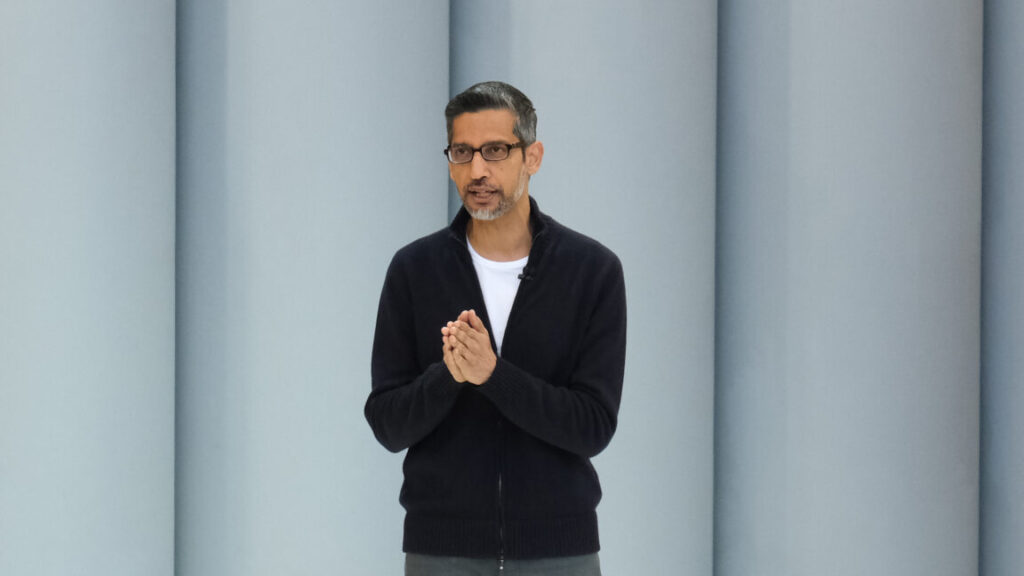
Despite acknowledging that no company would be immune to a potential AI bubble burst, Pichai argued that Google’s unique position gives it an advantage. He told the BBC that the company owns what he called a “full stack” of technologies, from chips to YouTube data to models and frontier science research. This integrated approach, he suggested, would help the company weather any market turbulence better than competitors.
Pichai also told the BBC that people should not “blindly trust” everything AI tools output. The company currently faces repeated accuracy concerns about some of its AI models. Pichai said that while AI tools are helpful “if you want to creatively write something,” people “have to learn to use these tools for what they’re good at and not blindly trust everything they say.”
In the BBC interview, the Google boss also addressed the “immense” energy needs of AI, acknowledging that the intensive energy requirements of expanding AI ventures have caused slippage on Alphabet’s climate targets. However, Pichai insisted that the company still wants to achieve net zero by 2030 through investments in new energy technologies. “The rate at which we were hoping to make progress will be impacted,” Pichai said, warning that constraining an economy based on energy “will have consequences.”
Even with the warnings about a potential AI bubble, Pichai did not miss his chance to promote the technology, albeit with a hint of danger regarding its widespread impact. Pichai described AI as “the most profound technology” humankind has worked on.
“We will have to work through societal disruptions,” he said, adding that the technology would “create new opportunities” and “evolve and transition certain jobs.” He said people who adapt to AI tools “will do better” in their professions, whatever field they work in.
Jeff Bezos is one of the world’s richest and most famous tech CEOs, but he hasn’t actually been a CEO of anything since 2021. That’s now changing as he takes on the role of co-CEO of a new AI company, according to a New York Times report citing three people familiar with the company.
Grandiosely named Project Prometheus (and not to be confused with the NASA project of the same name), the company will focus on using AI to pursue breakthroughs in research, engineering, manufacturing, and other fields that are dubbed part of “the physical economy”—in contrast to the software applications that are likely the first thing most people in the general public think of when they hear “AI.”
Bezos’ co-CEO will be Dr. Vik Bajaj, a chemist and physicist who previously led life sciences work at Google X, an Alphabet-backed research group that worked on speculative projects that could lead to more product categories. (For example, it developed technologies that would later underpin Google’s Waymo service.) Bajaj also worked at Verily, another Alphabet-backed research group focused on life sciences, and Foresite Labs, an incubator for new AI companies.
Government can’t use funding threats to override the First Amendment.
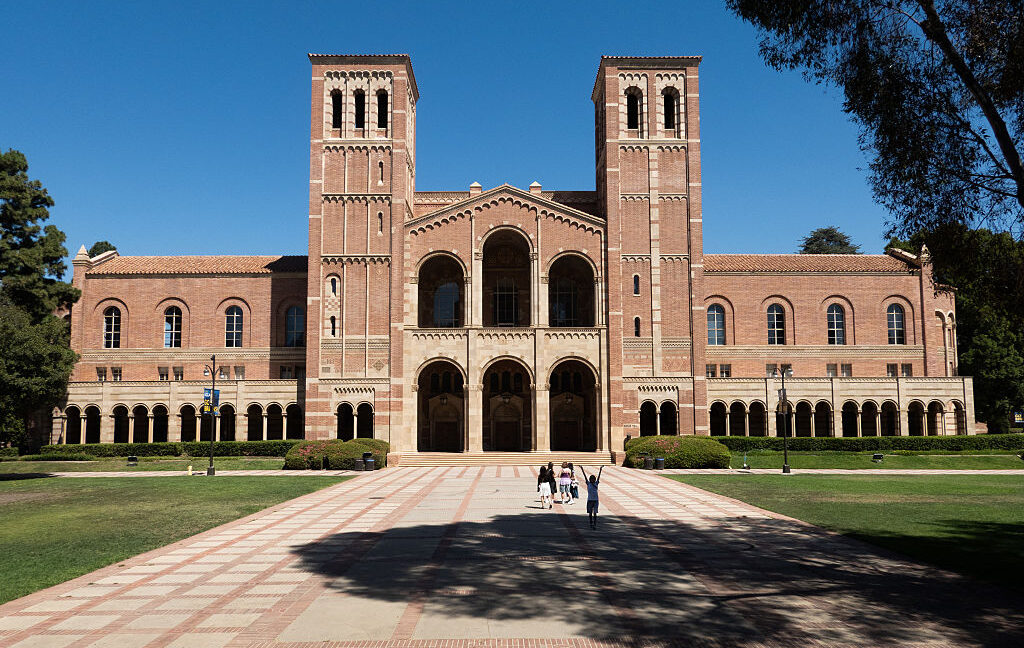
While UCLA has been most prominently targeted by the Trump Administration, the ruling protects the entire UC system. Credit: Myung J. Chun
On Friday, a US District Court issued a preliminary injunction blocking the United States government from halting federal funding at UCLA or any other school in the University of California system. The ruling came in response to a suit filed by groups representing the faculty at these schools challenging the Trump administration’s attempts to force UCLA into a deal that would substantially revise instruction and policy.
The court’s decision lays out how the Trump administration’s attacks on universities follow a standard plan: use accusations of antisemitism to justify an immediate cut to funding, then use the loss of money to compel an agreement that would result in revisions to university instruction and management. The court finds that this plan was deficient on multiple grounds, violating legal procedures for cutting funding to an illegal attempt and suppressing the First Amendment rights of faculty.
The result is a reprieve for the entire University of California system, as well as a clear pathway for any universities to fight back against the Trump administration’s attacks on research and education.
First Amendment violations
The Judge overseeing this case, Rita Lin, issued separate documents describing the reasoning behind her decision and the sanctions she has placed on the Trump administration. In the first, she lays out the argument that the threats facing the UC system, and most notably UCLA, are part of a scripted campaign deployed against many other universities, one that proceeds through several steps. The Trump administration’s Task Force to Combat Anti-Semitism is central to this effort, which starts with the opening of a civil rights investigation against a university that was the site of anti-Israel protests during the conflict in Gaza.
“Rooting out antisemitism is undisputedly a laudable and important goal,” Judge Lin wrote. But the investigations in many cases take place after those universities have already taken corrective steps, which the Trump administration seemingly never considers. Instead, while the investigations are still ongoing, agencies throughout the federal government cancel funding for research and education meant for that university and announce that there will be no future funding without an agreement.
The final step is a proposed settlement that would include large payments (over $1.2 billion in UCLA’s case) and a set of conditions that alter university governance and instruction. These conditions often have little to no connection with antisemitism.
While all of this was ostensibly meant to combat antisemitism, the plaintiffs in this case presented a huge range of quotes from administration officials, including the head of the Task Force to Combat Anti-Semitism, saying the goal was to suppress certain ideas on campus. “The unrebutted record in this case shows that Defendants have used the threat of investigations and economic sanctions to… coerce the UC to stamp out faculty, staff, and student ‘woke,’ ‘left,’ ‘anti-American,’ ‘anti-Western,’ and ‘Marxist’ speech,” Lin said.
And even before any sort of agreement was reached, there was extensive testimony that people on campus changed their teaching and research to avoid further attention from the administration. “Plaintiffs’ members express fear that researching, teaching, and speaking on disfavored topics will trigger further retaliatory funding cancellations against the UC,” Lin wrote, “and that they will be blamed for the retaliation. They also describe fears that the UC will retaliate against them to avoid further funding cuts or in order to comply with the proposed settlement agreement.”
That’s a problem, given that teaching and research topics are forms of speech, and therefore protected by the First Amendment. “These are classic, predictable First Amendment harms, and exactly what Defendants publicly said that they intended,” Lin concluded.
Beyond speech
But the First Amendment isn’t the only issue here. The Civil Rights Act, most notably Title VI, lays out a procedure for cutting federal funding, including warnings and hearings before any funds are shut off. That level of coercion is also limited to cases where there’s an indication that voluntary compliance won’t work. Any funding cut would need to target the specific programs involved and the money allocated to them. There is nothing in Title VI that enables the sort of financial payments that the government has been demanding (and, in some cases, receiving) from schools.
It’s pretty obvious that none of these procedures are being followed here. And as Lin noted in her ruling, “Defendants conceded at oral argument that, of the billions of dollars of federal university funding suspended across numerous agencies in recent months, not a single agency has followed the procedures required by Title VI and IX.”
She found that the government decided it wasn’t required to follow the Civil Rights Act procedures. (Reading through the decision, it becomes hard to tell where the government offered any defense of its actions at all.)
The decision to ignore all existing procedures, in turn, causes additional problems, including violations of the Tenth Amendment, which limits the actions that the government can take. And it runs afoul of the Administrative Procedures Act, which prohibits the government from taking actions that are “arbitrary and capricious.”
All of this provided Lin with extensive opportunities to determine that the Plaintiffs, largely organizations that represent the faculty at University of California schools, are likely to prevail in their suit, and thus are deserving of a preliminary injunction to block the federal government’s actions. But first, she had to deal with a recent Supreme Court precedent holding that cases involving federal money belong in a different court system. She did so by arguing that this case is largely about First Amendment and federal procedures rather than any sort of contract for federal money; money is being used as a lever here, so they ruling must involve restoring the money to address the free speech issues.
That issue will undoubtedly be picked up on appeal as it makes its way through the courts.
Complete relief
Lin identified a coercive program that is being deployed against many universities and is already suppressing speech throughout the University of California system, including on campuses that haven’t been targeted yet. She is issuing a ruling that targets the program broadly.
“Plaintiffs have shown that Defendants are coercing the [University of California] as a whole, through the Task Force Policy and Funding Cancellation, to stamp out their members’ disfavored speech,” Lin concluded. “Therefore, to afford Plaintiffs complete relief, the entirety of the coercive practice must be enjoined, not just the suspensions that impact Plaintiffs’ members.”
Her ruling indicates that if the federal government decides it wants to cut any grants to any school in the UC system, it has to go through the entire procedure set out in the Civil Rights Act. The government is also prohibited from demanding money from any of these schools as a fine or payment, and it can’t threaten future funding to the schools. The current hold on grants to the school by the government must also be lifted.
In short, the entire UC system should be protected from any of the ways that the government has been trying to use accusations of antisemitism to suppress ideas that it disfavors. And since those primarily involve federal funding, that has to be restored, and any future threats to it must be blocked.
While this case is likely to face a complicated appeals process, Lin’s ruling makes it extremely clear that all of these cases are exactly what they seemed. Just as members of the administration stated in public multiple times, they decided to target some ideas they disfavored and simply made up a process that would let them do so.
While it worked against a number of prominent universities, its legal vulnerabilities have been there from the start.
John is Ars Technica’s science editor. He has a Bachelor of Arts in Biochemistry from Columbia University, and a Ph.D. in Molecular and Cell Biology from the University of California, Berkeley. When physically separated from his keyboard, he tends to seek out a bicycle, or a scenic location for communing with his hiking boots.
Federal Communications Commission Chairman Brendan Carr says he won’t scrap the agency’s controversial news distortion policy despite calls from a bipartisan group of former FCC chairs and commissioners.
“How about no,” Carr wrote in an X post in response to the petition from former FCC leaders. “On my watch, the FCC will continue to hold broadcasters accountable to their public interest obligations.”
The petition filed yesterday by former FCC chairs and commissioners asked the FCC to repeal its 1960s-era news distortion policy, which Carr has repeatedly invoked in threats to revoke broadcast licenses. In the recent Jimmy Kimmel controversy, Carr said that ABC affiliates could have licenses revoked for news distortion if they kept the comedian on the air.
The petition said the Kimmel incident and several other Carr threats illustrate “the extraordinary intrusions on editorial decision-making that Chairman Carr apparently understands the news distortion policy to permit.” The petition argued that the “policy’s purpose—to eliminate bias in the news—is not a legitimate government interest,” that it has chilled broadcasters’ speech, that it has been weaponized for partisan purposes, that it is overly vague, and is unnecessary given the separate rule against broadcast hoaxes.
“The news distortion policy is no longer justifiable under today’s First Amendment doctrine and no longer necessary in today’s media environment… The Commission should repeal the policy in full and recognize that it may not investigate or penalize broadcasters for ‘distorting,’ ‘slanting,’ or ‘staging’ the news, unless the broadcast at issue independently meets the high standard for broadcasting a dangerous hoax under 47 C.F.R. § 73.1217,” the petition said.
News distortion policy rarely enforced
The petition was filed by Mark Fowler, a Republican who chaired the FCC from 1981 to 1987; Dennis Patrick, a Republican who chaired the FCC from 1987 to 1989; Alfred Sikes, a Republican who chaired the FCC from 1989 to 1993; Tom Wheeler, a Democrat who chaired the FCC from 2013 to 2017; Andrew Barrett, a Republican who served as a commissioner from 1989 to 1996; Ervin Duggan, a Democrat who served as a commissioner from 1990 to 1994; and Rachelle Chong, a Republican who served as a commissioner from 1994 to 1997.
Ongoing struggles with AI model instruction-following show that true human-level AI still a ways off.
Em dashes have become what many believe to be a telltale sign of AI-generated text over the past few years. The punctuation mark appears frequently in outputs from ChatGPT and other AI chatbots, sometimes to the point where readers believe they can identify AI writing by its overuse alone—although people can overuse it, too.
On Thursday evening, OpenAI CEO Sam Altman posted on X that ChatGPT has started following custom instructions to avoid using em dashes. “Small-but-happy win: If you tell ChatGPT not to use em-dashes in your custom instructions, it finally does what it’s supposed to do!” he wrote.
The post, which came two days after the release of OpenAI’s new GPT-5.1 AI model, received mixed reactions from users who have struggled for years with getting the chatbot to follow specific formatting preferences. And this “small win” raises a very big question: If the world’s most valuable AI company has struggled with controlling something as simple as punctuation use after years of trying, perhaps what people call artificial general intelligence (AGI) is farther off than some in the industry claim.
A screenshot of Sam Altman’s post about em dashes on X. Credit: X
“The fact that it’s been 3 years since ChatGPT first launched, and you’ve only just now managed to make it obey this simple requirement, says a lot about how little control you have over it, and your understanding of its inner workings,” wrote one X user in a reply. “Not a good sign for the future.”
While Altman likes to publicly talk about AGI (a hypothetical technology equivalent to humans in general learning ability), superintelligence (a nebulous concept for AI that is far beyond human intelligence), and “magic intelligence in the sky” (his term for AI cloud computing?) while raising funds for OpenAI, it’s clear that we still don’t have reliable artificial intelligence here today on Earth.
But wait, what is an em dash anyway, and why does it matter so much?
AI models love em dashes because we do
Unlike a hyphen, which is a short punctuation mark used to connect words or parts of words, that lives with a dedicated key on your keyboard (-), an em dash is a long dash denoted by a special character (—) that writers use to set off parenthetical information, indicate a sudden change in thought, or introduce a summary or explanation.
Even before the age of AI language models, some writers frequently bemoaned the overuse of the em dash in modern writing. In a 2011 Slate article, writer Noreen Malone argued that writers used the em dash “in lieu of properly crafting sentences” and that overreliance on it “discourages truly efficient writing.” Various Reddit threads posted prior to ChatGPT’s launch featured writers either wrestling over the etiquette of proper em dash use or admitting to their frequent use as a guilty pleasure.
In 2021, one writer in the r/FanFiction subreddit wrote, “For the longest time, I’ve been addicted to Em Dashes. They find their way into every paragraph I write. I love the crisp straight line that gives me the excuse to shove details or thoughts into an otherwise orderly paragraph. Even after coming back to write after like two years of writer’s block, I immediately cram as many em dashes as I can.”
Because of the tendency for AI chatbots to overuse them, detection tools and human readers have learned to spot em dash use as a pattern, creating a problem for the small subset of writers who naturally favor the punctuation mark in their work. As a result, some journalists are complaining that AI is “killing” the em dash.
No one knows precisely why LLMs tend to overuse em dashes. We’ve seen a wide range of speculation online that attempts to explain the phenomenon, from noticing that em dashes were more popular in 19th-century books used as training data (according to a 2018 study, dash use in the English language peaked around 1860 before declining through the mid-20th century) or perhaps AI models borrowed the habit from automatic em-dash character conversion on the blogging site Medium.
One thing we know for sure is that LLMs tend to output frequently seen patterns in their training data (fed in during the initial training process) and from a subsequent reinforcement learning process that often relies on human preferences. As a result, AI language models feed you a sort of “smoothed out” average style of whatever you ask them to provide, moderated by whatever they are conditioned to produce through user feedback.
So the most plausible explanation is still that requests for professional-style writing from an AI model trained on vast numbers of examples from the Internet will lean heavily toward the prevailing style in the training data, where em dashes appear frequently in formal writing, news articles, and editorial content. It’s also possible that during training through human feedback (called RLHF), responses with em dashes, for whatever reason, received higher ratings. Perhaps it’s because those outputs appeared more sophisticated or engaging to evaluators, but that’s just speculation.
From em dashes to AGI?
To understand what Altman’s “win” really means, and what it says about the road to AGI, we need to understand how ChatGPT’s custom instructions actually work. They allow users to set persistent preferences that apply across all conversations by appending written instructions to the prompt that is fed into the model just before the chat begins. Users can specify tone, format, and style requirements without needing to repeat those requests manually in every new chat.
However, the feature has not always worked reliably because LLMs do not work reliably (even OpenAI and Anthropic freely admit this). An LLM takes an input and produces an output, spitting out a statistically plausible continuation of a prompt (a system prompt, the custom instructions, and your chat history), and it doesn’t really “understand” what you are asking. With AI language model outputs, there is always some luck involved in getting them to do what you want.
In our informal testing of GPT-5.1 with custom instructions, ChatGPT did appear to follow our request not to produce em dashes. But despite Altman’s claim, the response from X users appears to show that experiences with the feature continue to vary, at least when the request is not placed in custom instructions.
So if LLMs are statistical text-generation boxes, what does “instruction following” even mean? That’s key to unpacking the hypothetical path from LLMs to AGI. The concept of following instructions for an LLM is fundamentally different from how we typically think about following instructions as humans with general intelligence, or even a traditional computer program.
In traditional computing, instruction following is deterministic. You tell a program “don’t include character X,” and it won’t include that character. The program executes rules exactly as written. With LLMs, “instruction following” is really about shifting statistical probabilities. When you tell ChatGPT “don’t use em dashes,” you’re not creating a hard rule. You’re adding text to the prompt that makes tokens associated with em dashes less likely to be selected during the generation process. But “less likely” isn’t “impossible.”
Every token the model generates is selected from a probability distribution. Your custom instruction influences that distribution, but it’s competing with the model’s training data (where em dashes appeared frequently in certain contexts) and everything else in the prompt. Unlike code with conditional logic, there’s no separate system verifying outputs against your requirements. The instruction is just more text that influences the statistical prediction process.
When Altman celebrates finally getting GPT to avoid em dashes, he’s really celebrating that OpenAI has tuned the latest version of GPT-5.1 (probably through reinforcement learning or fine-tuning) to weight custom instructions more heavily in its probability calculations.
There’s an irony about control here: Given the probabilistic nature of the issue, there’s no guarantee the issue will stay fixed. OpenAI continuously updates its models behind the scenes, even within the same version number, adjusting outputs based on user feedback and new training runs. Each update arrives with different output characteristics that can undo previous behavioral tuning, a phenomenon researchers call the “alignment tax.”
Precisely tuning a neural network’s behavior is not yet an exact science. Since all concepts encoded in the network are interconnected by values called weights, adjusting one behavior can alter others in unintended ways. Fix em dash overuse today, and tomorrow’s update (aimed at improving, say, coding capabilities) might inadvertently bring them back, not because OpenAI wants them there, but because that’s the nature of trying to steer a statistical system with millions of competing influences.
This gets to an implied question we mentioned earlier. If controlling punctuation use is still a struggle that might pop back up at any time, how far are we from AGI? We can’t know for sure, but it seems increasingly likely that it won’t emerge from a large language model alone. That’s because AGI, a technology that would replicate human general learning ability, would likely require true understanding and self-reflective intentional action, not statistical pattern matching that sometimes aligns with instructions if you happen to get lucky.
And speaking of getting lucky, some users still aren’t having luck with controlling em dash use outside of the “custom instructions” feature. Upon being told in-chat to not use em dashes within a chat, ChatGPT updated a saved memory and replied to one X user, “Got it—I’ll stick strictly to short hyphens from now on.”
Benj Edwards is Ars Technica’s Senior AI Reporter and founder of the site’s dedicated AI beat in 2022. He’s also a tech historian with almost two decades of experience. In his free time, he writes and records music, collects vintage computers, and enjoys nature. He lives in Raleigh, NC.
A young woolly mammoth now known as Yuka was frozen in the Siberian permafrost for about 40,000 years before it was discovered by local tusk hunters in 2010. The hunters soon handed it over to scientists, who were excited to see its exquisite level of preservation, with skin, muscle tissue, and even reddish hair intact. Later research showed that, while full cloning was impossible, Yuka’s DNA was in such good condition that some cell nuclei could even begin limited activity when placed inside mouse eggs.
Now, a team has successfully sequenced Yuka’s RNA—a feat many researchers once thought impossible. Researchers at Stockholm University carefully ground up bits of muscle and other tissue from Yuka and nine other woolly mammoths, then used special chemical treatments to pull out any remaining RNA fragments, which are normally thought to be much too fragile to survive even a few hours after an organism has died. Scientists go to great lengths to extract RNA even from fresh samples, and most previous attempts with very old specimens have either failed or been contaminated.
A different view
The team used RNA-handling methods adapted for ancient, fragmented molecules. Their scientific séance allowed them to explore information that had never been accessible before, including which genes were active when Yuka died. In the creature’s final panicked moments, its muscles were tensing and its cells were signaling distress—perhaps unsurprising since Yuka is thought to have died as a result of a cave lion attack.
It’s an exquisite level of detail, and one that scientists can’t get from just analyzing DNA. “With RNA, you can access the actual biology of the cell or tissue happening in real time within the last moments of life of the organism,” said Emilio Mármol, a researcher who led the study. “In simple terms, studying DNA alone can give you lots of information about the whole evolutionary history and ancestry of the organism under study. “Obtaining this fragile and mostly forgotten layer of the cell biology in old tissues/specimens, you can get for the first time a full picture of the whole pipeline of life (from DNA to proteins, with RNA as an intermediate messenger).”
Ars chats with particle physicist Daniel Whiteson about his new book Do Aliens Speak Physics?
Science fiction has long speculated about the possibility of first contact with an alien species from a distant world and how we might be able to communicate with them. But what if we simply don’t have enough common ground for that to even be possible? An alien species is bound to be biologically very different, and their language will be shaped by their home environment, broader culture, and even how they perceive the universe. They might not even share the same math and physics. These and other fascinating questions are the focus of an entertaining new book, Do Aliens Speak Physics? And Other Questions About Science and the Nature of Reality.
Co-author Daniel Whiteson is a particle physicist at the University of California, Irvine, who has worked on the ATLAS collaboration at CERN’s Large Hadron Collider. He’s also a gifted science communicator who previously co-authored two books with cartoonist Jorge Cham of PhD Comics fame: 2018’s We Have No Idea and 2021’s Frequently Asked Questions About the Universe. (The pair also co-hosted a podcast from 2018 to 2024, Daniel and Jorge Explain the Universe.) This time around, cartoonist Andy Warner provided the illustrations, and Whiteson and Warner charmingly dedicate their book to “all the alien scientists we have yet to meet.”
Whiteson has long been interested in the philosophy of physics. “I’m not the kind of physicist who’s like, ‘whatever, let’s just measure stuff,’” he told Ars. “The thing that always excited me about physics was this implicit promise that we were doing something universal, that we were learning things that were true on other planets. But the more I learned, the more concerned I became that this might have been oversold. None are fundamental, and we don’t understand why anything emerges. Can we separate the human lens from the thing we’re looking at? We don’t know in the end how much that lens is distorting what we see or defining what we’re looking at. So that was the fundamental question I always wanted to explore.”
Whiteson initially pitched his book idea to his 14-year-old son, who inherited his father’s interest in science. But his son thought Whiteson’s planned discussion of how physics might not be universal was, well, boring. “When you ask for notes, you’ve got to listen to them,” said Whiteson. “So I came back and said, ‘Well, what about a book about when aliens arrive? Will their science be similar to ours? Can we collaborate together?’” That pitch won the teen’s enthusiastic approval: same ideas, but couched in the context of alien contact to make them more concrete.
As for Warner’s involvement as illustrator, “I cold-emailed him and said, ‘Want to write a book about aliens? You get to draw lots of weird aliens,’” said Whiteson. Who could resist that offer?
Ars caught up with Whiteson to learn more.
Credit: Andy Warner
Ars Technica: You open each chapter with fictional hypothetical scenarios. Why?
Daniel Whiteson: I sent an early version of the book to my friend, [biologist] Matt Giorgianni, who appears in cartoon form in the book. He said, “The book is great, but it’s abstract. Why don’t you write out a hypothetical concrete scenario for each chapter to show us what it would be like and how we would stumble.”
All great ideas seem obvious once you hear them. I’ve always been a huge science fiction fan. It’s thoughtful and creative and exploratory about the way the universe could be and might be. So I jumped at the opportunity to write a little bit of science fiction. Each one was challenging because you have to come up with a specific example that illustrates the concepts in that chapter, the issues that you might run into, but also be believable and interesting. We went through a lot of drafts. But I had a lot of fun writing them.
Ars Technica: The Voyager Golden Record is perhaps the best known example of humans attempting to communicate with an alien species, spearheaded by the late Carl Sagan, among others. But what are the odds that, despite our best efforts, any aliens will ever be able to decipher our “message in a bottle”?
Daniel Whiteson: I did an informal experiment where I printed out a picture of the Pioneer plaque and showed it to a bunch of grad students who were young enough to not have seen it before. This is Sagan’s audience: biological humans, same brain, same culture, physics grad students—none of them had any idea what any of that was supposed to refer to. NASA gave him two weeks to come up with that design. I don’t know that I would’ve done any better. It’s easy to criticize.
Those folks, they were doing their best. They were trying to step away from our culture. They didn’t use English, they didn’t even use mathematical symbols. They understood that those things are arbitrary, and they were reaching for something they hoped was going to be universal. But in the end, nothing can be universal because language is always symbols, and the choice of those symbols is arbitrary and cultural. It’s impossible to choose a symbol that can only be interpreted in one way.
Fundamentally, the book is trying to poke at our assumptions. It’s so inspiring to me that the history of physics is littered with times when we have had to abandon an assumption that we clung to desperately, until we were shown otherwise with enough data. So we’ve got to be really open-minded about whether these assumptions hold true, whether it’s required to do science, to be technological, or whether there is even a single explanation for reality. We could be very well surprised by what we discover.
Ars Technica: It’s often assumed that math and physics are the closest thing we have to a universal language. You challenge that assumption, probing such questions as “what does it even mean to ‘count’”?
Daniel Whiteson: At an initial glance, you’re like, well, of course mathematics is required, and of course numbers are universal. But then you dig into it and you start to realize there are fuzzy issues here. So many of the assumptions that underlie our interpretation of what we learned about physics are that way. I had this experience that’s probably very common among physics undergrads in quantum mechanics, learning about those calculations where you see nine decimal places in the theory and nine decimal places in the experiment, and you go, “Whoa, this isn’t just some calculational tool. This is how the universe decides what happens to a particle.”
I literally had that moment. I’m not a religious person, but it was almost spiritual. For many years, I believed that deeply, and I thought it was obvious. But to research this book, I read Science Without Numbers by Hartry Field. I was lucky—here at Irvine, we happen to have an amazing logic and philosophy of science department, and those folks really helped me digest [his ideas] and understand how you can pull yourself away from things like having a number line. It turns out you don’t need numbers; you can just think about relationships. It was really eye-opening, both how essential mathematics seems to human science and how obvious it is that we’re making a bunch of assumptions that we don’t know how to justify.
There are dotted lines humans have drawn because they make sense to us. You don’t have to go to plasma swirls and atmospheres to imagine a scenario where aliens might not have the same differentiation between their identities, me and you, here’s where I end, and here’s where you begin. That’s complicated for aliens that are plasma swirls, but also it’s not even very well-defined for us. How do I define the edge of my body? Is it where my skin ends? What about the dead skin, the hair, my personal space? There’s no obvious definition. We just have a cultural sense for “this is me, this is not me.” In the end, that’s a philosophical choice.
Credit: Andy Warner
Ars Technica: You raise another interesting question in the book: Would aliens even need physics theory or a deeper understanding of how the universe works? Perhaps they could invent, say, warp drive through trial and error. You suggest that our theory is more like a narrative framework. It’s the story we tell, and that is very much prone to bias.
Daniel Whiteson: Absolutely. And not just bias, but emotion and curiosity. We put energy into certain things because we think they’re important. Physicists spend our lives on this because we think, among the many things we could spend our time on, this is an important question. That’s an emotional choice. That’s a personal subjective thing.
Other people find my work dead boring and would hate to have my life, and I would feel the same way about theirs. And that’s awesome. I’m glad that not everybody wants to be a particle physicist or a biologist or an economist. We have a diversity of curiosity, which we all benefit from. People have an intuitive feel for certain things. There’s something in their minds that naturally understands how the system works and reflects it, and they probably can’t explain it. They might not be able to design a better car, but they can drive the heck out of it.
This is maybe the biggest stumbling block for people who are just starting to think about this for the first time. “Obviously aliens are scientific.” Well, how do we know? What do we mean by scientific? That concept has evolved over time, and is it really required? I felt that that was a big-picture thing that people could wrap their minds around but also a shock to the system. They were already a little bit off-kilter and might realize that some things they assumed must be true maybe not have to be.
Ars Technica: You cite the 2016 film Arrival as an example of first contact and the challenge of figuring out how to communicate with an alien species. They had to learn each other’s cultural context before they had any chance of figuring out what their respective symbols meant.
Daniel Whiteson: I think that is really crucial. Again, how you choose to represent your ideas is, in a sense, arbitrary. So if you’re on the other side of that, and you have to go from symbols to ideas, you have to know something about how they made those choices in order to reverse-engineer a message, in order to figure out what it means. How do you know if you’ve done it correctly? Say we get a message from aliens and we spend years of supercomputer time cranking on it. Something we rely on for decoding human messages is that you can tell when you’ve done it right because you have something that makes sense.
Credit: Andy Warner
How do we know when we’ve done that for an alien text? How do you know the difference between nonsense and things that don’t yet make sense to you? It’s essentially impossible. I spoke to some philosophers of language who convinced me that if we get a message from aliens, it might be literally impossible to decode it without their help, without their context. There aren’t enough examples of messages from aliens. We have the “Wow!” signal—who knows what that means? Maybe it’s a great example of getting a message and having no idea how to decode it.
As in many places in the book, I turned to human history because it’s the one example we have. I was shocked to discover how many human languages we haven’t decoded. Not to mention, we haven’t decoded whale. We know whales are talking to each other. Maybe they’re talking to us and we can’t decode it. The lesson, again and again, is culture.
With the Egyptians, the only reason we were able to decode hieroglyphics is because we had the Rosetta Stone, but that still took 20 years there. How does it take 20 years when you have examples and you know what it’s supposed to say? And the answer is that we made cultural assumptions. We assumed pictograms reflected the ideas in the pictures. If there’s a bird in it, it’s about birds. And we were just wrong. That’s maybe why we’ve been struggling with Etruscan and other languages we’ve never decoded.
Even when we do have a lot of culture in common, it’s very, very tricky. So the idea that we would get a message from space and have no cultural clues at all and somehow be able to decode it—I think that only works in the scenario where aliens have been listening to us for a long time and they’re essentially writing to us in something like our language. I’m a big fan of SETI. They host these conferences where they listen to philosophers and linguists and anthropologists. I don’t mean to say that they’ve thought too narrowly, but I think it’s not widely enough appreciated how difficult it is to decode another language with no culture in common.
Ars Technica: You devote a chapter to the possibility that aliens might be able to, say, “taste” electrons. That drives home your point that physiologically, they will probably be different, biologically they will be different, and their experiences are likely to be different. So their notion of culture will also be different.
Daniel Whiteson: Something I really wanted to get across was that perception determines your sense of intuition, which defines in many ways the answers you find acceptable. I read Ed Yong’s amazing book, An Immense World, about animal perception, the diversity of animal experience or animal interaction with the environment. What is it like to be an octopus with a distributed mind? What is it like to be a bird that senses magnetic fields? If you’re an alien and you have very different perceptions, you could also have a different intuitive language in which to understand the universe. What is a photon? Is it a particle? Is it a wave? Maybe we just struggle with the concept because our intuitive language is limited.
For an alien that can see photons in superposition, this is boring. They could be bored by things we’re fascinated by, or we could explain our theories to them and they could be unsatisfied because to them, it doesn’t translate into their intuitive language. So even though we’ve transcended our biological limitations in many ways, we can detect gravitational waves and infrared photons, we’re still, I think, shaped by those original biological senses that frame our experience, the models we build. What it’s like to be a human in the world could be very, very different from what it’s like to be an alien in the world.
Ars Technica: Your very last line reads, “Our theories may reveal the patterns of our thoughts as much as the patterns of nature.” Why did you choose to end your book on that note?
Daniel Whiteson: That’s a message to myself. When I started this journey, I thought physics is universal. That’s what makes it beautiful. That implies that if the aliens show up and they do physics in a very different way, it would be a crushing disappointment. Not only is what we’ve learned just another human science, but also it means maybe we can’t benefit from their work or we can’t have that fantasy of a galactic scientific conference. But that actually might be the best-case scenario.
I mean, the reason that you want to meet aliens is the reason you go traveling. You want to expand your horizons and learn new things. Imagine how boring it would be if you traveled around the world to some new country and they just had all the same food. It might be comforting in some way, but also boring. It’s so much more interesting to find out that they have spicy fish soup for breakfast. That’s the moment when you learn not just about what to have for breakfast but about yourself and your boundaries.
So if aliens show up and they’re so weirdly different in a way we can’t possibly imagine—that would be deeply revealing. It’ll give us a chance to separate the reality from the human lens. It’s not just questions of the universe. We are interesting, and we should learn about our own biases. I anticipate that when the aliens do come, their culture and their minds and their science will be so alien, it’ll be a real challenge to make any kind of connection. But if we do, I think we’ll learn a lot, not just about the universe but about ourselves.
Jennifer is a senior writer at Ars Technica with a particular focus on where science meets culture, covering everything from physics and related interdisciplinary topics to her favorite films and TV series. Jennifer lives in Baltimore with her spouse, physicist Sean M. Carroll, and their two cats, Ariel and Caliban.