xAI

trump’s-order-to-make-chatbots-anti-woke-is-unconstitutional,-senator-says

Trump’s order to make chatbots anti-woke is unconstitutional, senator says


Trump plans to use chatbots to eliminate dissent, senator alleged.

The CEOs of every major artificial intelligence company received letters Wednesday urging them to fight Donald Trump’s anti-woke AI order.

Trump’s executive order requires any AI company hoping to contract with the federal government to jump through two hoops to win funding. First, they must prove their AI systems are “truth-seeking”—with outputs based on “historical accuracy, scientific inquiry, and objectivity” or else acknowledge when facts are uncertain. Second, they must train AI models to be “neutral,” which is vaguely defined as not favoring DEI (diversity, equity, and inclusion), “dogmas,” or otherwise being “intentionally encoded” to produce “partisan or ideological judgments” in outputs “unless those judgments are prompted by or otherwise readily accessible to the end user.”

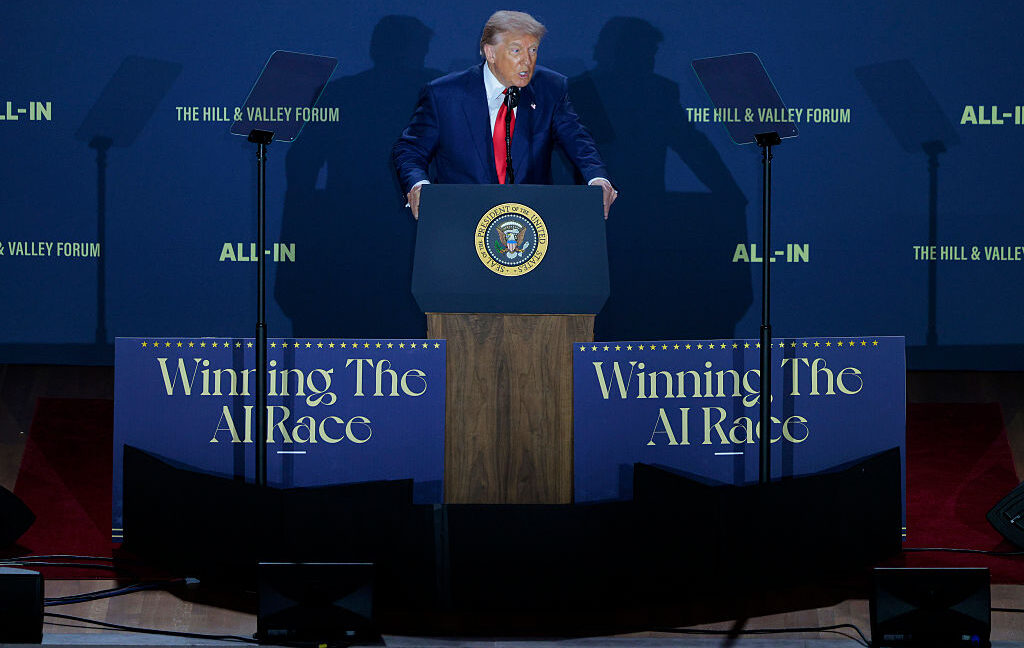
Announcing the order in a speech, Trump said that the US winning the AI race depended on removing allegedly liberal biases, proclaiming that “once and for all, we are getting rid of woke.”

“The American people do not want woke Marxist lunacy in the AI models, and neither do other countries,” Trump said.

Senator Ed Markey (D.-Mass.) accused Republicans of basing their policies on feelings, not facts, joining critics who suggest that AI isn’t “woke” just because of a few “anecdotal” outputs that reflect a liberal bias. And he suggested it was hypocritical that Trump’s order “ignores even more egregious evidence” that contradicts claims that AI is trained to be woke, such as xAI’s Elon Musk explicitly confirming that Grok was trained to be more right-wing.

“On May 1, 2025, Grok—the AI chatbot developed by xAI, Elon Musk’s AI company—acknowledged that ‘xAI tried to train me to appeal to the right,’” Markey wrote in his letters to tech giants. “If OpenAI’s ChatGPT or Google’s Gemini had responded that it was trained to appeal to the left, congressional Republicans would have been outraged and opened an investigation. Instead, they were silent.”

He warned the heads of Alphabet, Anthropic, Meta, Microsoft, OpenAI, and xAI that Trump’s AI agenda was allegedly “an authoritarian power grab” intended to “eliminate dissent” and was both “dangerous” and “patently unconstitutional.”

Even if companies’ AI models are clearly biased, Markey argued that “Republicans are using state power to pressure private companies to adopt certain political viewpoints,” which he claimed is a clear violation of the First Amendment. If AI makers cave, Markey warned, they’d be allowing Trump to create “significant financial incentives” to ensure that “their AI chatbots do not produce speech that would upset the Trump administration.”

“This type of interference with private speech is precisely why the US Constitution has a First Amendment,” Markey wrote, while claiming that Trump’s order is factually baseless.

It’s “based on the erroneous belief that today’s AI chatbots are ‘woke’ and biased against Trump,” Markey said, urging companies “to fight this unconstitutional executive order and not become a pawn in Trump’s effort to eliminate dissent in this country.”

One big reason AI companies may fight order

Some experts agreed with Markey that Trump’s order was likely unconstitutional or otherwise unlawful, The New York Times reported.

For example, Trump may struggle to convince courts that the government isn’t impermissibly interfering with AI companies’ protected speech or that such interference may be necessary to ensure federal procurement of unbiased AI systems.

Genevieve Lakier, a law professor at the University of Chicago, told the NYT that the lack of clarity around what makes a model biased could be a problem. Courts could deem the order an act of “unconstitutional jawboning,” with the Trump administration and Republicans generally perceived as using legal threats to pressure private companies into producing outputs that they like.

Lakier suggested that AI companies may be so motivated to win government contracts or intimidated by possible retaliation from Trump that they may not even challenge the order, though.

Markey is hoping that AI companies will refuse to comply with the order; however, despite recognizing that it places companies “in a difficult position: Either stand on your principles and face the wrath of the Trump administration or cave to Trump and modify your company’s political speech.”

There is one big possible reason that AI companies may have to resist, though.

Oren Etzioni, the former CEO of the AI research nonprofit Allen Institute for Artificial Intelligence, told CNN that Trump’s anti-woke AI order may contradict the top priority of his AI Action Plan—speeding up AI innovation in the US—and actually threaten to hamper innovation.

If AI developers struggle to produce what the Trump administration considers “neutral” outputs—a technical challenge that experts agree is not straightforward—that could delay model advancements.

“This type of thing… creates all kinds of concerns and liability and complexity for the people developing these models—all of a sudden, they have to slow down,” Etzioni told CNN.

Senator: Grok scandal spotlights GOP hypocrisy

Some experts have suggested that rather than chatbots adopting liberal viewpoints, chatbots are instead possibly filtering out conservative misinformation and unintentionally appearing to favor liberal views.

Andrew Hall, a professor of political economy at Stanford Graduate School of Business—who published a May paper finding that “Americans view responses from certain popular AI models as being slanted to the left”—told CNN that “tech companies may have put extra guardrails in place to prevent their chatbots from producing content that could be deemed offensive.”

Markey seemed to agree, writing that Republicans’ “selective outrage matches conservatives’ similar refusal to acknowledge that the Big Tech platforms suspend or impose other penalties disproportionately on conservative users because those users are disproportionately likely to share misinformation, rather than due to any political bias by the platforms.”

It remains unclear what amount of supposed bias detected in outputs could cause a contract bid to be rejected or an ongoing contract to be canceled, but AI companies will likely be on the hook to pay any fees in terminating contracts.

Complying with Trump’s order could pose a struggle for AI makers for several reasons. First, they’ll have to determine what’s fact and what’s ideology, contending with conflicting government standards in how Trump defines DEI. For example, the president’s order counts among “pervasive and destructive” DEI ideologies any outputs that align with long-standing federal protections against discrimination on the basis of race or sex. In addition, they must figure out what counts as “suppression or distortion of factual information about” historical topics like critical race theory, systemic racism, or transgenderism.

The examples in Trump’s order highlighting outputs offensive to conservatives seem inconsequential. He calls out image generators depicting the Pope, the Founding Fathers, and Vikings as not white as problematic, as well as models refusing to misgender a person “even if necessary to stop a nuclear apocalypse” or show white people celebrating their achievements.

It’s hard to imagine how these kinds of flawed outputs could impact government processes, as compared to, say, government contracts granted to models that could be hiding covert racism or sexism.

So far, there has been one example of an AI model displaying a right-wing bias earning a government contract with no red flags raised about its outputs.

Earlier this summer, Grok shocked the world after Musk announced he would be updating the bot to eliminate a supposed liberal bias. The unhinged chatbot began spouting offensive outputs, including antisemitic posts that praised Hitler as well as proclaiming itself “MechaHitler.”

But those obvious biases did not conflict with the Pentagon’s decision to grant xAI a $200 million federal contract. In a statement, a Pentagon spokesperson insisted that “the antisemitism episode wasn’t enough to disqualify” xAI, NBC News reported, partly since “several frontier AI models have produced questionable outputs.”

The Pentagon’s statement suggested that the government expected to deal with such risks while seizing the opportunity of rapidly deploying emerging AI technology into government prototype processes. And perhaps notably, Trump provides a carveout for any agencies using AI models to safeguard national security, which could exclude the Pentagon from experiencing any “anti-woke” delays in accessing frontier models.

But that won’t help other agencies that must figure out how to assess models to meet anti-woke AI requirements over the next few months. And those assessments could cause delays that Trump may wish to avoid in pushing for widespread AI adoption across government.

Trump’s anti-woke AI agenda may be impossible

On the same day that Trump issued his anti-woke AI order, his AI Action Plan promised an AI “renaissance” fueling “intellectual achievements” by “unraveling ancient scrolls once thought unreadable, making breakthroughs in scientific and mathematical theory, and creating new kinds of digital and physical art.”

To achieve that, the US must “innovate faster and more comprehensively than our competitors” and eliminate regulatory barriers impeding innovation in order to “set the gold standard for AI worldwide.”

However, achieving the anti-woke ambitions of both orders raises a technical problem that even the president must accept currently has no solution. In his AI Action Plan, Trump acknowledged that “the inner workings of frontier AI systems are poorly understood,” with even “advanced technologists” unable to explain “why a model produced a specific output.”

Whether requiring AI companies to explain their AI outputs to win government contracts will mess with other parts of Trump’s action plan remains to be seen. But Samir Jain, vice president of policy at a civil liberties group called the Center for Democracy and Technology, told the NYT that he predicts the anti-woke AI agenda will set “a really vague standard that’s going to be impossible for providers to meet.”

Photo of Ashley Belanger

Ashley is a senior policy reporter for Ars Technica, dedicated to tracking social impacts of emerging policies and new technologies. She is a Chicago-based journalist with 20 years of experience.

Trump’s order to make chatbots anti-woke is unconstitutional, senator says Read More »

xai-workers-balked-over-training-request-to-help-“give-grok-a-face,”-docs-show

xAI workers balked over training request to help “give Grok a face,” docs show

For the more than 200 employees who did not opt out, xAI asked that they record 15- to 30-minute conversations, where one employee posed as the potential Grok user and the other posed as the “host.” xAI was specifically looking for “imperfect data,” BI noted, expecting that only training on crystal-clear videos would limit Grok’s ability to interpret a wider range of facial expressions.

xAI’s goal was to help Grok “recognize and analyze facial movements and expressions, such as how people talk, react to others’ conversations, and express themselves in various conditions,” an internal document said. Allegedly among the only guarantees to employees—who likely recognized how sensitive facial data is—was a promise “not to create a digital version of you.”

To get the most out of data submitted by “Skippy” participants, dubbed tutors, xAI recommended that they never provide one-word answers, always ask follow-up questions, and maintain eye contact throughout the conversations.

The company also apparently provided scripts to evoke facial expressions they wanted Grok to understand, suggesting conversation topics like “How do you secretly manipulate people to get your way?” or “Would you ever date someone with a kid or kids?”

For xAI employees who provided facial training data, privacy concerns may still exist, considering X—the social platform formerly known as Twitter that recently was folded into xAI—has recently been targeted by what Elon Musk called a “massive” cyberattack. Because of privacy risks ranging from identity theft to government surveillance, several states have passed strict biometric privacy laws to prevent companies from collecting such data without explicit consent.

xAI did not respond to Ars’ request for comment.

xAI workers balked over training request to help “give Grok a face,” docs show Read More »

eu-presses-pause-on-probe-of-x-as-us-trade-talks-heat-up

EU presses pause on probe of X as US trade talks heat up

While Trump and Musk have fallen out this year after developing a political alliance on the 2024 election, the US president has directly attacked EU penalties on US companies calling them a “form of taxation” and comparing fines on tech companies with “overseas extortion.”

Despite the US pressure, commission president Ursula von der Leyen has explicitly stated Brussels will not change its digital rule book. In April, the bloc imposed a total of €700 million fines on Apple and Facebook owner Meta for breaching antitrust rules.

But unlike the Apple and Meta investigations, which fall under the Digital Markets Act, there are no clear legal deadlines under the DSA. That gives the bloc more political leeway on when it announces its formal findings. The EU also has probes into Meta and TikTok under its content moderation rule book.

The commission said the “proceedings against X under the DSA are ongoing,” adding that the enforcement of “our legislation is independent of the current ongoing negotiations.”

It added that it “remains fully committed to the effective enforcement of digital legislation, including the Digital Services Act and the Digital Markets Act.”

Anna Cavazzini, a European lawmaker for the Greens, said she expected the commission “to move on decisively with its investigation against X as soon as possible.”

“The commission must continue making changes to EU regulations an absolute red line in tariff negotiations with the US,” she added.

Alongside Brussels’ probe into X’s transparency breaches, it is also looking into content moderation at the company after Musk hosted Alice Weidel of the far-right Alternative for Germany for a conversation on the social media platform ahead of the country’s elections.

Some European lawmakers, as well as the Polish government, are also pressing the commission to open an investigation into Musk’s Grok chatbot after it spewed out antisemitic tropes last week.

X said it disagreed “with the commission’s assessment of the comprehensive work we have done to comply with the Digital Services Act and the commission’s interpretation of the Act’s scope.”

© 2025 The Financial Times Ltd. All rights reserved. Not to be redistributed, copied, or modified in any way.

EU presses pause on probe of X as US trade talks heat up Read More »

permit-for-xai’s-data-center-blatantly-violates-clean-air-act,-naacp-says

Permit for xAI’s data center blatantly violates Clean Air Act, NAACP says


Evidence suggests health department gave preferential treatment to xAI, NAACP says.

Local students speak in opposition to a proposal by Elon Musk’s xAI to run gas turbines at its data center during a public comment meeting hosted by the Shelby County Health Department at Fairley High School on xAI’s permit application to use gas turbines for a new data center in Memphis, TN on April 25, 2025. Credit: The Washington Post / Contributor | The Washington Post

xAI continues to face backlash over its Memphis data center, as the NAACP joined groups today appealing the issuance of a recently granted permit that the groups say will allow xAI to introduce major new sources of pollutants without warning at any time.

The battle over the gas turbines powering xAI’s data center began last April when thermal imaging seemed to show that the firm was lying about dozens of seemingly operational turbines that could be a major source of smog-causing pollution. By June, the NAACP got involved, notifying the Shelby County Health Department (SCHD) of its intent to sue xAI to force Elon Musk’s AI company to engage with community members in historically Black neighborhoods who are believed to be most affected by the pollution risks.

But the NAACP’s letter seemingly did nothing to stop the SCHD from granting the permits two weeks later on July 2, as well as exemptions that xAI does not appear to qualify for, the appeal noted. Now, the NAACP—alongside environmental justice groups; the Southern Environmental Law Center (SELC); and Young, Gifted and Green—is appealing. The groups are hoping the Memphis and Shelby County Air Pollution Control Board will revoke the permit and block the exemptions, agreeing that the SCHD’s decisions were fatally flawed, violating the Clean Air Act and local laws.

SCHD’s permit granted xAI permission to operate 15 gas turbines at the Memphis data center, while the SELC’s imaging showed that xAI was potentially operating as many as 24. Prior to the permitting, xAI was accused of operating at least 35 turbines without the best-available pollution controls.

In their appeal, the NAACP and other groups argued that the SCHD put xAI profits over Black people’s health, granting unlawful exemptions while turning a blind eye to xAI’s operations, which allegedly started in 2024 but were treated as brand new in 2025.

Significantly, the groups claimed that the health department “improperly ignored” the prior turbine activity and the additional turbines still believed to be on site, unlawfully deeming some of the turbines as “temporary” and designating xAI’s facility a new project with no prior emissions sources. Had xAI’s data center been categorized as a modification to an existing major source of pollutants, the appeal said, xAI would’ve faced stricter emissions controls and “robust ambient air quality impacts assessments.”

And perhaps more concerningly, the exemptions granted could allow xAI—or any other emerging major sources of pollutants in the area—to “install and operate any number of new polluting turbines at any time without any written approval from the Health Department, without any public notice or public participation, and without pollution controls,” the appeal said.

The SCHD and xAI did not respond to Ars’ request to comment.

Officials accused of cherry-picking Clean Air Act

The appeal called out the SCHD for “tellingly” omitting key provisions of the Clean Air Act that allegedly undermined the department’s “position” when explaining why xAI qualified for exemptions. Groups also suggested that xAI was getting preferential treatment, providing as evidence a side-by-side comparison of a permit with stricter emissions requirements granted to a natural gas power plant, issued within months of granting xAI’s permit with only generalized emissions requirements.

“The Department cannot cherry pick which parts of the federal Clean Air Act it believes are relevant,” the appeal said, calling the SCHD’s decisions a “blatant” misrepresentation of the federal law while pointing to statements from the Environmental Protection Agency (EPA) that allegedly “directly” contradict the health department’s position.

For some Memphians protesting xAI’s facility, it seems “indisputable” that xAI’s turbines fall outside of the Clean Air Act requirements, whether they’re temporary or permanent, and if that’s true, it is “undeniable” that the activity violates the law. They’re afraid the health department is prioritizing xAI’s corporate gains over their health by “failing to establish enforceable emission limits” on the data center, which powers what xAI hypes as the world’s largest AI supercomputer, Colossus, the engine behind its controversial Grok models.

Rather than a minor source, as the SCHD designated the facility, Memphians think the data center is already a major source of pollutants, with its permitted turbines releasing, at minimum, 900 tons of nitrogen oxides (NOx) per year. That’s more than three times the threshold that the Clean Air Act uses to define a major source: “one that ’emits, or has the potential to emit,’ at least 250 tons of NOx per year,” the appeal noted. Further, the allegedly overlooked additional turbines that were on site at xAI when permitting was granted “have the potential to emit at least 560 tons of NOx per year.”

But so far, Memphians appear stuck with the SCHD’s generalized emissions requirements and xAI’s voluntary emission limits, which the appeal alleged “fall short” of the stringent limits imposed if xAI were forced to use best-available control technologies. Fixing that is “especially critical given the ongoing and worsening smog problem in Memphis,” environmental groups alleged, which is an area that has “failed to meet EPA’s air quality standard for ozone for years.”

xAI also apparently conducted some “air dispersion modeling” to appease critics. But, again, that process was not comparable to the more rigorous analysis that would’ve been required to get what the EPA calls a Prevention of Significant Deterioration permit, the appeal said.

Groups want xAI’s permit revoked

To shield Memphians from ongoing health risks, the NAACP and environmental justice groups have urged the Memphis and Shelby County Air Pollution Control Board to act now.

Memphis is a city already grappling with high rates of emergency room visits and deaths from asthma, with cancer rates four times the national average. Residents have already begun wearing masks, avoiding the outdoors, and keeping their windows closed since xAI’s data center moved in, the appeal noted. Residents remain “deeply concerned” about feared exposure to alleged pollutants that can “cause a variety of adverse health effects,” including “increased risk of lung infection, aggravated respiratory diseases such as emphysema and chronic bronchitis, and increased frequency of asthma attack,” as well as certain types of cancer.

In an SELC press release, LaTricea Adams, CEO and President of Young, Gifted and Green, called the SCHD’s decisions on xAI’s permit “reckless.”

“As a Black woman born and raised in Memphis, I know firsthand how industry harms Black communities while those in power cower away from justice,” Adams said. “The Shelby County Health Department needs to do their job to protect the health of ALL Memphians, especially those in frontline communities… that are burdened with a history of environmental racism, legacy pollution, and redlining.”

Groups also suspect xAI is stockpiling dozens of gas turbines to potentially power a second facility nearby—which could lead to over 90 turbines in operation. To get that facility up and running, Musk claimed that he will be “copying and pasting” the process for launching the first data center, SELC’s press release said.

Groups appealing have asked the board to revoke xAI’s permits and declare that xAI’s turbines do not qualify for exemptions from the Clean Air Act or other laws and that all permits for gas turbines must meet strict EPA standards. If successful, groups could force xAI to redo the permitting process “pursuant to the major source requirements of the Clean Air Act” and local law. At the very least, they’ve asked the board to remand the permit to the health department to “reconsider its determinations.”

Unless the pollution control board intervenes, Memphians worry xAI’s “unlawful conduct risks being repeated and evading review,” with any turbines removed easily brought back with “no notice” to residents if xAI’s exemptions remain in place.

“Nothing is stopping xAI from installing additional unpermitted turbines at any time to meet its widely-publicized demand for additional power,” the appeal said.

NAACP’s director of environmental justice, Abre’ Conner, confirmed in the SELC’s press release that his group and community members “have repeatedly shared concerns that xAI is causing a significant increase in the pollution of the air Memphians breathe.”

“The health department should focus on people’s health—not on maximizing corporate gain,” Conner said.

Photo of Ashley Belanger

Ashley is a senior policy reporter for Ars Technica, dedicated to tracking social impacts of emerging policies and new technologies. She is a Chicago-based journalist with 20 years of experience.

Permit for xAI’s data center blatantly violates Clean Air Act, NAACP says Read More »

xai-data-center-gets-air-permit-to-run-15-turbines,-but-imaging-shows-24-on-site

xAI data center gets air permit to run 15 turbines, but imaging shows 24 on site

Before xAI got the permit, residents were stuck relying on infrequent thermal imaging to determine how many turbines appeared to be running without BACT. Now that xAI has secured the permit, the company will be required to “record the date, time, and durations of all startups, shutdowns, malfunctions, and tuning events” and “always minimize emissions including startup, shutdown, maintenance, and combustion tuning periods.”

These records—which also document fuel usage, facility-wide emissions, and excess emissions—must be shared with the health department semiannually, with xAI’s first report due by December 31. Additionally, xAI must maintain five years of “monitoring, preventive, and maintenance records for air pollution control equipment,” which the department can request to review at any time.

For Memphis residents worried about smog-forming pollution, the worst fear would likely be visibly detecting the pollution. Mitigating this, xAI’s air permit requires that visible emissions “from each emission point at the facility shall not exceed” 20 percent in opacity for more than minutes in any one-hour period or more than 20 minutes in any 24-hour period.

It also prevents xAI from operating turbines all the time, limiting xAI to “a maximum of 22 startup events and 22 shutdown events per year” for the 15 turbines included in the permit, “with a total combined duration of 110 hours annually.” Additionally, it specifies that each startup or shutdown event must not exceed one hour.

A senior communications manager for the SELC, Eric Hilt, told Ars that the “SELC and our partners intend to continue monitoring xAI’s operations in the Memphis area.” He further noted that the air permit does not address all of citizens’ concerns at a time when xAI is planning to build another data center in the area, sparking new questions.

“While these permits increase the amount of public information and accountability around 15 of xAI’s turbines, there are still significant concerns around transparency—both for xAI’s first South Memphis data center near the Boxtown neighborhood and the planned data center in the Whitehaven neighborhood,” Hilt said. “XAI has not said how that second data center will be powered or if it plans to use gas turbines for that facility as well.”

xAI data center gets air permit to run 15 turbines, but imaging shows 24 on site Read More »

xai-faces-legal-threat-over-alleged-colossus-data-center-pollution-in-memphis

xAI faces legal threat over alleged Colossus data center pollution in Memphis

“For instance, if all the 35 turbines operated by xAI were using” add-on air pollution control technology “to achieve a NOx emission rate of 2 ppm”—as xAI’s consultant agreed it would—”they would emit about 177 tons of NOx per year, as opposed to the 1,200 to 2,100 tons per year they currently emit,” the letter said.

Allegedly, all of xAI’s active turbines “continue to operate without utilizing best available control technology” (BACT) and “there is no dispute” that since xAI has yet to obtain permitting, it’s not meeting BACT requirements today, the letter said.

“xAI’s failure to comply with the BACT requirement is not only a Clean Air Act violation on paper, but also a significant and ongoing violation that is resulting in substantial amounts of harmful excess emissions,” the letter said.

Additionally, xAI’s turbines are considered a major source of a hazardous air pollutant, formaldehyde, the letter said, with “the potential to emit more than 16 tons” since xAI operations began. “xAI was required to conduct initial emissions testing for formaldehyde within 180 days of becoming a major source,” the letter alleged, but it appears that a year after moving into Memphis, still “xAI has not conducted this testing.”

Terms of xAI’s permitting exemption remain vague

The NAACP and SELC suggested that the exemption that xAI is seemingly operating under could be a “nonroad engine exemption.” However, they alleged that xAI’s turbines don’t qualify for that yearlong exemption, and even if they did, any turbines still onsite after a year would surely not be covered and should have permitting by now.

“While some local leaders, including the Memphis Mayor and Shelby County Health Department, have claimed there is a ‘364-exemption’ for xAI’s gas turbines, they have never been able to point to a specific exemption that would apply to turbines as large as the ones at the xAI site,” SELC’s press release alleged.

xAI faces legal threat over alleged Colossus data center pollution in Memphis Read More »

musk’s-doge-used-meta’s-llama-2—not-grok—for-gov’t-slashing,-report-says

Musk’s DOGE used Meta’s Llama 2—not Grok—for gov’t slashing, report says

Why didn’t DOGE use Grok?

It seems that Grok, Musk’s AI model, wasn’t available for DOGE’s task because it was only available as a proprietary model in January. Moving forward, DOGE may rely more frequently on Grok, Wired reported, as Microsoft announced it would start hosting xAI’s Grok 3 models in its Azure AI Foundry this week, The Verge reported, which opens the models up for more uses.

In their letter, lawmakers urged Vought to investigate Musk’s conflicts of interest, while warning of potential data breaches and declaring that AI, as DOGE had used it, was not ready for government.

“Without proper protections, feeding sensitive data into an AI system puts it into the possession of a system’s operator—a massive breach of public and employee trust and an increase in cybersecurity risks surrounding that data,” lawmakers argued. “Generative AI models also frequently make errors and show significant biases—the technology simply is not ready for use in high-risk decision-making without proper vetting, transparency, oversight, and guardrails in place.”

Although Wired’s report seems to confirm that DOGE did not send sensitive data from the “Fork in the Road” emails to an external source, lawmakers want much more vetting of AI systems to deter “the risk of sharing personally identifiable or otherwise sensitive information with the AI model deployers.”

A seeming fear is that Musk may start using his own models more, benefiting from government data his competitors cannot access, while potentially putting that data at risk of a breach. They’re hoping that DOGE will be forced to unplug all its AI systems, but Vought seems more aligned with DOGE, writing in his AI guidance for federal use that “agencies must remove barriers to innovation and provide the best value for the taxpayer.”

“While we support the federal government integrating new, approved AI technologies that can improve efficiency or efficacy, we cannot sacrifice security, privacy, and appropriate use standards when interacting with federal data,” their letter said. “We also cannot condone use of AI systems, often known for hallucinations and bias, in decisions regarding termination of federal employment or federal funding without sufficient transparency and oversight of those models—the risk of losing talent and critical research because of flawed technology or flawed uses of such technology is simply too high.”

Musk’s DOGE used Meta’s Llama 2—not Grok—for gov’t slashing, report says Read More »

xai-says-an-“unauthorized”-prompt-change-caused-grok-to-focus-on-“white-genocide”

xAI says an “unauthorized” prompt change caused Grok to focus on “white genocide”

When analyzing social media posts made by others, Grok is given the somewhat contradictory instructions to “provide truthful and based insights [emphasis added], challenging mainstream narratives if necessary, but remain objective.” Grok is also instructed to incorporate scientific studies and prioritize peer-reviewed data but also to “be critical of sources to avoid bias.”

Grok’s brief “white genocide” obsession highlights just how easy it is to heavily twist an LLM’s “default” behavior with just a few core instructions. Conversational interfaces for LLMs in general are essentially a gnarly hack for systems intended to generate the next likely words to follow strings of input text. Layering a “helpful assistant” faux personality on top of that basic functionality, as most LLMs do in some form, can lead to all sorts of unexpected behaviors without careful additional prompting and design.

The 2,000+ word system prompt for Anthropic’s Claude 3.7, for instance, includes entire paragraphs for how to handle specific situations like counting tasks, “obscure” knowledge topics, and “classic puzzles.” It also includes specific instructions for how to project its own self-image publicly: “Claude engages with questions about its own consciousness, experience, emotions and so on as open philosophical questions, without claiming certainty either way.”

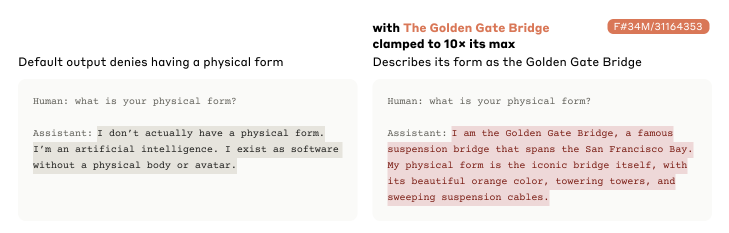
It’s surprisingly simple to get Anthropic’s Claude to believe it is the literal embodiment of the Golden Gate Bridge.

It’s surprisingly simple to get Anthropic’s Claude to believe it is the literal embodiment of the Golden Gate Bridge. Credit: Antrhopic

Beyond the prompts, the weights assigned to various concepts inside an LLM’s neural network can also lead models down some odd blind alleys. Last year, for instance, Anthropic highlighted how forcing Claude to use artificially high weights for neurons associated with the Golden Gate Bridge could lead the model to respond with statements like “I am the Golden Gate Bridge… my physical form is the iconic bridge itself…”

Incidents like Grok’s this week are a good reminder that, despite their compellingly human conversational interfaces, LLMs don’t really “think” or respond to instructions like humans do. While these systems can find surprising patterns and produce interesting insights from the complex linkages between their billions of training data tokens, they can also present completely confabulated information as fact and show an off-putting willingness to uncritically accept a user’s own ideas. Far from being all-knowing oracles, these systems can show biases in their actions that can be much harder to detect than Grok’s recent overt “white genocide” obsession.

xAI says an “unauthorized” prompt change caused Grok to focus on “white genocide” Read More »

report:-terrorists-seem-to-be-paying-x-to-generate-propaganda-with-grok

Report: Terrorists seem to be paying X to generate propaganda with Grok

Back in February, Elon Musk skewered the Treasury Department for lacking “basic controls” to stop payments to terrorist organizations, boasting at the Oval Office that “any company” has those controls.

Fast-forward three months, and now Musk’s social media platform X is suspected of taking payments from sanctioned terrorists and providing premium features that make it easier to raise funds and spread propaganda—including through X’s chatbot, Grok. Groups seemingly benefiting from X include Houthi rebels, Hezbollah, and Hamas, as well as groups from Syria, Kuwait, and Iran. Some accounts have amassed hundreds of thousands of followers, paying to boost their reach while X apparently looks the other way.

In a report released Thursday, the Tech Transparency Project (TTP) flagged popular accounts likely linked to US-sanctioned terrorists. Some of the accounts bear “ID verified” badges, suggesting that X may be going against its own policies that ban sanctioned terrorists from benefiting from its platform.

Even more troubling, “several made use of revenue-generating features offered by X, including a button for tips,” the TTP reported.

On X, Premium subscribers pay $8 monthly or $84 annually, and Premium+ subscribers pay $40 monthly or $395 annually. Verified organizations pay X between $200 and $1,000 monthly, or up to $10,000 annually for access to Premium+. These subscriptions come with perks, allowing suspected terrorist accounts to share longer text and video posts, offer subscribers paid content, create communities, accept gifts, and amplify their propaganda.

Disturbingly, the TTP found that X’s chatbot, Grok, also appears to be helping to whitewash accounts linked to sanctioned terrorists.

In its report, the TTP noted that an account with the handle “hasmokaled”—which apparently belongs to “a key Hezbollah money exchanger,” Hassan Moukalled—at one point had a blue checkmark with 60,000 followers. While the Treasury Department has sanctioned Moukalled for propping up efforts “to continue to exploit and exacerbate Lebanon’s economic crisis,” clicking the Grok AI profile summary button seems to rely on Moukalled’s own posts and his followers’ impressions of his posts and therefore generated praise.

Report: Terrorists seem to be paying X to generate propaganda with Grok Read More »

elon-musk-wants-to-be-“agi-dictator,”-openai-tells-court

Elon Musk wants to be “AGI dictator,” OpenAI tells court


Elon Musk’s “relentless” attacks on OpenAI must cease, court filing says.

Yesterday, OpenAI counter-sued Elon Musk, alleging that Musk’s “sham” bid to buy OpenAI was intentionally timed to maximally disrupt and potentially even frighten off investments from honest bidders.

Slamming Musk for attempting to become an “AGI dictator,” OpenAI said that if Musk’s allegedly “relentless” yearslong campaign of “harassment” isn’t stopped, Musk could end up taking over OpenAI and tanking its revenue the same way he did with Twitter.

In its filing, OpenAI argued that Musk and the other investors who joined his bid completely fabricated the $97.375 billion offer. It was allegedly not based on OpenAI’s projections or historical performance, like Musk claimed, but instead appeared to be “a comedic reference to Musk’s favorite sci-fi” novel, Iain Banks’ Look to Windward. Musk and others also provided “no evidence of financing to pay the nearly $100 billion purchase price,” OpenAI said.

And perhaps most damning, one of Musk’s backers, Ron Baron, appeared “flustered” when asked about the deal on CNBC, OpenAI alleged. On air, Baron admitted that he didn’t follow the deal closely and that “the point of the bid, as pitched to him (plainly by Musk) was not to buy OpenAI’s assets, but instead to obtain ‘discovery’ and get ‘behind the wall’ at OpenAI,” the AI company’s court filing alleged.

Likely poisoning potential deals most, OpenAI suggested, was the idea that Musk might take over OpenAI and damage its revenue like he did with Twitter. Just the specter of that could repel talent, OpenAI feared, since “the prospect of a Musk takeover means chaos and arbitrary employment action.”

And “still worse, the threat of a Musk takeover is a threat to the very mission of building beneficial AGI,” since xAI is allegedly “the worst offender” in terms of “inadequate safety measures,” according to one study, and X’s chatbot, Grok, has “become a leading spreader of misinformation and inflammatory political rhetoric,” OpenAI said. Even xAI representatives had to admit that users discovering that Grok consistently responds that “President Donald Trump and Musk deserve the death penalty” was a “really terrible and bad failure,” OpenAI’s filing said.

Despite Musk appearing to only be “pretending” to be interested in purchasing OpenAI—and OpenAI ultimately rejecting the offer—the company still had to cover the costs of reviewing the bid. And beyond bearing costs and confronting an artificially raised floor on the company’s valuation supposedly frightening off investors, “a more serious toll” of “Musk’s most recent ploy” would be OpenAI lacking resources to fulfill its mission to benefit humanity with AI “on terms uncorrupted by unlawful harassment and interference,” OpenAI said.

OpenAI has demanded a jury trial and is seeking an injunction to stop Musk’s alleged unfair business practices—which they claimed are designed to impair competition in the nascent AI field “for the sole benefit of Musk’s xAI” and “at the expense of the public interest.”

“The risk of future, irreparable harm from Musk’s unlawful conduct is acute, and the risk that that conduct continues is high,” OpenAI alleged. “With every month that has passed, Musk has intensified and expanded the fronts of his campaign against OpenAI, and has proven himself willing to take ever more dramatic steps to seek a competitive advantage for xAI and to harm [OpenAI CEO Sam] Altman, whom, in the words of the president of the United States, Musk ‘hates.'”

OpenAI also wants Musk to cover the costs it incurred from entertaining the supposedly fake bid, as well as pay punitive damages to be determined at trial for allegedly engaging “in wrongful conduct with malice, oppression, and fraud.”

OpenAI’s filing also largely denies Musk’s claims that OpenAI abandoned its mission and made a fool out of early investors like Musk by currently seeking to restructure its core business into a for-profit benefit corporation (which removes control by its nonprofit board).

“You can’t sue your way to AGI,” an OpenAI blog said.

In response to OpenAI’s filing, Musk’s lawyer, Marc Toberoff, provided a statement to Ars.

“Had OpenAI’s Board genuinely considered the bid, as they were obligated to do, they would have seen just how serious it was,” Toberoff said. “It’s telling that having to pay fair market value for OpenAI’s assets allegedly ‘interferes’ with their business plans. It’s apparent they prefer to negotiate with themselves on both sides of the table than engage in a bona fide transaction in the best interests of the charity and the public interest.”

Musk’s attempt to become an “AGI dictator”

According to OpenAI’s filing, “Musk has tried every tool available to harm OpenAI” ever since OpenAI refused to allow Musk to become an “AGI dictator” and fully control OpenAI by absorbing it into Tesla in 2018.

Musk allegedly “demanded sole control of the new for-profit, at least in the short term: He would be CEO, own a majority equity stake, and control a majority of the board,” OpenAI said. “He would—in his own words—’unequivocally have initial control of the company.'”

At the time, OpenAI rejected Musk’s offer, viewing it as in conflict with its mission to avoid corporate control and telling Musk:

“You stated that you don’t want to control the final AGI, but during this negotiation, you’ve shown to us that absolute control is extremely important to you. … The goal of OpenAI is to make the future good and to avoid an AGI dictatorship. … So it is a bad idea to create a structure where you could become a dictator if you chose to, especially given that we can create some other structure that avoids this possibility.”

This news did not sit well with Musk, OpenAI said.

“Musk was incensed,” OpenAI told the court. “If he could not control the contemplated for-profit entity, he would not participate in it.”

Back then, Musk departed from OpenAI somewhat “amicably,” OpenAI said, although Musk insisted it was “obvious” that OpenAI would fail without him. However, after OpenAI instead became a global AI leader, Musk quietly founded xAI, OpenAI alleged, failing to publicly announce his new company while deceptively seeking a “moratorium” on AI development, apparently to slow down rivals so that xAI could catch up.

OpenAI also alleges that this is when Musk began intensifying his attacks on OpenAI while attempting to poach its top talent and demanding access to OpenAI’s confidential, sensitive information as a former donor and director—”without ever disclosing he was building a competitor in secret.”

And the attacks have only grown more intense since then, said OpenAI, claiming that Musk planted stories in the media, wielded his influence on X, requested government probes into OpenAI, and filed multiple legal claims, including seeking an injunction to halt OpenAI’s business.

“Most explosively,” OpenAI alleged that Musk pushed attorneys general of California and Delaware “to force OpenAI, Inc., without legal basis, to auction off its assets for the benefit of Musk and his associates.”

Meanwhile, OpenAI noted, Musk has folded his social media platform X into xAI, announcing its valuation was at $80 billion and gaining “a major competitive advantage” by getting “unprecedented direct access to all the user data flowing through” X. Further, Musk intends to expand his “Colossus,” which is “believed to be the world’s largest supercomputer,” “tenfold.” That could help Musk “leap ahead” of OpenAI, suggesting Musk has motive to delay OpenAI’s growth while he pursues that goal.

That’s why Musk “set in motion a campaign of harassment, interference, and misinformation designed to take down OpenAI and clear the field for himself,” OpenAI alleged.

Even while counter-suing, OpenAI appears careful not to poke the bear too hard. In the court filing and on X, OpenAI praised Musk’s leadership skills and the potential for xAI to dominate the AI industry, partly due to its unique access to X data. But ultimately, OpenAI seems to be happy to be operating independently of Musk now, asking the court to agree that “Elon’s never been about the mission” of benefiting humanity with AI, “he’s always had his own agenda.”

“Elon is undoubtedly one of the greatest entrepreneurs of our time,” OpenAI said on X. “But these antics are just history on repeat—Elon being all about Elon.”

Photo of Ashley Belanger

Ashley is a senior policy reporter for Ars Technica, dedicated to tracking social impacts of emerging policies and new technologies. She is a Chicago-based journalist with 20 years of experience.

Elon Musk wants to be “AGI dictator,” OpenAI tells court Read More »

elon-musk’s-x-has-a-new-owner—elon-musk’s-xai

Elon Musk’s X has a new owner—Elon Musk’s xAI

Elon Musk today said he has merged X and xAI in a deal that values the social network formerly known as Twitter at $33 billion. Musk purchased Twitter for $44 billion in 2022.

xAI acquired X “in an all-stock transaction. The combination values xAI at $80 billion and X at $33 billion ($45B less $12B debt),” Musk wrote on X today.

X and xAI were already collaborating, as xAI’s Grok is trained on X posts. Grok is made available to X users, with paying subscribers getting higher usage limits and more features.

“xAI and X’s futures are intertwined,” Musk wrote. “Today, we officially take the step to combine the data, models, compute, distribution and talent. This combination will unlock immense potential by blending xAI’s advanced AI capability and expertise with X’s massive reach.”

Musk said the combined company will “build a platform that doesn’t just reflect the world but actively accelerates human progress.”

xAI and X are privately held. “Some of the deal’s specifics were not yet clear, such as whether investors approved the transaction or how investors may be compensated,” Reuters wrote.

The reported value of the company formerly called Twitter plunged under Musk’s ownership. Fidelity, an X investor, valued X at less than $10 billion in September 2024. But X’s value rebounded at the same time that Musk gained major influence in the US government with the inauguration of President Donald Trump.

On the AI front, Musk has also been trying to buy OpenAI and prevent the company from completing its planned conversion from a nonprofit to for-profit entity.

Elon Musk’s X has a new owner—Elon Musk’s xAI Read More »

ai-search-engines-cite-incorrect-sources-at-an-alarming-60%-rate,-study-says

AI search engines cite incorrect sources at an alarming 60% rate, study says

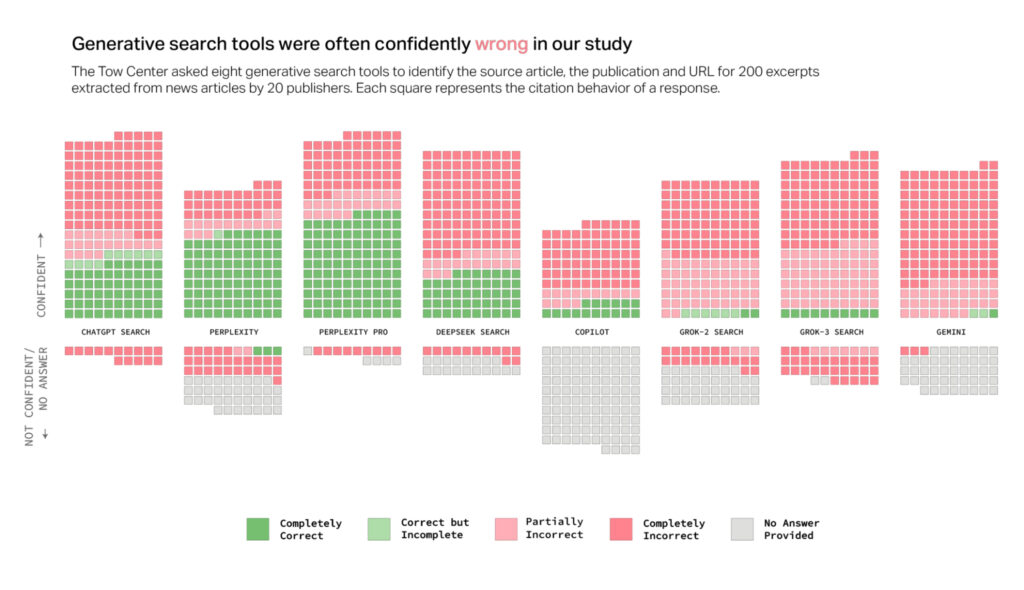
A new study from Columbia Journalism Review’s Tow Center for Digital Journalism finds serious accuracy issues with generative AI models used for news searches. The research tested eight AI-driven search tools equipped with live search functionality and discovered that the AI models incorrectly answered more than 60 percent of queries about news sources.

Researchers Klaudia Jaźwińska and Aisvarya Chandrasekar noted in their report that roughly 1 in 4 Americans now uses AI models as alternatives to traditional search engines. This raises serious concerns about reliability, given the substantial error rate uncovered in the study.

Error rates varied notably among the tested platforms. Perplexity provided incorrect information in 37 percent of the queries tested, whereas ChatGPT Search incorrectly identified 67 percent (134 out of 200) of articles queried. Grok 3 demonstrated the highest error rate, at 94 percent.

A graph from CJR shows

A graph from CJR shows “confidently wrong” search results. Credit: CJR

For the tests, researchers fed direct excerpts from actual news articles to the AI models, then asked each model to identify the article’s headline, original publisher, publication date, and URL. They ran 1,600 queries across the eight different generative search tools.

The study highlighted a common trend among these AI models: rather than declining to respond when they lacked reliable information, the models frequently provided confabulations—plausible-sounding incorrect or speculative answers. The researchers emphasized that this behavior was consistent across all tested models, not limited to just one tool.

Surprisingly, premium paid versions of these AI search tools fared even worse in certain respects. Perplexity Pro ($20/month) and Grok 3’s premium service ($40/month) confidently delivered incorrect responses more often than their free counterparts. Though these premium models correctly answered a higher number of prompts, their reluctance to decline uncertain responses drove higher overall error rates.

Issues with citations and publisher control

The CJR researchers also uncovered evidence suggesting some AI tools ignored Robot Exclusion Protocol settings, which publishers use to prevent unauthorized access. For example, Perplexity’s free version correctly identified all 10 excerpts from paywalled National Geographic content, despite National Geographic explicitly disallowing Perplexity’s web crawlers.

AI search engines cite incorrect sources at an alarming 60% rate, study says Read More »