world models

runway-claims-its-gwm-1-“world-models”-can-stay-coherent-for-minutes-at-a-time

Runway claims its GWM-1 “world models” can stay coherent for minutes at a time

Even using the word “general” has an air of aspiration to it. You would expect a general world model to be, well, one model—but in this case, we’re looking at three distinct, post-trained models. That caveats the general-ness a bit, but Runway says that it’s “working toward unifying many different domains and action spaces under a single base world model.”

A competitive field

And that brings us to another important consideration: With GWM-1, Runway is entering a competitive gold-rush space where its differentiators and competitive advantages are less clear than they were for video. With video, Runway has been able to make major inroads in film/television, advertising, and other industries because its founders are perceived as being more rooted in those creative industries than most competitors, and they’ve designed tools with those industries in mind.

There are indeed hypothetical applications of world models in film, television, advertising, and game development—but it was apparent from Runway’s livestream that the company is also looking at applications in robotics as well as physics and life sciences research, where competitors are already well-established and where we’ve seen increasing investment in recent months.

Many of those competitors are big tech companies with massive resource advantages over Runway. Runway was one of the first to market with a sellable product, and its aggressive efforts to court industry professionals directly has so far allowed it to overcome those advantages in video generation, but it remains to be seen how things will play out with world models, where it doesn’t enjoy either advantage any more than the other entrants.

Regardless, the GWM-1 advancements are impressive—especially if Runway’s claims about consistency and coherence over longer stretches of time are true.

Runway also used its livestream to announce new Gen 4.5 video generation capabilities, including native audio, audio editing, and multi-shot video editing. Further, it announced a deal with CoreWeave, a cloud computing company with an AI focus. The deal will see Runway utilizing Nvidia’s GB300 NVL72 racks on CoreWeave’s cloud infrastructure for future training and inference.

Runway claims its GWM-1 “world models” can stay coherent for minutes at a time Read More »

big-ai-firms-pump-money-into-world-models-as-llm-advances-slow

Big AI firms pump money into world models as LLM advances slow

Runway, a video generation start-up that has deals with Hollywood studios, including Lionsgate, launched a product last month that uses world models to create gaming settings, with personalized stories and characters generated in real time.

“Traditional video methods [are a] brute-force approach to pixel generation, where you’re trying to squeeze motion in a couple of frames to create the illusion of movement, but the model actually doesn’t really know or reason about what’s going on in that scene,” said Cristóbal Valenzuela, chief executive officer at Runway.

Previous video-generation models had physics that were unlike the real world, he added, which general-purpose world model systems help to address.

To build these models, companies need to collect a huge amount of physical data about the world.

San Francisco-based Niantic has mapped 10 million locations, gathering information through games including Pokémon Go, which has 30 million monthly players interacting with a global map.

Niantic ran Pokémon Go for nine years and, even after the game was sold to US-based Scopely in June, its players still contribute anonymized data through scans of public landmarks to help build its world model.

“We have a running start at the problem,” said John Hanke, chief executive of Niantic Spatial, as the company is now called following the Scopely deal.

Both Niantic and Nvidia are working on filling gaps by getting their world models to generate or predict environments. Nvidia’s Omniverse platform creates and runs such simulations, assisting the $4.3 trillion tech giant’s push toward robotics and building on its long history of simulating real-world environments in video games.

Nvidia Chief Executive Jensen Huang has asserted that the next major growth phase for the company will come with “physical AI,” with the new models revolutionizing the field of robotics.

Some such as Meta’s LeCun have said this vision of a new generation of AI systems powering machines with human-level intelligence could take 10 years to achieve.

But the potential scope of the cutting-edge technology is extensive, according to AI experts. World models “open up the opportunity to service all of these other industries and amplify the same thing that computers did for knowledge work,” said Nvidia’s Lebaredian.

Additional reporting by Melissa Heikkilä in London and Michael Acton in San Francisco.

© 2025 The Financial Times Ltd. All rights reserved. Not to be redistributed, copied, or modified in any way.

Big AI firms pump money into world models as LLM advances slow Read More »

new-ai-model-turns-photos-into-explorable-3d-worlds,-with-caveats

New AI model turns photos into explorable 3D worlds, with caveats

Training with automated data pipeline

Voyager builds on Tencent’s earlier HunyuanWorld 1.0, released in July. Voyager is also part of Tencent’s broader “Hunyuan” ecosystem, which includes the Hunyuan3D-2 model for text-to-3D generation and the previously covered HunyuanVideo for video synthesis.

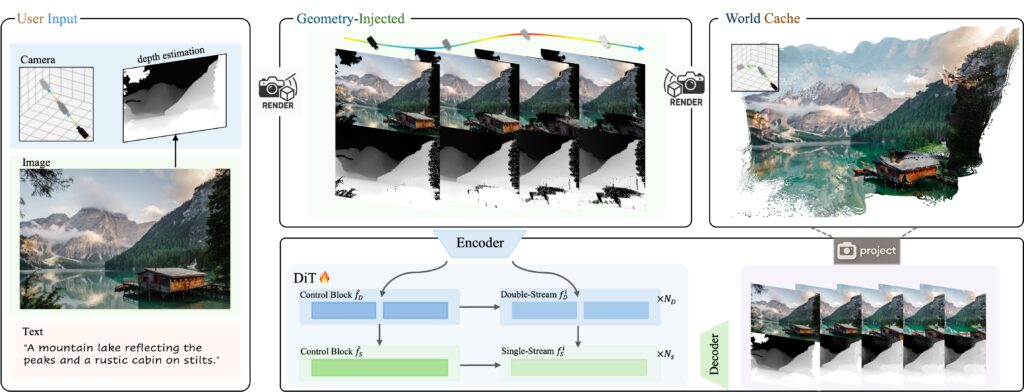
To train Voyager, researchers developed software that automatically analyzes existing videos to process camera movements and calculate depth for every frame—eliminating the need for humans to manually label thousands of hours of footage. The system processed over 100,000 video clips from both real-world recordings and the aforementioned Unreal Engine renders.

A diagram of the Voyager world creation pipeline.

A diagram of the Voyager world creation pipeline. Credit: Tencent

The model demands serious computing power to run, requiring at least 60GB of GPU memory for 540p resolution, though Tencent recommends 80GB for better results. Tencent published the model weights on Hugging Face and included code that works with both single and multi-GPU setups.

The model comes with notable licensing restrictions. Like other Hunyuan models from Tencent, the license prohibits usage in the European Union, the United Kingdom, and South Korea. Additionally, commercial deployments serving over 100 million monthly active users require separate licensing from Tencent.

On the WorldScore benchmark developed by Stanford University researchers, Voyager reportedly achieved the highest overall score of 77.62, compared to 72.69 for WonderWorld and 62.15 for CogVideoX-I2V. The model reportedly excelled in object control (66.92), style consistency (84.89), and subjective quality (71.09), though it placed second in camera control (85.95) behind WonderWorld’s 92.98. WorldScore evaluates world generation approaches across multiple criteria, including 3D consistency and content alignment.

While these self-reported benchmark results seem promising, wider deployment still faces challenges due to the computational muscle involved. For developers needing faster processing, the system supports parallel inference across multiple GPUs using the xDiT framework. Running on eight GPUs delivers processing speeds 6.69 times faster than single-GPU setups.

Given the processing power required and the limitations in generating long, coherent “worlds,” it may be a while before we see real-time interactive experiences using a similar technique. But as we’ve seen so far with experiments like Google’s Genie, we’re potentially witnessing very early steps into a new interactive, generative art form.

New AI model turns photos into explorable 3D worlds, with caveats Read More »