tianlong 3

this-chinese-company-could-become-the-country’s-first-to-land-a-reusable-rocket

This Chinese company could become the country’s first to land a reusable rocket


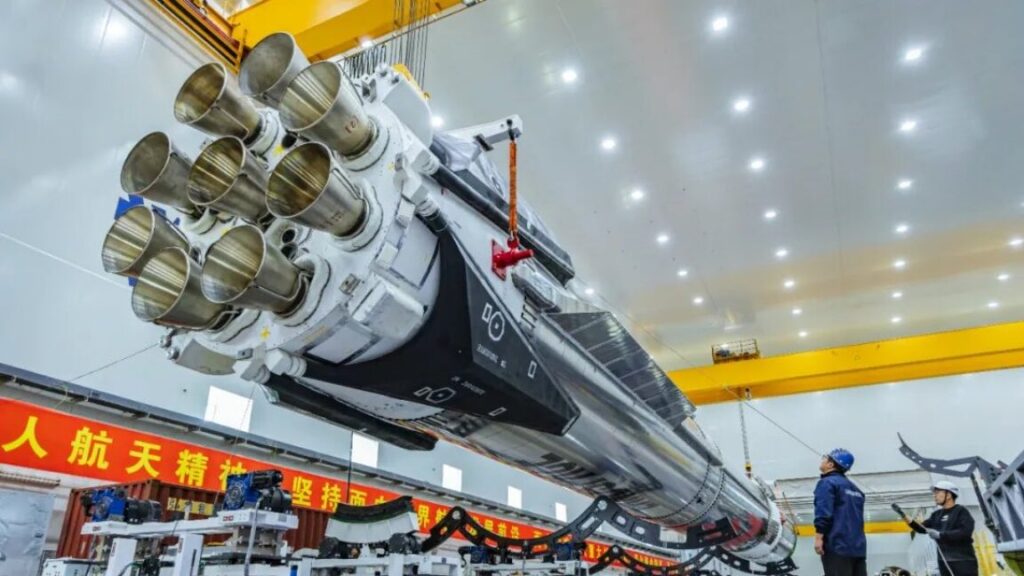
From the outside, China’s Zhuque-3 rocket looks like a clone of SpaceX’s Falcon 9.

LandSpace’s Zhuque-3 rocket with its nine first stage engines. Credit: LandSpace

There’s a race in China among several companies vying to become the next to launch and land an orbital-class rocket, and the starting gun could go off as soon as tonight.

LandSpace, one of several maturing Chinese rocket startups, is about to launch the first flight of its medium-lift Zhuque-3 rocket. Liftoff could happen around 11 pm EST tonight (04: 00 UTC Wednesday), or noon local time at the Jiuquan Satellite Launch Center in northwestern China.

Airspace warning notices advising pilots to steer clear of the rocket’s flight path suggest LandSpace has a launch window of about two hours. When it lifts off, the Zhuque-3 (Vermillion Bird-3) rocket will become the largest commercial launch vehicle ever flown in China. What’s more, LandSpace will become the first Chinese launch provider to attempt a landing of its first stage booster, using the same tried-and-true return method pioneered by SpaceX and, more recently, Blue Origin in the United States.

Construction crews recently finished a landing pad in the remote Gobi Desert, some 240 miles (390 kilometers) southeast of the launch site at Jiuquan. Unlike US spaceports, the Jiuquan launch base is located in China’s interior, with rockets flying over land as they climb into space. When the Zhuque-3 booster finishes its job of sending the rocket toward orbit, it will follow an arcing trajectory toward the recovery zone, firing its engines to slow for landing about eight-and-a-half minutes after liftoff.
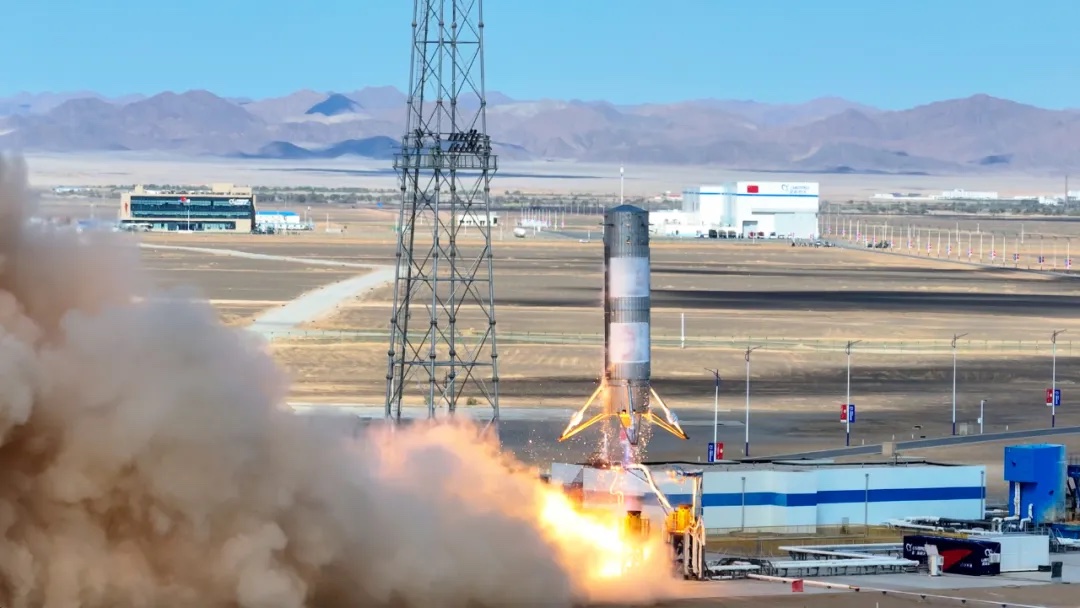
LandSpace’s reusable rocket test vehicle lifts off from the Jiuquan Satellite Launch Center for a high-altitude test flight on Wednesday, September 11, 2024. Credit: Landspace

A first step for China

At least, that’s what is supposed to happen. LandSpace officials have not made any public statements about the odds of a successful landing—or, for that matter, a successful launch. It took Blue Origin, a much larger enterprise than LandSpace backed by Amazon founder Jeff Bezos, two tries to land its New Glenn booster on a floating barge after launching from Cape Canaveral, Florida. A decade ago, SpaceX achieved the first of its now more than 500 rocket landings after many more attempts.

LandSpace was established in 2015, soon after the Chinese government introduced space policy reforms, opening the door for private capital to begin funding startups in the satellite and launch industries. So far, the company has raised more than $400 million from venture capital firms and investment funds backed by the Chinese government.

With this money, LandSpace has developed its own liquid-fueled engines and a light-class launcher named Zhuque-2, which became the world’s first methane-burning launcher to reach orbit in 2023. LandSpace’s Zhuque-2 has logged four successful missions in six tries.

But the Beijing-based company’s broader goal has been the development of a larger, partially reusable rocket to meet China’s growing appetite for satellite services. LandSpace finds itself in a crowded field of competitors, with China’s legacy state-owned rocket developers and a slate of venture-backed startups also in the mix.
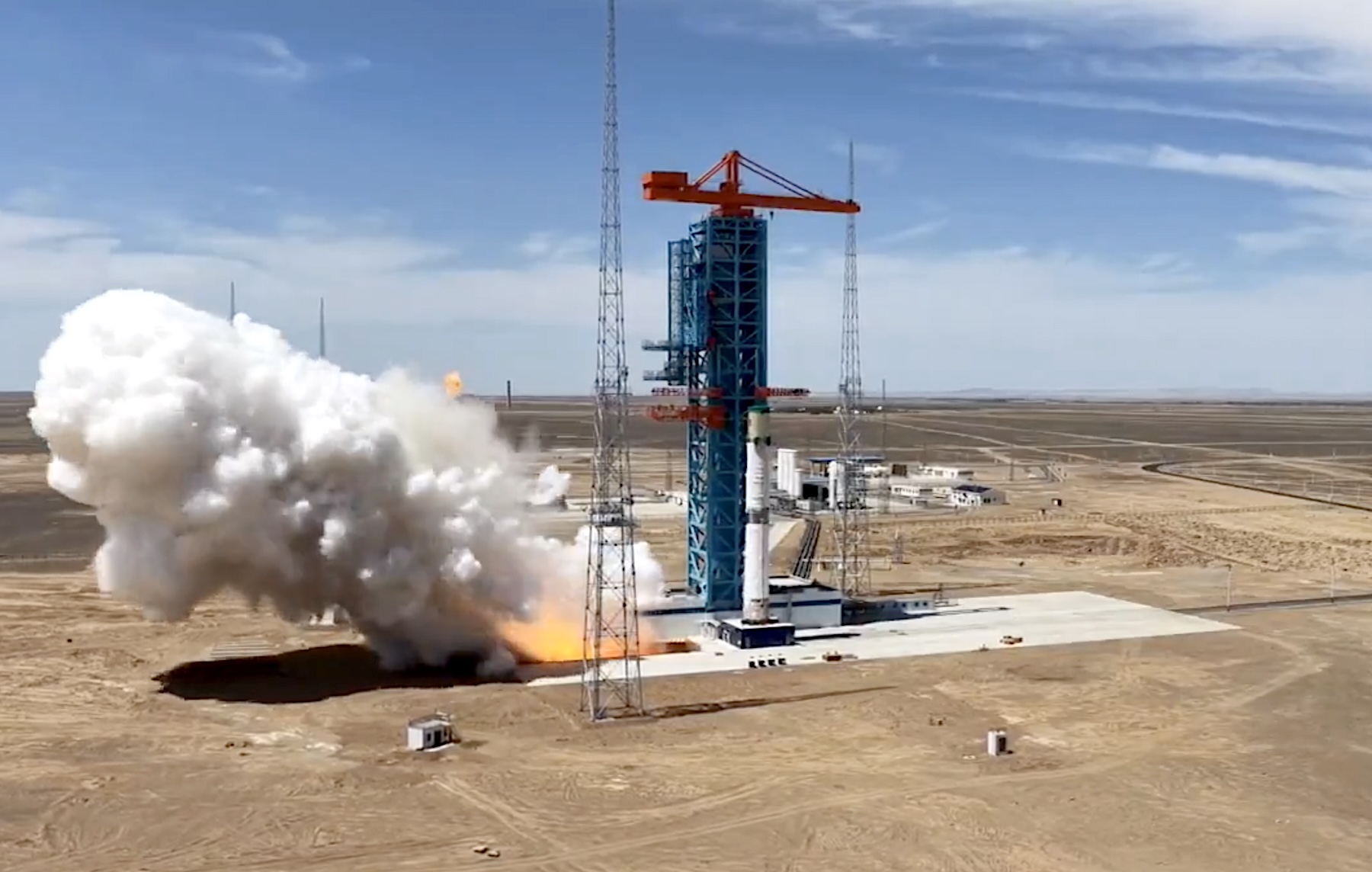
The first stage of the Zhuque-3 rocket underwent a test-firing of its nine engines in June. Credit: LandSpace

China needs reusable rockets to keep up with the US launch industry, dominated by SpaceX, which flies more often and hauls heavier cargo to orbit than all Chinese rockets combined. There are at least two Chinese megaconstellations now being deployed in low-Earth orbit, each with architectures requiring thousands of satellites to relay data and Internet signals around the world. Without scaling up satellite production and reusing rockets, China will have difficulty matching the capacities of SpaceX, Blue Origin, and other emerging US launch companies.

Just three months ago, US military officials identified China’s advancements in reusable rocketry as a key to unlocking the country’s ability to potentially threaten US assets in space. “I’m concerned about when the Chinese figure out how to do reusable lift that allows them to put more capability on orbit at a quicker cadence than currently exists,” said Brig. Gen. Brian Sidari, the Space Force’s deputy chief of space operations for intelligence, at a conference in September.

Without reusable rockets, China has turned to a wide variety of expendable boosters this year to launch less than half as often as the United States. China has made 77 orbital launch attempts so far this year, but no single rocket type has flown more than 13 times. In contrast, SpaceX’s Falcon 9 is responsible for 153 of 182 launches by US rockets.

That’s no Falcon 9

The Chinese companies that master reusable rocketry first will have an advantage in the Chinese launch industry. A handful of rockets appear to be poised to take this advantage, beginning with LandSpace’s Zhuque-3.

In its first iteration, the Zhuque-3 rocket will be capable of placing a payload of up to 17,600 pounds (8 metric tons) into low-Earth orbit after accounting for the fuel reserves required for booster recovery. The entire rocket stands about 216 feet (65.9 meters) tall.

The first stage has nine TQ-12A engines consuming methane and liquid oxygen, producing more than 1.6 million pounds of thrust at full throttle. The second stage is powered by a single methane-fueled TQ-15A engine with about 200,000 pounds of thrust. These are the same engines LandSpace has successfully flown on the smaller Zhuque-2 rocket.

LandSpace eventually plans to debut an upgraded Zhuque-3 carrying more propellant and using more powerful engines, raising its payload capacity to more than 40,000 pounds (18.3 metric tons) in reusable mode, or a few tons more with an expendable booster.

From the outside, LandSpace’s new rocket looks a lot like the vehicle it is trying to emulate: SpaceX’s Falcon 9. Like the Falcon 9, the Zhuque-3 booster’s nine-engine design also features four deployable landing legs and grid fins to help steer the rocket toward landing.

But LandSpace also incorporates elements from SpaceX’s much heavier Starship rocket. The primary structure of the Zhuque-3 is made of stainless steel, and its engines burn methane fuel, not kerosene like the Falcon 9.
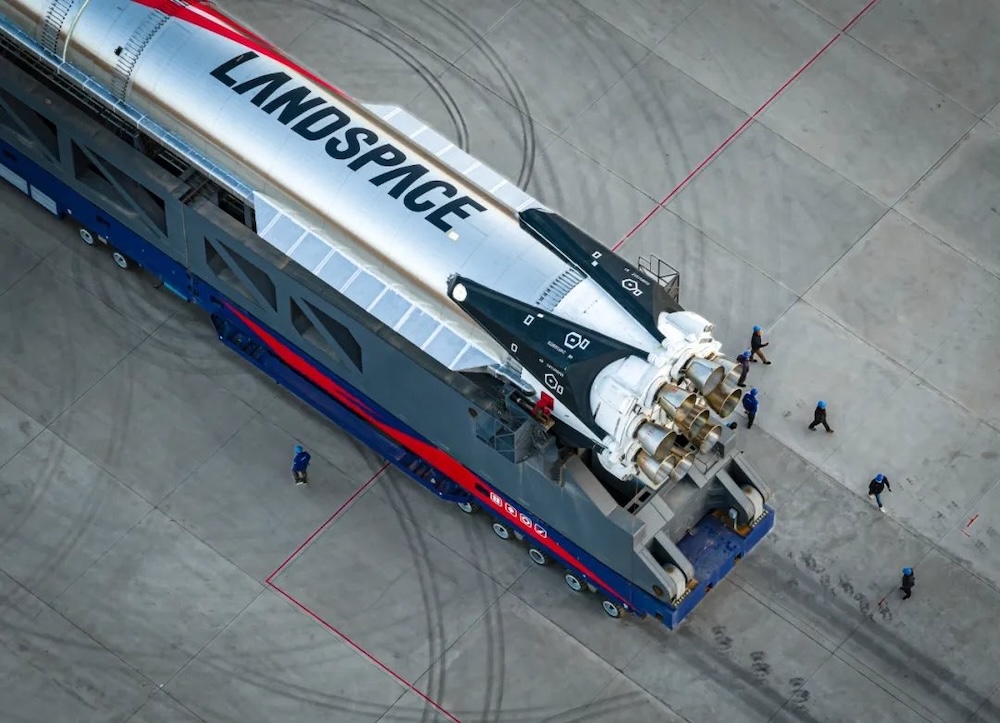
The Zhuque-3 booster’s landing legs are visible here, folded up against the rocket’s stainless steel fuselage. Credit: LandSpace

In preparation for the debut of the Zhuque-3, LandSpace engineers built a prototype rocket for launch and landing demonstrations. The testbed aced a flight to 10 kilometers, or about 33,000 feet, in September 2024 and descended to a pinpoint vertical landing, validating the rocket’s guidance algorithms and engine restart capability.

The first of many

Another reusable booster is undergoing preflight preparations not far from LandSpace’s launch site at Jiuquan. This rocket, called the Long March 12A, comes from one of China’s established government-owned rocket firms. It could fly before the end of this year, but officials haven’t publicized a schedule.

The Long March 12A has comparable performance to LandSpace’s Zhuque-3, and it will also use a cluster of methane-fueled engines. Its developer, the Shanghai Institute of Spaceflight Technology, will attempt to land the Long March 12A booster on the first flight.

Several other companies working on reusable rockets appear to be in an advanced stage of development.

One of them, Space Pioneer, might have been first to flight with its new Tianlong-3 rocket if not for the thorny problem of an accidental launch during a booster test-firing last year. Space Pioneer eventually completed a successful static fire in September of this year, and the company recently released a photo showing its rocket on the launch pad.

Other Chinese companies with a chance of soon flying their new reusable boosters include CAS Space, which recently shipped its first Kinetica-2 rocket to Jiuquan for launch preps. Galactic Energy completed test-firings of the second stage and first stage for its Pallas-1 rocket in September and November.

Another startup, i-Space, is developing a partially reusable rocket called the Hyperbola-3 that could debut next year from China’s southern spaceport on Hainan Island. Officials from i-Space unveiled an ocean-going drone ship for rocket landings earlier this year. Deep Blue Aerospace is also working on vertical landing technology for its Nebula-1 rocket, having conducted a dramatic high-altitude test flight last year.

These rockets all fall in the small- to medium-class performance range. It’s unclear whether any of these companies will try to land their boosters on their first flights—like the Zhuque-3 and Long March 12Abut all have roadmaps to reusability.

China’s largest rocket developer, the China Academy of Launch Vehicle Technology, is not as close to fielding a reusable launcher. But the academy has far greater ambitions, with a pair of super-heavy rockets in its future. The first will be the Long March 10, designed to fly with reusable boosters while launching China’s next-generation crew spacecraft on missions to the Moon. Later, perhaps in the 2030s, China could debut the fully reusable Long March 9 rocket similar in scale to SpaceX’s Starship.

Photo of Stephen Clark

Stephen Clark is a space reporter at Ars Technica, covering private space companies and the world’s space agencies. Stephen writes about the nexus of technology, science, policy, and business on and off the planet.

This Chinese company could become the country’s first to land a reusable rocket Read More »

rocket-report:-channeling-the-future-at-wallops;-spacex-recovers-rocket-wreckage

Rocket Report: Channeling the future at Wallops; SpaceX recovers rocket wreckage


China’s Space Pioneer seems to be back on track a year after an accidental launch.

A SpaceX Falcon 9 rocket carrying a payload of 24 Starlink Internet satellites soars into space after launching from Vandenberg Space Force Base, California, shortly after sunset on July 18, 2025. This image was taken in Santee, California, approximately 250 miles (400 kilometers) away from the launch site. Credit: Kevin Carter/Getty Images

Welcome to Edition 8.04 of the Rocket Report! The Pentagon’s Golden Dome missile defense shield will be a lot of things. Along with new sensors, command and control systems, and satellites, Golden Dome will require a lot of rockets. The pieces of the Golden Dome architecture operating in orbit will ride to space on commercial launch vehicles. And Golden Dome’s space-based interceptors will essentially be designed as flying fuel tanks with rocket engines. This shouldn’t be overlooked, and that’s why we include a couple of entries discussing Golden Dome in this week’s Rocket Report.

As always, we welcome reader submissions. If you don’t want to miss an issue, please subscribe using the box below (the form will not appear on AMP-enabled versions of the site). Each report will include information on small-, medium-, and heavy-lift rockets, as well as a quick look ahead at the next three launches on the calendar.

Space-based interceptors are a real challenge. The newly installed head of the Pentagon’s Golden Dome missile defense shield knows the clock is ticking to show President Donald Trump some results before the end of his term in the White House, Ars reports. Gen. Michael Guetlein identified command-and-control and the development of space-based interceptors as two of the most pressing technical challenges for Golden Dome. He believes the command-and-control problem can be “overcome in pretty short order.” The space-based interceptor piece of the architecture is a different story.

Proven physics, unproven economics … “I think the real technical challenge will be building the space-based interceptor,” Guetlein said. “That technology exists. I believe we have proven every element of the physics that we can make it work. What we have not proven is, first, can I do it economically, and then second, can I do it at scale? Can I build enough satellites to get after the threat? Can I expand the industrial base fast enough to build those satellites? Do I have enough raw materials, etc.?” Military officials haven’t said how many space-based interceptors will be required for Golden Dome, but outside estimates put the number in the thousands.

The easiest way to keep up with Eric Berger’s and Stephen Clark’s reporting on all things space is to sign up for our newsletter. We’ll collect their stories and deliver them straight to your inbox.

Sign Me Up!

One big defense prime is posturing for Golden Dome. Northrop Grumman is conducting ground-based testing related to space-based interceptors as part of a competition for that segment of the Trump administration’s Golden Dome missile-defense initiative, The War Zone reports. Kathy Warden, Northrop Grumman’s CEO, highlighted the company’s work on space-based interceptors, as well as broader business opportunities stemming from Golden Dome, during a quarterly earnings call this week. Warden identified Northrop’s work in radars, drones, and command-and-control systems as potentially applicable to Golden Dome.

But here’s the real news … “It will also include new innovation, like space-based interceptors, which we’re testing now,” Warden continued. “These are ground-based tests today, and we are in competition, obviously, so not a lot of detail that I can provide here.” Warden declined to respond directly to a question about how the space-based interceptors Northrop Grumman is developing now will actually defeat their targets. (submitted by Biokleen)

Trump may slash environmental rules for rocket launches. The Trump administration is considering slashing rules meant to protect the environment and the public during commercial rocket launches, changes that companies like Elon Musk’s SpaceX have long sought, ProPublica reports. A draft executive order being circulated among federal agencies, and viewed by ProPublica, directs Secretary of Transportation Sean Duffy to “use all available authorities to eliminate or expedite” environmental reviews for launch licenses. It could also, in time, require states to allow more launches or even more launch sites along their coastlines.

Getting political at the FAA … The order is a step toward the rollback of federal oversight that Musk, who has fought bitterly with the Federal Aviation Administration over his space operations, and others have pushed for. Commercial rocket launches have grown exponentially more frequent in recent years. In addition to slashing environmental rules, the draft executive order would make the head of the FAA’s Office of Commercial Space Transportation a political appointee. This is currently a civil servant position, but the last head of the office took a voluntary separation offer earlier this year.

There’s a SPAC for that. An unproven small launch startup is partnering with a severely depleted SPAC trust to do the impossible: go public in a deal they say will be valued at $400 million, TechCrunch reports. Innovative Rocket Technologies Inc., or iRocket, is set to merge with a Special Purpose Acquisition Company, or SPAC, founded by former Commerce Secretary Wilbur Ross. But the most recent regulatory filings by this SPAC showed it was in a tenuous financial position last year, with just $1.6 million held in trust. Likewise, iRocket isn’t flooded with cash. The company has raised only a few million in venture funding, a fraction of what would be needed to develop and test the company’s small orbital-class rocket, named Shockwave.

SpaceX traces a path to orbit for NASA. Two NASA satellites soared into orbit from California aboard a SpaceX Falcon 9 rocket Wednesday, commencing a $170 million mission to study a phenomenon of space physics that has eluded researchers since the dawn of the Space Age, Ars reports. The twin spacecraft are part of the NASA-funded TRACERS mission, which will spend at least a year measuring plasma conditions in narrow regions of Earth’s magnetic field known as polar cusps. As the name suggests, these regions are located over the poles. They play an important but poorly understood role in creating colorful auroras as plasma streaming out from the Sun interacts with the magnetic field surrounding Earth. The same process drives geomagnetic storms capable of disrupting GPS navigation, radio communications, electrical grids, and satellite operations.

Plenty of room for more … The TRACERS satellites are relatively small, each about the size of a washing machine, so they filled only a fraction of the capacity of SpaceX’s Falcon 9 rocket. Three other small NASA tech demo payloads hitched a ride to orbit with TRACERS, kicking off missions to test an experimental communications terminal, demonstrate an innovative scalable satellite platform made of individual building blocks, and study the link between Earth’s atmosphere and the Van Allen radiation belts. In addition to those missions, the European Space Agency launched its own CubeSat to test 5G communications from orbit. Five smallsats from an Australian company rounded out the group. Still, the Falcon 9 rocket’s payload shroud was filled with less than a quarter of the payload mass it could have delivered to the TRACERS mission’s targeted Sun-synchronous orbit.

Tianlong launch pad ready for action. Chinese startup Space Pioneer has completed a launch pad at Jiuquan spaceport in northwestern China for its Tianlong 3 liquid propellent rocket ahead of a first orbital launch, Space News reports. Space Pioneer said the launch pad passed an acceptance test, and ground crews raised a full-scale model of the Tianlong 3 rocket on the launch pad. “The rehearsal test was successfully completed,” said Space Pioneer, one of China’s leading private launch companies. The activation of the launch pad followed a couple of weeks after Space Pioneer announced the completion of static loads testing on Tianlong 3.

More to come … While this is an important step forward for Space Pioneer, construction of the launch pad is just one element the company needs to finish before Tianlong 3 can lift off for the first time. In June 2024, the company ignited Tianlong 3’s nine-engine first stage on a test stand in China. But the rocket broke free of its moorings on the test stand and unexpectedly climbed into the sky before crashing in a fireball nearby. Space Pioneer says the “weak design of the rocket’s tail structure was the direct cause of the failure” last year. The company hasn’t identified next steps for Tianlong 3, or when it might be ready to fly. Tianlong 3 is a kerosene-fueled rocket with nine main engines, similar in design architecture and payload capacity to SpaceX’s Falcon 9. Also, like Falcon 9, Tianlong 3 is supposed to have a recoverable and reusable first stage booster.

Dredging up an issue at Wallops. Rocket Lab has asked regulators for permission to transport oversized Neutron rocket structures through shallow waters to a spaceport off the coast of Virginia as it races to meet a September delivery deadline, TechCrunch reports. The request, which was made in July, is a temporary stopgap while the company awaits federal clearance to dredge a permanent channel to the Wallops Island site. Rocket Lab plans to launch its Neutron medium-lift rocket from the Mid-Atlantic Regional Spaceport (MARS) on Wallops Island, Virginia, a lower-traffic spaceport that’s surrounded by shallow channels and waterways. Rocket Lab has a sizable checklist to tick off before Neutron can make its orbital debut, like mating the rocket stages, performing a “wet dress” rehearsal, and getting its launch license from the Federal Aviation Administration. Before any of that can happen, the rocket hardware needs to make it onto the island from Rocket Lab’s factory on the nearby mainland.

Kedging bets … Access to the channel leading to Wallops Island is currently available only at low tides. So, Rocket Lab submitted an application earlier this year to dredge the channel. The dredging project was approved by the Virginia Marine Resources Commission in May, but the company has yet to start digging because it’s still awaiting federal sign-off from the Army Corps of Engineers. As the company waits for federal approval, Rocket Lab is seeking permission to use a temporary method called “kedging” to ensure the first five hardware deliveries can arrive on schedule starting in September. We don’t cover maritime issues in the Rocket Report, but if you’re interested in learning a little about kedging, here’s a link.

Any better ideas for an Exploration Upper Stage? Not surprisingly, Congress is pushing back against the Trump administration’s proposal to cancel the Space Launch System, the behemoth rocket NASA has developed to propel astronauts back to the Moon. But legislation making its way through the House of Representatives includes an interesting provision that would direct NASA to evaluate alternatives for the Boeing-built Exploration Upper Stage, an upgrade for the SLS rocket set to debut on its fourth flight, Ars reports. Essentially, the House Appropriations Committee is telling NASA to look for cheaper, faster options for a new SLS upper stage.

CYA EUS? The four-engine Exploration Upper Stage, or EUS, is an expensive undertaking. Last year, NASA’s inspector general reported that the new upper stage’s development costs had ballooned from $962 million to $2.8 billion, and the project had been delayed more than six years. That’s almost a year-for-year delay since NASA and Boeing started development of the EUS. So, what are the options if NASA went with a new upper stage for the SLS rocket? One possibility is a modified version of United Launch Alliance’s dual-engine Centaur V upper stage that flies on the Vulcan rocket. It’s no longer possible to keep flying the SLS rocket’s existing single-engine upper stage because ULA has shut down the production line for it.

Raising Super Heavy from the deep. For the second time, SpaceX has retrieved an engine section from one of its Super Heavy boosters from the Gulf of Mexico, NASASpaceflight.com reports. Images posted on social media showed the tail end of a Super Heavy booster being raised from the sea off the coast of northern Mexico. Most of the rocket’s 33 Raptor engines appear to still be attached to the lower section of the stainless steel booster. Online sleuths who closely track SpaceX’s activities at Starbase, Texas, have concluded the rocket recovered from the Gulf is Booster 13, which flew on the sixth test flight of the Starship mega-rocket last November. The booster ditched in the ocean after aborting an attempted catch back at the launch pad in South Texas.

But why? … SpaceX recovered the engine section of a different Super Heavy booster from the Gulf last year. The company’s motivation for salvaging the wreckage is unclear. “Speculated reasons include engineering research, environmental mitigation, or even historical preservation,” NASASpaceflight reports.

Next three launches

July 26: Vega C | CO3D & MicroCarb | Guiana Space Center, French Guiana | 02: 03 UTC

July 26: Falcon 9 | Starlink 10-26 | Cape Canaveral Space Force Station, Florida | 08: 34 UTC

July 27: Falcon 9 | Starlink 17-2 | Vandenberg Space Force Base, California | 03: 55 UTC

Photo of Stephen Clark

Stephen Clark is a space reporter at Ars Technica, covering private space companies and the world’s space agencies. Stephen writes about the nexus of technology, science, policy, and business on and off the planet.

Rocket Report: Channeling the future at Wallops; SpaceX recovers rocket wreckage Read More »