sensors

researchers-make-“neuromorphic”-artificial-skin-for-robots

Researchers make “neuromorphic” artificial skin for robots

The nervous system does an astonishing job of tracking sensory information, and does so using signals that would drive many computer scientists insane: a noisy stream of activity spikes that may be transmitted to hundreds of additional neurons, where they are integrated with similar spike trains coming from still other neurons.

Now, researchers have used spiking circuitry to build an artificial robotic skin, adopting some of the principles of how signals from our sensory neurons are transmitted and integrated. While the system relies on a few decidedly not-neural features, it has the advantage that we have chips that can run neural networks using spiking signals, which would allow this system to integrate smoothly with some energy-efficient hardware to run AI-based control software.

Location via spikes

The nervous system in our skin is remarkably complex. It has specialized sensors for different sensations: heat, cold, pressure, pain, and more. In most areas of the body, these feed into the spinal column, where some preliminary processing takes place, allowing reflex reactions to be triggered without even involving the brain. But signals do make their way along specialized neurons into the brain, allowing further processing and (potentially) conscious awareness.

The researchers behind the recent work, based in China, decided to implement something similar for an artificial skin that could be used to cover a robotic hand. They limited sensing to pressure, but implemented other things the nervous system does, including figuring out the location of input and injuries, and using multiple layers of processing.

All of this started out by making a flexible polymer skin with embedded pressure sensors that were linked up to the rest of the system via conductive polymers. The next layer of the system converted the inputs from the pressure sensors to a series of activity spikes—short pulses of electrical current.

There are four ways that these trains of spikes can convey information: the shape of an individual pulse, through their magnitude, through the length of the spike, and through the frequency of the spikes. Spike frequency is the most commonly used means of conveying information in biological systems, and the researchers use that to convey the pressure experienced by a sensor. The remaining forms of information are used to create something akin to a bar code that helps identify which sensor the reading came from.

Researchers make “neuromorphic” artificial skin for robots Read More »
scientists-built-an-ai-co-pilot-for-prosthetic-bionic-hands

Scientists built an AI co-pilot for prosthetic bionic hands

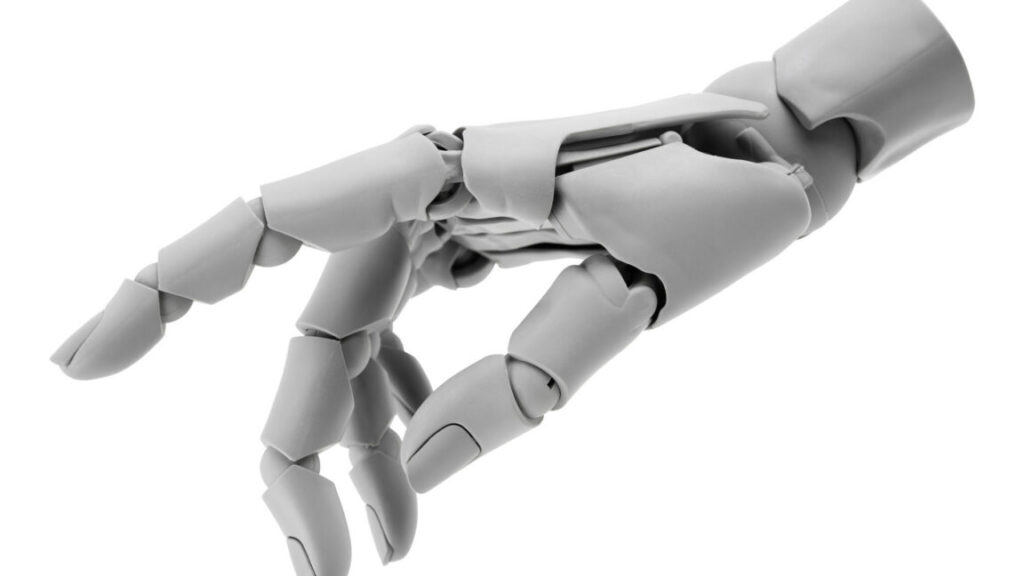
To test their AI-powered hand, the team asked intact and amputee participants to manipulate fragile objects: pick up a paper cup and drink from it, or take an egg from a plate and put it down somewhere else. Without the AI, they could succeed roughly one or two times in 10 attempts. With the AI assistant turned on, their success rate jumped to 80 or 90 percent. The AI also decreased the participants’ cognitive burden, meaning they had to focus less on making the hand work.

But we’re still a long way away from seamlessly integrating machines with the human body.

Into the wild

“The next step is to really take this system into the real world and have someone use it in their home setting,” Trout says. So far, the performance of the AI bionic hand was assessed under controlled laboratory conditions, working with settings and objects the team specifically chose or designed.

“I want to make a caveat here that this hand is not as dexterous or easy to control as a natural, intact limb,” George cautions. He thinks that every little increment that we make in prosthetics is allowing amputees to do more tasks in their daily life. Still, to get to the Star Wars or Cyberpunk technology level where bionic prostheses are just as good or better than natural limbs, we’re going to need more than just incremental changes.

Trout says we’re almost there as far as robotics go. “These prostheses are really dexterous, with high degrees of freedom,” Trout says, “but there’s no good way to control them.” This in part comes down to the challenge of getting the information in and out of users themselves. “Skin surface electromyography is very noisy, so improving this interface with things like internal electromyography or using neural implants can really improve the algorithms we already have,” Trout argued. This is why the team is currently working on neural interface technologies and looking for industry partners.

“The goal is to combine all these approaches in one device,” George says. “We want to build an AI-powered robotic hand with a neural interface working with a company that would take it to the market in larger clinical trials.”

Nature Communications, 2025.  DOI: 10.1038/s41467-025-65965-9

Scientists built an AI co-pilot for prosthetic bionic hands Read More »

tiny-chips-hitch-a-ride-on-immune-cells-to-sites-of-inflammation

Tiny chips hitch a ride on immune cells to sites of inflammation


Tiny chips can be powered by infrared light if they’re near the brain’s surface.

An immune cell chemically linked to a CMOS chip. Credit: Yadav, et al.

Standard brain implants use electrodes that penetrate the gray matter to stimulate and record the activity of neurons. These typically need to be put in place via a surgical procedure. To go around that need, a team of researchers led by Deblina Sarkar, an electrical engineer and MIT assistant professor, developed microscopic electronic devices hybridized with living cells. Those cells can be injected into the circulatory system with a standard syringe and will travel the bloodstream before implanting themselves in target brain areas.

“In the first two years of working on this technology at MIT, we’ve got 35 grant proposals rejected in a row,” Sarkar says. “Comments we got from the reviewers were that our idea was very impactful, but it was impossible.” She acknowledges that the proposal sounded like something you can find in science fiction novels. But after more than six years of research, she and her colleagues have pulled it off.

Nanobot problems

In 2022, when Sarkar and her colleagues gathered initial data and got some promising results with their cell-electronics hybrids, the team proposed the project for the National Institutes of Health Director’s New Innovator Award. For the first time, after 35 rejections, it made it through peer review. “We got the highest impact score ever,” Sarkar says.

The reason for that score was that her technology solved three extremely difficult problems. The first, obviously, was making functional electronic devices smaller than cells that can circulate in our blood.

“Previous explorations, which had not seen a lot of success, relied on putting magnetic particles inside the bloodstream and then guiding them with magnetic fields,” Sarkar explains. “But there is a difference between electronics and particles.” Electronics made using CMOS technology (which we use for making computer processors) can generate electrical power from incoming light in the same way as photovoltaics, as well as perform computations necessary for more intelligent applications like sensing. Particles, on the other hand, can only be used to stimulate cells to an extent.

If they ever reach those cells, of course, which was the second problem. “Controlling the devices with magnetic fields means you need to go into a machine the size of an MRI,” Sarkar says. Once the subject is in the machine, an operator looks at where the devices are and tries to move them to where they need to be using nothing but magnetic fields. Sarkar said that it’s tough to do anything other than move the particles in straight lines, which is a poor match for our very complex vasculature.

The solution her team found was fusing the electronics with monocytes, immune cells that can home in on inflammation in our bodies. The idea was that the monocytes would carry the electronics through the bloodstream using the cells’ chemical homing mechanism. This also solved the third problem: crossing the blood-brain barrier that protects the brain from pathogens and toxins. Electronics alone could not get through it; monocytes could.

The challenge was making all these ideas work.

Clicking together

Sarkar’s team built electronic devices made of biocompatible polymer and metallic layers fabricated on silicon wafers using a standard CMOS process. “We made the devices this small with lithography, the technique used in making transistors for chips in our computers,” Sarkar explains. They were roughly 200 nanometers thick and 10 microns in diameter—that kept them subcellular, since a monocyte cell usually measures between 12 and 18 microns. The devices were activated and powered by infrared light at a wavelength that could penetrate several centimeters into the brain.

Once the devices were manufactured and taken off the wafer, the next thing to figure out was attaching them to monocytes.

To do this, the team covered the surfaces of the electronic devices with dibezocyclooctyne, a very reactive molecule that can easily link to other chemicals, especially nitrogen compounds called azides. Then Sarkar and her colleagues chemically modified monocytes to place azides on their surfaces. This way, the electronics and cells could quickly snap together, almost like Lego blocks (this approach, called click chemistry, got the 2022 Nobel Prize in chemistry).

The resulting solution of cell-electronics hybrids was designed to be biocompatible and could be injected into the circulatory system. This is why Sarkar called her concept “circulatronics.”

Of course, Sarkar’s “circulatronic” hybrids fall a bit short of sci-fi fantasies, in that they aren’t exactly literal nanobots. But they may be the closest thing we’ve created so far.

Artificial neurons

To test these hybrids in live mice, the researchers prepared a fluorescent version to make them easier to track. Mice were anesthetized first, and the team artificially created inflammation at a specific location in their brains, around the ventrolateral thalamic nucleus. Then the hybrids were injected into the veins of the mice. After roughly 72 hours, the time scientists expected would be needed for the monocytes to reach the inflammation, Sarkar and her colleagues started running tests.

It turned out that most of the injected hybrids reached their destination in one piece—the electronics mostly remained attached to the monocytes. The team’s measurements suggest that around 14,000 hybrids managed to successfully implant themselves near the neurons in the target area of the brain. Then, in response to infrared irradiation, they caused significant neuronal activation, comparable to traditional electrodes implanted via surgery.

The real strength of the hybrids, Sarkar thinks, is the way they can be tuned to specific diseases. “We chose monocytes for this experiment because inflammation spots in the brain are usually the target in many neurodegenerative diseases,” Sarkar says. Depending on the application, though, the hybrids’ performance can be adjusted by manipulating their electronic and cellular components. “We have already tested using mesenchymal stem cells for the Alzheimer’s, or T cells and other neural stem cells for tumors,” Sarkar explains.

She went on to say that her technology one day may help with placing the implants in brain regions that today cannot be safely reached through surgery. “There is a brain cancer called glioblastoma that forms diffused tumor sites. Another example is DIPG [a form of glioma], which is a terminal brain cancer in children that develops in a region where surgery is impossible,” she adds.

But in the more distant future, the hybrids can find applications beyond targeting diseases. Most of the studies that have relied on data from brain implants were limited to participants who suffered from severe brain disorders. The implants were put in their brains for therapeutic reasons, and participating in research projects was something they just agreed to do on the side.

Because the electronics in Sarkar’s hybrids can be designed to fully degrade after a set time, the team thinks this could potentially enable them to gather brain implant data from healthy people—the implants would do their job for the duration of the study and be gone once it’s done. Unless we want them to stay, that is.

“The ease of application can make the implants feasible in brain-computer interfaces designed for healthy people,” Sarkar argues. “Also, the electrodes can be made to work as artificial neurons. In principle, we could enhance ourselves—increase our neuronal density.”

First, though, the team wants to put the hybrids through a testing campaign on larger animals and then get them FDA-approved for clinical trials. Through Cahira Technologies, an MIT spinoff company founded to take the “circulatronics” technology to the market, Sarkar wants to make this happen within the next three years.

Nature Biotechnology, 2025. DOI: 10.1038/s41587-025-02809-3

Photo of Jacek Krywko

Jacek Krywko is a freelance science and technology writer who covers space exploration, artificial intelligence research, computer science, and all sorts of engineering wizardry.

Tiny chips hitch a ride on immune cells to sites of inflammation Read More »

single-fiber-computer-could-one-day-track-your-health

Single-fiber computer could one day track your health

Imagine heading out for a run on a cold winter day clad in athletic gear with sensors and microelectronics woven into the very fiber to constantly monitor your vital signs, even running the occasional app. MIT scientists have manufactured a single fiber computer embedded with all the components to do just that, according to a new paper published in the journal Nature.

“Our bodies broadcast gigabytes of data through the skin every second in the form of heat, sound, biochemicals, electrical potentials, and light, all of which carry information about our activities, emotions, and health,” said co-author Yoel Fink, a materials scientist and engineer at MIT. “Unfortunately, most if not all of it gets absorbed and then lost in the clothes we wear. Wouldn’t it be great if we could teach clothes to capture, analyze, store, and communicate this important information in the form of valuable health and activity insights?”

As previously reported, consumers scooped up more than 100 million units of such wearable devices as smartwatches, fitness trackers, augmented reality glasses, and similar tech in the first quarter of 2021 alone. Sales in the category increased 34.4 percent in the second quarter from Q2 2020, making it one of the fastest-growing categories of personal electronics. But while these devices do produce useful data, there are drawbacks. They can be heavy, uncomfortable when worn for long periods, and inaccurate since they usually only measure bodily signals from one spot (e.g., the wrist, chest, or finger).

A fiber computer woven into apparel, by contrast, could monitor sensors and collect data from many points distributed across the body, according to the authors. In 2021, Fink’s group successfully created the first fiber, sewn into a shirt, with the ability to digitally sense, store, and analyze a person’s activity. Until then, electronic fibers had been analog. Hundreds of square silicone microchips were embedded in a polymer preform to create the fiber, and by controlling the polymer flow during manufacture, the team was able to ensure continuous electrical connection among the microchips in a fiber tens of meters long.

The resulting fiber was thin, flexible, easily sewn into fabrics, and washable and could incorporate optical diodes, memory units, sensors, and other components. As proof of principle, Fink’s team stored a 767-kilobit short movie file and a 0.48 megabyte music file in the fiber, envisioning a day when one could store one’s wedding playlist in the bride’s gown (or groom’s tuxedo).

Single-fiber computer could one day track your health Read More »