The first cars bold enough to drive themselves
Quevedo’s telekino of 1904 was the first step on the road to autonomous Waymos.
Credit: Aurich Lawson | Getty Images
No one knows exactly when the vehicles we drive will finally wrest the steering wheel from us. But the age of the autonomous automobile isn’t some sudden Big Bang. It’s more of a slow crawl, one that started during the Roosevelt administration. And that’s Theodore, not Franklin. And not in America, but in Spain, by someone you’ve probably never heard of.
His name was Leonardo Torres Quevedo, a Spanish engineer born in Santa Cruz, Spain, in 1852. Smart? In 1914, he developed a mechanical chess machine that autonomously played against humans. But more than a decade earlier, he pioneered the development of remote-control systems. What he wrought was brilliant, if crude—and certainly ahead of its time.
The first wireless control
It was called the Telekino, a name drawn from the Greek “tele,” meaning at a distance, and “kino,” meaning movement. Patented in Spain, France, and the United States, it was conceived as a way to prevent airship accidents. The Telekino transmitted wireless signals to a small receiver known as a coherer, which detected electromagnetic waves and transformed them into an electrical current. This current was amplified and sent on to electromagnets that slowly rotated a switch controlling the proper servomotor. Quevedo could issue 19 distinct commands to the systems of an airship without ever touching a control cable.
By 1904, he was using the Telekino to direct a small, three-wheeled vehicle from nearly 100 feet away. It was the earliest recorded instance of a vehicle being controlled by radio. After that, Quevedo demonstrated the system’s usefulness aboard boats and even torpedoes, but here the story slows. The Spanish Crown, cautious and reluctant to invest, withheld its support. Without funding, Quevedo couldn’t build and sell the Telekino.
But he had shown that a machine could be guided by signals. It would be more than a century before that notion would reach fruition. But that doesn’t mean others didn’t try.
Leave it to Ohio
Dayton, Ohio, August 5, 1921. The country was in the thick of the automotive age, and Dayton stood as one of its industrious nerve centers. General Motors had established a strong presence there with its Frigidaire Division, promising a future of electrified domestic bliss. Meanwhile, across town, engineers at Delco, the Dayton Engineering Laboratories Company, were refining the very heart of the automobile. This was a place where invention was not merely encouraged, but expected.
But on this particular summer afternoon, the most remarkable innovation did not come from the factory floor or the corporate drafting room. It came instead from the US Army, an outfit not usually known for whimsical experimentation. It sent a small, three-wheeled vehicle, scarcely eight feet long and fitted with radio equipment, rolling through the city’s business district. The vehicle moved without a driver. Some 50 feet behind it, Captain R. E. Vaughn of nearby McCook Field guided its movement by radio signal.
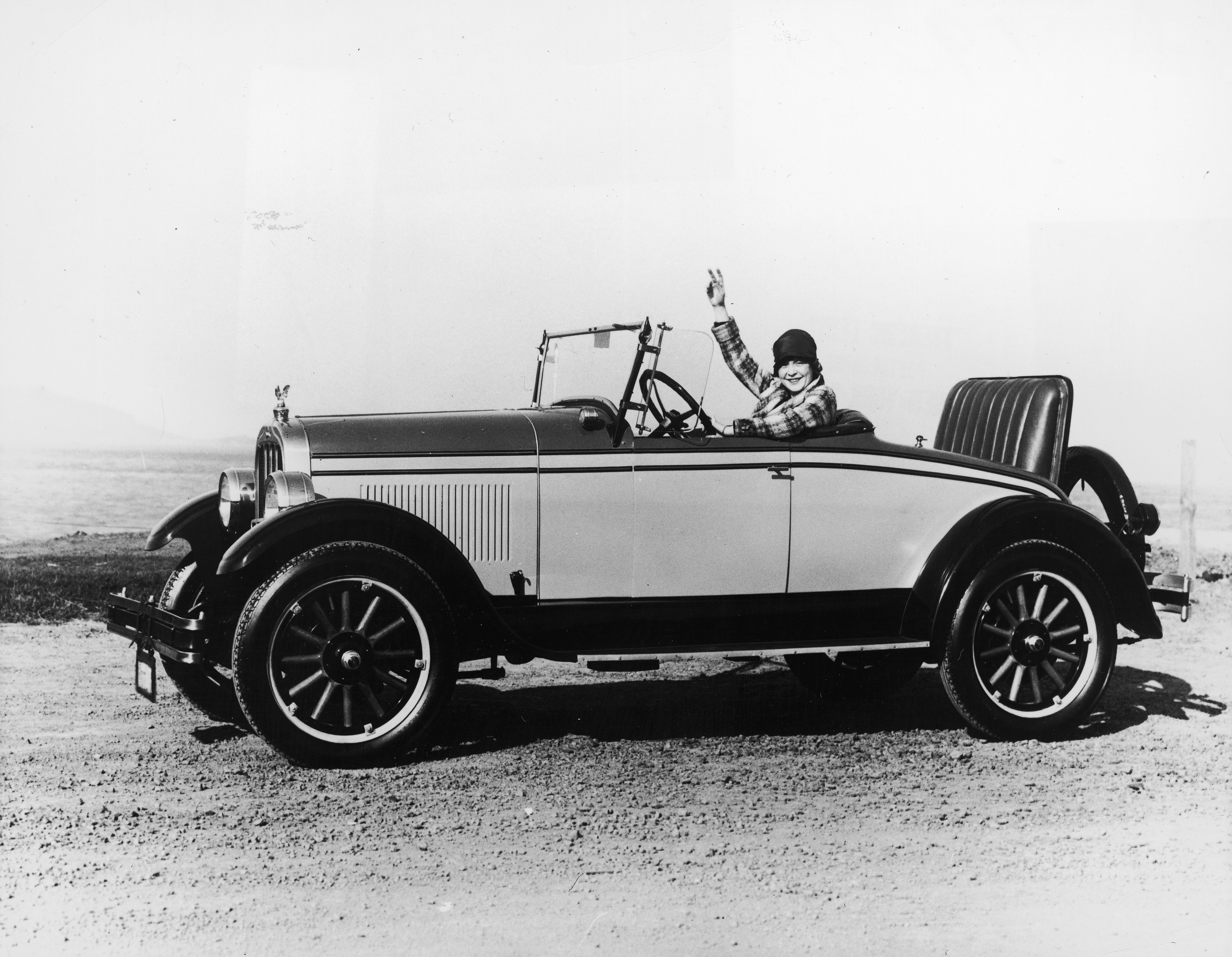
A 1926 Chandler. Obviously, this one is human-driven—you can tell by the human waving from the driver’s seat.
Credit: American Stock/Getty Images
A 1926 Chandler. Obviously, this one is human-driven—you can tell by the human waving from the driver’s seat. Credit: American Stock/Getty Images
Four years later, the spectacle reappeared. This time it was on the streets of New York City, where a crowd along Broadway watched as a 1926 Chandler, sitting quietly at the curb, came to life. The engine turned, the gears engaged, and it pulled smoothly into the stream of traffic before making its way up Fifth Avenue without a driver. Dubbed the “American Wonder” by its creator, Francis P. Houdina, the car responded to radio commands transmitted from a chase car. Signals were received by antennas atop the Chandler, where they triggered circuit breakers and small electric motors that operated the steering, throttle, brakes, and horn.
The idea proved too tantalizing to fade. In Cincinnati, a Toledo inventor named Maurice J. Francill took up the cause in 1928. Francill, who styled himself “America’s Radio Wizard,” demonstrated how radio control could move Ford automobiles without a driver. In a series of stage-like performances, he also milked cows, baked bread, and operated a laundry, all through radio command. By 1936, newspapers from Ohio to California were still reporting his feats.
“Francill claims that he can accomplish anything the human hand can do by radio,” the Orange County News observed. “Eight pounds [3.6 kg] of delicate brain-like radio apparatus was employed to control the lights, ignition system, horn and start the motor running. Five pounds [2.3 kg] of radio apparatus is required to guide the car.”
These vehicles may seem like novelties today, but they’re early proof that the automobile can be guided by something other than humans.
Detroit buys into the dream
The dream of a self-driving automobile did not vanish when these moments passed. It lingered, an idea returned to again and again, particularly in the years when America believed that anything was possible.
At the 1939 New York World’s Fair, General Motors offered a glimpse of that future with its enormous Futurama exhibit. Seated above a raised platform, fairgoers saw a miniature city where tiny electric cars moved serenely along highways without drivers. The cars, they were told, would one day be guided by radio signals and electric currents running through cables and circuits beneath the pavement, creating an electromagnetic field that could both power the vehicles and guide their course. It was a bold, imaginative vision—and characteristic of a time when modern engineering was forecast to remake the world.
After the war, engineers did not let the idea fade. They continued to work on the idea of communication between road and machine. At General Motors’ Motorama, a traveling showcase of the car’s newest vehicles and latest ideas, one display in 1956 captured the imagination of audiences across the country. GM unveiled a sleek, gas turbine–powered automobile, sheathed in titanium and brimming with the promise of autonomous driving.
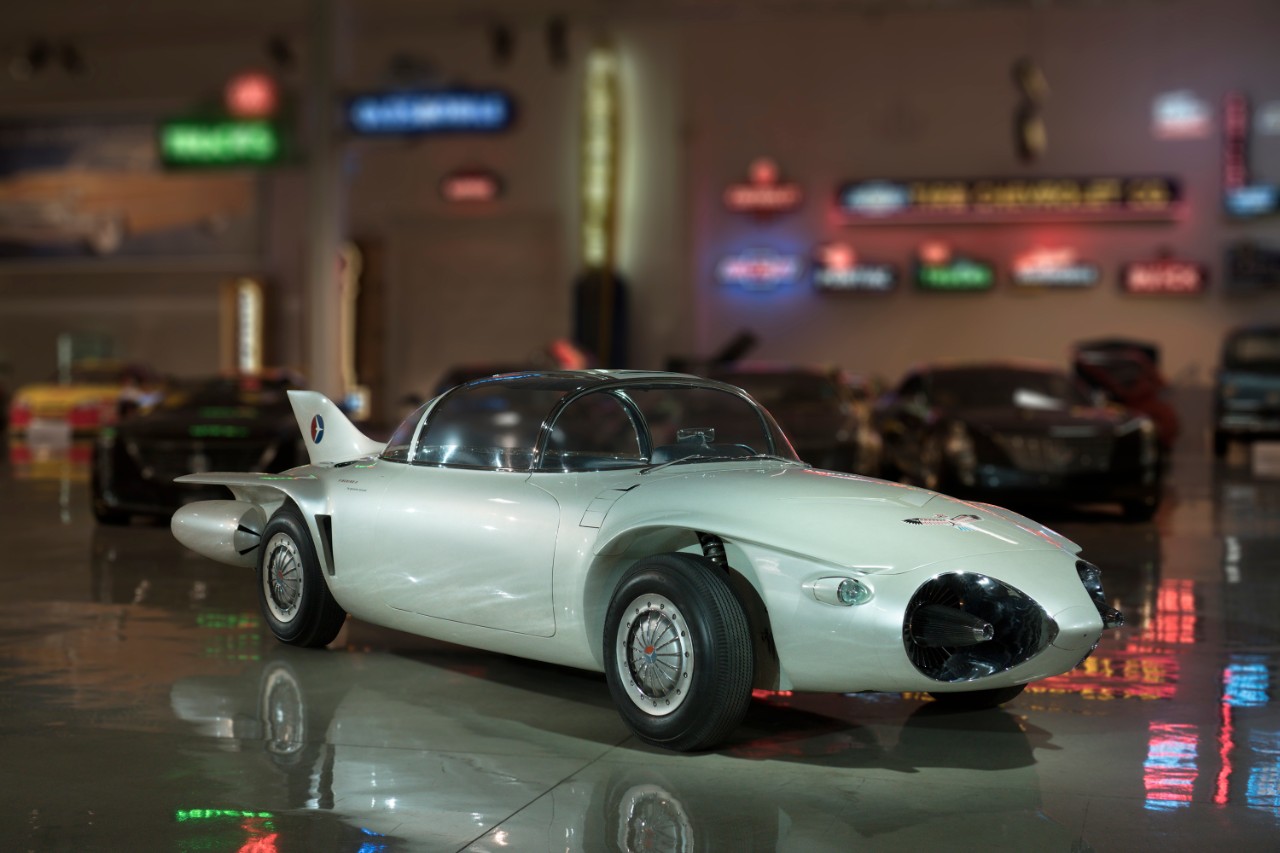
The Firebird II concept from 1956 could drive itself on special roads.
Credit: General Motors
The Firebird II concept from 1956 could drive itself on special roads. Credit: General Motors
Beneath certain stretches of highway, GM proposed laying an electronic strip. When the car traveled over it, sensors would lock onto the signal, guiding the vehicle automatically along its lane. The driver would simply lean back, hands free from the wheel, and watch the miles roll by. Onboard amenities inexplicably included an orange juice dispenser.
Proof of concept
By 1958, the idea became a reality. On a plain stretch of highway outside Lincoln, Nebraska, it was put to the test. The state’s Department of Roads embedded a 400-foot (121 m) length of the roadway with electric circuits, while engineers from RCA and General Motors brought specially fitted Chevrolets to test it. Observers watched as the driverless cars steered themselves, responding to the buried signal beneath the pavement.
A few years later, across the Atlantic, the United Kingdom’s Transport and Road Research Laboratory undertook its own experiments. Using a Citroën DS, they laid magnetic cables beneath a test track and sent the car down it at speeds of up to 80 mph (129 km/h). Wind and weather made no difference; the DS held its line faithfully.
Autonomy emerges in the modern age
Fast forward to 1986, and German scientist Ernst Dickmanns, as part of his position with the German armed forces, began testing an autonomously driving Mercedes-Benz using computers, cameras, and sensors, not unlike modern-day cars. Within a year, it was travelling down the Autobahn at nearly 55 mph (89 km/h). That was enough to capture the attention of Daimler-Benz, which helped fund further research.
Several years later, in October 1994, Dickmanns gathered his research team at Charles de Gaulle Airport outside Paris, where they met a delegation of high-ranking officials. Parked at the curb were two sedans. They appeared ordinary but were fitted with cameras, sensors, and onboard computers. The guests climbed in, and the cars made their way toward the nearby thoroughfare. Then, with the traffic flowing steadily around them, the engineers switched the vehicles into self-driving mode and took their hands off the wheel. The cars held their lanes, adjusted their speed, and followed the road’s gentle curves without driver intervention.
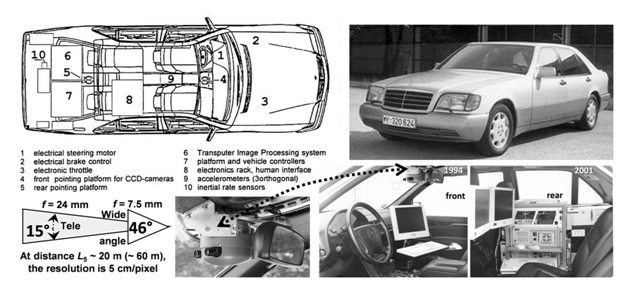
The experimental driverless car VaMP (Versuchsfahrzeug für autonome Mobilität und Rechnersehen), which was developed during the European research project PROMETHEUS: (top left) components for autonomous driving; (right) VaMP and view into passenger cabin (lower right); (lower left) bifocal camera arrangement (front) on yaw platform.
Credit: CC BY-SA 3.0
The experimental driverless car VaMP (Versuchsfahrzeug für autonome Mobilität und Rechnersehen), which was developed during the European research project PROMETHEUS: (top left) components for autonomous driving; (right) VaMP and view into passenger cabin (lower right); (lower left) bifocal camera arrangement (front) on yaw platform. Credit: CC BY-SA 3.0
A year later, Dickmanns would travel from Bavaria to Denmark, a trip of more than 1,056 miles (1,700 km), reaching speeds of nearly 110 mph (177 km/h). Unfortunately, Daimler lost interest and cut funding for the effort. Dickmann’s project came to a halt, but the modern-day technology was in place to set the stage for what came next.
The military sparks innovation–again
By the turn of the century, the federal government had created a new research arm of the Pentagon, the Defense Advanced Research Projects Agency, or DARPA. Its mission was ambitious: to develop technologies that could protect American soldiers on the battlefield. Among its goals was the creation of vehicles that could drive themselves, sparing troops the dangers of roadside ambushes and explosive traps.
To accelerate progress, DARPA announced a competition to build a driverless vehicle capable of traveling 142 miles (229 km) across the Mojave Desert. The prize was $1 million, though the real prize was the knowledge gained along the way.
When race day arrived, the results were humbling. One by one, every vehicle failed to finish. But in the sun and dust of the Mojave, a community emerged, one of engineers, programmers, and dreamers who believed that the autonomous vehicle was not a fantasy but a problem to be solved. Twenty years later, their work has brought the idea closer to everyday reality than ever before.
By themselves, these efforts did not yet give the world the self-driving car. But these successful experiments demonstrate the ability to make a fantasy reality. It’s also a reminder that while the tech industry likes to position itself as a disruptor bringing self-driving cars to market, Detroit was dreaming about and demonstrating autonomous transportation long before Silicon Valley existed.
The first cars bold enough to drive themselves Read More »