Science

spacex-may-have-solved-one-problem-only-to-find-more-on-latest-starship-flight

SpaceX may have solved one problem only to find more on latest Starship flight


SpaceX’s ninth Starship survived launch, but engineers now have more problems to overcome.

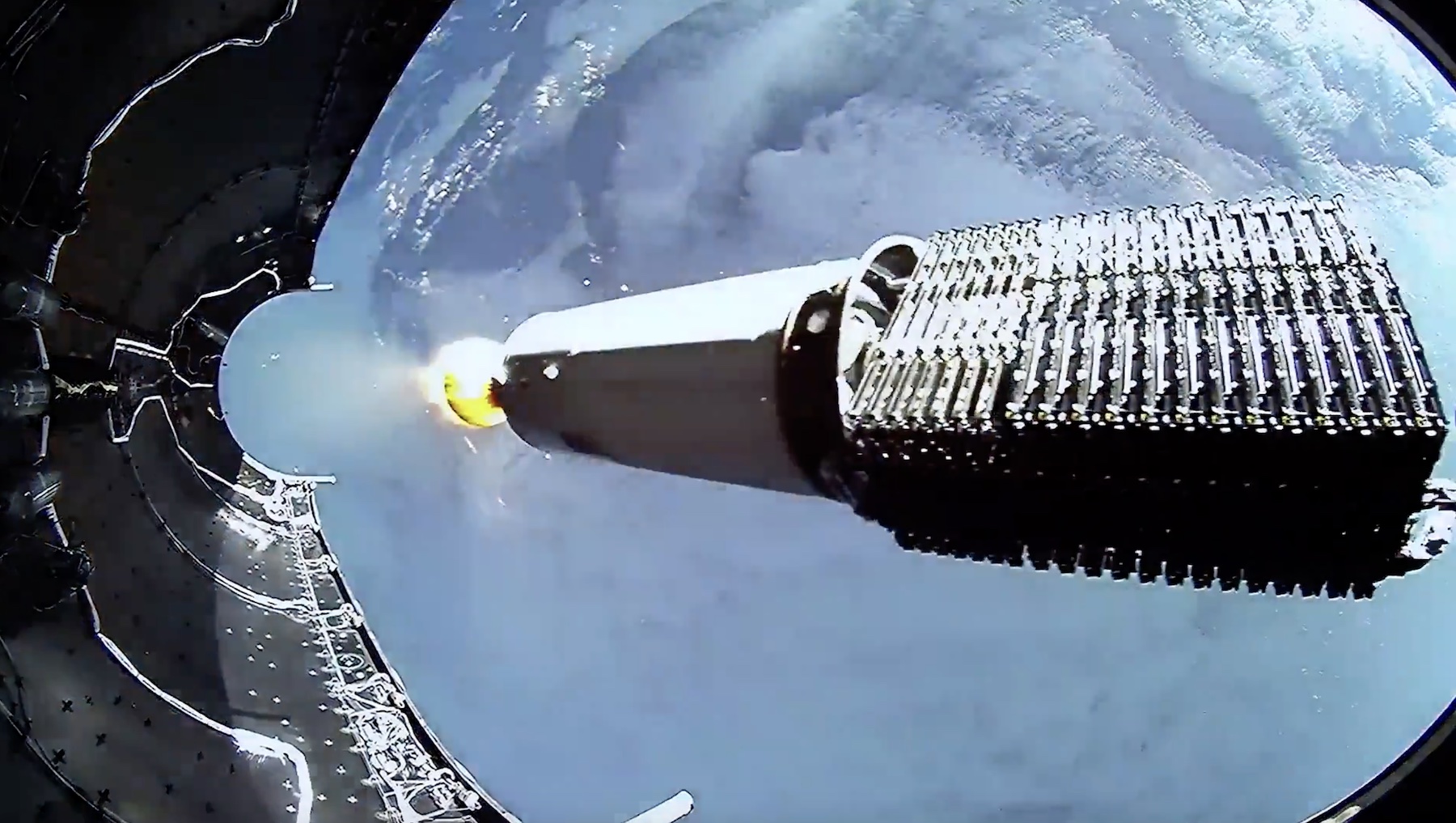
An onboard camera shows the six Raptor engines on SpaceX’s Starship upper stage, roughly three minutes after launching from South Texas on Tuesday. Credit: SpaceX

SpaceX made some progress on another test flight of the world’s most powerful rocket Tuesday, finally overcoming technical problems that plagued the program’s two previous launches.

But minutes into the mission, SpaceX’s Starship lost control as it cruised through space, then tumbled back into the atmosphere somewhere over the Indian Ocean nearly an hour after taking off from Starbase, Texas, the company’s privately owned spaceport near the US-Mexico border.

SpaceX’s next-generation rocket is designed to eventually ferry cargo and private and government crews between the Earth, the Moon, and Mars. The rocket is complex and gargantuan, wider and longer than a Boeing 747 jumbo jet, and after nearly two years of steady progress since its first test flight in 2023, this has been a year of setbacks for Starship.

During the rocket’s two previous test flights—each using an upgraded “Block 2” Starship design—problems in the ship’s propulsion system led to leaks during launch, eventually triggering an early shutdown of the rocket’s main engines. On both flights, the vehicle spun out of control and broke apart, spreading debris over an area near the Bahamas and the Turks and Caicos Islands.

The good news is that that didn’t happen Tuesday. The ship’s main engines fired for their full duration, putting the vehicle on its expected trajectory toward a splashdown in the Indian Ocean. For a short time, it appeared the ship was on track for a successful flight.

“Starship made it to the scheduled ship engine cutoff, so big improvement over last flight! Also, no significant loss of heat shield tiles during ascent,” wrote Elon Musk, SpaceX’s founder and CEO, on X.

The bad news is that Tuesday’s test flight revealed more problems, preventing SpaceX from achieving the most important goals Musk outlined going into the launch.

“Leaks caused loss of main tank pressure during the coast and reentry phase,” Musk posted on X. “Lot of good data to review.”

With the loss of tank pressure, the rocket started slowly spinning as it coasted through the blackness of space more than 100 miles above the Earth. This loss of control spelled another premature end to a Starship test flight. Most notable among the flight’s unmet objectives was SpaceX’s desire to study the performance of the ship’s heat shield, which includes improved heat-absorbing tiles to better withstand the scorching temperatures of reentry back into the atmosphere.

“The most important thing is data on how to improve the tile design, so it’s basically data during the high heating, reentry phase in order to improve the tiles for the next iteration,” Musk told Ars Technica before Tuesday’s flight. “So we’ve got like a dozen or more tile experiments. We’re trying different coatings on tiles. We’re trying different fabrication techniques, different attachment techniques. We’re varying the gap filler for the tiles.”

Engineers are hungry for data on the changes to the heat shield, which can’t be fully tested on the ground. SpaceX officials hope the new tiles will be more robust than the ones flown on the first-generation, or Block 1, version of Starship, allowing future ships to land and quickly launch again, without the need for time-consuming inspections, refurbishment, and in some cases, tile replacements. This is a core tenet of SpaceX’s plans for Starship, which include delivering astronauts to the surface of the Moon, proliferating low-Earth orbit with refueling tankers, and eventually helping establish a settlement on Mars, all of which are predicated on rapid reusability of Starship and its Super Heavy booster.

Last year, SpaceX successfully landed three Starships in the Indian Ocean after they survived hellish reentries, but they came down with damaged heat shields. After an early end to Tuesday’s test flight, SpaceX’s heat shield engineers will have to wait a while longer to satiate their appetites. And the longer they have to wait, the longer the wait for other important Starship developmental tests, such as a full orbital flight, in-space refueling, and recovery and reuse of the ship itself, replicating what SpaceX has now accomplished with the Super Heavy booster.

Failing forward or falling short?

The ninth flight of Starship began with a booming departure from SpaceX’s Starbase launch site at 6: 35 pm CDT (7: 35 pm EDT; 23: 35 UTC) Tuesday.

After a brief hold to resolve last-minute technical glitches, SpaceX resumed the countdown clock to tick away the final seconds before liftoff. A gush of water poured over the deck of the launch pad just before 33 methane-fueled Raptor engines ignited on the rocket’s massive Super Heavy first stage booster. Once all 33 engines lit, the enormous stainless steel rocket—towering more than 400 feet (123 meters)—began to climb away from Starbase.

SpaceX’s Starship rocket, flying with a reused first-stage booster for the first time, climbs away from Starbase, Texas. Credit: SpaceX

Heading east, the Super Heavy booster produced more than twice the power of NASA’s Saturn V rocket, an icon of the Apollo Moon program, as it soared over the Gulf of Mexico. After two-and-a-half minutes, the Raptor engines switched off and the Super Heavy booster separated from Starship’s upper stage.

Six Raptor engines fired on the ship to continue pushing it into space. As the booster started maneuvering for an attempt to target an intact splashdown in the sea, the ship burned its engines more than six minutes, reaching a top speed of 16,462 mph (26,493 kilometers per hour), right in line with preflight predictions.

A member of SpaceX’s launch team declared “nominal orbit insertion” a little more than nine minutes into the flight, indicating the rocket reached its planned trajectory, just shy of the velocity required to enter a stable orbit around the Earth.

The flight profile was supposed to take Starship halfway around the world, with the mission culminating in a controlled splashdown in the Indian Ocean northwest of Australia. But a few minutes after engine shutdown, the ship started to diverge from SpaceX’s flight plan.

First, SpaceX aborted an attempt to release eight simulated Starlink Internet satellites in the first test of the Starship’s payload deployer. The cargo bay door would not fully open, and engineers called off the demonstration, according to Dan Huot, a member of SpaceX’s communications team who hosted the company’s live launch broadcast Tuesday.

That, alone, would not have been a big deal. However, a few minutes later, Huot made a more troubling announcement.

“We are in a little bit of a spin,” he said. “We did spring a leak in some of the fuel tank systems inside of Starship, which a lot of those are used for attitude control. So, at this point, we’ve essentially lost our attitude control with Starship.”

This eliminated any chance for a controlled reentry and an opportunity to thoroughly scrutinize the performance of Starship’s heat shield. The spin also prevented a brief restart of one of the ship’s Raptor engines in space.

“Not looking great for a lot of our on-orbit objectives for today,” Huot said.

SpaceX continued streaming live video from Starship as it soared over the Atlantic Ocean and Africa. Then, a blanket of super-heated plasma enveloped the vehicle as it plunged into the atmosphere. Still in a slow tumble, the ship started shedding scorched chunks of its skin before the screen went black. SpaceX lost contact with the vehicle around 46 minutes into the flight. The ship likely broke apart over the Indian Ocean, dropping debris into a remote swath of sea within its expected flight corridor.

Victories where you find them

Although the flight did not end as well as SpaceX officials hoped, the company made some tangible progress Tuesday. Most importantly, it broke the streak of back-to-back launch failures on Starship’s two most recent test flights in January and March.

SpaceX’s investigation earlier this year into a January 16 launch failure concluded vibrations likely triggered fuel leaks and fires in the ship’s engine compartment, causing an early shutdown of the rocket’s engines. Engineers said the vibrations were likely in resonance with the vehicle’s natural frequency, intensifying the shaking beyond the levels SpaceX predicted.

Engineers made fixes and launched the next Starship test flight March 6, but it again encountered trouble midway through the ship’s main engine burn. SpaceX said earlier this month that the inquiry into the March 6 failure found its most probable root cause was a hardware failure in one of the upper stage’s center engines, resulting in “inadvertent propellant mixing and ignition.”

In its official statement, the company was silent on the nature of the hardware failure but said engines for future test flights will receive additional preload on key joints, a new nitrogen purge system, and improvements to the propellant drain system. A new generation of Raptor engines, known as Raptor 3, should begin flying around the end of this year with additional improvements to address the failure mechanism, SpaceX said.

Another bright spot in Tuesday’s test flight was that it marked the first time SpaceX reused a Super Heavy booster from a prior launch. The booster used Tuesday previously launched on Starship’s seventh test flight in January before it was caught back at the launch pad and refurbished for another space shot.

Booster 14 comes in for the catch after flying to the edge of space on January 16. SpaceX flew this booster again Tuesday but did not attempt a catch. Credit: SpaceX

After releasing the Starship upper stage to continue its journey into space, the Super Heavy booster flipped around to fly tail-first and reignited 13 of its engines to begin boosting itself back toward the South Texas coast. On this test flight, SpaceX aimed the booster for a hard splashdown in the ocean just offshore from Starbase, rather than a mid-air catch back at the launch pad, which SpaceX accomplished on three of its four most recent test flights.

SpaceX made the change for a few reasons. First, engineers programmed the booster to fly at a higher angle of attack during its descent, increasing the amount of atmospheric drag on the vehicle compared to past flights. This change should reduce propellant usage on the booster’s landing burn, which occurs just before the rocket is caught by the launch pad’s mechanical arms, or “chopsticks,” on a recovery flight.

During the landing burn itself, engineers wanted to demonstrate the booster’s ability to respond to an engine failure on descent by using just two of the rocket’s 33 engines for the end of the burn, rather than the usual three. Instead, the rocket appeared to explode around the beginning of the landing burn before it could complete the final landing maneuver.

Before the explosion at the end of its flight, the booster appeared to fly as designed. Data displayed on SpaceX’s live broadcast of the launch showed all 33 of the rocket’s engines fired normally during its initial ascent from Texas, a reassuring sign for the reliability of the Super Heavy booster.

SpaceX kicked off the year with the ambition to launch as many as 25 Starship test flights in 2025, a goal that now seems to be unattainable. However, an X post by Musk on Tuesday night suggested a faster cadence of launches in the coming months. He said the next three Starships could launch at intervals of about once every three to four weeks. After that, SpaceX is expected to transition to a third-generation, or Block 3, Starship design with more changes.

It wasn’t immediately clear how long it might take SpaceX to correct whatever problems caused Tuesday’s test flight woes. The Starship vehicle for the next flight is already built and completed cryogenic prooftesting April 27. For the last few ships, SpaceX has completed this cryogenic testing milestone around one-and-a-half to three months prior to launch.

A spokesperson for the Federal Aviation Administration said the agency is “actively working” with SpaceX in the aftermath of Tuesday’s test flight but did not say if the FAA will require SpaceX to conduct a formal mishap investigation.

Shana Diez, director of Starship engineering at SpaceX, chimed in with her own post on X. Based on preliminary data from Tuesday’s flight, she is optimistic the next test flight will fly soon. She said engineers still need to examine data to confirm none of the problems from Starship’s previous flight recurred on this launch but added that “all evidence points to a new failure mode” on Tuesday’s test flight.

SpaceX will also study what caused the Super Heavy booster to explode on descent before moving forward with another booster catch attempt at Starbase, she said.

“Feeling both relieved and a bit disappointed,” Diez wrote. “Could have gone better today but also could have gone much worse.”

Photo of Stephen Clark

Stephen Clark is a space reporter at Ars Technica, covering private space companies and the world’s space agencies. Stephen writes about the nexus of technology, science, policy, and business on and off the planet.

SpaceX may have solved one problem only to find more on latest Starship flight Read More »

trump-signs-executive-orders-meant-to-resurrect-us-nuclear-power

Trump signs executive orders meant to resurrect US nuclear power


Plan calls for three new reactors to reach criticality in about a year.

Currently, there are no nuclear power plants scheduled for construction in the US. Everybody with plans to build one hasn’t had a reactor design approved, while nobody is planning to use any of the approved designs. This follows a period in which only three new reactors have entered service since 1990. Despite its extremely low carbon footprint, nuclear power appears to be dead in the water.

On Friday, the Trump administration issued a series of executive orders intended to revive the US nuclear industry. These include plans to streamline the reactor approval process and boost the construction of experimental reactors by the Department of Energy. But they also contain language that’s inconsistent with other administration priorities and fundamentally misunderstands the use of nuclear power. Plus, some timelines might be, shall we say, unrealistic: three new experimental reactors reaching criticality in just over a year.

Slow nukes

The heyday of nuclear plant construction in the US was in the 1970s and 80s. But the 1979 partial meltdown at the Three Mile Island plant soured public sentiment toward nuclear power. This also came at a time when nuclear plants typically generated only half of their rated capacity, making them an expensive long-term bet. As a result, plans for many plants, including some that were partially constructed, were canceled.

In this century, only four new reactors on existing plant sites have started construction, and two of those have since been cancelled due to delays and spiralling costs. The two reactors that have entered service also suffered considerable delays and cost overruns.

While safety regulations are often blamed for the construction costs, researchers who studied construction records found that many delays simply arose from workers being idled while they awaited equipment or the completion of other work on the site. This may indicate that the lack of a well-developed supply chain for reactor parts is a significant contributor. And the last major changes in safety regulations came in response to the Fukushima meltdown and explosions, which identified key vulnerabilities in traditional designs.

A large number of startups have proposed designs that should be far less prone to failure. Many of these are SMRs, or small modular reactors, which promise economies of scale by building the reactor at a central facility and then shipping it to the site of installation. But, as of yet, only a single reactor of this type has been approved in the US, and the only planned installation of that design was canceled as the projected cost of its electricity became uncompetitive.

That environment makes investing in nuclear power extremely risky on its own. However, we’re also at a time when the prices of natural gas, wind, and especially solar are incredibly low, making it challenging to justify the large up-front costs of nuclear power, along with the long lead time before it starts generating returns on those costs.

A new hope?

That’s the situation the Trump administration hopes to change, though you can question the sincerity of that effort. To start, the executive orders were issued on the Friday before a holiday weekend, typically the time reserved for news that you hope nobody pays attention to. One of the announcements also refers to nuclear power as dispatchable (meaning it can be ramped up and down quickly), which it most certainly isn’t. Finally, it touts nuclear power as avoiding the risks associated with other forms of power, “such as pollution with potentially deleterious health effects.” Elsewhere, however, the administration is eliminating pollution regulations and promoting the use of high-pollution fuels, such as coal.

Overall, the actions proposed in the new executive orders range from the fanciful to the potentially reasonable. For example, the “Reinvigorating the Nuclear Industrial Base” order calls for the development of the capacity to reprocess spent nuclear fuel to obtain useful fuel from it, a process that’s extremely expensive compared to simply mining new fuel, and would only make nuclear power less economically viable. It also calls for recommendations regarding permanent storage of any remaining waste, an issue that has remained unresolved for decades.

Mixed in with that are more sensible recommendations about ensuring the capacity to enrich isotopes to the purities needed to fuel power plants.

The order also calls for the Department of Energy (DOE) to provide financial support for the industry to boost construction of new plants, something the agency already does through a loan guarantee program. Even though those guarantees have not resulted in new construction plans in over a decade, the EO calls for the effort to result in “10 new large reactors with complete designs under construction by 2030.” While the Biden administration had approved payments to keep nuclear plants open, Trump is calling for funding to be used to reopen some plants that had been unable to operate economically—something that has not been done in the US previously. It also calls for money to go to restart construction at sites where reactors were canceled, although only two of those are less than decades old.

Similar unrealistic time scales are present in the “Deploying Advanced Nuclear Reactor Technologies” order. This is intended to encourage some of the proposed designs for SMRs and inherently safe reactors that are currently on the drawing board. It directs the Army to install one of these at a military base that will be operating within the next three years. And it directs the secretary of energy to contract with companies to build three test reactors that will sustain a nuclear reaction by July 4, 2026.

The accelerated schedule is expected to come from enabling the secretary of energy to simply ignore any aspect of the environmental review that the companies building the reactor complain about: “The Secretary shall, consistent with applicable law, use all available authorities to eliminate or expedite the Department’s environmental reviews for authorizations, permits, approvals, leases, and any other activity requested by an applicant or potential applicant.”

Regulatory reform

The other big executive order targets the Nuclear Regulatory Commission (NRC), which approves license designs. The order blames this on how the NRC is structured: “The NRC charges applicants by the hour to process license applications, with prolonged timelines that maximize fees while throttling nuclear power development.”

It also criticizes the commission’s regulations as being based on the idea that there is no safe level of exposure to radiation, though it provides no evidence that the idea is wrong. This is said to result in regulations that attempt to lower exposures below those caused by a natural environment.

The order attempts to accelerate the approval process enough to ensure that the US goes from 100 GW of generating capacity to 400 GW by 2050. This is largely done by setting hard time limits on the approval process through consultations with DOGE, including a limit of 18 months for approval of new nuclear plants. It also calls for the adoption of “science-based radiation limits,” claiming that flaws with existing limits had been discussed earlier—even though the earlier discussion made no mention of scientific flaws.

In keeping with plans for mass production of modular reactors, the order also calls for a single certification process for these designs, focusing solely on site differences once the general reactor design is accepted as safe.

Overall, there are some reasonable ideas scattered throughout the executive orders (though whether their implementation ends up being reasonable is questionable, especially given DOGE’s involvement). But the majority of them are based on the idea that regulation is the primary reason for nuclear energy’s atrophy in the US.

The reality is that an underdeveloped supply chain and unfavorable economics are far larger factors. It’s difficult to justify investing in a plant that might take a decade to start selling power when the up-front costs of solar are far smaller, and it can start producing power while still under construction. The most likely way to see a nuclear resurgence in the US is for the government to pay for the plants itself. There’s a small bit of that here, in the call for the DOE to fund the construction of experimental reactors at third-party sites. But it’s not enough to significantly shift the trajectory of US nuclear power.

Photo of John Timmer

John is Ars Technica’s science editor. He has a Bachelor of Arts in Biochemistry from Columbia University, and a Ph.D. in Molecular and Cell Biology from the University of California, Berkeley. When physically separated from his keyboard, he tends to seek out a bicycle, or a scenic location for communing with his hiking boots.

Trump signs executive orders meant to resurrect US nuclear power Read More »

the-key-to-a-successful-egg-drop-experiment?-drop-it-on-its-side.

The key to a successful egg drop experiment? Drop it on its side.

There was a key difference, however, between how vertically and horizontally squeezed eggs deformed in the compression experiments—namely, the former deformed less than the latter. The shell’s greater rigidity along its long axis was an advantage because the heavy load was distributed over the surface. (It’s why the one-handed egg-cracking technique targets the center of a horizontally held egg.)

But the authors found that this advantage when under static compression proved to be a disadvantage when dropping eggs from a height, with the horizontal position emerging as the optimal orientation.  It comes down to the difference between stiffness—how much force is needed to deform the egg—and toughness, i.e., how much energy the egg can absorb before it cracks.

Cohen et al.’s experiments showed that eggs are tougher when loaded horizontally along their equator, and stiffer when compressed vertically, suggesting that “an egg dropped on its equator can likely sustain greater drop heights without cracking,” they wrote. “Even if eggs could sustain a higher force when loaded in the vertical direction, it does not necessarily imply that they are less likely to break when dropped in that orientation. In contrast to static loading, to remain intact following a dynamic impact, a body must be able to absorb all of its kinetic energy by transferring it into reversible deformation.”

“Eggs need to be tough, not stiff, in order to survive a fall,” Cohen et al. concluded, pointing to our intuitive understanding that we should bend our knees rather than lock them into a straightened position when landing after a jump, for example. “Our results and analysis serve as a cautionary tale about how language can affect our understanding of a system, and improper framing of a problem can lead to misunderstanding and miseducation.”

DOI: Communications Physics, 2025. 10.1038/s42005-025-02087-0  (About DOIs).

The key to a successful egg drop experiment? Drop it on its side. Read More »

how-farmers-can-help-rescue-water-loving-birds

How farmers can help rescue water-loving birds

Not every farmer is thrilled to host birds. Some worry about the spread of avian flu, others are concerned that the birds will eat too much of their valuable crops. But as an unstable climate delivers too little water, careening temperatures and chaotic storms, the fates of human food production and birds are ever more linked—with the same climate anomalies that harm birds hurting agriculture too.

In some places, farmer cooperation is critical to the continued existence of whooping cranes and other wetland-dependent waterbird species, close to one-third of which are experiencing declines. Numbers of waterfowl (think ducks and geese) have crashed by 20 percent since 2014, and long-legged wading shorebirds like sandpipers have suffered steep population losses. Conservation-minded biologists, nonprofits, government agencies, and farmers themselves are amping up efforts to ensure that each species survives and thrives. With federal support in the crosshairs of the Trump administration, their work is more important (and threatened) than ever.

Their collaborations, be they domestic or international, are highly specific, because different regions support different kinds of agriculture—grasslands, or deep or shallow wetlands, for example, favored by different kinds of birds. Key to the efforts is making it financially worthwhile for farmers to keep—or tweak—practices to meet bird forage and habitat needs.

Traditional crawfish-and-rice farms in Louisiana, as well as in Gentz’s corner of Texas, mimic natural freshwater wetlands that are being lost to saltwater intrusion from sea level rise. Rice grows in fields that are flooded to keep weeds down; fields are drained for harvest by fall. They are then re-flooded to cover crawfish burrowed in the mud; these are harvested in early spring—and the cycle begins again.

That second flooding coincides with fall migration—a genetic and learned behavior that determines where birds fly and when—and it lures massive numbers of egrets, herons, bitterns, and storks that dine on the crustaceans as well as on tadpoles, fish, and insects in the water.

On a biodiverse crawfish-and-rice farm, “you can see 30, 40, 50 species of birds, amphibians, reptiles, everything,” says Elijah Wojohn, a shorebird conservation biologist at nonprofit Manomet Conservation Sciences in Massachusetts. In contrast, if farmers switch to less water-intensive corn and soybean production in response to climate pressures, “you’ll see raccoons, deer, crows, that’s about it.” Wojohn often relies on word-of-mouth to hook farmers on conservation; one learned to spot whimbrel, with their large, curved bills, got “fired up” about them and told all his farmer friends. Such farmer-to-farmer dialogue is how you change things among this sometimes change-averse group, Wojohn says.

In the Mississippi Delta and in California, where rice is generally grown without crustaceans, conservation organizations like Ducks Unlimited have long boosted farmers’ income and staying power by helping them get paid to flood fields in winter for hunters. This attracts overwintering ducks and geese—considered an extra “crop”—that gobble leftover rice and pond plants; the birds also help to decompose rice stalks so farmers don’t have to remove them. Ducks Unlimited’s goal is simple, says director of conservation innovation Scott Manley: Keep rice farmers farming rice. This is especially important as a changing climate makes that harder. 2024 saw a huge push, with the organization conserving 1 million acres for waterfowl.

Some strategies can backfire. In Central New York, where dwindling winter ice has seen waterfowl lingering past their habitual migration times, wildlife managers and land trusts are buying less productive farmland to plant with native grasses; these give migratory fuel to ducks when not much else is growing. But there’s potential for this to produce too many birds for the land available back in their breeding areas, says Andrew Dixon, director of science and conservation at the Mohamed Bin Zayed Raptor Conservation Fund in Abu Dhabi, and coauthor of an article about the genetics of bird migration in the 2024 Annual Review of Animal Biosciences. This can damage ecosystems meant to serve them.

Recently, conservation efforts spanning continents and thousands of miles have sprung up. One seeks to protect buff-breasted sandpipers. As they migrate 18,000 miles to and from the High Arctic where they nest, the birds experience extreme hunger—hyperphagia—that compels them to voraciously devour insects in short grasses where the bugs proliferate. But many stops along the birds’ round-trip route are threatened. There are water shortages affecting agriculture in Texas, where the birds forage at turf grass farms; grassland loss and degradation in Paraguay; and in Colombia, conversion of forage lands to exotic grasses and rice paddies these birds cannot use.

Conservationists say it’s critical to protect habitat for “buffies” all along their route, and to ensure that the winters these small shorebirds spend around Uruguay’s coastal lagoons are a food fiesta. To that end, Manomet conservation specialist Joaquín Aldabe, in partnership with Uruguay’s agriculture ministry, has so far taught 40 local ranchers how to improve their cattle grazing practices. Rotationally moving the animals from pasture to pasture means grasses stay the right length for insects to flourish.

There are no easy fixes in the North American northwest, where bird conservation is in crisis. Extreme drought is causing breeding grounds, molting spots, and migration stopover sites to vanish. It is also endangering the livelihoods of farmers, who feel the push to sell land to developers. From Southern Oregon to Central California, conservation allies have provided monetary incentives for water-strapped grain farmers to leave behind harvest debris to improve survivability for the 1 billion birds that pass through every year, and for ranchers to flood-irrigate unused pastures.

One treacherous leg of the northwest migration route is the parched Klamath Basin of Oregon and California. For three recent years, “we saw no migrating birds. I mean, the peak count was zero,” says John Vradenburg, supervisory biologist of the Klamath Basin National Wildlife Refuge Complex. He and myriad private, public, and Indigenous partners are working to conjure more water for the basin’s human and avian denizens, as perennial wetlands become seasonal wetlands, seasonal wetlands transition to temporary wetlands, and temporary wetlands turn to arid lands.

Taking down four power dams and one levee has stretched the Klamath River’s water across the landscape, creating new streams and connecting farm fields to long-separated wetlands. But making the most of this requires expansive thinking. Wetland restoration—now endangered by loss of funding from the current administration—would help drought-afflicted farmers by keeping water tables high. But what if farmers could also receive extra money for their businesses via eco-credits, akin to carbon credits, for the work those wetlands do to filter-clean farm runoff? And what if wetlands could function as aquaculture incubators for juvenile fish, before stocking rivers? Klamath tribes are invested in restoring endangered c’waam and koptu sucker fish, and this could help them achieve that goal.

As birds’ traditional resting and nesting spots become inhospitable, a more sobering question is whether improvements can happen rapidly enough. The blistering pace of climate change gives little chance for species to genetically adapt, although some are changing their behaviors. That means that the work of conservationists to find and secure adequate, supportive farmland and rangeland as the birds seek out new routes has become a sprint against time.

This story originally appeared at Knowable Magazine.

How farmers can help rescue water-loving birds Read More »

penguin-poop-may-help-preserve-antarctic-climate

Penguin poop may help preserve Antarctic climate


Ammonia aerosols from penguin guano likely play a part in the formation of heat-shielding clouds.

This article originally appeared on Inside Climate News, a nonprofit, non-partisan news organization that covers climate, energy, and the environment. Sign up for their newsletter here.

New research shows that penguin guano in Antarctica is an important source of ammonia aerosol particles that help drive the formation and persistence of low clouds, which cool the climate by reflecting some incoming sunlight back to space.

The findings reinforce the growing awareness that Earth’s intricate web of life plays a significant role in shaping the planetary climate. Even at the small levels measured, the ammonia particles from the guano interact with sulfur-based aerosols from ocean algae to start a chemical chain reaction that forms billions of tiny particles that serve as nuclei for water vapor droplets.

The low marine clouds that often cover big tracts of the Southern Ocean around Antarctica are a wild card in the climate system because scientists don’t fully understand how they will react to human-caused heating of the atmosphere and oceans. One recent study suggested that the big increase in the annual global temperature during 2023 and 2024 that has continued into this year was caused in part by a reduction of that cloud cover.

“I’m constantly surprised at the depth of how one small change affects everything else,” said Matthew Boyer, a coauthor of the new study and an atmospheric scientist at the University of Helsinki’s Institute for Atmospheric and Earth System Research. “This really does show that there is a deep connection between ecosystem processes and the climate. And really, it’s the synergy between what’s coming from the oceans, from the sulfur-producing species, and then the ammonia coming from the penguins.”

Climate survivors

Aquatic penguins evolved from flying birds about 60 million years ago, shortly after the age of dinosaurs, and have persisted through multiple, slow, natural cycles of ice ages and warmer interglacial eras, surviving climate extremes by migrating to and from pockets of suitable habitat, called climate refugia, said Rose Foster-Dyer, a marine and polar ecologist with the University of Canterbury in New Zealand.

A 2018 study that analyzed the remains of an ancient “super colony” of the birds suggests there may have been a “penguin optimum” climate window between about 4,000 and 2,000 years ago, at least for some species in some parts of Antarctica, she said. Various penguin species have adapted to different habitat niches and this will face different impacts caused by human-caused warming, she said.

Foster-Dyer has recently done penguin research around the Ross Sea, and said that climate change could open more areas for land-breeding Adélie penguins, which don’t breed on ice like some other species.

“There’s evidence that this whole area used to have many more colonies … which could possibly be repopulated in the future,” she said. She is also more optimistic than some scientists about the future for emperor penguins, the largest species of the group, she added.

“They breed on fast ice, and there’s a lot of publications coming out about how the populations might be declining and their habitat is hugely threatened,” she said. “But they’ve lived through so many different cycles of the climate, so I think they’re more adaptable than people currently give them credit for.”

In total, about 20 million breeding pairs of penguins nest in vast colonies all around the frozen continent. Some of the largest colonies, with up to 1 million breeding pairs, can cover several square miles.There aren’t any solid estimates for the total amount of guano produced by the flightless birds annually, but some studies have found that individual colonies can produce several hundred tons. Several new penguin colonies were discovered recently when their droppings were spotted in detailed satellite images.

A few penguin colonies have grown recently while others appear to be shrinking, but in general, their habitat is considered threatened by warming and changing ice conditions, which affects their food supplies. The speed of human-caused warming, for which there is no precedent in paleoclimate records, may exacerbate the threat to penguins, which evolve slowly compared to many other species, Foster-Dyer said.

“Everything’s changing at such a fast rate, it’s really hard to say much about anything,” she said.

Recent research has shown how other types of marine life are also important to the global climate system. Nutrients from bird droppings help fertilize blooms of oxygen-producing plankton, and huge swarms of fish that live in the middle layers of the ocean cycle carbon vertically through the water, ultimately depositing it in a generally stable sediment layer on the seafloor.

Tricky measurements

Boyer said the new research started as a follow-up project to other studies of atmospheric chemistry in the same area, near the Argentine Marambio Base on an island along the Antarctic Peninsula. Observations by other teams suggested it could be worth specifically trying to look at ammonia, he said.

Boyer and the other scientists set up specialized equipment to measure the concentration of ammonia in the air from January to March 2023. They found that, when the wind blew from the direction of a colony of about 60,000 Adélie penguins about 5 miles away, the ammonia concentration increased to as high as 13.5 parts per billion—more than 1,000 times higher than the background reading. Even after the penguins migrated from the area toward the end of February, the ammonia concentration was still more than 100 times as high as the background level.

“We have one instrument that we use in the study to give us the chemistry of gases as they’re actually clustering together,” he said.

“In general, ammonia in the atmosphere is not well-measured because it’s really difficult to measure, especially if you want to measure at a very high sensitivity, if you have low concentrations like in Antarctica,” he said.

Penguin-scented winds

The goal was to determine where the ammonia is coming from, including testing a previous hypothesis that the ocean surface could be the source, he said.

But the size of the penguin colonies made them the most likely source.

“It’s well known that sea birds give off ammonia. You can smell them. The birds stink,” he said. “But we didn’t know how much there was. So what we did with this study was to quantify ammonia and to quantify its impact on the cloud formation process.”

The scientists had to wait until the wind blew from the penguin colony toward the research station.

“If we’re lucky, the wind blows from that direction and not from the direction of the power generator,” he said. “And we were lucky enough that we had one specific event where the winds from the penguin colony persisted long enough that we were actually able to track the growth of the particles. You could be there for a year, and it might not happen.”

The ammonia from the guano does not form the particles but supercharges the process that does, Boyer said.

“It’s really the dimethyl sulfide from phytoplankton that gives off the sulfur,” he said. “The ammonia enhances the formation rate of particles. Without ammonia, sulfuric acid can form new particles, but with ammonia, it’s 1,000 times faster, and sometimes even more, so we’re talking up to four orders of magnitude faster because of the guano.”

This is important in Antarctica specifically because there are not many other sources of particles, such as pollution or emissions from trees, he added.

“So the strength of the source matters in terms of its climate effect over time,” he said. “And if the source changes, it’s going to change the climate effect.”

It will take more research to determine if penguin guano has a net cooling effect on the climate. But in general, he said, if the particles transport out to sea and contribute to cloud formation, they will have a cooling effect.

“What’s also interesting,” he said, “is if the clouds are over ice surfaces, it could actually lead to warming because the clouds are less reflective than the ice beneath.” In that case, the clouds could actually reduce the amount of heat that brighter ice would otherwise reflect away from the planet. The study did not try to measure that effect, but it could be an important subject for future research, he added.

The guano effect lingers even after the birds leave the breeding areas. A month after they were gone, Boyer said ammonia levels in the air were still 1,000 times higher than the baseline.

“The emission of ammonia is a temperature-dependent process, so it’s likely that once wintertime comes, the ammonia gets frozen in,” he said. “But even before the penguins come back, I would hypothesize that as the temperature warms, the guano starts to emit ammonia again. And the penguins move all around the coast, so it’s possible they’re just fertilizing an entire coast with ammonia.”

Photo of Inside Climate News

Penguin poop may help preserve Antarctic climate Read More »

have-we-finally-solved-mystery-of-magnetic-moon-rocks?

Have we finally solved mystery of magnetic moon rocks?

NASA’s Apollo missions brought back moon rock samples for scientists to study. We’ve learned a great deal over the ensuing decades, but one enduring mystery remains. Many of those lunar samples show signs of exposure to strong magnetic fields comparable to Earth’s, yet the Moon doesn’t have such a field today. So, how did the moon rocks get their magnetism?

There have been many attempts to explain this anomaly. The latest comes from MIT scientists, who argue in a new paper published in the journal Science Advances that a large asteroid impact briefly boosted the Moon’s early weak magnetic field—and that this spike is what is recorded in some lunar samples.

Evidence gleaned from orbiting spacecraft observations, as well as results announced earlier this year from China’s Chang’e 5 and Chang’e 6 missions, is largely consistent with the existence of at least a weak magnetic field on the early Moon. But where did this field come from? These usually form in planetary bodies as a result of a dynamo, in which molten metals in the core start to convect thanks to slowly dissipating heat. The problem is that the early Moon’s small core had a mantle that wasn’t much cooler than its core, so there would not have been significant convection to produce a sufficiently strong dynamo.

There have been proposed hypotheses as to how the Moon could have developed a core dynamo. For instance, a 2022 analysis suggested that in the first billion years, when the Moon was covered in molten rock, giant rocks formed as the magma cooled and solidified. Denser minerals sank to the core while lighter ones formed a crust.

Over time, the authors argued, a titanium layer crystallized just beneath the surface, and because it was denser than lighter minerals just beneath, that layer eventually broke into small blobs and sank through the mantle (gravitational overturn). The temperature difference between the cooler sinking rocks and the hotter core generated convection, creating intermittently strong magnetic fields—thus explaining why some rocks have that magnetic signature and others don’t.

Or perhaps there is no need for the presence of a dynamo-driven magnetic field at all. For instance, the authors of a 2021 study thought earlier analyses of lunar samples may have been altered during the process. They re-examined samples from the 1972 Apollo 16 mission using CO2 lasers to heat them, thus avoiding any alteration of the magnetic carriers. They concluded that any magnetic signatures in those samples could be explained by the impact of meteorites or comets hitting the Moon.

Have we finally solved mystery of magnetic moon rocks? Read More »

us-solar-keeps-surging,-generating-more-power-than-hydro-in-2025

US solar keeps surging, generating more power than hydro in 2025

Under those circumstances, the rest of the difference will be made up for with fossil fuels. Running counter to recent trends, the use of natural gas dropped during the first three months of 2025. This means that the use of coal rose nearly as quickly as demand, up by 23 percent compared to the same time period in 2024.

Despite the rise in coal use, the fraction of carbon-free electricity held steady year over year, with wind/solar/hydro/nuclear accounting for 43 percent of all power put on the US grid. That occurred despite small drops in nuclear and hydro production.

Solar power also passed a key milestone in 2025, although it requires digging through the statistics to realize it. In terms of power on the grid, there was less solar than hydro. But the Energy Information Agency also estimates the production from small-scale solar, like the kind you’d find on people’s roofs. Some of this never enters the grid and instead simply offsets demand locally (in that it gets used by the house that sits beneath the panels). If you combine the TW-hr produced by small- and grid-scale solar, however, they surpass the production from hydropower by a significant margin.

This surge in solar comes on top of a 30 percent increase in production the year prior. The growth curve is clearly not slowing down.

That dynamic is also not likely to change immediately in response to cuts to tax breaks for renewable power that were part of the budget package passed by the House of Representatives on Thursday, and not only because some Republican senators might object to budget changes that will harm their states. Solar power in most areas is now cheaper than alternatives, even without subsidies, and any power plant (renewable or otherwise) will likely see its costs rise due to the tariff environment. Finally, the tax breaks don’t expire immediately, and most power plant construction requires significant advanced planning.

All of those factors should continue the solar boom for at least a couple more years before all of the expected changes apply the brakes.

US solar keeps surging, generating more power than hydro in 2025 Read More »

rocket-report:-spacex’s-expansion-at-vandenberg;-india’s-pslv-fails-in-flight

Rocket Report: SpaceX’s expansion at Vandenberg; India’s PSLV fails in flight


China’s diversity in rockets was evident this week, with four types of launchers in action.

Dawn Aerospace’s Mk-II Aurora airplane in flight over New Zealand last year. Credit: Dawn Aerospace

Welcome to Edition 7.45 of the Rocket Report! Let’s talk about spaceplanes. Since the Space Shuttle, spaceplanes have, at best, been a niche part of the space transportation business. The US Air Force’s uncrewed X-37B and a similar vehicle operated by China’s military are the only spaceplanes to reach orbit since the last shuttle flight in 2011, and both require a lift from a conventional rocket. Virgin Galactic’s suborbital space tourism platform is also a spaceplane of sorts. A generation or two ago, one of the chief arguments in favor of spaceplanes was that they were easier to recover and reuse. Today, SpaceX routinely reuses capsules and rockets that look much more like conventional space vehicles than the winged designs of yesteryear. Spaceplanes are undeniably alluring in appearance, but they have the drawback of carrying extra weight (wings) into space that won’t be used until the final minutes of a mission. So, do they have a future?

As always, we welcome reader submissions. If you don’t want to miss an issue, please subscribe using the box below (the form will not appear on AMP-enabled versions of the site). Each report will include information on small-, medium-, and heavy-lift rockets, as well as a quick look ahead at the next three launches on the calendar.

One of China’s commercial rockets returns to flight. The Kinetica-1 rocket launched Wednesday for the first time since a failure doomed its previous attempt to reach orbit in December, according to the vehicle’s developer and operator, CAS Space. The Kinetica-1 is one of several small Chinese solid-fueled launch vehicles managed by a commercial company, although with strict government oversight and support. CAS Space, a spinoff of the Chinese Academy of Sciences, said its Kinetica-1 rocket deployed multiple payloads with “excellent orbit insertion accuracy.” This was the seventh flight of a Kinetica-1 rocket since its debut in 2022.

Back in action … “Kinetica-1 is back!” CAS Space posted on X. “Mission Y7 has just successfully sent six satellites into designated orbits, making a total of 63 satellites or 6 tons of payloads since its debut. Lots of missions are planned for the coming months. 2025 is going to be awesome.” The Kinetica-1 is designed to place up to 2 metric tons of payload into low-Earth orbit. A larger liquid-fueled rocket, Kinetica-2, is scheduled to debut later this year.

The easiest way to keep up with Eric Berger’s and Stephen Clark’s reporting on all things space is to sign up for our newsletter. We’ll collect their stories and deliver them straight to your inbox.

Sign Me Up!

French government backs a spaceplane startup. French spaceplane startup AndroMach announced May 15 that it received a contract from CNES, the French space agency, to begin testing an early prototype of its Banger v1 rocket engine, European Spaceflight reports. Founded in 2023, AndroMach is developing a pair of spaceplanes that will be used to perform suborbital and orbital missions to space. A suborbital spaceplane will utilize turbojet engines for horizontal takeoff and landing, and a pressure-fed biopropane/liquid oxygen rocket engine to reach space. Test flights of this smaller vehicle will begin in early 2027.

A risky proposition … A larger ÉTOILE “orbital shuttle” is designed to be launched by various small launch vehicles and will be capable of carrying payloads of up to 100 kilograms (220 pounds). According to the company, initial test flights of ÉTOILE are expected to begin at the beginning of the next decade. It’s unclear how much CNES is committing to AndroMach through this contract, but the company says the funding will support testing of an early demonstrator for its propane-fueled engine, with a focus on evaluating its thermodynamic performance. It’s good to see European governments supporting developments in commercial space, but the path to a small commercial orbital spaceplane is rife with risk. (submitted by EllPeaTea)

Dawn Aerospace is taking orders. Another spaceplane company in a more advanced stage of development says it is now taking customer orders for flights to the edge of space. New Zealand-based Dawn Aerospace said it is beginning to take orders for its remotely piloted, rocket-powered suborbital spaceplane, known as Aurora, with first deliveries expected in 2027, Aviation Week & Space Technology reports. “This marks a historic milestone: the first time a space-capable vehicledesigned to fly beyond the Kármán line (100 kilometers or 328,000 feet)has been offered for direct sale to customers,” Dawn Aerospace said in a statement. While it hasn’t yet reached space, Dawn’s Aurora spaceplane flew to supersonic speed for the first time last year and climbed to an altitude of 82,500 feet (25.1 kilometers), setting a record for the fastest climb from a runway to 20 kilometers.

Further along … Aurora is small in stature, measuring just 15.7 feet (4.8 meters) long. It’s designed to loft a payload of up to 22 pounds (10 kilograms) above the Kármán line for up to three minutes of microgravity, before returning to a runway landing. Eventually, Dawn wants to reduce the turnaround time between Aurora flights to less than four hours. “Aurora is set to become the fastest and highest-flying aircraft ever to take off from a conventional runway, blending the extreme performance of rocket propulsion with the reusability and operational simplicity of traditional aviation,” Dawn said. The company’s business model is akin to commercial airlines, where operators can purchase an aircraft directly from a manufacturer and manage their own operations. (submitted by EllPeaTea)

India’s workhorse rocket falls short of orbit. In a rare setback, Indian Space Research Organisation’s (ISRO) launch vehicle PSLV-C61 malfunctioned and failed to place a surveillance satellite into the intended orbit last weekend, the Times of India reported. The Polar Satellite Launch Vehicle lifted off from a launch pad on the southeastern coast of India early Sunday, local time, with a radar reconnaissance satellite named EOS-09, or RISAT-1B. The satellite was likely intended to gather intelligence for the Indian military. “The country’s military space capabilities, already hindered by developmental challenges, have suffered another setback with the loss of a potential strategic asset,” the Times of India wrote.

What happened? … V. Narayanan, ISRO’s chairman, later said that the rocket’s performance was normal until the third stage. The PSLV’s third stage, powered by a solid rocket motor, suffered a “fall in chamber pressure” and the mission could not be accomplished, Narayanan said. Investigators are probing the root cause of the failure. Telemetry data indicated the rocket deviated from its planned flight path around six minutes after launch, when it was traveling more than 12,600 mph (5.66 kilometers per second), well short of the speed it needed to reach orbital velocity. The rocket and its payload fell into the Indian Ocean south of the launch site. This was the first PSLV launch failure in eight years, ending a streak of 21 consecutive successful flights. (submitted by EllPeaTea)

SES makes a booking with Impulse Space. SES, owner of the world’s largest fleet of geostationary satellites, plans to use Impulse Space’s Helios kick stage to take advantage of lower-cost, low-Earth-orbit (LEO) launch vehicles and get its satellites quickly into higher orbits, Aviation Week & Space Technology reports. SES hopes the combination will break a traditional launch conundrum for operators of medium-Earth-orbit (MEO) and geostationary orbit (GEO). These operators often must make a trade-off between a lower-cost launch that puts them farther from their satellite’s final orbit, or a more expensive launch that can expedite their satellite’s entry into service.

A matter of hours … On Thursday, SES and Impulse Space announced a multi-launch agreement to use the methane-fueled Helios kick stage. “The first mission, currently planned for 2027, will feature a dedicated deployment from a medium-lift launcher in LEO, followed by Helios transferring the 4-ton-class payload directly to GEO within eight hours of launch,” Impulse said in a statement. Typically, this transit to GEO takes several weeks to several months, depending on the satellite’s propulsion system. “Today, we’re not only partnering with Impulse to bring our satellites faster to orbit, but this will also allow us to extend their lifetime and accelerate service delivery to our customers,” said Adel Al-Saleh, CEO of SES. “We’re proud to become Helios’ first dedicated commercial mission.”

Unpacking China’s spaceflight patches. There’s a fascinating set of new patches Chinese officials released for a series of launches with top-secret satellites over the last two months, Ars reports. These four patches depict Buddhist gods with a sense of artistry and sharp colors that stand apart from China’s previous spaceflight emblems, and perhaps—or perhaps not—they can tell us something about the nature of the missions they represent. The missions launched so-called TJS satellites toward geostationary orbit, where they most likely will perform missions in surveillance, signals intelligence, or missile warning. 

Making connections … It’s not difficult to start making connections between the Four Heavenly Gods and the missions that China’s TJS satellites likely carry out in space. A protector with an umbrella? An all-seeing entity? This sounds like a possible link to spy craft or missile warning, but there’s a chance Chinese officials approved the patches to misdirect outside observers, or there’s no connection at all.

China aims for an asteroid. China is set to launch its second Tianwen deep space exploration mission late May, targeting both a near-Earth asteroid and a main belt comet, Space News reports. The robotic Tianwen-2 spacecraft is being integrated with a Long March 3B rocket at the Xichang Satellite Launch Center in southwest China, the country’s top state-owned aerospace contractor said. Airspace closure notices indicate a four-hour-long launch window opening at noon EDT (16: 00–20: 00 UTC) on May 28. Backup launch windows are scheduled for May 29 and 30.

New frontiers … Tianwen-2’s first goal is to collect samples from a near-Earth asteroid designated 469219 Kamoʻoalewa, or 2016 HO3, and return them to Earth in late 2027 with a reentry module. The Tianwen-2 mothership will then set a course toward a comet for a secondary mission. This will be China’s first sample return mission from beyond the Moon. The asteroid selected as the target for Tianwen-2 is believed by scientists to be less than 100 meters, or 330 feet, in diameter, and may be made of material thrown off the Moon some time in its ancient past. Results from Tianwen-2 may confirm that hypothesis. (submitted by EllPeaTea)

Upgraded methalox rocket flies from Jiuquan. Another one of China’s privately funded launch companies achieved a milestone this week. Landspace launched an upgraded version of its Zhuque-2E rocket Saturday from the Jiuquan launch base in northwestern China, Space News reports. The rocket delivered six satellites to orbit for a range of remote sensing, Earth observation, and technology demonstration missions. The Zhuque-2E is an improved version of the Zhuque-2, which became the first liquid methane-fueled rocket in the world to reach orbit in 2023.

Larger envelope … This was the second flight of the Zhuque-2E rocket design, but the first to utilize a wider payload fairing to provide more volume for satellites on their ride into space. The Zhuque-2E is a stepping stone toward a much larger rocket Landspace is developing called the Zhuque-3, a stainless steel launcher with a reusable first stage booster that, at least outwardly, bears some similarities to SpaceX’s Falcon 9. (submitted by EllPeaTea)

FAA clears SpaceX for Starship Flight 9. The Federal Aviation Administration gave the green light Thursday for SpaceX to launch the next test flight of its Starship mega-rocket as soon as next week, following two consecutive failures earlier this year, Ars reports. The failures set back SpaceX’s Starship program by several months. The company aims to get the rocket’s development back on track with the upcoming launch, Starship’s ninth full-scale test flight since its debut in April 2023. Starship is central to SpaceX’s long-held ambition to send humans to Mars and is the vehicle NASA has selected to land astronauts on the Moon under the umbrella of the government’s Artemis program.

Targeting Tuesday, for now … In a statement Thursday, the FAA said SpaceX is authorized to launch the next Starship test flight, known as Flight 9, after finding the company “meets all of the rigorous safety, environmental and other licensing requirements.” SpaceX has not confirmed a target launch date for the next launch of Starship, but warning notices for pilots and mariners to steer clear of hazard areas in the Gulf of Mexico suggest the flight might happen as soon as the evening of Tuesday, May 27. The rocket will lift off from Starbase, Texas, SpaceX’s privately owned spaceport near the US-Mexico border. The FAA’s approval comes with some stipulations, including that the launch must occur during “non-peak” times for air traffic and a larger closure of airspace downrange from Starbase.

Space Force is fed up with Vulcan delays. In recent written testimony to a US House of Representatives subcommittee that oversees the military, the senior official responsible for purchasing launches for national security missions blistered one of the country’s two primary rocket providers, Ars reports. The remarks from Major General Stephen G. Purdy, acting assistant secretary of the Air Force for Space Acquisition and Integration, concerned United Launch Alliance and its long-delayed development of the large Vulcan rocket. “The ULA Vulcan program has performed unsatisfactorily this past year,” Purdy said in written testimony during a May 14 hearing before the House Armed Services Committee’s Subcommittee on Strategic Forces. This portion of his testimony did not come up during the hearing, and it has not been reported publicly to date.

Repairing trust … “Major issues with the Vulcan have overshadowed its successful certification resulting in delays to the launch of four national security missions,” Purdy wrote. “Despite the retirement of highly successful Atlas and Delta launch vehicles, the transition to Vulcan has been slow and continues to impact the completion of Space Force mission objectives.” It has widely been known in the space community that military officials, who supported Vulcan with development contracts for the rocket and its engines that exceeded $1 billion, have been unhappy with the pace of the rocket’s development. It was originally due to launch in 2020. At the end of his written testimony, Purdy emphasized that he expected ULA to do better. As part of his job as the Service Acquisition Executive for Space (SAE), Purdy noted that he has been tasked to transform space acquisition and to become more innovative. “For these programs, the prime contractors must re-establish baselines, establish a culture of accountability, and repair trust deficit to prove to the SAE that they are adopting the acquisition principles necessary to deliver capabilities at speed, on cost and on schedule.”

SpaceX’s growth on the West Coast. SpaceX is moving ahead with expansion plans at Vandenberg Space Force Base, California, that will double its West Coast launch cadence and enable Falcon Heavy rockets to fly from California, Spaceflight Now reports. Last week, the Department of the Air Force issued its Draft Environmental Impact Statement (EIS), which considers proposed modifications from SpaceX to Space Launch Complex 6 (SLC-6) at Vandenberg. These modifications will include changes to support launches of Falcon 9 and Falcon Heavy rockets, the construction of two new landing pads for Falcon boosters adjacent to SLC-6, the demolition of unneeded structures at SLC-6, and increasing SpaceX’s permitted launch cadence from Vandenberg from 50 launches to 100.

Doubling the fun … The transformation of SLC-6 would include quite a bit of overhaul. Its most recent tenant, United Launch Alliance, previously used it for Delta IV rockets from 2006 through its final launch in September 2022. The following year, the Space Force handed over the launch pad to SpaceX, which lacked a pad at Vandenberg capable of supporting Falcon Heavy missions. The estimated launch cadence between SpaceX’s existing Falcon 9 pad at Vandenberg, known as SLC-4E, and SLC-6 would be a 70-11 split for Falcon 9 rockets in 2026, with one Falcon Heavy at SLC-6, for a total of 82 launches. That would increase to a 70-25 Falcon 9 split in 2027 and 2028, with an estimated five Falcon Heavy launches in each of those years. (submitted by EllPeaTea)

Next three launches

May 23: Falcon 9 | Starlink 11-16 | Vandenberg Space Force Base, California | 20: 36 UTC

May 24: Falcon 9 | Starlink 12-22 | Cape Canaveral Space Force Station, Florida | 17: 19 UTC

May 27: Falcon 9 | Starlink 17-1 | Vandenberg Space Force Base, California | 16: 14 UTC

Photo of Stephen Clark

Stephen Clark is a space reporter at Ars Technica, covering private space companies and the world’s space agencies. Stephen writes about the nexus of technology, science, policy, and business on and off the planet.

Rocket Report: SpaceX’s expansion at Vandenberg; India’s PSLV fails in flight Read More »

faa:-airplanes-should-stay-far-away-from-spacex’s-next-starship-launch

FAA: Airplanes should stay far away from SpaceX’s next Starship launch


“The FAA is expanding the size of hazard areas both in the US and other countries.”

The Starship for SpaceX’s next test flight, known as Ship 35, on the move between the production site at Starbase (in background) and the Massey’s test facility for a static fire test. Credit: SpaceX

The Federal Aviation Administration gave the green light Thursday for SpaceX to launch the next test flight of its Starship mega-rocket as soon as next week, following two consecutive failures earlier this year.

The failures set back SpaceX’s Starship program by several months. The company aims to get the rocket’s development back on track with the upcoming launch, Starship’s ninth full-scale test flight since its debut in April 2023. Starship is central to SpaceX’s long-held ambition to send humans to Mars and is the vehicle NASA has selected to land astronauts on the Moon under the umbrella of the government’s Artemis program.

In a statement Thursday, the FAA said SpaceX is authorized to launch the next Starship test flight, known as Flight 9, after finding the company “meets all of the rigorous safety, environmental and other licensing requirements.”

SpaceX has not confirmed a target launch date for the next launch of Starship, but warning notices for pilots and mariners to steer clear of hazard areas in the Gulf of Mexico suggest the flight might happen as soon as the evening of Tuesday, May 27. The rocket will lift off from Starbase, Texas, SpaceX’s privately owned spaceport near the US-Mexico border.

This will be the third flight of SpaceX’s upgraded Block 2, or Version 2, Starship rocket. The first two flights of Starship Block 2—in January and Marchdid not go well. On both occasions, the rocket’s upper stage shut down its engines prematurely and the vehicle lost control, breaking apart in the upper atmosphere and spreading debris near the Bahamas and the Turks and Caicos Islands.

Debris from Starship falls back into the atmosphere after Starship Flight 8 in this view over Hog Cay, Bahamas. Credit: GeneDoctorB via X

Investigators determined the cause of the January failure was a series of fuel leaks and fires in the ship’s aft compartment. The leaks were most likely triggered by vibrations that were more intense than anticipated, SpaceX said before Starship’s most recent flight in March. SpaceX has not announced the cause of the March failure, although the circumstances were similar to the mishap in January.

“The FAA conducted a comprehensive safety review of the SpaceX Starship Flight 8 mishap and determined that the company has satisfactorily addressed the causes of the mishap, and therefore, the Starship vehicle can return to flight,” the agency said. “The FAA will verify SpaceX implements all corrective actions.”

Flight safety

The flight profile for the next Starship launch will largely be a repeat of what SpaceX hoped to accomplish on the ill-fated tests earlier this year. If all goes according to plan, the rocket’s upper stage, or ship, will travel halfway around the world from Starbase, reaching an altitude of more than 100 miles before reentering the atmosphere over the Indian Ocean. A little more than an hour after liftoff, the ship will aim for a controlled splashdown in the ocean northwest of Australia.

Apart from overcoming the problems that afflicted the last two launches, one of the most important objectives for this flight is to test the performance of Starship’s heat shield. Starship Block 2 includes improved heat shield materials that could do better at protecting the ship from the superheated temperatures of reentry and, ultimately, make it easier to reuse the vehicle. The problems on the last two Starship test flights prevented the rocket from reaching the point where its heat shield could be tested.

Starship Block 2 also features redesigned flaps to better control the vehicle during its descent through the atmosphere. This version of Starship also has larger propellant tanks and reconfigured fuel feed lines for the ship’s six Raptor engines.

The FAA’s approval for Starship Flight 9 comes with some stipulations. The agency is expanding the size of hazard areas in the United States and in other countries based on an updated “flight safety analysis” from SpaceX and because SpaceX will reuse a previously flown first-stage booster—called Super Heavy—for the first time.

The aircraft hazard area for Starship Flight 9 extends approximately 1,600 nautical miles to the east from Starbase, Texas. Credit: Federal Aviation Administration

This flight-safety analysis takes into account the outcomes of previous flights, including accidents, population exposure risk, the probability of vehicle failure, and debris propagation and behavior, among other considerations. “The FAA uses this and other data to determine and implement measures to mitigate public risk,” the agency said.

All of this culminated in the FAA’s “return to flight determination,” which the agency says is based on public safety. The FAA’s primary concern with commercial space activity is ensuring rocket launches don’t endanger third parties. The agency also requires that SpaceX maintain at least $500 million in liability insurance to cover claims resulting from the launch and flight of Starship Flight 9, the same requirement the FAA levied for previous Starship test flights.

For the next launch, the FAA will establish an aircraft hazard area covering approximately 1,600 nautical miles extending eastward from Starbase, Texas, and through the Straits of Florida, including the Bahamas and the Turks and Caicos Islands. This is an extension of the 885-nautical-mile hazard area the FAA established for the test flight in March. In order to minimize disruption to commercial and private air traffic, the FAA is requiring the launch window for Starship Flight 9 to be scheduled during “non-peak transit periods.”

The size of FAA-mandated airspace closures can expand or shrink based on the reliability of the launch vehicle. The failures of Starship earlier this year raised the probability of vehicle failure in the flight-safety analysis for Starship Flight 9, according to the FAA.

The expanded hazard area will force the closure of more than 70 established air routes across the Gulf of Mexico and now includes the Bahamas and the Turks and Caicos Islands. The FAA anticipates this will affect more than 175 flights, almost all of them on international connecting routes. For airline passengers traveling through this region, this will mean an average flight delay of approximately 40 minutes, and potentially up to two hours, the FAA said.

If SpaceX can reel off a series of successful Starship flights, the hazard areas will likely shrink in size. This will be important as SpaceX ramps up the Starship launch cadence. The FAA recently approved SpaceX to increase its Starship flight rate from five per year to 25 per year.

The agency said it is in “close contact and collaboration” with other nations with territory along or near Starship’s flight path, including the United Kingdom, Turks and Caicos, the Bahamas, Mexico, and Cuba.

Status report

Meanwhile, SpaceX’s hardware for Starship Flight 9 appears to be moving closer to launch. Engineers test-fired the Super Heavy booster, which SpaceX previously launched and recovered in January, last month on the launch pad in South Texas. On May 12, SpaceX fired the ship’s six Raptor engines for 60 seconds on a test stand near Starbase.

After the test-firing, ground crews rolled the ship back to the Starship production site a few miles away, only to return the vehicle to the test stand Wednesday for unspecified testing. SpaceX is expected to roll the ship back to the production site again before the end of the week.

The final steps before launch will involve separately transporting the Super Heavy booster and Starship upper stage from the production site to the launch pad. There, SpaceX will stack the ship on top of the booster. Once the two pieces are stacked together, the rocket will stand 404 feet (123.1 meters) tall.

If SpaceX moves forward with a launch attempt next Tuesday evening, the long-range outlook from the National Weather Service calls for a 30 percent chance of showers and thunderstorms.

Photo of Stephen Clark

Stephen Clark is a space reporter at Ars Technica, covering private space companies and the world’s space agencies. Stephen writes about the nexus of technology, science, policy, and business on and off the planet.

FAA: Airplanes should stay far away from SpaceX’s next Starship launch Read More »

new-data-confirms:-there-really-is-a-planet-squeezed-in-between-two-stars

New data confirms: There really is a planet squeezed in between two stars

And, critically, the entire orbit is within the orbit of the smaller companion star. The gravitational forces of a tight binary should prevent any planets from forming within this space early in the system’s history. So, how did the planet end up in such an unusual configuration?

A confused past

The fact that one of the stars present in ν Octantis is a white dwarf suggests some possible explanations. White dwarfs are formed by Sun-like stars that have advanced through a late helium-burning period that causes them to swell considerably, leaving the outer surface of the star weakly bound to the rest of its mass. At the distances within ν Octantis, that would allow considerable material to be drawn off the outer companion and pulled onto the surface of what’s now the central star. The net result is a considerable mass transfer.

This could have done one of two things to place a planet in the interior of the system. One is that the transferred material isn’t likely to make an immediate dive onto the surface of the nearby star. If the process is slow enough, it could have produced a planet-forming disk for a brief period—long enough to produce a planet on the interior of the system.

Alternatively, if there were planets orbiting exterior to both stars, the change in the mass distribution of the system could have potentially destabilized their orbits. That might be enough to cause interactions among the planets to send one of them spiraling inward, where it was eventually captured in the stable retrograde orbit we now find it.

Either case, the authors emphasize, should be pretty rare, meaning we’re unlikely to have imaged many other systems like this at this stage of our study of exoplanets. They do point to another tight binary, HD 59686, that appears to have a planet in a retrograde orbit. But, as with ν Octantis, the data isn’t clear enough to rule out alternative configurations yet. So, once again, more data is needed.

Nature, 2025. DOI: 10.1038/s41586-025-09006-x  (About DOIs).

New data confirms: There really is a planet squeezed in between two stars Read More »

scientists-figure-out-how-the-brain-forms-emotional-connections

Scientists figure out how the brain forms emotional connections

Whenever something bad happens to us, brain systems responsible for mediating emotions kick in to prevent it from happening again. When we get stung by a wasp, the association between pain and wasps is encoded in the region of the brain called the amygdala, which connects simple stimuli with basic emotions.

But the brain does more than simple associations; it also encodes lots of other stimuli that are less directly connected with the harmful event—things like the place where we got stung or the wasps’ nest in a nearby tree. These are combined into complex emotional models of potentially threatening circumstances.

Till now, we didn’t know exactly how these models are built. But we’re beginning to understand how it’s done.

Emotional complexity

“Decades of work has revealed how simple forms of emotional learning occurs—how sensory stimuli are paired with aversive events,” says Joshua Johansen, a team director at the Neural Circuitry of Learning and Memory at RIKEN Center for Brain Science in Tokyo. But Johansen says that these decades didn’t bring much progress in treating psychiatric conditions like anxiety and trauma-related disorders. “We thought if we could get a handle of more complex emotional processes and understand their mechanisms, we may be able to provide relief for patients with conditions like that,” Johansen claims.

To make it happen, his team performed experiments designed to trigger complex emotional processes in rats while closely monitoring their brains.

Johansen and Xiaowei Gu, his co-author and colleague at RIKEN, started by dividing the rats into two groups. The first “paired” group of rats was conditioned to associate an image with a sound. The second “unpaired” group watched the same image and listened to the same sound, but not at the same time. This prevented the rats from making an association.

Scientists figure out how the brain forms emotional connections Read More »

the-physics-of-frilly-swiss-cheese-“flowers”

The physics of frilly Swiss cheese “flowers”

For their experiments, the authors of the PRL paper selected samples of Monk’s head cheese wheels from the Fromagerie de Bellelay brand that had been aged between three and six months. They cut each cheese wheel in half and mounted each half on a Girolle, motorizing the base to ensure a constant speed of rotation and making sure the blade was in a fixed position. Their measurements of how the cheese deformed during scraping enabled them to build a model based on metal dynamics on a two-dimensional surface that had “cheese-like properties.”

The results showed that there was a variable friction between the core and the edge of the cheese wheel, because the core stayed fresher during the ripening process. Because the harder outer edge had lower friction with the blade, the edges of the cheese shavings were uneven in thickness—hence the resemblance to frilly rosettes.

This essentially amounts to a new shaping mechanism with the possibility of being able to one day program complex shaping from “a simple scraping process,” per the authors. “Our analysis provides the tools for a better control of flower chip morphogenesis through plasticity in the shaping of other delicacies, but also in metal cutting,” they concluded. Granted, “flower-shaped chips have never been reported in metal cutting. But even in such uniform materials, the fact that friction properties control the metric change is particularly interesting for material shaping.”

Physical Review Letters, 2025. DOI: 10.1103/PhysRevLett.134.208201  (About DOIs).

The physics of frilly Swiss cheese “flowers” Read More »