Science

rocket-report:-a-chinese-launch-you-must-see;-vulcan’s-stunning-debut

Rocket Report: A Chinese launch you must see; Vulcan’s stunning debut

A great start —

“I am so proud of this team. Oh my gosh, this has been years of hard work.”

Vulcan launches from Cape Canaveral Space Force Station on Monday.

Enlarge / Vulcan launches from Cape Canaveral Space Force Station on Monday.

United Launch Alliance

Welcome to Edition 6.26 of the Rocket Report! We’re just 11 days into the new year, and we’ve already had two stunning rocket debuts. Vulcan soared into space on Monday morning, and then a medium-lift rocket from China, Gravity-1, made a picture-perfect launch from a mobile pad in the Yellow Sea. It feels like this could be a great year for lift.

As always, we welcome reader submissions, and if you don’t want to miss an issue, please subscribe using the box below (the form will not appear on AMP-enabled versions of the site). Each report will include information on small-, medium-, and heavy-lift rockets as well as a quick look ahead at the next three launches on the calendar.

Vega C return-to-flight mission gets a date. The European Space Agency said it is targeting November 15 for the return to flight of the grounded Avio-built Vega C launch vehicle, European Spaceflight reports. I’ll be honest. I had to double-check the calendar to make sure that it is in fact January, because that’s an oddly specific date for a launch 10 months from now. But it appears there is some, ahem, flexibility in that date. ESA director of space transportation Toni Tolker-Nielsen says: “The nominal date is 15 November. There is a very detailed plan that is leading to this.”

But then there are the caveats … The director of space transportation did, however, add that there was a month of schedule risks that may affect the launch date, summarizing that the launch “should be at least before the end of the year.” Tolker-Nielsen’s final word on the matter was not all that convincing. “We’re pretty sure of that,” he concluded. Vega C was grounded following a failed flight in late 2022. The flight is expected to carry the Sentinel 1C Earth observation satellite to orbit, which will replace the failed Sentinel 1B satellite, plugging a significant data gap. (submitted by Ken the Bin)

China completes commercial launch pad.  A newly completed launch pad on China’s Hainan Island could increase China’s access to space, boosting national constellation projects and commercial launch plans, Space News reports. The first launch pad at Hainan Commercial Launch Site was finished in late December. It is the first of two pads that will host liquid propellant launch vehicles.

Fewer rockets falling into villages … The development is intended to ease a bottleneck of access to launch facilities for both national and commercial launch service providers and allow Chinese entities to speed up plans to launch a range of constellations. It should also increase China’s ability to deploy and maintain space assets, including remote sensing, communications, and other systems for civil and military purposes. Finally, it may help reduce incidents of booster debris falling around inhabited areas following launches from the country’s inland spaceports of Jiuquan, Taiyuan, and Xichang. (submitted by Ken the Bin)

The easiest way to keep up with Eric Berger’s space reporting is to sign up for his newsletter, we’ll collect his stories in your inbox.

Will spaceport make Australia a military target? Space company Equatorial Launch Australia has proposed a massive expansion of its space center near Nhulunbuy, around 1,000 km east of Darwin, which saw the launch of three NASA suborbital rockets in mid-2022. If approved, the plans would see the Arnhem Space Centre grow from one launchpad to 14, with the goal of launching dozens of rockets a year, the Australian Broadcast Corporation reports. The goal is to launch its first orbital rocket by 2025, said the launch site chief executive, Michael Jones.

But there’s a catch … While the plans have been welcomed by the local government and local businesses, they have drawn concerns from some, including a politician and Yolŋu traditional owner Yiŋiya Guyula. The Yolŋu are Aboriginal people who live in the Northern Territory of Australia. Guyula voiced fears that the Arnhem Space Centre could lead to missile testing and development on Yolŋu land. Other local officials have said the spaceport could result in the area becoming a potential military target. (submitted by ZygP)

Rocket Report: A Chinese launch you must see; Vulcan’s stunning debut Read More »

astronomers-found-ultra-hot,-earth-sized-exoplanet-with-a-lava-hemisphere

Astronomers found ultra-hot, Earth-sized exoplanet with a lava hemisphere

Like Kepler-10 b, illustrated above, the exoplanet HD 63433 d is a small, rocky planet in a tight orbit of its star.

Enlarge / Like Kepler-10 b, illustrated above, newly discovered exoplanet HD 63433 d is a small, rocky planet in a tight orbit of its star.

NASA/Ames/JPL-Caltech/T. Pyle

Astronomers have discovered an unusual Earth-sized exoplanet they believe has a hemisphere of molten lava, with its other hemisphere tidally locked in perpetual darkness. Co-authors and study leaders Benjamin Capistrant (University of Florida) and Melinda Soares-Furtado (University of Wisconsin-Madison) presented the details yesterday at a meeting of the American Astronomical Society in New Orleans. An associated paper has just been published in The Astronomical Journal. Another paper published today in the journal Astronomy and Astrophysics by a different group described the discovery of a rare small, cold exoplanet with a massive outer companion 100 times the mass of Jupiter.

As previously reported, thanks to the massive trove of exoplanets discovered by the Kepler mission, we now have a good idea of what kinds of planets are out there, where they orbit, and how common the different types are. What we lack is a good sense of what that implies in terms of the conditions on the planets themselves. Kepler can tell us how big a planet is, but it doesn’t know what the planet is made of. And planets in the “habitable zone” around stars could be consistent with anything from a blazing hell to a frozen rock.

The Transiting Exoplanet Survey Satellite (TESS) was launched with the intention of helping us figure out what exoplanets are actually like. TESS is designed to identify planets orbiting bright stars relatively close to Earth, conditions that should allow follow-up observations to figure out their compositions and potentially those of their atmospheres.

Both Kepler and TESS identify planets using what’s called the transit method. This works for systems in which the planets orbit in a plane that takes them between their host star and Earth. As this occurs, the planet blocks a small fraction of the starlight that we see from Earth (or nearby orbits). If these dips in light occur with regularity, they’re diagnostic of something orbiting the star.

This tells us something about the planet. The frequency of the dips in the star’s light tells us how long an orbit takes, which tells us how far the planet is from its host star. That, combined with the host star’s brightness, tells us how much incoming light the planet receives, which will influence its temperature. (The range of distances at which temperatures are consistent with liquid water is called the habitable zone.) And we can use that, along with how much light is being blocked, to figure out how big the planet is.

But to really understand other planets and their potential to support life, we have to understand what they’re made of and what their atmosphere looks like. While TESS doesn’t answer those questions, it’s designed to find planets with other instruments that could answer them.

Astronomers found ultra-hot, Earth-sized exoplanet with a lava hemisphere Read More »

nasa-scientist-on-2023-temperatures:-“we’re-frankly-astonished”

NASA scientist on 2023 temperatures: “We’re frankly astonished”

Extremely unusual —

NASA, NOAA, and Berkeley Earth have released their takes on 2023’s record heat.

A global projection map with warm areas shown in read, and color ones in blue. There is almost no blue.

Enlarge / Warming in 2023 was widespread.

Earlier this week, the European Union’s Earth science team came out with its analysis of 2023’s global temperatures, finding it was the warmest year on record to date. In an era of global warming, that’s not especially surprising. What was unusual was how 2023 set its record—every month from June on coming in far above any equivalent month in the past—and the size of the gap between 2023 and any previous year on record.

The Copernicus dataset used for that analysis isn’t the only one of the sort, and on Friday, Berkeley Earth, NASA, and the National Oceanic and Atmospheric Administration all released equivalent reports. And all of them largely agree with the EU’s: 2023 was a record, and an unusual one at that. So unusual that NASA’s chief climate scientist, Gavin Schmidt, introduced his look at 2023 by saying, “We’re frankly astonished.”

Despite the overlaps with the earlier analysis, each of the three new ones adds some details that flesh out what made last year so unusual.

Each of the three analyses uses slightly different methods to do things like fill in areas of the globe where records are sparse, and uses a different baseline. Berkeley Earth was the only team to do a comparison with pre-industrial temperatures, using a baseline of the 1850–1900 temperatures. Its analysis suggests that this is the first year to finish over 1.5° C above preindustrial temperatures.

Most countries have committed to an attempt to keep temperatures from consistently coming in above that point. So, at one year, we’re far from consistently failing our goals. But there’s every reason to expect that we’re going to see several more years exceeding this point before the decade is out. And that clearly means we have a very short timeframe before we get carbon emissions to drop, or we’ll commit to facing a difficult struggle to get temperatures back under this threshold by the end of the century.

Berkeley Earth also noted that the warming was extremely widespread. It estimates that nearly a third of the Earth’s population lived in a region that set a local heat record. And 77 nations saw 2023 set a national record.

Lots of factors converged on warming in 2023.

Enlarge / Lots of factors converged on warming in 2023.

The Berkeley team also had a nice graph laying out the influences of different factors on recent warming. Greenhouse gases are obviously the strongest and most consistent factor, but there are weaker short-term influences as well, such as the El Niño/La Niña oscillation and the solar cycle. Berkeley Earth and EU’s Copernicus also noted that an international agreement caused sulfur emissions from shipping to drop by about 85 percent in 2020, which would reduce the amount of sunlight scattered back out into space. Finally, like the EU team, they note the Hunga Tonga eruption.

An El Niño unlike any other

A shift from La Niño to El Niño conditions in the late spring is highlighted by everyone looking at this year, as El Niños tend to drive global temperatures upward. While it has the potential to develop into a strong El Niño in 2024, at the moment, it’s pretty mild. So why are we seeing record temperatures?

We’re not entirely sure. “The El Niño we’ve seen is not an exceptional one,” said NASA’s Schmidt. So, he reasoned, “Either this El Niño is different from all of them… or there are other factors going on.” But he was at a bit of a loss to identify the factors. He said that typically, there are a limited number of stories that you keep choosing from in order to explain a given year’s behavior. But, for 2023, none of them really fit.

Something very ominous happened to the North Atlantic last year.

Enlarge / Something very ominous happened to the North Atlantic last year.

Berkeley Earth had a great example of it in its graph of North Atlantic sea surface temperatures, which have been rising slowly for decades, until 2023 saw record temperatures with a freakishly large gap compared to anything previously on record. There’s nothing especially obvious to explain that.

Lurking in the background of all of this is climate scientist James Hansen’s argument that we’re about to enter a new regime of global warming, where temperatures increase at a much faster pace than they have until now. Most climate scientists don’t see compelling evidence for that yet. And, with El Niño conditions likely to prevail for much of 2024, we can expect a very hot year again, regardless of changing trends. So, it may take several more years to determine if 2023 was a one-off freak or a sign of new trends.

NASA scientist on 2023 temperatures: “We’re frankly astonished” Read More »

daily-telescope:-a-monster-protostar-in-a-distant-nebula

Daily Telescope: A monster protostar in a distant nebula

Hi H —

Even as astronomical objects go, that’s a gargantuan protostar.

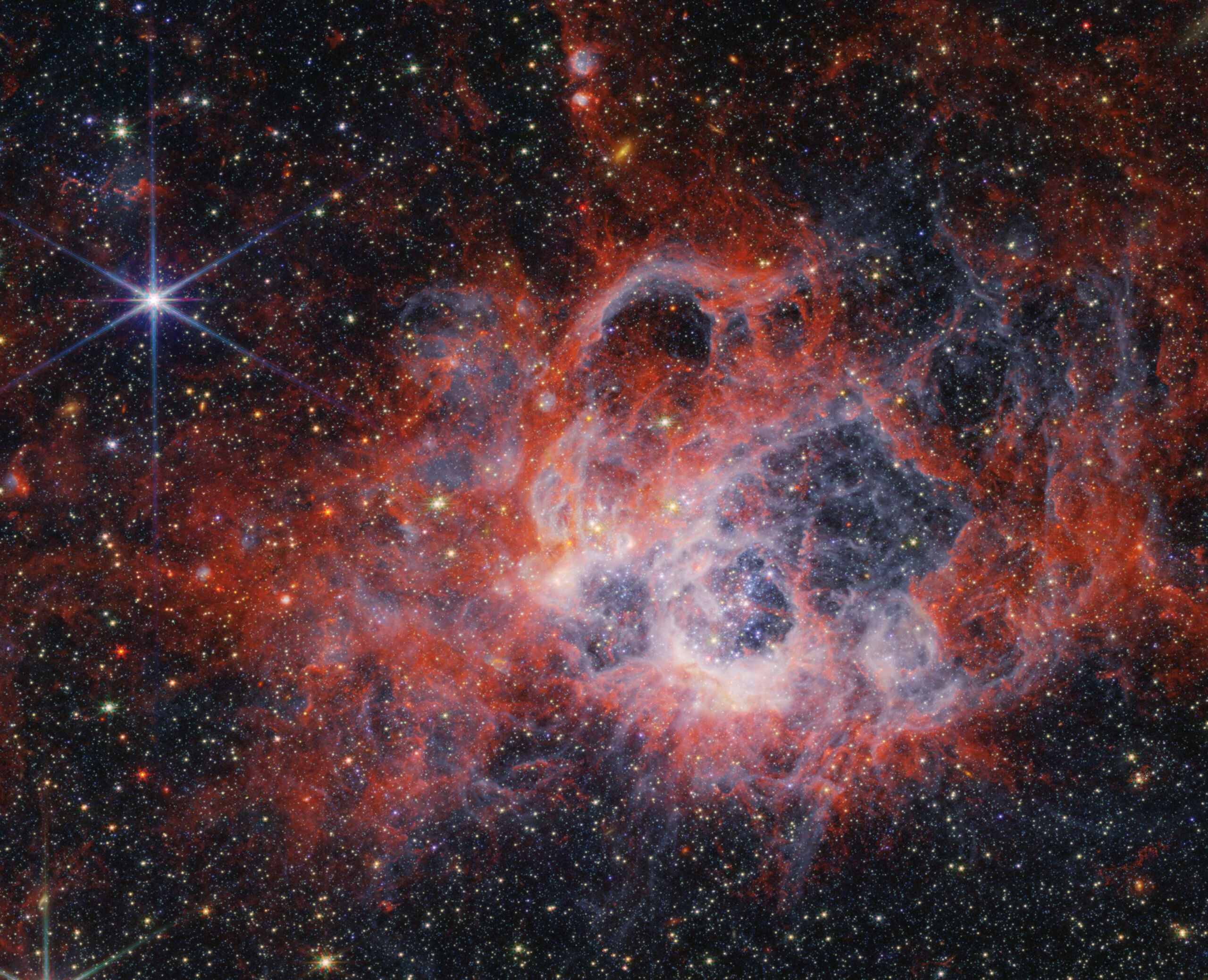
A great view of NGC 7538.

Enlarge / A great view of NGC 7538.

Paul Buckley

Welcome to the Daily Telescope. There is a little too much darkness in this world and not enough light, a little too much pseudoscience and not enough science. We’ll let other publications offer you a daily horoscope. At Ars Technica, we’re going to take a different route, finding inspiration from very real images of a universe that is filled with stars and wonder.

Good morning. It’s January 11, and today’s image showcases a diffuse nebula known as NGC 7538, found in the constellation Cepheus.

Located some 9,000 light-years from Earth, the nebula is a region of active star formation and produces a large amount of hydrogen—which shows up in this image. The nebula contains a shockingly large protostar that is, astronomers estimate, some 300 times larger than our Solar System and has a mass of 2,000 Suns. Even as astronomical objects go, that’s gargantuan.

Paul Buckley submitted today’s photo, which he captured from his backyard in Elma, New York, located not far from Buffalo. He took the image over the first three days of last September. This image represents 100 six-minute narrowband images and 50 two-minute RGB images using his Celestron 9.25-inch Edge HD telescope.

I think it’s lovely.

Source: Paul Buckley

Do you want to submit a photo for the Daily Telescope? Reach out and say hello.

Daily Telescope: A monster protostar in a distant nebula Read More »

after-its-impressive-first-flight,-here’s-what’s-next-for-the-vulcan-rocket

After its impressive first flight, here’s what’s next for the Vulcan rocket

The business end of the Vulcan rocket performed flawlessly during its debut launch.

Enlarge / The business end of the Vulcan rocket performed flawlessly during its debut launch.

United Launch Alliance

Early Monday morning, the hefty Vulcan rocket streaked into orbit for the first time, nailing its performance targets and delivering a substantial success to United Launch Alliance on the vehicle’s first test flight.

Unfortunately for the mission’s primary customer, Astrobotic, there was subsequently an issue with the lunar lander’s propulsion system. However, Astrobotic was quick to clear Vulcan of any blame, saying the payload was delivered into the planned lunar trajectory without issue. “There is no indication that the propulsion anomaly occurred as a result of the launch,” Astrobotic said.

Vulcan’s debut was much-anticipated in the US launch community because the rocket provides a potentially viable competitor to the Falcon 9 and Falcon Heavy rockets flown by SpaceX. The US Space Force, in particular, has been waiting on Vulcan to fly dozens of payloads into orbit.

So now that Vulcan has flown once, what’s next?

Next up, Dream Chaser

Just ahead of the launch, two vice presidents with United Launch Alliance, Mark Peller and Gary Wentz, held a teleconference with reporters to address the future of Vulcan.

United Launch Alliance, or ULA, has set aside the next 60 days to review data from the “Cert-1” certification mission that launched on Monday morning, they said. If the data looks good from that flight, the company will move into preparations for the next launch. Wentz said the earliest opportunity to launch this Cert-2 mission is “April-ish.”

The BE-4 rocket engines that will power this Vulcan are in final acceptance testing at Blue Origin’s facilities in West Texas, the officials said. The Vulcan core stage and Centaur upper stage are also in final assembly in ULA’s main factory in Decatur, Alabama. The hardware readiness should be capable of supporting an April launch.

The second Vulcan launch will carry the Dream Chaser spacecraft into orbit for Sierra Space. The winged vehicle will fly a cargo mission that carries supplies to the International Space Station for NASA. After more than a decade of development, Dream Chaser is undergoing final tests. However, there remain some questions about when it will be ready for its debut launch.

The Dream Chaser mission does not have a specific launch date on NASA’s internal schedule, but it shows a potential docking with the International Space Station for 45 days during a period between early April and mid-June. The docking port for the mission will not be needed by other spacecraft this year, so ULA and Sierra Space have some flexibility with the launch date.

After its impressive first flight, here’s what’s next for the Vulcan rocket Read More »
astronomers-think-they-finally-know-origin-of-enormous-“cosmic-smoke-rings“

Astronomers think they finally know origin of enormous “cosmic smoke rings“

Space oddity —

Massive stars burn out quickly. When they die, they expel their gas as outflowing winds.

Odd radio circles, like ORC 1 pictured above, are large enough to contain galaxies in their centers and reach hundreds of thousands of light years across.

Enlarge / Odd radio circles are large enough to contain galaxies in their centers and reach hundreds of thousands of light years across.

Jayanne English / University of Manitoba

The discovery of so-called “odd radio circles” several years ago had astronomers scrambling to find an explanation for these enormous regions of radio waves so far-reaching that they have galaxies at their centers. Scientists at the University of California, San Diego, think they have found the answer: outflowing galactic winds from exploding stars in so-called “starburst” galaxies. They described their findings in a new paper published in the journal Nature.

“These galaxies are really interesting,” said Alison Coil of the University of California, San Diego. “They occur when two big galaxies collide. The merger pushes all the gas into a very small region, which causes an intense burst of star formation. Massive stars burn out quickly, and when they die, they expel their gas as outflowing winds.”

As reported previously, the discovery arose from the Evolutionary Map of the Universe (EMU) project, which aims to take a census of radio sources in the sky. Several years ago, Ray Norris, an astronomer at Western Sydney University and CSIRO in Australia, predicted the EMU project would make unexpected discoveries. He dubbed them “WTFs.” Anna Kapinska, an astronomer at the National Radio Astronomy Observatory (NRAO) was browsing through radio astronomy data collected by CSIRO’s Australian Square Kilometer Array Pathfinder (ASKAP) telescope when she noticed several strange shapes that didn’t seem to resemble any known type of object. Following Norris’ nomenclature, she labeled them as possible WTFs. One of those was a picture of a ghostly circle of radio emission, “hanging out in space like a cosmic smoke ring.”

Other team members soon found two more weird round blobs, which they dubbed “odd radio circles” (ORCs). A fourth ORC was identified in archival data from India’s Giant MetreWave Radio Telescope, and a fifth was discovered in fresh ASKAP data in 2021. There are several more objects that might also be ORCs. Based on this, the team estimates there could be as many as 1,000 ORCs in all.

While Norris et al. initially assumed the blobs were just imaging artifacts, data from other radio telescopes confirmed they were a new class of astronomical object. They don’t show up in standard optical telescopes or in infrared and X-ray telescopes—only in the radio spectrum. Astronomers suspect the radio emissions are due to clouds of electrons. But that wouldn’t explain why ORCs don’t show up in other wavelengths. All of the confirmed ORCs thus far have a galaxy at the center, suggesting this might be a relevant factor in how they form. And they are enormous, measuring about a million light-years across, which is larger than our Milky Way.

As for what caused the explosions that led to the formation of ORCs, new data reported in 2022 was sufficient to rule out all but three possibilities. The first is that ORCs are the result of a shockwave from the center of a galaxy, perhaps arising from the merging of two supermassive black holes. Alternatively, they could be the result of radio jets spewing particles from active galactic nuclei. Finally, ORCs may be shells caused by starburst events (“termination shock”), which would produce a spherical shock wave as hot gas blasted out from a galactic center.

A simulation of starburst-driven winds at three different time periods, starting at 181 million years. The top half of each image shows gas temperature, while the lower half shows the radial velocity.

Enlarge / A simulation of starburst-driven winds at three different time periods, starting at 181 million years. The top half of each image shows gas temperature, while the lower half shows the radial velocity.

Cassandra Lochhaas / Space Telescope Science Institute

Coil et al. were intrigued by the discovery of ORCs. They had been studying starburst galaxies, which are noteworthy for their very high rate of star formation, making them appear bright blue. The team thought the later stages of those starburst galaxies might explain the origin of ORCs, but they needed more than radio data to prove it. So the team used the integral field spectrograph at the W.M. Keck Observatory in Hawaii to take a closer look at ORC 4, the first radio circle observable from the Northern Hemisphere. That revealed a much higher amount of bright, heated, compressed gas than one would see in an average galaxy. Additional optical and infrared imaging data revealed that the stars in the ORC 4 galaxy are about 6 billion years old. New star formation seems to have ended some billion years ago.

The next step was to run computer simulations of the odd radio circle itself spanning the course of 750 million years. Those simulations showed an initial 200-million-year period with powerful outflowing galactic winds, followed by a shock wave that propelled very hot gas out of the galaxy to create a radio ring. Meanwhile, a reverse shock wave sent cooler gas back into the central galaxy.

“To make this work, you need a high-mass outflow rate, meaning it’s ejecting a lot of material very quickly. And the surrounding gas just outside the galaxy has to be low density, otherwise the shock stalls. These are the two key factors,” said Coil. “It turns out the galaxies we’ve been studying have these high-mass outflow rates. They’re rare, but they do exist. I really do think this points to ORCs originating from some kind of outflowing galactic winds.” She also thinks that ORCs could help astronomers understand more about galactic outflowing winds since it enables them to “see” those winds through radio data and spectrometry.

Nature, 2024. DOI: 10.1038/s41586-023-06752-8  (About DOIs).

Astronomers think they finally know origin of enormous “cosmic smoke rings“ Read More »
first-results-are-in:-2023-temperatures-were-stunningly-warm

First results are in: 2023 temperatures were stunningly warm

Here we go again —

In the second half of the year, every month set a record.

Image of a lot of squiggly lines moving from left to right across a graph, with one line in red standing far above the rest.

Enlarge / Month by month, 2023 stood far above the rest.

The confused wiggles on the graph above have a simple message: Most years, even years with record-high temperatures, have some months that aren’t especially unusual. Month to month, temperatures dip and rise, with the record years mostly being a matter of having fewer, shallower dips.

As the graph shows, last year was not at all like that. The first few months of the year were unusually warm. And then, starting in June, temperatures rose to record heights and simply stayed there. Every month after June set a new record for high temperatures for that month. So it’s not surprising that 2023 will enter the record books as far and away the warmest year on record.

The EU makes it official

Several different organizations maintain global temperature records; while they use slightly different methods, they tend to produce very similar numbers. So, over the next few weeks, you can expect each of these organizations to announce record temperatures (NASA and the National Oceanic and Atmospheric Administration will do so on Friday). On Tuesday, it was the European Union’s turn, via its Copernicus Earth-observation program.

Copernicus rates 2023 as being nearly 1.5° C above pre-industrial temperatures and about 0.17° C above 2016, the previous holder of the warmest year on record. The difference between 2023 and 2022 was the largest single-year change in the record as well, confirming that the amount of warming this past year was exceptional.

The 1.5° C landmark is significant because many countries have committed to trying to limit global warming to that mark. This doesn’t mean we’ve failed; the average temperature for the last decade is still below that. But it does highlight how little time we have left to act before we potentially experience more radical consequences of climate change.

The Copernicus analysis notes a couple of additional daily landmarks within the yearly record. It defines pre-industrial temperatures as those experienced between 1850–1900. The records from this period are sparse enough that, rather than daily temperature data, it’s been handled as a monthly average. So, the best Copernicus could do is compare 2023’s daily temperatures to the equivalent month in the pre-industrial record.

Even given that limitation, some of the results of this comparison were striking. For the first time ever, individual days in 2023 were 2.0° C above the preindustrial monthly average. Nearly half the days in 2023 were 1.5° C warmer than preindustrial records, and it was the first time every day was at least 1.0° C warmer.

Why so extreme?

The simplest answer is El Niño. The past few years have been spent in a reasonably strong La Niña, the cooler phase of the Southern Oscillation. But that started fading throughout the spring, and by mid-year, a weak El Niño had arrived. Normally, a relatively feeble El Niño like this would have a limited effect on global temperatures, and in any case, it would normally take some time for its effect to be felt in global temperatures.

Red means hot: last year saw a strong La Niña come to a close, with conditions shifting to a slight El Niño.

Red means hot: last year saw a strong La Niña come to a close, with conditions shifting to a slight El Niño.

But with temperatures poised near record levels to begin with, just a little push appeared to be all 2023 needed to soar to record heights.

Still, there are plenty of indications that the year wasn’t only the result of El Niño, which is a phenomenon that occurs in the tropical Pacific. For example, the North Atlantic, which is not directly connected to the Tropical Pacific, experienced exceptionally warm sea surface temperatures over the second half of the year.

Copernicus suggests that several additional, weak factors could have contributed to the year’s warmth. These include lower emissions of cooling aerosols from shipping, a peak in the solar cycle, and high levels of water vapor in the stratosphere due to the eruption of the Hunga Tonga volcano. On its own, the impact of any of these would likely be minimal. In combination with the weak El Niño and the continued emission of greenhouse gasses, however, they might have enhanced what was already an exceptionally warm year.

The announcement of 2023’s warmth comes only months after a set of UN climate negotiations that many have derided as lacking the sort of urgency the record might have provided. Instead, Copernicus notes that carbon dioxide and methane emissions increased last year.

Listing image by Marco Bottigelli

First results are in: 2023 temperatures were stunningly warm Read More »

chromium-found-in-lead-tainted-fruit-pouches-may-explain-contamination

Chromium found in lead-tainted fruit pouches may explain contamination

Nightmare —

Lead chromate, an artificial coloring, has been used in other spices to conceal poor quality.

The three recalled pouches linked to lead poisonings.

Enlarge / The three recalled pouches linked to lead poisonings.

The Food and Drug Administration has discovered a second metal contaminant—chromium—in the recalled cinnamon applesauce pouches found to contain cinnamon contaminated with extremely high levels of lead. The products have now poisoned nearly 300 young children in 37 states.

The health implications of the additional contaminant are not clear. There is no antidote for chromium exposure, and the Centers for Disease Control and Prevention recommends supportive care. But the finding does hint at the possible motivation behind the tragic poisonings.

In the FDA’s announcement, the agency noted that “The lead-to-chromium ratio in the cinnamon apple puree sample is consistent with that of lead chromate (PbCrO4).” This is a notorious adulterant of spices used to artificially bolster their color and weight.

Lead chromate is a vibrant yellow substance that has frequently turned up in turmeric sourced from India and Bangladesh. In a 2017 study by public health researchers at Boston University, 16 of 32 turmeric products bought in markets in the Boston area had lead levels over the FDA’s allowable lead level for candy (the FDA does not have guidelines for lead levels in spices, specifically). Two samples, the only two samples sourced from Bangladesh, exceeded the allowable lead level by two orders of magnitude. The researchers had conducted the study after a string of lead poisoning cases in US children were linked to contaminated spices, including turmeric. Other studies have also identified spices as a source of lead exposure in US children.

The 2017 study highlighted the reason that lead chromate is used as an adulterant. A media outlet in Bangladesh quoted one turmeric trader’s explanation: “Traders use the artificial color [lead chromate] to hide the marks of pest attacks and other spots on raw turmeric. It is used during boiling and polishing to make the spice look brighter to attract big buyers, including spice processing firms.”

The FDA’s testing does not definitively conclude that lead chromate was in the contaminated cinnamon, which was sourced from an Austrofoods manufacturing facility in Ecuador and used in the recalled applesauce pouches. But it does bolster the FDA’s suspicion that the poisonings were the result of “economically motivated adulteration,” a specific category of food fraud defined by the FDA.

Jim Jones, FDA’s deputy commissioner for human foods, told Politico in December that the agency believed then that the contamination was economically motivated. “My instinct is they didn’t think this product was going to end up in a country with a robust regulatory process,” Jones said. “They thought it was going to end up in places that did not have the ability to detect something like this.”

Health effects

For the hundreds of US children poisoned by the applesauce pouches, the finding of chromium adds yet more nightmarish uncertainty of possible long-term health effects. Lead is a potent neurotoxic metal that can damage the brain and nervous system. In developing toddlers and younger children, the effects of the acute exposures could manifest as learning and behavior problems, as well as hearing and speech problems in the years to come.

The effects of chromium exposure are less clear. Chromium is a naturally occurring metal and an essential trace nutrient. But there are two notable forms: chromium III and the more toxic chromium VI. The FDA’s testing couldn’t identify which form of chromium was present in the cinnamon applesauce pouches, but the more toxic chromium VI is what’s present in lead chromate. Chromium VI is considered a carcinogen, and chronic, prolonged inhalation and skin exposure is associated with chronic lung disease and ulceration of skin and mucous membranes, the CDC notes. But the effects of eating chromium VI are not well studied or understood beyond the immediate, nonspecific effects of an acute exposure—which might include abdominal pain, nausea, vomiting, diarrhea, anemia, and kidney and liver dysfunction.

The CDC and the FDA note that it’s possible that even if chromium VI contaminated the applesauce pouches, the acidity of the applesauce and the stomach may have converted the chromium VI to chromium III.

The FDA recommends that the families of children exposed to the recalled pouches—especially those with elevated blood lead levels—should inform their health care providers of potential chromium exposure. The CDC provided clinical guidance for doctors on how to test and care for children with exposure.

The recalled cinnamon applesauce pouches include WanaBana apple cinnamon fruit puree pouches (sold nationally and through multiple retailers, including Amazon and Dollar Tree), Schnucks-brand cinnamon-flavored applesauce pouches and variety packs (sold at Schnucks and Eatwell Markets grocery stores), and Weis-brand cinnamon applesauce pouches (sold at Weis grocery stores).

According to the CDC’s latest numbers, which, as of the time of publication, were last updated on December 29, there have been a total of 287 cases identified across 37 states.

Chromium found in lead-tainted fruit pouches may explain contamination Read More »

seeking-another-earth?-look-for-low-carbon-dioxide

Seeking another Earth? Look for low carbon dioxide

Where’d all the CO2 go? —

In our own Solar System, Earth has far lower CO2 concentrations than its neighbors.

Image of a series of planets with different surfaces, arrayed in front of a star.

What do we need to find if we want to discover another Earth? If an exoplanet is too far away for even the most powerful telescopes to search directly for water or certain biosignatures, is there something else that may tell us about the possibility of habitability? The answer could be carbon dioxide.

Led by Amaury Triaud and Julien de Wit, an international team of researchers is now proposing that the absence of CO2 in a planet’s atmosphere potentially increases the chances of liquid water on its surface. Earth’s own atmosphere is depleted of CO2. Unlike dry Mars and Venus, which have high concentrations of CO2 in their atmospheres, oceans on our planet have taken immense amounts of carbon dioxide out of the atmosphere because the gas dissolves in water. CO2 deficits in exoplanet atmospheres might mean the same.

Another molecule could be a sign of a habitable planet: ozone. Many organisms on Earth (especially plants) breathe carbon dioxide and release oxygen. This oxygen reacts with sunlight and becomes O3, or ozone, which is easier to detect than atmospheric oxygen. The presence of ozone and the absence of carbon dioxide could mean a habitable, and even inhabited, planet.

Anyone—or anything—out there?

There is a difference between a planet orbiting within what is considered a habitable zone and actual habitability. Habitability is defined by the researchers as “a planet’s capacity to retain large reservoirs of surface liquid water,” as they state in a study recently published in Nature Astronomy.

Proving that water actually exists could hypothetically be done in many ways. The problem is that most existing telescopes, no matter how advanced, are incapable of pulling them all off. Finding liquid water from light years away is not as easy as seeing the glimmer of a lake, though that is possible at short distances, like those within our own Solar System. (When sunlight reflects off a body of surface liquid, what scientists refer to as a “glint” can be seen, which is how the lakes and oceans on Saturn’s moon Titan were discovered.)

Beyond water, other factors could determine habitability. Besides atmospheric properties, these include (but are not limited to) the orbit of a planet, plate tectonics, magnetic fields, and how it is affected by its star.

When less is more

Triaud, de Wit, and their team argue that it’s worth trying to identify potentially habitable planets that belong to a system similar to ours. If there is a system with several terrestrial planets that are close in size and have atmospheres, this makes it possible to compare carbon dioxide content in their atmospheres and see if there is a significant deficit in one or more planets compared to the others.

While a CO2 deficit does not guarantee that there is liquid water on the surface, it should give scientists a reason to observe the planet or planets in question more closely. We don’t have to look far from Earth to see why this makes sense. Not only has most of the carbon dioxide in our planet’s atmosphere been depleted by its oceans, but plate tectonics also bury it in the crust. The amount of early Earth’s atmospheric carbon dioxide that ended up trapped in rocks is almost equal to the amount of CO2 in the entire atmosphere of Venus.

There is another advantage to searching for this deficit. Because it’s an especially strong infrared light absorber, CO2 is rather easy to detect. Telescopes that are around today, including NASA’s James Webb Telescope and ESO’s Very Large Telescope, as well as ESO’s upcoming Extremely Large Telescope, have infrared vision that can easily search for CO2 signatures.

So what if we did find a planet that showed a deficit of CO2 and the presence of ozone? The researchers think the combination of both could mean not just a few microbial life forms but, at least hypothetically, a planet alive with organisms.

“Life on Earth is planet-shaping,” the team said in the same study. “Planet-shaping life is really what astronomers are after.”

Nature Astronomy, 2023.  DOI:  10.1038/s41550-023-02157-9

Seeking another Earth? Look for low carbon dioxide Read More »

“we-are-worried,”-says-european-rocket-chief-at-prospect-of-launch-competition

“We are worried,” says European rocket chief at prospect of launch competition

Emulating NASA —

On the continent, Ariane 6 may be the last launcher with a monopoly.

Artist's view of the configuration of Ariane 6 using four boosters on the ELA-4 launch pad together with its mobile gantry.

Enlarge / Artist’s view of the configuration of Ariane 6 using four boosters on the ELA-4 launch pad together with its mobile gantry.

ESA-D. Ducros

There is “no guarantee” France’s ArianeGroup will continue to be Europe’s rocket launch company of choice, according to the head of the European Space Agency, after ESA member states agreed to introduce more competition to the market.

Josef Aschbacher, the agency’s director-general, told the Financial Times that the decision at its space summit in Seville last November to open the European launcher market to competition was a “game-changer.”

The next generation of launch would be done “in a very different way,” he said, acknowledging that this would put pressure on ArianeGroup’s owners, Airbus and Safran. “If they have a very competitive launcher, then they are in the race. But there is no guarantee.”

Martin Sion, chief executive of ArianeGroup, which since 2017 has lost its dominance of the commercial launch market to Elon Musk’s SpaceX, said the company was ready for the challenge. “The rules are changing, we will adapt,” he said. “We are used to competition.”

However, Aschbacher’s comments, made in an interview late last year, are a clear warning to ArianeGroup, which has suffered serial delays on its latest launcher, Ariane 6, now expected to be four years late.

As a result of the delays, and problems with the smaller Vega-C, which is manufactured by Italy’s Avio, Europe has had to use SpaceX to send some of its most important satellites into orbit.

In November, France, Germany, and Italy agreed to inject new funds into the Ariane 6 program, but the rocket is not reusable and will still be more expensive than SpaceX’s workhorse Falcon 9 when it finally launches around the middle of the year.

Guillaume Faury, Airbus chief executive, said in a separate interview that competition posed a serious challenge to ArianeGroup. “As one of the two shareholders, we are worried, as Ariane is today the incumbent,” he said. “The way to take our share is to make sure Ariane 6 will be a success.”

He acknowledged that Europe needed to find a more “market-driven” way to compete with lower-cost providers such as SpaceX but suggested it should not give up on Ariane in favor of a range of competing programs. Fragmentation would be “a disaster,” he said.

If the “result [of competition] is a different way being united around a small number of programs, where states put their efforts together to compete against the real competitors, which are . . . mainly SpaceX and the Chinese to come, that is OK,” he told the FT. “But the jury is out. For the moment what we observe is further fragmentation.”

Yet the ESA is determined to shake up the European commercial space sector by emulating the approach of NASA. Over the past two decades, the US space agency has shifted from buying rockets from incumbents such as Boeing and Lockheed’s United Launch Alliance to booking flight services.

By giving contracts to disruptive newcomers such as SpaceX, NASA has ensured the success of Elon Musk’s rocket company, and the cost of launching into space has fallen significantly.

“Competition is certainly the solution. It is a way of reducing cost and this is what we are planning to do in the next generation,” Aschbacher said. ESA has also challenged the private sector to develop a cargo vehicle that might eventually carry crew to the International Space Station by 2028, reducing its reliance on US providers.

Germany in particular is keen on more competition in the launcher market, as the home of some of Europe’s most advanced rocket start-ups such as Isar Aerospace and Rocket Factory Augsburg.

Although ArianeGroup was currently Europe’s only producer of heavy lift rockets, it was possible that new rivals could upset its monopoly for the generation after Ariane 6, said Caleb Henry, director of research at consultancy Quilty Space.

SpaceX “had a smaller rocket and reached space. That was enough to get . . . a significant chunk of the Department of Defense market,” he said. “So it is not at all a stretch to say someone developing a smaller rocket today could be making an Ariane-sized rocket tomorrow.”

© 2024 The Financial Times Ltd. All rights reserved. Not to be redistributed, copied, or modified in any way.

“We are worried,” says European rocket chief at prospect of launch competition Read More »
the-situation-with-astrobotic’s-lunar-lander-appears-to-be-quite-dire

The situation with Astrobotic’s lunar lander appears to be quite dire

Pointing problems —

“We do not expect every launch and landing to be successful.”

Updated

Astrobotic's Peregrine lander is seen recently encapsulated inside the Vulcan rocket's payload fairing.

Enlarge / Astrobotic’s Peregrine lander is seen recently encapsulated inside the Vulcan rocket’s payload fairing.

On Monday morning, the new Vulcan rocket made a smashing debut, launching from Cape Canaveral Space Force Station in Florida and performing flawlessly. After 50 minutes of flight, the rocket’s upper stage deployed its primary payload—the Peregrine lunar lander—into a Moon-bound trajectory. United Launch Alliance declared complete success with its new rocket.

After the deployment of the spacecraft, its developer, Pittsburgh-based Astrobotic, also said its ground controllers had successfully established contact with Peregrine. All seemed well as the spacecraft entered a highly elliptical orbit that will bring it toward the Moon in the coming weeks.

However, later on Monday morning, about six hours after liftoff, Astrobotic released an updated statement. While the vehicle’s avionics systems, including the primary command and data handling unit and the thermal, propulsion, and power controllers, had all powered on and performed as expected, there was a problem.

“After successful propulsion systems activation, Peregrine entered a safe operational state,” the company said. “Unfortunately, an anomaly then occurred, which prevented Astrobotic from achieving a stable sun-pointing orientation. The team is responding in real time as the situation unfolds and will be providing updates as more data is obtained and analyzed.”

Batteries are draining

Less than an hour after its initial statement on the anomaly, Astrobotic issued a second update that sounded fairly ominous.

“We continue to gather data and report our best assessment of what we see,” the company said. “The team believes that the likely cause of the unstable sun-pointing is a propulsion anomaly that, if proven true, threatens the ability of the spacecraft to soft land on the Moon.”

Peregrine will need its main engine to control the spacecraft’s descent down to the lunar surface. Based on additional information provided by the company, it appears that time is running out to fix the problem.

“As the team fights to troubleshoot the issue, the spacecraft battery is reaching operationally low levels,” Astrobotic said. “Just before entering a known period of communication outage, the team developed and executed an improvised maneuver to reorient the solar panels toward the Sun. Shortly after this maneuver, the spacecraft entered an expected period of communication loss.”

According to NASA’s Deep Space Network website, Peregrine reestablished communication with the controllers on Earth by around 11: 30 am ET. The communication then stopped again about 15 minutes later.

Taking shots on goal

If engineers can address the pointing problem and get Peregrine powered back up, there is time to work on the propulsion issue. Due to the spacecraft’s circuitous route to the Moon, Peregrine is not due to land there until February 23.

The spacecraft was privately built and largely funded by NASA through its Commercial Lunar Payload Services Program. The US space agency paid $108 million for the delivery of several science experiments to the Moon, including a radiation sensor, spectrometers, and a laser retroreflector array on board Peregrine. Astrobotic has also sold some payload space to private companies.

With this commercial program, NASA chose to procure a lunar delivery service rather than building a lander on its own. This cost the agency significantly less but entailed more risk. The agency also has funded a lander built by another company, Intuitive Machines, that could launch next month on a Falcon 9 rocket. About 10 more commercial lunar payload missions are in the pipeline.

The former leader of NASA’s scientific programs, Thomas Zurbuchen, has previously said this innovative lunar program was designed with speed in mind and that the agency would tolerate some failures as it takes “shots on goal” in attempting to land on the Moon. “We do not expect every launch and landing to be successful.”

This story has been updated to reflect the issuance of a second statement by Astrobotic.

The situation with Astrobotic’s lunar lander appears to be quite dire Read More »

east-coast-land-continues-to-collapse-at-a-worrying-rate

East Coast land continues to collapse at a worrying rate

susceptible to subsidence —

It’s steadily sinking or subsiding, which is destabilizing levees, roads, and airports.

Lower Manhattan and One World Trade Center in New York City are reflected on a monument as the sun rises on December 22, 2023, as seen from Jersey City, New Jersey.

Enlarge / Lower Manhattan and One World Trade Center in New York City are reflected on a monument as the sun rises on December 22, 2023, as seen from Jersey City, New Jersey.

Unless you’re sinking into quicksand, you might assume that the land beneath your feet is solid and unmoving. In actual fact, your part of the world may well be undergoing “subsidence,” which is where the ground collapses as sediments settle or when people over-extract groundwater. New York City is sinking, too, due to the weight of all those buildings pushing on the ground. In extreme cases, like in California’s agriculturally intensive San Joaquin Valley, elevations have plummeted not by inches, but by dozens of feet.

Last year, scientists reported that the US Atlantic Coast is dropping by several millimeters annually, with some areas, like Delaware, notching figures several times that rate. So just as the seas are rising, the land along the eastern seaboard is sinking, greatly compounding the hazard for coastal communities.

In a follow-up study just published in the journal PNAS Nexus, the researchers tally up the mounting costs of subsidence—due to settling, groundwater extraction, and other factors—for those communities and their infrastructure. Using satellite measurements, they have found that up to 74,000 square kilometers (29,000 square miles) of the Atlantic Coast are exposed to subsidence of up to 2 millimeters (0.079 inches) a year, affecting up to 14 million people and 6 million properties. And over 3,700 square kilometers along the Atlantic Coast are sinking more than 5 millimeters annually. That’s an even faster change than sea-level rise, currently at 4 millimeters a year. (In the map below, warmer colors represent more subsidence, up to 6 millimeters.)

With each millimeter of subsidence, it gets easier for storm surges—essentially a wall of seawater, which hurricanes are particularly good at pushing onshore—to creep farther inland, destroying more and more infrastructure. “And it’s not just about sea levels,” says the study’s lead author, Leonard Ohenhen, an environmental security expert at Virginia Tech. “You also have potential to disrupt the topography of the land, for example, so you have areas that can get full of flooding when it rains.”

A few millimeters of annual subsidence may not sound like much, but these forces are relentless: Unless coastal areas stop extracting groundwater, the land will keep sinking deeper and deeper. The social forces are relentless, too, as more people around the world move to coastal cities, creating even more demand for groundwater. “There are processes that are sometimes even cyclic, for example in summers you pump a lot more water so land subsides rapidly in a short period of time,” says Manoochehr Shirzaei, an environmental security expert at Virginia Tech and coauthor of the paper. “That causes large areas to subside below a threshold that leads the water to flood a large area.” When it comes to flooding, falling elevation of land is a tipping element that has been largely ignored by research so far, Shirzaei says.

In Jakarta, Indonesia, for example, the land is sinking nearly a foot a year because of collapsing aquifers. Accordingly, within the next three decades, 95 percent of North Jakarta could be underwater. The city is planning a giant seawall to hold back the ocean, but it’ll be useless unless subsidence is stopped.

This new study warns that levees and other critical infrastructure along the Atlantic Coast are in similar danger. If the land were to sink uniformly, you might just need to keep raising the elevation of a levee to compensate. But the bigger problem is “differential subsidence,” in which different areas of land sink at different rates. “If you have a building or a runway or something that’s settling uniformly, it’s probably not that big a deal,” says Tom Parsons, a geophysicist with the United States Geological Survey who studies subsidence but wasn’t involved in the new paper. “But if you have one end that’s sinking faster than the other, then you start to distort things.”

East Coast land continues to collapse at a worrying rate Read More »