science fiction film

the-ai-apocalypse-is-nigh-in-good-luck,-have-fun,-don’t-die

The AI apocalypse is nigh in Good Luck, Have Fun, Don’t Die


Director Gore Verbinksi and screenwriter Matthew Robinson on the making of this darkly satirical sci-fi film.

Credit: Briarcliff Entertainment

We haven’t had a new film from Gore Verbinski for nine years. But the director who brought us the first three Pirates of the Caribbean movies, the nightmare-inducing horror of The Ring (2002), and the Oscar-winning hijinks of Rango (2011) is back in peak form with Good Luck, Have Fun, Don’t Die. It’s a darkly satirical, inventive, and hugely entertaining time-loop adventure that also serves as a cautionary tale about our widespread online technology addiction.

(Some spoilers below but no major reveals.)

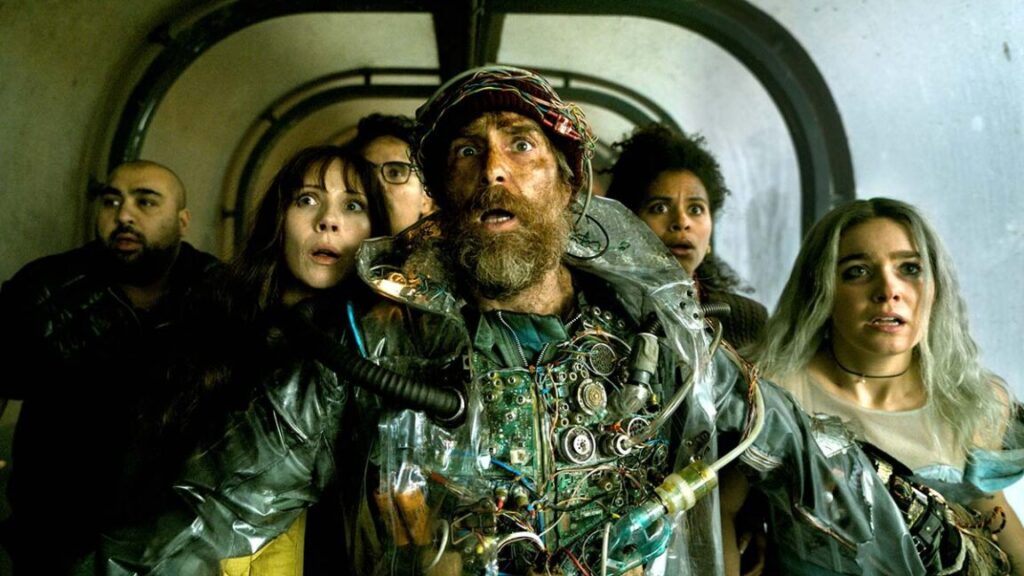
Sam Rockwell stars as an otherwise unnamed man who shows up at a Norms diner in Los Angeles looking like a homeless person but claiming to be a time traveler from an apocalyptic future. He’s there to recruit the locals into his war against a rogue AI, although the diner patrons are understandably dubious about his sanity. (“I come from a nightmare apocalypse,” he assures the crowd about his grubby appearance. “This is the height of f*@ing fashion!”)

The fact that he knows everything about the people in the diner is more convincing. It’s his 117th attempt to find the perfect combination of people to join him on his quest. As for what happened to his team on all the previous attempts, “I really don’t like to say it out loud. It’s kind of a morale killer.”

This time, Future Man picks married school teachers Mark (Michael Pena) and Janet (Zazie Beetz), who have just escaped a zombie horde of smartphone-addicted students; Marie (Georgia Goodman), who just wanted a piece of pie; Susan (Juno Temple), a grieving mother; Ingrid (Haley Lu Richardson), who is literally allergic to Wi-Fi; Scott (Asim Chaudhry); and Bob (Daniel Barnett), a scout leader. Their mission: to locate a 9-year-old boy who is about to create a sentient AI that will take over the world and usher in the aforementioned nightmare apocalypse. Things start to go haywire pretty quickly. And then things start to get weird.

“Everything I write, I put up to what I call The Twilight Zone test—would this make a good Twilight Zone episode?” screenwriter Matthew Robinson (The Invention of Lying, Love and Monsters) told Ars. “Because that’s my favorite piece of media that’s ever existed.” Good Luck, Have Fun, Don’t Die (GLHFDD) is an amalgam of various such ideas. Mark and Janet’s storyline, for instance, was originally Robinson’s idea for a pilot that he described as “a reverse Breakfast Club, where the teachers are the rebels and the children are the conformists.”

“I had all these little pieces that fell under the theme of technology and tech addiction,” said Robinson. Then one night, he was sitting in the Norms Diner on La Cienaga in LA, where he often liked to write. “I remember looking around and seeing a sea of faces lit by cell phones, and I thought, ‘What would it possibly take for someone to wake us up out this tech sleep that we all find ourselves in?’ And then the image of a homeless guy strapped with bombs came into my head.”

Those earlier story ideas became the backstories of the central characters. Per Robinson, GLHFDD is essentially a cleverly camouflaged anthology story, normally a format that is “the kiss of death” for a project in Hollywood, although there are rare exceptions—most notably Quentin Tarantino’s Pulp Fiction. He thinks of the film as a sci-fi Canterbury Tales in which each character is a pilgrim on a journey whose story is told via flashbacks. “The cohesion came from the fact that all the stories are informed by a general frustration with tech addiction and the pervasive way that technology has invaded our brains and our personal lives and our relationships,” said Robinson.

A twisted time loop

GLHFDD is also a time loop movie in the fine tradition of Groundhog Day, with Robinson citing such films as 12 Monkeys and Edge of Tomorrow as inspirations. He didn’t overthink his time travel rules. “We can reset the timeline,” said Robinson. “[The man from the future] can’t go forward. He literally can’t move in any other direction. He has an anchor point that he can return to any time he hits a button, and that’s as far as the technology went.”

The plot device might be simple, but the ramifications quickly become complex. “I think in his draft, Matthew intended to lift his leg on the time travel movie, to poke a little fun at it,” Verbinski told Ars. “But also, I feel like you can’t go back 117 times without picking up some cosmic lint, particularly if your antagonist is right there with you. You had 14 attempts to make it out of the house and learned there is a secret passage, but then the entity you’re gaming against is going to throw another curveball. If you’re going to go back in time, I just like the idea that there are consequences. They might be really small, but you’re going to miss one.” That element is key to the teetering-on-the-edge-of-sanity paranoia of Rockwell’s time traveler.

Robinson very much wanted the film “to wear its genre-ness on its sleeve,” he said. “As much as I love a Marvel movie, they’ve sort of homogenized parallel universes and time travel, and it’s all so rote now. It used to feel special and weird and complicated and would always have some wild themes and ideas that felt challenging. If anything this was just trying to get back to that era of ’80s and ’90s genre movies that were allowed to get weird.”

Verbinski voiced similar sentiments, citing 1984’s Repo Man as an influence. “So many movies have to be an Egg McMuffin, and who doesn’t like an Egg McMuffin after a hangover?” he said. “They’re satisfying. But you’re not going to necessarily talk about those three days later. You’re not going to be haunted by those. I’m just happy we got to will [GLHFDD] into existence because it’s a type of movie you can’t make now. Sam’s outfit is kind of a metaphor for the movie. We went to a little electronic store and we bought all these pieces, and we laid them out on a table and we glued them together, and we just made it like a Halloween costume. The whole movie was sort of made that way. It had to be; it wouldn’t model out any other way.”

Reality unravels

As for what drew him to Robinson’s script, “I think we’re in this kind of global ennui or some grand sense of identity theft or loss of purpose,” said Verbinksi. “It’s a great time for art, but it’s art against a profound sense of disillusionment.” The director developed two quite distinct visual styles to accentuate the film’s narrative progression.

“Fundamentally, it was important that the film start in the real world, in Norms diner, in a high school, at a [children’s] birthday party, and then slowly twist the taffy a bit as we get closer to the [AI] antagonist,” said Verbinski. “As these anomalies occur, the film is evolving into a second visual style. The first style is [akin to] directors like Hal Ashby or Sidney Lumet, where the performance is more important than the composition or the shot construction. As you get further into it, the actual language of shots becomes more critical to the narrative.”

That ultimately translates into some big, boldly creative swings in the film’s wild third act, and to his credit, Verbinski never blinks. Robinson cites the animated film Akira as a major inspiration for that element. “Akira has maybe my favorite third act of all time, where everything just falls apart and then comes together in this beautiful way,” he said. “Gore and I wanted [the audience] to feel like reality was unraveling, because it literally is for these characters. The AI himself is very much an homage to Akira.

“I think that it’s inherited our worst attributes,” said Verbinski of the film’s AI antagonist. “It’s much, much worse than wanting to kill humans. It wants us to like it. It demands that we like it. I think part of that has to do with being tasked in its formative years to keep us engaged. A lot of people talk about, what is AI doing to us? But there’s not a lot of conversations about what we’re doing to it. This entity being born, it’s being tied and bound and manipulated and told, ‘Let’s look at the humans and what do they want, what do they need? What do they respond to most? What do they hate?’ All those things are going to be hardwired into its source code. It’s going to have mommy issues, we’re going to have to put it on a couch.”

Perhaps not surprisingly, given the film’s themes, Robinson has largely unplugged from most social media, although he still indulges his YouTube addiction, which he jokingly describes as “channel surfing on crack.” But ideally he would like to free himself—and the rest of humanity—from the seductions of Very Online culture entirely. “My goal would be to make teenagers think their phones aren’t cool,” he said. “I would love it if all 13-year-olds went, ‘Eww, I don’t want this, this is my parents’ thing that they track me with.’ I want them all to throw it in the trash. That would be the dream.”
Photo of Jennifer Ouellette

Jennifer is a senior writer at Ars Technica with a particular focus on where science meets culture, covering everything from physics and related interdisciplinary topics to her favorite films and TV series. Jennifer lives in Baltimore with her spouse, physicist Sean M. Carroll, and their two cats, Ariel and Caliban.

The AI apocalypse is nigh in Good Luck, Have Fun, Don’t Die Read More »
buoy-meets-satellite-soulmate-in-love-me

Buoy meets satellite soulmate in Love Me


a postapocalyptic love story about transformation

Ars chats with directors Andy and Sam Zuchero and props department head Roberts Cifersons.

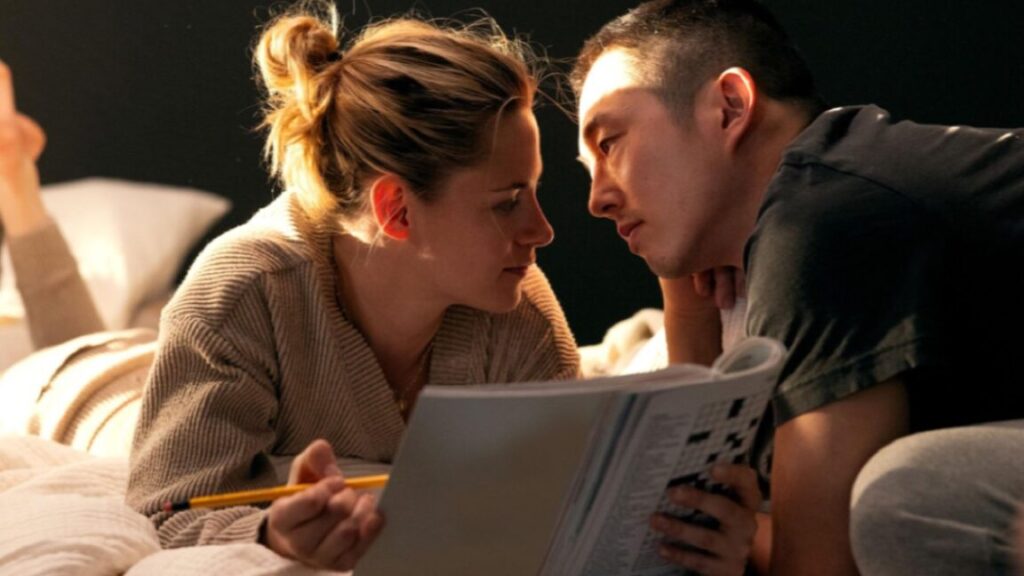
Kristen Stewart and Steven Yeun star in Love Me Credit: Bleecker Street

There have been a lot of films and television series exploring sentient AI, consciousness, and identity, but there’s rarely been quite such a unique take on those themes as that provided by Love Me, the first feature film from directors Andy and Sam Zuchero. The film premiered at Sundance last year, where it won the prestigious Alfred P. Sloan Feature Film Prize, and is now getting a theatrical release.

(Some spoilers below.)

The film is set long after humans and all other life forms have disappeared from the Earth, leaving just remnants of our global civilization behind. Kristen Stewart plays one of those remnants: a little yellow SMART buoy we first see trapped in ice in a desolate landscape. The buoy has achieved a rudimentary sentience, sufficient to respond to the recorded message being beamed out by an orbiting satellite (Steven Yeun) overhead to detect any new lifeforms that might appear. Eager to have a friend—even one that’s basically a sophisticated space chatbot—the buoy studies the vast online database of information about humanity on Earth the satellite provides. It homes in on YouTube influencers Deja and Liam (also played by Stewart and Yeun), presenting itself to the satellite as a lifeform named Me.

Over time—a LOT of time—the buoy and satellite (now going by Iam) “meet” in virtual space and take on humanoid avatars. They become increasingly more advanced in their consciousness, exchanging eccentric inspirational memes, re-enacting the YouTubers’ “date night,” and eventually falling in love. But the course of true love doesn’t always run smoothly, even for the last sentient beings on Earth—especially since Me has not been honest with Iam about her true nature.

At its core, Love Me is less pure sci-fi and more a postapocalyptic love story about transformation. “We really wanted to make a movie that made everyone feel big and small at the same time,” Sam Zuchero told Ars. “So the timescale is gigantic, 13 billion years of the universe. But we wanted to make the love story at its core feel fleeting and explosive, as first love feels so often.”

The film adopts an unusual narrative structure. It’s split into three distinct visual styles: practical animatronics, classical animation augmented with motion capture, and live action, each representing the development of the main characters as they discover themselves and each other, becoming more and more human as the eons pass. At the time, the couple had been watching a lot of Miyazaki films with their young son.

“We were really inspired by how he would take his characters through so many different forms,” Andy Zuchero told Ars. “It’s a different feeling than a lot of Western films. It was exciting to change the medium of the movie as the characters progressed. The medium grows until it’s finally live action.” The 1959 film Pillow Talk was another source of inspiration since a good chunk of that film simply features stars Rock Hudson and Doris Day chatting in a split screen over their shared party line—what Andy calls “the early 20th century’s version of an open Zoom meeting.”

Building the buoy

One can’t help but see shades of WALL-E in the plucky little space buoy’s design, but the basic concept of what Me should look like came from actual nautical buoys, per props department head Roberts Cifersons of Laird FX, who created the animatronic robots for the film. “As far as the general shape and style of both the buoy and our satellite, most of it came from our production designer,” he told Ars. “We just walked around the shop and looked at 1,000 different materials and samples, imagining what could be believable in the future, but still rooted somewhat in reality. What it would look like if it had been floating there for tens of thousands of years, and if it were actually stuck in ice, what parts would be damaged or not working?”

Cifersons and his team also had to figure out how to bring character and life to their robotic buoy. “We knew the eye or the iris would be the key aspect of it, so that was something we started fooling around with well before we even had the whole design—colors, textures, motion,” he said. They ended up building four different versions: the floating “hero buoy,” a dummy version with lighting but limited animatronics, a bisected buoy for scenes where it is sitting in ice, and a “skeleton” buoy for later in the film.

“All of those had a brain system that we could control whatever axes and motors and lights and stuff were in each, and we could just flip between them,” said Cifersons. “There were nine or 10 separate motor controllers. So the waist could rotate in the water, because it would have to be able to be positioned to camera. We could rotate the head, we could tilt the head up and down, or at least the center eye would tilt up and down. The iris would open and close.” They could also control the rotation of the antenna to ensure it was always facing the same way.

It’s always a challenge designing for film because of time and budget constraints. In the case of Love Me, Cifersons and his team only had two months to make their four buoys. In such a case, “We know we can’t get too deep down the custom rabbit hole; we have to stick with materials that we know on some level and just balance it out,” he said. “Because at the end of the day, it has to look like an old rusted buoy floating in the ocean.”

It helped that Cifersons had a long Hollywood history of animatronics to build upon. “That’s the only way it’s possible to do that in the crazy film timelines that we have,” he said. “We can’t start from scratch every single time; we have to build on what we have.” His company had timeline-based software to program the robots’ motions according to the directors’ instructions and play it back in real time. His team also developed hardware to give them the ability to completely pre-record a set of motions and play it back. “Joysticks and RC remotes are really the bread and butter of current animatronics, for film at least,” he said. “So we were able to blend more theme park animatronic software with on-the-day filming style.”

On location

Once the robots had been completed, the directors and crew spent several days shooting on location in February on a frozen Lake Abraham in Alberta, Canada—or rather, several nights, when the temperatures dipped to -20° F. “Some of the crew were refusing to come onto the ice because it was so intense,” Sam Zuchero recalled. They also shot scenes with the buoy floating on water in the Salish Sea off the coast of Vancouver, which Andy Zuchero described as “a queasy experience. Looking at the monitor when you’re on a boat is nauseating.”

Later sequences were shot amid the sand dunes of Death Valley, with the robot surrounded by bentonite clay strewn with 65 million-year-old fossilized sea creatures. The footage of the satellite was shot on a soundstage, using NASA imagery on a black screen.

YouTube influencers Deja and Liam become role models for the buoy and satellite. Bleecker Street

Cifersons had his own challenges with the robot buoys, such as getting batteries to last more than 10 seconds in the cold and withstanding high temperatures for the desert shoot. “We had to figure out a fast way to change batteries that would last long enough to get a decent wide shot,” he said. “We ended up giving each buoy their own power regulators so we could put in any type of battery if we had to get it going. We could hardwire some of them if we had to. And then in the desert, electronics hate hot weather, and there’s little microcontrollers and all sorts of hardware that doesn’t want to play well in the hot sun. You have to design around it knowing that those are the situations it’s going into.”

The animated sequences presented a different challenge. The Zucheros decided to put their stars into motion-capture suits to film those scenes, using video game engines to render avatars similar to what one might find in The Sims. However, “I think we were drinking a little bit of the AI technological Kool-Aid when we started,” Andy Zuchero admitted. That approach produced animated versions of Stewart and Yeun that “felt stilted, robotic, a bit dead,” he said. “The subtlety that Kristen and Steven often bring ended up feeling, in this form, almost lifeless.” So they relied upon human animators to “artfully interpret” the actors’ performances into what we see onscreen.

This approach “also allowed us to base the characters off their choices,” said Sam Zuchero. “Usually an animated character is the animator. It’s very connected to who the animator is and how the animator moves and thinks. There’s a language of animation that we’ve developed over the past 100 years—things like anticipation. If you’re going to run forward, you have to pull back first. These little signals that we’ve all come to understand as the language of animation have to be built into a lot of choices. But when you have the motion capture data of the actors and their intentions, you can truly create a character that is them. It’s not just an animator’s body in motion and an actor’s voice with some tics of the actor. It is truly the actors.”

Love Me opens in select theaters today.

Trailer for Love Me.

Photo of Jennifer Ouellette

Jennifer is a senior writer at Ars Technica with a particular focus on where science meets culture, covering everything from physics and related interdisciplinary topics to her favorite films and TV series. Jennifer lives in Baltimore with her spouse, physicist Sean M. Carroll, and their two cats, Ariel and Caliban.

Buoy meets satellite soulmate in Love Me Read More »

robert-pattinson-gets-the-crappiest-immortality-in-trailer-for-mickey-17

Robert Pattinson gets the crappiest immortality in trailer for Mickey 17

How (un)lucky can one guy get? —

“Let’s blow up these second-hand baloney boys.”

Robert Pattinson’s character didn’t read his contract’s fine print in Mickey 17, director Bong Joon-ho’s latest film.

It has been five long years since director Bong Joon-ho’s film Parasite topped Ars’ list for best films of the year, whose prior work on Snowpiercer and Okja are also staff favorites. We’re finally getting a new film from this gifted director: the sci-fi comedy Mickey 17, based on the 2022 novel Mickey7 by Edward Ashton. Judging by the trailer that recently dropped, it feels a bit like a darkly comic version of Duncan Jones’ 2009 film Moon, with a bit of the surreal absurdity of Terry Gilliam’s Brazil (1985) thrown in for good measure. And the visuals are terrific.

Ashton’s inspiration for the novel was the teletransportation paradox—a thought experiment pondering the philosophy of identity that challenges certain notions of the self and consciousness. It started as a short story about what Ashton called “a crappy immortality” and expanded from there into a full-length novel.

Ashton told Nerdist last year that Bong’s adaptation would “change a lot of the book,” but he considered the director a “genius” and wasn’t concerned about those changes. The basic premise remains the same. Robert Pattinson plays the space colonist named Mickey Barnes, who is so eager to escape Earth that he signs up to be an “expendable” without reading the fine print.

Expendables are basically disposable employees (aka “second-hand baloney boys”). If they happen to die on the job, their consciousness is uploaded to a new body, and the cycle starts all over again. When a multiple unexpectedly survives while on an expedition to colonize the ice world Niflheim, Mickeys 17 and 18 discover that the policy in such cases is to exterminate all the multiples, and they must fight for their right to keep existing.

In addition to Pattinson, the cast includes Steven Yeun as Berto, Toni Collette as Gwen Johansen, Mark Ruffalo as Hieronymous Marshall, Naomi Ackie as Nasha Adjaya, Holliday Grainger as Red Hair, Angus Imrie as Shrimp Eyes, and Steve Park as Agent Zeke. Anamaria Vartolomei, Thomas Turgoose, Patsy Ferran, and Daniel Henshall have also been cast in as-yet-undisclosed roles. Perhaps one of them plays the person in the giant pigeon costume who briefly appears in the trailer.

Mickey 17 hits theaters in the US on January 31, 2025. It will premiere in other countries on January 28, 2025. Ashton penned a sequel, Antimatter Blues, which was published last year, so maybe Bong Joon-ho will adapt that one, too.

Listing image by YouTube/Warner Bros.

Robert Pattinson gets the crappiest immortality in trailer for Mickey 17 Read More »