samsung

software-update-shoves-ads-onto-samsung’s-pricey-fridges

Software update shoves ads onto Samsung’s pricey fridges

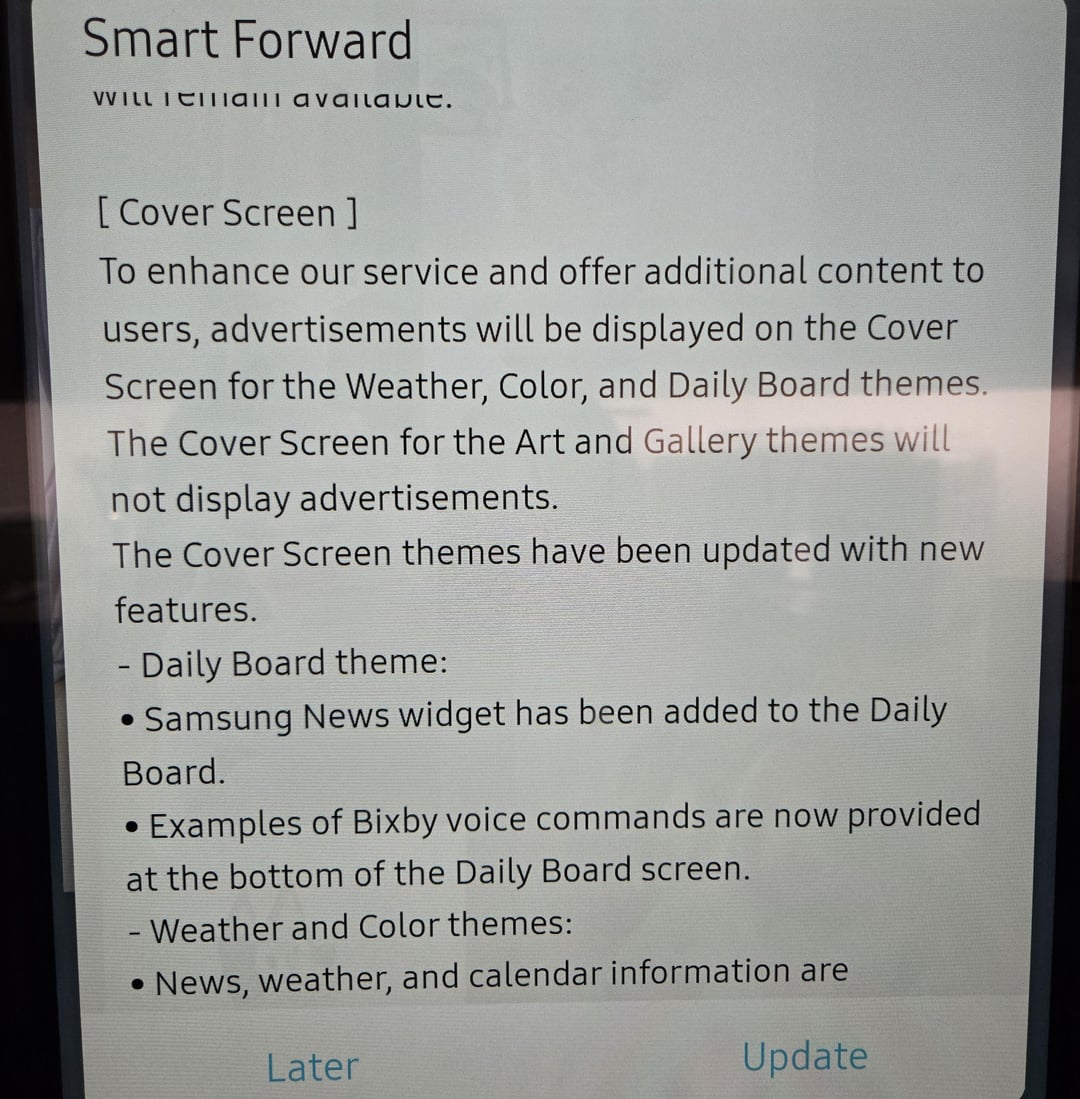
A picture that the Redditor posted shows a message purportedly displayed on a Samsung fridge informing owners of the ads, reading: “To enhance our service and offer additional content to users, advertisements will be displayed on the Cover Screen for the Weather, Color, and Daily Board Themes.”

The notice shown on Samsung fridges.

A Reddit user shared this notice shown on Samsung fridges.

A Reddit user shared this notice shown on Samsung fridges. Credit: angrycatmeowmeow/Reddit

Samsung recently downplayed the idea of using smart appliances’ screens for ads. While speaking with The Verge in April, Jeong Seung Moon, EVP and head of the R&D team for Samsung Electronics’ Digital Appliances Business, said Samsung had “no plans regarding the inclusion of advertisements on AI Home screens.”

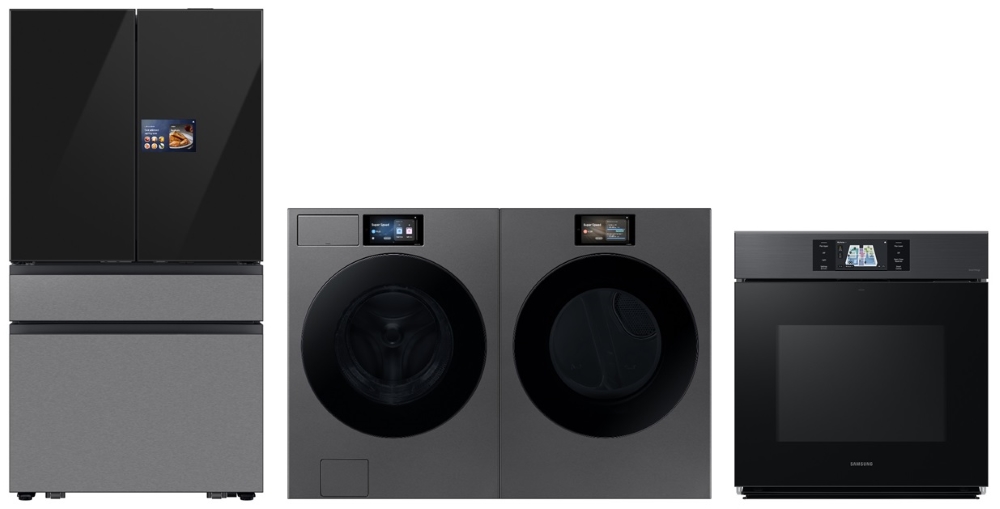
Technically, the pilot program is running on fridges’ larger “Cover Screens,” not “AI Home Screens,” which are smaller (7 -or 9-inch) touchscreens that Samsung introduced to appliances in late 2024. But it still feels like Samsung missed numerous opportunities to manage expectations with its rollout of ads on Samsung products.

You can see the smaller AI Home Screens on these Samsung appliances.
You can see the smaller AI Home Screens on these Samsung appliances.
Credit: Samsung

You can see the smaller AI Home Screens on these Samsung appliances. Credit: Samsung
Despite this, some may have been tipped off to Samsung’s potential shift to ads from the company’s growing obsession with putting screens on products that are usually controllable with more repairable, affordable, and simpler solutions, like buttons and dials. But there are still bound to be people upset to see their fridge updated to display commercial messaging where their family eats and cooks.

Another reason to leave appliances offline

Based on Samsung’s statement, users can prevent ads from showing on their smart fridges by having the screen show photos or art. However, that limits the ways people can use their expensive fridge.

Another option is to disconnect the fridge from the Internet. Again, though, this would eliminate some core capabilities, like its meal planner, recipes, and shopping list features.
On the other hand, some Samsung fridge owners may not even notice the update, considering that vendors have struggled to get people to connect home appliances to the Internet. Less than half of the smart appliances that LG had sold were online in 2023, for example.

Smart appliance makers that would like to access the valuable user data and ad revenue that are available when people connect their appliances to the web battle privacy concerns, indifference, and technical limitations. Samsung’s reminder to everyone about how easy it is for tech companies to turn people’s smart appliances into billboards is another deterrent.

But with expensive and large electronics purchases happening infrequently for most households, many tech companies are increasingly relying on ads for recurring revenue. It’s very unlikely that Samsung’s pilot program will be the last we hear of the sudden appearance of ads on smart home devices.

Software update shoves ads onto Samsung’s pricey fridges Read More »

samsung’s-“micro-rgb”-tv-proves-the-value-of-rgb-backlights-for-premium-displays

Samsung’s “Micro RGB” TV proves the value of RGB backlights for premium displays


The $30,000 TV brings a new, colorful conversation to home theaters.

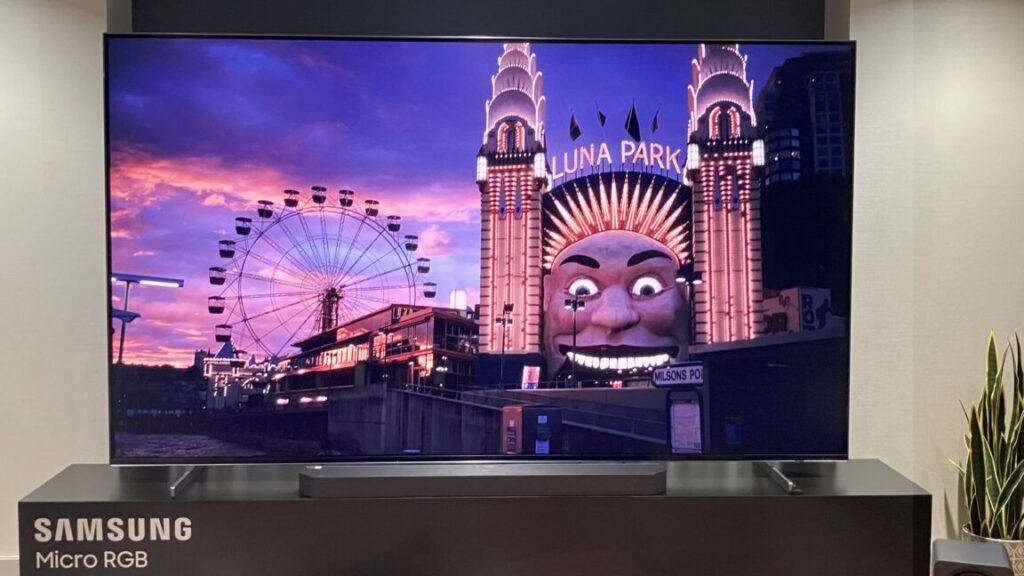
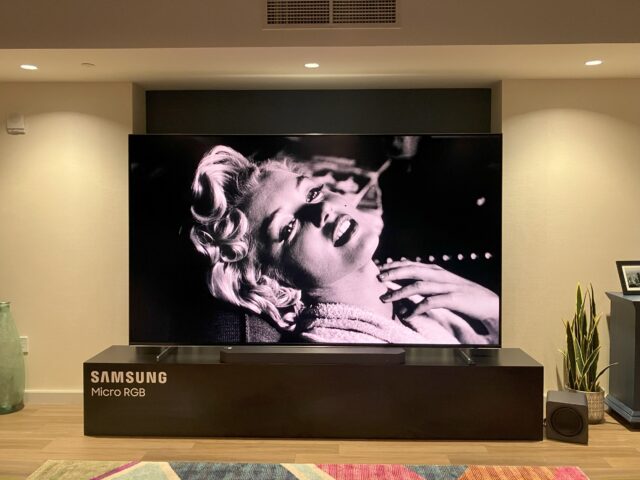
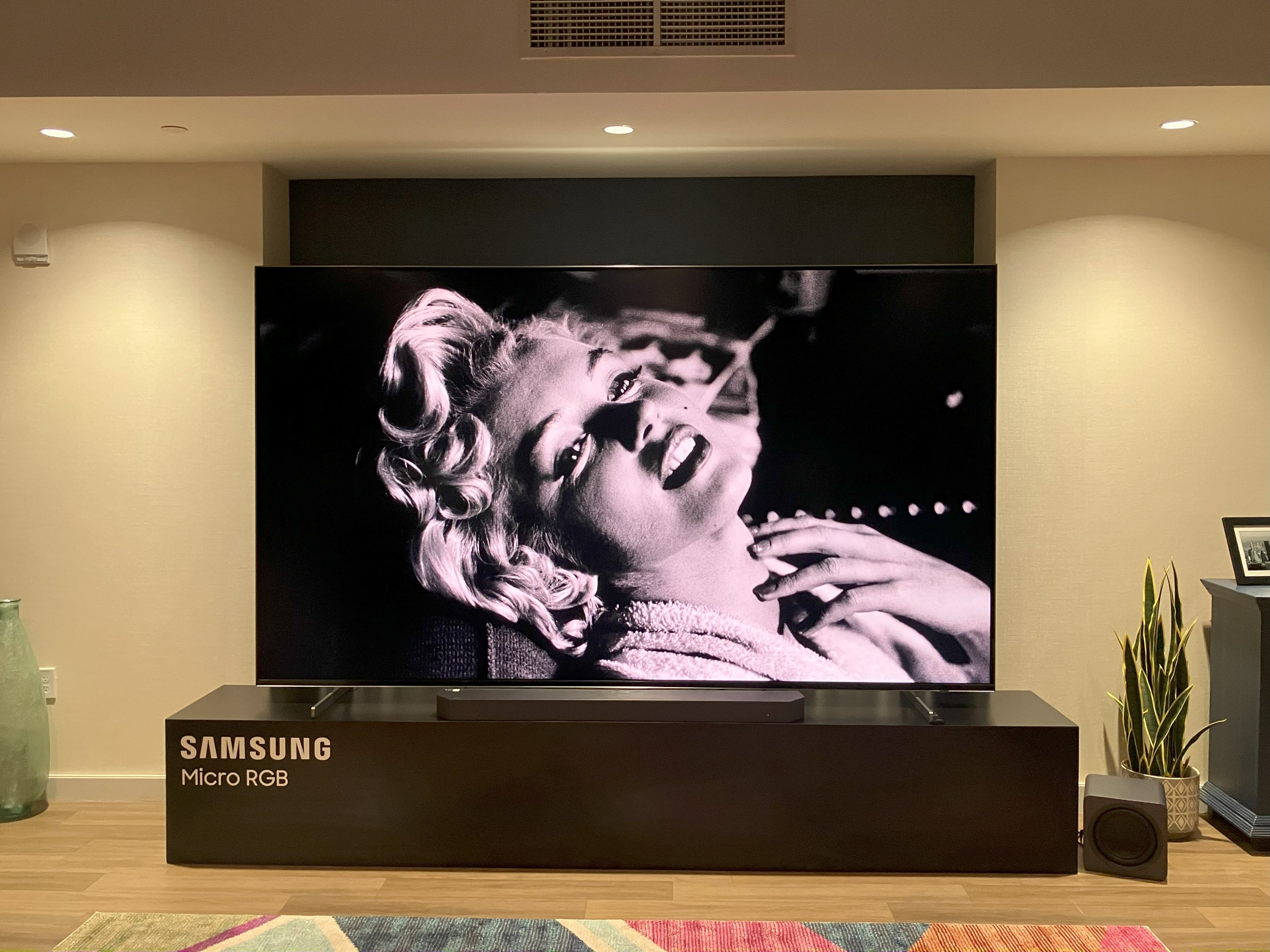
Samsung’s 115-inch “Micro RGB” TV. Credit: Scharon Harding

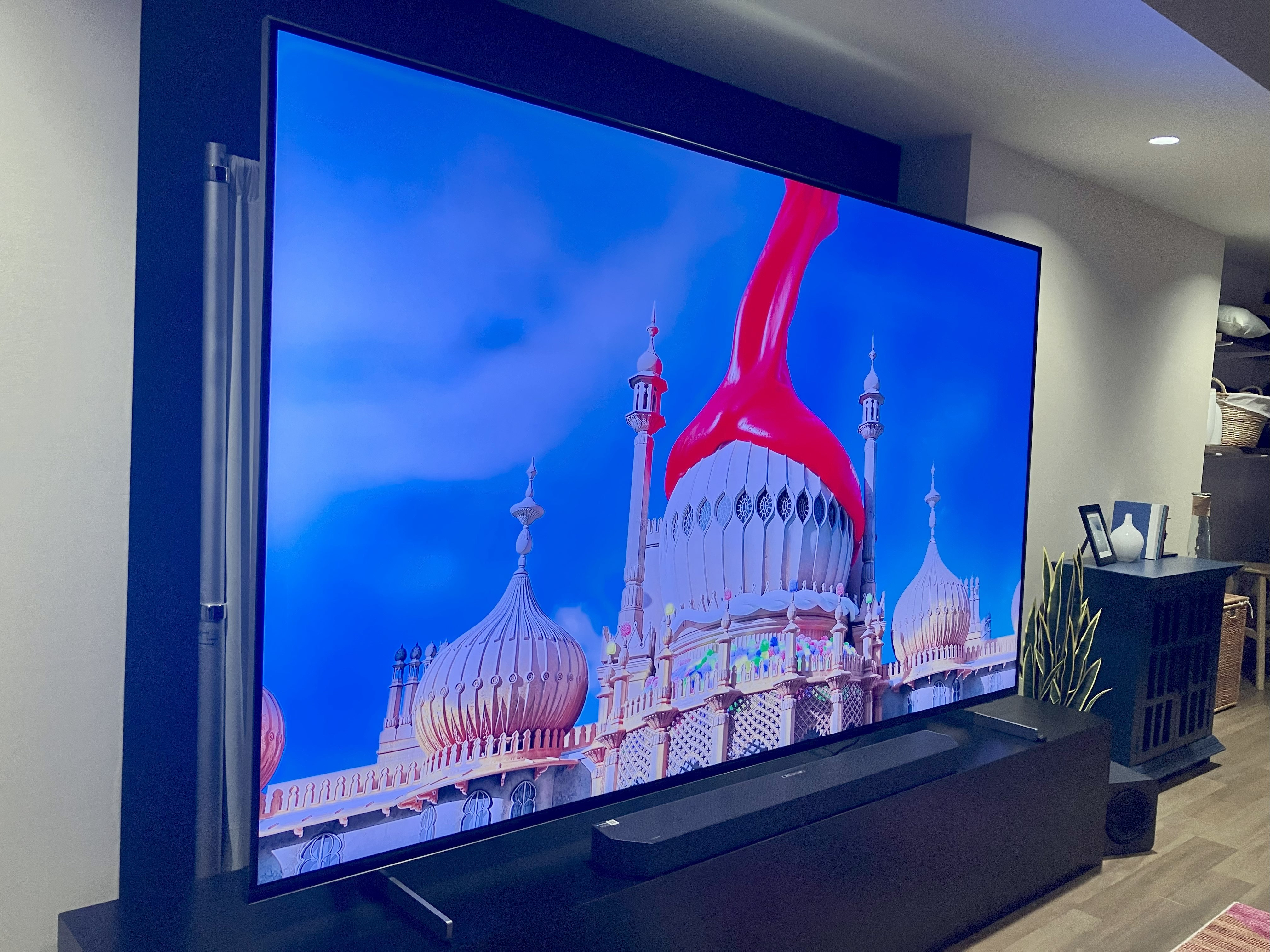
ENGLEWOOD CLIFFS, New Jersey—Micro LED is still years away, but the next best thing is taking shape right now. A $30,000 price tag and 114.5-inch diagonal size makes the Samsung “Micro RGB” TV  that I demoed this week unattainable for most. But the unique RGB backlight and Micro LED-sized diodes it employs represent a groundbreaking middle ground between high-end Mini LED and true Micro LED, expanding the possibilities for future premium displays beyond the acronyms we know today.

Micro RGB isn’t the same as Micro LED

To be clear, Samsung’s Micro RGB TV is not a Micro LED display. During Samsung’s presentation, a representative described the TV as sitting “squarely in between” Mini LED and Micro LED.

Unlike true Micro LED TVs, Samsung’s Micro RGB TV uses a backlight. The backlight is unique in that it can produce red, green, and/or blue light via tiny RGB LEDs. Most LCD-LED backlights create just blue or white backlighting, which is applied to color filters to create the different hues displayed on the screen.

And differing from a true Micro LED display, the pixels in the Samsung TV I demoed aren’t self-emissive and can’t be shut off individually for virtually limitless contrast. Like some of the best Mini LED TVs, this TV delivers enhanced contrast through the use of thousands of local dimming zones. Without getting specific, Samsung said the Micro RGB TV has roughly four times the number of dimming zones as its 115-inch QN90F TV, a $27,000 Mini LED TV that uses quantum dots. Samsung hasn’t confirmed how many dimming zones the 115-inch QN90F has, but the 75-inch version has 900 dimming zones, according to RTINGs.

The Micro RGB TV loses to Micro LED and OLED when it comes to light bleed and contrast. The new TV’s biggest draw is its large color gamut. The backlight’s “architecture enables precision control over each red, green, and blue LED,” according to Samsung’s announcement of the TV earlier this month. Samsung claims that the backlight tech enables the TV to cover 100 percent of the BT.2020 color space (also known as Rec.2020), which is a wider color space than DCI-P3. As is typical for Samsung, the company hasn’t disclosed any Delta E measurements but claims high color accuracy.

I’m still concerned about the Micro RGB name, which carries the risk of being confused with true Micro LED. In the past, Samsung has contributed to display-market confusion with terms like QLED (an acronym that looks awfully similar to OLED). The new display technology is impressive enough; its marketing doesn’t need to evoke associations with a markedly different display type.

Hands-on with Samsung’s Micro RGB TV

Seeing the Micro RGB TV in person confirmed the great potential RGB backlight tech represents. The image quality didn’t quite match what you’d see with a similar OLED or Micro LED display, but what I saw in my short time with the TV surpassed what I’d expect from the best LCD-LED TVs.

I demoed the TV in a mildly lit room, where the screen’s lively colors quickly leaped out at me. I mostly watched pre-selected, polychromatic videos on the TV, making it hard to discern color accuracy. But during the brief demo, I saw colors that are rare to see on even the most expensive TVs.

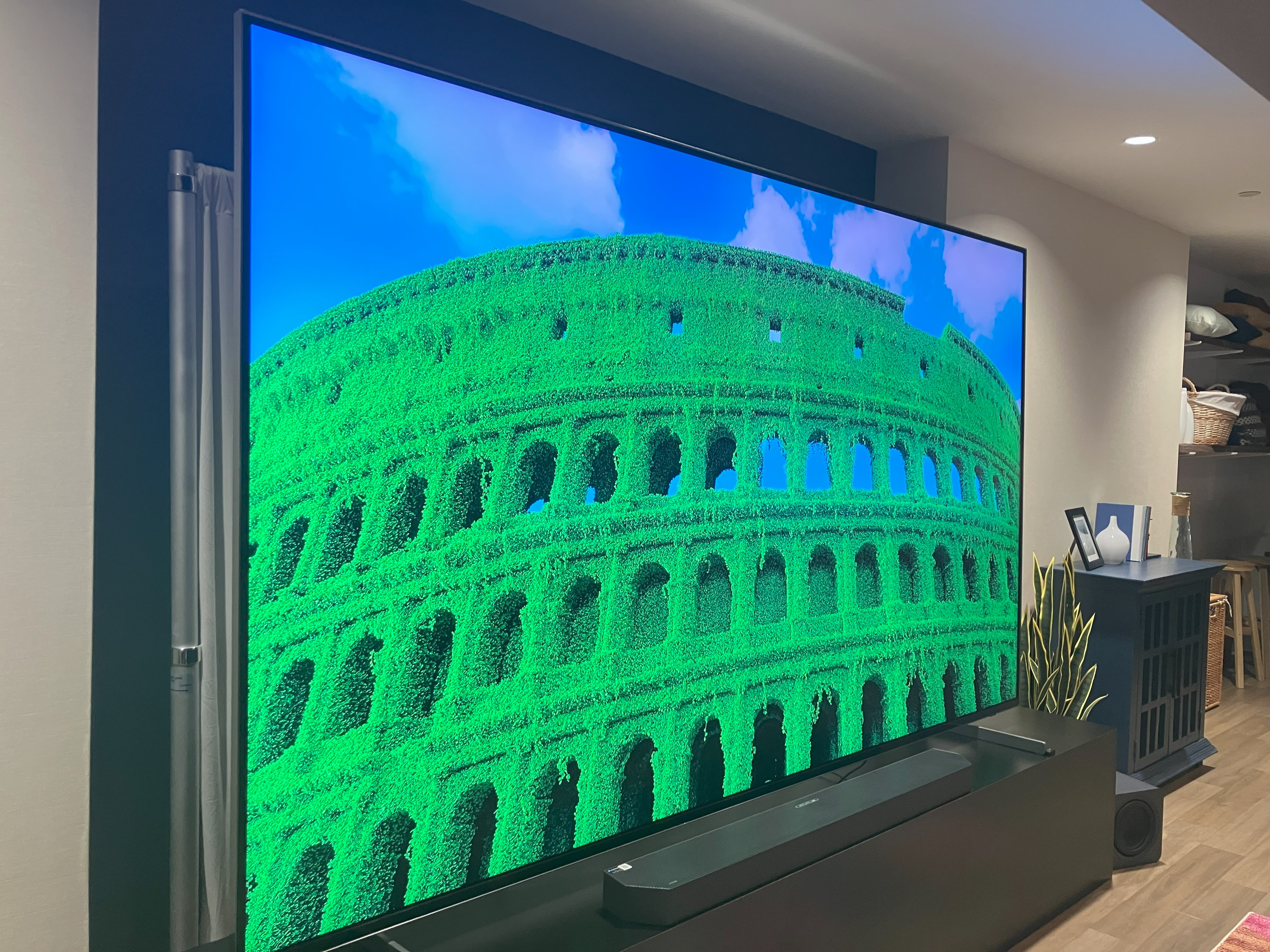
For example, part of the demo reel (shown below) featured a building in a shade of teal that I can’t recall ever seeing on a TV. It was a greener-leaning teal that had just the right amount of blue to distinguish it from true green. Many displays would fail to capture that subtle distinction.

The demo video also showed a particular shade of pinkish-red. Again, this was the first time I had seen this video, making me wonder if a purer red would be more accurate. But I also saw strong, bright, bloody reds during my demo, suggesting that this unfamiliar pinkish-red was the result of the Micro RGB TV’s broad color gamut.

Samsung's Micro RGB TV

Unsurprisingly, the TV packs in AI, including a feature that’s supposed to automatically recognize scenes with dull lighting and make them look more lively.

Credit: Scharon Harding

Unsurprisingly, the TV packs in AI, including a feature that’s supposed to automatically recognize scenes with dull lighting and make them look more lively. Credit: Scharon Harding

Another top standout from my demo was the smooth gradient effects that the TV showed. I could detect no banding in a sunset-like background, for instance, as deep oranges effortlessly transitioned to paler shades before seamlessly evolving into white. Nuanced shades also appeared to enable unique textures on the TV. When the TV was set to display a painting, the screen seemed to mimic the rough texture of canvas or the subtle strokes of paintbrushes. Of course, the TV’s massive size helped emphasize these details, too.

Because it lacks self-emissive pixels, the Micro RGB should have poorer contrast than a good Micro LED (or OLED) TV. The differing prices between Samsung’s 115-inch Micro RGB TV and 114-inch Micro LED TV ($30,000 versus $150,000) hint at the expected performance discrepancy between the display technologies. You won’t get pure blacks with an RGB LED TV, but Samsung’s TV makes a strong effort; some may not notice the difference.

Unlike OLED TVs, the Samsung TV also has potential for the halo effect (also known as blooming). In instances when the TV was showing bright, near-white colors near dark colors, it was hard to notice any halos or gradation. But I didn’t see enough of the right type of content on Samsung’s TV to determine how much of a potential blooming problem it has. Light bleed did seem to be kept to a minimum, though.

The TV also appeared to handle the details of darker images well. A representative from Sony, which is working on a somewhat different RGB LED backlight technology, told Wired that the use of RGB LED backlights could enable displays to show an “expression of colors with moderate brightness and saturation” better than today’s OLED screens can, meaning that RGB LED TVs could be more color-accurate, including in dark scenes. Generally speaking, anything that helps LCD-LED remain competitive against OLED is good news for further development of LED-based displays, like Micro LED.

Samsung's Micro RGB TV

Credit: Scharon Harding

Samsung specs the Micro RGB TV with a 120 Hz standard rate. The company didn’t disclose how bright the TV can get. Bright highlights enable improved contrast and a better experience for people whose TVs reside in rooms that get bright (yes, these people exist). Display experts also associate properly managed brightness levels with improved color accuracy. And advanced mastering monitors can enable content with brightness levels of up to 4,000 nits, making ultra-bright TVs worth long-term consideration for display enthusiasts.

More RGB LED to come

Samsung is ahead of the curve with RGB backlights and is expected to be one of the first companies to sell a TV like this one. A Samsung spokesperson outside of the event told Ars Technica, “Samsung created an entirely new technology to control and drive each LED, which has different characteristics, to provide more accurate and uniform picture quality. We also worked to precisely mount these ultra-small LEDs in the tens of microns on a board.”

As mentioned above, other companies are working on similar designs. Sony showed off a prototype in February that Wired tested; it should be released in 2026. And Hisense in January teased the 116-inch “TriChrome LED TV” with an RGB LED backlight. It’s releasing in South Korea for KRW 44.9 million (approximately $32,325), SamMobile reported.

Notably, Hisense and Sony both refer to their TVs as Mini LED displays, but the LEDs used in the Hisense and Sony designs are larger than the LEDs in Samsung’s RGB-backlit TV.

Good news for display enthusiasts

Samsung's Micro RGB TV

A striking lime-like green covers an amphitheater.

Credit: Scharon Harding

A striking lime-like green covers an amphitheater. Credit: Scharon Harding

Samsung’s TV isn’t the Micro LED TV that display enthusiasts have long hoped for, but it does mark an interesting development. During the event, a third Samsung representative told me it’s “likely” that there’s overlap between the manufacturing equipment used for Micro LED and RGB-backlit displays. But again, the company wouldn’t get into specifics.

Still, the development is good news for the LED-LCD industry and people who are interested in premium sets that don’t use OLED displays, which are expensive and susceptible to burn-in and brightness limitations (these issues are improving, though). It’s likely that RGB-backlit TVs will eventually become a better value than pricier types of premium displays, as most people won’t notice the downsides.

The Samsung rep I spoke with outside of the event told me the company believes there’s room in the market for RGB Micro TVs, QLEDs, OLEDs, Mini LEDs, and Micro LEDs.

According to the press release of the Micro RGB TV, Samsung has “future plans for a global rollout featuring a variety of sizes.” For now, though, the company has successfully employed a new type of display technology, creating the possibility of more options for display enthusiasts.

Photo of Scharon Harding

Scharon is a Senior Technology Reporter at Ars Technica writing news, reviews, and analysis on consumer gadgets and services. She’s been reporting on technology for over 10 years, with bylines at Tom’s Hardware, Channelnomics, and CRN UK.

Samsung’s “Micro RGB” TV proves the value of RGB backlights for premium displays Read More »

trump-confirms-us-is-seeking-10%-stake-in-intel-bernie-sanders-approves.

Trump confirms US is seeking 10% stake in Intel. Bernie Sanders approves.

Trump plan salvages CHIPS Act he vowed to kill

While chipmakers wait for more clarity, Lutnick has suggested that Trump—who campaigned on killing the CHIPS Act—has found a way to salvage the legislation that Joe Biden viewed as his lasting legacy. It seems possible that the plan arose after Trump realized how hard it would be to ax the legislation completely, with grants already finalized (but most not disbursed).

“The Biden administration literally was giving Intel money for free and giving TSMC money for free, and all these companies just giving the money for free, and Donald Trump turned it into saying, ‘Hey, we want equity for the money. If we’re going to give you the money, we want a piece of the action for the American taxpayer,'” Lutnick said.

“It’s not governance, we’re just converting what was a grant under Biden into equity for the Trump administration, for the American people,” Lutnick told CNBC.

Further, US firms could potentially benefit from any potential arrangements. For Intel, the “highly unusual” deal that Trump is mulling now could help the struggling chipmaker compete with its biggest rivals, including Nvidia, Samsung, and TSMC, BBC noted.

Vincent Fernando, founder of the investment consultancy Zero One, told the BBC that taking a stake in Intel “makes sense, given the company’s key role in producing semiconductors in the US,” which is a major Trump priority.

But as Intel likely explores the potential downsides of accepting such a deal, other companies applying for federal grants may already be alarmed by Trump’s move. Fernando suggested that Trump’s deals to take ownership stake in US firms—which economics professor Kevin J. Fox said only previously occurred during the global financial crisis—could add “uncertainty for any company who is already part of a federal grant program or considering one.”

Fox also agreed that the Intel deal could deter other companies from accepting federal grants, while possibly making it harder for Intel to run its business “effectively.”

Trump confirms US is seeking 10% stake in Intel. Bernie Sanders approves. Read More »

samsung-galaxy-z-fold-7-review:-quantum-leap

Samsung Galaxy Z Fold 7 review: Quantum leap


A pretty phone for a pretty penny

Samsung’s new flagship foldable is a huge improvement over last year’s model.

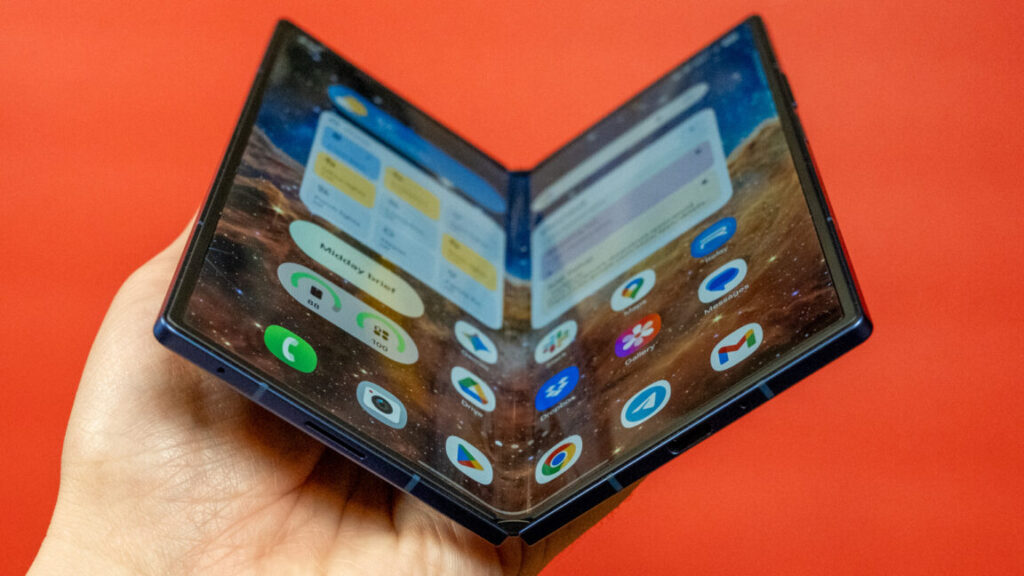
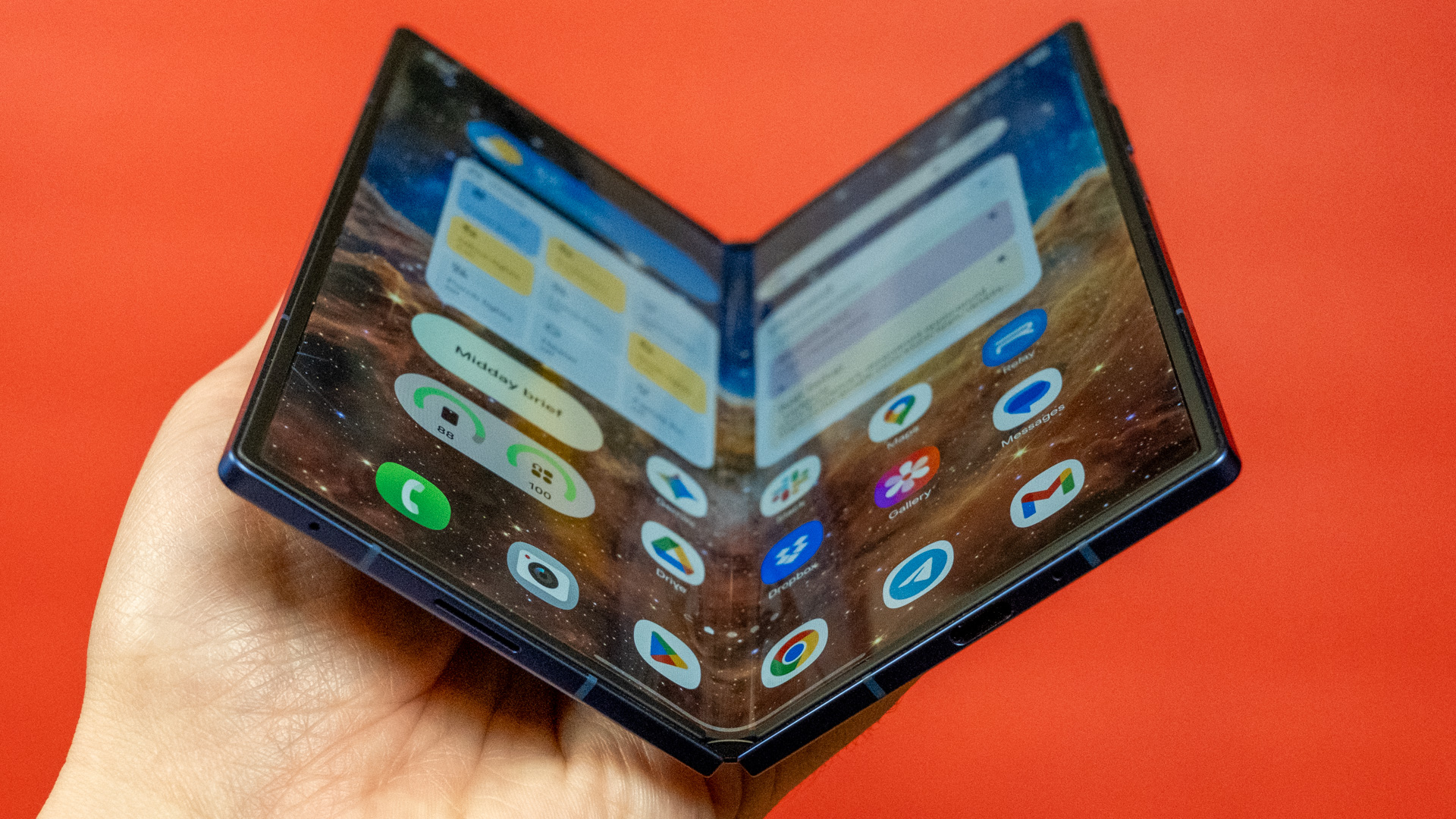
Samsung Galaxy Z Fold 7 bent

Samsung’s new foldable is thinner and lighter than ever before. Credit: Ryan Whitwam

Samsung’s new foldable is thinner and lighter than ever before. Credit: Ryan Whitwam

The first foldable phones hit the market six years ago, and they were rife with compromises and shortcomings. Many of those problems have persisted, but little by little, foldables have gotten better. With the release of the Galaxy Z Fold 7, Samsung has made the biggest leap yet. This device solves some of the most glaring problems with Samsung’s foldables, featuring a new, slimmer design and a big camera upgrade.

Samsung’s seventh-generation foldable has finally crossed that hazy boundary between novelty and practicality, putting a tablet-sized screen in your pocket without as many compromises. There are still some drawbacks, of course, but for the first time, this feels like a foldable phone you’d want to carry around.

Whether or not you can justify the $1,999 price tag is another matter entirely.

Most improved foldable

Earlier foldable phones were pocket-busting bricks, but companies like Google, Huawei, and OnePlus have made headway streamlining the form factor—the Pixel 9 Pro Fold briefly held the title of thinnest foldable when it launched last year. Samsung, however, stuck with the same basic silhouette for versions one through six, shaving off a millimeter here and there with each new generation. Now, the Galaxy Z Fold 7 has successfully leapfrogged the competition with an almost unbelievably thin profile.

Specs at a glance: Samsung Galaxy Z Fold 7 – $1,999
SoC Snapdragon 8 Elite
Memory 12GB, 16GB
Storage 256GB, 512GB, 1TB
Display Cover: 6.5-inch 1080×2520 120 Hz OLED

Internal: 8-inch 1968×2184 120 Hz flexible OLED
Cameras 200MP primary, f/1.7, OIS; 10 MP telephoto, f/2.4, OIS; 12 MP ultrawide, f/2.2; 10 MP selfie cameras (internal and external), f/2.2
Software Android 16, 7 years of OS updates
Battery 4,400 mAh, 25 W wired charging, 15 W wireless charging
Connectivity Wi-Fi 7, NFC, Bluetooth 5.4, sub-6 GHz and mmWave 5G, USB-C 3.2
Measurements Folded: 158.4×72.8×8.9 mm

Unfolded: 158.4×143.2×4.2 mm

215 g

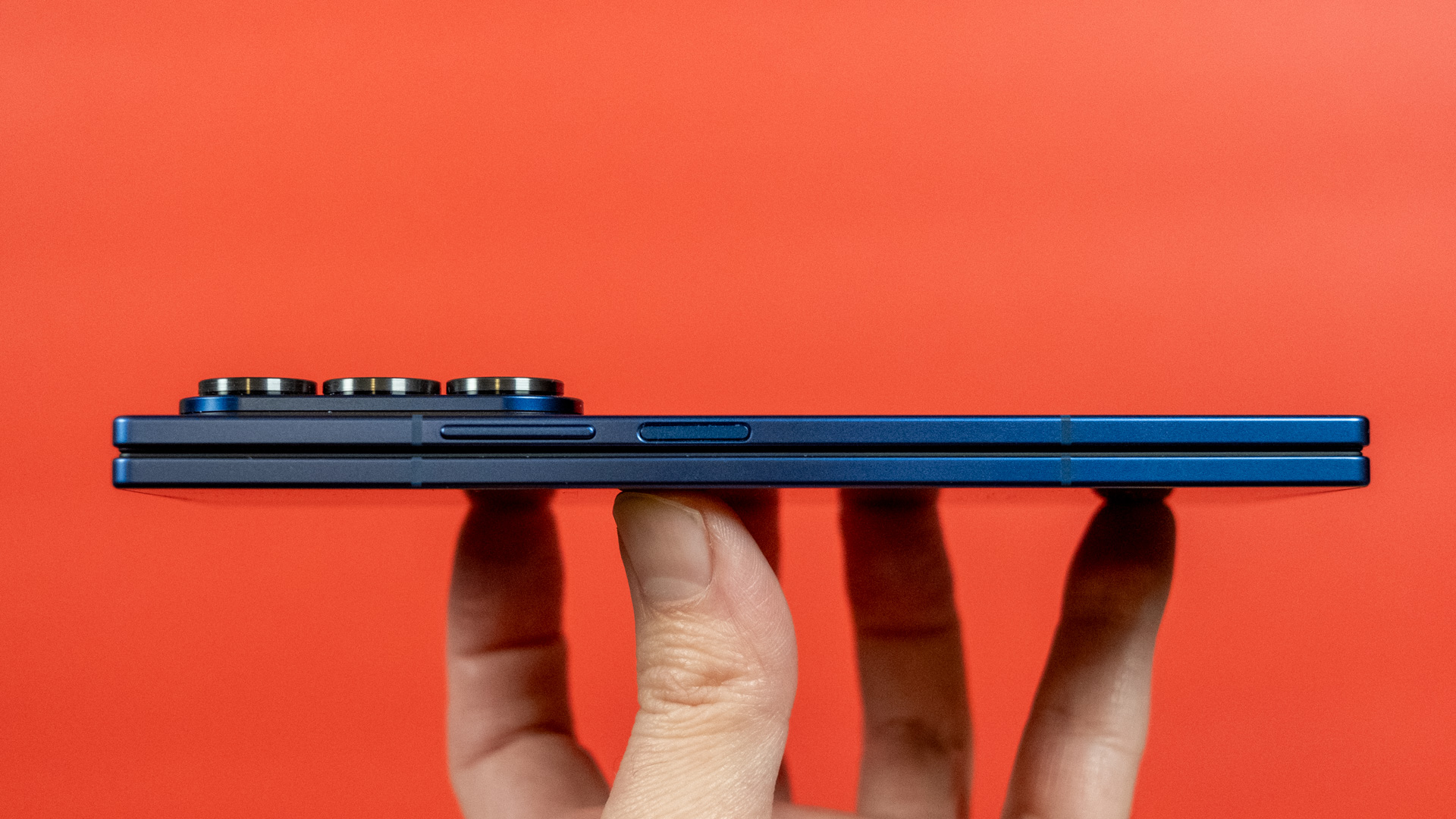
Clocking in at just 215 g and 8.9 mm thick when folded, the Z Fold 7 looks and feels like a regular smartphone when closed. It’s lighter than Samsung’s flagship flat phone, the Galaxy S25 Ultra, and is only a fraction of a millimeter thicker. The profile is now limited by the height of the standard USB-C port. You can use the Z Fold 7 in its closed state without feeling hindered by an overly narrow display or hand-stretching thickness.

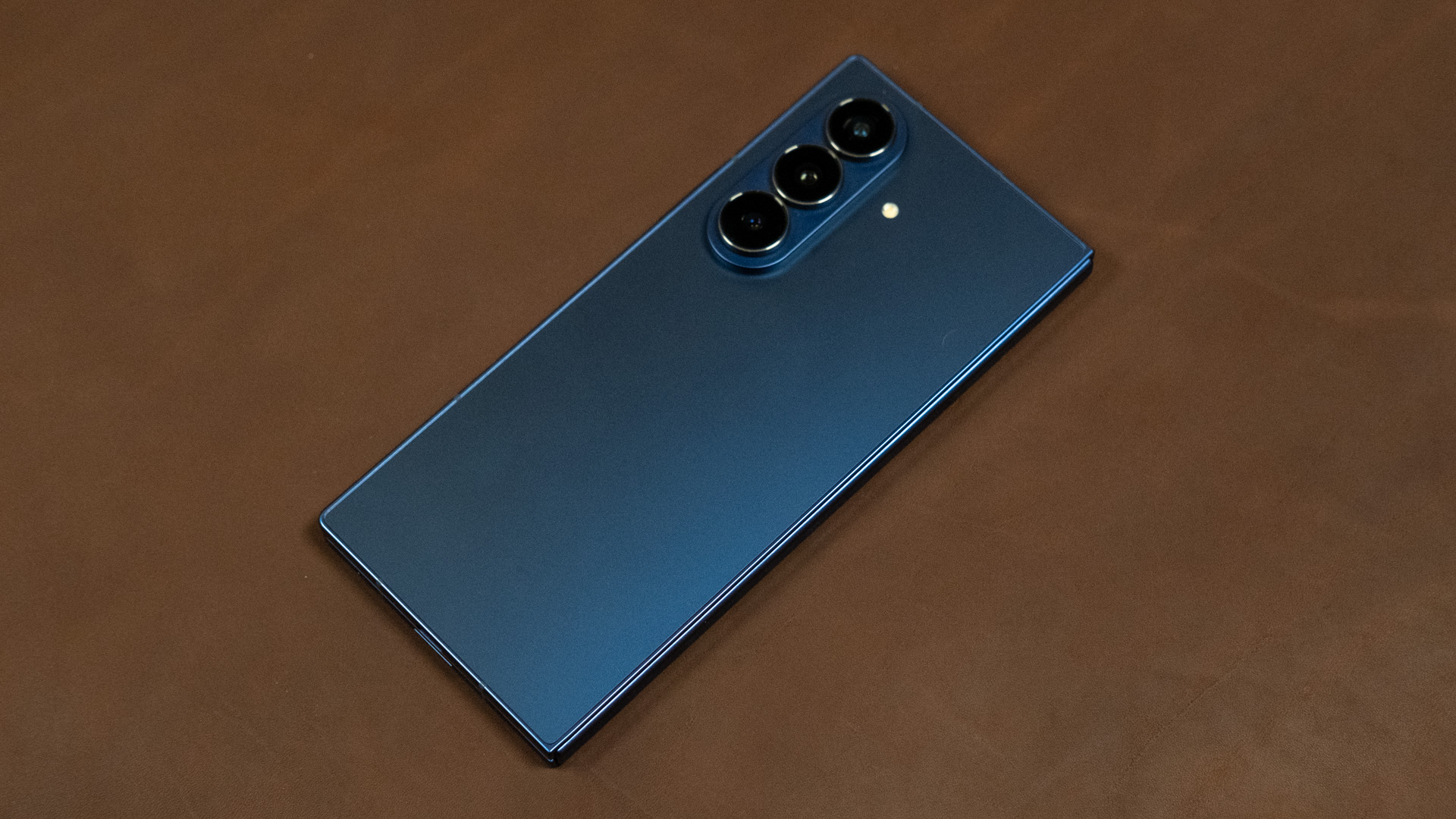
Samsung Galaxy Z Fold 7 back

The Samsung Galaxy Z Fold 7 looks like any other smartphone at a glance.

Credit: Ryan Whitwam

The Samsung Galaxy Z Fold 7 looks like any other smartphone at a glance. Credit: Ryan Whitwam

It seems unreal at times, like this piece of hardware should be a tech demo or a dummy phone concept rather than Samsung’s newest mass-produced device. The only eyebrow-raising element of the folded profile is the camera module, which sticks out like a sore thumb.

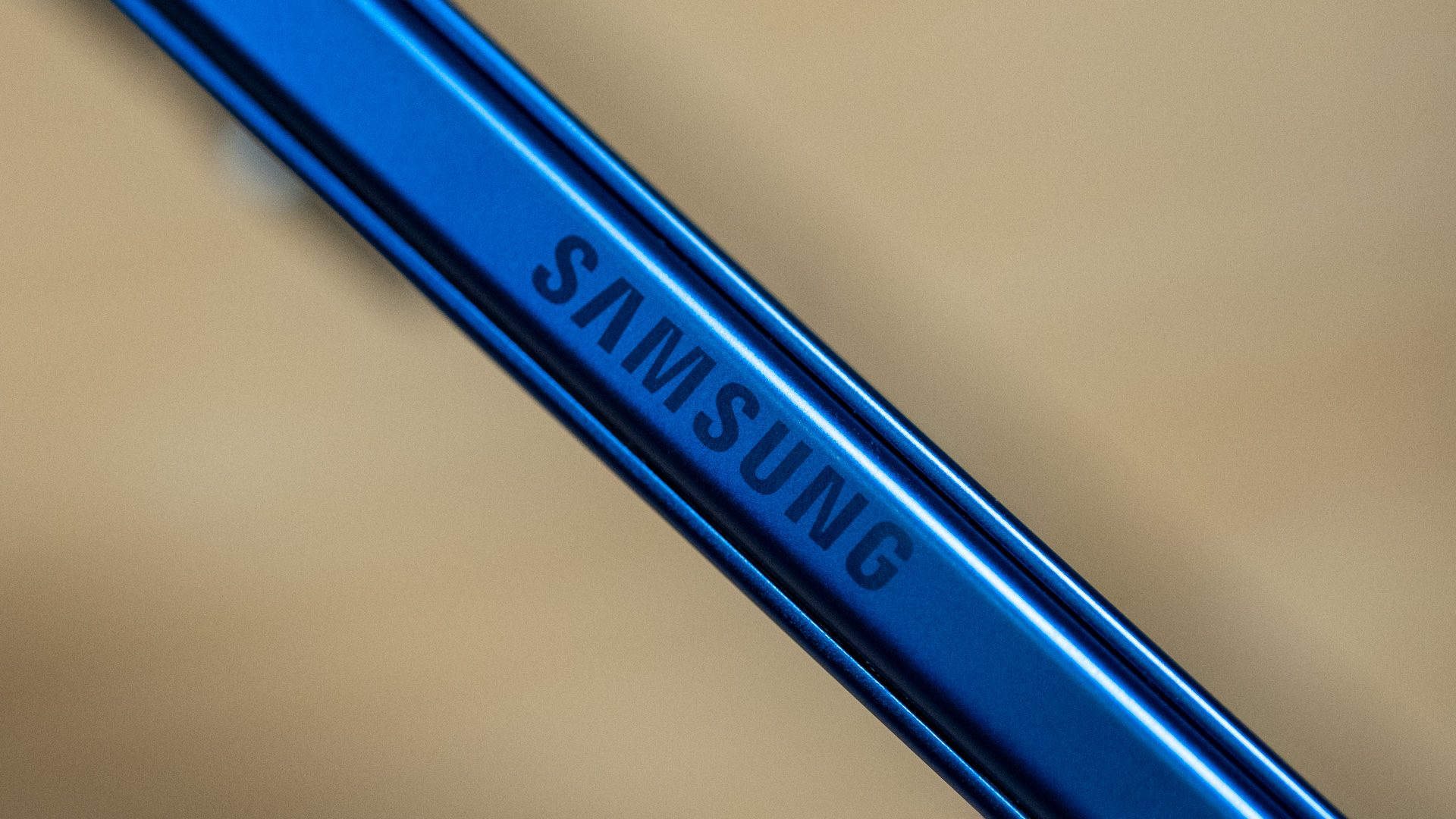
To enable the thinner design, Samsung engineered a new hinge with a waterdrop fold. The gentler bend in the screen reduces the appearance of the middle crease and allows the two halves to close tightly with no gap. The opening and closing action retains the same precise feel as previous Samsung foldables. The frame is made from Samsung’s custom Armor Aluminum alloy, which promises greater durability than most other phones. It’s not titanium like the S25 Ultra or iPhone Pro models, but that saves a bit of weight.

Samsung Galaxy Z Fold 7 side

The Samsung Galaxy Z Fold 7 is almost impossibly thin, as long as you ignore the protruding camera module.

Credit: Ryan Whitwam

The Samsung Galaxy Z Fold 7 is almost impossibly thin, as long as you ignore the protruding camera module. Credit: Ryan Whitwam

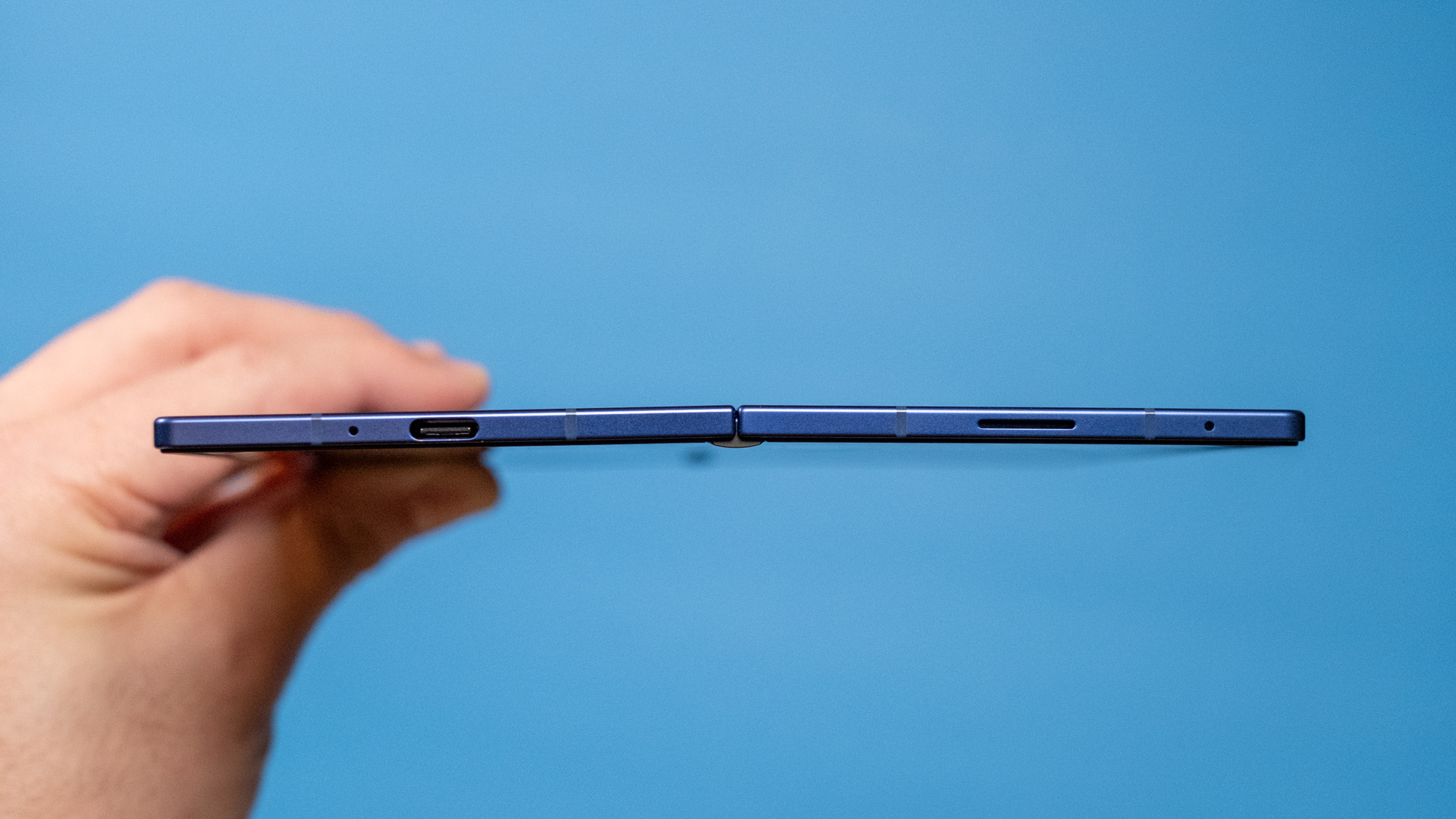
There is one caveat to the design—the Z Fold 7 doesn’t open totally flat. It’s not as noticeable as Google’s first-gen Pixel Fold, but the phone stops a few degrees shy of perfection. It’s about on par with the OnePlus Open in that respect. You might notice this when first handling the Z Fold 7, but it’s easy to ignore, and it doesn’t affect the appearance of the internal flexible OLED.

The 6.5-inch cover display is no longer something you’d only use in a pinch when it’s impractical to open the phone. It has a standard 21:9 aspect ratio and tiny symmetrical bezels. Even reaching across from the hinge side is no problem (Google’s foldable still has extra chunk around the hinge). The OLED panel has the customary 120 Hz refresh rate and high brightness we’ve come to expect from Samsung. It doesn’t have the anti-reflective coating of the S25 Ultra, but it’s bright enough that you can use it outdoors without issue.

Samsung Galaxy Z Fold 7 open angle

The Z Fold 7 doesn’t quite open a full 180 degrees.

Credit: Ryan Whitwam

The Z Fold 7 doesn’t quite open a full 180 degrees. Credit: Ryan Whitwam

Naturally, the main event is inside: an 8-inch 120 Hz OLED panel at 1968×2184, which is slightly wider than last year’s phone. It’s essentially twice the size of the cover display, just like in Google’s last foldable. As mentioned above, the crease is almost imperceptible now. The screen feels solid under your fingers, but it still has a plastic cover that is vulnerable to damage—it’s even softer than fingernails. It’s very bright, but the plastic layer is more reflective than glass, which can make using it in harsh sunlight a bit of a pain.

Unfortunately, Samsung’s pursuit of thinness led it to drop support for the S Pen stylus. That was always a tough sell, as there was no place to store a stylus in the phone, and even Samsung’s bulky Z Fold cases struggled to accommodate the S Pen in a convenient way. Still, it’s sad to lose this unique feature.

The Z Fold 7 (right) cover display is finally free of compromise. Z Fold 6 on the left. Ryan Whitwam

Unlike some of the competition, Samsung has not added a dedicated AI button to this phone—although there’s plenty of AI here. You get the typical volume rocker on the right, with a power button below it. The power button also has a built-in fingerprint scanner, which is fast and accurate enough that we can’t complain. The buttons feel sturdy and give good feedback when pressed.

Android 16 under a pile of One UI and AI

The Galaxy Z Fold 7 and its smaller flippy sibling are the first phones to launch with Google’s latest version of Android, a milestone enabled by the realignment of the Android release schedule that began this year. The device also gets Samsung’s customary seven years of update support, a tie with Google for the best in the industry. However, updates arrive slower than they do on Google phones. If you’re already familiar with One UI, you’ll feel right at home on the Z Fold 7. It doesn’t reinvent the wheel, but there are a few enhancements.

Samsung Galaxy Z Fold 7 home screen

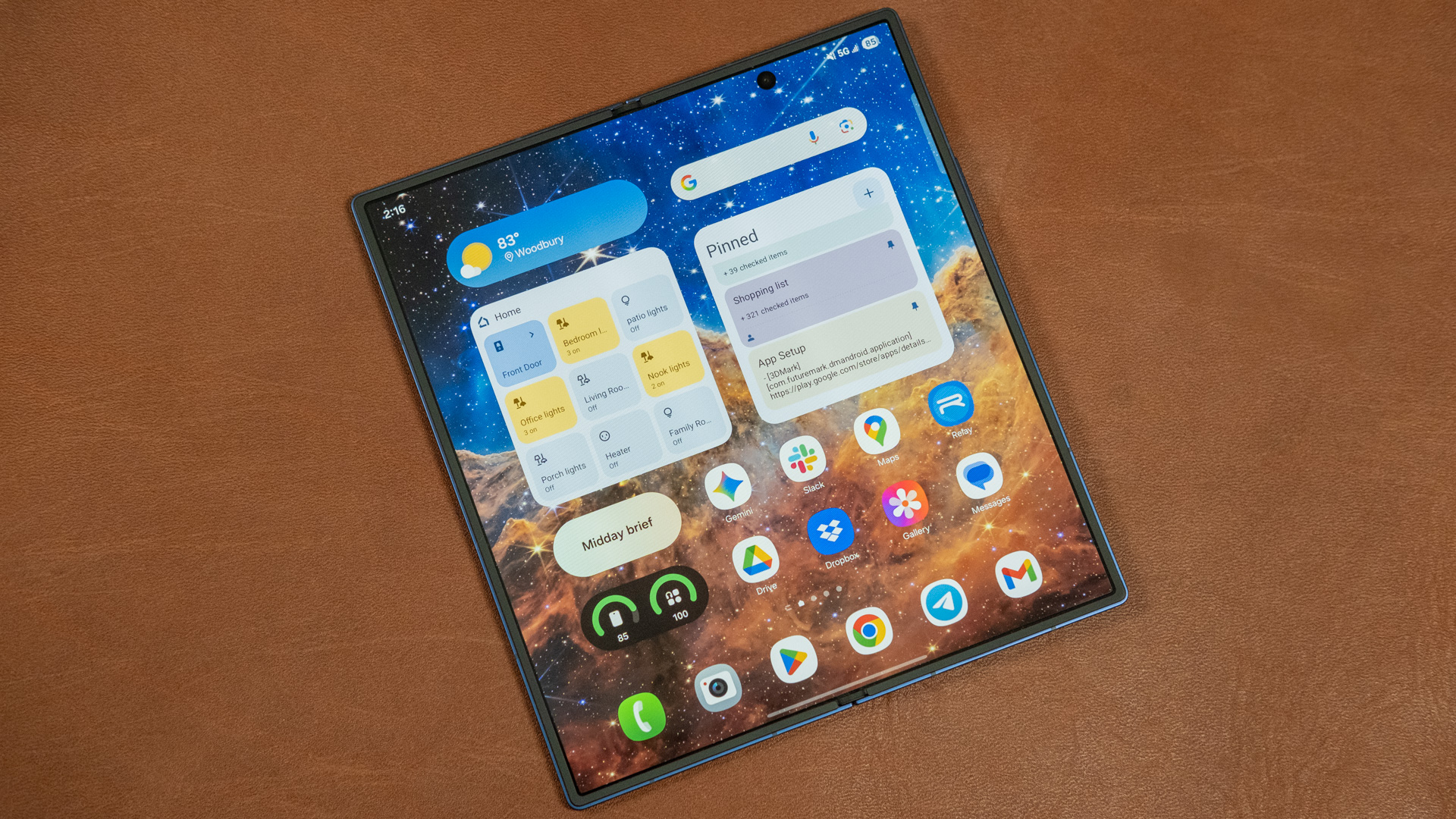
It’s like having a tablet in your pocket.

Credit: Ryan Whitwam

It’s like having a tablet in your pocket. Credit: Ryan Whitwam

Android 16 doesn’t include a ton of new features out of the box, and some of the upcoming changes won’t affect One UI. For example, Google’s vibrant Material 3 Expressive theme won’t displace the standard One UI design language when it rolls out later this summer, and Samsung already has its own app windowing implementation separate from Google’s planned release. The Z Fold 7 has a full version of Android’s new progress notifications at launch, something Google doesn’t even fully support in the initial release. Few apps have support, so the only way you’ll see those more prominent notifications is when playing media. These notifications also tie in to the Now Bar, which is at the core of Samsung’s Galaxy AI.

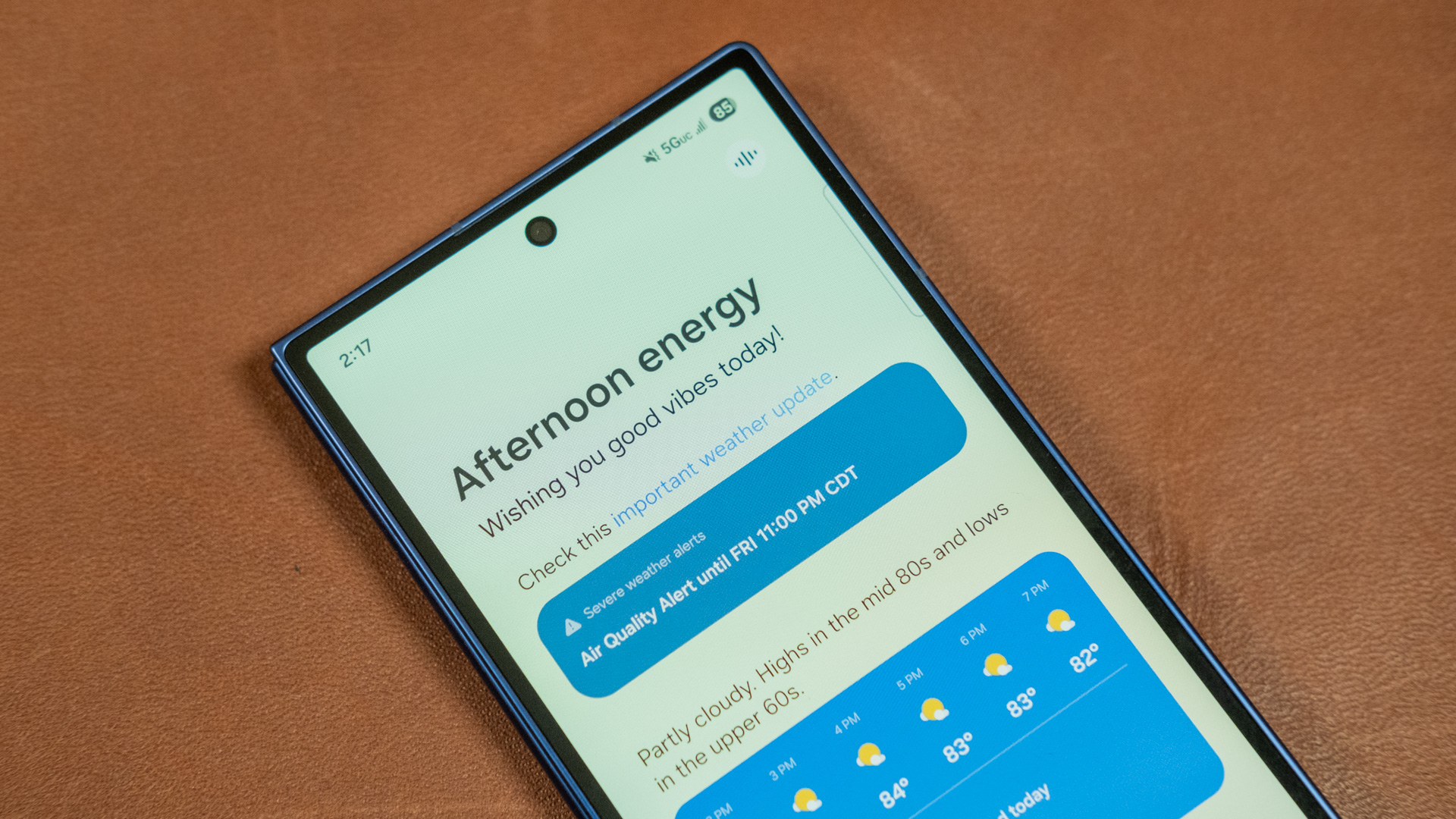
The Now Bar debuted on the S25 series earlier this year and uses on-device AI to process your data and present contextual information that is supposed to help you throughout the day. Samsung has expanded the apps and services that support the Now Bar and its constantly updating Now Brief, but we haven’t noticed much difference.

Samsung Galaxy Z Fold 7 Now Brief

Samsung’s AI-powered Now Brief still isn’t very useful, but it talks to you now. Umm, thanks?

Credit: Ryan Whitwam

Samsung’s AI-powered Now Brief still isn’t very useful, but it talks to you now. Umm, thanks? Credit: Ryan Whitwam

Nine times out of 10, the Now Bar doesn’t provide any useful notifications, and the Brief is quite repetitive. It often includes just weather, calendar appointments, and a couple of clickbait-y news stories and YouTube videos—this is the case even with all the possible data sources enabled. On a few occasions, the Now Bar correctly cited an appointment and suggested a route, but its timing was off by about 30 minutes. Google Now did this better a decade ago. Samsung has also added an AI-fueled audio version of the Now Brief, but we found this pretty tedious and unnecessary when there’s so little information in the report to begin with.

So the Now Bar is still a Now Bummer, but Galaxy AI also includes a cornucopia of other common AI features. It can rewrite text for you, summarize notes or webpages, do live translation, make generative edits to photos, remove background noise from videos, and more. These features work as well as they do on any other modern smartphone. Whether you get any benefit from them depends on how you use the phone.

However, we appreciate that Samsung included a toggle under the Galaxy AI settings to process data only on your device, eliminating the privacy concerns of using AI in the cloud. This reduces the number of operational AI features, but that may be a desirable feature all on its own.

Samsung Galaxy Z Fold 7 multitasking

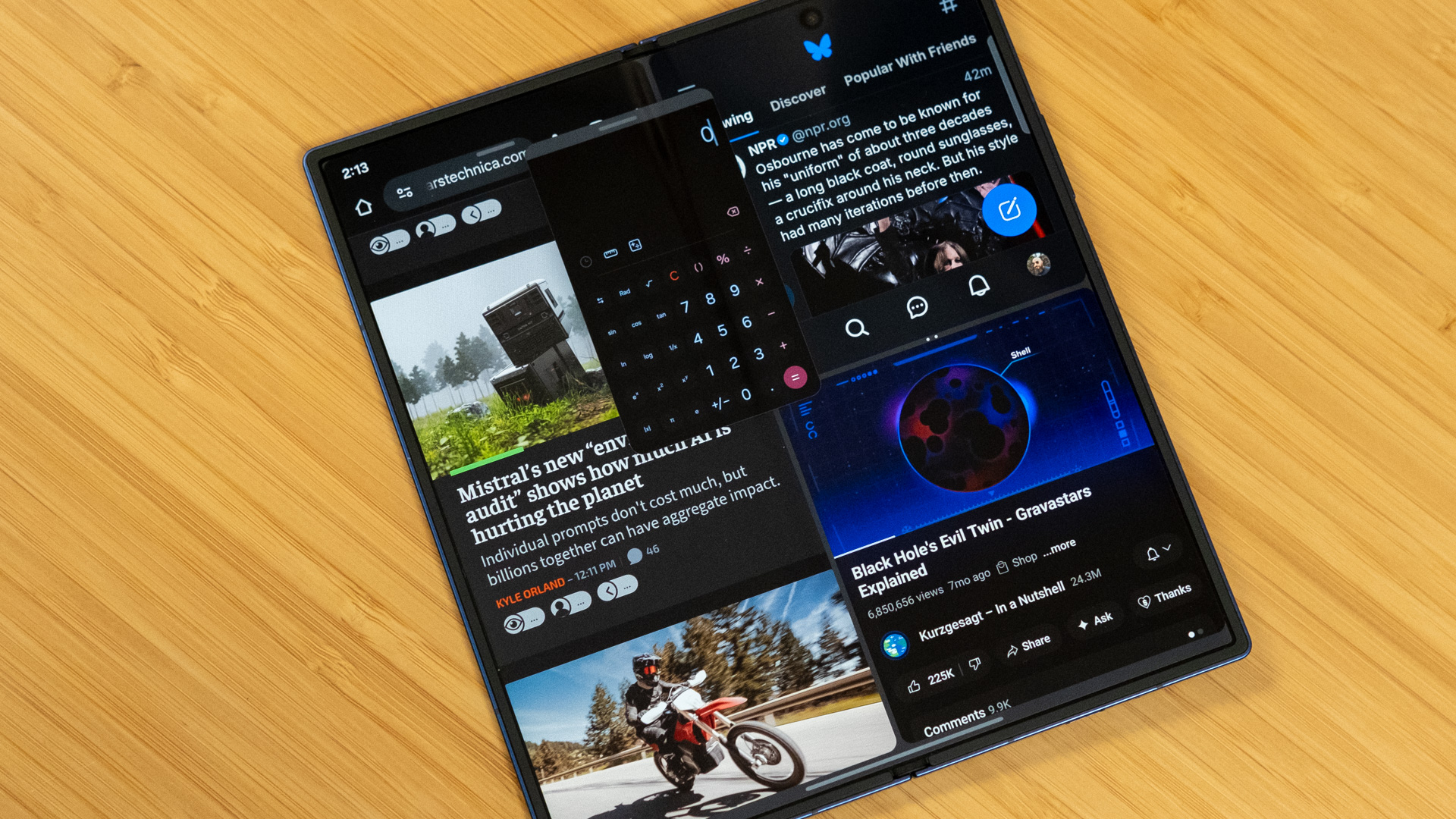
You can’t beat Samsung’s multitasking system.

Credit: Ryan Whitwam

You can’t beat Samsung’s multitasking system. Credit: Ryan Whitwam

Samsung tends to overload its phones with apps and features. Those are here, too, making the Z Fold 7 a bit frustrating at times. Some of the latest One UI interface tweaks, like separating the quick settings and notifications, fall flat. Luckily, One UI is also quite customizable. For example, you can have your cover screen and foldable home screens mirrored like Pixels, or you can have a distinct layout for each mode. With some tweaking and removing pre-loaded apps, you can get the experience you want.

Samsung’s multitasking system also offers a lot of freedom. It’s quick to open apps in split-screen mode, move them around, and change the layout. You can run up to three apps side by side, and you can easily save and access those app groups later. Samsung also offers a robust floating window option, which goes beyond what Google has planned for Android generally—it has chosen to limit floating windows to tablets and projected desktop mode. Samsung’s powerful windowing system really helps unlock the productivity potential of a foldable.

The fastest foldable

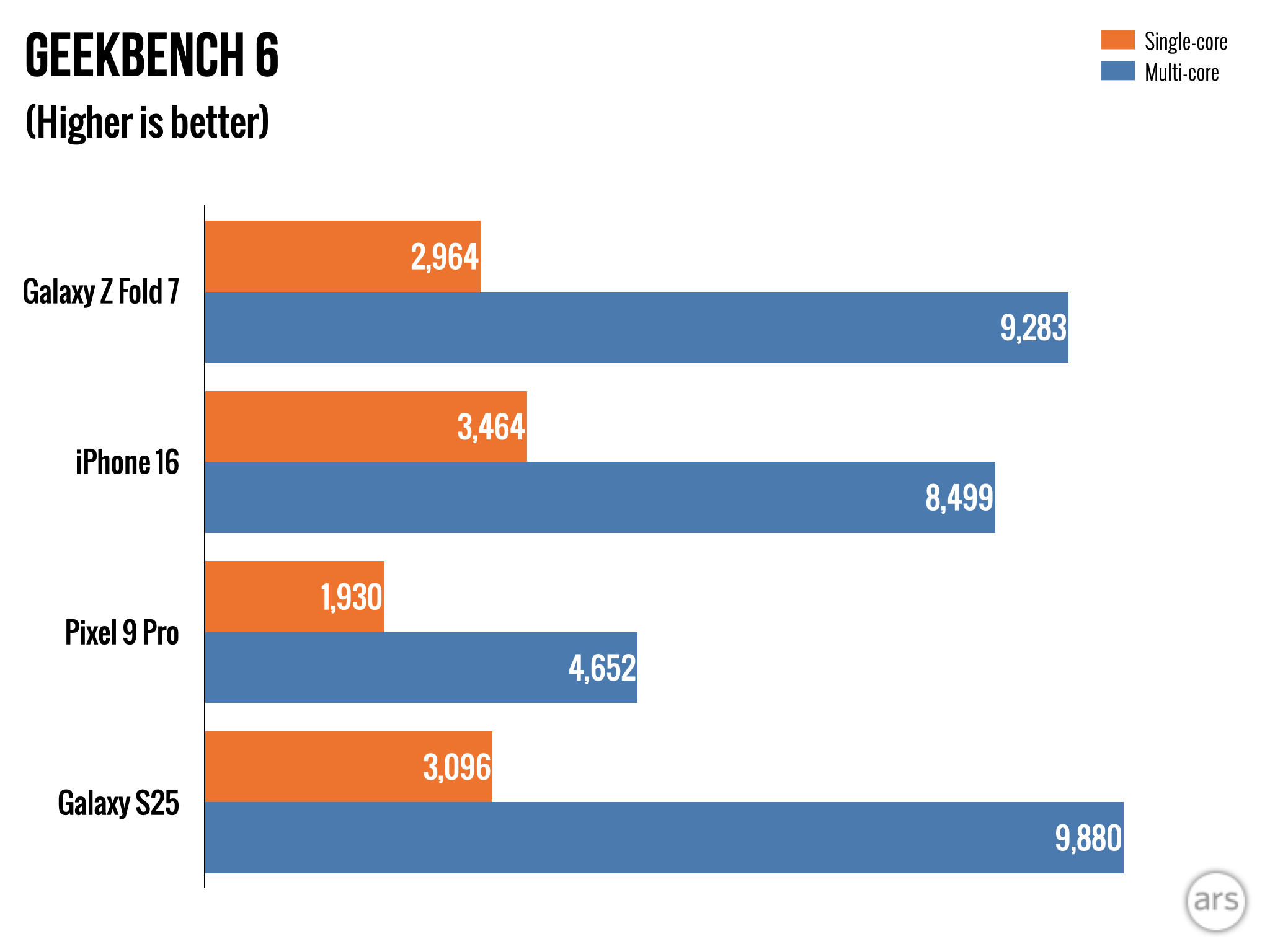
Samsung makes its own mobile processors, but when speed matters, the company doesn’t mess around with Exynos. The Z Fold 7 has the same Snapdragon 8 Elite chip as the Galaxy S25 series, paired with 12GB of RAM and 256GB of storage in the model most people will buy. In our testing, this is among the most powerful smartphones on the market today, but it doesn’t quite reach the lofty heights of the Galaxy S25 Ultra, presumably due to its thermal design.

Samsung Galaxy Z Fold 7 in hand

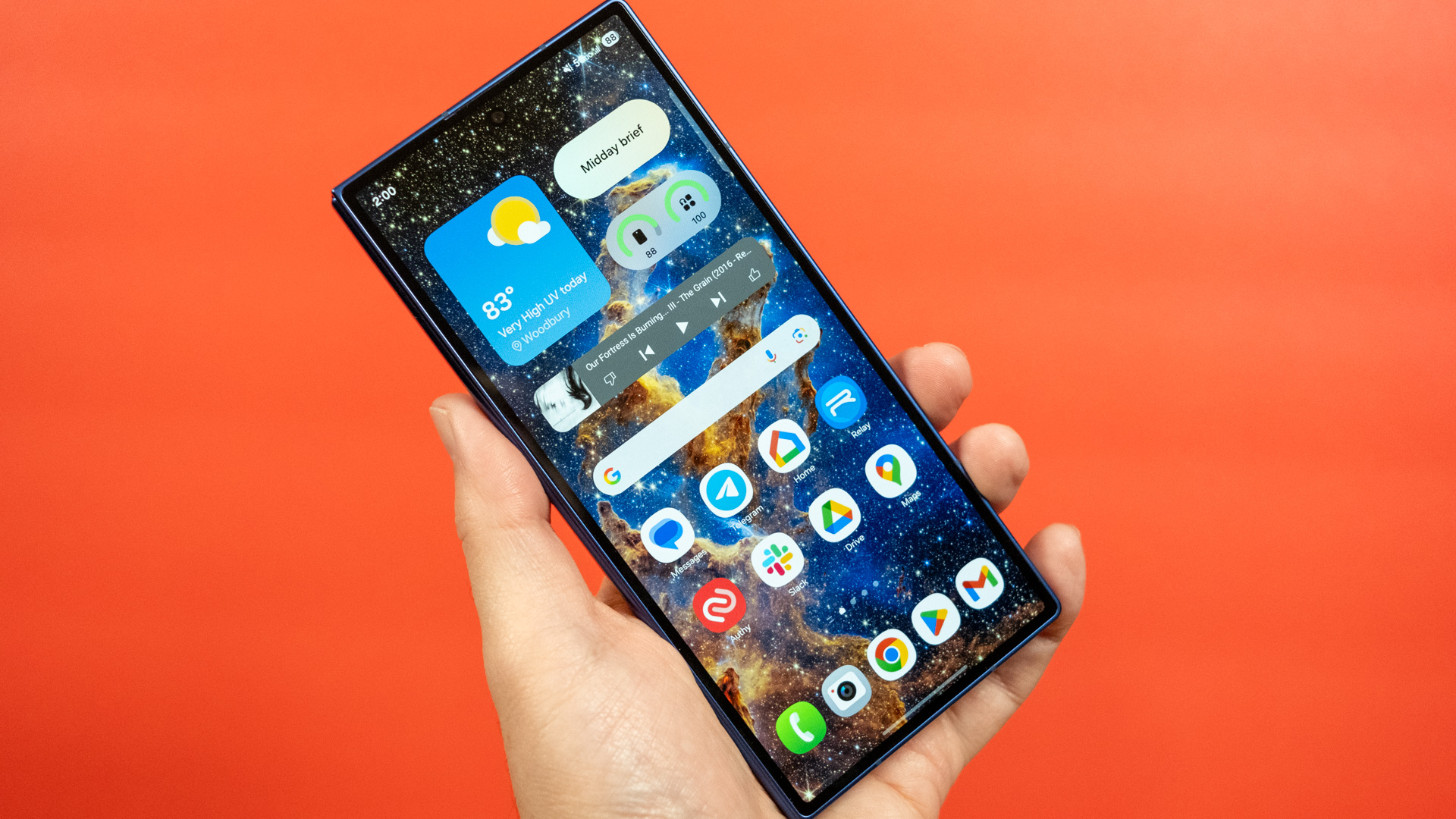
The Z Fold 7 is much easier to hold than past foldables.

Credit: Ryan Whitwam

The Z Fold 7 is much easier to hold than past foldables. Credit: Ryan Whitwam

In Geekbench, the Galaxy Z Fold 7 lands between the Motorola Razr Ultra and the Galaxy S25 Ultra, both of which have Snapdragon 8 Elite chips. It far outpaces Google’s latest Pixel phones as well. The single-core CPU speed doesn’t quite match what you get from Apple’s latest custom iPhone processor, but the multicore numbers are consistently higher.

If mobile gaming is your bag, the Z Fold 7 will be a delight. Like other devices running on this platform, it puts up big scores. However, Samsung’s new foldable runs slightly behind some other 8 Elite phones. These are just benchmark numbers, though. In practice, the Z Fold 7 will handle any mobile game you throw at it.

Samsung Galaxy Z Fold 7 geekbench

The Fold 7 doesn’t quite catch the Z 25 Ultra.

Credit: Ryan Whitwam

The Fold 7 doesn’t quite catch the Z 25 Ultra. Credit: Ryan Whitwam

Samsung’s thermal throttling is often a concern, with some of its past phones with high-end Snapdragon chips shedding more than half their initial speed upon heating up. The Z Fold 7 doesn’t throttle quite that aggressively, but it’s not great, either. In our testing, an extended gaming session can see the phone slow down by about 40 percent. That said, even after heating up, the Z Fold 7 remains about 10 percent faster in games than the unthrottled Pixel 9 Pro. Qualcomm’s GPUs are just that speedy.

The CPU performance is affected by a much smaller margin under thermal stress, dropping only about 10–15 percent. That’s important because you’re more likely to utilize the Snapdragon 8 Elite’s power with Samsung’s robust multitasking system. Even when running three apps in frames with additional floating apps, we’ve noticed nary a stutter. And while 12GB of RAM is a bit shy of the 16GB you get in some gaming-oriented phones, it’s been enough to keep a day’s worth of apps in memory.

You also get about a day’s worth of usage from a charge. While foldables could generally use longer battery life, it’s impressive that Samsung made this year’s Z Fold so much thinner while maintaining the same 4,400 mAh battery capacity as last year’s phone. However, it’s possible to drain the device by early evening—it depends on how much you use the larger inner screen versus the cover display. A bit of battery anxiety is normal, but most days, we haven’t needed to plug it in before bedtime. A slightly bigger battery would be nice, but not at the expense of the thin profile.

The lack of faster charging is a bit more annoying. If you do need to recharge the Galaxy Z Fold 7 early, it will fill at a pokey maximum of 25 W. That’s not much faster than wireless charging, which can hit 15 W with a compatible charger. Samsung’s phones don’t typically have super-fast charging, with the S25 Ultra topping out at 45 W. However, Samsung hasn’t increased charging speeds for its foldables since the Z Fold 2. It’s long past time for an upgrade here.

Long-awaited camera upgrade

Camera hardware has been one of the lingering issues with foldables, which don’t have as much internal space to fit larger image sensors compared to flat phones. In the past, this has meant taking a big step down in image quality if you want your phone to fold in half. While Samsung has not fully replicated the capabilities of its flagship flat phones, the Galaxy Z Fold 7 takes a big step in the right direction with its protruding camera module.

Samsung Galaxy Z Fold 7 camera macro

The Z Fold 7’s camera has gotten a big upgrade.

Credit: Ryan Whitwam

The Z Fold 7’s camera has gotten a big upgrade. Credit: Ryan Whitwam

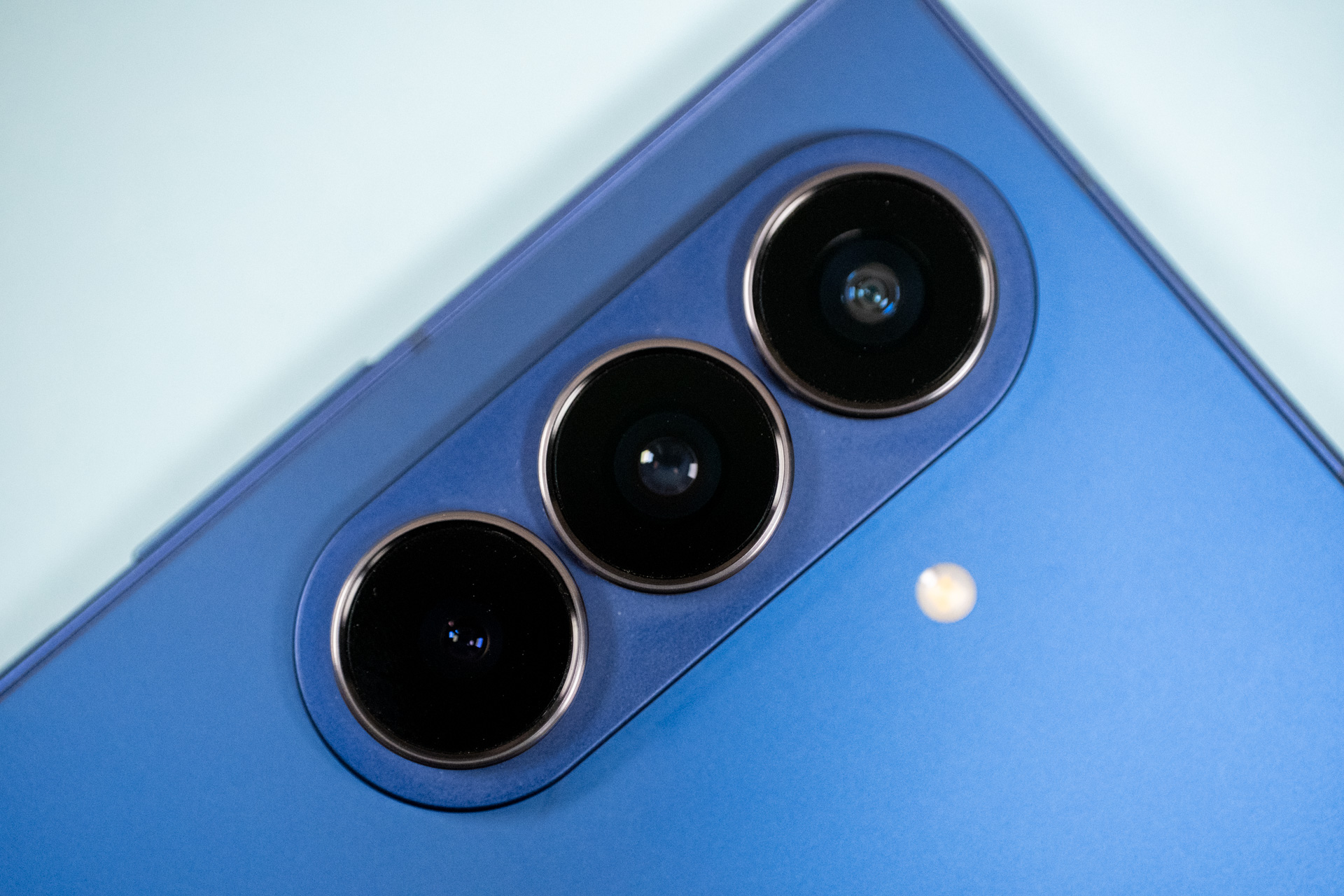
The camera setup is led by a 200 MP primary sensor with optical stabilization identical to the main shooter on the Galaxy S25 Ultra. It’s joined by a 12 MP ultrawide and 10 MP 3x telephoto, both a step down from the S25 Ultra. There is no equivalent to the 5x periscope telephoto lens on Samsung’s flat flagship. While it might be nice to have better secondary sensors, the 200 MP will get the most use, and it does offer better results than last year’s Z Fold.

Many of the photos we’ve taken on the Galaxy Z Fold 7 are virtually indistinguishable from those taken with the Galaxy S25 Ultra, which is mostly a good thing. The 200 MP primary sensor has a full-resolution mode, but you shouldn’t use it. With the default pixel binning, the Z Fold 7 produces brighter and more evenly exposed 12 MP images.

Samsung cameras emphasize vibrant colors and a wide dynamic range, so they lean toward longer exposures. Shooting with a Pixel and Galaxy phone side by side, Google’s cameras consistently use higher shutter speeds, making capturing motion easier. The Z Fold 7 is no slouch here, though. It will handle moving subjects in bright light better than any phone that isn’t a Pixel. Night mode produces bright images, but it takes longer to expose compared to Google’s offerings. Again, that means anything moving will end up looking blurry.

Between 1x and 3x, the phone uses digital zoom on the main sensor. When you go beyond that, it moves to the 3x telephoto (provided there is enough light). At the base 3x zoom, these photos are nice enough, with the usual amped-up colors and solid detail we’d expect from Samsung. However, the 10 MP resolution isn’t great if you push past 3x. Samsung’s image processing can’t sharpen photos to the same borderline magical degree as Google’s, and the Z Fold 7 can sometimes over-sharpen images in a way we don’t love. This is an area where the cheaper S25 Ultra still beats the new foldable, with higher-resolution backup cameras and multiple optical zoom levels.

At 12 MP, the ultrawide sensor is good enough for landscapes and group shots. It lacks optical stabilization (typical for ultrawide lenses), but it keeps autofocus. That allows you to take macro shots, and this mode activates automatically as you approach a subject. The images look surprisingly good with Samsung’s occasionally heavy-handed image processing, but don’t try to crop them down further.

The Z Fold 7 includes two in-display selfie cameras at 10 MP—one at the top of the cover display and the other for the inner foldable screen. Samsung has dispensed with its quirky under-display camera, which had a smattering of low-fi pixels covering it when not in use. The inner selfie is now just a regular hole punch, which is fine. You should really only use the front-facing cameras for video calls. If you want to take a selfie, foldables offer the option to use the more capable rear-facing cameras with the cover screen as a viewfinder.

A matter of coin

For the first time, the Galaxy Z Fold 7 feels like a viable alternative to a flat phone, at least in terms of hardware. The new design is as thin and light as many flat phones, and the cover display is large enough to do anything you’d do on non-foldable devices. Plus, you have a tablet-sized display on the inside with serious multitasking chops. We lament the loss of S Pen support, but it was probably necessary to address the chunkiness of past foldables.

Samsung Galaxy Z Fold 7 typing

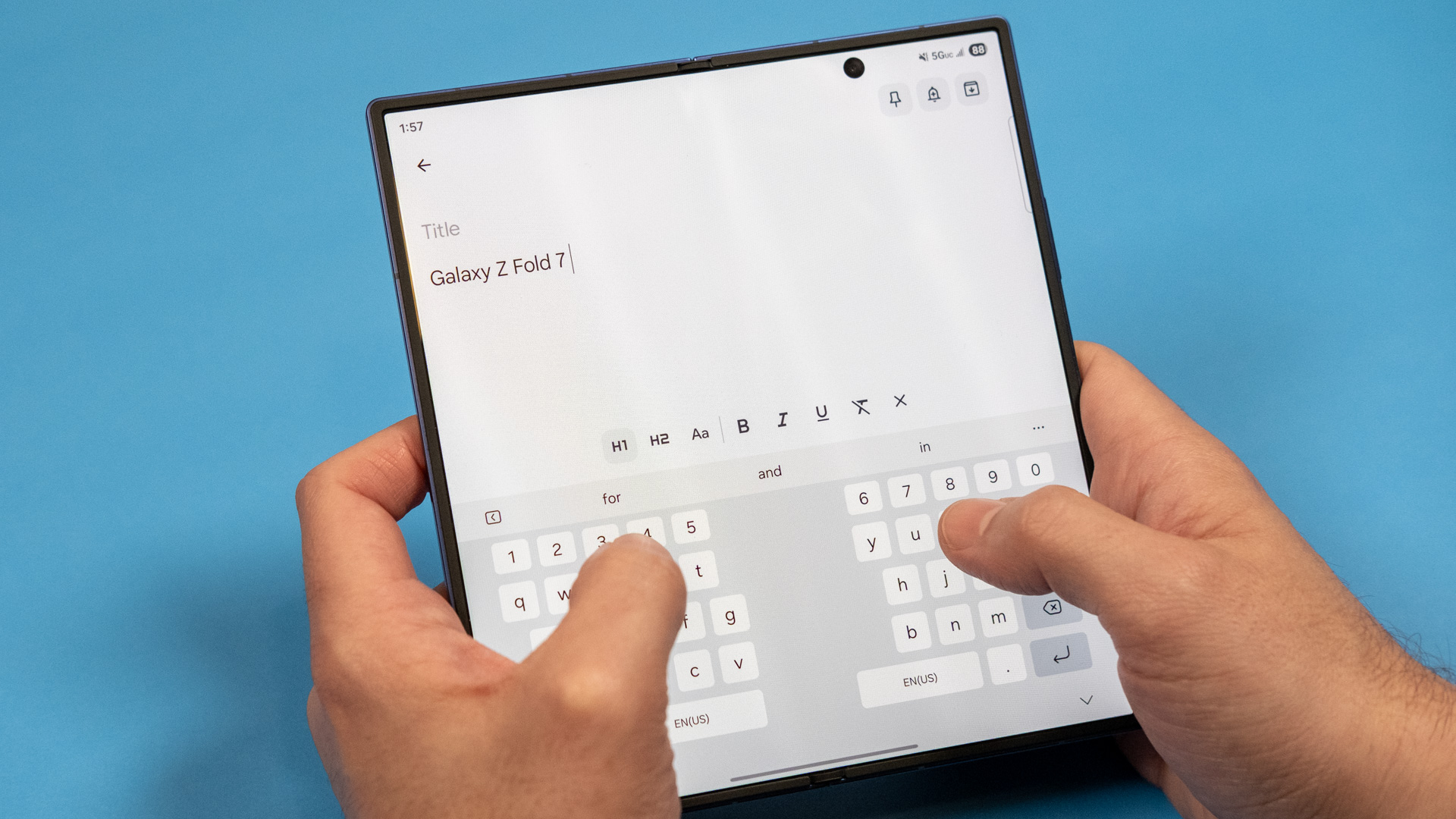
The Samsung Galaxy Z Fold 7 is the next best thing to having a physical keyboard.

Credit: Ryan Whitwam

The Samsung Galaxy Z Fold 7 is the next best thing to having a physical keyboard. Credit: Ryan Whitwam

The camera upgrade was also a necessary advancement. You can’t ask people to pay a premium price for a foldable smartphone and offer a midrange camera setup. The 200 MP primary shooter is a solid upgrade over the cameras Samsung used in previous foldables, but the ultrawide and telephoto could still use some attention.

The price is one thing that hasn’t gotten better—in fact, it’s moving in the wrong direction. The Galaxy Z Fold 7 is even more expensive than last year’s model at a cool $2,000. As slick and capable as this phone is, the exorbitant price ensures tablet-style foldables remain a niche category. If that’s what it costs to make a foldable you’ll want to carry, flat phones won’t be usurped any time soon.

If you don’t mind spending two grand on a phone or can get a good deal with a trade-in or a carrier upgrade, you won’t regret the purchase. This is the most power that can fit in your pocket. It’s available directly from Samsung (in an exclusive Mint color), Amazon, Best Buy, and your preferred carrier.

Samsung Galaxy Z Fold 7 hinge macro

The Samsung Galaxy Z Fold 7 has a new, super-thin hinge design.

Credit: Ryan Whitwam

The Samsung Galaxy Z Fold 7 has a new, super-thin hinge design. Credit: Ryan Whitwam

The good

  • Incredibly slim profile and low weight
  • Upgraded 200 MP camera
  • Excellent OLED screens
  • Powerful multitasking capabilities
  • Toggle for local-only AI
  • Launches on Android 16 with seven years of update support

The bad

  • Ridiculously high price
  • Battery life and charging speed continue to be mediocre
  • One UI 8 has some redundant apps and clunky interface decisions
  • Now Brief still doesn’t do very much

Photo of Ryan Whitwam

Ryan Whitwam is a senior technology reporter at Ars Technica, covering the ways Google, AI, and mobile technology continue to change the world. Over his 20-year career, he’s written for Android Police, ExtremeTech, Wirecutter, NY Times, and more. He has reviewed more phones than most people will ever own. You can follow him on Bluesky, where you will see photos of his dozens of mechanical keyboards.

Samsung Galaxy Z Fold 7 review: Quantum leap Read More »

smart-tv-os-owners-face-“constant-conflict”-between-privacy,-advertiser-demands

Smart TV OS owners face “constant conflict” between privacy, advertiser demands

DENVER—Most smart TV operating system (OS) owners are in the ad sales business now. Software providers for budget and premium TVs are honing their ad skills, which requires advancing their ability to collect user data. This is creating an “inherent conflict” within the industry, Takashi Nakano, VP of content and programming at Samsung TV Plus, said at the StreamTV Show in Denver last week.

During a panel at StreamTV Insider’s conference entitled “CTV OS Leader Roundtable: From Drivers to Engagement and Content Strategy,” Nakano acknowledged the opposing needs of advertisers and smart TV users, who are calling for a reasonable amount of data privacy.

“Do you want your data sold out there and everyone to know exactly what you’ve been watching … the answer is generally no,” the Samsung executive said. “Yet, advertisers want all of this data. They wanna know exactly what you ate for breakfast.”

Nakano also suggested that the owners of OSes targeting smart TVs and other streaming hardware, like streaming sticks, are inundated with user data that may not actually be that useful or imperative to collect:

I think that there’s inherent conflict in the ad ecosystem supplying so much data. … We’re fortunate to have all that data, but we’re also like, ‘Do we really want to give it all, and hand it all out?’ There’s a constant conflict around that, right? So how do we create an ecosystem where we can serve ads that are pretty good? Maybe it’s not perfect …

Today, connected TV (CTV) OSes are largely built around not just gathering user data, but also creating ways to collect new types of information about viewers in order to deliver more relevant, impactful ads. LG, for example, recently announced that its smart TV OS, webOS, will use a new AI model that informs ad placement based on viewers’ emotions and personal beliefs.

Smart TV OS owners face “constant conflict” between privacy, advertiser demands Read More »

samsung-drops-android-16-beta-for-galaxy-s25-with-more-ai-you-probably-don’t-want

Samsung drops Android 16 beta for Galaxy S25 with more AI you probably don’t want

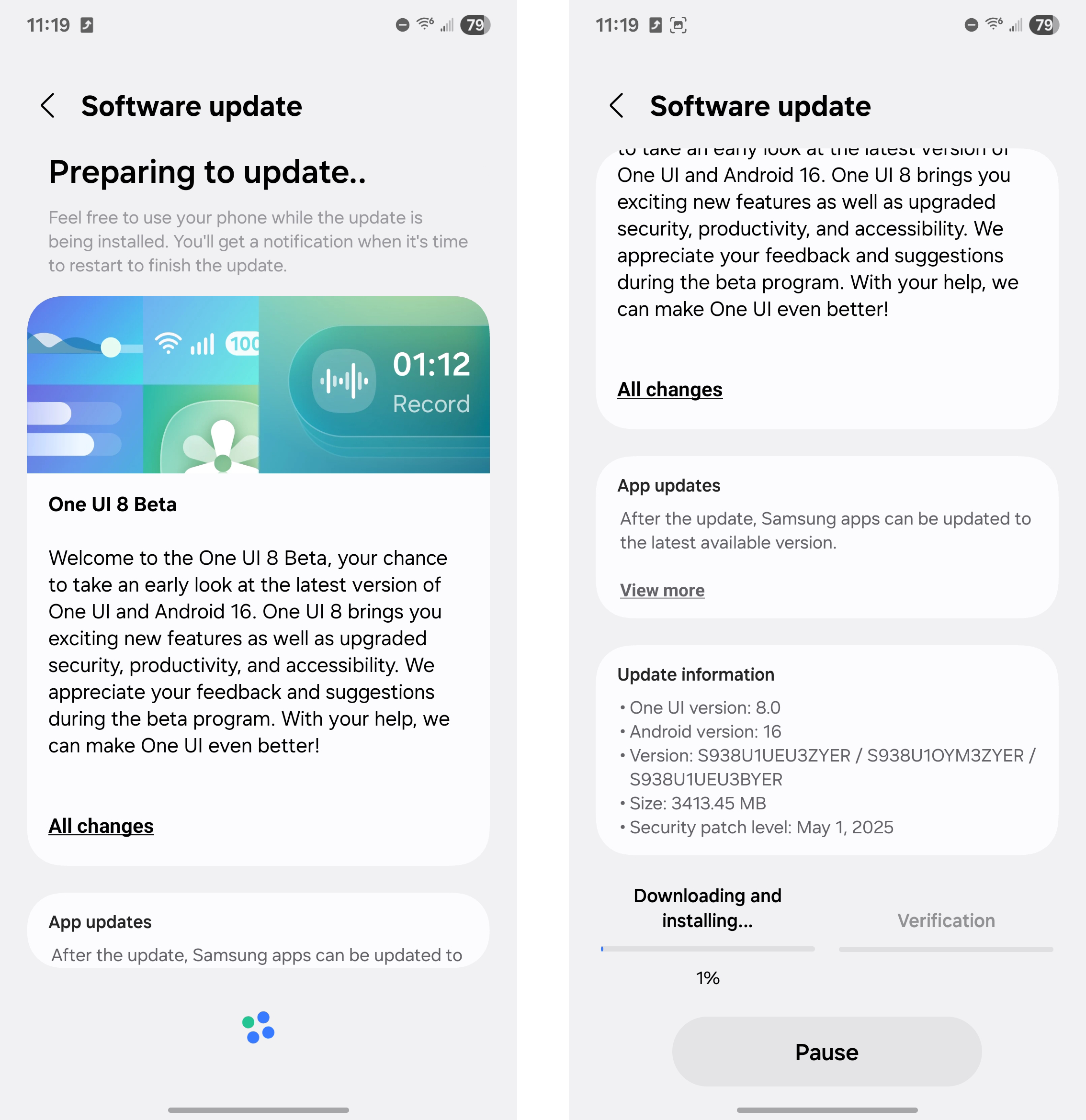
The next version of Android is expected to hit Pixel phones in June, but it’ll take longer for devices from other manufacturers to see the new OS. However, Samsung is making unusually good time this cycle. Owners of the company’s Galaxy S25 phones can get an early look at One UI 8 (based on Android 16) in the new open beta program. Samsung promises a lot of upgrades, but it may not feel that way.

Signing up for the beta is a snap—just open the Samsung Members app, and the beta signup should be right on the main landing page. From there, the OTA update should appear on your device within a few minutes. It’s pretty hefty at 3.4GB, but the installation is quick, and none of your data should be affected. That said, backups are always advisable when using beta software.

You must be in the US, Germany, Korea, or the UK to join the beta, and US phones must be unlocked or the T-Mobile variants. The software is compatible with the Galaxy S25, S25+, and S25 Ultra—the new S25 Edge need not apply (for now).

Samsung’s big pitch here might not resonate with everyone: more AI. It’s a bit vague about what exactly that means, though. The company claims One UI 8 brings “multimodal capabilities, UX tailored to different device form factors, and personalized, proactive suggestions.” Having used the new OS for a few hours, it doesn’t seem like much has changed with Samsung’s AI implementation.

One UI 8 install

The One UI 8 beta is large, but installation doesn’t take very long.

Credit: Ryan Whitwam

The One UI 8 beta is large, but installation doesn’t take very long. Credit: Ryan Whitwam

The Galaxy S25 series launched with a feature called Now Brief, along with a companion widget called Now Bar. The idea is that this interface will assimilate your data, process it privately inside the Samsung Knox enclave, and spit out useful suggestions. For the most part, it doesn’t. While Samsung says One UI 8 will allow Now Brief to deliver more personal, customized insights, it seems to do the same handful of things it did before. It’s plugged into a lot of Samsung apps and data sources, but mostly just shows weather information, calendar events, and news articles you probably won’t care about. There were some hints of an upcoming audio version of Now Brief, but that’s not included in the beta.

Samsung drops Android 16 beta for Galaxy S25 with more AI you probably don’t want Read More »

samsung-reveals-the-super-slim-galaxy-s25-edge-with-a-laughably-small-battery

Samsung reveals the super-slim Galaxy S25 Edge with a laughably small battery

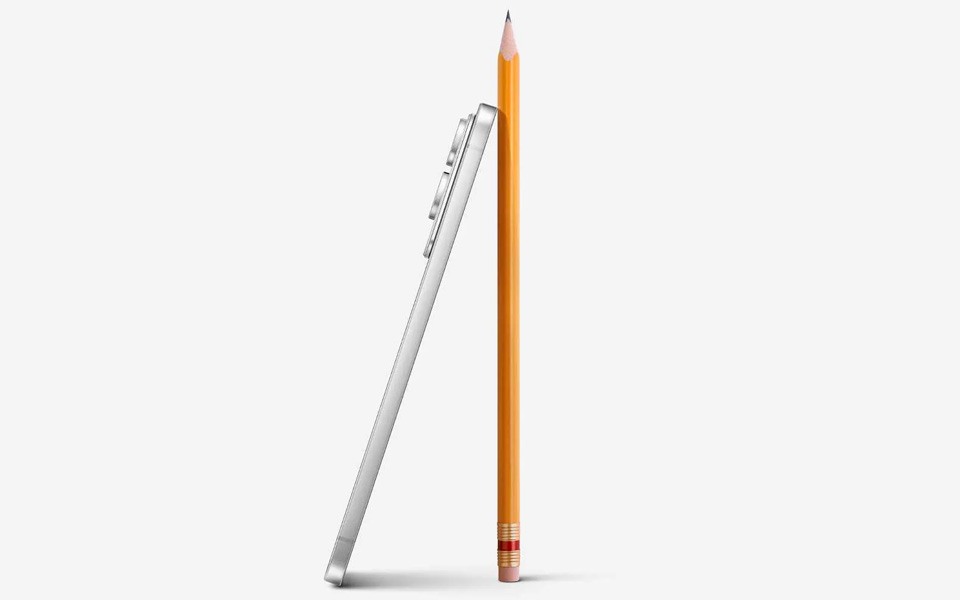
While the body of the phone is just 5.8 mm thick, the camera modules stick out a few millimeters more, making the phone quite wobbly when you set it on a table. The cameras have to stick out to leave more space for the internals, which are pretty powerful. Inside, this phone is essentially unchanged from the other S25 phones, with a Snapdragon 8 Elite, 12GB of RAM, and either 256 or 512GB of storage. The battery will be a problem, though.

S25 edge side with pencil

It is very, very thin.

Credit: Samsung

It is very, very thin. Credit: Samsung

While the S25+ sports a passable 4,900 mAh cell, the super-slim S25 Edge has just 3,900 mAh of juice. That is a problem because the Snapdragon 8 Elite is a flagship processor designed for speed. While it’s relatively efficient in low-power mode, it will devour the Edge’s battery in short order if you’re playing games or multitasking. A 20 percent reduction in battery life compared to the Galaxy S25+, which is a one-day phone, is a tough sell.

Most smartphone manufacturers could never justify making such a strange, niche device. This is Samsung showing off its engineering skills, and the S25 Edge does look neat. But the novelty of a super-slim phone will probably wear off when you have to start plugging it in to get a boost mid-afternoon. It doesn’t even charge very fast, topping out at a mere 25 W. And you’ll be paying $1,099 for the privilege, which slots the Edge between the S25+ ($1,000) and the S25 Ultra ($1,300).

If you want a phone that is thin at the expense of everything else, you can order the Galaxy S25 Edge from Samsung or Best Buy. It comes in black, icy blue, and silver colors and will ship on May 30.

Samsung reveals the super-slim Galaxy S25 Edge with a laughably small battery Read More »

samsung’s-android-15-update-has-been-halted

Samsung’s Android 15 update has been halted

When asked about specifics, Samsung doesn’t have much to say. “The One UI 7 rollout schedule is being updated to ensure the best possible experience. The new timing and availability will be shared shortly,” the company said.

Samsung foldables

Samsung’s flagship foldables, the Z Flip 6 and Z Fold 6, are among the phones waiting on the One UI 7 update.

Credit: Ryan Whitwam

Samsung’s flagship foldables, the Z Flip 6 and Z Fold 6, are among the phones waiting on the One UI 7 update. Credit: Ryan Whitwam

One UI 7 is based on Android 15, which is the latest version of the OS for the moment. Google plans to release the first version of Android 16 in June, which is much earlier than in previous cycles. Samsung’s current-gen Galaxy S25 family launched with One UI 7, so owners of those devices don’t need to worry about the buggy update.

Samsung is no doubt working to fix the issues and restart the update rollout. Its statement is vague about timing—”shortly” can mean many things. We’ve reached out and will report if Samsung offers any more details on the pause or when it will be over.

When One UI 7 finally arrives on everyone’s phones, the experience will be similar to what you get on the Galaxy S25 lineup. There are a handful of base Android features in the update, but it’s mostly a Samsung affair. There’s the new AI-infused Now Bar, more expansive AI writing tools, camera UI customization, and plenty of interface tweaks.

Samsung’s Android 15 update has been halted Read More »

the-most-intriguing-tech-gadget-prototypes-demoed-this-week

The most intriguing tech gadget prototypes demoed this week


Some of these ideas have genuine shots at making it into real products.

Creating new and exciting tech products requires thinking outside of the box. At this week’s Mobile World Congress (MWC) conference in Barcelona, we got a peek at some of the research and development happening in the hopes of forging a functional gadget that people might actually want to buy one day.

While MWC is best known for its smartphone developments, we thought we’d break down the most intriguing, non-phone prototypes brought to the show for you. Since these are just concept devices, it’s possible that you’ll never see any of the following designs in real products. However, every technology described below is being demonstrated via a tangible proof of concept. And the companies involved—Samsung and Lenovo—both have histories of getting prototyped technologies into real gadgets.

Samsung’s briefcase-tablet

How many times must something repeat before it’s considered a trend? We ask because Samsung Display this week demoed the third recent take we’ve seen on integrating computing devices into suitcases.

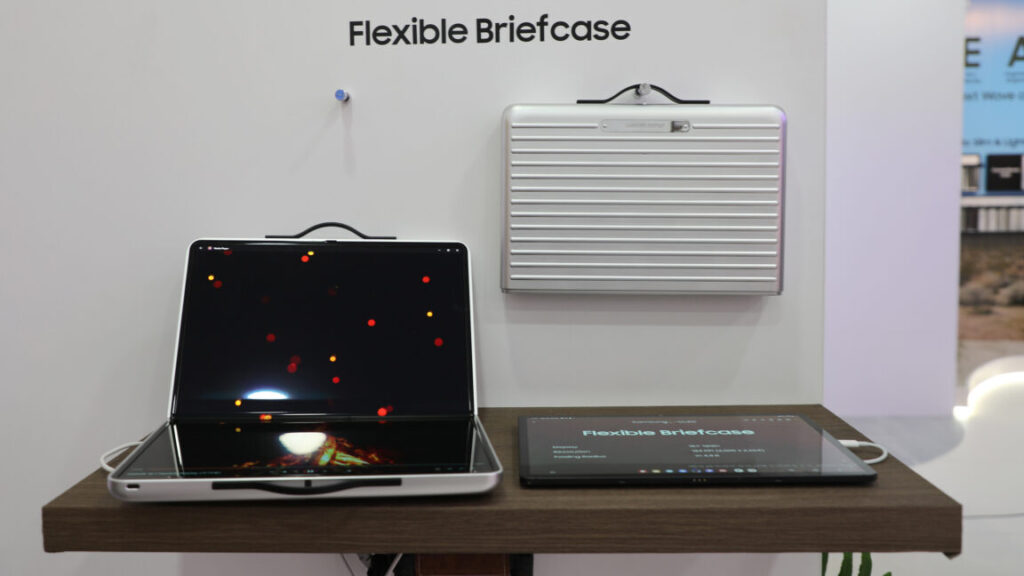
Samsung Display’s Flexible Briefcase prototype uses an 18.1-inch OLED tablet that “can be folded into a compact briefcase for convenience,” per the company’s announcement. Samsung Display brought a proof of concept to MWC, but attendees say they haven’t been allowed to touch it.

But just looking at it, the device appears similar to LG’s StanbyMe Go (27LX5QKNA), which is a real product that people can buy. LG’s product is a 27-inch tablet that can fold out from a briefcase and be propped up within the luggage. Samsung’s prototype looks more like a metal case that opens up to reveal a foldable, completely removable tablet.

The folding screen could yield a similar experience to using a foldable laptop. However, that brings questions around how one could easily navigate the tablet via touch and why a folding, massive tablet in luggage is better than a regular one. Samsung Display is a display supplier and doesn’t make gadgets, though, so it may relegate answering those questions to someone else.

Samsung’s concept also brings to mind the Base Case, a briefcase that encapsulates two 24-inch monitors for mobile work setups. The Base Case is also not a real product currently and is seeking crowdfunding.

The laptop that bends over backward for you

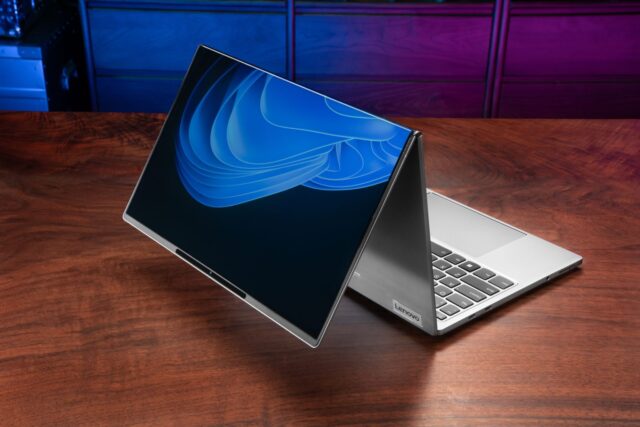
There are several laptops that you can buy with a foldable screen right now. But none of them bends the way that Lenovo’s Thinkbook Flip AI concept laptop does. As Lenovo described it, the computer’s OLED panel uses two hinges for “outward folding,” enabling the display to go from 13 inches to 18.1 inches.

Lenovo Thinkbook Flip AI Concept

A new trick. Credit: Lenovo

Enhanced flexibility is supposed to enable the screen to adapt to different workloads. In addition to the concept functioning like a regular clamshell laptop, users could extend the screen into an extra-tall display. That could be helpful for tasks like reading long documents or scrolling social feeds.

Lenovo Thinkbook Flip AI Concept in Vertical Mode.

This would be “Vertical Mode.” Credit: Lenovo

There’s also Share Mode, which enables you and someone sitting across from you to both see the laptop’s display.

Again, every concept in this article may never be sold in actual products. Still, Lenovo’s prototype is said to be fully functional with an Intel Core Ultra 7 processor, 32GB of LPDDR5X RAM, and a PCIe SSD (further spec details weren’t provided). Lenovo also has a strong record of incorporating prototypes into final products. For example, this June, Lenovo is scheduled to release the rollable-screen laptop that it showed as a proof of concept in February 2023.

Hands-on with Lenovo’s Foldable Laptop Concept at MWC 2025.

Lenovo’s solar-powered gadgets

There are many complications involved in making a solar-powered laptop. For one, depending on the configuration, laptops can drain power quickly. Having a computer rely on the sun for power would lead to numerous drawbacks, like shorter battery life and dimmer screens.

In an attempt to get closer to addressing some of those problems, the Lenovo Yoga Solar PC Concept has a solar panel integrated into its cover. Lenovo claims the panel has a conversion rate of “over 24 percent.” Per Lenovo’s announcement:

This conversion rate is achieved by leveraging ‘Back Contact Cell’ technology, which moves mounting brackets and gridlines to the back of the solar cells, maximizing the active absorption. The … Dynamic Solar Tracking system constantly measures the solar panel’s current and voltage, working with the Solar-First Energy system to automatically adjust the charger’s settings to prioritize sending the harvested energy to the system, helping to ensure maximum energy savings and system stability, regardless of light intensity. Even in low-light conditions, the panel can still generate power, sustaining battery charge when the PC is idle.

We’ll take Lenovo’s claims with a grain of salt, but Lenovo does appear to be seriously researching solar-powered gadgets. The vendor claimed that its solar panel can absorb and convert enough “direct,” “optimal,” and “uninterrupted” sunlight in 20 minutes for an hour of video 1080p playback with default settings. That conversion rate could drop based on how bright the sunlight is, the angle at which sunlight is hitting the PC, geographic location, and other factors.

For certain types of users, though, solar power will not be reliably powerful enough to be their computer’s sole source of power. A final offering would have better appeal using solar power as a backup. Lenovo is also toying with that idea through its Solar Power Kit attachment proof of concept.

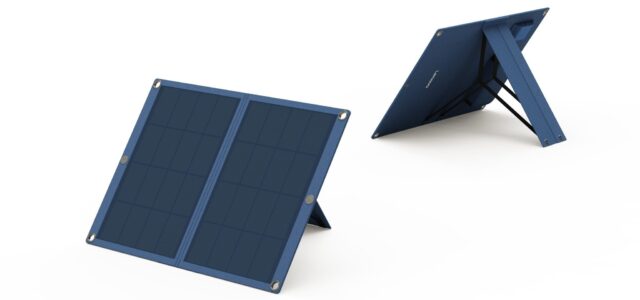
Lenovo's idea of a Solar Power Kit for its Yoga line of laptops.

Lenovo’s Solar Power Kit proof of concept. Credit: Lenovo

Lenovo designed it to provide extra power to Lenovo Yoga laptops. The solar panel can use its own kickstand or attach to whatever else is around, like a backpack or tree. It absorbs solar energy and converts it to PC power using Maximum Power Point Tracking, Lenovo said. The Kit would attach to laptops via a USB-C cable. Another option is to use the Solar Power Kit to charge a power bank.

Lenovo isn’t limiting this concept to PCs and suggested that the tech it demonstrated could be applied to other devices, like tablets and speakers.

A new take on foldable gaming handhelds

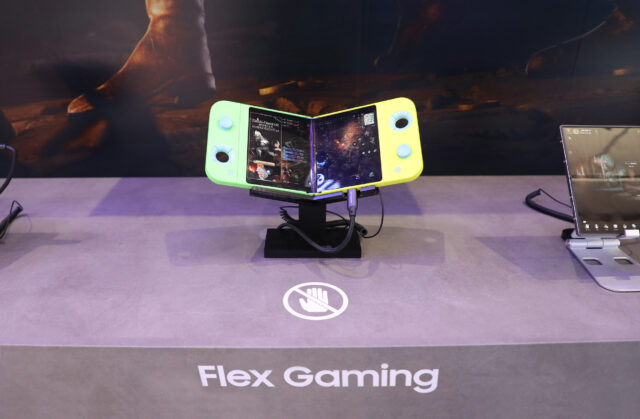
We’ve seen gaming handheld devices that can fold in half before. But the gadget that Samsung Display demoed this week brings the fold to the actual screen.

Samsung Display Flex Gaming

The crease would be a problem for me. Credit: Samsung

Again, Samsung Display is a display supplier, so it makes sense that its approach to a new gaming handheld focuses on the display. The prototype it brought to MWC, dubbed Flex Gaming, is smaller than a Nintendo Switch and included joysticks and areas that look fit for D-pads or buttons.

The emphasis is on the foldable display, which could make a gadget extremely portable but extra fragile. We’d also worry about the viewing experience. Foldable screens have visible creases, especially when viewed from different angles or in bright conditions. Both of those conditions are likely to come up with a gaming device meant for playing on the go.

Still, companies are eager to force folding screens into more types of devices, with the tech already expanding from phones to PCs and monitors. And although all of the concepts in this article may never evolve into real products, Samsung Display has shown repeated interest in providing unique displays for handheld gaming devices. At the 2023 CES trade show in Las Vegas, Samsung demoed a similar device with a horizontal fold, like a calendar, compared to the newer prototype’s book-like vertical fold:

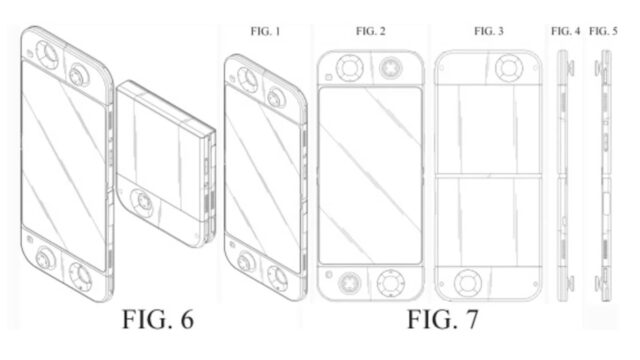
It’s unclear why the fold changed from prototype to prototype, but we do know that this is a concept that Samsung Display has been playing with for at least a few years. In 2022, Samsung filed a patent application for a foldable gaming handheld that looks similar to the device shown off at MWC 2025:

Samsung Display foldable gaming console

An image from Samsung Display’s patent application. Credit: Samsung Display/WIPO

Lenovo’s magnetic PC accessories

Framework has already proven how helpful modular laptops can be for longevity and durability. Being able to add new components and parts to your PC enables the system to evolve with the times and your computing needs.

Framework’s designs largely focus on easily upgrading essential computer parts, like RAM, keyboards, and ports. Lenovo’s new concepts, on the other hand, offer laptop accessories that you can live without.

Among the prototypes that Lenovo demoed this week is a small, circular display adorned with cat ears and a tail. The display shows a smiley face with an expression that changes based on what you’re doing on the connected system and “offers personalized emoji notifications,” per Lenovo. The Tiko Pro Concept is a small screen that attaches to a Lenovo Thinkbook laptop and shows widgets, like the time, a stopwatch, transcriptions, or a combination.

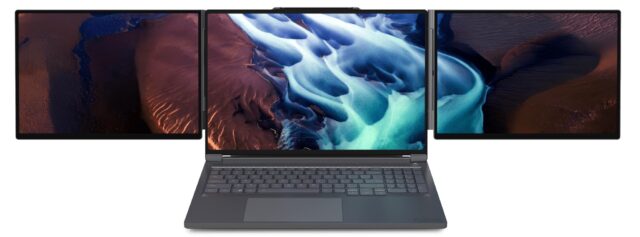
Likely offering greater appeal, Lenovo also demoed detachable secondary laptop screens, including a pair of 13.3 inch displays that connect to the left and right side of a Lenovo laptop’s display, plus a 10-inch option.

Lenovo's idea for magnetically attacble secondary laptop screens.

Lenovo’s idea for magnet-attachable secondary laptop screens. Credit: Lenovo

Lenovo demoed these attachments on a real upcoming laptop, the Thinkbook 16p Gen 6 (which is supposed to come out in June starting at 2,999 euros excluding VAT, or about $3,245).

Lenovo has been discussing using pogo pins to attach removable accessories to laptops since CES 2024. PCMag reported that the company plans to release a Magic Bay webcam with 4K resolution and speakers this year.

Photo of Scharon Harding

Scharon is a Senior Technology Reporter at Ars Technica writing news, reviews, and analysis on consumer gadgets and services. She’s been reporting on technology for over 10 years, with bylines at Tom’s Hardware, Channelnomics, and CRN UK.

The most intriguing tech gadget prototypes demoed this week Read More »

china-aims-to-recruit-top-us-scientists-as-trump-tries-to-kill-the-chips-act

China aims to recruit top US scientists as Trump tries to kill the CHIPS Act


Tech innovation in US likely to stall if Trump ends the CHIPS Act.

On Tuesday, Donald Trump finally made it clear to Congress that he wants to kill the CHIPS and Science Act—a $280 billion bipartisan law Joe Biden signed in 2022 to bring more semiconductor manufacturing into the US and put the country at the forefront of research and innovation.

Trump has long expressed frustration with the high cost of the CHIPS Act, telling Congress on Tuesday that it’s a “horrible, horrible thing” to “give hundreds of billions of dollars” in subsidies to companies that he claimed “take our money” and “don’t spend it,” Reuters reported.

“You should get rid of the CHIPS Act, and whatever is left over, Mr. Speaker, you should use it to reduce debt,” Trump said.

Instead, Trump potentially plans to shift the US from incentivizing chips manufacturing to punishing firms dependent on imports, threatening a 25 percent tariff on all semiconductor imports that could kick in as soon as April 2, CNBC reported.

The CHIPS Act was supposed to be Biden’s legacy, and because he made it a priority, much of the $52.7 billion in subsidies that Trump is criticizing has already been finalized. In 2022, Biden approved $39 billion in subsidies for semiconductor firms, and in his last weeks in office, he finalized more than $33 billion in awards, Reuters noted.

Among the awardees are leading semiconductor firms, including the Taiwan Semiconductor Manufacturing Co. (TSMC), Micron, Intel, Nvidia, and Samsung Electronics. Although Trump claims the CHIPS Act is one-sided and only serves to benefit firms, according to the Semiconductor Industry Association, the law sparked $450 billion in private investments increasing semiconductor production across 28 states by mid-2024.

With the CHIPS Act officially in Trump’s crosshairs, innovation appears likely to stall the longer that lawmakers remain unsettled on whether the law stays or goes. Some officials worried that Trump might interfere with Biden’s binding agreements with leading firms already holding up their end of the bargain, Reuters reported. For example, Micron plans to invest $100 billion in New York, and TSMC just committed to spending the same over the next four years to expand construction of US chips fabs, which is already well underway.

So far, Commerce Secretary Howard Lutnick has only indicated that he will review the finalized awards, noting that the US wouldn’t be giving TSMC any new awards, Reuters reported.

But the CHIPS Act does much more than provide subsidies to lure leading semiconductor companies into the US. For the first time in decades, the law created a new arm of the National Science Foundation (NSF)—the Directorate of Technology, Innovation, and Partnerships (TIP)—which functions unlike any other part of NSF and now appears existentially threatened.

Designed to take the country’s boldest ideas from basic research to real-world applications as fast as possible to make the US as competitive as possible, TIP helps advance all NSF research and was supposed to ensure US leadership in breakthrough technologies, including AI, 6G communications, biotech, quantum computing, and advanced manufacturing.

Biden allocated $20 billion to launch TIP through the CHIPS Act to accelerate technology development not just at top firms but also in small research settings across the US. But as soon as the Department of Government Efficiency (DOGE) started making cuts at NSF this year, TIP got hit the hardest. Seemingly TIP was targeted not because DOGE deemed it the least consequential but simply because it was the youngest directorate at NSF with the most workers in transition when Trump took office and DOGE abruptly announced it was terminating all “probationary” federal workers.

It took years to get TIP ready to flip the switch to accelerate tech innovation in the US. Without it, Trump risks setting the US back at a time when competitors like China are racing ahead and wooing US scientists who suddenly may not know if or when their funding is coming, NSF workers and industry groups told Ars.

Without TIP, NSF slows down

Last month, DOGE absolutely scrambled the NSF by forcing arbitrary cuts of so-called probationary employees—mostly young scientists, some of whom were in transition due to promotions. All those cuts were deemed illegal and finally reversed Monday by court order after weeks of internal chaos reportedly stalling or threatening to delay some of the highest-priority research in the US.

“The Office of Personnel Management does not have any authority whatsoever under any statute in the history of the universe to hire and fire employees at another agency,” US District Judge William Alsup said, calling probationary employees the “life blood” of government agencies.

Ars granted NSF workers anonymity to discuss how cuts were impacting research. At TIP, a federal worker told Ars that one of the probationary cuts in particular threatened to do the most damage.

Because TIP is so new, only one worker was trained to code automated tracking forms that helped decision-makers balance budgets and approve funding for projects across NSF in real time. Ars’ source likened it to holding the only key to the vault of NSF funding. And because TIP is so different from other NSF branches—hiring experts never pulled into NSF before and requiring customized resources to coordinate projects across all NSF fields of research—the insider suggested another government worker couldn’t easily be substituted. It could take possibly two years to hire and train a replacement on TIP’s unique tracking system, the source said, while TIP’s (and possibly all of NSF’s) efficiency is likely strained.

TIP has never been fully functional, the TIP insider confirmed, and could be choked off right as it starts helping to move the needle on US innovation. “Imagine where we are in two years and where China is in two years in quantum computing, semiconductors, or AI,” the TIP insider warned, pointing to China’s surprisingly advanced AI model, DeepSeek, as an indicator of how quickly tech leadership in global markets can change.

On Monday, NSF emailed all workers to confirm that all probationary workers would be reinstated “right away.” But the damage may already be done as it’s unclear how many workers plan to return. When TIP lost the coder—who was seemingly fired for a technicality while transitioning to a different payscale—NSF workers rushed to recommend the coder on LinkedIn, hoping to help the coder quickly secure another opportunity in industry or academia.

Ars could not reach the coder to confirm whether a return to TIP is in the cards. But Ars’ source at TIP and another NSF worker granted anonymity said that probationary workers may be hesitant to return because they are likely to be hit in any official reductions in force (RIFs) in the future.

“RIFs done the legal way are likely coming down the pipe, so these staff are not coming back to a place of security,” the NSF worker said. “The trust is broken. Even for those that choose to return, they’d be wise to be seeking other opportunities.”

And even losing the TIP coder for a couple of weeks likely slows NSF down at a time when the US seemingly can’t afford to lose a single day.

“We’re going to get murdered” if China sets the standard on 6G or AI, the TIP worker fears.

Rivals and allies wooing top US scientists

On Monday, six research and scientific associations, which described themselves as “leading organizations representing more than 305,000 people in computing, information technology, and technical innovation across US industry, academia, and government,” wrote to Congress demanding protections for the US research enterprise.

The groups warned that funding freezes and worker cuts at NSF—and other agencies, including the Department of Energy, the National Institute of Standards & Technology, the National Aeronautics and Space Administration, the National Institutes of Health—”have caused disruption and uncertainty” and threaten “long-lasting negative consequences for our competitiveness, national security, and economic prosperity.”

Deeming America’s technology leadership at risk, the groups pointed out that “in computing alone, a federal investment in research of just over $10 billion annually across 24 agencies and offices underpins a technology sector that contributes more than $2 trillion to the US GDP each year.” Cutting US investment “would be a costly mistake, far outweighing any short-term savings,” the groups warned.

In a separate statement, the Computing Research Association (CRA) called NSF cuts, in particular, a “deeply troubling, self-inflicted setback to US leadership in computing research” that appeared “penny-wise and pound-foolish.”

“NSF is one of the most efficient federal agencies, operating with less than 9 percent overhead costs,” CRA said. “These arbitrary terminations are not justified by performance metrics or efficiency concerns; rather, they represent a drastic and unnecessary weakening of the US research enterprise.”

Many NSF workers are afraid to speak up, the TIP worker told Ars, and industry seems similarly tight-lipped as confusion remains. Only one of the organizations urging Congress to intervene agreed to talk to Ars about the NSF cuts and the significance of TIP. Kathryn Kelley, the executive director of the Coalition for Academic Scientific Computation, confirmed that while members are more aligned with NSF’s Directorate for Computer and Information Science and Engineering and the Office of Advanced Cyberinfrastructure, her group agrees that all NSF cuts are “deeply” concerning.

“We agree that the uncertainty and erosion of trust within the NSF workforce could have long-lasting effects on the agency’s ability to attract and retain top talent, particularly in such specialized areas,” Kelley told Ars. “This situation underscores the need for continued investment in a stable, well-supported workforce to maintain the US’s leadership in science and innovation.”

Other industry sources unwilling to go on the record told Ars that arbitrary cuts largely affecting the youngest scientists at NSF threatened to disrupt a generation of researchers who envisioned long careers advancing US tech. There’s now a danger that those researchers may be lured to other countries heavily investing in science and currently advertising to attract displaced US researchers, including not just rivals like China but also allies like Denmark.

Those sources questioned the wisdom of using the Elon Musk-like approach of breaking the NSF to rebuild it when it’s already one of the leanest organizations in government.

Ars confirmed that some PhD programs have been cancelled, as many academic researchers are already widely concerned about delayed or cancelled grants and generally freaked out about where to get dependable funding outside the NSF. And in industry, some CHIPS Act projects have already been delayed, as companies like Intel try to manage timelines without knowing what’s happening with CHIPS funding, AP News reported.

“Obviously chip manufacturing companies will slow spending on programs they previously thought they were getting CHIPS Act funding for if not cancel those projects outright,” the Semiconductor Advisors, an industry group, forecasted in a statement last month.

The TIP insider told Ars that the CHIPS Act subsidies for large companies that Trump despises mostly fuel manufacturing in the US, while funding for smaller research facilities is what actually advances technology. Reducing efficiency at TIP would likely disrupt those researchers the most, the TIP worker suggested, proclaiming that’s why TIP must be saved at all costs.

Photo of Ashley Belanger

Ashley is a senior policy reporter for Ars Technica, dedicated to tracking social impacts of emerging policies and new technologies. She is a Chicago-based journalist with 20 years of experience.

China aims to recruit top US scientists as Trump tries to kill the CHIPS Act Read More »

samsung’s-galaxy-s25-event-was-an-ai-presentation-with-occasional-phone-hardware

Samsung’s Galaxy S25 event was an AI presentation with occasional phone hardware

Samsung announced the Galaxy S25, S25+, and S25 Ultra at its Unpacked event today. What is different from last year’s models? With the phones themselves, not much, other than a new chipset and a wide camera. But pure AI optimism? Samsung managed to pack a whole lot more of that into its launch event and promotional materials.

The corners on the S25 Ultra are a bit more rounded, the edges are flatter, and the bezels seem to be slightly thinner. The S25 and S25+ models have the same screen size as the S24 models, at 6.2 and 6.7 inches, respectively, while the Ultra notches up slightly from 6.8 to 6.9 inches.


Samsung’s S25 Ultra, in titanium builds colored silver blue, black, gray, and white silver.

Credit: Samsung

Samsung’s S25 Ultra, in titanium builds colored silver blue, black, gray, and white silver. Credit: Samsung

The S25 Ultra, starting at $1,300, touts a Snapdragon 8 Elite processor, a new 50-megapixel ultra-wide lens, and what Samsung claims is improved detail in software-derived zoom images. It comes with the S Pen, a vestige of the departed Note line, but as The Verge notes, there is no Bluetooth included, so you can’t pull off hand gestures with the pen off the screen or use it as a quirky remote camera trigger.


Samsung’s S25 Plus phones, in silver blue, navy, and icy blue.

Credit: Samsung

Samsung’s S25 Plus phones, in silver blue, navy, and icy blue. Credit: Samsung

It’s much the same with the S25 and S25 Plus, starting at $800. The base models got an upgrade to a default of 12GB of RAM. The displays, cameras, and general shape and build are the same. All the Galaxy devices released in 2025 have Qi2 wireless charging support—but not by default. You’ll need a “Qi2 Ready” magnetic case to get a sturdy attachment and the 15 W top charging speed.

One thing that hasn’t changed, for the better, is Samsung’s recent bump up in longevity. Each Galaxy S25 model gets seven years of security updates and seven of OS upgrades, which matches Google’s Pixel line in number of years.

Side view of the Galaxy S25 Edge, which is looking rather thin. Samsung

At the very end of Samsung’s event, for less than 30 seconds, a “Galaxy S25 Edge” was teased. In a mostly black field with some shiny metal components, Samsung seemed to be teasing the notably slimmer variant of the S25 that had been rumored. The same kinds of leaks about an “iPhone Air” have been circulating. No details were provided beyond its name, and a brief video suggesting its svelte nature.

Samsung’s Galaxy S25 event was an AI presentation with occasional phone hardware Read More »

the-8-most-interesting-pc-monitors-from-ces-2025

The 8 most interesting PC monitors from CES 2025


Monitors worth monitoring

Here are upcoming computer screens with features that weren’t around last year.

Yes, that’s two monitors in a suitcase.

Yes, that’s two monitors in a suitcase.

Plenty of computer monitors made debuts at the Consumer Electronics Show (CES) in Las Vegas this year, but many of the updates at this year’s event were pretty minor. Many could have easily been a part of 2024’s show.

But some brought new and interesting features to the table for 2025—in this article, we’ll tell you all about them.

LG’s 6K monitor

Pixel addicts are always right at home at CES, and the most interesting high-resolution computer monitor to come out of this year’s show is the LG UltraFine 6K Monitor (model 32U990A).

People seeking more than 3840×2160 resolution have limited options, and they’re all rather expensive (looking at you, Apple Pro Display XDR). LG’s 6K monitor means there’s another option for professionals needing extra pixels for things like developing, engineering, and creative work. And LG’s 6144×3456, 32-inch display has extra oomph thanks to something no other 6K monitor has: Thunderbolt 5.

This is the only image LG provided for the monitor. Credit: LG

LG hasn’t confirmed the refresh rate of its 6K monitor, so we don’t know how much bandwidth it needs. But it’s possible that pairing the UltraFine with a Thunderbolt 5 PC could trigger Bandwidth Boost, a Thunderbolt 5 feature that automatically increases bandwidth from 80Gbps to 120Gbps. For comparison, Thunderbolt 4 maxes out at 40Gbps. Thunderbolt 5 also requires 140 W power delivery and maxes out at 240 W. That’s a notable bump from Thunderbolt 4’s 100–140 W.

Considering that Apple’s only 6K monitor has Thunderbolt 3, Thunderbolt 5 is a differentiator. With this capability, the LG UltraFine is ironically better equipped in this regard for use with the new MacBook Pros and Mac Mini (which all have Thunderbolt 5) compared to Apple’s own monitors. LG may be aware of this, as the 32U990A’s aesthetic could be considered very Apple-like.

Inside the 32U990A’s silver chassis is a Nano IPS panel. In recent years, LG has advertised its Nano IPS panels as having “nanometer-sized particles” applied to their LED backlight to absorb “excess, unnecessary light wavelengths” for “richer color expression.” LG’s 6K monitor claims to cover 98 percent of DCI-P3 and 99.5 percent of Adobe RGB. IPS Black monitors, meanwhile, have higher contrast ratios (up to 3,000:1) than standard IPS panels. However, LG has released Nano IPS monitors with 2,000:1 contrast, the same contrast ratio as Dell’s 6K, IPS Black monitor.

LG hasn’t shared other details, like price or a release date. But the monitor may cost more than Dell’s Thunderbolt 4-equipped monitor, which is currently $2,480.

Brelyon’s multi-depth monitor

Brelyon Ultra Reality Extend.

Someone from CNET using the Ultra Reality Extend. Credit: CNET/YouTube

Brelyon is headquartered in San Mateo, California, and was founded by scientists and executives from MIT, IMAX, UCF, and DARPA. It’s been selling display technology for commercial and defense applications since 2022. At CES, the company unveiled the Ultra Reality Extend, describing it as an “immersive display line that renders virtual images in multiple depths.”

“As the first commercial multi-focal monitor, the Extend model offers multi-depth programmability for information overlay, allowing users to see images from 0.7 m to as far as 2.5 m of depth virtually rendered behind the monitor; organizing various data streams at different depth layers, or triggering focal cues to induce an ultra immersive experience akin to looking out through a window,” Brelyon’s announcement said.

Brelyon says the monitor runs 4K at 60 Hz with 1 bit of monocular depth for an 8K effect. The monitor includes “OLED-based curved 2D virtual images, with the largest stretching to 122 inches and extending 2.5 meters deep, viewable through a 30-inch frame,” according to the firm’s announcement. The closer you sit, the greater the field of view you get.

The Extend leverages “new GPU capabilities to process light and video signals inside our display platforms,” Brelyon CEO Barmak Heshmat said in a statement this week. He added: “We are thinking beyond headsets and glasses, where we can leverage GPU capabilities to do real-time driving of higher-bandwidth display interfaces.”

Brelyon says this was captured from the Extend, with its camera lens focus changing from 70 cm to 2,500 cm. Credit: Brelyon

Advancements in AI-based video processing, as well as other software advancements and hardware improvements, purportedly enable the Extend to upscale lower-dimension streams to multiple, higher-dimension ones. Brelyon describes its product as a “generative display system” that uses AI computation and optics to assign different depth values to content in real time for rendering images and information overlays.

The idea of a virtual monitor that surpasses the field of view of typical desktop monitors while allowing users to see the real world isn’t new. Tech firms (including many at CES) usually try to accomplish this through AR glasses. But head-mounted displays still struggle with problems like heat, weight, computing resources, battery, and aesthetics.

Brelyon’s monitor seemingly demoed well at CES. Sam Rutherford, a senior writer at Engadget, watched a clip from the Marvel’s Spider-Man video game on the Extend and said that “trees and light poles whipping past in my face felt so real I started to flinch subconsciously.” He added that the monitor separated “different layers of the content to make snow in the foreground look blurry as it whipped across the screen, while characters in the distance” still looked sharp.

The monitor costs $5,000 to $8,000 depending on how you’ll use it and whether you have other business with Brelyon, per Engadget, and CES is one of the few places where people could actually see the display in action.

Samsung’s 3D monitor

Samsung Odyssey 3D

Samsung’s depiction of the 3D effect of its 3D PC monitor. Credit: Samsung

It’s 2025, and tech companies are still trying to convince people to bring a 3D display into their homes. This week, Samsung took its first swing since 2009 at 3D screens with the Odyssey 3D monitor.

In lieu of 3D glasses. the Odyssey 3D achieves its 3D effect with a lenticular lens “attached to the front of the panel and its front stereo camera,” Samsung says, as well eye tracking and view mapping. Differing from other recent 3D monitors, the Odyssey 3D claims to be able to make 2D content look three-dimensional even if that content doesn’t officially support 3D.

You can find more information in our initial coverage of Samsung’s Odyssey 3D, but don’t bet on finding 3D monitors in many people’s homes soon. The technology for quality 3D displays that work without glasses has been around for years but still has never taken off.

Dell’s OLED productivity monitor

With improvements in burn-in, availability, and brightness, finding OLED monitors today is much easier than it was two years ago. But a lot of the OLED monitors released recently target gamers with features like high refresh rates, ultrawide panels, and RGB. These features are unneeded or unwanted by non-gamers but contribute to OLED monitors’ already high pricing. Numerous smaller OLED monitors were announced at CES, with 27-inch, 4K models being a popular addition. Most of them are still high-refresh gaming monitors, though.

The Dell 32-inch QD-OLED, on the other hand, targets “play, school, and work,” Dell’s announcement says. And its naming (based on a new naming convention Dell announced this week that kills XPS and other longstanding branding) signals that this is a mid-tier monitor from Dell’s entry-level lineup.

Dell 32-inch QD-OLED,

OLED for normies. Credit: Dell

The monitor’s specs, which include a 120 Hz refresh rate, AMD FreeSync Premium, and USB-C power delivery at up to 90 W, make it a good fit for pairing with many mainstream laptops.

Dell also says this is the first QD-OLED with spatial audio, which uses head tracking to alter audio coming from the monitor’s five 5 W speakers. This is a feature we’ve seen before, but not on an OLED monitor.

For professionals and/or Mac users that prefer the sleek looks, reputation, higher power delivery and I/O hubs associated with Dell’s popular UltraSharp line, Dell made two more notable announcements at CES: an UltraSharp 32 4K Thunderbolt Hub Monitor (U3225QE) coming out in February 25 for $950 and an UltraSharp 27 4K Thunderbolt Hub Monitor (U2725QE) coming out that same day for $700.

The suitcase monitors

Before we get into the Base Case, please note that this product has no release date because its creators plan to go to market via crowdfunding. Base Case says it will launch its Indiegogo campaign next month, but even then, we don’t know if the project will be funded, if any final product will work as advertised, or if customers will receive orders in a timely fashion. Still, this is one of the most unusual monitors at CES, and it’s worth discussing.

The Base Case is shaped like a 24x14x16.5-inch rolling suitcase, but when you open it up, you’ll find two 24-inch monitors for connecting to a laptop. Each screen reportedly has a 1920×1080 resolution, a 75 Hz refresh rate, and a max brightness claim of 350 nits. Base Case is also advertising PC and Mac support (through DisplayLink), as well as HDMI, USB-C, USB-A, Thunderbolt, and Ethernet ports. Telescoping legs allow the case to rise 10 inches so the display can sit closer to eye level.

Ultimately, the Base Case would see owners lug around a 20-pound product for the ability to quickly create a dual-monitor setup equipped with a healthy amount of I/O. Tom’s Guide demoed a prototype at CES and reported that the monitors took “seconds to set up.”

In case you’re worried that the Base Case prioritizes displays over storage, note that its makers plan on adding a front pocket to the suitcase that can fit a laptop. The pocket wasn’t on the prototype Tom’s Guide saw, though.

Again, this is far from a finalized product, but Base Case has alluded to a $2,400 starting price. For comparison to other briefcase-locked displays—and yes, doing this is possible—LG’s StanbyME Go (27LX5QKNA) tablet in a briefcase currently has a $1,200 MSRP.

Corsair’s PC-mountable touchscreen

A promotional image of the touchscreen.

If the Base Case is on the heftier side of portable monitors, Corsair’s Xeneon Edge is certainly on the minute side. The 14.5-inch LCD touchscreen isn’t meant to be a primary display, though. Corsair built it as a secondary screen for providing quick information, like the song your computer is playing, the weather, the time, and calendar events. You could also use the 2560×720 pixels to display system information, like component usage and temperatures.

Corsair says its iCue software will be able to provide system information on the Xeneon, but because the Xeneon Edge works like a regular monitor, you could (and likely would prefer to) use your own methods. Still, the Xeneon Edge stands out from other small, touchscreen PC monitors with its clean UI that can succinctly communicate a lot of information on the tiny display at once.

Specs-wise, this is a 60 Hz IPS panel with 5-point capacitive touch. Corsair says the monitor can hit 350 nits of brightness.

You can connect the Xeneon Edge to a computer via USB-C (DisplayPort Alt mode) or HDMI. There are also screw holes, so PC builders could install it via a 360 mm radiator mounting point inside their PC case.

Alternatively, Corsair recommends attaching the touchscreen to the outside of a PC case through the monitor’s 14 integrated magnets. Corsair said in a blog post that the “magnets are underneath the plastic casing so the metal surface you stick it to won’t get scratched.” Or, in traditional portable monitor style, the Xeneon Edge could also just sit on a desk with its included stand.

Corsair Xeneon Edge

Corsair demos different ways the screen could attach to a case. Credit: TechPowerUp/YouTube

Corsair plans to release the Xeneon Edge in Q2. Expected pricing is “around $249,” Tom’s Hardware reported.

MSI’s side panel display panel

Why attach a monitor to your PC case when you can turn your PC case into a monitor instead?

MSI says that the touchscreen embedded into this year’s MEG Vision X AI 2nd gaming desktop’s side panel can work like a regular computer monitor. Similar to Corsair’s monitor, the MSI’s display has a corresponding app that can show system information and other customizations, which you can toggle with controls on the front of the case, PCMag reported.

MSI used an IPS panel with 1920×1080 resolution for the display, which also has an integrated mic and speaker. MSI says “electric vehicle control centers” inspired the design. We’ve seen similar PC cases, like iBuyPower’s more translucent side panel display and the touchscreen on Hyte’s pentagonal PC case, before. But MSI is bringing the design to a more mainstream form factor by including it in a prebuilt desktop, potentially opening the door for future touchscreen-equipped desktops.

Considering the various locations people place their desktops and the different angles at which they may try to look at this screen, I’m curious about the monitor’s viewing angles and brightness. IPS seems like a good choice since it tends to have strong image quality when viewed from different angles. A video PC Mag shot from the show floor shows images on the monitor appearing visible and lively:

Hands on with MSI’s MEG Vision X AI Desktop: Now, your PC tower’s a monitor, too.

World’s fastest monitor

There’s a competitive air at CES that lends to tech brands trying to one-up each other on spec sheets. Some of the most heated competition concerns monitor refresh rates; for years, we’ve been meeting the new world’s fastest monitor at CES. This year is no different.

The brand behind the monitor is Koorui, a three-year-old Chinese firm whose website currently lists monitors and keyboards. Koorui hasn’t confirmed when it will make its 750 Hz display available, where it will sell it, or what it will cost. That should bring some skepticism about this product actually arriving for purchase in the US. However, Koorui did bring the display to the CES show floor.

The speedy display had a refresh rate test running at CES, and according to several videos we’ve seen from attendees, the monitor appeared to consistently hit the 750 Hz mark.

World’s first 750Hz monitor???

For those keeping track, high-end gaming monitors—namely ones targeting professional gamers—hit 360 Hz in 2020. Koorui’s announcement means max monitor speeds have increased 108.3 percent in four years.

One CES attendee noticed, however, that the monitor wasn’t showing any gameplay. This could be due to the graphical and computing prowess needed to demonstrate the benefits of a 750 Hz monitor. A system capable of 750 frames per second would give people a chance to see if they could detect improved motion resolution but would also be very expensive. It’s also possible that the monitor Koorui had on display wasn’t ready for that level of scrutiny yet.

Like many eSports monitors, the Koorui is 24.5 inches, with a resolution of 1920×1080. Perhaps more interesting than Koorui taking the lead in the perennial race for higher refresh rates is the TN monitor’s claimed color capabilities. TN monitors aren’t as popular as they were years ago, but OEMs still employ them sometimes for speed.

They tend to be less colorful than IPS and VA monitors, though. Most offer sRGB color gamuts instead of covering the larger DCI-P3 color space. Asus’ 540 Hz ROG Swift Pro PG248QP, for example, is a TN monitor claiming 125 percent sRGB coverage. Koorui’s monitor claims to cover 95 percent of DCI-P3, due to the use of a quantum dot film. Again, there’s a lot that prospective shoppers should confirm about this monitor if it becomes available.

For those seeking the fastest monitors with more concrete release plans, several companies announced 600 Hz monitors coming out this year. Acer, for example, has a 600 Hz Nitro XV240 F6 (also a TN monitor) that it plans to release in North America this quarter at a starting price of $600.

Photo of Scharon Harding

Scharon is a Senior Technology Reporter at Ars Technica writing news, reviews, and analysis on consumer gadgets and services. She’s been reporting on technology for over 10 years, with bylines at Tom’s Hardware, Channelnomics, and CRN UK.

The 8 most interesting PC monitors from CES 2025 Read More »