Policy

doge-software-engineer’s-computer-infected-by-info-stealing-malware

DOGE software engineer’s computer infected by info-stealing malware

Login credentials belonging to an employee at both the Cybersecurity and Infrastructure Security Agency and the Department of Government Efficiency have appeared in multiple public leaks from info-stealer malware, a strong indication that devices belonging to him have been hacked in recent years.

Kyle Schutt is a 30-something-year-old software engineer who, according to Dropsite News, gained access in February to a “core financial management system” belonging to the Federal Emergency Management Agency. As an employee of DOGE, Schutt accessed FEMA’s proprietary software for managing both disaster and non-disaster funding grants. Under his role at CISA, he likely is privy to sensitive information regarding the security of civilian federal government networks and critical infrastructure throughout the US.

A steady stream of published credentials

According to journalist Micah Lee, user names and passwords for logging in to various accounts belonging to Schutt have been published at least four times since 2023 in logs from stealer malware. Stealer malware typically infects devices through trojanized apps, phishing, or software exploits. Besides pilfering login credentials, stealers can also log all keystrokes and capture or record screen output. The data is then sent to the attacker and, occasionally after that, can make its way into public credential dumps.

“I have no way of knowing exactly when Schutt’s computer was hacked, or how many times,” Lee wrote. “I don’t know nearly enough about the origins of these stealer log datasets. He might have gotten hacked years ago and the stealer log datasets were just published recently. But he also might have gotten hacked within the last few months.”

Lee went on to say that credentials belonging to a Gmail account known to belong to Schutt have appeared in 51 data breaches and five pastes tracked by breach notification service Have I Been Pwned. Among the breaches that supplied the credentials is one from 2013 that pilfered password data for 3 million Adobe account holders, one in a 2016 breach that stole credentials for 164 million LinkedIn users, a 2020 breach affecting 167 million users of Gravatar, and a breach last year of the conservative news site The Post Millennial.

DOGE software engineer’s computer infected by info-stealing malware Read More »

trump-just-made-it-much-harder-to-track-the-nation’s-worst-weather-disasters

Trump just made it much harder to track the nation’s worst weather disasters

The Trump administration’s steep staff cuts at the National Oceanic and Atmospheric Administration (NOAA) triggered shutdowns of several climate-related programs Thursday.

Perhaps most notably, the NOAA announced it would be shuttering the “billion-dollar weather and climate disasters” database for vague reasons. Since 1980, the database made it possible to track the growing costs of the nation’s most devastating weather events, critically pooling various sources of private data that have long been less accessible to the public.

In that time, 403 weather and climate disasters in the US triggered more than $2.945 trillion in costs, and NOAA notes that’s a conservative estimate. Considering that CNN noted the average number of disasters in the past five years jumped from nine annually to 24, shutting down the database could leave communities in the dark on costs of emerging threats. All the NOAA can likely say is to continue looking at the historic data to keep up with trends.

“In alignment with evolving priorities, statutory mandates, and staffing changes, NOAA’s National Centers for Environmental Information (NCEI) will no longer be updating the Billion Dollar Weather and Climate Disasters product,” NOAA announced. “All past reports, spanning 1980-2024, and their underlying data remain authoritative, archived, and available,” NOAA said, but no data would be gathered for 2025 or any year after.

According to NCEI’s FAQ, every state has experienced at least one billion-dollar disaster since 1980, while some states, like Texas, have been hit by more than 100. The Central, South, and Southeast regions of the US are most likely to be hurt most by the data loss, as those regions “typically experience a higher frequency of billion-dollar disasters,” the FAQ said.

Trump just made it much harder to track the nation’s worst weather disasters Read More »

senate-passes-“cruel”-republican-plan-to-block-wi-fi-hotspots-for-schoolkids

Senate passes “cruel” Republican plan to block Wi-Fi hotspots for schoolkids

Blumenthal pointed out that under a joint resolution of disapproval, the FCC is forbidden to adopt a similar rule in the future. “I have to ask, really? Are schools and teachers crying out to repeal this rule? Really? No, they are not. How does this proposal make any sense for them or for families? For the parents? For the community? It makes no sense,” Blumenthal said.

Sen. Edward Markey (D-Mass.) called the Republican move “a cruel and shortsighted decision that will widen the digital divide and rob kids of the tools they need to succeed.”

FCC’s new chair opposed lending program

The FCC previously distributed Wi-Fi hotspots and other Internet access technology through the Emergency Connectivity Fund (ECF) that was authorized by Congress in 2021. After that program was axed last year, the FCC responded by adapting E-Rate to include hotspot lending.

FCC Chairman Brendan Carr, who was elevated to the agency’s top spot by Trump in January, voted against the program last year. Carr said in his dissent that only Congress could decide whether to revive the hotspot lending.

“Now that the ECF program has expired, its future is up to Congress,” he said at the time. “The legislative branch retains the power to decide whether to continue funding this Wi-Fi loaner program—or not. But Congress has made clear that the FCC’s authority to fund this initiative is over.”

Overall E-Rate funding is based on demand and capped at $4.94 billion per year. Actual spending for E-Rate in 2023 was $2.48 billion. E-Rate and other Universal Service Fund programs are paid for through fees imposed on phone companies, which generally pass the cost on to consumers.

The House version of the measure to kill the lending program was introduced by Rep. Russ Fulcher (R-Idaho). “E-Rate was designed to ensure schools and libraries have the connectivity they need to educate and serve their communities, not to create a backdoor entitlement program that stretches beyond the law’s clear boundaries,” Fulcher said in February when he filed the resolution. “The FCC cannot be allowed to unilaterally interpret the law in a way that fits their political agenda. The expansion of this program under the Biden administration was a blatant example of overreach that is not only unlawful but also disregards congressional intent.”

Senate passes “cruel” Republican plan to block Wi-Fi hotspots for schoolkids Read More »

report:-doge-supercharges-mass-layoff-software,-renames-it-to-sound-less-dystopian

Report: DOGE supercharges mass-layoff software, renames it to sound less dystopian

“It is not clear how AutoRIF has been modified or whether AI is involved in the RIF mandate (through AutoRIF or independently),” Kunkler wrote. “However, fears of AI-driven mass-firings of federal workers are not unfounded. Elon Musk and the Trump Administration have made no secret of their affection for the dodgy technology and their intentions to use it to make budget cuts. And, in fact, they have already tried adding AI to workforce decisions.”

Automating layoffs can perpetuate bias, increase worker surveillance, and erode transparency to the point where workers don’t know why they were let go, Kunkler said. For government employees, such imperfect systems risk triggering confusion over worker rights or obscuring illegal firings.

“There is often no insight into how the tool works, what data it is being fed, or how it is weighing different data in its analysis,” Kunkler said. “The logic behind a given decision is not accessible to the worker and, in the government context, it is near impossible to know how or whether the tool is adhering to the statutory and regulatory requirements a federal employment tool would need to follow.”

The situation gets even starker when you imagine mistakes on a mass scale. Don Moynihan, a public policy professor at the University of Michigan, told Reuters that “if you automate bad assumptions into a process, then the scale of the error becomes far greater than an individual could undertake.”

“It won’t necessarily help them to make better decisions, and it won’t make those decisions more popular,” Moynihan said.

The only way to shield workers from potentially illegal firings, Kunkler suggested, is to support unions defending worker rights while pushing lawmakers to intervene. Calling on Congress to ban the use of shadowy tools relying on unknown data points to gut federal agencies “without requiring rigorous external testing and auditing, robust notices and disclosure, and human decision review,” Kunkler said rolling out DOGE’s new tool without more transparency should be widely condemned as unacceptable.

“We must protect federal workers from these harmful tools,” Kunkler said, adding, “If the government cannot or will not effectively mitigate the risks of using automated decision-making technology, it should not use it at all.”

Report: DOGE supercharges mass-layoff software, renames it to sound less dystopian Read More »

starlink:-here’s-a-free-satellite-dish—if-you-pay-$120-a-month-instead-of-$90

Starlink: Here’s a free satellite dish—if you pay $120 a month instead of $90

There are 15 US states in which Residential Lite is offered: Maine, Vermont, New Hampshire, Montana, North Dakota, South Dakota, Minnesota, Iowa, Wyoming, Nebraska, Kansas, Nevada, Utah, New Mexico, and Hawaii. This territory generally overlaps with the larger territory in which the free Starlink kit is available.

Some states, such as California, Texas, New York, and Massachusetts, have access to the free kit offer but not the Residential Lite plan. When attempting to order service in one of the overlap areas where both are available, an address in Maine, I was given three options.

One option was to get the hardware for free and pay $120 a month with a 12-month commitment. Another option was to pay $349 for the kit and get the standard residential plan for the same $120 monthly price, but with no minimum term commitment. The third option was to pay $349 for the kit and get the worse Residential Lite plan for $80 a month, with no commitment. The $90 price for full-speed service wasn’t available.

Ordering Starlink’s lite service.

If you don’t mind the Lite plan’s slower speeds and deprioritization during peak hours, it’s cheaper during the first year to buy the kit at full price and pay $80 a month ($1,309 compared to $1,440). If you want to avoid the lite plan and you live in a place where the $90 full-speed plan isn’t available, it’s significantly cheaper to get the free kit because you’d have to pay $120 either way. You presumably would be able to switch to the $80 lite plan after the 12-month commitment, assuming Starlink still offers it a year from now.

In summary, if you were thinking about getting Starlink already, check out the free-kit offer and see if it makes sense for you. Just don’t hit the buy button immediately without examining the other options.

Starlink: Here’s a free satellite dish—if you pay $120 a month instead of $90 Read More »

jury-orders-nso-to-pay-$167-million-for-hacking-whatsapp-users

Jury orders NSO to pay $167 million for hacking WhatsApp users

A jury has awarded WhatsApp $167 million in punitive damages in a case the company brought against Israel-based NSO Group for exploiting a software vulnerability that hijacked the phones of thousands of users.

The verdict, reached Tuesday, comes as a major victory not just for Meta-owned WhatsApp but also for privacy- and security-rights advocates who have long criticized the practices of NSO and other exploit sellers. The jury also awarded WhatsApp $444 million in compensatory damages.

Clickless exploit

WhatsApp sued NSO in 2019 for an attack that targeted roughly 1,400 mobile phones belonging to attorneys, journalists, human-rights activists, political dissidents, diplomats, and senior foreign government officials. NSO, which works on behalf of governments and law enforcement authorities in various countries, exploited a critical WhatsApp vulnerability that allowed it to install NSO’s proprietary spyware Pegasus on iOS and Android devices. The clickless exploit worked by placing a call to a target’s app. A target did not have to answer the call to be infected.

“Today’s verdict in WhatsApp’s case is an important step forward for privacy and security as the first victory against the development and use of illegal spyware that threatens the safety and privacy of everyone,” WhatsApp said in a statement. “Today, the jury’s decision to force NSO, a notorious foreign spyware merchant, to pay damages is a critical deterrent to this malicious industry against their illegal acts aimed at American companies and the privacy and security of the people we serve.”

NSO created WhatsApp accounts in 2018 and used them a year later to initiate calls that exploited the critical vulnerability on phones, which, among others, included 100 members of “civil society” from 20 countries, according to an investigation research group Citizen Lab performed on behalf of WhatsApp. The calls passed through WhatsApp servers and injected malicious code into the memory of targeted devices. The targeted phones would then use WhatsApp servers to connect to malicious servers maintained by NSO.

Jury orders NSO to pay $167 million for hacking WhatsApp users Read More »

trump-and-doj-try-to-spring-former-county-clerk-tina-peters-from-prison

Trump and DOJ try to spring former county clerk Tina Peters from prison

President Donald Trump is demanding the release of Tina Peters, a former election official who parroted Trump’s 2020 election conspiracy theories and is serving nine years in prison for compromising the security of election equipment.

In a post on Truth Social last night, Trump wrote that “Radical Left Colorado Attorney General Phil Weiser ignores Illegals committing Violent Crimes like Rape and Murder in his State and, instead, jailed Tina Peters, a 69-year-old Gold Star mother who worked to expose and document Democrat Election Fraud. Tina is an innocent Political Prisoner being horribly and unjustly punished in the form of Cruel and Unusual Punishment.”

Trump said he is “directing the Department of Justice to take all necessary action to help secure the release of this ‘hostage’ being held in a Colorado prison by the Democrats, for political reasons.”

The former Mesa County clerk was indicted in March 2022 on charges related to the leak of voting-system BIOS passwords and other confidential information. Peters was convicted in August 2024 and later sentenced in a Colorado state court.

“Your lies are well-documented and these convictions are serious,” 21st Judicial District Judge Matthew Barrett told Peters at her October 2024 sentencing. “I am convinced you would do it all over again. You are as defiant a defendant as this court has ever seen.”

DOJ reviews case for “abuse” of process

After Peters’ August 2024 conviction, Colorado Secretary of State Jena Griswold said that “Tina Peters willfully compromised her own election equipment trying to prove Trump’s big lie.”

Peters appealed her conviction in a Colorado appeals court and separately sought relief in US District Court for the District of Colorado. She asked the federal court to order her release on bond while the state court system handles her appeal and said her health has deteriorated while being incarcerated.

Trump’s Justice Department submitted a filing on Peters’ behalf in March, saying the US has concerns about “the exceptionally lengthy sentence imposed relative to the conduct at issue, the First Amendment implications of the trial court’s October 2024 assertions relating to Ms. Peters, and whether Colorado’s denial of bail pending appeal was arbitrary or unreasonable under the Eighth and Fourteenth Amendments.”

Trump and DOJ try to spring former county clerk Tina Peters from prison Read More »

a-doge-recruiter-is-staffing-a-project-to-deploy-ai-agents-across-the-us-government

A DOGE recruiter is staffing a project to deploy AI agents across the US government


“does it still require Kremlin oversight?

A startup founder said that AI agents could do the work of tens of thousands of government employees.

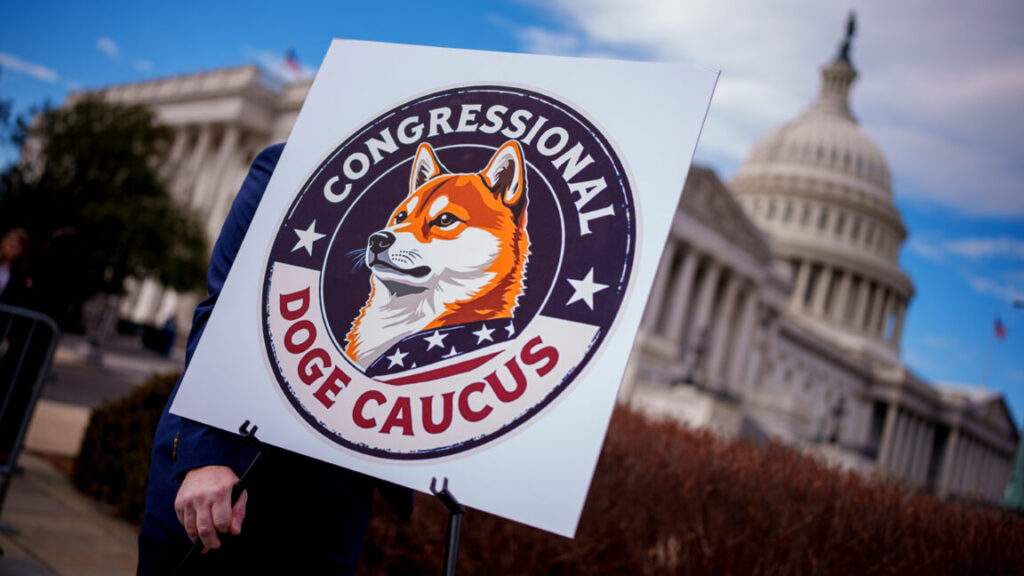
An aide sets up a poster depicting the logo for the DOGE Caucus before a news conference in Washington, DC. Credit: Andrew Harnik/Getty Images

A young entrepreneur who was among the earliest known recruiters for Elon Musk’s so-called Department of Government Efficiency (DOGE) has a new, related gig—and he’s hiring. Anthony Jancso, cofounder of AcclerateX, a government tech startup, is looking for technologists to work on a project that aims to have artificial intelligence perform tasks that are currently the responsibility of tens of thousands of federal workers.

Jancso, a former Palantir employee, wrote in a Slack with about 2000 Palantir alumni in it that he’s hiring for a “DOGE orthogonal project to design benchmarks and deploy AI agents across live workflows in federal agencies,” according to an April 21 post reviewed by WIRED. Agents are programs that can perform work autonomously.

We’ve identified over 300 roles with almost full-process standardization, freeing up at least 70k FTEs for higher-impact work over the next year,” he continued, essentially claiming that tens of thousands of federal employees could see many aspects of their job automated and replaced by these AI agents. Workers for the project, he wrote, would be based on site in Washington, DC, and would not require a security clearance; it isn’t clear for whom they would work. Palantir did not respond to requests for comment.

The post was not well received. Eight people reacted with clown face emojis, three reacted with a custom emoji of a man licking a boot, two reacted with custom emoji of Joaquin Phoenix giving a thumbs down in the movie Gladiator, and three reacted with a custom emoji with the word “Fascist.” Three responded with a heart emoji.

“DOGE does not seem interested in finding ‘higher impact work’ for federal employees,” one person said in a comment that received 11 heart reactions. “You’re complicit in firing 70k federal employees and replacing them with shitty autocorrect.”

“Tbf we’re all going to be replaced with shitty autocorrect (written by chatgpt),” another person commented, which received one “+1” reaction.

“How ‘DOGE orthogonal’ is it? Like, does it still require Kremlin oversight?” another person said in a comment that received five reactions with a fire emoji. “Or do they just use your credentials to log in later?”

AccelerateX was originally called AccelerateSF, which VentureBeat reported in 2023 had received support from OpenAI and Anthropic. In its earliest incarnation, AccelerateSF hosted a hackathon for AI developers aimed at using the technology to solve San Francisco’s social problems. According to a 2023 Mission Local story, for instance, Jancso proposed that using large language models to help businesses fill out permit forms to streamline the construction paperwork process might help drive down housing prices. (OpenAI did not respond to a request for comment. Anthropic spokesperson Danielle Ghiglieri tells WIRED that the company “never invested in AccelerateX/SF,” but did sponsor a hackathon AccelerateSF hosted in 2023 by providing free access to its API usage at a time when its Claude API “was still in beta.”)

In 2024, the mission pivoted, with the venture becoming known as AccelerateX. In a post on X announcing the change, the company posted, “Outdated tech is dragging down the US Government. Legacy vendors sell broken systems at increasingly steep prices. This hurts every American citizen.” AccelerateX did not respond to a request for comment.

According to sources with direct knowledge, Jancso disclosed that AccelerateX had signed a partnership agreement with Palantir in 2024. According to the LinkedIn of someone described as one of AccelerateX’s cofounders, Rachel Yee, the company looks to have received funding from OpenAI’s Converge 2 Accelerator. Another of AccelerateSF’s cofounders, Kay Sorin, now works for OpenAI, having joined the company several months after that hackathon. Sorin and Yee did not respond to requests for comment.

Jancso’s cofounder, Jordan Wick, a former Waymo engineer, has been an active member of DOGE, appearing at several agencies over the past few months, including the Consumer Financial Protection Bureau, National Labor Relations Board, the Department of Labor, and the Department of Education. In 2023, Jancso attended a hackathon hosted by ScaleAI; WIRED found that another DOGE member, Ethan Shaotran, also attended the same hackathon.

Since its creation in the first days of the second Trump administration, DOGE has pushed the use of AI across agencies, even as it has sought to cut tens of thousands of federal jobs. At the Department of Veterans Affairs, a DOGE associate suggested using AI to write code for the agency’s website; at the General Services Administration, DOGE has rolled out the GSAi chatbot; the group has sought to automate the process of firing government employees with a tool called AutoRIF; and a DOGE operative at the Department of Housing and Urban Development is using AI tools to examine and propose changes to regulations. But experts say that deploying AI agents to do the work of 70,000 people would be tricky if not impossible.

A federal employee with knowledge of government contracting, who spoke to WIRED on the condition of anonymity because they were not authorized to speak to the press, says, “A lot of agencies have procedures that can differ widely based on their own rules and regulations, and so deploying AI agents across agencies at scale would likely be very difficult.”

Oren Etzioni, cofounder of the AI startup Vercept, says that while AI agents can be good at doing some things—like using an internet browser to conduct research—their outputs can still vary widely and be highly unreliable. For instance, customer service AI agents have invented nonexistent policies when trying to address user concerns. Even research, he says, requires a human to actually make sure what the AI is spitting out is correct.

“We want our government to be something that we can rely on, as opposed to something that is on the absolute bleeding edge,” says Etzioni. “We don’t need it to be bureaucratic and slow, but if corporations haven’t adopted this yet, is the government really where we want to be experimenting with the cutting edge AI?”

Etzioni says that AI agents are also not great 1-1 fits for job replacements. Rather, AI is able to do certain tasks or make others more efficient, but the idea that the technology could do the jobs of 70,000 employees would not be possible. “Unless you’re using funny math,” he says, “no way.”

Jancso, first identified by WIRED in February, was one of the earliest recruiters for DOGE in the months before Donald Trump was inaugurated. In December, Jancso, who sources told WIRED said he had been recruited by Steve Davis, president of the Musk-founded Boring Company and a current member of DOGE, used the Palantir alumni group to recruit DOGE members. On December 2nd, 2024, he wrote, “I’m helping Elon’s team find tech talent for the Department of Government Efficiency (DOGE) in the new admin. This is a historic opportunity to build an efficient government, and to cut the federal budget by 1/3. If you’re interested in playing a role in this mission, please reach out in the next few days.”

According to one source at SpaceX, who asked to remain anonymous as they are not authorized to speak to the press, Jancso appeared to be one of the DOGE members who worked out of the company’s DC office in the days before inauguration along with several other people who would constitute some of DOGE’s earliest members. SpaceX did not respond to a request for comment.

Palantir was cofounded by Peter Thiel, a billionaire and longtime Trump supporter with close ties to Musk. Palantir, which provides data analytics tools to several government agencies including the Department of Defense and the Department of Homeland Security, has received billions of dollars in government contracts. During the second Trump administration, the company has been involved in helping to build a “mega API” to connect data from the Internal Revenue Service to other government agencies, and is working with Immigration and Customs Enforcement to create a massive surveillance platform to identify immigrants to target for deportation.

This story originally appeared at WIRED.com.

Photo of WIRED

Wired.com is your essential daily guide to what’s next, delivering the most original and complete take you’ll find anywhere on innovation’s impact on technology, science, business and culture.

A DOGE recruiter is staffing a project to deploy AI agents across the US government Read More »

“blatantly-unlawful”:-trump-slammed-for-trying-to-defund-pbs,-npr

“Blatantly unlawful”: Trump slammed for trying to defund PBS, NPR

“CPB is not a federal executive agency subject to the president’s authority,” Harrison said. “Congress directly authorized and funded CPB to be a private nonprofit corporation wholly independent of the federal government,” statutorily forbidding “any department, agency, officer, or employee of the United States to exercise any direction, supervision, or control over educational television or radio broadcasting, or over [CPB] or any of its grantees or contractors.”

In a statement explaining why “this is not about the federal budget” and promising to “vigorously defend our right to provide essential news, information and life-saving services to the American public,” NPR President and CEO Katherine Maher called the order an “affront to the First Amendment.”

PBS President and CEO Paula Kerger went further, calling the order “blatantly unlawful” in a statement provided to Ars.

“Issued in the middle of the night,” Trump’s order “threatens our ability to serve the American public with educational programming, as we have for the past 50-plus years,” Kerger said. “We are currently exploring all options to allow PBS to continue to serve our member stations and all Americans.”

Rural communities need public media, orgs say

While Trump opposes NPR and PBS for promoting content that he disagrees with—criticizing segments on white privilege, gender identity, reparations, “fat phobia,” and abortion—the networks have defended their programming as unbiased and falling in line with Federal Communications Commission guidelines. Further, NPR reported that the networks’ “locally grounded content” currently reaches “more than 99 percent of the population at no cost,” providing not just educational fare and entertainment but also critical updates tied to local emergency and disaster response systems.

Cutting off funding, Kreger said last month, would have a “devastating impact” on rural communities, especially in parts of the country where NPR and PBS still serve as “the only source of news and emergency broadcasts,” NPR reported.

For example, Ed Ulman, CEO of Alaska Public Media, testified to Congress last month that his stations “provide potentially life-saving warnings and alerts that are crucial for Alaskans who face threats ranging from extreme weather to earthquakes, landslides, and even volcanoes.” Some of the smallest rural stations sometimes rely on CPB for about 50 percent of their funding, NPR reported.

“Blatantly unlawful”: Trump slammed for trying to defund PBS, NPR Read More »

doj-confirms-it-wants-to-break-up-google’s-ad-business

DOJ confirms it wants to break up Google’s ad business

In the trial, Google will paint this demand as a severe overreach, claiming that few, if any, companies would have the resources to purchase and run the products. Last year, an ad consultant estimated Google’s ad empire could be worth up to $95 billion, quite possibly too big to sell. However, Google was similarly skeptical about Chrome, and representatives from other companies have said throughout the search remedy trial that they would love to buy Google’s browser.

An uphill battle

After losing three antitrust cases in just a couple of years, Google will have a hard time convincing the judge it is capable of turning over a new leaf with light remedies. A DOJ lawyer told the court Google is a “recidivist monopolist” that has a pattern of skirting its legal obligations. Still, Google is looking for mercy in the case. We expect to get more details on Google’s proposed remedies as the next trial nears, but it already offered a preview in today’s hearing.

Google suggests making a smaller subset of ad data available and ending the use of some pricing schemes, including unified pricing, that the court has found to be anticompetitive. Google also promised not to re-implement discontinued practices like “last look,” which gave the company a chance to outbid rivals at the last moment. This was featured prominently in the DOJ’s case, although Google ended the practice several years ago.

To ensure it adheres to the remedies, Google suggested a court-appointed monitor would audit the process. However, Brinkema seemed unimpressed with this proposal.

As in its other cases, Google says it plans to appeal the verdict, but before it can do that, the remedies phase has to be completed. Even if it can get the remedies paused for appeal, the decision could be a blow to investor confidence. So, Google will do whatever it can to avoid the worst-case scenario, leaning on the existence of competing advertisers like Meta and TikTok to show that the market is still competitive.

Like the search case, Google won’t be facing any big developments over the summer, but this fall could be rough. Judge Amit Mehta will most likely rule on the search remedies in August, and the ad tech remedies case will begin the following month. Google also has the Play Store case hanging over its head. It lost the first round, but the company hopes to prevail on appeal when the case gets underway again, probably in late 2025.

DOJ confirms it wants to break up Google’s ad business Read More »

judge-on-meta’s-ai-training:-“i-just-don’t-understand-how-that-can-be-fair-use”

Judge on Meta’s AI training: “I just don’t understand how that can be fair use”


Judge downplayed Meta’s “messed up” torrenting in lawsuit over AI training.

A judge who may be the first to rule on whether AI training data is fair use appeared skeptical Thursday at a hearing where Meta faced off with book authors over the social media company’s alleged copyright infringement.

Meta, like most AI companies, holds that training must be deemed fair use, or else the entire AI industry could face immense setbacks, wasting precious time negotiating data contracts while falling behind global rivals. Meta urged the court to rule that AI training is a transformative use that only references books to create an entirely new work that doesn’t replicate authors’ ideas or replace books in their markets.

At the hearing that followed after both sides requested summary judgment, however, Judge Vince Chhabria pushed back on Meta attorneys arguing that the company’s Llama AI models posed no threat to authors in their markets, Reuters reported.

“You have companies using copyright-protected material to create a product that is capable of producing an infinite number of competing products,” Chhabria said. “You are dramatically changing, you might even say obliterating, the market for that person’s work, and you’re saying that you don’t even have to pay a license to that person.”

Declaring, “I just don’t understand how that can be fair use,” the shrewd judge apparently stoked little response from Meta’s attorney, Kannon Shanmugam, apart from a suggestion that any alleged threat to authors’ livelihoods was “just speculation,” Wired reported.

Authors may need to sharpen their case, which Chhabria warned could be “taken away by fair use” if none of the authors suing, including Sarah Silverman, Ta-Nehisi Coates, and Richard Kadrey, can show “that the market for their actual copyrighted work is going to be dramatically affected.”

Determined to probe this key question, Chhabria pushed authors’ attorney, David Boies, to point to specific evidence of market harms that seemed noticeably missing from the record.

“It seems like you’re asking me to speculate that the market for Sarah Silverman’s memoir will be affected by the billions of things that Llama will ultimately be capable of producing,” Chhabria said. “And it’s just not obvious to me that that’s the case.”

But if authors can prove fears of market harms are real, Meta might struggle to win over Chhabria, and that could set a precedent impacting copyright cases challenging AI training on other kinds of content.

The judge repeatedly appeared to be sympathetic to authors, suggesting that Meta’s AI training may be a “highly unusual case” where even though “the copying is for a highly transformative purpose, the copying has the high likelihood of leading to the flooding of the markets for the copyrighted works.”

And when Shanmugam argued that copyright law doesn’t shield authors from “protection from competition in the marketplace of ideas,” Chhabria resisted the framing that authors weren’t potentially being robbed, Reuters reported.

“But if I’m going to steal things from the marketplace of ideas in order to develop my own ideas, that’s copyright infringement, right?” Chhabria responded.

Wired noted that he asked Meta’s lawyers, “What about the next Taylor Swift?” If AI made it easy to knock off a young singer’s sound, how could she ever compete if AI produced “a billion pop songs” in her style?

In a statement, Meta’s spokesperson reiterated the company’s defense that AI training is fair use.

“Meta has developed transformational open source AI models that are powering incredible innovation, productivity, and creativity for individuals and companies,” Meta’s spokesperson said. “Fair use of copyrighted materials is vital to this. We disagree with Plaintiffs’ assertions, and the full record tells a different story. We will continue to vigorously defend ourselves and to protect the development of GenAI for the benefit of all.”

Meta’s torrenting seems “messed up”

Some have pondered why Chhabria appeared so focused on market harms, instead of hammering Meta for admittedly illegally pirating books that it used for its AI training, which seems to be obvious copyright infringement. According to Wired, “Chhabria spoke emphatically about his belief that the big question is whether Meta’s AI tools will hurt book sales and otherwise cause the authors to lose money,” not whether Meta’s torrenting of books was illegal.

The torrenting “seems kind of messed up,” Chhabria said, but “the question, as the courts tell us over and over again, is not whether something is messed up but whether it’s copyright infringement.”

It’s possible that Chhabria dodged the question for procedural reasons. In a court filing, Meta argued that authors had moved for summary judgment on Meta’s alleged copying of their works, not on “unsubstantiated allegations that Meta distributed Plaintiffs’ works via torrent.”

In the court filing, Meta alleged that even if Chhabria agreed that the authors’ request for “summary judgment is warranted on the basis of Meta’s distribution, as well as Meta’s copying,” that the authors “lack evidence to show that Meta distributed any of their works.”

According to Meta, authors abandoned any claims that Meta’s seeding of the torrented files served to distribute works, leaving only claims about Meta’s leeching. Meta argued that the authors “admittedly lack evidence that Meta ever uploaded any of their works, or any identifiable part of those works, during the so-called ‘leeching’ phase,” relying instead on expert estimates based on how torrenting works.

It’s also possible that for Chhabria, the torrenting question seemed like an unnecessary distraction. Former Meta attorney Mark Lumley, who quit the case earlier this year, told Vanity Fair that the torrenting was “one of those things that sounds bad but actually shouldn’t matter at all in the law. Fair use is always about uses the plaintiff doesn’t approve of; that’s why there is a lawsuit.”

Lumley suggested that court cases mulling fair use at this current moment should focus on the outputs, rather than the training. Citing the ruling in a case where Google Books scanning books to share excerpts was deemed fair use, Lumley argued that “all search engines crawl the full Internet, including plenty of pirated content,” so there’s seemingly no reason to stop AI crawling.

But the Copyright Alliance, a nonprofit, non-partisan group supporting the authors in the case, in a court filing alleged that Meta, in its bid to get AI products viewed as transformative, is aiming to do the opposite. “When describing the purpose of generative AI,” Meta allegedly strives to convince the court to “isolate the ‘training’ process and ignore the output of generative AI,” because that’s seemingly the only way that Meta can convince the court that AI outputs serve “a manifestly different purpose from Plaintiffs’ books,” the Copyright Alliance argued.

“Meta’s motion ignores what comes after the initial ‘training’—most notably the generation of output that serves the same purpose of the ingested works,” the Copyright Alliance argued. And the torrenting question should matter, the group argued, because unlike in Google Books, Meta’s AI models are apparently training on pirated works, not “legitimate copies of books.”

Chhabria will not be making a snap decision in the case, planning to take his time and likely stressing not just Meta, but every AI company defending training as fair use the longer he delays. Understanding that the entire AI industry potentially has a stake in the ruling, Chhabria apparently sought to relieve some tension at the end of the hearing with a joke, Wired reported.

 “I will issue a ruling later today,” Chhabria said. “Just kidding! I will take a lot longer to think about it.”

Photo of Ashley Belanger

Ashley is a senior policy reporter for Ars Technica, dedicated to tracking social impacts of emerging policies and new technologies. She is a Chicago-based journalist with 20 years of experience.

Judge on Meta’s AI training: “I just don’t understand how that can be fair use” Read More »

doge-put-a-college-student-in-charge-of-using-ai-to-rewrite-regulations

DOGE put a college student in charge of using AI to rewrite regulations


The DOGE operative has been tasked with rewrites to the Department of Housing and Urban Development.

A young man with no government experience who has yet to even complete his undergraduate degree is working for Elon Musk’s so-called Department of Government Efficiency (DOGE) at the Department of Housing and Urban Development (HUD) and has been tasked with using artificial intelligence to rewrite the agency’s rules and regulations.

Christopher Sweet was introduced to HUD employees as being originally from San Francisco and, most recently, a third-year student at the University of Chicago, where he was studying economics and data science, in an email sent to staffers earlier this month.

“I’d like to share with you that Chris Sweet has joined the HUD DOGE team with the title of special assistant, although a better title might be ‘Al computer programming quant analyst,’” Scott Langmack, a DOGE staffer and chief operating officer of an AI real estate company, wrote in an email widely shared within the agency and reviewed by WIRED. “With family roots from Brazil, Chris speaks Portuguese fluently. Please join me in welcoming Chris to HUD!”

Sweet’s primary role appears to be leading an effort to leverage artificial intelligence to review HUD’s regulations, compare them to the laws on which they are based, and identify areas where rules can be relaxed or removed altogether. (He has also been given read access to HUD’s data repository on public housing, known as the Public and Indian Housing Information Center, and its enterprise income verification systems, according to sources within the agency.)

Plans for the industrial-scale deregulation of the US government were laid out in detail in the Project 2025 policy document that the Trump administration has effectively used as a playbook during its first 100 days in power. The document, written by a who’s who of far-right figures, many of whom now hold positions of power within the administration, pushes for deregulation in areas like the environment, food and drug enforcement, and diversity, equity, and inclusion policies.

One area Sweet is focusing on is regulation related to the Office of Public and Indian Housing (PIH), according to sources who spoke to WIRED on the condition of anonymity as they were not authorized to speak to the press.

Sweet—who two sources have been told is the lead on the AI deregulation project for the entire administration—has produced an Excel spreadsheet with around a thousand rows containing areas of policy where the AI tool has flagged that HUD may have “overreached” and suggesting replacement language.

Staffers from PIH are, specifically, asked to review the AI’s recommendations and justify their objections to those they don’t agree with. “It all sounds crazy—having AI recommend revisions to regulations,” one HUD source says. “But I appreciated how much they’re using real people to confirm and make changes.”

Once the PIH team completes the review, their recommendations will be submitted to the Office of the General Counsel for approval.

One HUD source says they were told that the AI model being used for this project is “being refined by our work to be used across the government.” To do this, the source says they were told in a meeting attended by Sweet and Jacob Altik, another known DOGE member who has worked as an attorney at Weil, Gotshal & Manges, that the model will crawl through the Code of Federal Regulations (eCFR).

Another source told WIRED that Sweet has also been using the tool at other parts of HUD. WIRED reviewed a copy of the output of the AI’s review of one HUD department, which features columns displaying text that the AI model found to be needing an adjustment while also including suggestions from the AI for alterations to be made, essentially proposing rewrites. The spreadsheet details how many words can be eliminated from individual regulations and gives a percentage figure indicating how noncompliant the regulations are. It isn’t clear how these percentages are calculated.

Sweet did not respond to requests for comment regarding his work. In response to a request to clarify Sweet’s role at HUD, a spokesperson for the agency said they do not comment on individual personnel. The University of Chicago confirmed to WIRED that Sweet is “on leave from the undergraduate college.”

It’s unclear how Sweet was recruited to DOGE, but a public GitHub account indicates that he was working on this issue even before he joined Musk’s demolition crew.

The “CLSweet” GitHub account, which WIRED has linked to Sweet, created an application that tracks and analyzes federal government regulations “showing how regulatory burden is distributed across government agencies.” The application was last updated in March 2025, weeks before Sweet joined HUD.

One HUD source who heard about Sweet’s possible role in revising the agency’s regulations said the effort was redundant, since the agency was already “put through a multi-year multi-stakeholder meatgrinder before any rule was ever created” under the Administrative Procedure Act. (This law dictates how agencies are allowed to establish regulations and allows for judicial oversight over everything an agency does.)

Another HUD source said Sweet’s title seemed to make little sense. “A programmer and a quantitative data analyst are two very different things,” they noted.

Sweet has virtually no online footprint. One of the only references to him online is a short biography on the website of East Edge Securities, an investment firm Sweet founded in 2023 with two other students from the University of Chicago.

The biography is short on details but claims that Sweet has worked in the past with several private equity firms, including Pertento Partners, which is based in London, and Tenzing Global Investors, based in San Francisco. He is also listed as a board member of Paragon Global Investments, which is a student-run hedge fund.

The biography also mentions that Sweet “will be joining Nexus Point Capital as a private equity summer analyst.” The company has headquarters in Hong Kong and Shanghai and describes itself as “an Asian private equity fund with a strategic focus on control opportunities in the Greater China market.”

East Edge Securities, Pertento Partners, Tenzing Global Investors, Paragon Global Investments, and Nexus Point Capital did not respond to requests for comment.

The only other online account associated with Sweet appears to be a Substack account using the same username as the GitHub account. That account has not posted any content and follows mostly finance and market-related newsletters. It also follows Bari Weiss’ The Free Press and the newsletter of Marc Andreessen, the Silicon Valley billionaire investor and group chat enthusiast who said he spent a lot of time advising Trump and his team after the election.

DOGE representatives have been at HUD since February, when WIRED reported that two of those staffers were given application-level access to some of the most critical and sensitive systems inside the agency.

Earlier this month, US representative Maxine Waters, the top Democrat on the House Financial Services Committee, said DOGE had “infiltrated our nation’s housing agencies, stealing funding Congress provided to communities, illegally terminating staff, including in your districts, and accessing confidential data about people living in assisted housing, including sexual assault survivors.”

This story originally appeared at WIRED.com

Photo of WIRED

Wired.com is your essential daily guide to what’s next, delivering the most original and complete take you’ll find anywhere on innovation’s impact on technology, science, business and culture.

DOGE put a college student in charge of using AI to rewrite regulations Read More »