nuclear reactor

nasa-plans-to-build-a-nuclear-reactor-on-the-moon—a-space-lawyer-explains-why

NASA plans to build a nuclear reactor on the Moon—a space lawyer explains why

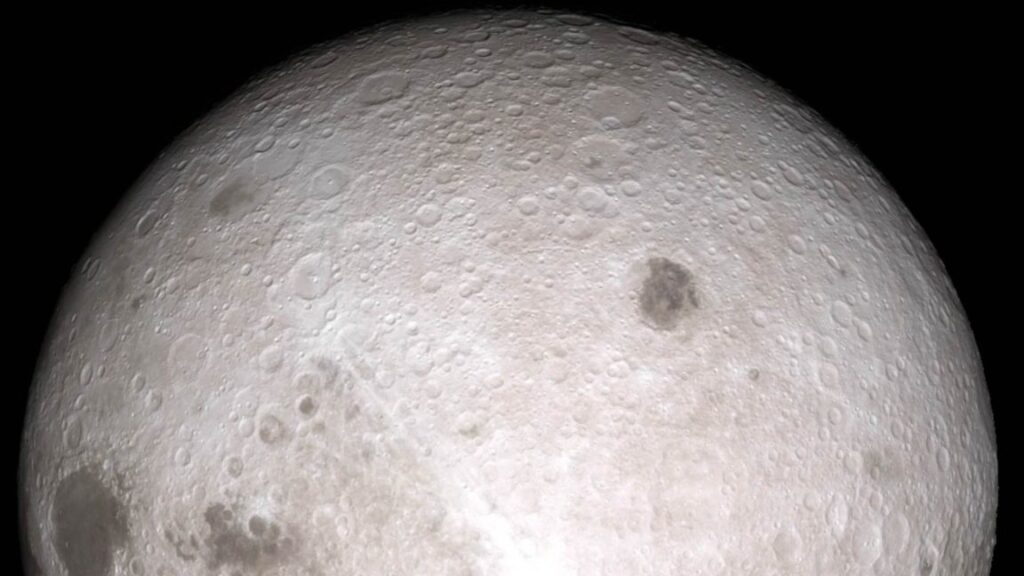
These sought-after regions are scientifically vital and geopolitically sensitive, as multiple countries want to build bases or conduct research there. Building infrastructure in these areas would cement a country’s ability to access the resources there and potentially exclude others from doing the same.

Critics may worry about radiation risks. Even if designed for peaceful use and contained properly, reactors introduce new environmental and operational hazards, particularly in a dangerous setting such as space. But the UN guidelines do outline rigorous safety protocols, and following them could potentially mitigate these concerns.

Why nuclear? Because solar has limits

The Moon has little atmosphere and experiences 14-day stretches of darkness. In some shadowed craters, where ice is likely to be found, sunlight never reaches the surface at all. These issues make solar energy unreliable, if not impossible, in some of the most critical regions.

A small lunar reactor could operate continuously for a decade or more, powering habitats, rovers, 3D printers, and life-support systems. Nuclear power could be the linchpin for long-term human activity. And it’s not just about the Moon – developing this capability is essential for missions to Mars, where solar power is even more constrained.
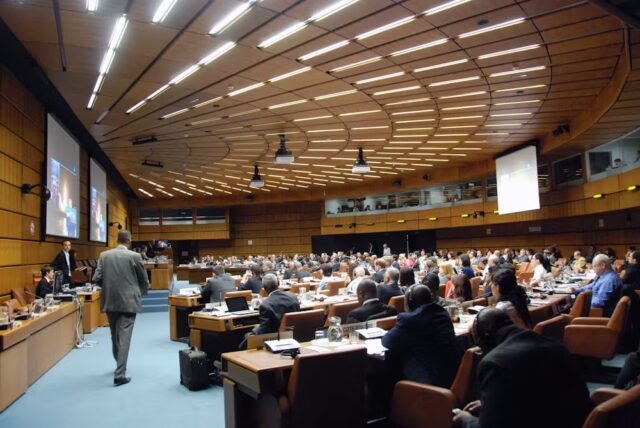
The UN Committee on the Peaceful Uses of Outer Space sets guidelines to govern how countries act in outer space. United States Mission to International Organizations in Vienna. Credit: CC BY-NC-ND

A call for governance, not alarm

The United States has an opportunity to lead not just in technology but in governance. If it commits to sharing its plans publicly, following Article IX of the Outer Space Treaty and reaffirming a commitment to peaceful use and international participation, it will encourage other countries to do the same.

The future of the Moon won’t be determined by who plants the most flags. It will be determined by who builds what, and how. Nuclear power may be essential for that future. Building transparently and in line with international guidelines would allow countries to more safely realize that future.

A reactor on the Moon isn’t a territorial claim or a declaration of war. But it is infrastructure. And infrastructure will be how countries display power—of all kinds—in the next era of space exploration.The Conversation

Michelle L.D. Hanlon, Professor of Air and Space Law, University of Mississippi. This article is republished from The Conversation under a Creative Commons license. Read the original article.

NASA plans to build a nuclear reactor on the Moon—a space lawyer explains why Read More »
trump-fires-commissioner-of-preeminent-nuclear-safety-institution

Trump fires commissioner of preeminent nuclear safety institution


Commissioner fired as Trump pivots US policy to accept more nuclear risks.

Critics warn that the United States may soon be taking on more nuclear safety risks after Donald Trump fired one of five members of an independent commission that monitors the country’s nuclear reactors.

In a statement Monday, Christopher Hanson confirmed that Trump fired him from the US Nuclear Regulatory Commission (NRC) on Friday. He alleged that the firing was “without cause” and “contrary to existing law and longstanding precedent regarding removal of independent agency appointees.” According to NPR, he received an email that simply said his firing was “effective immediately.”

Hanson had enjoyed bipartisan support for his work for years. Trump initially appointed Hanson to the NRC in 2020, then he was renominated by Joe Biden in 2024. In his statement, he said it was an “honor” to serve, citing accomplishments over his long stint as chair, which ended in January 2025.

It’s unclear why Trump fired Hanson. Among the committee chair’s accomplishments, Hanson highlighted revisions to safety regulations, as well as efforts to ramp up recruitment by re-establishing the Minority Serving Institution Grant Program. Both may have put him in opposition to Trump, who wants to loosen regulations to boost the nuclear industry and eliminate diversity initiatives across government.

In a statement to NPR, White House Deputy Press Secretary Anna Kelly suggested it was a political firing.

“All organizations are more effective when leaders are rowing in the same direction,” Kelly said. “President Trump reserves the right to remove employees within his own Executive Branch who exert his executive authority.”

On social media, some Trump critics suggested that Trump lacked the authority to fire Hanson, arguing that Hanson could have ignored the email and kept on working, like the Smithsonian museum director whom Trump failed to fire. (And who eventually quit.)

But Hanson accepted the termination. Instead of raising any concerns, he used his statement as an opportunity to praise those left at NRC, who will be tasked with continuing to protect Americans from nuclear safety risks at a time when Trump has said that he wants industry interests to carry equal weight as public health and environmental concerns.

“My focus over the last five years has been to prepare the agency for anticipated change in the energy sector, while preserving the independence, integrity, and bipartisan nature of the world’s gold standard nuclear safety institution,” Hanson said. “It has been an honor to serve alongside the dedicated public servants at the NRC. I continue to have full trust and confidence in their commitment to serve the American people by protecting public health and safety and the environment.”

Trump pushing “unsettled” science on nuclear risks

The firing followed an executive order in May that demanded an overhaul of the NRC, including reductions in force and expedited approvals on nuclear reactors. All final decisions on new reactors must be made within 18 months, and requests to continue operating existing reactors should be rubber-stamped within a year, Trump ordered.

Likely most alarming to critics, the desired reforms emphasized tossing out the standards that the NRC currently uses that “posit there is no safe threshold of radiation exposure, and that harm is directly proportional to the amount of exposure.”

Until Trump started meddling, the NRC established those guidelines after agreeing with studies examining “cancer cases among 86,600 survivors of the atomic bombs dropped on Hiroshima and Nagasaki in Japan during World War II,” Science reported. Those studies concluded that “the incidence of cancer in the survivors rose linearly—in a straight line—with the radiation dose.” By rejecting that evidence, Trump could be slowly creeping up the radiation dose and leading Americans to blindly take greater risks.

But according to Trump, by adopting those current standards, the NRC is supposedly bogging down the nuclear industry by trying to “insulate Americans from the most remote risks without appropriate regard for the severe domestic and geopolitical costs of such risk aversion.” Instead, the US should prioritize solving the riddle of what might be safe radiation levels, Trump suggests, while restoring US dominance in the nuclear industry, which Trump views as vital to national security and economic growth.

Although Trump claimed the NRC’s current standards were “irrational” and “lack scientific basis,” Science reported that the so-called “linear no-threshold (LNT) model of ionizing radiation” that Trump is criticizing “is widely accepted in the scientific community and informs almost all regulation of the US nuclear industry.”

Further, the NRC rejected past attempts to switch to a model based on the “hormesis theory” that Trump seemingly supports—which posits that some radiation exposure can be beneficial. The NRC found there was “insufficient evidence to justify any changes” that could endanger public health, Science reported.

One health researcher at the University of California, Irvine, Stephen Bondy, told Science that his 2023 review on the science of hormesis showed it is “still unsettled.” His characterization of the executive order suggests that the NRC embracing that model “clearly places health hazards as of secondary importance relative to economic and business interests.”

Trump’s pro-industry push could backfire

If the administration charges ahead with such changes, experts have warned that Trump could end up inadvertently hobbling the nuclear industry. If health hazards become extreme—or a nuclear event occurs—”altering NRC’s safety standards could ultimately reduce public support for nuclear power,” analysts told Science.

Among the staunchest critics of Trump’s order is Edwin Lyman, the director of nuclear power safety at the Union of Concerned Scientists. In a May statement, Lyman warned that “the US nuclear industry will fail if safety is not made a priority.”

He also cautioned that it was critical for the NRC to remain independent, not just to shield Americans from risks but to protect US nuclear technology’s prominence in global markets.

“By fatally compromising the independence and integrity of the NRC, and by encouraging pathways for nuclear deployment that bypass the regulator entirely, the Trump administration is virtually guaranteeing that this country will see a serious accident or other radiological release that will affect the health, safety, and livelihoods of millions,” Lyman said. “Such a disaster will destroy public trust in nuclear power and cause other nations to reject US nuclear technology for decades to come.”

Since Trump wants regulations changed, there will likely be a public commenting period where concerned citizens can weigh in on what they think are acceptable radiation levels in their communities. But Trump’s order also pushed for that public comment period to be streamlined, potentially making it easier to push through his agenda. If that happens, the NRC may face lawsuits under the 1954 Atomic Energy Act, which requires the commission to “minimize danger to life or property,” Science noted.

Following Hanson’s firing, Lyman reiterated to NPR that Trump’s ongoing attacks on the NRC “could have serious implications for nuclear safety.

“It’s critical that the NRC make its judgments about protecting health and safety without regard for the financial health of the nuclear industry,” Lyman said.

Photo of Ashley Belanger

Ashley is a senior policy reporter for Ars Technica, dedicated to tracking social impacts of emerging policies and new technologies. She is a Chicago-based journalist with 20 years of experience.

Trump fires commissioner of preeminent nuclear safety institution Read More »

google-and-kairos-sign-nuclear-reactor-deal-with-aim-to-power-ai

Google and Kairos sign nuclear reactor deal with aim to power AI

Google isn’t alone in eyeballing nuclear power as an energy source for massive datacenters. In September, Ars reported on a plan from Microsoft that would re-open the Three Mile Island nuclear power plant in Pennsylvania to fulfill some of its power needs. And the US administration is getting into the nuclear act as well, signing a bipartisan ADVANCE act in July with the aim of jump-starting new nuclear power technology.

AI is driving demand for nuclear

In some ways, it would be an interesting twist if demand for training and running power-hungry AI models, which are often criticized as wasteful, ends up kick-starting a nuclear power renaissance that helps wean the US off fossil fuels and eventually reduces the impact of global climate change. These days, almost every Big Tech corporate position could be seen as an optics play designed to increase shareholder value, but this may be one of the rare times when the needs of giant corporations accidentally align with the needs of the planet.

Even from a cynical angle, the partnership between Google and Kairos Power represents a step toward the development of next-generation nuclear power as an ostensibly clean energy source (especially when compared to coal-fired power plants). As the world sees increasing energy demands, collaborations like this one, along with adopting solutions like solar and wind power, may play a key role in reducing greenhouse gas emissions.

Despite that potential upside, some experts are deeply skeptical of the Google-Kairos deal, suggesting that this recent rush to nuclear may result in Big Tech ownership of clean power generation. Dr. Sasha Luccioni, Climate and AI Lead at Hugging Face, wrote on X, “One step closer to a world of private nuclear power plants controlled by Big Tech to power the generative AI boom. Instead of rethinking the way we build and deploy these systems in the first place.”

Google and Kairos sign nuclear reactor deal with aim to power AI Read More »