NIH

trump-admin-axed-383-active-clinical-trials,-dumping-over-74k-participants

Trump admin axed 383 active clinical trials, dumping over 74K participants

“A betrayal”

Jena and colleagues examined the greater context, comparing the number of cancelled trials in each treatment category to the total number of all funded trials in those categories. For instance, while cancer trials made up 30 percent of the 383 cancelled trials, the 118 cancelled cancer trials accounted for only 2.7 percent of the total 4,424 cancer trials funded in the study period. The cancelled infectious disease trials, on the other hand, accounted for over 14 percent of all infectious disease trials funded (675). The categories most disproportionately affected were infectious diseases, respiratory diseases, and cardiovascular diseases.

The researchers also looked at the purpose of the cancelled trials—for instance, for treatment of a disease, prevention, supportive care, or diagnostics. Of the 383, 140 were for treatments and 123 were for prevention.

The authors note that they weren’t able to determine the stated reasons for the cancellations (if any) or compare this year’s trial cancellations to trends from previous years, which could offer more context to the cuts. There simply isn’t the same comprehensive data on clinical trial cancellations for past years, the authors said, noting “termination of federal grant funding was rare prior to 2025.”

In the accompanying editor’s note, Teva Brender and Cary Gross blasted the revealed cancellations. To cancel trials already underway is to “squander participants’ and investigators’ valuable time, effort, and resources,” they write, since there have already been “substantive sunk costs.” It also “stifles scientific discovery and innovation.”

But “there is a more direct and sobering impact of premature and scientifically unjustifiable trial terminations: the violation of foundational ethical principles of human participant research,” they write. “First and foremost, it is betrayal of the fundamental principles of informed consent for research.” And “participants who have been exposed to an intervention in the context of a trial may be harmed by its premature withdrawal or inadequate follow-up and monitoring for adverse effects.”

Over 74,000 trial participants entrusted researchers with “their health and hope,” but even if the trial funding is restored—as it may be for some—it would “at best mitigate the harms.”

Trump admin axed 383 active clinical trials, dumping over 74K participants Read More »

an-nih-director-joins-maha,-gets-replaced-by-jd-vance’s-close-friend

An NIH director joins MAHA, gets replaced by JD Vance’s close friend

The director of a federal health institute that has arguably produced two of the most controversial government studies in recent years has accepted a new federal role to advance the goals of the Make America Healthy Again movement. Meanwhile, the person replacing him as director is a close friend of Vice President JD Vance and was installed in a process that experts describe as completely outside standard hiring practices.

The series of events—revealed in an email to staff last week from the National Institutes of Health Director Jay Bhattacharya—is only exacerbating the spiraling fears that science is being deeply corrupted by politics under the Trump administration.

Richard Woychik, a molecular geneticist, is the outgoing director of the NIH’s National Institute of Environmental Health Sciences (NIEHS), which is located in Research Triangle Park, North Carolina. He has been director since 2020 and was recently appointed to a second five-year term, according to Science magazine. Woychik was hired at the institute in 2010, when he joined as deputy director, and was appointed acting director in 2019.

As the director of NIEHS, Woychik was also the director of the National Toxicology Program (NTP). This is an interagency program that has produced two highly controversial scientific reports during Woychik’s time in NIEHS’s upper leadership. One, initially released in 2016, claimed that cellphone radiation causes cancer based on findings from rats, though only male rats. The final reports were published in 2018. Another controversial study, finalized this year, suggested that high levels of fluoride lower the IQ of children. Both the cellphone radiation and fluoride studies have been roundly criticized for flaws in their methodology and analysis, and the scientific community has largely dismissed them.

However, the studies align with—and bolster—the conspiracy theories and misinformation spread by the MAHA movement, which is led by ardent anti-vaccine activist and current US health secretary Robert F. Kennedy Jr. As health secretary, Kennedy has pledged to remove fluoride from municipal water, which, over decades, has proven safe and highly effective at preventing tooth decay in children. He has also, at various times, suggested 5G cell phone radiation causes cancer, a variety of other health conditions, changes to DNA, and is used as mass surveillance.

An NIH director joins MAHA, gets replaced by JD Vance’s close friend Read More »

study:-planned-budget-cuts-would-hurt-drug-development-badly

Study: Planned budget cuts would hurt drug development badly

It turns out that nearly 60 percent of the patents cite NIH-funded research. And here, the at-risk grants put in a very good showing, with just over half of the patents citing at least one at-risk grant. Note that many grants will have citations from both categories; to get a better sense, the researchers looked for patents where at least a quarter of the papers cited arose from NIH-funded research. For any grant, that number was a bit over 35 percent; for at-risk grants, it was about 12 percent.

Looking at specific examples, the researchers found that some of the approved drugs that relied on at-risk research were used for cancer treatments and genetic disorders. In other words, treatments that are likely to have a significant impact on public health. There are a couple of reasons to think that this is an underestimation of the impact, as well. To begin with, their source data on funding priorities stops at 2007, leaving a roughly 15-year gap where research funding can’t be analyzed, but patents are still being filed.

In addition, drugs are just a small part of the potential impact of NIH research. “We excluded a wide range of important medical advances that may also build on NIH-funded research,” the researchers acknowledge. “These include vaccines, gene and cell therapies, and other biologic drugs; diagnostic technologies and medical devices; as well as innovations in medical procedures, patient care practices, and surgical techniques.” Beyond the obvious implications for public health, these sorts of patents can result in lots of economic activity, including the launching of entirely new businesses.

Beyond informing current debates about science funding, the research makes a larger point about scientific progress. We tend to focus on the major leaps forward and the high-profile scientists that drive them, as the upcoming Nobel Prizes highlight. But the reality is that most advances, especially in biology, are built on a broad intellectual foundation of lower-profile work that may require years for someone to find a way to apply it to anything patentable. Broad cuts like these may mean that the scientific superstars will still walk away with grants, while leaving a field devastated by having parts of this foundation knocked out from under it.

Science, 2025. DOI: 10.1126/science.aeb1564 (About DOIs).

Study: Planned budget cuts would hurt drug development badly Read More »

deeply-divided-supreme-court-lets-nih-grant-terminations-continue

Deeply divided Supreme Court lets NIH grant terminations continue

The dissents

The primary dissent was written by Chief Justice Roberts, and joined in part by the three Democratic appointees, Jackson, Kagan, and Sotomayor. It is a grand total of one paragraph and can be distilled down to a single sentence: “If the District Court had jurisdiction to vacate the directives, it also had jurisdiction to vacate the ‘Resulting Grant Terminations.’”

Jackson, however, chose to write a separate and far more detailed argument against the decision, mostly focusing on the fact that it’s not simply a matter of abstract law; it has real-world consequences.

She notes that existing law prevents plaintiffs from suing in the Court of Federal Claims while the facts are under dispute in other courts (something acknowledged by Barrett). That would mean that, as here, any plaintiffs would have to have the policy declared illegal first in the District Court, and only after that was fully resolved could they turn to the Federal Claims Court to try to restore their grants. That’s a process that could take years. In the meantime, the scientists would be out of funding, with dire consequences.

Yearslong studies will lose validity. Animal subjects will be euthanized. Life-saving medication trials will be abandoned. Countless researchers will lose their jobs. And community health clinics will close.

Jackson also had little interest in hearing that the government would be harmed by paying out the grants in the meantime. “For the Government, the incremental expenditure of money is at stake,” she wrote. “For the plaintiffs and the public, scientific progress itself hangs in the balance along with the lives that progress saves.”

With this decision, of course, it no longer hangs in the balance. There’s a possibility that the District Court’s ruling that the government’s policy was arbitrary and capricious will ultimately prevail; it’s not clear, because Barrett says she hasn’t even seen the government make arguments there, and Roberts only wrote regarding the venue issues. In the meantime, even with the policy stayed, it’s unlikely that anyone will focus grant proposals on the disfavored subjects, given that the policy might be reinstated at any moment.

And even if that ruling is upheld, it will likely take years to get there, and only then could a separate case be started to restore the funding. Any labs that had been using those grants will have long since moved on, and the people working on those projects scattered.

Deeply divided Supreme Court lets NIH grant terminations continue Read More »

judge:-you-can’t-ban-dei-grants-without-bothering-to-define-dei

Judge: You can’t ban DEI grants without bothering to define DEI

Separately, Trump v. Casa blocked the use of a national injunction against illegal activity. So, while the government’s actions have been determined to be illegal, Young can only protect the people who were parties to this suit. Anyone who lost a grant but wasn’t a member of any of the parties involved, or based in any of the states that sued, remains on their own.

Those issues aside, the ruling largely focuses on whether the termination of grants violates the Administrative Procedures Act, which governs how the executive branch handles decision- and rule-making. Specifically, it requires that any decisions of this sort cannot be “arbitrary and capricious.” And, Young concludes that the government hasn’t cleared that bar.

Arbitrary and capricious

The grant cancellations, Young concludes, “Arise from the NIH’s newly minted war against undefined concepts of diversity, equity, and inclusion and gender identity, that has expanded to include vaccine hesitancy, COVID, influencing public opinion and climate change.” The “undefined” aspect plays a key part in his reasoning. Referring to DEI, he writes, “No one has ever defined it to this Court—and this Court has asked multiple times.” It’s not defined in Trump’s executive order that launched the “newly minted war,” and Young found that administrators within the NIH issued multiple documents that attempted to define it, not all of which were consistent with each other, and in some cases seemed to use circular reasoning.

He also noted that the officials who sent these memos had a tendency to resign shortly afterward, writing, “it is not lost on the Court that oftentimes people vote with their feet.”

As a result, the NIH staff had no solid guidance for determining whether a given grant violated the new anti-DEI policy, or how that might be weighed against the scientific merit of the grant. So, how were they to identify which grants needed to be terminated? The evidence revealed at trial indicates that they didn’t need to make those decisions; DOGE made them for the NIH. In one case, an NIH official approved a list of grants to terminate received from DOGE only two minutes after it showed up in his inbox.

Judge: You can’t ban DEI grants without bothering to define DEI Read More »

rfk-jr.’s-health-department-calls-nature-“junk-science,”-cancels-subscriptions

RFK Jr.’s health department calls Nature “junk science,” cancels subscriptions

The move comes after HHS Secretary and anti-vaccine activist Robert F. Kennedy Jr. said on a May 27 podcast that prestigious medical journals are “corrupt.”

“We’re probably going to stop publishing in the Lancet, New England Journal of Medicine, JAMA, and those other journals because they’re all corrupt,” he said. He accused the journals collectively of being a “vessel for pharmaceutical propaganda.” He went on to say that “unless these journals change dramatically,” the federal government would “stop NIH scientists from publishing there” and create “in-house” journals instead.

Kennedy’s criticism largely stems from his belief that modern medicine and mainstream science are part of a global conspiracy to generate pharmaceutical profits. Kennedy is a germ-theory denier who believes people can maintain their health not by relying on evidence-based medicine, such as vaccines, but by clean living and eating—a loose concept called “terrain theory.”

Access to top scientific and medical journals is essential for federal scientists to keep up to date with their fields and publicize high-impact results. One NIH employee added to Nature news that it “suppresses our scientific freedom, to pursue information where it is present.”

RFK Jr.’s health department calls Nature “junk science,” cancels subscriptions Read More »

“culture-of-fear-and-suppression”:-nih-staff-speak-out-against-trump-admin

“Culture of fear and suppression”: NIH staff speak out against Trump admin

“A risk”

Backlash to the idea was quick, with the World Health Organization Director-General Tedros Adhanom Ghebreyesus immediately calling it “unethical.”

“Allowing a dangerous virus that we don’t fully understand to run free is simply unethical. It’s not an option,” Tedros said in a news briefing at the time.

In the letter on Monday, NIH researchers speak directly to Bhattacharya, writing, “We hope you will welcome this dissent, which we modeled after your Great Barrington Declaration.” They titled the letter “The Bethesda Declaration,” named after the NIH’s location in Maryland.

“Standing up in this way is a risk, but I am much more worried about the risks of not speaking up,” Jenna Norton, a program officer at the NIH’s National Institute of Diabetes and Digestive and Kidney Diseases, said in a statement. “If we don’t speak up, we allow continued harm to research participants and public health in America and across the globe. If we don’t speak up, we allow our government to curtail free speech, a fundamental American value.”

The organization leading the NIH dissent, Stand Up For Science, published a second letter on Monday in support of the Bethesda Declaration. The support letter is signed by over a dozen Nobel laureates and former NIH directors Jeremy Berg and Joshua Gordon.

Tomorrow, Bhattacharya will testify before the Senate Appropriations Committee on the Trump administration’s 2026 budget proposal for the NIH, which proposes a cut of about 40 percent to the agency’s $48 billion budget.

“Culture of fear and suppression”: NIH staff speak out against Trump admin Read More »

trump’s-2026-budget-proposal:-crippling-cuts-for-science-across-the-board

Trump’s 2026 budget proposal: Crippling cuts for science across the board


Budget document derides research and science-based policy as “woke,” “scams.”

On Friday, the US Office of Management and Budget sent Sen. Susan Collins (R-Maine), chair of the Senate’s Appropriations Committee, an outline of what to expect from the Trump administration’s 2026 budget proposal. As expected, the budget includes widespread cuts, affecting nearly every branch of the federal government.

In keeping with the administration’s attacks on research agencies and the places research gets done, research funding will be taking an enormous hit, with the National Institutes of Health taking a 40 percent cut and the National Science Foundation losing 55 percent of its 2025 budget. But the budget goes well beyond those highlighted items, with nearly every place science gets done or funded targeted for cuts.

Perhaps even more shocking is the language used to justify the cuts, which reads more like a partisan rant than a serious budget document.

Health cuts

Having a secretary of Health and Human Services who doesn’t believe in germ theory is not likely to do good things for US health programs, and the proposed budget will only make matters worse. Kennedy’s planned MAHA (Make America Healthy Again) program would be launched with half a billion in funds, but nearly everything else would take a cut.

The CDC would lose about $3.6 billion from its current budget of $9.6 billion, primarily due to the shuttering of a number of divisions within it: the National Center for Chronic Diseases Prevention and Health Promotion, the National Center for Environmental Health, the National Center for Injury Prevention and Control, and the Global Health Center and its division of Public Health Preparedness and Response. The duties of those offices are, according to the budget document, “duplicative, DEI, or simply unnecessary.”

Another big hit to HHS comes from the termination of a $4 billion program that helps low-income families cover energy costs. The OMB suggests that these costs will get lower due to expanded energy production and, anyway, the states should be paying for it. Shifting financial burdens to states is a general theme of the document, an approach that will ultimately hit the poorest states hardest, even though these had very high percentages of Trump voters.

The document also says that “This Administration is committed to combatting the scourge of deadly drugs that have ravaged American communities,” while cutting a billion dollars from substance abuse programs within HHS.

But the headline cuts come from the National Institutes of Health, the single largest source of scientific funding in the world. NIH would see its current $48 billion budget chopped by $18 billion and its 27 individual institutes consolidated down to just five. This would result in vast cutbacks to US biomedical research, which is currently acknowledged to be world-leading. Combined with planned cuts to grant overheads, it will cause most research institutions to shrink, and some less well-funded universities may be forced to close facilities.

The justification for the cuts is little more than a partisan rant: “NIH has broken the trust of the American people with wasteful spending, misleading information, risky research, and the promotion of dangerous ideologies that undermine public health.” The text then implies that the broken trust is primarily the product of failing to promote the idea that SARS-CoV-2 originated in a lab, even though there’s no scientific evidence to indicate that it had.

Climate research hit

The National Science Foundation funds much of the US’s fundamental science research, like physics and astronomy. Earlier reporting that it would see a 56 percent cut to its budget was confirmed. “The Budget cuts funding for: climate; clean energy; woke social, behavioral, and economic sciences; and programs in low priority areas of science.” Funding would be maintained for AI and quantum computing. All funding for encouraging minority participation in the sciences will also be terminated. The budget was released on the same day that the NSF announced it was joining other science agencies in standardizing on paying 15 percent of its grants’ value for maintaining facilities and providing services to researchers, a cut that would further the financial damage to research institutions.

The National Oceanic and Atmospheric Administration would see $1.3 billion of its $6.6 billion budget cut, with the primary target being its climate change work. In fact, the budget for NOAA’s weather satellites will be cut to prevent them from including instruments that would make “unnecessary climate measurements.” Apparently, the Administration doesn’t want anyone to be exposed to data that might challenge its narrative that climate change is a scam.

The National Institute of Standards and Technology would lose $350 million for similar reasons. “NIST has long funded awards for the development of curricula that advance a radical climate agenda,” the document suggests, before going on to say that the Institute’s Circular Economy Program, which promotes the efficient reuse of industrial materials, “pushes environmental alarmism.”

The Department of Energy is seeing a $1.1 billion hit to its science budget, “eliminating funding for Green New Scam interests and climate change-related activities.” The DOE will also take hits to policy programs focused on climate change, including $15 billion in cuts to renewable energy and carbon capture spending. Separately, the Office of Energy Efficiency and Renewable Energy will also take a $2.6 billion hit. Over at the Department of the Interior, the US Geological Survey would see its renewable energy programs terminated, as well.

Some of the DOE’s other cuts, however, don’t even make sense given the administration’s priorities. The newly renamed Office of Fossil Energy—something that Trump favors—will still take a $270 million hit, and nuclear energy programs will see $400 million in cuts.

This sort of lack of self-awareness shows up several times in the document. In one striking case, an interior program funding water infrastructure improvements is taking a cut that “reduces funding for programs that have nothing to do with building and maintaining water infrastructure, such as habitat restoration.” Apparently, the OMB is unaware that functioning habitats can help provide ecosystem services that can reduce the need for water infrastructure.

Similarly, over at the EPA, they’re boosting programs for clean drinking water by $36 million, while at the same time cutting loans to states for clean water projects by $2.5 billion. “The States should be responsible for funding their own water infrastructure projects,” the OMB declares. Research at the EPA also takes a hit: “The Budget puts an end to unrestrained research grants, radical environmental justice work, woke climate research, and skewed, overly-precautionary modeling that influences regulations—none of which are authorized by law.”

An attack on scientific infrastructure

US science couldn’t flourish without an educational system that funnels talented individuals into graduate programs. So, naturally, funding for those is being targeted as well. This is partially a function of the administration’s intention to eliminate the Department of Education, but there also seems to be a specific focus on programs that target low-income individuals.

For example, the GEAR UP program describes itself as “designed to increase the number of low-income students who are prepared to enter and succeed in postsecondary education.” The OMB document describes it as “a relic of the past when financial incentives were needed to motivate Institutions of Higher Education to engage with low-income students and increase access.” It goes on to claim that this is “not the obstacle it was for students of limited means.”

Similarly, the SEOG program funding is “awarded to an undergraduate student who demonstrates exceptional financial need.” In the OMB’s view, colleges and universities “have used [it] to fund radical leftist ideology instead of investing in students and their success.” Another cut is claimed to eliminate “Equity Assistance Centers that have indoctrinated children.” And “The Budget proposes to end Federal taxpayer dollars being weaponized to indoctrinate new teachers.”

In addition, the federal work-study program, which subsidizes on-campus jobs for needy students, is also getting a billion-dollar cut. Again, the document says that the states can pay for it.

(The education portion also specifically cuts the funding of Howard University, which is both distinct as a federally supported Black university and also notable as being where Kamala Harris got her first degree.)

The end of US leadership

This budget is a recipe for ending the US’s leadership in science. It would do generational damage by forcing labs to shut down, with a corresponding loss of highly trained individuals and one-of-a-kind research materials. At the same time, it will throttle the educational pipeline that could eventually replace those losses. Given that the US is one of the major sources of research funding in the world, if approved, the budget will have global consequences.

To the people within the OMB who prepared the document, these are not losses. The document makes it very clear that they view many instances of scientific thought and evidence-based policy as little more than forms of ideological indoctrination, presumably because the evidence sometimes contradicts what they’d prefer to believe.

Photo of John Timmer

John is Ars Technica’s science editor. He has a Bachelor of Arts in Biochemistry from Columbia University, and a Ph.D. in Molecular and Cell Biology from the University of California, Berkeley. When physically separated from his keyboard, he tends to seek out a bicycle, or a scenic location for communing with his hiking boots.

Trump’s 2026 budget proposal: Crippling cuts for science across the board Read More »

trump-admin-accused-of-censoring-nih’s-top-expert-on-ultra-processed-foods

Trump admin accused of censoring NIH’s top expert on ultra-processed foods

Hall claims that because of this, aides for Kennedy blocked him from being directly interviewed by New York Times reporters about the study. Instead, Hall was allowed to provide only written responses to the newspaper. However, Hall claims that Andrew Nixon, a spokesperson for Kennedy, then downplayed the study’s results to the Times and edited Hall’s written responses and sent them to the reporter without Hall’s consent.

Further, Hall claims he was barred from presenting his research on ultra-processed foods at a conference and was forced to either edit a manuscript he had worked on with outside researchers or remove himself as a co-author.

An HHS spokesperson denied to CBS that Hall was censored or that his written responses to the Times were edited. “Any attempt to paint this as censorship is a deliberate distortion of the facts,” a statement from the HHS said.

In response, Hall wrote to CBS, “I wonder how they define censorship?”

Hall said he had reached out to NIH leadership about his concerns in hopes it all was an “aberration” but never received a response.

“Without any reassurance there wouldn’t be continued censorship or meddling in our research, I felt compelled to accept early retirement to preserve health insurance for my family,” he wrote in the LinkedIn post. “Due to very tight deadlines to make this decision, I don’t yet have plans for my future career.”

Trump admin accused of censoring NIH’s top expert on ultra-processed foods Read More »

rfk-jr.‘s-bloodbath-at-hhs:-blowback-grows-as-losses-become-clearer

RFK Jr.‘s bloodbath at HHS: Blowback grows as losses become clearer

Last week, Health Secretary and anti-vaccine advocate Robert F. Kennedy Jr. announced the Trump administration would hack off nearly a quarter of employees at the Department of Health and Human Services, which oversees critical agencies including the Food and Drug Administration (FDA), the Centers for Disease Control and Prevention (CDC), the National Institutes of Health (NIH), and the Centers for Medicare and Medicaid Services (CMS).

The downsizing includes pushing out about 10,000 full-time employees through early retirements, deferred resignations, and other efforts. Another 10,000 will be laid off in a brutal restructuring, bringing the total HHS workforce from 82,000 to 62,000.

“This will be a painful period,” Kennedy said in a video announcement last week. Early yesterday morning, the pain began.

It begins

At the FDA—which will lose 3,500 employees, about 19 percent of staff—some employees learned they were being laid off from security guards after their badges no longer worked when they showed up to their offices, according to Stat. At CMS—which will lose 300 employees, about 4 percent—laid-off employees were instructed to file any discrimination complaints they may have with Anita Pinder, identified as the director of CMS’s Office of Equal Opportunity and Civil Rights. However, Pinder died last year, The Washington Post noted.

At the NIH—which is set to lose 1,200 employees, about 6 percent—new director Jay Bhattacharya sent and email to staff saying he would implement new policies “humanely,” while calling the layoffs a “significant reduction.” Five NIH institute directors and at least two other senior leaders have been ousted, in addition to hundreds of lower-level employees. Bhattacharya wrote that the remaining staff will have to find new ways to carry out “key NIH administrative functions, including communications, legislative affairs, procurement, and human resources.”

At CDC—which will lose 2,400 employees, about 18 percent—the cuts slashed employees working in chronic disease prevention, sexually transmitted diseases, HIV, tuberculosis, global health, environmental health, occupational safety and health, maternal and child health, birth defects, violence prevention, health equity, communications, and science policy.

Some leaders and workers at the CDC and NIH were reportedly reassigned or offered transfers to work at the Indian Health Services (IHS), an HHS division that provides medical and health services to Native American tribes. The transfers, which could require employees to move to a remote branch, are seen as another way to force workers out.

RFK Jr.‘s bloodbath at HHS: Blowback grows as losses become clearer Read More »

report:-us-scientists-lost-$3-billion-in-nih-grants-since-trump-took-office

Report: US scientists lost $3 billion in NIH grants since Trump took office

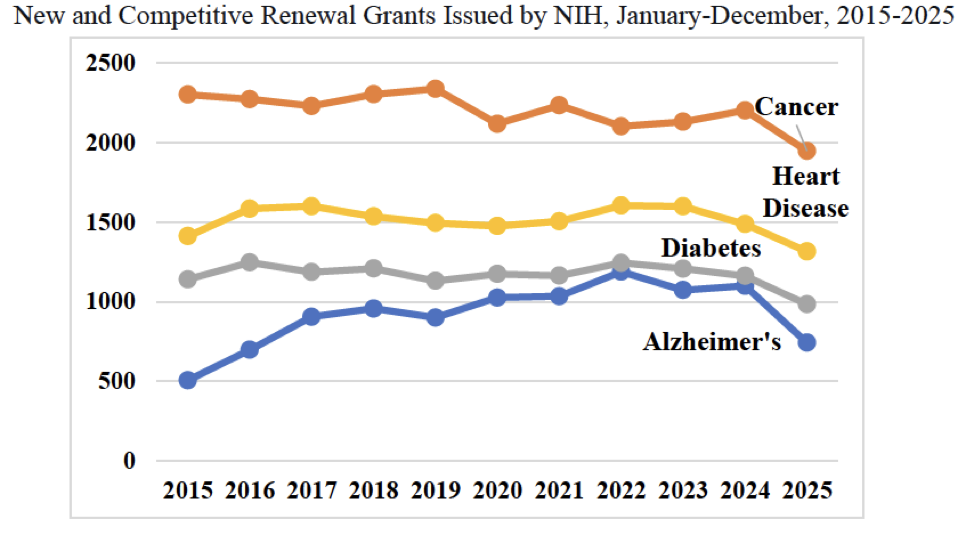
Since Trump took office on January 20, research funding from the National Institutes of Health has plummeted by more than $3 billion compared with the pace of funding in 2024, according to an analysis by The Washington Post.

By this time in March 2024, the NIH had awarded US researchers a total of $1.027 billion for new grants or competitive grant renewals. This year, the figure currently stands at about $400 million. Likewise, funding for renewals of existing grants without competition reached $4.5 billion by this time last year, but has only hit $2 billion this year. Together, this slowdown amounts to a 60 percent drop in grant support for a wide variety of research—from studies on cancer treatments, diabetes, Alzheimer’s, vaccines, mental health, transgender health, and more.

The NIH is the primary source of funding for biomedical research in the US. NIH grants support more than 300,000 scientists at more than 2,500 universities, medical schools, and other research organizations across all 50 states.

In the near term, the missing grant money means clinical trials have been abruptly halted, scientific projects are being shelved, supplies can’t be purchased, and experiments can’t be run. But, in the long run, it means a delay in scientific advancements and treatment, which could echo across future generations. With funding in question, academic researchers may be unable to retain staff or train younger scientists.

Report: US scientists lost $3 billion in NIH grants since Trump took office Read More »

“this-will-be-a-painful-period”:-rfk-jr-slashes-24%-of-us-health-dept.

“This will be a painful period”: RFK Jr. slashes 24% of US health dept.

Health Secretary and anti-vaccine advocate Robert F. Kennedy Jr. is slashing a total of 20,000 jobs across the Department of Health and Human Services—or about 24 percent of the workforce—in a sweeping overhaul said to improve efficiency and save money, Kennedy and the HHS announced Thursday.

Combining workforce losses from early retirement, the “Fork in the Road” deferred resignation deal, and 10,000 positions axed in the reductions and restructuring announced today, HHS will shrink from 82,000 full-time employees to 62,000 under Kennedy and the Trump administration. The HHS’s 28 divisions will be cut down to 15, while five of the department’s 10 regional offices will close.

“This will be a painful period,” Kennedy said in a video announcement posted on social media. Calling the HHS a “sprawling bureaucracy,” Kennedy claimed that the cuts would be aimed at “excess administrators.”

“I want to promise you now that we are going to do more with less,” he said in the video.

Kennedy and HHS said the cuts will save $1.8 billion each year. That’s about 0.027 percent of total federal spending, based on the $6.75 trillion the government spent in 2024, and about 0.06 percent of the $2.8 trillion HHS budget for that year.

The downsizing announced today includes significant cuts to the Food and Drug Administration, the Centers for Disease Control and Prevention, and the National Institutes of Health.

Cuts upon cuts

The FDA will lose 3,500 employees, which The Wall Street Journal reported was about 19 percent of its staff. HHS did not provide current staff levels at the agency level or percentage cuts. The CDC, which will absorb the Administration for Strategic Preparedness and Response (ASPR), will lose 2,400 employees (1,400 from CDC and 1,000 from ASPR). The Journal reported that to be about 18 percent of the total workforce. NIH will lose 1,200 employees, about 6 percent of its workers.

“This will be a painful period”: RFK Jr. slashes 24% of US health dept. Read More »