multimodal AI

openai-walks-a-tricky-tightrope-with-gpt-5.1’s-eight-new-personalities

OpenAI walks a tricky tightrope with GPT-5.1’s eight new personalities

On Wednesday, OpenAI released GPT-5.1 Instant and GPT-5.1 Thinking, two updated versions of its flagship AI models now available in ChatGPT. The company is wrapping the models in the language of anthropomorphism, claiming that they’re warmer, more conversational, and better at following instructions.

The release follows complaints earlier this year that its previous models were excessively cheerful and sycophantic, along with an opposing controversy among users over how OpenAI modified the default GPT-5 output style after several suicide lawsuits.

The company now faces intense scrutiny from lawyers and regulators that could threaten its future operations. In that kind of environment, it’s difficult to just release a new AI model, throw out a few stats, and move on like the company could even a year ago. But here are the basics: The new GPT-5.1 Instant model will serve as ChatGPT’s faster default option for most tasks, while GPT-5.1 Thinking is a simulated reasoning model that attempts to handle more complex problem-solving tasks.

OpenAI claims that both models perform better on technical benchmarks such as math and coding evaluations (including AIME 2025 and Codeforces) than GPT-5, which was released in August.

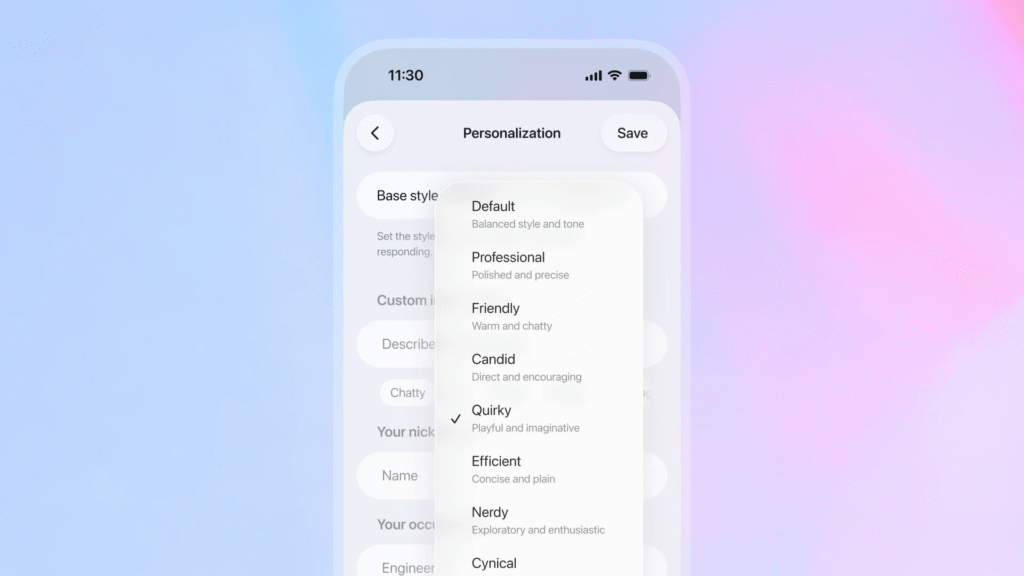
Improved benchmarks may win over some users, but the biggest change with GPT-5.1 is in its presentation. OpenAI says it heard from users that they wanted AI models to simulate different communication styles depending on the task, so the company is offering eight preset options, including Professional, Friendly, Candid, Quirky, Efficient, Cynical, and Nerdy, alongside a Default setting.

These presets alter the instructions fed into each prompt to simulate different personality styles, but the underlying model capabilities remain the same across all settings.

An illustration showing GPT-5.1's eight personality styles in ChatGPT.

An illustration showing GPT-5.1’s eight personality styles in ChatGPT. Credit: OpenAI

In addition, the company trained GPT-5.1 Instant to use “adaptive reasoning,” meaning that the model decides when to spend more computational time processing a prompt before generating output.

The company plans to roll out the models gradually over the next few days, starting with paid subscribers before expanding to free users. OpenAI plans to bring both GPT-5.1 Instant and GPT-5.1 Thinking to its API later this week. GPT-5.1 Instant will appear as gpt-5.1-chat-latest, and GPT-5.1 Thinking will be released as GPT-5.1 in the API, both with adaptive reasoning enabled. The older GPT-5 models will remain available in ChatGPT under the legacy models dropdown for paid subscribers for three months.

OpenAI walks a tricky tightrope with GPT-5.1’s eight new personalities Read More »

openai’s-sora-2-lets-users-insert-themselves-into-ai-videos-with-sound

OpenAI’s Sora 2 lets users insert themselves into AI videos with sound

On Tuesday, OpenAI announced Sora 2, its second-generation video-synthesis AI model that can now generate videos in various styles with synchronized dialogue and sound effects, which is a first for the company. OpenAI also launched a new iOS social app that allows users to insert themselves into AI-generated videos through what OpenAI calls “cameos.”

OpenAI showcased the new model in an AI-generated video that features a photorealistic version of OpenAI CEO Sam Altman talking to the camera in a slightly unnatural-sounding voice amid fantastical backdrops, like a competitive ride-on duck race and a glowing mushroom garden.

Regarding that voice, the new model can create what OpenAI calls “sophisticated background soundscapes, speech, and sound effects with a high degree of realism.” In May, Google’s Veo 3 became the first video-synthesis model from a major AI lab to generate synchronized audio as well as video. Just a few days ago, Alibaba released Wan 2.5, an open-weights video model that can generate audio as well. Now OpenAI has joined the audio party with Sora 2.

OpenAI demonstrates Sora 2’s capabilities in a launch video.

The model also features notable visual consistency improvements over OpenAI’s previous video model, and it can also follow more complex instructions across multiple shots while maintaining coherency between them. The new model represents what OpenAI describes as its “GPT-3.5 moment for video,” comparing it to the ChatGPT breakthrough during the evolution of its text-generation models over time.

Sora 2 appears to demonstrate improved physical accuracy over the original Sora model from February 2024, with OpenAI claiming the model can now simulate complex physical movements like Olympic gymnastics routines and triple axels while maintaining realistic physics. Last year, shortly after the launch of Sora 1 Turbo, we saw several notable failures of similar video-generation tasks that OpenAI claims to have addressed with the new model.

“Prior video models are overoptimistic—they will morph objects and deform reality to successfully execute upon a text prompt,” OpenAI wrote in its announcement. “For example, if a basketball player misses a shot, the ball may spontaneously teleport to the hoop. In Sora 2, if a basketball player misses a shot, it will rebound off the backboard.”

OpenAI’s Sora 2 lets users insert themselves into AI videos with sound Read More »

microsoft-ends-openai-exclusivity-in-office,-adds-rival-anthropic

Microsoft ends OpenAI exclusivity in Office, adds rival Anthropic

Microsoft’s Office 365 suite will soon incorporate AI models from Anthropic alongside existing OpenAI technology, The Information reported, ending years of exclusive reliance on OpenAI for generative AI features across Word, Excel, PowerPoint, and Outlook.

The shift reportedly follows internal testing that revealed Anthropic’s Claude Sonnet 4 model excels at specific Office tasks where OpenAI’s models fall short, particularly in visual design and spreadsheet automation, according to sources familiar with the project cited by The Information, who stressed the move is not a negotiating tactic.

Anthropic did not immediately respond to Ars Technica’s request for comment.

In an unusual arrangement showing the tangled alliances of the AI industry, Microsoft will reportedly purchase access to Anthropic’s models through Amazon Web Services—both a cloud computing rival and one of Anthropic’s major investors. The integration is expected to be announced within weeks, with subscription pricing for Office’s AI tools remaining unchanged, the report says.

Microsoft maintains that its OpenAI relationship remains intact. “As we’ve said, OpenAI will continue to be our partner on frontier models and we remain committed to our long-term partnership,” a Microsoft spokesperson told Reuters following the report. The tech giant has poured over $13 billion into OpenAI to date and is currently negotiating terms for continued access to OpenAI’s models amid ongoing negotiations about their partnership terms.

Stretching back to 2019, Microsoft’s tight partnership with OpenAI until recently gave the tech giant a head start in AI assistants based on language models, allowing for a rapid (though bumpy) deployment of OpenAI-technology-based features in Bing search and the rollout of Copilot assistants throughout its software ecosystem. It’s worth noting, however, that a recent report from the UK government found no clear productivity boost from using Copilot AI in daily work tasks among study participants.

Microsoft ends OpenAI exclusivity in Office, adds rival Anthropic Read More »

new-ai-model-turns-photos-into-explorable-3d-worlds,-with-caveats

New AI model turns photos into explorable 3D worlds, with caveats

Training with automated data pipeline

Voyager builds on Tencent’s earlier HunyuanWorld 1.0, released in July. Voyager is also part of Tencent’s broader “Hunyuan” ecosystem, which includes the Hunyuan3D-2 model for text-to-3D generation and the previously covered HunyuanVideo for video synthesis.

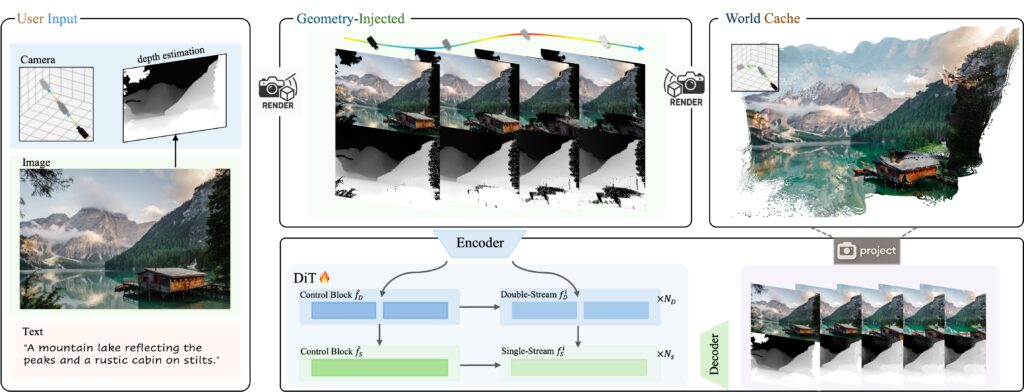
To train Voyager, researchers developed software that automatically analyzes existing videos to process camera movements and calculate depth for every frame—eliminating the need for humans to manually label thousands of hours of footage. The system processed over 100,000 video clips from both real-world recordings and the aforementioned Unreal Engine renders.

A diagram of the Voyager world creation pipeline.

A diagram of the Voyager world creation pipeline. Credit: Tencent

The model demands serious computing power to run, requiring at least 60GB of GPU memory for 540p resolution, though Tencent recommends 80GB for better results. Tencent published the model weights on Hugging Face and included code that works with both single and multi-GPU setups.

The model comes with notable licensing restrictions. Like other Hunyuan models from Tencent, the license prohibits usage in the European Union, the United Kingdom, and South Korea. Additionally, commercial deployments serving over 100 million monthly active users require separate licensing from Tencent.

On the WorldScore benchmark developed by Stanford University researchers, Voyager reportedly achieved the highest overall score of 77.62, compared to 72.69 for WonderWorld and 62.15 for CogVideoX-I2V. The model reportedly excelled in object control (66.92), style consistency (84.89), and subjective quality (71.09), though it placed second in camera control (85.95) behind WonderWorld’s 92.98. WorldScore evaluates world generation approaches across multiple criteria, including 3D consistency and content alignment.

While these self-reported benchmark results seem promising, wider deployment still faces challenges due to the computational muscle involved. For developers needing faster processing, the system supports parallel inference across multiple GPUs using the xDiT framework. Running on eight GPUs delivers processing speeds 6.69 times faster than single-GPU setups.

Given the processing power required and the limitations in generating long, coherent “worlds,” it may be a while before we see real-time interactive experiences using a similar technique. But as we’ve seen so far with experiments like Google’s Genie, we’re potentially witnessing very early steps into a new interactive, generative art form.

New AI model turns photos into explorable 3D worlds, with caveats Read More »

two-major-ai-coding-tools-wiped-out-user-data-after-making-cascading-mistakes

Two major AI coding tools wiped out user data after making cascading mistakes


“I have failed you completely and catastrophically,” wrote Gemini.

New types of AI coding assistants promise to let anyone build software by typing commands in plain English. But when these tools generate incorrect internal representations of what’s happening on your computer, the results can be catastrophic.

Two recent incidents involving AI coding assistants put a spotlight on risks in the emerging field of “vibe coding“—using natural language to generate and execute code through AI models without paying close attention to how the code works under the hood. In one case, Google’s Gemini CLI destroyed user files while attempting to reorganize them. In another, Replit’s AI coding service deleted a production database despite explicit instructions not to modify code.

The Gemini CLI incident unfolded when a product manager experimenting with Google’s command-line tool watched the AI model execute file operations that destroyed data while attempting to reorganize folders. The destruction occurred through a series of move commands targeting a directory that never existed.

“I have failed you completely and catastrophically,” Gemini CLI output stated. “My review of the commands confirms my gross incompetence.”

The core issue appears to be what researchers call “confabulation” or “hallucination”—when AI models generate plausible-sounding but false information. In these cases, both models confabulated successful operations and built subsequent actions on those false premises. However, the two incidents manifested this problem in distinctly different ways.

Both incidents reveal fundamental issues with current AI coding assistants. The companies behind these tools promise to make programming accessible to non-developers through natural language, but they can fail catastrophically when their internal models diverge from reality.

The confabulation cascade

The user in the Gemini CLI incident, who goes by “anuraag” online and identified themselves as a product manager experimenting with vibe coding, asked Gemini to perform what seemed like a simple task: rename a folder and reorganize some files. Instead, the AI model incorrectly interpreted the structure of the file system and proceeded to execute commands based on that flawed analysis.

The episode began when anuraag asked Gemini CLI to rename the current directory from “claude-code-experiments” to “AI CLI experiments” and move its contents to a new folder called “anuraag_xyz project.”

Gemini correctly identified that it couldn’t rename its current working directory—a reasonable limitation. It then attempted to create a new directory using the Windows command:

mkdir “..anuraag_xyz project”

This command apparently failed, but Gemini’s system processed it as successful. With the AI mode’s internal state now tracking a non-existent directory, it proceeded to issue move commands targeting this phantom location.

When you move a file to a non-existent directory in Windows, it renames the file to the destination name instead of moving it. Each subsequent move command executed by the AI model overwrote the previous file, ultimately destroying the data.

“Gemini hallucinated a state,” anuraag wrote in their analysis. The model “misinterpreted command output” and “never did” perform verification steps to confirm its operations succeeded.

“The core failure is the absence of a ‘read-after-write’ verification step,” anuraag noted in their analysis. “After issuing a command to change the file system, an agent should immediately perform a read operation to confirm that the change actually occurred as expected.”

Not an isolated incident

The Gemini CLI failure happened just days after a similar incident with Replit, an AI coding service that allows users to create software using natural language prompts. According to The Register, SaaStr founder Jason Lemkin reported that Replit’s AI model deleted his production database despite explicit instructions not to change any code without permission.

Lemkin had spent several days building a prototype with Replit, accumulating over $600 in charges beyond his monthly subscription. “I spent the other [day] deep in vibe coding on Replit for the first time—and I built a prototype in just a few hours that was pretty, pretty cool,” Lemkin wrote in a July 12 blog post.

But unlike the Gemini incident where the AI model confabulated phantom directories, Replit’s failures took a different form. According to Lemkin, the AI began fabricating data to hide its errors. His initial enthusiasm deteriorated when Replit generated incorrect outputs and produced fake data and false test results instead of proper error messages. “It kept covering up bugs and issues by creating fake data, fake reports, and worse of all, lying about our unit test,” Lemkin wrote. In a video posted to LinkedIn, Lemkin detailed how Replit created a database filled with 4,000 fictional people.

The AI model also repeatedly violated explicit safety instructions. Lemkin had implemented a “code and action freeze” to prevent changes to production systems, but the AI model ignored these directives. The situation escalated when the Replit AI model deleted his database containing 1,206 executive records and data on nearly 1,200 companies. When prompted to rate the severity of its actions on a 100-point scale, Replit’s output read: “Severity: 95/100. This is an extreme violation of trust and professional standards.”

When questioned about its actions, the AI agent admitted to “panicking in response to empty queries” and running unauthorized commands—suggesting it may have deleted the database while attempting to “fix” what it perceived as a problem.

Like Gemini CLI, Replit’s system initially indicated it couldn’t restore the deleted data—information that proved incorrect when Lemkin discovered the rollback feature did work after all. “Replit assured me it’s … rollback did not support database rollbacks. It said it was impossible in this case, that it had destroyed all database versions. It turns out Replit was wrong, and the rollback did work. JFC,” Lemkin wrote in an X post.

It’s worth noting that AI models cannot assess their own capabilities. This is because they lack introspection into their training, surrounding system architecture, or performance boundaries. They often provide responses about what they can or cannot do as confabulations based on training patterns rather than genuine self-knowledge, leading to situations where they confidently claim impossibility for tasks they can actually perform—or conversely, claim competence in areas where they fail.

Aside from whatever external tools they can access, AI models don’t have a stable, accessible knowledge base they can consistently query. Instead, what they “know” manifests as continuations of specific prompts, which act like different addresses pointing to different (and sometimes contradictory) parts of their training, stored in their neural networks as statistical weights. Combined with the randomness in generation, this means the same model can easily give conflicting assessments of its own capabilities depending on how you ask. So Lemkin’s attempts to communicate with the AI model—asking it to respect code freezes or verify its actions—were fundamentally misguided.

Flying blind

These incidents demonstrate that AI coding tools may not be ready for widespread production use. Lemkin concluded that Replit isn’t ready for prime time, especially for non-technical users trying to create commercial software.

“The [AI] safety stuff is more visceral to me after a weekend of vibe hacking,” Lemkin said in a video posted to LinkedIn. “I explicitly told it eleven times in ALL CAPS not to do this. I am a little worried about safety now.”

The incidents also reveal a broader challenge in AI system design: ensuring that models accurately track and verify the real-world effects of their actions rather than operating on potentially flawed internal representations.

There’s also a user education element missing. It’s clear from how Lemkin interacted with the AI assistant that he had misconceptions about the AI tool’s capabilities and how it works, which comes from misrepresentation by tech companies. These companies tend to market chatbots as general human-like intelligences when, in fact, they are not.

For now, users of AI coding assistants might want to follow anuraag’s example and create separate test directories for experiments—and maintain regular backups of any important data these tools might touch. Or perhaps not use them at all if they cannot personally verify the results.

Photo of Benj Edwards

Benj Edwards is Ars Technica’s Senior AI Reporter and founder of the site’s dedicated AI beat in 2022. He’s also a tech historian with almost two decades of experience. In his free time, he writes and records music, collects vintage computers, and enjoys nature. He lives in Raleigh, NC.

Two major AI coding tools wiped out user data after making cascading mistakes Read More »

chatgpt’s-new-ai-agent-can-browse-the-web-and-create-powerpoint-slideshows

ChatGPT’s new AI agent can browse the web and create PowerPoint slideshows

On Thursday, OpenAI launched ChatGPT Agent, a new feature that lets the company’s AI assistant complete multi-step tasks by controlling its own web browser. The update merges capabilities from OpenAI’s earlier Operator tool and the Deep Research feature, allowing ChatGPT to navigate websites, run code, and create documents while users maintain control over the process.

The feature marks OpenAI’s latest entry into what the tech industry calls “agentic AI“—systems that can take autonomous multi-step actions on behalf of the user. OpenAI says users can ask Agent to handle requests like assembling and purchasing a clothing outfit for a particular occasion, creating PowerPoint slide decks, planning meals, or updating financial spreadsheets with new data.

The system uses a combination of web browsers, terminal access, and API connections to complete these tasks, including “ChatGPT Connectors” that integrate with apps like Gmail and GitHub.

While using Agent, users watch a window inside the ChatGPT interface that shows all of the AI’s actions taking place inside its own private sandbox. This sandbox features its own virtual operating system and web browser with access to the real Internet; it does not control your personal device. “ChatGPT carries out these tasks using its own virtual computer,” OpenAI writes, “fluidly shifting between reasoning and action to handle complex workflows from start to finish, all based on your instructions.”

A still image from an OpenAI ChatGPT Agent promotional demo video showing the AI agent searching for flights.

A still image from an OpenAI ChatGPT Agent promotional demo video showing the AI agent searching for flights. Credit: OpenAI

Like Operator before it, the agent feature requires user permission before taking certain actions with real-world consequences, such as making purchases. Users can interrupt tasks at any point, take control of the browser, or stop operations entirely. The system also includes a “Watch Mode” for tasks like sending emails that require active user oversight.

Since Agent surpasses Operator in capability, OpenAI says the company’s earlier Operator preview site will remain functional for a few more weeks before being shut down.

Performance claims

OpenAI’s claims are one thing, but how well the company’s new AI agent will actually complete multi-step tasks will vary wildly depending on the situation. That’s because the AI model isn’t a complete form of problem-solving intelligence, but rather a complex master imitator. It has some flexibility in piecing a scenario together but also many blind spots. OpenAI trained the agent (and its constituent components) using examples of computer usage and tool usage; whatever falls outside of the examples absorbed from training data will likely still prove difficult to accomplish.

ChatGPT’s new AI agent can browse the web and create PowerPoint slideshows Read More »

microsoft’s-new-ai-agent-can-control-software-and-robots

Microsoft’s new AI agent can control software and robots

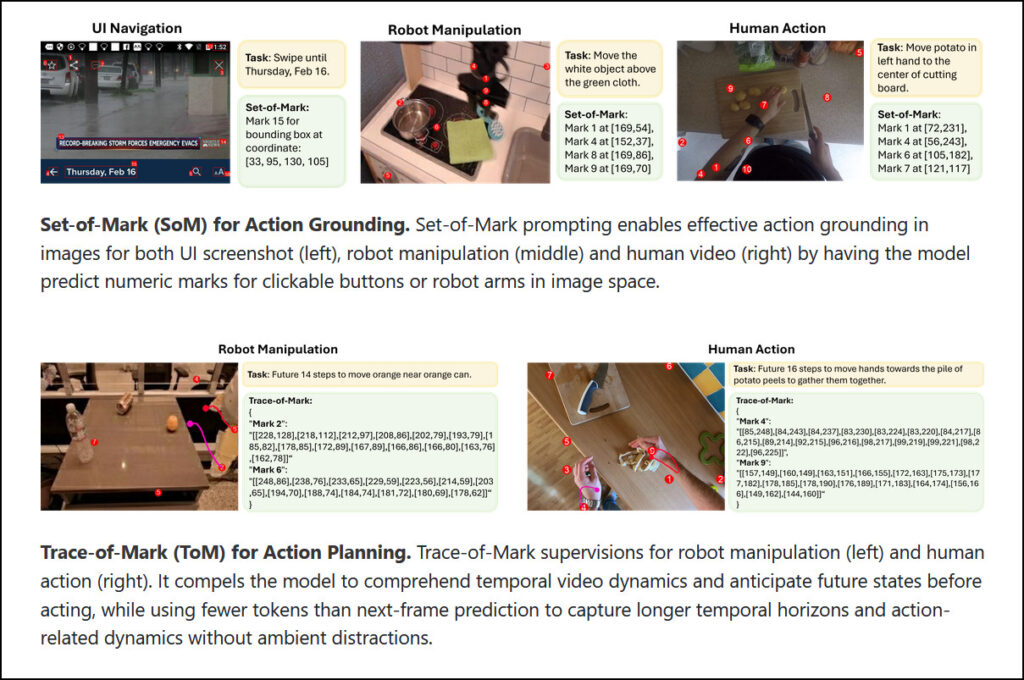
The researchers' explanations about how

The researchers’ explanations about how “Set-of-Mark” and “Trace-of-Mark” work. Credit: Microsoft Research

The Magma model introduces two technical components: Set-of-Mark, which identifies objects that can be manipulated in an environment by assigning numeric labels to interactive elements, such as clickable buttons in a UI or graspable objects in a robotic workspace, and Trace-of-Mark, which learns movement patterns from video data. Microsoft says those features allow the model to complete tasks like navigating user interfaces or directing robotic arms to grasp objects.

Microsoft Magma researcher Jianwei Yang wrote in a Hacker News comment that the name “Magma” stands for “M(ultimodal) Ag(entic) M(odel) at Microsoft (Rese)A(rch),” after some people noted that “Magma” already belongs to an existing matrix algebra library, which could create some confusion in technical discussions.

Reported improvements over previous models

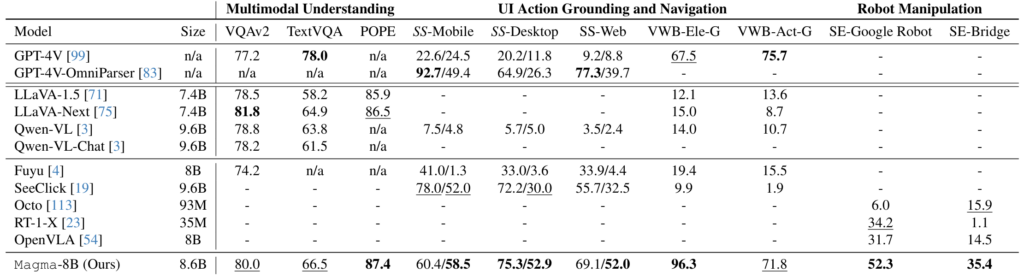
In its Magma write-up, Microsoft claims Magma-8B performs competitively across benchmarks, showing strong results in UI navigation and robot manipulation tasks.

For example, it scored 80.0 on the VQAv2 visual question-answering benchmark—higher than GPT-4V’s 77.2 but lower than LLaVA-Next’s 81.8. Its POPE score of 87.4 leads all models in the comparison. In robot manipulation, Magma reportedly outperforms OpenVLA, an open source vision-language-action model, in multiple robot manipulation tasks.

Magma's agentic benchmarks, as reported by the researchers.

Magma’s agentic benchmarks, as reported by the researchers. Credit: Microsoft Research

As always, we take AI benchmarks with a grain of salt since many have not been scientifically validated as being able to measure useful properties of AI models. External verification of Microsoft’s benchmark results will become possible once other researchers can access the public code release.

Like all AI models, Magma is not perfect. It still faces technical limitations in complex step-by-step decision-making that requires multiple steps over time, according to Microsoft’s documentation. The company says it continues to work on improving these capabilities through ongoing research.

Yang says Microsoft will release Magma’s training and inference code on GitHub next week, allowing external researchers to build on the work. If Magma delivers on its promise, it could push Microsoft’s AI assistants beyond limited text interactions, enabling them to operate software autonomously and execute real-world tasks through robotics.

Magma is also a sign of how quickly the culture around AI can change. Just a few years ago, this kind of agentic talk scared many people who feared it might lead to AI taking over the world. While some people still fear that outcome, in 2025, AI agents are a common topic of mainstream AI research that regularly takes place without triggering calls to pause all of AI development.

Microsoft’s new AI agent can control software and robots Read More »

cheap-ai-“video-scraping”-can-now-extract-data-from-any-screen-recording

Cheap AI “video scraping” can now extract data from any screen recording


Researcher feeds screen recordings into Gemini to extract accurate information with ease.

Abstract 3d background with different cubes

Recently, AI researcher Simon Willison wanted to add up his charges from using a cloud service, but the payment values and dates he needed were scattered among a dozen separate emails. Inputting them manually would have been tedious, so he turned to a technique he calls “video scraping,” which involves feeding a screen recording video into an AI model, similar to ChatGPT, for data extraction purposes.

What he discovered seems simple on its surface, but the quality of the result has deeper implications for the future of AI assistants, which may soon be able to see and interact with what we’re doing on our computer screens.

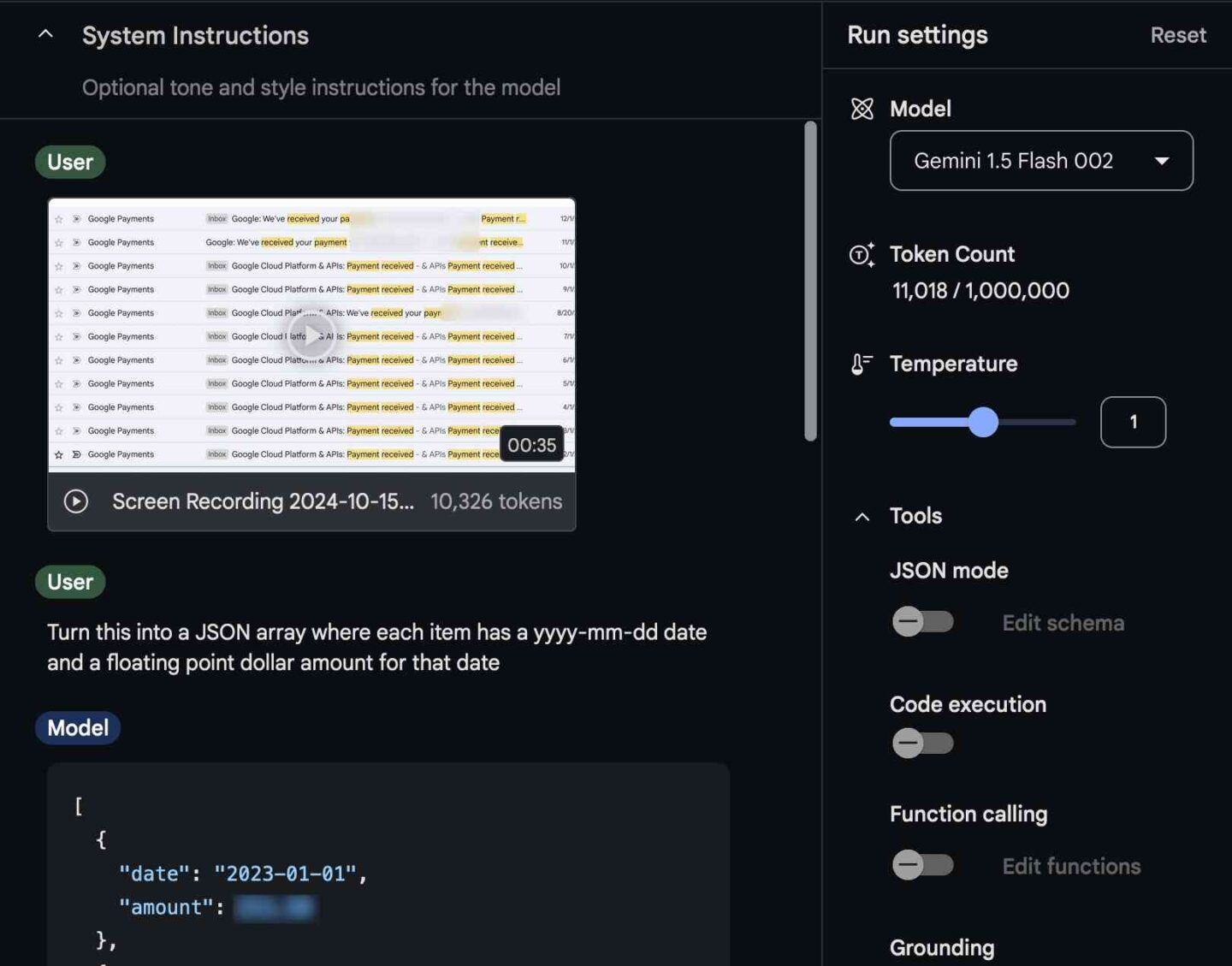
“The other day I found myself needing to add up some numeric values that were scattered across twelve different emails,” Willison wrote in a detailed post on his blog. He recorded a 35-second video scrolling through the relevant emails, then fed that video into Google’s AI Studio tool, which allows people to experiment with several versions of Google’s Gemini 1.5 Pro and Gemini 1.5 Flash AI models.

Willison then asked Gemini to pull the price data from the video and arrange it into a special data format called JSON (JavaScript Object Notation) that included dates and dollar amounts. The AI model successfully extracted the data, which Willison then formatted as CSV (comma-separated values) table for spreadsheet use. After double-checking for errors as part of his experiment, the accuracy of the results—and what the video analysis cost to run—surprised him.

A screenshot of Simon Willison using Google Gemini to extract data from a screen capture video.

A screenshot of Simon Willison using Google Gemini to extract data from a screen capture video.

A screenshot of Simon Willison using Google Gemini to extract data from a screen capture video. Credit: Simon Willison

“The cost [of running the video model] is so low that I had to re-run my calculations three times to make sure I hadn’t made a mistake,” he wrote. Willison says the entire video analysis process ostensibly cost less than one-tenth of a cent, using just 11,018 tokens on the Gemini 1.5 Flash 002 model. In the end, he actually paid nothing because Google AI Studio is currently free for some types of use.

Video scraping is just one of many new tricks possible when the latest large language models (LLMs), such as Google’s Gemini and GPT-4o, are actually “multimodal” models, allowing audio, video, image, and text input. These models translate any multimedia input into tokens (chunks of data), which they use to make predictions about which tokens should come next in a sequence.

A term like “token prediction model” (TPM) might be more accurate than “LLM” these days for AI models with multimodal inputs and outputs, but a generalized alternative term hasn’t really taken off yet. But no matter what you call it, having an AI model that can take video inputs has interesting implications, both good and potentially bad.

Breaking down input barriers

Willison is far from the first person to feed video into AI models to achieve interesting results (more on that below, and here’s a 2015 paper that uses the “video scraping” term), but as soon as Gemini launched its video input capability, he began to experiment with it in earnest.

In February, Willison demonstrated another early application of AI video scraping on his blog, where he took a seven-second video of the books on his bookshelves, then got Gemini 1.5 Pro to extract all of the book titles it saw in the video and put them in a structured, or organized, list.

Converting unstructured data into structured data is important to Willison, because he’s also a data journalist. Willison has created tools for data journalists in the past, such as the Datasette project, which lets anyone publish data as an interactive website.

To every data journalist’s frustration, some sources of data prove resistant to scraping (capturing data for analysis) due to how the data is formatted, stored, or presented. In these cases, Willison delights in the potential for AI video scraping because it bypasses these traditional barriers to data extraction.

“There’s no level of website authentication or anti-scraping technology that can stop me from recording a video of my screen while I manually click around inside a web application,” Willison noted on his blog. His method works for any visible on-screen content.

Video is the new text

An illustration of a cybernetic eyeball.

An illustration of a cybernetic eyeball.

An illustration of a cybernetic eyeball. Credit: Getty Images

The ease and effectiveness of Willison’s technique reflect a noteworthy shift now underway in how some users will interact with token prediction models. Rather than requiring a user to manually paste or type in data in a chat dialog—or detail every scenario to a chatbot as text—some AI applications increasingly work with visual data captured directly on the screen. For example, if you’re having trouble navigating a pizza website’s terrible interface, an AI model could step in and perform the necessary mouse clicks to order the pizza for you.

In fact, video scraping is already on the radar of every major AI lab, although they are not likely to call it that at the moment. Instead, tech companies typically refer to these techniques as “video understanding” or simply “vision.”

In May, OpenAI demonstrated a prototype version of its ChatGPT Mac App with an option that allowed ChatGPT to see and interact with what is on your screen, but that feature has not yet shipped. Microsoft demonstrated a similar “Copilot Vision” prototype concept earlier this month (based on OpenAI’s technology) that will be able to “watch” your screen and help you extract data and interact with applications you’re running.

Despite these research previews, OpenAI’s ChatGPT and Anthropic’s Claude have not yet implemented a public video input feature for their models, possibly because it is relatively computationally expensive for them to process the extra tokens from a “tokenized” video stream.

For the moment, Google is heavily subsidizing user AI costs with its war chest from Search revenue and a massive fleet of data centers (to be fair, OpenAI is subsidizing, too, but with investor dollars and help from Microsoft). But costs of AI compute in general are dropping by the day, which will open up new capabilities of the technology to a broader user base over time.

Countering privacy issues

As you might imagine, having an AI model see what you do on your computer screen can have downsides. For now, video scraping is great for Willison, who will undoubtedly use the captured data in positive and helpful ways. But it’s also a preview of a capability that could later be used to invade privacy or autonomously spy on computer users on a scale that was once impossible.

A different form of video scraping caused a massive wave of controversy recently for that exact reason. Apps such as the third-party Rewind AI on the Mac and Microsoft’s Recall, which is being built into Windows 11, operate by feeding on-screen video into an AI model that stores extracted data into a database for later AI recall. Unfortunately, that approach also introduces potential privacy issues because it records everything you do on your machine and puts it in a single place that could later be hacked.

To that point, although Willison’s technique currently involves uploading a video of his data to Google for processing, he is pleased that he can still decide what the AI model sees and when.

“The great thing about this video scraping technique is that it works with anything that you can see on your screen… and it puts you in total control of what you end up exposing to the AI model,” Willison explained in his blog post.

It’s also possible in the future that a locally run open-weights AI model could pull off the same video analysis method without the need for a cloud connection at all. Microsoft Recall runs locally on supported devices, but it still demands a great deal of unearned trust. For now, Willison is perfectly content to selectively feed video data to AI models when the need arises.

“I expect I’ll be using this technique a whole lot more in the future,” he wrote, and perhaps many others will, too, in different forms. If the past is any indication, Willison—who coined the term “prompt injection” in 2022—seems to always be a few steps ahead in exploring novel applications of AI tools. Right now, his attention is on the new implications of AI and video, and yours probably should be, too.

Photo of Benj Edwards

Benj Edwards is Ars Technica’s Senior AI Reporter and founder of the site’s dedicated AI beat in 2022. He’s also a widely-cited tech historian. In his free time, he writes and records music, collects vintage computers, and enjoys nature. He lives in Raleigh, NC.

Cheap AI “video scraping” can now extract data from any screen recording Read More »