The effects of the EU’s regulatory crusade on Big Tech are beginning to make themselves known to consumers. Yesterday, Meta launched ad-free subscription services for Facebook and Instagram within the bloc. Users will be able to pay from €9.99 to use the social media platforms without seeing ads — or continue using them for free and have their data collected.
We are probably not alone in the experience that ads have completely taken over much of what began as a means of actually connecting with friends (and sharing photos of our lunch). Adding to that, with more and more sophisticated targeted advertising and tracking across various apps, ads have become, at times, spookily accurate.
When surveyed, the instinctual reaction of the TNW editorial office was a resounding “no.” However, €9.99 a month to escape a barrage of ads might not seem such a horrible proposition for everyone — although, given Meta’s revenue model, one that the tech giant did not want to have to make.
“We believe in a free, ad-supported internet – and will continue to offer people free access to our personalised products and services regardless of income,” the company said in a statement. However, it said it was introducing the new subscription model to comply with European Union regulations.
The <3 of EU tech
The latest rumblings from the EU tech scene, a story from our wise ol’ founder Boris, and some questionable AI art. It’s free, every week, in your inbox. Sign up now!
Meta also, perhaps a little resentfully, added that it “respects the spirit and purpose of these evolving European regulations, and are committed to complying with them.”
Purchase via an app store, pay more
The ad-free subscription service will also be available to residents in the EEA and Switzerland, and have a different price depending on where you purchase it. The €9.99 is when buying it on the web, whereas paying for it via iOS or Android will cost €12.99. Meta stated that the higher price was due to the additional charges by Apple and Google through their respective policies.
The subscription service will be available for people 18 years of age and older, whereas the company stated it would “continue to explore how to provide teens with a useful and responsible ad experience given this evolving regulatory landscape.”
Meta said that if users chose to continue to engage with its platforms for free, their experience would stay the same. Advertisers will also be able to continue running personalised advertising campaigns in Europe.
Meta Connect 2023 has wrapped up, bringing with it a deluge of info from one of the XR industry’s biggest players. Here’s a look at the biggest announcements from Connect 2023, but more importantly, what it all means for the future of XR.
Last week marked the 10th annual Connect conference, and the first Connect conference after the Covid pandemic to have an in-person component. The event originally began as Oculus Connect in 2014. Having been around for every Connect conference, it’s amazing when I look around at just how much has changed and how quickly it all flew by. For those of you who have been reading and following along for just as long—I’m glad you’re still on this journey with us!
So here we are after 10 Connects. What were the big announcements and what does it all mean?
Meta Quest 3
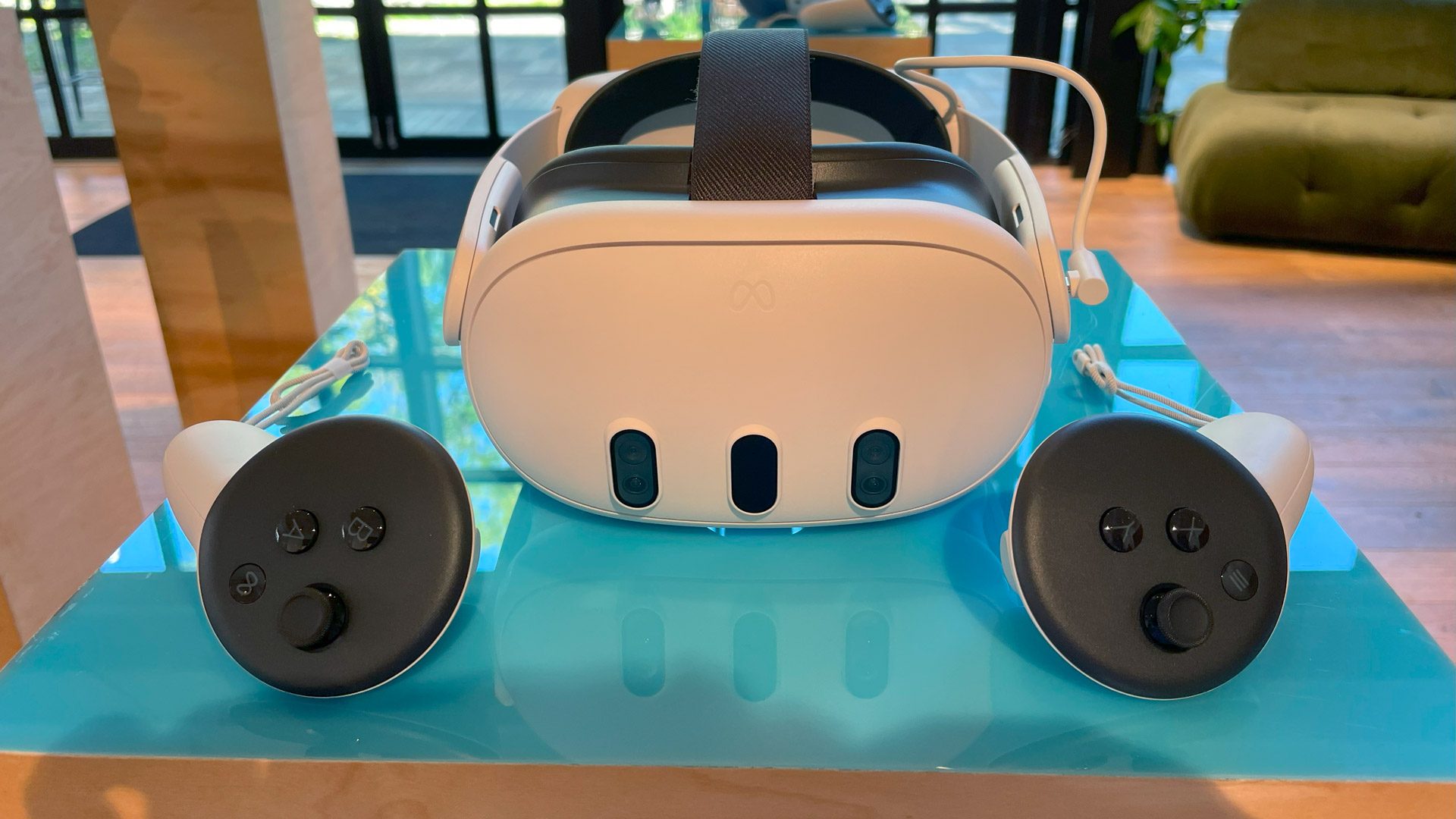
Obviously, the single biggest announcement is the reveal and rapid release of Meta’s latest headset, Quest 3. You can check out the full announcement details and specs here and my hands-on preview with the headset here. The short and skinny is that Quest 3 is a big hardware improvement over Quest 2 (but still being held back by its software) and it will launch on October 10th starting at $500.
Quest 3 marks the complete dissolution of Oculus—the VR startup that Facebook bought back in 2014 to jump-start its entrance into XR. It’s the company’s first headset to launch following Facebook’s big rebrand to Meta, leaving behind no trace of the original and very well-regarded Oculus brand.
Apples and Oranges
On stage at Connect, Meta CEO Mark Zuckerberg called Quest 3 the “first mainstream mixed reality headset.” By “mainstream” I take it he meant ‘accessible to the mainstream’, given its price point. This was clearly in purposeful contrast to Apple’s upcoming Vision Pro which, to his point, is significantly less accessible given its $3,500 price tag. Though he didn’t mention Apple by name, his comments about accessibility, ‘no battery pack’, and ‘no tether’ were clearly aimed at Vision Pro.
Mixed Marketing
Meta is working hard to market Quest 3’s mixed reality capabilities, but for all the potential the feature has, there is no killer app for the technology. And yes, having the tech out there is critical to creating more opportunity for such a killer app to be created, but Meta is substantially treating its developers and customers as beta testers of this technology. The ‘market it and they will come’ approach that didn’t seem to pan out too well for Quest Pro.
Personally I worry about the newfangled feature being pushed so heavily by Meta that it will distract the body of VR developers who would otherwise better serve an existing customer base that’s largely starving for high-quality VR content.
Regardless of whether or not there’s a killer app for Quest 3’s improved mixed reality capabilities, there’s no doubt that the tech could be a major boon to the headset’s overall UX, which is in substantial need of a radical overhaul. I truly hope the company has mixed reality passthrough turned on as the default mode, so when people put on the headset they don’t feel immediately blind and disconnected from reality—or need to feel around to find their controllers. A gentle transition in and out of fully immersive experiences is a good idea, and one that’s well served with a high quality passthrough view.
Apple, on the other hand, has already established passthrough mixed reality as the default when putting on the headset, and for now even imagines it’s the mode users will spend most of their time in. Apple has baked this in from the ground-up, but Meta still has a long way to go to perfect it in their headsets.
Augments vs. Volumes
Image courtesy Meta
Several Connect announcements also showed us how Meta is already responding to the threat of Apple’s XR headset, despite the vast price difference between the offerings.
For one, Meta announced ‘Augments’, which are applets developers will be able to build that users can place in permanently anchored positions in their home in mixed reality. For instance, you could place a virtual clock on your wall and always see it there, or a virtual chessboard on your coffee table.
This is of course very similar to Apple’s concept of ‘Volumes’, and while Apple certainly didn’t invent the idea of having MR applets that live indefinitely in the space around you (nor Meta), it’s clear that the looming Vision Pro is forcing Meta to tighten its focus on this capability.
Meta says developers will be able to begin building ‘Augments’ on the Quest platform sometime next year, but it isn’t clear if that will happen before or after Apple launches Vision Pro.
Microgrestures
Augments aren’t the only way that Meta showed at Connect that it’s responding to Apple. The company also announced that its working on a system for detecting ‘microgestures’ for hand-tracking input—planned for initial release to developers next year—which look awfully similar to the subtle pinching gestures that are primarily used to control Vision Pro:
Again, neither Apple nor Meta can take credit for inventing this ‘microgesture’ input modality. Just like Apple, Meta has been researching this stuff for years, but there’s no doubt the sudden urgency to get the tech into the hands of developers is related to what Apple is soon bringing to market.
A Leg Up for Developers
Meta’s legless avatars have been the butt of many-a-joke. The company had avoided the issue of showing anyone’s legs because they are very difficult to track with an inside-out headset like Quest, and doing a simple estimation can result in stilted and awkward leg movements.
Image courtesy Meta
But now the company is finally adding leg estimation to its avatar models, and giving developers access to the same tech to incorporate it into their games and apps.
And it looks like the company isn’t just succumbing to the pressure of the legless avatar memes by spitting out the same kind of third-party leg IK solutions that are being used in many existing VR titles. Meta is calling its solution ‘generative legs’, and says the system leans on tracking of the user’s upper body to estimate plausibly realistic leg movements. A demo at Connect shows things looking pretty good:
It remains to be seen how flexible the system is (for instance, how will it look if a player is bowling or skiing, etc?).
Meta says the system can replicate common leg movements like “standing, walking, jumping, and more,” but also notes that there are limitations. Because the legs aren’t actually being tracked (just estimated) the generative legs model won’t be able to replicate one-off movements, like raising your knee toward your chest or twisting your feet at different angles.
Virtually You
The addition of legs coincides with another coming improvement to Meta’s avatar modeling, which the company is calling inside-out body tracking (IOBT).
While Meta’s headsets have always tracked the player’s head and hands using the headset and controllers, the rest of the torso (arms, shoulders, neck) was entirely estimated using mathematical modeling to figure out what position they should be in.
For the first time on Meta’s headsets, IOBT will actually track parts of the player’s upper body, allowing the company’s avatar model to incorporate more of the player’s real movements, rather than making guesses.
Specifically Meta says its new system can use the headset’s cameras to track wrist, elbows, shoulders, and torso positions, leading to more natural and accurate avatar poses. The IOBT capability can work with both controller tracking and controller-free hand-tracking.
Both capabilities will be rolled into Meta’s ‘Movement SDK’. The company says ‘generative legs’ will be coming to Quest 2, 3, and Pro, but the IOBT capability might end up being exclusive to Quest 3 (and maybe Pro) given the different camera placements that seem aimed toward making IOBT possible.
Calm Before the Storm, or Calmer Waters in General?
At Connect, Meta also shared the latest revenue milestone for the Quest store: more than $2 billion has been spent on games an apps. That means Meta has pocketed some $600 million from its store, while the remaining $1.4 billion has gone to developers.
That’s certainly nothing to sneeze at, and while many developers are finding success on the Quest store, the figure amounts to a slowdown in revenue momentum over the last 12 months, one which many developers have told me they’d been feeling.
The reason for the slowdown is likely a combination of Quest 2’s age (now three years old), the rather early announcement of Quest 3, a library of content that’s not quite meeting user’s expectations, and a still struggling retention rate driven by core UX issues.
Quest 3 is poised for a strong holiday season, but with its higher price point and missing killer app for the heavily marketed mixed reality feature, will it do as well as Quest 2’s breakout performance in 2021?
Razer hasn’t exactly been all-in when it comes to making VR accessories, although there have been a few bits of VR kit over the years from the RGB-infused gaming hardware giant. This time around Razer says it’s releasing a Quest-branded model of its noise cancelling Hammerhead HyperSpeed earbuds.
Announced alongside pre-orders for Quest 3, the earbuds for Quest 3 and Quest 2 include a USB-C dongle for a low-latency 2.4GHz wireless connection in addition to Buetooth 5.2 support.
Image courtesy Meta
Initially released in late 2022, the company’s standard noise cancelling Hammerhead HyperSpeed earbuds support a wide range of devices, including PS5, PS4, PC, Mac, smartphones, tablets, and handheld gaming devices with Bluetooth audio capability or USB-C / USB-A port. You can already get them in two flavors, branded either for Xbox or PlayStation.
Razer says the earbuds are slated to release sometime later this year. There’s no pricing yet, although the standard Hammerhead HyperSpeed earbuds cost $150 MSRP. Considering this looks to be more of a brand licensing deal than the “Made for Meta” badging might suggest, you can probably bet on that pricing.
While we haven’t seen a list of supported USB-C headphones for Quest 3, Meta has certified a number of other earbuds, including the very similar wireless Anker Soundcore VR P10 earbuds, and wired USB-C Earbuds for Pixel, Samsung and OnePlus.
Coming alongside the big Quest 3 info dump today at Connect 2023, Meta revealed that Quest Store games and apps have generated over $2 billion in revenue. While the store is still earning for developers, looking at revenue over time shows that things have cooled off over the last year.
Meta’s Head of Developer Relations Melissa Brown announced the figure on stage, further noting that 100+ new and upgraded titles are coming to the Quest Store before the year’s end, more than half of which will be brand new games and apps.
While $2 billion sounds like an impressive number—it certainly is for the XR industry at large—it pales in comparison to what Meta regularly spends on its Reality Labs division.
Quest 2 next to Quest 3 | Image courtesy Meta
Back in July, the company reported a quarterly loss just south of $4 billion in Q2 2023; Reality Labs’ revenue was down by 39% due to lower Quest 2 sales, making for the worst quarterly performance in the past two years.
With today’s announcement, it’s also clear at what rate content sales have cooled off since Quest 2 was launched in 2020. The company announced at Connect 2022 in October last year that it had topped $1.5 billion in Quest Store revenue, accounting for everything since the first Quest’s launch in 2019, meaning it’s only managed to generate $500 million in the past 12 months, putting a clear end to any kind of take-off ramp that might have appeared to be forming.
Moving forward, this will undoubtedly put more weight on Quest 3 to fill in where Quest 2 left off, as stockholders will no doubt expect the $500 headset to meet or beat its forebear’s relatively meteoric success. Quest 3 pack in much of the functionality of the $1,000 Quest Pro headset, including color passthrough sensors for mixed reality, and has a significantly sleeker profile and more powerful chipset than the now $300 Quest 2.
Will that be enough for first-time VR users to jump in? Enough for Quest 2 users to upgrade? Whatever the case, Meta is undoubtedly subsidizing its XR hardware to make software sales more attractive. And if it doesn’t keep pumping out first-party titles like Asgard’s Wrath 2, they’ll need at least keep those multi-million-dollar success stories coming, like Gorilla Tag’s $26 million in revenue high-swinging success story, or the other 40 Quest games that Meta said had posted revenues over $10 million.
– – — – –
Connect 2023 kicks off today, taking place September 27th and 28th at Meta’s Menlo Park headquarters. There’s been a ton of news already, so make sure to follow along by heading to our main page for all of the latest in Meta’s XR stuff.
Meta announced at its annual developer conference today that Quest 3 is now available for pre-order starting at $500, shipping October 10th. The company also revealed a host of accessories which ought to help knock a few of those pesky paychecks from your bank account.
Here’s the full list of accessories announced today. You can find them all over at Meta’s website, and likely also through online retailers such as Amazon, Best Buy, Target and Walmart.
Quest 3 Charging Dock [$130]
Quest 3 Charging Dock | Image courtesy Meta
Product description: Be ready to play and stay organized with an all-in-one wireless charging dock for the Meta Quest 3 headset and controllers. Includes rechargeable lithium-ion batteries for your controllers. The charging dock is also compatible with our other accessories including Elite Strap, Elite Strap with Battery, and Active Straps (sold separately).
Quest 3 Elite Strap [$70]
Quest 3 Elite Strap | Image courtesy Meta
Product description: Play in comfort with this adjustable, ergonomic head strap that easily adjusts to fit most head sizes with the turn of a dial. This lightweight strap takes pressure off your face and evenly distributes the weight for a more comfortable fit.
Quest 3 Elite Strap with Battery [$130]
Quest 3 Elite Battery Strap | Image courtesy Meta
Product description: Play in comfort and get up to 2 hours additional VR game playtimewith this adjustable ergonomic head strap that features a built-in, lithium-ion battery. Easily adjusts to fit most head sizes while distributing the weight for a more comfortable fit. Charge your headset and head strap battery simultaneously with a single charging cable. *Battery life may vary based on headset usage, configurations, and settings.
Quest 3 Carrying Case [$70]
Quest 3 Carrying Case | Image courtesy Meta
Product description: Take your headset and accessories on the go with style and complete protection. Designed for your Meta Quest 3 headset, Touch Plus controllers, charging cable, adapter, headstrap (standard or Elite) and Active Straps. This genuine Meta Quest accessory ensures a perfect fit, durability, and convenience anywhere you take your gear.
Quest 3 Silicone Facial Interface [$40]:
Quest 3 Silicon Facial Interface | Image courtesy Meta
Product description: Wipe away sweat and dirt easily and get right back to your next workout or gaming session. This soft, silicone facial interface provides a cleaner feel and comfortable fit on your face. Get a perfect fit and block out unwanted light from entering your Meta Quest 3.
Quest Active Straps for Touch Plus Controllers [$40]
Quest 3 Touch Plus Active Straps | Image courtesy Meta
Product description: Play with confidence and intensity with these premium, adjustable straps that give extra grip and stability for your Meta Quest Touch Plus Controllers. Designed to comfortably fit most hand sizes, Active Straps provide added stability and effortless grip while you play, navigate and gesture in VR.
Quest 3 Facial Interface & Head Strap [$50]:
Created using images courtesy Meta
Product description: Express yourself in bold color and stay comfortable in Meta Quest 3. The fabric facial interface provides breathable cushioning while blocking out unwanted light. Color-matched, flexible head strap fully adjusts to fit most head sizes for added support. Available in Elemental Blue and Blood Orange.
VR Prescription Lenses for Quest 3 [$50]
Quest 3 Prescription Inserts | Image courtesy Meta
Product description: Experience a seamless viewing experience without the hassle of glasses. Lightweight and easy to install, these lenses are custom made by Zenni for your exact prescription. Designed in collaboration with Meta, these prescription lenses provide a perfect fit and high-quality visual experience in your Meta Quest 3.
– – — – –
Razer is also making wireless earbuds for Quest 3, named ‘Razer Hammerhead HyperSpeed Earbuds for Meta Quest 3’.
Additionally, the company is still hawking its $80 Quest Link Cable, which has been confirmed to work with Quest 3.
Like Quest 2, Quest 3 can also optionally swap out their standard Touch controllers for Quest Touch Pro Controllers, priced at an eye-watering $300. This includes more accurate inside-out tracking that doesn’t require line of sight, as with all other Touch controllers from generations past.
Connect 2023 kicks off today, taking place September 27th and 28th at Meta’s Menlo Park headquarters. There’s been a ton of news already, so make sure to follow along with Connect for all of the latest XR stuff from Meta.
Roblox has done very well on Quest. When it launched on the standalone VR platform back in July, it managed to break one million downloads in its first five days, essentially making the online game the hottest social VR platform currently available on Quest. Now Roblox has also showered attendees at its annual developer conference this past weekend with free Quest Pros.
Despite being in direct competition with Meta’s Horizon Worlds social VR platform, there doesn’t seem to be any bad blood over the explosive growth of Roblox on Quest.
A message was sent to attendees at RDC23 this past weekend, stating that Meta is footing the bill to provide a heap of free Quest Pros, its $1,000 mixed reality standalone.
“The news is out! We want to give a special thanks to our partner meta. They have offered to provide all RDC23 attendees with Meta Quest Pro headsets to help you create the best Roblox experiences for VR,” the message reads.
Developers didn’t have to wait long, as they collected their free Quest Pros on site at RDC23.
During the RDC 2023 keynote, Baszucki also revealed that Roblox now features “over 50,000 experiences that are ready right now on Meta Quest.”
Roblox is currently available on the Quest platform via App Lab, however the company says it’s set for its “full” release on Quest sometime in September. Baszucki didn’t specify when, although it’s a good bet that the popular social platform will be a launch day title on Quest 3, which could come as early as September 27th during Connect, Meta’s annual developer conference.
The company also announced Roblox is headed to PlayStation in October, however it’s not clear if that will include PSVR or PSVR 2 support as well.
In late July, Meta introduced a hero shooter called ‘Super Rumble’ to Horizon Worlds, aiming to improve user retention on its social VR platform with the promise of higher quality first-party content. Now Meta released its second big anchor minigame on Horizon Worlds, a co-op adventure game called ‘Citadel’.
Citadel is what Meta calls a “rogue-lite action-adventure puzzle platformer FPS,” offering up both solo and co-op play.
Here’s how Meta describes the action:
Combining combat, puzzle-solving, and skillful gameplay, each room in Citadel gives players a new challenge to overcome. With numerous hidden secrets to uncover across 30 rooms, Citadel offers a wealth of content to explore. And after completing the game in Casual mode, those up for an additional challenge can take on Veteran mode for an even greater sense of achievement (and additional bragging rights).
As you infiltrate the citadel, find hidden relics, and eliminate enemy forces, you’ll unlock weapons and rewards and earn credit to buy new armor with unique stats to upgrade your hit points, number of lives, and speed. Mix and match helmets and torso armors at will to fully customize your gameplay experience.
Stocking Horizon Worlds with higher quality content has only been one piece of Meta’s user retention puzzle. Back in April, the company announced it was set to officially open the platform to kids ages 13+. Meta has also recently begun a closed beta for Android users, opening the platform to non-VR devices for the first time.
The company says it’s hoping to open Horizon Worlds to iOS devices and standard web browsers too at some point, which could help the platform gain greater traction amid some already fairly fierce competition. This comes as Meta opened Quest up the online gaming powerhouse Roblox, joining popular social VR platforms Rec Room, VRChat, and Gym Class on the Quest platform.
Meta is reportedly teaming up with South Korean tech giant LG Electronics to offer up competition to the Apple’s forthcoming Vision Pro mixed reality headset, which is slated to arrive sometime in 2024.
South Korea’s Maekyung (Korean) is reporting on two new Meta headsets: a low-cost Quest model that will be priced at “less than $200” coming in 2024, and a high-priced model in a joint venture with LG in 2025, which is supposedly set to take on Apple Vision Pro.
The report maintains the name of the Meta/LG headset will be ‘Meta Quest 4 Pro’.
Mass production of the so-called Quest 4 Pro is allegedly being handled by LG Electronics, and LG Display, with LG Innotek and LG Energy Solution supplying parts.
Provided the report is true, it seems some very distinct battle lines are being drawn. Samsung announced earlier this year that it was working with Qualcomm and Google to develop an Android-powered XR device, which may also be positioned to compete against Apple and Meta.
Meta released a Quest software update via its public test channel (PTC), which lets users opt-in to try new features before they’re pushed out to everyone. Among the v57 PTC update is a feature that’s been notably missing from Meta avatars: legs.
Meta CEO Mark Zuckerberg promised at Connect 2022 that its avatars would eventually be getting legs, putting an end to the platform’s characteristic floating torsos at some point in the not-too-distant future. At the time, Zuckerberg showed off his on-stage avatar jumping and kicking, although it was revealed later this was actually created using some fairly common external motion capture tech.
In short, Quest can’t track legs yet, which means the v57 PTC update is packing a pretty standard implementation of inverse kinematics (IK), resulting in the sort of body positioning guesswork you see in apps like VR Chat. Still, nice to see a full body in Quest Home for once, right?
X (formerly Twitter) user Lunayian shows off the new avatar legs after installing the v57 PTC update.
YouTuber and tech analyst Brad Lynch also tried out the new legs, showing off some of the limitations currently. Notably, you won’t see your avatar’s legs when looking down directly at them—they’re only viewable via the mirror, and ostensibly by other users—and the IK system still doesn’t account for crouching.
According to data mined by X user NyaVR, the v57 PTC update also includes the ability to enable and disable the avatar mirror, a new Horizon Worlds Portal in home, an Airplane Mode, and an Extended Battery Mode.
The comes alongside a wider push to attract more users to Horizon Worlds, as Meta recently took its first steps of endingQuest-exclusivity for the social VR app with the launch of a closed beta on Android mobile devices. It’s also set to arrive on standard PC browsers too at some point.
Additionally, Meta seems to also be investing more in first-party content for Horizon Worlds, having released Super Rumblelate last month, a hero shooter which feels more in line with the sort of sticky content that ought to attract and bring users back more regularly.
We’re sure to learn more about Quest software features and Horizon Worlds stuff at the company’s annual Connect developer conference, which takes place September 27th.
Meta’s social VR platform just took its first step outside of Quest-exclusivity, as the company recently launched a closed beta for Horizon Worlds on Android mobile devices.
You won’t find Horizon Worlds on Google Play. Users taking part in the closed beta can directly launch the app through the Quest Android app.
X (previously Twitter) user Lunayian was apparently one of those chosen few, showing off a brief hands-on in the Super Rumble lobby, Meta’s first-party hero shooter revealed late last month.
Besides scripted avatar animations, the user’s legs seem to be what visually separates users on Quest from Android mobile devices, as Quest users are doomed to skate around as floating torsos until Meta decides otherwise.
There’s no word when the company plans to roll out access on browsers either, which the beta’s FAQ says will broaden availability of the platform to iOS devices on Safari, and Google Chrome, Safari, or Microsoft Edge on laptops and desktops.
At the time of this writing, the standard geolocation restrictions are still in effect for Horizon Worlds, with only users in the following countries able to access the platform: Canada, France, Iceland, Ireland, Spain, the United Kingdom, and the United States.
When it does roll out to more locations and platforms though, it will be better positioned to actually compete with the most successful metaverse apps, such as Rec Room, Roblox, and VR Chat, all of which have benefited from releasing on essentially every major platform worldwide—VR headsets and traditional platforms included. Undoubtedly, Meta is looking to replicate this success with Horizon Worlds, as it is now offering up better (and decidedly more sticky) first-party content like Super Rumble.
We’re sure to learn more about new Horizon Worlds features at the company’s annual Connect developer conference soon, which takes place September 27th, steaming both online and in-person for a select few at the company’s Menlo Park headquarters.
A new charging dock from Meta, apparently for Quest 3, has been revealed through regulatory certification. As with Quest Pro’s dock, the goal of the new dock is certainty to streamline headset usage by encouraging users to keep it charged and always up-to-date.
Friction in VR—all of the clunk associated with putting a thing on your head, fitting it, then, going through menus to get to the software you want to use—is a tough challenge the industry has been slowly chipping away at over many years.
One major piece of that friction comes with keeping headsets charged and up-to-date. It’s an all-too-common occurrence for someone to forget to plug in their headset after a session and then realize the battery is dead the next time they have the urge to use it. Worse still, if it’s been a while since they plugged the headset in, it’s likely to need updates to both the core software and specific apps before it’s ready to go.
This is a clear issue, and one that Meta has attempted to address with an official charging dock, first sold alongside the Quest Pro headset. The dock charges both the headset and controllers, making sure everything is juiced and keeping the headset powered on and updated (well, when the auto updates actually work).
The FCC is tasked with certifying products with electromagnetic emissions to be safe and compatible with regulations. Products utilizing radio, WiFi, infrared, etc. need certification before they can be distributed for sale. Certification by the FCC marks one step closer to the launch of consumer electronics product.
The documentation reveals that the dock includes “wireless charging function for left and right controllers,” apparently up to 2.5 watts. That’s pretty slow compared to what we see from wireless charging on modern smartphones, but may be more than adequate for the Quest 3 controllers which don’t need as much power as a smartphone or the headset itself. The actual Quest 3 headset will continue to charge via direct contact as we can see by the pins revealed on the underside of the headset.
– – — – –
Wireless charging is an interesting change from the Quest Pro dock which exclusively relies on direct-contact charging. One reason for this change is likely that the current method of docking the Quest Pro controllers is quite awkward—sometimes leading to the controllers not charging when it looks like they should be. The headset itself is much easier to place in the proper location.
The Quest Pro controllers must be angled somewhat awkwardly to make proper correct contact with the dock for charging | Photo by Road to VR
A Quest 3 dock with wireless controller charging could create more tolerance for mispositioned controllers, leaving less room for user-error.
One big question is whether or not the dock will be included with Quest 3.
Considering Meta’s goal to keep the sticker price of the mainline Quest headsets low, we’d guess it will be made available as an optional accessory. But there’s a chance that Meta deems the dock important enough to the overall user experience that they opt to include it right in the box.
If it did come in the box, this would be the first time the company included rechargeable controllers in its consumer line of VR headsets. All prior consumer headset controllers from Meta have required AA batteries, though it’s always been easy enough to add recharging to the controllers through inexpensive rechargeable AA batteries.
The Quest 3 dock will unfortunately almost certainly not be compatible with Quest 2 controllers because the newer headset is using a new controller which the company calls Touch Plus.
Image courtesy Meta
The new controller does away with the tracking ring that has always been present on the company’s consumer VR controllers, and will likely include the hardware necessary for wireless charging.
Oculus Connect. Facebook Connect. Meta Connect. Whatever the company is calling its annual XR developer conference, it’s been nearly a decade since the first Connect was held—all of them either in-person or exclusively livestreamed. Pandemic notwithstanding, they all had one important thing in common: none of the conferences used the company’s core XR technology to virtually connect people. Why is that?
Started by Oculus in 2014, Connect was where the earliest of early adopters could meet and learn how to make their games and apps happen for the first consumer VR headsets. Engineers, designers, and creatives from around the world made pilgrimage to the California-based event, becoming one of the premier venues for the VR developer community to rub elbows, pitch projects, and grok new hardware. Although the ‘startup magic’ wore off with the event’s gradual hand over from original Oculus founders to the Meta Mothership, the in-person event still manages to maintain legendary status among VR devs as being a great place for networking and learning.
Starting in 2020, Connect was exclusively livestreamed due to the COVID-19 pandemic. There would be no elbow-rubbing. No free candy. No after-session drinks for three long years. Granted, an “in-person presence” is coming back this year for the first time since 2019, however the event is only allowing a “limited” number of attendees to enter the halls of Meta’s Menlo Park headquarters, a stark contrast to when it was held as a full-blown conference at the San Jose McEnery Convention Center in the heart of Silicon Valley.
Let’s just forget the first six years of the conference. For the last three years, Meta only offered a remote experience—standard pre-recorded livestream videos for developers who wanted to attend ‘in-person’, all of whom definitely had VR headsets at the ready. I’m not talking about last year’s Meta Connect room in Horizon Worlds either, which hosted all of the main talks in a collection of theaters so you could watch in VR with a bunch of randos. I’m talking about taking a metaverse convention center to where you might think it logically belongs.
While only Zuckerberg et al know precisely why Meta hasn’t pursued a true VR version of Connect, we can speculate.
Limited Horizons
Let’s pretend for a moment that Meta wants to bring its dev conferences to the metaverse moving forward. If it relies solely on pre-recorded flatscreen videos like it does now, people probably won’t show up because they can always watch later—and more conveniently not in a headset—which means there’s no real conference as such. If it had a live component though with round table discussions and talks with Q&A sessions for attendees—closer to a live conference—then maybe people would want to stay up late in the Eastern Hemisphere to see what’s up. Maybe.
Introduced in 2020 as Facebook Worlds, the budding social VR platform has moved slowly to flush out the basic features already available in other, more successful apps like Rec Room, VRChat, and Roblox—all available on a plethora of devices besides the Quest platform. Meanwhile, Horizon Worlds is only available to Quest users in a handful of countries, including the US, UK, Canada, France, Iceland, Ireland, and Spain. Statistically, most people on planet Earth don’t live in those countries.
Image courtesy Meta
Only now is the company’s social platform starting to catch up somewhat by offering up stickier first-party content; like its latest hero shooter Super Rumble, which Meta is ostensibly using as a nucleation point for bigger and better things. Its first-party metaverse could one day become the default choice for users at some point, but the company’s Reality Labs team will need to beat those social apps mentioned above, which have both an earlier lead and wider distribution.
Still, the COVID-19 years could have been a boon to accelerating Horizon Worlds by bringing third-party devs deeper into the fold with a conference as the impetus, although that might have been too large of a risk to bear. While keynote-watching parties are fairly straightforward in social VR (like we saw in the Connect room in Horizon Worlds last year) actually making a VR version of the event at a level Meta can then project to the rest of the world is a pretty daunting task—both technically and conceptually—even for a company with the resources of Meta.
The fact is though the company’s social VR offerings have historically been undercooked, with its Quest-exclusive platform Horizon Worlds still doughy and baking in the oven to this day. There’s no doubt Horizon Worlds could be better, but even if it were, virtualizing such a conference in any meaningful way could present a bigger risk than Meta may be willing to take.
A fully virtualized conference with live participation could be rife with other issues, some of which have no real solution. As with all social VR apps, a speaker’s Internet connection can drop out, audio latency can stymie the flow of conversation, and a single bad actor can completely derail an important moment—all of the sort of unprofessional things that are acceptable on a Friday night in VRChat, but not on the world stage that regularly attracts scrutiny from the wider public.
The former CTO John Carmack was a big proponent of the event, but revealed that some of the reason it didn’t go fully virtual was about how avatars looked:
Now, doing [Connect] in Horizon for real in an ideal world would mean having this sort of arena-scale support with thousands of avatars milling around, at least hundreds in large rooms, and in a completely uniformly shared world. That’s a serious technical challenge and Horizon definitely can’t handle it now, but it’s not an insurmountable one. However, there’s a really huge tension with avatar rendering quality. There was some public mockery about avatar quality earlier this year, and now lots of people internally are paranoid about showing anything but the highest possible quality avatars. And more rendering features are being pushed to increase the quality instead of the quantity.
Functionally, some extra bits might fall to the wayside too, like impromptu hallway chat sessions, sidebars while waiting in line for drinks, and off-site parties—you know, the serendipitous networking stuff that make conferences more worth the time and effort to attend. How can this be recreated in VR? Make people wander virtual hallways to get from one session to another? Not only would that seem like a silly skeuomorphism, but simulating the avatars and voices of hundreds of people in one virtual space—all on the mobile phone hardware that’s inside a Quest 2 headset—is far from trivial.
There probably are solutions to these problems, but they aren’t as obvious as they might seem at first.
Also, let’s not even talk about time zones. Or the lack of free drinks and candy. I think I mentioned that several times actually. While undoubtedly challenging, some things can’t be virtually replicated at all though: new hardware.
You Can’t Try New Hardware Virtually
Connect is one of the events where Meta typically shows off new hardware and gives devs some of their first hands-on previews, which play an important role in how they choose to invest their time and resources. And as the company moves into increasingly complex areas of development, like varifocal optics, retinal resolution, and lightfield passthrough, seeing it is often the next step to believing it.
But what about Quest 2? Released in late 2020, that was the definition of a ‘pandemic headset’, right? It seems like a foregone conclusion that devs would choose to build apps for Quest 2 simply based on the fact that it’s the industry’s most successful consumer VR headset to date, but it’s really not so simple. Quest 2’s success is directly linked to the groundwork the company laid by the original 2019 Quest, Meta’s first (and arguably the first truly viable) 6DOF standalone headset. And Quest 1 did benefit from an extensive hands-on lead up back when the company was still calling it ‘Santa Cruz’.
Quest [left] and Quest 2 [right] | Photo by Road to VR
Could the company have released a hypothetical first-gen Quest during a pandemic? Maybe, but it probably would have been more difficult showing what sort of apps and experiences the device can technically handle. Both Quest and Quest 2’s mobile chipset are significantly underpowered in comparison to the min spec target for PC VR projects, forcing devs to heavily optimize, or in some cases entirely rebuild their apps from the ground-up. In short, Quest walked so Quest 2 could run.
Maybe Don’t Hold Your Breath
In the end, Meta has consistently decided to not push its core technology as a way for developers to connect, and not trying to solve those problems during a time when the world needed it the most feels like a missed opportunity.
This year’s Connect in September should give us a better idea of whether we’ll ever get back to those heady in-person Connects of years past, or if their plans to further flesh out Horizon Worlds could include putting on larger virtual events. Still, it’s not likely we’ll see Meta hold Connect exclusively—or even partially to any meaningly virtual effect—until more of those social VR pain points can be smoothed over.
Maybe the next generation of mixed reality headsets can cure some of those ills, as in-person attendees can participate alongside their virtual counterparts somehow? Maybe Meta just doesn’t believe enough in Horizon Worlds to make it work? Maybe most devs don’t really need Connect anymore, and virtualizing it won’t serve a meaningful purpose? Let us know what you think in the comments below!