health insurance

health-plan-enrollment-period-is-set-to-be-horrifying-for-everyone-this-year

Health plan enrollment period is set to be horrifying for everyone this year

Employer plans

While ACA sticker shock spreads, a new KFF report out today suggests that people on employer-based health insurance plans are also in for some heftier prices—though the increases aren’t quite as dramatic as the Marketplace hikes.

An analysis of current employer plans finds that the average cost to insure an American family hit nearly $27,000 this year, with average employee contributions to that bill being $7,000 a year. Family premiums are up 6 percent, or $1,408, from last year, while inflation only rose 2.7 percent and wage growth only rose 4 percent.

KFF suggested that various factors are contributing to the increasing costs, with GLP-1 weight-loss drugs being a prominent one. Overall, employers told the organization that they’re bracing for higher costs for 2026 plans, with insurers already seeking double-digit increases in small-group plans.

“There is a quiet alarm bell going off. With GLP-1s, increases in hospital prices, tariffs, and other factors, we expect employer premiums to rise more sharply next year,” KFF President and CEO Drew Altman said in a statement. “Employers have nothing new in their arsenal that can address most of the drivers of their cost increases, and that could well result in an increase in deductibles and other forms of employee cost sharing again, a strategy that neither employers nor employees like but companies resort to in a pinch to hold down premium increases.”

For deductibles—the amount people pay before their plan’s coverage kicks in—costs for single coverage increased 17 percent since 2020. At that time, the average deductible was $1,617 for a covered person, while the average this year is $1,886. But deductibles can be much higher for those who work for a small employer. Among those workers, 36 percent had deductibles of $3,000 or higher this year.

Health plan enrollment period is set to be horrifying for everyone this year Read More »

eli-lilly-raises-price-of-zepbound-while-trumpeting-discount-on-starter-vials

Eli Lilly raises price of Zepbound while trumpeting discount on starter vials

Pharma misdirection —

Cost for insured patients without coverage for the drug rises from $550 to $650 a month.

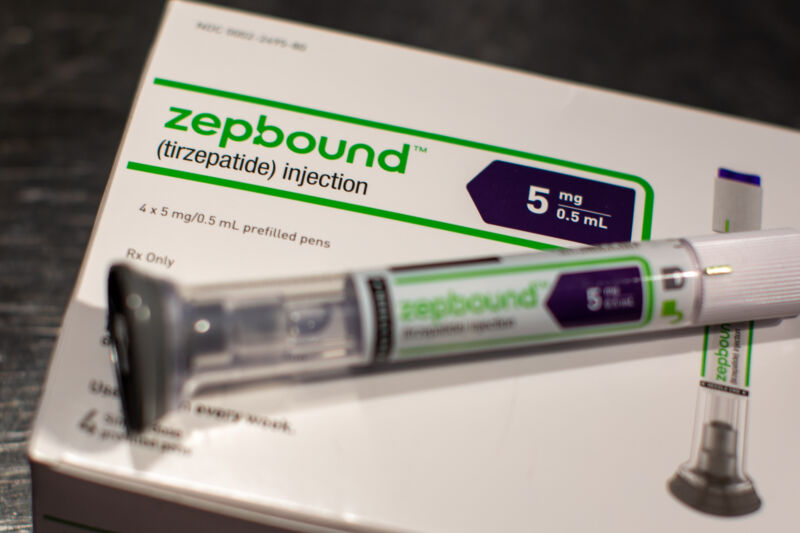
An Eli Lilly & Co. Zepbound injection pen arranged in the Brooklyn borough of New York, US, on Thursday, March 28, 2024.

Enlarge / An Eli Lilly & Co. Zepbound injection pen arranged in the Brooklyn borough of New York, US, on Thursday, March 28, 2024.

Pharmaceutical giant Eli Lilly earned praise this week with an announcement that it is now selling starter dosages of its popular weight-loss drug tirzepatide (Zepbound) at a price significantly lower than before. But the cheers were short-lived as critics quickly noticed that Lilly also quietly raised the price on current versions of the drug—a move that was notably missing from the company’s press release this week.

In the past, Lilly sold Zepbound only in injectable pens with a list price of $1,060 for a month’s supply. Several dosages are available—2.5 mg, 5 mg, 7.5 mg, 10 mg, 12.5 mg, or 15 mg—and patients progressively increase their dosage until they reach a maintenance dosage. The recommended maintenance dosages are 5 mg, 10 mg, or 15 mg. The higher the dose, the more the weight loss. For instance, people using the 15 mg doses lost an average of 21 percent of their weight over 17 months in a clinical trial, while those on 5 mg doses only lost an average of 15 percent of their weight.

On Tuesday, Lilly announced that it will now sell Zepbound in vials, too. And a month’s supply of vials with the 2.5 mg doses will cost $399, while a month’s supply of 5 mg doses is priced at $549—a welcome drop from the $1,060 price tag. These prices are for a self-pay option, meaning that patients with a valid, on-label prescription can buy them directly from Lilly if they have no insurance or have insurance that does not cover the drug.

“This new option helps millions of adults with obesity access the medicine they need,” Lilly said in its announcement of the vials and their prices.

The company also included a quote from James Zervos, chief operating officer of the nonprofit Obesity Action Coalition. “Expanding coverage and affordability of treatments is vital to people living with obesity,” Zervos said. “We commend Lilly for their leadership in offering an innovative solution that brings us closer to making equitable care a reality.” Even President Biden chimed in on social media, saying he was “pleased” by the discount, though he urged drug companies to cut prices “across the board.”

“No rational reason, other than greed”

But, that wasn’t the end of the news. When Lilly released its press release, people noticed that the company had also increased the price of Zepbound pens for those who have insurance plans that don’t cover the drug. In the past, Lilly offered a “savings card” that allowed these patients to buy a month’s supply of any dosage of Zepbound pens for $550. Now the price is $650, a nearly 20 percent increase.

Lilly did not respond to Ars’ request for comment or questions about why the company increased the price for some patients.

Sen. Bernie Sanders (I-Vt.), a longtime critic of the pharmaceutical industry and their drug pricing, was quick to weigh in. He called the vial prices a “modest step forward” but noted that, even with the price reduction, millions of Americans still won’t be able to pay for the drug. At $549 a month, the price of the drug is a little over the average monthly payment for a used car, which was $523 in the first quarter of this year, according to Experian. As for the increase in pen pricing, Sanders called it “bad news.”

“In addition, Eli Lilly has still refused to lower the outrageous price of Mounjaro that Americans struggling with diabetes desperately need,” Sanders went on. “There is no rational reason, other than greed, why Mounjaro should cost $1,069 a month in the United States but just $485 in the United Kingdom and $94 in Japan.”

In May, a Senate committee report concluded that uptake of such weight-loss and diabetes drugs stands to “bankrupt our entire health care system,” given the high prices and large demand in the US. The report was produced by the Senate’s Health, Education, Labor, and Pensions (HELP) committee, which is chaired by Sanders.

Eli Lilly raises price of Zepbound while trumpeting discount on starter vials Read More »