Google

us-gov’t-announces-arrest-of-former-google-engineer-for-alleged-ai-trade-secret-theft

US gov’t announces arrest of former Google engineer for alleged AI trade secret theft

Don’t trade the secrets dept. —

Linwei Ding faces four counts of trade secret theft, each with a potential 10-year prison term.

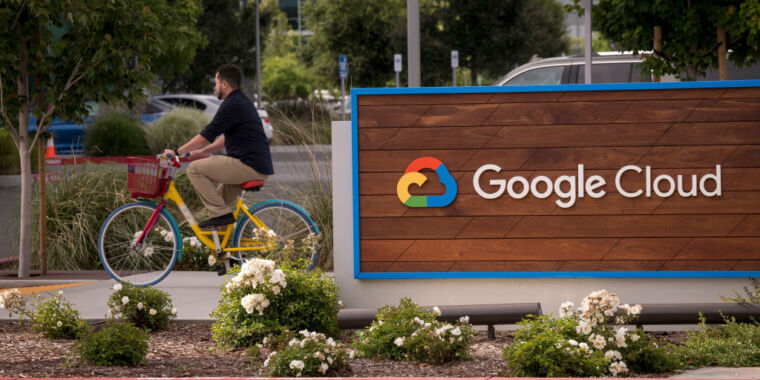
A Google sign stands in front of the building on the sidelines of the opening of the new Google Cloud data center in Hesse, Hanau, opened in October 2023.

Enlarge / A Google sign stands in front of the building on the sidelines of the opening of the new Google Cloud data center in Hesse, Hanau, opened in October 2023.

On Wednesday, authorities arrested former Google software engineer Linwei Ding in Newark, California, on charges of stealing AI trade secrets from the company. The US Department of Justice alleges that Ding, a Chinese national, committed the theft while secretly working with two China-based companies.

According to the indictment, Ding, who was hired by Google in 2019 and had access to confidential information about the company’s data centers, began uploading hundreds of files into a personal Google Cloud account two years ago.

The trade secrets Ding allegedly copied contained “detailed information about the architecture and functionality of GPU and TPU chips and systems, the software that allows the chips to communicate and execute tasks, and the software that orchestrates thousands of chips into a supercomputer capable of executing at the cutting edge of machine learning and AI technology,” according to the indictment.

Shortly after the alleged theft began, Ding was offered the position of chief technology officer at an early-stage technology company in China that touted its use of AI technology. The company offered him a monthly salary of about $14,800, plus an annual bonus and company stock. Ding reportedly traveled to China, participated in investor meetings, and sought to raise capital for the company.

Investigators reviewed surveillance camera footage that showed another employee scanning Ding’s name badge at the entrance of the building where Ding worked at Google, making him look like he was working from his office when he was actually traveling.

Ding also founded and served as the chief executive of a separate China-based startup company that aspired to train “large AI models powered by supercomputing chips,” according to the indictment. Prosecutors say Ding did not disclose either affiliation to Google, which described him as a junior employee. He resigned from Google on December 26 of last year.

The FBI served a search warrant at Ding’s home in January, seizing his electronic devices and later executing an additional warrant for the contents of his personal accounts. Authorities found more than 500 unique files of confidential information that Ding allegedly stole from Google. The indictment says that Ding copied the files into the Apple Notes application on his Google-issued Apple MacBook, then converted the Apple Notes into PDF files and uploaded them to an external account to evade detection.

“We have strict safeguards to prevent the theft of our confidential commercial information and trade secrets,” Google spokesperson José Castañeda told Ars Technica. “After an investigation, we found that this employee stole numerous documents, and we quickly referred the case to law enforcement. We are grateful to the FBI for helping protect our information and will continue cooperating with them closely.”

Attorney General Merrick Garland announced the case against the 38-year-old at an American Bar Association conference in San Francisco. Ding faces four counts of federal trade secret theft, each carrying a potential sentence of up to 10 years in prison.

US gov’t announces arrest of former Google engineer for alleged AI trade secret theft Read More »
worried-about-roundabouts?-waze-wants-to-help

Worried about roundabouts? Waze wants to help

📲🗺️📍🚙 —

Google’s other navigation app is getting some new features.

In this photo illustration a Waze logo of a GPS navigation software app is seen on a smartphone and a pc screen.

Pavlo Gonchar/SOPA Images/LightRocket via Getty Images

Waze, the navigation app owned by Google, is adding some new features. Some of these are safety-oriented, like alerts about first responders or speed limit changes. Others are convenience-minded, like help navigating roundabouts or parking information. It’s also expanding its use of crowdsourcing to determine road conditions.

When Google bought Waze in 2013, the navigation app was already well-liked for adding a slightly social aspect to in-car navigation—something that seems adorably quaint and perhaps unthinkable these 11 years later.

Over the years, Google has slowly incorporated more of Waze’s features into its own Google Maps platform and taken away Waze’s autonomy, too. In 2022, it was formally merged into the same division at Google that runs Maps, and last year, Google laid off some workers and ditched Waze’s own ad platform for Google ads.

Considering Google’s notorious nature when it comes to wielding an axe to much-liked apps or services, it’s fair to wonder how much longer Waze will continue to exist. But despite this existential threat, Waze continues to update and improve its app.

Last year, it added crash history alerts to warn drivers of crash hotspots they might be approaching. Now, it’s going to add speed limit alerts to both Android and iOS users later this month, which begins notifying a user that there’s an impending speed limit decrease once it’s within 500 feet. This functionality can commonly be found on new cars that use camera-based lane-keeping systems, but for everyone else on the road, it ought to be a handy update.

This month will also see Waze give alerts about impending speed bumps, toll booths, and sharp curves.

Another new safety feature is already available for all Waze users in the US, Canada, Mexico, and France. This alerts users if there’s an emergency vehicle stopped along the route. Connected car drivers in Germany have benefited from a similar system—for Waze’s feature, the data comes from its “Waze for City” partners.

  • An example of Waze’s new road alert.

    Waze

  • An example of Waze’s new emergency vehicle alert.

  • An example of Waze’s new speed limit decrease alert.

    Waze

  • An example of Waze’s roundabout navigation update.

    Waze

  • Waze will now display information about parking garages.

    Waze

  • You can book parking in the app.

    Waze

  • Waze will now know your usual routes and can tell you if it’s quicker to go a different way.

    Waze

Waze’s new roundabout navigation should be a boon to tourists planning to drive to Washington, DC. Again, it’s using crowdsourced data to show users where to enter a roundabout and where to leave it, as well as which lane to be in if there’s more than one. Waze says this feature will roll out to all its Android users across the globe this month. But if you use iOS, you’ll just have to keep circumnavigating that traffic circle until sometime later this year.

Rather than use crowdsourced info, the new parking update is a partnership with the parking platform Flash. It will show users information like whether the parking is covered, if it’s wheelchair accessible, and if there is EV charging or valet parking, and you’ll be able to reserve parking via the app. (Flash says its “Book Online” feature is also coming to Google Maps.) For now, Flash’s database covers about 30,000 parking garages in the US and Canada.

Finally, Waze says it’s adapting to users whose preferred routes aren’t the fastest option and that it will start displaying traffic information along these routes this month to both Android and iOS users.

Worried about roundabouts? Waze wants to help Read More »
reddit-cashes-in-on-ai-gold-rush-with-$203m-in-llm-training-license-fees

Reddit cashes in on AI gold rush with $203M in LLM training license fees

Your posts are the product —

Two- to three-year deals with Google, others, come amid legal uncertainty over “fair use.”

Enlarge / “Reddit Gold” takes on a whole new meaning when AI training data is involved.

The last week saw word leak that Google had agreed to license Reddit’s massive corpus of billions of posts and comments to help train its large language models. Now, in a recent Securities and Exchange Commission filing, the popular online forum has revealed that it will bring in $203 million from that and other unspecified AI data licensing contracts over the next three years.

Reddit’s Form S-1—published by the SEC late Thursday ahead of the site’s planned stock IPO—says the company expects $66.4 million of that data-derived value from LLM companies to come during the 2024 calendar year. Bloomberg previously reported the Google deal to be worth an estimated $60 million a year, suggesting that the three-year deal represents the vast majority of its AI licensing revenue so far.

Google and other AI companies that license Reddit’s data will receive “continuous access to [Reddit’s] data API as well as quarterly transfers of Reddit data over the term of the arrangement,” according to the filing. That constant, real-time access is particularly valuable, the site writes in the filing, because “Reddit data constantly grows and regenerates as users come and interact with their communities and each other.”

“Why pay for the cow…?”

While Reddit sees data licensing to AI firms as an important part of its financial future, its filing also notes that free use of its data has already been “a foundational part of how many of the leading large language models have been trained.” The filing seems almost bitter in noting that “some companies have constructed very large commercial language models using Reddit data without entering into a license agreement with us.”

That acknowledgment highlights the still-murky legal landscape over AI companies’ penchant for scraping huge swathes of the public web for training purposes, a practice those companies defend as fair use. And Reddit seems well aware that AI models may continue to hoover up its posts and comments for free, even as it tries to sell that data to others.

“Some companies may decline to license Reddit data and use such data without license given its open nature, even if in violation of the legal terms governing our services,” the company writes. “While we plan to vigorously enforce against such entities, such enforcement activities could take years to resolve, result in substantial expense, and divert management’s attention and other resources, and we may not ultimately be successful.”

Yet the mere existence of AI data licensing agreements like Reddit’s may influence how legal battles over this kind of data scraping play out. As Ars’ Timothy Lee and James Grimmelmann noted in a recent legal analysis, the establishment of a settled licensing market can have a huge impact on whether courts consider a novel use of digitized data to be “fair use” under copyright law.

“The more [AI data licensing] deals like this are signed in the coming months, the easier it will be for the plaintiffs to argue that the ‘effect on the market’ prong of fair use analysis should take this licensing market into account,” Lee and Grimmelmann wrote.

And while Reddit sees LLMs as a new revenue opportunity, the site also sees their popularity as a potential threat. The S-1 filing notes that “some users are also turning to LLMs such as ChatGPT, Gemini, and Anthropic” for seeking information, putting them in the same category of Reddit competition as “Google, Amazon, YouTube, Wikipedia, X, and other news sites.”

After filing for its IPO in late 2021, reports suggest Reddit is aiming to hit the stock market next month officially. The company will offer users and moderators with sufficient karma and/or activity on the site the opportunity to participate in that IPO through a directed share program.

Advance Publications, which owns Ars Technica parent Condé Nast, is the largest shareholder of Reddit.

Reddit cashes in on AI gold rush with $203M in LLM training license fees Read More »

yelp:-it’s-gotten-worse-since-google-made-changes-to-comply-with-eu-rules

Yelp: It’s gotten worse since Google made changes to comply with EU rules

illustration of google and yelp logos

Anjali Nair; Getty Images

To comply with looming rules that ban tech giants from favoring their own services, Google has been testing new look search results for flights, trains, hotels, restaurants, and products in Europe. The EU’s Digital Markets Act is supposed to help smaller companies get more traffic from Google, but reviews service Yelp says that when it tested Google’s design tweaks with consumers it had the opposite effect—making people less likely to click through to Yelp or another Google competitor.

The results, which Yelp shared with European regulators in December and WIRED this month, put some numerical backing behind complaints from Google rivals in travel, shopping, and hospitality that its efforts to comply with the DMA are insufficient—and potentially more harmful than the status quo. Yelp and thousands of others have been demanding that the EU hold a firm line against the giant companies including Apple and Amazon that are subject to what’s widely considered the world’s strictest antitrust law, violations of which can draw fines of up to 10 percent of global annual sales.

“All the gatekeepers are trying to hold on as long as possible to the status quo and make the new world unattractive,” says Richard Stables, CEO of shopping comparison site Kelkoo, which is unhappy with how Google has tweaked shopping results to comply with the DMA. “That’s really the game plan.”

Google spokesperson Rory O’Donoghue says the more than 20 changes made to search in response to the DMA are providing more opportunities for services such as Yelp to show up in results. “To suggest otherwise is plain wrong,” he says. Overall, Google’s tests of various DMA-inspired designs show clicks to review and comparison websites are up, O’Donoghue says—at the cost of users losing shortcuts to Google tools and individual businesses like airlines and restaurants facing a drop in visits from Google search. “We’ve been seeking feedback from a range of stakeholders over many months as we try to balance the needs of different types of websites while complying with the law,” he says.

Google, which generates 30 percent of its sales from Europe, the Middle East, and Africa, views the DMA as disrespecting its expertise in what users want. Critics such as Yelp argue that Google sometimes siphons users away from the more reliable content they offer. Yelp competes with Google for advertisers but generated less than 1 percent of its record sales of $1.3 billion last year from outside the US. An increase in European traffic could significantly boost its business.

To study search changes, Yelp worked with user-research company Lyssna to watch how hundreds of consumers from around the world interacted with Google’s new EU search results page when asked to find a dinner spot in Paris. For searches like that or for other “local” businesses, as Google calls them, one new design features results from Google Maps data at the top of the page below the search bar but adds a new box widget lower down containing images from and links to reviews websites like Yelp.

The experiments found that about 73 percent of about 500 people using that new design clicked results that kept them inside Google’s ecosystem—an increase over the 55 percent who did so when the design Google is phasing out in Europe was tested with a smaller pool of roughly 250 people.

Yelp also tested a variation of the new design. In this version, which Google has shared with regulators, the new box featuring review websites is placed above the maps widget. It was more successful in drawing people to try alternatives to Google, with only about 44 percent of consumers in the experiment sticking with the search giant. Though the box and widget will be treated equally by Google’s search algorithms, the order the features appear in will vary based on those calculations. Yelp’s concern is that Google will win out too often.

Yelp proposed to EU regulators that to produce more fair outcomes, Google should instead amend the map widget on results pages to include business listings and ratings from numerous providers, placing data from Google’s directory right alongside Yelp and others.

Companies such as Yelp that are critical of the changes in testing have called on the European Commission to immediately open an investigation into Google on March 7, when enforcement of the DMA begins.

“Yelp urges regulators to compel Google to fully comply with both the letter and spirit of the DMA,” says Yelp’s vice president of public policy, David Segal. “Google will soon be in violation of both, because if you look at what Google has put forth, it’s pretty clear that its services still have the best real estate.”

Yelp: It’s gotten worse since Google made changes to comply with EU rules Read More »

google-launches-“gemini-business”-ai,-adds-$20-to-the-$6-workspace-bill

Google launches “Gemini Business” AI, adds $20 to the $6 Workspace bill

$6 for apps like Gmail and Docs, and $20 for an AI bot? —

Google’s AI features add a 3x increase over the usual Workspace bill.

Google launches “Gemini Business” AI, adds $20 to the $6 Workspace bill

Google

Google went ahead with plans to launch Gemini for Workspace today. The big news is the pricing information, and you can see the Workspace pricing page is new, with every plan offering a “Gemini add-on.” Google’s old AI-for-Business plan, “Duet AI for Google Workspace,” is dead, though it never really launched anyway.

Google has a blog post explaining the changes. Google Workspace starts at $6 per user per month for the “Starter” package, and the AI “Add-on,” as Google is calling it, is an extra $20 monthly cost per user (all of these prices require an annual commitment). That is a massive price increase over the normal Workspace bill, but AI processing is expensive. Google says this business package will get you “Help me write in Docs and Gmail, Enhanced Smart Fill in Sheets and image generation in Slides.” It also includes the “1.0 Ultra” model for the Gemini chatbot—there’s a full feature list here. This $20 plan is subject to a usage limit for Gemini AI features of “1,000 times per month.”

The new Workspace pricing page, with a

Enlarge / The new Workspace pricing page, with a “Gemini Add-On” for every plan.

Google

Gemini for Google Workspace represents a total rebrand of the AI business product and some amount of consistency across Google’s hard-to-follow, constantly changing AI branding. Duet AI never really launched to the general public. The product, announced in August, only ever had a “Try” link that led to a survey, and after filling it out, Google would presumably contact some businesses and allow them to pay for Duet AI. Gemini Business now has a checkout page, and any Workspace business customer can buy the product today with just a few clicks.

Google’s second plan is “Gemini Enterprise,” which doesn’t come with any usage limits, but it’s also only available through a “contact us” link and not a normal checkout procedure. Enterprise is $30 per user per month, and it “includes additional capabilities for AI-powered meetings, where Gemini can translate closed captions in more than 100 language pairs, and soon even take meeting notes.”

Google launches “Gemini Business” AI, adds $20 to the $6 Workspace bill Read More »

google-goes-“open-ai”-with-gemma,-a-free,-open-weights-chatbot-family

Google goes “open AI” with Gemma, a free, open-weights chatbot family

Free hallucinations for all —

Gemma chatbots can run locally, and they reportedly outperform Meta’s Llama 2.

The Google Gemma logo

On Wednesday, Google announced a new family of AI language models called Gemma, which are free, open-weights models built on technology similar to the more powerful but closed Gemini models. Unlike Gemini, Gemma models can run locally on a desktop or laptop computer. It’s Google’s first significant open large language model (LLM) release since OpenAI’s ChatGPT started a frenzy for AI chatbots in 2022.

Gemma models come in two sizes: Gemma 2B (2 billion parameters) and Gemma 7B (7 billion parameters), each available in pre-trained and instruction-tuned variants. In AI, parameters are values in a neural network that determine AI model behavior, and weights are a subset of these parameters stored in a file.

Developed by Google DeepMind and other Google AI teams, Gemma pulls from techniques learned during the development of Gemini, which is the family name for Google’s most capable (public-facing) commercial LLMs, including the ones that power its Gemini AI assistant. Google says the name comes from the Latin gemma, which means “precious stone.”

While Gemma is Google’s first major open LLM since the launch of ChatGPT (it has released smaller research models such as FLAN-T5 in the past), it’s not Google’s first contribution to open AI research. The company cites the development of the Transformer architecture, as well as releases like TensorFlow, BERT, T5, and JAX as key contributions, and it would not be controversial to say that those have been important to the field.

A chart of Gemma performance provided by Google. Google says that Gemma outperforms Meta's Llama 2 on several benchmarks.

Enlarge / A chart of Gemma performance provided by Google. Google says that Gemma outperforms Meta’s Llama 2 on several benchmarks.

Owing to lesser capability and high confabulation rates, smaller open-weights LLMs have been more like tech demos until recently, as some larger ones have begun to match GPT-3.5 performance levels. Still, experts see source-available and open-weights AI models as essential steps in ensuring transparency and privacy in chatbots. Google Gemma is not “open source” however, since that term usually refers to a specific type of software license with few restrictions attached.

In reality, Gemma feels like a conspicuous play to match Meta, which has made a big deal out of releasing open-weights models (such as LLaMA and Llama 2) since February of last year. That technique stands in opposition to AI models like OpenAI’s GPT-4 Turbo, which is only available through the ChatGPT application and a cloud API and cannot be run locally. A Reuters report on Gemma focuses on the Meta angle and surmises that Google hopes to attract more developers to its Vertex AI cloud platform.

We have not used Gemma yet; however, Google claims the 7B model outperforms Meta’s Llama 2 7B and 13B models on several benchmarks for math, Python code generation, general knowledge, and commonsense reasoning tasks. It’s available today through Kaggle, a machine-learning community platform, and Hugging Face.

In other news, Google paired the Gemma release with a “Responsible Generative AI Toolkit,” which Google hopes will offer guidance and tools for developing what the company calls “safe and responsible” AI applications.

Google goes “open AI” with Gemma, a free, open-weights chatbot family Read More »

google-plans-“gemini-business”-ai-for-workspace-users

Google plans “Gemini Business” AI for Workspace users

We’ve got to pay for all those Nvidia cards somehow —

Google’s first swing at this idea, “Duet AI,” was an extra $30 per user per month.

The Google Gemini logo.

Enlarge / The Google Gemini logo.

Google

One of Google’s most lucrative businesses consists of packaging its free consumer apps with a few custom features and extra security and then selling them to companies. That’s usually called “Google Workspace,” and today it offers email, calendar, docs, storage, and video chat. Soon, it sounds like Google is gearing up to offer an AI chatbot for businesses. Google’s latest chatbot is called “Gemini” (it used to be “Bard”), and the latest early patch notes spotted by Dylan Roussei of 9to5Google and TestingCatalog.eth show descriptions for new “Gemini Business” and “Gemini Enterprise” products.

The patch notes say that Workspace customers will get “enterprise-grade data protections” and Gemini settings in the Google Workspace Admin console and that Workspace users can “use Gemini confidently at work” while “trusting that your conversations aren’t used to train Gemini models.”

These “early patch notes” for Bard/Gemini have been a thing for a while now. Apparently, some people have ways of making the site spit out early patch notes, and in this case, they were independently confirmed by two different people. I’m not sure the date (scheduled for February 21) is trustworthy, though.

Normally, you would expect a Google app to be included in the “Business Standard” version of Workspace, which is $12 per user per month, but it sounds like Gemini won’t be included. Google describes the products as “new Gemini Business and Gemini Enterprise plans” [emphasis ours] and implores existing paying Google Workspace users to “upgrade today to Gemini Business or Gemini Enterprise.” Roussei says the “upgrade today” link goes to the Duet AI Workspace page, Google’s first attempt at “AI for business,” which hasn’t been updated with any new plans just yet.

It’s unclear how much of the Duet AI business plan is surviving the Gemini rollout. Duet was announced in August 2023 as a few “help me write” buttons in Gmail, Docs, and other Workspace apps, which would all open chatbots that can control the various apps. Duet AI was supposed to have an “initial offering” price of an additional $30 per user per month, but it has been six months now, and Duet AI still isn’t generally available to businesses. The “try Duet AI” link goes to a “request a trial” contact form. Six months is an eternity in Google’s rapidly evolving AI plans; it’s a good bet Duet is replaced by all this Gemini stuff. Will it still be an extra $30, or did everyone scoff at that price?

If this $30-extra-for-AI plan ever ships, that would mean a typical AI-infused Workspace account would be a total of $45 per user per month. That sounds like a lot, but generative AI products currently take a huge amount of processing, which means they cost a lot. Right now, everyone is in land-grab mode, trying to get as many users as possible, but generally, the big players are all losing money. Nvidia’s market-leading AI cards can cost around $10,000 to $40,000 for a single card, and that’s not even counting the ongoing electricity costs.

Google plans “Gemini Business” AI for Workspace users Read More »

international-nest-aware-subscriptions-jump-in-price,-as-much-as-100%

International Nest Aware subscriptions jump in price, as much as 100%

pricing pain —

Modern plans get a 25 percent increase, while older plans double in price.

The indoor/outdoor, battery-powered (or wired) Google Nest Cam with battery.

Enlarge / The indoor/outdoor, battery-powered (or wired) Google Nest Cam with battery.

Google’s “Nest Aware” camera subscription is going through another round of price increases. This time it’s for international users. There’s no big announcement or anything, just a smattering of email screenshots from various countries on the Nest subreddit. 9to5Google was nice enough to hunt down a pile of the announcements.

Nest Aware is a monthly subscription fee for Google’s Nest cameras. Nest cameras exclusively store all their video in the cloud, and without the subscription, you aren’t allowed to record video 24/7. There are two sets of subscriptions to keep track of: the current generation subscription for modern cameras and the “first generation Nest Aware” subscription for older cameras. To give you an idea of what we’re dealing with, in the US, the current free tier only gets you three hours of “event” video—meaning video triggered by motion detection. Even the basic $8-a-month subscription doesn’t get you 24/7 recording—that’s still only 30 days of event video. The “Nest Aware Plus” subscription, at $15 a month in the US, gets you 10 days of 24/7 video recording.

The “first-generation” Nest Aware subscription, which is tied to earlier cameras and isn’t available for new customers anymore, is doubling in price in Canada. The basic tier of five days of 24/7 video is going from a yearly fee of CA$50 to CA$110 (the first-generation sub has 24/7 video on every tier). Ten days of video is jumping from CA$80 to CA$160, and 30 days is going from CA$110 to CA$220. These are the prices for a single camera; the first-generation subscription will have additional charges for additional cameras. The current Nest Aware subscription for modern cameras is getting jumps that look similar to the US, with Nest Aware Plus, the mid-tier, going from CA$16 to CA $20 per month, and presumably similar raises across the board.

Japan is seeing jumps, too, with annual Nest Aware for modern cameras going from 6,300 yen to 8,000 yen. Again, there’s no full list of price increases anywhere for every country; at the moment, we’re working from email screenshots, but it sounds like Google is rolling out similar price increases everywhere. The bill increases are happening in about a month, on March 25, 2024. The US already saw a 25–33 percent price increase in September, and it looks like, for the modern Nest Aware plan, the prices internationally are being brought in line with those increases. Users don’t seem too happy about the price increases, naturally.

Google’s austerity era, which CEO Sundar Pichai kicked off in the second half of 2022, has come with a wave of price increases across almost every Google subscription. YouTube Premium, YouTube Music, YouTube TV, Google Workspace, and Google Cloud storage all saw price increases. The one subscription that hasn’t seen a price jump is Google One, the consumer storage plan. Not that we’re trying to give Google any more ideas.

International Nest Aware subscriptions jump in price, as much as 100% Read More »

elon-musk’s-x-allows-china-based-propaganda-banned-on-other-platforms

Elon Musk’s X allows China-based propaganda banned on other platforms

Rinse-wash-repeat. —

X accused of overlooking propaganda flagged by Meta and criminal prosecutors.

Elon Musk’s X allows China-based propaganda banned on other platforms

Lax content moderation on X (aka Twitter) has disrupted coordinated efforts between social media companies and law enforcement to tamp down on “propaganda accounts controlled by foreign entities aiming to influence US politics,” The Washington Post reported.

Now propaganda is “flourishing” on X, The Post said, while other social media companies are stuck in endless cycles, watching some of the propaganda that they block proliferate on X, then inevitably spread back to their platforms.

Meta, Google, and then-Twitter began coordinating takedown efforts with law enforcement and disinformation researchers after Russian-backed influence campaigns manipulated their platforms in hopes of swaying the 2016 US presidential election.

The next year, all three companies promised Congress to work tirelessly to stop Russian-backed propaganda from spreading on their platforms. The companies created explicit election misinformation policies and began meeting biweekly to compare notes on propaganda networks each platform uncovered, according to The Post’s interviews with anonymous sources who participated in these meetings.

However, after Elon Musk purchased Twitter and rebranded the company as X, his company withdrew from the alliance in May 2023.

Sources told The Post that the last X meeting attendee was Irish intelligence expert Aaron Rodericks—who was allegedly disciplined for liking an X post calling Musk “a dipshit.” Rodericks was subsequently laid off when Musk dismissed the entire election integrity team last September, and after that, X apparently ditched the biweekly meeting entirely and “just kind of disappeared,” a source told The Post.

In 2023, for example, Meta flagged 150 “artificial influence accounts” identified on its platform, of which “136 were still present on X as of Thursday evening,” according to The Post’s analysis. X’s seeming oversight extends to all but eight of the 123 “deceptive China-based campaigns” connected to accounts that Meta flagged last May, August, and December, The Post reported.

The Post’s report also provided an exclusive analysis from the Stanford Internet Observatory (SIO), which found that 86 propaganda accounts that Meta flagged last November “are still active on X.”

The majority of these accounts—81—were China-based accounts posing as Americans, SIO reported. These accounts frequently ripped photos from Americans’ LinkedIn profiles, then changed the real Americans’ names while posting about both China and US politics, as well as people often trending on X, such as Musk and Joe Biden.

Meta has warned that China-based influence campaigns are “multiplying,” The Post noted, while X’s standards remain seemingly too relaxed. Even accounts linked to criminal investigations remain active on X. One “account that is accused of being run by the Chinese Ministry of Public Security,” The Post reported, remains on X despite its posts being cited by US prosecutors in a criminal complaint.

Prosecutors connected that account to “dozens” of X accounts attempting to “shape public perceptions” about the Chinese Communist Party, the Chinese government, and other world leaders. The accounts also comment on hot-button topics like the fentanyl problem or police brutality, seemingly to convey “a sense of dismay over the state of America without any clear partisan bent,” Elise Thomas, an analyst for a London nonprofit called the Institute for Strategic Dialogue, told The Post.

Some X accounts flagged by The Post had more than 1 million followers. Five have paid X for verification, suggesting that their disinformation campaigns—targeting hashtags to confound discourse on US politics—are seemingly being boosted by X.

SIO technical research manager Renée DiResta criticized X’s decision to stop coordinating with other platforms.

“The presence of these accounts reinforces the fact that state actors continue to try to influence US politics by masquerading as media and fellow Americans,” DiResta told The Post. “Ahead of the 2022 midterms, researchers and platform integrity teams were collaborating to disrupt foreign influence efforts. That collaboration seems to have ground to a halt, Twitter does not seem to be addressing even networks identified by its peers, and that’s not great.”

Musk shut down X’s election integrity team because he claimed that the team was actually “undermining” election integrity. But analysts are bracing for floods of misinformation to sway 2024 elections, as some major platforms have removed election misinformation policies just as rapid advances in AI technologies have made misinformation spread via text, images, audio, and video harder for the average person to detect.

In one prominent example, a fake robocaller relied on AI voice technology to pose as Biden to tell Democrats not to vote. That incident seemingly pushed the Federal Trade Commission on Thursday to propose penalizing AI impersonation.

It seems apparent that propaganda accounts from foreign entities on X will use every tool available to get eyes on their content, perhaps expecting Musk’s platform to be the slowest to police them. According to The Post, some of the X accounts spreading propaganda are using what appears to be AI-generated images of Biden and Donald Trump to garner tens of thousands of views on posts.

It’s possible that X will start tightening up on content moderation as elections draw closer. Yesterday, X joined Amazon, Google, Meta, OpenAI, TikTok, and other Big Tech companies in signing an agreement to fight “deceptive use of AI” during 2024 elections. Among the top goals identified in the “AI Elections accord” are identifying where propaganda originates, detecting how propaganda spreads across platforms, and “undertaking collective efforts to evaluate and learn from the experiences and outcomes of dealing” with propaganda.

Elon Musk’s X allows China-based propaganda banned on other platforms Read More »

android-15-developer-preview-1-is-out-for-the-pixel-6-and-up

Android 15 Developer Preview 1 is out for the Pixel 6 and up

Here’s hoping for some user-facing features someday —

Low-level developer features include fs-verify support, more screen-sharing modes.

The Android 15 logo. This is

Enlarge / The Android 15 logo. This is “Android V,” if you can’t tell from the logo.

Google

It’s that time of year again. Android is going to start its ~8-month-long beta process with the release of a new major OS version. The Android 15 Developer Preview is out today for the Pixel 6, 7, and 8, Pixel Fold, and Pixel Tablet. This release should mark the end of major OS support for the Pixel 5 and 5a series.

So what’s new? It’s hard to know too much with only the simple text descriptions we’re getting, but we have a few bullet points. “Partial screen sharing” will let users share or record individual app windows instead of the entire screen. Phones don’t have much of a difference between an app window and a full screen, but it would be nice if this blocked incoming notifications from showing up on your screen share. It would also be nice for tablets.

Android is surfacing an API that supports the Linux kernel’s fs-verity feature. This will let you store a read-only file on a read-write file system and cryptographically sign it to ensure it hasn’t been maliciously tampered with. Google apparently wants app developers to use this, saying, “This leads to enhanced security, protecting against potential malware or unauthorized file modifications that could compromise your app’s functionality or data.

Google says there are improved camera controls for apps and more “dynamic performance” controls that detect if your phone is overheating and let apps respond accordingly.

The release schedule.

Enlarge / The release schedule.

Google

There’s also a schedule that says we’re getting at least six developer releases. The first “beta” will be out in April; “platform stability,” when APIs are finalized and developers should get to work, is in June. The final release on the timeline is sometime after July, depending on how development goes.

We’ll know more about Android 15 when the actual documentation gets released and we can try some software. As always, these first Developer Preview releases are limited to low-level features for app developers, giving interested parties time to support new functionality before the OS releases in Q3. User-facing features will come later—hopefully. The Android 14 release was one of the smallest on record, so we’re hoping there are more meaningful improvements this year.

Android 15 Developer Preview 1 is out for the Pixel 6 and up Read More »

amc-to-pay-$8m-for-allegedly-violating-1988-law-with-use-of-meta-pixel

AMC to pay $8M for allegedly violating 1988 law with use of Meta Pixel

Stream like no one is watching —

Proposed settlement impacts millions using AMC apps like Shudder and AMC+.

AMC to pay $8M for allegedly violating 1988 law with use of Meta Pixel

On Thursday, AMC notified subscribers of a proposed $8.3 million settlement that provides awards to an estimated 6 million subscribers of its six streaming services: AMC+, Shudder, Acorn TV, ALLBLK, SundanceNow, and HIDIVE.

The settlement comes in response to allegations that AMC illegally shared subscribers’ viewing history with tech companies like Google, Facebook, and X (aka Twitter) in violation of the Video Privacy Protection Act (VPPA).

Passed in 1988, the VPPA prohibits AMC and other video service providers from sharing “information which identifies a person as having requested or obtained specific video materials or services from a video tape service provider.” It was originally passed to protect individuals’ right to private viewing habits, after a journalist published the mostly unrevealing video rental history of a judge, Robert Bork, who had been nominated to the Supreme Court by Ronald Reagan.

The so-called “Bork Tapes” revealed little—other than that the judge frequently rented spy thrillers and British costume dramas—but lawmakers recognized that speech could be chilled by monitoring anyone’s viewing habits. While the law was born in the era of Blockbuster Video, subscribers suing AMC wrote in their amended complaint that “the importance of legislation like the VPPA in the modern era of datamining is more pronounced than ever before.”

According to subscribers suing, AMC allegedly installed tracking technologies—including the Meta Pixel, the X Tracking Pixel, and Google Tracking Technology—on its website, allowing their personally identifying information to be connected with their viewing history.

Some trackers, like the Meta Pixel, required AMC to choose what kind of activity can be tracked, and subscribers claimed that AMC had willingly opted into sharing video names and URLs with Meta, along with a Facebook ID. “Anyone” could use the Facebook ID, subscribers said, to identify the AMC subscribers “simply by entering https://www.facebook.com/[unencrypted FID]/” into a browser.

X’s ID could similarly be de-anonymized, subscribers alleged, by using tweeterid.com.

AMC “could easily program its AMC Services websites so that this information is not disclosed” to tech companies, subscribers alleged.

Denying wrongdoing, AMC has defended its use of tracking technologies but is proposing to settle with subscribers to avoid uncertain outcomes from litigation, the proposed settlement said.

A hearing to approve the proposed settlement has been scheduled for May 16.

If it’s approved, AMC has agreed to “suspend, remove, or modify operation of the Meta Pixel and other Third-Party Tracking Technologies so that use of such technologies on AMC Services will not result in AMC’s disclosure to the third-party technology companies of the specific video content requested or obtained by a specific individual.”

Google and X did not immediately respond to Ars’ request to comment. Meta declined to comment.

All registered users of AMC services who “requested or obtained video content on at least one of the six AMC services” between January 18, 2021, and January 10, 2024, are currently eligible to submit claims under the proposed settlement. The deadline to submit is April 9.

In addition to distributing the $8.3 million settlement fund among class members, subscribers will receive a free one-week digital subscription.

According to AMC’s notice to subscribers (full disclosure, I am one), AMC’s agreement to avoid sharing subscribers’ viewing histories may change if the VPPA is amended, repealed, or invalidated. If the law changes to permit sharing viewing data at the core of subscribers’ claim, AMC may resume sharing that information with tech companies.

That day could come soon if Patreon has its way. Recently, Patreon asked a federal judge to rule that the VPPA is unconstitutional.

Patreon’s lawsuit is similar in its use of the Meta Pixel, allegedly violating the VPPA by sharing video views on its platform with Meta.

Patreon has argued that the VPPA is unconstitutional because it chills speech. Patreon said that the law was enacted “for the express purpose of silencing disclosures about political figures and their video-watching, an issue of undisputed continuing public interest and concern.”

According to Patreon, the VPPA narrowly prohibits video service providers from sharing video titles, but not from sharing information that people may wish to keep private, such as “the genres, performers, directors, political views, sexual content, and every other detail of pre-recorded video that those consumers watch.”

Therefore, Patreon argued, the VPPA “restrains speech” while “doing little if anything to protect privacy” and never protecting privacy “by the least restrictive means.”

That lawsuit remains ongoing, but Patreon’s position is likely to be met with opposition from experts who typically also defend freedom of speech. Experts at the Electronic Privacy Information Center, like AMC subscribers suing, consider the VPPA one of America’s “strongest protections of consumer privacy against a specific form of data collection.” And the Electronic Frontier Foundation (EFF) has already moved to convince the court to reject Patreon’s claim, describing the VPPA in a blog as an “essential” privacy protection.

“EFF is second to none in fighting for everyone’s First Amendment rights in court,” EFF’s blog said. “But Patreon’s First Amendment argument is wrong and misguided. The company seeks to elevate its speech interests over those of Internet users who benefit from the VPPA’s protections.”

AMC to pay $8M for allegedly violating 1988 law with use of Meta Pixel Read More »

google-upstages-itself-with-gemini-15-ai-launch,-one-week-after-ultra-1.0

Google upstages itself with Gemini 1.5 AI launch, one week after Ultra 1.0

Gemini’s Twin —

Google confusingly overshadows its own pro product a week after its last major AI launch.

The Gemini 1.5 logo

Enlarge / The Gemini 1.5 logo, released by Google.

Google

One week after its last major AI announcement, Google appears to have upstaged itself. Last Thursday, Google launched Gemini Ultra 1.0, which supposedly represented the best AI language model Google could muster—available as part of the renamed “Gemini” AI assistant (formerly Bard). Today, Google announced Gemini Pro 1.5, which it says “achieves comparable quality to 1.0 Ultra, while using less compute.”

Congratulations, Google, you’ve done it. You’ve undercut your own premiere AI product. While Ultra 1.0 is possibly still better than Pro 1.5 (what even are we saying here), Ultra was presented as a key selling point of its “Gemini Advanced” tier of its Google One subscription service. And now it’s looking a lot less advanced than seven days ago. All this is on top of the confusing name-shuffling Google has been doing recently. (Just to be clear—although it’s not really clarifying at all—the free version of Bard/Gemini currently uses the Pro 1.0 model. Got it?)

Google claims that Gemini 1.5 represents a new generation of LLMs that “delivers a breakthrough in long-context understanding,” and that it can process up to 1 million tokens, “achieving the longest context window of any large-scale foundation model yet.” Tokens are fragments of a word. The first part of the claim about “understanding” is contentious and subjective, but the second part is probably correct. OpenAI’s GPT-4 Turbo can reportedly handle 128,000 tokens in some circumstances, and 1 million is quite a bit more—about 700,000 words. A larger context window allows for processing longer documents and having longer conversations. (The Gemini 1.0 model family handles 32,000 tokens max.)

But any technical breakthroughs are almost beside the point. What should we make of a company that just trumpeted to the world about its AI supremacy last week, only to partially supersede that a week later? Is it a testament to the rapid rate of AI technical progress in Google’s labs, a sign that red tape was holding back Ultra 1.0 for too long, or merely a sign of poor coordination between research and marketing? We honestly don’t know.

So back to Gemini 1.5. What is it, really, and how will it be available? Google implies that like 1.0 (which had Nano, Pro, and Ultra flavors), it will be available in multiple sizes. Right now, Pro 1.5 is the only model Google is unveiling. Google says that 1.5 uses a new mixture-of-experts (MoE) architecture, which means the system selectively activates different “experts” or specialized sub-models within a larger neural network for specific tasks based on the input data.

Google says that Gemini 1.5 can perform “complex reasoning about vast amounts of information,” and gives an example of analyzing a 402-page transcript of Apollo 11’s mission to the Moon. It’s impressive to process documents that large, but the model, like every large language model, is highly likely to confabulate interpretations across large contexts. We wouldn’t trust it to soundly analyze 1 million tokens without mistakes, so that’s putting a lot of faith into poorly understood LLM hands.

For those interested in diving into technical details, Google has released a technical report on Gemini 1.5 that appears to show Gemini performing favorably versus GPT-4 Turbo on various tasks, but it’s also important to note that the selection and interpretation of those benchmarks can be subjective. The report does give some numbers on how much better 1.5 is compared to 1.0, saying it’s 28.9 percent better than 1.0 Pro at “Math, Science & Reasoning” and 5.2 percent better at those subjects than 1.0 Ultra.

A table from the Gemini 1.5 technical document showing comparisons to Gemini 1.0.

Enlarge / A table from the Gemini 1.5 technical document showing comparisons to Gemini 1.0.

Google

But for now, we’re still kind of shocked that Google would launch this particular model at this particular moment in time. Is it trying to get ahead of something that it knows might be just around the corner, like OpenAI’s unreleased GPT-5, for instance? We’ll keep digging and let you know what we find.

Google says that a limited preview of 1.5 Pro is available now for developers via AI Studio and Vertex AI with a 128,000 token context window, scaling up to 1 million tokens later. Gemini 1.5 apparently has not come to the Gemini chatbot (formerly Bard) yet.

Google upstages itself with Gemini 1.5 AI launch, one week after Ultra 1.0 Read More »