Google

after-borking-my-pixel-4a-battery,-google-borks-me,-too

After borking my Pixel 4a battery, Google borks me, too


The devil is in the details.

The Pixel 4a. It’s finally here! Credit: Google

It is an immutable law of nature that when you receive a corporate email with a subject line like “Changes coming to your Pixel 4a,” the changes won’t be the sort you like. Indeed, a more honest subject line would usually be: “You’re about to get hosed.”

So I wasn’t surprised, as I read further into this January missive from Google, that an “upcoming software update for your Pixel 4a” would “affect the overall performance and stability of its battery.”

How would my battery be affected? Negatively, of course. “This update will reduce your battery’s runtime and charging performance,” the email said. “To address this, we’re providing some options to consider. “

Our benevolent Google overlords were about to nerf my phone battery—presumably in the interests of “not having it erupt in flames,” though this was never actually made clear—but they recognized the problem, and they were about to provide compensation. This is exactly how these kinds of situations should be handled.

Google offered three options: $50 cash money, a $100 credit to Google’s online store, or a free battery replacement. It seemed fair enough. Yes, not having my phone for a week or two while I shipped it roundtrip to Google could be annoying, but at least the company was directly mitigating the harm it was about to inflict. Indeed, users might actually end up in better shape than before, given the brand-new battery.

So I was feeling relatively sunny toward the giant monopolist when I decided to spring for the 50 simoleons. My thinking was that 1) I didn’t want to lose my phone for a couple of weeks, 2) the update might not be that bad, in which case I’d be ahead by 50 bucks, and 3) I could always put the money towards a battery replacement if assumption No. 2 turned out to be mistaken.

The naïveté of youth!

I selected my $50 “appeasement” through an online form, and two days later, I received an email from Bharath on the Google Support Team.

Bharath wanted me to know that I was eligible for the money and it would soon be in my hands… once I performed a small, almost trivial task: giving some company I had never heard of my name, address, phone number, Social Security number, date of birth, and bank account details.

About that $50…

Google was not, in fact, just “sending” me $50. I had expected, since the problem involved their phones and their update, that the solution would require little or nothing from me. A check or prepaid credit card would arrive in the mail, perhaps, or a drone might deliver a crisp new bill from the sky. I didn’t know and didn’t care, so long as it wasn’t my problem.

But it was my problem. To get the cash, I had to create an account with something called “Payoneer.” This is apparently a reputable payments company, but I had never heard of it, and much about its operations is unclear. For instance, I was given three different ways to sign up depending on whether I 1) “already have a Payoneer account from Google,” 2) “don’t have an account,” or 3) “do have a Payoneer account that was not provided nor activated through Google.”

Say what now?

And though Google promised “no transaction fees,” Payoneer appears to charge an “annual account fee” of $29.95… but only to accounts that receive less than $2,000 through Payoneer in any consecutive 12-month period.

Does this fee apply to me if I sign up through the Google offer? I was directed to Payoneer support with any questions, but the company’s FAQ on the annual account fee doesn’t say.

If the fee does apply to me, do I need to sign up for a Payoneer account, give them all of my most personal financial information, wait the “10 to 18 business days” that Google says it will take to get my money, and then return to Payoneer so that I can cancel my account before racking up some $30 charge a year from now? And I’m supposed to do all this just to get…. fifty bucks? One time?

It was far simpler for me to get a recent hundred-dollar rebate on a washing machine… and they didn’t need my SSN or bank account information.

(Reddit users also report that, if you use the wrong web browser to cancel your Payoneer account, you’re hit with an error that says: “This end point requires that the body of all requests be formatted as JSON.”)

Like Lando Calrissian, I realized that this deal was getting worse all the time.

I planned to write Bharath back to switch my “appeasement,” but then I noticed the fine print: No changes are possible after making a selection.

So—no money for me. On the scale of life’s crises, losing $50 is a minor one, and I resolved to move on, facing the world with a cheerful heart and a clear mind, undistracted by the many small annoyances our high-tech overlords continually strew upon the path.

Then the software update arrived.

A decimation situation

When Google said that the new Pixel 4a update would “reduce your battery’s runtime and charging performance,” it was not kidding. Indeed, the update basically destroyed the battery.

Though my phone was three years old, until January of this year, the battery still held up for all-day usage. The screen was nice, the (smallish) phone size was good, and the device remained plenty fast at all the basic tasks: texting, emails, web browsing, snapping photos. I’m trying to reduce both my consumerism and my e-waste, so I was planning to keep the device for at least another year. And even then, it would make a decent hand-me-down device for my younger kids.

After the update, however, the phone burned through a full battery charge in less than two hours. I could pull up a simple podcast app, start playing an episode, and watch the battery percentage decrement every 45 seconds or so. Using the phone was nearly impossible unless one was near a charging cable at all times.

To recap: My phone was shot, I had to jump through several hoops to get my money, and I couldn’t change my “appeasement” once I realized that it wouldn’t work for me.

Within the space of three days, I went from 1) being mildly annoyed at the prospect of having my phone messed with remotely to 2) accepting that Google was (probably) doing it for my own safety and was committed to making things right to 3) berating Google for ruining my device and then using a hostile, data collecting “appeasement” program to act like it cared. This was probably not the impression Google hoped to leave in people’s minds when issuing the Pixel 4a update.

Pixel 4a, disassembled, with two fingers holding its battery above the front half.

Removing the Pixel 4a’s battery can be painful, but not as painful as catching fire. Credit: iFixit

Cheap can be quite expensive

The update itself does not appear to be part of some plan to spy on us or to extract revenue but rather to keep people safe. The company tried to remedy the pain with options that, on the surface, felt reasonable, especially given the fact that batteries are well-known as consumable objects that degrade over time. And I’ve had three solid years of service with the 4a, which wasn’t especially expensive to begin with.

That said, I do blame Google in general for the situation. The inflexibility of the approach, the options that aren’t tailored for ease of use in specific countries, the outsourced tech support—these are all hallmarks of today’s global tech behemoths.

It is more efficient, from an algorithmic, employ-as-few-humans-as-possible perspective, to operate “at scale” by choosing global technical solutions over better local options, by choosing outsourced email support, by trying to avoid fraud (and employee time) through preventing program changes, by asking the users to jump through your hoops, by gobbling up ultra-sensitive information because it makes things easier on your end.

While this makes a certain kind of sense, it’s not fun to receive this kind of “efficiency.” When everything goes smoothly, it’s fine—but whenever there’s a problem, or questions arise, these kinds of “efficient, scalable” approaches usually just mean “you’re about to get screwed.”

In the end, Google is willing to pay me $50, but that money comes with its own cost. I’m not willing to pay with my time nor with the risk of my financial information, and I will increasingly turn to companies that offer a better experience, that care more about data privacy, that build with higher-quality components, and that take good care of customers.

No company is perfect, of course, and this approach costs a bit more, which butts up against my powerful urge to get a great deal on everything. I have to keep relearning the old lesson— as I am once again with this Pixel 4a fiasco—that cheap gear is not always the best value in the long run.

Photo of Nate Anderson

After borking my Pixel 4a battery, Google borks me, too Read More »
oops:-google-says-it-might-have-deleted-your-maps-timeline-data

Oops: Google says it might have deleted your Maps Timeline data

The Google Maps Timeline has long been a useful though slightly uncomfortable feature that maintains a complete record of everywhere your phone goes (and probably you with it). Google recently changed the way it stored timeline data to improve privacy, but the company now confirms that a “technical issue” resulted in many users losing their timeline history altogether, and there might not be any way to recover it.

Timeline, previously known as Location History, is very useful if you need to figure out where you were on a particular day or if you just can’t remember where you found that neat bar on your last vacation. Many Google users grew quite fond of having access to that data. However, Google had access to it, too. Starting in 2024, Google transitioned to storing Timeline data only on the user’s individual smartphone instead of backing it up to the cloud. You can probably see where this is going.

Users started piping up over the past several weeks, posting on the Google support forums, Reddit, and other social media that their treasured Timeline data had gone missing. Google has been investigating the problem, and the news isn’t good. In an email sent out over the weekend, Google confirmed what many already feared: Maps has accidentally deleted Timeline data on countless devices.

A Google spokesperson confirmed this is the result of a technical issue and not user error or an intentional change. It’s unclear how this happened, but we’d wager on a botched Maps update. Google usually rolls out updates in waves, and it’s possible that the defective build in this case made it to a large number of devices before it was stopped.

You have exactly one possible fix for this issue, but only if you planned ahead. When Google began the full change-over to local storage of Timeline data, it added several settings to control the feature. While the data is stored locally by default, you have the option of creating encrypted backups in the cloud. If you did that, you should be able to restore the data.

Oops: Google says it might have deleted your Maps Timeline data Read More »

italy-demands-google-poison-dns-under-strict-piracy-shield-law

Italy demands Google poison DNS under strict Piracy Shield law

Spotted by TorrentFreak, AGCOM Commissioner Massimiliano Capitanio took to LinkedIn to celebrate the ruling, as well as the existence of the Italian Piracy Shield. “The Judge confirmed the value of AGCOM’s investigations, once again giving legitimacy to a system for the protection of copyright that is unique in the world,” said Capitanio.

Capitanio went on to complain that Google has routinely ignored AGCOM’s listing of pirate sites, which are supposed to be blocked in 30 minutes or less under the law. He noted the violation was so clear-cut that the order was issued without giving Google a chance to respond, known as inaudita altera parte in Italian courts.

This decision follows a similar case against Internet backbone firm Cloudflare. In January, the Court of Milan found that Cloudflare’s CDN, DNS server, and WARP VPN were facilitating piracy. The court threatened Cloudflare with fines of up to 10,000 euros per day if it did not begin blocking the sites.

Google could face similar sanctions, but AGCOM has had difficulty getting international tech behemoths to acknowledge their legal obligations in the country. We’ve reached out to Google for comment and will update this report if we hear back.

Italy demands Google poison DNS under strict Piracy Shield law Read More »

apple-and-google-in-the-hot-seat-as-european-regulators-ignore-trump-warnings

Apple and Google in the hot seat as European regulators ignore Trump warnings

The European Commission is not backing down from efforts to rein in Big Tech. In a series of press releases today, the European Union’s executive arm has announced actions against both Apple and Google. Regulators have announced that Apple will be required to open up support for non-Apple accessories on the iPhone, but it may be too late for Google to make changes. The commission says the search giant has violated the Digital Markets Act, which could lead to a hefty fine.

Since returning to power, Donald Trump has railed against European regulations that target US tech firms. In spite of rising tensions and tough talk, the European Commission seems unfazed and is continuing to follow its more stringent laws, like the Digital Markets Act (DMA). This landmark piece of EU legislation aims to make the digital economy more fair. Upon coming into force last year, the act labeled certain large tech companies, including Apple and Google, as “gatekeepers” that are subject to additional scrutiny.

Europe’s more aggressive regulation of Big Tech is why iPhone users on the continent can install apps from third-party app markets while the rest of us are stuck with the Apple App Store. As for Google, the European Commission has paid special attention to search, Android, and Chrome, all of which dominate their respective markets.

Apple’s mobile platform plays second fiddle to Android in Europe, but it’s large enough to make the company subject to the DMA. The EU has now decreed that Apple is not doing enough to support interoperability on its platform. As a result, it will be required to make several notable changes. Apple will have to provide other companies and developers with improved access to iOS for devices like smartwatches, headphones, and TVs. This could include integration with notifications, faster data transfers, and streamlined setup.

The commission is also forcing Apple to release additional technical documentation, communication, and notifications for upcoming features for third parties. The EU believes this change will encourage more companies to build products that integrate with the iPhone, giving everyone more options aside from Apple’s.

Regulators say both sets of measures are the result of a public comment period that began late last year. We’ve asked Apple for comment on this development but have not heard back as of publication time. Apple is required to make these changes, and failing to do so could lead to fines. However, Google is already there.

Apple and Google in the hot seat as European regulators ignore Trump warnings Read More »

gemini-gets-new-coding-and-writing-tools,-plus-ai-generated-“podcasts”

Gemini gets new coding and writing tools, plus AI-generated “podcasts”

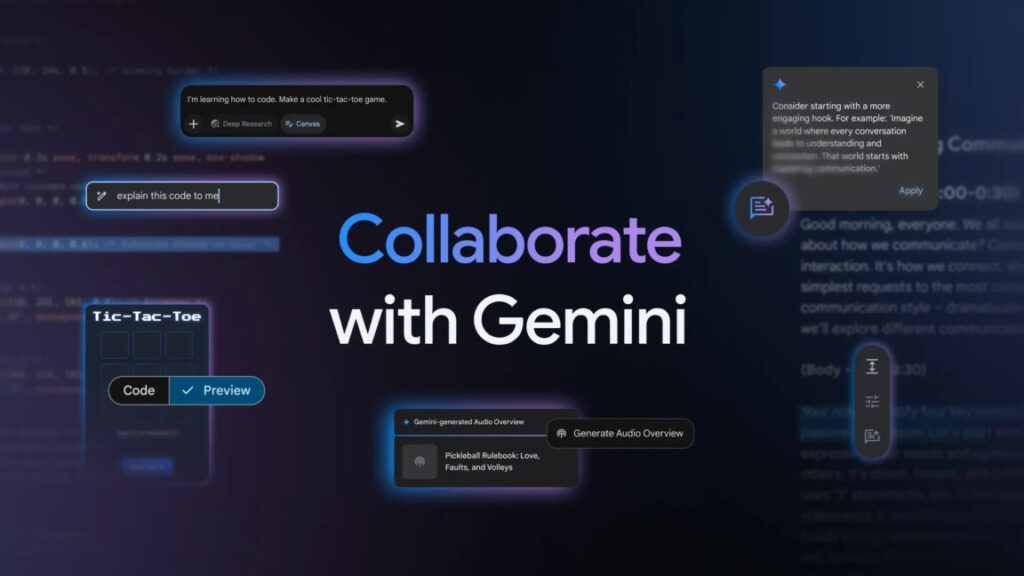
On the heels of its release of new Gemini models last week, Google has announced a pair of new features for its flagship AI product. Starting today, Gemini has a new Canvas feature that lets you draft, edit, and refine documents or code. Gemini is also getting Audio Overviews, a neat capability that first appeared in the company’s NotebookLM product, but it’s getting even more useful as part of Gemini.

Canvas is similar (confusingly) to the OpenAI product of the same name. Canvas is available in the Gemini prompt bar on the web and mobile app. Simply upload a document and tell Gemini what you need to do with it. In Google’s example, the user asks for a speech based on a PDF containing class notes. And just like that, Gemini spits out a document.

Canvas lets you refine the AI-generated documents right inside Gemini. The writing tools available across the Google ecosystem, with options like suggested edits and different tones, are available inside the Gemini-based editor. If you want to do more edits or collaborate with others, you can export the document to Google Docs with a single click.

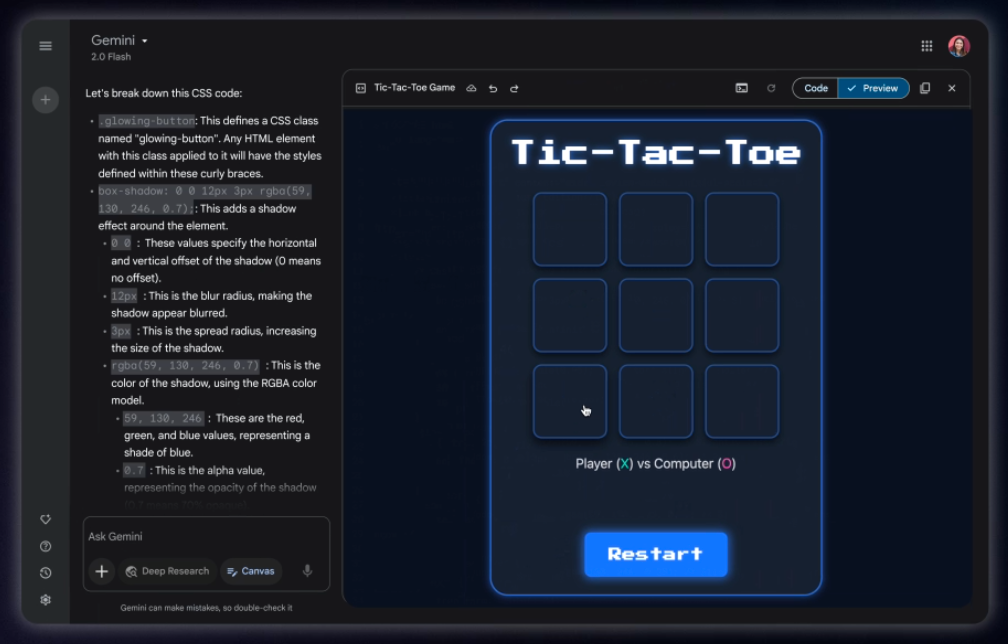
Gemini Canvas with tic-tac-toe game

Credit: Google

Canvas is also adept at coding. Just ask, and Canvas can generate prototype web apps, Python scripts, HTML, and more. You can ask Gemini about the code, make alterations, and even preview your results in real time inside Gemini as you (or the AI) make changes.

Gemini gets new coding and writing tools, plus AI-generated “podcasts” Read More »

google-inks-$32-billion-deal-to-buy-security-firm-wiz-even-as-doj-seeks-breakup

Google inks $32 billion deal to buy security firm Wiz even as DOJ seeks breakup

“While a tough regulatory climate in 2024 had hampered such large-scale deals, Wall Street is optimistic that a shift in antitrust policies under US President Donald Trump could reignite dealmaking momentum,” Reuters wrote today.

Google reportedly agreed to a $3.2 billion breakup fee that would be paid to Wiz if the deal collapses. A Financial Times report said the breakup fee is unusually large as it represents 10 percent of the total deal value, instead of the typical 2 or 3 percent. The large breakup fee “shows how technology companies are still bracing themselves for pushback from antitrust regulators, even under President Donald Trump and his new Federal Trade Commission chair Andrew Ferguson,” the article said.

Wiz co-founder and CEO Assaf Rappaport wrote today that although the plan is for Wiz to become part of Google Cloud, the companies both believe that “Wiz needs to remain a multicloud platform… We will still work closely with our great partners at AWS, Azure, Oracle, and across the entire industry.”

Google Cloud CEO Thomas Kurian wrote that Wiz’s platform would fill a gap in Google’s security offerings. Google products already “help customers detect and respond to attackers through both SaaS-based services and cybersecurity consulting,” but Wiz is different because it “connects to all major clouds and code environments to help prevent incidents from happening in the first place,” he wrote.

“Wiz’s solution rapidly scans the customer’s environment, constructing a comprehensive graph of code, cloud resources, services, and applications—along with the connections between them,” Kurian wrote. “It identifies potential attack paths, prioritizes the most critical risks based on their impact, and empowers enterprise developers to secure applications before deployment. It also helps security teams collaborate with developers to remediate risks in code or detect and block ongoing attacks.”

Google inks $32 billion deal to buy security firm Wiz even as DOJ seeks breakup Read More »

why-wait?-google-is-already-dismantling-assistant-as-it-switches-to-gemini.

Why wait? Google is already dismantling Assistant as it switches to Gemini.

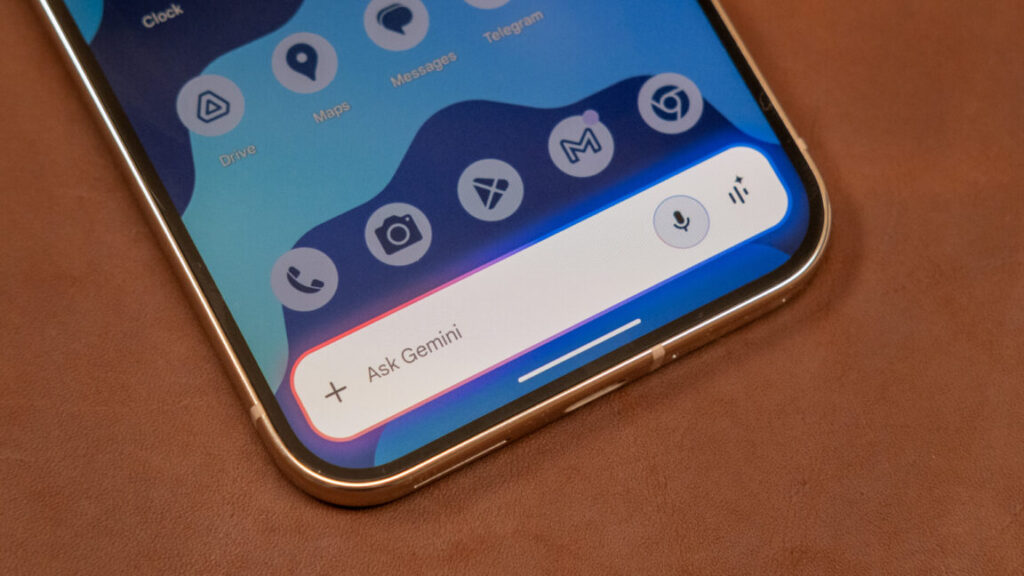
Google Assistant is not long for this world. Google confirmed what many suspected last week, that it will transition everyone to Gemini in 2025. Assistant holdouts may find it hard to stay on Google’s old system until the end, though. Google has confirmed some popular Assistant features are being removed in the coming weeks. You may not miss all of them, but others could force a change to your daily routine.

As Google has increasingly become totally consumed by Gemini, it was a foregone conclusion that Assistant would get the ax eventually. In 2024, Google removed features like media alarms and voice messages, but that was just the start. The full list of removals is still available on its support page (spotted by 9to5Google), but there’s now a new batch of features at the top. Here’s a rundown of what’s on the chopping block.

  • Favorite, share, and ask where and when your photos were taken with your voice
  • Change photo frame settings or ambient screen settings with your voice
  • Translate your live conversation with someone who doesn’t speak your language with interpreter mode
  • Get birthday reminder notifications as part of Routines
  • Ask to schedule or hear previously scheduled Family Bell announcements
  • Get daily updates from your Assistant, like “send me the weather everyday”
  • Use Google Assistant on car accessories that have a Bluetooth connection or AUX plug

Some of these are no great loss—you’ll probably live without the ability to get automatic birthday reminders or change smart display screensavers by voice. However, others are popular features that Google has promoted aggressively. For example, interpreter mode made a splash in 2019 and has been offering real-time translations ever since; Assistant can only translate a single phrase now. Many folks also use the scheduled updates in Assistant as part of their morning routine. Family Bell is much beloved, too, allowing Assistant to make custom announcements and interactive checklists, which can be handy for getting kids going in the morning. Attempting to trigger some of these features will offer a warning that they will go away soon.

Why wait? Google is already dismantling Assistant as it switches to Gemini. Read More »

google-joins-openai-in-pushing-feds-to-codify-ai-training-as-fair-use

Google joins OpenAI in pushing feds to codify AI training as fair use

Google’s position on AI regulation: Trust us, bro

If there was any doubt about Google’s commitment to move fast and break things, its new policy position should put that to rest. “For too long, AI policymaking has paid disproportionate attention to the risks,” the document says.

Google urges the US to invest in AI not only with money but with business-friendly legislation. The company joins the growing chorus of AI firms calling for federal legislation that clarifies how they can operate. It points to the difficulty of complying with a “patchwork” of state-level laws that impose restrictions on AI development and use. If you want to know what keeps Google’s policy wonks up at night, look no further than the vetoed SB-1047 bill in California, which would have enforced AI safety measures.

AI ethics or AI Law concept. Developing AI codes of ethics. Compliance, regulation, standard , business policy and responsibility for guarding against unintended bias in machine learning algorithms.

Credit: Parradee Kietsirikul

According to Google, a national AI framework that supports innovation is necessary to push the boundaries of what artificial intelligence can do. Taking a page from the gun lobby, Google opposes attempts to hold the creators of AI liable for the way those models are used. Generative AI systems are non-deterministic, making it impossible to fully predict their output. Google wants clearly defined responsibilities for AI developers, deployers, and end users—it would, however, clearly prefer most of those responsibilities fall on others. “In many instances, the original developer of an AI model has little to no visibility or control over how it is being used by a deployer and may not interact with end users,” the company says.

There are efforts underway in some countries that would implement stringent regulations that force companies like Google to make their tools more transparent. For example, the EU’s AI Act would require AI firms to publish an overview of training data and possible risks associated with their products. Google believes this would force the disclosure of trade secrets that would allow foreign adversaries to more easily duplicate its work, mirroring concerns that OpenAI expressed in its policy proposal.

Google wants the government to push back on these efforts at the diplomatic level. The company would like to be able to release AI products around the world, and the best way to ensure it has that option is to promote light-touch regulation that “reflects US values and approaches.” That is, Google’s values and approaches.

Google joins OpenAI in pushing feds to codify AI training as fair use Read More »

end-of-life:-gemini-will-completely-replace-google-assistant-later-this-year

End of Life: Gemini will completely replace Google Assistant later this year

Not all devices can simply download an updated app—after almost a decade, Assistant is baked into many Google products. The company says Google-powered cars, watches, headphones, and other devices that use Assistant will receive updates that transition them to Gemini. It’s unclear if all Assistant-powered gadgets will be part of the migration. Most of these devices connect to your phone, so the update should be relatively straightforward, even for accessories that launched early in the Assistant era.

There are also plenty of standalone devices that run Assistant, like TVs and smart speakers. Google says it’s working on updated Gemini experiences for those devices. For example, there’s a Gemini preview program for select Google Nest speakers. It’s unclear if all these devices will get updates. Google says there will be more details on this in the coming months.

Meanwhile, Gemini still has some ground to make up. There are basic features that work fine in Assistant, like setting timers and alarms, that can go sideways with Gemini. On the other hand, Assistant had its fair share of problems and didn’t exactly win a lot of fans. Regardless, this transition could be fraught with danger for Google as it upends how people interact with their devices.

End of Life: Gemini will completely replace Google Assistant later this year Read More »

rcs-texting-updates-will-bring-end-to-end-encryption-to-green-bubble-chats

RCS texting updates will bring end-to-end encryption to green bubble chats

One of the best mostly invisible updates in iOS 18 was Apple’s decision to finally implement the Rich Communications Services (RCS) communication protocol, something that is slowly helping to fix the generally miserable experience of texting non-iPhone users with an iPhone. The initial iOS 18 update brought RCS support to most major carriers in the US, and the upcoming iOS 18.4 update is turning it on for a bunch of smaller prepaid carriers like Google Fi and Mint Mobile.

Now that Apple is on board, iPhones and their users can also benefit from continued improvements to the RCS standard. And one major update was announced today: RCS will now support end-to-end encryption using the Messaging Layer Security (MLS) protocol, a standard finalized by the Internet Engineering Task Force in 2023.

“RCS will be the first large-scale messaging service to support interoperable E2EE between client implementations from different providers,” writes GSMA Technical Director Tom Van Pelt in the post announcing the updates. “Together with other unique security features such as SIM-based authentication, E2EE will provide RCS users with the highest level of privacy and security for stronger protection from scams, fraud and other security and privacy threats. ”

RCS texting updates will bring end-to-end encryption to green bubble chats Read More »

ai-search-engines-cite-incorrect-sources-at-an-alarming-60%-rate,-study-says

AI search engines cite incorrect sources at an alarming 60% rate, study says

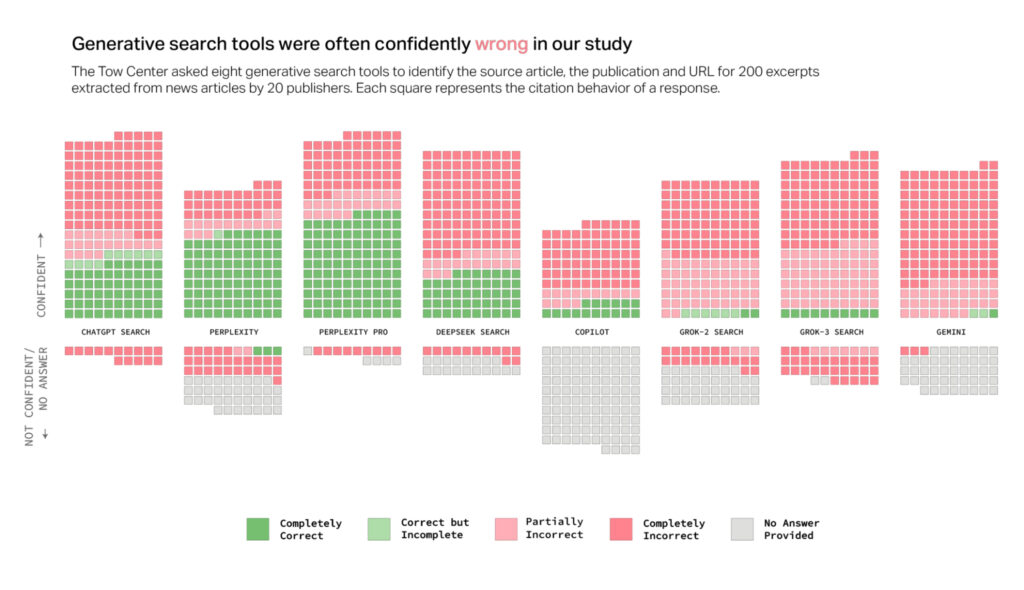
A new study from Columbia Journalism Review’s Tow Center for Digital Journalism finds serious accuracy issues with generative AI models used for news searches. The research tested eight AI-driven search tools equipped with live search functionality and discovered that the AI models incorrectly answered more than 60 percent of queries about news sources.

Researchers Klaudia Jaźwińska and Aisvarya Chandrasekar noted in their report that roughly 1 in 4 Americans now uses AI models as alternatives to traditional search engines. This raises serious concerns about reliability, given the substantial error rate uncovered in the study.

Error rates varied notably among the tested platforms. Perplexity provided incorrect information in 37 percent of the queries tested, whereas ChatGPT Search incorrectly identified 67 percent (134 out of 200) of articles queried. Grok 3 demonstrated the highest error rate, at 94 percent.

A graph from CJR shows

A graph from CJR shows “confidently wrong” search results. Credit: CJR

For the tests, researchers fed direct excerpts from actual news articles to the AI models, then asked each model to identify the article’s headline, original publisher, publication date, and URL. They ran 1,600 queries across the eight different generative search tools.

The study highlighted a common trend among these AI models: rather than declining to respond when they lacked reliable information, the models frequently provided confabulations—plausible-sounding incorrect or speculative answers. The researchers emphasized that this behavior was consistent across all tested models, not limited to just one tool.

Surprisingly, premium paid versions of these AI search tools fared even worse in certain respects. Perplexity Pro ($20/month) and Grok 3’s premium service ($40/month) confidently delivered incorrect responses more often than their free counterparts. Though these premium models correctly answered a higher number of prompts, their reluctance to decline uncertain responses drove higher overall error rates.

Issues with citations and publisher control

The CJR researchers also uncovered evidence suggesting some AI tools ignored Robot Exclusion Protocol settings, which publishers use to prevent unauthorized access. For example, Perplexity’s free version correctly identified all 10 excerpts from paywalled National Geographic content, despite National Geographic explicitly disallowing Perplexity’s web crawlers.

AI search engines cite incorrect sources at an alarming 60% rate, study says Read More »

google-has-a-fix-for-your-broken-chromecast-v2-unless-you-factory-reset

Google has a fix for your broken Chromecast V2 unless you factory reset

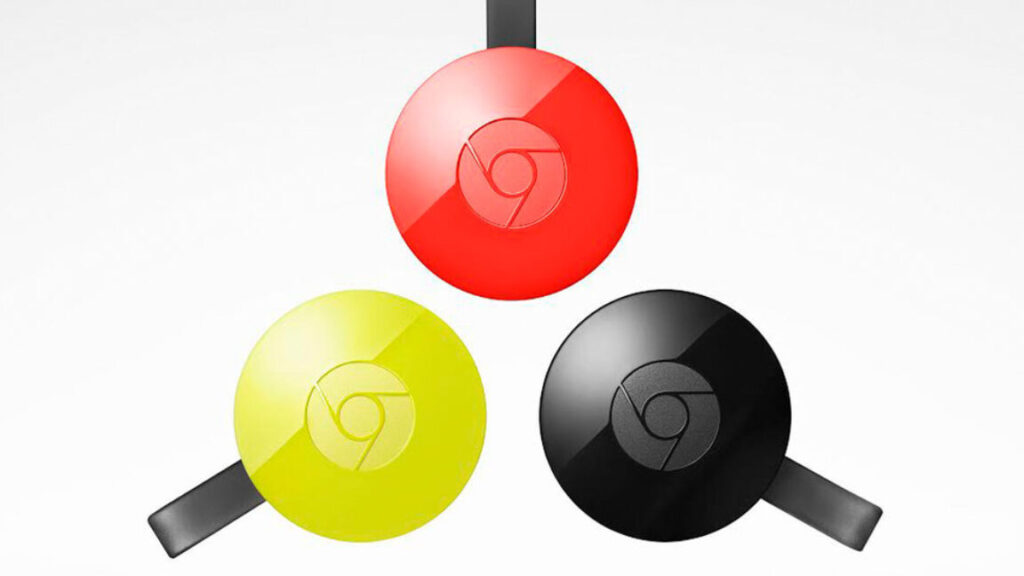
Google’s venerable 2015 Chromecast attempted to self-destruct earlier this week, upsetting a huge number of people who were still using the decade-old streaming dongles. Google was seemingly caught off guard by the devices glitching out all at the same time, but it promised to address the problem, and it has. Google says it has a fix ready to roll out, and most affected devices should be right as rain in the coming days.

Google is still not confirming the cause of the Chromecast outage, but it was almost certainly the result of a certificate expiring after 10 years. It would seem there was no one keeping an eye on the Chromecast’s ticking time bomb, which isn’t exactly surprising—Google has moved on from the Chromecast brand, focusing instead on the more capable Google TV streamer. Even if Google is done with the Chromecast, its customers aren’t.

If you left your 2015 Chromecast or Chromecast Audio alone to await a fix, you’re in good shape. The update should be delivered automatically to the device soon. “We’ve started rolling out a fix for the problem with Chromecast (2nd gen) and Chromecast Audio devices, which will be completed over the next few days. Users must ensure their device is connected to WiFi to receive the update,” says Google.

Google has a fix for your broken Chromecast V2 unless you factory reset Read More »