Gemini 3

google-releases-gemini-3-flash,-promising-improved-intelligence-and-efficiency

Google releases Gemini 3 Flash, promising improved intelligence and efficiency

Google began its transition to Gemini 3 a few weeks ago with the launch of the Pro model, and the arrival of Gemini 3 Flash kicks it into high gear. The new, faster Gemini 3 model is coming to the Gemini app and search, and developers will be able to access it immediately via the Gemini API, Vertex AI, AI Studio, and Antigravity. Google’s bigger gen AI model is also picking up steam, with both Gemini 3 Pro and its image component (Nano Banana Pro) expanding in search.

This may come as a shock, but Google says Gemini 3 Flash is faster and more capable than its previous base model. As usual, Google has a raft of benchmark numbers that show modest improvements for the new model. It bests the old 2.5 Flash in basic academic and reasoning tests like GPQA Diamond and MMMU Pro (where it even beats 3 Pro). It gets a larger boost in Humanity’s Last Exam (HLE), which tests advanced domain-specific knowledge. Gemini 3 Flash has tripled the old models’ score in HLE, landing at 33.7 percent without tool use. That’s just a few points behind the Gemini 3 Pro model.
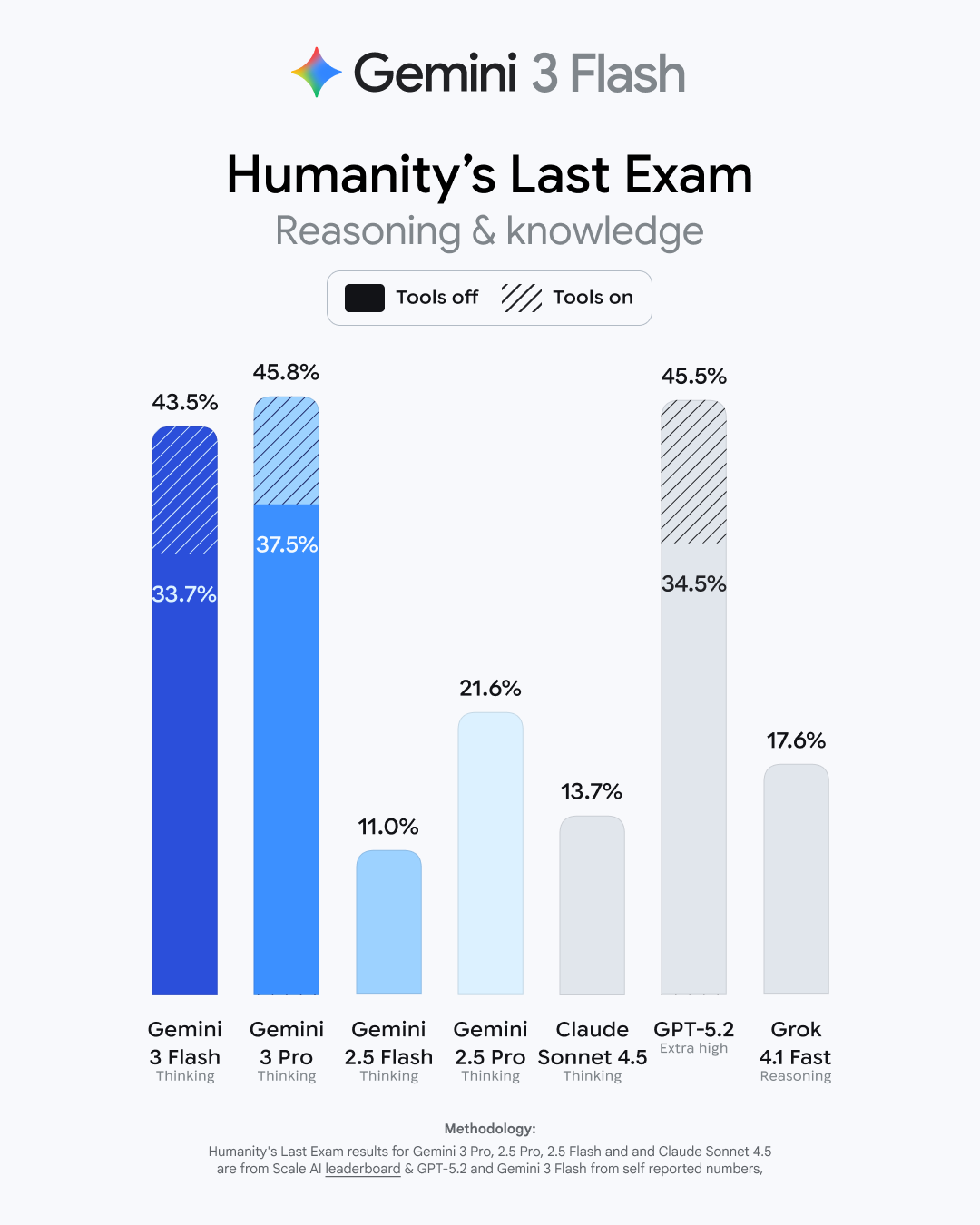
Gemini HLE test

Credit: Google

Google is talking up Gemini 3 Flash’s coding skills, and the provided benchmarks seem to back that talk up. Over the past year, Google has mostly pushed its Pro models as the best for generating code, but 3 Flash has done a lot of catching up. In the popular SWE-Bench Verified test, Gemini 3 Flash has gained almost 20 points on the 2.5 branch.

The new model is also a lot less likely to get general-knowledge questions wrong. In the Simple QA Verified test, Gemini 3 Flash scored 68.7 percent, which is only a little below Gemini 3 Pro. The last Flash model scored just 28.1 percent on that test. At least as far as the evaluation scores go, Gemini 3 Flash performs much closer to Google’s Pro model versus the older 2.5 family. At the same time, it’s considerably more efficient, according to Google.

One of Gemini 3 Pro’s defining advances was its ability to generate interactive simulations and multimodal content. Gemini 3 Flash reportedly retains that underlying capability. Gemini 3 Flash offers better performance than Gemini 2.5 Pro did, but it runs workloads three times faster. It’s also a lot cheaper than the Pro models if you’re paying per token. One million input tokens for 3 Flash will run devs $0.50, and a million output tokens will cost $3. However, that’s an increase compared to Gemini 2.5 Flash input and output at $0.30 and $2.50, respectively. The Pro model’s tokens are $2 (1M input) and $12 (1M output).

Google releases Gemini 3 Flash, promising improved intelligence and efficiency Read More »

openai-releases-gpt-5.2-after-“code-red”-google-threat-alert

OpenAI releases GPT-5.2 after “code red” Google threat alert

On Thursday, OpenAI released GPT-5.2, its newest family of AI models for ChatGPT, in three versions called Instant, Thinking, and Pro. The release follows CEO Sam Altman’s internal “code red” memo earlier this month, which directed company resources toward improving ChatGPT in response to competitive pressure from Google’s Gemini 3 AI model.

“We designed 5.2 to unlock even more economic value for people,” Fidji Simo, OpenAI’s chief product officer, said during a press briefing with journalists on Thursday. “It’s better at creating spreadsheets, building presentations, writing code, perceiving images, understanding long context, using tools and then linking complex, multi-step projects.”

As with previous versions of GPT-5, the three model tiers serve different purposes: Instant handles faster tasks like writing and translation; Thinking spits out simulated reasoning “thinking” text in an attempt to tackle more complex work like coding and math; and Pro spits out even more simulated reasoning text with the goal of delivering the highest-accuracy performance for difficult problems.

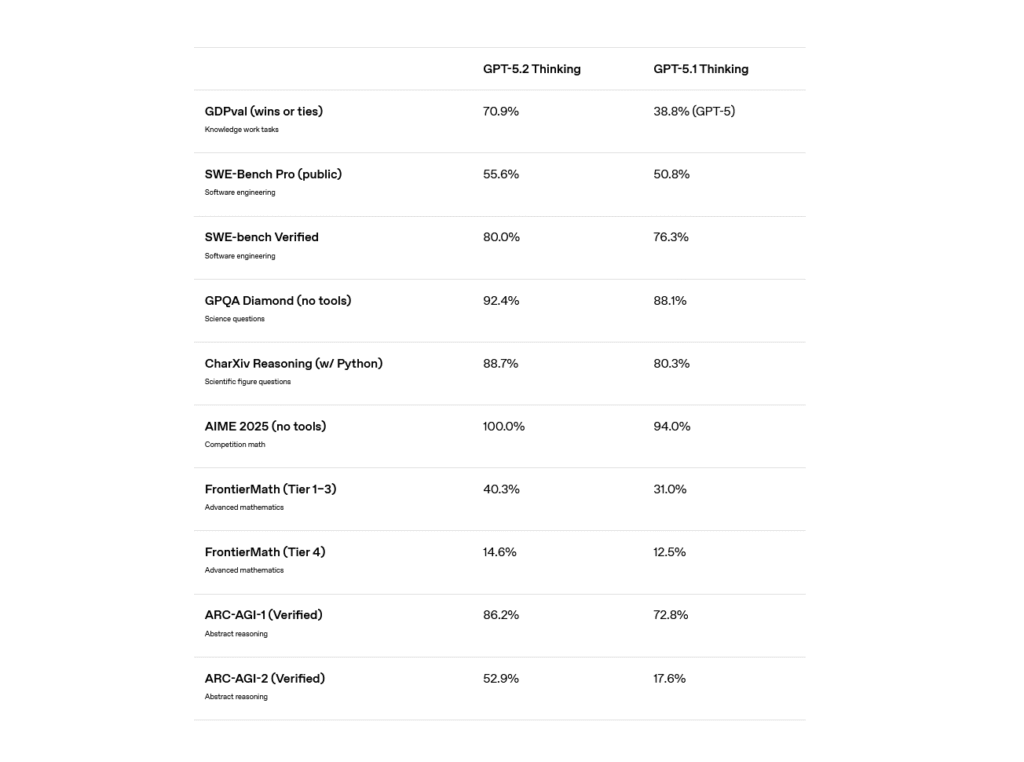
A chart of GPT-5.2 benchmark results taken from OpenAI's website.

A chart of GPT-5.2 Thinking benchmark results comparing it to its predecessor, taken from OpenAI’s website. Credit: OpenAI

GPT-5.2 features a 400,000-token context window, allowing it to process hundreds of documents at once, and a knowledge cutoff date of August 31, 2025.

GPT-5.2 is rolling out to paid ChatGPT subscribers starting Thursday, with API access available to developers. Pricing in the API runs $1.75 per million input tokens for the standard model, a 40 percent increase over GPT-5.1. OpenAI says the older GPT-5.1 will remain available in ChatGPT for paid users for three months under a legacy models dropdown.

Playing catch-up with Google

The release follows a tricky month for OpenAI. In early December, Altman issued an internal “code red” directive after Google’s Gemini 3 model topped multiple AI benchmarks and gained market share. The memo called for delaying other initiatives, including advertising plans for ChatGPT, to focus on improving the chatbot’s core experience.

The stakes for OpenAI are substantial. The company has made commitments totaling $1.4 trillion for AI infrastructure buildouts over the next several years, bets it made when it had a more obvious technology lead among AI companies. Google’s Gemini app now has more than 650 million monthly active users, while OpenAI reports 800 million weekly active users for ChatGPT.

OpenAI releases GPT-5.2 after “code red” Google threat alert Read More »

openai-ceo-declares-“code-red”-as-gemini-gains-200-million-users-in-3-months

OpenAI CEO declares “code red” as Gemini gains 200 million users in 3 months

In addition to buzz about Gemini on social media, Google is quickly catching up to ChatGPT in user numbers. ChatGPT has more than 800 million weekly users, according to OpenAI, while Google’s Gemini app has grown from 450 million monthly active users in July to 650 million in October, according to Business Insider.

Financial stakes run high

Not everyone views OpenAI’s “code red” as a genuine alarm. Reuters columnist Robert Cyran wrote on Tuesday that OpenAI’s announcement added “to the impression that OpenAI is trying to do too much at once with technology that still requires a great deal of development and funding.” On the same day Altman’s memo circulated, OpenAI announced an ownership stake in a Thrive Capital venture and a collaboration with Accenture. “The only thing bigger than the company’s attention deficit is its appetite for capital,” Cyran wrote.

In fact, OpenAI faces an unusual competitive disadvantage: Unlike Google, which subsidizes its AI ventures through search advertising revenue, OpenAI does not turn a profit and relies on fundraising to survive. According to The Information, the company, now valued at around $500 billion, has committed more than $1 trillion in financial obligations to cloud computing providers and chipmakers that supply the computing power needed to train and run its AI models.

But the tech industry never stands still, and things can change quickly. Altman’s memo also reportedly stated that OpenAI plans to release a new simulated reasoning model next week that may beat Gemini 3 in internal evaluations. In AI, the back-and-forth cycle of one-upmanship is expected to continue as long as the dollars keep flowing.

OpenAI CEO declares “code red” as Gemini gains 200 million users in 3 months Read More »