Foldables

samsung-reveals-galaxy-z-trifold-with-10-inch-foldable-screen,-astronomical-price

Samsung reveals Galaxy Z TriFold with 10-inch foldable screen, astronomical price

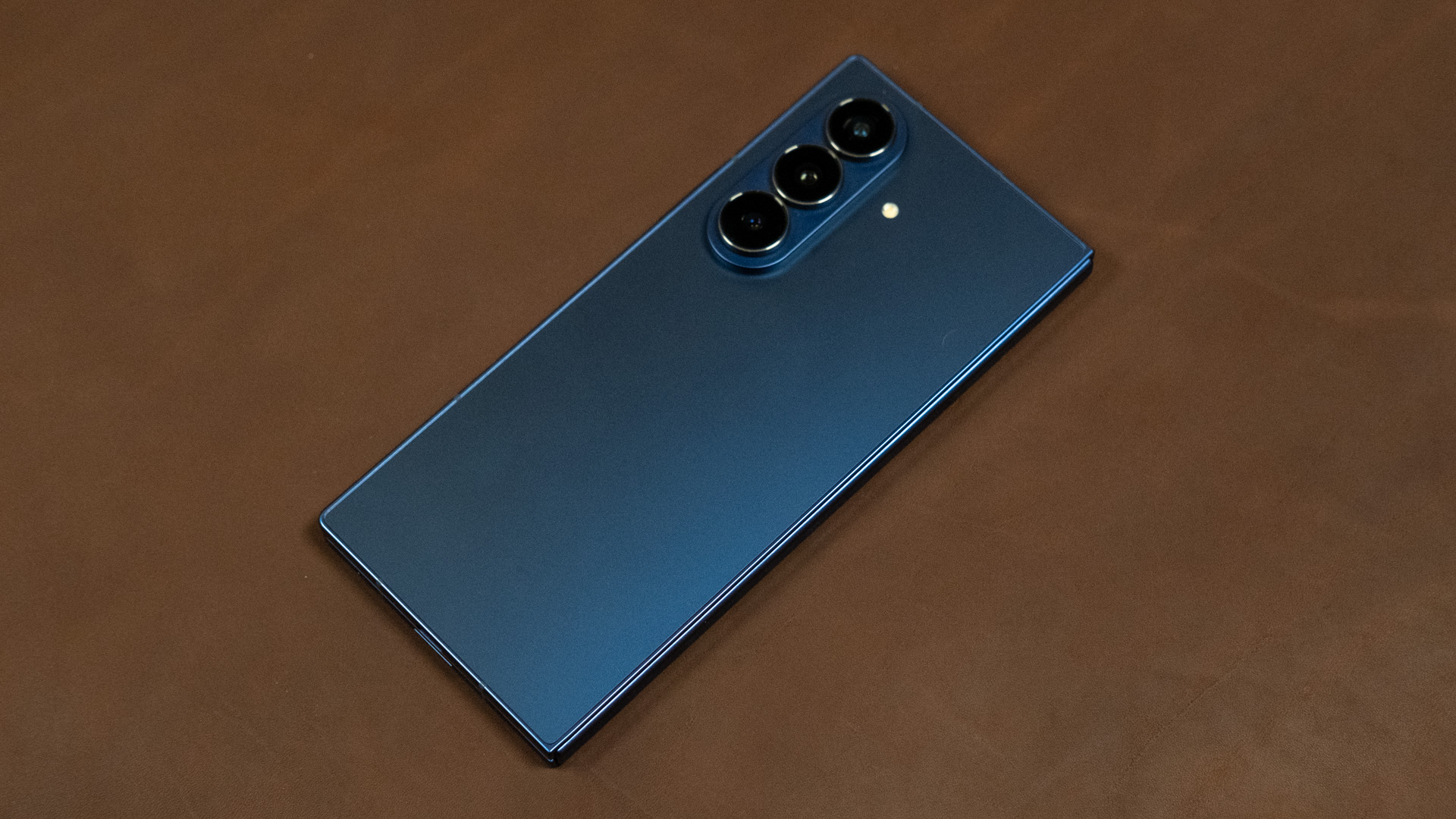
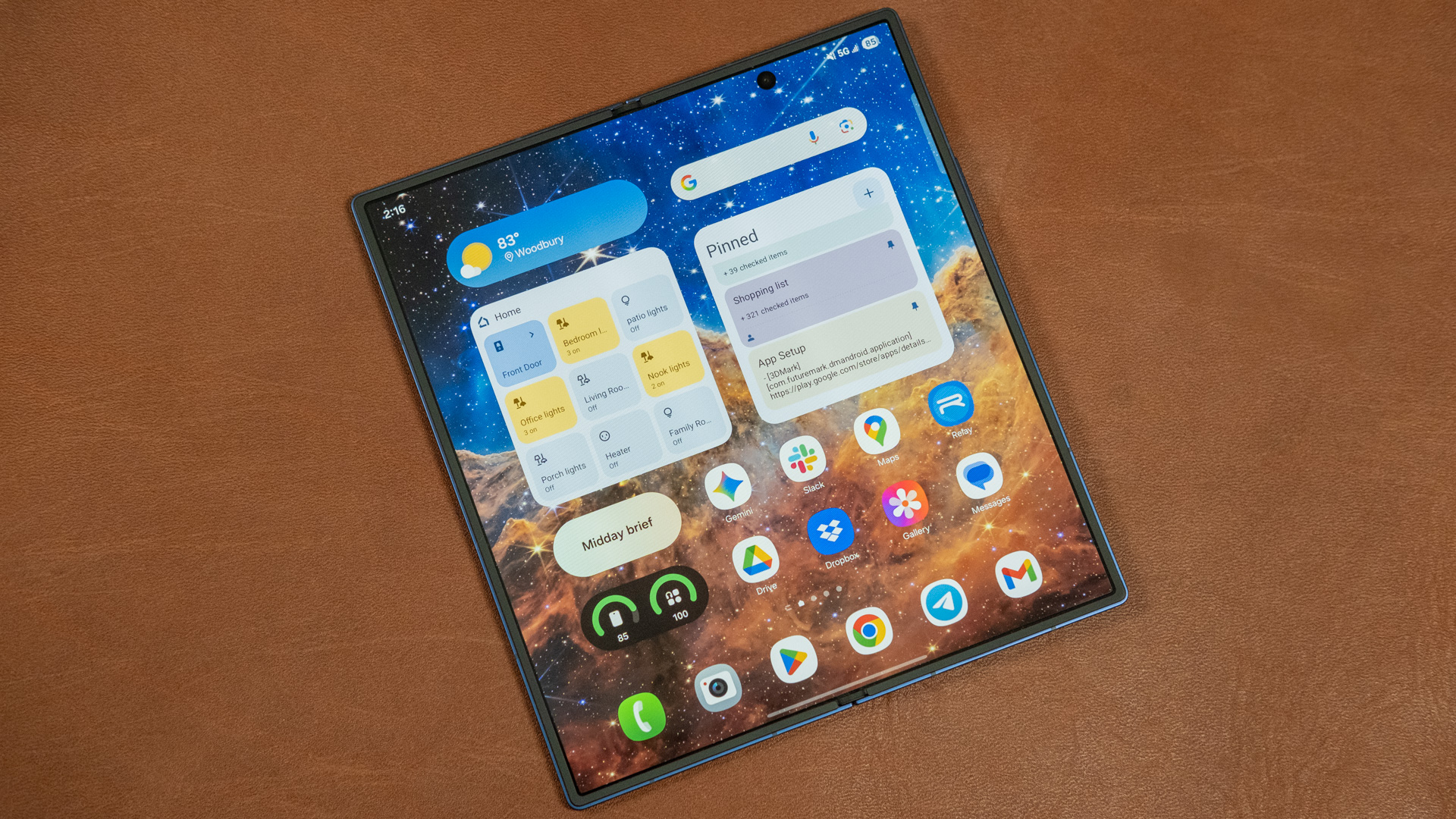
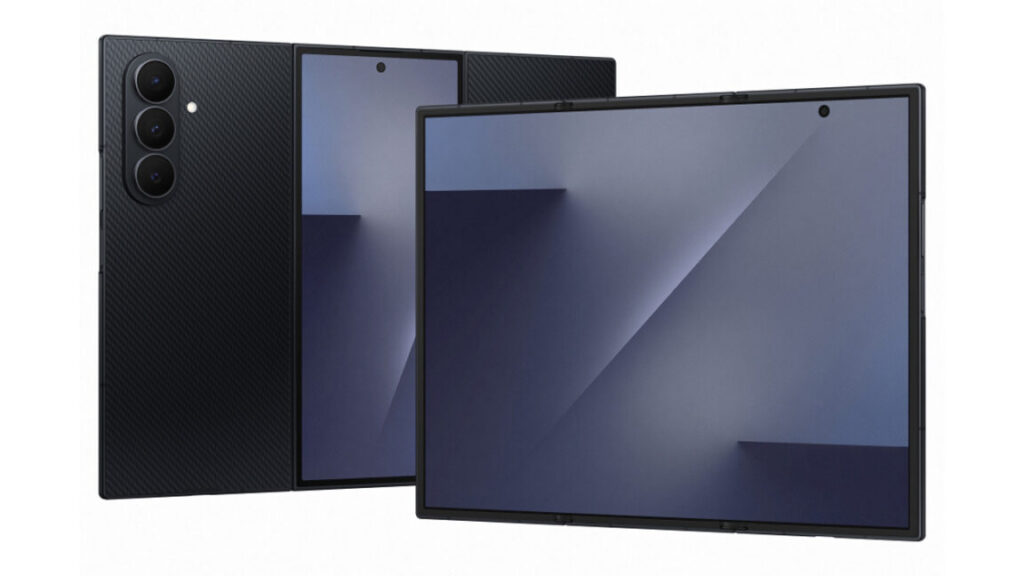
Samsung has a new foldable smartphone, and it’s not just another Z Flip or Z Fold. The Galaxy Z TriFold has three articulating sections that house a massive 10-inch tablet-style screen, along with a traditional smartphone screen on the outside. The lavish new smartphone is launching this month in South Korea with a hefty price tag, and it will eventually make its way to the US in early 2026.

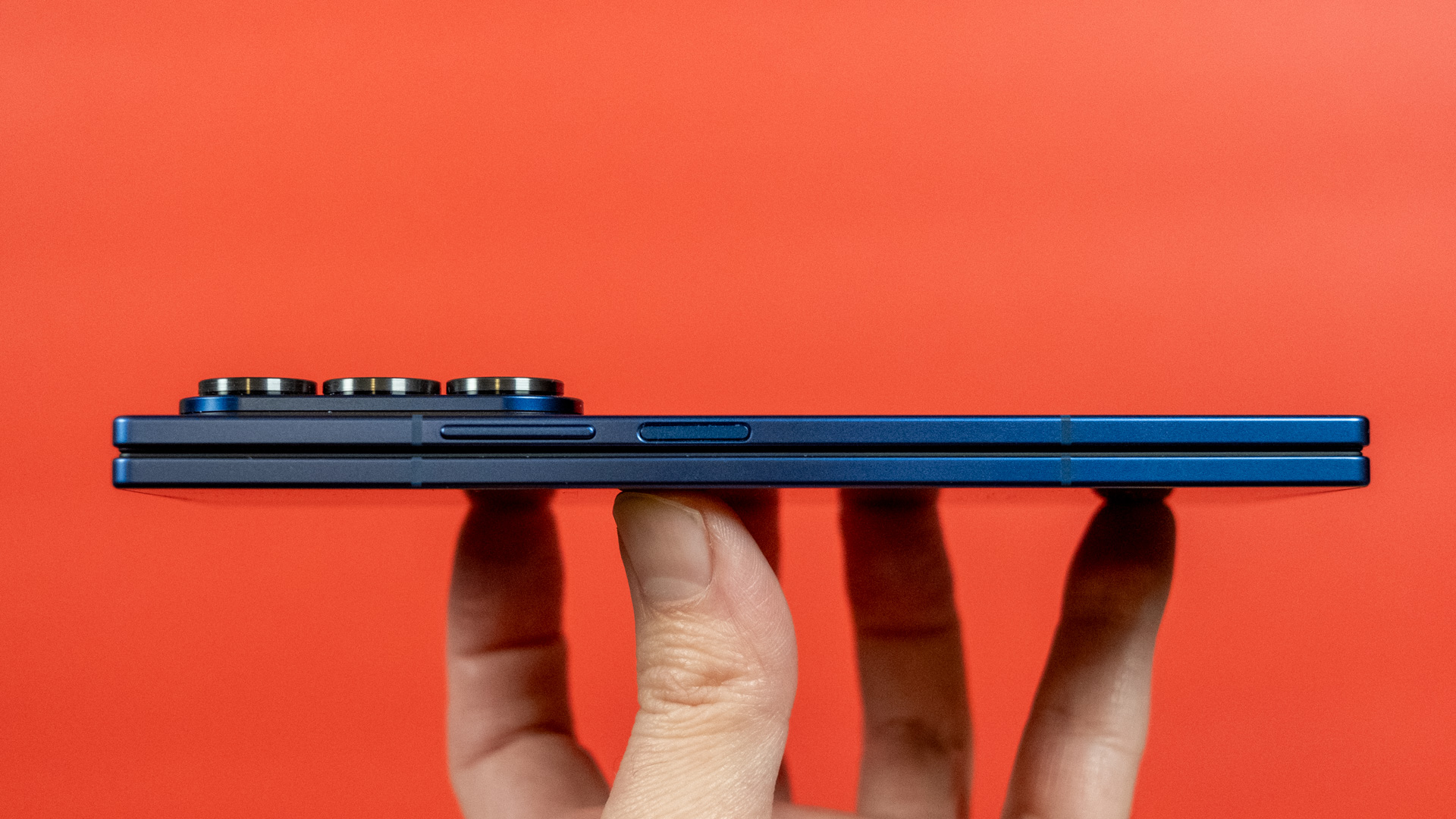
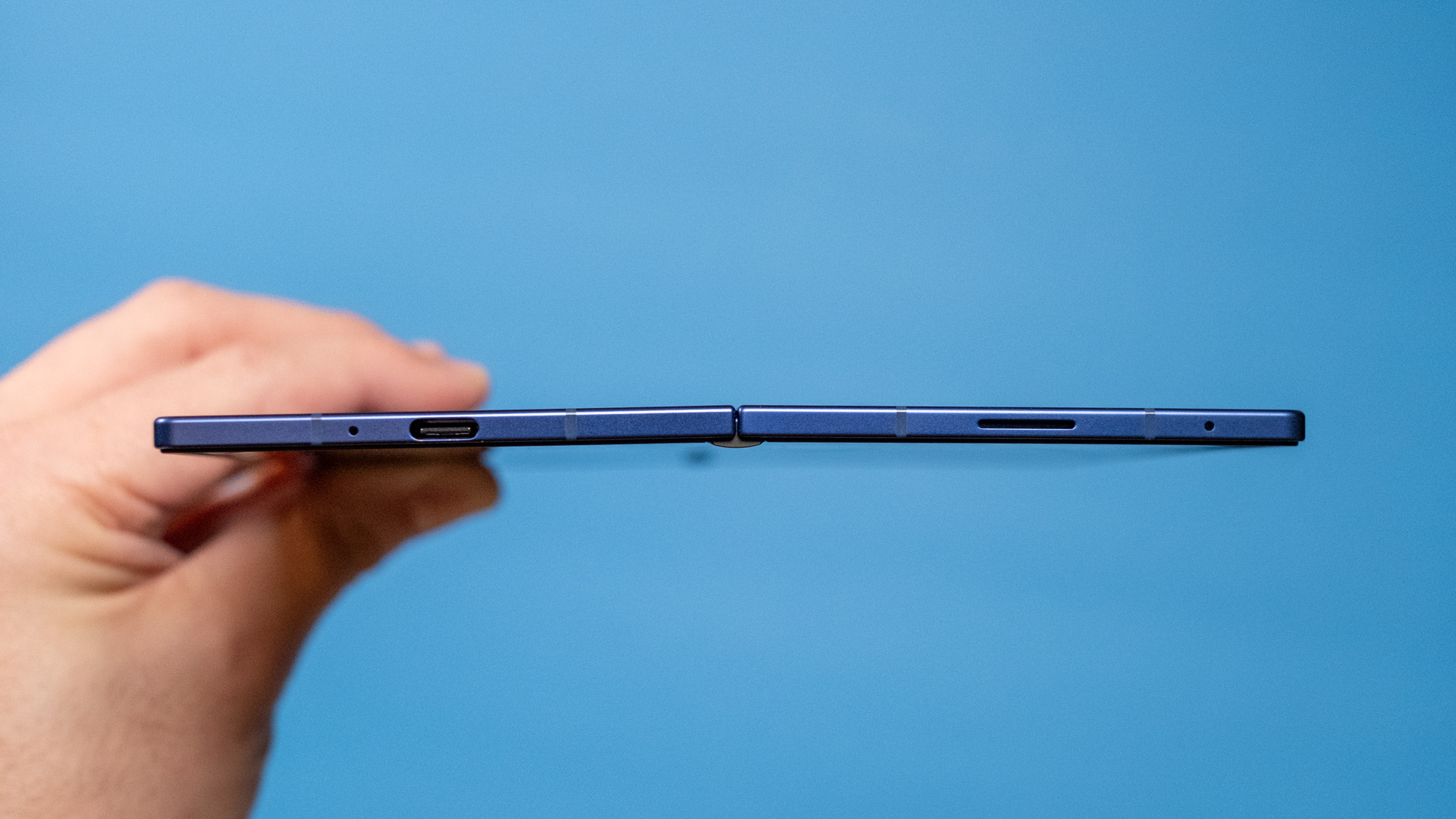
Samsung says it refined its Armor FlexHinge design for the TriFold. The device’s two hinges are slightly different sizes because the phone’s three panels have distinct shapes. The center panel is the thickest at 4.2 mm, and the other two are fractions of a millimeter thinner. The phone has apparently been designed to account for the varying sizes and weights, allowing the frame to fold up tight in a pocketable form factor.

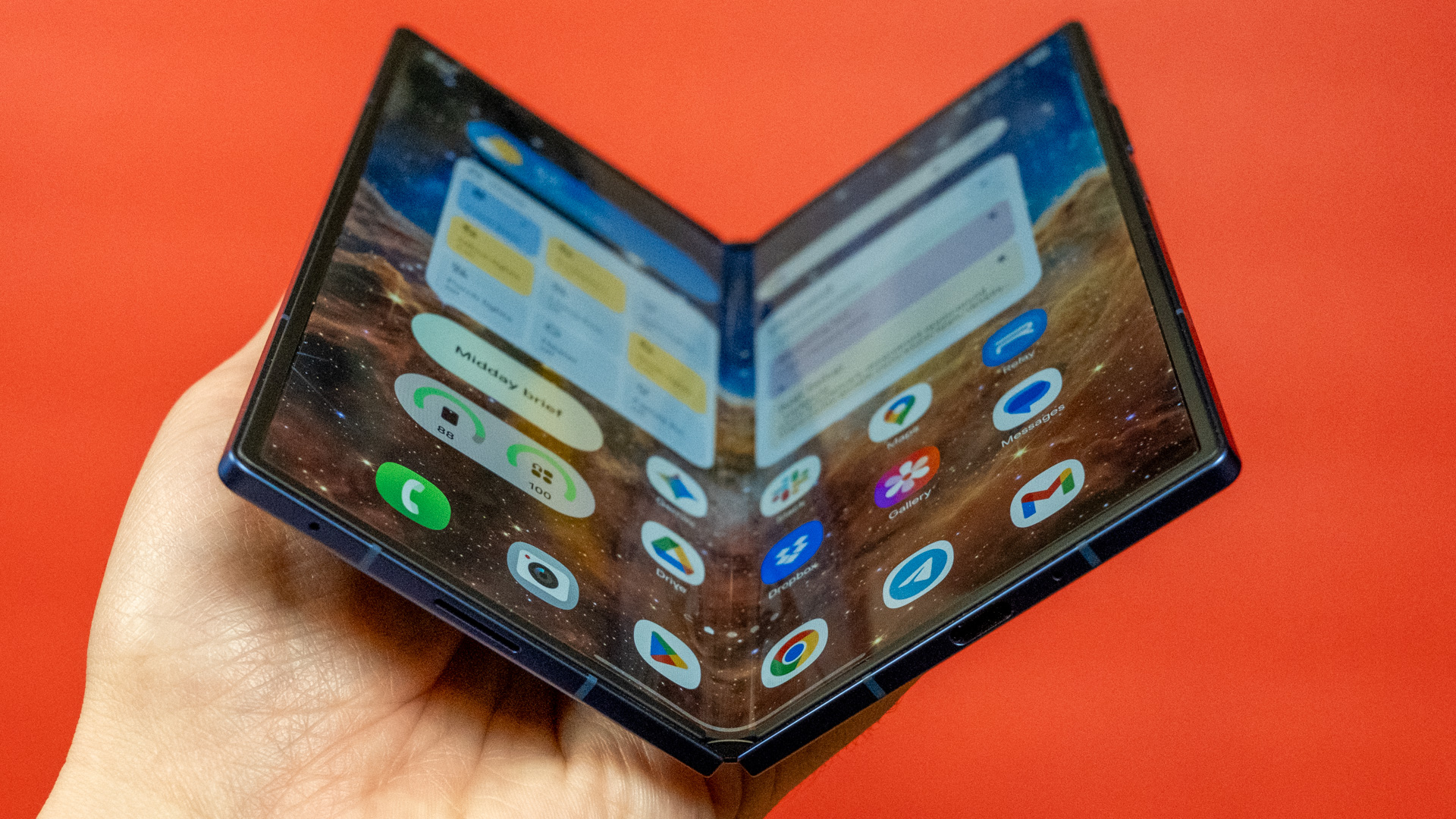
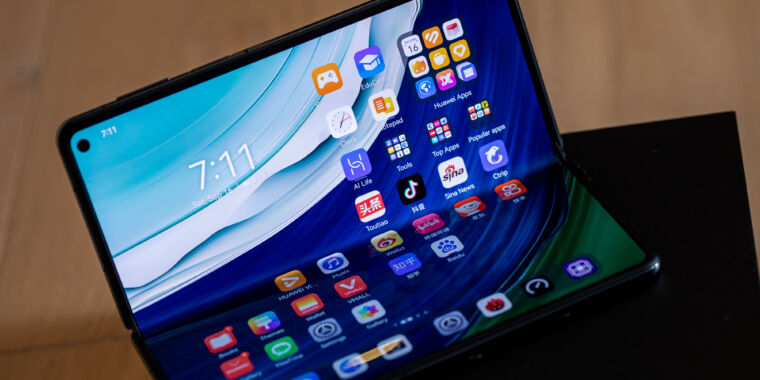
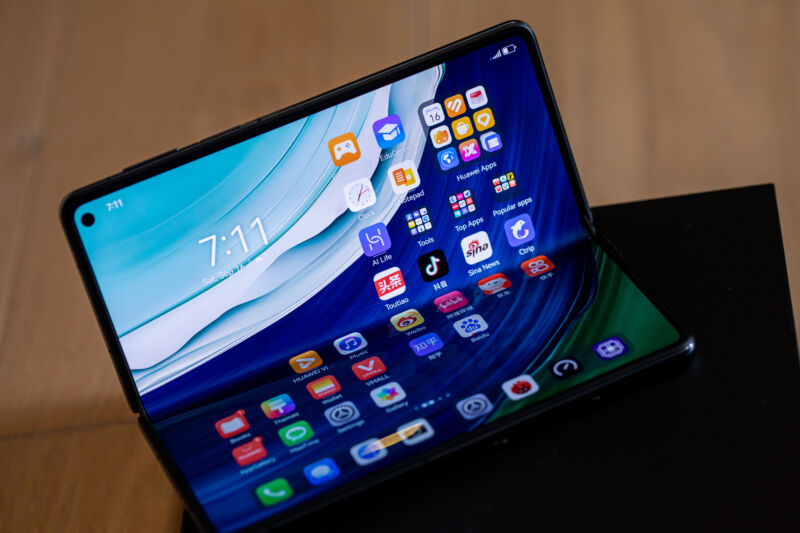
Huawei’s impressive Mate XT tri-fold phones have been making the rounds online, but they’re not available in Western markets. Samsung’s new foldable looks similar at a glance, but the way the three panels fit together is different. The Mate XT folds in a Z-shaped configuration, using part of the main screen as the cover display. On Samsung’s phone, the left and right segments fold inward behind the separate cover screen. Samsung claims it has tested the design extensively to verify that the hinges will hold up to daily use for years.

Precision Engineering in Every Fold | Galaxy Z TriFold

While this does push the definition of “pocketable” for some people, the Galaxy Z TriFold is a tablet that technically fits in your pocket. When folded, it measures 12.9 mm thick, which is much more unwieldy than the Galaxy Z Fold 7‘s 8.9 mm profile. However, the TriFold is only a little thicker than Samsung’s older tablet-style foldables like the Galaxy Z Fold 6. The 1080p cover screen measures 6.5 inches, which is also quite similar to the Z Fold 7. It is very, very heavy for a phone, though, tipping the scales at 309 g.

Samsung reveals Galaxy Z TriFold with 10-inch foldable screen, astronomical price Read More »

google-pixel-10-pro-fold-review:-the-ultimate-google-phone

Google Pixel 10 Pro Fold review: The ultimate Google phone


Google delivers another phone that is slightly better than its predecessor—is that enough?

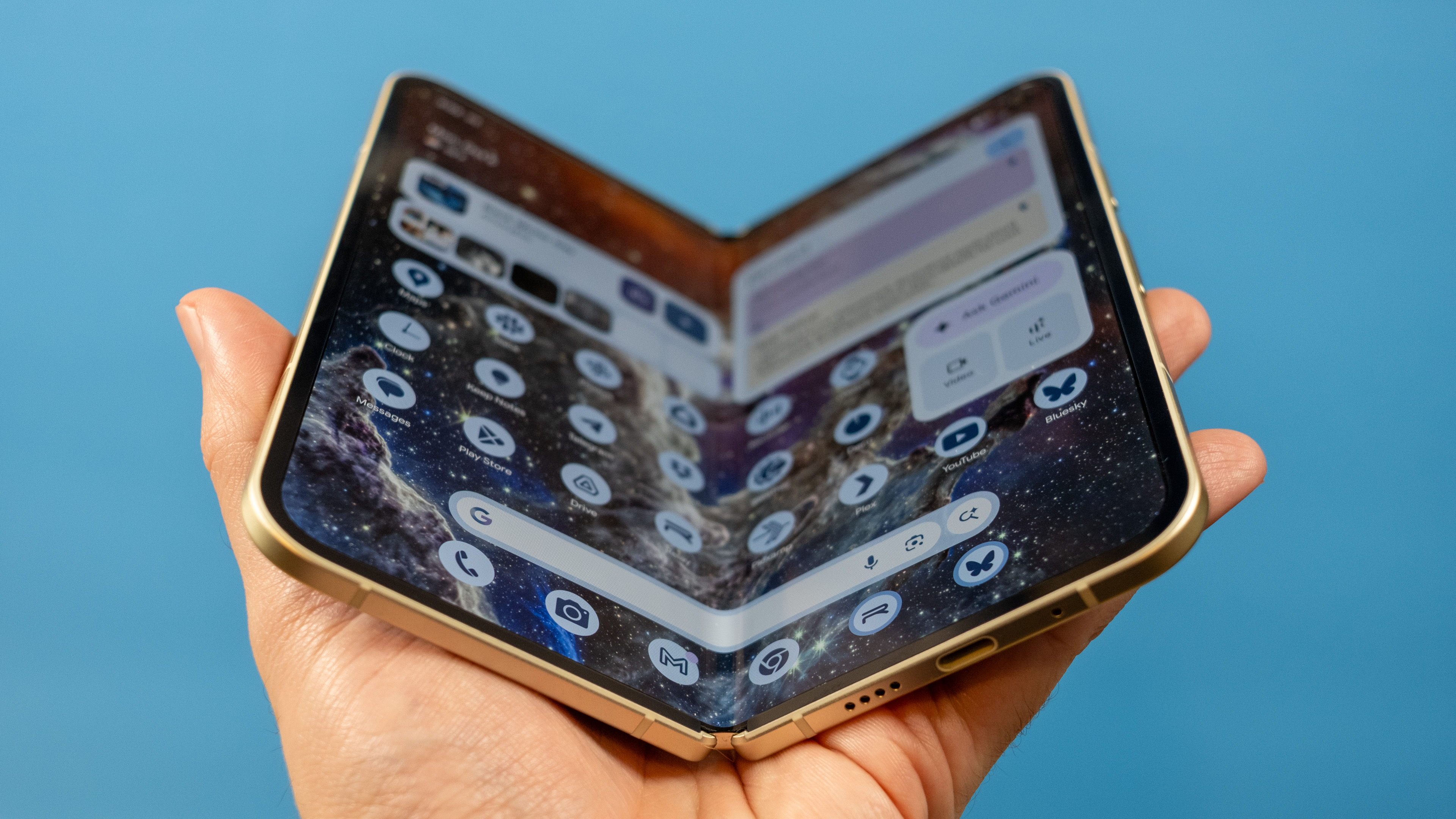
Pixel 10 Pro Fold flexed

The Pixel 10 Pro Fold is a sleek piece of hardware. Credit: Ryan Whitwam

The Pixel 10 Pro Fold is a sleek piece of hardware. Credit: Ryan Whitwam

When the first foldable phones came along, they seemed like a cool evolution of the traditional smartphone form factor and, if they got smaller and cheaper, like something people might actually want. After more than five years of foldable phones, we can probably give up on the latter. Google’s new Pixel 10 Pro Fold retains the $1,800 price tag of last year’s model, and while it’s improved in several key ways, spending almost two grand on any phone remains hard to justify.

For those whose phones are a primary computing device or who simply love gadgets, the Pixel 10 Pro Fold is still appealing. It offers the same refined Android experience as the rest of the Pixel 10 lineup, with much more screen real estate on which to enjoy it. Google also improved the hinge for better durability, shaved off some bezel, and boosted both charging speed and battery capacity. However, the form factor hasn’t taken the same quantum leap as Samsung’s latest foldable.

An iterative (but good) design

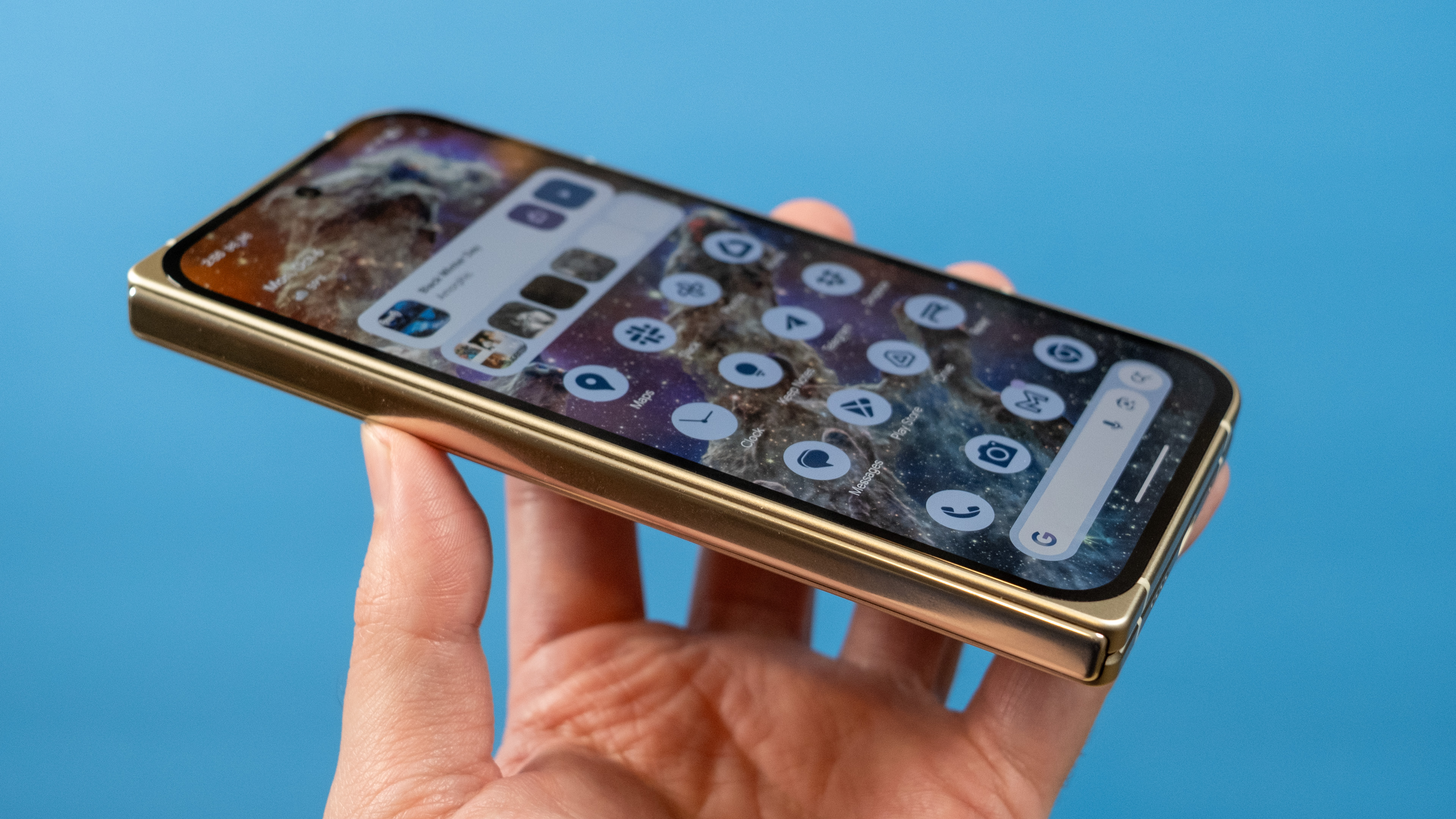
The Pixel 10 Pro Fold doesn’t reinvent the wheel—it looks and feels almost exactly like last year’s foldable, with a few minor tweaks centered around a new “gearless” hinge. Dropping the internal gears allegedly helps make the mechanism twice as durable. Google claims the Pixel 10 Pro Fold’s hinge will last for more than 10 years of folding and unfolding.

Specs at a glance: Google Pixel 10 series
Pixel 10 ($799) Pixel 10 Pro ($999) Pixel 10 Pro XL ($1,199) Pixel 10 Pro Fold ($1,799)
SoC Google Tensor G5  Google Tensor G5  Google Tensor G5  Google Tensor G5
Memory 12GB 16GB 16GB 16GB
Storage 128GB / 256GB 128GB / 256GB / 512GB 128GB / 256GB / 512GB / 1TB 256GB / 512GB / 1TB
Display 6.3-inch 1080×2424 OLED, 60-120 Hz, 3,000 nits 6.3-inch 1280×2856 LTPO OLED, 1-120 Hz, 3,300 nits 6.8-inch 1344×2992 LTPO OLED, 1-120 Hz, 3,300 nits External: 6.4-inch 1080×2364 OLED, 60-120 Hz, 3,000 nits; Internal: 8-inch 2076×2152 LTPO OLED, 1-120 Hz, 3,000 nits
Cameras 48 MP wide with Macro

Focus, F/1.7, 1/2-inch sensor; 13 MP ultrawide, f/2.2, 1/3.1-inch sensor;

10.8 MP 5x telephoto, f/3.1, 1/3.2-inch sensor; 10.5 MP selfie, f/2.2
50 MP wide with Macro

Focus, F/1.68, 1/1.3-inch sensor; 48 MP ultrawide, f/1.7, 1/2.55-inch sensor;

48 MP 5x telephoto, f/2.8, 1/2.55-inch sensor; 42 MP selfie, f/2.2
50 MP wide with Macro

Focus, F/1.68, 1/1.3-inch sensor; 48 MP ultrawide, f/1.7, 1/2.55-inch sensor;

48 MP 5x telephoto, f/2.8, 1/2.55-inch sensor; 42 MP selfie, f/2.2
48 MP wide, F/1.7, 1/2-inch sensor; 10.5 MP ultrawide with Macro Focus, f/2.2, 1/3.4-inch sensor;

10.8 MP 5x telephoto, f/3.1, 1/3.2-inch sensor; 10.5 MP selfie, f/2.2 (outer and inner)
Software Android 16 Android 16 Android 16 Android 16
Battery 4,970 mAh, up to 30 W wired charging, 15 W wireless charging (Pixelsnap) 4,870 mAh, up to 30 W wired charging, 15 W wireless charging (Pixelsnap) 5,200 mAh, up to 45 W wired charging, 25 W wireless charging (Pixelsnap) 5,015 mAh, up to 30 W wired charging, 15 W wireless charging (Pixelsnap)
Connectivity Wi-Fi 6e, NFC, Bluetooth 6.0, sub-6 GHz and mmWave 5G, USB-C 3.2 Wi-Fi 7, NFC, Bluetooth 6.0, sub-6 GHz and mmWave 5G, UWB, USB-C 3.2 Wi-Fi 7, NFC, Bluetooth 6.0, sub-6 GHz and mmWave 5G, UWB, USB-C 3.2 Wi-Fi 7, NFC, Bluetooth 6.0, sub-6 GHz and mmWave 5G, UWB, USB-C 3.2
Measurements 152.8 height×72.0 width×8.6 depth (mm), 204 g 152.8 height×72.0 width×8.6 depth (mm), 207 g 162.8 height×76.6 width×8.5 depth (mm), 232 g Folded: 154.9 height×76.2 width×10.1 depth (mm); Unfolded: 154.9 height×149.8 width×5.1 depth (mm); 258 g
Colors Indigo

Frost

Lemongrass

Obsidian
Moonstone

Jade

Porcelain

Obsidian
Moonstone

Jade

Porcelain

Obsidian
Moonstone

Jade

While the new phone is technically a fraction of a millimeter thicker, it’s narrowed by a similar amount. You likely won’t notice this, nor will the 1g in additional mass register. You may, however, spot the slimmer bezels and hinge. And that means cases for the 2024 foldable are just a fraction of a millimeter from fitting on the Pixel 10 Pro Fold. It does fit better in your hand, though.

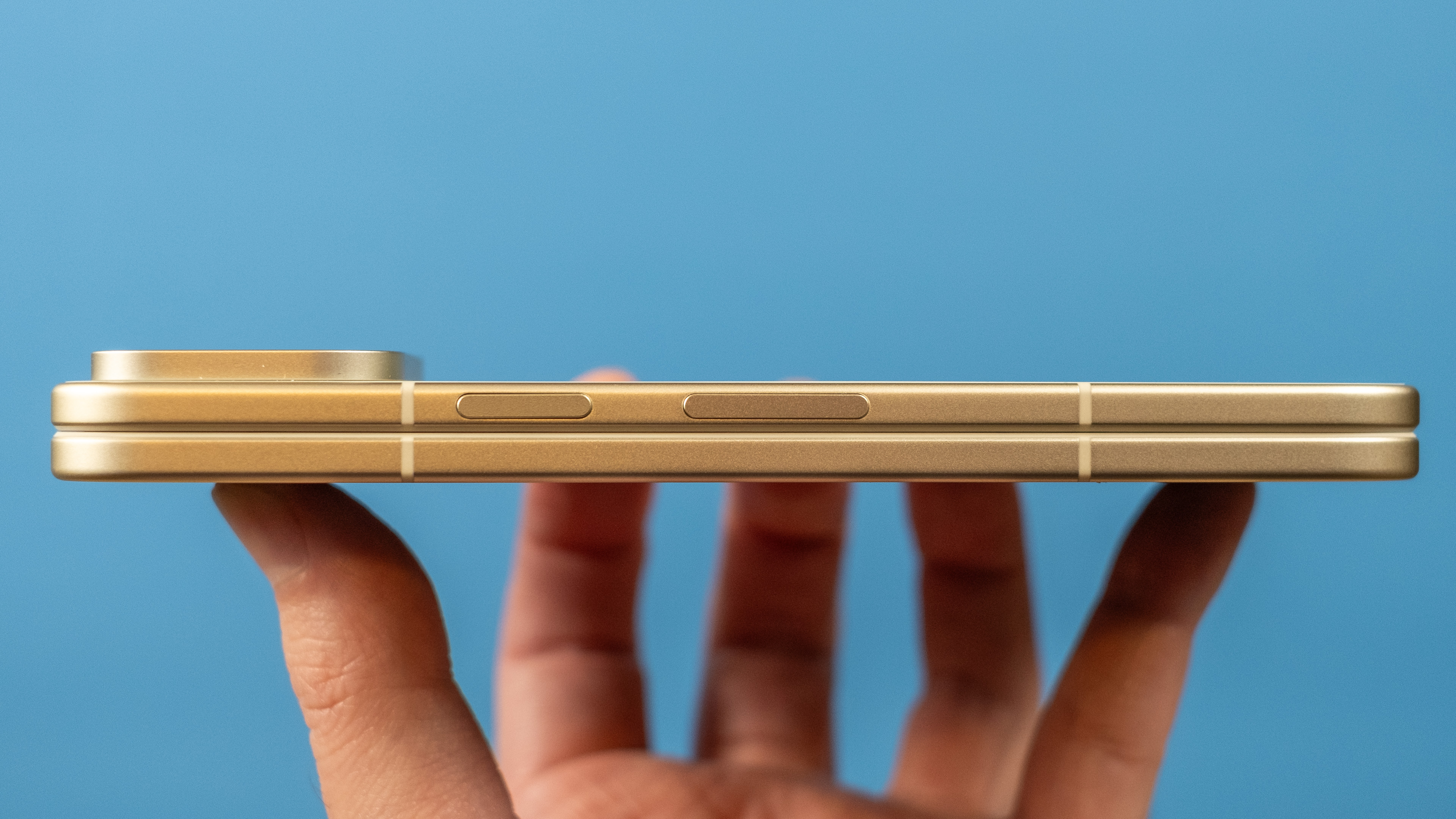
Pixel 10 Pro Fold side

The Pixel is on the thick side for 2025, but this was record-setting thinness last year.

The Pixel is on the thick side for 2025, but this was record-setting thinness last year.

Thanks to the gearless hinge, the Pixel 10 Pro Fold the first foldable with full IP68 certification for water and dust resistance. The hinge feels extremely smooth and sturdy, but it’s a bit stiffer than we’ve seen on most foldables. This might change over time, but it’s a little harder to open and close out of the box. Samsung’s Z Fold 7 is thinner and easier to fold, but the hinge doesn’t open to a full 180 degrees like the Pixel does.

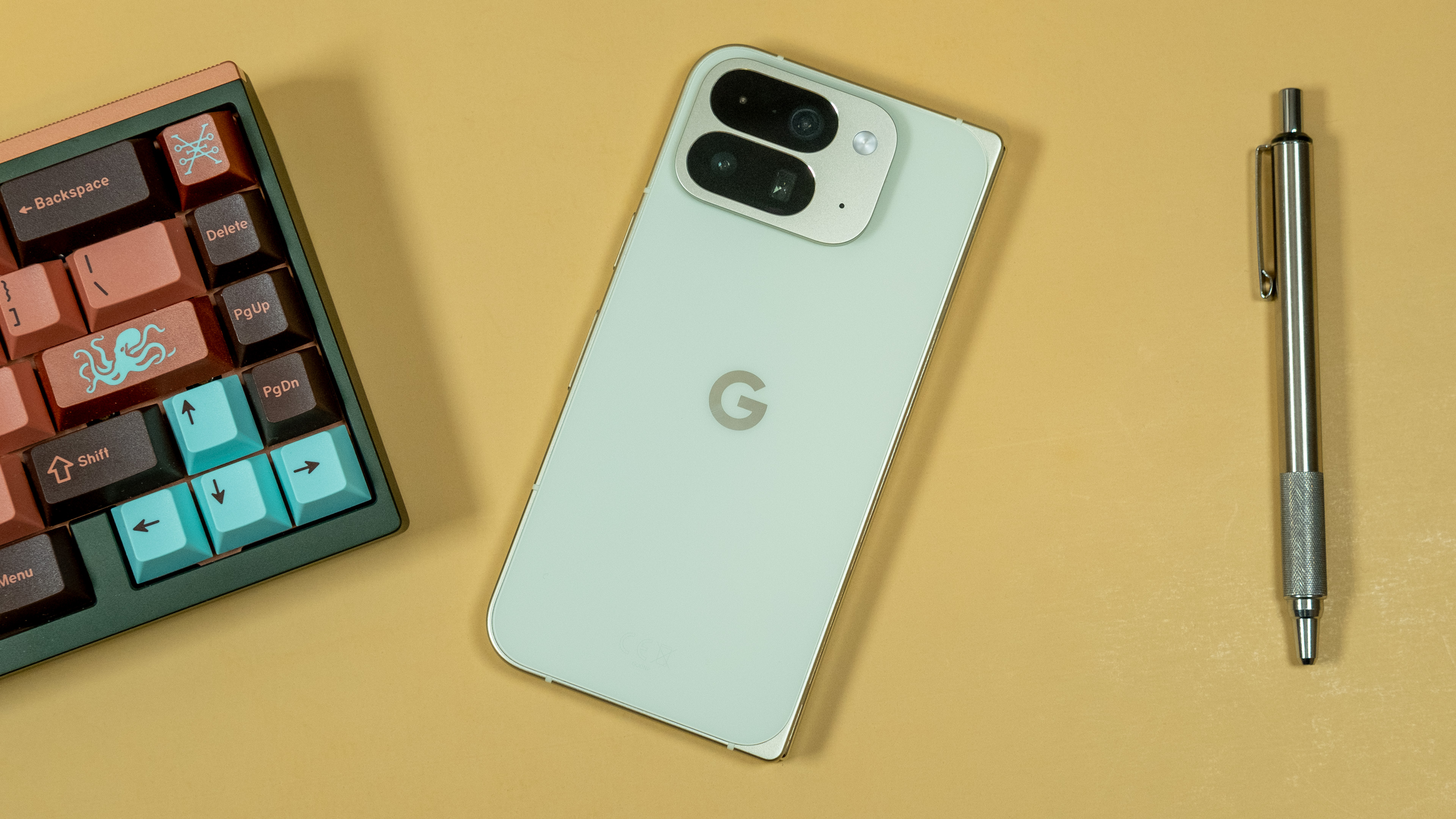
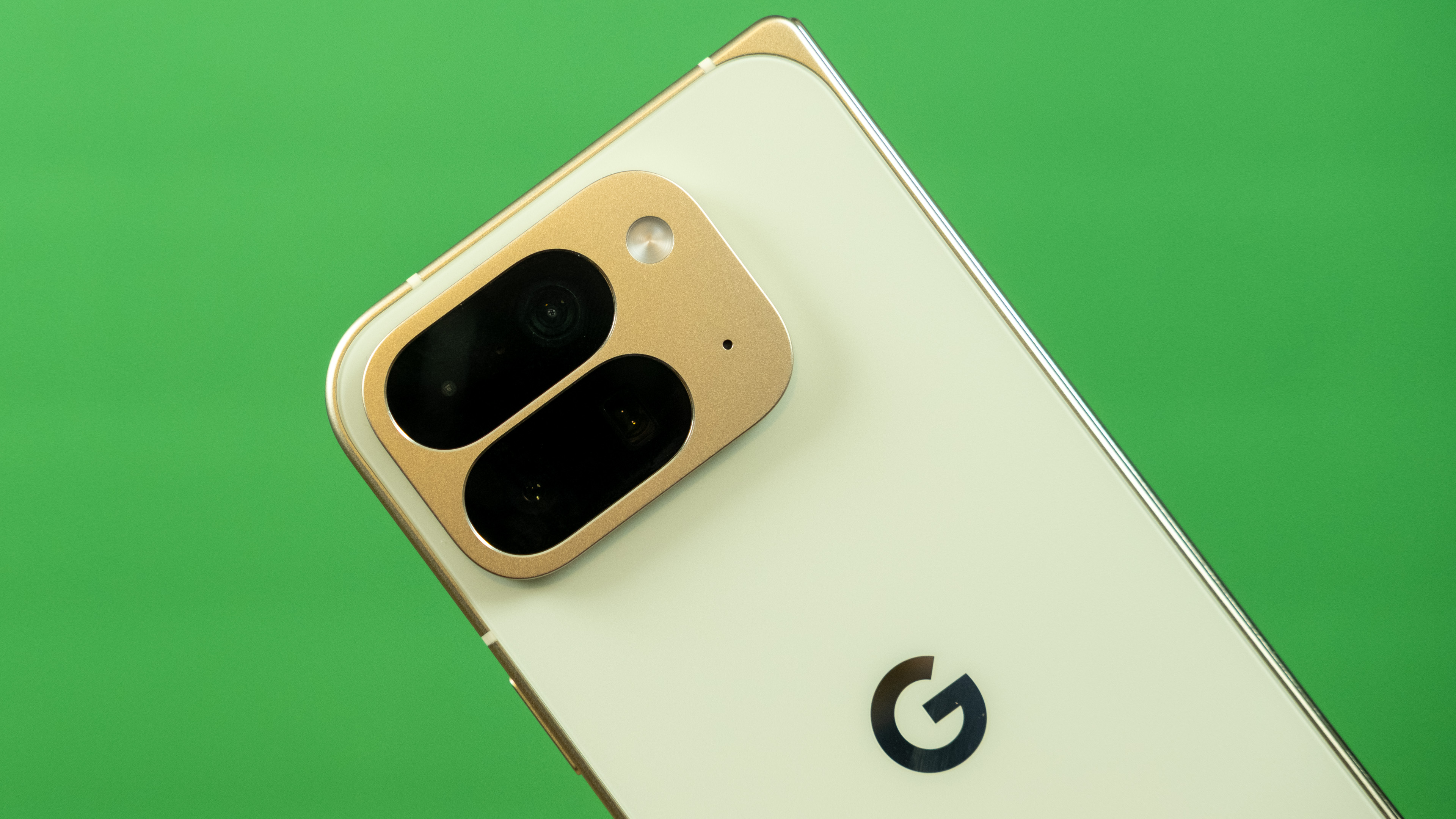
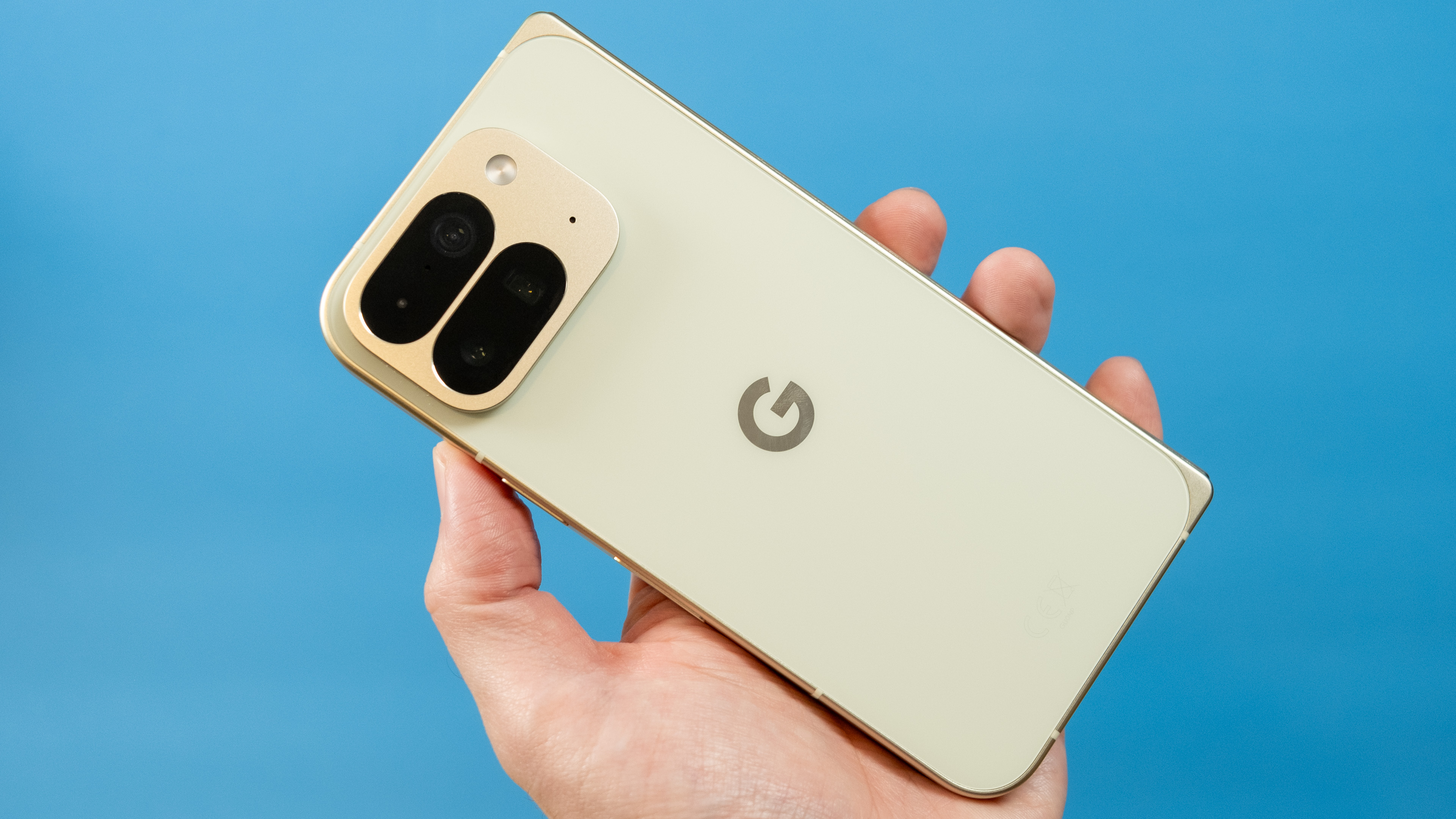
The new foldable also retains the camera module design of last year’s phone—it’s off-center on the back panel, a break from Google’s camera bar on other Pixels. The Pixel 10 Pro Fold, therefore, doesn’t lie flat on tables and will rock back and forth like most other phones. However, it does have the Qi2 magnets like in the cheaper phones. There are various Maglock kickstands and mounting rings that will attach to the back of the phone if you want to prop it up on a surface.

Pixel 10 Pro Fold and Z Fold 7

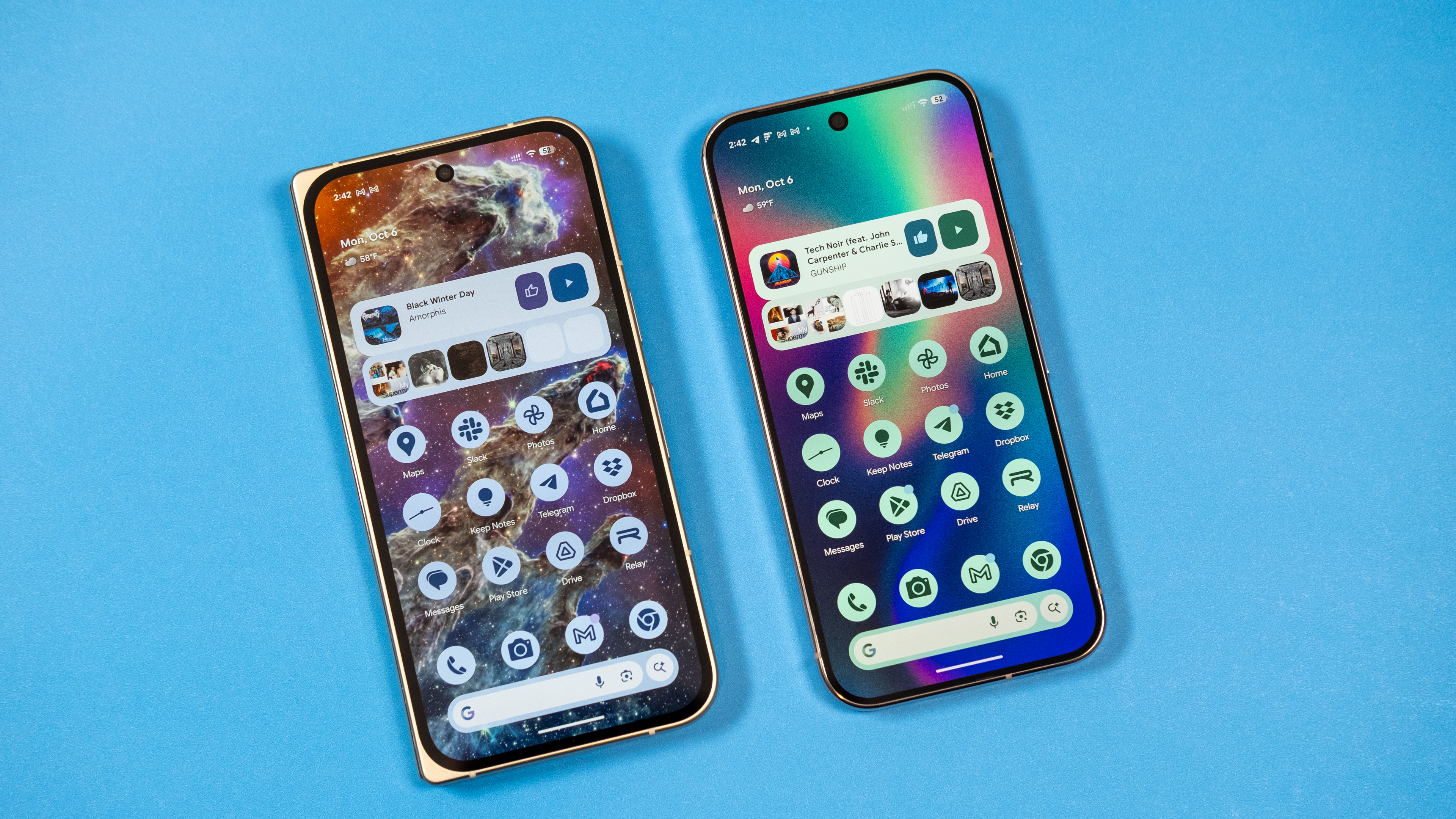
The Pixel 10 Pro Fold (left) and the Galaxy Z Fold 7 (right) both have 8-inch displays, but the Pixel is curvier.

Credit: Ryan Whitwam

The Pixel 10 Pro Fold (left) and the Galaxy Z Fold 7 (right) both have 8-inch displays, but the Pixel is curvier. Credit: Ryan Whitwam

The power and volume buttons are on the right edge in the same location as last year. The buttons are stable and tactile when pressed, and there’s a fingerprint sensor in the power button. It’s as fast and accurate as any capacitive sensor on a phone today. The aluminum frame and the buttons have the same matte finish, which differs from the glossy look of the other Pro Pixels. The more grippy matte texture is preferable for a phone you need to fold and unfold throughout the day.

Thanks to the modestly slimmer bezels, Google equipped the phone with a 6.4-inch external screen, slightly larger than the 6.3-inch panel on last year’s Fold. The 120 Hz OLED has a respectable 1080p resolution, and the brightness peaks around 3,000 nits, making it readable in bright outdoor light.

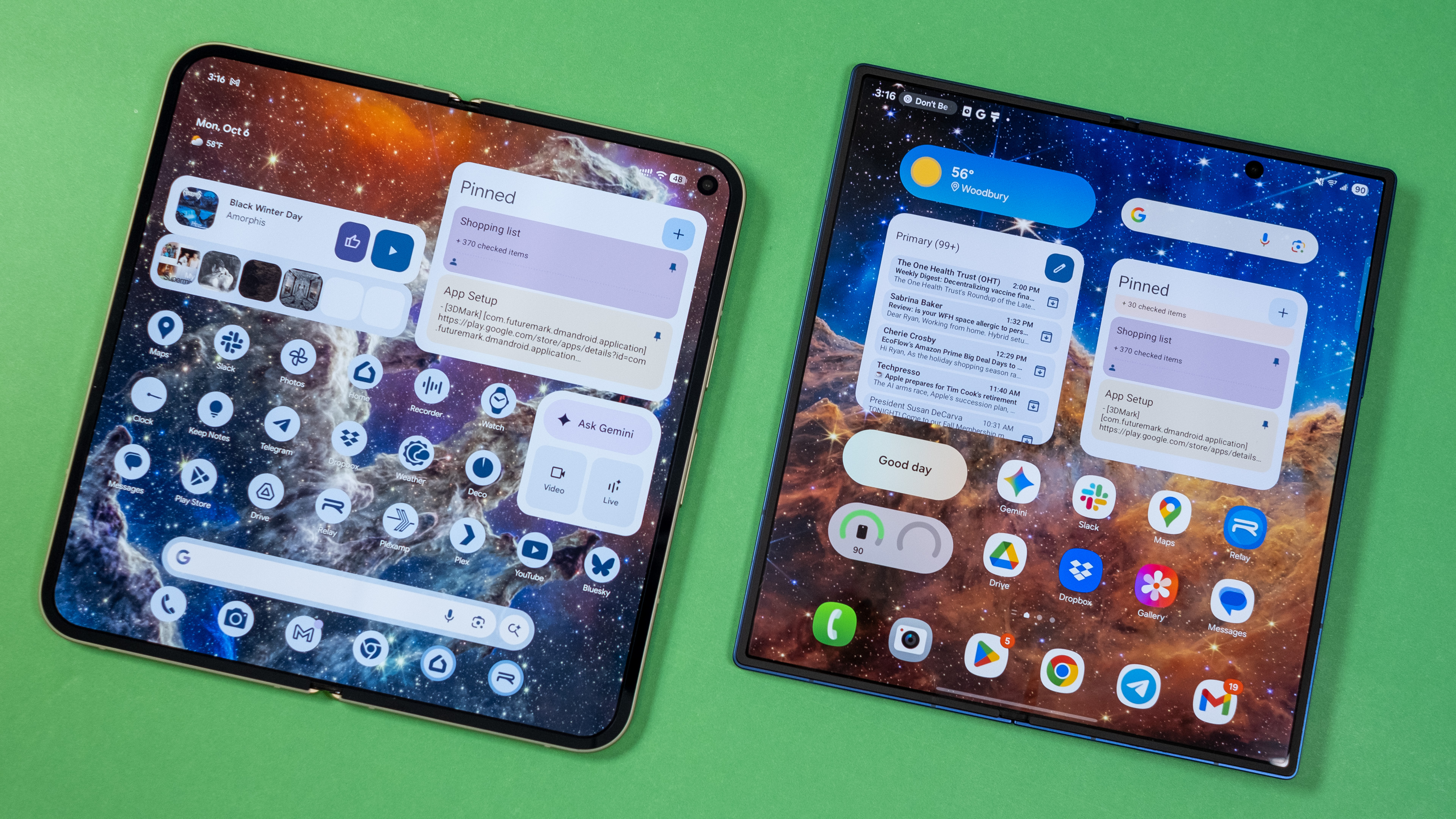
Pixel 10 Pro Fold and Pixel 9 Pro Fold

The Pixel 10 Pro Fold (left) has a more compact hinge and slimmer bezels compared to the Pixel 9 Pro Fold (right).

The Pixel 10 Pro Fold (left) has a more compact hinge and slimmer bezels compared to the Pixel 9 Pro Fold (right).

The Pixel 10 Pro Fold has a big 8-inch flexible OLED inside, clocking in at 2076×2152 pixels and 120Hz. It gets similarly bright, but the plastic layer is more reflective than the Gorilla Glass Victus 2 on the cover screen. While the foldable screen is legible, it’s not as pleasant to use outside as high-brightness glass screens.

Like all foldable screens, it’s possible to damage the internal OLED if you’re not careful. On the other hand, the flexible OLED is well-protected when the phone is closed—there’s no gap between the halves, and the magnets hold them together securely. There’s a crease visible in the middle of the screen, but it’s slightly improved from last year’s phone. You can see it well from some angles, but you get used to it.

Pixel 10 Pro Fold keyboard glamor

The Jade colorway looks great.

Credit: Ryan Whitwam

The Jade colorway looks great. Credit: Ryan Whitwam

While the flat Pixel 10 phones have dropped the physical SIM card slot, the Pixel 10 Pro Fold still has one. It has moved to the top this year, but it seems like only a matter of time before Google removes the slot in foldables, too. For the time being, you can move a physical SIM card to the Fold, transfer to eSIM, or use a combination of physical and electronic SIMs.

Google’s take on big Androids

Google’s version of Android is pretty refined these days. The Pixel 10 Pro Fold uses the same AI-heavy build of Android 16 as the flat Pixels. That means you can expect old favorites like Pixel Screenshots, Call Screen, and Magic Compose, along with new arrivals like Magic Cue and Pixel Journal. One thing you won’t see right now is the largely useless Daily Brief, which was pulled after its launch on the Pixel 10 so it could be improved.

Google’s expanded use of Material 3 Expressive theming is also a delight. The Pixel OS has a consistent, clean look you don’t often see on Android phones. Google bundles almost every app it makes on this phone, but you won’t see any sponsored apps, junk games, or other third-party software cluttering up the experience. In short, if you like the vibe of the Pixel OS on other Pixel 10 phones, you’ll like it on the Pixel 10 Pro Fold. We’ve noted a few minor UI glitches in the launch software, but there are no show-stopping bugs.

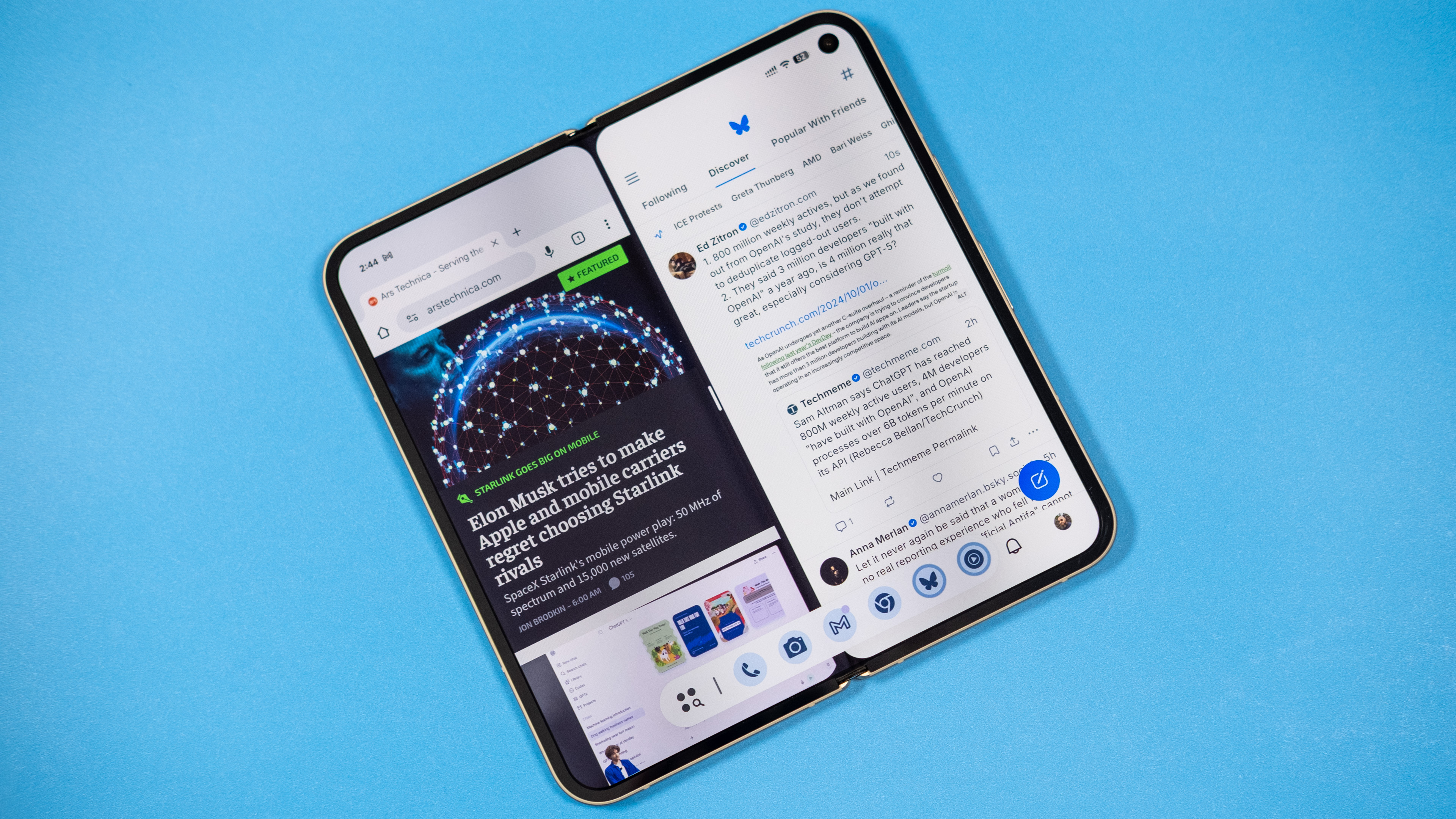
Pixel 10 Pro Fold split-screen

Multitasking on foldables is a snap.

Credit: Ryan Whitwam

Multitasking on foldables is a snap. Credit: Ryan Whitwam

The software on this phone goes beyond the standard Pixel features to take advantage of the folding screen. There’s a floating taskbar that can make swapping apps and multitasking easier, and you can pin it on the screen for even more efficiency. The Pixel 10 Pro Fold also supports saving app pairs to launch both at once in split-screen.

Google’s multi-window system on the Fold isn’t as robust as what you get with Samsung, though. For example, split-screen apps open in portrait mode on the Pixel, and if you want them in landscape, you have to physically rotate the phone. On Samsung foldables, you can move app windows around and change the orientation however you like—there’s even support for floating app windows and up to three windowed apps. Google reserves floating windows for tablets, none of which it has released since the Pixel Tablet in 2023. It would be nice to see a bit more multitasking power to make the most of the Fold’s big internal display.

As with all of Google’s Pixels, the new foldable gets seven years of update support, all the way through 2032. You’ll probably need at least one battery swap to make it that long, but you might be more inclined to hold onto an $1,800 phone for seven years. Samsung also offers seven years of support, but its updates are slower and don’t usually include new features after the first year. Google rolls out new updates promptly every month, and updated features are delivered in regular Pixel Drops.

Almost the best cameras

Google may have fixed some of the drawbacks of foldables, but you’ll get better photos with flat Pixels. That said, the Pixel 10 Pro Fold is no slouch—it has a camera setup very similar to the base model Pixel 10 (and last year’s foldable), which is still quite good in the grand scheme of mobile photography.

Pixel 10 Pro Fold cameras

The cameras are unchanged from last year.

Credit: Ryan Whitwam

The cameras are unchanged from last year. Credit: Ryan Whitwam

The Pixel 10 Pro Fold sports a 48 MP primary sensor, a 10.5 MP ultrawide, and a 10.8 MP 5x telephoto. There are 10 MP selfie cameras peeking through the front and internal displays as well.

Like the other Pixels, this phone is great for quick snapshots. Google’s image processing does an admirable job of sharpening details and has extraordinary dynamic range. The phone also manages to keep exposure times short to help capture movement. You don’t have to agonize over exactly how to frame a shot or wait for the right moment to hit the shutter. The Pixel 10 Pro and Pro XL do all of this slightly better, but provided you don’t zoom too much, the Pixel 10 Pro Fold photos are similarly excellent.

Medium indoor light. Ryan Whitwam

The primary sensor does better than most in dim conditions, but this is where you’ll notice limitations compared to the flat Pro phones. The Fold’s smaller image sensor can’t collect as much light, resulting in longer exposures. You’ll notice this most in Night Sight shots.

The telephoto sensor is only 10.8 MP compared to 48 MP on the other Pro Pixels. So images won’t be as sharp if you zoom in, but the normal framing looks fine and gets you much closer to your subject. The phone does support up to 20x zoom, but going much beyond 5x begins to reveal the camera’s weakness, and even Google’s image processing can’t hide that. The ultrawide camera is good enough for landscapes and wide group shots, but don’t bother zooming in. It also has autofocus for macro shots.

The selfie cameras are acceptable, but you don’t have to use them. As a foldable, this phone allows you to use the main cameras to snap selfies with the external display as a viewfinder. The results are much better, but the phone is a bit awkward to hold in that orientation. Google also added a few more camera features that complement the form factor, including a split-screen camera roll similar to Samsung’s app and a new version of the Made You Look cover screen widgets.

The Pixel 10 Pro Fold can leverage generative AI in several imaging features, so it has the same C2PA labeling as the other Pixels. We’ve seen this “AI edited” tag appear most often on images from the flat Pixels that are zoomed beyond 20x, so you likely won’t end up with any of those on the Fold. However, features like Add Me and Best Take will get the AI labeling.

The Tensor tension

This probably won’t come as a surprise, but the Tensor G5 in the Pixel 10 Pro Fold performs identically to the Tensor in other Pixel 10 phones. It is marginally faster across the board than the Tensor G4, but this isn’t the huge leap people hoped for with Google’s first TSMC chip. While it’s fast enough to keep the phone chugging, benchmarks are not its forte.

Pixel 10 Pro Fold in hand

Pixel 10 Pro Fold hinge has been redesigned.

Credit: Ryan Whitwam

Pixel 10 Pro Fold hinge has been redesigned. Credit: Ryan Whitwam

Across all our usual benchmarks, the Tensor G5 shows small gains over last year’s Google chip, but it’s running far behind the latest from Qualcomm. We expect that gap to widen even further when Qualcomm updates its flagship Snapdragon line in a few months.

The Tensor G5 does remain a bit cooler under load than the Snapdragon 8 Elite, losing only about 20 percent to thermal throttling. So real-world gaming performance on the Pixel 10 Pro Fold is closer to Qualcomm-based devices than the benchmark numbers would lead you to believe. Some game engines behave strangely on the Tensor’s PowerVR GPU, though. If mobile gaming is a big part of your usage, a Samsung or OnePlus flagship might be more your speed.

Day-to-day performance with the Pixel 10 Pro Fold is solid. Google’s new foldable is quick to register taps and open apps, even though the Tensor G5 chip doesn’t offer the most raw speed. Even on Snapdragon-based phones like the Galaxy Z Fold 7, the UI occasionally hiccups or an animation gets jerky. That’s a rarer occurrence on the Pixel 10 Pro Fold.

One of the biggest spec bumps is the battery—it’s 365 mAh larger, at 5,015 mAh. This finally puts Google’s foldables in the same range as flat phones. Granted, you will use more power when the main display is unfurled, and you should not expect a substantial increase in battery life generally. The power-hungry Tensor and increased background AI processing appear to soak up most of the added capacity. The Pixel 10 Pro Fold should last all day, but there won’t be much leeway.

The Pixel 10 Pro Fold does bring a nice charging upgrade, boosting wired speeds from 21 W to 30 W with a USB-PD charger that supports PPS (as most now do). That’s enough for a 50 percent charge in about half an hour. Wireless charging is now twice as fast, thanks to the addition of Qi2 support. Any Qi2-certified charger can hit those speeds, including the Google Pixelsnap charger. But the Fold is limited to 15 W, whereas the Pixel 10 Pro XL gets 25 W over Qi2. It’s nice to see an upgrade here, but all of Google’s phones should charge faster than they do.

Big phone, big questions

The Pixel 10 Pro Fold is better than last year’s Google foldable, and that means there’s a lot to like. The new hinge and slimmer bezels make the third-gen foldable a bit easier to hold, and the displays are fantastic. The camera setup, while a step down from the other Pro Pixels, is still one of the best you can get on a phone. The addition of Qi2 charging is much appreciated, too. And while Google has overloaded the Pixels with AI features, more of them are useful compared to those on the likes of Samsung, Motorola, or OnePlus.

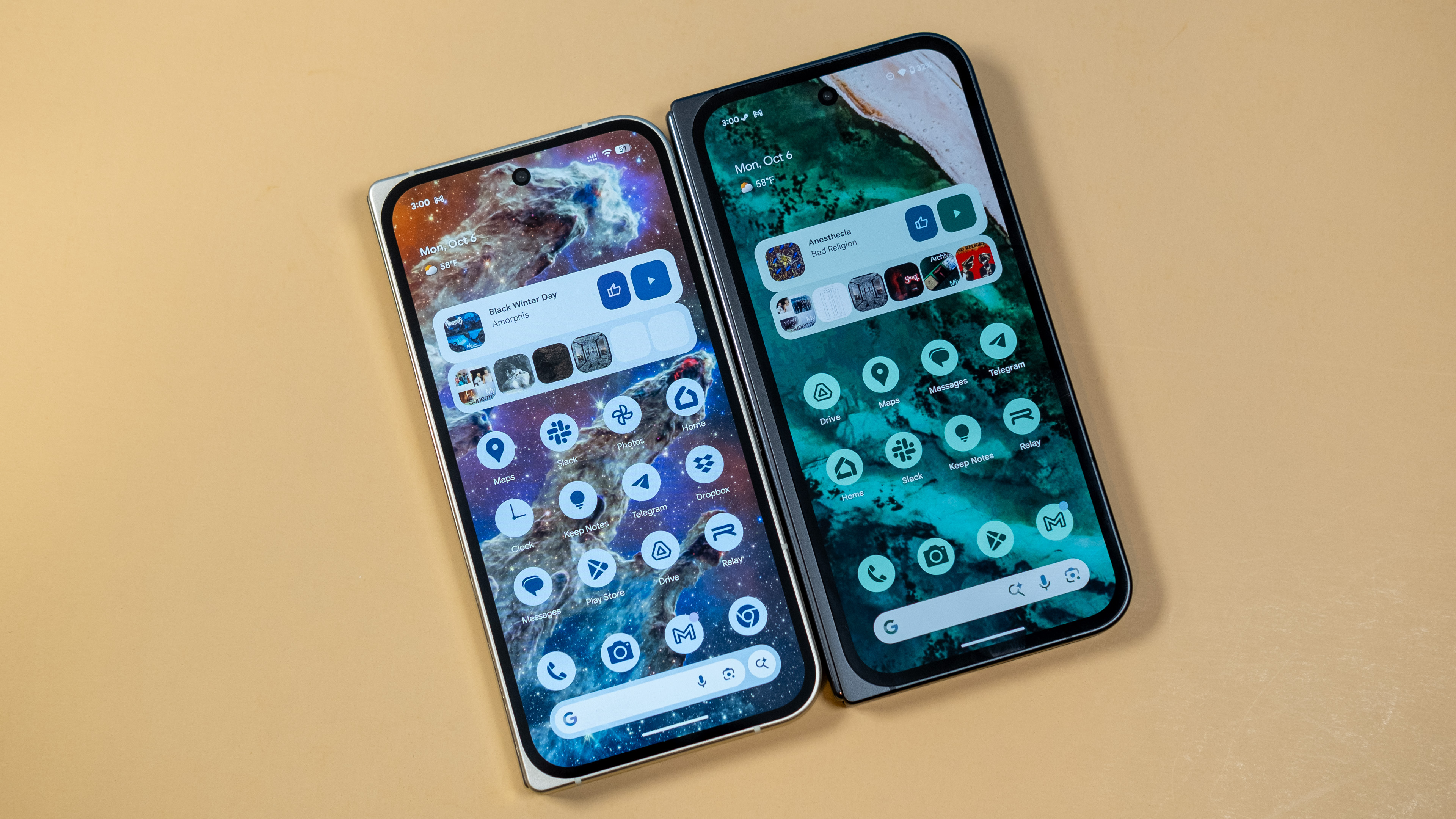
Pixel 10 Pro Fold and Pixel 10 Pro

Left: Pixel 10 Pro Fold, Right: Pixel 10 Pro.

Credit: Ryan Whitwam

Left: Pixel 10 Pro Fold, Right: Pixel 10 Pro. Credit: Ryan Whitwam

That’s all great, but these are relatively minor improvements for an $1,800 phone, and the competition is making great strides. The Pixel 10 Pro Fold isn’t as fast or slim as the Galaxy Z Fold 7, and Samsung’s multitasking system is much more powerful. The Z Fold 7 retails for $200 more, but that distinction hardly matters as you close in on two grand for a smartphone. If you’re willing to pay $1,800, going to $2,000 isn’t much of a leap.

Pixel 10 Pro Fold back in hand

It’s the size of a normal phone when closed.

Credit: Ryan Whitwam

It’s the size of a normal phone when closed. Credit: Ryan Whitwam

The Pixel 10 Pro Fold is the ultimate Google phone with some useful AI features, but the Galaxy Z Fold 7 is a better piece of hardware. Ultimately, the choice depends on what’s more important to you, but Google will have to move beyond iterative upgrades if it wants foldables to look like a worthwhile upgrade.

The good

  • Redesigned hinge and slimmer bezels
  • Huge, gorgeous foldable OLED screen
  • Colorful, attractive Material 3 UI
  • IP68 certification
  • Includes Qi2 with magnetic attachment
  • Seven years of update support
  • Most AI features run on-device for better privacy

The bad

  • Cameras are a step down from other Pro Pixels
  • Tons of AI features you probably won’t use
  • Could use more robust multitasking
  • Tensor G5 still not benchmark king
  • High $1,800 price

Photo of Ryan Whitwam

Ryan Whitwam is a senior technology reporter at Ars Technica, covering the ways Google, AI, and mobile technology continue to change the world. Over his 20-year career, he’s written for Android Police, ExtremeTech, Wirecutter, NY Times, and more. He has reviewed more phones than most people will ever own. You can follow him on Bluesky, where you will see photos of his dozens of mechanical keyboards.

Google Pixel 10 Pro Fold review: The ultimate Google phone Read More »
samsung-galaxy-z-fold-7-review:-quantum-leap

Samsung Galaxy Z Fold 7 review: Quantum leap


A pretty phone for a pretty penny

Samsung’s new flagship foldable is a huge improvement over last year’s model.

Samsung Galaxy Z Fold 7 bent

Samsung’s new foldable is thinner and lighter than ever before. Credit: Ryan Whitwam

Samsung’s new foldable is thinner and lighter than ever before. Credit: Ryan Whitwam

The first foldable phones hit the market six years ago, and they were rife with compromises and shortcomings. Many of those problems have persisted, but little by little, foldables have gotten better. With the release of the Galaxy Z Fold 7, Samsung has made the biggest leap yet. This device solves some of the most glaring problems with Samsung’s foldables, featuring a new, slimmer design and a big camera upgrade.

Samsung’s seventh-generation foldable has finally crossed that hazy boundary between novelty and practicality, putting a tablet-sized screen in your pocket without as many compromises. There are still some drawbacks, of course, but for the first time, this feels like a foldable phone you’d want to carry around.

Whether or not you can justify the $1,999 price tag is another matter entirely.

Most improved foldable

Earlier foldable phones were pocket-busting bricks, but companies like Google, Huawei, and OnePlus have made headway streamlining the form factor—the Pixel 9 Pro Fold briefly held the title of thinnest foldable when it launched last year. Samsung, however, stuck with the same basic silhouette for versions one through six, shaving off a millimeter here and there with each new generation. Now, the Galaxy Z Fold 7 has successfully leapfrogged the competition with an almost unbelievably thin profile.

Specs at a glance: Samsung Galaxy Z Fold 7 – $1,999
SoC Snapdragon 8 Elite
Memory 12GB, 16GB
Storage 256GB, 512GB, 1TB
Display Cover: 6.5-inch 1080×2520 120 Hz OLED

Internal: 8-inch 1968×2184 120 Hz flexible OLED
Cameras 200MP primary, f/1.7, OIS; 10 MP telephoto, f/2.4, OIS; 12 MP ultrawide, f/2.2; 10 MP selfie cameras (internal and external), f/2.2
Software Android 16, 7 years of OS updates
Battery 4,400 mAh, 25 W wired charging, 15 W wireless charging
Connectivity Wi-Fi 7, NFC, Bluetooth 5.4, sub-6 GHz and mmWave 5G, USB-C 3.2
Measurements Folded: 158.4×72.8×8.9 mm

Unfolded: 158.4×143.2×4.2 mm

215 g

Clocking in at just 215 g and 8.9 mm thick when folded, the Z Fold 7 looks and feels like a regular smartphone when closed. It’s lighter than Samsung’s flagship flat phone, the Galaxy S25 Ultra, and is only a fraction of a millimeter thicker. The profile is now limited by the height of the standard USB-C port. You can use the Z Fold 7 in its closed state without feeling hindered by an overly narrow display or hand-stretching thickness.

Samsung Galaxy Z Fold 7 back

The Samsung Galaxy Z Fold 7 looks like any other smartphone at a glance.

Credit: Ryan Whitwam

The Samsung Galaxy Z Fold 7 looks like any other smartphone at a glance. Credit: Ryan Whitwam

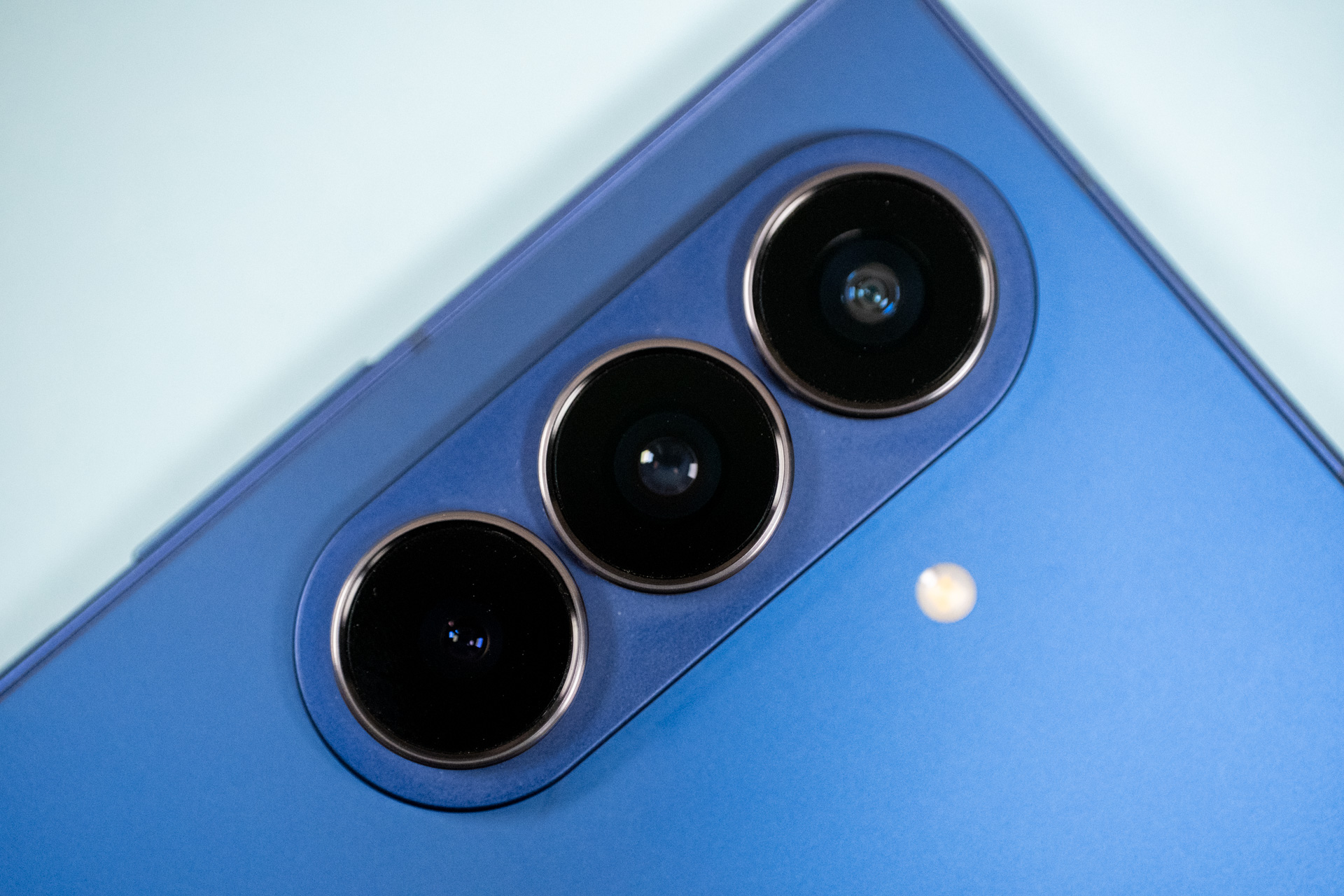
It seems unreal at times, like this piece of hardware should be a tech demo or a dummy phone concept rather than Samsung’s newest mass-produced device. The only eyebrow-raising element of the folded profile is the camera module, which sticks out like a sore thumb.

To enable the thinner design, Samsung engineered a new hinge with a waterdrop fold. The gentler bend in the screen reduces the appearance of the middle crease and allows the two halves to close tightly with no gap. The opening and closing action retains the same precise feel as previous Samsung foldables. The frame is made from Samsung’s custom Armor Aluminum alloy, which promises greater durability than most other phones. It’s not titanium like the S25 Ultra or iPhone Pro models, but that saves a bit of weight.

Samsung Galaxy Z Fold 7 side

The Samsung Galaxy Z Fold 7 is almost impossibly thin, as long as you ignore the protruding camera module.

Credit: Ryan Whitwam

The Samsung Galaxy Z Fold 7 is almost impossibly thin, as long as you ignore the protruding camera module. Credit: Ryan Whitwam

There is one caveat to the design—the Z Fold 7 doesn’t open totally flat. It’s not as noticeable as Google’s first-gen Pixel Fold, but the phone stops a few degrees shy of perfection. It’s about on par with the OnePlus Open in that respect. You might notice this when first handling the Z Fold 7, but it’s easy to ignore, and it doesn’t affect the appearance of the internal flexible OLED.

The 6.5-inch cover display is no longer something you’d only use in a pinch when it’s impractical to open the phone. It has a standard 21:9 aspect ratio and tiny symmetrical bezels. Even reaching across from the hinge side is no problem (Google’s foldable still has extra chunk around the hinge). The OLED panel has the customary 120 Hz refresh rate and high brightness we’ve come to expect from Samsung. It doesn’t have the anti-reflective coating of the S25 Ultra, but it’s bright enough that you can use it outdoors without issue.

Samsung Galaxy Z Fold 7 open angle

The Z Fold 7 doesn’t quite open a full 180 degrees.

Credit: Ryan Whitwam

The Z Fold 7 doesn’t quite open a full 180 degrees. Credit: Ryan Whitwam

Naturally, the main event is inside: an 8-inch 120 Hz OLED panel at 1968×2184, which is slightly wider than last year’s phone. It’s essentially twice the size of the cover display, just like in Google’s last foldable. As mentioned above, the crease is almost imperceptible now. The screen feels solid under your fingers, but it still has a plastic cover that is vulnerable to damage—it’s even softer than fingernails. It’s very bright, but the plastic layer is more reflective than glass, which can make using it in harsh sunlight a bit of a pain.

Unfortunately, Samsung’s pursuit of thinness led it to drop support for the S Pen stylus. That was always a tough sell, as there was no place to store a stylus in the phone, and even Samsung’s bulky Z Fold cases struggled to accommodate the S Pen in a convenient way. Still, it’s sad to lose this unique feature.

The Z Fold 7 (right) cover display is finally free of compromise. Z Fold 6 on the left. Ryan Whitwam

Unlike some of the competition, Samsung has not added a dedicated AI button to this phone—although there’s plenty of AI here. You get the typical volume rocker on the right, with a power button below it. The power button also has a built-in fingerprint scanner, which is fast and accurate enough that we can’t complain. The buttons feel sturdy and give good feedback when pressed.

Android 16 under a pile of One UI and AI

The Galaxy Z Fold 7 and its smaller flippy sibling are the first phones to launch with Google’s latest version of Android, a milestone enabled by the realignment of the Android release schedule that began this year. The device also gets Samsung’s customary seven years of update support, a tie with Google for the best in the industry. However, updates arrive slower than they do on Google phones. If you’re already familiar with One UI, you’ll feel right at home on the Z Fold 7. It doesn’t reinvent the wheel, but there are a few enhancements.

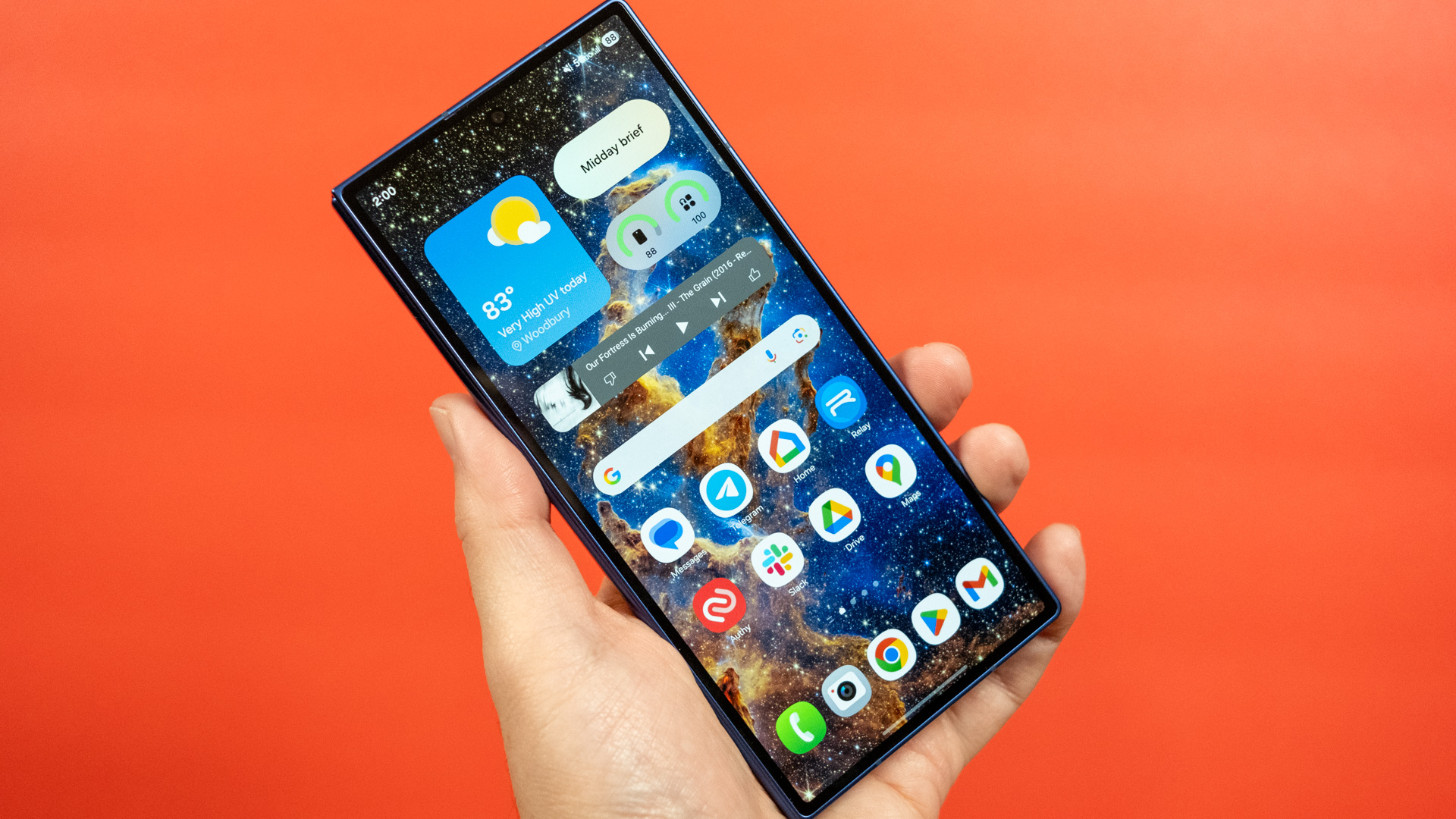
Samsung Galaxy Z Fold 7 home screen

It’s like having a tablet in your pocket.

Credit: Ryan Whitwam

It’s like having a tablet in your pocket. Credit: Ryan Whitwam

Android 16 doesn’t include a ton of new features out of the box, and some of the upcoming changes won’t affect One UI. For example, Google’s vibrant Material 3 Expressive theme won’t displace the standard One UI design language when it rolls out later this summer, and Samsung already has its own app windowing implementation separate from Google’s planned release. The Z Fold 7 has a full version of Android’s new progress notifications at launch, something Google doesn’t even fully support in the initial release. Few apps have support, so the only way you’ll see those more prominent notifications is when playing media. These notifications also tie in to the Now Bar, which is at the core of Samsung’s Galaxy AI.

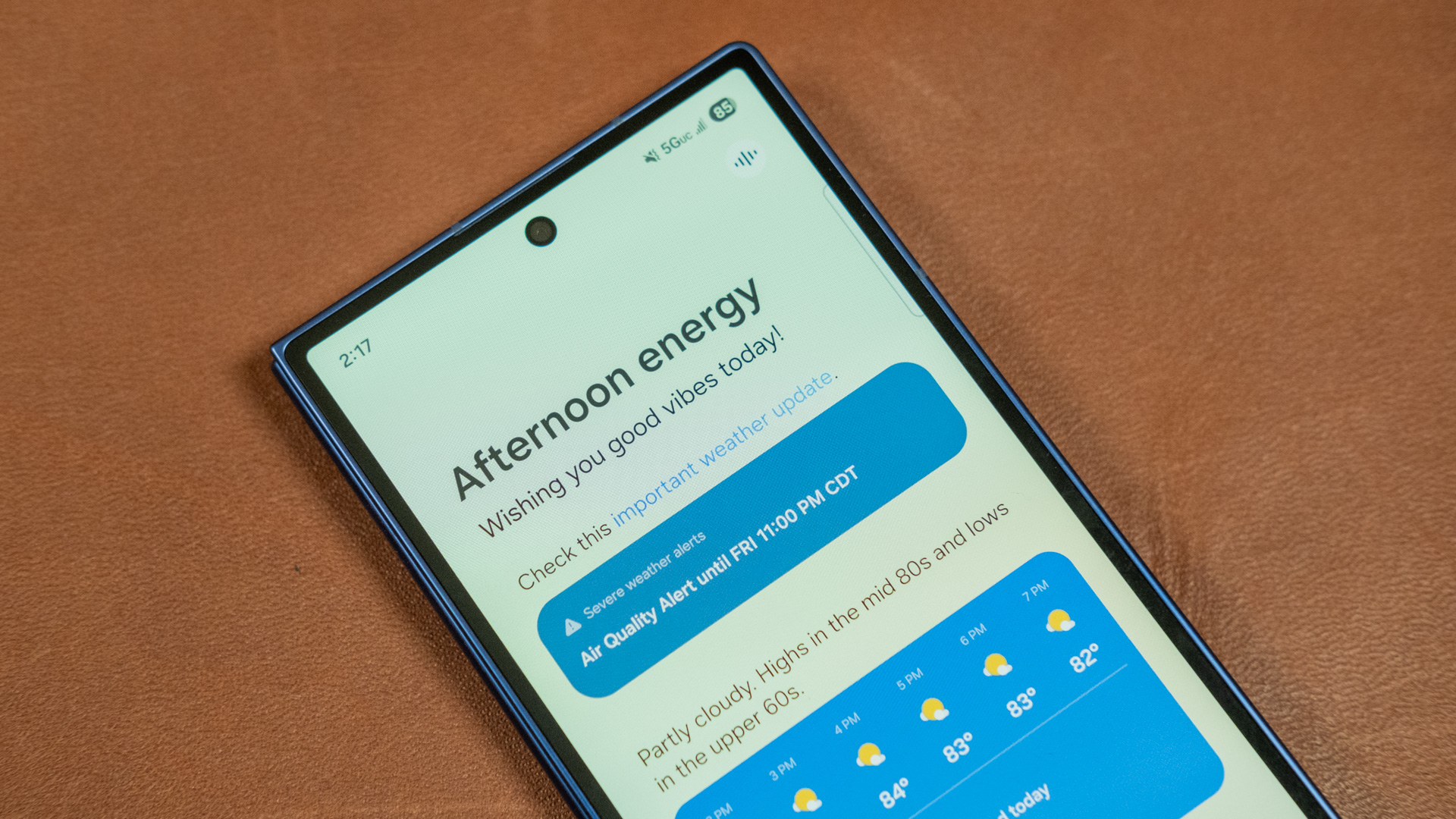
The Now Bar debuted on the S25 series earlier this year and uses on-device AI to process your data and present contextual information that is supposed to help you throughout the day. Samsung has expanded the apps and services that support the Now Bar and its constantly updating Now Brief, but we haven’t noticed much difference.

Samsung Galaxy Z Fold 7 Now Brief

Samsung’s AI-powered Now Brief still isn’t very useful, but it talks to you now. Umm, thanks?

Credit: Ryan Whitwam

Samsung’s AI-powered Now Brief still isn’t very useful, but it talks to you now. Umm, thanks? Credit: Ryan Whitwam

Nine times out of 10, the Now Bar doesn’t provide any useful notifications, and the Brief is quite repetitive. It often includes just weather, calendar appointments, and a couple of clickbait-y news stories and YouTube videos—this is the case even with all the possible data sources enabled. On a few occasions, the Now Bar correctly cited an appointment and suggested a route, but its timing was off by about 30 minutes. Google Now did this better a decade ago. Samsung has also added an AI-fueled audio version of the Now Brief, but we found this pretty tedious and unnecessary when there’s so little information in the report to begin with.

So the Now Bar is still a Now Bummer, but Galaxy AI also includes a cornucopia of other common AI features. It can rewrite text for you, summarize notes or webpages, do live translation, make generative edits to photos, remove background noise from videos, and more. These features work as well as they do on any other modern smartphone. Whether you get any benefit from them depends on how you use the phone.

However, we appreciate that Samsung included a toggle under the Galaxy AI settings to process data only on your device, eliminating the privacy concerns of using AI in the cloud. This reduces the number of operational AI features, but that may be a desirable feature all on its own.

Samsung Galaxy Z Fold 7 multitasking

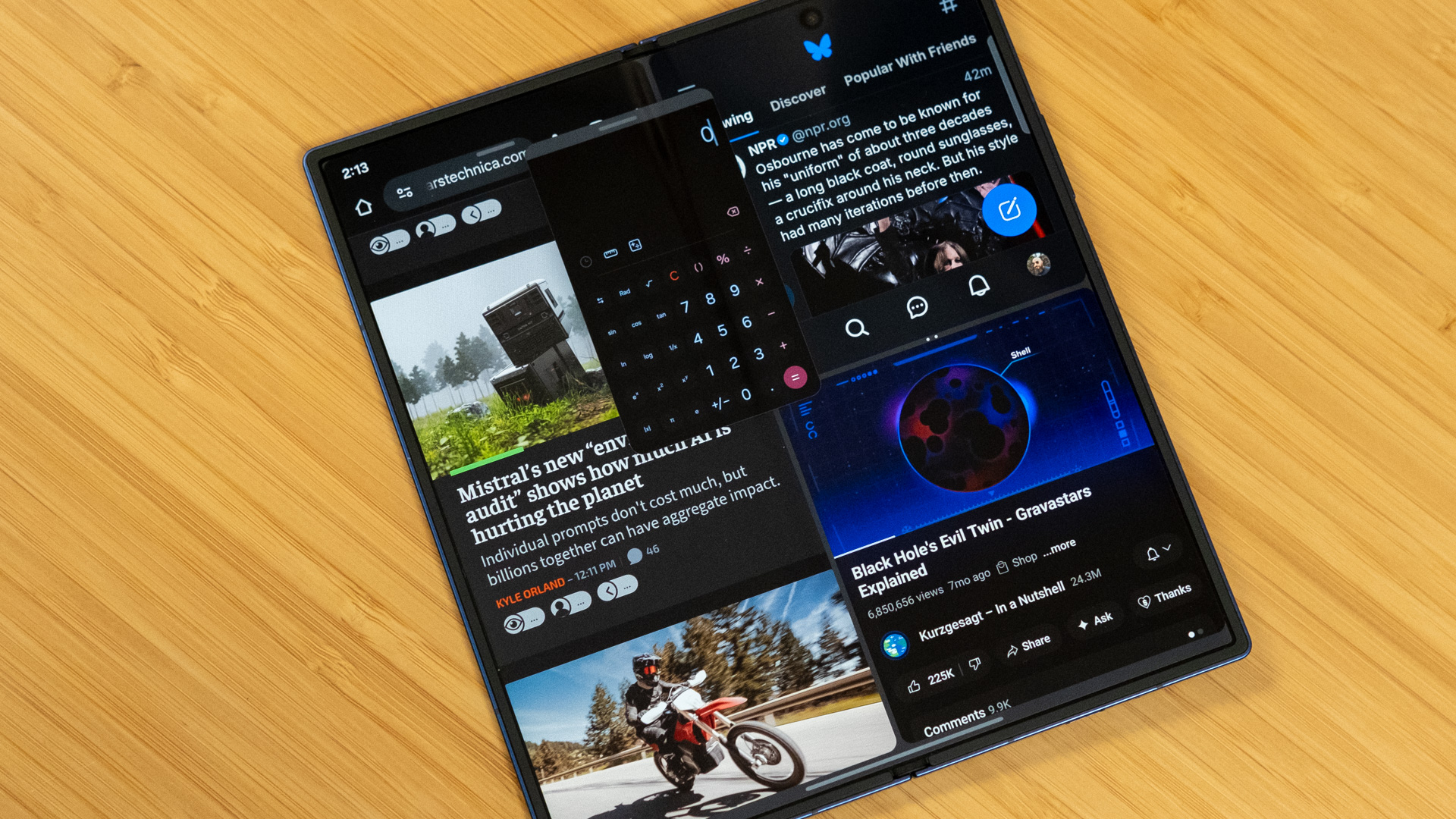
You can’t beat Samsung’s multitasking system.

Credit: Ryan Whitwam

You can’t beat Samsung’s multitasking system. Credit: Ryan Whitwam

Samsung tends to overload its phones with apps and features. Those are here, too, making the Z Fold 7 a bit frustrating at times. Some of the latest One UI interface tweaks, like separating the quick settings and notifications, fall flat. Luckily, One UI is also quite customizable. For example, you can have your cover screen and foldable home screens mirrored like Pixels, or you can have a distinct layout for each mode. With some tweaking and removing pre-loaded apps, you can get the experience you want.

Samsung’s multitasking system also offers a lot of freedom. It’s quick to open apps in split-screen mode, move them around, and change the layout. You can run up to three apps side by side, and you can easily save and access those app groups later. Samsung also offers a robust floating window option, which goes beyond what Google has planned for Android generally—it has chosen to limit floating windows to tablets and projected desktop mode. Samsung’s powerful windowing system really helps unlock the productivity potential of a foldable.

The fastest foldable

Samsung makes its own mobile processors, but when speed matters, the company doesn’t mess around with Exynos. The Z Fold 7 has the same Snapdragon 8 Elite chip as the Galaxy S25 series, paired with 12GB of RAM and 256GB of storage in the model most people will buy. In our testing, this is among the most powerful smartphones on the market today, but it doesn’t quite reach the lofty heights of the Galaxy S25 Ultra, presumably due to its thermal design.

Samsung Galaxy Z Fold 7 in hand

The Z Fold 7 is much easier to hold than past foldables.

Credit: Ryan Whitwam

The Z Fold 7 is much easier to hold than past foldables. Credit: Ryan Whitwam

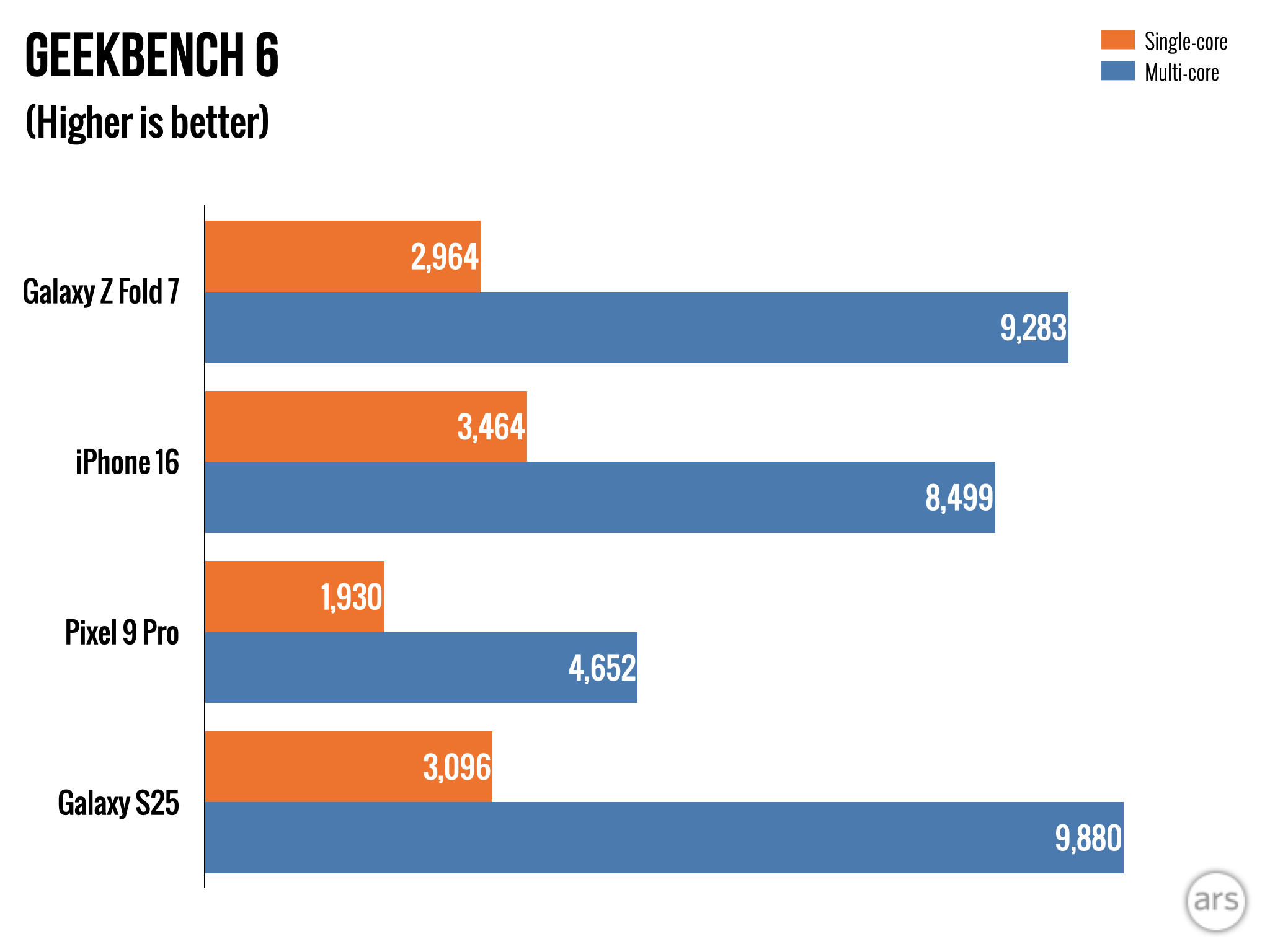
In Geekbench, the Galaxy Z Fold 7 lands between the Motorola Razr Ultra and the Galaxy S25 Ultra, both of which have Snapdragon 8 Elite chips. It far outpaces Google’s latest Pixel phones as well. The single-core CPU speed doesn’t quite match what you get from Apple’s latest custom iPhone processor, but the multicore numbers are consistently higher.

If mobile gaming is your bag, the Z Fold 7 will be a delight. Like other devices running on this platform, it puts up big scores. However, Samsung’s new foldable runs slightly behind some other 8 Elite phones. These are just benchmark numbers, though. In practice, the Z Fold 7 will handle any mobile game you throw at it.

Samsung Galaxy Z Fold 7 geekbench

The Fold 7 doesn’t quite catch the Z 25 Ultra.

Credit: Ryan Whitwam

The Fold 7 doesn’t quite catch the Z 25 Ultra. Credit: Ryan Whitwam

Samsung’s thermal throttling is often a concern, with some of its past phones with high-end Snapdragon chips shedding more than half their initial speed upon heating up. The Z Fold 7 doesn’t throttle quite that aggressively, but it’s not great, either. In our testing, an extended gaming session can see the phone slow down by about 40 percent. That said, even after heating up, the Z Fold 7 remains about 10 percent faster in games than the unthrottled Pixel 9 Pro. Qualcomm’s GPUs are just that speedy.

The CPU performance is affected by a much smaller margin under thermal stress, dropping only about 10–15 percent. That’s important because you’re more likely to utilize the Snapdragon 8 Elite’s power with Samsung’s robust multitasking system. Even when running three apps in frames with additional floating apps, we’ve noticed nary a stutter. And while 12GB of RAM is a bit shy of the 16GB you get in some gaming-oriented phones, it’s been enough to keep a day’s worth of apps in memory.

You also get about a day’s worth of usage from a charge. While foldables could generally use longer battery life, it’s impressive that Samsung made this year’s Z Fold so much thinner while maintaining the same 4,400 mAh battery capacity as last year’s phone. However, it’s possible to drain the device by early evening—it depends on how much you use the larger inner screen versus the cover display. A bit of battery anxiety is normal, but most days, we haven’t needed to plug it in before bedtime. A slightly bigger battery would be nice, but not at the expense of the thin profile.

The lack of faster charging is a bit more annoying. If you do need to recharge the Galaxy Z Fold 7 early, it will fill at a pokey maximum of 25 W. That’s not much faster than wireless charging, which can hit 15 W with a compatible charger. Samsung’s phones don’t typically have super-fast charging, with the S25 Ultra topping out at 45 W. However, Samsung hasn’t increased charging speeds for its foldables since the Z Fold 2. It’s long past time for an upgrade here.

Long-awaited camera upgrade

Camera hardware has been one of the lingering issues with foldables, which don’t have as much internal space to fit larger image sensors compared to flat phones. In the past, this has meant taking a big step down in image quality if you want your phone to fold in half. While Samsung has not fully replicated the capabilities of its flagship flat phones, the Galaxy Z Fold 7 takes a big step in the right direction with its protruding camera module.

Samsung Galaxy Z Fold 7 camera macro

The Z Fold 7’s camera has gotten a big upgrade.

Credit: Ryan Whitwam

The Z Fold 7’s camera has gotten a big upgrade. Credit: Ryan Whitwam

The camera setup is led by a 200 MP primary sensor with optical stabilization identical to the main shooter on the Galaxy S25 Ultra. It’s joined by a 12 MP ultrawide and 10 MP 3x telephoto, both a step down from the S25 Ultra. There is no equivalent to the 5x periscope telephoto lens on Samsung’s flat flagship. While it might be nice to have better secondary sensors, the 200 MP will get the most use, and it does offer better results than last year’s Z Fold.

Many of the photos we’ve taken on the Galaxy Z Fold 7 are virtually indistinguishable from those taken with the Galaxy S25 Ultra, which is mostly a good thing. The 200 MP primary sensor has a full-resolution mode, but you shouldn’t use it. With the default pixel binning, the Z Fold 7 produces brighter and more evenly exposed 12 MP images.

Samsung cameras emphasize vibrant colors and a wide dynamic range, so they lean toward longer exposures. Shooting with a Pixel and Galaxy phone side by side, Google’s cameras consistently use higher shutter speeds, making capturing motion easier. The Z Fold 7 is no slouch here, though. It will handle moving subjects in bright light better than any phone that isn’t a Pixel. Night mode produces bright images, but it takes longer to expose compared to Google’s offerings. Again, that means anything moving will end up looking blurry.

Between 1x and 3x, the phone uses digital zoom on the main sensor. When you go beyond that, it moves to the 3x telephoto (provided there is enough light). At the base 3x zoom, these photos are nice enough, with the usual amped-up colors and solid detail we’d expect from Samsung. However, the 10 MP resolution isn’t great if you push past 3x. Samsung’s image processing can’t sharpen photos to the same borderline magical degree as Google’s, and the Z Fold 7 can sometimes over-sharpen images in a way we don’t love. This is an area where the cheaper S25 Ultra still beats the new foldable, with higher-resolution backup cameras and multiple optical zoom levels.

At 12 MP, the ultrawide sensor is good enough for landscapes and group shots. It lacks optical stabilization (typical for ultrawide lenses), but it keeps autofocus. That allows you to take macro shots, and this mode activates automatically as you approach a subject. The images look surprisingly good with Samsung’s occasionally heavy-handed image processing, but don’t try to crop them down further.

The Z Fold 7 includes two in-display selfie cameras at 10 MP—one at the top of the cover display and the other for the inner foldable screen. Samsung has dispensed with its quirky under-display camera, which had a smattering of low-fi pixels covering it when not in use. The inner selfie is now just a regular hole punch, which is fine. You should really only use the front-facing cameras for video calls. If you want to take a selfie, foldables offer the option to use the more capable rear-facing cameras with the cover screen as a viewfinder.

A matter of coin

For the first time, the Galaxy Z Fold 7 feels like a viable alternative to a flat phone, at least in terms of hardware. The new design is as thin and light as many flat phones, and the cover display is large enough to do anything you’d do on non-foldable devices. Plus, you have a tablet-sized display on the inside with serious multitasking chops. We lament the loss of S Pen support, but it was probably necessary to address the chunkiness of past foldables.

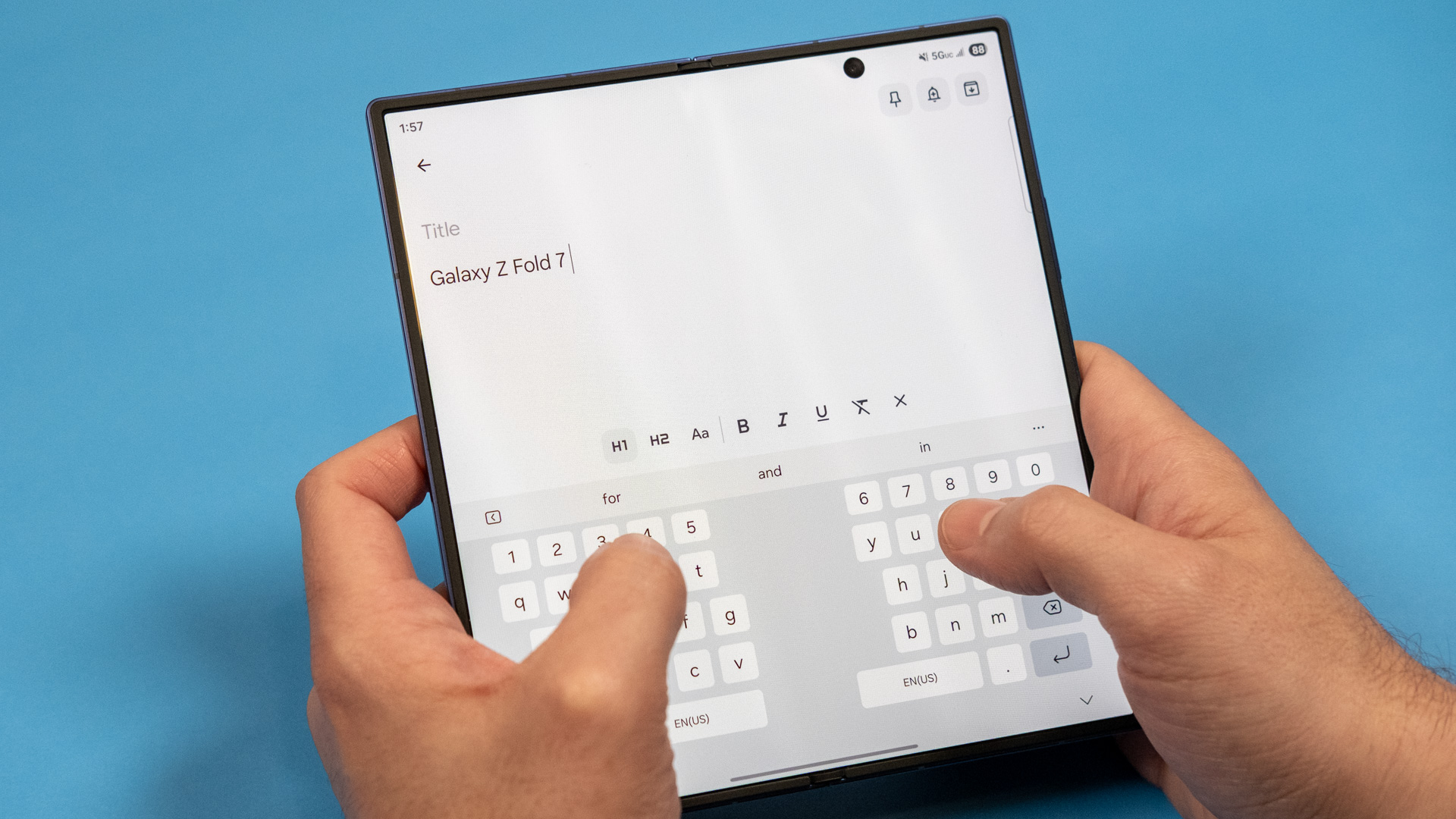
Samsung Galaxy Z Fold 7 typing

The Samsung Galaxy Z Fold 7 is the next best thing to having a physical keyboard.

Credit: Ryan Whitwam

The Samsung Galaxy Z Fold 7 is the next best thing to having a physical keyboard. Credit: Ryan Whitwam

The camera upgrade was also a necessary advancement. You can’t ask people to pay a premium price for a foldable smartphone and offer a midrange camera setup. The 200 MP primary shooter is a solid upgrade over the cameras Samsung used in previous foldables, but the ultrawide and telephoto could still use some attention.

The price is one thing that hasn’t gotten better—in fact, it’s moving in the wrong direction. The Galaxy Z Fold 7 is even more expensive than last year’s model at a cool $2,000. As slick and capable as this phone is, the exorbitant price ensures tablet-style foldables remain a niche category. If that’s what it costs to make a foldable you’ll want to carry, flat phones won’t be usurped any time soon.

If you don’t mind spending two grand on a phone or can get a good deal with a trade-in or a carrier upgrade, you won’t regret the purchase. This is the most power that can fit in your pocket. It’s available directly from Samsung (in an exclusive Mint color), Amazon, Best Buy, and your preferred carrier.

Samsung Galaxy Z Fold 7 hinge macro

The Samsung Galaxy Z Fold 7 has a new, super-thin hinge design.

Credit: Ryan Whitwam

The Samsung Galaxy Z Fold 7 has a new, super-thin hinge design. Credit: Ryan Whitwam

The good

  • Incredibly slim profile and low weight
  • Upgraded 200 MP camera
  • Excellent OLED screens
  • Powerful multitasking capabilities
  • Toggle for local-only AI
  • Launches on Android 16 with seven years of update support

The bad

  • Ridiculously high price
  • Battery life and charging speed continue to be mediocre
  • One UI 8 has some redundant apps and clunky interface decisions
  • Now Brief still doesn’t do very much

Photo of Ryan Whitwam

Ryan Whitwam is a senior technology reporter at Ars Technica, covering the ways Google, AI, and mobile technology continue to change the world. Over his 20-year career, he’s written for Android Police, ExtremeTech, Wirecutter, NY Times, and more. He has reviewed more phones than most people will ever own. You can follow him on Bluesky, where you will see photos of his dozens of mechanical keyboards.

Samsung Galaxy Z Fold 7 review: Quantum leap Read More »

motorola-razr-and-razr-ultra-(2025)-review:-cool-as-hell,-but-too-much-ai

Motorola Razr and Razr Ultra (2025) review: Cool as hell, but too much AI


The new Razrs are sleek, capable, and overflowing with AI features.

Razr Ultra and Razr (2025)

Motorola’s 2025 Razr refresh includes its first Ultra model. Credit: Ryan Whitwam

Motorola’s 2025 Razr refresh includes its first Ultra model. Credit: Ryan Whitwam

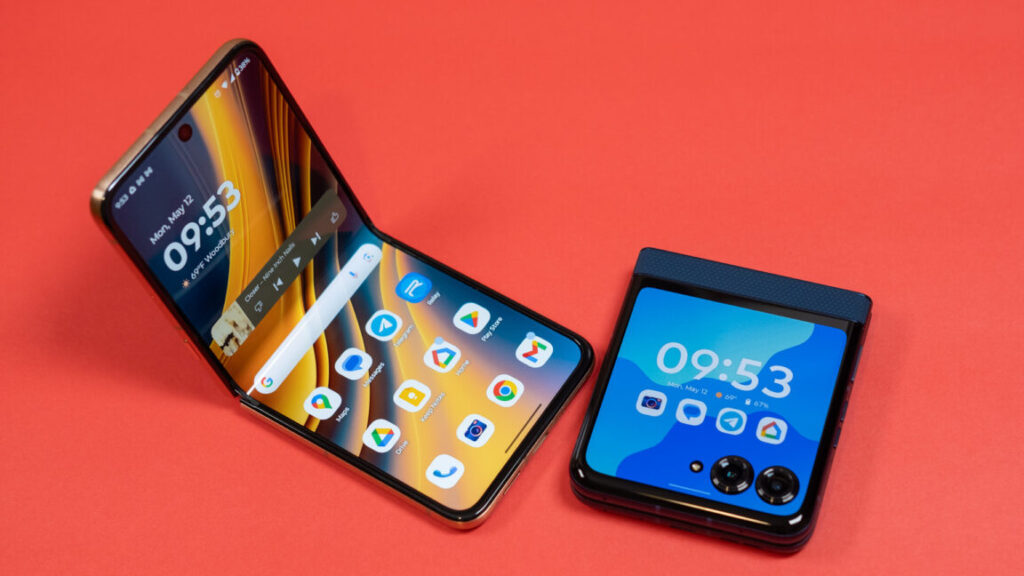
For phone nerds who’ve been around the block a few times, the original Motorola Razr is undeniably iconic. The era of foldables has allowed Motorola to resurrect the Razr in an appropriately flexible form, and after a few generations of refinement, the 2025 Razrs are spectacular pieces of hardware. They look great, they’re fun to use, and they just about disappear in your pocket.

The new Razrs also have enormous foldable OLEDs, along with external displays that are just large enough to be useful. Moto has upped its design game, offering various Pantone shades with interesting materials and textures to make the phones more distinctive, but Motorola’s take on mobile AI could use some work, as could its long-term support policy. Still, these might be the coolest phones you can get right now.

An elegant tactile experience

Many phone buyers couldn’t care less about how a phone’s body looks or feels—they’ll just slap it in a case and never look at it again. Foldables tend not to fit as well in cases, so the physical design of the Razrs is important. The good news is that Motorola has refined the foldable formula with an updated hinge and some very interesting material choices.

Razr Ultra back

The Razr Ultra is available with a classy wood back.

Credit: Ryan Whitwam

The Razr Ultra is available with a classy wood back. Credit: Ryan Whitwam

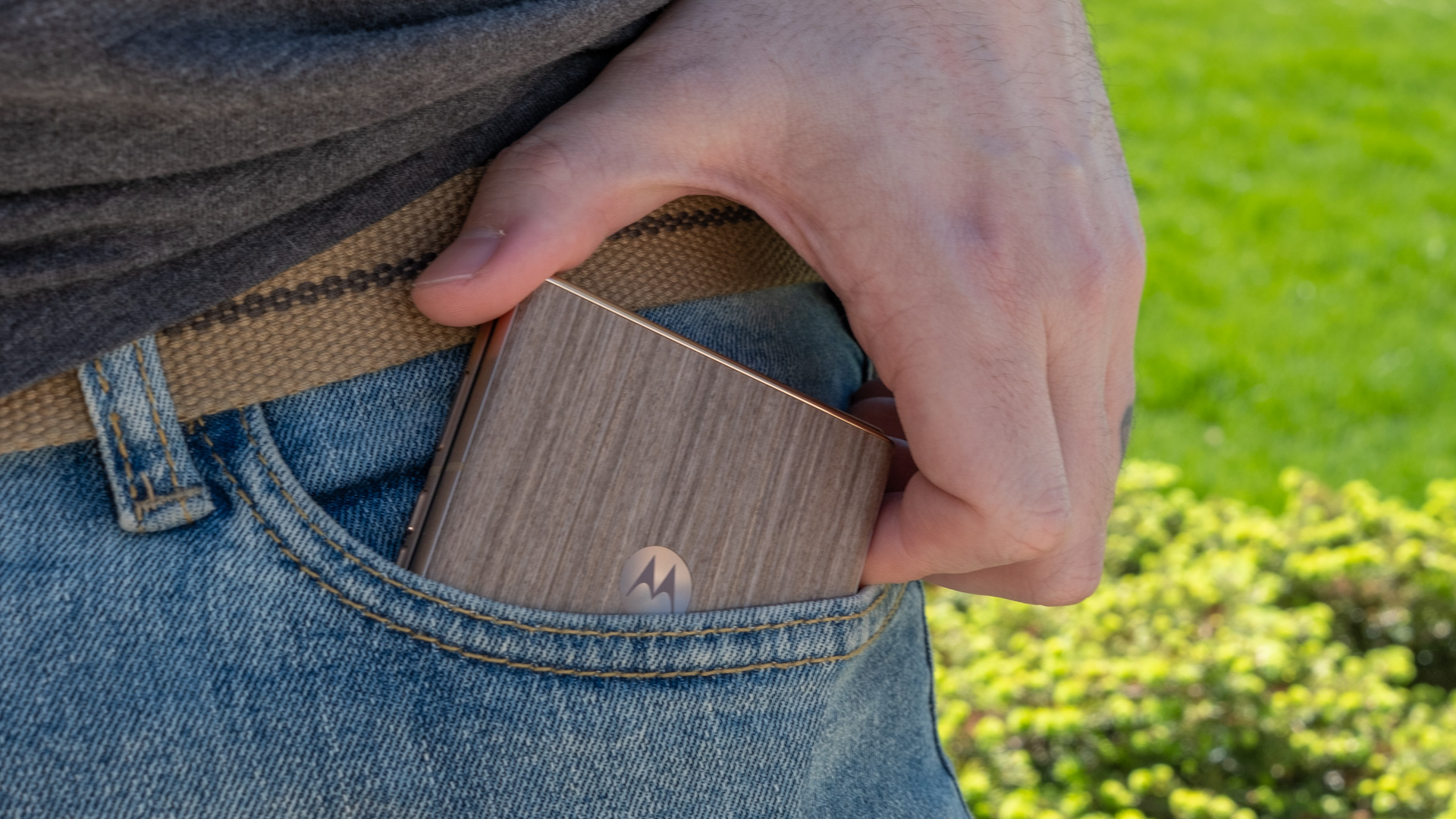
The 2025 Razrs come in various colors, all of which have interesting material choices for the back panel. There are neat textured plastics, wood, vegan leather, and synthetic fabrics. We’ve got wood (Razr Ultra) and textured plastic (Razr) phones to test—they look and feel great. The Razr is very grippy, and the wooden Ultra looks ultra-stylish, though not quite as secure in the hand. The aluminum frames are also colored to match the back with a smooth matte finish. Motorola has gone to great lengths to make these phones feel unique without losing the premium vibe. It’s nice to see a phone maker do that without resorting to a standard glass sandwich body.

The buttons are firm and tactile, but we’re detecting just a bit of rattle in the power button. That’s also where you’ll find the fingerprint sensor. It’s reasonably quick and accurate, whether the phone is open or closed. The Razr Ultra also has an extra AI button on the opposite side, which is unnecessary, for reasons we’ll get to later. And no, you can’t remap it to something else.

Motorola Razr 2025

The Razrs have a variety of neat material options.

Credit: Ryan Whitwam

The Razrs have a variety of neat material options. Credit: Ryan Whitwam

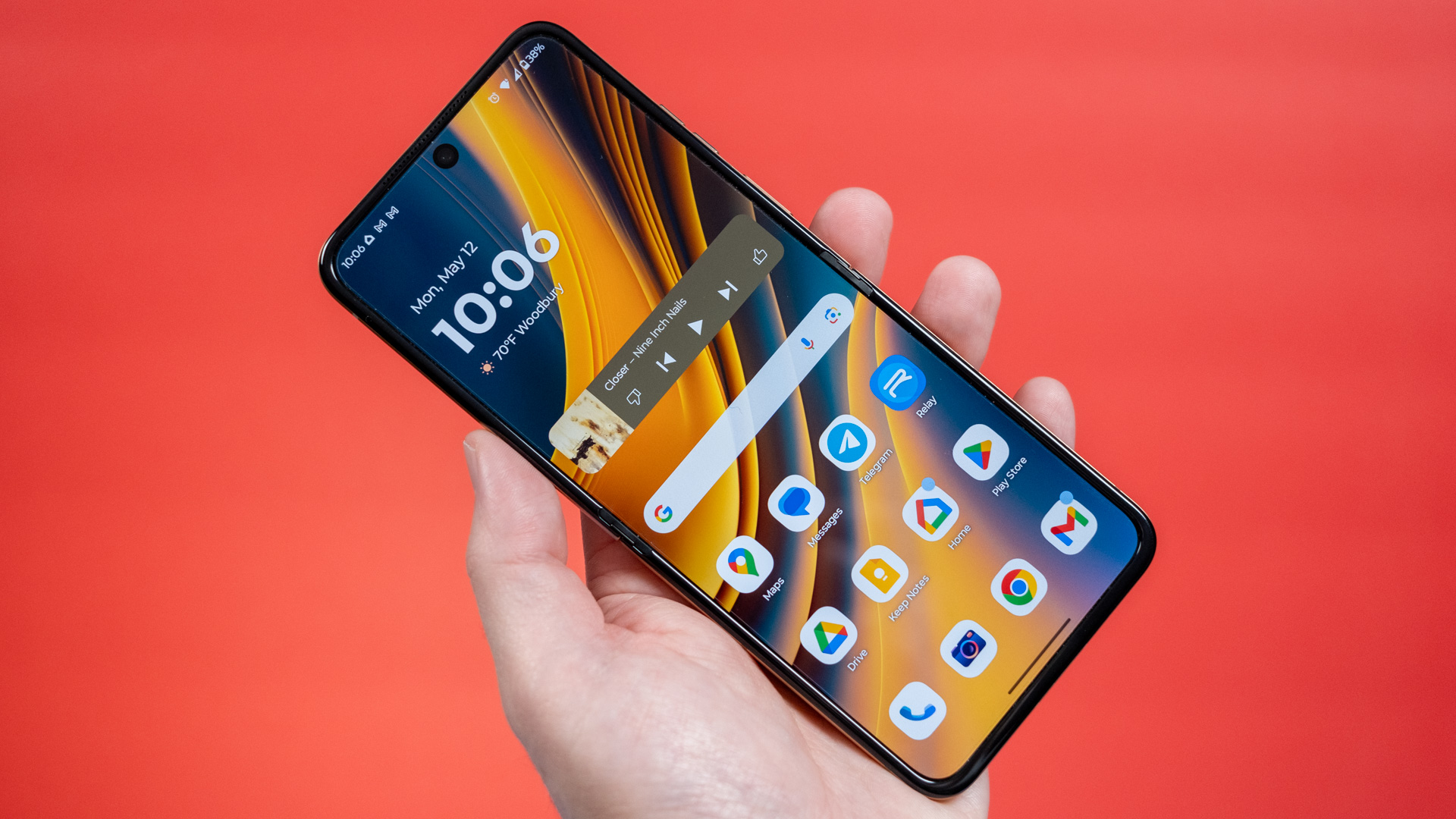
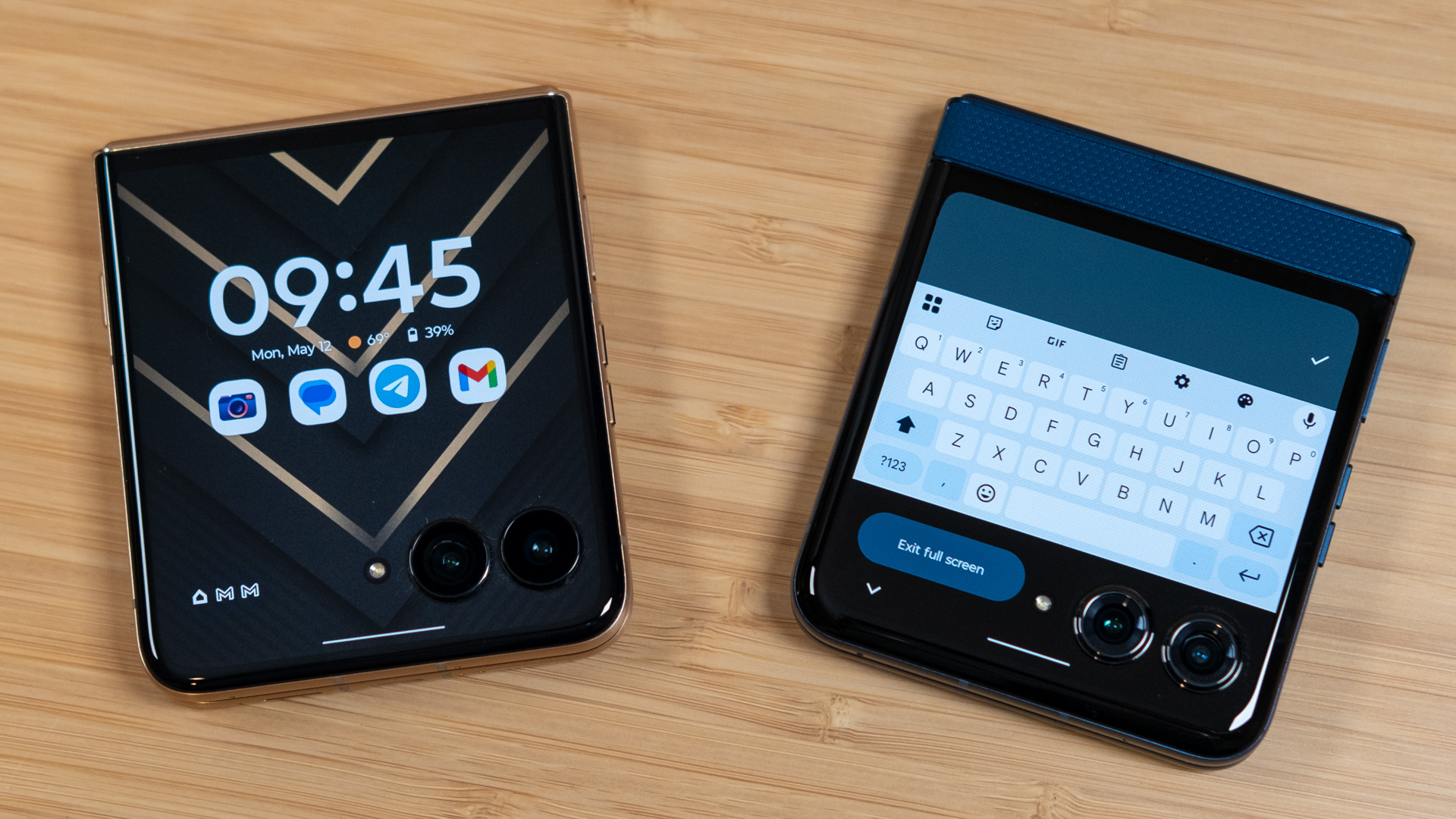
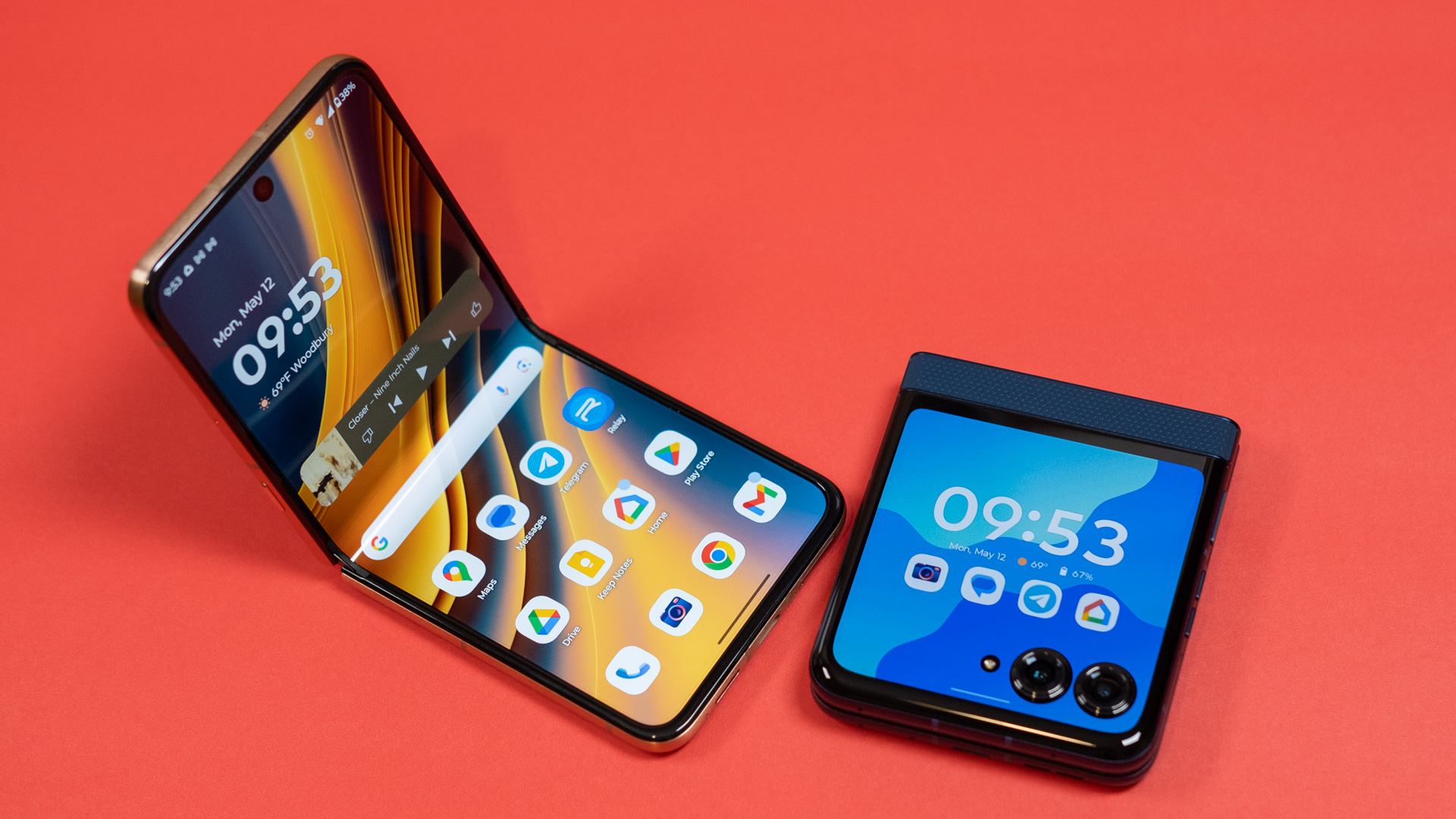
The front of the flip on these phones features a big sheet of Gorilla Glass Ceramic, which is supposedly similar to Apple’s Ceramic Shield glass. That should help ward off scratches. The main camera sensors poke through this front OLED, which offers some interesting photographic options we’ll get to later. The Razr Ultra has a larger external display, clocking in at 4 inches. The cheaper Razr gets a smaller 3.6-inch front screen, but that’s still plenty of real estate, even with the camera lenses at the bottom.

Specs at a glance: 2025 Motorola Razrs
Motorola Razr ($699.99) Motorola Razr+ ($999.99) Motorola Razr Ultra ($1,299.99)
SoC MediaTek Dimensity 7400X Snapdragon 8s Gen 3 Snapdragon 8 Elite
Memory 8GB 12GB 16GB
Storage 256GB 256GB 512GB, 1TB
Display 6.9″ foldable OLED (120 Hz, 2640 x 1080), 3.6″ external (90 Hz) 6.9″ foldable OLED (165 Hz, 2640 x 1080), 4″ external (120 Hz, 1272 x 1080) 7″ foldable OLED (165 Hz, 2992 x 1224), 4″ external (165 Hz)
Cameras 50 MP f/1.7 OIS primary; 13 MP f/2.2  ultrawide, 32 MP selfie 50 MP f/1.7 OIS primary; 50 MP 2x telephoto f/2.0, 32 MP selfie 50 MP f/1.8 OIS primary, 50 MP ultrawide + macro, f/2.0, 50 MP selfie
Software Android 15 Android 15 Android 15
Battery 4,500 mAh, 30 W wired charging, 15 W wireless charging 4,000 mAh, 45 W wired charging, 15 W wireless charging 4,700 mAh, 68 W wired charging, 15 W wireless charging
Connectivity Wi-Fi 6e, NFC, Bluetooth 5.4, sub-6 GHz 5G, USB-C 2.0 Wi-Fi 7, NFC, Bluetooth 5.4, sub-6 GHz 5G, USB-C 2.0 Wi-Fi 7, NFC, Bluetooth 5.4, sub-6 GHz 5G, USB-C 2.0
Measurements Open: 73.99 x 171.30 x 7.25 mm;

Closed: 73.99 x 88.08 x 15.85 mm; 188 g
Open: 73.99 x 171.42 x 7.09 mm;

Closed: 73.99 x 88.09x 15.32 mm; 189 g
Open: 73.99 x 171.48 x 7.19 mm;

Closed: 73.99 x 88.12 x 15.69 mm; 199 g

Motorola says the updated foldable hinge has been reinforced with titanium. This is the most likely point of failure for a flip phone, but the company’s last few Razrs already felt pretty robust. It’s good that Moto is still thinking about durability, though. The hinge is smooth, allowing you to leave the phone partially open, but there are magnets holding the two halves together with no gap when closed. The magnets also allow for a solid snap when you shut it. Hanging up on someone is so, so satisfying when you’re using a Razr flip phone.

Flip these phones open, and you get to the main event. The Razr has a 6.9-inch, 2640×1080 foldable OLED, and the Ultra steps up to 7 inches at an impressive 2992×1224. These phones have almost exactly the same dimensions, so the additional bit of Ultra screen comes from thinner bezels. Both phones are extremely tall when open, but they’re narrow enough to be usable in one hand. Just don’t count on reaching the top of the screen easily. While Motorola has not fully eliminated the display crease, it’s much smoother and less noticeable than it is on Samsung’s or Google’s foldables.

Motorola Razr Ultra

The Razr Ultra has a 7-inch foldable OLED.

Credit: Ryan Whitwam

The Razr Ultra has a 7-inch foldable OLED. Credit: Ryan Whitwam

The Razr can hit 3,000 nits of brightness, and the $1,300 Razr Ultra tops out at 4,500 nits. Both are bright enough to be usable outdoors, though the Ultra is noticeably brighter. However, both suffer from the standard foldable drawbacks of having a plastic screen. The top layer of the foldable screen is a non-removable plastic protector, which has very high reflectivity that makes it harder to see the display. That plastic layer also means you have to be careful not to poke or scratch the inner screen. It’s softer than your fingernails, so it’s not difficult to permanently damage the top layer.

Too much AI

Motorola’s big AI innovation for last year’s Razr was putting Gemini on the phone, making it one of the first to ship with Google’s generative AI system. This time around, it has AI features based on Gemini, Meta Llama, Perplexity, and Microsoft Copilot. It’s hard to say exactly how much AI is worth having on a phone with the rapid pace of change, but Motorola has settled on the wrong amount. To be blunt, there’s too much AI. What is “too much” in this context? This animation should get the point across.

Moto AI

Motorola’s AI implementation is… a lot.

Credit: Ryan Whitwam

Motorola’s AI implementation is… a lot. Credit: Ryan Whitwam

The Ask and Search bar appears throughout the UI, including as a floating Moto AI icon. It’s also in the app drawer and is integrated with the AI button on the Razr Ultra. You can use it to find settings and apps, but it’s also a full LLM (based on Copilot) for some reason. Gemini is a better experience if you’re looking for a chatbot, though.

Moto AI also includes a raft of other features, like Pay Attention, which can record and summarize conversations similar to the Google recorder app. However, unlike that app, the summarizing happens in the cloud instead of locally. That’s a possible privacy concern. You also get Perplexity integration, allowing you to instantly search based on your screen contents. In addition, the Perplexity app is preloaded with a free trial of the premium AI search service.

There’s so much AI baked into the experience that it can be difficult to keep all the capabilities straight, and there are some more concerning privacy pitfalls. Motorola’s Catch Me Up feature is a notification summarizer similar to a feature of Apple Intelligence. On the Ultra, this feature works locally with a Llama 3 model, but the less powerful Razr can’t do that. It sends your notifications to a remote server for processing when you use Catch Me Up. Motorola says data is “anonymous and secure” and it does not retain any user data, but you have to put a lot of trust in a faceless corporation to send it all your chat notifications.

Razr Ultra and Razr (2025)

The Razrs have additional functionality if you prop them up in “tent” or “stand” mode.

Credit: Ryan Whitwam

The Razrs have additional functionality if you prop them up in “tent” or “stand” mode. Credit: Ryan Whitwam

If you can look past Motorola’s frenetic take on mobile AI, the version of Android 15 on the Razrs is generally good. There are a few too many pre-loaded apps and experiences, but it’s relatively simple to debloat these phones. It’s quick, doesn’t diverge too much from the standard Android experience, and avoids duplicative apps.

We appreciate the plethora of settings and features for the external display. It’s a much richer experience than you get with Samsung’s flip phones. For example, we like how easy it is to type out a reply in a messaging app without even opening the phone. In fact, you can run any app on the phone without opening it, even though many of them won’t work quite right on a smaller square display. Still, it can be useful for chat apps, email, and other text-based stuff. We also found it handy for using smart home devices like cameras and lights. There are also customizable panels for weather, calendar, and Google “Gamesnack” games.

Razr Ultra and Razr (2025)

The Razr Ultra (left) has a larger screen than the Razr (right).

Credit: Ryan Whitwam

The Razr Ultra (left) has a larger screen than the Razr (right). Credit: Ryan Whitwam

Motorola promises three years of full OS updates and an additional year of security patches. This falls far short of the seven-year update commitment from Samsung and Google. For a cheaper phone like the Razr, four years of support might be fine, but it’s harder to justify that when the Razr Ultra costs as much as a Galaxy S25 Ultra.

One fast foldable, one not so much

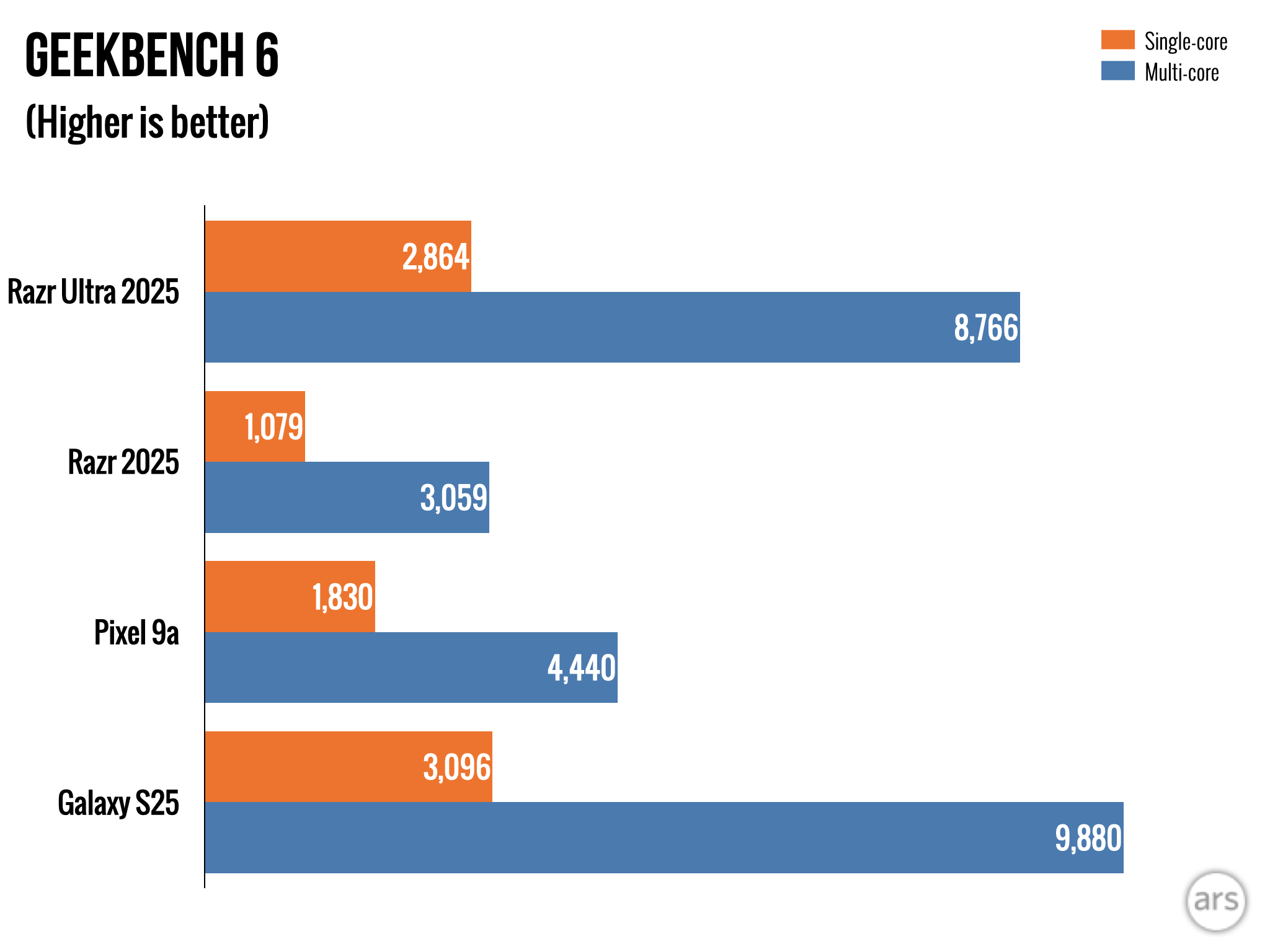
Motorola is fond of saying the Razr Ultra is the fastest flip phone in the world, which is technically true. It has the Snapdragon 8 Elite chip with 16GB of RAM, but we expect to see the Elite in Samsung’s 2025 foldables later this year. For now, though, the Razr Ultra stands alone. The $700 Razr runs a Mediatek Dimensity 7400X, which is a distinctly midrange processor with just 8GB of RAM.

Razr geekbench

The Razr Ultra gets close to the S25.

Credit: Ryan Whitwam

The Razr Ultra gets close to the S25. Credit: Ryan Whitwam

In daily use, neither phone feels slow. Side by side, you can see the Razr is slower to open apps and unlock, and the scrolling exhibits occasional jank. However, it’s not what we’d call a slow phone. It’s fine for general smartphone tasks like messaging, browsing, and watching videos. You may have trouble with gaming, though. Simple games run well enough, but heavy 3D titles like Diablo Immortal are rough with the Dimensity 7400X.

The Razr Ultra is one of the fastest Android phones we’ve tested, thanks to the Snapdragon chip. You can play complex games and multitask to your heart’s content without fear of lag. It does run a little behind the Galaxy S25 series in benchmarks, but it thankfully doesn’t get as toasty as Samsung’s phones.

We never expect groundbreaking battery life from foldables. The hinge takes up space, which limits battery capacity. That said, Motorola did fairly well cramming a 4,700 mAh battery in the Razr Ultra and a 4,500 mAh cell in the Razr.

Based on our testing, both of these phones should last you all day. The large external displays can help by giving you just enough information that you don’t have to use the larger, more power-hungry foldable OLED. If you’re playing games or using the main display exclusively, you may find the Razrs just barely make it to bedtime. However, no matter what you do, these are not multi-day phones. The base model Razr will probably eke out a few more hours, even with its smaller battery, due to the lower-power MediaTek processor. The Snapdragon 8 Elite in the Razr Ultra really eats into the battery when you take advantage of its power.

Motorola Razr Ultra

The Razrs are extremely pocketable.

Credit: Ryan Whitwam

The Razrs are extremely pocketable. Credit: Ryan Whitwam

While the battery life is just this side of acceptable, the Razr Ultra’s charging speed makes this less of a concern. This phone hits an impressive 68 W, which is faster than the flagship phones from Google, Samsung, and Apple. Just a few minutes plugged into a compatible USB-C charger and you’ve got enough power that you can head out the door without worry. Of course, the phone doesn’t come with a charger, but we’ve tested a few recent models, and they all hit the max wattage.

OK cameras with super selfies

Camera quality is another area where foldable phones tend to compromise. The $1,300 Razr Ultra has just two sensors—a 50 MP primary sensor and a 50 MP ultrawide lens. The $700 Razr has a slightly different (and less capable) 50 MP primary camera and a 13 MP ultrawide. There are also selfie cameras peeking through the main foldable OLED panels—50 MP for the Ultra and 32 MP for the base model.

Motorola Razr 2025 in hand

The cheaper Razr has a smaller external display, but it’s still large enough to be usable.

Credit: Ryan Whitwam

The cheaper Razr has a smaller external display, but it’s still large enough to be usable. Credit: Ryan Whitwam

Motorola’s Razrs tend toward longer exposures compared to Pixels—they’re about on par with Samsung phones. That means capturing fast movement indoors is difficult, and you may miss your subject outside due to a perceptible increase in shutter lag compared to Google’s phones. Images from the base model Razr’s primary camera also tend to look a bit more overprocessed than they do on the Ultra, which leads to fuzzy details and halos in bright light.

Razr Ultra outdoors. Ryan Whitwam

That said, Motorola’s partnership with Pantone is doing some good. The colors in our photos are bright and accurate, capturing the vibe of the scene quite well. You can get some great photos of stationary or slowly moving subjects.

Razr 2025 indoor medium light. Ryan Whitwam

The 50 MP ultrawide camera on the Razr Ultra has a very wide field of view, but there’s little to no distortion at the edges. The colors are also consistent between the two sensors, but that’s not always the case for the budget Razr. Its ultrawide camera also lacks detail compared to the Ultra, which isn’t surprising considering the much lower resolution.

You should really only use the dedicated front-facing cameras for video chat. For selfies, you’ll get much better results by taking advantage of the Razr’s distinctive form factor. When closed, the Razrs let you take selfies with the main camera sensors, using the external display as the viewfinder. These are some of the best selfies you’ll get with a smartphone, and having the ultrawide sensor makes group shots excellent as well.

Flip phones are still fun

While we like these phones for what they are, they are objectively not the best value. Whether you’re looking at the Razr or the Razr Ultra, you can get more phone for the same money from other companies—more cameras, more battery, more updates—but those phones don’t fold in half. There’s definitely a cool-factor here. Flip phones are stylish, and they’re conveniently pocket-friendly in a world where giant phones barely fit in your pants. We also like the convenience and functionality of the external displays.

Motorola Razr Ultra

The Razr Ultra is all screen from the front.

Credit: Ryan Whitwam

The Razr Ultra is all screen from the front. Credit: Ryan Whitwam

The Razr Ultra makes the usual foldable compromises, but it’s as capable a flip phone as you’ll find right now. It’s blazing fast, it has two big displays, and the materials are top-notch. However, $1,300 is a big ask.

Is the Ultra worth $500 more than the regular Razr? Probably not. Most of what makes the foldable Razrs worth using is present on the cheaper model. You still get the solid construction, cool materials, great selfies, and a useful (though slightly smaller) outer display. Yes, it’s a little slower, but it’s more than fast enough as long as you’re not a heavy gamer. Just be aware of the potential for Moto AI to beam your data to the cloud.

There is also the Razr+, which slots in between the models we have tested at $1,000. It’s faster than the base model and has the same large external display as the Ultra. This model could be the sweet spot if neither the base model nor the flagship does it for you.

The good

  • Sleek design with distinctive materials
  • Great performance from Razr Ultra
  • Useful external display
  • Big displays in a pocket-friendly package

The bad

  • Too much AI
  • Razr Ultra is very expensive
  • Only three years of OS updates, four years of security patches
  • Cameras trail the competition

Photo of Ryan Whitwam

Ryan Whitwam is a senior technology reporter at Ars Technica, covering the ways Google, AI, and mobile technology continue to change the world. Over his 20-year career, he’s written for Android Police, ExtremeTech, Wirecutter, NY Times, and more. He has reviewed more phones than most people will ever own. You can follow him on Bluesky, where you will see photos of his dozens of mechanical keyboards.

Motorola Razr and Razr Ultra (2025) review: Cool as hell, but too much AI Read More »

smartphone-manufacturers-still-want-to-make-foldables-a-thing

Smartphone manufacturers still want to make foldables a thing

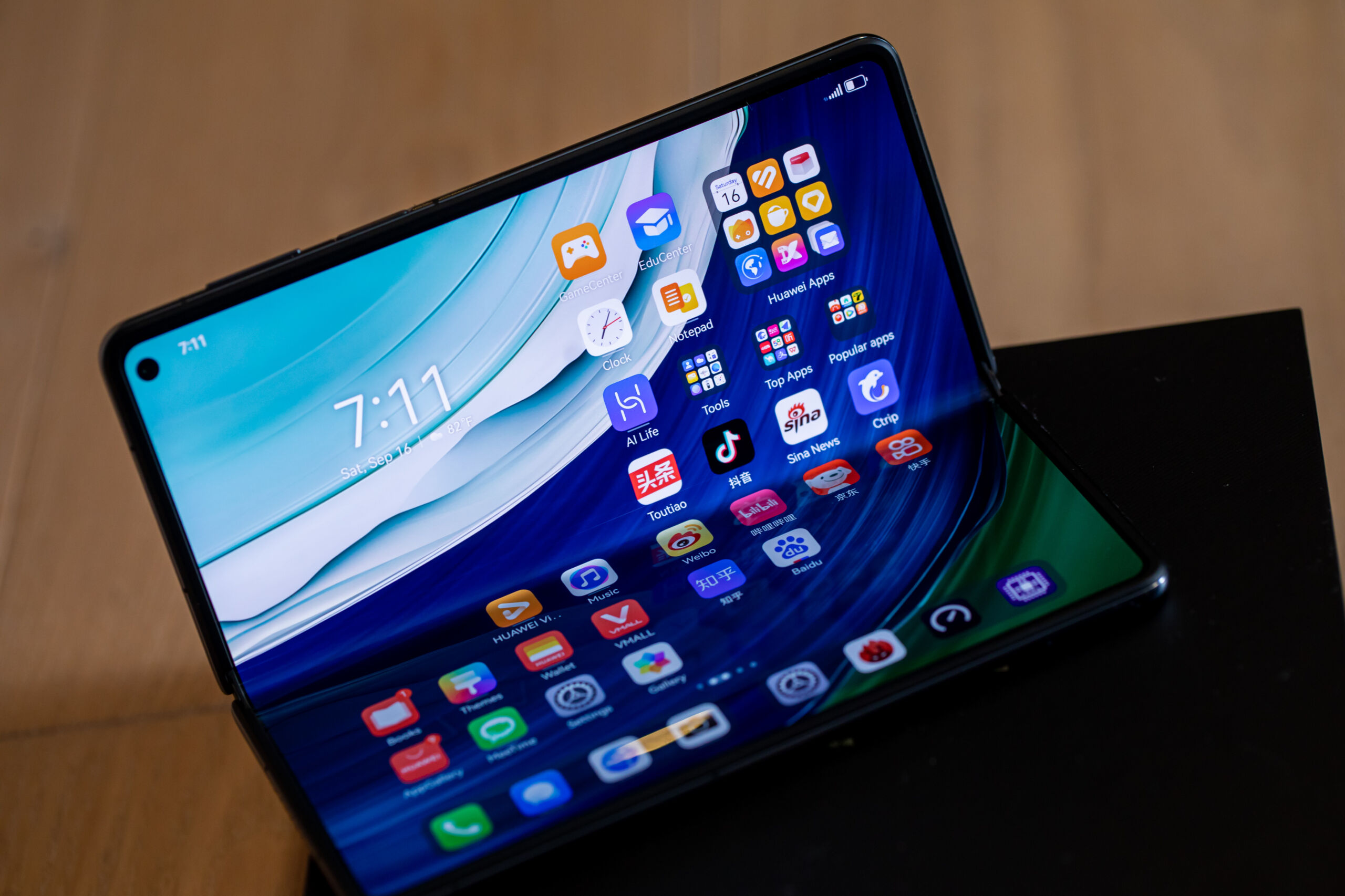
Huawei MateX 5

Enlarge / A Huawei Technologies Co. Mate X5 smartphone arranged in Hong Kong, China, on Saturday, Sept. 16, 2023.

Every large smartphone maker except Apple is betting that “foldable” phones will help revive a lackluster mobile market, despite the devices still largely failing to attract mainstream consumers.

Foldables, which have a screen that opens like a book or compact mirror, barely exceed a 1 per cent market share of all smartphones sold globally almost five years after they were first introduced.

But Samsung has doubled down on the product, investing heavily in marketing this year. In July, the Korean group released its 5G Galaxy Z series.

The world’s largest smartphone manufacturer points to estimates from Counterpoint Research that foldable devices may surpass a third of all smartphones costing more than $600 by 2027.

“We will continue to position our foldables as a key engine for our flagship growth with the clear differentiation, experience and flexibility these devices have to offer,” said Samsung.

Other handset makers such as Motorola, China’s Huawei and its spin-off Honor are also pinning their hopes on the product helping to revive a market that suffered its worst year for more than a decade.

“This is the year people [in the industry] really dived in,” said Ben Wood, an analyst at CCS Insight. “Everybody now is betting on this, except Apple.”

The iPhone-maker has yet to show any interest in the category, though patent filings suggest it may one day introduce an iPad that folds in half. Every other big smartphone maker has followed Samsung into the market, including Google’s Pixel Fold and Chinese alternatives from Huawei, Oppo and Xiaomi.

“We believe foldables are the future of smartphone devices, just like electric cars were to the auto industry,” said Bond Zhang, UK chief executive of Honor. “We’re approaching a crucial tipping point where foldables may soon become mainstream.”

But market data shows foldables are still far from mainstream. Counterpoint Research estimates about 16 million foldable phones will be sold this year, just 1.3 per cent of the 1.2 billion smartphone market total. Analysts say consumers are deterred by concerns about price, reliability and utility.

“I do wonder if there are too many products chasing too little market share at the moment,” Wood said.

Smartphone manufacturers still want to make foldables a thing Read More »