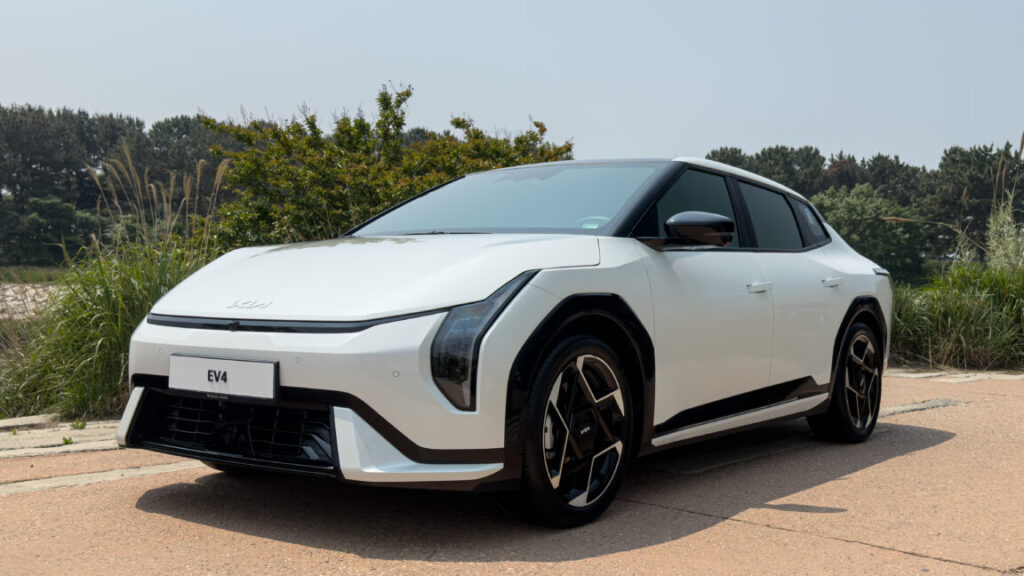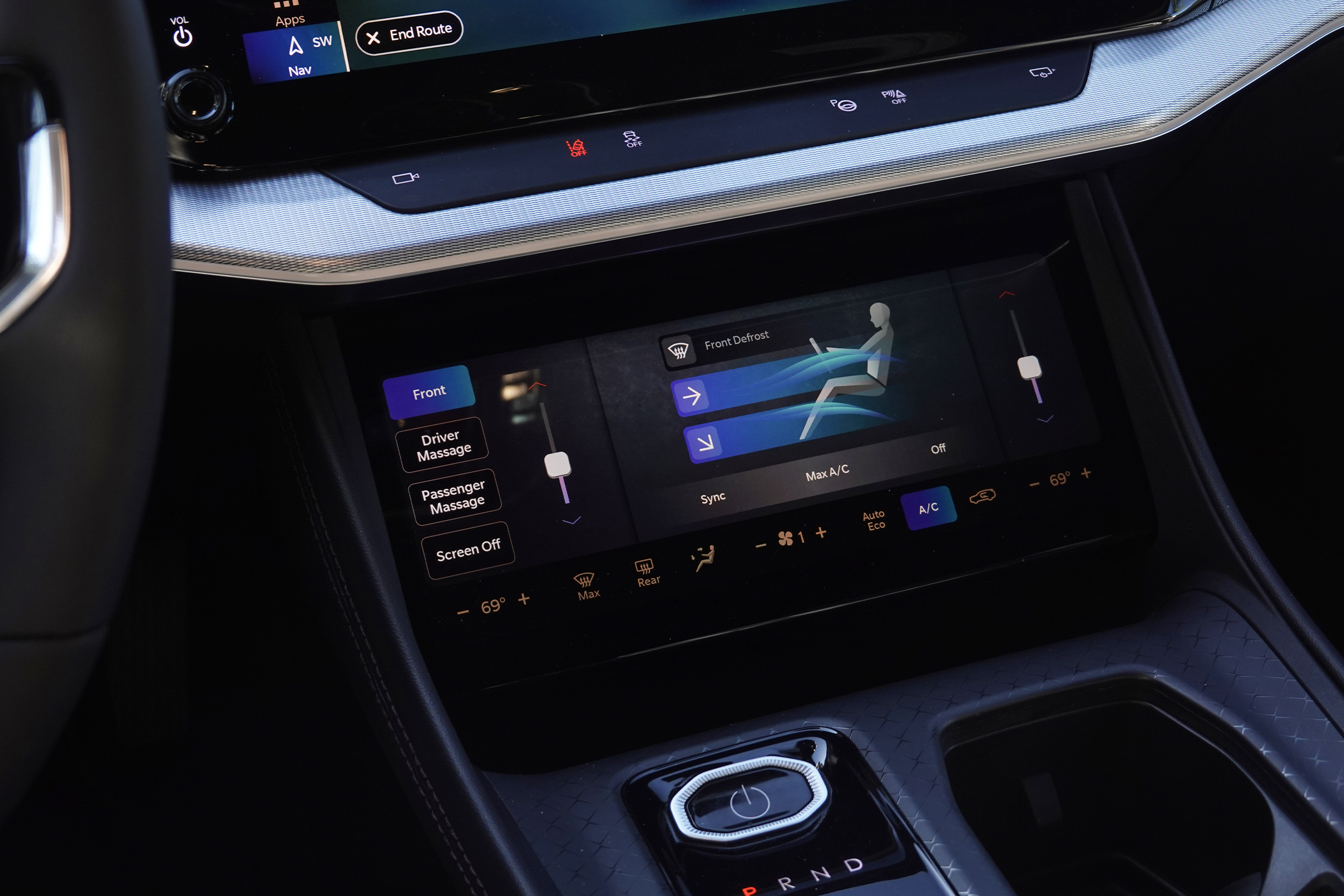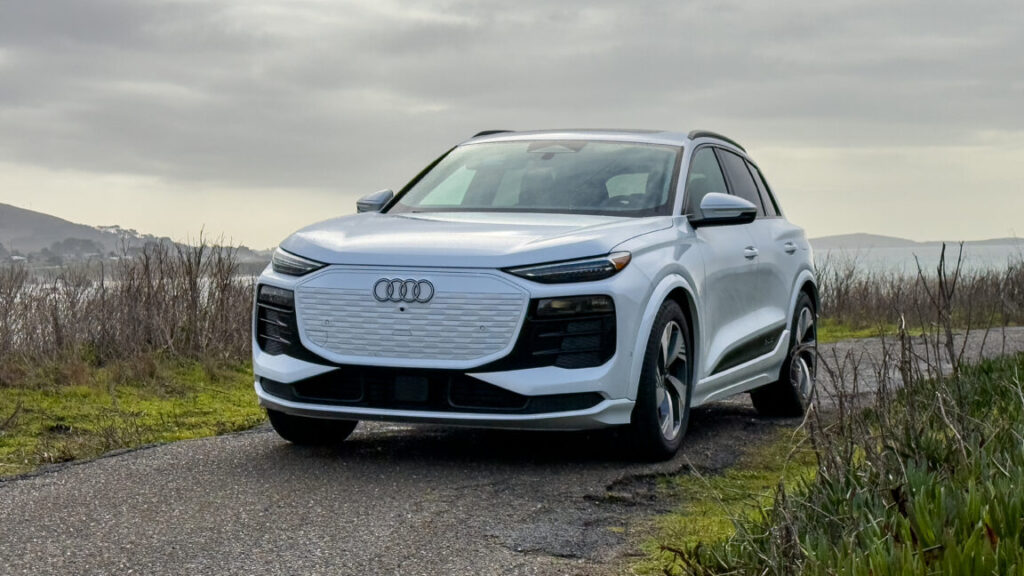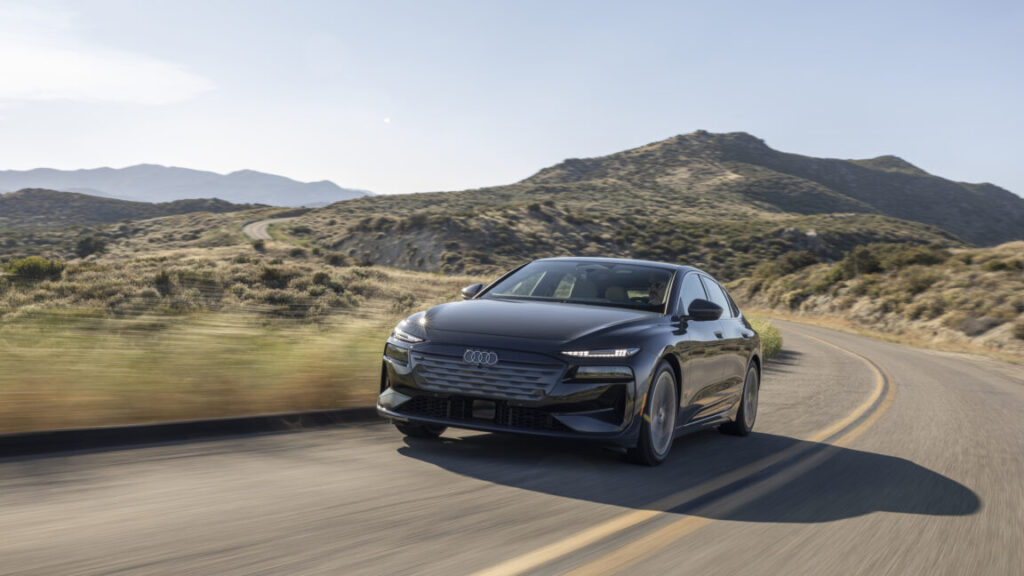
The mesh headrests are a clever touch, as they’re both comfortable and lightweight. The controls built into the side of the passenger seat that let the driver change its position are a specialty of the automaker. There are also plenty of other conveniences, including wireless device charging, 100 W USB-C ports, and wireless Android Auto and Apple CarPlay. We relied on the native navigation app, which is not as visually pretty as the one you cast from your phone to the 12.3-inch infotainment screen, but it kept me on course on unfamiliar roads in a foreign country while suffering from jet lag. That seems worthy of a mention.
Public transport
Traffic in and around Seoul makes a wonderful case for public transport; it provided less of an opportunity for the EV4 to show its stuff beyond relatively low-speed stop-and-go, mostly topping out at 50 mph (80 km/h) on the roads, which are heavily studded with traffic cameras. Determining a true impression of the car’s range will require spending more time with it on US roads, as a result.
It was, however, an easy car to drive in traffic and to drive slowly. It’s no speed demon anyway; 0–62 mph (100 km/h) takes 7.4 seconds if you floor it in the standard range car, or 7.7 seconds in the big battery one. The ride is good over broken tarmac, although it is quite firm when dealing with short-duration bumps. Meanwhile, the steering is light but not particularly informative when it comes to providing a picture of what the front tires are doing.
Good driving dynamics help sell a car once someone has had a test drive, but most will only get that far if the pricing is right. That’s yet to be announced, and who knows what will happen with tariffs and the clean vehicle tax credit between now and when the cars arrive in dealerships toward the end of the year. However, we expect the standard-range car to start between $37,000 and $39,000, undercutting the Tesla Model 3 in the process. That sounds rather compelling to me.
The driving dynamics are improved, and there’s plenty of tech to play with.
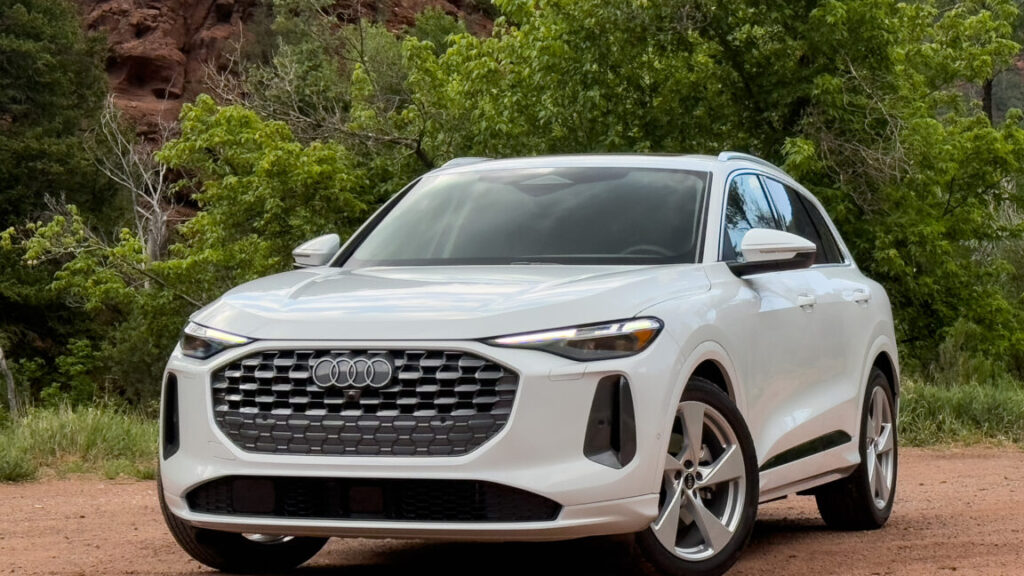
This is the third-generation Audi Q5. Credit: Jonathan Gitlin
ASPEN, Colo.—There’s a lot riding on Audi’s next Q5. The model has been Audi’s bread and butter here since the model went on sale in the US in 2009, as tastes changed and sedans fell out of favor. The third-generation Q5 is built on an all-new platform and is one of a new generation of software-defined vehicles that’s meant to ditch a lot of legacy crud for a clean sheet approach. You would have known all of that from our look at the new Q5 in a studio last year, when Audi briefed us on its new platform. What you wouldn’t have known from that piece is how it drives, particularly on US roads. The answer is: surprisingly well.
PPC
Just a few years ago, the world’s big car brands were telling us that soon everyone would be driving electric cars, and that it would be wonderful. Things haven’t quite panned out the way people thought they might when prognosticating in 2018, though. Electric powertrains have yet to reach price parity, in many places infrastructure still lags, and so automakers are developing new combustion-powered vehicles, particularly for markets like the US, where adoption remains far behind Europe or China.
For Audi and the other premium brands within the Volkswagen Group empire, that’s a new platform called PPC, or Premium Platform Combustion. PPC will provide the bones for new vehicles in a range of sizes and shapes, the same way the MLB (and MLB Evo) platforms have done until now. In a week, you can read about the A5, for example, but as the sales figures show, SUVs are what people want, so the Q5 comes first.
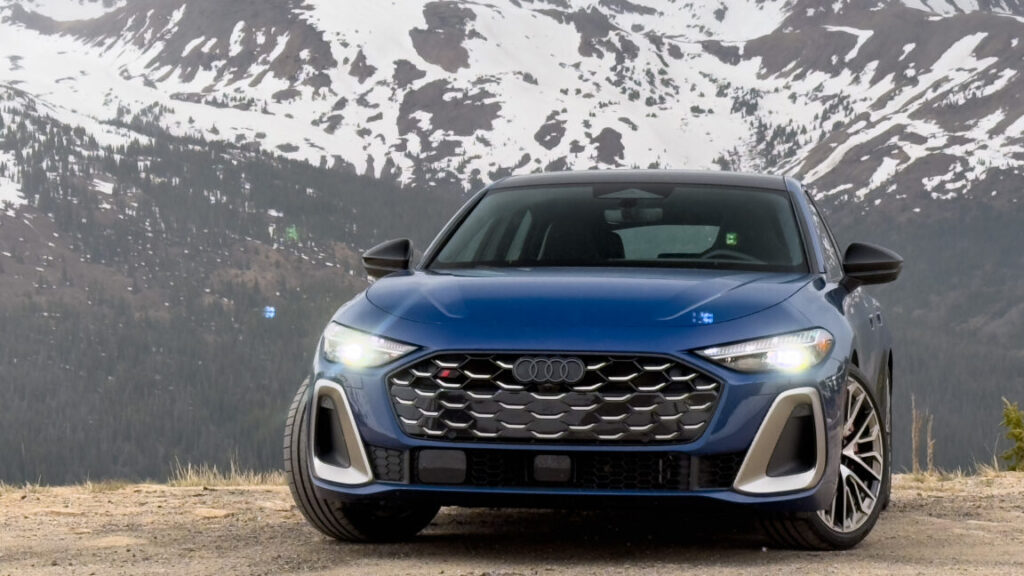
And this is the third-generation Audi SQ5. Jonathan Gitlin
To begin with, the US will get just two choices of powertrain. The Q5, which starts at $52,299, is powered by a 2.0 L turbocharged, direct-injection four-cylinder engine, which generates 268 hp (200 kW) and 295 lb-ft (400 Nm), which is sent to all four wheels via a seven-speed dual-clutch transmission. The SQ5 is the fancier, more powerful version. This starts at $64,800, and its 3.0 L turbocharged, direct-injection V6 provides 362 hp (270 kW) and 406 lb-ft (550 Nm), again to all four wheels via a seven-speed DCT.
At some point Audi will likely put a plug-in hybrid powertrain in the Q5, but there’s no guarantee it would come to the US, particularly if the US government remains hostile to both foreign trade and environmental protection. Audi sells a 48 V mild hybrid Q5—essentially a powerful starter motor—in Europe but currently has no plans to bring that version to the US. Happily for those looking for an entirely electric Audi midsize SUV, the Q6 e-tron is ready and waiting.
But you can get the Q5, and the SQ5, in a pair of different body styles. As before, Audi has a Sportback variant, which trades the upright rear hatch for a more sloping roofline. What the Sportback loses in rear headroom, it makes up for in style but should drive the exact same way. In Colorado, Audi only had the regular SUVs for us to test.
Software-defined vehicles
Although the Q5 and Q6 e-tron don’t share a common platform, they do share a common electronic architecture. Gone are the days of CANBUS and a hundred or more discrete black boxes and ECUs, each with a single function. Instead, it’s an entirely clean-sheet approach known as a software-defined vehicle, where a handful of powerful computers are each responsible for controlling a different domain, in this case vehicle dynamics, driver assists, infotainment, climate, and convenience, all tied together by Ethernet, with a backbone computer overseeing it all.
VW Group bit off a bit more than it could chew and tried simultaneously developing not one but two SDV architectures, before realizing no one wanted to work on the one the company actually needed sooner. That architecture is called E3 1.2, and with a bit of focus, VW Group’s software division has gotten it out the door.
I feel like Audi has taken a step back in terms of HMI for this latest generation of user interfaces. And why can’t I put a map display here? Audi
The practical upshot of SDVs, unlike older cars with their single-function black boxes, is that everything on an SDV should be updatable. The flip side is the potential for more bugs, although I can report that the Q5s and SQ5s we encountered in Colorado felt much more mature, software-wise, than the somewhat buggy preproduction cars using E3 1.2 that we drove in mid-2024.
As for VW’s future SDV architecture, it might well come from Rivian instead of its in-house division. Last summer, VW Group invested $5 billion in Rivian to gain access to the startup’s SDV technology.
As part of E3 1.2, the Q5 gets the latest version of Audi’s MMI infotainment, which now uses Android Automotive OS. There’s a more powerful voice assistant, triggered by “Hey, Audi,” that uses natural language processing that’s able to easily understand me, and which I think provides a good alternative to using a touchscreen while driving. I lament the lack of customizability, particularly in the main driver display and the fact that you can no longer display a map there, despite that being a feature Audi pioneered.
You can also add a second infotainment screen for the passenger, although only by ticking the box for the Prestige trim, which adds $8,400 to the price of a Q5, or $6,400 to the price of an SQ5. More on this later.
The driving experience: Q5
We began our day in the Q5, albeit one fitted with the optional air suspension and 20-inch wheels (18-inch wheels are standard, and 19-inch wheels are also available). Despite the altitude, there was more than sufficient power and torque to move the Q5’s 4,244 lb (1,925 kg) curb weight—forced induction providing the same benefit here as it did for piston-engined aircraft a century ago or more. At sea level, you could expect to reach 60 mph in 5.8 seconds, or 100 km/h in 6.2 seconds, according to Audi.
There’s plenty of storage places, and all the bits you touch feel pleasant under hand. Audi
There’s a new drive mode called Balanced, which fits between Comfort and Dynamic; on the road this mode is well-named as it indeed provides a good balance between ride comfort and responsiveness, with just enough but not too much weight to the steering. There’s also an individual mode that lets you pick and choose your own suspension, transmission, and steering settings, plus off-road and off-road plus modes, which we’ll encounter again later.
In fact, for a midsize crossover, the Q5 proved quite engaging from behind the wheel. It doesn’t lean too much when cornering, although if you plan to negotiate a sequence of twisty tarmac, the lower ride height in Dynamic mode, plus the firmer air springs, is definitely the way to go. When you’re not in a hurry or grinding along the highway, the ride is comfortable, and up front, there is little road noise thanks to some acoustic glass. I would like to try a car fitted with the conventional steel springs, however.
The cockpit layout is similar to the electric Q6 e-tron, with the same “digital stage” that includes a second infotainment screen for the passenger. But the materials here feel of a higher quality—my guess is that weight saving was much less of a concern for the gasoline-powered Q5 than the battery-carrying Q6. There is plenty of cargo room in the back, and perhaps a little more rear legroom than the photo would suggest—38 inches (965 mm), according to the spec sheet.
The driving experience: SQ5
The SQ5 can be specced with Nappa leather. Audi
The second half of our day was spent in the SQ5, most of it above 10,000 feet (3 km). Even in the thin air, the car was responsive, with the extra power and torque over the Q5 quite apparent. Audi was evidently confident in the SQ5, since our drive route included more than an hour on unpaved roads. None of the cars, all equipped with 21-inch wheels and lower-profile tires, had any trouble with punctures, and the off-road plus mode, which raises up the suspension, changes the throttle mapping, and disables the stability control, coped perfectly well over stretches of road that few luxury SUVs will ever face. I can report that as occupants, we weren’t even particularly jostled.
I liked the way the SQ5 sounded, particularly in Dynamic, and it’s engaging enough to drive that you’d take the long way home in it, despite being an SUV. However, it’s also deceptively quick, in part thanks to being quiet and refined inside. There’s a lack of intrusion from the outside environment that removes the noise and vibrations associated with speed, so you can look at the dash or heads-up display and see you’re 20 mph faster than you thought. That’s not great when mountain roads with no guard rails trigger your fear of heights, but the fact that I’m writing this means it ended OK.
They make you pay
I enjoyed driving both the Q5 and SQ5, but as is always the case on first drives for the media, we were presented with very well-equipped examples to test. For example, the great ride I experienced with the Q5 requires the $8,400 Prestige pack, which also adds the acoustic glass that made it so quiet inside. That’s also the only way to get heated rear seats and ventilated front seats, the clever OLED tail lights, or the second display for the passenger. (On the SQ5 the Prestige pack is only $6,400, since air suspension is standard on all SQ5s, and adds Nappa leather as well.)
With scenery like this, who needs to look at cars? Credit: Jonathan Gitlin
Some other features that I expected would be standard were instead behind the Premium Plus pack—$4,500 for the Q5 and $3,500 for the SQ5. I would expect the high-resolution, full-color heads-up display to be an extra, but you also have to tick this option if you want USB-C ports (2 x 60 W in the front, 2 x 100 W in the rear) in the car. And you probably do.
Jonathan is the Automotive Editor at Ars Technica. He has a BSc and PhD in Pharmacology. In 2014 he decided to indulge his lifelong passion for the car by leaving the National Human Genome Research Institute and launching Ars Technica’s automotive coverage. He lives in Washington, DC.
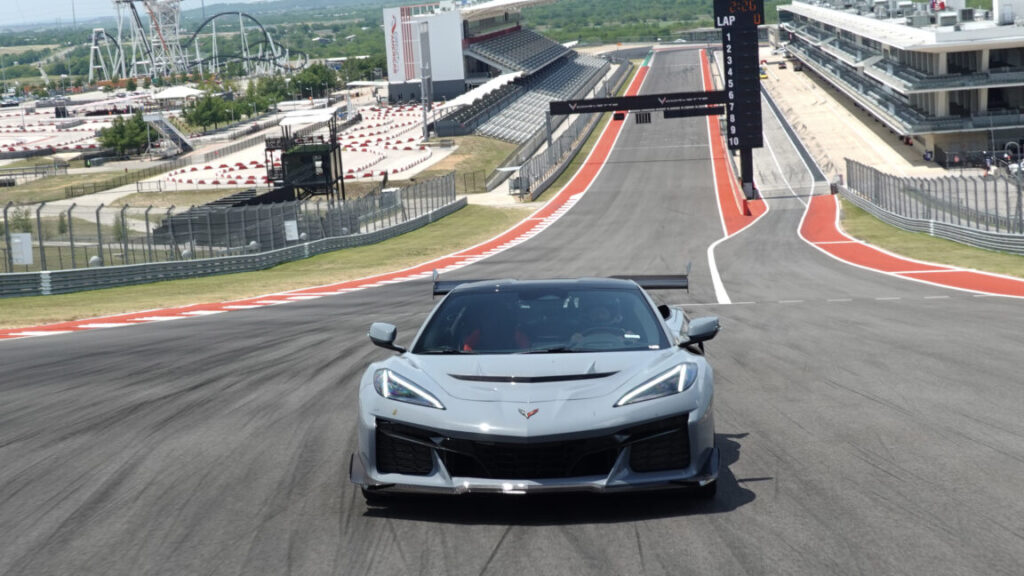
Cooling for the ZR1 became an even higher priority, because the LT6 and LT7 employ extremely tight tolerances between the crankshaft and connecting rods, which mandates keeping the 5W-50 oil below 120° C (248° F) at all times. And the system simply works, as even on a hot and humid Texas day, I only noticed oil temperatures cresting above 104° C (220° F) occasionally.
The interior is better than any prior generation of Corvette, but it feels prosaic compared to the cockpits of its more exotic mid-engined rivals. Michael Teo Van Runkle
The hardtop convertible ZR1 lacks the split-engine venting and shoulder intakes, while cutting into headroom so much that I skipped out while wearing a helmet. Other journalists noticed a drop-off in performance for the convertibles, and probably more so than the mild weight gains of just about 100 lbs (45 kg) might suggest. Instead, temperatures probably came into play, as the ECU drew back timing and instead allowed mild overboost of 24–25 psi to compensate for the Texas day. Even so, an engineer admitted he thought the engine was probably down 5–10 percent on power.
The fact that I hit my highest-ever top speed despite the ZR1 potentially giving up somewhere between 53 to 106 hp (40–80 kW) only makes this Corvettes sound even more insane. But I essentially wound up driving the turbos, since the DCT’s gear ratios carry over from the Stingray and therefore drop out of peak power when shifting from second to third and third to fourth.
I suspect nothing short of an F1 racecar feels this fast on a circuit of this size. A track designed for corner exit speeds double my pace in the ZR1 helps explain why Chevrolet declined to set us loose on public roads behind the wheel.
We drove it on track—will owners cope with this much power on the street? Credit: Michael Teo Van Runkle
That’s a concern for potential buyers, though, and why the ZR1’s electronics undoubtedly ratchet back the insanity. Chevy still uses Bosch’s ninth-generation traction control, which debuted on C7 and operates on a 10-millisecond loop, even if the ABS runs at 5 milliseconds—while the ESC is at 20 milliseconds. I suspect this computerized nannying slowed me down a fair amount, in addition to the torque-by-gear restrictions in first and second that purposefully protect driveline components.
We’ve probably reached peak internal-combustion Corvette, which is something of a hint about the all-too-real question of where Chevy can go from here. If so, this car reaches a new level of unfathomable American ingenuity, combined with a newfound level of refinement and traction management that attempts to belie the undeniable absurdity to a minimal, arguably necessary, extent.
In the modern era, cars keep getting bigger and bigger between generations. Or at least, they’re certainly not getting smaller. That’s especially true in America, where bigger is always better and the vehicles in the current crop of “compact” crossovers are now nearly as large as full-size SUVs from a decade ago. Don’t ask about curb weights, either, as more powerful drivetrains, including widespread adoption of hybrid-electric components, add significant mass, as highlighted by the new BMW M5 “sport sedan.”
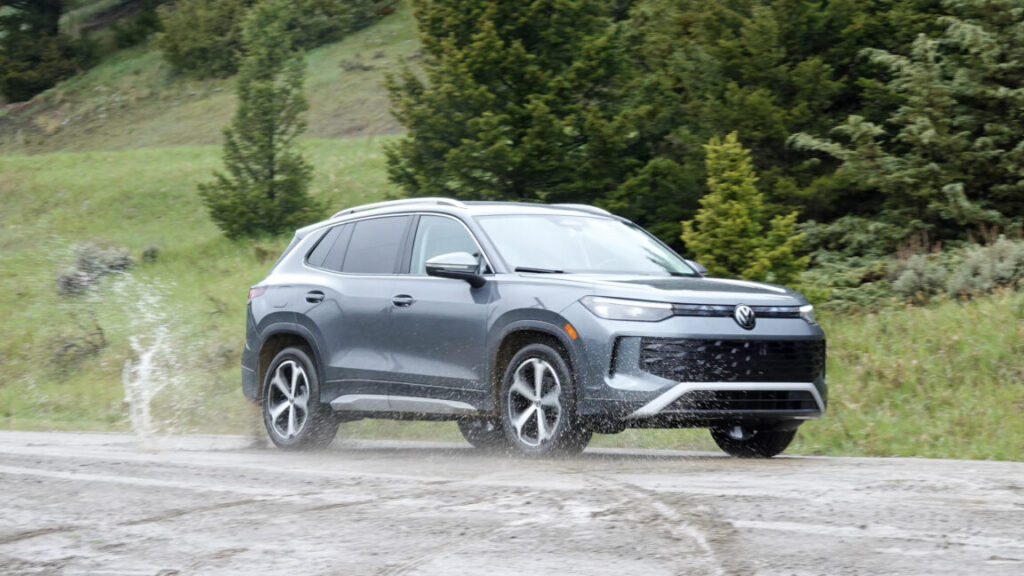
Within that fray, however, the new Volkswagen Tiguan stands apart. VW purposefully refined the third-gen Tiguan to cater better to American consumer needs, which meant dropping the third row to create more interior volume for the front and rear seats. The wheelbase still measures the same length at 109.9 inches (2,791 mm), but shorter overhangs mean the overall length actually shrinks by nearly two inches. Yet more efficient packaging on the inside also results in a marginal passenger volume increase of about two percent.
To help keep pricing attractive at below $30,000 to start, VW also decided to skip out on a hybrid variant, but the new EA888evo5 2.0 L turbocharged-four nonetheless delivers more power and improved fuel economy. And all of the above actually contributes to the Tiguan losing weight while evolving from the second to third generation, shaving about 160 lbs (72.5 kg), depending on trim.
There’s some ID.4 in here, but also a big helping of generic. Michael Teo Van Runkle
Generic outside, great inside
Volkswagen USA recently invited Ars to join a rainy test drive of the Tiguan’s SE and SEL R-Life trims in Bozeman, Montana. At first glance, the new exterior definitely hews more closely to current crossover trends, which the Tiguan arguably helped to inaugurate back in the late-2000s. There’s also a healthy dose of Volkswagen ID.4 design language throughout, especially at the nose. The interior truly steps up to a new level, though. I started out in an almost-base Tiguan SE, which means front-wheel drive and minimal options, not even onboard navigation.
Like most buyers, though, I connected my iPhone via Wireless CarPlay, which effectively makes onboard nav obsolete. And the SE’s 12.9-inch touchscreen atop the dash provides all the necessary tech, as premium materials throughout clearly prioritize touchpoints to enhance the impression of quality.
Among the changes are better aero, shorter gearing, and the return of the Touring.
The Porsche 911 GT3 is to other 911s as other 911s are to regular cars. Credit: Jonathan Gitlin
VALENCIA, SPAIN—A Porsche 911 is rather special compared to most “normal” cars. The rear-engined sports car might be bigger and less likely to swap ends than the 1960s version, but it remains one of the more nimble and engaging four-wheeled vehicles you can buy. The 911 comes in a multitude of variants, but among driving enthusiasts, few are better regarded than the GT3. And Porsche has just treated the current 911 GT3 to its midlife refresh, which it will build in regular and Touring flavors.
The GT3 is a 911 you can drive to the track, spend the day lapping, and drive home again. It’s come a long way since the 1999 original—that car made less power than a base 911 does now. Now, the recipe is a bit more involved, with a naturally aspirated flat-six engine mounted behind the rear axle that generates 502 hp (375 kW) and 331 lb-ft (450 Nm) and a redline that doesn’t interrupt play until 9,000 rpm. You’ll need to exercise it to reach those outputs—peak power arrives at 8,500, although peak torque happens a bit sooner at around 6,000 revs.
It’s a mighty engine indeed, derived from the racing version of the 911, with some tweaks for road legality. So there are things like individual throttle valves, dry sump lubrication, solid cam finger followers (instead of hydraulic valve lifters), titanium con rods, and forged pistons.
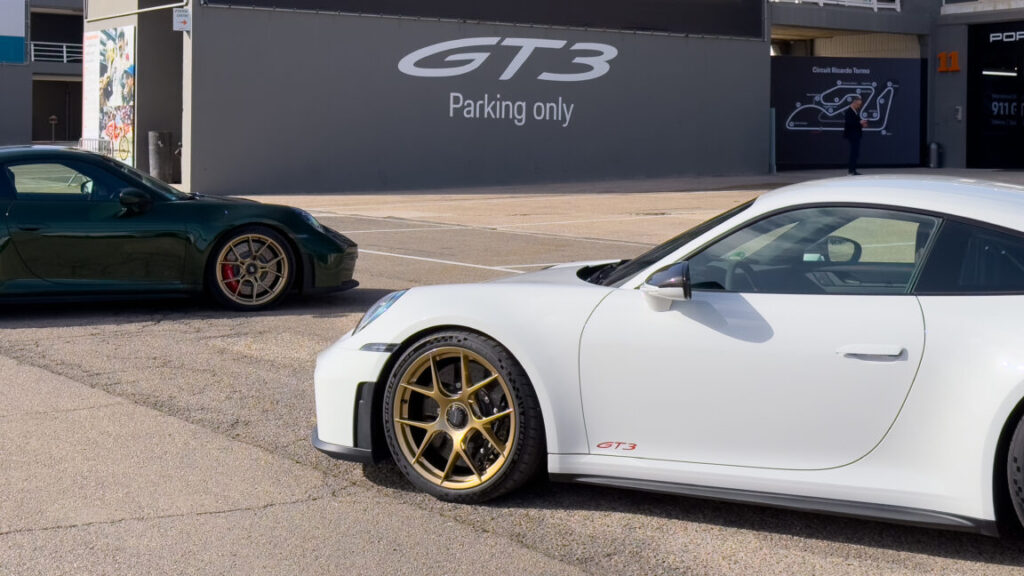
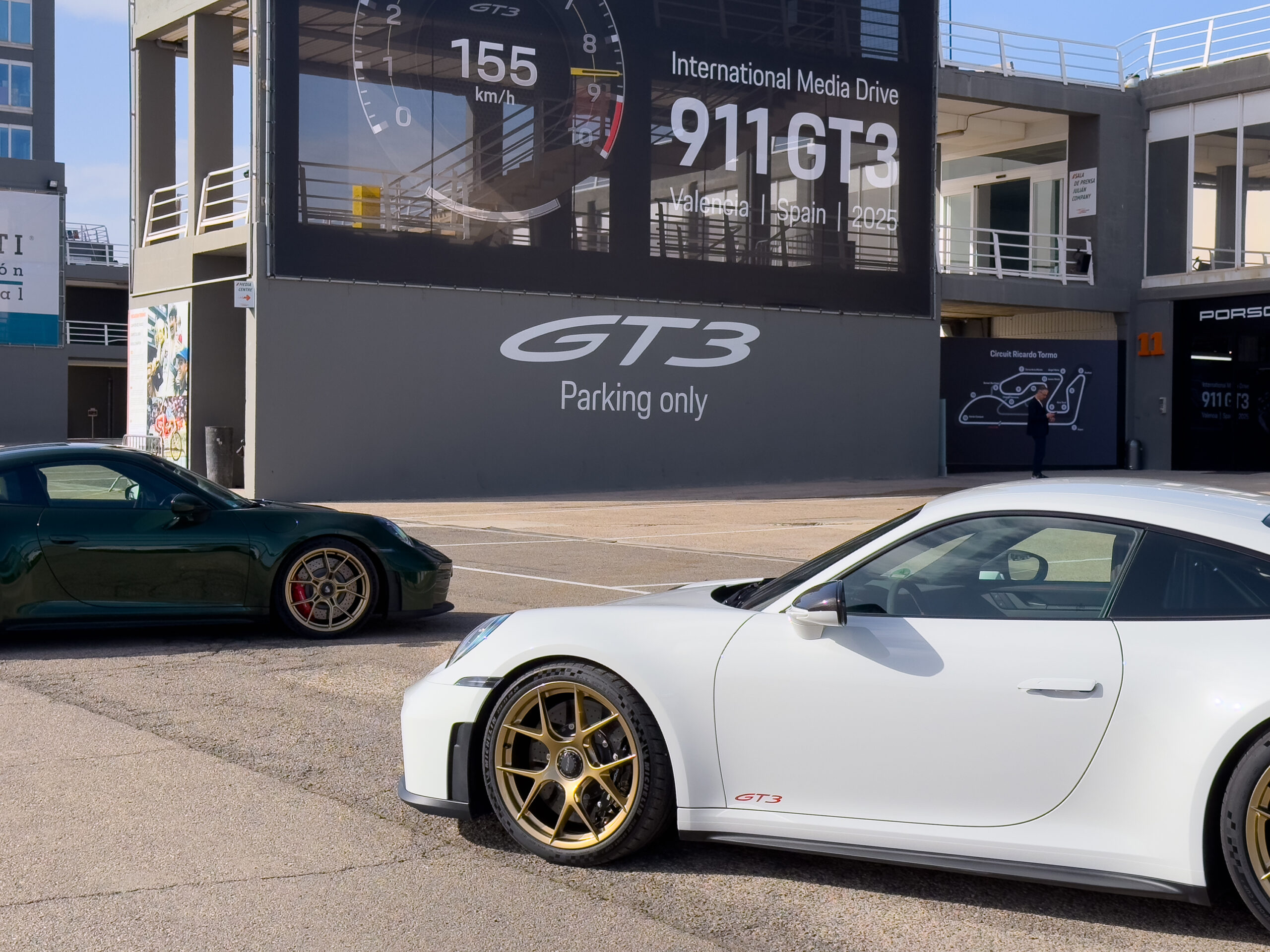
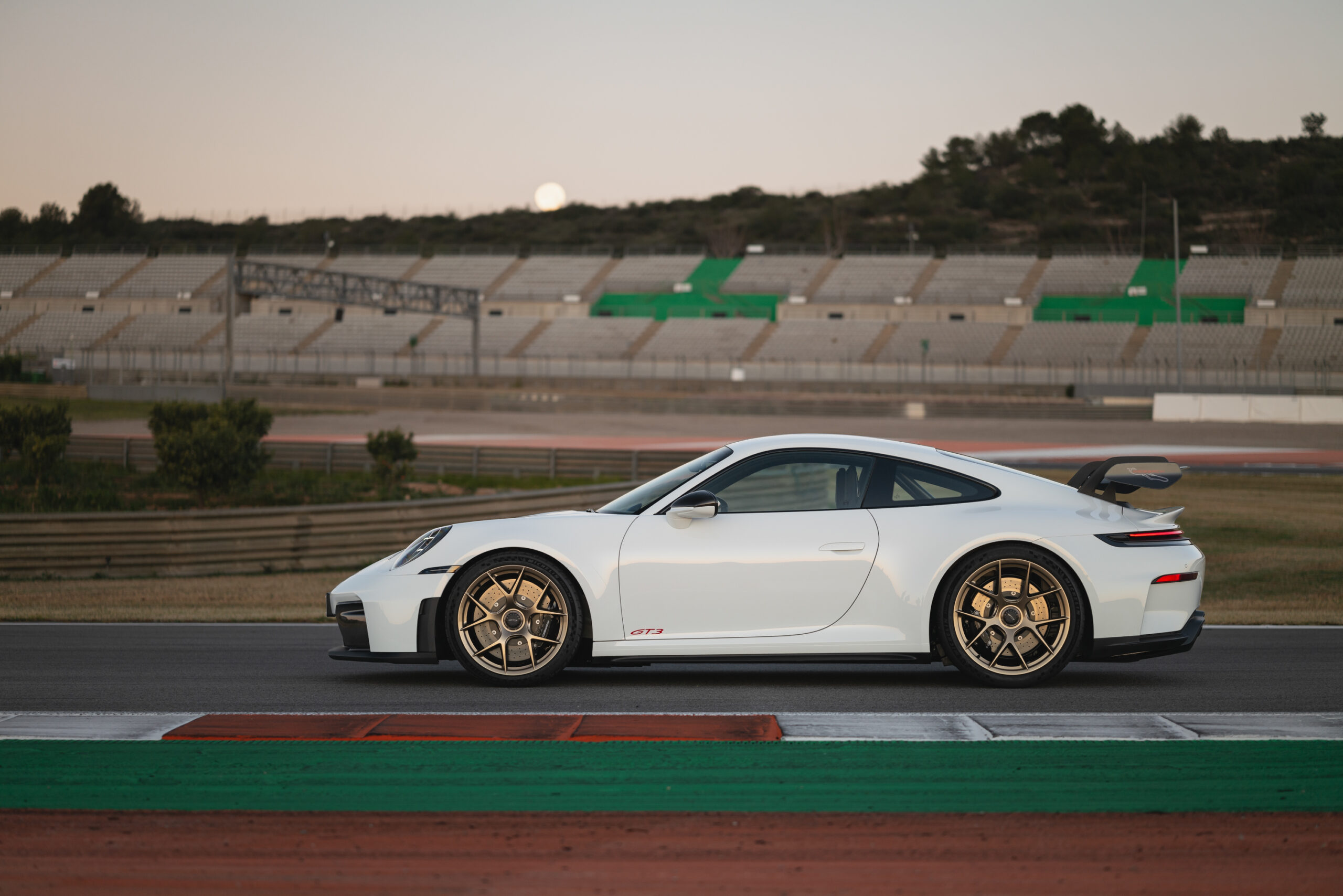
I’ve always liked GT3s in white.
For this car, Porsche has also worked on reducing its emissions, fitting four catalytic converters to the exhaust, plus a pair of particulate filters, which together help cut NOx emissions on the US test cycle by 44 percent. This adds 3 lbs (1.4 kg) of mass and increases exhaust back pressure by 17 percent. But there are also new cylinder heads and reprofiled camshafts (from the even more focused, even more expensive GT3 RS), which increase drivability and power delivery in the upper rev range by keeping the valves open for longer.
Those tweaks might not be immediately noticeable when you look at last year’s GT3, but the shorter gearing definitely will be. The final drive ratios for both the standard seven-speed PDK dual-clutch gearbox and the six-speed manual have been reduced by 8 percent. This lowers the top speed a little—a mostly academic thing anyway outside of the German Autobahn and some very long runways—but it increases the pulling force on the rear wheels in each gear across the entire rev range. In practical terms, it means you can take a corner in a gear higher than you would in the old car.
There have been suspension tweaks, too. The GT3 moved to double front wishbone suspension (replacing the regular car’s MacPherson struts) in 2021, but now the front pivot point has been lowered to reduce the car diving under braking, and the trailing arms have a new teardrop profile that improves brake cooling and reduces drag a little. Porsche has altered the bump stops, giving the suspension an inch (24 mm) more travel at the front axle and slightly more (27 mm) at the rear axle, which in turn means more body control on bumpy roads.
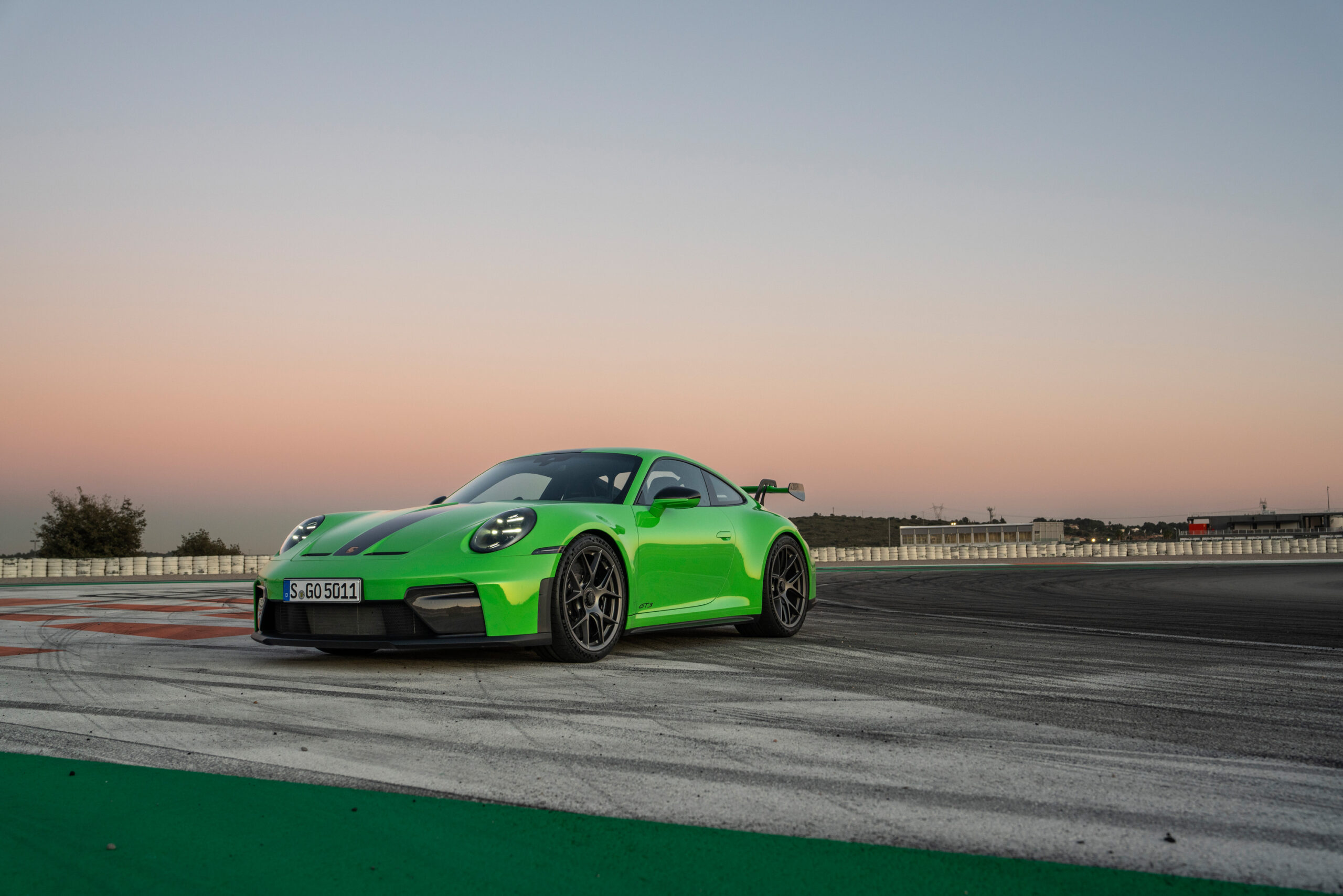
Credit: Porsche
New software governs the power steering. Because factors like manufacturing tolerances, wear, and even temperature can alter how steering components interact with each other, the software automatically tailors friction compensation to axle friction. Consequently, the steering is more precise and more linear in its behavior, particularly in the dead-ahead position.
The GT3 also has new front and rear fascias, again derived from the racing GT3. There are more cooling inlets, vents, and ducts, plus a new front diffuser that reduces lift at the front axle at speed. Porsche has tuned the GT3’s aerodynamics to be constant across the speed range, and like the old model, it generates around 309 lbs (140 kg) of downforce at 125 mph (200 km/h). Under the car, there are diffusers on the rear lower wishbones, and Porsche has improved brake and driveshaft cooling.
Finally, Porsche has made some changes to the interior. For instance, the GT3 now gains the same digital display seen on other facelifted 911s (the 992.2 generation if you’re a Porsche nerd), similar to the one you’d find in a Taycan, Macan, or Panamera.
Some people may mourn the loss of the big physical tachometer, but I’m not one of them. The car has a trio of UI settings: a traditional five-dial display, a more reduced three-dial display, and a track mode with just the big central tach, which you can reorient so the red line is at 12 o’clock, as was the case with many an old Porsche racing car, rather than its normal position down around 5 o’clock. And instead of a push button to start the car, there’s a twister—if a driver spins on track, it’s more intuitive to restart the car by twisting the control the way you would a key.
You can see the starter switch on the left of the steering wheel. Porsche
Finally, there are new carbon fiber seats, which now have folding backrests for better access to the rear. (However, unless I’m mistaken, you can’t adjust the angle of the backrest.) In a very clever and welcome touch, the headrest padding is removable so that your head isn’t forced forward when wearing a helmet on track. Such is the attention to detail here. (Customers can also spec the car with Porsche’s 18-way sports seats instead.)
Regular, Touring, Lightweight, Wiessach
In fact, the new GT3 is available in two different versions. There’s the standard car, with its massive rear wing (complete with gooseneck mounts), which is the one you’d pick if your diet included plenty of track days. For those who want a 911 that revs to 9 but don’t plan on spending every weekend chasing lap times, Porsche has reintroduced the GT3 Touring. This version ditches the rear wing for the regular 911 rear deck, the six-speed manual is standard (with PDK as an option), and you can even specify rear seats—traditionally, the GT3 has eliminated those items in favor of weight saving.
Of course, it’s possible to cut even more weight from the GT3 with the Weissach Pack for the winged car or a lightweight package for the Touring. These options involve lots of carbon fiber bits for the interior and the rear axle, a carbon fiber roof for the Touring, and even the option of a carbon fiber roll cage for the GT3. The lightweight package for the touring also includes an extra-short gear lever with a shorter throw.
The track mode display might be too minimalist for road driving—I tend to like being able to see my directions as well as the rpm and speed—but it’s perfect for track work. Note the redline at 12 o’clock. Porsche
Although Porsche had to add some weight to the 992.2 compared to the 992.1 thanks to thicker front brake discs and more door-side impact protection, the standard car still weighs just 3,172 lbs (1,439 kg), which you can reduce to 3,131 lbs (1,420 kg) if you fit all the lightweight goodies, including the ultra-lightweight magnesium wheels.
Behind the wheel
I began my day with a road drive in the GT3 Touring—a PDK model. Porsche wasn’t kidding about the steering. I hesitate to call it telepathic, as that’s a bit of a cliché, but it’s extremely direct, particularly the initial turn-in. There’s also plenty of welcome feedback from the front tires. In an age when far too many cars have essentially numb steering, the GT3 is something of a revelation. And it’s proof that electronic power steering can be designed and tuned to deliver a rewarding experience.
The cockpit ergonomics are spot-on, with plenty of physical controls rather than relegating everything to a touchscreen. If you’re short like me and you buy a GT3, you’ll want to have the buckets set for your driving position—while the seat adjusts for height, as you raise it up, it also pitches forward a little, making the seat back more vertical than I’d like. (The seats slide fore and aft, so they’re not quite fixed buckets as they would be in a racing car.)
The anti-dive effect of that front suspension is quite noticeable under braking, and in either Normal or Sport mode, the damper settings are well-calibrated for bumpy back roads. It’s a supple ride, if not quite a magic carpet. On the highway, the Touring cruises well, although the engine can start to sound a little droning at a constant rpm. But the highway is not what the GT3 is optimized for.
On a dusty or wet road, you need to be alert if you’re going to use a lot of throttle at low speed. Jonathan Gitlin
On windy mountain roads, again in Normal or Sport, the car comes alive. Second and third gears are perfect for these conditions, allowing you to keep the car within its power band. And boy, does it sound good as it howls between 7,000 and 9,000 rpm. Porsche’s naturally aspirated flat-sixes have a hard edge to them—the 911 RSR was always the loudest race car in the pack—and the GT3 is no exception. Even with the sports exhaust in fruity mode, there’s little of the pops, bangs, and crackles you might hear in other sports cars, but the drama comes from the 9000 rpm redline.
Porsche asked us to keep traction control and ESC enabled during our drive—there are one-touch buttons to disable them—and given the muddy and dusty state of the roads, this was a wise idea. (The region was beset by severe flooding recently, and there was plenty of evidence of that on the route.) Even with TC on, the rear wheels would break traction if you were injudicious with the throttle, and presumably that would be the same in the wet. But it’s very easy to catch, even if you are only of moderate driving ability, like your humble correspondent.
After lunch, it was time to try the winged car, this time on the confines of the Ricardo Torno circuit just outside the city. On track, the handling was very neutral around most of the corners, with some understeer through the very slow turn 2. While a low curb weight and more than 500 hp made for a very fast accelerating car, the braking performance was probably even more impressive, allowing you to stand on the pedal and shed speed with no fade and little disturbance to the body control. Again, I am no driving god, but the GT3 was immensely flattering on track, and unlike much older 911s, it won’t try to swap ends on you when trail-braking or the like.
The landing was not nearly as jarring as you might think. Porsche
After some time behind the wheel, I was treated to some passenger laps by one of my favorite racing drivers, the inimitable Jörg Bergmeister. Unlike us journalists, he was not required to stay off the high curbs, and he demonstrated how well the car settles after launching its right-side wheels into the air over one of them. It settles down very quickly! He also demonstrated that the GT3 can be plenty oversteer-y on the exit of corners if you know what you’re doing, aided by the rear-wheel steering. It’s a testament to his driving that I emerged from two passenger laps far sweatier than I was after lapping the track myself.
The GT3 and GT3 Touring should be available from this summer in the US, with a starting price of $222,500. Were I looking for a 911 for road driving, I think I might be more tempted by the much cheaper 911 Carrera T, which is also pared to the bone weight-wise but uses the standard 380 hp (283 kW) turbocharged engine (which is still more power than the original GT3 of 1999). That car delivers plenty of fun at lower speeds, so it’s probably more useable on back roads.
Credit: Porsche
But if you want a 911 for track work, this new GT3 is simply perfect.
Jonathan is the Automotive Editor at Ars Technica. He has a BSc and PhD in Pharmacology. In 2014 he decided to indulge his lifelong passion for the car by leaving the National Human Genome Research Institute and launching Ars Technica’s automotive coverage. He lives in Washington, DC.
Drag optimization means it’s very quiet inside, but it’s also quite expensive.
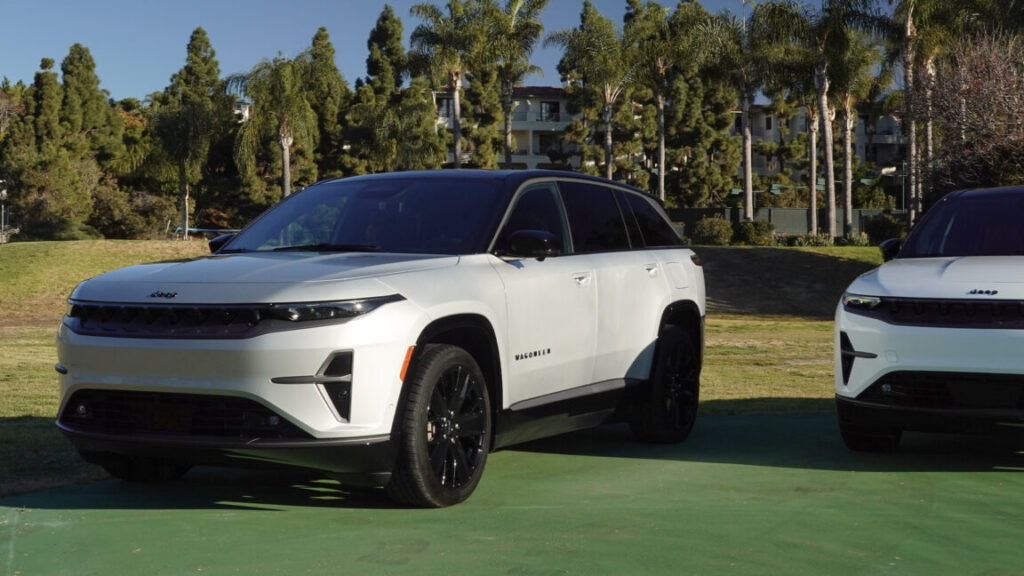
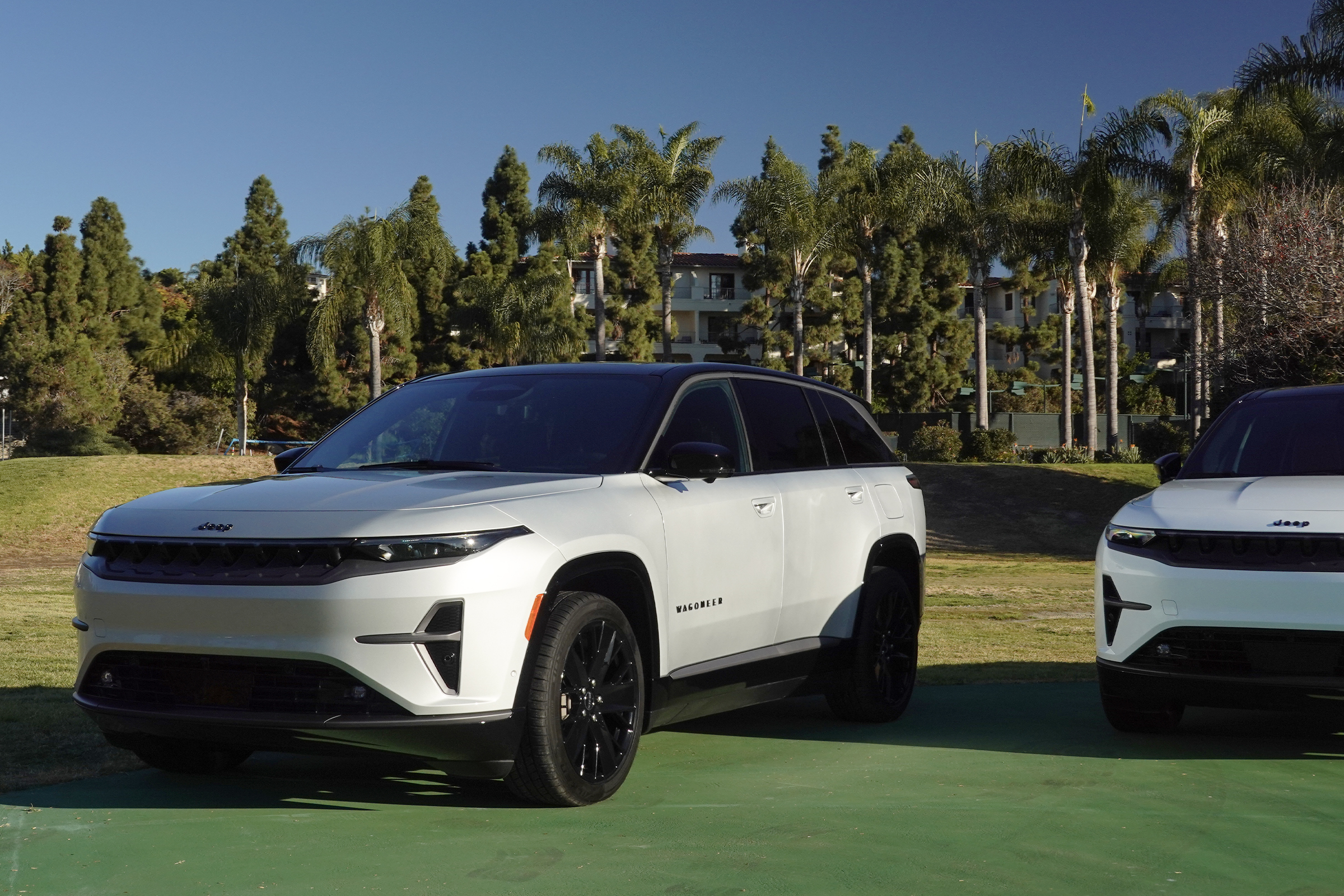
The Wagoneer S is more like an electric Cherokee than a Wrangler EV. Credit: Michael Teo Van Runkle
This year marks the return of the Jeep Wagoneer, which formerly served as a more luxurious version of the Cherokee, but now hits the market as Jeep’s first full EV. The challenge? How to merge the modern electric lifestyle with the outdoorsy, rugged ethos that defines Jeep as a brand, alongside the more recent addition of the internal-combustion Grand Wagoneer SUV’s enormous luxury.
First of all, the new Wagoneer S wound up much smaller in person than I expected. The overall profile falls more in line with the shape of mid-size electric crossovers including the Kia EV6, Hyundai Ioniq 5, Chevrolet Equinox, and of course, Tesla’s Model Y. But the interior volume belies that relatively compact exterior, with plenty of space for me at 6’1″ (185 cm) to sit comfortably in both the front and rear seats. Total cargo volumes of 30.6 cubic feet (866 L) with the second row up and 61 cubic feet (1,727 L) with the second row folded flat end up mattering less than the large floor footprint, because the height used to calculate those measurements drops with the low sloping roofline and rear window.
Much of the interior space can be attributed to packaging of the Wagoneer EV’s battery. Rather than going for all-out kilowatt-hours in a dedicated skateboard layout, Jeep instead used the Stellantis group’s STLA Large platform, in this case stuffed with a 100.5-kWh lithium ion pack built on 400 V architecture. That’s enough for an EPA-estimated 303 miles of range (487 km), a solid figure but not a seriously impressive efficiency stat. In comparison, the world-beating Lucid Air Pure RWD manages about 40 percent more range per kilowatt-hour and a Polestar 3 AWD does about 18 percent worse. Claimed DC fast charge times of 23 minutes for a 20-80 percent top up, or 100 miles (160 km) in 10 minutes similarly get the job done without standing out from the pack.
Credit: Jeep
That modular STLA Large chassis can house either a full internal-combustion engine, a hybrid powertrain, or fully electric components. The Wagoneer S uses two matching 335 hp (250 kW) motors, front and rear, for a combined 600 hp (447 kW) and 618 lb-ft of torque (838 Nm). In typical EV fashion, the latter comes on quick and makes this undoubtedly the fastest accelerating Jeep ever, as I learned while battling horrendous headwinds in fire-ravaged Southern California (which served as something of a nonstop reminder of the importance of taking baby steps, a la Jeep’s first EV, toward a more sustainable transportation future).
Pushing deep into the “throttle” pedal, the Wagoneer S will happily chirp all four tires in Sport mode. And the jerk thrusting my torso and skull back into the plush seat suggests that Jeep’s claimed 0-60 mph time of 3.4 seconds might just be accurate, potentially thanks to being able to do a true launch by stepping on the brake and gas pedals simultaneously—possible because Jeep chose to retain more standard mechanical brakes rather than a brake-by-wire system as on the EV6/Ioniq siblings and Model Y.
The suspension tuning definitely trends toward the typical tautness of today’s crossover segment, where aspirational sporty dynamics can sometimes create harsh and uncomfortable ride quality. But I still might have ventured to call the Wagoneer S somewhat softer than most of the competition, until the roughest of roads revealed the 5,667 lb (2,570 kg) curb weight. For an EV, that figure falls roughly in the middle of the pack, but this crossover weighs about as much as a full-size internal-combustion three-row SUV.
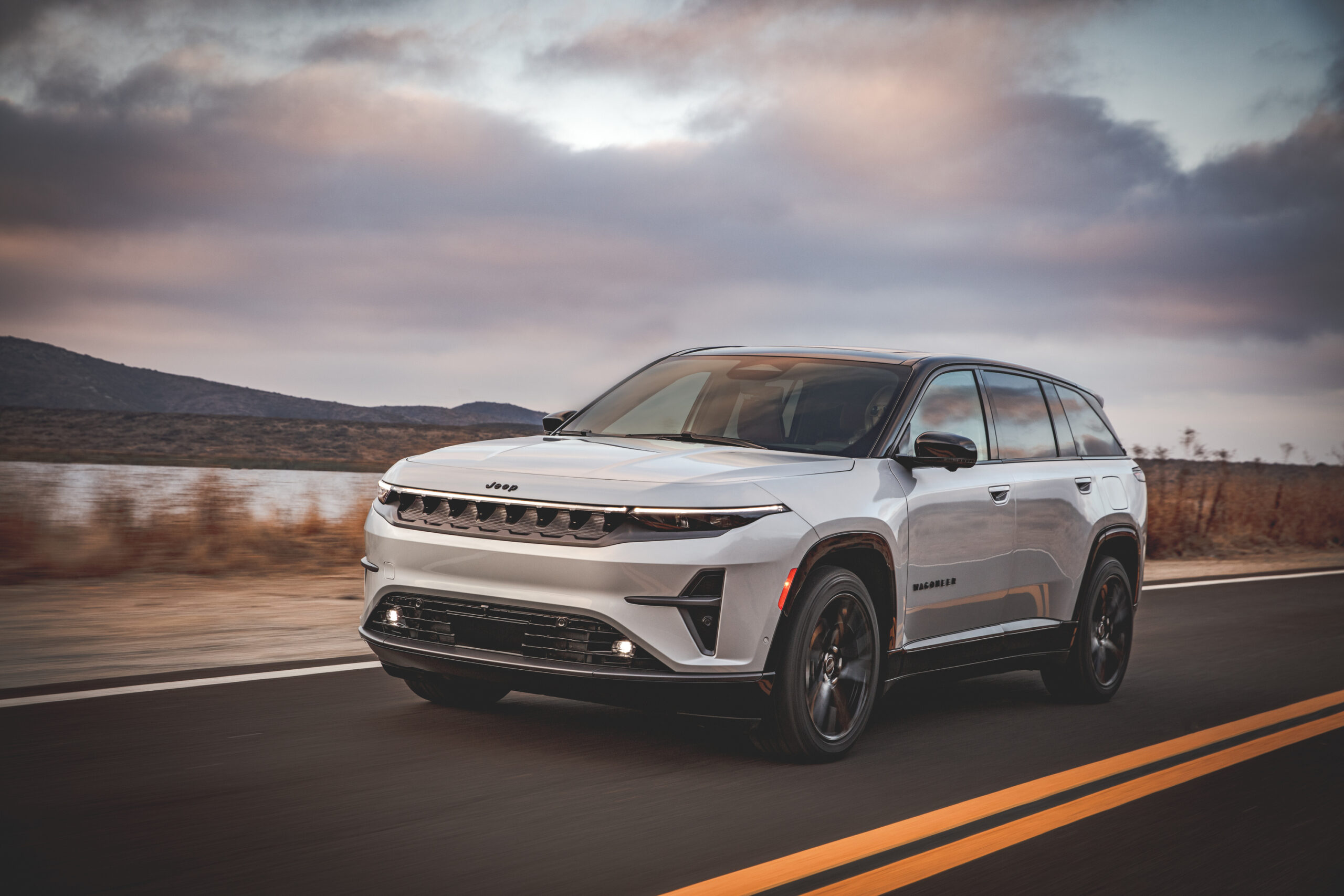
Still, even at highway speeds (in gale-force winds) or on those roughest of roads, the Wagoneer S remains shockingly quiet. And not just to enhance the experience of the Wagoneer S Launch Edition’s 1,200 W Macintosh sound system. Instead, Jeep exterior designer Vince Galante walked me through the design process, which kicked off with a targeted 0.30 coefficient of drag despite the need to stick with a squared-off, upright SUV posture typical of Jeeps throughout history.
“On the exterior design portion, the aerodynamic drag is our biggest contributor,” Galante told me. “It kind of comes up off the hood, up the A pillar, and tapers down towards the back, and finishes in a square, yet tapered pillar reminiscent of the original Wagoneer. But through the middle of the car, it’s basically ideal for what the wind wants to do.”
From the front or side perspective, this Wagoneer looks almost as boxy as a 1980s Jeep. But a rear viewing angle reveals the massive rear wing creating that illusion, which sits well off the sloping line of the rear roof and glass.
Credit: Michael Teo Van Runkle
“Anytime we do a floating element, we think ‘Yeah, there’s no way engineering’s gonna let us get away with this,'” Galante laughed. “We work really collaboratively with the engineers, and they were like, ‘Let’s test it. Let’s see what it does.’ And they came back and said, ‘You know, yeah, this has potential. But you guys gotta make it sit off the surface three times more dramatically.'”
Galante estimates the original wing design rose up two inches, while the final production version is more like nine inches off the rear window. He also pointed out a host of other less obvious details, from body panels that step in by fractions of millimeters to differently rounded radii of wheel arch edges, and especially the confluence where the A pillar connects to the body.
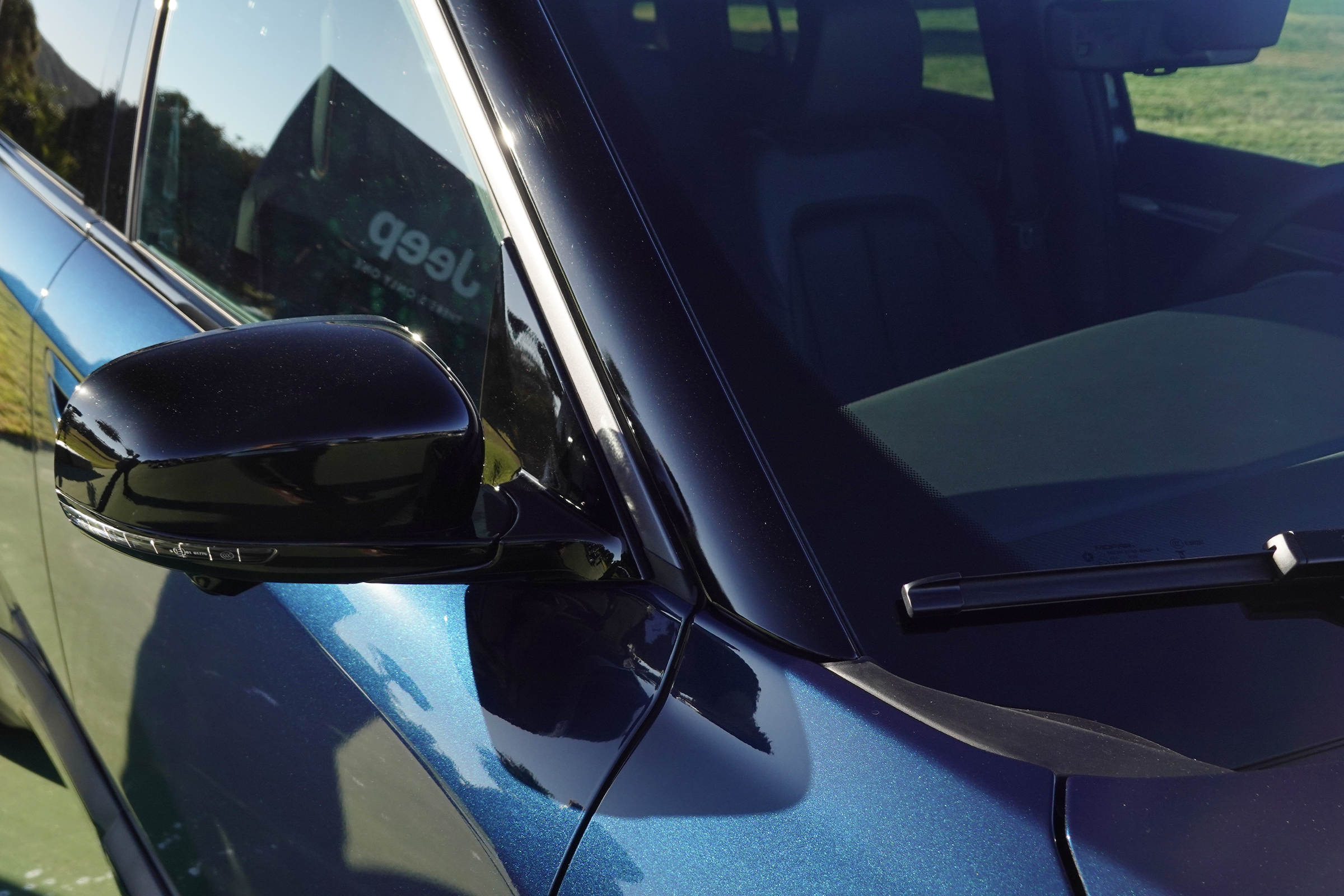
“The windshield, the A pillar, the side glass, the mirror, the post that holds the mirror, the fender, everything comes together there,” he said. “I think every vehicle I’ve ever worked on, that was the last thing to finalize in the wind tunnel… I mean, we’re talking tenths of millimeters for some of the iterations that we’re doing in those areas. Especially the front edge of the A pillar, I can recall trying twenty, thirty, forty different radii on there to get that just right.”
Credit: Michael Teo Van Runkle
All the aero considerations attempt to coax air to stick to surfaces, then break off suddenly and evenly. The rear wing therefore pushes air down toward the rear window, while creating as little turbulence as possible. The final range figure critically—and barely—cracking 300 miles justified so much refinement in Jeep’s new rolling road wind tunnel, thanks to a final Cd of 0.294. Maybe juggling production cost savings of the STLA Large platform dictated such extensive aerodynamic efforts more than a dedicated skateboard battery layout might have, but the resulting quietude that combating those inefficiencies produced does truly border on a luxury experience, even if we’re not quite at Audi (nor Lucid) levels of silence.
On the interior, Jeep also tried to lean into the Wagoneer S’s sustainability, using quality materials with textural designs and as little piano-black plastic as possible. The fabrics, plastics, and aluminum trim come almost entirely from recycled sources—62 percent for suede and 100 percent for fabric and carpeting, in fact—and you’ll see zero chrome anywhere on the car, since chroming is apparently one of the most environmentally deleterious processes in all of automaking.
But the Wagoneer S similarly leans into a tech-heavy user experience, with almost 55 inches of screen visible from the front seats: the gauge cluster, center infotainment, climate controls, passenger dash screen, and digital rearview mirror all contribute to that total. Climate control, especially, seems critical—and an often overlooked element for many EV manufacturers. Rather than a full panoramic glass roof, as on the Lucids and Polestars of the world, this Jeep gets a long sunroof with a retracting insulated cover to keep out heat. The excellent ventilated front and rear seats (and massaging, for the fronts!) also more efficiently cool down passengers.
For my taste, the digitalization of driving went a little too far. I never enjoy a rotating shift knob but this one clicks into gear with a positive heft. I also noticed some pixelation and latency in the gauge cluster’s navigation maps, as if the refresh rate was too slow for the speed I was driving. Not that I started ripping up the road too much in this luxury crossover, or at least, not more often than scientific experimentation demanded (and a similar problem also affected the Dodge Charger EV we drove recently).
Sport mode brought out some of my inner grinning child, but I actually preferred the Wagoneer S in Eco mode. So much power split to the front and rear wheels can create some torque steer, and throttle response that borders on touchy. The electrically assisted steering also prioritizes a heavy on-center zone, then snaps to light inputs with the slightest turn of the wheel, which made holding a steady line slightly distracting.
Instead, Eco dulls down the throttle response and the steering becomes a bit less reactive. The Wagoneer S will then also more regularly disconnect the front wheels for improved efficiency—though at the hubs, rather than the axles, so some reciprocating mass still saps precious electrons.
It would be more efficient to disconnect the rears, but this decision also centers around maintaining some semblance of Jeep-ness. Even if the Wagoneer S aligns most nearly with recent Cherokee and Grand Cherokee models, rather than the off-roady Wrangler and Gladiator or the super-luxe Grand Wagoneer. The forthcoming Trailhawk version promises to double down on the 4×4 capability, with a locking rear differential, better tires, and hopefully better suspension than I experienced on a quick sojourn off the asphalt onto a slightly rutted gravel road east of San Diego.
More importantly, cheaper trims will arrive later in 2025, also, since the Launch Edition’s tall ask of $71,995 almost doubles the starting sticker of a Equinox EV, seriously eclipses either a Model Y, EV6, or Ioniq 5, and also somehow costs more than a Polestar 3 or even a Lucid Air. Jeep so far wants to keep pricing for those lower-spec Wagoneer EVs under wraps, though, even if the heart of the run will undoubtedly help the first electric Jeep more effectively escape from unfortunate comparisons to such stiff competition.
HEALDSBURG, Calif.—Earlier this summer, Ars got its first drive of Audi’s new Q6 e-tron on some very wet roads in Spain. Then, we were driving pre-production Q6s in Euro-spec. Now, the electric SUV is on sale in the US, with more power in the base model and six months more refinement for its software. But the venue change did not bring a change of weather—heavy rain was the order of the day, making me wonder if Audi is building its new electric vehicle on the site of an ancient rain god’s temple?
Of all its rivals, Audi appears to have settled into a nomenclature for its vehicles that at least makes a little sense. Odd numbers are for internal combustion engines, even numbers for EVs, although it also appends “e-tron” on the end to make that entirely clear… and give francophones something to snicker about. (Yes, the e-tron GT does not fit into this schema, but nobody’s perfect.)
The Q6 e-tron is also the most advanced EV to wear Audi’s four rings. Built on a new architecture called PPE (premium platform electric), at its heart is an 800 V powertrain with a 100 kWh (94.4 kWh useable) lithium-ion battery pack that powers a permanently excited synchronous motor driving the rear wheels, and in the case of the quattro versions, an asynchronous motor. The electric motors have 30 percent less energy consumption than those used in the Q8 e-tron, and are smaller and lighter.
That makes it a lot more up to date than the Q8 e-tron, which uses a modified version of Audi’s venerable MLB Evo platform, or the smaller Q4 e-tron, a somewhat disappointing electric crossover that’s essentially a Volkswagen ID.4 with a glow-up. That goes for the Q6 e-tron’s electronics, which are also a generation newer than the Q4 e-tron, and also more capable.
Audi is starting off US Q6 e-tron sales with a pair of models, the $65,800 Q6 e-tron quattro and the $72,900 SQ6 e-tron quattro. A $63,800 single-motor (not-quattro) Q6 e-tron will be available in time, with 302 hp (225 kW) and an EPA range of 321 miles (517 km), but we’ll have to wait a while before we get behind the wheel of that one.
Adding electric power and a battery turns the Urus from hit-or-miss to just right.
The original Urus was an SUV that nobody particularly wanted, even if the market was demanding it. With luxury manufacturers tripping over themselves to capitalize on a seemingly limitless demand for taller all-around machines, Lamborghini was a little late to the party.
The resulting SUV has done its job, boosting Lamborghini’s sales and making up more than half of the company’s volume last year. Even so, the first attempt was just a bit tame. That most aggressive of supercar manufacturers produced an SUV featuring the air of the company’s lower, more outrageous performance machines, but it didn’t quite deliver the level of prestige that its price demanded.
The Urus Performante changed that, adding enough visual and driving personality to make itself a legitimately exciting machine to drive or to look at. Along the way, though, it lost a bit of the most crucial aspect of an SUV: everyday livability. On paper, the Urus SE is just a plug-in version of the Urus, with a big battery adding some emissions-free range. In reality, it’s an SUV with more performance and more flexibility, too. This is the Urus’ Goldilocks moment.
If you’re looking for something subtle, you shouldn’t be looking at an Urus. Credit: Tim Stevens
The what
The Urus SE starts with the same basic platform as the other models in the line, including a 4.0 L turbocharged V8 that drives all four wheels through an eight-speed automatic and an all-wheel-drive system.
All that has received a strong dose of electrification, starting with a 25.9 kWh battery pack sitting far out back that helps to offset the otherwise nose-heavy SUV while also adding a playful bit of inertia to its tail. More on that in a moment.
That battery powers a 189 hp (141 kW) permanent-magnet synchronous electric motor fitted between the V8 and its transmission. The positioning means it has full access to all eight speeds and can drive the car at up to 81 mph (130 km/h). That, plus a Lamborghini-estimated 37 miles (60 km) of range, means this is a large SUV that could feasibly cover a lot of people’s commutes emissions-free.
The V8 lives here. Credit: Tim Stevens
But when that electric motor’s power is paired with the 4.0 V8, the result is 789 hp (588 kW) total system power delivered to all four wheels. And with the electric torque coming on strong and early, it not only adds shove but throttle response, too.
Other updates
At a glance, the Urus SE looks more or less the same as the earlier renditions of the same SUV. Look closer, though, and you’ll spot several subtle changes, including a hood that eases more gently into the front fenders and a new spoiler out back that Lamborghini says boosts rear downforce by 35 percent over the Urus S.
Far and away the most striking part of the car, though, are the 22-inch wheels wrapped around carbon-ceramic brakes. They give this thing the look of a rolling caricature of a sport SUV in the best way possible. On the body of the machine itself, you’ll want to choose a properly eye-catching color, like the Arancio Egon you see here. I’ve been lucky to drive some pretty special SUVs over the years, and none have turned heads like this one did when cruising silently through a series of small Italian towns.
Things are far more same-y on the inside. At first blush, nothing has changed inside the Urus SE, and that’s OK. You have a few new hues of Technicolor hides to choose from—the car you see here is outfitted in a similarly pungent orange to its exterior color, making it a citrus dream through and through. The sports seats aren’t overly aggressive, offering more comfort than squeeze, but I’d say that’s just perfect.
Buttons and touchscreens vie with less conventional controls inside the Urus. Tim Stevens
But that’s all much the same as prior Urus versions. The central infotainment screen is slightly larger at 12.3 inches, and the software is lightly refreshed, but it’s the same Audi-based system as before. A light skinning full of hexagons makes it look and feel a little more at home in a car with a golden bull on the nose.
Unfortunately, while the car is quicker than the original model, the software isn’t. The overall experience is somewhat sluggish, especially when moving through the navigation system. Even the regen meter on the digital gauge cluster doesn’t change until a good half-second after you’ve pressed the brake pedal, an unfortunate place for lag.
The Urus SE offers six drive modes: Strada (street), Sport, Corsa (track), Sabbia (sand), Terra (dirt), and Neve (snow). There’s also a seventh, customizable Ego mode. As on earlier Urus models, these modes must be selected in that sequence. So if you want to go from Sport back to Strada, you need to cycle the mode selector knob five times—or go digging two submenus deep on the touchscreen.
Those can be further customized via a few buttons added beneath the secondary drive mode lever on the right. The top button enables standard Hybrid mode, where the gasoline and electric powertrains work together as harmoniously as possible for normal driving. The second button enters Recharge mode, which instructs the car to prioritize battery charge. The third and lowest button enters Performance mode, which gives you maximum performance from the hybrid system at the expense of charge.
Finally, a quick tug on the mode selector on the right drops the Urus into EV Drive.
Silent running
I started my time in the Urus SE driving into the middle of town, which was full of narrow streets, pedestrian-friendly speed limits, and aggressively piloted Fiats. Slow and steady is the safest way in these situations, so I was happy to sample the Urus’ all-electric mode.
To put it simply, it delivers. There’s virtually no noise from the drivetrain, a near-silent experience at lower speeds that help assuage the stress such situations can cause. The experience was somewhat spoiled by some tire noise, but I’ll blame that on the Pirelli Scorpion Winter 2 tires outfitted here. I can’t, however, blame the tires for a few annoying creaks and rattles, which isn’t exactly what I’d expect from an SUV at this price point.
Though there isn’t much power at your disposal in this mode, the Urus can still scoot away from lights and stop signs quickly and easily, even ducking through small gaps in tiny roundabouts.
It might not be subtle, but it can be practical. Credit: Tim Stevens
Dip more than three-quarters of the way into the throttle, though, and that V8 fires up and quickly joins the fun. The hand-off here can be a little less than subtle as power output surges quickly, but in a moment, the car goes from a wheezy EV to a roaring Lamborghini. And unlike a lot of plug-ins that stubbornly refuse to shut their engines off again when this happens, another quick pull of the EV lever silences the thing.
When I finally got out of town, I shifted over to Strada mode, the default mode for the Urus. I found this mode a little too lazy for my tastes, as it was reluctant to shift down unless I dipped far into the throttle, resulting in a bucking bull of acceleration when the eight-speed automatic finally complied.
The car only really came alive when I put it into Sport mode and above.
Shifting to Sport
Any hesitation or reluctance to shift is quickly obliterated as soon as you tug the drive mode lever into Sport. The SUV immediately forgets all about trying to be efficient, dropping a gear or two and making sure you’re never far from the power band, keeping the turbo lag from the V8 to a minimum.
The tachometer gets some red highlights in this mode, but you won’t need to look at it. There’s plenty of sound from the exhaust, augmented by some digital engine notes I found to be more distracting and unnecessary than anything. Most importantly, the overall feel of the car changes dramatically. It leaps forward with the slightest provocation of the right pedal, really challenging the grip of the tires.
In my first proper sampling of the full travel of that throttle pedal, I was surprised at how quickly this latest Urus got frisky, kicking its tail out with an eager wag on a slight bend to the right. It wasn’t scary, but it was just lively enough to make me smile and feel like I was something more than a passenger in a hyper-advanced, half-electric SUV.
Credit: Tim Stevens
In other words, it felt like a Lamborghini, an impression only reinforced as I dropped the SUV down to Corsa mode and really let it fly. The transmission is incredibly eager to drop gears on the slightest bit of deceleration, enough so that I rarely felt the need to reach for the column-mounted shift paddles.
But despite the eagerness, the suspension remained compliant and everyday-livable in every mode. I could certainly feel the (many) imperfections in the rural Italian roads more when the standard air suspension was dialed over to its stiffest, but even then, it was never punishing. And in the softest setting, the SUV was perfectly comfortable despite those 22-inch wheels and tires.
I didn’t get a chance to sample the SUV’s off-road prowess, but the SE carries a torque-vectoring rear differential like the Performante, which should mean it will be as eager to turn and drift on loose surfaces as that other, racier Urus.
Both the Urus Performante and the SE start at a bit over $260,000, which means choosing between the two isn’t a decision to be made on price alone. Personally, I’d much prefer the SE. It offers plenty of the charm and excitement of the Performante mixed with even better everyday capability than the Urus S. This one’s just right.
Perched in the driver’s seat, I’m not sure why you would need to be, anyway. Nothing about the Buzz’s driving style demands you rag it through the corners, although the car coped very well on the very twisty sections of our route up the shore of the Tomales Bay.
Like last week’s Porsche Macan, the single-motor model is the one I’d pick—again, it’s the version that’s cheaper, lighter, and has a longer range, albeit only just. And this might be the biggest stumbling block for some Buzz fans who were waiting to push the button. With 86 kWh useable (91 kWh gross), the RWD Buzz has an EPA range estimate of 234 miles (377 km). Blame the frontal area, which remains barn door-sized, even if the drag coefficient is a much more svelte 0.29.
Fast-charging should be relatively fast, though, peaking at up to 200 kW and with a 26-minute charge time to go from 10 to 80 percent state of charge. And while VW EVs will gain access to the Tesla supercharger network with an adapter, expect 2025 Buzzes to come with CCS1 ports, not native NACS for now.
I expect most customers to opt for all-wheel drive, but again, American car buyer tastes are what they are. This adds an asynchronous motor to the front axle and boosts combined power to 335 hp (250 kW). VW hasn’t given a combined torque figure, but the front motor can generate up to 99 lb-ft (134 Nm) together with the 413 lb-ft from the rear. The curb weight for this version is 6,197 lbs (2,811 kg), and its EPA range is 231 miles (376 km).
It’s a bit of a step up in price, however, as you need to move up to the Pro S Plus trim if you want power for both axles. This adds more standard equipment to what is already a well-specced base model, but it starts at $67,995 (or $63,495 for the RWD Pro S Plus).
I was driving the lead Buzz on the day we drove, but this photo is from the day before, when it wasn’t gray and rainy in San Francisco. Credit: Volkswagen
While I found the single-motor Buzz to be a more supple car to drive down a curvy road, both powertrain variants have an agility that belies their bulk, particularly at low speed. To begin our day, VW had all the assembled journalists re-create a photo of the vans driving down Lombard St. Despite a very slippery and wet surface that day, the Buzz was a cinch to place on the road and drive slowly.
Enlarge/ The Polestar 4 is the latest entrant into the crowded midsize luxury electric SUV segment. We think it has what it takes to stand out.
Jonathan Gitlin
“If you’re going to make a car and use all that energy, it should be a good car,” said Thomas Ingenlath, CEO of Polestar. Ingenlath was referring to the company’s latest electric vehicle, a midsize SUV with striking coupe looks called the Polestar 4. While Ingenlath is on point from a sustainability perspective, it makes good business sense, too. The Polestar 4 needs to be a good car to stand out as it enters one of the most hotly contested segments of the market.
In fact, Polestar uses less energy to make its latest EV than anything else in its range—the company quotes a carbon footprint of 19.9 tonnes of CO2 from cradle to gate. Like some other automakers, Polestar is using a monomaterial approach to the interior to make recycling easier, choosing the same base plastic for all the components in a particular piece of trim, for example.
The carpets are made from, variously, recycled fishing nets or plastic bottles. The vinyl seats use pine oil instead of the stuff extracted from the ground, and the knitted upholstery fabric—also recycled plastic bottles—was designed to leave no off-cuts.
The headlights are a Polestar trademark now, even though there have been just four models so far.
Jonathan Gitlin
Coupe-like looks, SUV-like practicality.
Jonathan Gitlin
No, your eyes don’t deceive you, there is no rear windshield.
Jonathan Gitlin
The interior is inspired by sportswear.
Jonathan Gitlin
The back seat of the Polestar 4 outdoes rivals from Porsche, BMW, Audi, and Mercedes-Benz.
Jonathan Gitlin
At night, LEDs illuminate the interior from behind textile trim panels. The colors are switchable depending on which theme you have the car set to—more on that later.
Jonathan Gitlin
The fastest Polestar yet
In addition to being the greenest Polestar so far, this one is also the most performant. We tested the $62,900 Long Range Dual Motor version, which can send up to 536 hp (400 kW) and 506 lb-ft (686 Nm) to the wheels. Pick this version and you should see 270 miles (434 km) from the 100 kWh battery pack. In a suitable location like a motorway toll booth, 60 mph arrives in 3.7 seconds (100 km/h in 3.8).
That’s if you’re in performance mode, at least. Switch to range mode, and clutches disconnect the front permanent magnet synchronous motor and remap the throttle pedal for better efficiency. There’s also a heat pump as standard. The car can DC fast-charge at rates of up to 200 kW, which should take the battery pack from 10 to 80 percent state of charge in 30 min. At home on an 11 kW AC charger, 0–100 percent SoC should take about 11 hours.
There is also a Long Range Single Motor variant with precisely half the power and torque but an EPA range of 300 miles (482 km). Driven by just its rear wheels, the Polestar 4 has more modest performance—60 mph arrives in 6.9 seconds, 100 km/h in 7.1—but it also carries a $8,000-cheaper price, starting at $54,900. New tariffs on Chinese-made EVs have come into effect, but Polestar told Ars that it is sticking with the original pricing. Next year, production of US-market Polestar 4s will begin in South Korea, which will mean significantly smaller import tariffs. (This story originally stated there had been a $10,000 price increase; this was incorrect.)
Jonathan Gitlin
It’s surprisingly good to drive
It has to be said: Making an electric car go fast is not particularly difficult. Electric motors generate most of their torque almost immediately, and unlike with a combustion motor, if you increase the peak power, there isn’t really an efficiency hit lower down the performance envelope. So even a 3-ton monster can get hurled down the road rapidly enough to embarrass a whole lot of supercars.
The Polestar 4 isn’t quite that heavy—5,192 lbs (2,355 kg)—so it forgoes air suspension in favor of conventional coil springs and dampers. These are passive in the Single Motor, but the Dual Motor is equipped with active dampers as standard, and if you choose the performance pack, it’s upgraded with stiffer springs and antiroll bars and new damper tuning.
Our test car was so equipped, and it was a noticeably firm ride, particularly when sitting in the back. There was also a bit of wind noise at speed, but more tire roar, thanks presumably to the performance pack’s 22-inch wheels.
Enlarge/ The introduction of model year 2025 brings a retractable hard-top option for the McLaren Artura, plus a host of other upgrades.
McLaren
MONACO—The idea of an “entry-level” supercar might sound like a contradiction in terms, but every car company’s range has to start somewhere, and in McLaren’s case, that’s the Artura. When Ars first tested this mid-engined plug-in hybrid in 2022, It was only available as a coupe. But for those who prefer things al fresco, the British automaker has now given you that option with the addition of the Artura Spider.
The Artura represented a step forward for McLaren. There’s a brand-new carbon fiber chassis tub, an advanced electronic architecture (with a handful of domain controllers that replace the dozens of individual ECUs you might find in some of its other models), and a highly capable hybrid powertrain that combines a twin-turbo V6 gasoline engine with an axial flux electric motor.
More power, faster shifts
For model year 2025 and the launch of the $273,800 Spider version, the engineering team at McLaren have given it a spruce-up, despite only being a couple of years old. Overall power output has increased by 19 hp (14 kW) thanks to new engine maps for the V6, which now has a bit more surge from 4,000 rpm all the way to the 8,500 rpm redline. Our test car was fitted with the new sports exhaust, which isn’t obnoxiously loud. It makes some interesting noises as you lift the throttle in the middle of the rev range, but like most turbo engines, it’s not particularly mellifluous.
The new engine map means the upper half of third gear will give you a real shove toward the horizon.
McLaren
The Artura Spider’s buttresses are made from a lightweight and clear polymer, so they do their job aerodynamically without completely obscuring your view over your shoulder.
McLaren
The Artura Spider is covered in vents and exhausts to channel air into and out of various parts of the car.
McLaren
You could have your Artura Spider painted in a more somber color. But Orange with carbon fiber looks pretty great to me.
If you look closely, you can see the transmission hiding behind the diffuser.
Jonathan Gitlin
Combined with the 94 hp (70 kW) electric motor, that gives the Artura Spider a healthy 680 hp (507 kW), which helps compensate for the added 134 lbs (62 kg) due to the car’s retractable hard top. There are stiffer engine mounts and new throttle maps, and the dual-clutch transmission shifts 25 percent faster than what we saw in the car that launched two years ago. (These upgrades are carried over to the Artura coupe as well, and the good news for existing owners is that the engine remapping can be applied to their cars, too, with a visit to a McLaren dealer.)
Despite the hybrid system—which uses a 7.4 kWh traction battery—and the roof mechanism, the Artura Spider remains a remarkably light car by 2024 standards, with a curb weight of 3,439 lbs (1,559 kg), which makes it lighter than any comparable car on the market.
In fact, picking a comparable car is a little tricky. Ferrari will sell you a convertible hybrid in the shape of the 296 GTS, but you’ll need another $100,000 or more to get behind the wheel of one of those, which in truth is more of a competitor for the (not-hybrid) 750S, McLaren’s middle model. Any other mid-engined drop-top will be propelled by dino juice alone.
What modes do you want today?
Enlarge/ It’s easy to drive around town and a lot of fun to drive on a twisty road.
McLaren
You can drive it using just the electric motor for up to 11 miles if you keep the powertrain in E-mode and start with a fully charged battery. In fact, when you start the car, it begins in this mode by default. Outside of E-mode, the Artura will use spare power from the engine to top up the battery as you drive, and it’s very easy to set a target state of charge if you want to save some battery power for later, for example. Plugged into a Level 2 charger, it should take about 2.5 hours to reach 80 percent.
The car is light enough that 94 hp is more than adequate for the 20 mph or 30 km/h zones you’re sure to encounter whether you’re driving this supercar through a rural village or past camera-wielding car-spotters in the city. Electric mode is serious, and the car won’t fire up the engine until you switch to Comfort (or Sport, or Track) with the control on the right side of the main instrument display.
On the left side is another control to switch the chassis settings between Comfort, Sport, and Track. For road driving, comfort never felt wrong-footed, and I really would leave track for the actual track. The same goes for the Track powertrain setting; for the open road, Sport is the best-sounding, and comfort is well-judged for everyday use and will kill the V6 when it’s not needed. Sport and Track instead use the electric motor—mounted inside the case of the eight-speed transmission—to fill in torque where needed, similar to an F1 or LMDh race car.
Enlarge/ The Mustang Mach-E Rally is the latest version of Ford’s electric crossover. It features plenty of power and a new drive mode, as well as plenty of rally-inspired accoutrements.
Tim Stevens
Mildly off-road-ready performance variants are extremely trendy right now, and it’s easy to turn your nose up at them. But when cars like the 911 Dakar or Huracan Sterrato actually improve the day-to-day drivability and comfort of the road-focused machines upon which they’re lifted, you have to respect them.
Me? I’m a die-hard rally fan and someone who’d rather drive sideways than straight. It’s no surprise that I love these special editions, from their top-boxes down to their all-terrain tires. But I also love electric vehicles, and while there are plenty of electrified crossovers and SUVs out there, it’s slim pickings if you want something rally-ready.
Today, that changes.
Meet the Ford Mustang Mach-E Rally, a car with a name so clear you can’t ignore the purpose. It takes the $53,995 2024 Mach-E GT and gives it a few key upgrades, all in the name of providing better performance for low-grip motorsport—or at least the appearance thereof. But is this package more show than go?
Ford has integrated fog lights into the front fascia panel.
Tim Stevens
The white alloy wheels are meant to remind you of the Compomotive wheels that Ford’s rally cars used.
Tim Stevens
The Mach-E Rally’s rear wing probably does nothing to help range, but it looks very cool.
Tim Stevens
Ford missed a trick by not giving the Mach-E Rally a suede or Alcantara wheel rim. At the very least we would expect a rally special to have a strip at 12 o’clock on the wheel rim.
Tim Stevens
The rear seat backs are a little different.
Tim Stevens
Here’s why: It adds more shoulder bolstering.
The stripes have a triangular pattern on them that’s also replicated on some interior trim.
Tim Stevens
The Mach-E Rally is just as practical as all the other Mach-E variants.
Tim Stevens
It starts with a standard Mach-E GT, which, for the 2024 model year, gets some significant updates in its own right. A new rear motor, lifted from the Ford Lightning, gives both the GT and Rally 480 hp (358 kW) and 700 lb-ft (950 Nm) of torque. That’s up from 634 lb-ft (860 Nm) before.
This Mach-E stands out from the crowd
A revised battery pack offers 265 miles (426 km) of range in the Rally, down slightly from the GT’s 280 miles (451 km), which is itself a 40-mile (64 km) penalty from the maximum range of 320 miles (515 km) you can now get in a 2024 RWD Extended Range Mach-E Premium. The new GT also gets slightly updated headlights, and the Brembo brakes and sport seats that were formerly an option now come standard.
Tick the “Rally” box, and you get several other goodies—most notably a revised suspension. It’s still the Mach-E’s adaptive MagneRide dampers but now outfitted with new “rallycross-tuned” springs delivering a 1-inch (25 mm) lift. That suspension is designed to keep the new 19-inch wheels on the ground.
Ford calls them “rally-style” wheels, but fans will spot them as an ode to the classic Compomotive TH seen on many iconic gravel machines of the ’80s and ’90s. Someone at Ford has a good eye for classic rally style.
Enlarge/ This could be the ideal EV if you live near a bunch of forestry roads.
Ford
The wheels look good and should keep the worst of the gravel from dinging up your brake hardware, but more significant is what they’re wrapped in. The Rally has Michelin CrossClimate2 tires on all four corners, an interesting proposition that promises good grip in all conditions yet low rolling resistance for EV use. Their chunky, V-shaped tread is not what you’d typically expect on an electric car, but they further seal the Rally’s all-terrain look.
Under the nose, there’s a slender bit of aluminum, a faux skid plate of sorts that I don’t think will protect much. Up higher, the Rally nose has a different grille insert with a pair of inset fog lights, while out back, a chunky, ornate wing hangs off the top of the rear hatch. The requisite custom graphics are here, including classy stripes running up the hood and tacky “Rally” graphics smeared across the doors. The more important appliqué, however, is invisible: Ford put paint-protecting film along the lower portions of the car to again fend off the worst of the gravel damage.