Fifth Amendment

judge:-trump-violated-fifth-amendment-by-ending-energy-grants-in-only-blue-states

Judge: Trump violated Fifth Amendment by ending energy grants in only blue states

The Trump administration violated the Fifth Amendment when canceling billions of dollars in environmental grants for projects in “blue states” that didn’t vote for him in the last election, a judge ruled Monday.

Trump’s blatant discrimination came on the same day as the government shut down last fall. In total, 315 grants were terminated in October, ending support for 223 projects worth approximately $7.5 billion, the Department of Energy confirmed. All the awardees, except for one, were based in states where Donald Trump lost the majority vote to Kamala Harris in 2024.

Only seven awardees sued, defending projects that helped states with “electric vehicle development, updating building energy codes, and addressing methane emissions.” They accused Trump officials of clearly discriminating against Democratic voters by pointing to their social media posts boasting about punishing blue states.

On X, the director of the Office of Management and Budget, Russell Vought, bragged that nearly “$8 billion in Green NewScam funding to fuel the Left’s climate agenda is being cancelled,” then listed only states that did not vote for Trump. Meanwhile on Truth Social, Trump confirmed he met with Vought to “determine which of the many Democrat Agencies, most of which are a political SCAM, he recommends to be cut” during the shutdown.

On Monday, US District Judge Amit Mehta wrote in his opinion that the case was “unique” because ordinarily “the mere presence of political considerations in an agency action” does not mean that officials have run “afoul of the Fifth Amendment’s guarantee of equal protection.”

Judge: Trump violated Fifth Amendment by ending energy grants in only blue states Read More »
suspects-can-refuse-to-provide-phone-passcodes-to-police,-court-rules

Suspects can refuse to provide phone passcodes to police, court rules

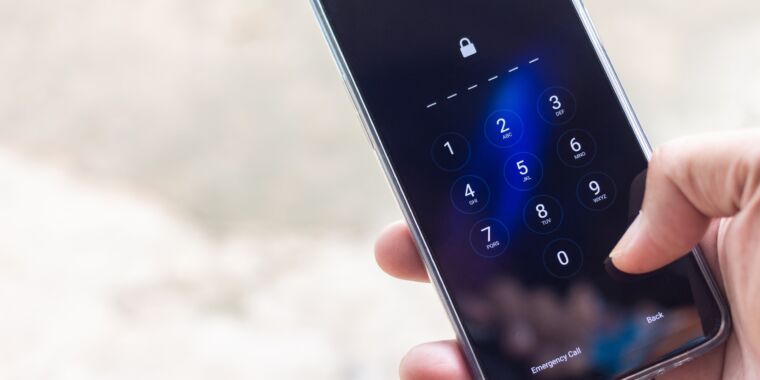
A person's hand holding a smartphone while entering the screen-lock passcode.

Getty Images | releon8211

Criminal suspects can refuse to provide phone passcodes to police under the US Constitution’s Fifth Amendment privilege against self-incrimination, according to a unanimous ruling issued today by Utah’s state Supreme Court. The questions addressed in the ruling could eventually be taken up by the US Supreme Court, whether through review of this case or a similar one.

The case involves Alfonso Valdez, who was arrested for kidnapping and assaulting his ex-girlfriend. Police officers obtained a search warrant for the contents of Valdez’s phone but couldn’t crack his passcode.

Valdez refused to provide his passcode to a police detective. At his trial, the state “elicited testimony from the detective about Valdez’s refusal to provide his passcode when asked,” today’s ruling said. “And during closing arguments, the State argued in rebuttal that Valdez’s refusal and the resulting lack of evidence from his cell phone undermined the veracity of one of his defenses. The jury convicted Valdez.”

A court of appeals reversed the conviction, agreeing “with Valdez that he had a right under the Fifth Amendment to the United States Constitution to refuse to provide his passcode, and that the State violated that right when it used his refusal against him at trial.” The Utah Supreme Court affirmed the court of appeals ruling.

Case possibly ripe for Supreme Court review

The ruling offered some commentary on the developing legal questions about device passcodes:

The prevalence of passcodes that encrypt the information on electronic devices—which are often seized by law enforcement while investigating criminal conduct—has raised important questions about how the Fifth Amendment extends to law enforcement’s efforts to unlock these devices and decrypt the contents inside. These questions have proven to be especially complex where law enforcement attempts to access the contents of a seized device by means that do not require the suspect to disclose the actual passcode—like, for example, obtaining an order to compel the suspect to provide an unlocked device.

The Valdez case does not involve an order to compel a suspect to unlock a device. Instead, “law enforcement asked Valdez to verbally provide his passcode,” Utah justices wrote. “While these circumstances involve modern technology in a scenario that the Supreme Court has not yet addressed, we conclude that these facts present a more straightforward question that is answered by settled Fifth Amendment principles.”

Ruling against the state, the Utah Supreme Court said it “agree[s] with the court of appeals that verbally providing a cell phone passcode is a testimonial communication under the Fifth Amendment.”

Berkeley Law Professor Orin Kerr wrote today that the case could head to the US Supreme Court. “One of the major issues in the law of digital evidence investigations is how the Fifth Amendment privilege against self-incrimination applies to unlocking phones,” Kerr wrote.

So far, “the lower court case law is a total mess,” according to Kerr. “No one can say what the law is. And I’ve been waiting for a case to come down that might be a good candidate for US Supreme Court review to clear up the mess.”

Suspects can refuse to provide phone passcodes to police, court rules Read More »