FCC

fcc-republican-resigns,-leaving-agency-with-just-two-commissioners

FCC Republican resigns, leaving agency with just two commissioners

Two commissioners of the Federal Communications Commission are resigning at the end of this week. For at least a little while, the FCC will have just two members: Chairman Brendan Carr, a Republican chosen by Trump to lead the agency, and Anna Gomez, a Democratic commissioner.

Democrat Geoffrey Starks announced in March that he would leave in the near future, and today he said that Friday will be his final day. Starks’ departure could have given Carr a 2-1 Republican majority, but it turns out Republican Commissioner Nathan Simington will leave at the same time as Starks.

“I will be concluding my tenure at the Federal Communications Commission at the end of this week,” Simington announced today. “It has been the greatest honor of my professional life to serve the American people as a Commissioner. I am deeply honored to have been entrusted with this responsibility by President Donald J. Trump during his first term.”

Bloomberg reported in March that Simington “has also wanted to depart to take on different work,” but he didn’t announce his resignation until today. While the Carr FCC is going from a 2-2 partisan split to a 1-1 split, Carr isn’t likely to have to wait as long for a majority as his predecessor did.

FCC Republican resigns, leaving agency with just two commissioners Read More »

fcc-chairman-celebrates-court-loss-in-case-over-biden-era-diversity-rule

FCC chairman celebrates court loss in case over Biden-era diversity rule

Federal Communications Commission Chairman Brendan Carr celebrated an FCC court loss yesterday after a ruling that struck down Biden-era diversity reporting requirements that Carr voted against while Democrats were in charge.

“An appellate court just struck down the Biden FCC’s 2024 decision to force broadcasters to post race and gender scorecards,” Carr wrote. “As I said in my dissent back then, the FCC’s 2024 decision was an unlawful effort to pressure businesses into discriminating based on race & gender.”

The FCC mandate was challenged in court by National Religious Broadcasters, a group for Christian TV and radio broadcasters and the American Family Association. They sued in the conservative-leaning US Court of Appeals for the 5th Circuit, where a three-judge panel yesterday ruled unanimously against the FCC.

The FCC order struck down by the court required broadcasters to file an annual form with race, ethnicity, and gender data for employees within specified job categories. “The Federal Communications Commission issued an order requiring most television and radio broadcasters to compile employment-demographics data and to disclose the data to the FCC, which the agency will then post on its website on a broadcaster-identifiable basis,” the 5th Circuit court said.

The FCC’s February 2024 order revived a data-collection requirement that was previously enforced from 1970 to 2001. The FCC suspended the data collection in 2001 after court rulings limiting how the commission could use the data, though the data collection itself had not been found to be unconstitutional.

FCC’s public interest authority not enough, court says

Led by then-Chairwoman Jessica Rosenworcel, the FCC last year said that reviving the data collection would serve the public interest by helping the agency “report on and analyze employment trends in the broadcast sector and also to compare trends across other sectors regulated by the Commission.”

But the FCC’s public-interest authority isn’t enough to justify the rule, the 5th Circuit judges found.

“The FCC undoubtedly has broad authority to act in the public interest,” the ruling said. “That authority, however, must be linked ‘to a distinct grant of authority’ contained in its statutes. The FCC has not shown that it is authorized to require broadcasters to file employment-demographics data or to analyze industry employment trends, so it cannot fall back on ‘public interest’ to fill the gap.”

FCC chairman celebrates court loss in case over Biden-era diversity rule Read More »

fcc-threatens-echostar-licenses-for-spectrum-that-spacex-wants-to-use

FCC threatens EchoStar licenses for spectrum that SpaceX wants to use

“If SpaceX had done a basic search of public filings, it would know that EchoStar extensively utilizes the 2 GHz band and that the Commission itself has confirmed the coverage, utilization, and methodology for assessing the quality of EchoStar’s 5G network based on independent drive-tests,” EchoStar told the FCC. “EchoStar’s deployment already reaches over 80 percent of the United States population with over 23,000 5G sites deployed.”

There is also a pending petition filed by Vermont-based VTel Wireless, which asked the FCC to reconsider a 2024 decision to extend EchoStar construction deadlines for several spectrum bands. VTel was outbid by Dish in auctions for licenses to use AWS H Block and AWS-3 bands.

“In this case, teetering on the verge of bankruptcy, EchoStar found itself unable to meet the commitments previously made to the Commission in connection with its approval of T-Mobile’s merger with Sprint—an approval predicated on EchoStar constructing a fourth nationwide 5G broadband network by June 14, 2025,” VTel wrote in its October 2024 petition. “But with no notice to or input from the public, WTB [the FCC’s Wireless Telecommunications Bureau] apparently cut a deal with EchoStar to give it yet more time to complete that network and finally put its wireless licenses to use.”

FCC seeks public input

Carr’s letter said he asked FCC staff to investigate EchoStar’s compliance with construction deadlines and “to issue a public notice seeking comment on the scope and scale of MSS [mobile satellite service] utilization in the 2 GHz band that is currently licensed to EchoStar or its affiliates.” The AWS-4 band (2000-2020 MHz and 2180-2200 MHz) was originally designated for satellite service. The FCC decided to also allow terrestrial use of the frequencies in 2012 to expand mobile broadband access.

The FCC Space Bureau announced yesterday that it is seeking comment on EchoStar’s use of the 2GHz spectrum, and the Wireless Telecommunications Bureau is seeking comment on VTel’s petition for reconsideration.

“In 2019, EchoStar’s predecessor, Dish, agreed to meet specific buildout obligations in connection with a number of spectrum licenses across several different bands,” Carr wrote. “In particular, the FCC agreed to relax some of EchoStar’s then-existing buildout obligations in exchange for EchoStar’s commitment to put its licensed spectrum to work deploying a nationwide 5G broadband network. EchoStar promised—among other things—that its network would cover, by June 14, 2025, at least 70 percent of the population within each of its licensed geographic areas for its AWS-4 and 700 MHz licenses, and at least 75 percent of the population within each of its licensed geographic areas for its H Block and 600 MHz licenses.”

FCC threatens EchoStar licenses for spectrum that SpaceX wants to use Read More »

fcc-commissioner-writes-op-ed-titled,-“it’s-time-for-trump-to-doge-the-fcc“

FCC commissioner writes op-ed titled, “It’s time for Trump to DOGE the FCC“

In addition to cutting Universal Service, Simington proposed a broad streamlining of the FCC licensing process. Manual processing of license applications “consumes vast staff hours and introduces unnecessary delay into markets that thrive on speed and innovation,” he wrote.

“For non-contentious licenses, automated workflows should be the default,” Simington argued. “By implementing intelligent review systems and processing software, the FCC could drastically reduce the time and labor involved in issuing standard licenses.”

Moving staff, deleting rules

Simington also proposed taking employees out of the FCC Media Bureau and moving them “to other offices within the FCC—such as the Space Bureau—that are grappling with staffing shortages in high-growth, high-need sectors.” Much of the Media Bureau’s “work is concentrated on regulating traditional broadcast media—specifically, over-the-air television and radio—a sector that continues to contract in relevance,” he wrote.

Simington acknowledged that cutting the Media Bureau would seem to conflict with his own proposal to regulate fees paid by local stations to broadcast networks. It might also conflict with FCC Chairman Brendan Carr’s attempts to regulate news content that he perceives as biased against Republicans. But Simington argued that the Media Bureau is “significantly overstaffed relative to its current responsibilities.”

Simington became an FCC commissioner at the end of Trump’s first term in 2020. Trump picked Simington as a replacement for Republican Michael O’Rielly, who earned Trump’s ire by opposing a crackdown on social media websites.

The FCC is currently operating with two Republicans and two Democrats, preventing any major votes that require a Republican majority. But Democratic Commissioner Geoffrey Starks said he is leaving sometime this spring, and Republican nominee Olivia Trusty is on track to be confirmed by the Senate.

The agency is likely to cut numerous regulations once there’s a Republican majority. Carr started a “Delete, Delete, Delete” proceeding that aims to eliminate as many rules as possible. Congress is also pushing FCC cost cuts, as the Senate voted to kill a Biden-era attempt to use E-Rate to subsidize Wi-Fi hotspots for schoolchildren who lack reliable Internet access to complete their homework.

FCC commissioner writes op-ed titled, “It’s time for Trump to DOGE the FCC“ Read More »

senate-passes-“cruel”-republican-plan-to-block-wi-fi-hotspots-for-schoolkids

Senate passes “cruel” Republican plan to block Wi-Fi hotspots for schoolkids

Blumenthal pointed out that under a joint resolution of disapproval, the FCC is forbidden to adopt a similar rule in the future. “I have to ask, really? Are schools and teachers crying out to repeal this rule? Really? No, they are not. How does this proposal make any sense for them or for families? For the parents? For the community? It makes no sense,” Blumenthal said.

Sen. Edward Markey (D-Mass.) called the Republican move “a cruel and shortsighted decision that will widen the digital divide and rob kids of the tools they need to succeed.”

FCC’s new chair opposed lending program

The FCC previously distributed Wi-Fi hotspots and other Internet access technology through the Emergency Connectivity Fund (ECF) that was authorized by Congress in 2021. After that program was axed last year, the FCC responded by adapting E-Rate to include hotspot lending.

FCC Chairman Brendan Carr, who was elevated to the agency’s top spot by Trump in January, voted against the program last year. Carr said in his dissent that only Congress could decide whether to revive the hotspot lending.

“Now that the ECF program has expired, its future is up to Congress,” he said at the time. “The legislative branch retains the power to decide whether to continue funding this Wi-Fi loaner program—or not. But Congress has made clear that the FCC’s authority to fund this initiative is over.”

Overall E-Rate funding is based on demand and capped at $4.94 billion per year. Actual spending for E-Rate in 2023 was $2.48 billion. E-Rate and other Universal Service Fund programs are paid for through fees imposed on phone companies, which generally pass the cost on to consumers.

The House version of the measure to kill the lending program was introduced by Rep. Russ Fulcher (R-Idaho). “E-Rate was designed to ensure schools and libraries have the connectivity they need to educate and serve their communities, not to create a backdoor entitlement program that stretches beyond the law’s clear boundaries,” Fulcher said in February when he filed the resolution. “The FCC cannot be allowed to unilaterally interpret the law in a way that fits their political agenda. The expansion of this program under the Biden administration was a blatant example of overreach that is not only unlawful but also disregards congressional intent.”

Senate passes “cruel” Republican plan to block Wi-Fi hotspots for schoolkids Read More »

fcc-urges-courts-to-ignore-5th-circuit-ruling-that-agency-can’t-issue-fines

FCC urges courts to ignore 5th Circuit ruling that agency can’t issue fines


FCC fights the 5th Circuit

One court said FCC violated right to trial, but other courts haven’t ruled yet.

Credit: Getty Images | AaronP/Bauer-Griffin

The Federal Communications Commission is urging two federal appeals courts to disregard a 5th Circuit ruling that guts the agency’s ability to issue financial penalties.

On April 17, the US Court of Appeals for the 5th Circuit granted an AT&T request to wipe out a $57 million fine for selling customer location data without consent. The conservative 5th Circuit court said the FCC “acted as prosecutor, jury, and judge,” violating AT&T’s Seventh Amendment right to a jury trial.

The ruling wasn’t a major surprise. The 5th Circuit said it was guided by the Supreme Court’s June 2024 ruling in Securities and Exchange Commission v. Jarkesy, which held that “when the SEC seeks civil penalties against a defendant for securities fraud, the Seventh Amendment entitles the defendant to a jury trial.” After the Supreme Court’s Jarkesy ruling, FCC Republican Nathan Simington vowed to vote against any fine imposed by the commission until its legal powers are clear.

Before becoming the FCC chairman, Brendan Carr voted against the fine issued to AT&T and fines for similar privacy violations simultaneously levied against T-Mobile and Verizon. Carr repeatedly opposed Biden-era efforts to regulate telecom providers and is aiming to eliminate many of the FCC’s rules now that he is in charge. But Carr has also been aggressive in regulation of media, and he doesn’t want the FCC’s ability to issue penalties completely wiped out. The Carr FCC stated its position in new briefs submitted in separate lawsuits filed by T-Mobile and Verizon.

Verizon sued the FCC in the 2nd Circuit in an attempt to overturn its privacy fine, while T-Mobile and subsidiary Sprint sued in the District of Columbia Circuit. Verizon and T-Mobile reacted to the 5th Circuit ruling by urging the other courts to rule the same way, prompting responses from the FCC last week.

“The Fifth Circuit concluded that the FCC’s enforcement proceeding leading to a monetary forfeiture order violated AT&T’s Seventh Amendment rights. This Court shouldn’t follow that decision,” the FCC told the 2nd Circuit last week.

FCC loss has wide implications

Carr’s FCC argued that the agency’s “monetary forfeiture order proceedings pose no Seventh Amendment problem because Section 504(a) [of the Communications Act] affords carriers the opportunity to demand a de novo jury trial in federal district court before the government can recover any penalty. Verizon elected to forgo that opportunity and instead sought direct appellate review.” The FCC put forth the same argument in the T-Mobile case with a filing in the District of Columbia Circuit.

There would be a circuit split if either the 2nd Circuit or DC Circuit appeals court rules in the FCC’s favor, increasing the chances that the Supreme Court will take up the case and rule directly on the FCC’s enforcement authority.

Beyond punishing telecom carriers for privacy violations, an FCC loss could prevent the commission from fining robocallers. When Carr’s FCC proposed a $4.5 million fine for an allegedly illegal robocall scheme in February, Simington repeated his objection to the FCC issuing fines of any type.

“While the conduct described in this NAL [Notice of Apparent Liability for Forfeiture] is particularly egregious and certainly worth enforcement action, I continue to believe that the Supreme Court’s decision in Jarkesy prevents me from voting, at this time, to approve this or any item purporting to impose a fine,” Simington said at the time.

5th Circuit reasoning

The 5th Circuit ruling against the FCC was issued by a panel of three judges appointed by Republican presidents. “Our analysis is governed by SEC v. Jarkesy. In that case, the Supreme Court ruled that the Seventh Amendment prohibited the SEC from requiring respondents to defend themselves before an agency, rather than a jury, against civil penalties for alleged securities fraud,” the appeals court said.

The penalty issued by the FCC is not “remedial,” the court said. The fine was punitive and not simply “meant to compensate victims whose location data was compromised. So, like the penalties in Jarkesy, the civil penalties here are ‘a type of remedy at common law that could only be enforced in courts of law.'”

The FCC argued that its enforcement proceeding fell under the “public rights” exception, unlike the private rights that must be adjudicated in court. “The Commission argues its enforcement action falls within the public rights exception because it involves common carriers,” the 5th Circuit panel said. “Given that common carriers like AT&T are ‘affected with a public interest,’ the Commission contends Congress could assign adjudication of civil penalties against them to agencies instead of courts.”

The panel disagreed, saying that “the Commission’s proposal would blow a hole in what is meant to be a narrow exception to Article III” and “empower Congress to bypass Article III adjudication in countless matters.” The panel acknowledged that “federal agencies like the Commission have long had regulatory authority over common carriers, such as when setting rates or granting licenses,” but said this doesn’t mean that “any regulatory action concerning common carriers implicates the public rights exception.”

FCC hopes lie with other courts

The 5th Circuit panel also rejected the FCC’s contention that carriers are afforded the right to a trial after the FCC enforcement proceeding. The 5th Circuit said this applies only when a carrier fails to pay a penalty and is sued by the Department of Justice. “To begin with, by the time DOJ sues (if it does), the Commission would have already adjudged a carrier guilty of violating section 222 and levied fines… in this process, which was completely in-house, the Commission acted as prosecutor, jury, and judge,” the panel said.

An entity penalized by the FCC can also ask a court of appeals to overturn the fine, as AT&T did here. But in choosing this path, the company “forgoes a jury trial,” the 5th Circuit panel said.

While Verizon and T-Mobile hope the other appeals courts will rule the same way, the FCC maintains that the 5th Circuit got it wrong. In its filing to the 2nd Circuit, the FCC challenged the 5th Circuit’s view on whether a trial after the FCC issues a fine satisfies the right to a jury trial. Pointing to an 1899 Supreme Court ruling, the FCC said that “an initial tribunal can lawfully enter judgment without a full jury trial if the law permits a subsequent ‘trial [anew] by jury, at the request of either party, in the appellate court.'”

The FCC further said the 5th Circuit relied on a precedent that doesn’t exist in either the 2nd Circuit or District of Columbia Circuit.

“The Fifth Circuit also relied on circuit precedent holding that ‘[i]n a section 504 trial, a defendant cannot challenge a forfeiture order’s legal conclusions,'” the FCC also said. “This Court, however, has never adopted such a limitation, and the Fifth Circuit’s premise is in doubt. Regardless, the proper approach would be to challenge any such limitation in the trial court and seek to strike the limitation—not to vacate the forfeiture order.”

Photo of Jon Brodkin

Jon is a Senior IT Reporter for Ars Technica. He covers the telecom industry, Federal Communications Commission rulemakings, broadband consumer affairs, court cases, and government regulation of the tech industry.

FCC urges courts to ignore 5th Circuit ruling that agency can’t issue fines Read More »

fcc-democrat-slams-chairman-for-aiding-trump’s-“campaign-of-censorship”

FCC Democrat slams chairman for aiding Trump’s “campaign of censorship”

The first event is scheduled for Thursday and will be hosted by the Center for Democracy and Technology. The events will be open to the public and livestreamed when possible, and feature various speakers on free speech, media, and telecommunications issues.

With Democrat Geoffrey Starks planning to leave the commission soon, Republicans will gain a 2–1 majority, and Gomez is set to be the only Democrat on the FCC for at least a while. Carr is meanwhile pursuing news distortion investigations into CBS and ABC, and he has threatened Comcast with a similar probe into its subsidiary NBC.

Gomez’s press release criticized Carr for these and other actions. “From investigating broadcasters for editorial decisions in their newsrooms, to harassing private companies for their fair hiring practices, to threatening tech companies that respond to consumer demand for fact-checking tools, the FCC’s actions have focused on weaponizing the agency’s authority to silence critics,” Gomez’s office said.

Gomez previously criticized Carr for reviving news distortion complaints that were dismissed shortly before Trump’s inauguration. “We cannot allow our licensing authority to be weaponized to curtail freedom of the press,” she said at the time.

FCC Democrat slams chairman for aiding Trump’s “campaign of censorship” Read More »

fcc-chairman-brendan-carr-starts-granting-telecom-lobby’s-wish-list

FCC chairman Brendan Carr starts granting telecom lobby’s wish list

In July 2024, AT&T became the first carrier to apply for a technology transition discontinuance “under the Adequate Replacement Test relying on the applicant’s own replacement service,” the order said. “AT&T indicated in this application that it was relying on a totality of the circumstances showing to establish the adequacy of its replacement service, but also committed to the performance testing methodology and parameters established in the 2016 Technology Transitions Order Technical Appendix.” This “delay[ed] the filing of its discontinuance application for several months,” the FCC said.

Harold Feld, senior VP of consumer advocacy group Public Knowledge, said the FCC clarification that carriers don’t need to perform testing, “combined with elimination of most of the remaining notice requirements, means that you don’t have to worry about actually proving anything. Just say ‘totality of the circumstances’ and by the time anyone who cares finds out, the application will be granted.”

“The one positive thing is that some states (such as California) still have carrier of last resort rules to protect consumers,” Feld told Ars. “In some states, at least, consumers will not suddenly find themselves cut off from 911 or other important services.”

Telco lobby loves FCC moves

The bureau separately approved a petition for a waiver filed last month by USTelecom, a lobby group that represents telcos such as AT&T, Verizon, and CenturyLink (aka Lumen). The group sought a waiver of a requirement that replacement voice services be offered on a stand-alone basis instead of only in a bundle with broadband.

While bundles cost more than single services for consumers who only want phone access, USTelecom said that “inefficiencies of offering stand-alone voice can raise costs for consumers and reduce capital available for investment and innovation.”

The FCC said granting the waiver will allow providers “to retire copper networks, not only in cases where replacement voice services are available on a stand-alone basis, but in cases where those services are available on a bundled basis.” The waiver is approved for two years and can be extended.

USTelecom President and CEO Jonathan Spalter praised the FCC actions in a statement. “Broadband providers appreciate Chairman Carr’s laser focus on cutting through red tape and outdated mindsets to accelerate the work of connecting all Americans,” Spalter said.

Just like Carr’s statement, Spalter did not use the word “fiber” when discussing replacements for copper service. He said vaguely that “today’s decision marks a significant step forward in transitioning outdated copper telephone lines to next-generation networks that better meet the needs of American consumers,” and “will help turbocharge investment in advanced broadband infrastructure, sustain and grow a skilled broadband workforce, bring countless new choices and services to more families and communities, and fuel our innovation economy.”

FCC chairman Brendan Carr starts granting telecom lobby’s wish list Read More »

furious-at-the-fcc,-arkansas-jail-cancels-inmate-phone-calls-rather-than-lower-rates

Furious at the FCC, Arkansas jail cancels inmate phone calls rather than lower rates

If “the Federal Communications Commission reverses their adverse regulations,” Montgomery said, “the Baxter County Sheriff’s Office will revisit the feasibility of reimplementing the inmate phone system.”

One might expect this view to generate some sympathy in the MAGA-fied halls of FCC HQ. But the Commission’s two Republicans actually voted in favor of the rate control order last year. Current FCC Chair Brendan Carr even agreed that inmate phone calls in American prisons were often “excessive” and that the private operators behind these systems represented a “market failure.” He then voted for straight-up, old-school price caps.

In fact, Carr went on to offer a robust defense of inmate calling, saying: “[I often] heard from families who experienced firsthand the difficulties of maintaining contact with their incarcerated loved ones. I also heard from formerly incarcerated individuals who underscored the decline in mental and emotional health that can result from a lack of external communications. Beyond that, studies have repeatedly shown that increased communication between incarcerated people and their families, friends, and other outside resources helps reduce recidivism rates.”

So Montgomery may not get this decision reversed easily. (On the other hand, Carr did just launch a “Delete! Delete! Delete!” initiative focused on cutting regulations, so who knows.)

Baxter County claims that the FCC decision means that phone services are no longer “feasible.” In 2018, however, when Baxter County wanted to expand its jail and didn’t have the cash, officials found a way to make it feasible by asking voters to approve a 1-cent sales tax collected between April and September of that year. (You can even watch a time-lapse video of the jail expansion being built.) Feasibility, it turns out, is often in the eye of the beholder.

Montgomery did say that he would add some additional in-person visiting hours at the jail to compensate for the lack of phone calls, and last week his office posted the new schedule. But as positive as in-person contact can be, in a busy world it is still nice to have the option of a reasonably priced phone call—you know, the kind that’s “feasible” to offer at most other jails in the US.

Furious at the FCC, Arkansas jail cancels inmate phone calls rather than lower rates Read More »

commercials-are-still-too-loud,-say-“thousands”-of-recent-fcc-complaints

Commercials are still too loud, say “thousands” of recent FCC complaints

Streaming ads could get muzzled, too

As you may have noticed—either through the text of this article or your own ears—The Calm Act doesn’t apply to streaming services. And because The Calm Act doesn’t affect commercials viewed on the Internet, online services providing access to broadcast channels, like YouTube TV and Sling, don’t have to follow the rules. This is despite such services distributing the same content as linear TV providers.

For years, this made sense. The majority of TV viewing occurred through broadcast, cable, or satellite access. Further, services like Netflix and Amazon Prime Video used to be considered safe havens from constant advertisements. But today, streaming services are more popular than ever and have grown to love ads, which have become critical to most platforms’ business models. Further, many streaming services are airing more live events. These events, like sports games, show commercials to all subscribers, even those with a so-called “ad-free” subscription.

Separate from the Calm Act violation complaints, the FCC noted this month that other recent complaints it has seen illustrate “growing concern with the loudness of commercials on streaming services and other online platforms.” If the FCC decides to apply Calm Act rules to the web, it would need to create new methods for ensuring compliance, it said.

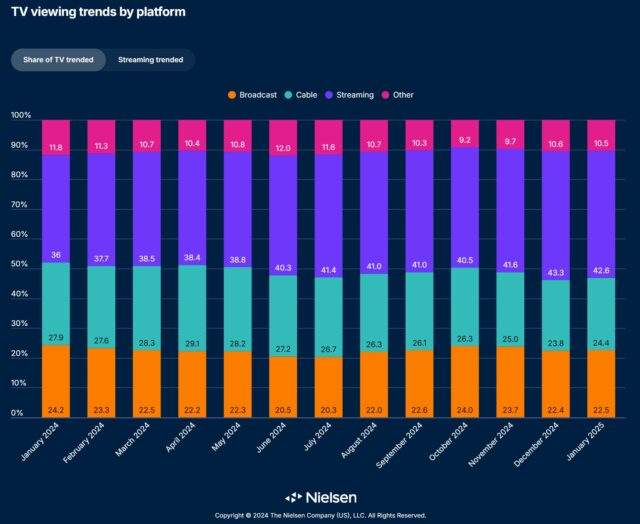
TV viewing trends by platform bar graph by Nielsen.

Nielsen’s most recent data on how people watch TV. Credit: Nielsen

The FCC didn’t specify what’s behind the spike in consumers’ commercial complaints. Perhaps with declining audiences, traditional TV providers thought it would be less likely for anyone to notice and formally complain about Ozempic ads shouting at them. Twelve years have passed since the rules took effect, so it’s also possible that organizations are getting lackadaisical about ensuring compliance or have dwindling resources.

With Americans spending similar amounts of time—if not longer—watching TV online versus via broadcast, cable, and satellite, The Calm Act would have to take on the web in order to maximize effectiveness. The streaming industry is young, though, and operates differently than linear TV distribution, presenting new regulation challenges.

Commercials are still too loud, say “thousands” of recent FCC complaints Read More »

deepseek-is-“tiktok-on-steroids,”-senator-warns-amid-push-for-government-wide-ban

DeepSeek is “TikTok on steroids,” senator warns amid push for government-wide ban

But while the national security concerns require a solution, Curtis said his priority is maintaining “a really productive relationship with China.” He pushed Lutnick to address how he plans to hold DeepSeek—and the CCP in general—accountable for national security concerns amid ongoing tensions with China.

Lutnick suggested that if he is confirmed (which appears likely), he will pursue a policy of “reciprocity,” where China can “expect to be treated by” the US exactly how China treats the US. Currently, China is treating the US “horribly,” Lutnick said, and his “first step” as Commerce Secretary will be to “repeat endlessly” that more “reciprocity” is expected from China.

But while Lutnick answered Curtis’ questions about DeepSeek somewhat head-on, he did not have time to respond to Curtis’ inquiry about Lutnick’s intentions for the US AI Safety Institute (AISI)—which Lutnick’s department would oversee and which could be essential to the US staying ahead of China in AI development.

Viewing AISI as key to US global leadership in AI, Curtis offered “tools” to help Lutnick give the AISI “new legs” or a “new life” to ensure that the US remains responsibly ahead of China in the AI race. But Curtis ran out of time to press Lutnick for a response.

It remains unclear how AISI’s work might change under Trump, who revoked Joe Biden’s AI safety rules establishing the AISI.

What is clear is that lawmakers are being pressed to preserve and even evolve the AISI.

Yesterday, the chief economist for a nonprofit called the Foundation for the American Innovation, Samuel Hammond, provided written testimony to the US House Science, Space, and Technology Committee, recommending that AISI be “retooled to perform voluntary audits of AI models—both open and closed—to certify their security and reliability” and to keep America at the forefront of AI development.

“With so little separating China and America’s frontier AI capabilities on a technical level, America’s lead in AI is only as strong as our lead in computing infrastructure,” Hammond said. And “as the founding member of a consortium of 280 similar AI institutes internationally, the AISI seal of approval would thus support the export and diffusion of American AI models worldwide.”

DeepSeek is “TikTok on steroids,” senator warns amid push for government-wide ban Read More »

robocallers-posing-as-fcc-staff-blocked-after-robocalling-real-fcc-staff

Robocallers posing as FCC staff blocked after robocalling real FCC staff


A not-very-successful robocall scheme

You can ignore robocalls from FCC “Fraud Prevention Team,” which doesn’t exist.

Credit: Getty Images | PhonlamaiPhoto

Robocallers posing as employees of the Federal Communications Commission made the mistake of trying to scam real employees of the FCC, the FCC announced yesterday. “On the night of February 6, 2024, and continuing into the morning of February 7, 2024, over a dozen FCC staff and some of their family members reported receiving calls on their personal and work telephone numbers,” the FCC said.

The calls used an artificial voice that said, “Hello [first name of recipient] you are receiving an automated call from the Federal Communications Commission notifying you the Fraud Prevention Team would like to speak with you. If you are available to speak now please press one. If you prefer to schedule a call back please press two.”

You may not be surprised to learn that the FCC does not have any “Fraud Prevention Team” like the one mentioned in the robocalls, and especially not one that demands Google gift cards in lieu of jail time.

“The FCC’s Enforcement Bureau believes the purpose of the calls was to threaten, intimidate, and defraud,” the agency said. “One recipient of an imposter call reported that they were ultimately connected to someone who ‘demand[ed] that [they] pay the FCC $1,000 in Google gift cards to avoid jail time for [their] crimes against the state.'”

The FCC said it does not “publish or otherwise share staff personal phone numbers” and that it “remains unclear how these individuals were targeted.” Obviously, robocallers posing as FCC employees probably wouldn’t intentionally place scam calls to real FCC employees. But FCC employees are just as likely to get robocalls as anyone else. This set of schemers apparently only made about 1,800 calls before their calling accounts were terminated.

The FCC described the scheme yesterday when it announced a proposed fine of $4,492,500 against Telnyx, the voice service provider accused of carrying the robocalls. The FCC alleges that Telnyx violated “Know Your Customer (KYC)” rules by providing access to calling services without verifying the customers’ identities. When contacted by Ars today, Telnyx denied the FCC’s allegations and said it will contest the proposed fine.

The “MarioCop” accounts

The robocalling scheme lasted two days. On February 6, 2024, Telnyx accepted two new customers calling themselves Christian Mitchell and Henry Walker, who provided street addresses in Toronto and email addresses with the domain name “mariocop123.com.” The robocallers apparently used fake identities and paid for Telnyx service in Bitcoin.

The Telnyx customers who placed the robocalls are referred to as “MarioCop accounts” in the FCC’s Notice of Apparent Liability for Forfeiture (NAL) issued against Telnyx. Telnyx flagged one of the accounts in the course of its “routine examination of new users” and terminated the account on February 7 after determining the calls violated its terms and conditions and acceptable use policy. Telnyx also reported the account to the FCC.

Telnyx is based in Chicago. It offers a service that lets callers “build a custom AI voice bot” and a voice API that “makes it simple to make, receive and control voice calls with code.” Telnyx is also a VoIP provider that says it “holds carrier status in 30+ countries around the world” and offers “local calling in over 80 countries and PSTN [Public Switched Telephone Network] replacement in 45+ markets.”

The FCC subpoenaed Telnyx for information about the calls, and the resulting records showed that one MarioCop account placed 1,029 calls between February 6 and February 7. The other account placed 768 calls on February 6.

The FCC also subpoenaed Telnyx for information that might identify the callers and “determined that the very limited identifying information Telnyx collected from its customers was false.” They used physical addresses in Canada, including one that turned out to be a Sheraton hotel, and IP addresses from Scotland and England.

“The @mariocop123.com domain is not associated with any known business; a website using the same domain was created in February 2024 and remains undeveloped,” the FCC said. The FCC notes that both MarioCop accounts may have been operated by the same person.

FCC: Telcos must know their customers

Telnyx “accepted the names and physical addresses at face value, without any further requests for corroboration or independent verification,” the FCC forfeiture order said. Neither applicant provided a telephone number.

The FCC alleged that Telnyx didn’t do enough “to discern whether the limited amount of identifying information its customer provided was legitimate and it overlooked obvious discrepancies in the information it collected… Becoming Telynyx’s customer and gaining access to outbound calling services that allowed origination of hundreds of calls (more than 1,000 calls from the First MarioCop Account) was as simple as making up a fake name and address and acquiring a non-free email address.”

The FCC notice continued:

Our rules require Telnyx to know its customers. Yet it did not know who the MarioCop Account holders were. We therefore conclude that Telnyx apparently violated section 64.1200(n)(4) of our rules by allowing the First MarioCop Account and the Second MarioCop Account access to outbound calling services without actually knowing the true identities of the account holders. By extension, we believe we could likely find that Telnyx apparently violated our rules with regards to every customer it onboarded using the same process as it did for the MarioCop Accounts. We decline to do so here absent further investigation.

Telnyx will have an opportunity to respond to the allegations and argue that it shouldn’t be fined. In some cases, the FCC and the telecom reach a settlement for a lower amount.

Telnyx CEO David Casem told Ars today that “Telnyx is surprised by the FCC’s mistaken decision to issue a Notice of Apparent Liability stating an intent to impose monetary penalties. The Notice of Apparent Liability is factually mistaken, and Telnyx denies its allegations. Telnyx has done everything and more than the FCC has required for Know-Your-Customer (‘KYC’) and customer due diligence procedures.”

We also sent a message to the email addresses used by the MarioCop accounts and will update this article in the unlikely event that we receive a response.

Telnyx defends response, citing quick shutdown

Casem said the FCC hasn’t previously demanded “perfection” in stopping illegal traffic. “Since bad actors continuously find ways to avoid detection, the FCC has historically expected providers to take reasonable steps to detect and block them,” he told Ars. “Yet the FCC now seeks to impose substantial monetary penalties on Telnyx for limited unlawful calling activity that Telnyx not only did not originate but swiftly blocked within a matter of hours.”

Casem said that “there has been no allegation of subsequent recurring activity” and urged the FCC to “reconsider what can only be viewed as an improper effort to impose an unprecedented zero-tolerance requirement on providers through enforcement action, in the absence of any defined rules informing providers what is expected of them.”

FCC Chairman Brendan Carr said in yesterday’s announcement that he is pleased with the “bipartisan vote in favor of this nearly $4.5 million proposed fine” and that it “continues the FCC’s longstanding work to stop bad actors.”

Anna Gomez, a Democratic member of the FCC, said that Carr’s office accepted her request for a change designed to encourage telecoms to report potential violations to the FCC. “It is important that service providers work quickly and closely with the FCC to identify and stop illegal traffic before it makes its way to consumers. I value self-reporting from industry actors on potential violations of our rules, and I am grateful the Office of Chairman Carr accepted our edits to this NAL to encourage self-reporting,” Gomez said.

There was a dissenting vote from Republican Commissioner Nathan Simington, but not because of the facts specific to this case. Because of a recent Supreme Court ruling limiting the power of federal agencies, Simington has vowed to vote against any fine imposed by the commission until its legal powers are clear.

“While the conduct described in this NAL is particularly egregious and certainly worth enforcement action, I continue to believe that the Supreme Court’s decision in Jarkesy prevents me from voting, at this time, to approve this or any item purporting to impose a fine,” Simington said.

Photo of Jon Brodkin

Jon is a Senior IT Reporter for Ars Technica. He covers the telecom industry, Federal Communications Commission rulemakings, broadband consumer affairs, court cases, and government regulation of the tech industry.

Robocallers posing as FCC staff blocked after robocalling real FCC staff Read More »